Presentation
Save Enegry toSave Enegry toSave Enegry toSave Enegry to LLLLeeeeaaaadddd
the world better !the world better !the world better !the world better !
1
the world better !the world better !the world better !the world better !
DUNIA-LED
Ruko Market Place PR-1 No. 09
Grand Wisata Bekasi - Jawa Barat
Phone. +62 87880806072 Fax. 021-29080079
Email : Bachtiar@dunia-led.com
Website : www.dunia-led.com
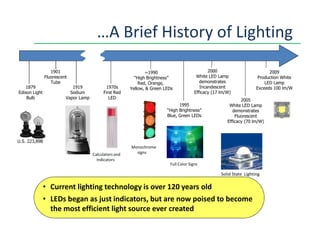
…A Brief History of Lighting
1879
Edison Light
Bulb
1901
Fluorescent
Tube
1919
Sodium
Vapor Lamp
1970s
First Red
LED
~1990
“High Brightness”
Red, Orange,
Yellow, & Green LEDs
1995
“High Brightness”
Blue, Green LEDs
2000
White LED Lamp
demonstrates
Incandescent
Efficacy (17 lm/W)
2005
White LED Lamp
demonstrates
Fluorescent
Efficacy (70 lm/W)
2009
Production White
LED Lamp
Exceeds 100 lm/W
U.S. 223,898
Efficacy (70 lm/W)
• Current lighting technology is over 120 years old
• LEDs began as just indicators, but are now poised to become
the most efficient light source ever created
Calculators and
Indicators
Monochrome
signs
Full Color Signs
Solid State Lighting
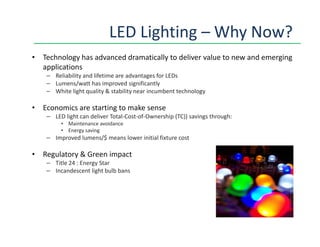
LED Lighting – Why Now?
• Technology has advanced dramatically to deliver value to new and emerging
applications
– Reliability and lifetime are advantages for LEDs
– Lumens/watt has improved significantly
– White light quality & stability near incumbent technology
• Economics are starting to make sense
– LED light can deliver Total-Cost-of-Ownership (TC)) savings through:
• Maintenance avoidance• Maintenance avoidance
• Energy saving
– Improved lumens/$ means lower initial fixture cost
• Regulatory & Green impact
– Title 24 : Energy Star
– Incandescent light bulb bans
Basic Advantages of LED Light
• Advance technology semiconductor base, work with solar
• Energy efficient 140 LPW (still improving)
• Directional No wasted light
• Long Lifetime > 50,000 hours to 70% LM
• Rugged No filament to break
• Start instantly nanoseconds vs. minutes (HID)
• Enviromentally sound no Hg, Pb, heavy metals
• Low temperature comfortable, warm not hot
• Dimmable, controllable New lighting features, power savings
• Love cold temperature No cold starting issues
LEDs can replace any incumbent lighting technology
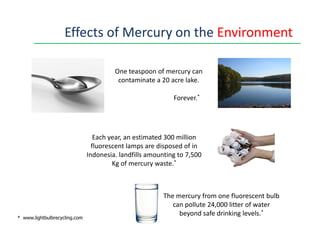
One teaspoon of mercury can
contaminate a 20 acre lake.
.
Effects of Mercury on the Environment
Forever.*
* www.lightbulbrecycling.com
Each year, an estimated 300 million
fluorescent lamps are disposed of in
Indonesia. landfills amounting to 7,500
Kg of mercury waste.*
The mercury from one fluorescent bulb
can pollute 24,000 litter of water
beyond safe drinking levels.*
Disadvantages of LED Light
New Technology
no standard, lack of knowledge, high expectation
Expensive
price gap with conventional is big
Technology LeapTechnology Leap
race on LPW, and other things
Color Rendering Index
less than Halogen or incandescent, different RGB peaks
Heat Control
limit its application on certain area (explosion, hot area,
etc)
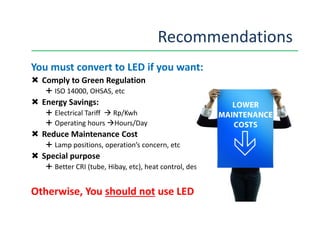
Recommendations
You must convert to LED if you want:
Comply to Green Regulation
ISO 14000, OHSAS, etc
Energy Savings:
Electrical Tariff Rp/Kwh
Operating hours Hours/DayOperating hours Hours/Day
Reduce Maintenance Cost
Lamp positions, operation’s concern, etc
Special purpose
Better CRI (tube, Hibay, etc), heat control, design, etc
Otherwise, You should not use LED
LED
manufacturing
LED
manufacturingmanufacturingmanufacturing
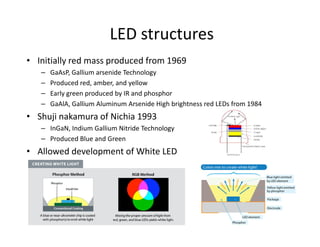
LED structures
• Initially red mass produced from 1969
– GaAsP, Gallium arsenide Technology
– Produced red, amber, and yellow
– Early green produced by IR and phosphor
– GaAlA, Gallium Aluminum Arsenide High brightness red LEDs from 1984
• Shuji nakamura of Nichia 1993
– InGaN, Indium Gallium Nitride Technology
– Produced Blue and Green
• Allowed development of White LED
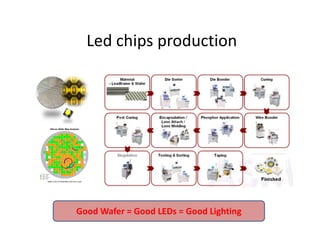
Led chips production
Good Wafer = Good LEDs = Good Lighting
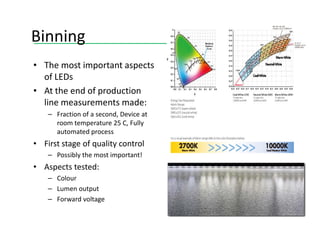
Binning
• The most important aspects
of LEDs
• At the end of production
line measurements made:
– Fraction of a second, Device at
room temperature 25 C, Fullyroom temperature 25 C, Fully
automated process
• First stage of quality control
– Possibly the most important!
• Aspects tested:
– Colour
– Lumen output
– Forward voltage
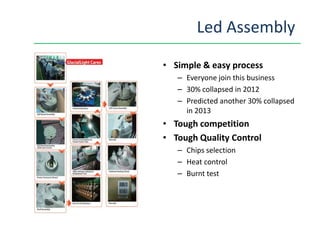
Led Assembly
• Simple & easy process
– Everyone join this business
– 30% collapsed in 2012
– Predicted another 30% collapsed
in 2013
• Tough competition• Tough competition
• Tough Quality Control
– Chips selection
– Heat control
– Burnt test
LED
know how
LED
know howknow howknow how
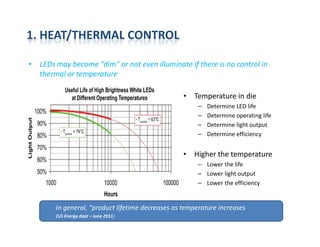
• Temperature in die
– Determine LED life
– Determine operating life
– Determine light output
• LEDs may become “dim” or not even illuminate if there is no control in
thermal or temperature
1. HEAT/THERMAL CONTROL
– Determine light output
– Determine efficiency
• Higher the temperature
– Lower the life
– Lower light output
– Lower the efficiency
In general, “product lifetime decreases as temperature increases
(US Energy dept – June 2011)
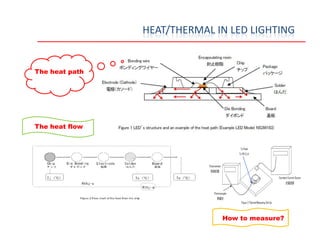
The heat path
The heat flow
HEAT/THERMAL IN LED LIGHTING
The heat flow
How to measure?
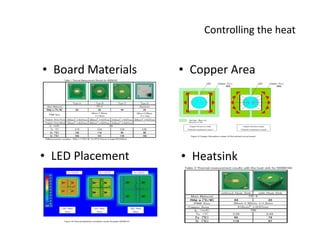
Controlling the heat
• Board Materials • Copper Area
• LED Placement • Heatsink
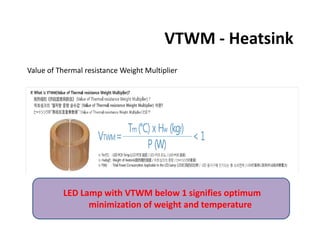
VTWM - Heatsink
Value of Thermal resistance Weight Multiplier
LED Lamp with VTWM below 1 signifies optimum
minimization of weight and temperature
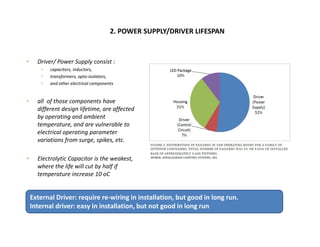
2. POWER SUPPLY/DRIVER LIFESPAN
• Driver/ Power Supply consist :
• capacitors, inductors,
• transformers, opto-isolators,
• and other electrical components
• all of those components have
different design lifetime, are affected
by operating and ambient
temperature, and are vulnerable totemperature, and are vulnerable to
electrical operating parameter
variations from surge, spikes, etc.
• Electrolytic Capacitor is the weakest,
where the life will cut by half if
temperature increase 10 oC
External Driver: require re-wiring in installation, but good in long run.
Internal driver: easy in installation, but not good in long run
Driver Selection
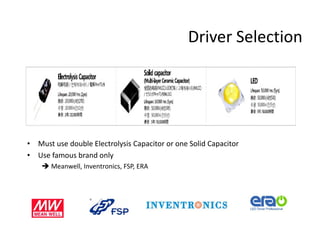
• Must use double Electrolysis Capacitor or one Solid Capacitor
• Use famous brand only
Meanwell, Inventronics, FSP, ERA
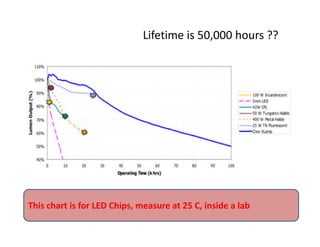
Lifetime is 50,000 hours ??
This chart is for LED Chips, measure at 25 C, inside a lab
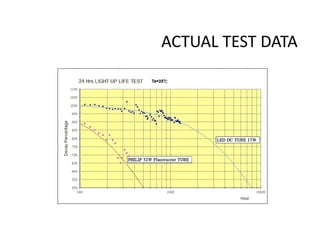
ACTUAL TEST DATA
3. Current APPLIED
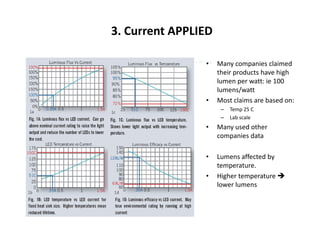
• Many companies claimed
their products have high
lumen per watt: ie 100
lumens/watt
• Most claims are based on:
– Temp 25 C
– Lab scale
• Many used other• Many used other
companies data
• Lumens affected by
temperature.
• Higher temperature
lower lumens
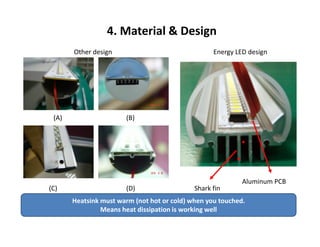
Other design Energy LED design
(A) (B)
4. Material & Design
(C) (D) Shark fin
Aluminum PCB
Heatsink must warm (not hot or cold) when you touched.
Means heat dissipation is working well
PC/glass cover
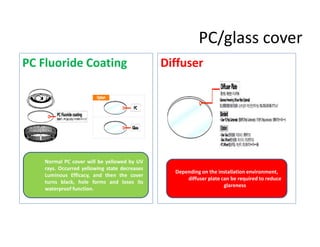
PC Fluoride Coating Diffuser
Normal PC cover will be yellowed by UV
rays. Occurred yellowing state decreases
Luminous Efficacy, and then the cover
turns black, hole forms and loses its
waterproof function.
Depending on the installation environment,
diffuser plate can be required to reduce
glareness
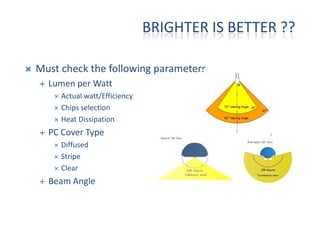
Must check the following parameters
Lumen per Watt
Actual watt/Efficiency
Chips selection
Heat Dissipation
BRIGHTER IS BETTER ??
Heat Dissipation
PC Cover Type
Diffused
Stripe
Clear
Beam Angle
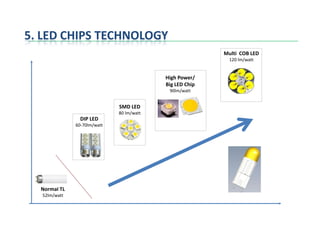
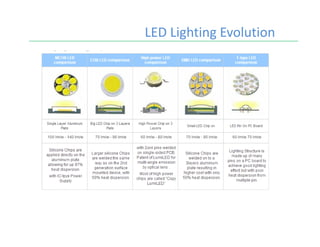
DIP LED
60-70lm/watt
SMD LED
80 lm/watt
High Power/
Big LED Chip
90lm/watt
Multi COB LED
120 lm/watt
5. LED CHIPS TECHNOLOGY
60-70lm/watt
Normal TL
52lm/watt
LED Lighting Evolution
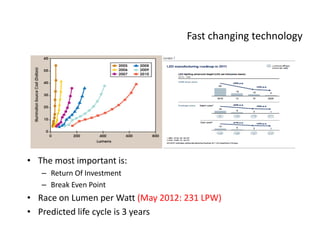
Fast changing technology
• The most important is:
– Return Of Investment
– Break Even Point
• Race on Lumen per Watt (May 2012: 231 LPW)
• Predicted life cycle is 3 years
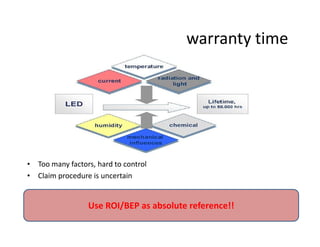
warranty time
• Too many factors, hard to control
• Claim procedure is uncertain
Use ROI/BEP as absolute reference!!
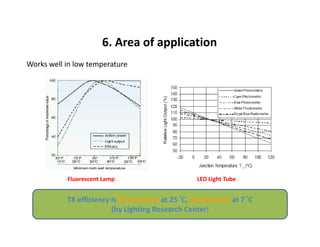
6. Area of application
Works well in low temperature
T8 efficiency is 90 lumen/w at 25 °°°°C, 40 lumen/w at 7 °°°°C
(by Lighting Research Center)
Fluorescent Lamp LED Light Tube
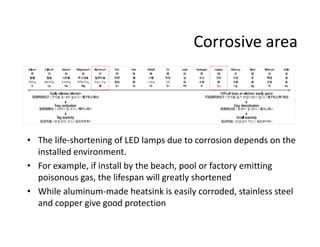
Corrosive area
• The life-shortening of LED lamps due to corrosion depends on the
installed environment.
• For example, if install by the beach, pool or factory emitting
poisonous gas, the lifespan will greatly shortened
• While aluminum-made heatsink is easily corroded, stainless steel
and copper give good protection
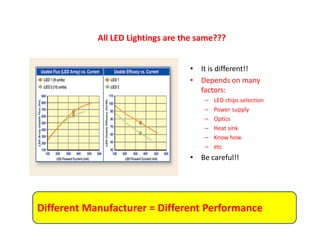
All LED Lightings are the same???
• It is different!!
• Depends on many
factors:
– LED chips selection
– Power supply
– Optics
– Heat sink
– Know how
– etc
• Be careful!!
Different Manufacturer = Different Performance
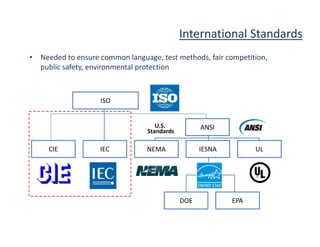
International Standards
• Needed to ensure common language, test methods, fair competition,
public safety, environmental protection
ISO
ANSIU.S.
CIE IEC NEMA IESNA UL
ANSI
DOE EPA
U.S.
Standards
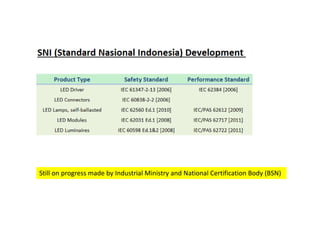
Still on progress made by Industrial Ministry and National Certification Body (BSN)
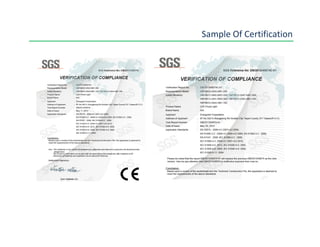
Sample Of Certification

Dunia led presentation 2014

  • 1.
    Presentation Save Enegry toSaveEnegry toSave Enegry toSave Enegry to LLLLeeeeaaaadddd the world better !the world better !the world better !the world better ! 1 the world better !the world better !the world better !the world better ! DUNIA-LED Ruko Market Place PR-1 No. 09 Grand Wisata Bekasi - Jawa Barat Phone. +62 87880806072 Fax. 021-29080079 Email : Bachtiar@dunia-led.com Website : www.dunia-led.com
  • 2.
    …A Brief Historyof Lighting 1879 Edison Light Bulb 1901 Fluorescent Tube 1919 Sodium Vapor Lamp 1970s First Red LED ~1990 “High Brightness” Red, Orange, Yellow, & Green LEDs 1995 “High Brightness” Blue, Green LEDs 2000 White LED Lamp demonstrates Incandescent Efficacy (17 lm/W) 2005 White LED Lamp demonstrates Fluorescent Efficacy (70 lm/W) 2009 Production White LED Lamp Exceeds 100 lm/W U.S. 223,898 Efficacy (70 lm/W) • Current lighting technology is over 120 years old • LEDs began as just indicators, but are now poised to become the most efficient light source ever created Calculators and Indicators Monochrome signs Full Color Signs Solid State Lighting
  • 3.
    LED Lighting –Why Now? • Technology has advanced dramatically to deliver value to new and emerging applications – Reliability and lifetime are advantages for LEDs – Lumens/watt has improved significantly – White light quality & stability near incumbent technology • Economics are starting to make sense – LED light can deliver Total-Cost-of-Ownership (TC)) savings through: • Maintenance avoidance• Maintenance avoidance • Energy saving – Improved lumens/$ means lower initial fixture cost • Regulatory & Green impact – Title 24 : Energy Star – Incandescent light bulb bans
  • 4.
    Basic Advantages ofLED Light • Advance technology semiconductor base, work with solar • Energy efficient 140 LPW (still improving) • Directional No wasted light • Long Lifetime > 50,000 hours to 70% LM • Rugged No filament to break • Start instantly nanoseconds vs. minutes (HID) • Enviromentally sound no Hg, Pb, heavy metals • Low temperature comfortable, warm not hot • Dimmable, controllable New lighting features, power savings • Love cold temperature No cold starting issues LEDs can replace any incumbent lighting technology
  • 7.
    One teaspoon ofmercury can contaminate a 20 acre lake. . Effects of Mercury on the Environment Forever.* * www.lightbulbrecycling.com Each year, an estimated 300 million fluorescent lamps are disposed of in Indonesia. landfills amounting to 7,500 Kg of mercury waste.* The mercury from one fluorescent bulb can pollute 24,000 litter of water beyond safe drinking levels.*
  • 8.
    Disadvantages of LEDLight New Technology no standard, lack of knowledge, high expectation Expensive price gap with conventional is big Technology LeapTechnology Leap race on LPW, and other things Color Rendering Index less than Halogen or incandescent, different RGB peaks Heat Control limit its application on certain area (explosion, hot area, etc)
  • 9.
    Recommendations You must convertto LED if you want: Comply to Green Regulation ISO 14000, OHSAS, etc Energy Savings: Electrical Tariff Rp/Kwh Operating hours Hours/DayOperating hours Hours/Day Reduce Maintenance Cost Lamp positions, operation’s concern, etc Special purpose Better CRI (tube, Hibay, etc), heat control, design, etc Otherwise, You should not use LED
  • 10.
  • 11.
    LED structures • Initiallyred mass produced from 1969 – GaAsP, Gallium arsenide Technology – Produced red, amber, and yellow – Early green produced by IR and phosphor – GaAlA, Gallium Aluminum Arsenide High brightness red LEDs from 1984 • Shuji nakamura of Nichia 1993 – InGaN, Indium Gallium Nitride Technology – Produced Blue and Green • Allowed development of White LED
  • 12.
    Led chips production GoodWafer = Good LEDs = Good Lighting
  • 13.
    Binning • The mostimportant aspects of LEDs • At the end of production line measurements made: – Fraction of a second, Device at room temperature 25 C, Fullyroom temperature 25 C, Fully automated process • First stage of quality control – Possibly the most important! • Aspects tested: – Colour – Lumen output – Forward voltage
  • 14.
    Led Assembly • Simple& easy process – Everyone join this business – 30% collapsed in 2012 – Predicted another 30% collapsed in 2013 • Tough competition• Tough competition • Tough Quality Control – Chips selection – Heat control – Burnt test
  • 15.
  • 16.
    • Temperature indie – Determine LED life – Determine operating life – Determine light output • LEDs may become “dim” or not even illuminate if there is no control in thermal or temperature 1. HEAT/THERMAL CONTROL – Determine light output – Determine efficiency • Higher the temperature – Lower the life – Lower light output – Lower the efficiency In general, “product lifetime decreases as temperature increases (US Energy dept – June 2011)
  • 17.
    The heat path Theheat flow HEAT/THERMAL IN LED LIGHTING The heat flow How to measure?
  • 18.
    Controlling the heat •Board Materials • Copper Area • LED Placement • Heatsink
  • 19.
    VTWM - Heatsink Valueof Thermal resistance Weight Multiplier LED Lamp with VTWM below 1 signifies optimum minimization of weight and temperature
  • 20.
    2. POWER SUPPLY/DRIVERLIFESPAN • Driver/ Power Supply consist : • capacitors, inductors, • transformers, opto-isolators, • and other electrical components • all of those components have different design lifetime, are affected by operating and ambient temperature, and are vulnerable totemperature, and are vulnerable to electrical operating parameter variations from surge, spikes, etc. • Electrolytic Capacitor is the weakest, where the life will cut by half if temperature increase 10 oC External Driver: require re-wiring in installation, but good in long run. Internal driver: easy in installation, but not good in long run
  • 21.
    Driver Selection • Mustuse double Electrolysis Capacitor or one Solid Capacitor • Use famous brand only Meanwell, Inventronics, FSP, ERA
  • 22.
    Lifetime is 50,000hours ?? This chart is for LED Chips, measure at 25 C, inside a lab
  • 23.
  • 24.
    3. Current APPLIED •Many companies claimed their products have high lumen per watt: ie 100 lumens/watt • Most claims are based on: – Temp 25 C – Lab scale • Many used other• Many used other companies data • Lumens affected by temperature. • Higher temperature lower lumens
  • 25.
    Other design EnergyLED design (A) (B) 4. Material & Design (C) (D) Shark fin Aluminum PCB Heatsink must warm (not hot or cold) when you touched. Means heat dissipation is working well
  • 26.
    PC/glass cover PC FluorideCoating Diffuser Normal PC cover will be yellowed by UV rays. Occurred yellowing state decreases Luminous Efficacy, and then the cover turns black, hole forms and loses its waterproof function. Depending on the installation environment, diffuser plate can be required to reduce glareness
  • 27.
    Must check thefollowing parameters Lumen per Watt Actual watt/Efficiency Chips selection Heat Dissipation BRIGHTER IS BETTER ?? Heat Dissipation PC Cover Type Diffused Stripe Clear Beam Angle
  • 28.
    DIP LED 60-70lm/watt SMD LED 80lm/watt High Power/ Big LED Chip 90lm/watt Multi COB LED 120 lm/watt 5. LED CHIPS TECHNOLOGY 60-70lm/watt Normal TL 52lm/watt
  • 29.
  • 30.
    Fast changing technology •The most important is: – Return Of Investment – Break Even Point • Race on Lumen per Watt (May 2012: 231 LPW) • Predicted life cycle is 3 years
  • 31.
    warranty time • Toomany factors, hard to control • Claim procedure is uncertain Use ROI/BEP as absolute reference!!
  • 32.
    6. Area ofapplication Works well in low temperature T8 efficiency is 90 lumen/w at 25 °°°°C, 40 lumen/w at 7 °°°°C (by Lighting Research Center) Fluorescent Lamp LED Light Tube
  • 33.
    Corrosive area • Thelife-shortening of LED lamps due to corrosion depends on the installed environment. • For example, if install by the beach, pool or factory emitting poisonous gas, the lifespan will greatly shortened • While aluminum-made heatsink is easily corroded, stainless steel and copper give good protection
  • 34.
    All LED Lightingsare the same??? • It is different!! • Depends on many factors: – LED chips selection – Power supply – Optics – Heat sink – Know how – etc • Be careful!! Different Manufacturer = Different Performance
  • 40.
    International Standards • Neededto ensure common language, test methods, fair competition, public safety, environmental protection ISO ANSIU.S. CIE IEC NEMA IESNA UL ANSI DOE EPA U.S. Standards
  • 41.
    Still on progressmade by Industrial Ministry and National Certification Body (BSN)
  • 42.