Functional areas within business
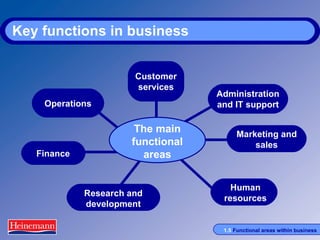
Key functions in business  Operations Finance Research and development Human resources Marketing and sales Administration and IT support Customer services The main functional areas
Delivering key functions In a small business, will be done by individuals In a medium/large business, will be done by individuals working in   functional  areas or  departments
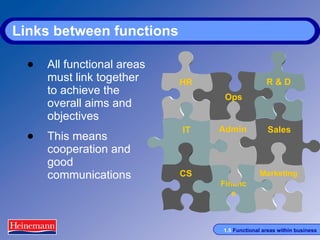
Links between functions  All functional areas must link together to achieve the overall aims and objectives This means cooperation and good communications Sales Finance Marketing Admin IT CS Ops R & D HR
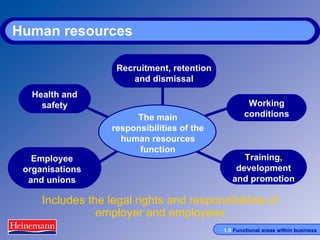
Human resources Includes the legal rights and responsibilities of employer and employees Health and safety Employee organisations and unions Training, development and promotion Working conditions Recruitment, retention and dismissal The main responsibilities of the human resources function
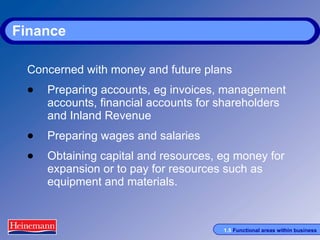
Finance Concerned with money and future plans Preparing accounts, eg invoices, management accounts, financial accounts for shareholders and Inland Revenue Preparing wages and salaries Obtaining capital and resources, eg money for expansion or to pay for resources such as equipment and materials.
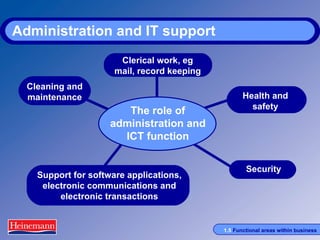
Administration and IT support Cleaning and maintenance Support for software applications, electronic communications and electronic transactions Security Health and safety Clerical work, eg mail, record keeping The role of administration and ICT function
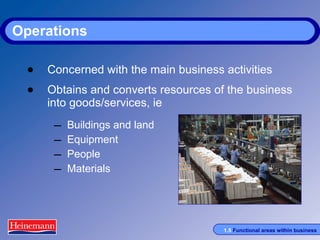
Operations Concerned with the main business activities Obtains and converts resources of the business into goods/services, ie Buildings and land Equipment People Materials
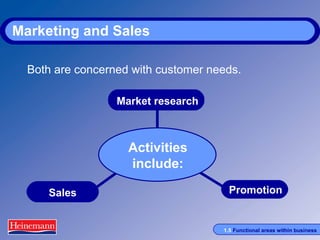
Marketing and Sales Both are concerned with customer needs. Sales Promotion Market research Activities include:
Customer service Concerned with customer relationships Activities include: Providing information Giving advice Providing credit facilities Delivering goods Providing after-sales service
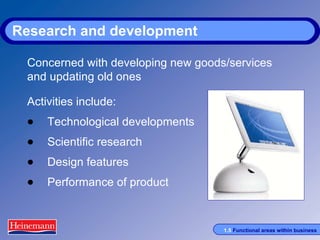
Research and development Activities include: Technological developments Scientific research Design features Performance of product Concerned with developing new goods/services and updating old ones
The use of IT Relates to all functional areas: Electronic communications (eg email) Data sharing (eg databases) Security systems (eg virus protection) External communications (eg Internet) Online support for customers (eg order tracking) Electronic transactions (eg EFT)
Functional variations No two businesses are the same! Functions will vary because of: Size and scale of business Activities of business Type(s) of customers Needs of customers Preferences of owner(s)
Investigating functional areas Identify key functions Find out where these carried out (or by whom) Check names of key areas/departments Identify links between functions/areas Identify use of IT within/between functions and customers Note any problem areas

Functionalareas

  • 1.
  • 2.
    Key functions inbusiness Operations Finance Research and development Human resources Marketing and sales Administration and IT support Customer services The main functional areas
  • 3.
    Delivering key functionsIn a small business, will be done by individuals In a medium/large business, will be done by individuals working in functional areas or departments
  • 4.
    Links between functions All functional areas must link together to achieve the overall aims and objectives This means cooperation and good communications Sales Finance Marketing Admin IT CS Ops R & D HR
  • 5.
    Human resources Includesthe legal rights and responsibilities of employer and employees Health and safety Employee organisations and unions Training, development and promotion Working conditions Recruitment, retention and dismissal The main responsibilities of the human resources function
  • 6.
    Finance Concerned withmoney and future plans Preparing accounts, eg invoices, management accounts, financial accounts for shareholders and Inland Revenue Preparing wages and salaries Obtaining capital and resources, eg money for expansion or to pay for resources such as equipment and materials.
  • 7.
    Administration and ITsupport Cleaning and maintenance Support for software applications, electronic communications and electronic transactions Security Health and safety Clerical work, eg mail, record keeping The role of administration and ICT function
  • 8.
    Operations Concerned withthe main business activities Obtains and converts resources of the business into goods/services, ie Buildings and land Equipment People Materials
  • 9.
    Marketing and SalesBoth are concerned with customer needs. Sales Promotion Market research Activities include:
  • 10.
    Customer service Concernedwith customer relationships Activities include: Providing information Giving advice Providing credit facilities Delivering goods Providing after-sales service
  • 11.
    Research and developmentActivities include: Technological developments Scientific research Design features Performance of product Concerned with developing new goods/services and updating old ones
  • 12.
    The use ofIT Relates to all functional areas: Electronic communications (eg email) Data sharing (eg databases) Security systems (eg virus protection) External communications (eg Internet) Online support for customers (eg order tracking) Electronic transactions (eg EFT)
  • 13.
    Functional variations Notwo businesses are the same! Functions will vary because of: Size and scale of business Activities of business Type(s) of customers Needs of customers Preferences of owner(s)
  • 14.
    Investigating functional areasIdentify key functions Find out where these carried out (or by whom) Check names of key areas/departments Identify links between functions/areas Identify use of IT within/between functions and customers Note any problem areas