BY
Mr. ISHAN KAUSHIK
• Maintenance involves fixing any sort of
mechanical or electrical device which has become
out of order or broken.
• It also includes performing routine actions
which keep device in working order or prevent
trouble from arising.
 Maintenance department implements
some maintenance operations to produce
products according to specific criteria.
 Before this department implement s
maintenance operations, they can be
categorized by whether the product remains
the property of the customer, service is
being offered, or whether the product is
bought by the reprocessing organization
and sold to any customer wishing to make
the purchase.
1. Preventive Maintenance:
2. Corrective Maintenance:
 Preventive maintenance can be
described as maintenance of equipment or
systems before fault occurs.
 Corrective maintenance is probably the
most commonly used approach, but it is easy to
see its limitations. When equipment fails, it
often leads to downtime in production. In most
cases it is costly business. Also, if the equipment
needs to be replaced, the cost of replacing it
alone can be substantial. It is also important to
consider health, safety and environment issues
related to malfunctioning equipment.
 While preventive maintenance is generally
considered to be worthwhile, there are risks
such as equipment failure or human error
involved when performing preventive
maintenance, just as in any maintenance
operation.
 Preventive maintenance as scheduled
overhaul or scheduled replacement provides
two of the three proactive failure management
policies available to the maintenance engineer.
 Preventive maintenance is conducted to
keep equipment working or extend the life of
the equipment.
 Corrective maintenance, sometimes
called “repair” is conducted to get equipment
working again.
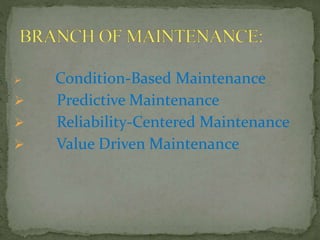
 Condition-Based Maintenance
 Predictive Maintenance
 Reliability-Centered Maintenance
 Value Driven Maintenance
 Shortly described, this maintenance is
performed after one or more indicators
show that equipment is going to fail or that
equipment performance is deteriorating.
 CBM was introduced to try to maintain
the correct equipment at the right time.
CBM is based on using real-time data to
prioritize and optimize maintenance
resources.
 Techniques help to determine the
condition of in-service equipment in order
to predict when maintenance should be
performed. This approach offers cost savings
over routine or time –based predictive
maintenance, because tasks are performed
only when warranted.
 Increased plant readiness due to greater reliability of
the equipment.
 Many industries report from two to ten percent
productivity increases due to predictive maintenance
practices.
 Reduced expenditures for spare parts and labor.
 Reduces the probability of a machine experiencing a
disastrous failure, and this results in an improvement
in worker safety
 It is generally used to achieve improvements
in fields such as the establishment of safe
minimum levels of maintenance, changes to
operating procedures strategies and the
establishment of capital maintenance regimes and
plans.
 Successful implementation of RCM will lead
to increase in cost effectiveness, machine uptime.
And a greater understanding of the level of risk
that the organization is presently managing.
 Based on five Japanese words that begin with ‘S’, the
5S Philosophy focuses on effective work place
organization and standardized work procedures.
5 S’s
1. Sort :(Seiri)
2. Set In Order:(Seiton)
3. Shine: (Seiso)
4. Standardize: (Seiketsu)
5. Sustain: (Shitsuke)
 The first S focuses on eliminating unnecessary
items from the workplace.
 An effective visual method to identify these unneeded
items is called red tagging.
 A red tag is placed on all items not required to
complete your job. These items are then moved to a
central holding area.
 This process is for evaluation of the red tag items.
 second S focuses on efficient and effective storage
methods and how to organize the work area.
 Strategies for effective Set In Order are painting floors,
outlining work areas and locations, shadow boards,
and modular shelving and cabinets for needed items
such as trash cans, brooms, mop and buckets
 Once you have eliminated the clutter and junk that has
been clogging your work areas and identified the
necessary items, the next step is to thoroughly clean
the work area.
 Workers will also begin to notice changes in
equipment and facility location such as air, oil, coolant
leaks, fatigue, breakage, and misalignment.
 These changes, if left unattended, could lead to
equipment failure and loss of production.
 Now the first three S’s are implemented.
 Use standard methods to keep Sort, Set In Order,
and Shine to a condition .
 Allow your employees to participate in the
development of such standards.
 This is the most difficult S to implement and achieve.
 Maintain through empowerment, commitment, and
discipline .
 Sustain focuses on defining a new status quo and
standard of work place organization.
 Simplifies work environment
 reduces waste
 Improves quality
 Improves safety
 Provide self esteem for everyone in the organization.
ISHAN KAUSHIK
maintenance

Maintenance

  • 1.
  • 2.
    • Maintenance involvesfixing any sort of mechanical or electrical device which has become out of order or broken. • It also includes performing routine actions which keep device in working order or prevent trouble from arising.
  • 3.
     Maintenance departmentimplements some maintenance operations to produce products according to specific criteria.
  • 4.
     Before thisdepartment implement s maintenance operations, they can be categorized by whether the product remains the property of the customer, service is being offered, or whether the product is bought by the reprocessing organization and sold to any customer wishing to make the purchase.
  • 5.
    1. Preventive Maintenance: 2.Corrective Maintenance:
  • 6.
     Preventive maintenancecan be described as maintenance of equipment or systems before fault occurs.
  • 7.
     Corrective maintenanceis probably the most commonly used approach, but it is easy to see its limitations. When equipment fails, it often leads to downtime in production. In most cases it is costly business. Also, if the equipment needs to be replaced, the cost of replacing it alone can be substantial. It is also important to consider health, safety and environment issues related to malfunctioning equipment.
  • 8.
     While preventivemaintenance is generally considered to be worthwhile, there are risks such as equipment failure or human error involved when performing preventive maintenance, just as in any maintenance operation.  Preventive maintenance as scheduled overhaul or scheduled replacement provides two of the three proactive failure management policies available to the maintenance engineer.
  • 9.
     Preventive maintenanceis conducted to keep equipment working or extend the life of the equipment.  Corrective maintenance, sometimes called “repair” is conducted to get equipment working again.
  • 10.
     Condition-Based Maintenance Predictive Maintenance  Reliability-Centered Maintenance  Value Driven Maintenance
  • 11.
     Shortly described,this maintenance is performed after one or more indicators show that equipment is going to fail or that equipment performance is deteriorating.  CBM was introduced to try to maintain the correct equipment at the right time. CBM is based on using real-time data to prioritize and optimize maintenance resources.
  • 13.
     Techniques helpto determine the condition of in-service equipment in order to predict when maintenance should be performed. This approach offers cost savings over routine or time –based predictive maintenance, because tasks are performed only when warranted.
  • 14.
     Increased plantreadiness due to greater reliability of the equipment.  Many industries report from two to ten percent productivity increases due to predictive maintenance practices.  Reduced expenditures for spare parts and labor.  Reduces the probability of a machine experiencing a disastrous failure, and this results in an improvement in worker safety
  • 15.
     It isgenerally used to achieve improvements in fields such as the establishment of safe minimum levels of maintenance, changes to operating procedures strategies and the establishment of capital maintenance regimes and plans.  Successful implementation of RCM will lead to increase in cost effectiveness, machine uptime. And a greater understanding of the level of risk that the organization is presently managing.
  • 16.
     Based onfive Japanese words that begin with ‘S’, the 5S Philosophy focuses on effective work place organization and standardized work procedures. 5 S’s 1. Sort :(Seiri) 2. Set In Order:(Seiton) 3. Shine: (Seiso) 4. Standardize: (Seiketsu) 5. Sustain: (Shitsuke)
  • 17.
     The firstS focuses on eliminating unnecessary items from the workplace.  An effective visual method to identify these unneeded items is called red tagging.  A red tag is placed on all items not required to complete your job. These items are then moved to a central holding area.  This process is for evaluation of the red tag items.
  • 18.
     second Sfocuses on efficient and effective storage methods and how to organize the work area.  Strategies for effective Set In Order are painting floors, outlining work areas and locations, shadow boards, and modular shelving and cabinets for needed items such as trash cans, brooms, mop and buckets
  • 19.
     Once youhave eliminated the clutter and junk that has been clogging your work areas and identified the necessary items, the next step is to thoroughly clean the work area.  Workers will also begin to notice changes in equipment and facility location such as air, oil, coolant leaks, fatigue, breakage, and misalignment.  These changes, if left unattended, could lead to equipment failure and loss of production.
  • 20.
     Now thefirst three S’s are implemented.  Use standard methods to keep Sort, Set In Order, and Shine to a condition .  Allow your employees to participate in the development of such standards.
  • 21.
     This isthe most difficult S to implement and achieve.  Maintain through empowerment, commitment, and discipline .  Sustain focuses on defining a new status quo and standard of work place organization.
  • 22.
     Simplifies workenvironment  reduces waste  Improves quality  Improves safety  Provide self esteem for everyone in the organization.
  • 23.