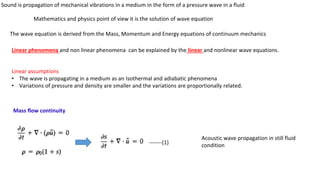
Sound is propagation of mechanical vibrations in a medium in the form of a pressure wave in a fluid
Mathematics and physics point of view it is the solution of wave equation
The wave equation is derived from the Mass, Momentum and Energy equations of continuum mechanics
Linear phenomena and non linear phenomena can be explained by the linear and nonlinear wave equations.
Linear assumptions
• The wave is propagating in a medium as an Isothermal and adiabatic phenomena
• Variations of pressure and density are smaller and the variations are proportionally related.
Mass flow continuity
-------(1)
Acoustic wave propagation in still fluid
condition
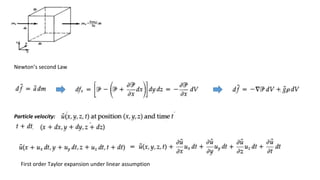
Newton’s second Law
Particle velocity:
First order Taylor expansion under linear assumption
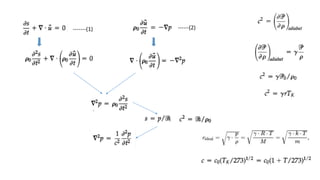
Linear Acceleration
=
When there is no acoustic excitation
------(2)
------(2)
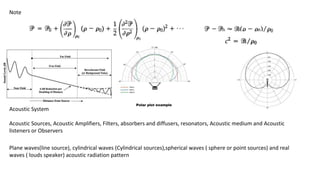
Acoustic System
Acoustic Sources, Acoustic Amplifiers, Filters, absorbers and diffusers, resonators, Acoustic medium and Acoustic
listeners or Observers
Plane waves(line source), cylindrical waves (Cylindrical sources),spherical waves ( sphere or point sources) and real
waves ( louds speaker) acoustic radiation pattern
Note
For Pane Wave
Acoustic impedance
Reflection, Refraction, Attenuation, Interference ( Superposition principal)
Sound generation mechanisms
so many but only two are considered
Air born and Structure born (impact noise)
Acoustic energy propagation in air
sound power P= W/t
sound Intensity I=W/(areaxtime)
-
for plane harmonic waves
acoustics Notes1.pptx

acoustics Notes1.pptx

  • 1.
    Sound is propagationof mechanical vibrations in a medium in the form of a pressure wave in a fluid Mathematics and physics point of view it is the solution of wave equation The wave equation is derived from the Mass, Momentum and Energy equations of continuum mechanics Linear phenomena and non linear phenomena can be explained by the linear and nonlinear wave equations. Linear assumptions • The wave is propagating in a medium as an Isothermal and adiabatic phenomena • Variations of pressure and density are smaller and the variations are proportionally related. Mass flow continuity -------(1) Acoustic wave propagation in still fluid condition
  • 3.
    Newton’s second Law Particlevelocity: First order Taylor expansion under linear assumption
  • 4.
    Linear Acceleration = When thereis no acoustic excitation ------(2)
  • 5.
  • 6.
    Acoustic System Acoustic Sources,Acoustic Amplifiers, Filters, absorbers and diffusers, resonators, Acoustic medium and Acoustic listeners or Observers Plane waves(line source), cylindrical waves (Cylindrical sources),spherical waves ( sphere or point sources) and real waves ( louds speaker) acoustic radiation pattern Note
  • 7.
    For Pane Wave Acousticimpedance Reflection, Refraction, Attenuation, Interference ( Superposition principal)
  • 8.
    Sound generation mechanisms somany but only two are considered Air born and Structure born (impact noise) Acoustic energy propagation in air sound power P= W/t sound Intensity I=W/(areaxtime) -
  • 9.