PROPOSAL OF PRE
SELECTION MOVABLE
SEWER TREATMENT
SYSTEM FOR MILITARY
ESTABLISHMENTS
Introduction
 Every year water and sanitation problems cause more deaths than
war and the lack of sanitation is the world’s biggest cause of
diseases.
 48% of the world’s population does not have access to adequate
sewage treatment.
 Therefore need to proper treatment system in every sector.
 A treatment plant’s primary objectives are to clean the sewage
and meet the plant’s discharge standards.
 The treatment plant personnel do this by reducing the
concentrations of solids, organic matter, nutrients, pathogens and
other pollutants in sewage.
Objectives
1
• Identify the problem
• Sewer treatment technologies
2
• Design aspects for the sewerage
treatment
3
• Design of sewerage treatment for mobile
application
Identify the problem
 Consider in military establishments, most of establishments are
not a permanent cantonments.
 Military person are involve in sudden disasters in the country (ex:
war, flooding, landslides, pandemic situations).
 Nearly 300 to 500 heads basically movement in cases of the
military establishment.
 At that case nearly 49000L to 8200L sewerage discharge per day.
 Also need to minimum 20 days sewerage disposal and treatment
process.
Identify the problem
 Normally military people effluent BOD nearly 300mg/L.
 Before discharge the effluent need to design movable sewerage
treatment plant for reduce BOD level up to 25mg/L.
 Other thing is the latest disaster in the world is Covid pandemic
situation.
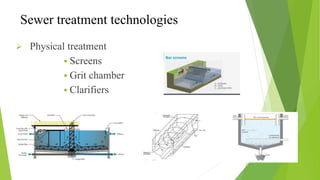
Sewer treatment technologies
 Physical treatment
 Screens
 Grit chamber
 Clarifiers
 Biological treatment
 Trickling filter
 Activated sludge
 Rotating biological contractors
 Pond system
 Chemical treatment
 Chemical reaction
Sewer treatment process
Literature Survey
Research gaps
1. Most of the cases using MBR system
 Impacts on their cost, relative to their design & operation
 Membrane surface fauling,clogging
 Member surface cleaning
 Member aeration
2. Treated effluent is not meeting biochemical oxygen demand (bod)
targets
 Incomplete wastewater treatment due to organic overloading
 Low oxygen concentration
 High algae or sulphur bacteria growth
 Low hydraulic detention time
1. Downstream equipment is failing due to a build of large solids, hairs and fibres
 Downstream plant and equipment from any possible damage
 Accumulation of unwanted material that will interfere with the wastewater
treatment process
1. Treated effluent is not meeting total nitrogen (TN) target
2. A direct consequence of odour issues associated with the sewerage treatment
plant
Proposal
1. Primary treatment/screening
 Mechanical pre-treatment on top of the container
 Install compact units for grease separation and sand remova
 Tanks collect the removed waste constituents for separate disposal
 Primary treatment can be built into the system by use of settling in a
pre-treatment tank
1. Biological treatment
 process can incorporate an SBR type system
 The type of biological treatment depends on the wastewater type and
concentration
 biological treatment process and all necessary controls are fully built into the
container
1. Clarification
 effluent is use separators built into containers providing high flow capacity
final clarification prior to discharge.
1. Tertiary treatment
 where stringent discharge limits exist and require the integration of tertiary treatment
modules into the treatment process such as chemical dosing, phosphorous reduction and
disinfection

FINAL EV5ALUATION.pptx

  • 1.
    PROPOSAL OF PRE SELECTIONMOVABLE SEWER TREATMENT SYSTEM FOR MILITARY ESTABLISHMENTS
  • 2.
    Introduction  Every yearwater and sanitation problems cause more deaths than war and the lack of sanitation is the world’s biggest cause of diseases.  48% of the world’s population does not have access to adequate sewage treatment.  Therefore need to proper treatment system in every sector.  A treatment plant’s primary objectives are to clean the sewage and meet the plant’s discharge standards.  The treatment plant personnel do this by reducing the concentrations of solids, organic matter, nutrients, pathogens and other pollutants in sewage.
  • 3.
    Objectives 1 • Identify theproblem • Sewer treatment technologies 2 • Design aspects for the sewerage treatment 3 • Design of sewerage treatment for mobile application
  • 4.
    Identify the problem Consider in military establishments, most of establishments are not a permanent cantonments.  Military person are involve in sudden disasters in the country (ex: war, flooding, landslides, pandemic situations).  Nearly 300 to 500 heads basically movement in cases of the military establishment.  At that case nearly 49000L to 8200L sewerage discharge per day.  Also need to minimum 20 days sewerage disposal and treatment process.
  • 5.
    Identify the problem Normally military people effluent BOD nearly 300mg/L.  Before discharge the effluent need to design movable sewerage treatment plant for reduce BOD level up to 25mg/L.  Other thing is the latest disaster in the world is Covid pandemic situation.
  • 6.
    Sewer treatment technologies Physical treatment  Screens  Grit chamber  Clarifiers
  • 7.
     Biological treatment Trickling filter  Activated sludge  Rotating biological contractors  Pond system  Chemical treatment  Chemical reaction
  • 8.
  • 9.
  • 10.
    Research gaps 1. Mostof the cases using MBR system  Impacts on their cost, relative to their design & operation  Membrane surface fauling,clogging  Member surface cleaning  Member aeration 2. Treated effluent is not meeting biochemical oxygen demand (bod) targets  Incomplete wastewater treatment due to organic overloading  Low oxygen concentration  High algae or sulphur bacteria growth  Low hydraulic detention time
  • 11.
    1. Downstream equipmentis failing due to a build of large solids, hairs and fibres  Downstream plant and equipment from any possible damage  Accumulation of unwanted material that will interfere with the wastewater treatment process 1. Treated effluent is not meeting total nitrogen (TN) target 2. A direct consequence of odour issues associated with the sewerage treatment plant
  • 12.
    Proposal 1. Primary treatment/screening Mechanical pre-treatment on top of the container  Install compact units for grease separation and sand remova  Tanks collect the removed waste constituents for separate disposal  Primary treatment can be built into the system by use of settling in a pre-treatment tank 1. Biological treatment  process can incorporate an SBR type system  The type of biological treatment depends on the wastewater type and concentration  biological treatment process and all necessary controls are fully built into the container
  • 13.
    1. Clarification  effluentis use separators built into containers providing high flow capacity final clarification prior to discharge. 1. Tertiary treatment  where stringent discharge limits exist and require the integration of tertiary treatment modules into the treatment process such as chemical dosing, phosphorous reduction and disinfection