Branches & Scope of
Toxicology
Dr. Nirbhay Kumar
Asstt. Professor & Head
Deptt. of Veterinary Pharmacology & Toxicology
Bihar Veterinary College, Bihar Animal Sciences University, Patna
Branches of
Toxicology
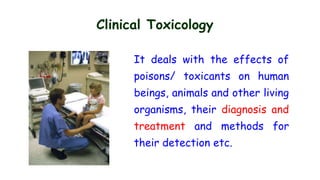
Clinical Toxicology
It deals with the effects of
poisons/ toxicants on human
beings, animals and other living
organisms, their diagnosis and
treatment and methods for
their detection etc.
Environmental Toxicology (ENTOX)
It is a multidisciplinary field of science concerned with the study
of the harmful effects of various chemical, biological and physical
agents on individual living organisms. It is not to be confused with
ecotoxicology which is concerned on studying the harmful effects
at the population and ecosystem levels.
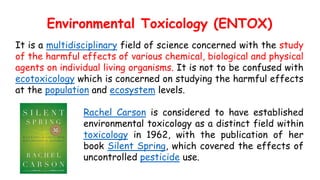
Rachel Carson is considered to have established
environmental toxicology as a distinct field within
toxicology in 1962, with the publication of her
book Silent Spring, which covered the effects of
uncontrolled pesticide use.
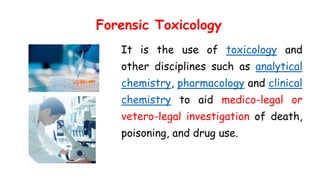
Forensic Toxicology
It is the use of toxicology and
other disciplines such as analytical
chemistry, pharmacology and clinical
chemistry to aid medico-legal or
vetero-legal investigation of death,
poisoning, and drug use.
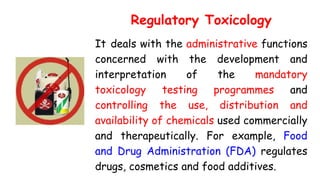
Regulatory Toxicology
It deals with the administrative functions
concerned with the development and
interpretation of the mandatory
toxicology testing programmes and
controlling the use, distribution and
availability of chemicals used commercially
and therapeutically. For example, Food
and Drug Administration (FDA) regulates
drugs, cosmetics and food additives.
Nutritional Toxicology
It is the study of toxicological aspects of food/ feed
stuffs and nutritional habits.
Aquatic Toxicology
It deals with assessing the toxicity on aquatic organisms
of chemicals discharged into marine and fresh water.
Industrial Toxicology
It deals with the clinical study of workers of industries
and environment around them.
Occupational Toxicology
It deals with assessing the potential of adverse effects
from chemicals in occupational environment and the
recommendations of appropriate protective and
precautionary measures.
Geographical Toxicology
It deals with the geographical distribution of toxicants/
toxicity, e.g. poisonous plants, poisonous animals and
minerals.
Reproductive Toxicology
It is the study of occurrence of adverse effects on the
male or female reproductive system due to exposure to
chemical or physical agents.
Developmental Toxicology
It is the study of adverse effects on the developing
organisms occurring anytime during the life span of the
organism due to exposure to chemical or physical agents
before conception (either parent), during prenatal
development or postnatally until the time of puberty.
Genetic Toxicology
It deals with the study of interaction of toxicants with
the process of heredity.
Toxicokinetics
It refers to the process of absorption, distribution,
biotransformation and excretion of toxicants in relation
to time, i.e. what the body does to the poison with relation
to time.
Toxicodynamics
It refers to the study of biochemical and physiological
effects of toxicants and their mechanisms of action and
comprises the sequence of events following interaction of
the toxicants with target molecules.
Scope of
Toxicology
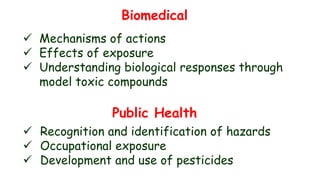
Biomedical
 Mechanisms of actions
 Effects of exposure
 Understanding biological responses through
model toxic compounds
Public Health
 Recognition and identification of hazards
 Occupational exposure
 Development and use of pesticides
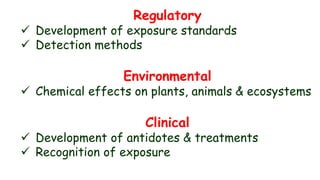
Regulatory
 Development of exposure standards
 Detection methods
Environmental
 Chemical effects on plants, animals & ecosystems
Clinical
 Development of antidotes & treatments
 Recognition of exposure
Lecture_3-_Branches___Scope_of_Toxicology.pptx

Lecture_3-_Branches___Scope_of_Toxicology.pptx

  • 1.
    Branches & Scopeof Toxicology Dr. Nirbhay Kumar Asstt. Professor & Head Deptt. of Veterinary Pharmacology & Toxicology Bihar Veterinary College, Bihar Animal Sciences University, Patna
  • 2.
  • 3.
    Clinical Toxicology It dealswith the effects of poisons/ toxicants on human beings, animals and other living organisms, their diagnosis and treatment and methods for their detection etc.
  • 4.
    Environmental Toxicology (ENTOX) Itis a multidisciplinary field of science concerned with the study of the harmful effects of various chemical, biological and physical agents on individual living organisms. It is not to be confused with ecotoxicology which is concerned on studying the harmful effects at the population and ecosystem levels. Rachel Carson is considered to have established environmental toxicology as a distinct field within toxicology in 1962, with the publication of her book Silent Spring, which covered the effects of uncontrolled pesticide use.
  • 5.
    Forensic Toxicology It isthe use of toxicology and other disciplines such as analytical chemistry, pharmacology and clinical chemistry to aid medico-legal or vetero-legal investigation of death, poisoning, and drug use.
  • 6.
    Regulatory Toxicology It dealswith the administrative functions concerned with the development and interpretation of the mandatory toxicology testing programmes and controlling the use, distribution and availability of chemicals used commercially and therapeutically. For example, Food and Drug Administration (FDA) regulates drugs, cosmetics and food additives.
  • 7.
    Nutritional Toxicology It isthe study of toxicological aspects of food/ feed stuffs and nutritional habits. Aquatic Toxicology It deals with assessing the toxicity on aquatic organisms of chemicals discharged into marine and fresh water.
  • 8.
    Industrial Toxicology It dealswith the clinical study of workers of industries and environment around them. Occupational Toxicology It deals with assessing the potential of adverse effects from chemicals in occupational environment and the recommendations of appropriate protective and precautionary measures.
  • 9.
    Geographical Toxicology It dealswith the geographical distribution of toxicants/ toxicity, e.g. poisonous plants, poisonous animals and minerals. Reproductive Toxicology It is the study of occurrence of adverse effects on the male or female reproductive system due to exposure to chemical or physical agents.
  • 10.
    Developmental Toxicology It isthe study of adverse effects on the developing organisms occurring anytime during the life span of the organism due to exposure to chemical or physical agents before conception (either parent), during prenatal development or postnatally until the time of puberty. Genetic Toxicology It deals with the study of interaction of toxicants with the process of heredity.
  • 11.
    Toxicokinetics It refers tothe process of absorption, distribution, biotransformation and excretion of toxicants in relation to time, i.e. what the body does to the poison with relation to time. Toxicodynamics It refers to the study of biochemical and physiological effects of toxicants and their mechanisms of action and comprises the sequence of events following interaction of the toxicants with target molecules.
  • 12.
  • 13.
    Biomedical  Mechanisms ofactions  Effects of exposure  Understanding biological responses through model toxic compounds Public Health  Recognition and identification of hazards  Occupational exposure  Development and use of pesticides
  • 14.
    Regulatory  Development ofexposure standards  Detection methods Environmental  Chemical effects on plants, animals & ecosystems Clinical  Development of antidotes & treatments  Recognition of exposure