Lecture 13: Memory and
Programmable Logic
Aby K George, ECE Department, Wayne State University
Syed M. Mahmud, Ph.D
ECE Department
Wayne State University
Contents
• Introduction
• Random Access Memory
• Memory Decoding
• Read Only Memory
• Programmable Logic Array
• Programmable Array Logic
• Sequential Programmable Devices
Chapter 7 ECE 2610 – Digital Logic 1 2
Introduction
• Memory unit: A device to which binary information is stored, and from
which information is retrieved when needed for processing.
• Two types of Memories
• Random Access Memory (RAM)
• Read Only Memory (ROM)
• RAM can perform read and write operations
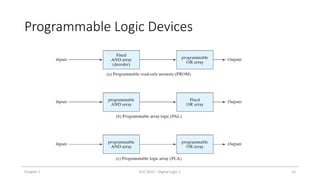
• ROM is a programmable logic device (PLD)
• Other types of PLDs
• Programmable Logic Array (PLA)
• Programmable Array Logic (PAL)
• Field Programmable Gate Array (FPGA)
Chapter 7 ECE 2610 – Digital Logic 1 3
Random Access Memory (RAM)
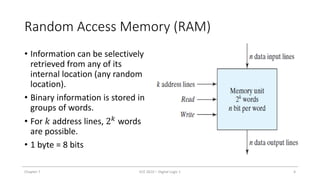
• Information can be selectively
retrieved from any of its
internal location (any random
location).
• Binary information is stored in
groups of words.
• For 𝑘 address lines, 2𝑘 words
are possible.
• 1 byte = 8 bits
Chapter 7 ECE 2610 – Digital Logic 1 4
Random Access Memory (RAM)
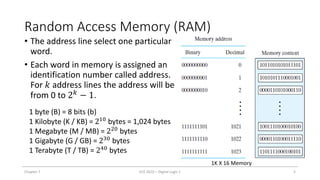
• The address line select one particular
word.
• Each word in memory is assigned an
identification number called address.
For 𝑘 address lines the address will be
from 0 to 2𝑘 − 1.
Chapter 7 ECE 2610 – Digital Logic 1 5
1 byte (B) = 8 bits (b)
1 Kilobyte (K / KB) = 210 bytes = 1,024 bytes
1 Megabyte (M / MB) = 220 bytes
1 Gigabyte (G / GB) = 230
bytes
1 Terabyte (T / TB) = 240 bytes
1K X 16 Memory
Write and Read Operations in RAM
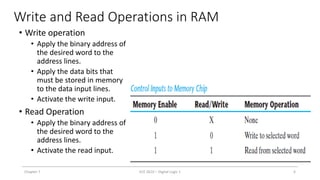
• Write operation
• Apply the binary address of
the desired word to the
address lines.
• Apply the data bits that
must be stored in memory
to the data input lines.
• Activate the write input.
• Read Operation
• Apply the binary address of
the desired word to the
address lines.
• Activate the read input.
Chapter 7 ECE 2610 – Digital Logic 1 6
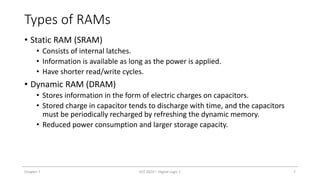
Types of RAMs
• Static RAM (SRAM)
• Consists of internal latches.
• Information is available as long as the power is applied.
• Have shorter read/write cycles.
• Dynamic RAM (DRAM)
• Stores information in the form of electric charges on capacitors.
• Stored charge in capacitor tends to discharge with time, and the capacitors
must be periodically recharged by refreshing the dynamic memory.
• Reduced power consumption and larger storage capacity.
Chapter 7 ECE 2610 – Digital Logic 1 7
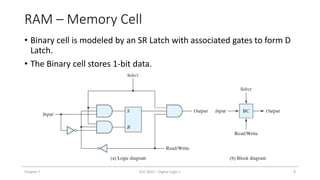
RAM – Memory Cell
• Binary cell is modeled by an SR Latch with associated gates to form D
Latch.
• The Binary cell stores 1-bit data.
Chapter 7 ECE 2610 – Digital Logic 1 8
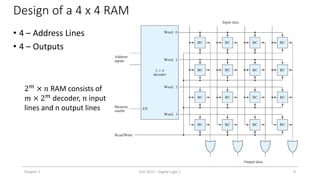
Design of a 4 x 4 RAM
• 4 – Address Lines
• 4 – Outputs
Chapter 7 ECE 2610 – Digital Logic 1 9
2𝑚
× 𝑛 RAM consists of
𝑚 × 2𝑚 decoder, 𝑛 input
lines and n output lines
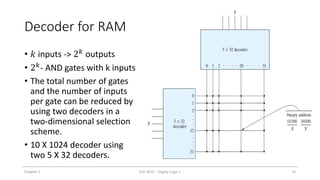
Decoder for RAM
• 𝑘 inputs -> 2𝑘
outputs
• 2𝑘- AND gates with k inputs
• The total number of gates
and the number of inputs
per gate can be reduced by
using two decoders in a
two-dimensional selection
scheme.
• 10 X 1024 decoder using
two 5 X 32 decoders.
Chapter 7 ECE 2610 – Digital Logic 1 10
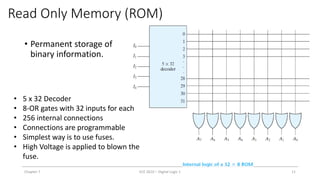
Read Only Memory (ROM)
• Permanent storage of
binary information.
Chapter 7 ECE 2610 – Digital Logic 1 11
• 5 x 32 Decoder
• 8-OR gates with 32 inputs for each
• 256 internal connections
• Connections are programmable
• Simplest way is to use fuses.
• High Voltage is applied to blown the
fuse.
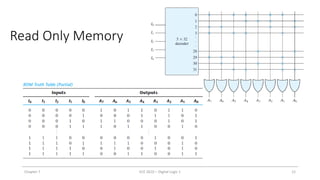
Read Only Memory
Chapter 7 ECE 2610 – Digital Logic 1 12
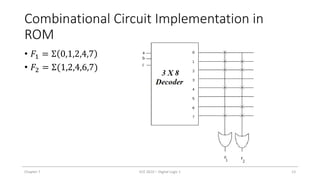
Combinational Circuit Implementation in
ROM
• 𝐹1 = Σ 0,1,2,4,7
• 𝐹2 = Σ(1,2,4,6,7)
Chapter 7 ECE 2610 – Digital Logic 1 13
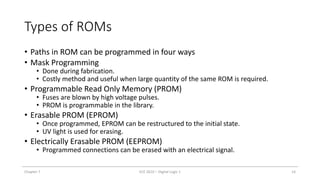
Types of ROMs
• Paths in ROM can be programmed in four ways
• Mask Programming
• Done during fabrication.
• Costly method and useful when large quantity of the same ROM is required.
• Programmable Read Only Memory (PROM)
• Fuses are blown by high voltage pulses.
• PROM is programmable in the library.
• Erasable PROM (EPROM)
• Once programmed, EPROM can be restructured to the initial state.
• UV light is used for erasing.
• Electrically Erasable PROM (EEPROM)
• Programmed connections can be erased with an electrical signal.
Chapter 7 ECE 2610 – Digital Logic 1 14
Programmable Logic Devices
Chapter 7 ECE 2610 – Digital Logic 1 15
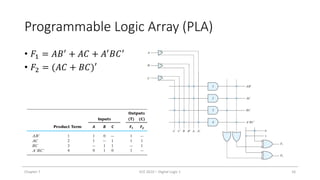
Programmable Logic Array (PLA)
• 𝐹1 = 𝐴𝐵′ + 𝐴𝐶 + 𝐴′𝐵𝐶′
• 𝐹2 = (𝐴𝐶 + 𝐵𝐶)′
Chapter 7 ECE 2610 – Digital Logic 1 16
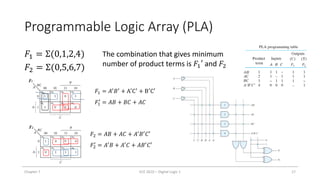
Programmable Logic Array (PLA)
𝐹1 = Σ(0,1,2,4)
𝐹2 = Σ(0,5,6,7)
Chapter 7 ECE 2610 – Digital Logic 1 17
𝐹1 = 𝐴′
𝐵′
+ A′
C′
+ B′
C′
𝐹1
′
= 𝐴𝐵 + 𝐵𝐶 + 𝐴𝐶
𝐹2 = 𝐴𝐵 + 𝐴𝐶 + 𝐴′
𝐵′
𝐶′
𝐹2
′
= 𝐴′𝐵 + 𝐴′𝐶 + 𝐴𝐵′𝐶′
The combination that gives minimum
number of product terms is 𝐹1′ and 𝐹2
Sequential Programmable Devices
• Sequential Programmable Logic Device (SPLD)
• Includes AND-OR array (PAL or PLA) and flip-flops
• Complex Programmable Logic Device (CPLD)
• Collection of PLDs on a single integrated circuit and I/O blocks.
• Field Programmable Gate Array (FPGA)
• Consists of lookup tables, multiplexers, gates and flip-flops.
• The design with PLD, CPLD, or FPGA requires extensive computer-
aided design (CAD) tools to facilitate the synthesis procedure.
Chapter 7 ECE 2610 – Digital Logic 1 18
Summary
• How to implement a combinational function in a ROM?
• What is the difference between ROM, PLA and PAL?
• What are the different types of ROMs?
• How to implement a combinational function in a PLA?
• What are the common sequential programmable devices?
Chapter 7 ECE 2610 – Digital Logic 1 19
Homework – 7
• 7.1, 7.19, 7.20, 7.21
• Design a Full Adder using ROM and PLA
• Design a 5X2 RAM using D Flip-flop
Chapter 7 ECE 2610 – Digital Logic 1 20
Lecture13.pdf UNIT 4 In digital logic Circuits

  • 1.
    Lecture 13: Memoryand Programmable Logic Aby K George, ECE Department, Wayne State University Syed M. Mahmud, Ph.D ECE Department Wayne State University
  • 2.
    Contents • Introduction • RandomAccess Memory • Memory Decoding • Read Only Memory • Programmable Logic Array • Programmable Array Logic • Sequential Programmable Devices Chapter 7 ECE 2610 – Digital Logic 1 2
  • 3.
    Introduction • Memory unit:A device to which binary information is stored, and from which information is retrieved when needed for processing. • Two types of Memories • Random Access Memory (RAM) • Read Only Memory (ROM) • RAM can perform read and write operations • ROM is a programmable logic device (PLD) • Other types of PLDs • Programmable Logic Array (PLA) • Programmable Array Logic (PAL) • Field Programmable Gate Array (FPGA) Chapter 7 ECE 2610 – Digital Logic 1 3
  • 4.
    Random Access Memory(RAM) • Information can be selectively retrieved from any of its internal location (any random location). • Binary information is stored in groups of words. • For 𝑘 address lines, 2𝑘 words are possible. • 1 byte = 8 bits Chapter 7 ECE 2610 – Digital Logic 1 4
  • 5.
    Random Access Memory(RAM) • The address line select one particular word. • Each word in memory is assigned an identification number called address. For 𝑘 address lines the address will be from 0 to 2𝑘 − 1. Chapter 7 ECE 2610 – Digital Logic 1 5 1 byte (B) = 8 bits (b) 1 Kilobyte (K / KB) = 210 bytes = 1,024 bytes 1 Megabyte (M / MB) = 220 bytes 1 Gigabyte (G / GB) = 230 bytes 1 Terabyte (T / TB) = 240 bytes 1K X 16 Memory
  • 6.
    Write and ReadOperations in RAM • Write operation • Apply the binary address of the desired word to the address lines. • Apply the data bits that must be stored in memory to the data input lines. • Activate the write input. • Read Operation • Apply the binary address of the desired word to the address lines. • Activate the read input. Chapter 7 ECE 2610 – Digital Logic 1 6
  • 7.
    Types of RAMs •Static RAM (SRAM) • Consists of internal latches. • Information is available as long as the power is applied. • Have shorter read/write cycles. • Dynamic RAM (DRAM) • Stores information in the form of electric charges on capacitors. • Stored charge in capacitor tends to discharge with time, and the capacitors must be periodically recharged by refreshing the dynamic memory. • Reduced power consumption and larger storage capacity. Chapter 7 ECE 2610 – Digital Logic 1 7
  • 8.
    RAM – MemoryCell • Binary cell is modeled by an SR Latch with associated gates to form D Latch. • The Binary cell stores 1-bit data. Chapter 7 ECE 2610 – Digital Logic 1 8
  • 9.
    Design of a4 x 4 RAM • 4 – Address Lines • 4 – Outputs Chapter 7 ECE 2610 – Digital Logic 1 9 2𝑚 × 𝑛 RAM consists of 𝑚 × 2𝑚 decoder, 𝑛 input lines and n output lines
  • 10.
    Decoder for RAM •𝑘 inputs -> 2𝑘 outputs • 2𝑘- AND gates with k inputs • The total number of gates and the number of inputs per gate can be reduced by using two decoders in a two-dimensional selection scheme. • 10 X 1024 decoder using two 5 X 32 decoders. Chapter 7 ECE 2610 – Digital Logic 1 10
  • 11.
    Read Only Memory(ROM) • Permanent storage of binary information. Chapter 7 ECE 2610 – Digital Logic 1 11 • 5 x 32 Decoder • 8-OR gates with 32 inputs for each • 256 internal connections • Connections are programmable • Simplest way is to use fuses. • High Voltage is applied to blown the fuse.
  • 12.
    Read Only Memory Chapter7 ECE 2610 – Digital Logic 1 12
  • 13.
    Combinational Circuit Implementationin ROM • 𝐹1 = Σ 0,1,2,4,7 • 𝐹2 = Σ(1,2,4,6,7) Chapter 7 ECE 2610 – Digital Logic 1 13
  • 14.
    Types of ROMs •Paths in ROM can be programmed in four ways • Mask Programming • Done during fabrication. • Costly method and useful when large quantity of the same ROM is required. • Programmable Read Only Memory (PROM) • Fuses are blown by high voltage pulses. • PROM is programmable in the library. • Erasable PROM (EPROM) • Once programmed, EPROM can be restructured to the initial state. • UV light is used for erasing. • Electrically Erasable PROM (EEPROM) • Programmed connections can be erased with an electrical signal. Chapter 7 ECE 2610 – Digital Logic 1 14
  • 15.
    Programmable Logic Devices Chapter7 ECE 2610 – Digital Logic 1 15
  • 16.
    Programmable Logic Array(PLA) • 𝐹1 = 𝐴𝐵′ + 𝐴𝐶 + 𝐴′𝐵𝐶′ • 𝐹2 = (𝐴𝐶 + 𝐵𝐶)′ Chapter 7 ECE 2610 – Digital Logic 1 16
  • 17.
    Programmable Logic Array(PLA) 𝐹1 = Σ(0,1,2,4) 𝐹2 = Σ(0,5,6,7) Chapter 7 ECE 2610 – Digital Logic 1 17 𝐹1 = 𝐴′ 𝐵′ + A′ C′ + B′ C′ 𝐹1 ′ = 𝐴𝐵 + 𝐵𝐶 + 𝐴𝐶 𝐹2 = 𝐴𝐵 + 𝐴𝐶 + 𝐴′ 𝐵′ 𝐶′ 𝐹2 ′ = 𝐴′𝐵 + 𝐴′𝐶 + 𝐴𝐵′𝐶′ The combination that gives minimum number of product terms is 𝐹1′ and 𝐹2
  • 18.
    Sequential Programmable Devices •Sequential Programmable Logic Device (SPLD) • Includes AND-OR array (PAL or PLA) and flip-flops • Complex Programmable Logic Device (CPLD) • Collection of PLDs on a single integrated circuit and I/O blocks. • Field Programmable Gate Array (FPGA) • Consists of lookup tables, multiplexers, gates and flip-flops. • The design with PLD, CPLD, or FPGA requires extensive computer- aided design (CAD) tools to facilitate the synthesis procedure. Chapter 7 ECE 2610 – Digital Logic 1 18
  • 19.
    Summary • How toimplement a combinational function in a ROM? • What is the difference between ROM, PLA and PAL? • What are the different types of ROMs? • How to implement a combinational function in a PLA? • What are the common sequential programmable devices? Chapter 7 ECE 2610 – Digital Logic 1 19
  • 20.
    Homework – 7 •7.1, 7.19, 7.20, 7.21 • Design a Full Adder using ROM and PLA • Design a 5X2 RAM using D Flip-flop Chapter 7 ECE 2610 – Digital Logic 1 20