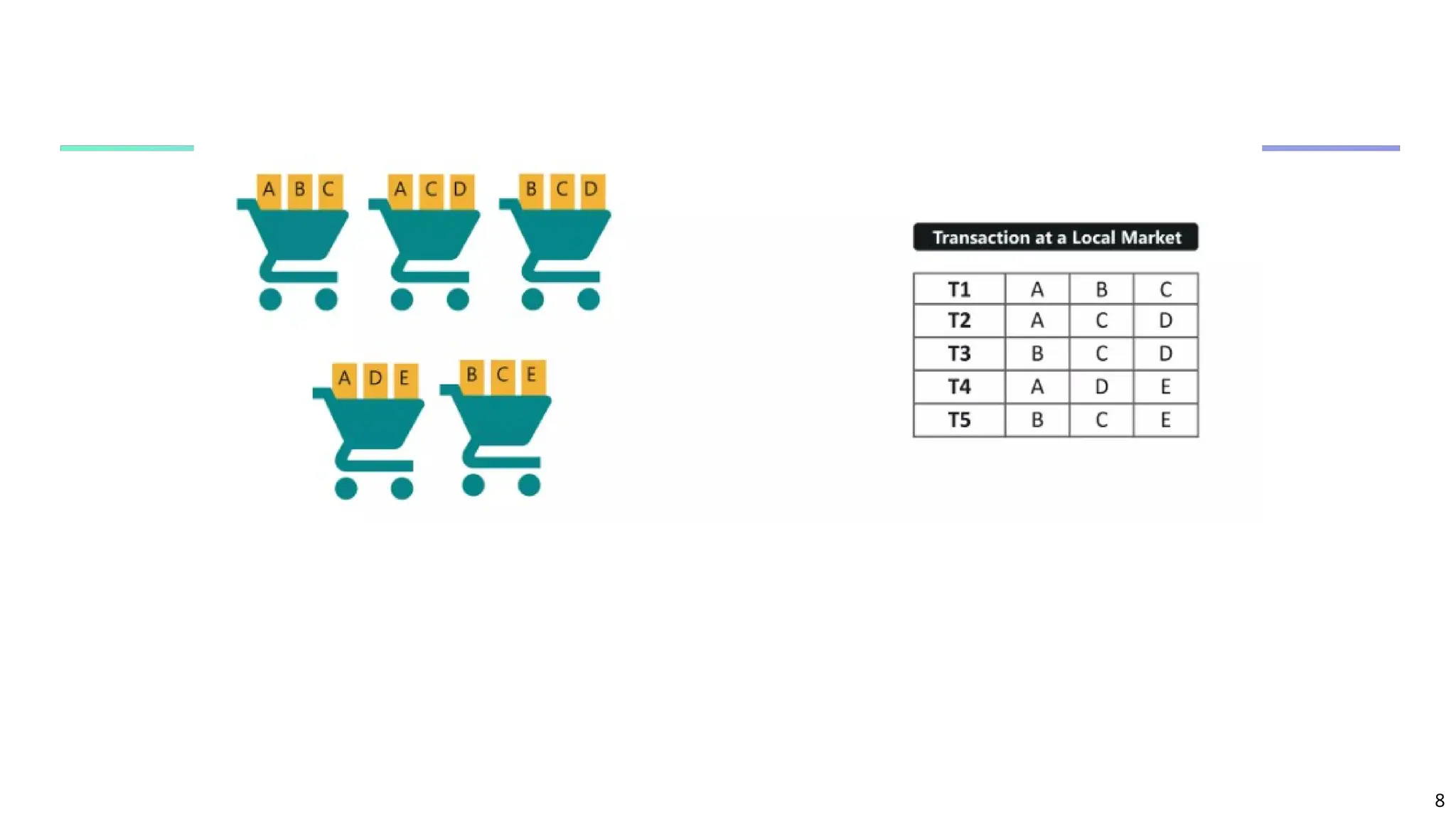
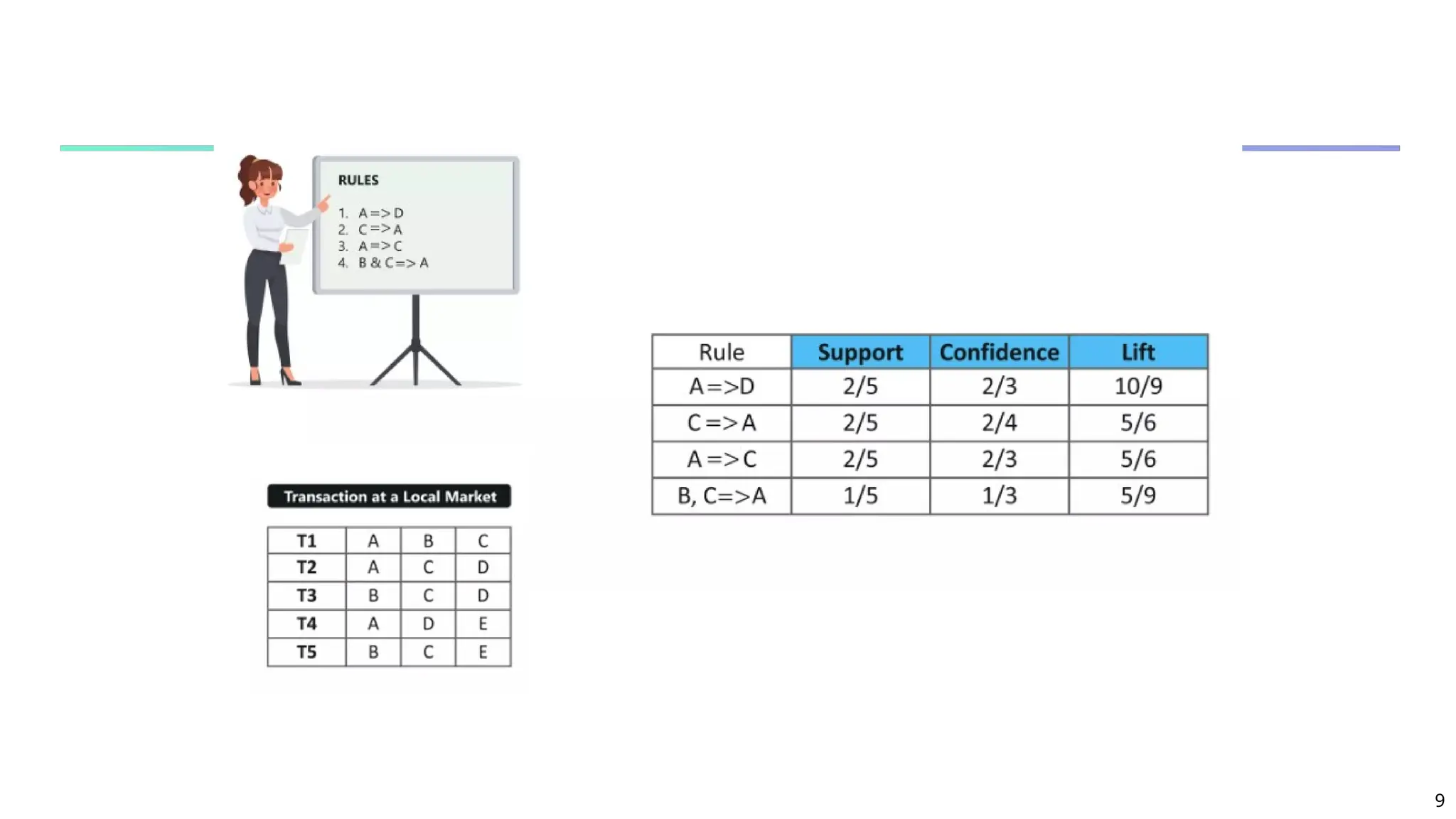
1
1
Mining Frequent
Patterns, Association,
Correlation
2
Mining Frequent Patterns, Association and
Correlations: Basic Concepts and Methods
 Basic Concepts
 Frequent Itemset Mining Methods
 Which Patterns Are Interesting?—Pattern
Evaluation Methods
 Summary
3
What Is Frequent Pattern Analysis?
 Frequent pattern: a pattern (a set of items, subsequences,
substructures, etc.) that occurs frequently in a data set
 First proposed by Agrawal, Imielinski, and Swami [AIS93] in the
context of frequent itemsets and association rule mining
 Motivation: Finding inherent regularities in data
 What products were often purchased together?— Beer and
diapers?!
 What are the subsequent purchases after buying a PC?
 What kinds of DNA are sensitive to this new drug?
 Can we automatically classify web documents?
 Applications
 Basket data analysis
https://www.youtube.com/watch?v=3bMNqemjhsc&t=7s , cross-
marketing, catalog design, sale campaign analysis, Web log (click
4
5
Why Is Freq. Pattern Mining Important?
 Freq. pattern: An intrinsic and important property of
datasets
 Foundation for many essential data mining tasks
 Association, correlation, and causality analysis
 Sequential, structural (e.g., sub-graph) patterns
 Pattern analysis in spatiotemporal, multimedia, time-
series, and stream data
 Classification: discriminative, frequent pattern
analysis
 Cluster analysis: frequent pattern-based clustering
 Data warehousing: iceberg cube and cube-gradient
 Semantic data compression: fascicles
 Broad applications
6
7
8
9
10
Basic Concepts: Frequent Patterns
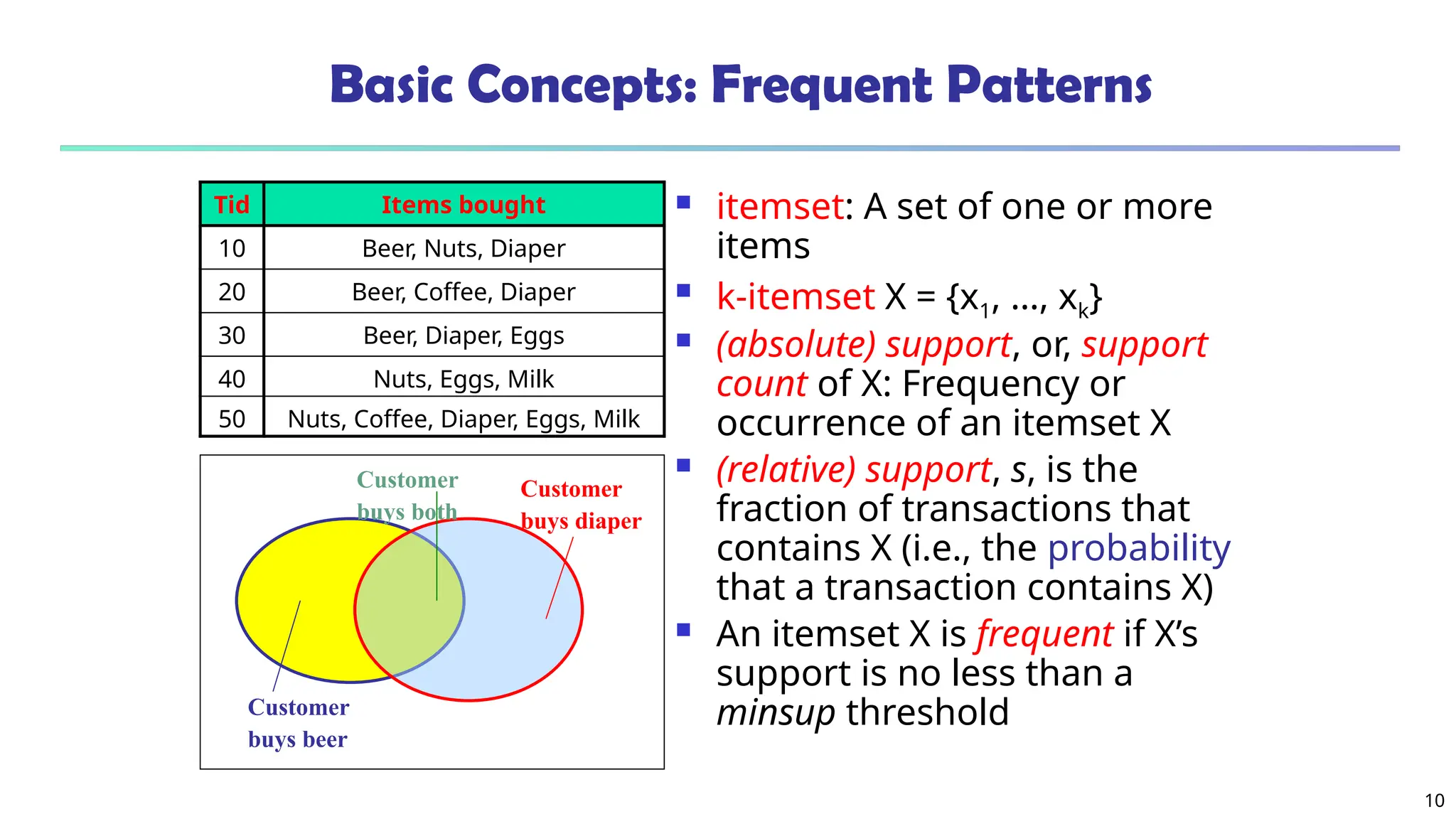
 itemset: A set of one or more
items
 k-itemset X = {x1, …, xk}
 (absolute) support, or, support
count of X: Frequency or
occurrence of an itemset X
 (relative) support, s, is the
fraction of transactions that
contains X (i.e., the probability
that a transaction contains X)
 An itemset X is frequent if X’s
support is no less than a
minsup threshold
Customer
buys diaper
Customer
buys both
Customer
buys beer
Tid Items bought
10 Beer, Nuts, Diaper
20 Beer, Coffee, Diaper
30 Beer, Diaper, Eggs
40 Nuts, Eggs, Milk
50 Nuts, Coffee, Diaper, Eggs, Milk
11
Basic Concepts: Association Rules
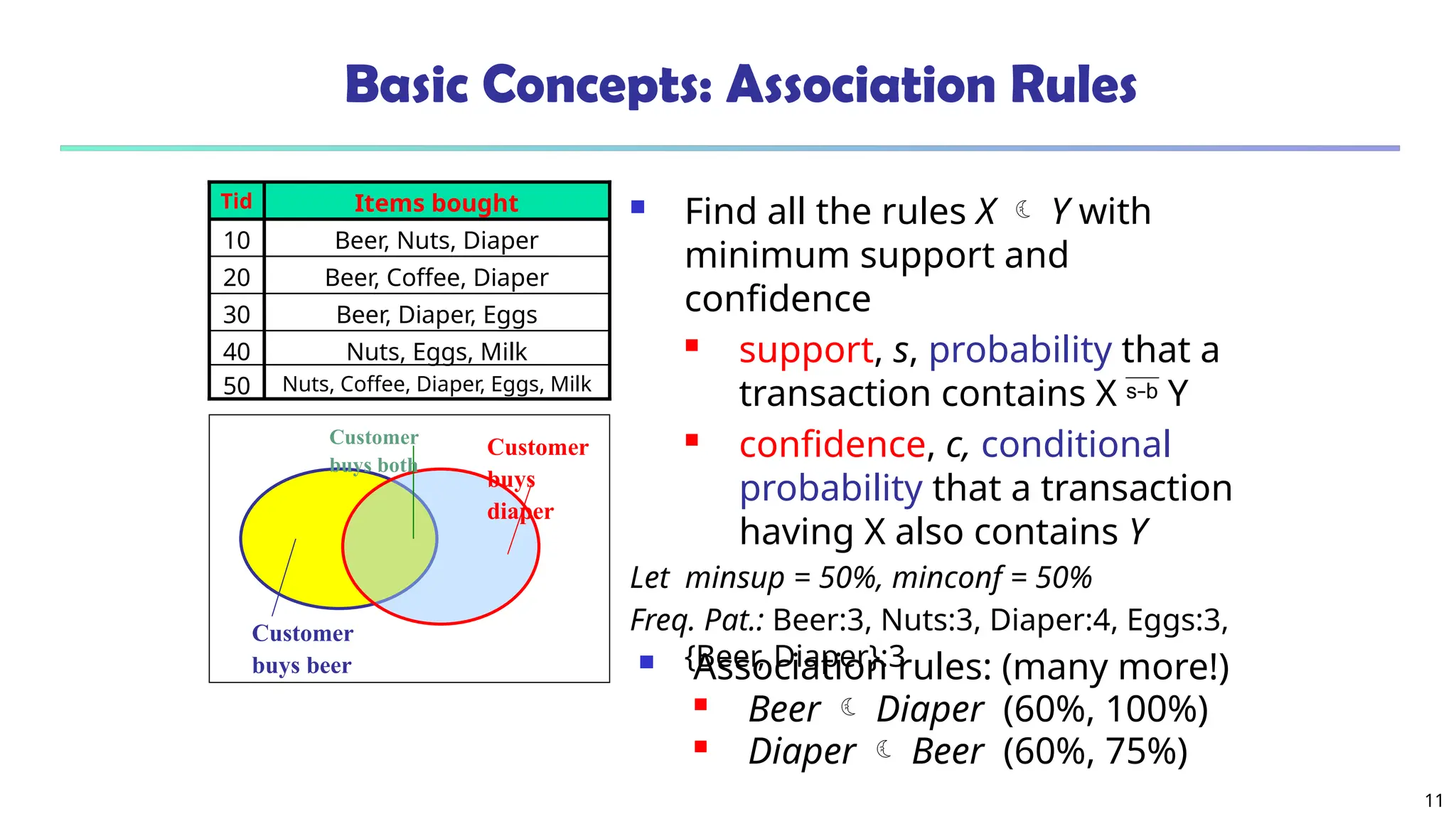
 Find all the rules X  Y with
minimum support and
confidence
 support, s, probability that a
transaction contains X  Y
 confidence, c, conditional
probability that a transaction
having X also contains Y
Let minsup = 50%, minconf = 50%
Freq. Pat.: Beer:3, Nuts:3, Diaper:4, Eggs:3,
{Beer, Diaper}:3
Customer
buys
diaper
Customer
buys both
Customer
buys beer
Nuts, Eggs, Milk
40
Nuts, Coffee, Diaper, Eggs, Milk
50
Beer, Diaper, Eggs
30
Beer, Coffee, Diaper
20
Beer, Nuts, Diaper
10
Items bought
Tid
 Association rules: (many more!)
 Beer  Diaper (60%, 100%)
 Diaper  Beer (60%, 75%)
12
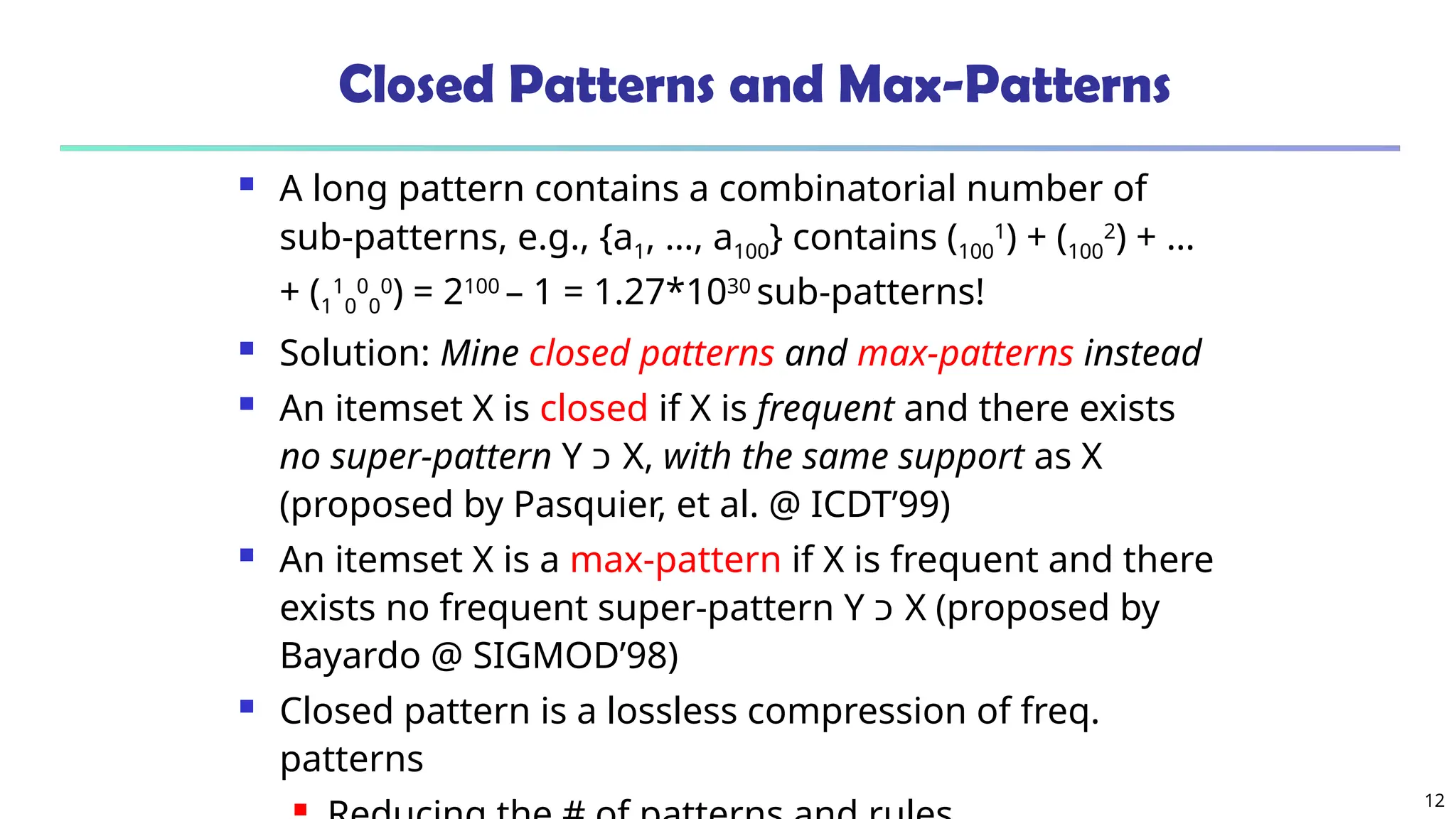
Closed Patterns and Max-Patterns
 A long pattern contains a combinatorial number of
sub-patterns, e.g., {a1, …, a100} contains (100
1
) + (100
2
) + …
+ (1
1
0
0
0
0
) = 2100
– 1 = 1.27*1030
sub-patterns!
 Solution: Mine closed patterns and max-patterns instead
 An itemset X is closed if X is frequent and there exists
no super-pattern Y ‫כ‬ X, with the same support as X
(proposed by Pasquier, et al. @ ICDT’99)
 An itemset X is a max-pattern if X is frequent and there
exists no frequent super-pattern Y ‫כ‬ X (proposed by
Bayardo @ SIGMOD’98)
 Closed pattern is a lossless compression of freq.
patterns

13
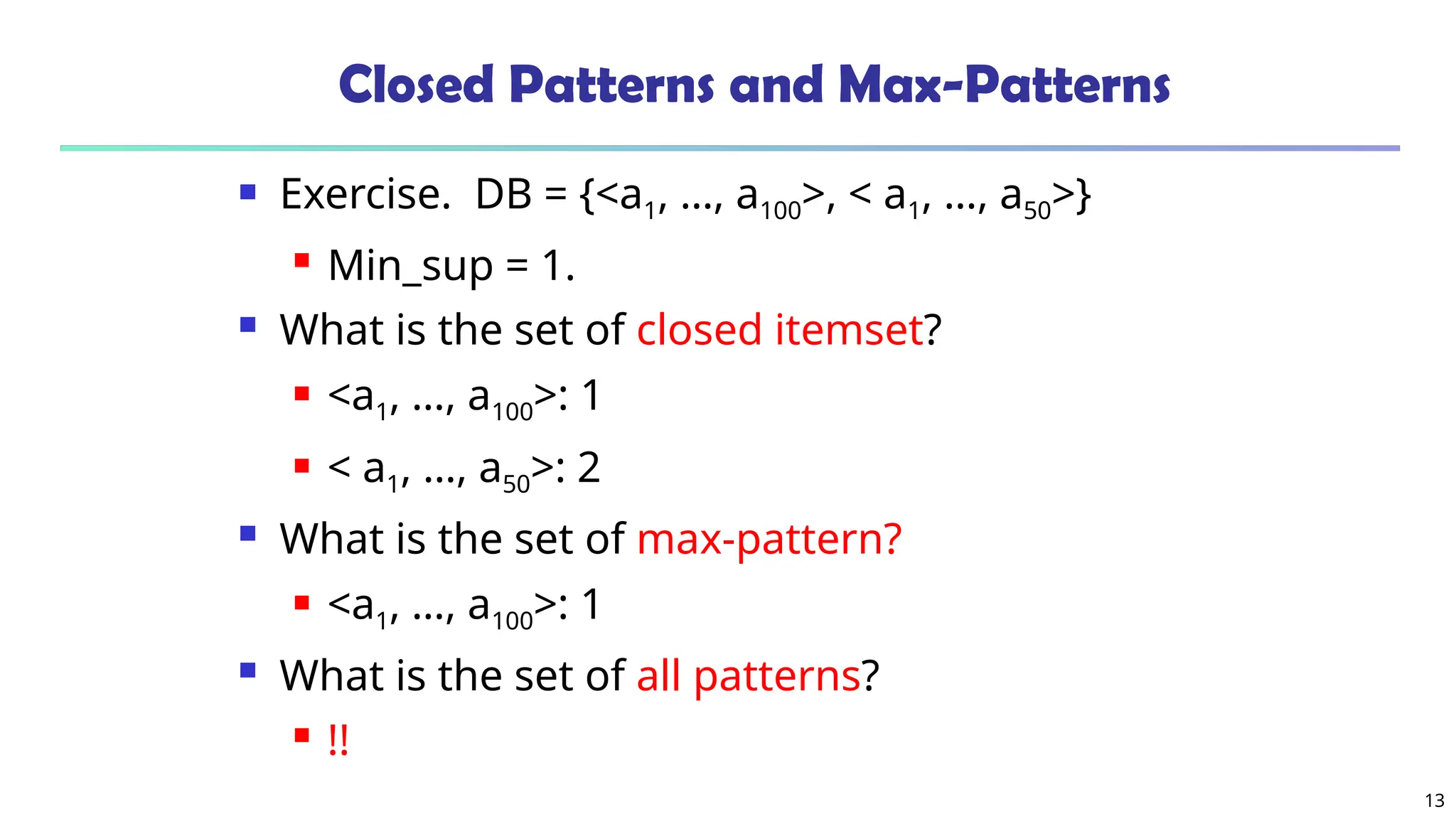
Closed Patterns and Max-Patterns
 Exercise. DB = {<a1, …, a100>, < a1, …, a50>}
 Min_sup = 1.
 What is the set of closed itemset?
 <a1, …, a100>: 1
 < a1, …, a50>: 2
 What is the set of max-pattern?
 <a1, …, a100>: 1
 What is the set of all patterns?
 !!
14
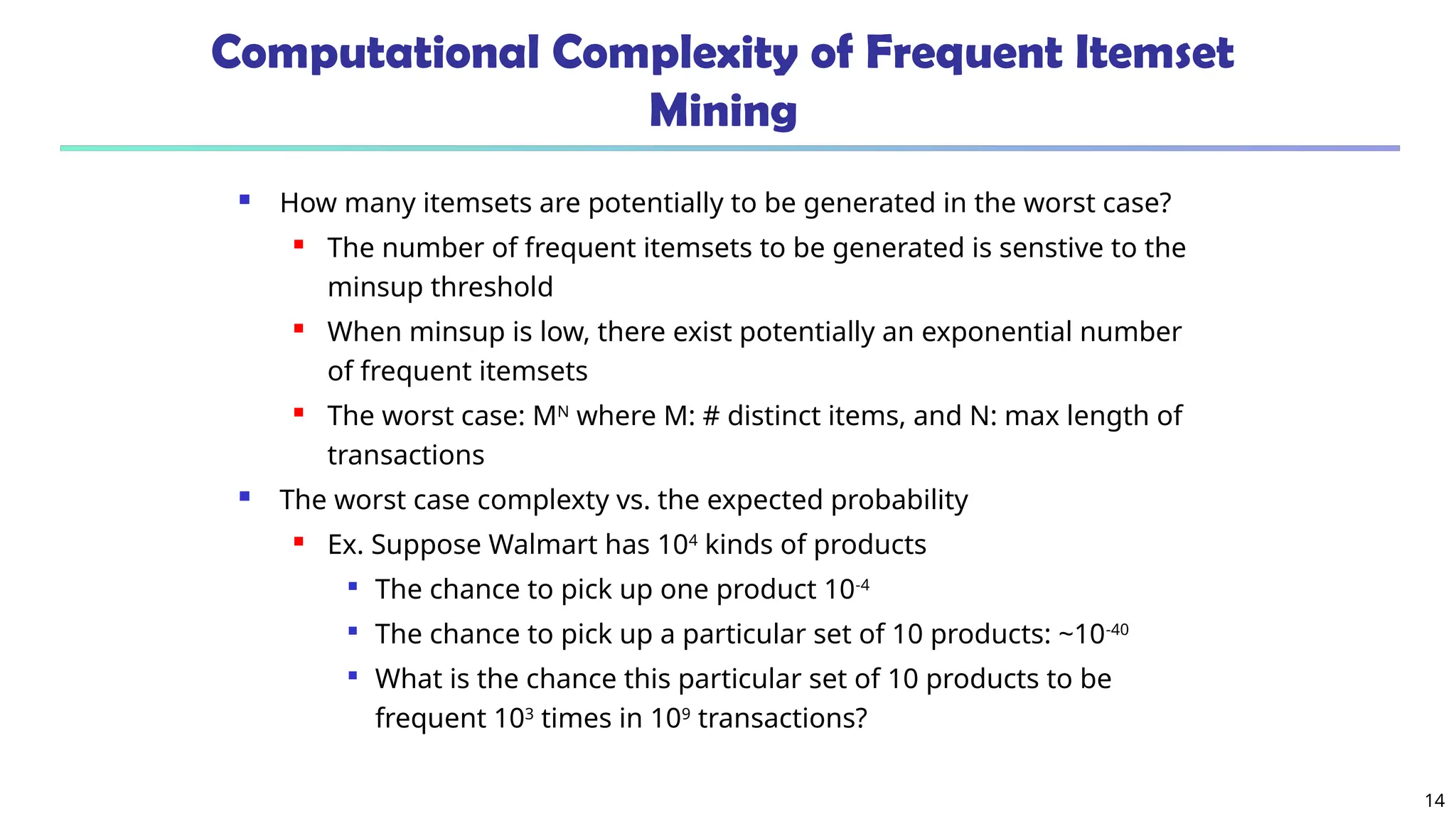
Computational Complexity of Frequent Itemset
Mining
 How many itemsets are potentially to be generated in the worst case?
 The number of frequent itemsets to be generated is senstive to the
minsup threshold
 When minsup is low, there exist potentially an exponential number
of frequent itemsets
 The worst case: MN
where M: # distinct items, and N: max length of
transactions
 The worst case complexty vs. the expected probability
 Ex. Suppose Walmart has 104
kinds of products

The chance to pick up one product 10-4

The chance to pick up a particular set of 10 products: ~10-40

What is the chance this particular set of 10 products to be
frequent 103
times in 109
transactions?
15
Mining Frequent Patterns, Association and
Correlations: Basic Concepts and Methods
 Basic Concepts
 Frequent Itemset Mining Methods
 Which Patterns Are Interesting?—Pattern
Evaluation Methods
 Summary
16
Scalable Frequent Itemset Mining Methods
 Apriori: A Candidate Generation-and-Test Approach
 Improving the Efficiency of Apriori
 FPGrowth: A Frequent Pattern-Growth Approach
 ECLAT: Frequent Pattern Mining with Vertical Data Format
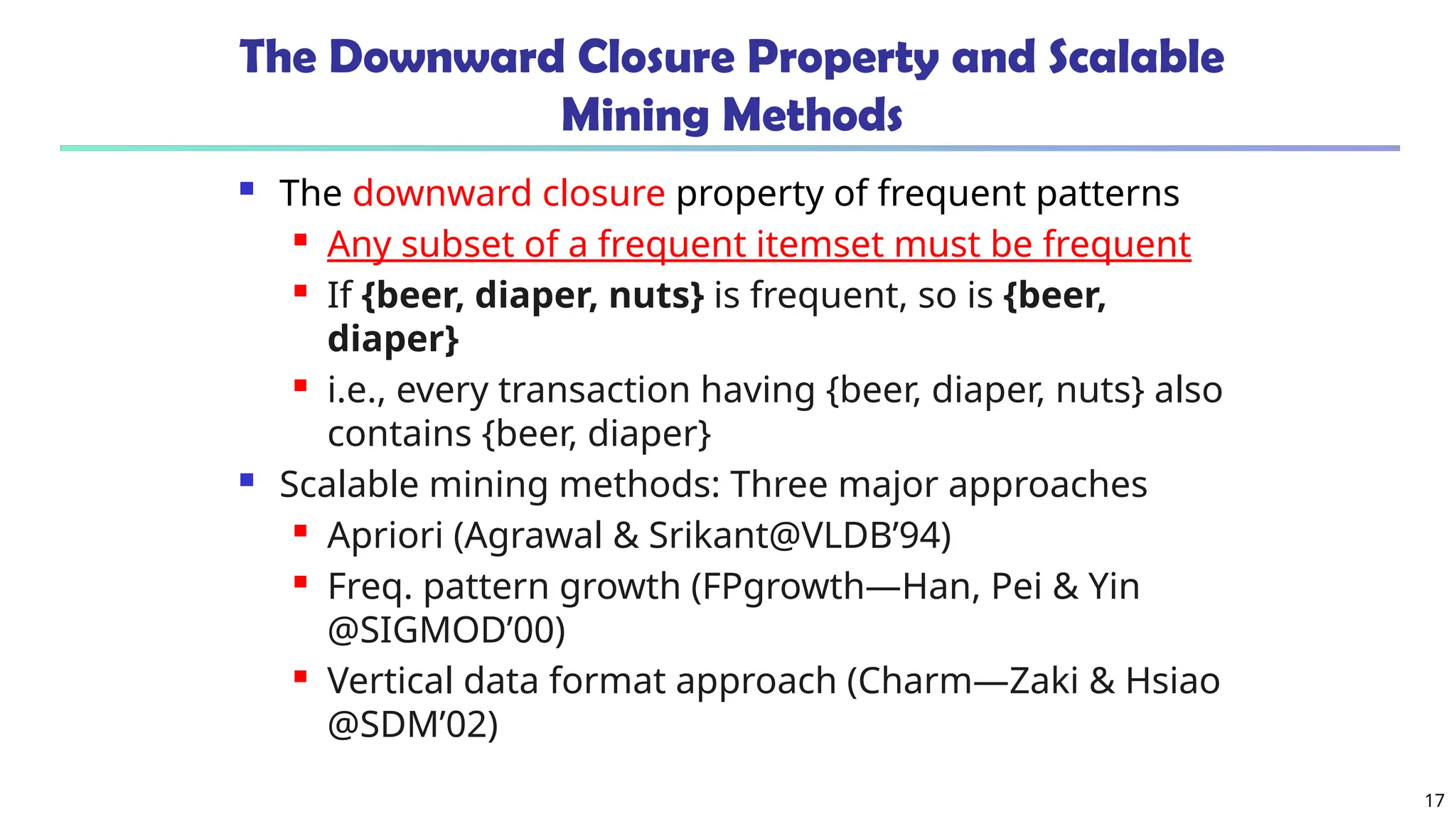
17
The Downward Closure Property and Scalable
Mining Methods
 The downward closure property of frequent patterns
 Any subset of a frequent itemset must be frequent
 If {beer, diaper, nuts} is frequent, so is {beer,
diaper}
 i.e., every transaction having {beer, diaper, nuts} also
contains {beer, diaper}
 Scalable mining methods: Three major approaches
 Apriori (Agrawal & Srikant@VLDB’94)
 Freq. pattern growth (FPgrowth—Han, Pei & Yin
@SIGMOD’00)
 Vertical data format approach (Charm—Zaki & Hsiao
@SDM’02)
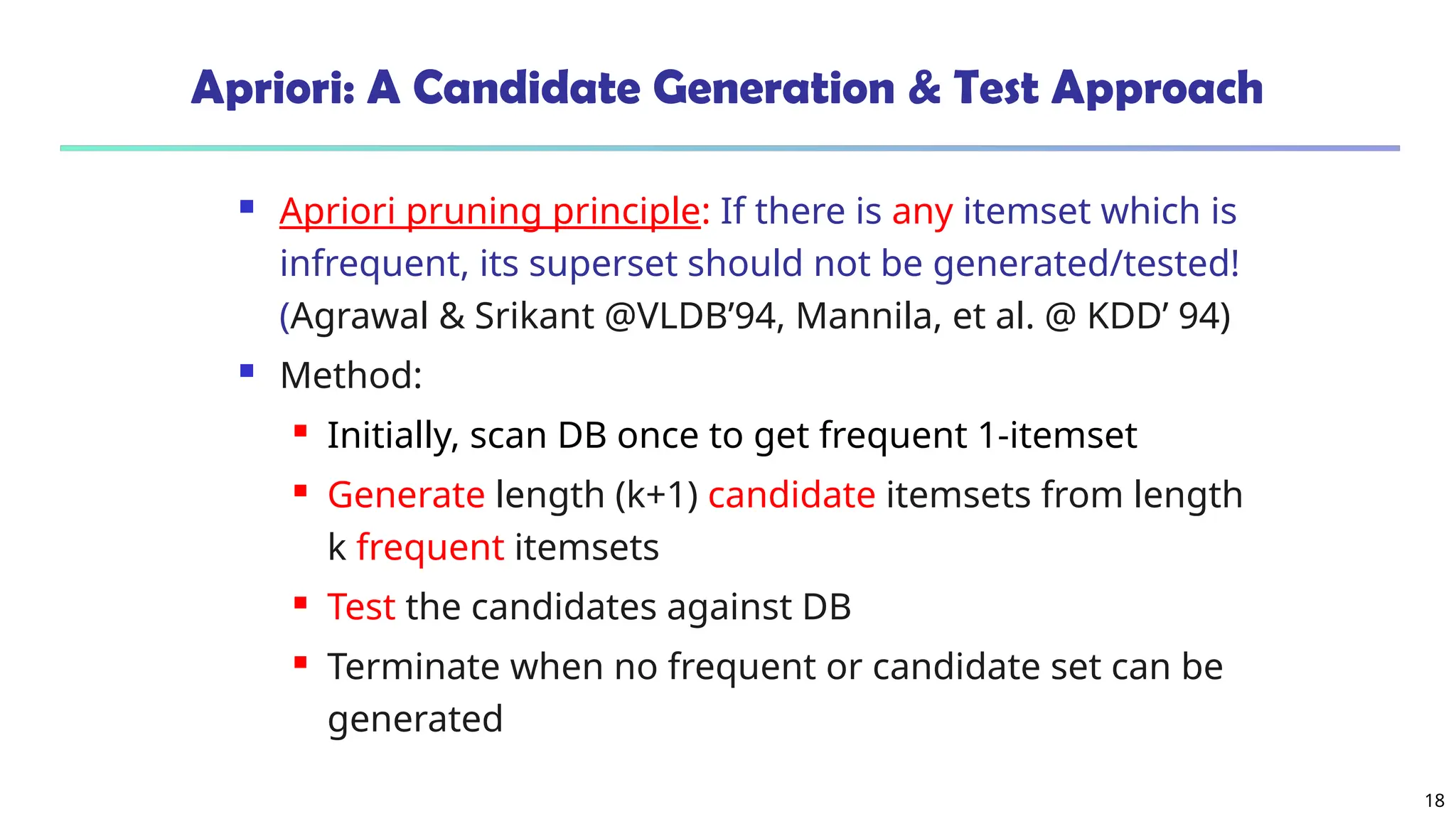
18
Apriori: A Candidate Generation & Test Approach
 Apriori pruning principle: If there is any itemset which is
infrequent, its superset should not be generated/tested!
(Agrawal & Srikant @VLDB’94, Mannila, et al. @ KDD’ 94)
 Method:
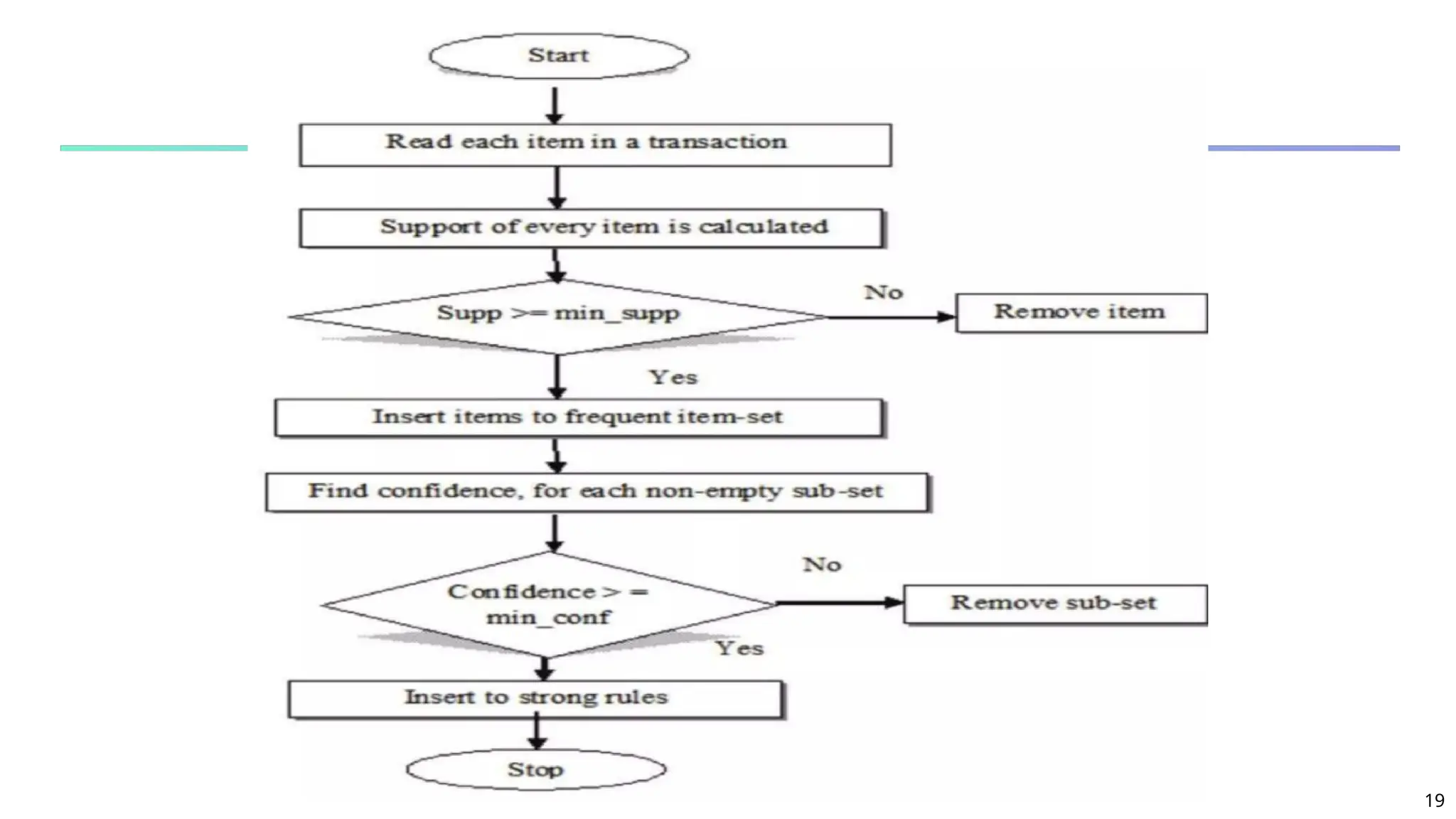
 Initially, scan DB once to get frequent 1-itemset
 Generate length (k+1) candidate itemsets from length
k frequent itemsets
 Test the candidates against DB
 Terminate when no frequent or candidate set can be
generated
19
20
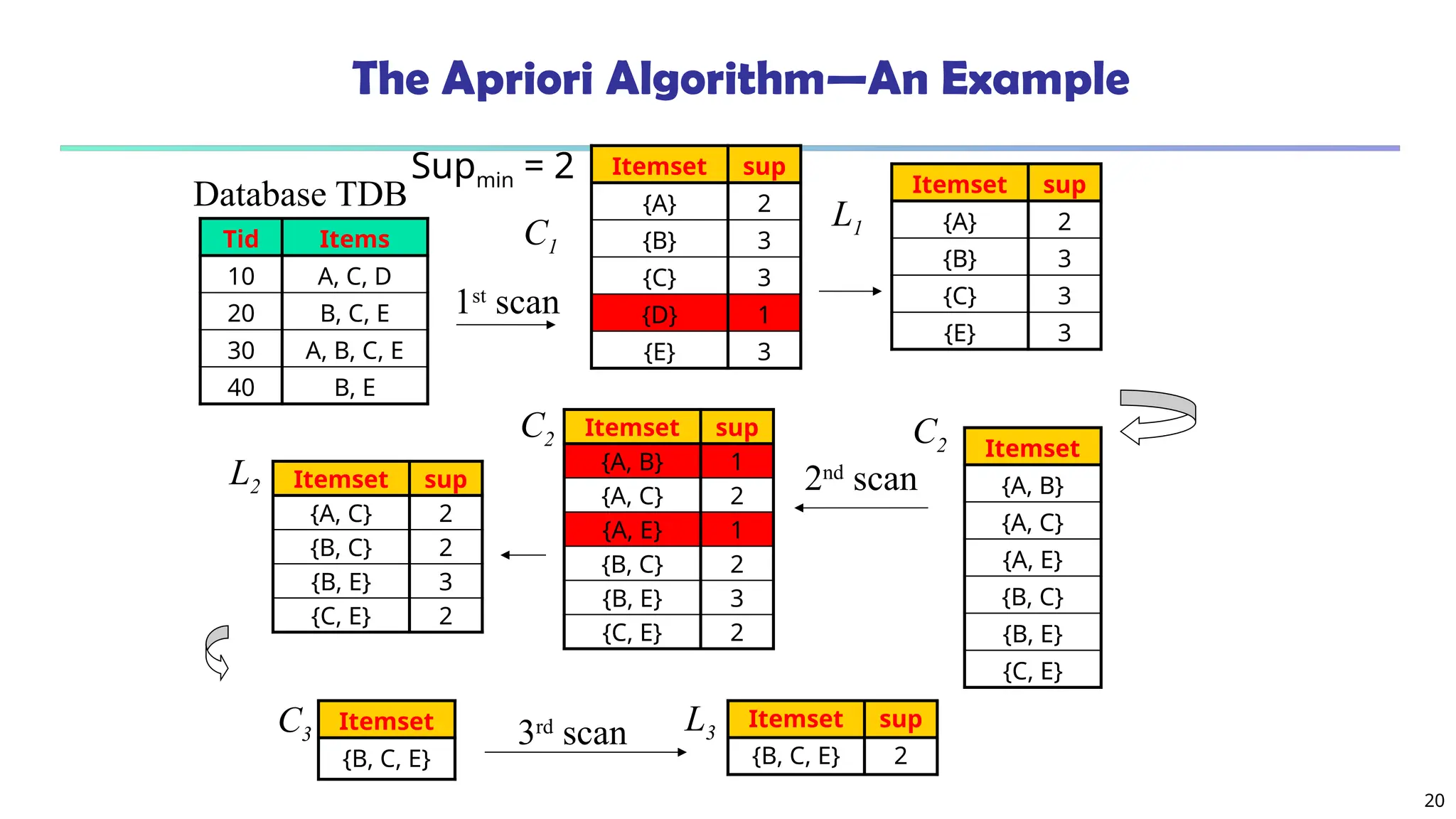
The Apriori Algorithm—An Example
Database TDB
1st
scan
C1
L1
L2
C2 C2
2nd
scan
C3 L3
3rd
scan
Tid Items
10 A, C, D
20 B, C, E
30 A, B, C, E
40 B, E
Itemset sup
{A} 2
{B} 3
{C} 3
{D} 1
{E} 3
Itemset sup
{A} 2
{B} 3
{C} 3
{E} 3
Itemset
{A, B}
{A, C}
{A, E}
{B, C}
{B, E}
{C, E}
Itemset sup
{A, B} 1
{A, C} 2
{A, E} 1
{B, C} 2
{B, E} 3
{C, E} 2
Itemset sup
{A, C} 2
{B, C} 2
{B, E} 3
{C, E} 2
Itemset
{B, C, E}
Itemset sup
{B, C, E} 2
Supmin = 2
21
22
23
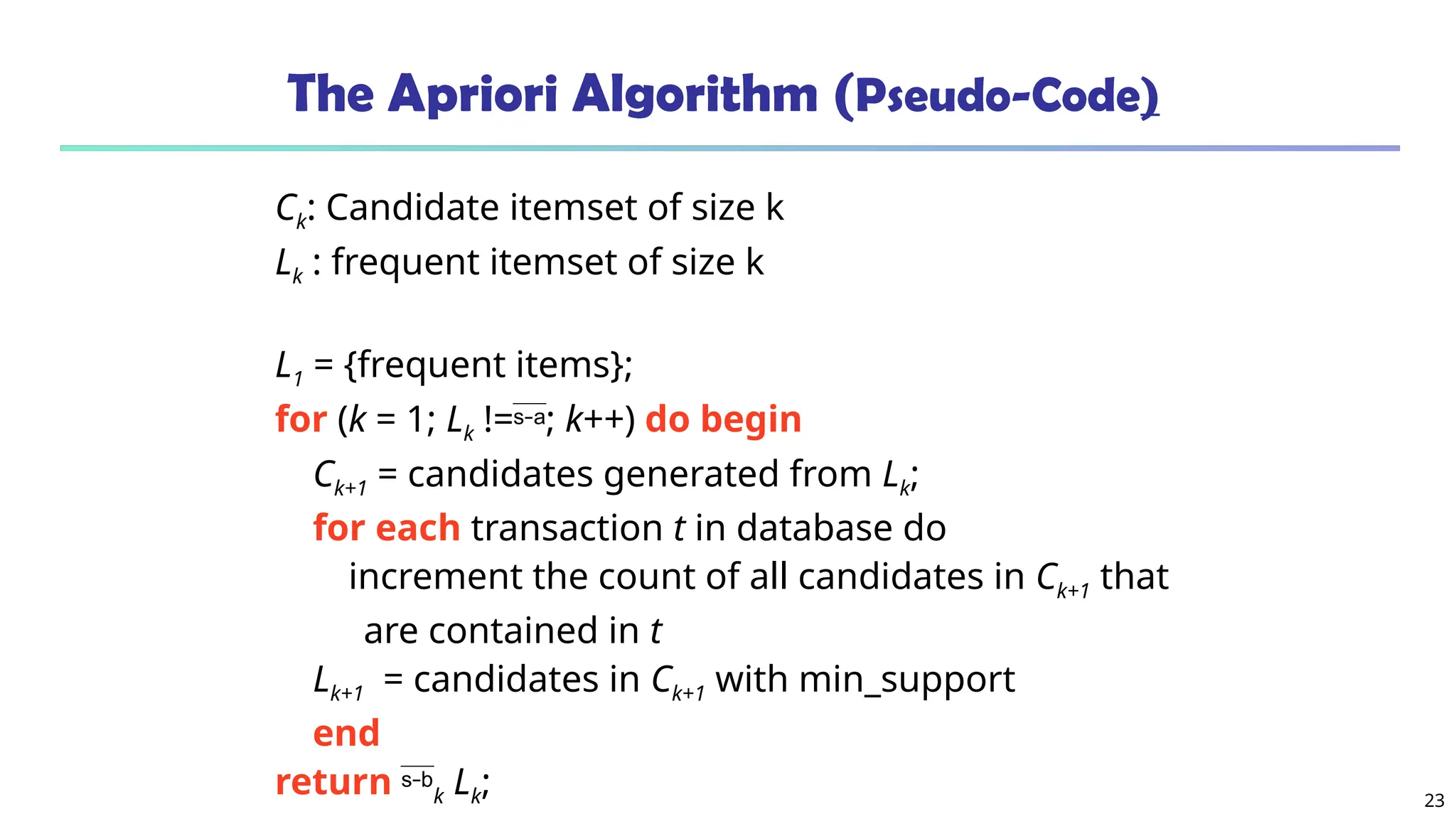
The Apriori Algorithm (Pseudo-Code)
Ck: Candidate itemset of size k
Lk : frequent itemset of size k
L1 = {frequent items};
for (k = 1; Lk !=; k++) do begin
Ck+1 = candidates generated from Lk;
for each transaction t in database do
increment the count of all candidates in Ck+1 that
are contained in t
Lk+1 = candidates in Ck+1 with min_support
end
return k Lk;
24
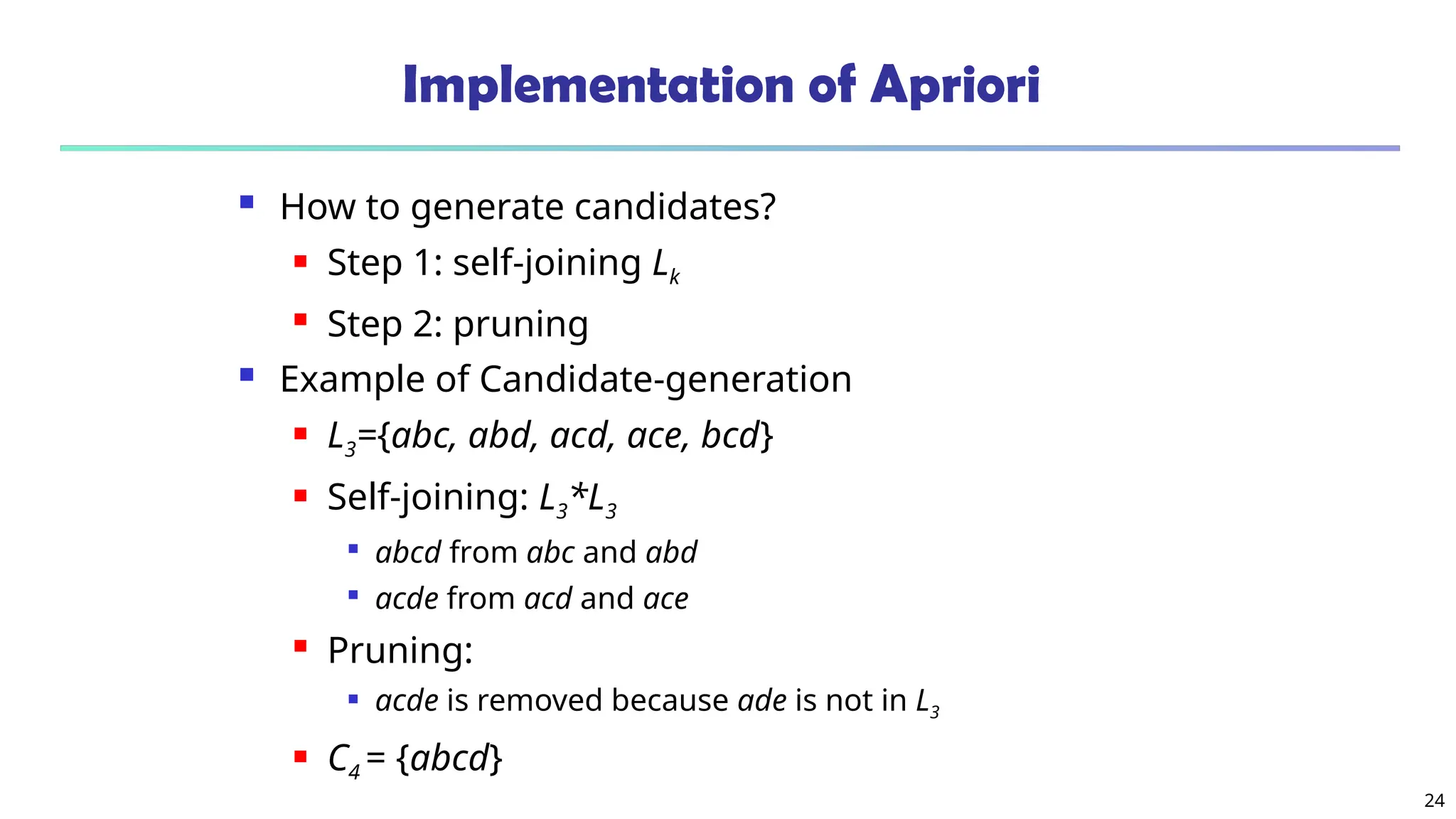
Implementation of Apriori
 How to generate candidates?
 Step 1: self-joining Lk
 Step 2: pruning
 Example of Candidate-generation
 L3={abc, abd, acd, ace, bcd}
 Self-joining: L3*L3

abcd from abc and abd

acde from acd and ace
 Pruning:
 acde is removed because ade is not in L3
 C4 = {abcd}
25
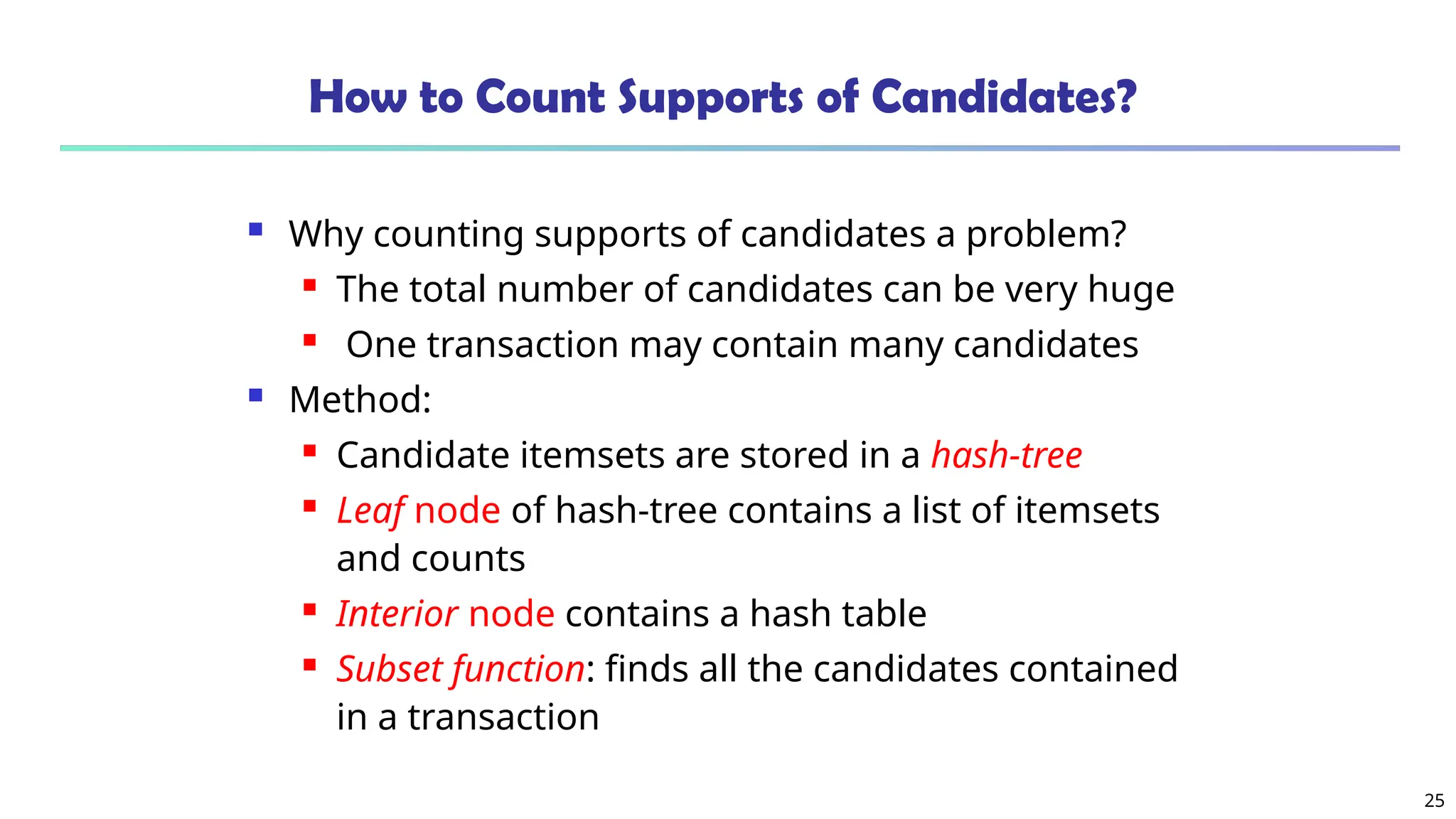
How to Count Supports of Candidates?
 Why counting supports of candidates a problem?
 The total number of candidates can be very huge
 One transaction may contain many candidates
 Method:
 Candidate itemsets are stored in a hash-tree
 Leaf node of hash-tree contains a list of itemsets
and counts
 Interior node contains a hash table
 Subset function: finds all the candidates contained
in a transaction
26
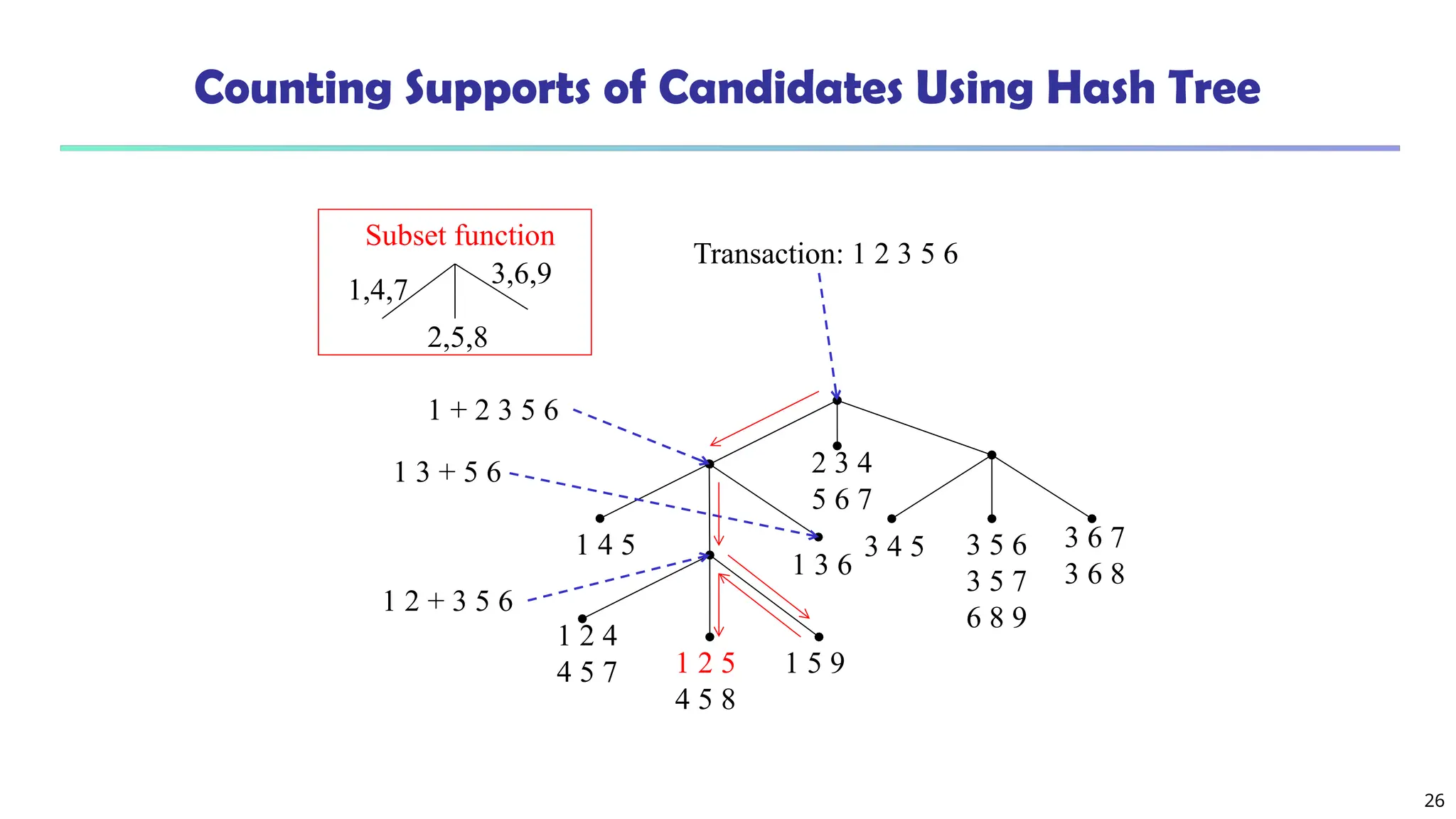
Counting Supports of Candidates Using Hash Tree
1,4,7
2,5,8
3,6,9
Subset function
2 3 4
5 6 7
1 4 5
1 3 6
1 2 4
4 5 7 1 2 5
4 5 8
1 5 9
3 4 5 3 5 6
3 5 7
6 8 9
3 6 7
3 6 8
Transaction: 1 2 3 5 6
1 + 2 3 5 6
1 2 + 3 5 6
1 3 + 5 6
27
Candidate Generation: An SQL Implementation
 SQL Implementation of candidate generation
 Suppose the items in Lk-1 are listed in an order
 Step 1: self-joining Lk-1
insert into Ck
select p.item1, p.item2, …, p.itemk-1, q.itemk-1
from Lk-1 p, Lk-1 q
where p.item1=q.item1, …, p.itemk-2=q.itemk-2, p.itemk-1 < q.itemk-1
 Step 2: pruning
forall itemsets c in Ck do
forall (k-1)-subsets s of c do
if (s is not in Lk-1) then delete c from Ck
 Use object-relational extensions like UDFs, BLOBs, and Table functions for
efficient implementation [See: S. Sarawagi, S. Thomas, and R. Agrawal.
Integrating association rule mining with relational database systems:
Alternatives and implications. SIGMOD’98]
28
Scalable Frequent Itemset Mining Methods
 Apriori: A Candidate Generation-and-Test Approach
 Improving the Efficiency of Apriori
 FPGrowth: A Frequent Pattern-Growth Approach
 ECLAT: Frequent Pattern Mining with Vertical Data Format
 Mining Close Frequent Patterns and Maxpatterns
29
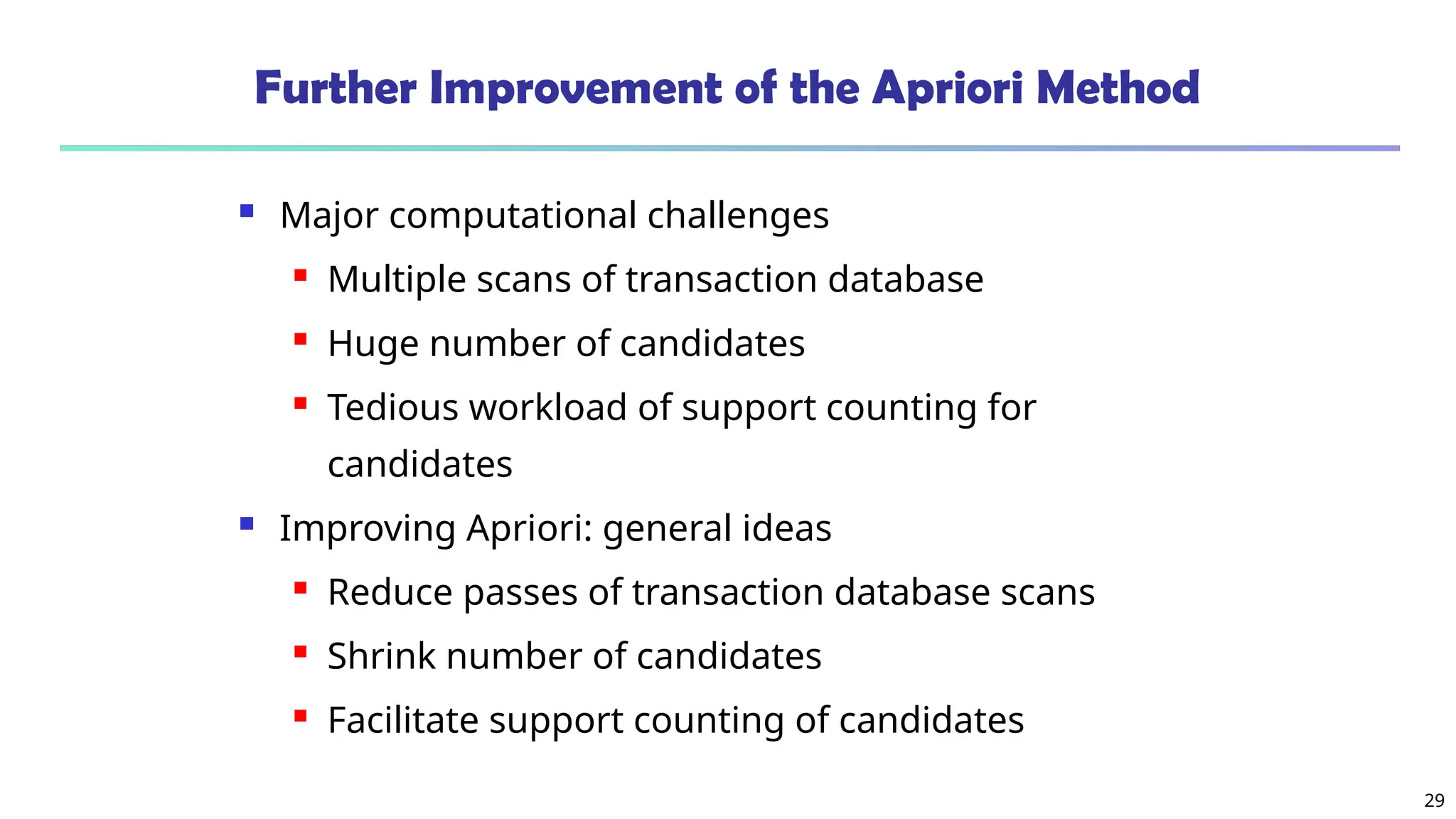
Further Improvement of the Apriori Method
 Major computational challenges
 Multiple scans of transaction database
 Huge number of candidates
 Tedious workload of support counting for
candidates
 Improving Apriori: general ideas
 Reduce passes of transaction database scans
 Shrink number of candidates
 Facilitate support counting of candidates
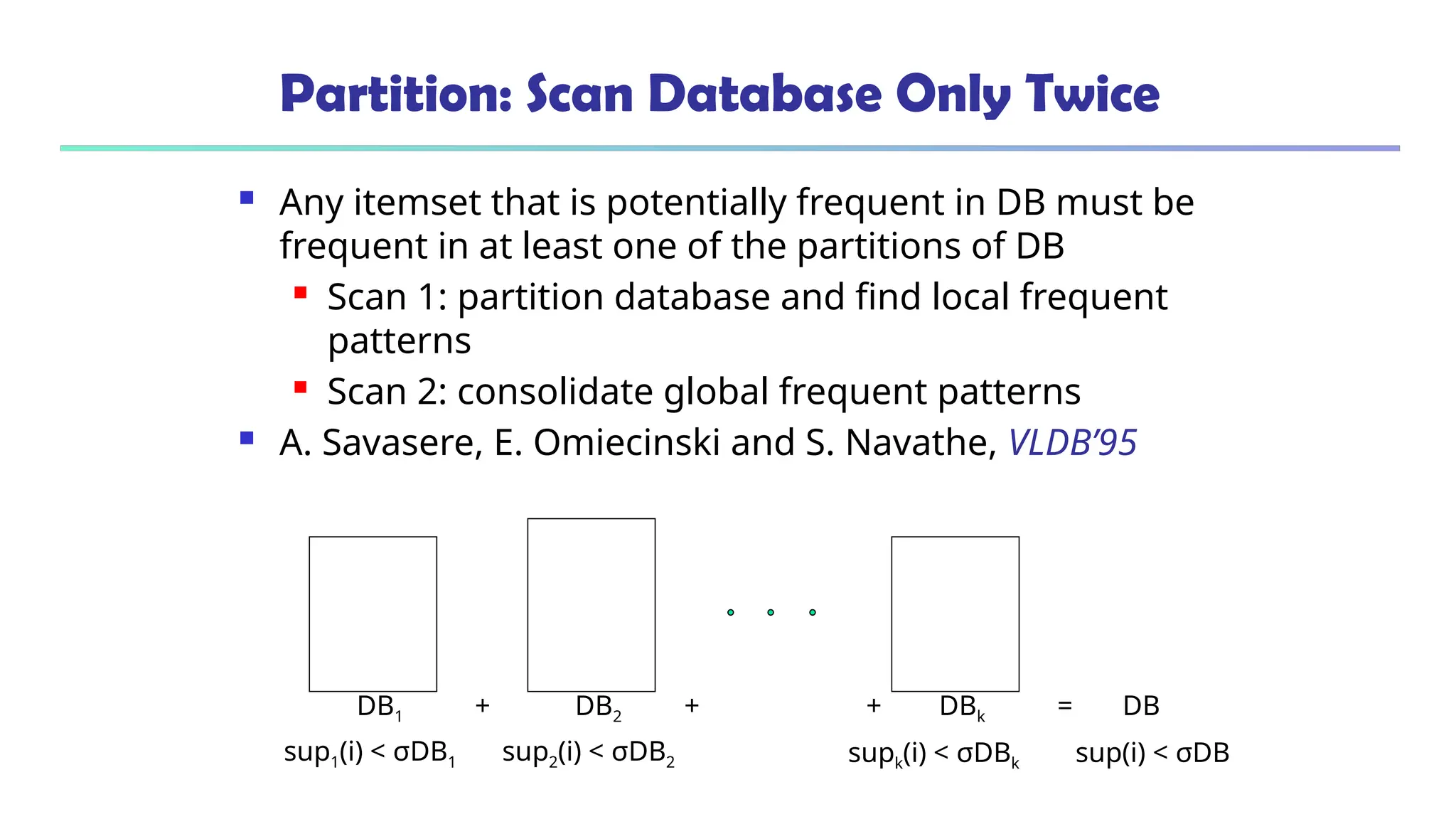
Partition: Scan Database Only Twice
 Any itemset that is potentially frequent in DB must be
frequent in at least one of the partitions of DB
 Scan 1: partition database and find local frequent
patterns
 Scan 2: consolidate global frequent patterns
 A. Savasere, E. Omiecinski and S. Navathe, VLDB’95
DB1 DB2 DBk
+ = DB
+
+
sup1(i) < σDB1 sup2(i) < σDB2 supk(i) < σDBk sup(i) < σDB
31
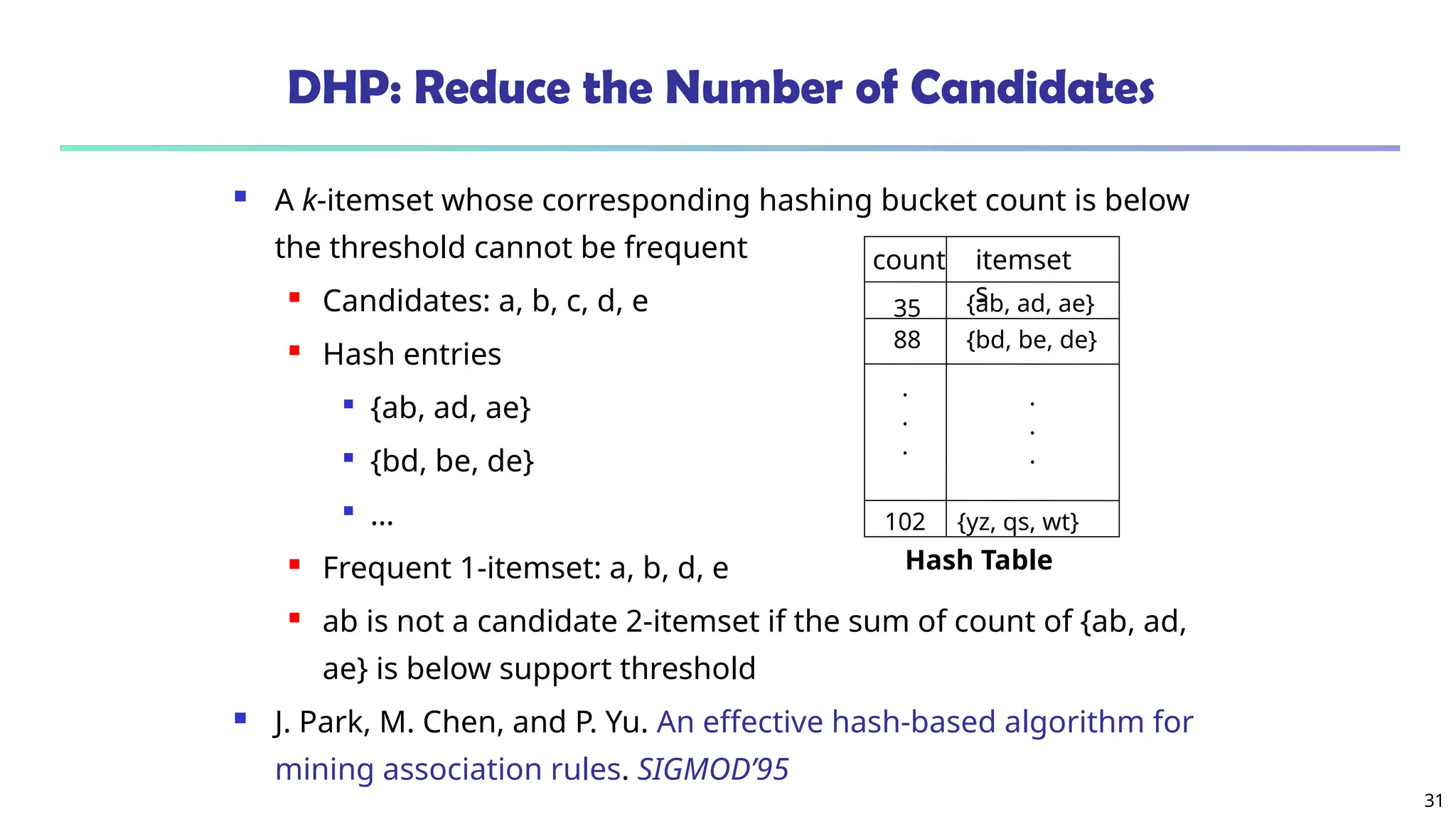
DHP: Reduce the Number of Candidates
 A k-itemset whose corresponding hashing bucket count is below
the threshold cannot be frequent
 Candidates: a, b, c, d, e
 Hash entries

{ab, ad, ae}

{bd, be, de}

…
 Frequent 1-itemset: a, b, d, e
 ab is not a candidate 2-itemset if the sum of count of {ab, ad,
ae} is below support threshold
 J. Park, M. Chen, and P. Yu. An effective hash-based algorithm for
mining association rules. SIGMOD’95
count itemset
s
35 {ab, ad, ae}
{yz, qs, wt}
88
102
.
.
.
{bd, be, de}
.
.
.
Hash Table
32
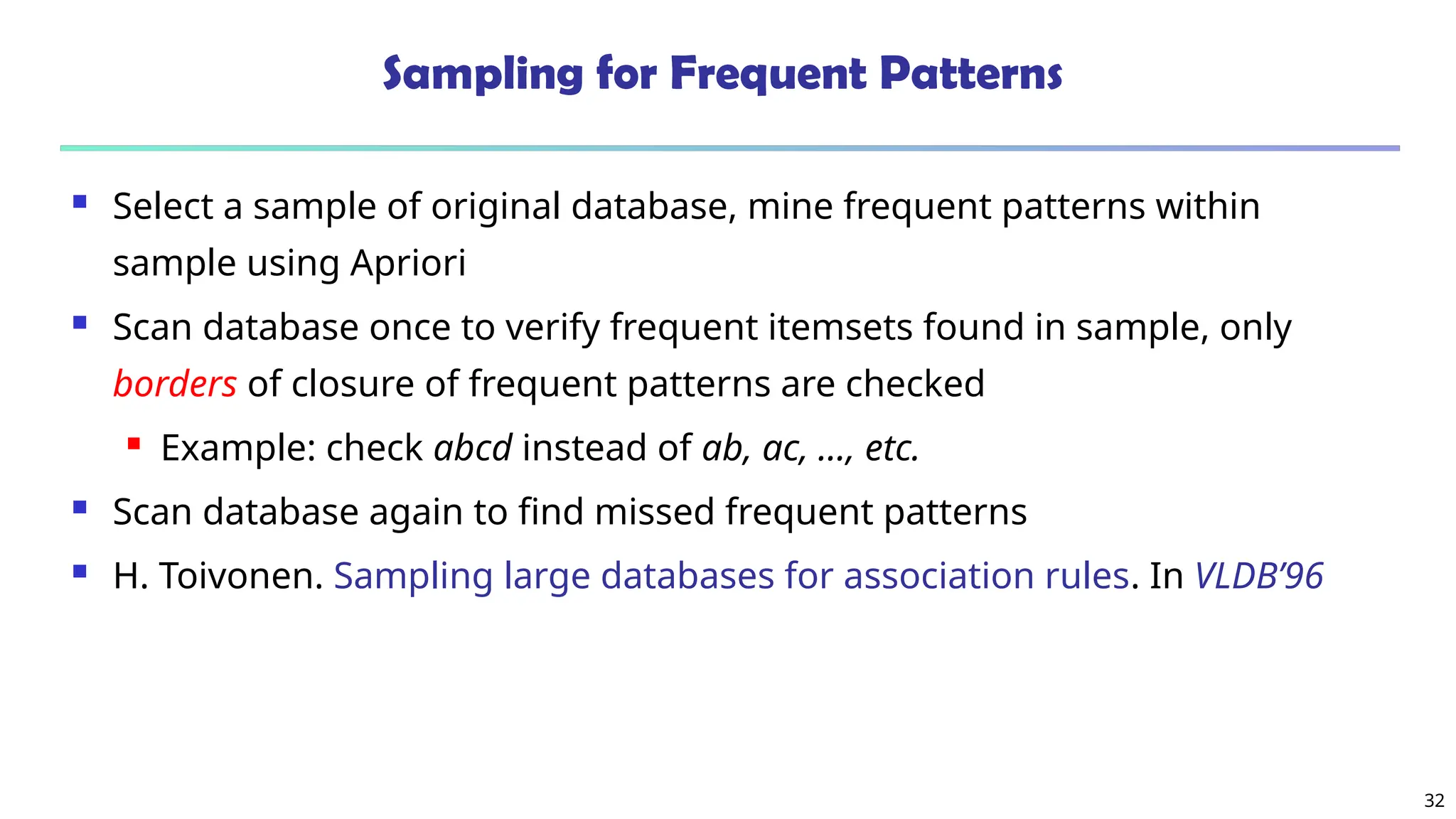
Sampling for Frequent Patterns
 Select a sample of original database, mine frequent patterns within
sample using Apriori
 Scan database once to verify frequent itemsets found in sample, only
borders of closure of frequent patterns are checked
 Example: check abcd instead of ab, ac, …, etc.
 Scan database again to find missed frequent patterns
 H. Toivonen. Sampling large databases for association rules. In VLDB’96
33
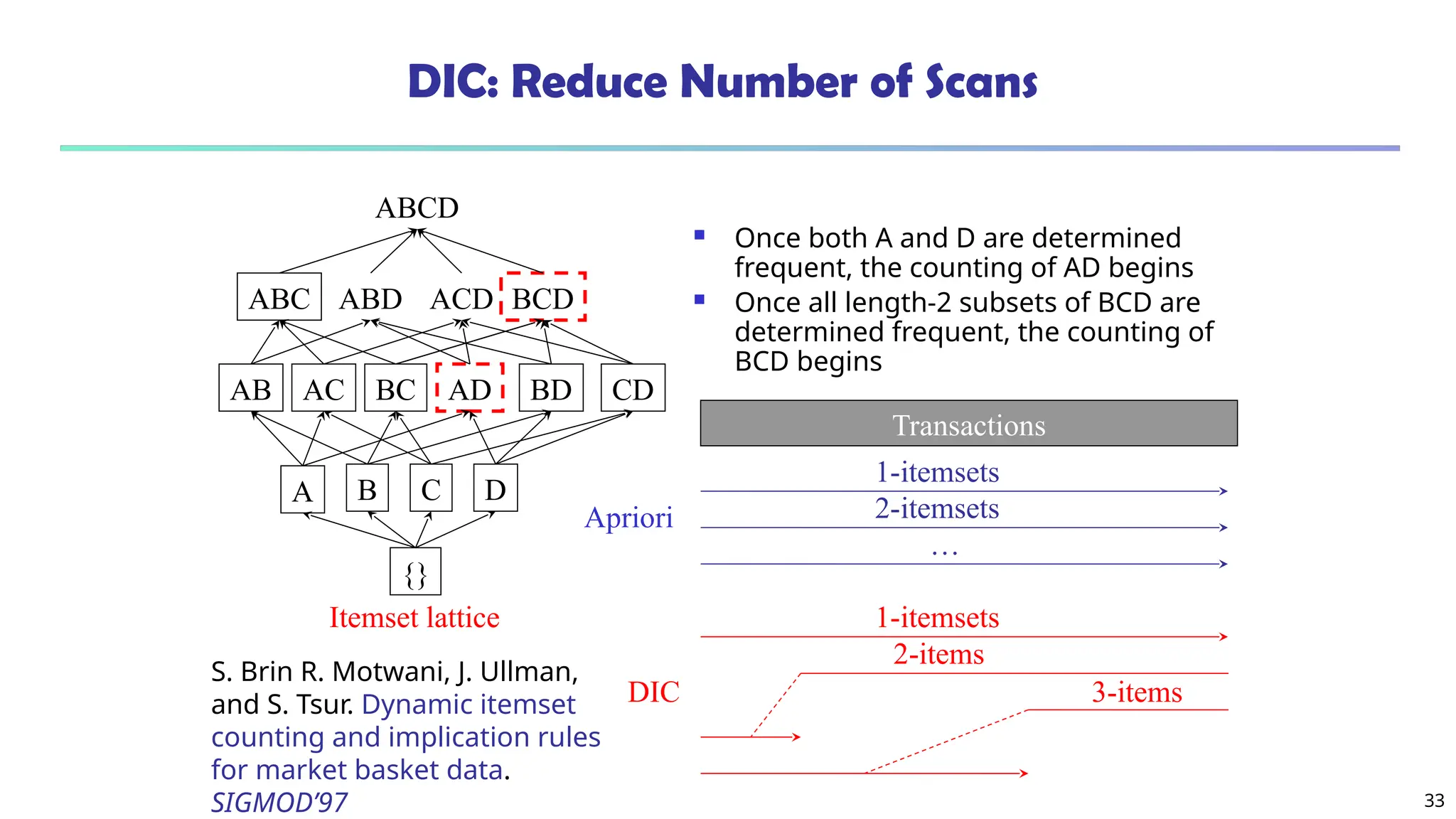
DIC: Reduce Number of Scans
ABCD
ABC ABD ACD BCD
AB AC BC AD BD CD
A B C D
{}
Itemset lattice
 Once both A and D are determined
frequent, the counting of AD begins
 Once all length-2 subsets of BCD are
determined frequent, the counting of
BCD begins
Transactions
1-itemsets
2-itemsets
…
Apriori
1-itemsets
2-items
3-items
DIC
S. Brin R. Motwani, J. Ullman,
and S. Tsur. Dynamic itemset
counting and implication rules
for market basket data.
SIGMOD’97
34
Scalable Frequent Itemset Mining Methods
 Apriori: A Candidate Generation-and-Test Approach
 Improving the Efficiency of Apriori
 FPGrowth: A Frequent Pattern-Growth Approach
 ECLAT: Frequent Pattern Mining with Vertical Data Format
 Mining Close Frequent Patterns and Maxpatterns
35
Pattern-Growth Approach: Mining Frequent
Patterns Without Candidate Generation
 Bottlenecks of the Apriori approach
 Breadth-first (i.e., level-wise) search
 Candidate generation and test

Often generates a huge number of candidates
 The FPGrowth Approach (J. Han, J. Pei, and Y. Yin, SIGMOD’ 00)
 Depth-first search
 Avoid explicit candidate generation
 Major philosophy: Grow long patterns from short ones using local
frequent items only
 “abc” is a frequent pattern
 Get all transactions having “abc”, i.e., project DB on abc: DB|abc
 “d” is a local frequent item in DB|abc  abcd is a frequent
pattern
36
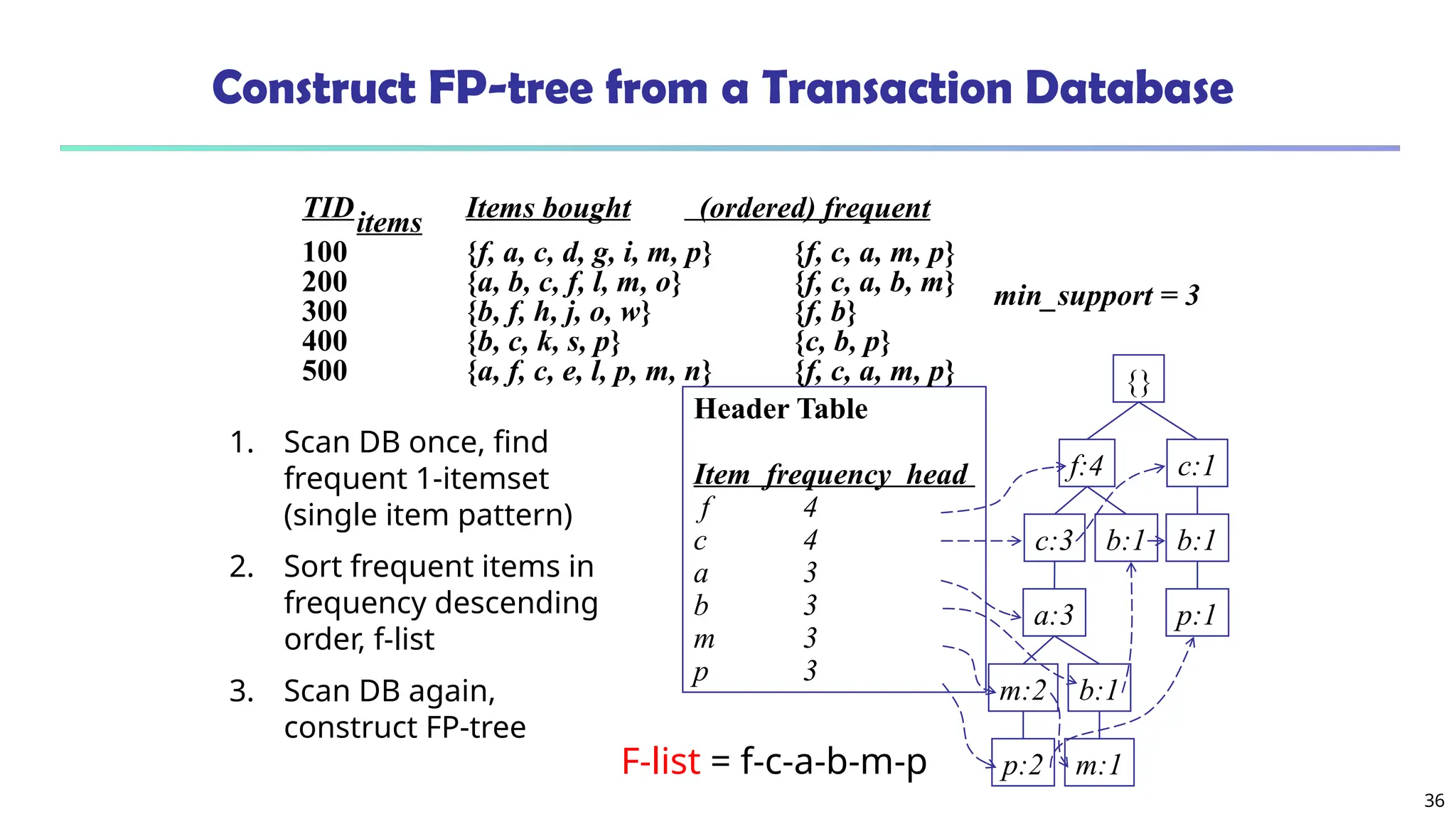
Construct FP-tree from a Transaction Database
{}
f:4 c:1
b:1
p:1
b:1
c:3
a:3
b:1
m:2
p:2 m:1
Header Table
Item frequency head
f 4
c 4
a 3
b 3
m 3
p 3
min_support = 3
TID Items bought (ordered) frequent
items
100 {f, a, c, d, g, i, m, p} {f, c, a, m, p}
200 {a, b, c, f, l, m, o} {f, c, a, b, m}
300 {b, f, h, j, o, w} {f, b}
400 {b, c, k, s, p} {c, b, p}
500 {a, f, c, e, l, p, m, n} {f, c, a, m, p}
1. Scan DB once, find
frequent 1-itemset
(single item pattern)
2. Sort frequent items in
frequency descending
order, f-list
3. Scan DB again,
construct FP-tree
F-list = f-c-a-b-m-p
37
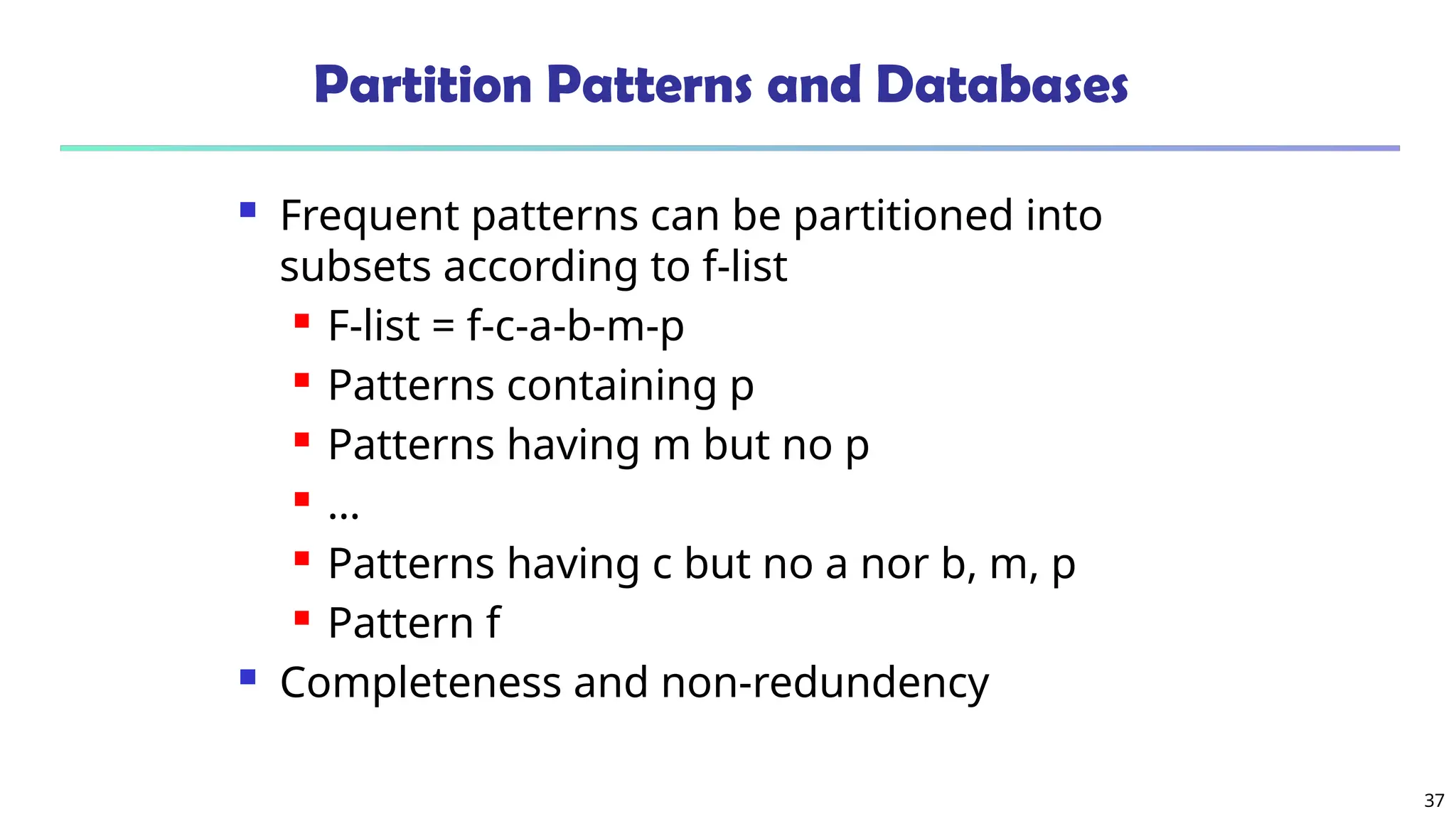
Partition Patterns and Databases
 Frequent patterns can be partitioned into
subsets according to f-list
 F-list = f-c-a-b-m-p
 Patterns containing p
 Patterns having m but no p
 …
 Patterns having c but no a nor b, m, p
 Pattern f
 Completeness and non-redundency
38
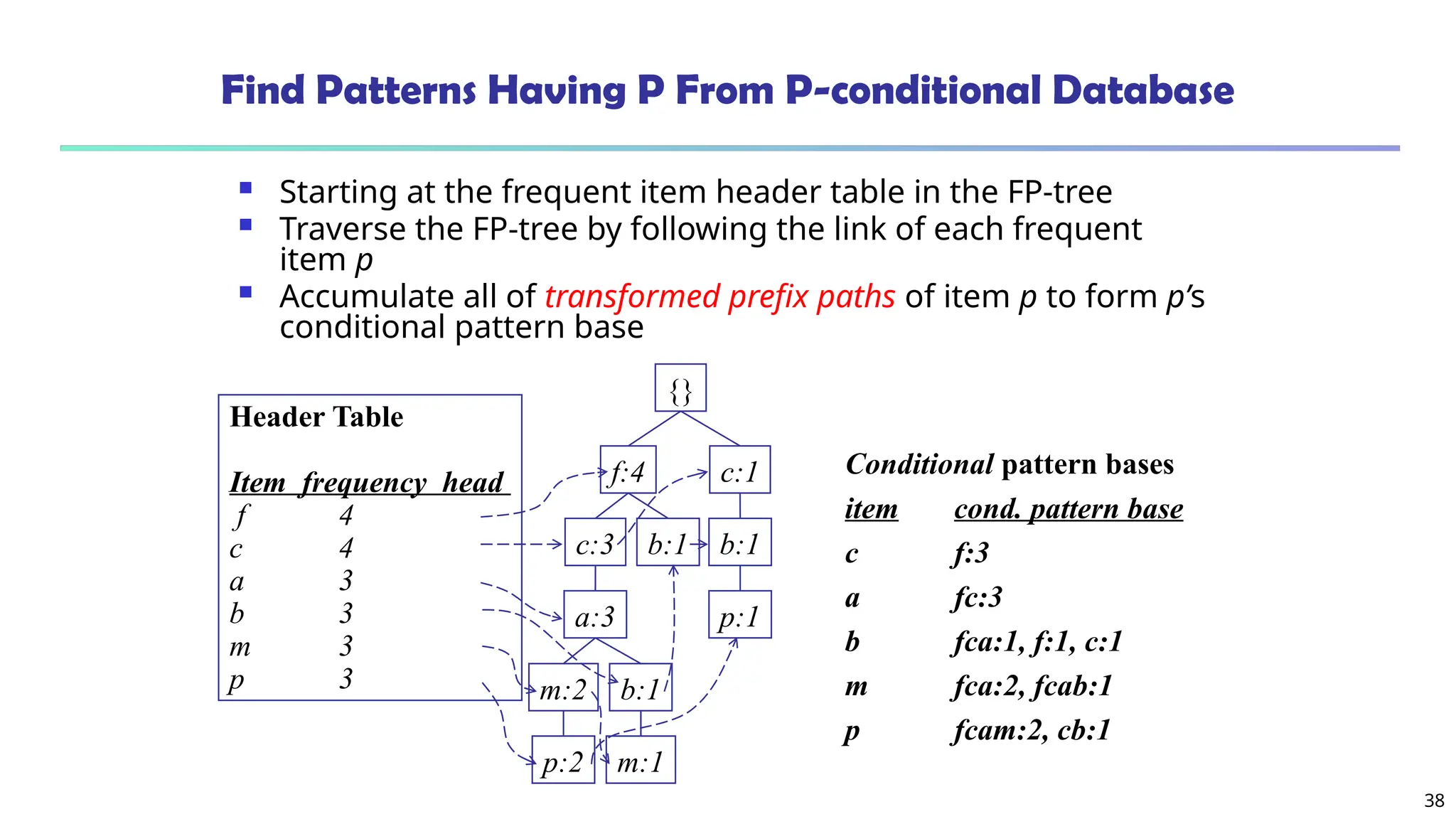
Find Patterns Having P From P-conditional Database
 Starting at the frequent item header table in the FP-tree
 Traverse the FP-tree by following the link of each frequent
item p
 Accumulate all of transformed prefix paths of item p to form p’s
conditional pattern base
Conditional pattern bases
item cond. pattern base
c f:3
a fc:3
b fca:1, f:1, c:1
m fca:2, fcab:1
p fcam:2, cb:1
{}
f:4 c:1
b:1
p:1
b:1
c:3
a:3
b:1
m:2
p:2 m:1
Header Table
Item frequency head
f 4
c 4
a 3
b 3
m 3
p 3
39
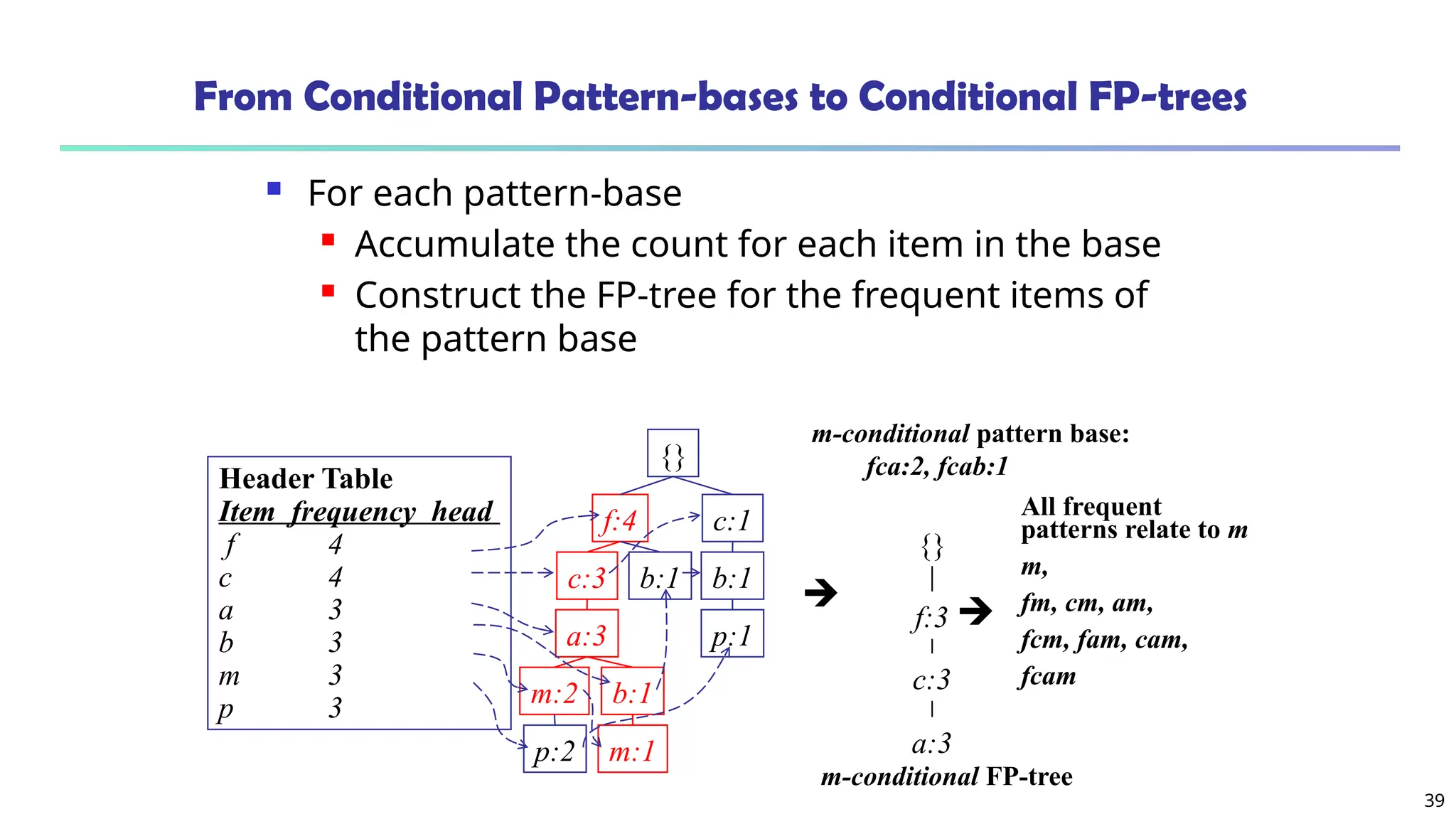
From Conditional Pattern-bases to Conditional FP-trees
 For each pattern-base
 Accumulate the count for each item in the base
 Construct the FP-tree for the frequent items of
the pattern base
m-conditional pattern base:
fca:2, fcab:1
{}
f:3
c:3
a:3
m-conditional FP-tree
All frequent
patterns relate to m
m,
fm, cm, am,
fcm, fam, cam,
fcam


{}
f:4 c:1
b:1
p:1
b:1
c:3
a:3
b:1
m:2
p:2 m:1
Header Table
Item frequency head
f 4
c 4
a 3
b 3
m 3
p 3
40
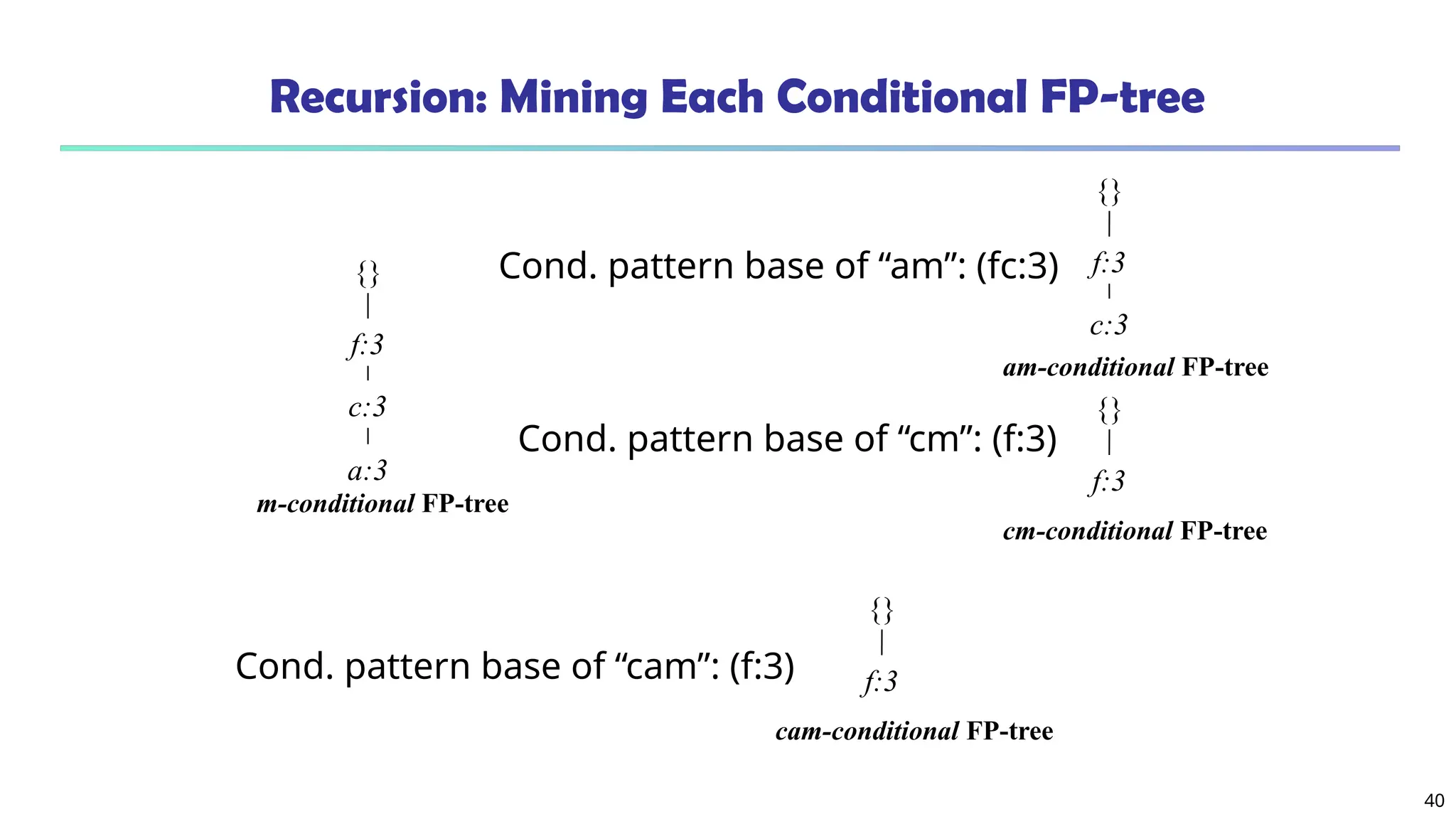
Recursion: Mining Each Conditional FP-tree
{}
f:3
c:3
a:3
m-conditional FP-tree
Cond. pattern base of “am”: (fc:3)
{}
f:3
c:3
am-conditional FP-tree
Cond. pattern base of “cm”: (f:3)
{}
f:3
cm-conditional FP-tree
Cond. pattern base of “cam”: (f:3)
{}
f:3
cam-conditional FP-tree
41
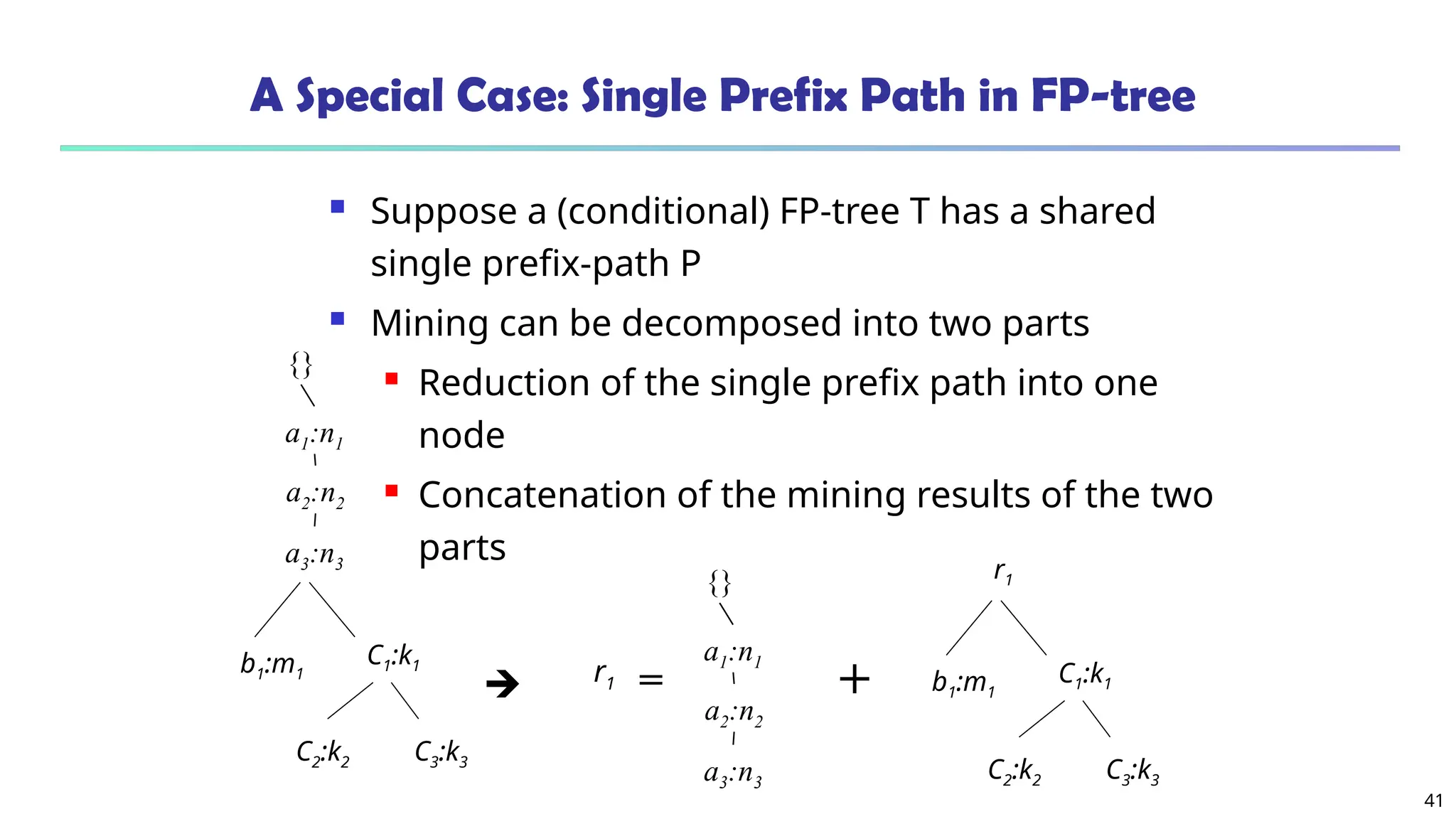
A Special Case: Single Prefix Path in FP-tree
 Suppose a (conditional) FP-tree T has a shared
single prefix-path P
 Mining can be decomposed into two parts
 Reduction of the single prefix path into one
node
 Concatenation of the mining results of the two
parts

a2:n2
a3:n3
a1:n1
{}
b1:m1
C1:k1
C2:k2 C3:k3
b1:m1
C1:k1
C2:k2 C3:k3
r1
+
a2:n2
a3:n3
a1:n1
{}
r1 =
42
Benefits of the FP-tree Structure
 Completeness
 Preserve complete information for frequent pattern
mining
 Never break a long pattern of any transaction
 Compactness
 Reduce irrelevant info—infrequent items are gone
 Items in frequency descending order: the more
frequently occurring, the more likely to be shared
 Never be larger than the original database (not count
node-links and the count field)
43
The Frequent Pattern Growth Mining Method
 Idea: Frequent pattern growth
 Recursively grow frequent patterns by pattern and
database partition
 Method
 For each frequent item, construct its conditional
pattern-base, and then its conditional FP-tree
 Repeat the process on each newly created
conditional FP-tree
 Until the resulting FP-tree is empty, or it contains
only one path—single path will generate all the
combinations of its sub-paths, each of which is a
frequent pattern
44
Scaling FP-growth by Database Projection
 What about if FP-tree cannot fit in memory?
 DB projection
 First partition a database into a set of projected DBs
 Then construct and mine FP-tree for each projected DB
 Parallel projection vs. partition projection techniques
 Parallel projection

Project the DB in parallel for each frequent item

Parallel projection is space costly

All the partitions can be processed in parallel
 Partition projection

Partition the DB based on the ordered frequent items

Passing the unprocessed parts to the subsequent partitions
45
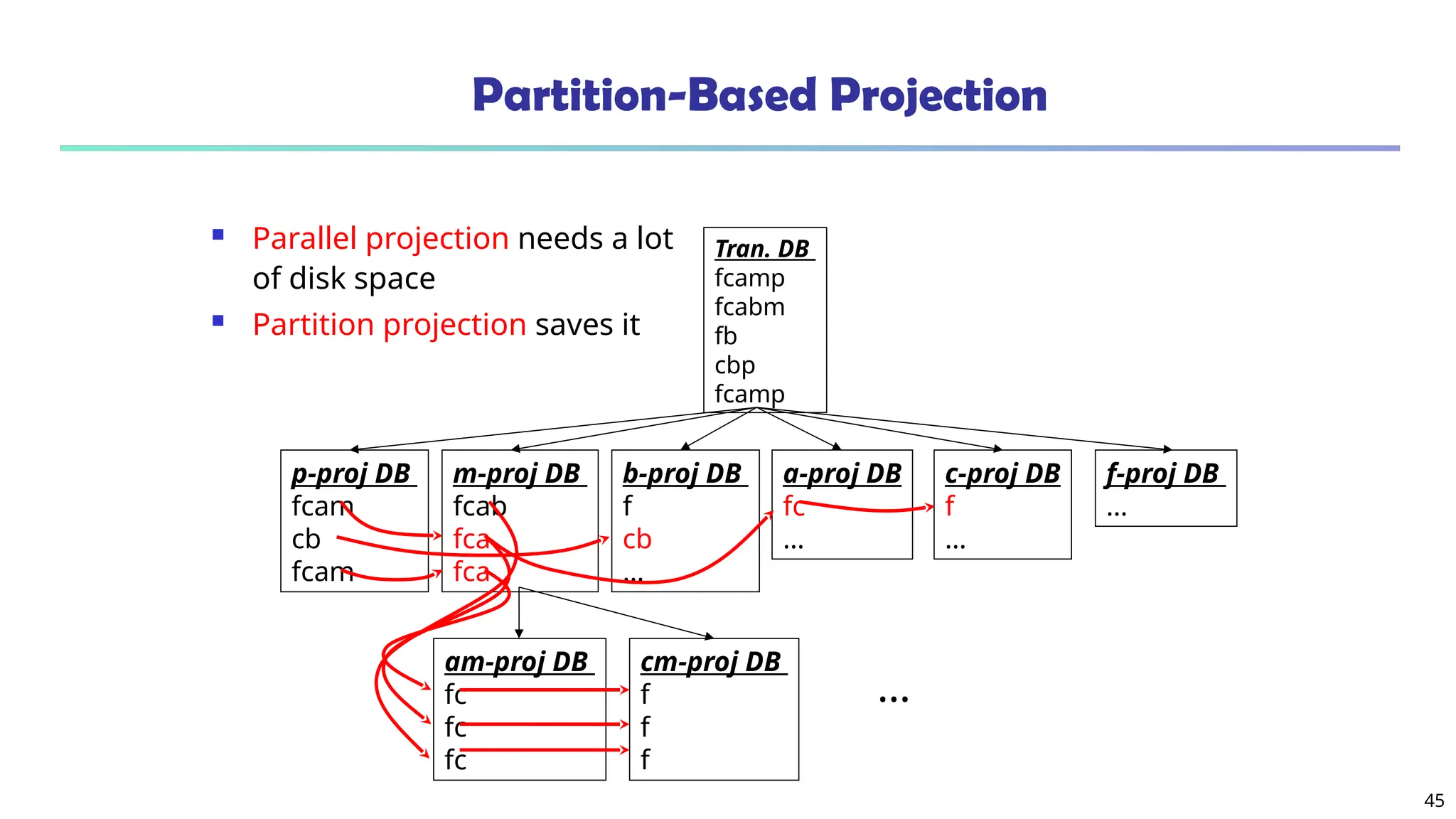
Partition-Based Projection
 Parallel projection needs a lot
of disk space
 Partition projection saves it
Tran. DB
fcamp
fcabm
fb
cbp
fcamp
p-proj DB
fcam
cb
fcam
m-proj DB
fcab
fca
fca
b-proj DB
f
cb
…
a-proj DB
fc
…
c-proj DB
f
…
f-proj DB
…
am-proj DB
fc
fc
fc
cm-proj DB
f
f
f
…
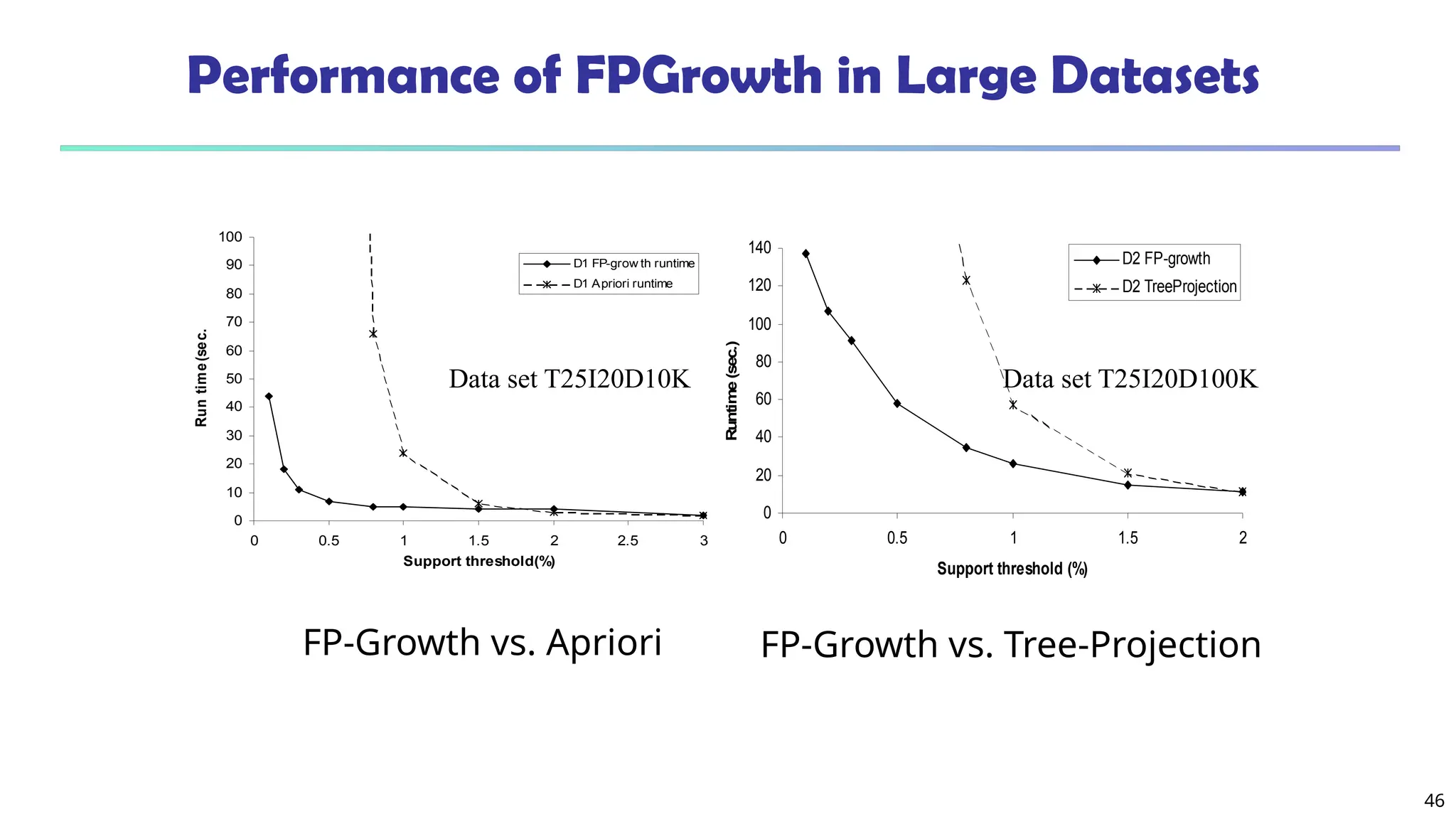
Performance of FPGrowth in Large Datasets
FP-Growth vs. Apriori
46
0
10
20
30
40
50
60
70
80
90
100
0 0.5 1 1.5 2 2.5 3
Support threshold(%)
Run
tim
e(sec.)
D1 FP-grow th runtime
D1 Apriori runtime
Data set T25I20D10K
0
20
40
60
80
100
120
140
0 0.5 1 1.5 2
Support threshold (%)
Runtime
(sec.)
D2 FP-growth
D2 TreeProjection
Data set T25I20D100K
FP-Growth vs. Tree-Projection
47
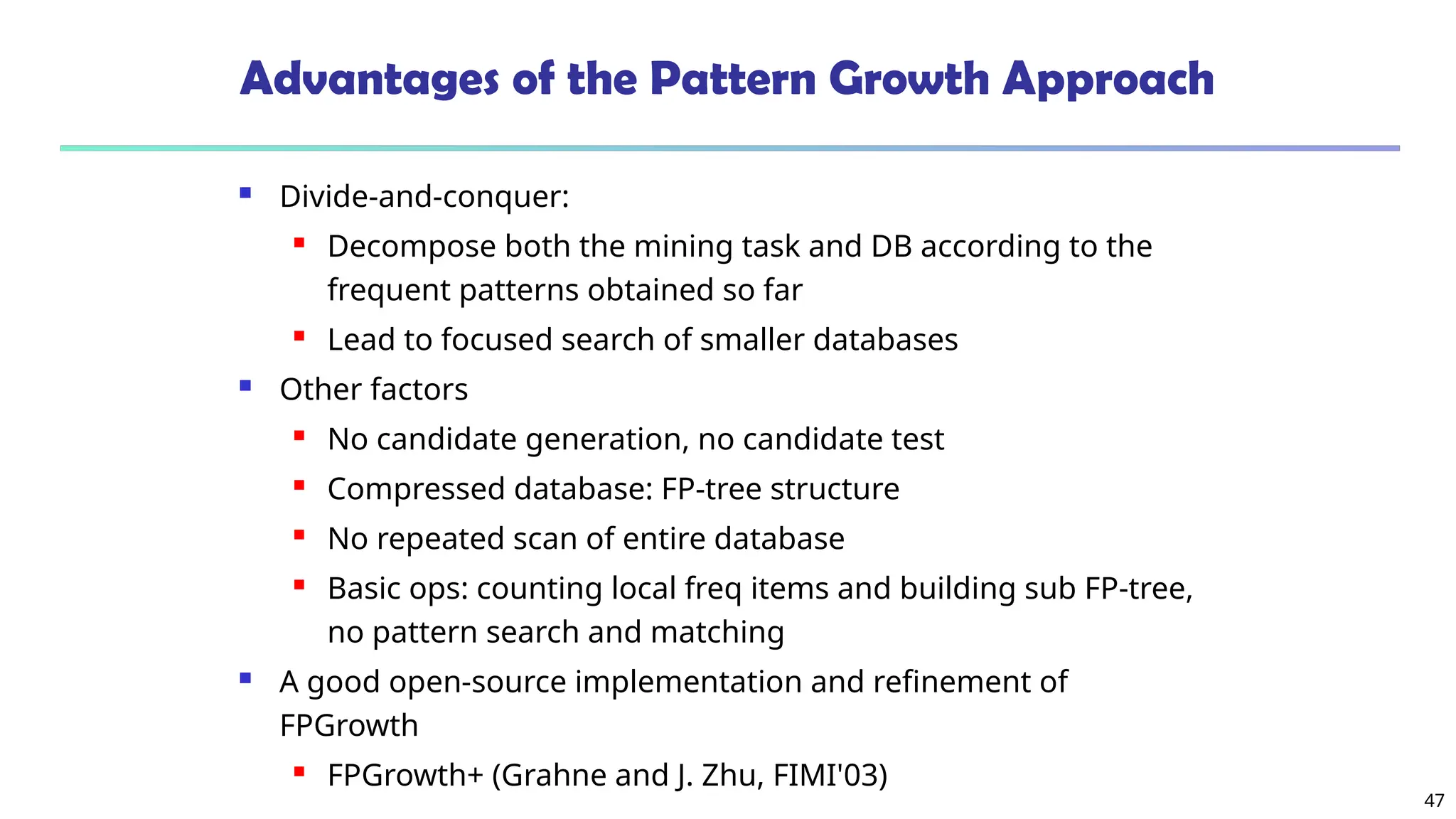
Advantages of the Pattern Growth Approach
 Divide-and-conquer:
 Decompose both the mining task and DB according to the
frequent patterns obtained so far
 Lead to focused search of smaller databases
 Other factors
 No candidate generation, no candidate test
 Compressed database: FP-tree structure
 No repeated scan of entire database
 Basic ops: counting local freq items and building sub FP-tree,
no pattern search and matching
 A good open-source implementation and refinement of
FPGrowth
 FPGrowth+ (Grahne and J. Zhu, FIMI'03)
48
Further Improvements of Mining Methods
 AFOPT (Liu, et al. @ KDD’03)
 A “push-right” method for mining condensed frequent pattern
(CFP) tree
 Carpenter (Pan, et al. @ KDD’03)
 Mine data sets with small rows but numerous columns
 Construct a row-enumeration tree for efficient mining
 FPgrowth+ (Grahne and Zhu, FIMI’03)
 Efficiently Using Prefix-Trees in Mining Frequent Itemsets,
Proc. ICDM'03 Int. Workshop on Frequent Itemset Mining
Implementations (FIMI'03), Melbourne, FL, Nov. 2003
 TD-Close (Liu, et al, SDM’06)
49
Extension of Pattern Growth Mining Methodology
 Mining closed frequent itemsets and max-patterns
 CLOSET (DMKD’00), FPclose, and FPMax (Grahne & Zhu, Fimi’03)
 Mining sequential patterns
 PrefixSpan (ICDE’01), CloSpan (SDM’03), BIDE (ICDE’04)
 Mining graph patterns
 gSpan (ICDM’02), CloseGraph (KDD’03)
 Constraint-based mining of frequent patterns
 Convertible constraints (ICDE’01), gPrune (PAKDD’03)
 Computing iceberg data cubes with complex measures
 H-tree, H-cubing, and Star-cubing (SIGMOD’01, VLDB’03)
 Pattern-growth-based Clustering
 MaPle (Pei, et al., ICDM’03)
 Pattern-Growth-Based Classification
 Mining frequent and discriminative patterns (Cheng, et al,
ICDE’07)
50
Scalable Frequent Itemset Mining Methods
 Apriori: A Candidate Generation-and-Test Approach
 Improving the Efficiency of Apriori
 FPGrowth: A Frequent Pattern-Growth Approach
 ECLAT: Frequent Pattern Mining with Vertical Data Format
 Mining Close Frequent Patterns and Maxpatterns
51
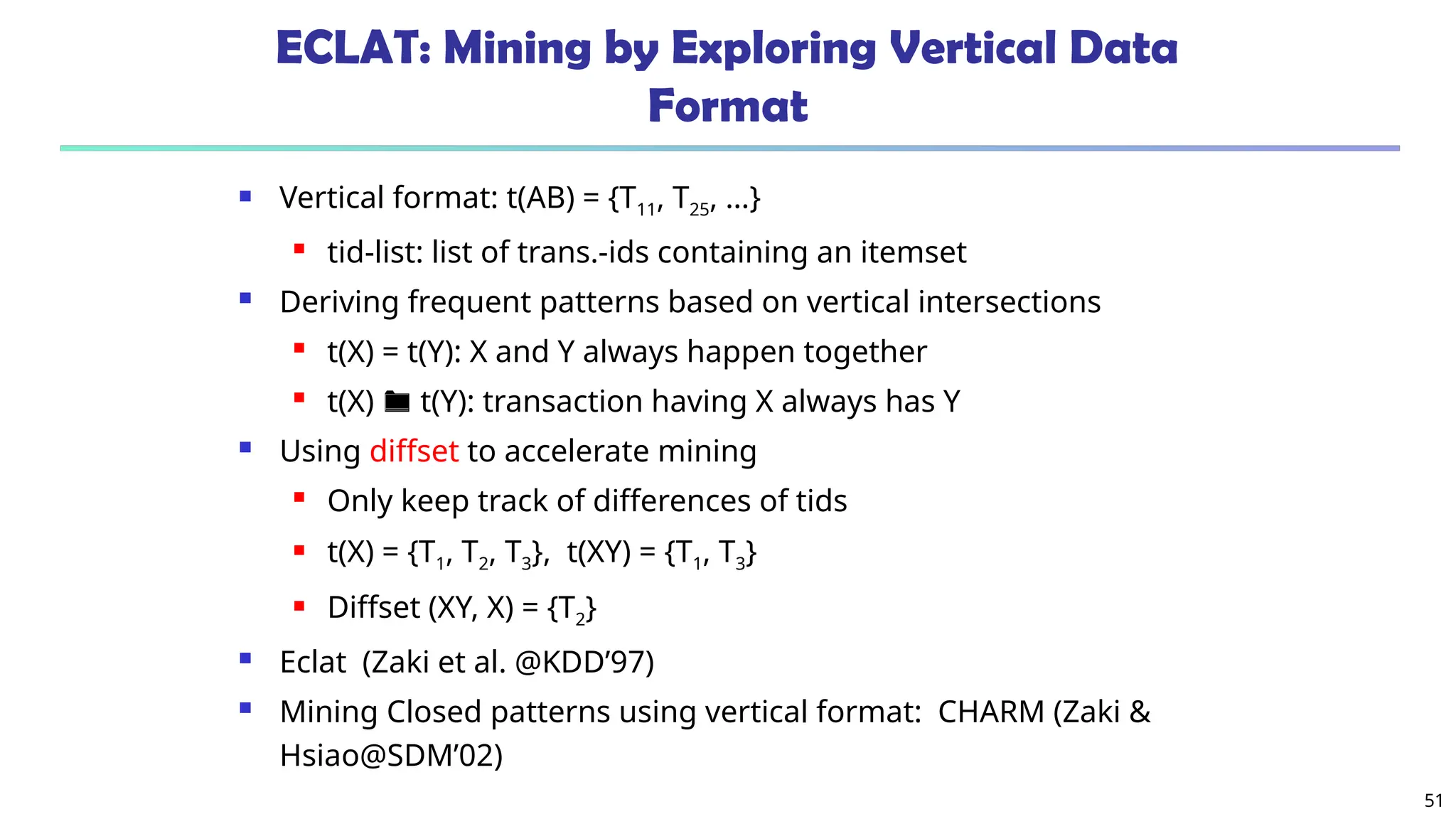
ECLAT: Mining by Exploring Vertical Data
Format
 Vertical format: t(AB) = {T11, T25, …}
 tid-list: list of trans.-ids containing an itemset
 Deriving frequent patterns based on vertical intersections
 t(X) = t(Y): X and Y always happen together
 t(X)  t(Y): transaction having X always has Y
 Using diffset to accelerate mining
 Only keep track of differences of tids
 t(X) = {T1, T2, T3}, t(XY) = {T1, T3}
 Diffset (XY, X) = {T2}
 Eclat (Zaki et al. @KDD’97)
 Mining Closed patterns using vertical format: CHARM (Zaki &
Hsiao@SDM’02)
52
Scalable Frequent Itemset Mining Methods
 Apriori: A Candidate Generation-and-Test Approach
 Improving the Efficiency of Apriori
 FPGrowth: A Frequent Pattern-Growth Approach
 ECLAT: Frequent Pattern Mining with Vertical Data Format
 Mining Close Frequent Patterns and Maxpatterns
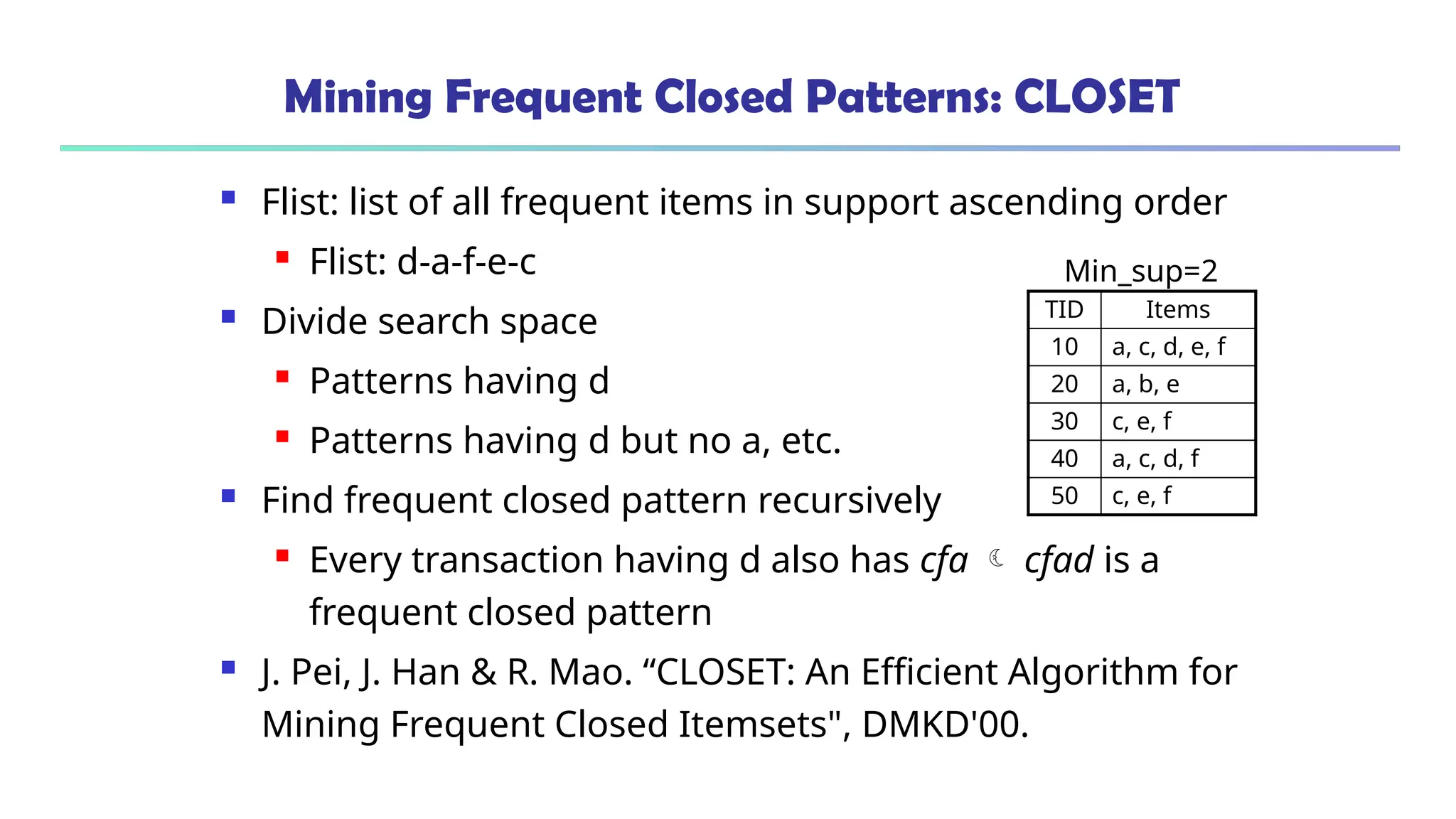
Mining Frequent Closed Patterns: CLOSET
 Flist: list of all frequent items in support ascending order
 Flist: d-a-f-e-c
 Divide search space
 Patterns having d
 Patterns having d but no a, etc.
 Find frequent closed pattern recursively
 Every transaction having d also has cfa  cfad is a
frequent closed pattern
 J. Pei, J. Han & R. Mao. “CLOSET: An Efficient Algorithm for
Mining Frequent Closed Itemsets", DMKD'00.
TID Items
10 a, c, d, e, f
20 a, b, e
30 c, e, f
40 a, c, d, f
50 c, e, f
Min_sup=2
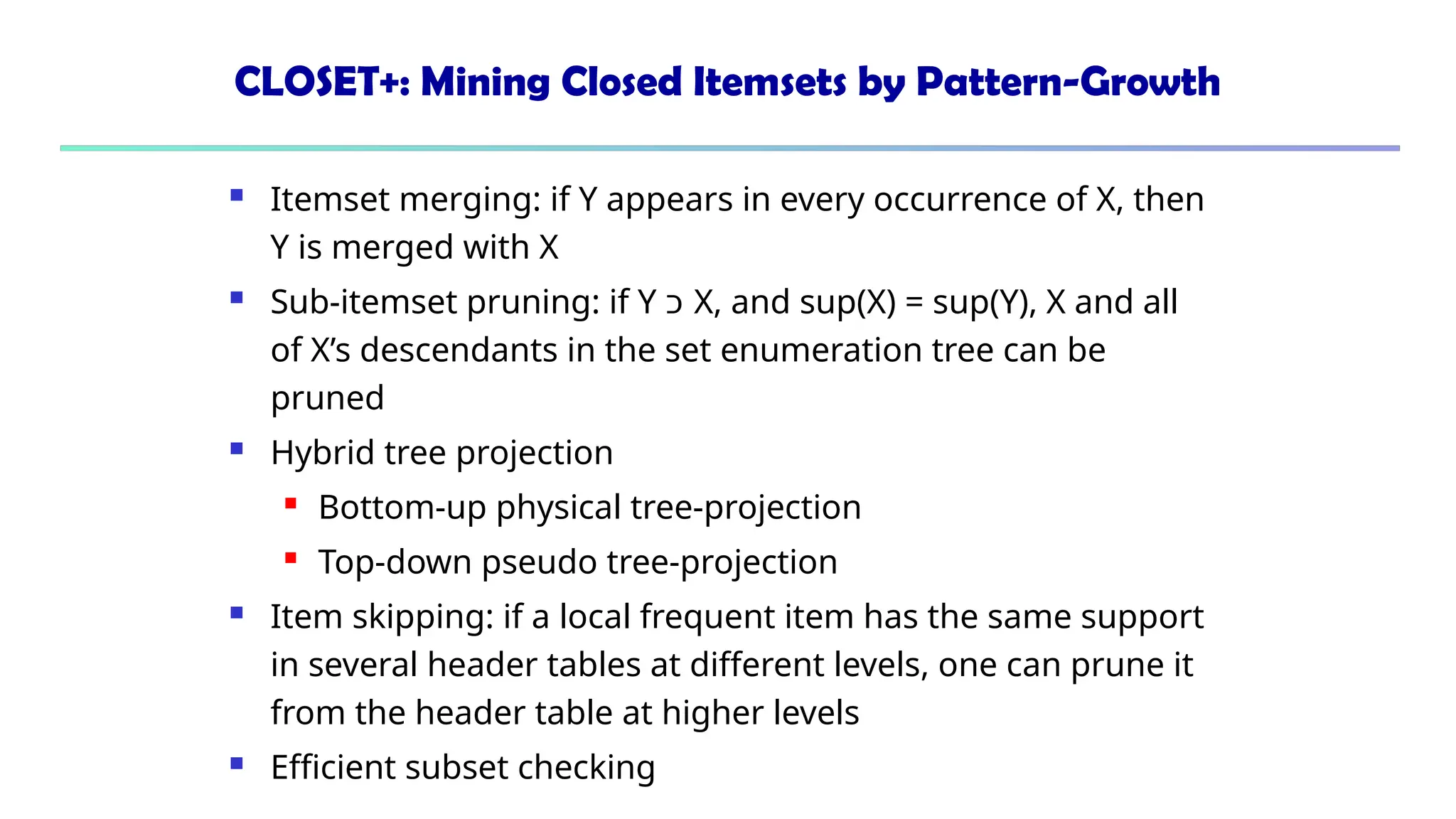
CLOSET+: Mining Closed Itemsets by Pattern-Growth
 Itemset merging: if Y appears in every occurrence of X, then
Y is merged with X
 Sub-itemset pruning: if Y ‫כ‬ X, and sup(X) = sup(Y), X and all
of X’s descendants in the set enumeration tree can be
pruned
 Hybrid tree projection
 Bottom-up physical tree-projection
 Top-down pseudo tree-projection
 Item skipping: if a local frequent item has the same support
in several header tables at different levels, one can prune it
from the header table at higher levels
 Efficient subset checking
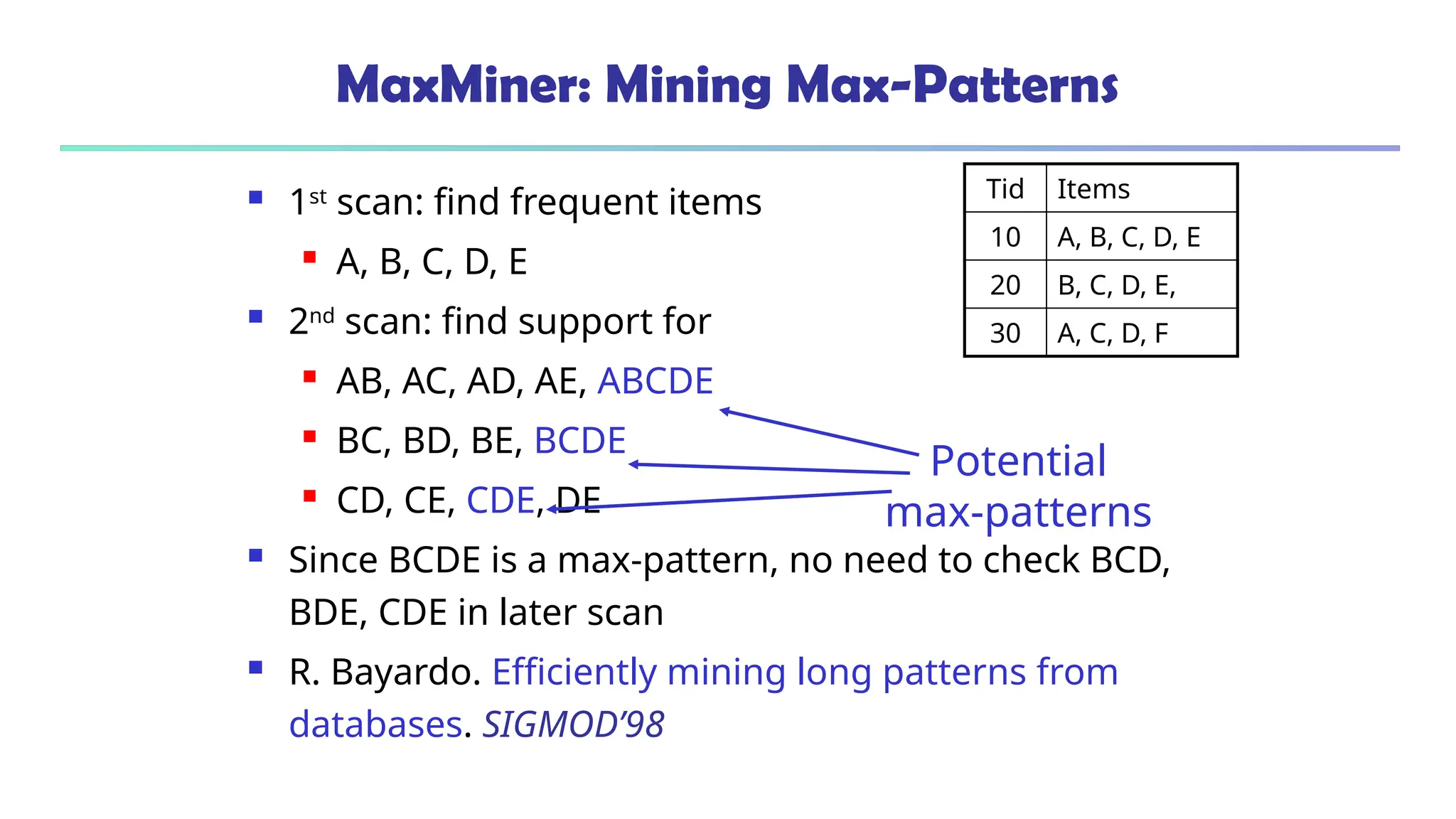
MaxMiner: Mining Max-Patterns
 1st
scan: find frequent items
 A, B, C, D, E
 2nd
scan: find support for
 AB, AC, AD, AE, ABCDE
 BC, BD, BE, BCDE
 CD, CE, CDE, DE
 Since BCDE is a max-pattern, no need to check BCD,
BDE, CDE in later scan
 R. Bayardo. Efficiently mining long patterns from
databases. SIGMOD’98
Tid Items
10 A, B, C, D, E
20 B, C, D, E,
30 A, C, D, F
Potential
max-patterns
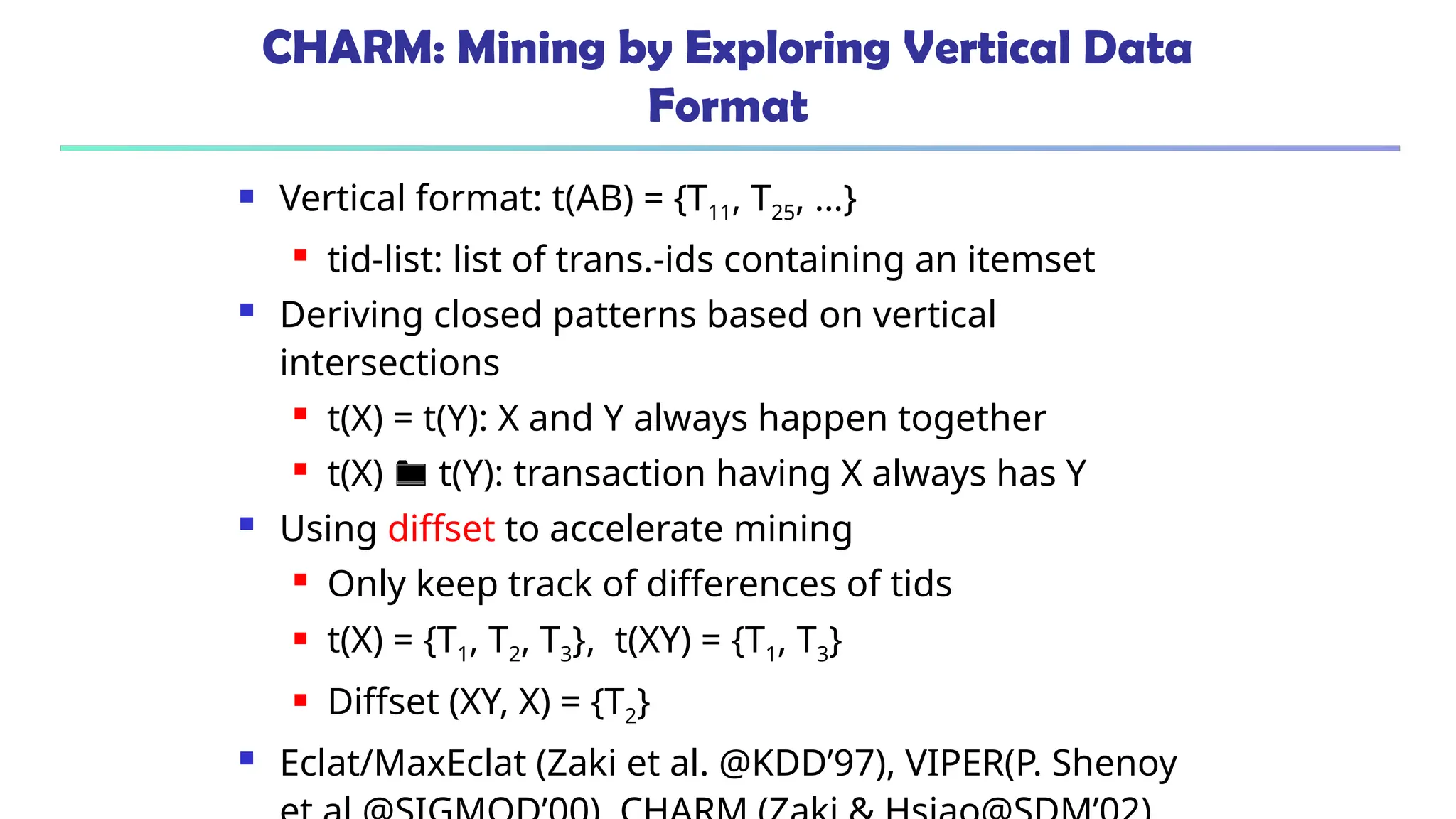
CHARM: Mining by Exploring Vertical Data
Format
 Vertical format: t(AB) = {T11, T25, …}
 tid-list: list of trans.-ids containing an itemset
 Deriving closed patterns based on vertical
intersections
 t(X) = t(Y): X and Y always happen together
 t(X)  t(Y): transaction having X always has Y
 Using diffset to accelerate mining
 Only keep track of differences of tids
 t(X) = {T1, T2, T3}, t(XY) = {T1, T3}
 Diffset (XY, X) = {T2}
 Eclat/MaxEclat (Zaki et al. @KDD’97), VIPER(P. Shenoy
57
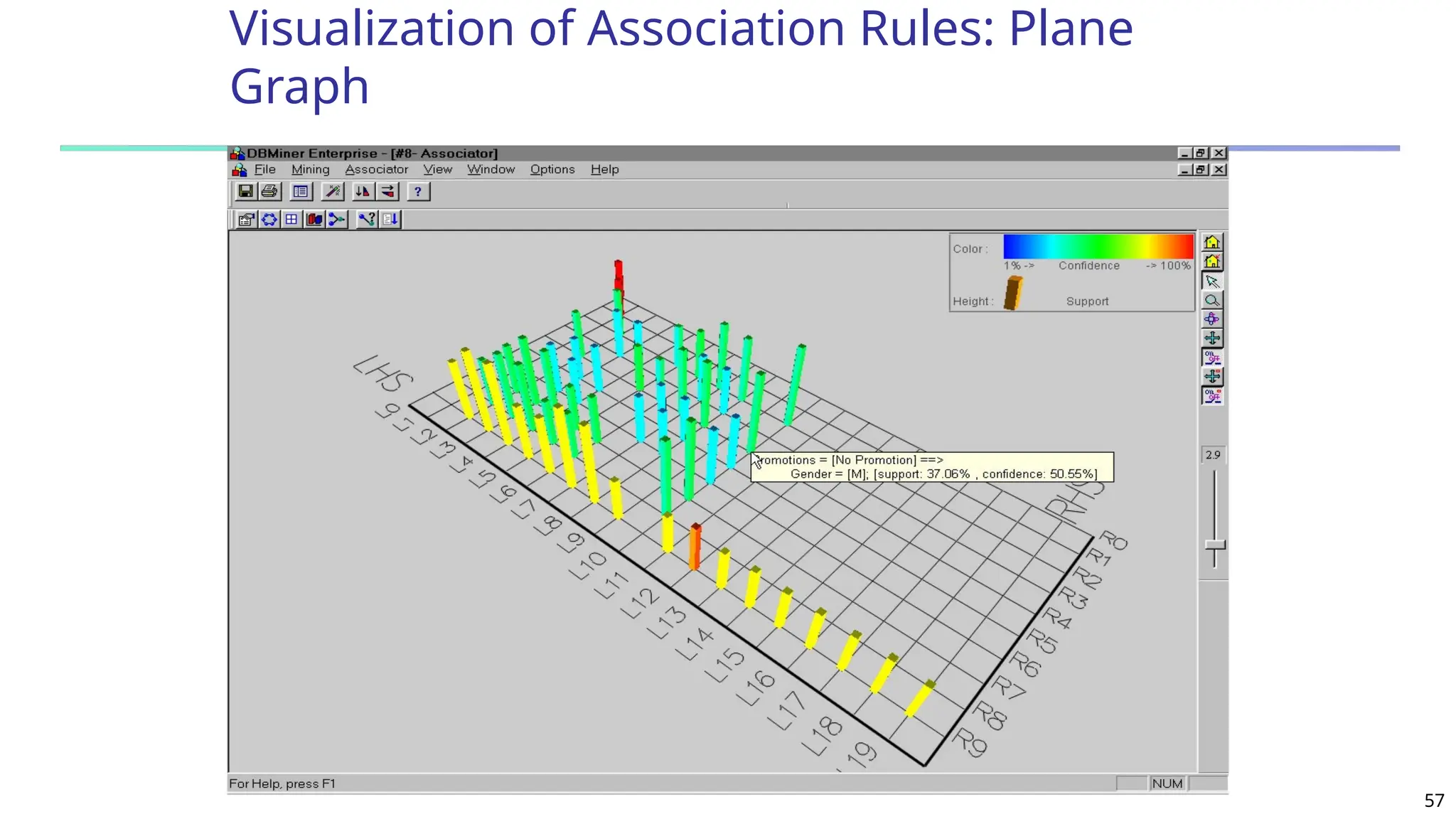
Visualization of Association Rules: Plane
Graph
58
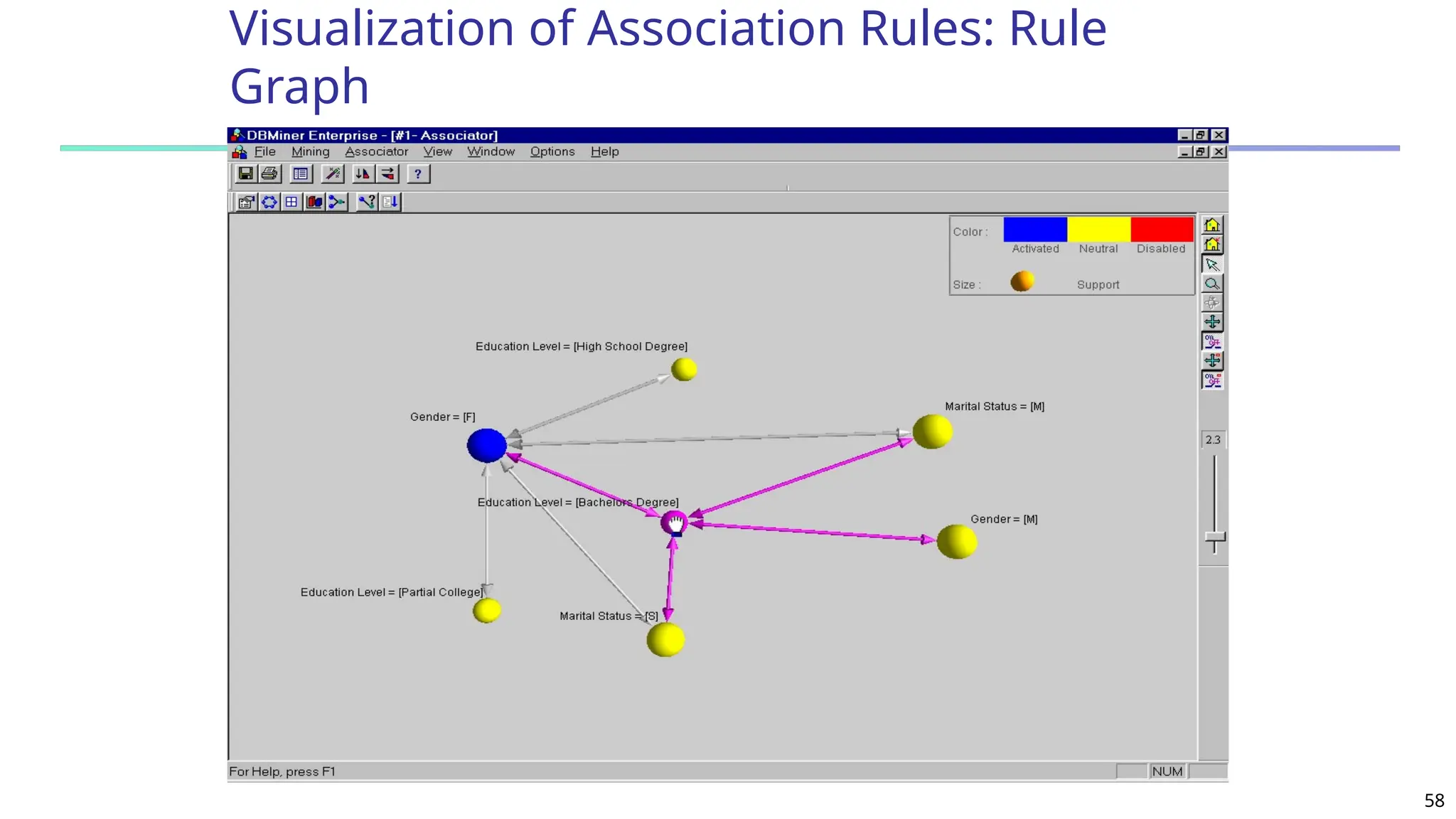
Visualization of Association Rules: Rule
Graph
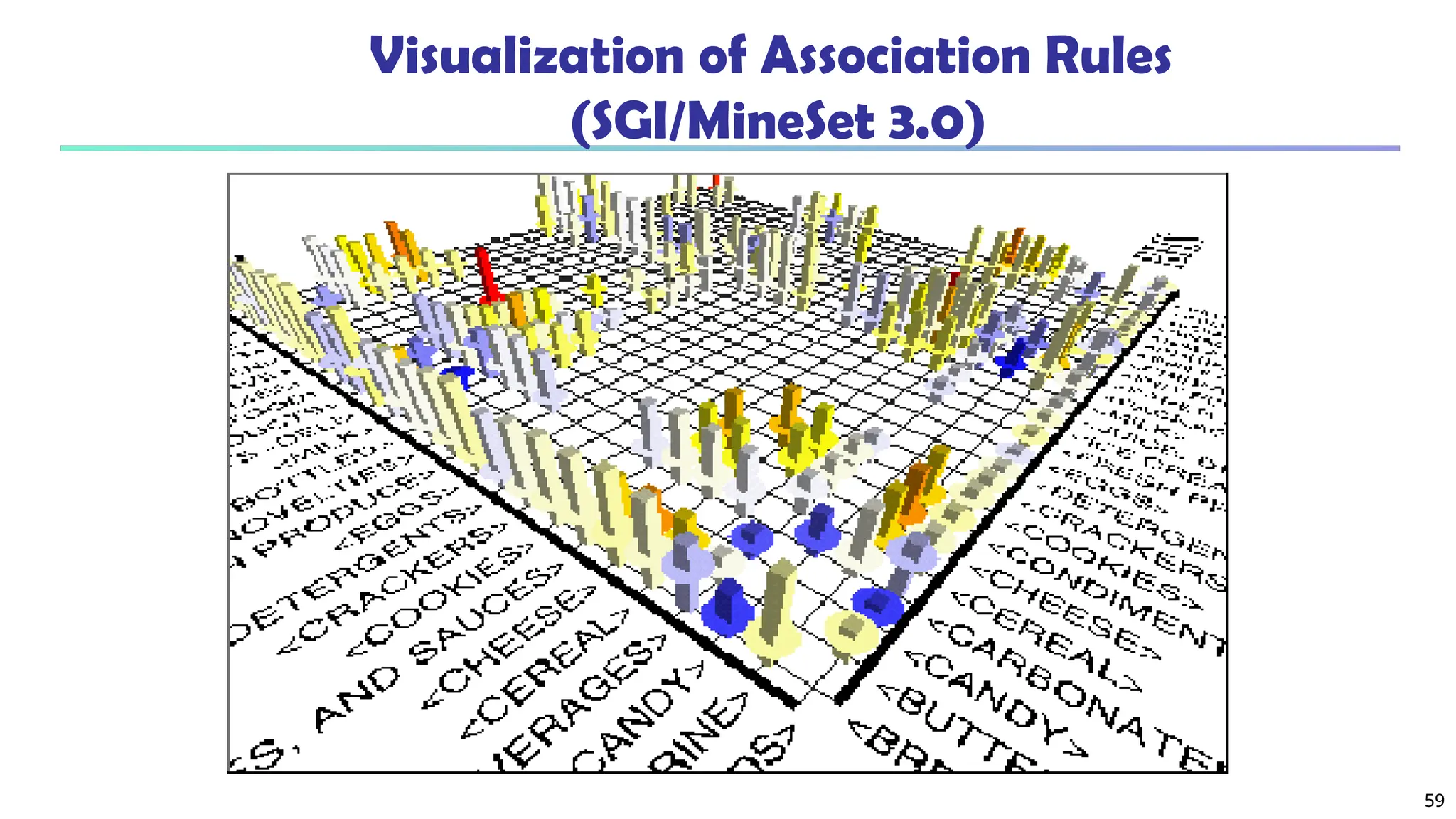
59
Visualization of Association Rules
(SGI/MineSet 3.0)
60
Chapter 5: Mining Frequent Patterns, Association
and Correlations: Basic Concepts and Methods
 Basic Concepts
 Frequent Itemset Mining Methods
 Which Patterns Are Interesting?—Pattern
Evaluation Methods
 Summary
61
Interestingness Measure: Correlations (Lift)
 play basketball  eat cereal [40%, 66.7%] is misleading
 The overall % of students eating cereal is 75% > 66.7%.
 play basketball  not eat cereal [20%, 33.3%] is more accurate,
although with lower support and confidence
 Measure of dependent/correlated events: lift
89
.
0
5000
/
3750
*
5000
/
3000
5000
/
2000
)
,
( 

C
B
lift
Basketbal
l
Not
basketball
Sum (row)
Cereal 2000 1750 3750
Not cereal 1000 250 1250
Sum(col.) 3000 2000 5000
)
(
)
(
)
(
B
P
A
P
B
A
P
lift


33
.
1
5000
/
1250
*
5000
/
3000
5000
/
1000
)
,
( 

C
B
lift
62
Are lift and 2
Good Measures of Correlation?
 “Buy walnuts  buy
milk [1%, 80%]” is
misleading if 85% of
customers buy milk
 Support and
confidence are not
good to indicate
correlations
 Over 20
interestingness
measures have been
proposed (see Tan,
Kumar, Sritastava
@KDD’02)
 Which are good ones?
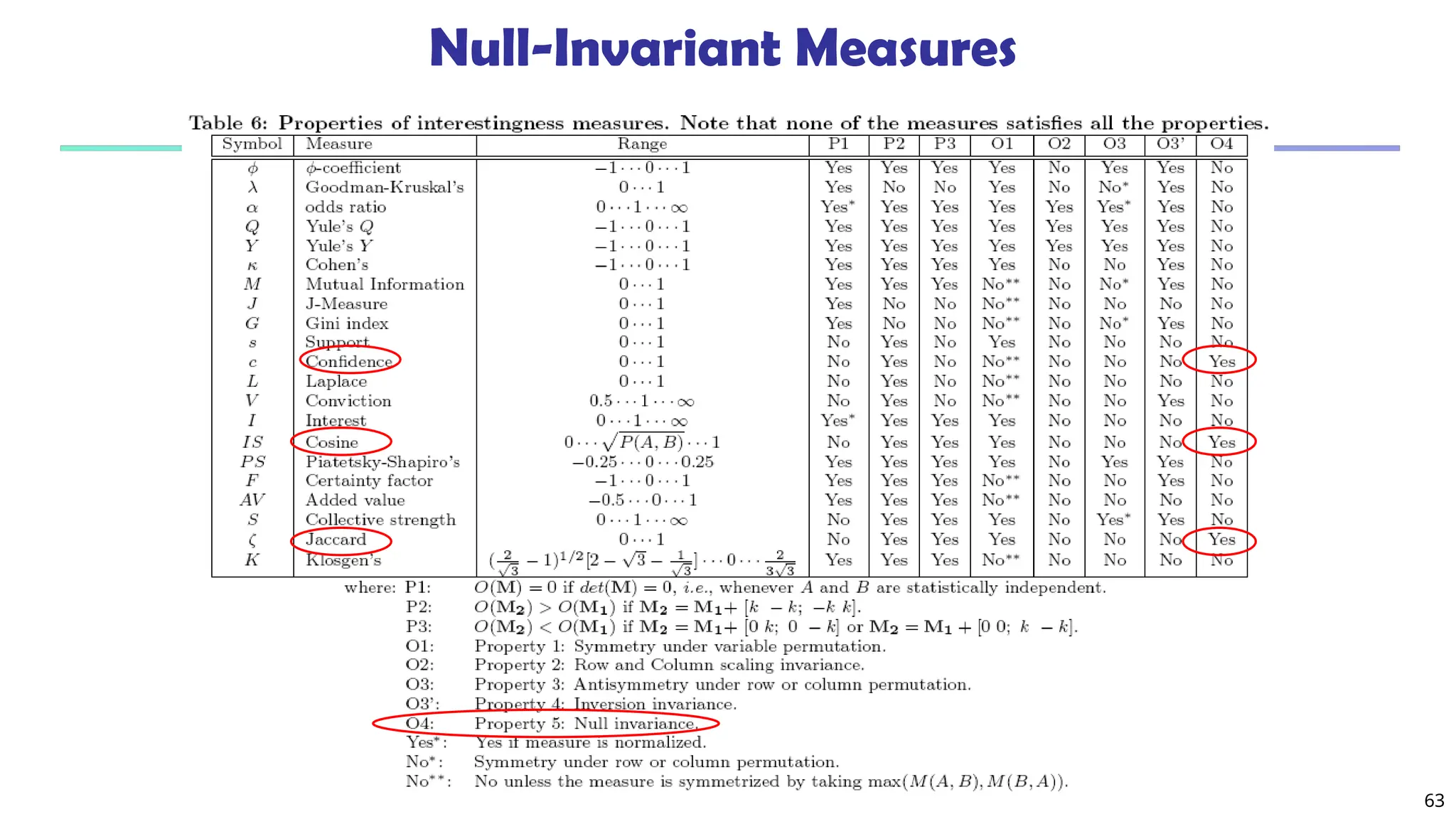
63
Null-Invariant Measures
January 30, 2025 Data Mining: Concepts and
Techniques
64
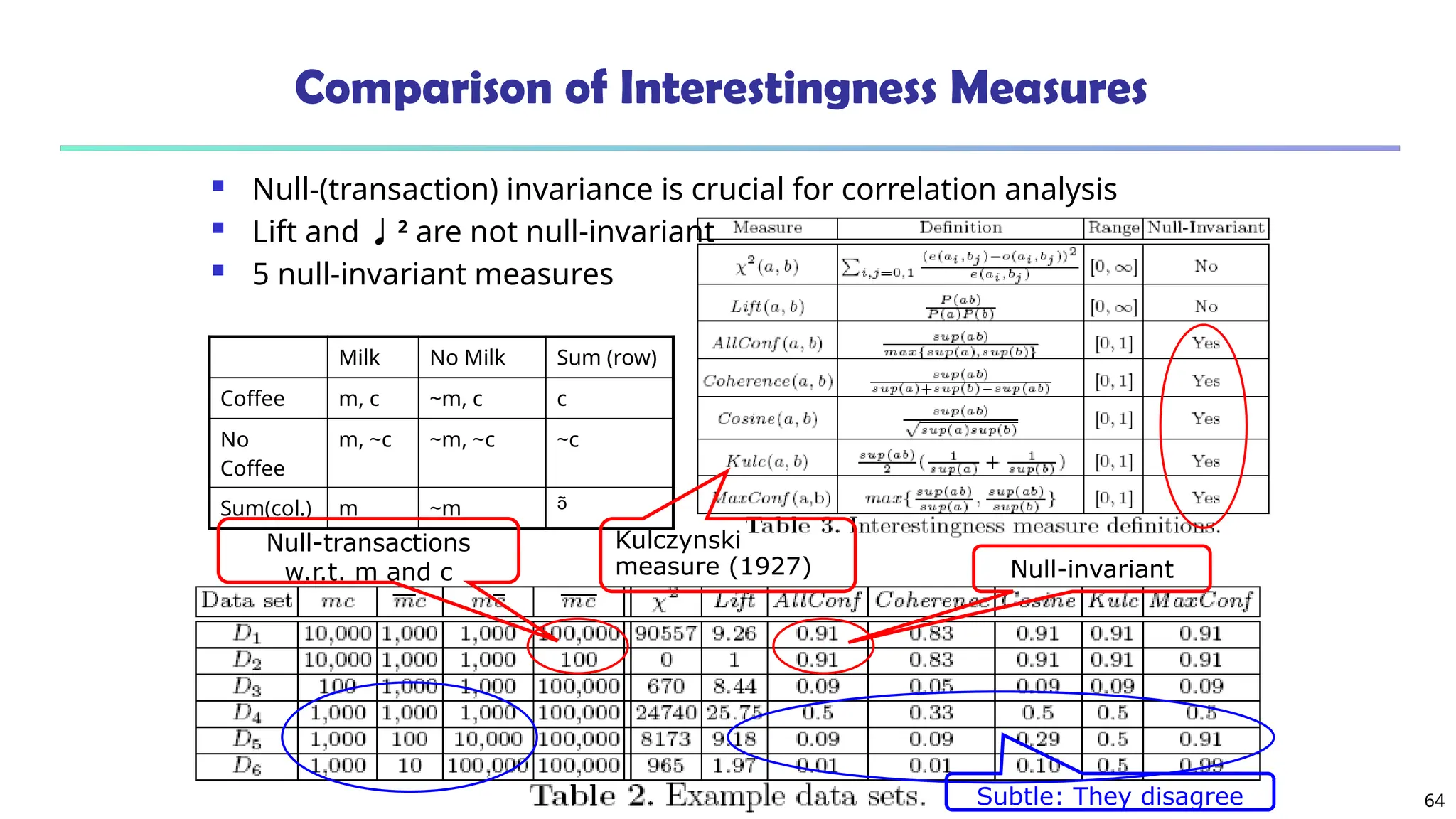
Comparison of Interestingness Measures
Milk No Milk Sum (row)
Coffee m, c ~m, c c
No
Coffee
m, ~c ~m, ~c ~c
Sum(col.) m ~m 
 Null-(transaction) invariance is crucial for correlation analysis
 Lift and 2
are not null-invariant
 5 null-invariant measures
Null-transactions
w.r.t. m and c Null-invariant
Subtle: They disagree
Kulczynski
measure (1927)
65
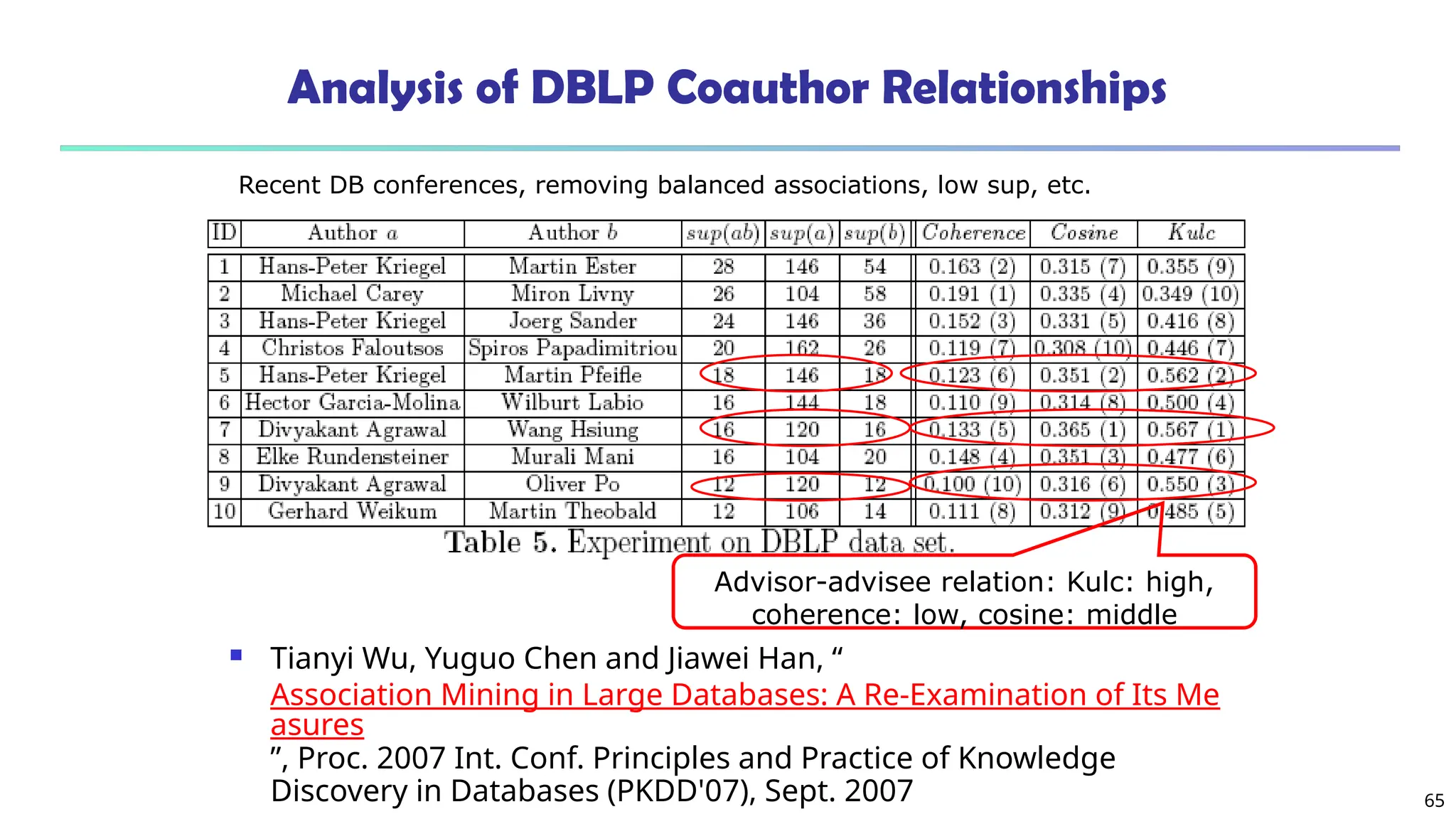
Analysis of DBLP Coauthor Relationships
Advisor-advisee relation: Kulc: high,
coherence: low, cosine: middle
Recent DB conferences, removing balanced associations, low sup, etc.
 Tianyi Wu, Yuguo Chen and Jiawei Han, “
Association Mining in Large Databases: A Re-Examination of Its Me
asures
”, Proc. 2007 Int. Conf. Principles and Practice of Knowledge
Discovery in Databases (PKDD'07), Sept. 2007
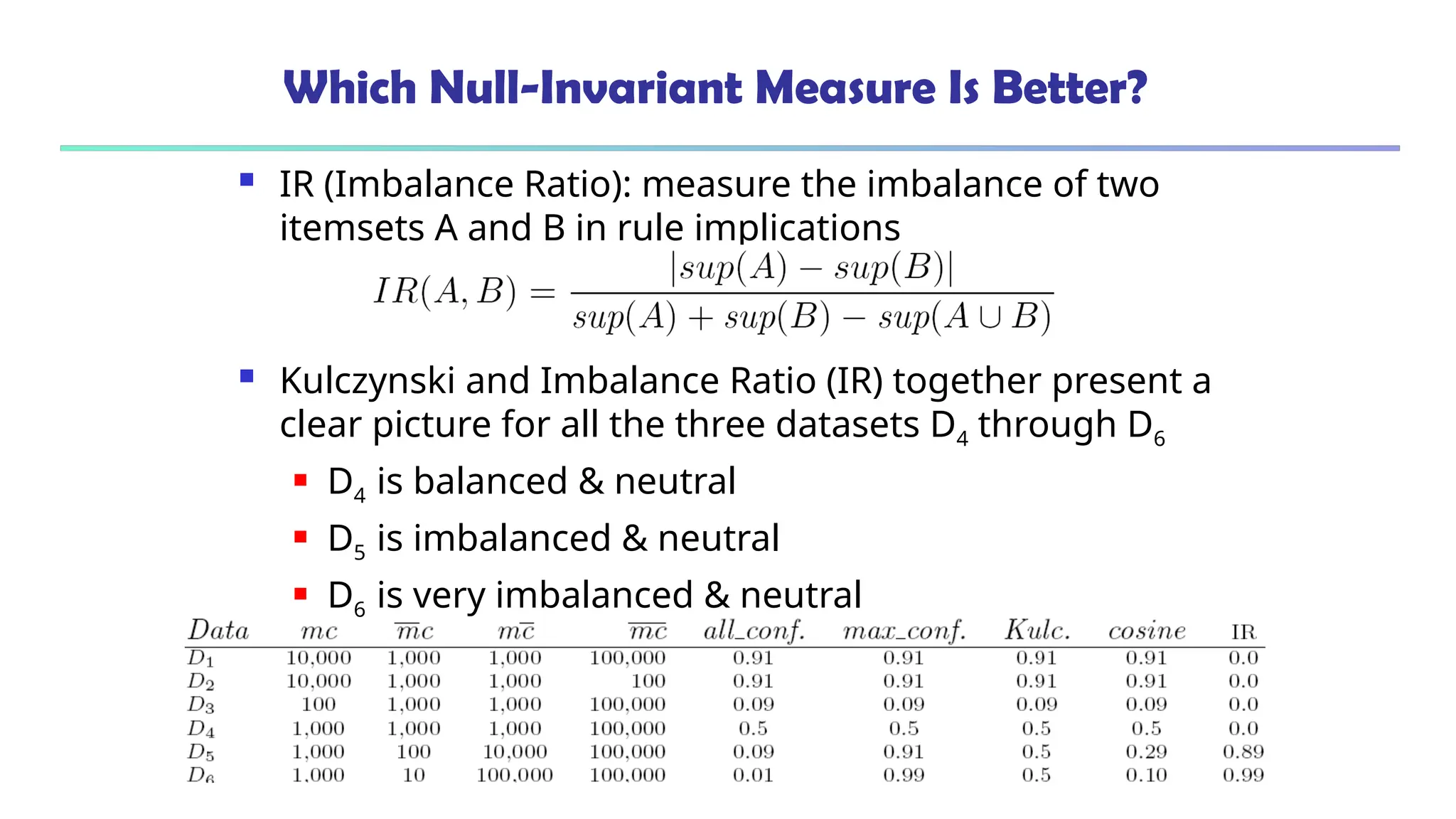
Which Null-Invariant Measure Is Better?
 IR (Imbalance Ratio): measure the imbalance of two
itemsets A and B in rule implications
 Kulczynski and Imbalance Ratio (IR) together present a
clear picture for all the three datasets D4 through D6
 D4 is balanced & neutral
 D5 is imbalanced & neutral
 D6 is very imbalanced & neutral
67
Chapter 5: Mining Frequent Patterns, Association
and Correlations: Basic Concepts and Methods
 Basic Concepts
 Frequent Itemset Mining Methods
 Which Patterns Are Interesting?—Pattern
Evaluation Methods
 Summary
68
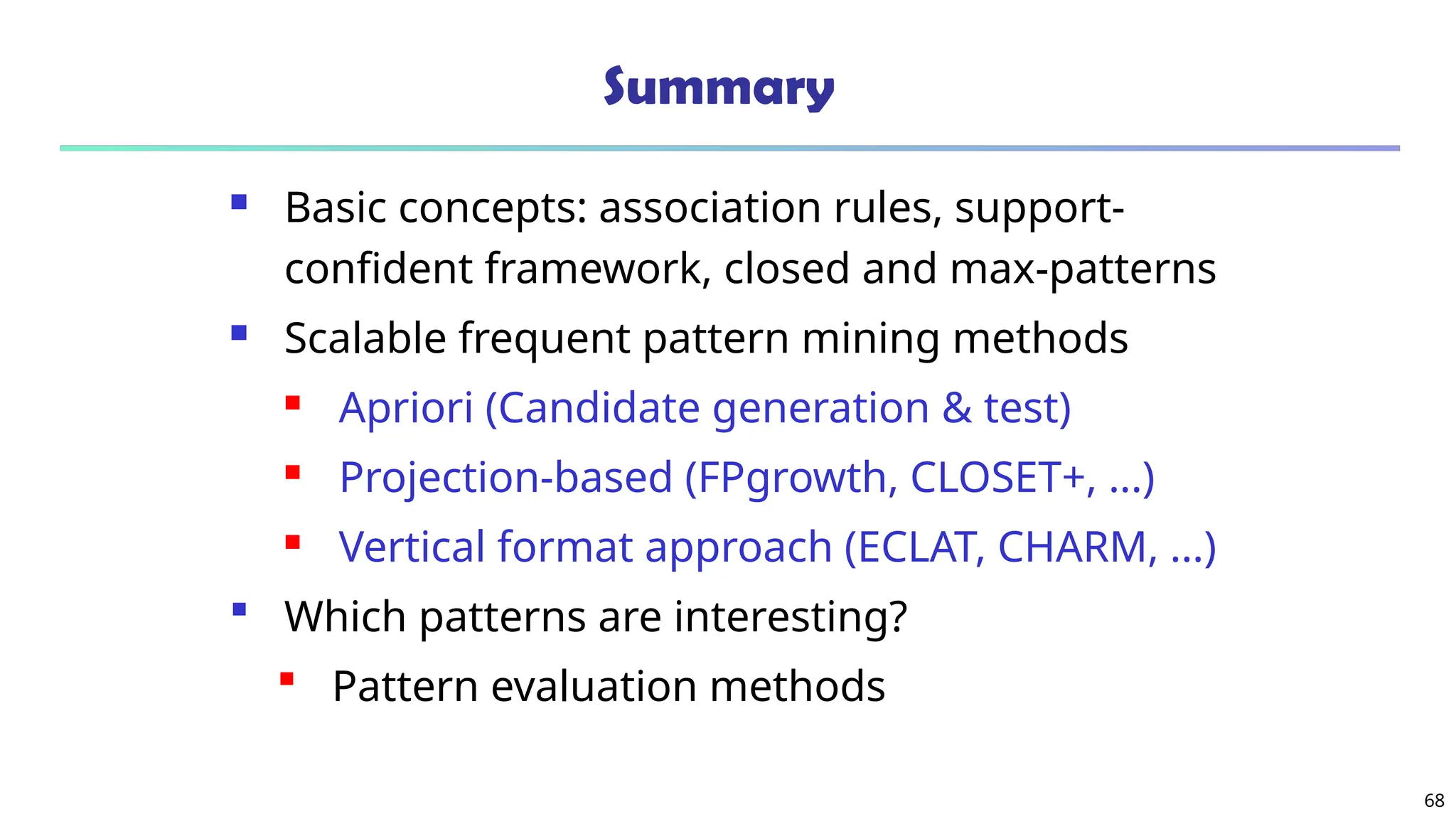
Summary
 Basic concepts: association rules, support-
confident framework, closed and max-patterns
 Scalable frequent pattern mining methods
 Apriori (Candidate generation & test)
 Projection-based (FPgrowth, CLOSET+, ...)
 Vertical format approach (ECLAT, CHARM, ...)
 Which patterns are interesting?
 Pattern evaluation methods
69
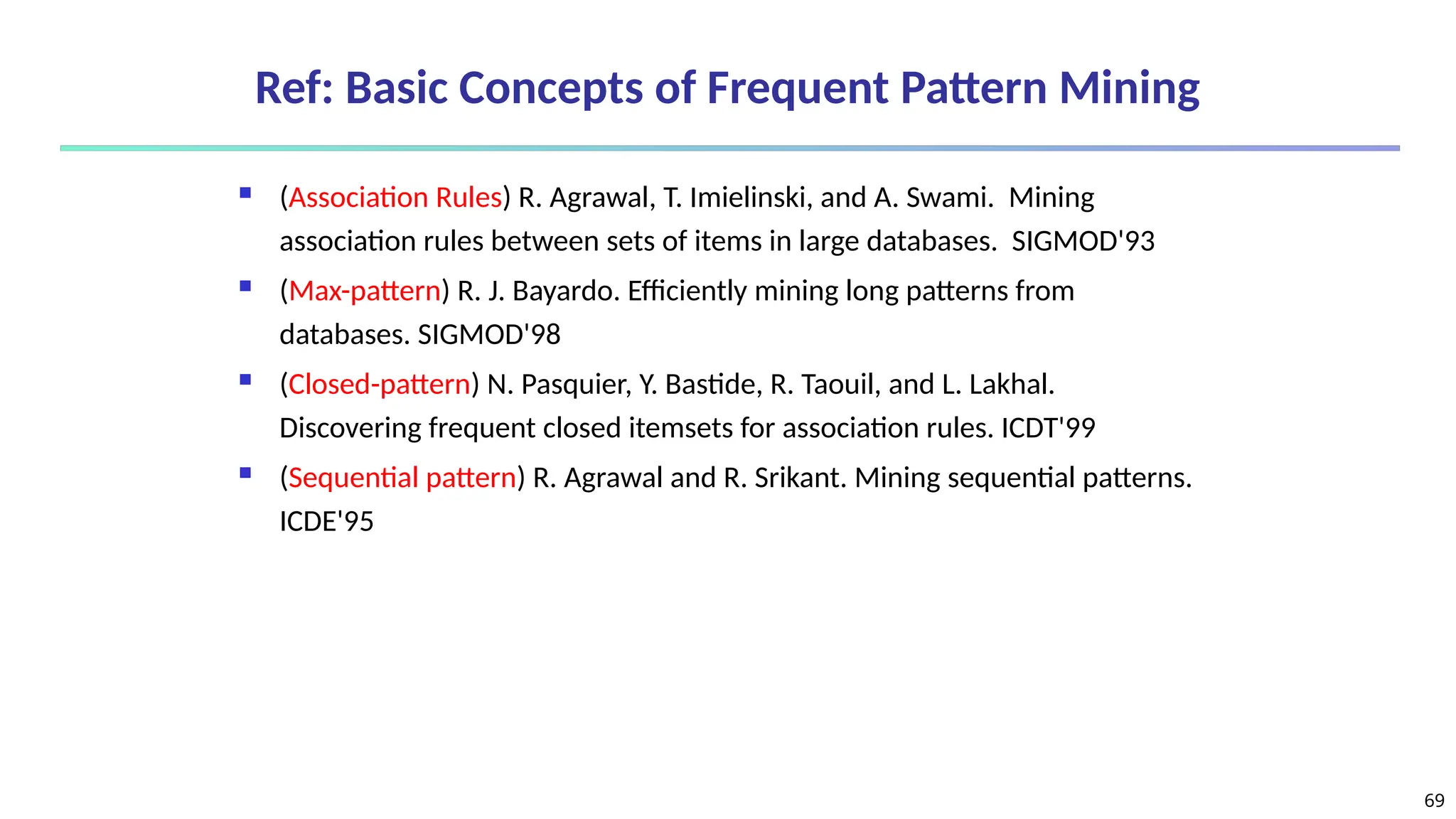
Ref: Basic Concepts of Frequent Pattern Mining
 (Association Rules) R. Agrawal, T. Imielinski, and A. Swami. Mining
association rules between sets of items in large databases. SIGMOD'93
 (Max-pattern) R. J. Bayardo. Efficiently mining long patterns from
databases. SIGMOD'98
 (Closed-pattern) N. Pasquier, Y. Bastide, R. Taouil, and L. Lakhal.
Discovering frequent closed itemsets for association rules. ICDT'99
 (Sequential pattern) R. Agrawal and R. Srikant. Mining sequential patterns.
ICDE'95
70
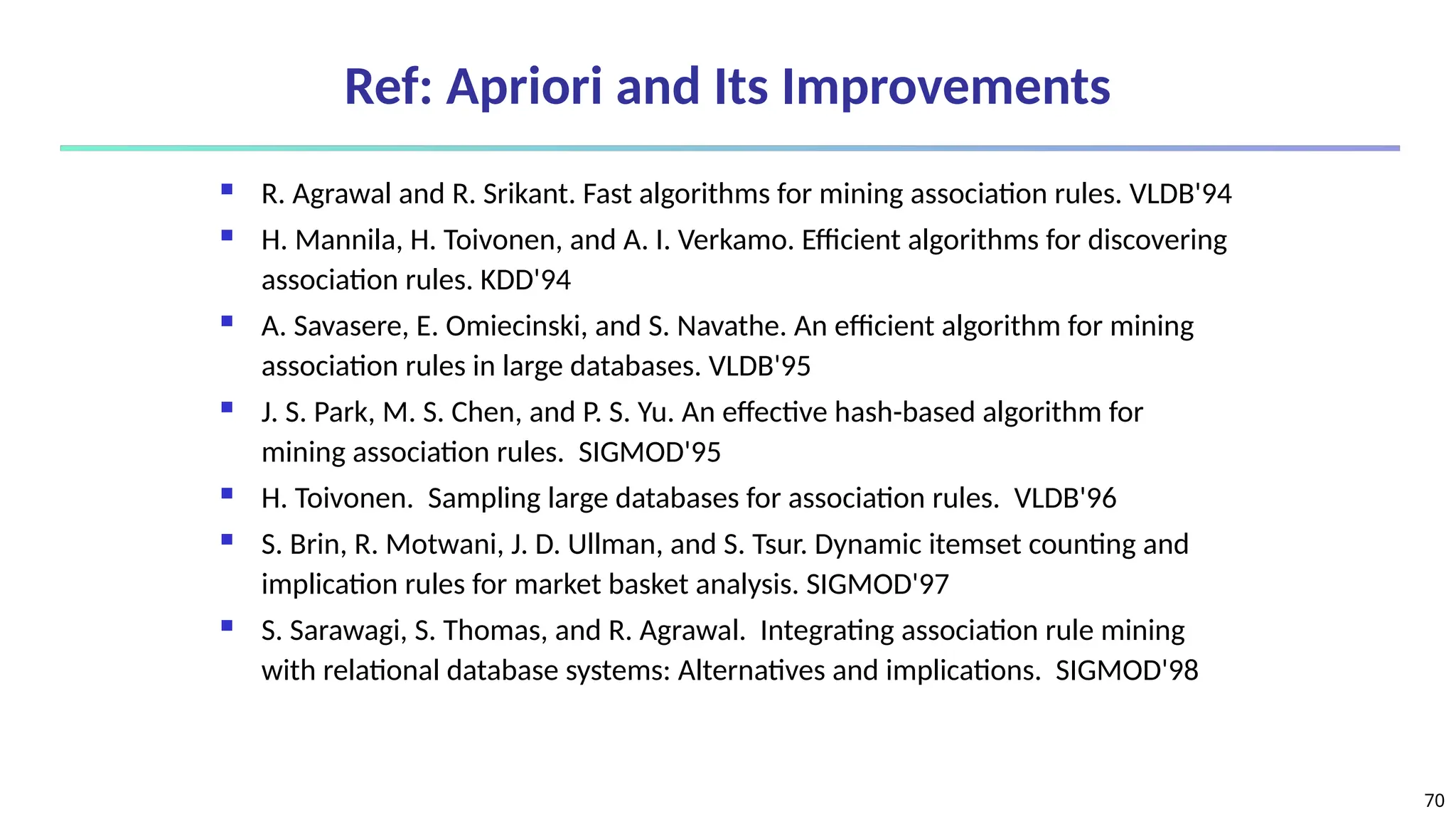
Ref: Apriori and Its Improvements
 R. Agrawal and R. Srikant. Fast algorithms for mining association rules. VLDB'94
 H. Mannila, H. Toivonen, and A. I. Verkamo. Efficient algorithms for discovering
association rules. KDD'94
 A. Savasere, E. Omiecinski, and S. Navathe. An efficient algorithm for mining
association rules in large databases. VLDB'95
 J. S. Park, M. S. Chen, and P. S. Yu. An effective hash-based algorithm for
mining association rules. SIGMOD'95
 H. Toivonen. Sampling large databases for association rules. VLDB'96
 S. Brin, R. Motwani, J. D. Ullman, and S. Tsur. Dynamic itemset counting and
implication rules for market basket analysis. SIGMOD'97
 S. Sarawagi, S. Thomas, and R. Agrawal. Integrating association rule mining
with relational database systems: Alternatives and implications. SIGMOD'98
71
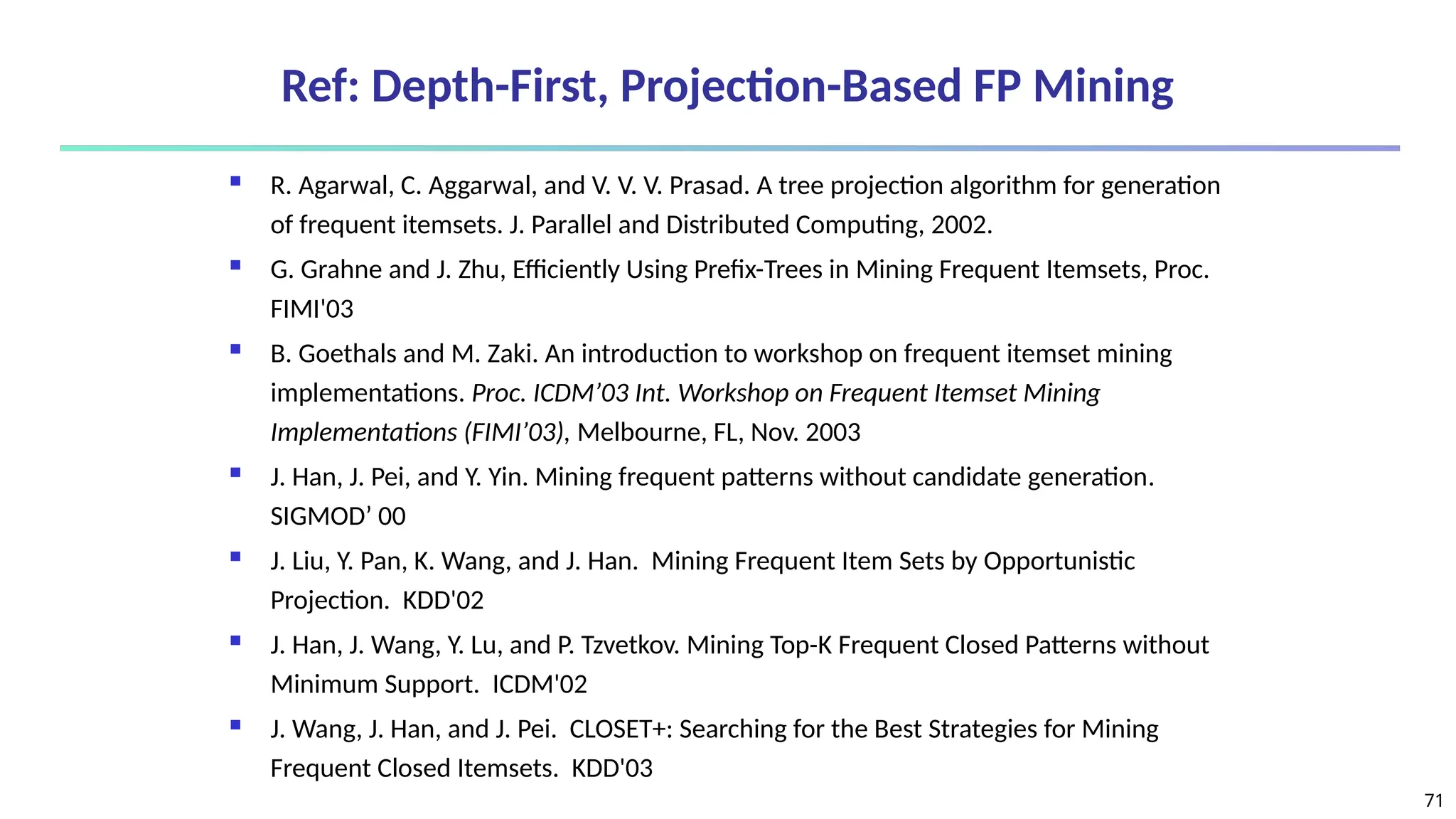
Ref: Depth-First, Projection-Based FP Mining
 R. Agarwal, C. Aggarwal, and V. V. V. Prasad. A tree projection algorithm for generation
of frequent itemsets. J. Parallel and Distributed Computing, 2002.
 G. Grahne and J. Zhu, Efficiently Using Prefix-Trees in Mining Frequent Itemsets, Proc.
FIMI'03
 B. Goethals and M. Zaki. An introduction to workshop on frequent itemset mining
implementations. Proc. ICDM’03 Int. Workshop on Frequent Itemset Mining
Implementations (FIMI’03), Melbourne, FL, Nov. 2003
 J. Han, J. Pei, and Y. Yin. Mining frequent patterns without candidate generation.
SIGMOD’ 00
 J. Liu, Y. Pan, K. Wang, and J. Han. Mining Frequent Item Sets by Opportunistic
Projection. KDD'02
 J. Han, J. Wang, Y. Lu, and P. Tzvetkov. Mining Top-K Frequent Closed Patterns without
Minimum Support. ICDM'02
 J. Wang, J. Han, and J. Pei. CLOSET+: Searching for the Best Strategies for Mining
Frequent Closed Itemsets. KDD'03
72
Ref: Vertical Format and Row Enumeration Methods
 M. J. Zaki, S. Parthasarathy, M. Ogihara, and W. Li. Parallel algorithm for
discovery of association rules. DAMI:97.
 M. J. Zaki and C. J. Hsiao. CHARM: An Efficient Algorithm for Closed Itemset
Mining, SDM'02.
 C. Bucila, J. Gehrke, D. Kifer, and W. White. DualMiner: A Dual-Pruning
Algorithm for Itemsets with Constraints. KDD’02.
 F. Pan, G. Cong, A. K. H. Tung, J. Yang, and M. Zaki , CARPENTER: Finding
Closed Patterns in Long Biological Datasets. KDD'03.
 H. Liu, J. Han, D. Xin, and Z. Shao, Mining Interesting Patterns from Very High
Dimensional Data: A Top-Down Row Enumeration Approach, SDM'06.
73
Ref: Mining Correlations and Interesting Rules
 S. Brin, R. Motwani, and C. Silverstein. Beyond market basket: Generalizing
association rules to correlations. SIGMOD'97.
 M. Klemettinen, H. Mannila, P. Ronkainen, H. Toivonen, and A. I. Verkamo. Finding
interesting rules from large sets of discovered association rules. CIKM'94.
 R. J. Hilderman and H. J. Hamilton. Knowledge Discovery and Measures of Interest.
Kluwer Academic, 2001.
 C. Silverstein, S. Brin, R. Motwani, and J. Ullman. Scalable techniques for mining
causal structures. VLDB'98.
 P.-N. Tan, V. Kumar, and J. Srivastava. Selecting the Right Interestingness Measure
for Association Patterns. KDD'02.
 E. Omiecinski. Alternative Interest Measures for Mining Associations. TKDE’03.
 T. Wu, Y. Chen, and J. Han, “Re-Examination of Interestingness Measures in Pattern
Mining: A Unified Framework", Data Mining and Knowledge Discovery, 21(3):371-
397, 2010

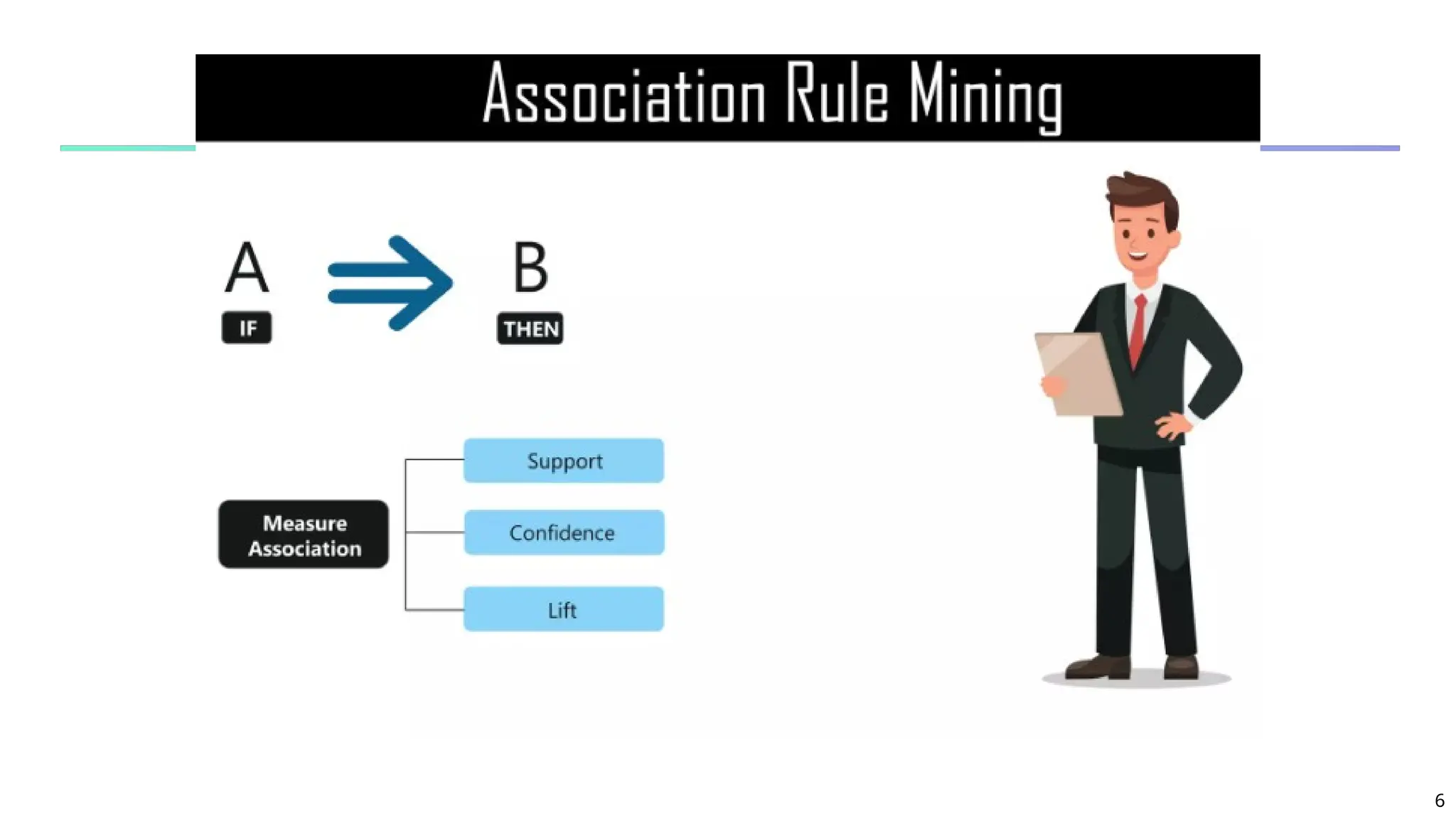
Association Rule Mining, Correlation,Clustering

  • 1.
  • 2.
    2 Mining Frequent Patterns,Association and Correlations: Basic Concepts and Methods  Basic Concepts  Frequent Itemset Mining Methods  Which Patterns Are Interesting?—Pattern Evaluation Methods  Summary
  • 3.
    3 What Is FrequentPattern Analysis?  Frequent pattern: a pattern (a set of items, subsequences, substructures, etc.) that occurs frequently in a data set  First proposed by Agrawal, Imielinski, and Swami [AIS93] in the context of frequent itemsets and association rule mining  Motivation: Finding inherent regularities in data  What products were often purchased together?— Beer and diapers?!  What are the subsequent purchases after buying a PC?  What kinds of DNA are sensitive to this new drug?  Can we automatically classify web documents?  Applications  Basket data analysis https://www.youtube.com/watch?v=3bMNqemjhsc&t=7s , cross- marketing, catalog design, sale campaign analysis, Web log (click
  • 4.
  • 5.
    5 Why Is Freq.Pattern Mining Important?  Freq. pattern: An intrinsic and important property of datasets  Foundation for many essential data mining tasks  Association, correlation, and causality analysis  Sequential, structural (e.g., sub-graph) patterns  Pattern analysis in spatiotemporal, multimedia, time- series, and stream data  Classification: discriminative, frequent pattern analysis  Cluster analysis: frequent pattern-based clustering  Data warehousing: iceberg cube and cube-gradient  Semantic data compression: fascicles  Broad applications
  • 6.
  • 7.
  • 8.
  • 9.
  • 10.
    10 Basic Concepts: FrequentPatterns  itemset: A set of one or more items  k-itemset X = {x1, …, xk}  (absolute) support, or, support count of X: Frequency or occurrence of an itemset X  (relative) support, s, is the fraction of transactions that contains X (i.e., the probability that a transaction contains X)  An itemset X is frequent if X’s support is no less than a minsup threshold Customer buys diaper Customer buys both Customer buys beer Tid Items bought 10 Beer, Nuts, Diaper 20 Beer, Coffee, Diaper 30 Beer, Diaper, Eggs 40 Nuts, Eggs, Milk 50 Nuts, Coffee, Diaper, Eggs, Milk
  • 11.
    11 Basic Concepts: AssociationRules  Find all the rules X  Y with minimum support and confidence  support, s, probability that a transaction contains X  Y  confidence, c, conditional probability that a transaction having X also contains Y Let minsup = 50%, minconf = 50% Freq. Pat.: Beer:3, Nuts:3, Diaper:4, Eggs:3, {Beer, Diaper}:3 Customer buys diaper Customer buys both Customer buys beer Nuts, Eggs, Milk 40 Nuts, Coffee, Diaper, Eggs, Milk 50 Beer, Diaper, Eggs 30 Beer, Coffee, Diaper 20 Beer, Nuts, Diaper 10 Items bought Tid  Association rules: (many more!)  Beer  Diaper (60%, 100%)  Diaper  Beer (60%, 75%)
  • 12.
    12 Closed Patterns andMax-Patterns  A long pattern contains a combinatorial number of sub-patterns, e.g., {a1, …, a100} contains (100 1 ) + (100 2 ) + … + (1 1 0 0 0 0 ) = 2100 – 1 = 1.27*1030 sub-patterns!  Solution: Mine closed patterns and max-patterns instead  An itemset X is closed if X is frequent and there exists no super-pattern Y ‫כ‬ X, with the same support as X (proposed by Pasquier, et al. @ ICDT’99)  An itemset X is a max-pattern if X is frequent and there exists no frequent super-pattern Y ‫כ‬ X (proposed by Bayardo @ SIGMOD’98)  Closed pattern is a lossless compression of freq. patterns 
  • 13.
    13 Closed Patterns andMax-Patterns  Exercise. DB = {<a1, …, a100>, < a1, …, a50>}  Min_sup = 1.  What is the set of closed itemset?  <a1, …, a100>: 1  < a1, …, a50>: 2  What is the set of max-pattern?  <a1, …, a100>: 1  What is the set of all patterns?  !!
  • 14.
    14 Computational Complexity ofFrequent Itemset Mining  How many itemsets are potentially to be generated in the worst case?  The number of frequent itemsets to be generated is senstive to the minsup threshold  When minsup is low, there exist potentially an exponential number of frequent itemsets  The worst case: MN where M: # distinct items, and N: max length of transactions  The worst case complexty vs. the expected probability  Ex. Suppose Walmart has 104 kinds of products  The chance to pick up one product 10-4  The chance to pick up a particular set of 10 products: ~10-40  What is the chance this particular set of 10 products to be frequent 103 times in 109 transactions?
  • 15.
    15 Mining Frequent Patterns,Association and Correlations: Basic Concepts and Methods  Basic Concepts  Frequent Itemset Mining Methods  Which Patterns Are Interesting?—Pattern Evaluation Methods  Summary
  • 16.
    16 Scalable Frequent ItemsetMining Methods  Apriori: A Candidate Generation-and-Test Approach  Improving the Efficiency of Apriori  FPGrowth: A Frequent Pattern-Growth Approach  ECLAT: Frequent Pattern Mining with Vertical Data Format
  • 17.
    17 The Downward ClosureProperty and Scalable Mining Methods  The downward closure property of frequent patterns  Any subset of a frequent itemset must be frequent  If {beer, diaper, nuts} is frequent, so is {beer, diaper}  i.e., every transaction having {beer, diaper, nuts} also contains {beer, diaper}  Scalable mining methods: Three major approaches  Apriori (Agrawal & Srikant@VLDB’94)  Freq. pattern growth (FPgrowth—Han, Pei & Yin @SIGMOD’00)  Vertical data format approach (Charm—Zaki & Hsiao @SDM’02)
  • 18.
    18 Apriori: A CandidateGeneration & Test Approach  Apriori pruning principle: If there is any itemset which is infrequent, its superset should not be generated/tested! (Agrawal & Srikant @VLDB’94, Mannila, et al. @ KDD’ 94)  Method:  Initially, scan DB once to get frequent 1-itemset  Generate length (k+1) candidate itemsets from length k frequent itemsets  Test the candidates against DB  Terminate when no frequent or candidate set can be generated
  • 19.
  • 20.
    20 The Apriori Algorithm—AnExample Database TDB 1st scan C1 L1 L2 C2 C2 2nd scan C3 L3 3rd scan Tid Items 10 A, C, D 20 B, C, E 30 A, B, C, E 40 B, E Itemset sup {A} 2 {B} 3 {C} 3 {D} 1 {E} 3 Itemset sup {A} 2 {B} 3 {C} 3 {E} 3 Itemset {A, B} {A, C} {A, E} {B, C} {B, E} {C, E} Itemset sup {A, B} 1 {A, C} 2 {A, E} 1 {B, C} 2 {B, E} 3 {C, E} 2 Itemset sup {A, C} 2 {B, C} 2 {B, E} 3 {C, E} 2 Itemset {B, C, E} Itemset sup {B, C, E} 2 Supmin = 2
  • 21.
  • 22.
  • 23.
    23 The Apriori Algorithm(Pseudo-Code) Ck: Candidate itemset of size k Lk : frequent itemset of size k L1 = {frequent items}; for (k = 1; Lk !=; k++) do begin Ck+1 = candidates generated from Lk; for each transaction t in database do increment the count of all candidates in Ck+1 that are contained in t Lk+1 = candidates in Ck+1 with min_support end return k Lk;
  • 24.
    24 Implementation of Apriori How to generate candidates?  Step 1: self-joining Lk  Step 2: pruning  Example of Candidate-generation  L3={abc, abd, acd, ace, bcd}  Self-joining: L3*L3  abcd from abc and abd  acde from acd and ace  Pruning:  acde is removed because ade is not in L3  C4 = {abcd}
  • 25.
    25 How to CountSupports of Candidates?  Why counting supports of candidates a problem?  The total number of candidates can be very huge  One transaction may contain many candidates  Method:  Candidate itemsets are stored in a hash-tree  Leaf node of hash-tree contains a list of itemsets and counts  Interior node contains a hash table  Subset function: finds all the candidates contained in a transaction
  • 26.
    26 Counting Supports ofCandidates Using Hash Tree 1,4,7 2,5,8 3,6,9 Subset function 2 3 4 5 6 7 1 4 5 1 3 6 1 2 4 4 5 7 1 2 5 4 5 8 1 5 9 3 4 5 3 5 6 3 5 7 6 8 9 3 6 7 3 6 8 Transaction: 1 2 3 5 6 1 + 2 3 5 6 1 2 + 3 5 6 1 3 + 5 6
  • 27.
    27 Candidate Generation: AnSQL Implementation  SQL Implementation of candidate generation  Suppose the items in Lk-1 are listed in an order  Step 1: self-joining Lk-1 insert into Ck select p.item1, p.item2, …, p.itemk-1, q.itemk-1 from Lk-1 p, Lk-1 q where p.item1=q.item1, …, p.itemk-2=q.itemk-2, p.itemk-1 < q.itemk-1  Step 2: pruning forall itemsets c in Ck do forall (k-1)-subsets s of c do if (s is not in Lk-1) then delete c from Ck  Use object-relational extensions like UDFs, BLOBs, and Table functions for efficient implementation [See: S. Sarawagi, S. Thomas, and R. Agrawal. Integrating association rule mining with relational database systems: Alternatives and implications. SIGMOD’98]
  • 28.
    28 Scalable Frequent ItemsetMining Methods  Apriori: A Candidate Generation-and-Test Approach  Improving the Efficiency of Apriori  FPGrowth: A Frequent Pattern-Growth Approach  ECLAT: Frequent Pattern Mining with Vertical Data Format  Mining Close Frequent Patterns and Maxpatterns
  • 29.
    29 Further Improvement ofthe Apriori Method  Major computational challenges  Multiple scans of transaction database  Huge number of candidates  Tedious workload of support counting for candidates  Improving Apriori: general ideas  Reduce passes of transaction database scans  Shrink number of candidates  Facilitate support counting of candidates
  • 30.
    Partition: Scan DatabaseOnly Twice  Any itemset that is potentially frequent in DB must be frequent in at least one of the partitions of DB  Scan 1: partition database and find local frequent patterns  Scan 2: consolidate global frequent patterns  A. Savasere, E. Omiecinski and S. Navathe, VLDB’95 DB1 DB2 DBk + = DB + + sup1(i) < σDB1 sup2(i) < σDB2 supk(i) < σDBk sup(i) < σDB
  • 31.
    31 DHP: Reduce theNumber of Candidates  A k-itemset whose corresponding hashing bucket count is below the threshold cannot be frequent  Candidates: a, b, c, d, e  Hash entries  {ab, ad, ae}  {bd, be, de}  …  Frequent 1-itemset: a, b, d, e  ab is not a candidate 2-itemset if the sum of count of {ab, ad, ae} is below support threshold  J. Park, M. Chen, and P. Yu. An effective hash-based algorithm for mining association rules. SIGMOD’95 count itemset s 35 {ab, ad, ae} {yz, qs, wt} 88 102 . . . {bd, be, de} . . . Hash Table
  • 32.
    32 Sampling for FrequentPatterns  Select a sample of original database, mine frequent patterns within sample using Apriori  Scan database once to verify frequent itemsets found in sample, only borders of closure of frequent patterns are checked  Example: check abcd instead of ab, ac, …, etc.  Scan database again to find missed frequent patterns  H. Toivonen. Sampling large databases for association rules. In VLDB’96
  • 33.
    33 DIC: Reduce Numberof Scans ABCD ABC ABD ACD BCD AB AC BC AD BD CD A B C D {} Itemset lattice  Once both A and D are determined frequent, the counting of AD begins  Once all length-2 subsets of BCD are determined frequent, the counting of BCD begins Transactions 1-itemsets 2-itemsets … Apriori 1-itemsets 2-items 3-items DIC S. Brin R. Motwani, J. Ullman, and S. Tsur. Dynamic itemset counting and implication rules for market basket data. SIGMOD’97
  • 34.
    34 Scalable Frequent ItemsetMining Methods  Apriori: A Candidate Generation-and-Test Approach  Improving the Efficiency of Apriori  FPGrowth: A Frequent Pattern-Growth Approach  ECLAT: Frequent Pattern Mining with Vertical Data Format  Mining Close Frequent Patterns and Maxpatterns
  • 35.
    35 Pattern-Growth Approach: MiningFrequent Patterns Without Candidate Generation  Bottlenecks of the Apriori approach  Breadth-first (i.e., level-wise) search  Candidate generation and test  Often generates a huge number of candidates  The FPGrowth Approach (J. Han, J. Pei, and Y. Yin, SIGMOD’ 00)  Depth-first search  Avoid explicit candidate generation  Major philosophy: Grow long patterns from short ones using local frequent items only  “abc” is a frequent pattern  Get all transactions having “abc”, i.e., project DB on abc: DB|abc  “d” is a local frequent item in DB|abc  abcd is a frequent pattern
  • 36.
    36 Construct FP-tree froma Transaction Database {} f:4 c:1 b:1 p:1 b:1 c:3 a:3 b:1 m:2 p:2 m:1 Header Table Item frequency head f 4 c 4 a 3 b 3 m 3 p 3 min_support = 3 TID Items bought (ordered) frequent items 100 {f, a, c, d, g, i, m, p} {f, c, a, m, p} 200 {a, b, c, f, l, m, o} {f, c, a, b, m} 300 {b, f, h, j, o, w} {f, b} 400 {b, c, k, s, p} {c, b, p} 500 {a, f, c, e, l, p, m, n} {f, c, a, m, p} 1. Scan DB once, find frequent 1-itemset (single item pattern) 2. Sort frequent items in frequency descending order, f-list 3. Scan DB again, construct FP-tree F-list = f-c-a-b-m-p
  • 37.
    37 Partition Patterns andDatabases  Frequent patterns can be partitioned into subsets according to f-list  F-list = f-c-a-b-m-p  Patterns containing p  Patterns having m but no p  …  Patterns having c but no a nor b, m, p  Pattern f  Completeness and non-redundency
  • 38.
    38 Find Patterns HavingP From P-conditional Database  Starting at the frequent item header table in the FP-tree  Traverse the FP-tree by following the link of each frequent item p  Accumulate all of transformed prefix paths of item p to form p’s conditional pattern base Conditional pattern bases item cond. pattern base c f:3 a fc:3 b fca:1, f:1, c:1 m fca:2, fcab:1 p fcam:2, cb:1 {} f:4 c:1 b:1 p:1 b:1 c:3 a:3 b:1 m:2 p:2 m:1 Header Table Item frequency head f 4 c 4 a 3 b 3 m 3 p 3
  • 39.
    39 From Conditional Pattern-basesto Conditional FP-trees  For each pattern-base  Accumulate the count for each item in the base  Construct the FP-tree for the frequent items of the pattern base m-conditional pattern base: fca:2, fcab:1 {} f:3 c:3 a:3 m-conditional FP-tree All frequent patterns relate to m m, fm, cm, am, fcm, fam, cam, fcam   {} f:4 c:1 b:1 p:1 b:1 c:3 a:3 b:1 m:2 p:2 m:1 Header Table Item frequency head f 4 c 4 a 3 b 3 m 3 p 3
  • 40.
    40 Recursion: Mining EachConditional FP-tree {} f:3 c:3 a:3 m-conditional FP-tree Cond. pattern base of “am”: (fc:3) {} f:3 c:3 am-conditional FP-tree Cond. pattern base of “cm”: (f:3) {} f:3 cm-conditional FP-tree Cond. pattern base of “cam”: (f:3) {} f:3 cam-conditional FP-tree
  • 41.
    41 A Special Case:Single Prefix Path in FP-tree  Suppose a (conditional) FP-tree T has a shared single prefix-path P  Mining can be decomposed into two parts  Reduction of the single prefix path into one node  Concatenation of the mining results of the two parts  a2:n2 a3:n3 a1:n1 {} b1:m1 C1:k1 C2:k2 C3:k3 b1:m1 C1:k1 C2:k2 C3:k3 r1 + a2:n2 a3:n3 a1:n1 {} r1 =
  • 42.
    42 Benefits of theFP-tree Structure  Completeness  Preserve complete information for frequent pattern mining  Never break a long pattern of any transaction  Compactness  Reduce irrelevant info—infrequent items are gone  Items in frequency descending order: the more frequently occurring, the more likely to be shared  Never be larger than the original database (not count node-links and the count field)
  • 43.
    43 The Frequent PatternGrowth Mining Method  Idea: Frequent pattern growth  Recursively grow frequent patterns by pattern and database partition  Method  For each frequent item, construct its conditional pattern-base, and then its conditional FP-tree  Repeat the process on each newly created conditional FP-tree  Until the resulting FP-tree is empty, or it contains only one path—single path will generate all the combinations of its sub-paths, each of which is a frequent pattern
  • 44.
    44 Scaling FP-growth byDatabase Projection  What about if FP-tree cannot fit in memory?  DB projection  First partition a database into a set of projected DBs  Then construct and mine FP-tree for each projected DB  Parallel projection vs. partition projection techniques  Parallel projection  Project the DB in parallel for each frequent item  Parallel projection is space costly  All the partitions can be processed in parallel  Partition projection  Partition the DB based on the ordered frequent items  Passing the unprocessed parts to the subsequent partitions
  • 45.
    45 Partition-Based Projection  Parallelprojection needs a lot of disk space  Partition projection saves it Tran. DB fcamp fcabm fb cbp fcamp p-proj DB fcam cb fcam m-proj DB fcab fca fca b-proj DB f cb … a-proj DB fc … c-proj DB f … f-proj DB … am-proj DB fc fc fc cm-proj DB f f f …
  • 46.
    Performance of FPGrowthin Large Datasets FP-Growth vs. Apriori 46 0 10 20 30 40 50 60 70 80 90 100 0 0.5 1 1.5 2 2.5 3 Support threshold(%) Run tim e(sec.) D1 FP-grow th runtime D1 Apriori runtime Data set T25I20D10K 0 20 40 60 80 100 120 140 0 0.5 1 1.5 2 Support threshold (%) Runtime (sec.) D2 FP-growth D2 TreeProjection Data set T25I20D100K FP-Growth vs. Tree-Projection
  • 47.
    47 Advantages of thePattern Growth Approach  Divide-and-conquer:  Decompose both the mining task and DB according to the frequent patterns obtained so far  Lead to focused search of smaller databases  Other factors  No candidate generation, no candidate test  Compressed database: FP-tree structure  No repeated scan of entire database  Basic ops: counting local freq items and building sub FP-tree, no pattern search and matching  A good open-source implementation and refinement of FPGrowth  FPGrowth+ (Grahne and J. Zhu, FIMI'03)
  • 48.
    48 Further Improvements ofMining Methods  AFOPT (Liu, et al. @ KDD’03)  A “push-right” method for mining condensed frequent pattern (CFP) tree  Carpenter (Pan, et al. @ KDD’03)  Mine data sets with small rows but numerous columns  Construct a row-enumeration tree for efficient mining  FPgrowth+ (Grahne and Zhu, FIMI’03)  Efficiently Using Prefix-Trees in Mining Frequent Itemsets, Proc. ICDM'03 Int. Workshop on Frequent Itemset Mining Implementations (FIMI'03), Melbourne, FL, Nov. 2003  TD-Close (Liu, et al, SDM’06)
  • 49.
    49 Extension of PatternGrowth Mining Methodology  Mining closed frequent itemsets and max-patterns  CLOSET (DMKD’00), FPclose, and FPMax (Grahne & Zhu, Fimi’03)  Mining sequential patterns  PrefixSpan (ICDE’01), CloSpan (SDM’03), BIDE (ICDE’04)  Mining graph patterns  gSpan (ICDM’02), CloseGraph (KDD’03)  Constraint-based mining of frequent patterns  Convertible constraints (ICDE’01), gPrune (PAKDD’03)  Computing iceberg data cubes with complex measures  H-tree, H-cubing, and Star-cubing (SIGMOD’01, VLDB’03)  Pattern-growth-based Clustering  MaPle (Pei, et al., ICDM’03)  Pattern-Growth-Based Classification  Mining frequent and discriminative patterns (Cheng, et al, ICDE’07)
  • 50.
    50 Scalable Frequent ItemsetMining Methods  Apriori: A Candidate Generation-and-Test Approach  Improving the Efficiency of Apriori  FPGrowth: A Frequent Pattern-Growth Approach  ECLAT: Frequent Pattern Mining with Vertical Data Format  Mining Close Frequent Patterns and Maxpatterns
  • 51.
    51 ECLAT: Mining byExploring Vertical Data Format  Vertical format: t(AB) = {T11, T25, …}  tid-list: list of trans.-ids containing an itemset  Deriving frequent patterns based on vertical intersections  t(X) = t(Y): X and Y always happen together  t(X)  t(Y): transaction having X always has Y  Using diffset to accelerate mining  Only keep track of differences of tids  t(X) = {T1, T2, T3}, t(XY) = {T1, T3}  Diffset (XY, X) = {T2}  Eclat (Zaki et al. @KDD’97)  Mining Closed patterns using vertical format: CHARM (Zaki & Hsiao@SDM’02)
  • 52.
    52 Scalable Frequent ItemsetMining Methods  Apriori: A Candidate Generation-and-Test Approach  Improving the Efficiency of Apriori  FPGrowth: A Frequent Pattern-Growth Approach  ECLAT: Frequent Pattern Mining with Vertical Data Format  Mining Close Frequent Patterns and Maxpatterns
  • 53.
    Mining Frequent ClosedPatterns: CLOSET  Flist: list of all frequent items in support ascending order  Flist: d-a-f-e-c  Divide search space  Patterns having d  Patterns having d but no a, etc.  Find frequent closed pattern recursively  Every transaction having d also has cfa  cfad is a frequent closed pattern  J. Pei, J. Han & R. Mao. “CLOSET: An Efficient Algorithm for Mining Frequent Closed Itemsets", DMKD'00. TID Items 10 a, c, d, e, f 20 a, b, e 30 c, e, f 40 a, c, d, f 50 c, e, f Min_sup=2
  • 54.
    CLOSET+: Mining ClosedItemsets by Pattern-Growth  Itemset merging: if Y appears in every occurrence of X, then Y is merged with X  Sub-itemset pruning: if Y ‫כ‬ X, and sup(X) = sup(Y), X and all of X’s descendants in the set enumeration tree can be pruned  Hybrid tree projection  Bottom-up physical tree-projection  Top-down pseudo tree-projection  Item skipping: if a local frequent item has the same support in several header tables at different levels, one can prune it from the header table at higher levels  Efficient subset checking
  • 55.
    MaxMiner: Mining Max-Patterns 1st scan: find frequent items  A, B, C, D, E  2nd scan: find support for  AB, AC, AD, AE, ABCDE  BC, BD, BE, BCDE  CD, CE, CDE, DE  Since BCDE is a max-pattern, no need to check BCD, BDE, CDE in later scan  R. Bayardo. Efficiently mining long patterns from databases. SIGMOD’98 Tid Items 10 A, B, C, D, E 20 B, C, D, E, 30 A, C, D, F Potential max-patterns
  • 56.
    CHARM: Mining byExploring Vertical Data Format  Vertical format: t(AB) = {T11, T25, …}  tid-list: list of trans.-ids containing an itemset  Deriving closed patterns based on vertical intersections  t(X) = t(Y): X and Y always happen together  t(X)  t(Y): transaction having X always has Y  Using diffset to accelerate mining  Only keep track of differences of tids  t(X) = {T1, T2, T3}, t(XY) = {T1, T3}  Diffset (XY, X) = {T2}  Eclat/MaxEclat (Zaki et al. @KDD’97), VIPER(P. Shenoy
  • 57.
  • 58.
  • 59.
    59 Visualization of AssociationRules (SGI/MineSet 3.0)
  • 60.
    60 Chapter 5: MiningFrequent Patterns, Association and Correlations: Basic Concepts and Methods  Basic Concepts  Frequent Itemset Mining Methods  Which Patterns Are Interesting?—Pattern Evaluation Methods  Summary
  • 61.
    61 Interestingness Measure: Correlations(Lift)  play basketball  eat cereal [40%, 66.7%] is misleading  The overall % of students eating cereal is 75% > 66.7%.  play basketball  not eat cereal [20%, 33.3%] is more accurate, although with lower support and confidence  Measure of dependent/correlated events: lift 89 . 0 5000 / 3750 * 5000 / 3000 5000 / 2000 ) , (   C B lift Basketbal l Not basketball Sum (row) Cereal 2000 1750 3750 Not cereal 1000 250 1250 Sum(col.) 3000 2000 5000 ) ( ) ( ) ( B P A P B A P lift   33 . 1 5000 / 1250 * 5000 / 3000 5000 / 1000 ) , (   C B lift
  • 62.
    62 Are lift and2 Good Measures of Correlation?  “Buy walnuts  buy milk [1%, 80%]” is misleading if 85% of customers buy milk  Support and confidence are not good to indicate correlations  Over 20 interestingness measures have been proposed (see Tan, Kumar, Sritastava @KDD’02)  Which are good ones?
  • 63.
  • 64.
    January 30, 2025Data Mining: Concepts and Techniques 64 Comparison of Interestingness Measures Milk No Milk Sum (row) Coffee m, c ~m, c c No Coffee m, ~c ~m, ~c ~c Sum(col.) m ~m   Null-(transaction) invariance is crucial for correlation analysis  Lift and 2 are not null-invariant  5 null-invariant measures Null-transactions w.r.t. m and c Null-invariant Subtle: They disagree Kulczynski measure (1927)
  • 65.
    65 Analysis of DBLPCoauthor Relationships Advisor-advisee relation: Kulc: high, coherence: low, cosine: middle Recent DB conferences, removing balanced associations, low sup, etc.  Tianyi Wu, Yuguo Chen and Jiawei Han, “ Association Mining in Large Databases: A Re-Examination of Its Me asures ”, Proc. 2007 Int. Conf. Principles and Practice of Knowledge Discovery in Databases (PKDD'07), Sept. 2007
  • 66.
    Which Null-Invariant MeasureIs Better?  IR (Imbalance Ratio): measure the imbalance of two itemsets A and B in rule implications  Kulczynski and Imbalance Ratio (IR) together present a clear picture for all the three datasets D4 through D6  D4 is balanced & neutral  D5 is imbalanced & neutral  D6 is very imbalanced & neutral
  • 67.
    67 Chapter 5: MiningFrequent Patterns, Association and Correlations: Basic Concepts and Methods  Basic Concepts  Frequent Itemset Mining Methods  Which Patterns Are Interesting?—Pattern Evaluation Methods  Summary
  • 68.
    68 Summary  Basic concepts:association rules, support- confident framework, closed and max-patterns  Scalable frequent pattern mining methods  Apriori (Candidate generation & test)  Projection-based (FPgrowth, CLOSET+, ...)  Vertical format approach (ECLAT, CHARM, ...)  Which patterns are interesting?  Pattern evaluation methods
  • 69.
    69 Ref: Basic Conceptsof Frequent Pattern Mining  (Association Rules) R. Agrawal, T. Imielinski, and A. Swami. Mining association rules between sets of items in large databases. SIGMOD'93  (Max-pattern) R. J. Bayardo. Efficiently mining long patterns from databases. SIGMOD'98  (Closed-pattern) N. Pasquier, Y. Bastide, R. Taouil, and L. Lakhal. Discovering frequent closed itemsets for association rules. ICDT'99  (Sequential pattern) R. Agrawal and R. Srikant. Mining sequential patterns. ICDE'95
  • 70.
    70 Ref: Apriori andIts Improvements  R. Agrawal and R. Srikant. Fast algorithms for mining association rules. VLDB'94  H. Mannila, H. Toivonen, and A. I. Verkamo. Efficient algorithms for discovering association rules. KDD'94  A. Savasere, E. Omiecinski, and S. Navathe. An efficient algorithm for mining association rules in large databases. VLDB'95  J. S. Park, M. S. Chen, and P. S. Yu. An effective hash-based algorithm for mining association rules. SIGMOD'95  H. Toivonen. Sampling large databases for association rules. VLDB'96  S. Brin, R. Motwani, J. D. Ullman, and S. Tsur. Dynamic itemset counting and implication rules for market basket analysis. SIGMOD'97  S. Sarawagi, S. Thomas, and R. Agrawal. Integrating association rule mining with relational database systems: Alternatives and implications. SIGMOD'98
  • 71.
    71 Ref: Depth-First, Projection-BasedFP Mining  R. Agarwal, C. Aggarwal, and V. V. V. Prasad. A tree projection algorithm for generation of frequent itemsets. J. Parallel and Distributed Computing, 2002.  G. Grahne and J. Zhu, Efficiently Using Prefix-Trees in Mining Frequent Itemsets, Proc. FIMI'03  B. Goethals and M. Zaki. An introduction to workshop on frequent itemset mining implementations. Proc. ICDM’03 Int. Workshop on Frequent Itemset Mining Implementations (FIMI’03), Melbourne, FL, Nov. 2003  J. Han, J. Pei, and Y. Yin. Mining frequent patterns without candidate generation. SIGMOD’ 00  J. Liu, Y. Pan, K. Wang, and J. Han. Mining Frequent Item Sets by Opportunistic Projection. KDD'02  J. Han, J. Wang, Y. Lu, and P. Tzvetkov. Mining Top-K Frequent Closed Patterns without Minimum Support. ICDM'02  J. Wang, J. Han, and J. Pei. CLOSET+: Searching for the Best Strategies for Mining Frequent Closed Itemsets. KDD'03
  • 72.
    72 Ref: Vertical Formatand Row Enumeration Methods  M. J. Zaki, S. Parthasarathy, M. Ogihara, and W. Li. Parallel algorithm for discovery of association rules. DAMI:97.  M. J. Zaki and C. J. Hsiao. CHARM: An Efficient Algorithm for Closed Itemset Mining, SDM'02.  C. Bucila, J. Gehrke, D. Kifer, and W. White. DualMiner: A Dual-Pruning Algorithm for Itemsets with Constraints. KDD’02.  F. Pan, G. Cong, A. K. H. Tung, J. Yang, and M. Zaki , CARPENTER: Finding Closed Patterns in Long Biological Datasets. KDD'03.  H. Liu, J. Han, D. Xin, and Z. Shao, Mining Interesting Patterns from Very High Dimensional Data: A Top-Down Row Enumeration Approach, SDM'06.
  • 73.
    73 Ref: Mining Correlationsand Interesting Rules  S. Brin, R. Motwani, and C. Silverstein. Beyond market basket: Generalizing association rules to correlations. SIGMOD'97.  M. Klemettinen, H. Mannila, P. Ronkainen, H. Toivonen, and A. I. Verkamo. Finding interesting rules from large sets of discovered association rules. CIKM'94.  R. J. Hilderman and H. J. Hamilton. Knowledge Discovery and Measures of Interest. Kluwer Academic, 2001.  C. Silverstein, S. Brin, R. Motwani, and J. Ullman. Scalable techniques for mining causal structures. VLDB'98.  P.-N. Tan, V. Kumar, and J. Srivastava. Selecting the Right Interestingness Measure for Association Patterns. KDD'02.  E. Omiecinski. Alternative Interest Measures for Mining Associations. TKDE’03.  T. Wu, Y. Chen, and J. Han, “Re-Examination of Interestingness Measures in Pattern Mining: A Unified Framework", Data Mining and Knowledge Discovery, 21(3):371- 397, 2010