
Contents: Phonetics and phonology  What is phonetics? Branches of phonetics What is phonology? Difference between phonetics and phonology Laboratory phonetics speech chain Stages
Developments in the field of phonetics and phonology
Phonetics and phonology What is phonetics? Phonetics is the precise study of  human speech sounds. An appropriate knowledge of phonetics enables a person to acquire a correct knowledge of pronunciation and describes how sounds are made.
Phonetics  It helps in pointing out mistakes and learning the correct form of sounds and to differentiate sounds of English. It has three branches. Articulatory phonetics Acoustic phonetics Auditory phonetics
Branches of phonetics Articulatory phonetics  is about how human vocal apparatus produces sounds. In this movement of the speech organs in the articulation of speech is studied. Acoustic phonetics  studies the sound waves produced by the human vocal apparatus.  Auditory phonetics  explores how human speech sounds are perceived by the ear.
What is phonology? Phonology  is the study of sound pattern that occurs within a language. It is the broader form of major speech sounds in a particular language.
Difference between phonetics and phonology Study of speech sounds in general is phonetics and study of speech sounds in particular is phonology. For example when we talk about the  ' vowel system of English ‘ we are making a phonological statement, but when we talk about bilabial consonants in general then it is  phonetic statement.
Laboratory phonetics It is an important part of phonetics and many important discoveries have been made relating to production of speech and how it is perceived. This field is regarded as a mysterious world where incomprehensible things are done with the help of expansive equipments.
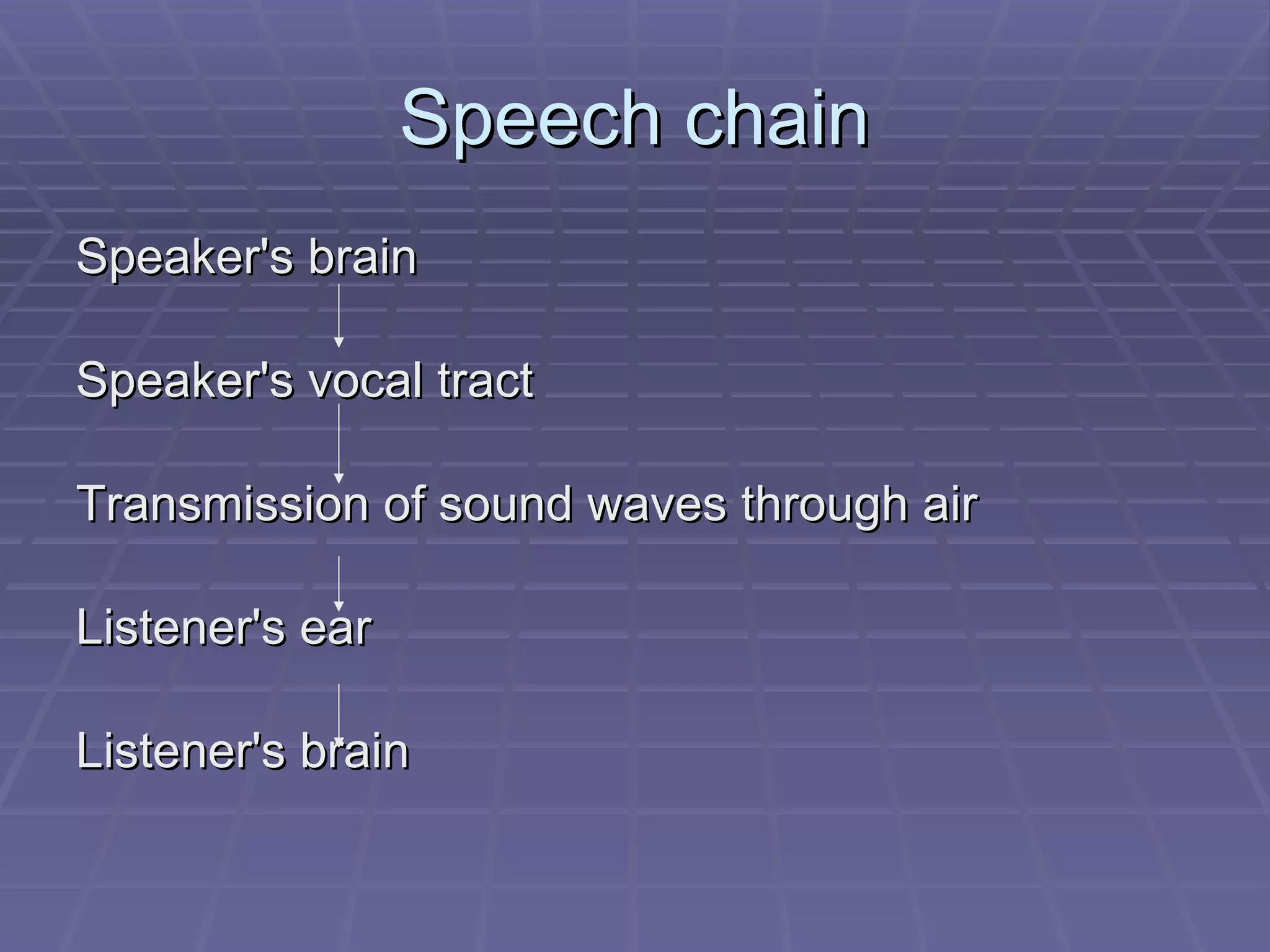
Speech chain Speaker's brain Speaker's vocal tract Transmission of sound waves through air Listener's ear Listener's brain
Stage 1: speaker's brain  We do not know much about this.  But we make informed guesses on the evidence of speech errors, brain scanning, and effect  due to brain damage.
Stage 3: Articulatory aspect of speech production Many special instruments have been developed and they help us to find about such things as the pressure of air in the lungs and the vocal tract, the flow of air out of mouth and nose, the opening and closing of the vocal folds and the soft palate, and the movement of articulators lips and lower jaws.
x-ray techniques X-ray techniques were used for the examination of articulator's movement until 1970,s and it lead to many important discoveries. But serious health risks in using  Normal radiographic and cine radiographic technology. Safer microbeam techniques were used.
Eletropalatography (EPG) technique It  is used to electrically measure the contact between tongue and lips. False palate is used. This technique reveals interesting information about the working of tongue during speech.
Electromyography (EMG) technique This technique makes possible to detect the electrical activity that is produced when muscles contract  and as a result we can observe the complex co-ordination of the muscles in the speech production.
Expensive and difficult but useful techniques  Although most of these techniques are expensive and difficult to use but may become easily available.
Stage 3: transmission of sound waves through air This stage is studied by  acoustic analysis. Physical events that produce the perceptual characteristics of speech sounds have been discovered including the duration or length of sounds or syllables, intensity of different sounds and the fundamental frequency of sounds. Developments in the field of computer technology has made possible speech analysis on a large scale. Additional pronunciation training is also provided by the computers.
Stage 4 & 5 Human beings are very sensitive to very slight acoustic differences and they are very flexible in being able to adjust to very different speakers. We are strongly influenced by our expectations.
Experimental phonetics has made use of speech produced  through speech synthesis.  Many discoveries regarding perception are also made by modifying and manipulating recordings of real speech. Tricks are used which provided surprising results.
Problem in the experimental study of speech A great problem in the experimental study of speech is the variability in the speech of an individual and among different speakers.
Previous research made use of speech of only one or two but modern research makes use of a large amount of data.

Copy Of Developments In The Field Of

  • 1.
    Contents: Phonetics andphonology What is phonetics? Branches of phonetics What is phonology? Difference between phonetics and phonology Laboratory phonetics speech chain Stages
  • 2.
    Developments in thefield of phonetics and phonology
  • 3.
    Phonetics and phonologyWhat is phonetics? Phonetics is the precise study of human speech sounds. An appropriate knowledge of phonetics enables a person to acquire a correct knowledge of pronunciation and describes how sounds are made.
  • 4.
    Phonetics Ithelps in pointing out mistakes and learning the correct form of sounds and to differentiate sounds of English. It has three branches. Articulatory phonetics Acoustic phonetics Auditory phonetics
  • 5.
    Branches of phoneticsArticulatory phonetics is about how human vocal apparatus produces sounds. In this movement of the speech organs in the articulation of speech is studied. Acoustic phonetics studies the sound waves produced by the human vocal apparatus. Auditory phonetics explores how human speech sounds are perceived by the ear.
  • 6.
    What is phonology?Phonology is the study of sound pattern that occurs within a language. It is the broader form of major speech sounds in a particular language.
  • 7.
    Difference between phoneticsand phonology Study of speech sounds in general is phonetics and study of speech sounds in particular is phonology. For example when we talk about the ' vowel system of English ‘ we are making a phonological statement, but when we talk about bilabial consonants in general then it is phonetic statement.
  • 8.
    Laboratory phonetics Itis an important part of phonetics and many important discoveries have been made relating to production of speech and how it is perceived. This field is regarded as a mysterious world where incomprehensible things are done with the help of expansive equipments.
  • 9.
    Speech chain Speaker'sbrain Speaker's vocal tract Transmission of sound waves through air Listener's ear Listener's brain
  • 10.
    Stage 1: speaker'sbrain We do not know much about this. But we make informed guesses on the evidence of speech errors, brain scanning, and effect due to brain damage.
  • 11.
    Stage 3: Articulatoryaspect of speech production Many special instruments have been developed and they help us to find about such things as the pressure of air in the lungs and the vocal tract, the flow of air out of mouth and nose, the opening and closing of the vocal folds and the soft palate, and the movement of articulators lips and lower jaws.
  • 12.
    x-ray techniques X-raytechniques were used for the examination of articulator's movement until 1970,s and it lead to many important discoveries. But serious health risks in using Normal radiographic and cine radiographic technology. Safer microbeam techniques were used.
  • 13.
    Eletropalatography (EPG) techniqueIt is used to electrically measure the contact between tongue and lips. False palate is used. This technique reveals interesting information about the working of tongue during speech.
  • 14.
    Electromyography (EMG) techniqueThis technique makes possible to detect the electrical activity that is produced when muscles contract and as a result we can observe the complex co-ordination of the muscles in the speech production.
  • 15.
    Expensive and difficultbut useful techniques Although most of these techniques are expensive and difficult to use but may become easily available.
  • 16.
    Stage 3: transmissionof sound waves through air This stage is studied by acoustic analysis. Physical events that produce the perceptual characteristics of speech sounds have been discovered including the duration or length of sounds or syllables, intensity of different sounds and the fundamental frequency of sounds. Developments in the field of computer technology has made possible speech analysis on a large scale. Additional pronunciation training is also provided by the computers.
  • 17.
    Stage 4 &5 Human beings are very sensitive to very slight acoustic differences and they are very flexible in being able to adjust to very different speakers. We are strongly influenced by our expectations.
  • 18.
    Experimental phonetics hasmade use of speech produced through speech synthesis. Many discoveries regarding perception are also made by modifying and manipulating recordings of real speech. Tricks are used which provided surprising results.
  • 19.
    Problem in theexperimental study of speech A great problem in the experimental study of speech is the variability in the speech of an individual and among different speakers.
  • 20.
    Previous research madeuse of speech of only one or two but modern research makes use of a large amount of data.