MAGNETIC PROPERTIES
OF
TRANSITION METAL COMPLEXES
By:
Chemistry Department
Govt. Shivalik College,
Naya Nangal
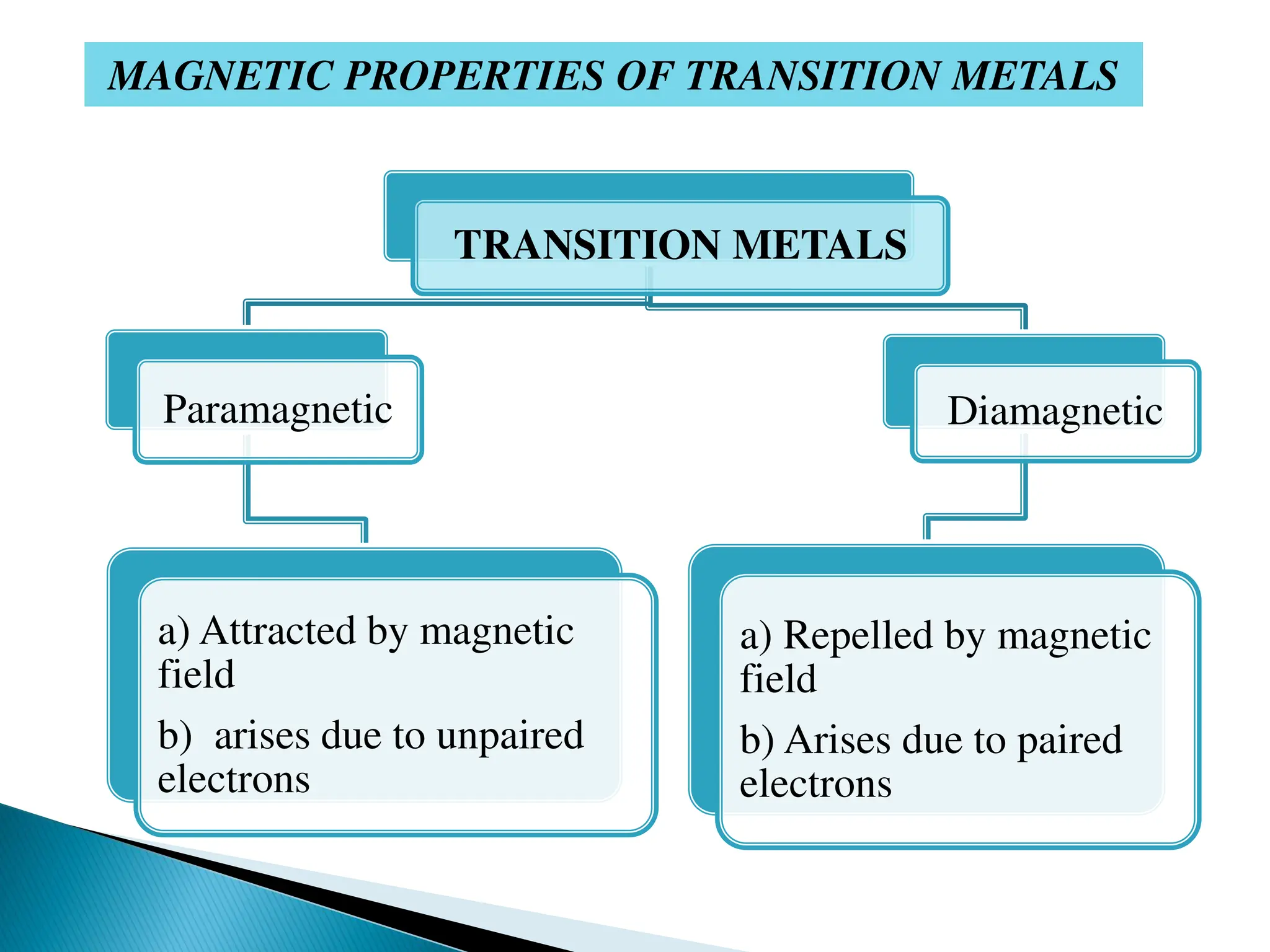
TRANSITION METALS
Paramagnetic
a) Attracted by magnetic
field
b) arises due to unpaired
electrons
Diamagnetic
a) Repelled by magnetic
field
b) Arises due to paired
electrons
MAGNETIC PROPERTIES OF TRANSITION METALS
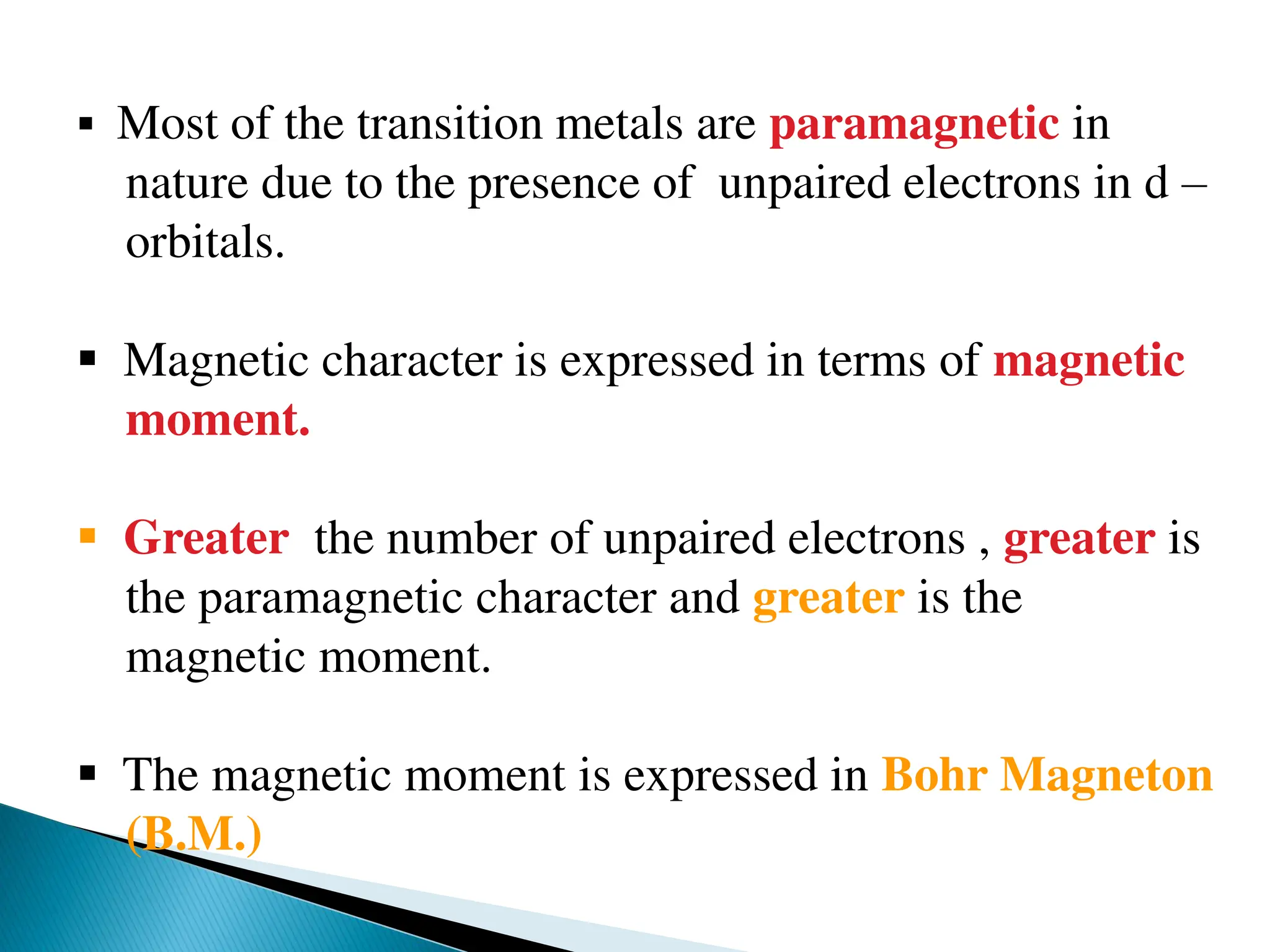
 Most of the transition metals are paramagnetic in
nature due to the presence of unpaired electrons in d –
orbitals.
 Magnetic character is expressed in terms of magnetic
moment.
 Greater the number of unpaired electrons , greater is
the paramagnetic character and greater is the
magnetic moment.
 The magnetic moment is expressed in Bohr Magneton
(B.M.)
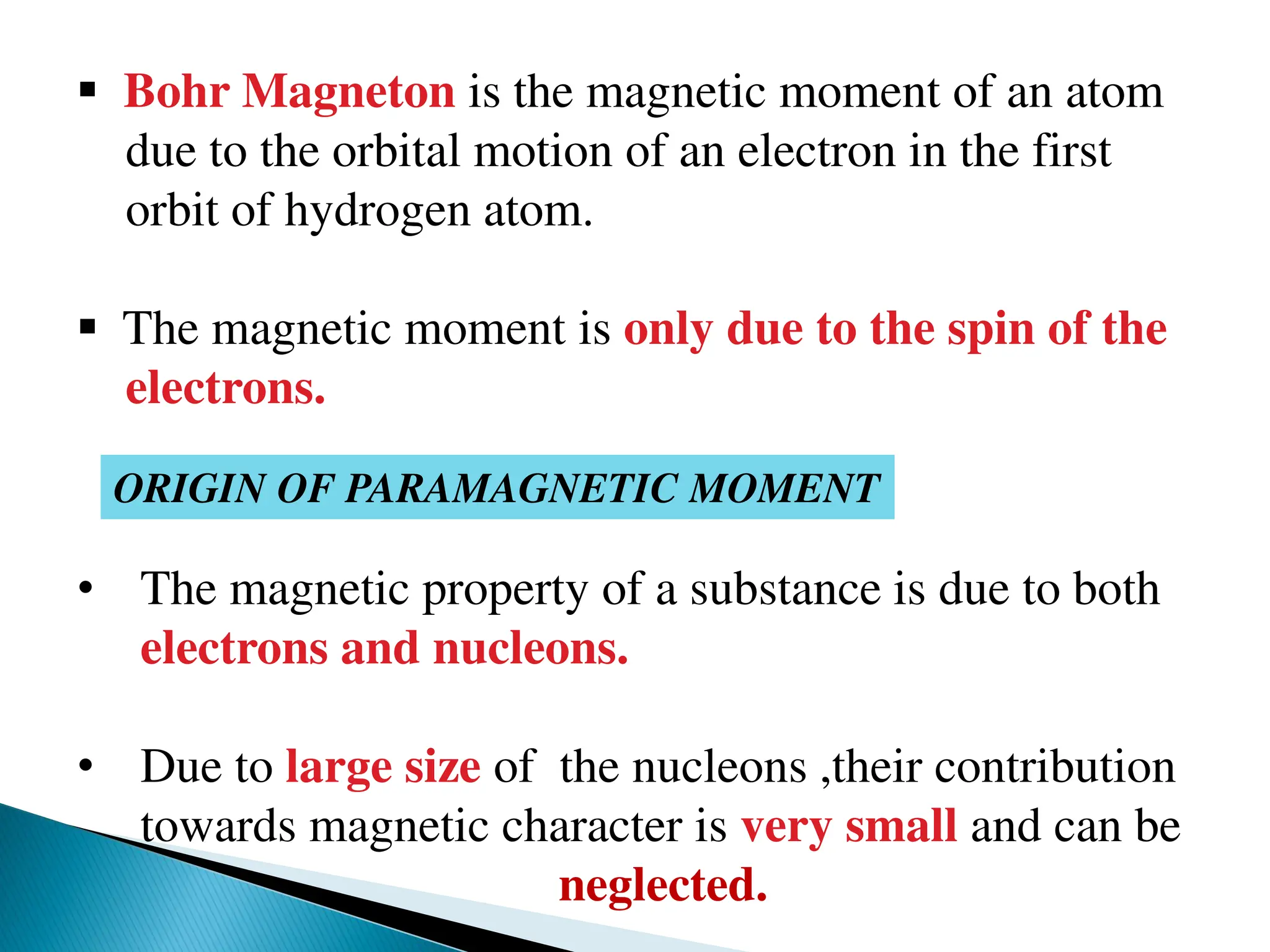
 Bohr Magneton is the magnetic moment of an atom
due to the orbital motion of an electron in the first
orbit of hydrogen atom.
 The magnetic moment is only due to the spin of the
electrons.
ORIGIN OF PARAMAGNETIC MOMENT
• The magnetic property of a substance is due to both
electrons and nucleons.
• Due to large size of the nucleons ,their contribution
towards magnetic character is very small and can be
neglected.
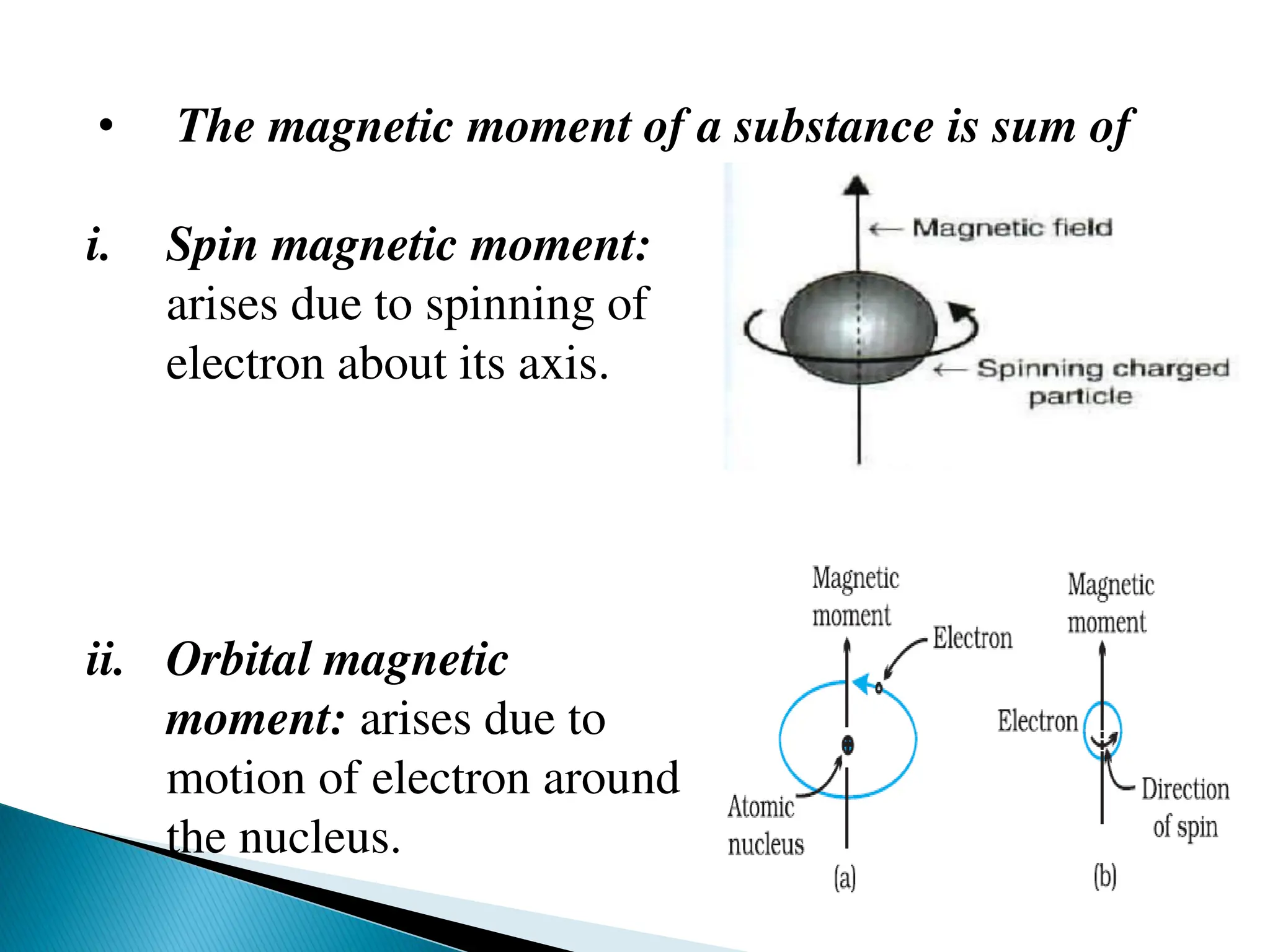
• The magnetic moment of a substance is sum of
i. Spin magnetic moment:
arises due to spinning of
electron about its axis.
ii. Orbital magnetic
moment: arises due to
motion of electron around
the nucleus.
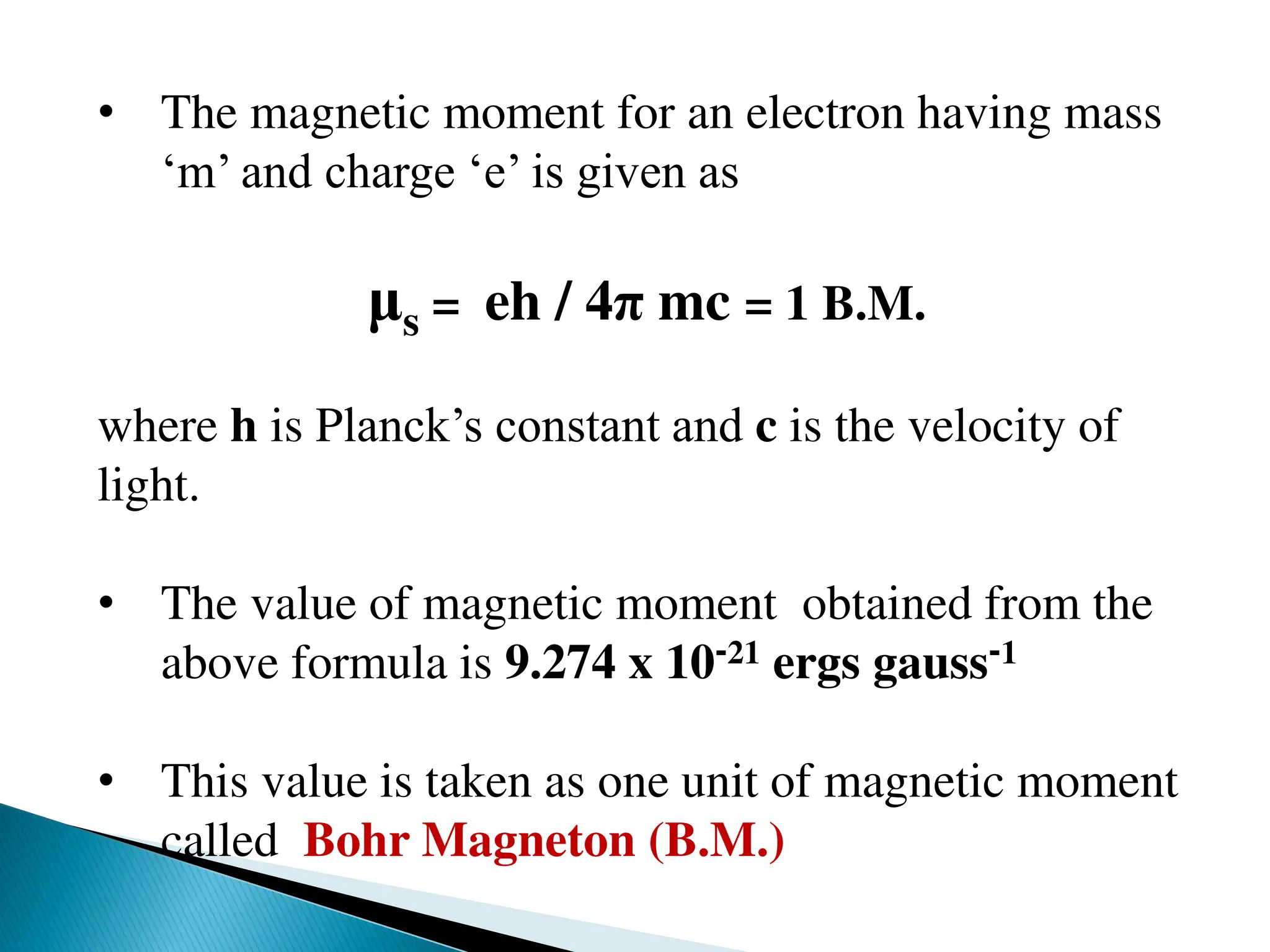
• The magnetic moment for an electron having mass
‘m’ and charge ‘e’ is given as
μs = eh / 4π mc = 1 B.M.
where h is Planck’s constant and c is the velocity of
light.
• The value of magnetic moment obtained from the
above formula is 9.274 x 10⁻²¹ ergs gauss-1
• This value is taken as one unit of magnetic moment
called Bohr Magneton (B.M.)
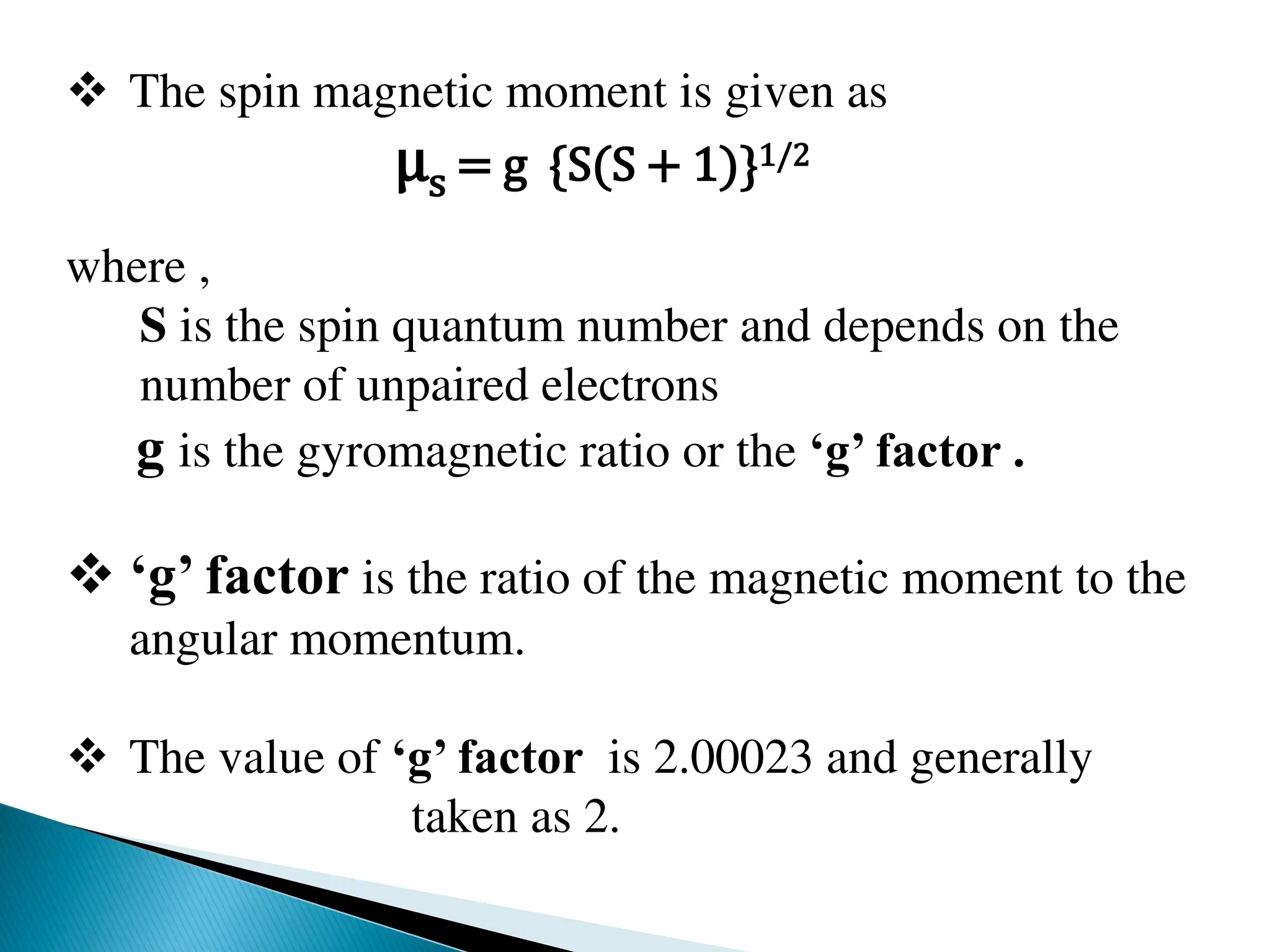
 The spin magnetic moment is given as
μs = g {S(S + 1)}1/2
where ,
S is the spin quantum number and depends on the
number of unpaired electrons
g is the gyromagnetic ratio or the ‘g’ factor .
 ‘g’ factor is the ratio of the magnetic moment to the
angular momentum.
 The value of ‘g’ factor is 2.00023 and generally
taken as 2.
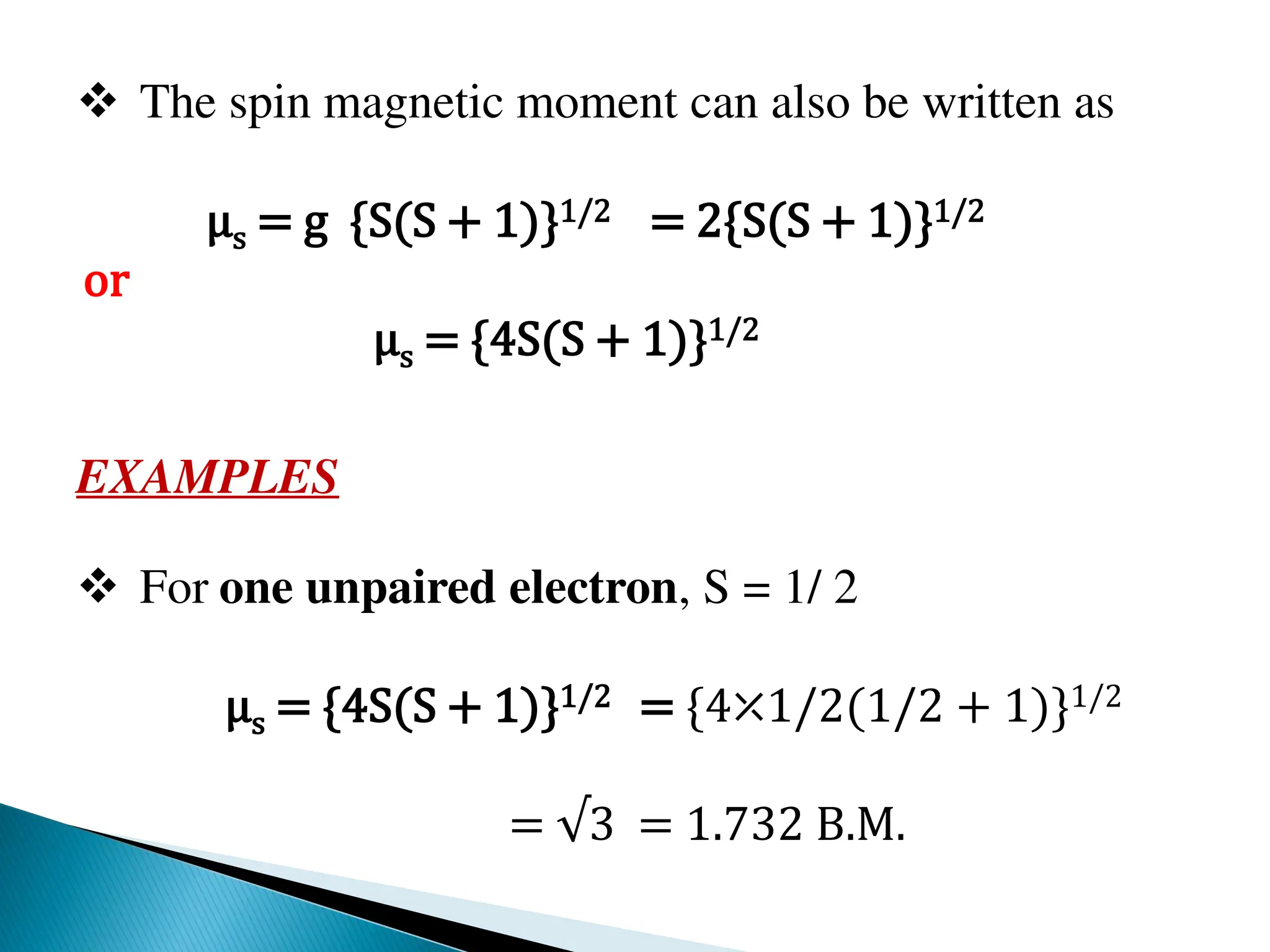
 The spin magnetic moment can also be written as
μs = g {S(S + 1)}1/2 = 2{S(S + 1)}1/2
or
μs = {4S(S + 1)}1/2
EXAMPLES
 For one unpaired electron, S = 1/ 2
μs = {4S(S + 1)}1/2 = {4⤫1/2(1/2 + 1)}1/2
= √3 = 1.732 B.M.
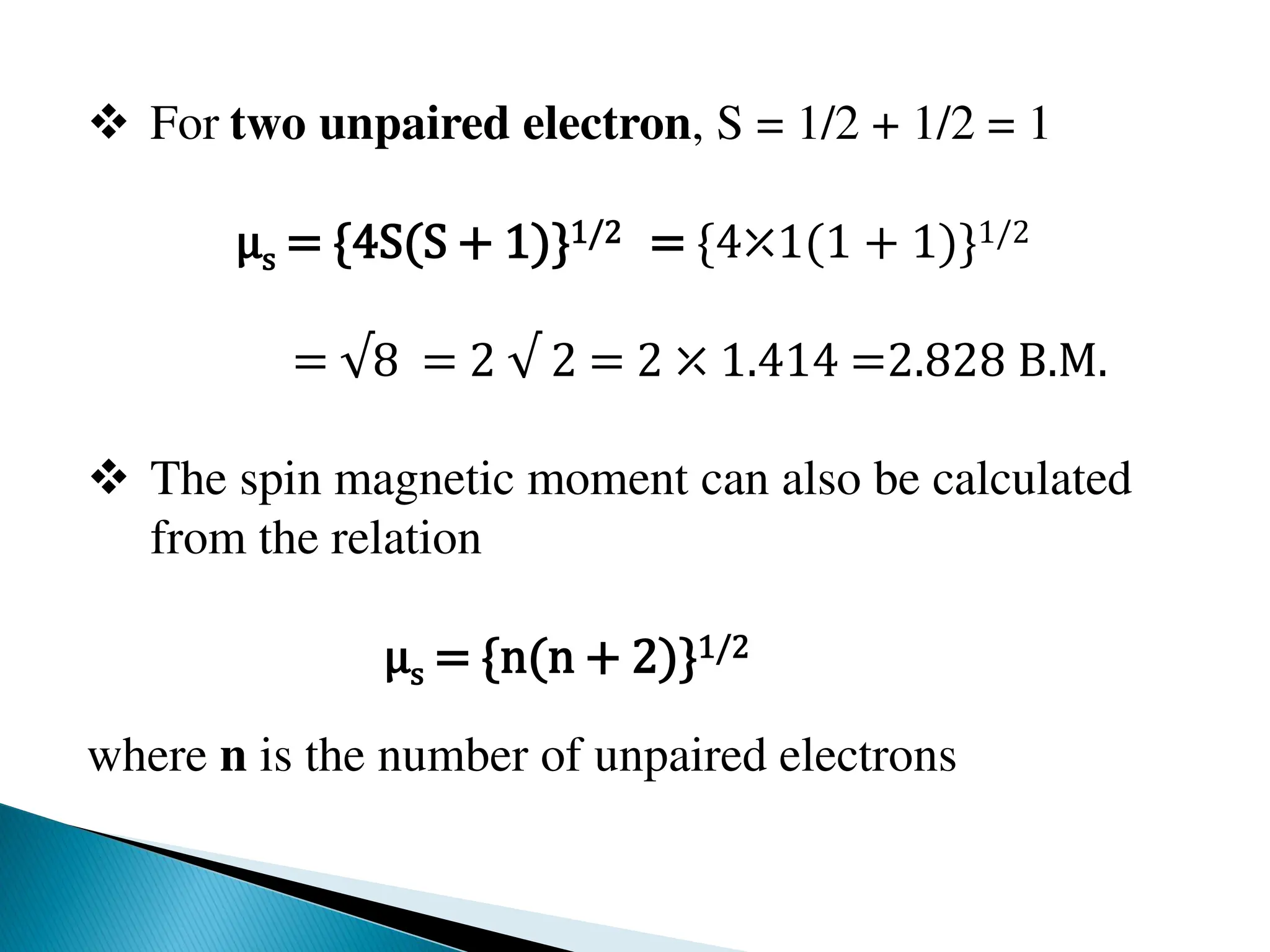
 For two unpaired electron, S = 1/2 + 1/2 = 1
μs = {4S(S + 1)}1/2 = {4⤫1(1 + 1)}1/2
= √8 = 2 √ 2 = 2 ⤫ 1.414 =2.828 B.M.
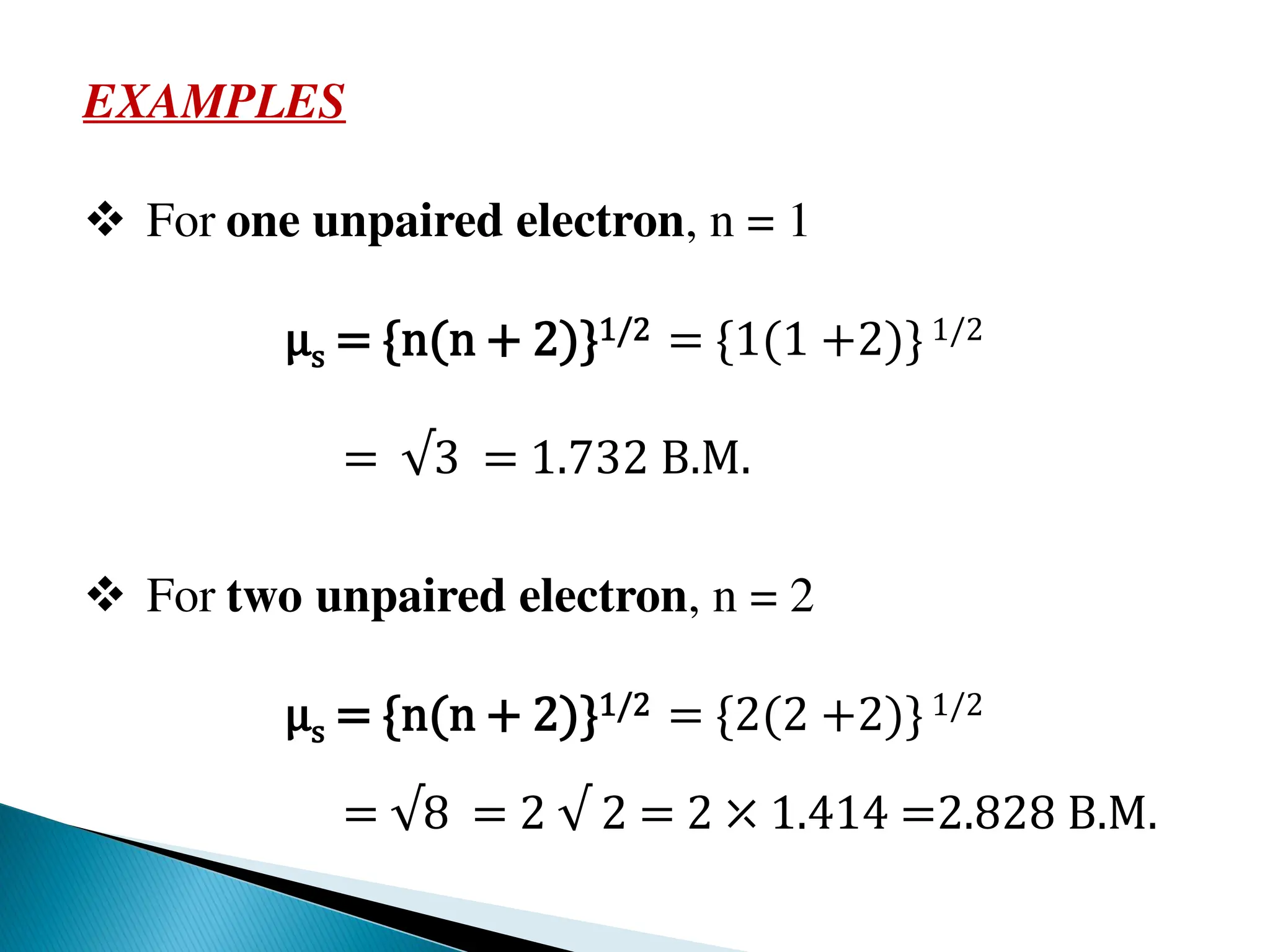
 The spin magnetic moment can also be calculated
from the relation
μs = {n(n + 2)}1/2
where n is the number of unpaired electrons
EXAMPLES
 For one unpaired electron, n = 1
μs = {n(n + 2)}1/2 = {1(1 +2)}1/2
= √3 = 1.732 B.M.
 For two unpaired electron, n = 2
μs = {n(n + 2)}1/2 = {2(2 +2)}1/2
= √8 = 2 √ 2 = 2 ⤫ 1.414 =2.828 B.M.
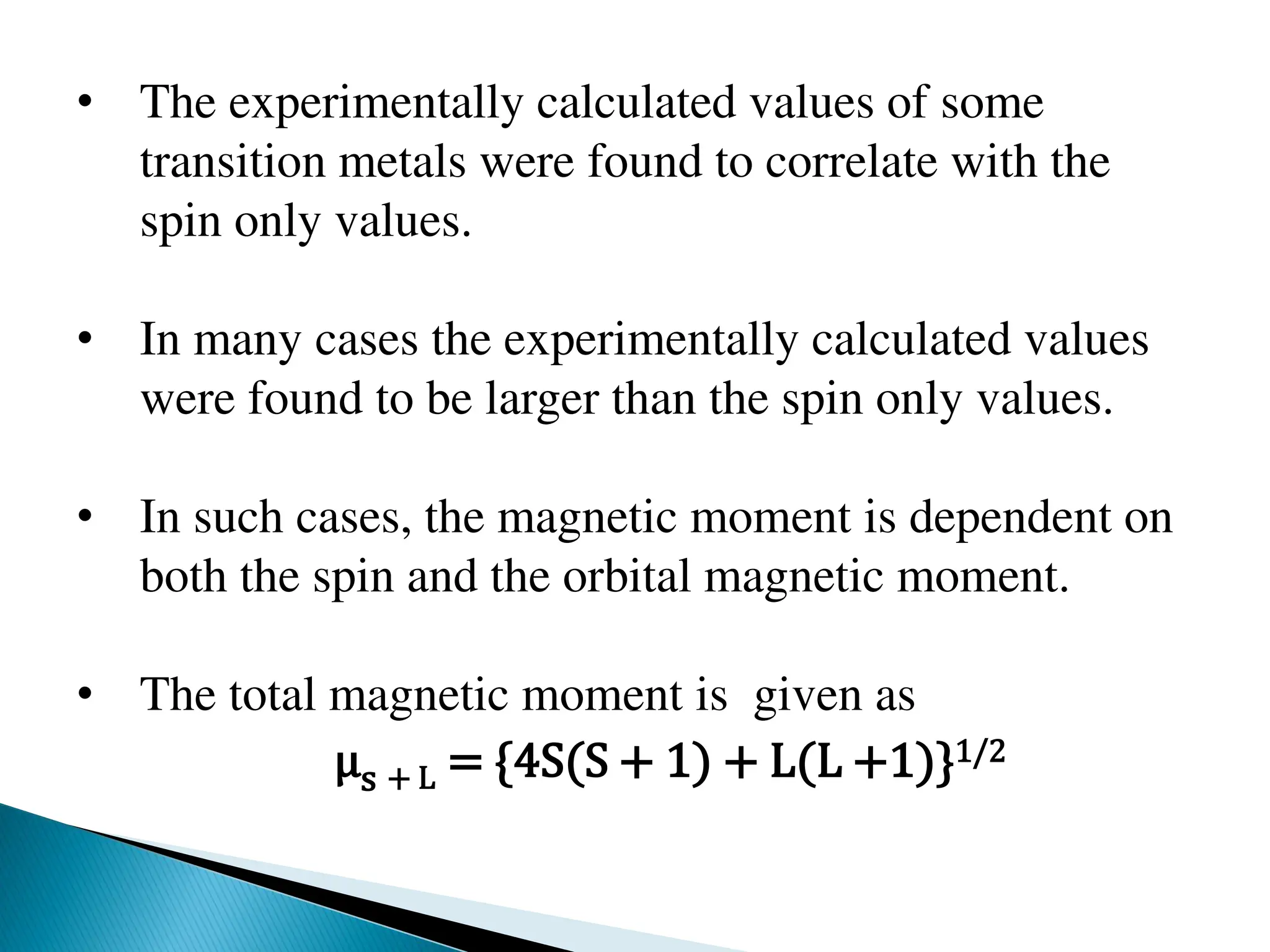
• The experimentally calculated values of some
transition metals were found to correlate with the
spin only values.
• In many cases the experimentally calculated values
were found to be larger than the spin only values.
• In such cases, the magnetic moment is dependent on
both the spin and the orbital magnetic moment.
• The total magnetic moment is given as
μs + L = {4S(S + 1) + L(L +1)}1/2
where,
S is the resultant spin angular momentum quantum no.
L is the resultant orbital angular momentum quantum no.
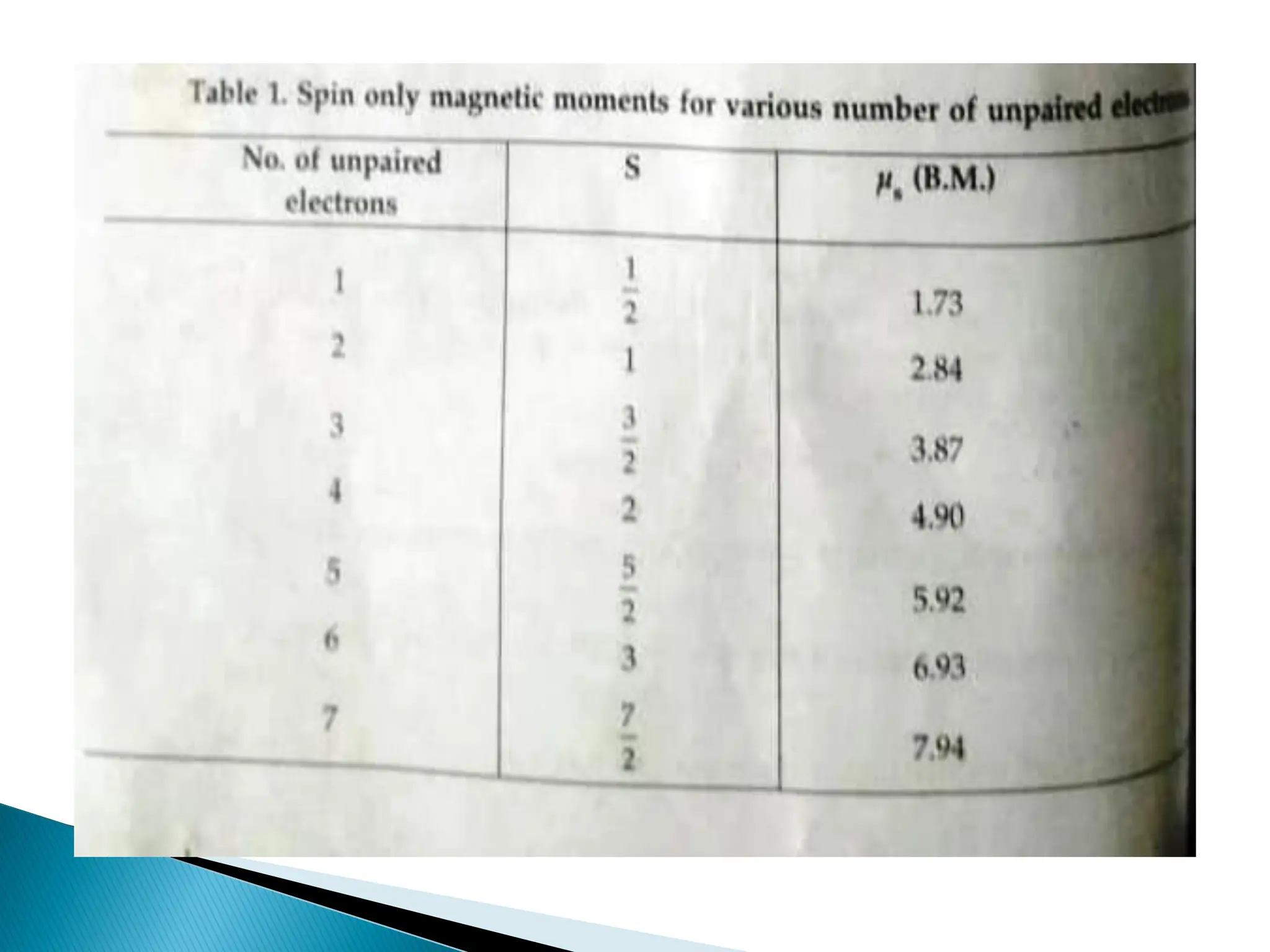
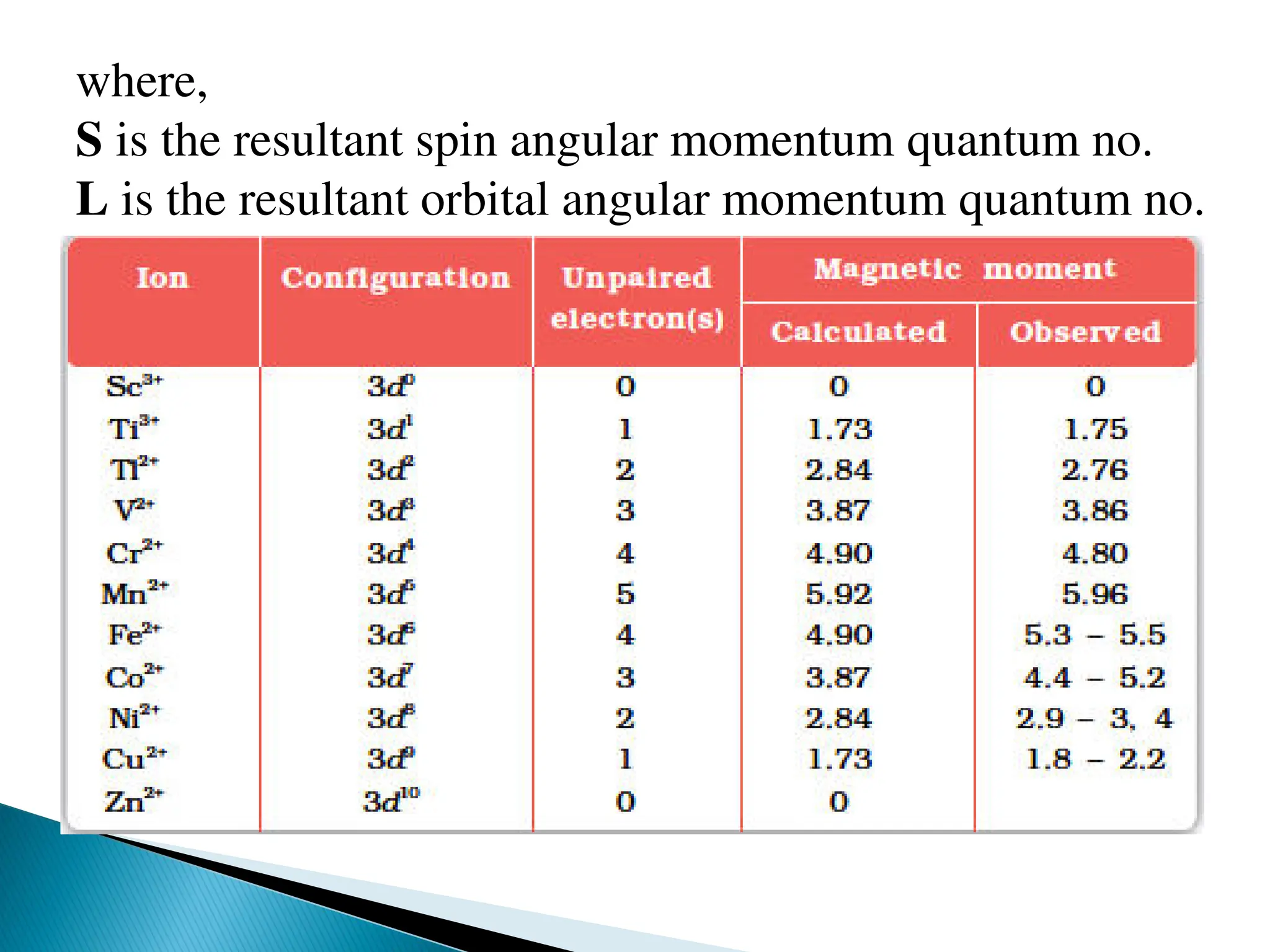
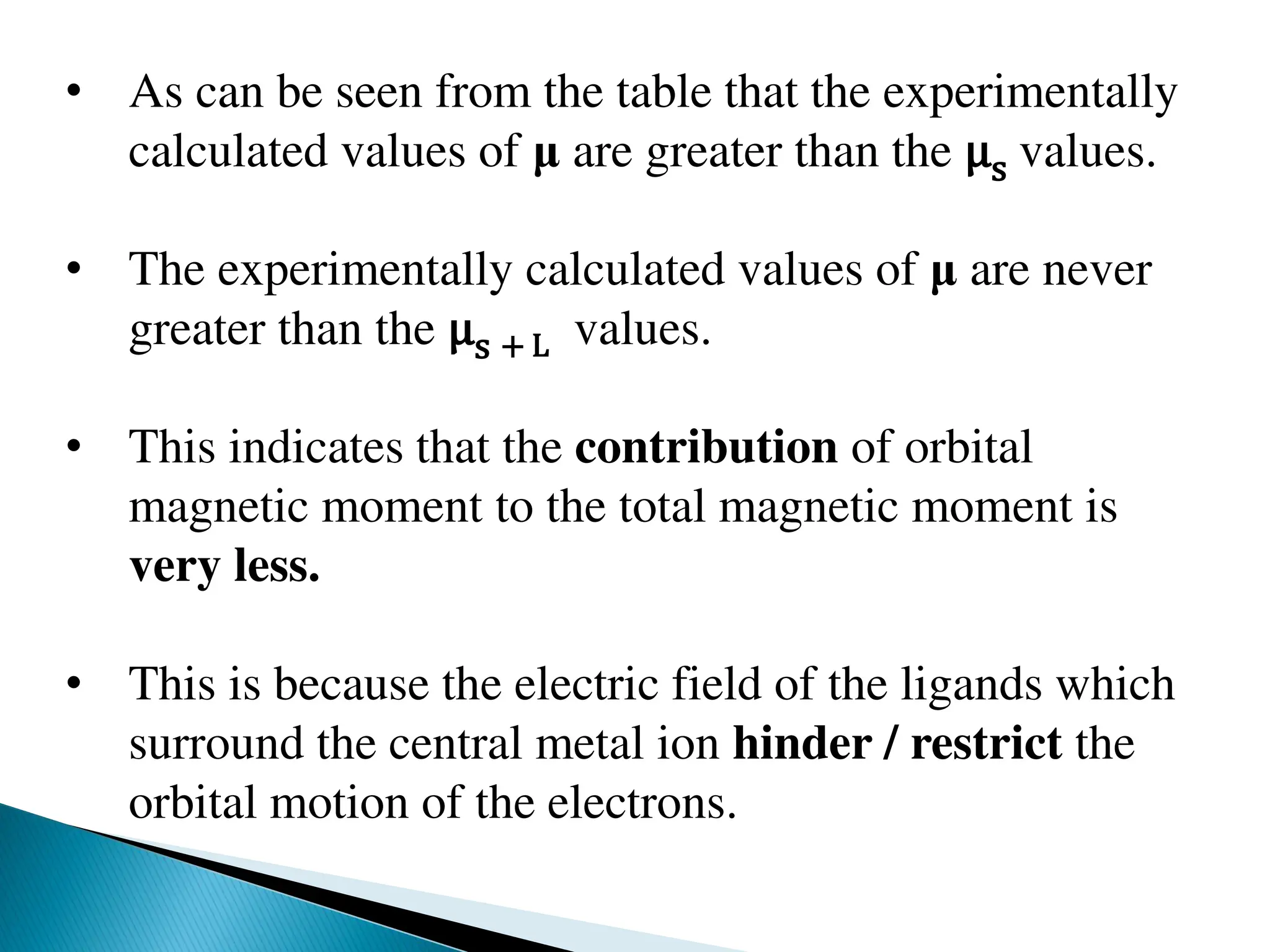
• As can be seen from the table that the experimentally
calculated values of μ are greater than the μs values.
• The experimentally calculated values of μ are never
greater than the μs + L values.
• This indicates that the contribution of orbital
magnetic moment to the total magnetic moment is
very less.
• This is because the electric field of the ligands which
surround the central metal ion hinder / restrict the
orbital motion of the electrons.
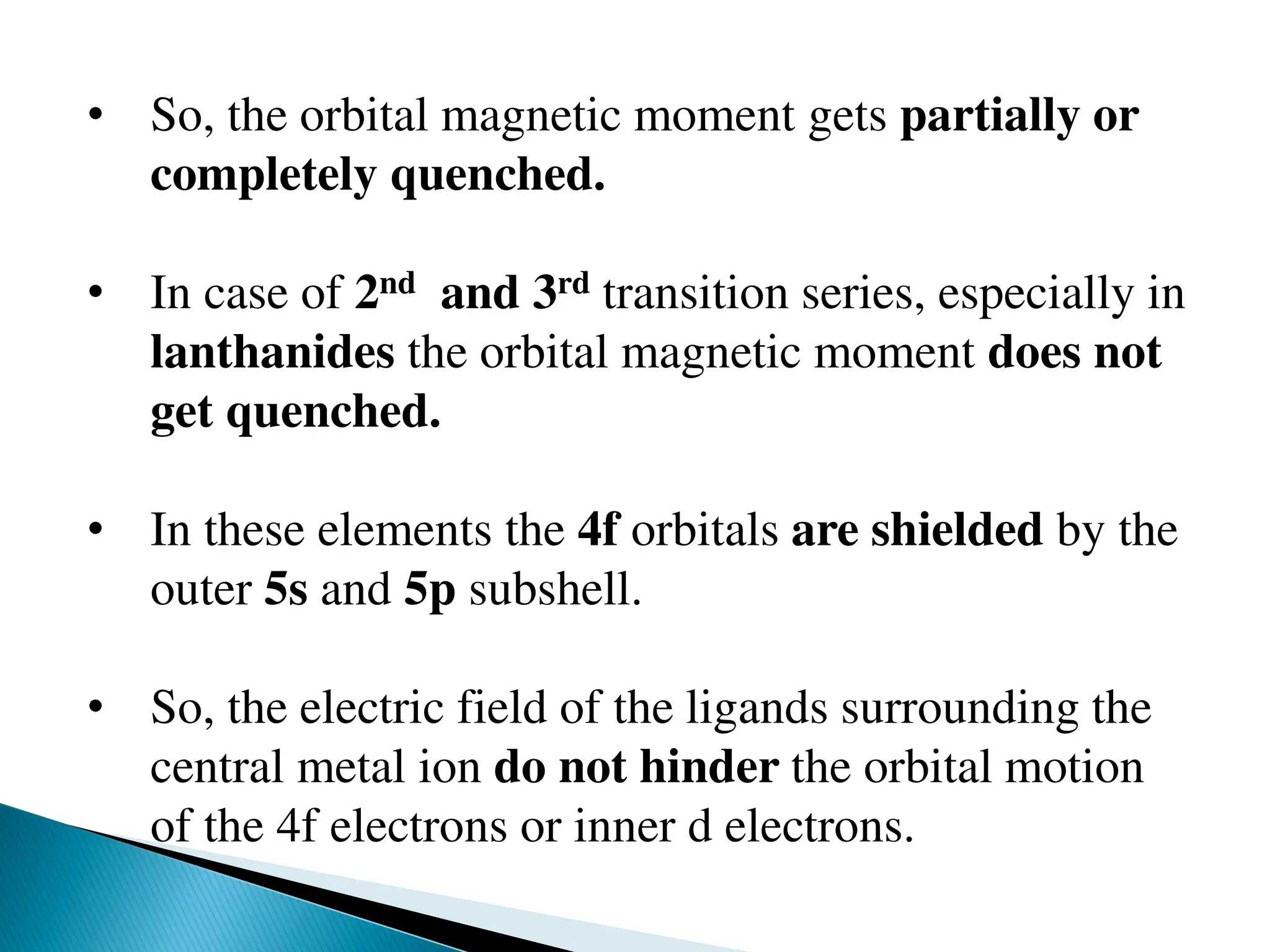
• So, the orbital magnetic moment gets partially or
completely quenched.
• In case of 2nd and 3rd transition series, especially in
lanthanides the orbital magnetic moment does not
get quenched.
• In these elements the 4f orbitals are shielded by the
outer 5s and 5p subshell.
• So, the electric field of the ligands surrounding the
central metal ion do not hinder the orbital motion
of the 4f electrons or inner d electrons.
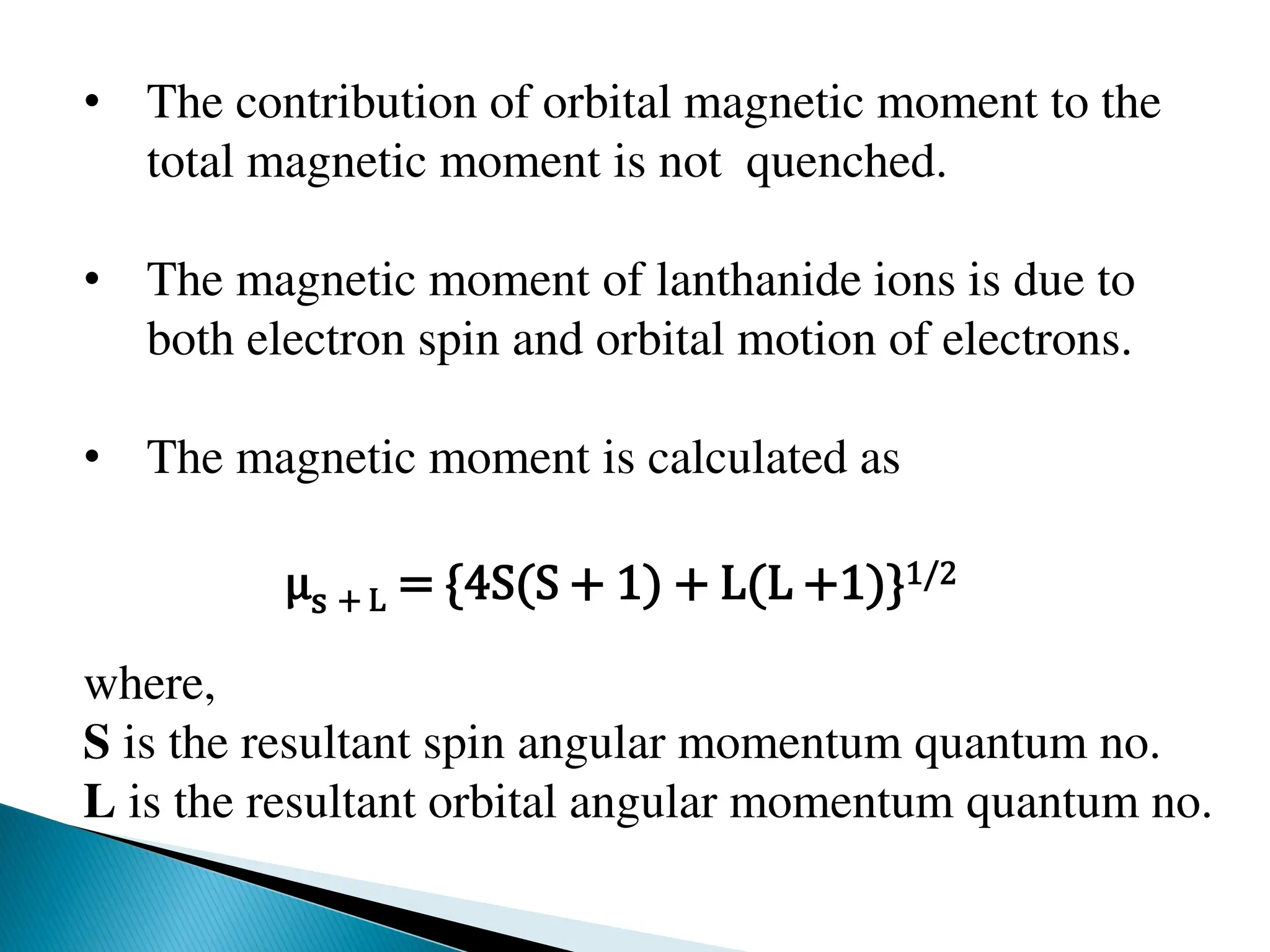
• The contribution of orbital magnetic moment to the
total magnetic moment is not quenched.
• The magnetic moment of lanthanide ions is due to
both electron spin and orbital motion of electrons.
• The magnetic moment is calculated as
μs + L = {4S(S + 1) + L(L +1)}1/2
where,
S is the resultant spin angular momentum quantum no.
L is the resultant orbital angular momentum quantum no.
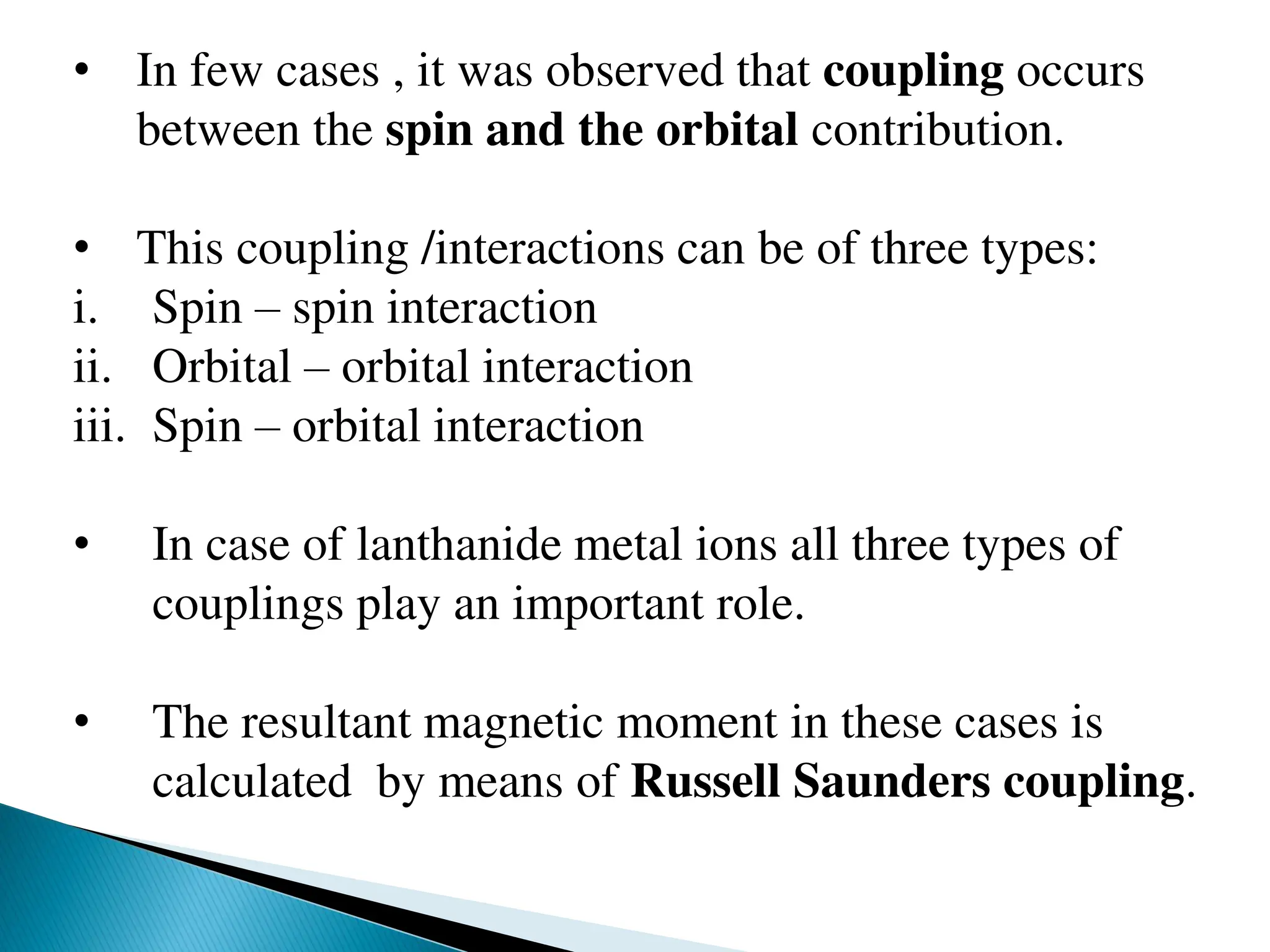
• In few cases , it was observed that coupling occurs
between the spin and the orbital contribution.
• This coupling /interactions can be of three types:
i. Spin – spin interaction
ii. Orbital – orbital interaction
iii. Spin – orbital interaction
• In case of lanthanide metal ions all three types of
couplings play an important role.
• The resultant magnetic moment in these cases is
calculated by means of Russell Saunders coupling.
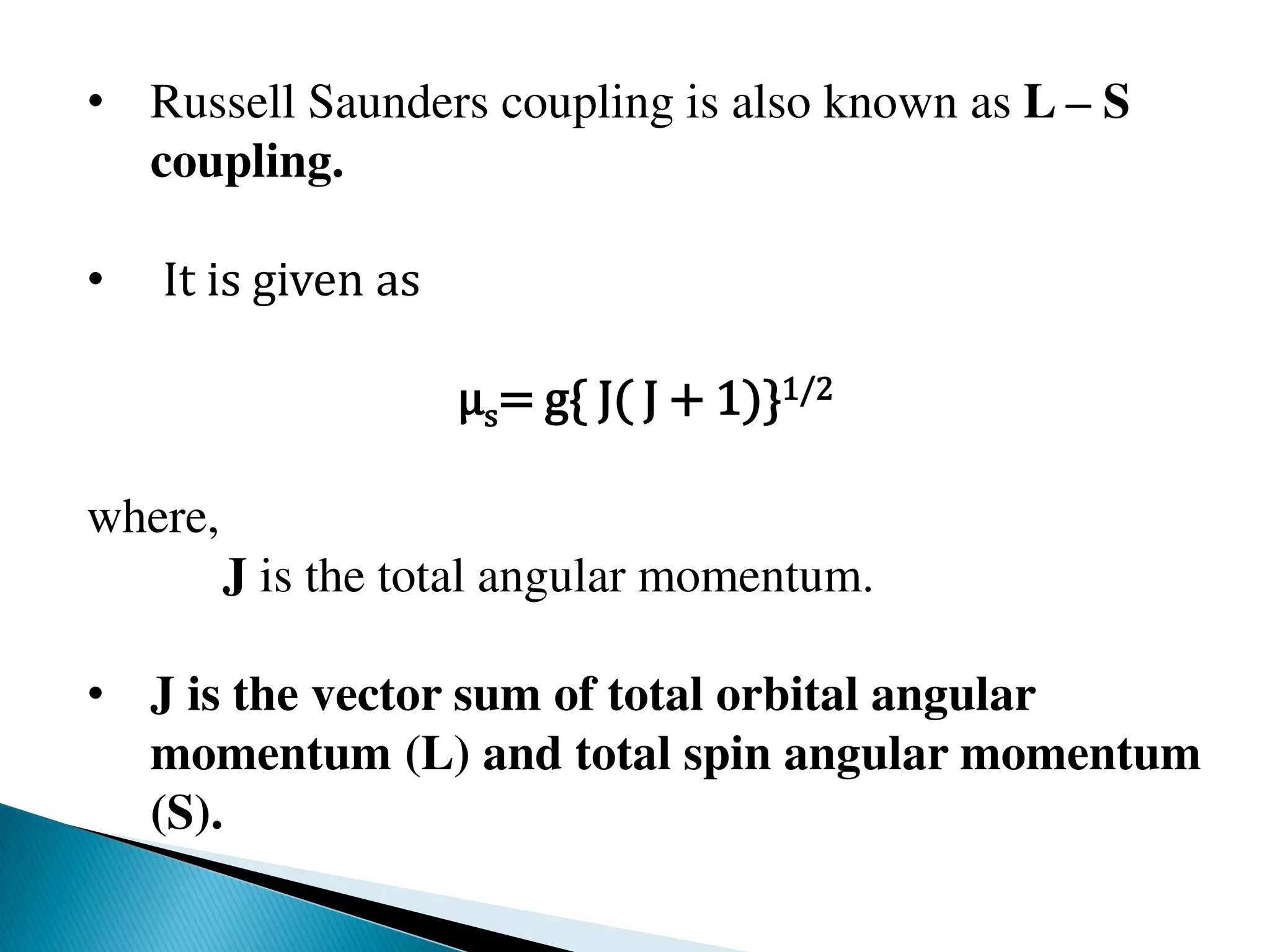
• Russell Saunders coupling is also known as L – S
coupling.
• It is given as
μs= g{ J( J + 1)}1/2
where,
J is the total angular momentum.
• J is the vector sum of total orbital angular
momentum (L) and total spin angular momentum
(S).
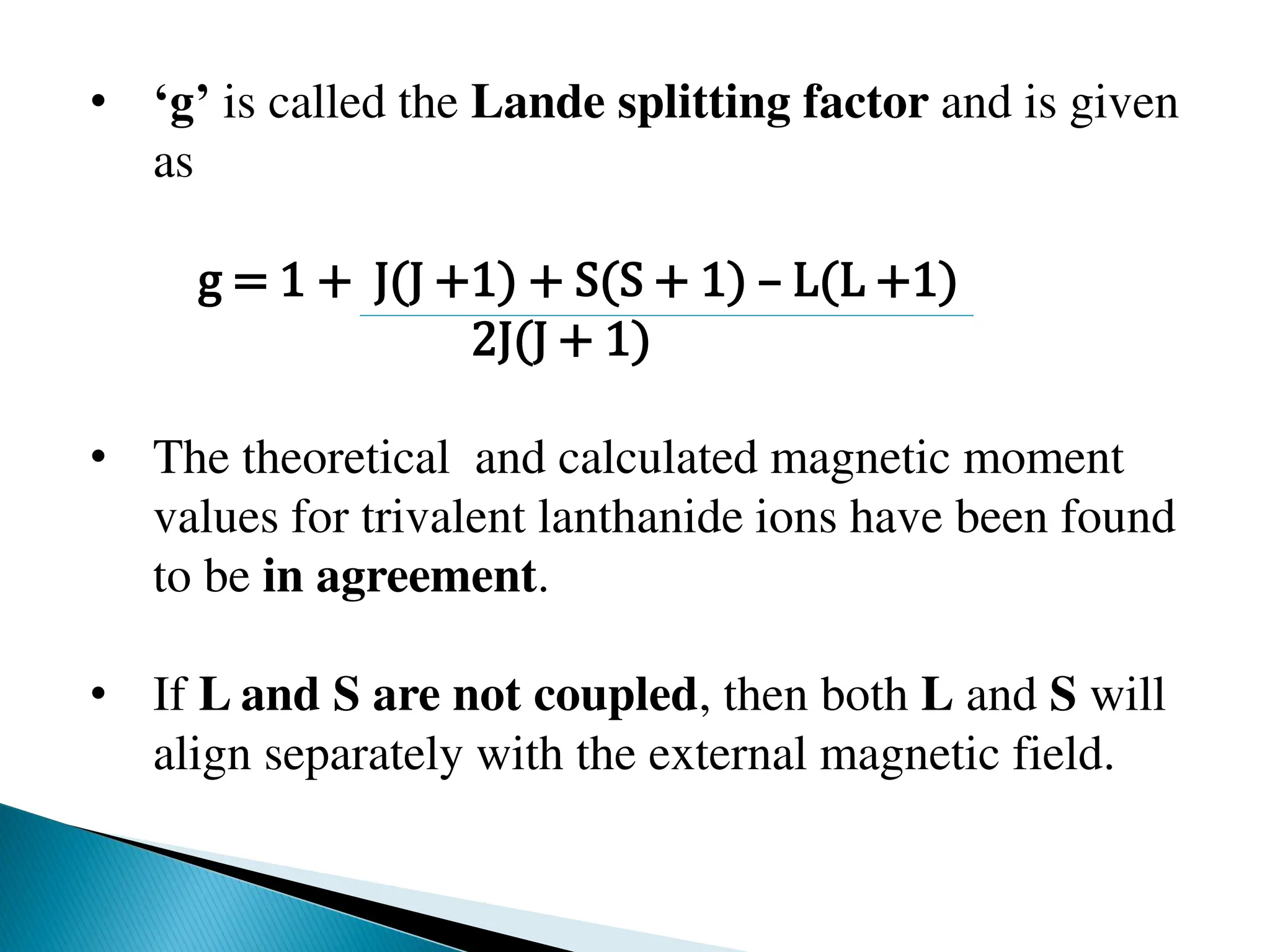
• ‘g’ is called the Lande splitting factor and is given
as
g = 1 + J(J +1) + S(S + 1) – L(L +1)
2J(J + 1)
• The theoretical and calculated magnetic moment
values for trivalent lanthanide ions have been found
to be in agreement.
• If L and S are not coupled, then both L and S will
align separately with the external magnetic field.
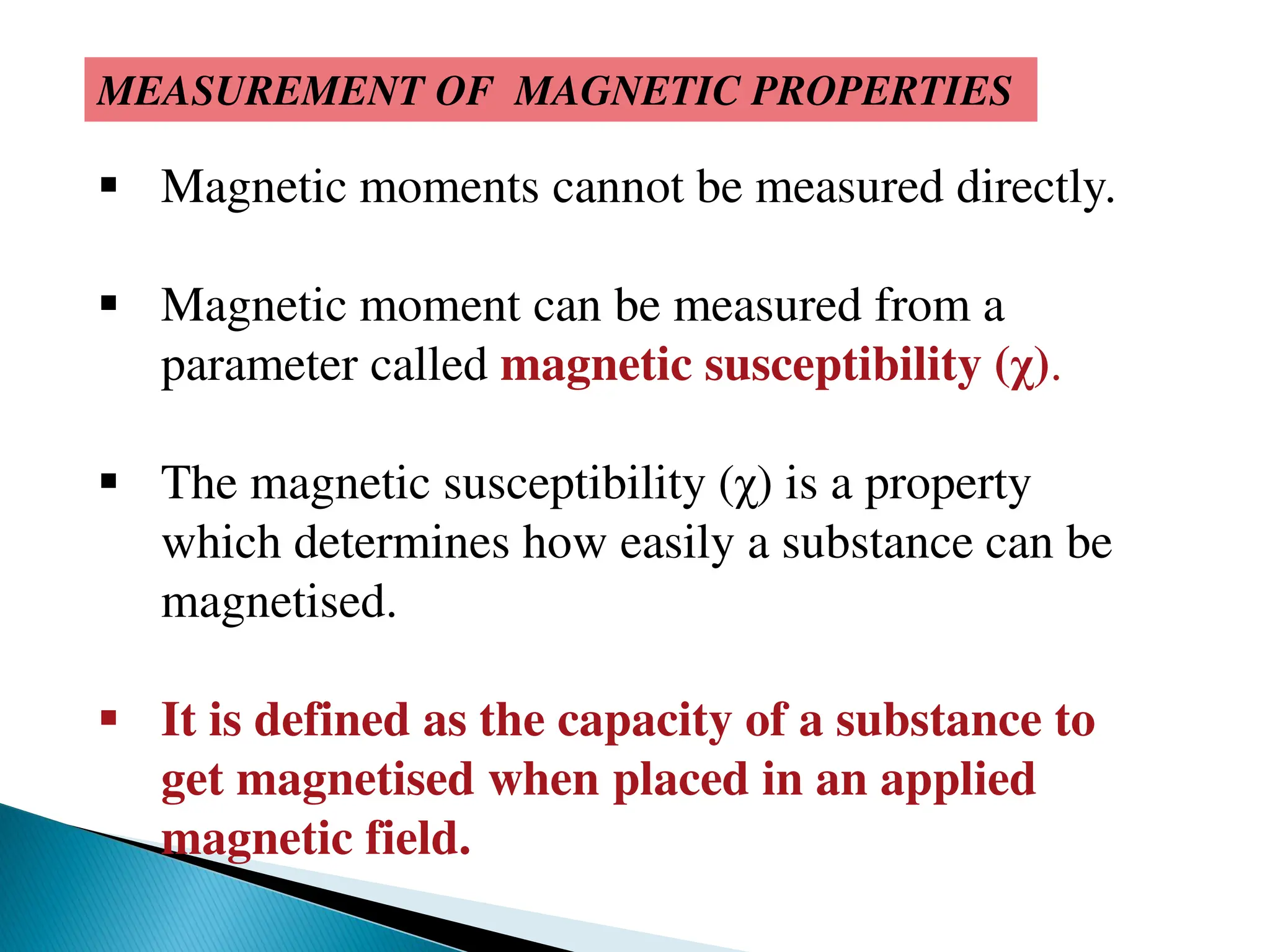
MEASUREMENT OF MAGNETIC PROPERTIES
 Magnetic moments cannot be measured directly.
 Magnetic moment can be measured from a
parameter called magnetic susceptibility (χ).
 The magnetic susceptibility (χ) is a property
which determines how easily a substance can be
magnetised.
 It is defined as the capacity of a substance to
get magnetised when placed in an applied
magnetic field.
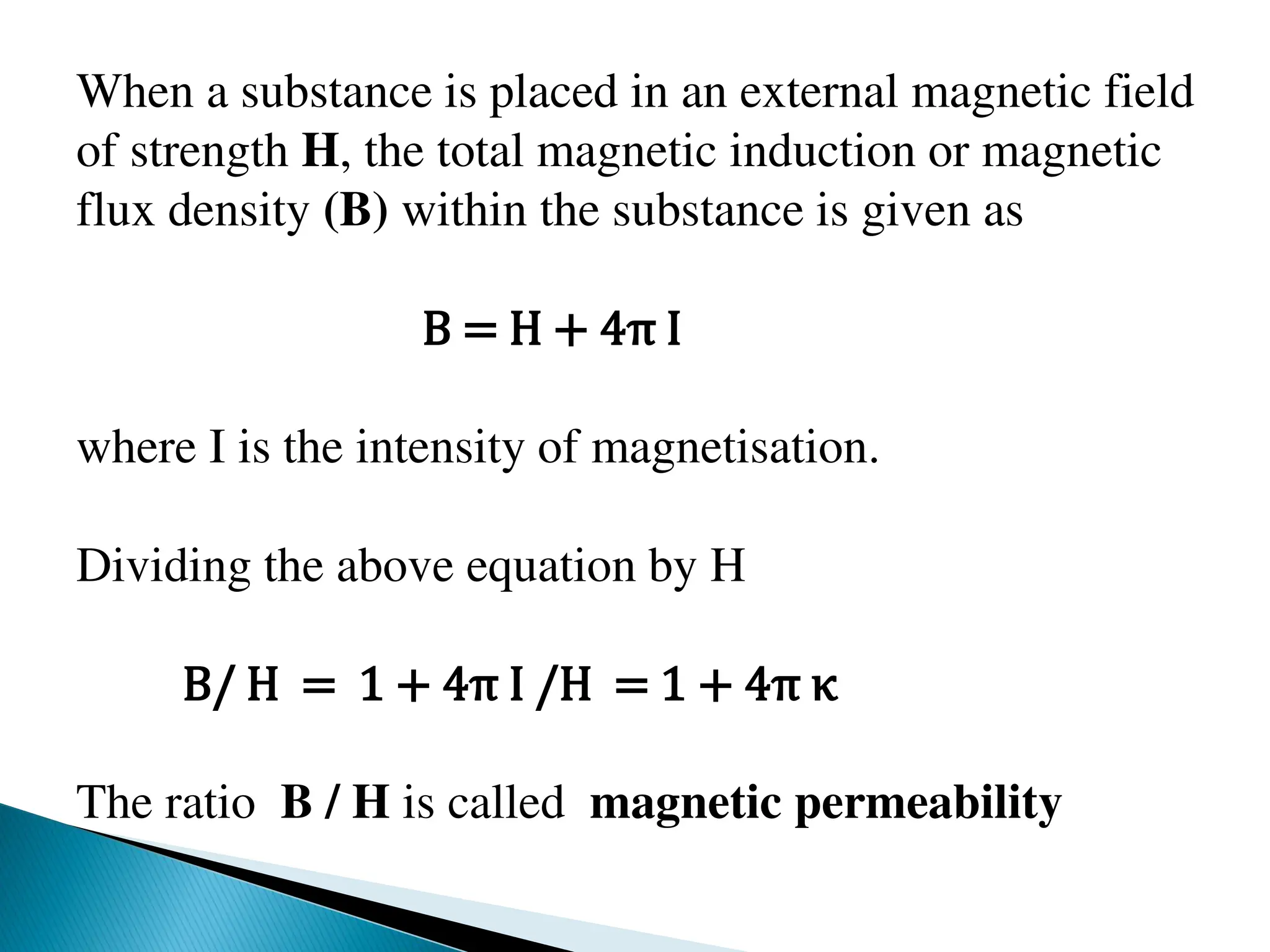
When a substance is placed in an external magnetic field
of strength H, the total magnetic induction or magnetic
flux density (B) within the substance is given as
B = H + 4π I
where I is the intensity of magnetisation.
Dividing the above equation by H
B/ H = 1 + 4π I /H = 1 + 4π κ
The ratio B / H is called magnetic permeability
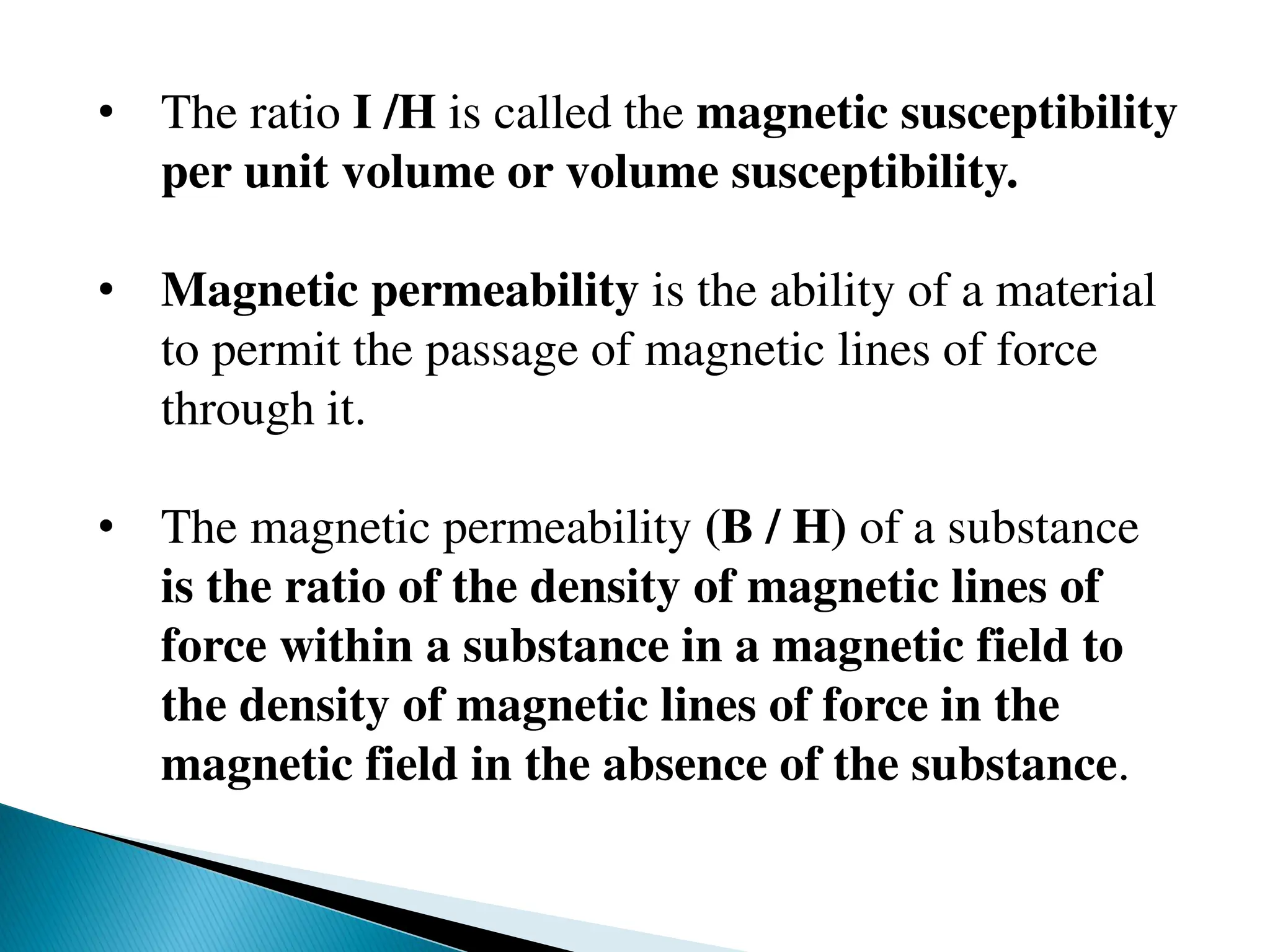
• The ratio I /H is called the magnetic susceptibility
per unit volume or volume susceptibility.
• Magnetic permeability is the ability of a material
to permit the passage of magnetic lines of force
through it.
• The magnetic permeability (B / H) of a substance
is the ratio of the density of magnetic lines of
force within a substance in a magnetic field to
the density of magnetic lines of force in the
magnetic field in the absence of the substance.
EXPERIMENTAL MEASUREMENT OF MAGNETIC MOMENT
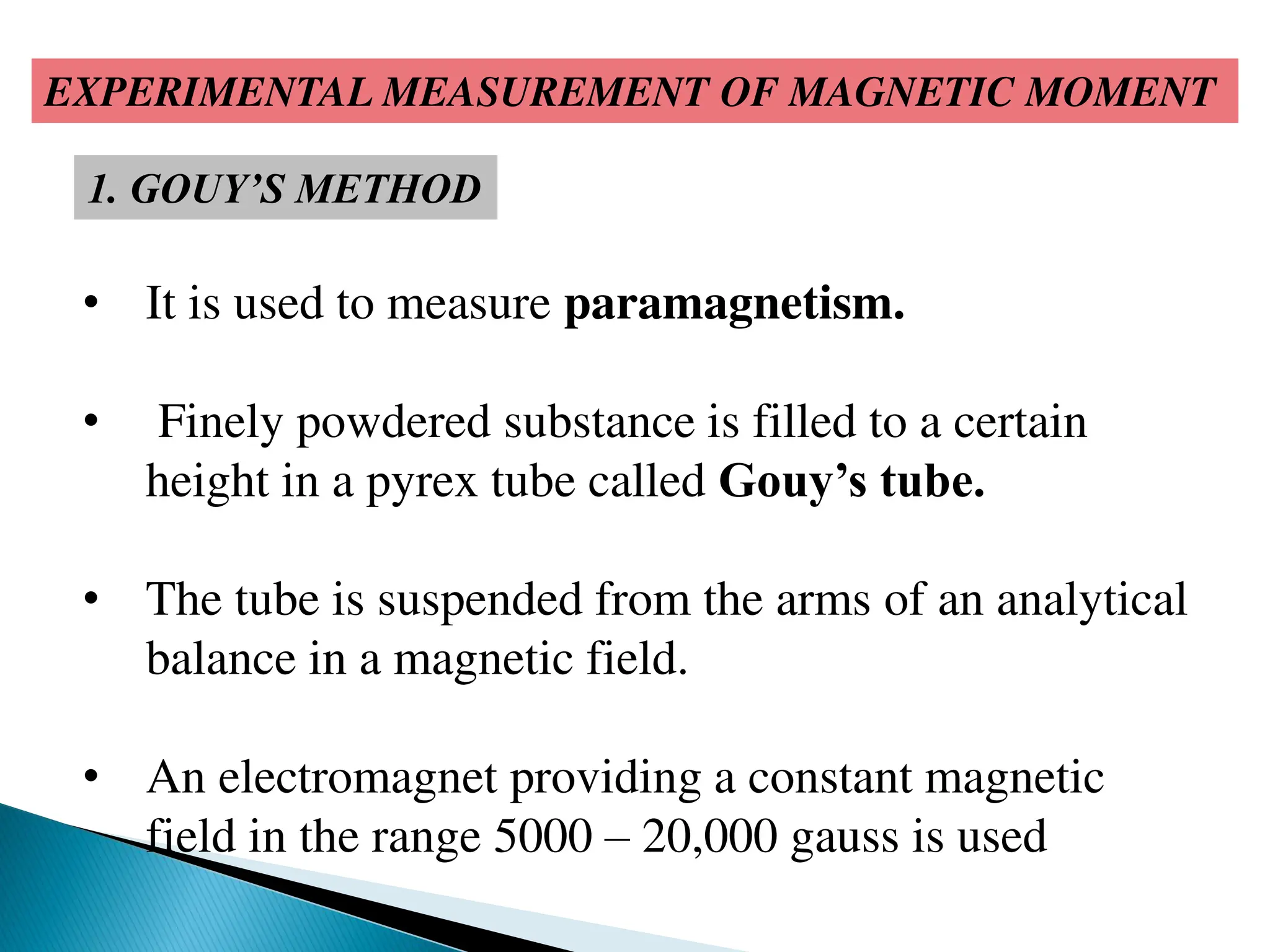
1. GOUY’S METHOD
• It is used to measure paramagnetism.
• Finely powdered substance is filled to a certain
height in a pyrex tube called Gouy’s tube.
• The tube is suspended from the arms of an analytical
balance in a magnetic field.
• An electromagnet providing a constant magnetic
field in the range 5000 – 20,000 gauss is used
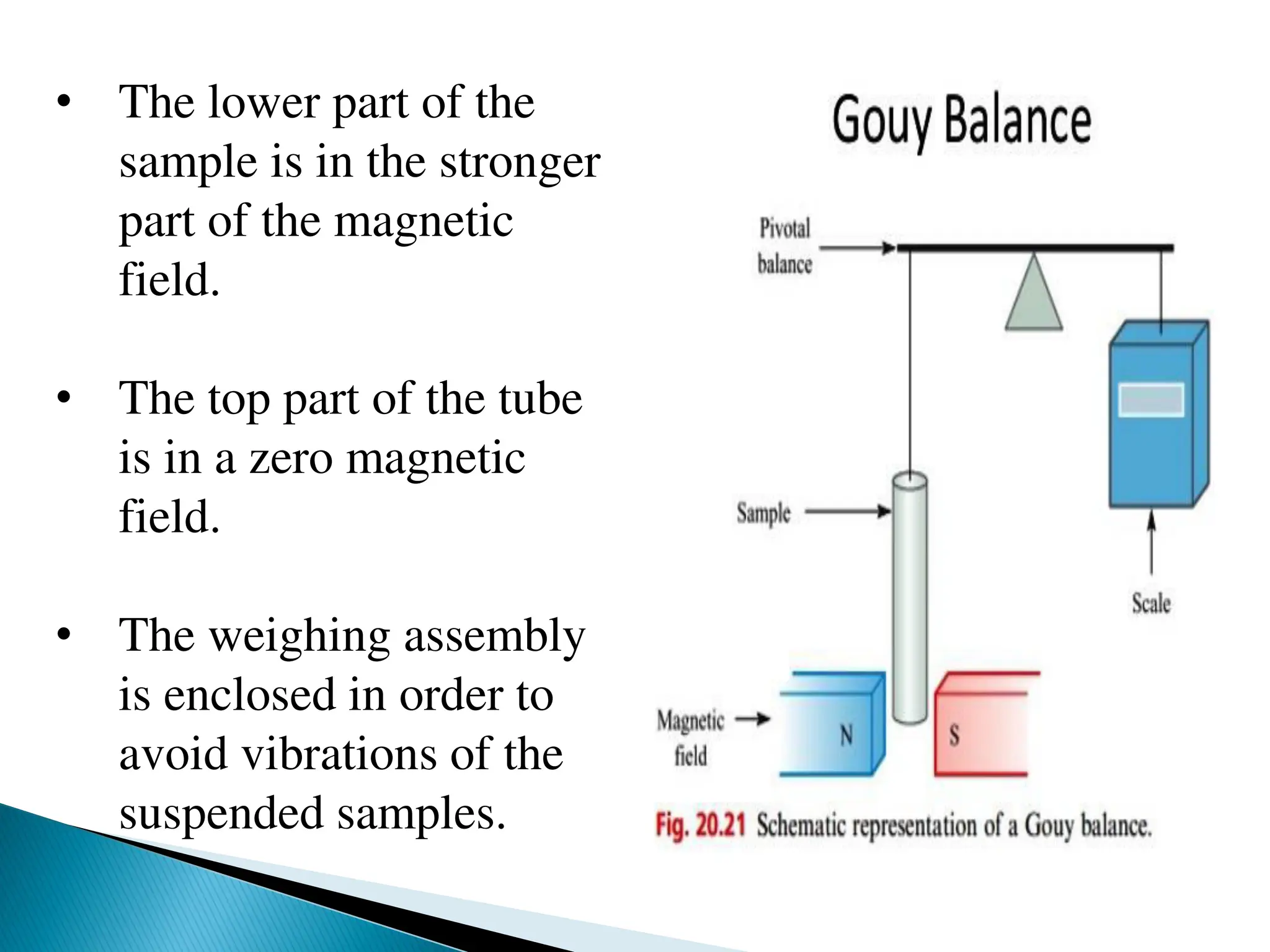
• The lower part of the
sample is in the stronger
part of the magnetic
field.
• The top part of the tube
is in a zero magnetic
field.
• The weighing assembly
is enclosed in order to
avoid vibrations of the
suspended samples.
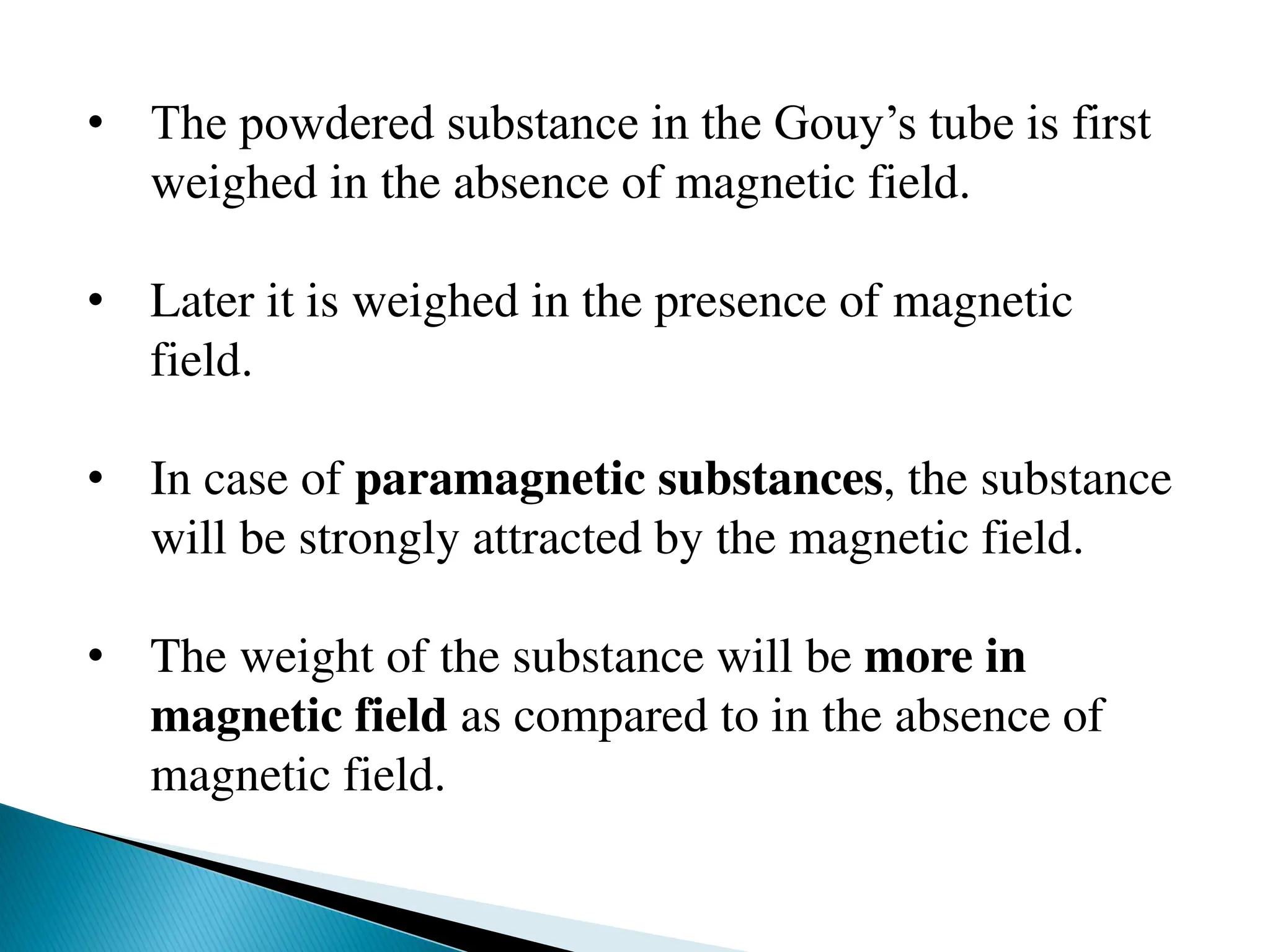
• The powdered substance in the Gouy’s tube is first
weighed in the absence of magnetic field.
• Later it is weighed in the presence of magnetic
field.
• In case of paramagnetic substances, the substance
will be strongly attracted by the magnetic field.
• The weight of the substance will be more in
magnetic field as compared to in the absence of
magnetic field.
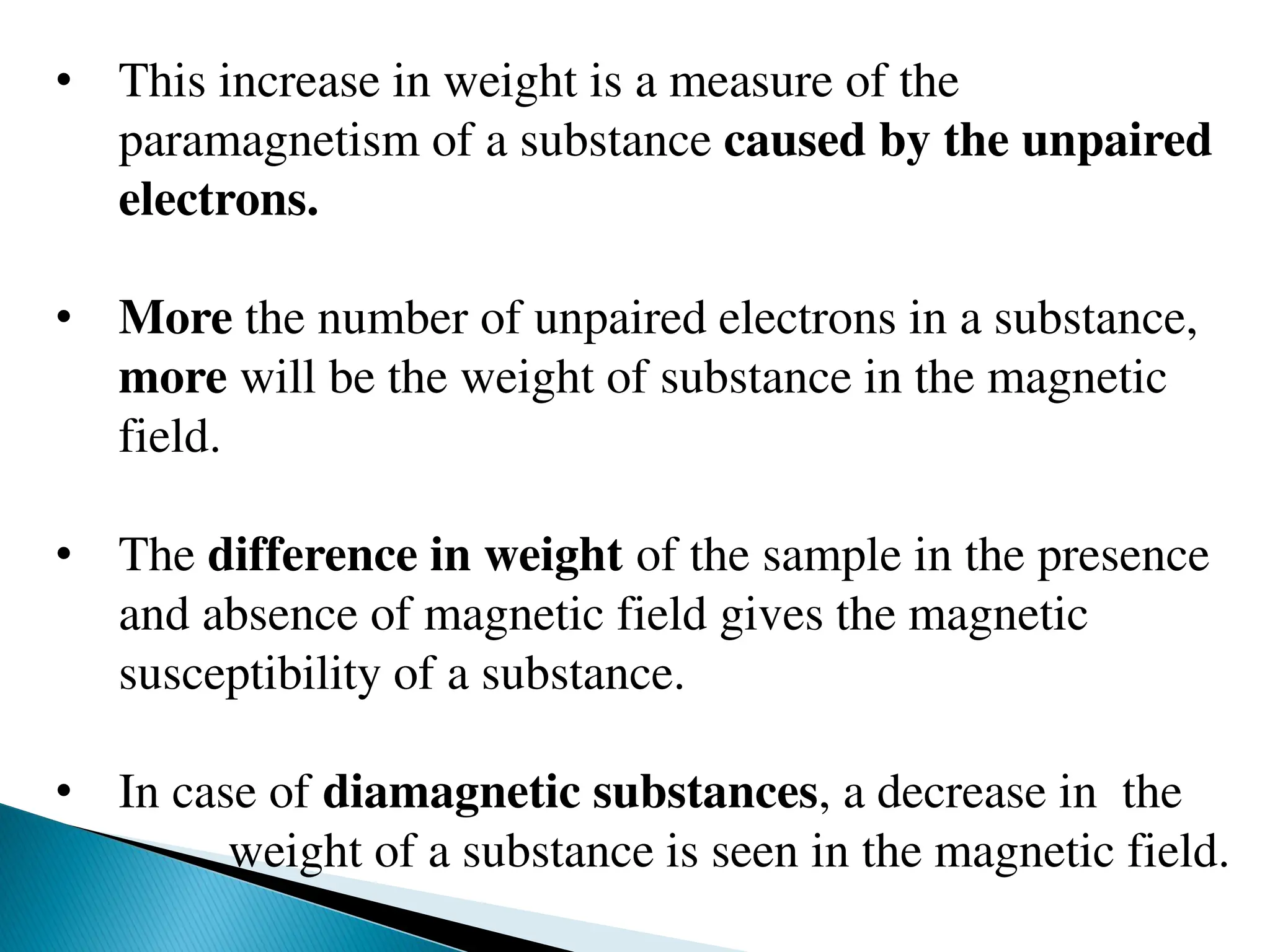
• This increase in weight is a measure of the
paramagnetism of a substance caused by the unpaired
electrons.
• More the number of unpaired electrons in a substance,
more will be the weight of substance in the magnetic
field.
• The difference in weight of the sample in the presence
and absence of magnetic field gives the magnetic
susceptibility of a substance.
• In case of diamagnetic substances, a decrease in the
weight of a substance is seen in the magnetic field.
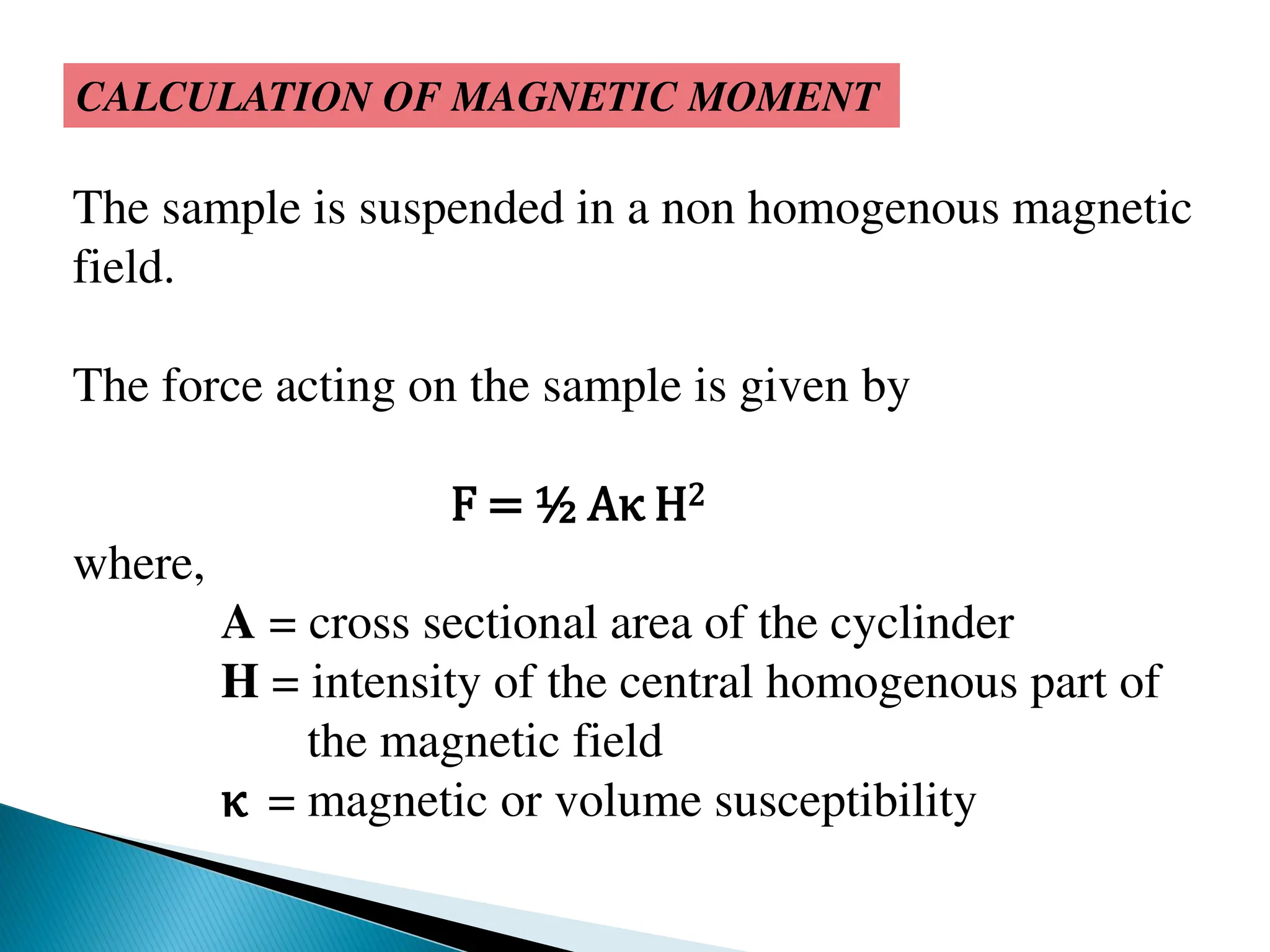
CALCULATION OF MAGNETIC MOMENT
The sample is suspended in a non homogenous magnetic
field.
The force acting on the sample is given by
F = ½ Aκ H2
where,
A = cross sectional area of the cyclinder
H = intensity of the central homogenous part of
the magnetic field
κ = magnetic or volume susceptibility
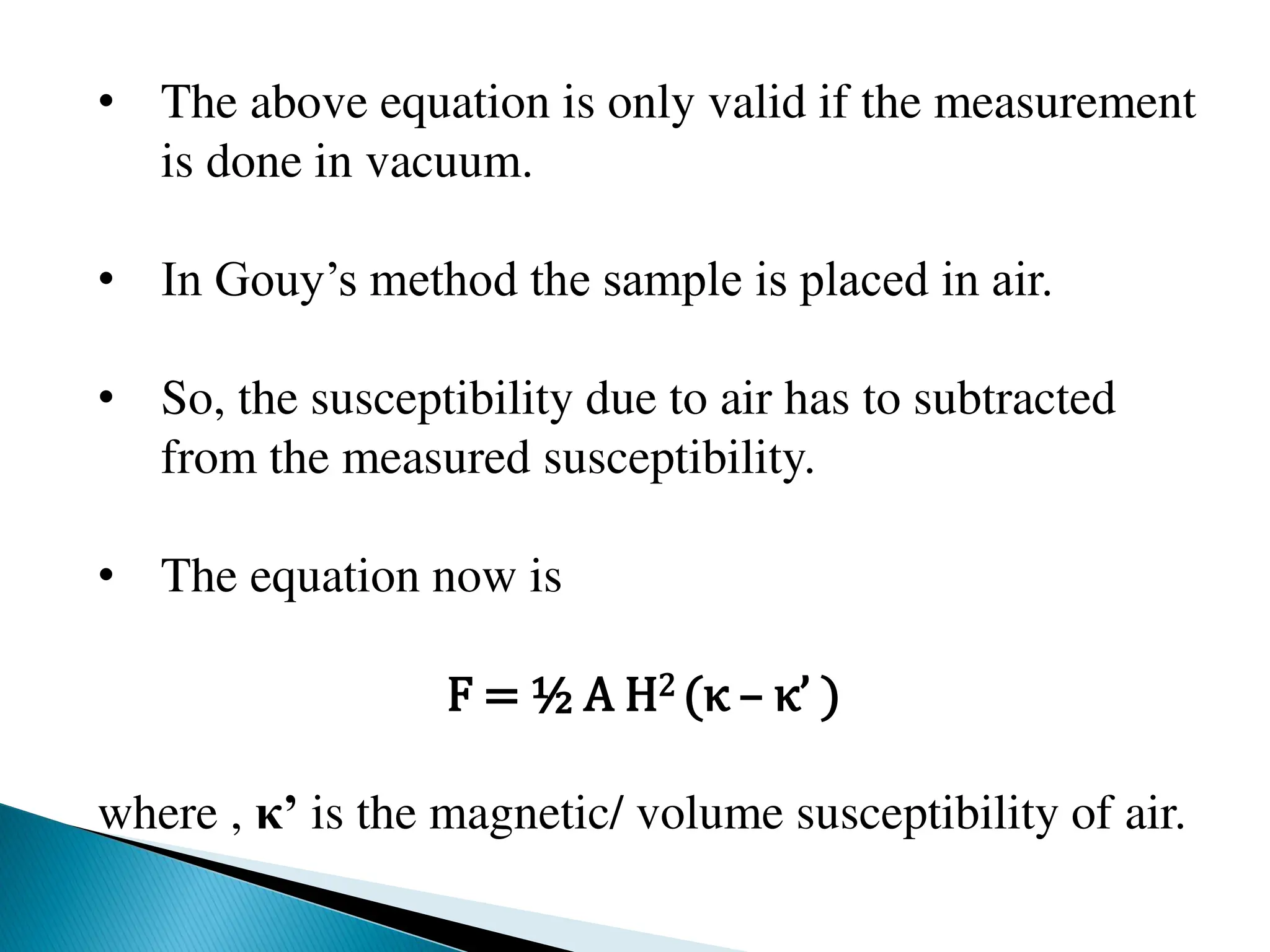
• The above equation is only valid if the measurement
is done in vacuum.
• In Gouy’s method the sample is placed in air.
• So, the susceptibility due to air has to subtracted
from the measured susceptibility.
• The equation now is
F = ½ A H2 (κ – κ’ )
where , κ’ is the magnetic/ volume susceptibility of air.
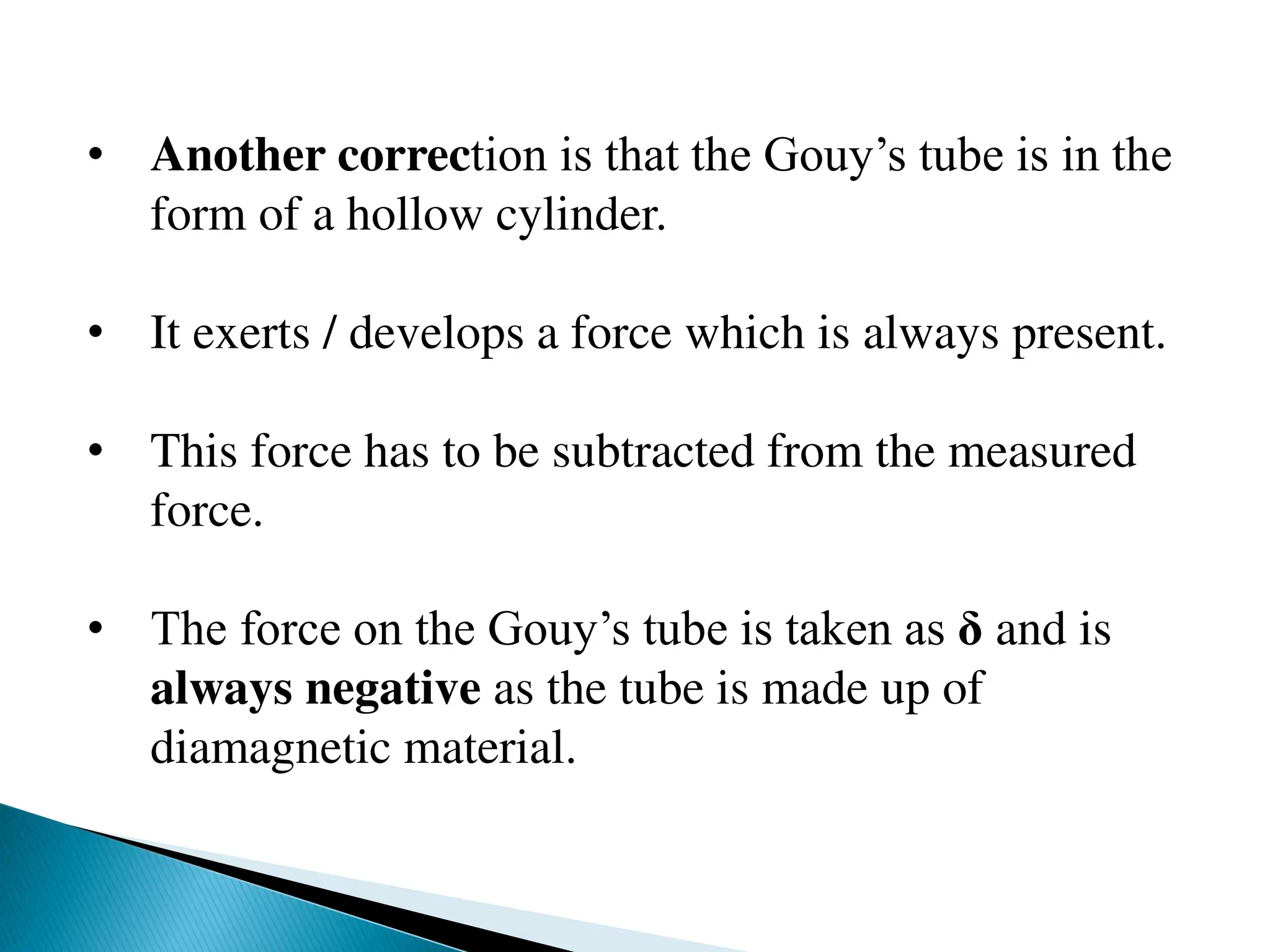
• Another correction is that the Gouy’s tube is in the
form of a hollow cylinder.
• It exerts / develops a force which is always present.
• This force has to be subtracted from the measured
force.
• The force on the Gouy’s tube is taken as δ and is
always negative as the tube is made up of
diamagnetic material.
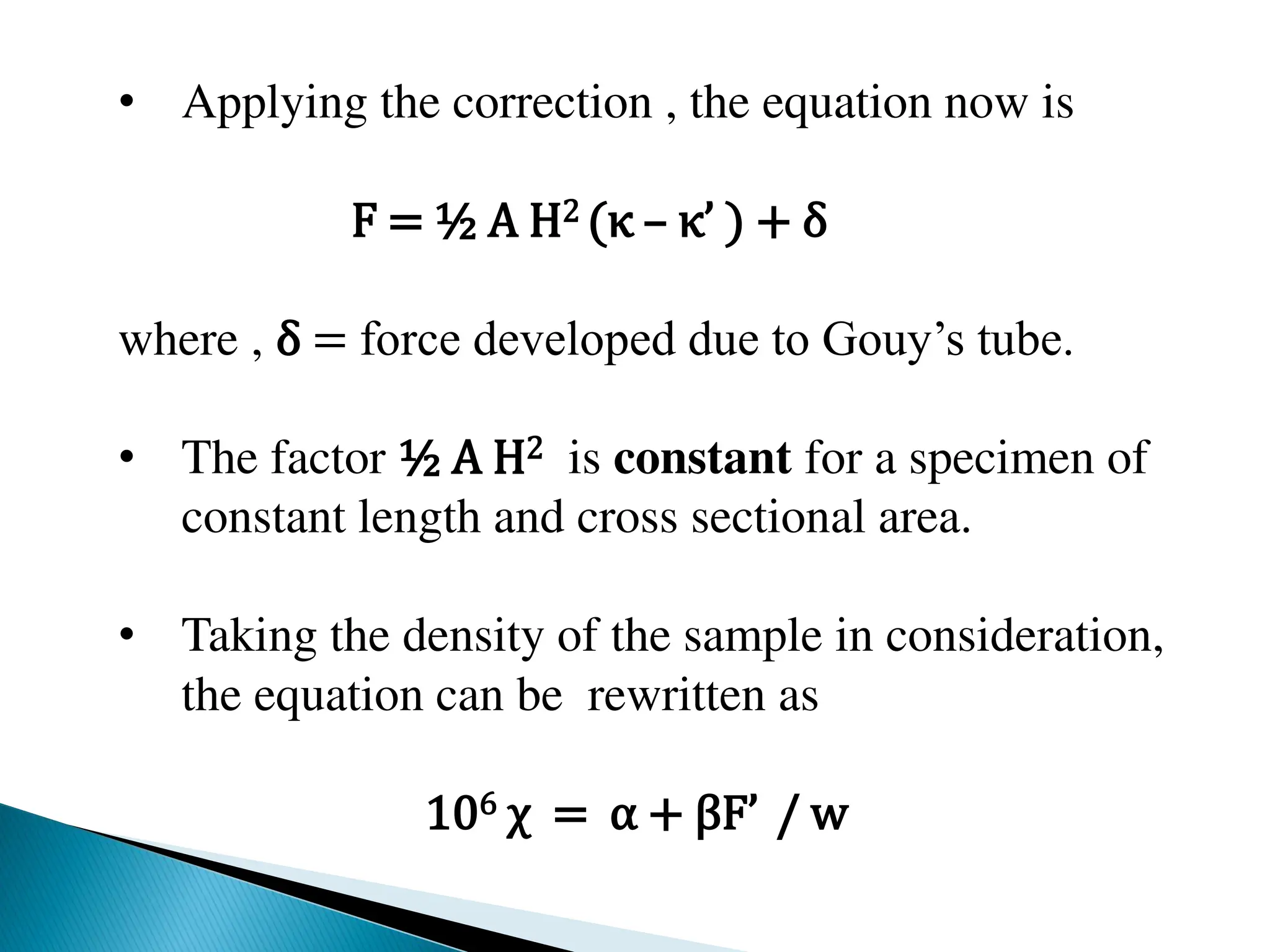
• Applying the correction , the equation now is
F = ½ A H2 (κ – κ’ ) + δ
where , δ = force developed due to Gouy’s tube.
• The factor ½ A H2 is constant for a specimen of
constant length and cross sectional area.
• Taking the density of the sample in consideration,
the equation can be rewritten as
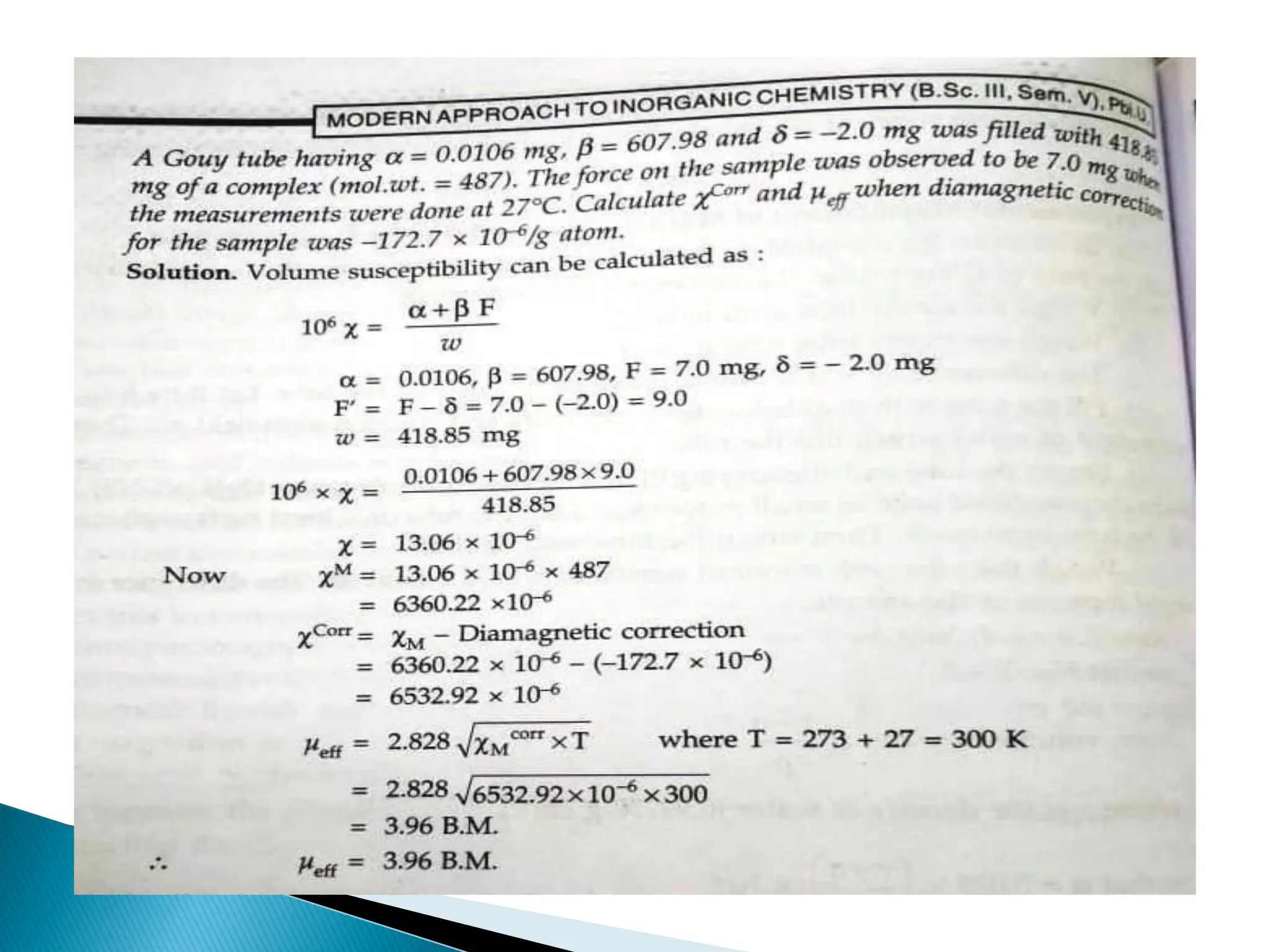
106 χ = α + βF’ / w
where
α = constant for displaced air = 0.029 x volume of the
sample.
β = tube calibration constant
w = weight of the sample in gms.
F’= Force on the sample = F – δ, where F and δ are in gms
• The calibration of the tube is done by filling the tube
with a substance whose susceptibility is accurately
known.
• The most commonly used substance is mercury
tetrathiocyanatocobaltate (II), Hg[Co(CNS)4]. Its
susceptibility is 1.644 x 10⁻⁷ at 200C.
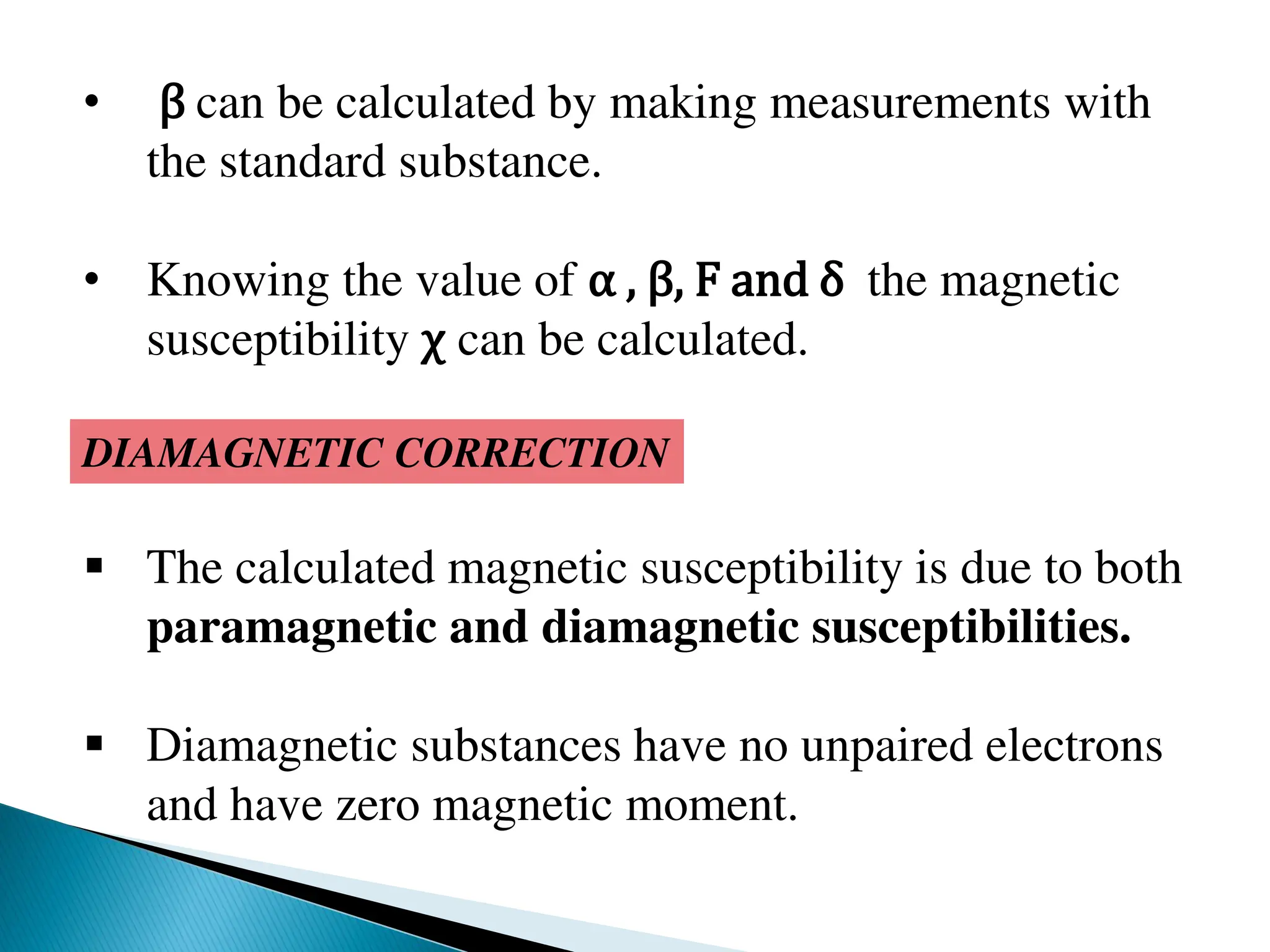
• β can be calculated by making measurements with
the standard substance.
• Knowing the value of α , β, F and δ the magnetic
susceptibility χ can be calculated.
DIAMAGNETIC CORRECTION
 The calculated magnetic susceptibility is due to both
paramagnetic and diamagnetic susceptibilities.
 Diamagnetic substances have no unpaired electrons
and have zero magnetic moment.
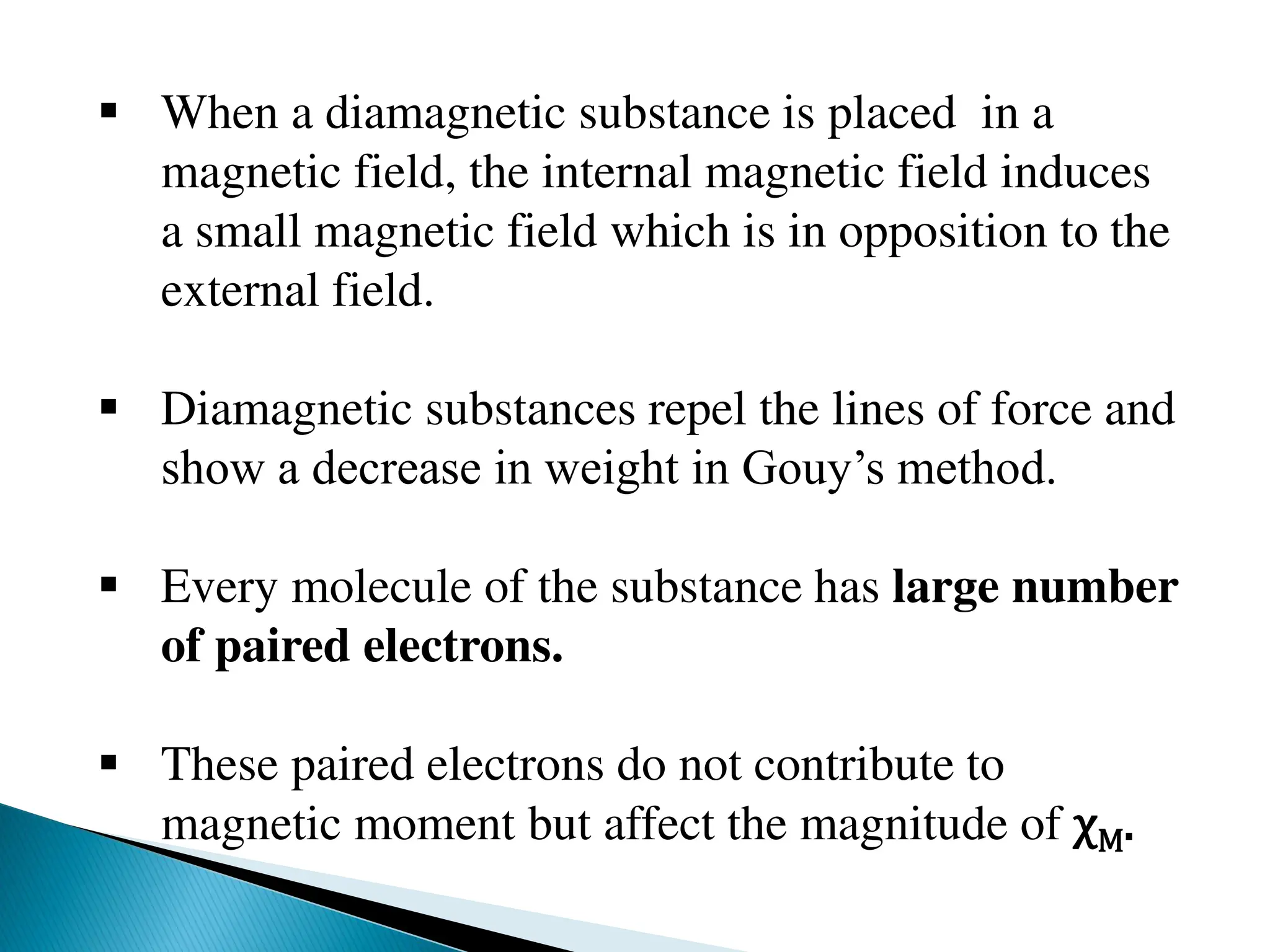
 When a diamagnetic substance is placed in a
magnetic field, the internal magnetic field induces
a small magnetic field which is in opposition to the
external field.
 Diamagnetic substances repel the lines of force and
show a decrease in weight in Gouy’s method.
 Every molecule of the substance has large number
of paired electrons.
 These paired electrons do not contribute to
magnetic moment but affect the magnitude of χM.
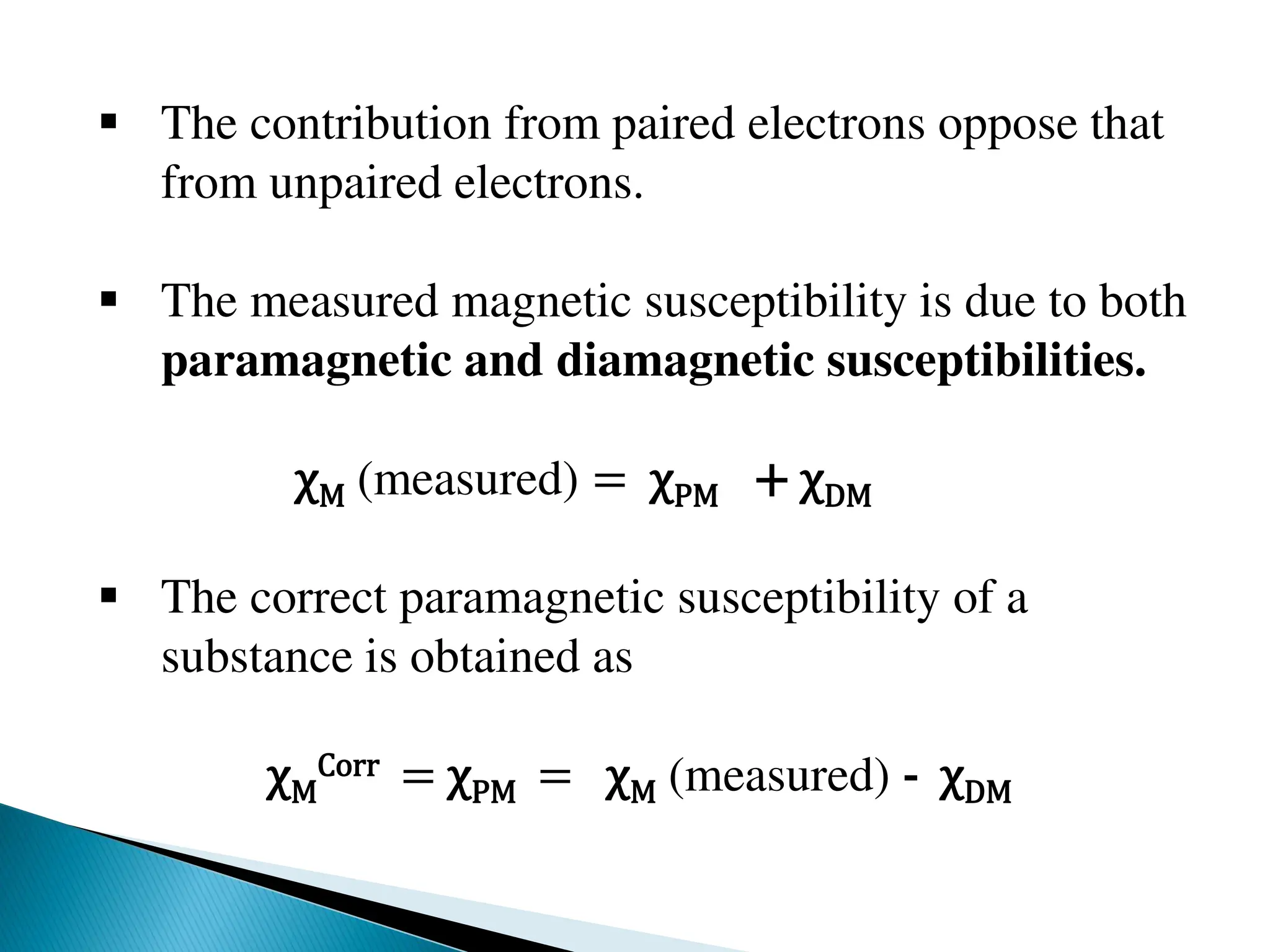
 The contribution from paired electrons oppose that
from unpaired electrons.
 The measured magnetic susceptibility is due to both
paramagnetic and diamagnetic susceptibilities.
χM (measured) = χPM + χDM
 The correct paramagnetic susceptibility of a
substance is obtained as
χM
Corr = χPM = χM (measured) - χDM
ADVANTAGES OF GOUY’S METHOD
• Very simple and easy to assemble apparatus.
• Easy to handle and use
• Requires large amount of sample. So, an ordinary
balance can be used to measure the change in mass.
DISADVANTAGES OF GOUY’S METHOD
• Requires large amount of sample.
• Requires perfect uniform packing of the sample. It
is tedious and time consuming.
• Correct results are not obtained if the packing is
not uniform.
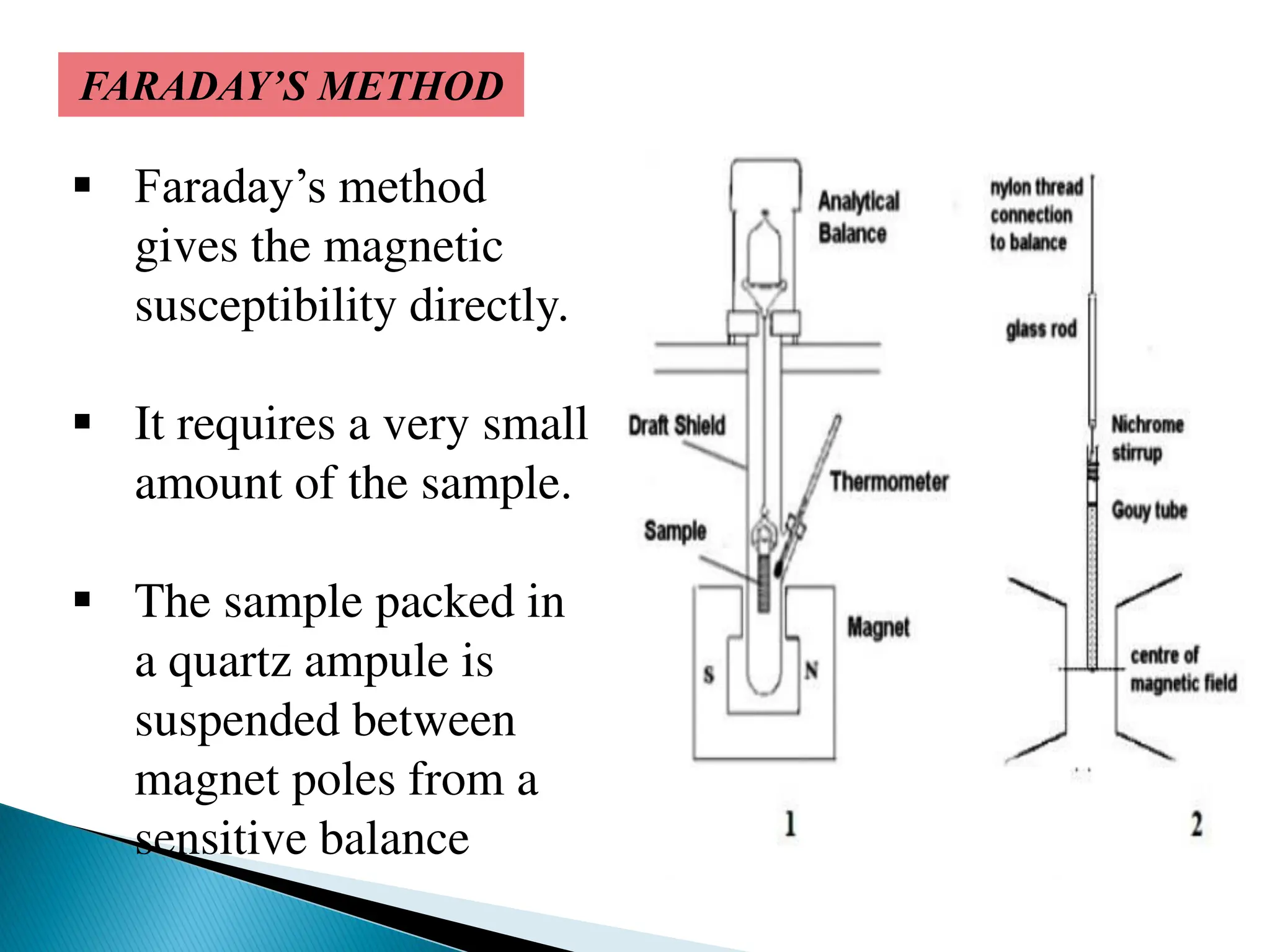
FARADAY’S METHOD
 Faraday’s method
gives the magnetic
susceptibility directly.
 It requires a very small
amount of the sample.
 The sample packed in
a quartz ampule is
suspended between
magnet poles from a
sensitive balance
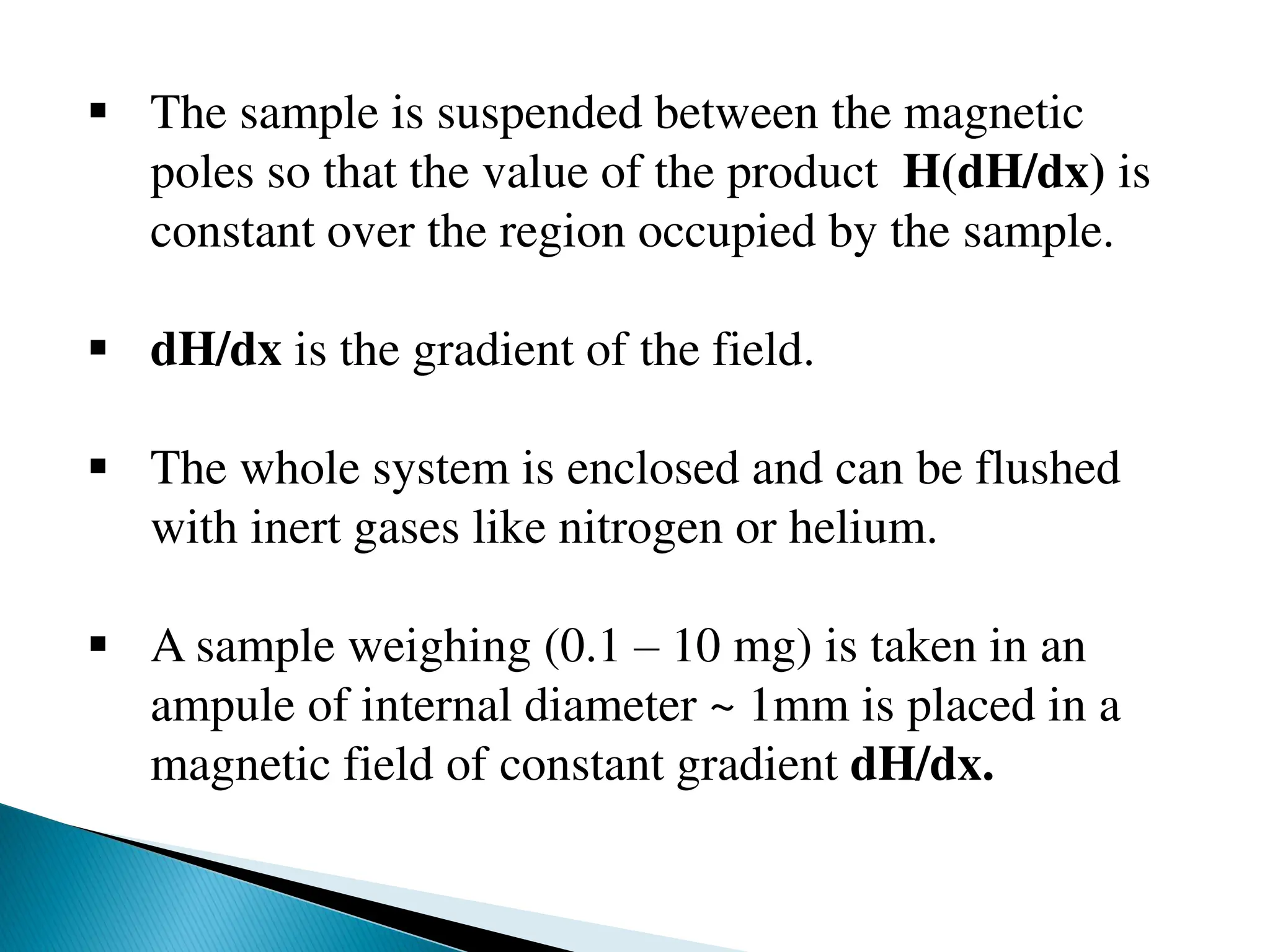
 The sample is suspended between the magnetic
poles so that the value of the product H(dH/dx) is
constant over the region occupied by the sample.
 dH/dx is the gradient of the field.
 The whole system is enclosed and can be flushed
with inert gases like nitrogen or helium.
 A sample weighing (0.1 – 10 mg) is taken in an
ampule of internal diameter ~ 1mm is placed in a
magnetic field of constant gradient dH/dx.
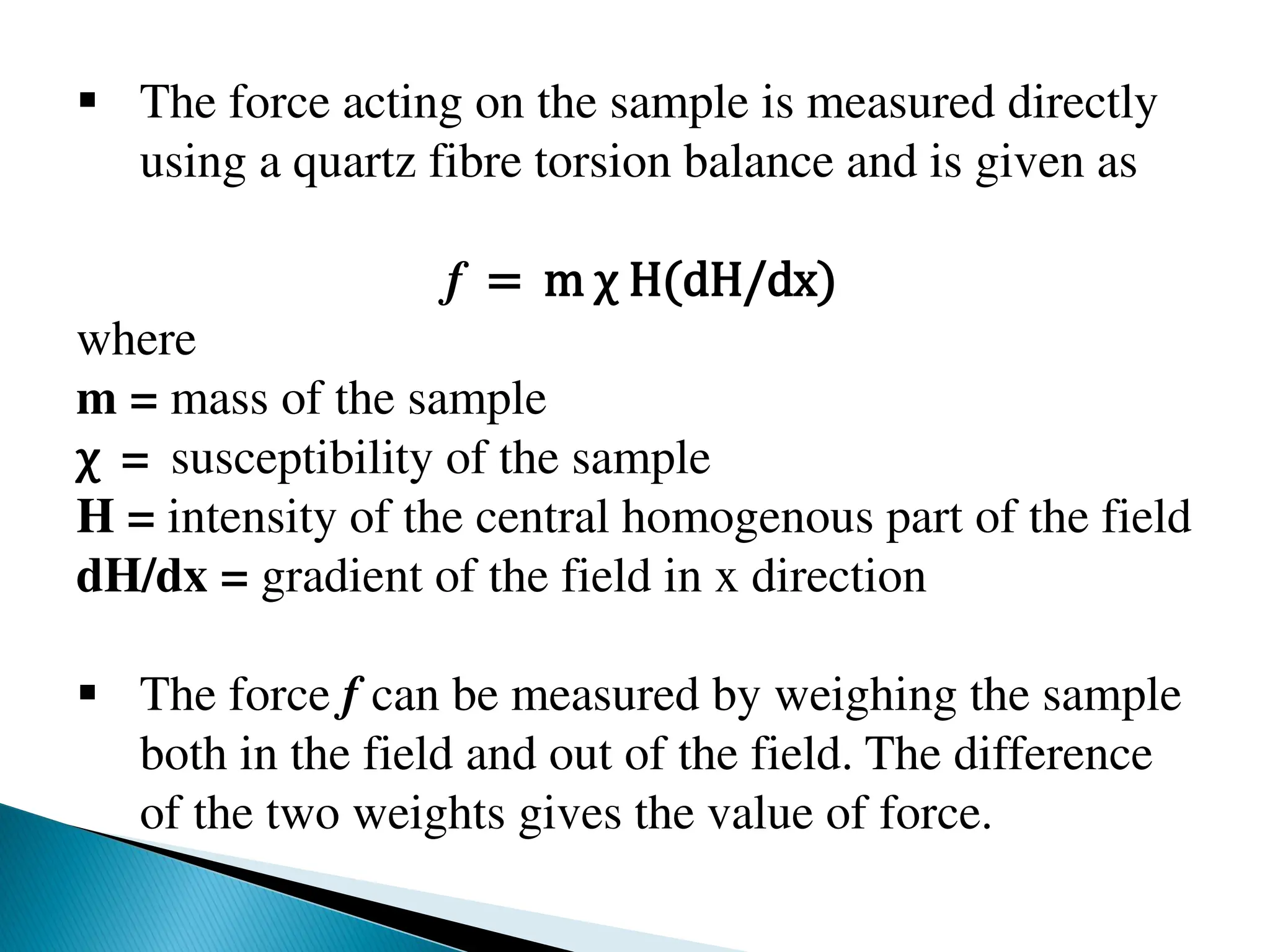
 The force acting on the sample is measured directly
using a quartz fibre torsion balance and is given as
f = m χ H(dH/dx)
where
m = mass of the sample
χ = susceptibility of the sample
H = intensity of the central homogenous part of the field
dH/dx = gradient of the field in x direction
 The force f can be measured by weighing the sample
both in the field and out of the field. The difference
of the two weights gives the value of force.
 This method is based on comparison of unknown
substance and the standard [mercury
tetrathiocyanatocobaltate (II)].
 As the magnetic field H and the field gradient
dH/dx are the same in both case, the force acting
on the standard and the unknown sample can be
rewritten as
H (dH/dx) = fu / mu χu (for unknown sample)
H (dH/dx) = fs / ms χs (for standard)
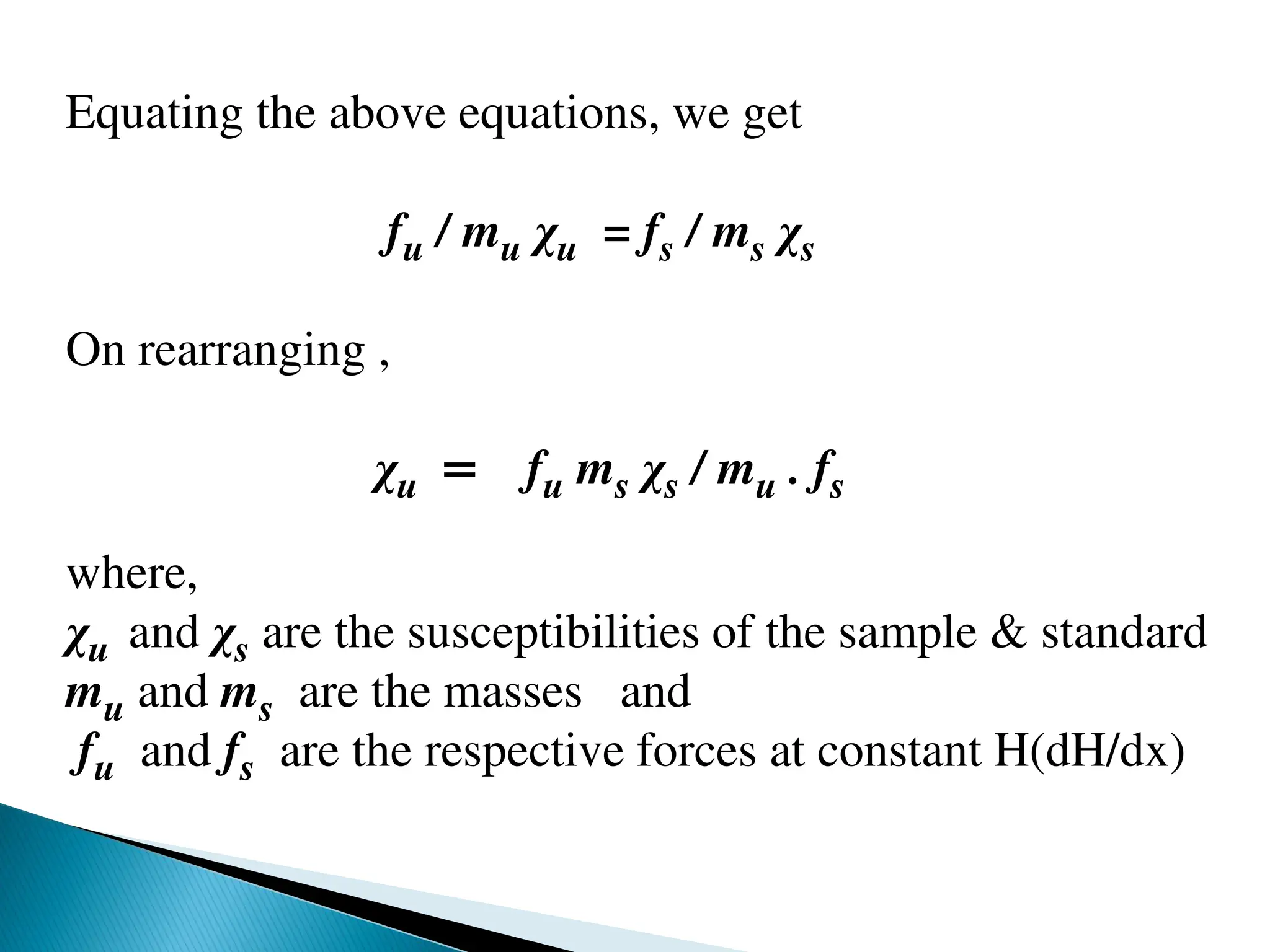
Equating the above equations, we get
fu / mu χu = fs / ms χs
On rearranging ,
χu = fu ms χs / mu . fs
where,
χu and χs are the susceptibilities of the sample & standard
mu and ms are the masses and
fu and fs are the respective forces at constant H(dH/dx)
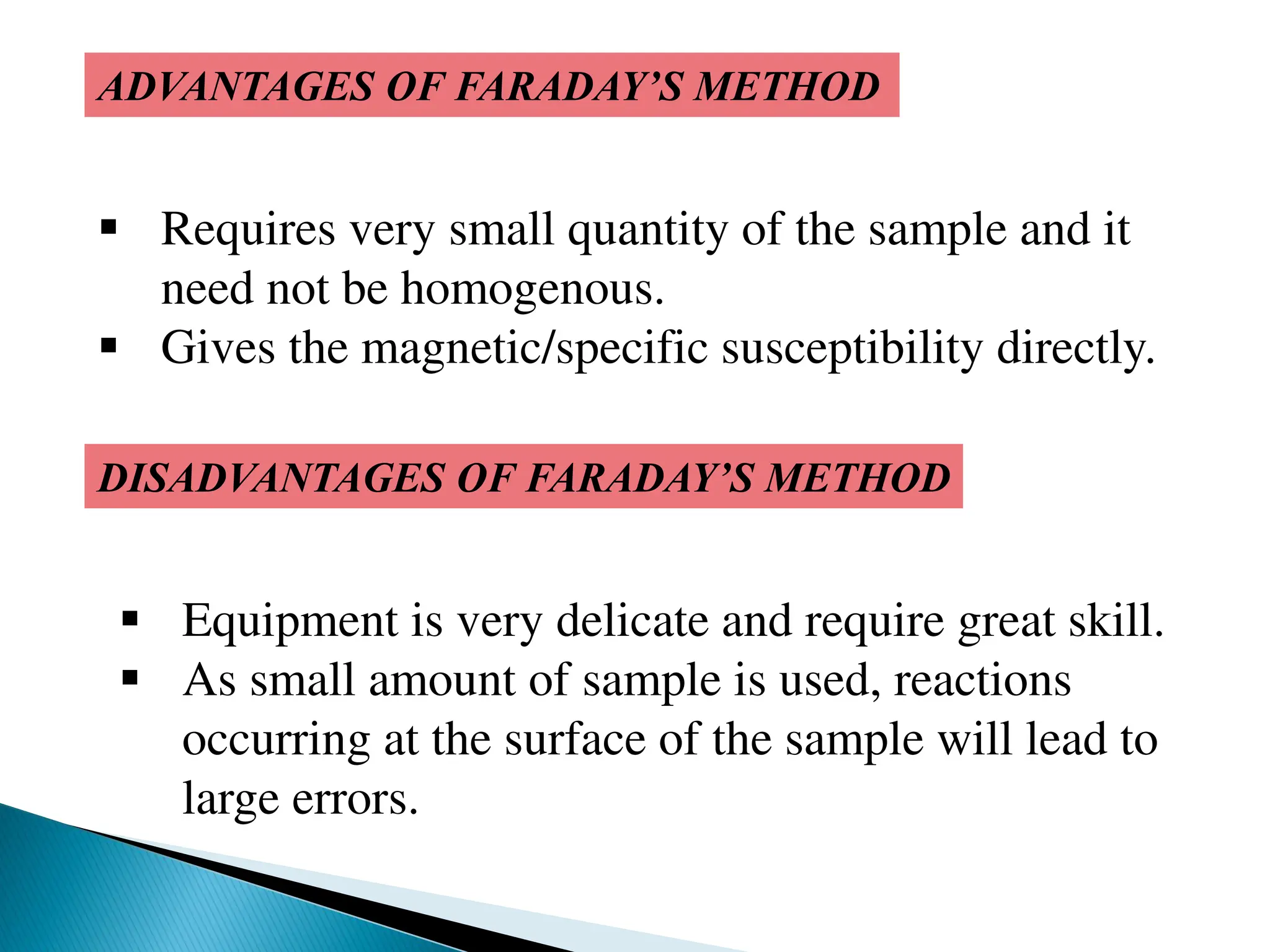
ADVANTAGES OF FARADAY’S METHOD
 Requires very small quantity of the sample and it
need not be homogenous.
 Gives the magnetic/specific susceptibility directly.
DISADVANTAGES OF FARADAY’S METHOD
 Equipment is very delicate and require great skill.
 As small amount of sample is used, reactions
occurring at the surface of the sample will lead to
large errors.
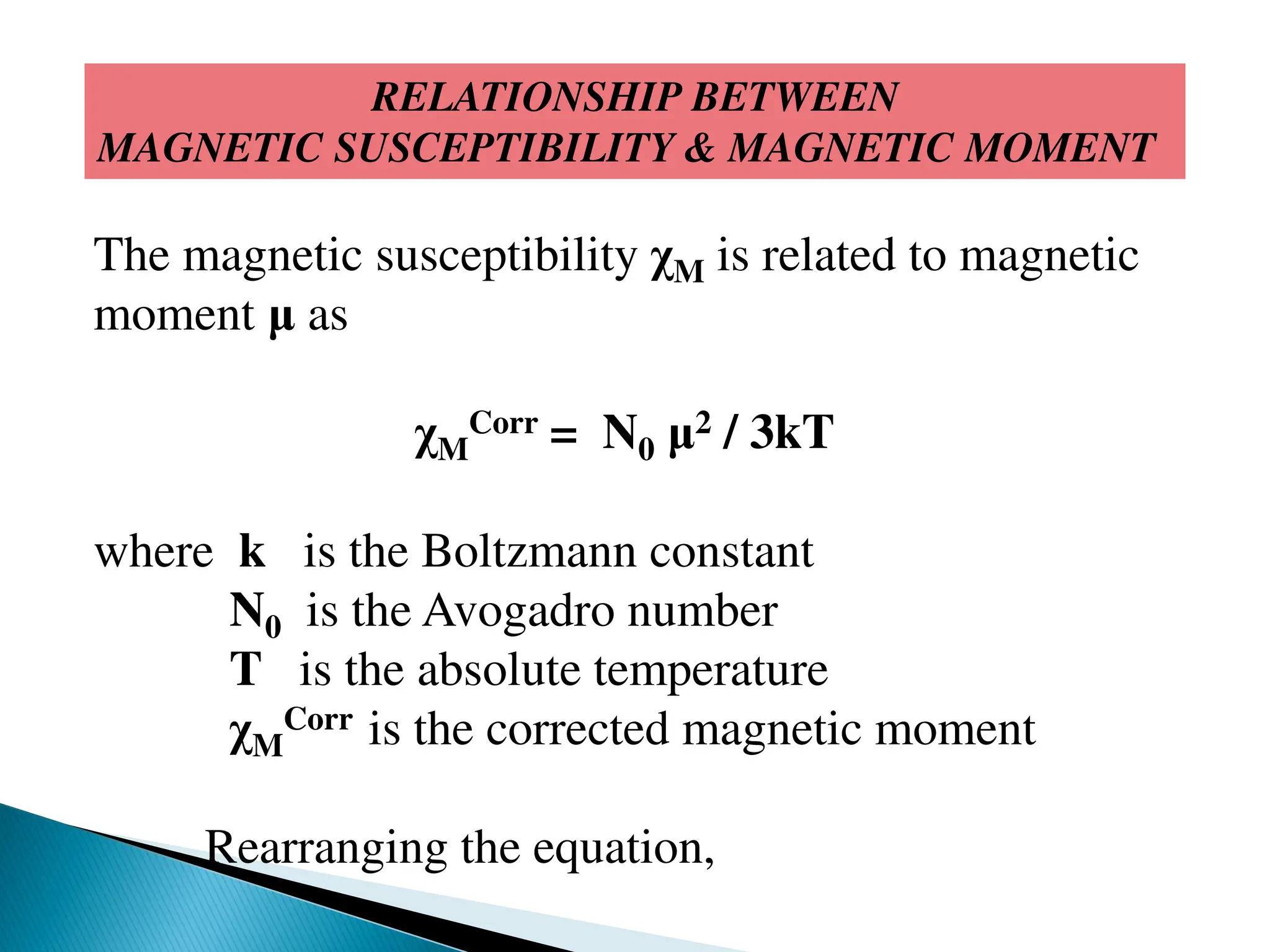
RELATIONSHIP BETWEEN
MAGNETIC SUSCEPTIBILITY & MAGNETIC MOMENT
The magnetic susceptibility χM is related to magnetic
moment μ as
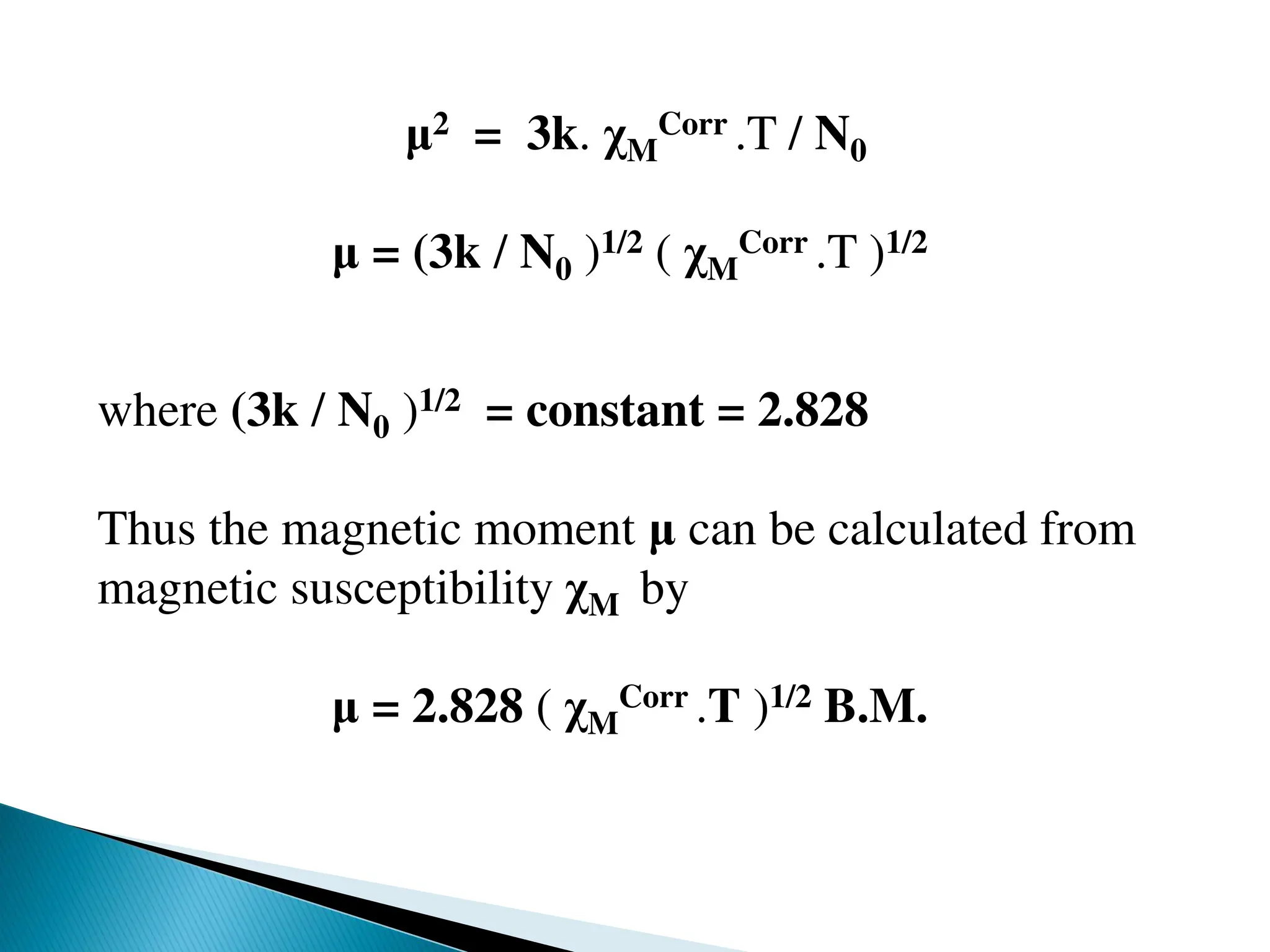
χM
Corr = N0 μ2 / 3kT
where k is the Boltzmann constant
N0 is the Avogadro number
T is the absolute temperature
χM
Corr is the corrected magnetic moment
Rearranging the equation,
μ2 = 3k. χM
Corr .T / N0
μ = (3k / N0 )1/2 ( χM
Corr .T )1/2
where (3k / N0 )1/2 = constant = 2.828
Thus the magnetic moment μ can be calculated from
magnetic susceptibility χM by
μ = 2.828 ( χM
Corr .T )1/2 B.M.
VARIATIONOF MAGNETIC SUSCEPTIBILITY WITH
TEMPERATURE
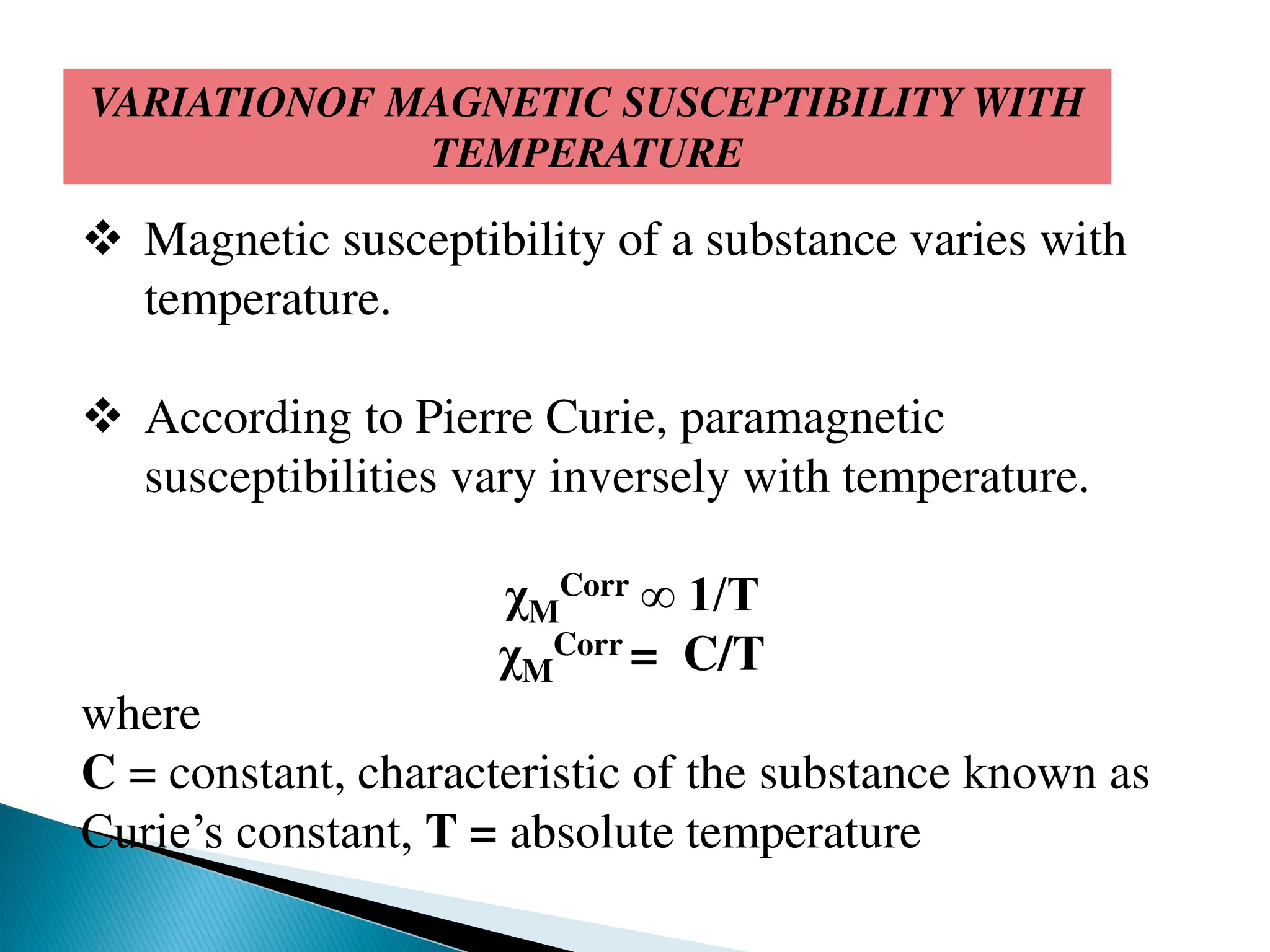
 Magnetic susceptibility of a substance varies with
temperature.
 According to Pierre Curie, paramagnetic
susceptibilities vary inversely with temperature.
χM
Corr ∞ 1/T
χM
Corr = C/T
where
C = constant, characteristic of the substance known as
Curie’s constant, T = absolute temperature
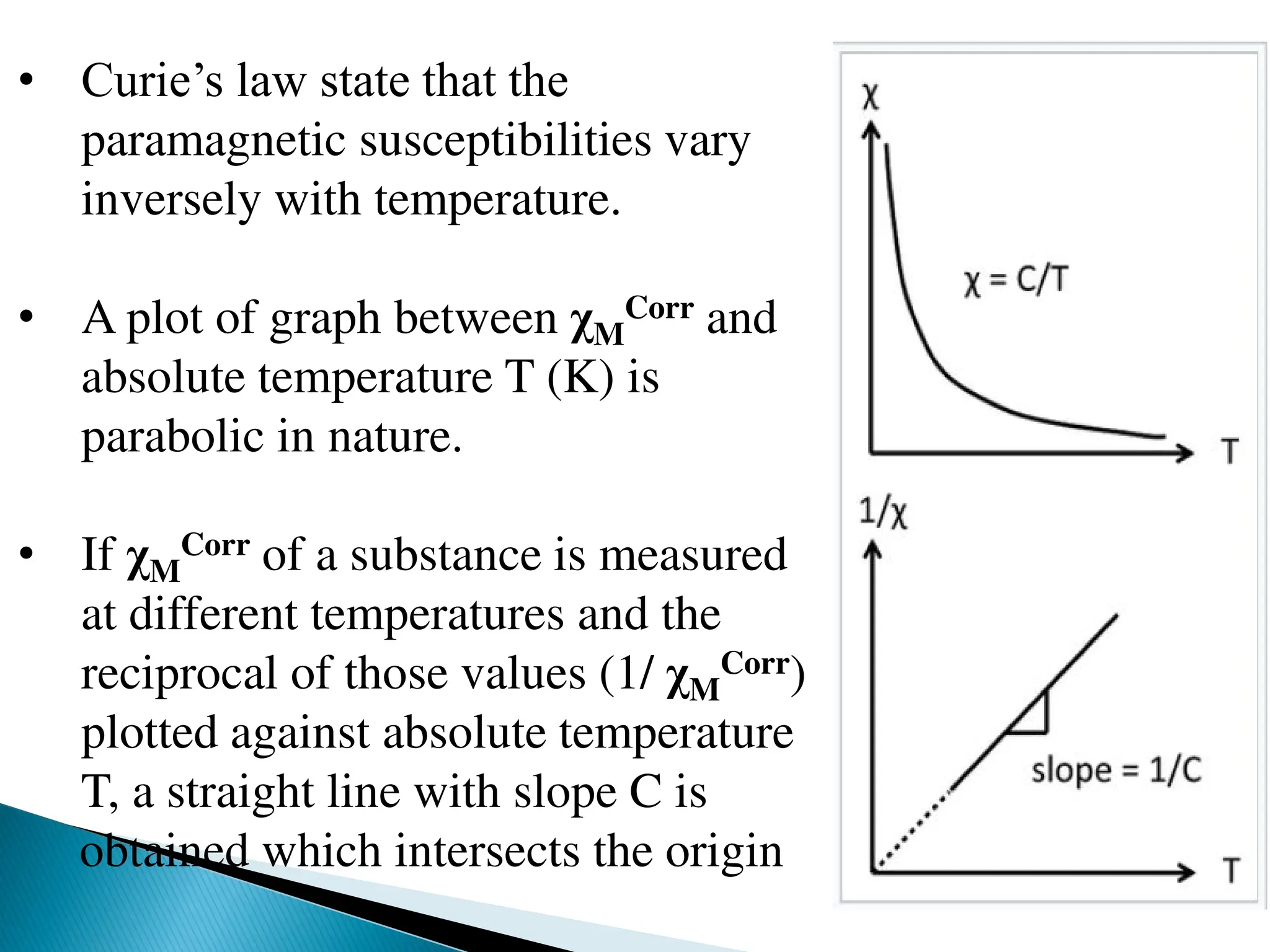
• Curie’s law state that the
paramagnetic susceptibilities vary
inversely with temperature.
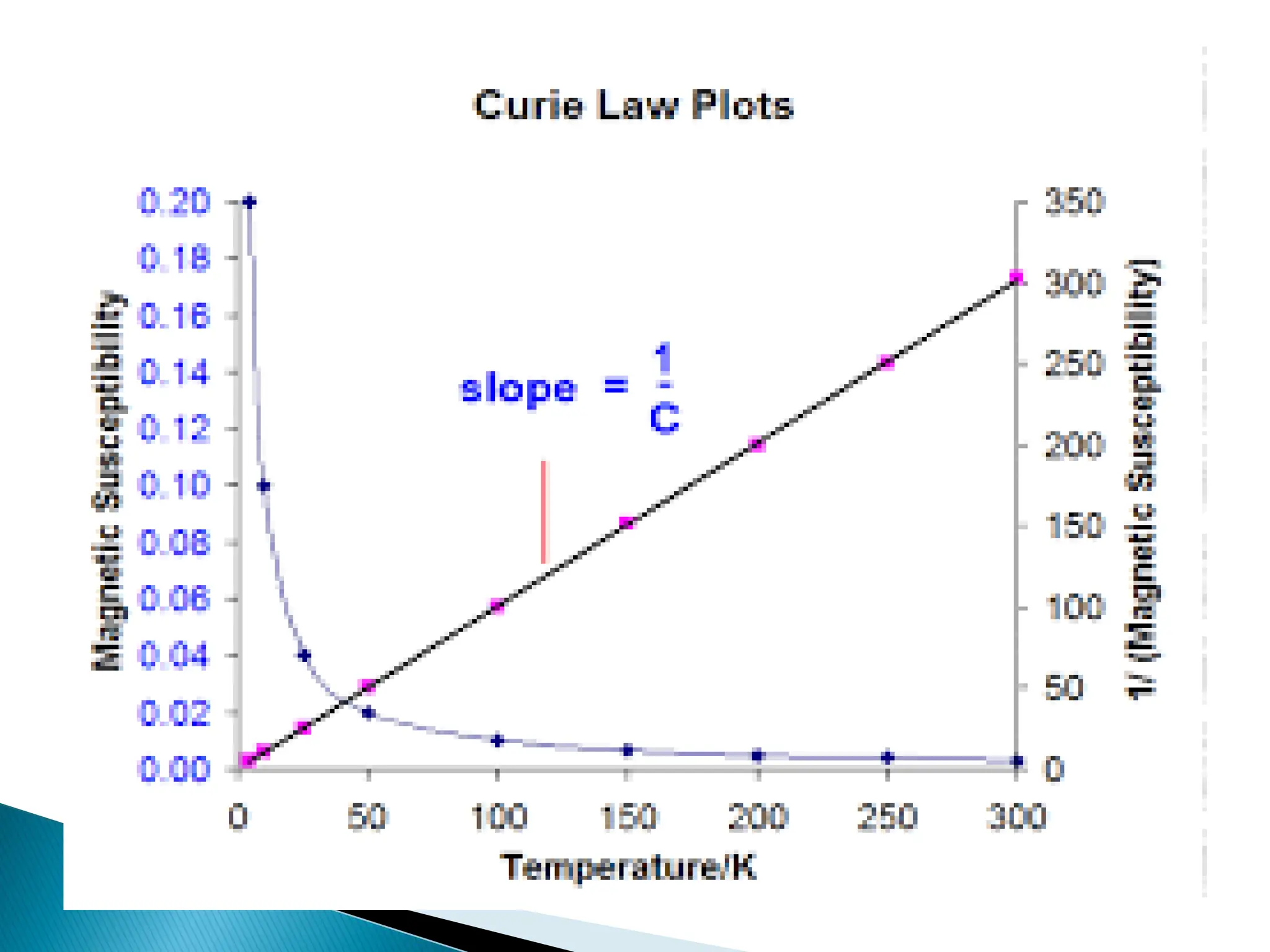
• A plot of graph between χM
Corr and
absolute temperature T (K) is
parabolic in nature.
• If χM
Corr of a substance is measured
at different temperatures and the
reciprocal of those values (1/ χM
Corr)
plotted against absolute temperature
T, a straight line with slope C is
obtained which intersects the origin
• Curie’s law is followed by substances in whom
there is no spontaneous interaction between
adjacent unpaired electrons i.e. paramagnetic
substances.
• In other words, there is no secondary magnetic
interactions between the neighbouring magnetic
centres.
• Such substances are called magnetically dilute.
• Many substances give straight lines which do not
pass through the origin.
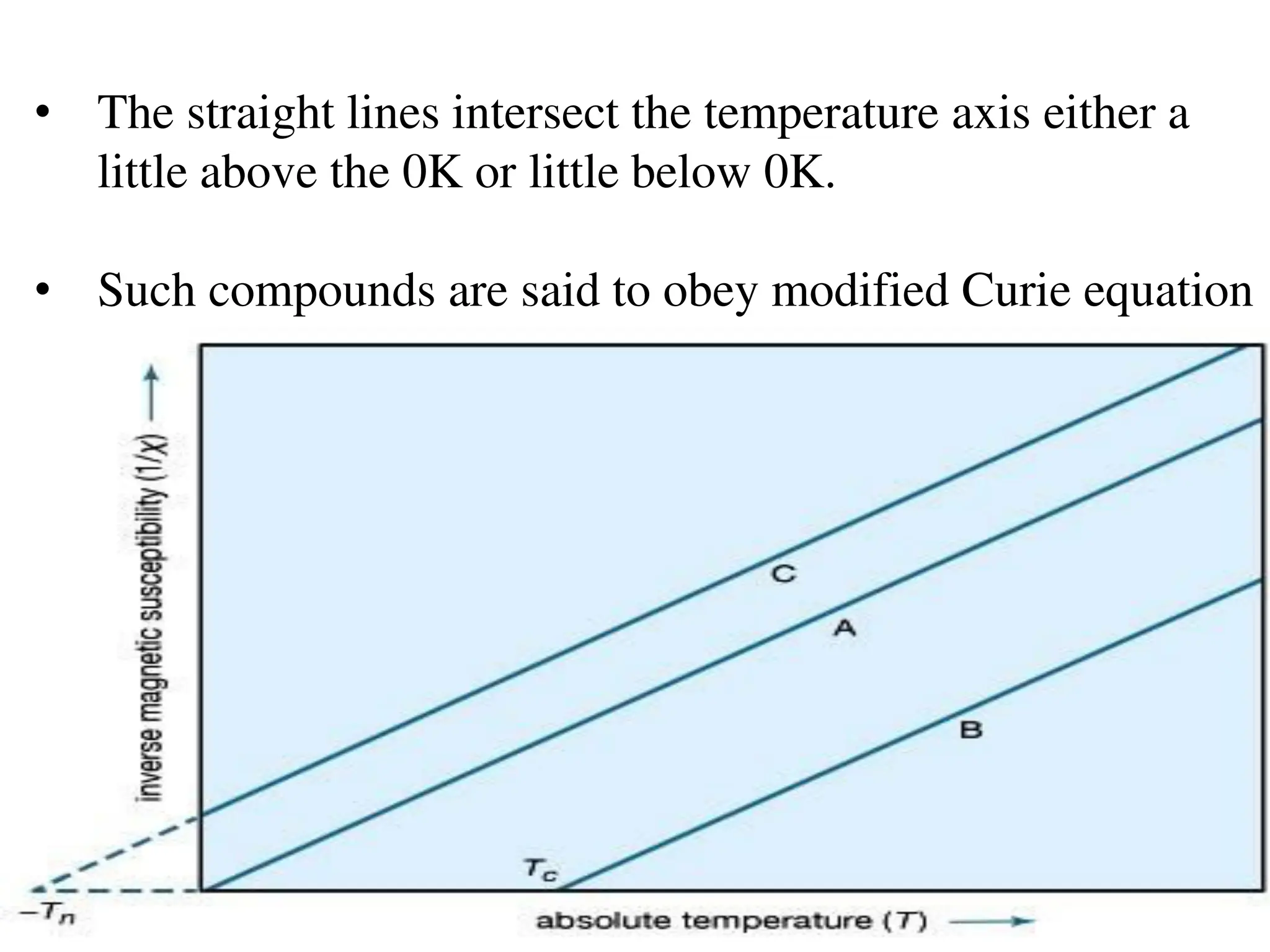
• The straight lines intersect the temperature axis either a
little above the 0K or little below 0K.
• Such compounds are said to obey modified Curie equation
• The modified Curie’s equation is
χM
Corr = C / T – θ
where θ is the temperature at which the straight line cuts
the absolute temperature axis.
• The modified equation is called Curie – Weiss law
and the θ is called Weiss constant.
• The Weiss constant takes into account interionic/
intermolecular interactions and eliminate them.
• So, Magnetic moment μ = 2.828 [ χM
Corr (T - θ )]1/2
MAGNETISM
Paramagnetism
Diamagnetism
Ferromagnetism
Anti - Ferromagnetism
There are many
kinds of magnetic
substances and the
magnetic
properties
exhibited by them
are of the
following types
• In some materials, the permanent atomic magnetic
moments have a strong tendency to align themselves
even without any external field.
• These materials are said to be Ferromagnetic
materials.
• The ferromagnetic materials are those substances
which exhibit strong magnetism in the same direction
of the field, when a magnetic field is applied to it.
A. FERROMAGNETIC SUBSTANCES
• In solid state , the metal ions of ferromagnetic
substances are grouped together into small regions
called Domains.
• They get their strong magnetic properties due to
the presence of magnetic domains.
• In these domains, large numbers of atom's moments
(1012 to 1015) are aligned parallel so that the
magnetic force within the domain is strong.
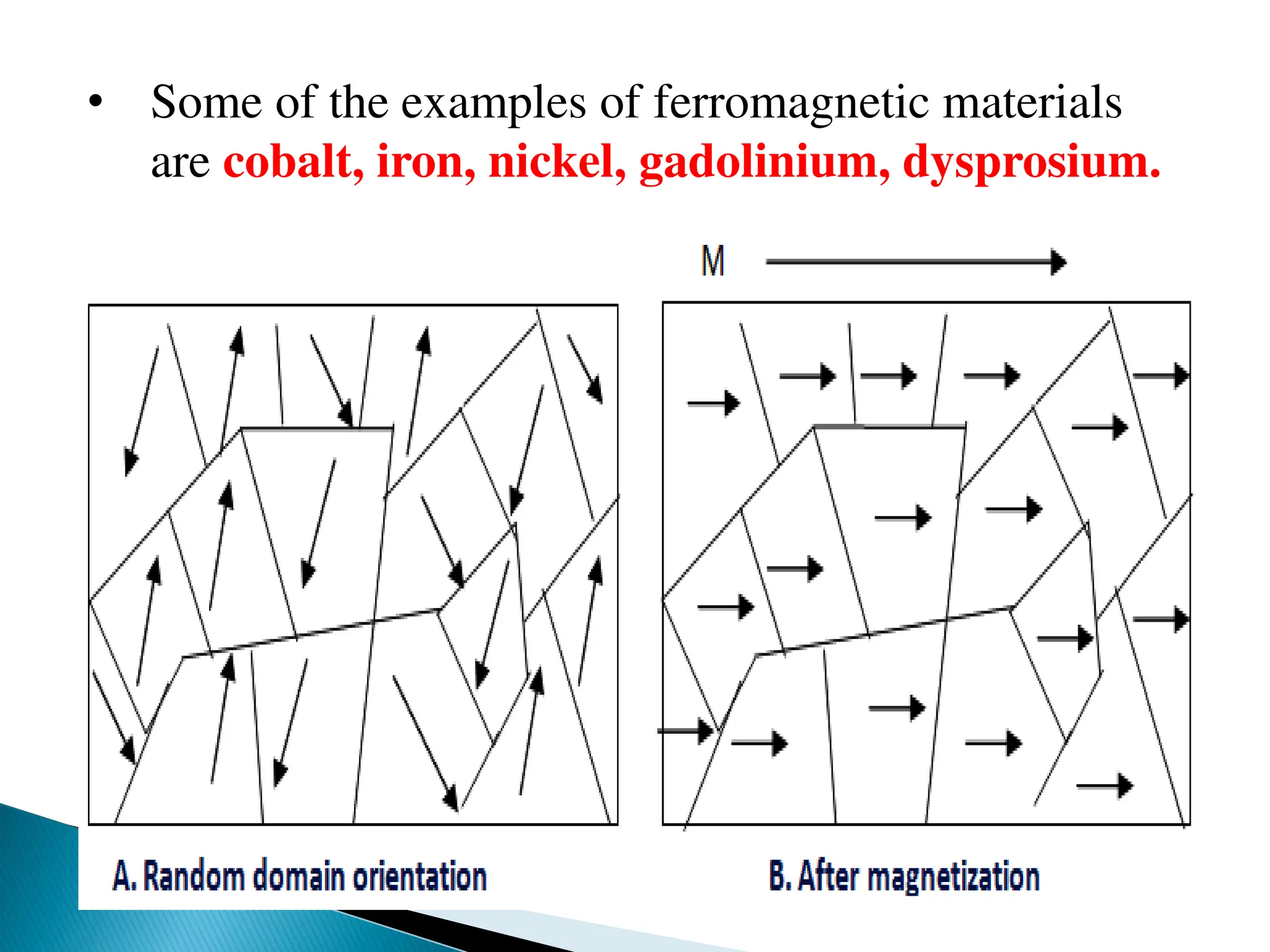
• When a ferromagnetic material is in the
unmagnetized state, the domains are nearly
randomly organized and the net magnetic moments
get cancelled.
• When a magnetizing field is applied, the domains
become aligned in the direction of the magnetic field.
• They are able to retain their magnetic properties
after the external field has been removed.
• It means it becomes permanently magnetized even
after the removal of the external magnetic field.
• Some of the examples of ferromagnetic materials
are cobalt, iron, nickel, gadolinium, dysprosium.
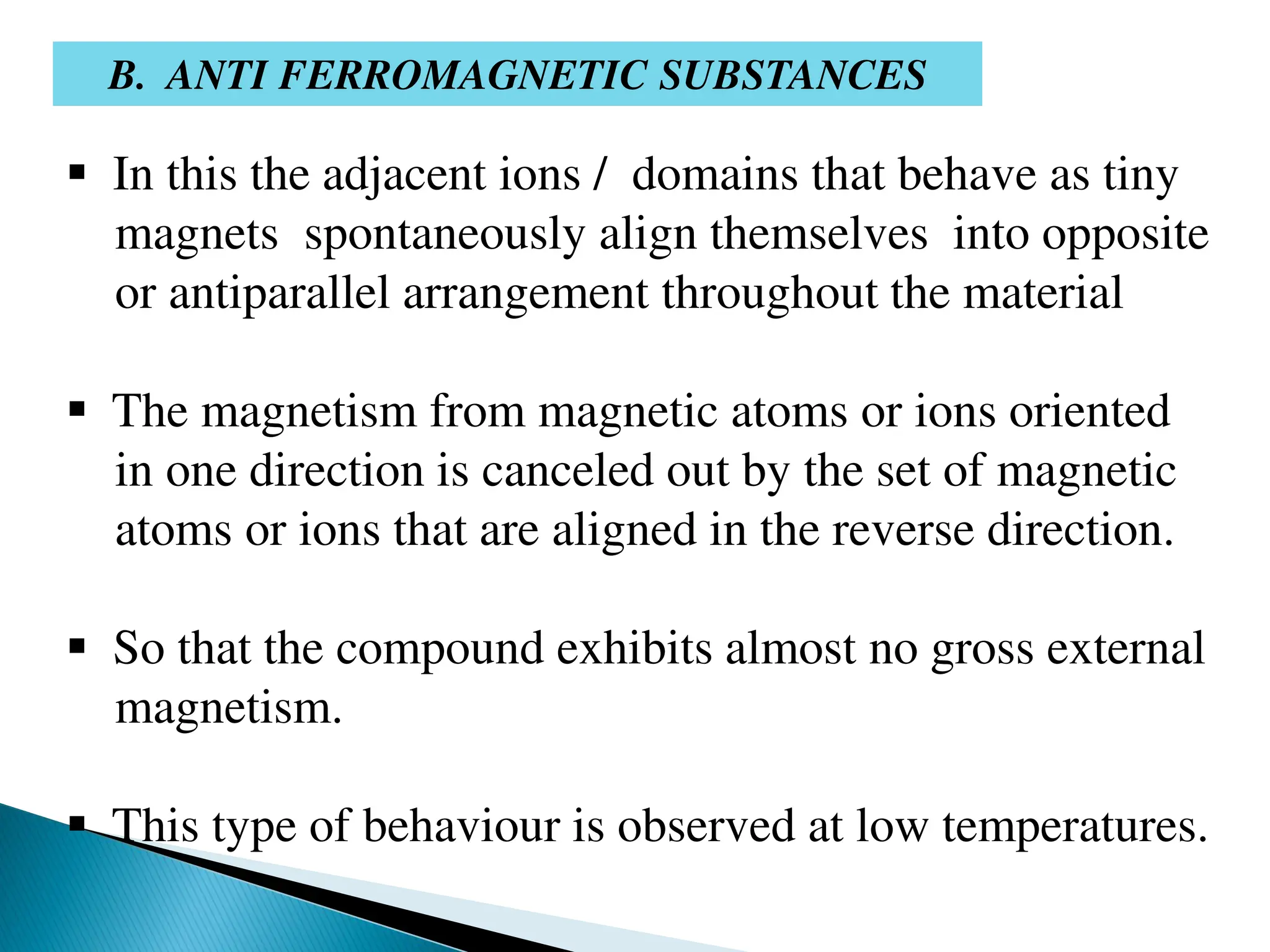
B. ANTI FERROMAGNETIC SUBSTANCES
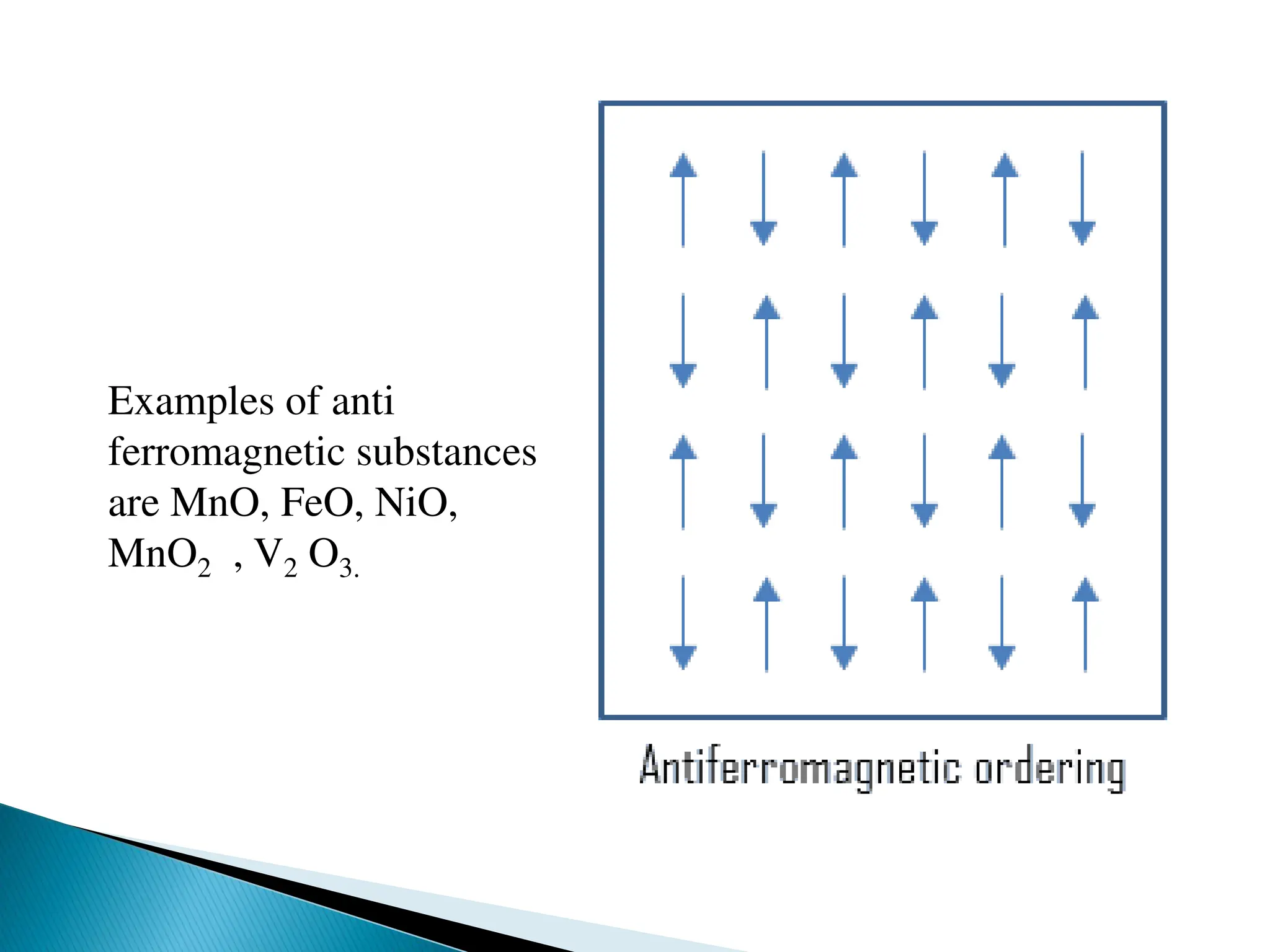
 In this the adjacent ions / domains that behave as tiny
magnets spontaneously align themselves into opposite
or antiparallel arrangement throughout the material
 The magnetism from magnetic atoms or ions oriented
in one direction is canceled out by the set of magnetic
atoms or ions that are aligned in the reverse direction.
 So that the compound exhibits almost no gross external
magnetism.
 This type of behaviour is observed at low temperatures.
Examples of anti
ferromagnetic substances
are MnO, FeO, NiO,
MnO2 , V2 O3.
• In paramagnetic substances, the magnetic
moment results entirely from the individual
magnetic centres.
• In other words, there is no secondary magnetic
interactions between the neighbouring
magnetic centres.
• Such substances are called magnetically dilute.
• But, there are some paramagnetic substances in
which secondary interactions exist between
the neighbouring magnetic centres.
• Such substances are called magnetically
concentrated substances.
• In such substances the magnetic susceptibility shows
dependence on both field strength and temperature.
• These substances are Ferromagnetic and Anti
ferromagnetic substances.
• The main features of the curves of these substances
can be understood in terms of Curie – Weiss law.
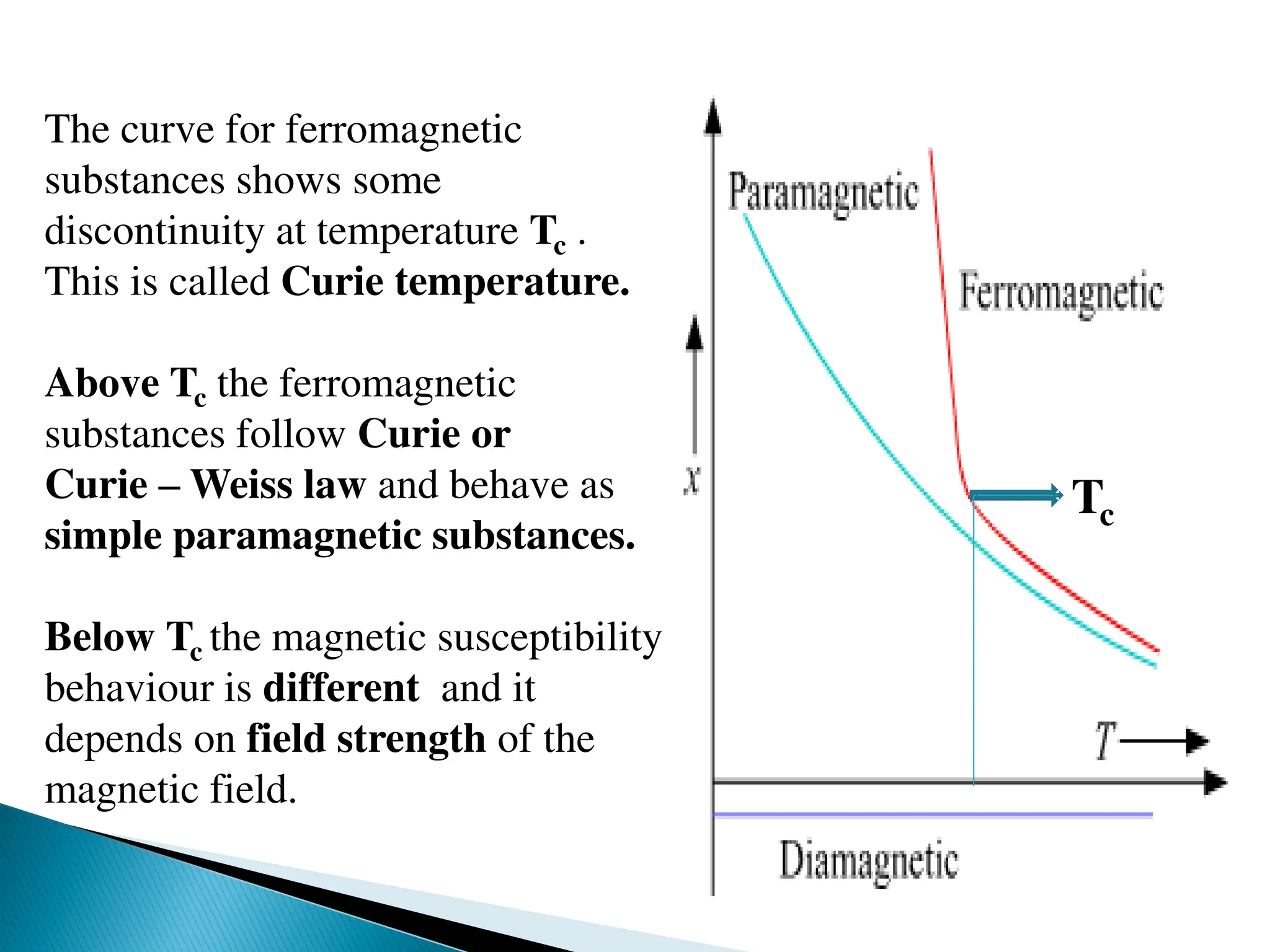
The curve for ferromagnetic
substances shows some
discontinuity at temperature Tc .
This is called Curie temperature.
Above Tc the ferromagnetic
substances follow Curie or
Curie – Weiss law and behave as
simple paramagnetic substances.
Below Tc the magnetic susceptibility
behaviour is different and it
depends on field strength of the
magnetic field.
Tc
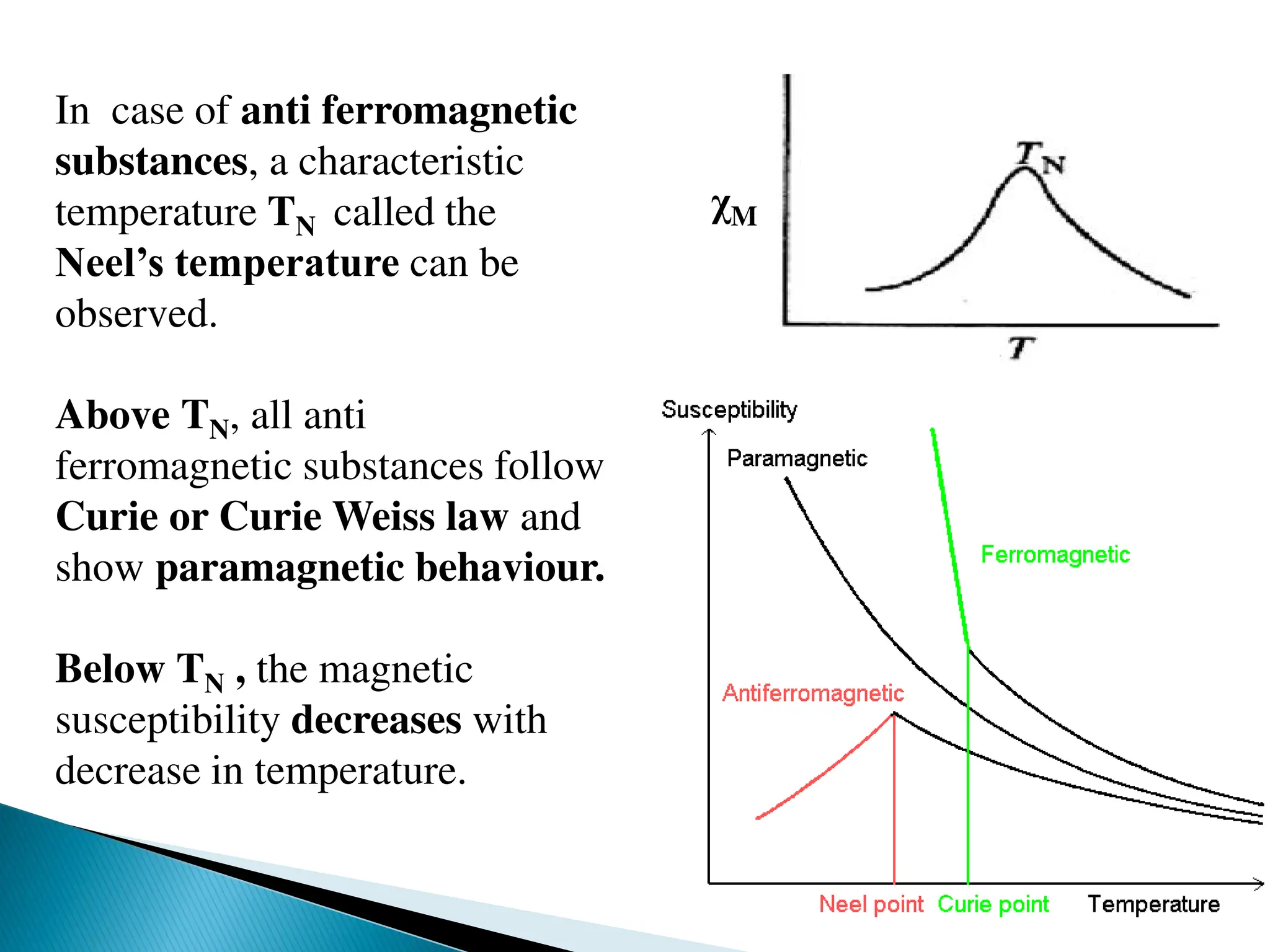
In case of anti ferromagnetic
substances, a characteristic
temperature TN called the
Neel’s temperature can be
observed.
Above TN, all anti
ferromagnetic substances follow
Curie or Curie Weiss law and
show paramagnetic behaviour.
Below TN , the magnetic
susceptibility decreases with
decrease in temperature.
χM
• The abnormal behaviour in ferromagnetic and
anti- ferromagnetic substances is due to interionic
interactions.
• Above Tc thermal energies are able to randomize
the orientations, resulting in decrease in
magnetic susceptibility with increase in
temperature.
• Above Neels temperature, the magnetic moments
are not aligned in antiparallel directions due to
large thermal energy.
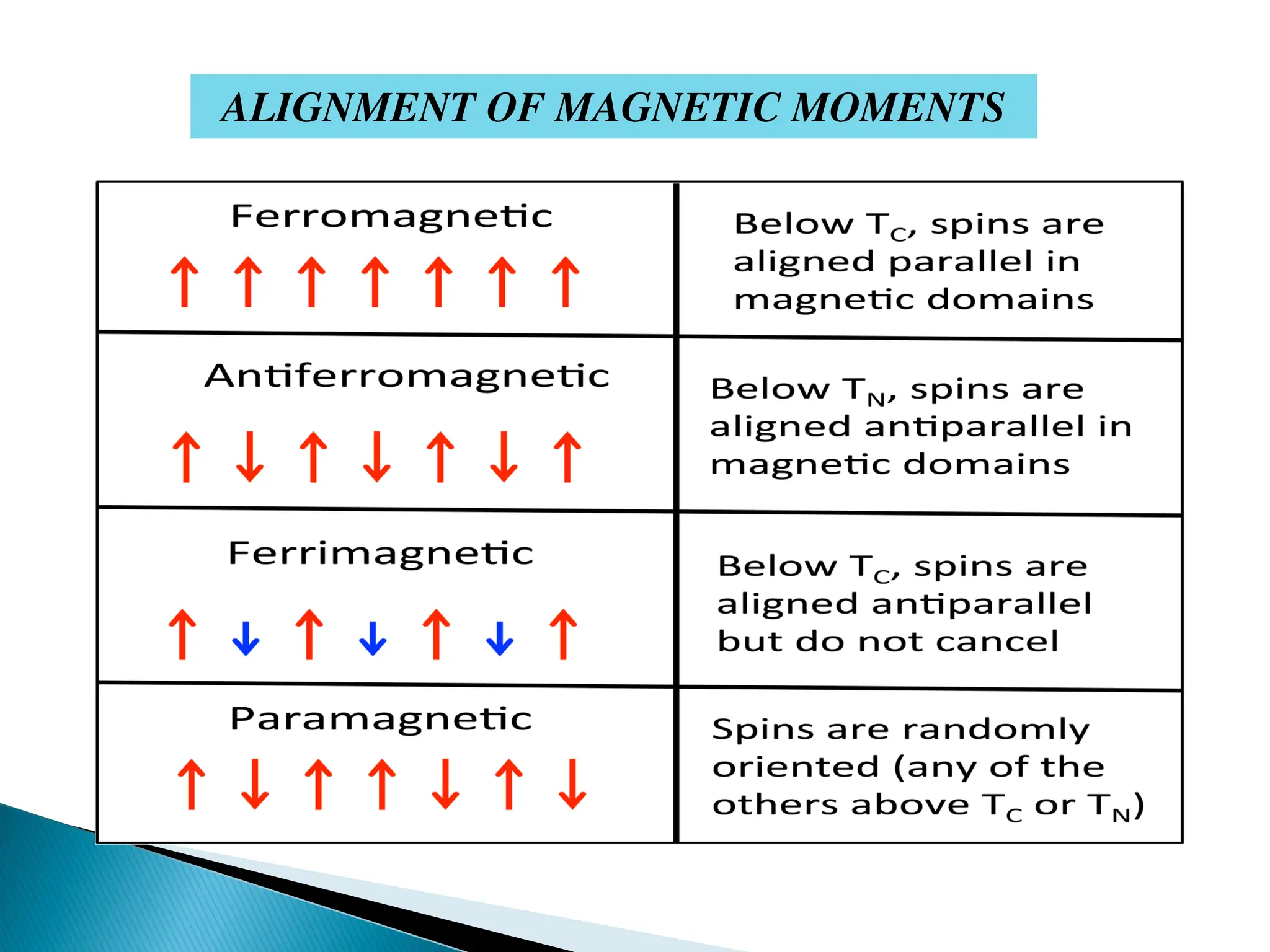
ALIGNMENT OF MAGNETIC MOMENTS
ORBITAL CONTRIBUTION TO MAGNETIC MOMENT
• The total magnetic moment of a substance is due to
both spin and orbital contribution.
• Both these contributions occur because of unpaired
electrons.
• In many cases, the unpaired electrons are the
outermost electrons under consideration and these
are not screened by other electrons.
• In such cases, magnetic moment depends on only the
spin contribution, the orbital contribution can be
neglected.
• In cases like lanthanides and actinides, the
unpaired electrons are inside ( lie within the shell)
and are shielded by the outer electrons (from the
electric field of the in coming ligands), orbital
contribution cannot be neglected.
• Thus in these the total magnetic moment is due to
both spin and orbital magnetic moment.
• The spin angular momentum of an electron does not
depend on its surrounding (chemical environment).
• The orbital angular momentum of an electron
depend on its surrounding (chemical environment).
• The orbital contribution can be reduced or quenched
in the substance.
• Qualitatively, quenching of orbital angular
momentum can be explained on the basis of crystal
field theory.
• In case of first transition series, the unpaired electrons
are present in 3d orbitals.
• A transition metal ion has five 3d orbitals of same
energy (degenerate).
• The orbital angular momentum arises due to rotation
of electron about the nucleus via these 3d orbitals.
• Generation of orbital angular momentum occurs only if
the following conditions are satisfied:
i. The orbitals should have the same energy
(degenerate).
ii. The orbitals should have similar size and shape, so
that they may be transformed into one another by
rotation about some axis.
iii. The orbitals should not have electrons of same /
identical spin.
• The orbital angular momentum of an electron along
an axis is equal to the number of times the orbital
gets transformed into equivalent orbitals during a
rotation of π / 2 (or 900) around that axis.
• Consider a free metal ion in which all d – orbitals
are degenerate.
• An electron in dx
2
- y
2 orbital will contribute 2 units
of angular momentum (h / 2π ) along z – axis
towards orbital angular momentum as rotation of
dx
2
- y
2 orbital by 450 around the z – axis will
transform it into equivalent dxy orbital.
• In other words, a rotation of dx
2
- y
2 orbital by 900
around the z – axis will carry the dx
2
- y
2 orbital into
dxy orbital twice.
• Similarly, an electron in dxy orbital will contribute
2 units of angular momentum (h / 2π ) along z –
axis towards orbital angular momentum.
• An electron in dxz orbital will contribute 1 unit of
angular momentum (h / 2π ) along z – axis
towards orbital angular momentum, because dxz
orbital will transform into dyz orbital once on
rotating around x – axis by 900.
Circulation of electron density about z – axis (perpendicular to
the plane) in dxy and dx
2
- y
2 orbitals
• Only d z
2 orbital cannot be transformed into any
other d – orbital due to their different shape.
• So, d z
2 orbital has zero orbital angular momentum
along z – axis.
• When the metal ion gets surrounded by ligands,
the degeneracy of d – orbitals gets splitted.
• The dx
2
- y
2 (e set) and dxy (t2 set) orbitals are no
longer equivalent as they now have different
energies and cannot be transformed into each other
by rotation along z – axis.
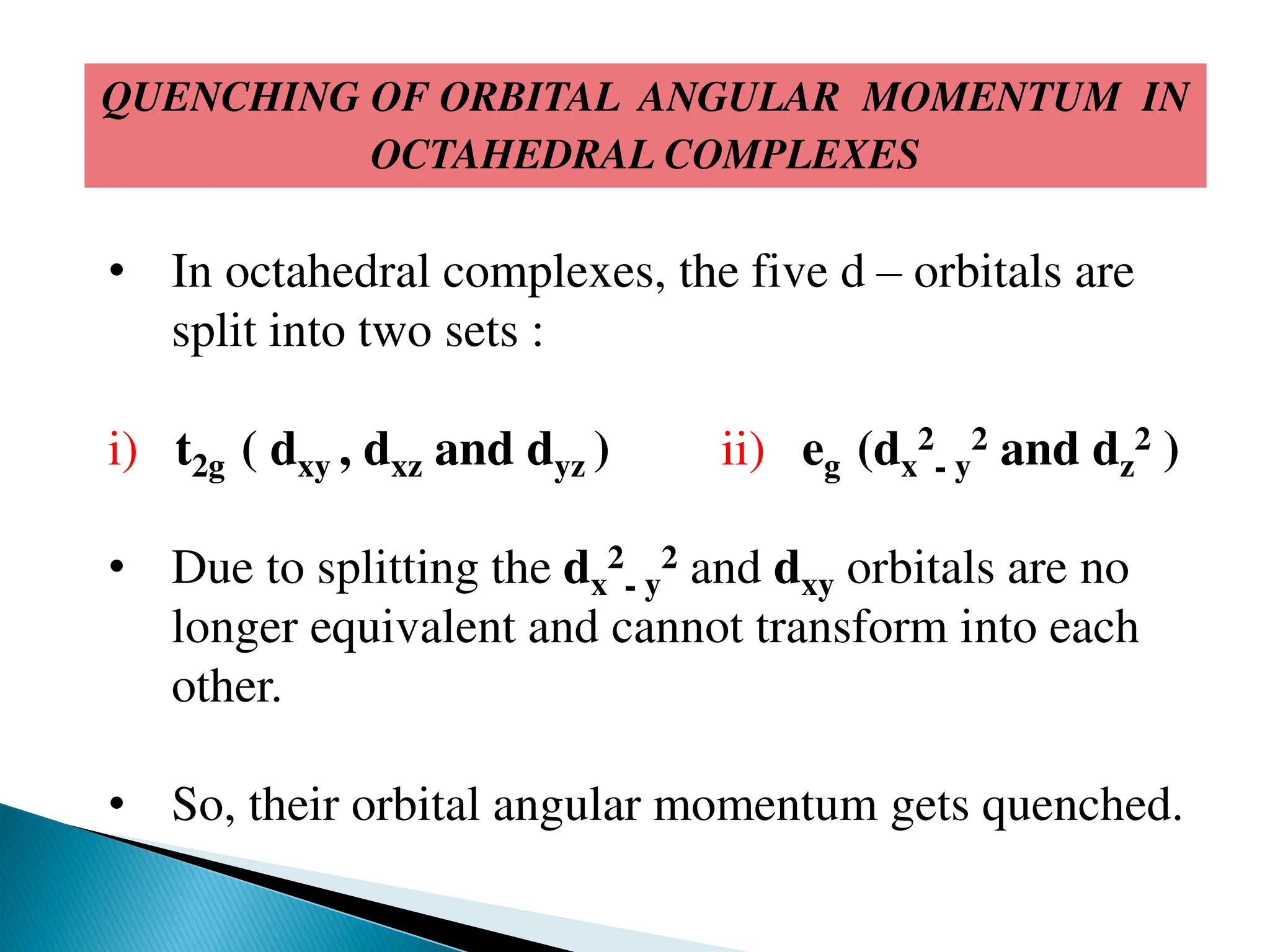
QUENCHING OF ORBITAL ANGULAR MOMENTUM IN
OCTAHEDRAL COMPLEXES
• In octahedral complexes, the five d – orbitals are
split into two sets :
i) t2g ( dxy , dxz and dyz ) ii) eg (dx
2
- y
2 and dz
2 )
• Due to splitting the dx
2
- y
2 and dxy orbitals are no
longer equivalent and cannot transform into each
other.
• So, their orbital angular momentum gets quenched.
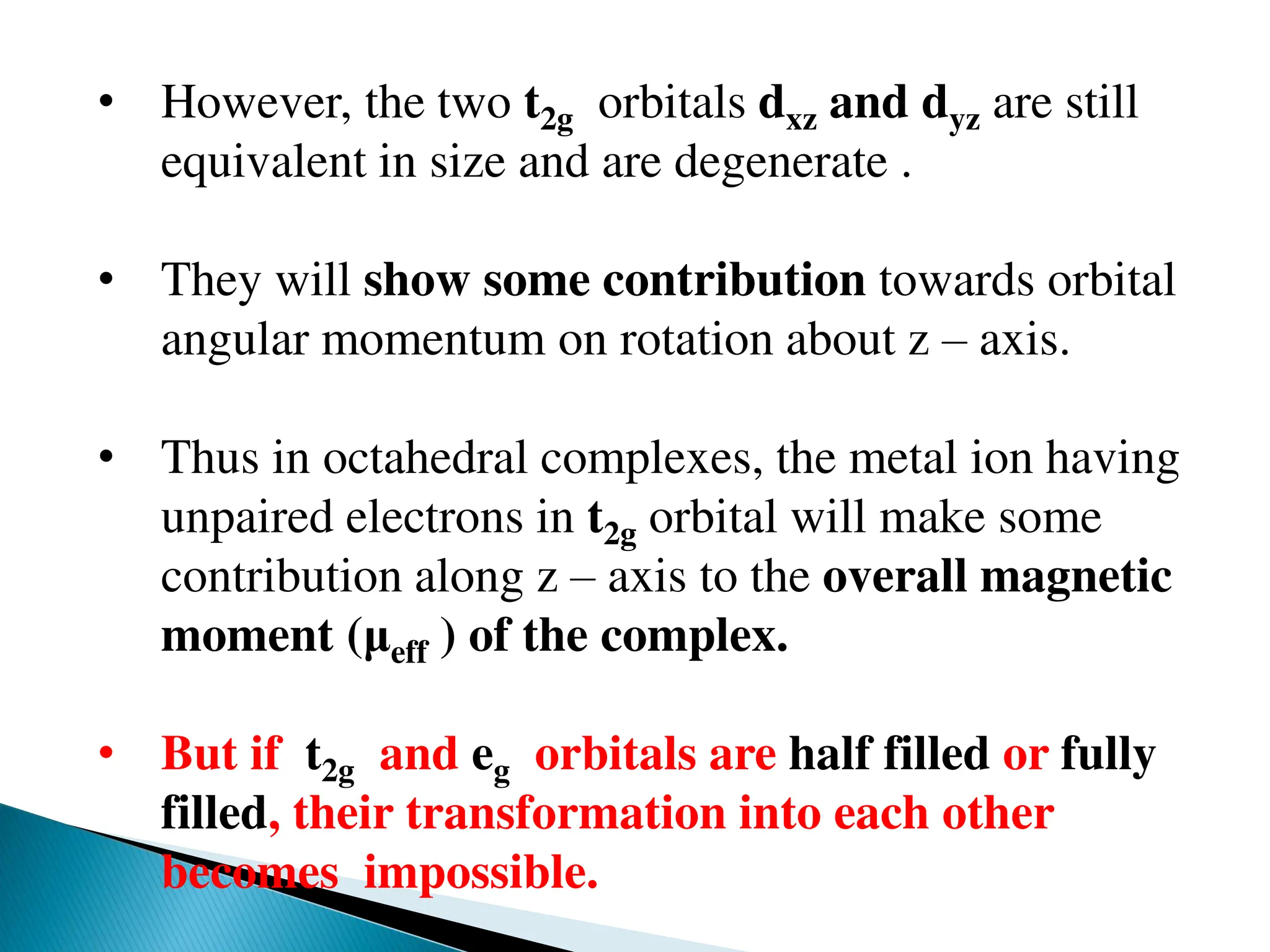
• However, the two t2g orbitals dxz and dyz are still
equivalent in size and are degenerate .
• They will show some contribution towards orbital
angular momentum on rotation about z – axis.
• Thus in octahedral complexes, the metal ion having
unpaired electrons in t2g orbital will make some
contribution along z – axis to the overall magnetic
moment (μeff ) of the complex.
• But if t2g and eg orbitals are half filled or fully
filled, their transformation into each other
becomes impossible.
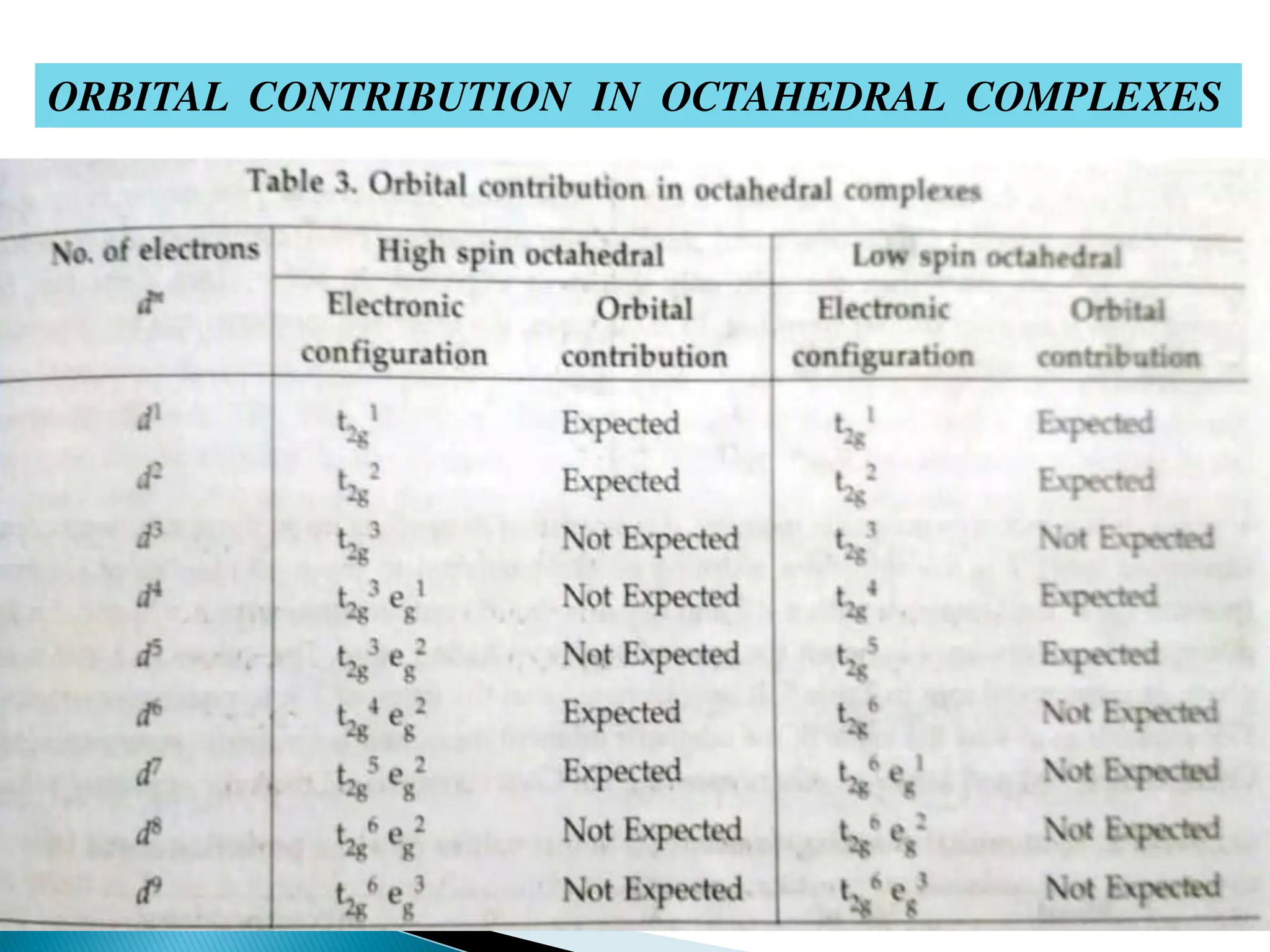
ORBITAL CONTRIBUTION IN OCTAHEDRAL COMPLEXES
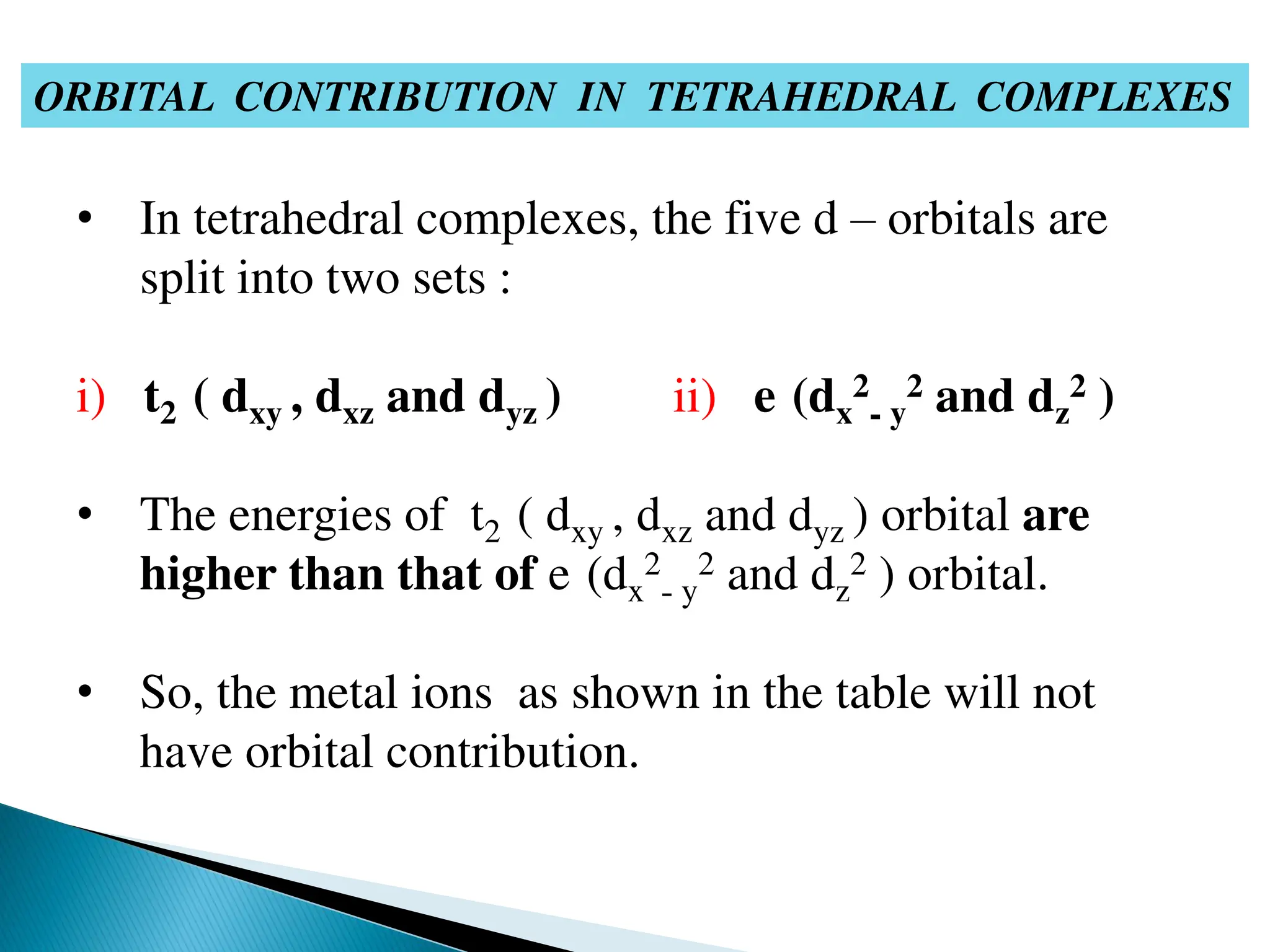
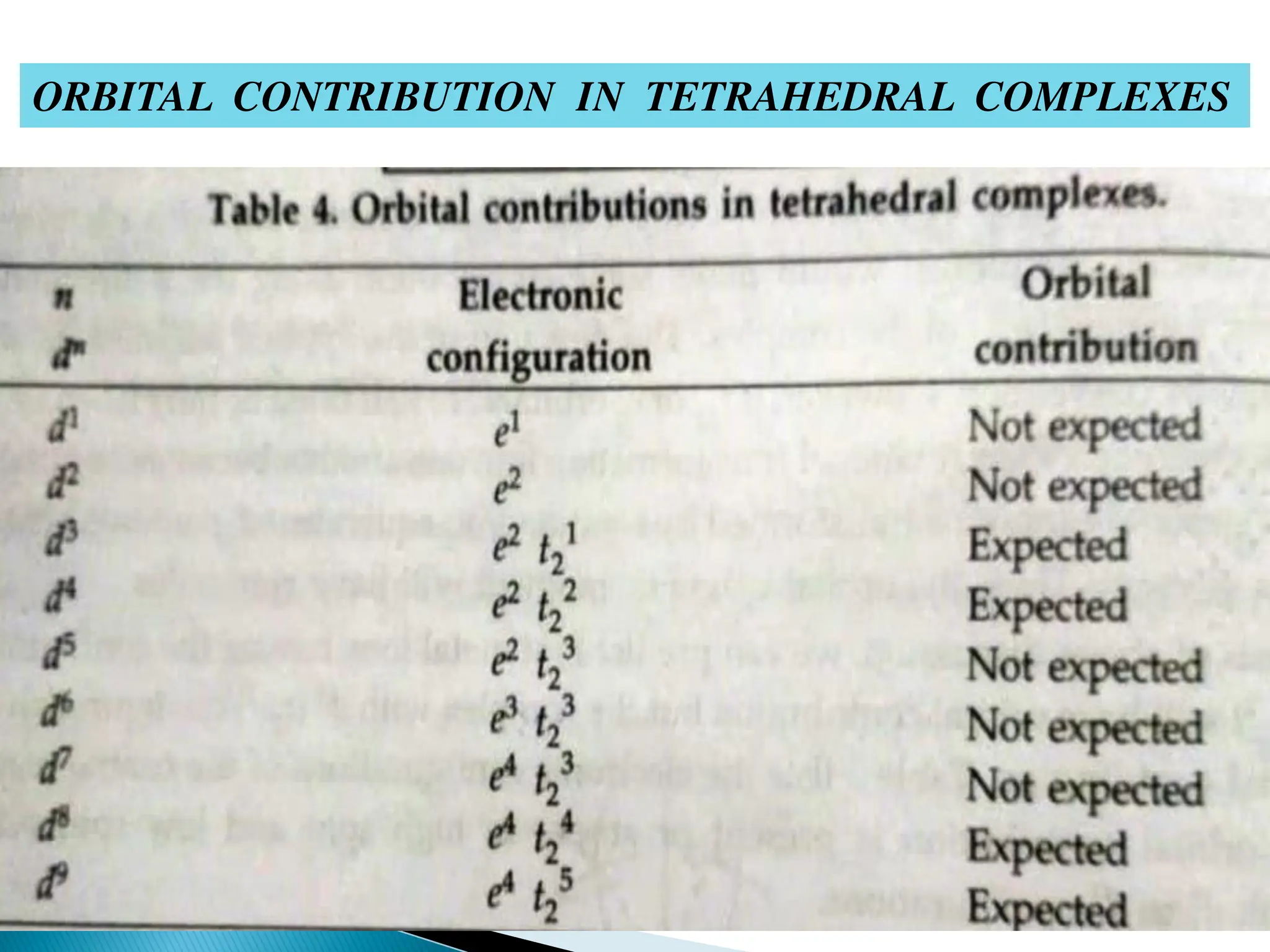
ORBITAL CONTRIBUTION IN TETRAHEDRAL COMPLEXES
• In tetrahedral complexes, the five d – orbitals are
split into two sets :
i) t2 ( dxy , dxz and dyz ) ii) e (dx
2
- y
2 and dz
2 )
• The energies of t2 ( dxy , dxz and dyz ) orbital are
higher than that of e (dx
2
- y
2 and dz
2 ) orbital.
• So, the metal ions as shown in the table will not
have orbital contribution.
ORBITAL CONTRIBUTION IN TETRAHEDRAL COMPLEXES
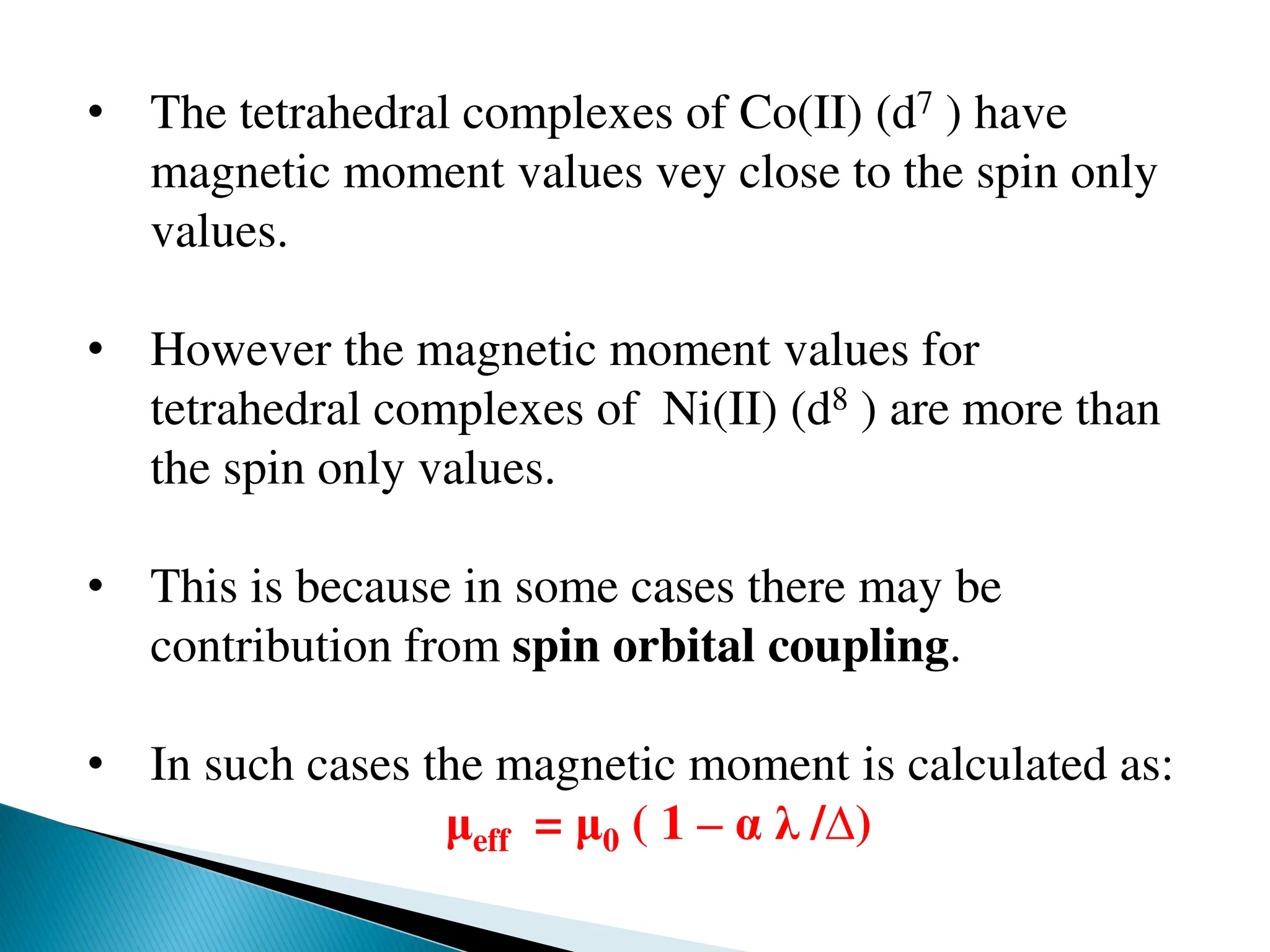
• The tetrahedral complexes of Co(II) (d7 ) have
magnetic moment values vey close to the spin only
values.
• However the magnetic moment values for
tetrahedral complexes of Ni(II) (d8 ) are more than
the spin only values.
• This is because in some cases there may be
contribution from spin orbital coupling.
• In such cases the magnetic moment is calculated as:
μeff = μ0 ( 1 – α λ /∆)
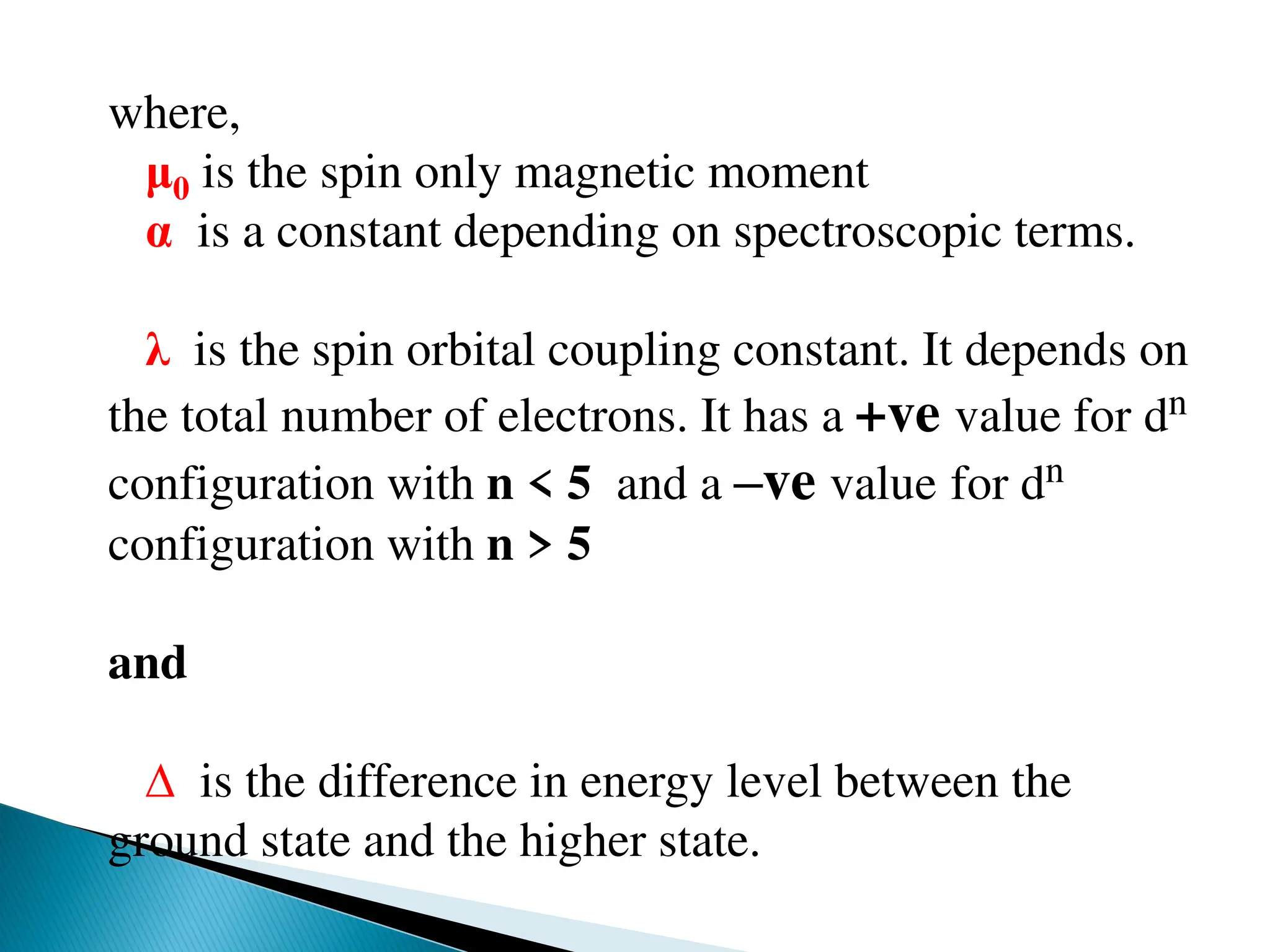
where,
μ0 is the spin only magnetic moment
α is a constant depending on spectroscopic terms.
λ is the spin orbital coupling constant. It depends on
the total number of electrons. It has a +ve value for dn
configuration with n < 5 and a –ve value for dn
configuration with n > 5
and
∆ is the difference in energy level between the
ground state and the higher state.
TEMPERATURE INDEPENDENT PARAMAGNETISM
• Certain compounds show weak paramagnetism or
paramagnetic behaviour despite having no unpaired
electrons in their ground state.
• This paramagnetism is independent of temperature
and is called temperature independent
paramagnetism (TIP).
• Complex ions such as MnO4
-, CrO4
2-, [Co(NH3)6]3+
etc. show TIP.
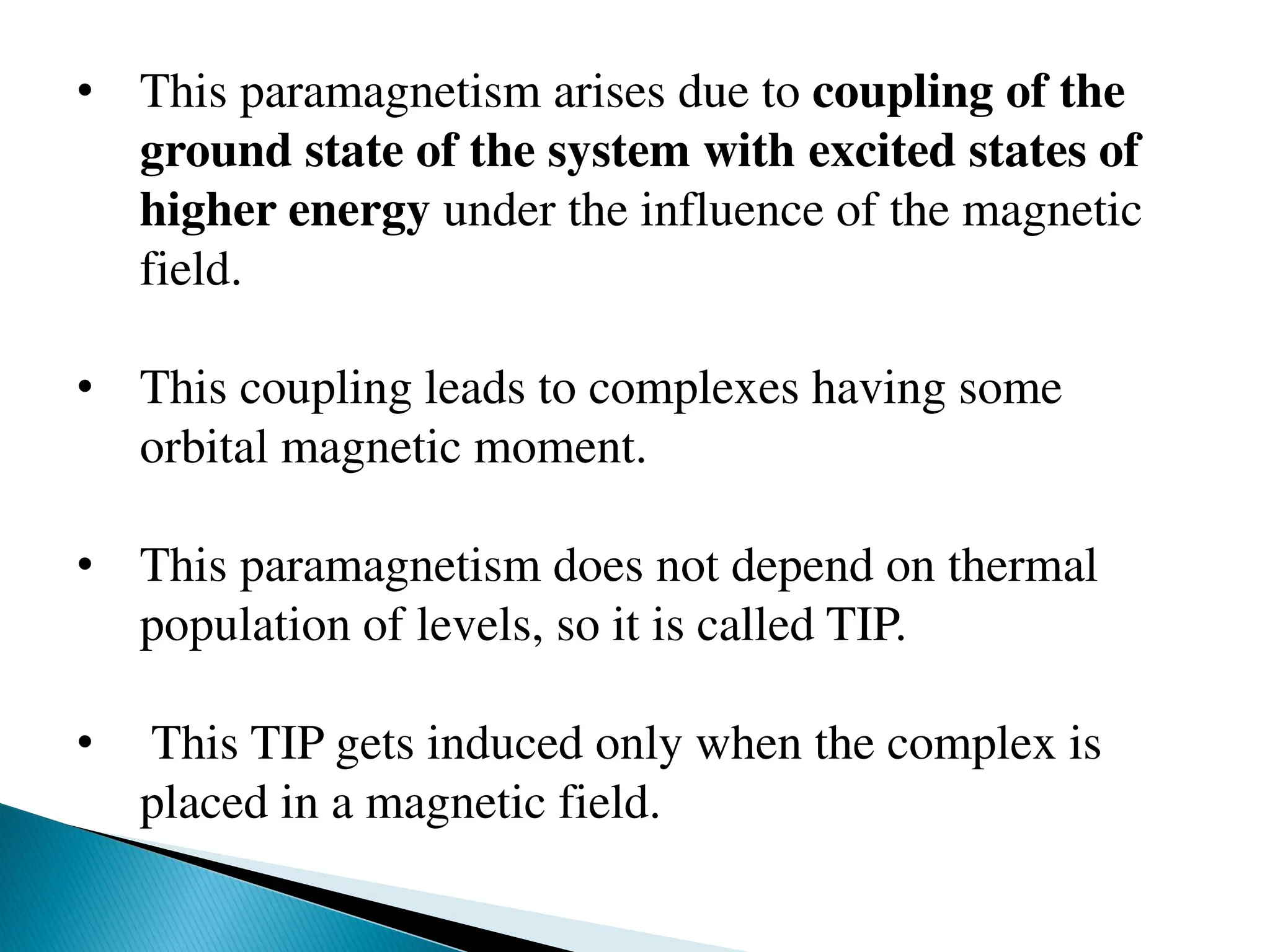
• This paramagnetism arises due to coupling of the
ground state of the system with excited states of
higher energy under the influence of the magnetic
field.
• This coupling leads to complexes having some
orbital magnetic moment.
• This paramagnetism does not depend on thermal
population of levels, so it is called TIP.
• This TIP gets induced only when the complex is
placed in a magnetic field.

Lecture-ppt--Magnetic-properties-of-TM-complexes.pdf

  • 1.
    MAGNETIC PROPERTIES OF TRANSITION METALCOMPLEXES By: Chemistry Department Govt. Shivalik College, Naya Nangal
  • 2.
    TRANSITION METALS Paramagnetic a) Attractedby magnetic field b) arises due to unpaired electrons Diamagnetic a) Repelled by magnetic field b) Arises due to paired electrons MAGNETIC PROPERTIES OF TRANSITION METALS
  • 3.
     Most ofthe transition metals are paramagnetic in nature due to the presence of unpaired electrons in d – orbitals.  Magnetic character is expressed in terms of magnetic moment.  Greater the number of unpaired electrons , greater is the paramagnetic character and greater is the magnetic moment.  The magnetic moment is expressed in Bohr Magneton (B.M.)
  • 4.
     Bohr Magnetonis the magnetic moment of an atom due to the orbital motion of an electron in the first orbit of hydrogen atom.  The magnetic moment is only due to the spin of the electrons. ORIGIN OF PARAMAGNETIC MOMENT • The magnetic property of a substance is due to both electrons and nucleons. • Due to large size of the nucleons ,their contribution towards magnetic character is very small and can be neglected.
  • 5.
    • The magneticmoment of a substance is sum of i. Spin magnetic moment: arises due to spinning of electron about its axis. ii. Orbital magnetic moment: arises due to motion of electron around the nucleus.
  • 6.
    • The magneticmoment for an electron having mass ‘m’ and charge ‘e’ is given as μs = eh / 4π mc = 1 B.M. where h is Planck’s constant and c is the velocity of light. • The value of magnetic moment obtained from the above formula is 9.274 x 10⁻²¹ ergs gauss-1 • This value is taken as one unit of magnetic moment called Bohr Magneton (B.M.)
  • 7.
     The spinmagnetic moment is given as μs = g {S(S + 1)}1/2 where , S is the spin quantum number and depends on the number of unpaired electrons g is the gyromagnetic ratio or the ‘g’ factor .  ‘g’ factor is the ratio of the magnetic moment to the angular momentum.  The value of ‘g’ factor is 2.00023 and generally taken as 2.
  • 8.
     The spinmagnetic moment can also be written as μs = g {S(S + 1)}1/2 = 2{S(S + 1)}1/2 or μs = {4S(S + 1)}1/2 EXAMPLES  For one unpaired electron, S = 1/ 2 μs = {4S(S + 1)}1/2 = {4⤫1/2(1/2 + 1)}1/2 = √3 = 1.732 B.M.
  • 9.
     For twounpaired electron, S = 1/2 + 1/2 = 1 μs = {4S(S + 1)}1/2 = {4⤫1(1 + 1)}1/2 = √8 = 2 √ 2 = 2 ⤫ 1.414 =2.828 B.M.  The spin magnetic moment can also be calculated from the relation μs = {n(n + 2)}1/2 where n is the number of unpaired electrons
  • 10.
    EXAMPLES  For oneunpaired electron, n = 1 μs = {n(n + 2)}1/2 = {1(1 +2)}1/2 = √3 = 1.732 B.M.  For two unpaired electron, n = 2 μs = {n(n + 2)}1/2 = {2(2 +2)}1/2 = √8 = 2 √ 2 = 2 ⤫ 1.414 =2.828 B.M.
  • 12.
    • The experimentallycalculated values of some transition metals were found to correlate with the spin only values. • In many cases the experimentally calculated values were found to be larger than the spin only values. • In such cases, the magnetic moment is dependent on both the spin and the orbital magnetic moment. • The total magnetic moment is given as μs + L = {4S(S + 1) + L(L +1)}1/2
  • 13.
    where, S is theresultant spin angular momentum quantum no. L is the resultant orbital angular momentum quantum no.
  • 14.
    • As canbe seen from the table that the experimentally calculated values of μ are greater than the μs values. • The experimentally calculated values of μ are never greater than the μs + L values. • This indicates that the contribution of orbital magnetic moment to the total magnetic moment is very less. • This is because the electric field of the ligands which surround the central metal ion hinder / restrict the orbital motion of the electrons.
  • 15.
    • So, theorbital magnetic moment gets partially or completely quenched. • In case of 2nd and 3rd transition series, especially in lanthanides the orbital magnetic moment does not get quenched. • In these elements the 4f orbitals are shielded by the outer 5s and 5p subshell. • So, the electric field of the ligands surrounding the central metal ion do not hinder the orbital motion of the 4f electrons or inner d electrons.
  • 16.
    • The contributionof orbital magnetic moment to the total magnetic moment is not quenched. • The magnetic moment of lanthanide ions is due to both electron spin and orbital motion of electrons. • The magnetic moment is calculated as μs + L = {4S(S + 1) + L(L +1)}1/2 where, S is the resultant spin angular momentum quantum no. L is the resultant orbital angular momentum quantum no.
  • 17.
    • In fewcases , it was observed that coupling occurs between the spin and the orbital contribution. • This coupling /interactions can be of three types: i. Spin – spin interaction ii. Orbital – orbital interaction iii. Spin – orbital interaction • In case of lanthanide metal ions all three types of couplings play an important role. • The resultant magnetic moment in these cases is calculated by means of Russell Saunders coupling.
  • 18.
    • Russell Saunderscoupling is also known as L – S coupling. • It is given as μs= g{ J( J + 1)}1/2 where, J is the total angular momentum. • J is the vector sum of total orbital angular momentum (L) and total spin angular momentum (S).
  • 19.
    • ‘g’ iscalled the Lande splitting factor and is given as g = 1 + J(J +1) + S(S + 1) – L(L +1) 2J(J + 1) • The theoretical and calculated magnetic moment values for trivalent lanthanide ions have been found to be in agreement. • If L and S are not coupled, then both L and S will align separately with the external magnetic field.
  • 20.
    MEASUREMENT OF MAGNETICPROPERTIES  Magnetic moments cannot be measured directly.  Magnetic moment can be measured from a parameter called magnetic susceptibility (χ).  The magnetic susceptibility (χ) is a property which determines how easily a substance can be magnetised.  It is defined as the capacity of a substance to get magnetised when placed in an applied magnetic field.
  • 21.
    When a substanceis placed in an external magnetic field of strength H, the total magnetic induction or magnetic flux density (B) within the substance is given as B = H + 4π I where I is the intensity of magnetisation. Dividing the above equation by H B/ H = 1 + 4π I /H = 1 + 4π κ The ratio B / H is called magnetic permeability
  • 22.
    • The ratioI /H is called the magnetic susceptibility per unit volume or volume susceptibility. • Magnetic permeability is the ability of a material to permit the passage of magnetic lines of force through it. • The magnetic permeability (B / H) of a substance is the ratio of the density of magnetic lines of force within a substance in a magnetic field to the density of magnetic lines of force in the magnetic field in the absence of the substance.
  • 23.
    EXPERIMENTAL MEASUREMENT OFMAGNETIC MOMENT 1. GOUY’S METHOD • It is used to measure paramagnetism. • Finely powdered substance is filled to a certain height in a pyrex tube called Gouy’s tube. • The tube is suspended from the arms of an analytical balance in a magnetic field. • An electromagnet providing a constant magnetic field in the range 5000 – 20,000 gauss is used
  • 24.
    • The lowerpart of the sample is in the stronger part of the magnetic field. • The top part of the tube is in a zero magnetic field. • The weighing assembly is enclosed in order to avoid vibrations of the suspended samples.
  • 25.
    • The powderedsubstance in the Gouy’s tube is first weighed in the absence of magnetic field. • Later it is weighed in the presence of magnetic field. • In case of paramagnetic substances, the substance will be strongly attracted by the magnetic field. • The weight of the substance will be more in magnetic field as compared to in the absence of magnetic field.
  • 26.
    • This increasein weight is a measure of the paramagnetism of a substance caused by the unpaired electrons. • More the number of unpaired electrons in a substance, more will be the weight of substance in the magnetic field. • The difference in weight of the sample in the presence and absence of magnetic field gives the magnetic susceptibility of a substance. • In case of diamagnetic substances, a decrease in the weight of a substance is seen in the magnetic field.
  • 27.
    CALCULATION OF MAGNETICMOMENT The sample is suspended in a non homogenous magnetic field. The force acting on the sample is given by F = ½ Aκ H2 where, A = cross sectional area of the cyclinder H = intensity of the central homogenous part of the magnetic field κ = magnetic or volume susceptibility
  • 28.
    • The aboveequation is only valid if the measurement is done in vacuum. • In Gouy’s method the sample is placed in air. • So, the susceptibility due to air has to subtracted from the measured susceptibility. • The equation now is F = ½ A H2 (κ – κ’ ) where , κ’ is the magnetic/ volume susceptibility of air.
  • 29.
    • Another correctionis that the Gouy’s tube is in the form of a hollow cylinder. • It exerts / develops a force which is always present. • This force has to be subtracted from the measured force. • The force on the Gouy’s tube is taken as δ and is always negative as the tube is made up of diamagnetic material.
  • 30.
    • Applying thecorrection , the equation now is F = ½ A H2 (κ – κ’ ) + δ where , δ = force developed due to Gouy’s tube. • The factor ½ A H2 is constant for a specimen of constant length and cross sectional area. • Taking the density of the sample in consideration, the equation can be rewritten as 106 χ = α + βF’ / w
  • 31.
    where α = constantfor displaced air = 0.029 x volume of the sample. β = tube calibration constant w = weight of the sample in gms. F’= Force on the sample = F – δ, where F and δ are in gms • The calibration of the tube is done by filling the tube with a substance whose susceptibility is accurately known. • The most commonly used substance is mercury tetrathiocyanatocobaltate (II), Hg[Co(CNS)4]. Its susceptibility is 1.644 x 10⁻⁷ at 200C.
  • 32.
    • β canbe calculated by making measurements with the standard substance. • Knowing the value of α , β, F and δ the magnetic susceptibility χ can be calculated. DIAMAGNETIC CORRECTION  The calculated magnetic susceptibility is due to both paramagnetic and diamagnetic susceptibilities.  Diamagnetic substances have no unpaired electrons and have zero magnetic moment.
  • 33.
     When adiamagnetic substance is placed in a magnetic field, the internal magnetic field induces a small magnetic field which is in opposition to the external field.  Diamagnetic substances repel the lines of force and show a decrease in weight in Gouy’s method.  Every molecule of the substance has large number of paired electrons.  These paired electrons do not contribute to magnetic moment but affect the magnitude of χM.
  • 34.
     The contributionfrom paired electrons oppose that from unpaired electrons.  The measured magnetic susceptibility is due to both paramagnetic and diamagnetic susceptibilities. χM (measured) = χPM + χDM  The correct paramagnetic susceptibility of a substance is obtained as χM Corr = χPM = χM (measured) - χDM
  • 35.
    ADVANTAGES OF GOUY’SMETHOD • Very simple and easy to assemble apparatus. • Easy to handle and use • Requires large amount of sample. So, an ordinary balance can be used to measure the change in mass. DISADVANTAGES OF GOUY’S METHOD • Requires large amount of sample. • Requires perfect uniform packing of the sample. It is tedious and time consuming. • Correct results are not obtained if the packing is not uniform.
  • 36.
    FARADAY’S METHOD  Faraday’smethod gives the magnetic susceptibility directly.  It requires a very small amount of the sample.  The sample packed in a quartz ampule is suspended between magnet poles from a sensitive balance
  • 37.
     The sampleis suspended between the magnetic poles so that the value of the product H(dH/dx) is constant over the region occupied by the sample.  dH/dx is the gradient of the field.  The whole system is enclosed and can be flushed with inert gases like nitrogen or helium.  A sample weighing (0.1 – 10 mg) is taken in an ampule of internal diameter ~ 1mm is placed in a magnetic field of constant gradient dH/dx.
  • 38.
     The forceacting on the sample is measured directly using a quartz fibre torsion balance and is given as f = m χ H(dH/dx) where m = mass of the sample χ = susceptibility of the sample H = intensity of the central homogenous part of the field dH/dx = gradient of the field in x direction  The force f can be measured by weighing the sample both in the field and out of the field. The difference of the two weights gives the value of force.
  • 39.
     This methodis based on comparison of unknown substance and the standard [mercury tetrathiocyanatocobaltate (II)].  As the magnetic field H and the field gradient dH/dx are the same in both case, the force acting on the standard and the unknown sample can be rewritten as H (dH/dx) = fu / mu χu (for unknown sample) H (dH/dx) = fs / ms χs (for standard)
  • 40.
    Equating the aboveequations, we get fu / mu χu = fs / ms χs On rearranging , χu = fu ms χs / mu . fs where, χu and χs are the susceptibilities of the sample & standard mu and ms are the masses and fu and fs are the respective forces at constant H(dH/dx)
  • 41.
    ADVANTAGES OF FARADAY’SMETHOD  Requires very small quantity of the sample and it need not be homogenous.  Gives the magnetic/specific susceptibility directly. DISADVANTAGES OF FARADAY’S METHOD  Equipment is very delicate and require great skill.  As small amount of sample is used, reactions occurring at the surface of the sample will lead to large errors.
  • 42.
    RELATIONSHIP BETWEEN MAGNETIC SUSCEPTIBILITY& MAGNETIC MOMENT The magnetic susceptibility χM is related to magnetic moment μ as χM Corr = N0 μ2 / 3kT where k is the Boltzmann constant N0 is the Avogadro number T is the absolute temperature χM Corr is the corrected magnetic moment Rearranging the equation,
  • 43.
    μ2 = 3k.χM Corr .T / N0 μ = (3k / N0 )1/2 ( χM Corr .T )1/2 where (3k / N0 )1/2 = constant = 2.828 Thus the magnetic moment μ can be calculated from magnetic susceptibility χM by μ = 2.828 ( χM Corr .T )1/2 B.M.
  • 45.
    VARIATIONOF MAGNETIC SUSCEPTIBILITYWITH TEMPERATURE  Magnetic susceptibility of a substance varies with temperature.  According to Pierre Curie, paramagnetic susceptibilities vary inversely with temperature. χM Corr ∞ 1/T χM Corr = C/T where C = constant, characteristic of the substance known as Curie’s constant, T = absolute temperature
  • 46.
    • Curie’s lawstate that the paramagnetic susceptibilities vary inversely with temperature. • A plot of graph between χM Corr and absolute temperature T (K) is parabolic in nature. • If χM Corr of a substance is measured at different temperatures and the reciprocal of those values (1/ χM Corr) plotted against absolute temperature T, a straight line with slope C is obtained which intersects the origin
  • 48.
    • Curie’s lawis followed by substances in whom there is no spontaneous interaction between adjacent unpaired electrons i.e. paramagnetic substances. • In other words, there is no secondary magnetic interactions between the neighbouring magnetic centres. • Such substances are called magnetically dilute. • Many substances give straight lines which do not pass through the origin.
  • 49.
    • The straightlines intersect the temperature axis either a little above the 0K or little below 0K. • Such compounds are said to obey modified Curie equation
  • 50.
    • The modifiedCurie’s equation is χM Corr = C / T – θ where θ is the temperature at which the straight line cuts the absolute temperature axis. • The modified equation is called Curie – Weiss law and the θ is called Weiss constant. • The Weiss constant takes into account interionic/ intermolecular interactions and eliminate them. • So, Magnetic moment μ = 2.828 [ χM Corr (T - θ )]1/2
  • 51.
    MAGNETISM Paramagnetism Diamagnetism Ferromagnetism Anti - Ferromagnetism Thereare many kinds of magnetic substances and the magnetic properties exhibited by them are of the following types
  • 52.
    • In somematerials, the permanent atomic magnetic moments have a strong tendency to align themselves even without any external field. • These materials are said to be Ferromagnetic materials. • The ferromagnetic materials are those substances which exhibit strong magnetism in the same direction of the field, when a magnetic field is applied to it. A. FERROMAGNETIC SUBSTANCES
  • 53.
    • In solidstate , the metal ions of ferromagnetic substances are grouped together into small regions called Domains. • They get their strong magnetic properties due to the presence of magnetic domains. • In these domains, large numbers of atom's moments (1012 to 1015) are aligned parallel so that the magnetic force within the domain is strong.
  • 54.
    • When aferromagnetic material is in the unmagnetized state, the domains are nearly randomly organized and the net magnetic moments get cancelled. • When a magnetizing field is applied, the domains become aligned in the direction of the magnetic field. • They are able to retain their magnetic properties after the external field has been removed. • It means it becomes permanently magnetized even after the removal of the external magnetic field.
  • 55.
    • Some ofthe examples of ferromagnetic materials are cobalt, iron, nickel, gadolinium, dysprosium.
  • 56.
    B. ANTI FERROMAGNETICSUBSTANCES  In this the adjacent ions / domains that behave as tiny magnets spontaneously align themselves into opposite or antiparallel arrangement throughout the material  The magnetism from magnetic atoms or ions oriented in one direction is canceled out by the set of magnetic atoms or ions that are aligned in the reverse direction.  So that the compound exhibits almost no gross external magnetism.  This type of behaviour is observed at low temperatures.
  • 57.
    Examples of anti ferromagneticsubstances are MnO, FeO, NiO, MnO2 , V2 O3.
  • 58.
    • In paramagneticsubstances, the magnetic moment results entirely from the individual magnetic centres. • In other words, there is no secondary magnetic interactions between the neighbouring magnetic centres. • Such substances are called magnetically dilute. • But, there are some paramagnetic substances in which secondary interactions exist between the neighbouring magnetic centres.
  • 59.
    • Such substancesare called magnetically concentrated substances. • In such substances the magnetic susceptibility shows dependence on both field strength and temperature. • These substances are Ferromagnetic and Anti ferromagnetic substances. • The main features of the curves of these substances can be understood in terms of Curie – Weiss law.
  • 60.
    The curve forferromagnetic substances shows some discontinuity at temperature Tc . This is called Curie temperature. Above Tc the ferromagnetic substances follow Curie or Curie – Weiss law and behave as simple paramagnetic substances. Below Tc the magnetic susceptibility behaviour is different and it depends on field strength of the magnetic field. Tc
  • 61.
    In case ofanti ferromagnetic substances, a characteristic temperature TN called the Neel’s temperature can be observed. Above TN, all anti ferromagnetic substances follow Curie or Curie Weiss law and show paramagnetic behaviour. Below TN , the magnetic susceptibility decreases with decrease in temperature. χM
  • 62.
    • The abnormalbehaviour in ferromagnetic and anti- ferromagnetic substances is due to interionic interactions. • Above Tc thermal energies are able to randomize the orientations, resulting in decrease in magnetic susceptibility with increase in temperature. • Above Neels temperature, the magnetic moments are not aligned in antiparallel directions due to large thermal energy.
  • 63.
  • 64.
    ORBITAL CONTRIBUTION TOMAGNETIC MOMENT • The total magnetic moment of a substance is due to both spin and orbital contribution. • Both these contributions occur because of unpaired electrons. • In many cases, the unpaired electrons are the outermost electrons under consideration and these are not screened by other electrons. • In such cases, magnetic moment depends on only the spin contribution, the orbital contribution can be neglected.
  • 65.
    • In caseslike lanthanides and actinides, the unpaired electrons are inside ( lie within the shell) and are shielded by the outer electrons (from the electric field of the in coming ligands), orbital contribution cannot be neglected. • Thus in these the total magnetic moment is due to both spin and orbital magnetic moment. • The spin angular momentum of an electron does not depend on its surrounding (chemical environment). • The orbital angular momentum of an electron depend on its surrounding (chemical environment).
  • 66.
    • The orbitalcontribution can be reduced or quenched in the substance. • Qualitatively, quenching of orbital angular momentum can be explained on the basis of crystal field theory. • In case of first transition series, the unpaired electrons are present in 3d orbitals. • A transition metal ion has five 3d orbitals of same energy (degenerate).
  • 67.
    • The orbitalangular momentum arises due to rotation of electron about the nucleus via these 3d orbitals. • Generation of orbital angular momentum occurs only if the following conditions are satisfied: i. The orbitals should have the same energy (degenerate). ii. The orbitals should have similar size and shape, so that they may be transformed into one another by rotation about some axis. iii. The orbitals should not have electrons of same / identical spin.
  • 68.
    • The orbitalangular momentum of an electron along an axis is equal to the number of times the orbital gets transformed into equivalent orbitals during a rotation of π / 2 (or 900) around that axis. • Consider a free metal ion in which all d – orbitals are degenerate. • An electron in dx 2 - y 2 orbital will contribute 2 units of angular momentum (h / 2π ) along z – axis towards orbital angular momentum as rotation of dx 2 - y 2 orbital by 450 around the z – axis will transform it into equivalent dxy orbital.
  • 69.
    • In otherwords, a rotation of dx 2 - y 2 orbital by 900 around the z – axis will carry the dx 2 - y 2 orbital into dxy orbital twice. • Similarly, an electron in dxy orbital will contribute 2 units of angular momentum (h / 2π ) along z – axis towards orbital angular momentum. • An electron in dxz orbital will contribute 1 unit of angular momentum (h / 2π ) along z – axis towards orbital angular momentum, because dxz orbital will transform into dyz orbital once on rotating around x – axis by 900.
  • 70.
    Circulation of electrondensity about z – axis (perpendicular to the plane) in dxy and dx 2 - y 2 orbitals
  • 71.
    • Only dz 2 orbital cannot be transformed into any other d – orbital due to their different shape. • So, d z 2 orbital has zero orbital angular momentum along z – axis. • When the metal ion gets surrounded by ligands, the degeneracy of d – orbitals gets splitted. • The dx 2 - y 2 (e set) and dxy (t2 set) orbitals are no longer equivalent as they now have different energies and cannot be transformed into each other by rotation along z – axis.
  • 72.
    QUENCHING OF ORBITALANGULAR MOMENTUM IN OCTAHEDRAL COMPLEXES • In octahedral complexes, the five d – orbitals are split into two sets : i) t2g ( dxy , dxz and dyz ) ii) eg (dx 2 - y 2 and dz 2 ) • Due to splitting the dx 2 - y 2 and dxy orbitals are no longer equivalent and cannot transform into each other. • So, their orbital angular momentum gets quenched.
  • 73.
    • However, thetwo t2g orbitals dxz and dyz are still equivalent in size and are degenerate . • They will show some contribution towards orbital angular momentum on rotation about z – axis. • Thus in octahedral complexes, the metal ion having unpaired electrons in t2g orbital will make some contribution along z – axis to the overall magnetic moment (μeff ) of the complex. • But if t2g and eg orbitals are half filled or fully filled, their transformation into each other becomes impossible.
  • 74.
    ORBITAL CONTRIBUTION INOCTAHEDRAL COMPLEXES
  • 75.
    ORBITAL CONTRIBUTION INTETRAHEDRAL COMPLEXES • In tetrahedral complexes, the five d – orbitals are split into two sets : i) t2 ( dxy , dxz and dyz ) ii) e (dx 2 - y 2 and dz 2 ) • The energies of t2 ( dxy , dxz and dyz ) orbital are higher than that of e (dx 2 - y 2 and dz 2 ) orbital. • So, the metal ions as shown in the table will not have orbital contribution.
  • 76.
    ORBITAL CONTRIBUTION INTETRAHEDRAL COMPLEXES
  • 77.
    • The tetrahedralcomplexes of Co(II) (d7 ) have magnetic moment values vey close to the spin only values. • However the magnetic moment values for tetrahedral complexes of Ni(II) (d8 ) are more than the spin only values. • This is because in some cases there may be contribution from spin orbital coupling. • In such cases the magnetic moment is calculated as: μeff = μ0 ( 1 – α λ /∆)
  • 78.
    where, μ0 is thespin only magnetic moment α is a constant depending on spectroscopic terms. λ is the spin orbital coupling constant. It depends on the total number of electrons. It has a +ve value for dn configuration with n < 5 and a –ve value for dn configuration with n > 5 and ∆ is the difference in energy level between the ground state and the higher state.
  • 79.
    TEMPERATURE INDEPENDENT PARAMAGNETISM •Certain compounds show weak paramagnetism or paramagnetic behaviour despite having no unpaired electrons in their ground state. • This paramagnetism is independent of temperature and is called temperature independent paramagnetism (TIP). • Complex ions such as MnO4 -, CrO4 2-, [Co(NH3)6]3+ etc. show TIP.
  • 80.
    • This paramagnetismarises due to coupling of the ground state of the system with excited states of higher energy under the influence of the magnetic field. • This coupling leads to complexes having some orbital magnetic moment. • This paramagnetism does not depend on thermal population of levels, so it is called TIP. • This TIP gets induced only when the complex is placed in a magnetic field.