1
Lecture Notes in Modern Petroleum
Refining Processes
Barhm Abdullah Mohamad
Erbil Polytechnic University
LinkedIn: https://www.linkedin.com/in/barhm-mohamad-900b1b138/
Google Scholar: https://scholar.google.com/citations?user=KRQ96qgAAAAJ&hl=en
ResearchGate: https://www.researchgate.net/profile/Barhm_Mohamad
YouTube channel: https://www.youtube.com/channel/UC16-u0i4mxe6TmAUQH0kmNw
2
PREFACE
The most prolific and dynamic industries of this century are the petroleum and the
petrochemical. Mankind consumes more than 2,500 million tons of oil yearly. This
significantly reveals the magnitude, economic edifice, and necessity of industry. From
the most primitive method of extraction and refining of petroleum, a great
transformation has occurred throughout these years to materialize the modern
refinery. This due to the timely inductions of the scientific and technological
advancements into refinery operations. Advancements are many and knowledge is
expanding, one has to keep abreast with these things.
This lecture notes describes refinery processes in a concise manner which is necessary
for students in engineering college and technical institute, also who working in
petroleum refineries.
3
Chapter 1
1.1 Unconventional oil reservoirs
Oil sands are reservoirs of partially biodegraded oil still in the process of escaping and
being biodegraded, but they contain so much migrating oil that, although most of it
has escaped, vast amounts are still present, more than can be found in conventional oil
reservoirs. The lighter fractions of the crude oil are destroyed first, resulting in
reservoirs containing an extremely heavy form of crude oil, called crude bitumen in
Canada, or extra-heavy crude oil in Venezuela. These two countries have the world's
largest deposits of oil sands.
On the other hand, oil shales are source rocks that have not been exposed to heat or
pressure long enough to convert their trapped hydrocarbons into crude oil. Technically
speaking, oil shales are not really shales and do not really contain oil but are usually
relatively hard rocks called marls containing a waxy substance called kerogen. The
kerogen trapped in the rock can be converted into crude oil using heat and pressure to
simulate natural processes. The method has been known for centuries and was
patented in 1694 under British Crown Patent No. 330 covering, "A way to extract and
make great quantities of pitch, tar, and oil out of a sort of stone." Although oil shales
are found in many countries, the United States has the world's largest deposits.
1.2 Classification
The petroleum industry generally classifies crude oil by the geographic location it is
produced in (e.g., West Texas Intermediate, Brent, or Oman), its API gravity (an oil
industry measure of density), and by its sulfur content. Crude oil may be considered
light if it has low density or heavy if it has high density; and it may be referred to as
sweet if it contains relatively little sulfur or sour if it contains substantial amounts of
sulfur.
1.2.1 The American Petroleum Institute gravity, or API gravity
The measurement of how heavy or light a petroleum liquid is compared to water. If its
API gravity is greater than 10, it is lighter and floats on water; if less than 10, it is
heavier and sinks. API gravity is thus a measure of the relative density of a petroleum
liquid and the density of water, but it is used to compare the relative densities of
petroleum liquids. For example, if one petroleum liquid floats on another and is
therefore less dense, it has a greater API gravity. Although mathematically API gravity
has no units (see the formula below), it is nevertheless referred to as being in
“degrees”. API gravity is graduated in degrees on a hydrometer instrument and was
designed so that most values would fall between 10 and 70 API gravity degrees.
API gravity formulas, the formula used to obtain the API gravity of petroleum liquids
is thus:
4
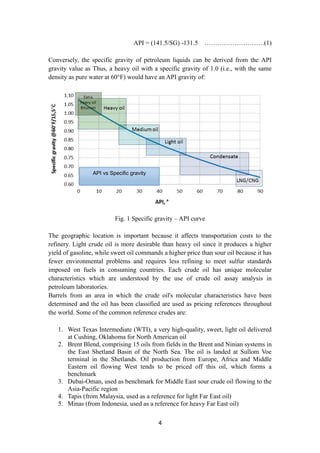
API = (141.5/SG) -131.5 ……………………….(1)
Conversely, the specific gravity of petroleum liquids can be derived from the API
gravity value as Thus, a heavy oil with a specific gravity of 1.0 (i.e., with the same
density as pure water at 60°F) would have an API gravity of:
Fig. 1 Specific gravity – API curve
The geographic location is important because it affects transportation costs to the
refinery. Light crude oil is more desirable than heavy oil since it produces a higher
yield of gasoline, while sweet oil commands a higher price than sour oil because it has
fewer environmental problems and requires less refining to meet sulfur standards
imposed on fuels in consuming countries. Each crude oil has unique molecular
characteristics which are understood by the use of crude oil assay analysis in
petroleum laboratories.
Barrels from an area in which the crude oil's molecular characteristics have been
determined and the oil has been classified are used as pricing references throughout
the world. Some of the common reference crudes are:
1. West Texas Intermediate (WTI), a very high-quality, sweet, light oil delivered
at Cushing, Oklahoma for North American oil
2. Brent Blend, comprising 15 oils from fields in the Brent and Ninian systems in
the East Shetland Basin of the North Sea. The oil is landed at Sullom Voe
terminal in the Shetlands. Oil production from Europe, Africa and Middle
Eastern oil flowing West tends to be priced off this oil, which forms a
benchmark
3. Dubai-Oman, used as benchmark for Middle East sour crude oil flowing to the
Asia-Pacific region
4. Tapis (from Malaysia, used as a reference for light Far East oil)
5. Minas (from Indonesia, used as a reference for heavy Far East oil)
API vs Specific gravity
5
6. The OPEC Reference Basket, a weighted average of oil blends from various
OPEC (The Organization of the Petroleum Exporting Countries) countries
There are declining amounts of these benchmark oils being produced each year, so
other oils are more commonly what is actually delivered. While the reference price
may be for West Texas Intermediate delivered at Cushing, the actual oil being traded
may be a discounted Canadian heavy oil delivered at Hardisty, Alberta, and for a
Brent Blend delivered at the Shetlands, it may be a Russian Export Blend delivered at
the port of Primorsk.
1.3 Petroleum industry
The petroleum industry is involved in the global processes of exploration, extraction,
refining, transporting (often with oil tankers and pipelines), and marketing petroleum
products. The largest volume products of the industry are fuel oil and gasoline (petrol).
Petroleum is also the raw material for many chemical products, including
pharmaceuticals, solvents, fertilizers, pesticides, and plastics. The industry is usually
divided into three major components: upstream, midstream and downstream.
Midstream operations are usually included in the downstream category.
Petroleum is vital to many industries and is of importance to the maintenance of
industrialized civilization itself, and thus is critical concern to many nations. Oil
accounts for a large percentage of the world's energy consumption, ranging from a
low of 32% for Europe and Asia, up to a high of 53% for the Middle East. Other
geographic regions' consumption patterns are as follows: South and Central America
(44%), Africa (41%), and North America (40%). The world at large consumes 30
billion barrels (4.8 km³) of oil per year, and the top oil consumers largely consist of
developed nations. In fact, 24% of the oil consumed in 2004 went to the United States
alone, though by 2007 this had dropped to 21% of world oil consumed.
1.4 Oil characteristics
1.4.1 Pour Point
The pour point of a liquid is the lowest temperature at which it will pour or flow
under prescribed conditions. It is a rough indication of the lowest temperature at
which oil is readily pumpable.
Also, the pour point can be defined as the minimum temperature of a liquid,
particularly a lubricant, after which, on decreasing the temperature, the liquid ceases
to flow, the starting point is called pour point the ending point is called freezing point.
a. Measuring the pour point of petroleum products
The specimen is cooled inside a cooling bath to allow the formation of paraffin wax
crystals. At about 9oC above the expected pour point, and for every subsequent 3, the
test jar is removed and tilted to check for surface movement. When the specimen does
not flow when tilted, the jar is held horizontally for 5 secs. If it does not flow, 3°C is
added to the corresponding temperature and the result is the pour point temperature.
It is also useful to note that failure to flow at the pour point may also be due to the
effect of viscosity or the previous thermal history of the specimen. Therefore, the pour
6
point may give a misleading view of the handling properties of the oil. Additional
fluidity or pumpability tests may also be undertaken. An approximate range of pour
point can be observed from the specimen's upper and lower pour point.
Measuring the pour point of crude oils.
Two pour points can be derived which can give an approximate temperature window
depending on its thermal history. Within this temperature range, the sample may
appear liquid or solid. This peculiarity happens because wax crystals form more
readily when it has been heated within the past 24hrs and contributes to the lower
pour point.
The upper pour point is measured by pouring the test sample directly into a test jar.
The sample is then cooled and then inspected for pour point as per the usual pour
point method.
The lower pour point is measured by first pouring the sample into a stainless-steel
pressure vessel. The vessel is then screwed tight and heated to above 100°C in an oil
bath.
After a specified time, the vessel is removed and cooled for a short time. The sample
is then poured into a test jar and immediately closed with a cork carrying the
thermometer.
The sample is then cooled and then inspected for pour point as per the usual pour
point method the pour point and frizzing point are equal for water.
Table 1 Several location petroleum properties
Parameters Pennington, Nigeria Lalang, Indonesia
Specific Gravity at 15ºC 0.85 0.84
Pour Point 6°C 35 °C
Specification Group 2 Group 2
These two crude oil samples show the difference between pour points will need
different responses. The Nigerian will lose approximately 35% to evaporation
whereas the Indonesian will lose nothing. The Nigerian could be chemically
dispersing whereas the Indonesian will need to be recovered completely.
1.4.2 Viscosity
Viscosity is the resistance to flow. The higher the viscosity the slower the liquid will
flow and the lower the quality.
Resistance of a fluid to a change in shape, or movement of neighboring portions
relative to one another. Viscosity denotes opposition to flow. It may also be thought of
as internal friction between the molecules. Viscosity is a major factor in determining
the forces that must be overcome when fluids are used in lubrication or transported in
pipelines. It also determines the liquid flow in spraying, injection molding, and
surface coating. The viscosity of liquids decreases rapidly with an increase in
temperature, while that of gases increases with an increase in temperature.
The SI unit for viscosity is the newton-second per square meter (N.s/m2
).
7
b. Standard Test Method for Kinematic Viscosity
This test method specifies a procedure for the determination of the kinematic viscosity,
v, of liquid petroleum products, both transparent and opaque, by measuring the time
for a volume of liquid to flow under gravity through a calibrated glass capillary
viscometer. The dynamic viscosity, ŋ, can be obtained by multiplying the kinematic
viscosity, v, by the density, p, of the liquid.
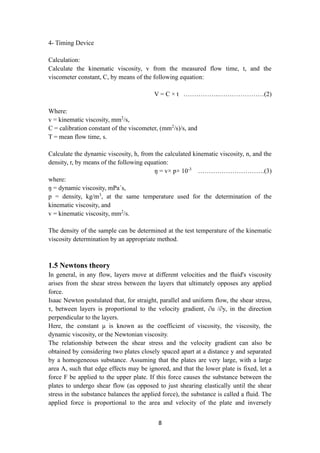
ŋ= v × p ………………….………….(1)
Viscosity a measure of the ability of a liquid to flow or a measure of its resistance to
flow; the force required to move a plane surface of area 1 m2
over another parallel
plane surface 1 m away at a rate of 1 m/sec when both surfaces are immersed in the
fluid.
Dynamic (shear) viscosity: of a fluid expresses its resistance to shearing flows, where
adjacent layers move parallel to each other with different speeds.
Physical unit of dynamic viscosity is the pascal second (Pa·s), (equivalent to (N·s)/m2
,
or kg/(m·s)). Physical unit for dynamic viscosity is the poise:
1 P = 0.1 Pa·s,
1 cP = 1 mPa·s = 0.001 Pa·s.
Kinematic viscosity:
Kinematic viscosity the ratio of viscosity to density, both measured at the same
temperature.
The SI unit of kinematic viscosity is m2/s. It is sometimes expressed in terms of
centistokes (cSt).
1 St = 1 cm2
·s−1
= 10−4 m2
·s−1
1 cSt = 1 mm2
·s−1
= 10−6m2
·s−1
Water at 20 °C has a kinematic viscosity of about 1 cSt.
The time is measured for a fixed volume of liquid to flow under gravity through the
capillary of a calibrated viscometer under a reproducible driving head and at a closely
controlled and known temperature. The kinematic viscosity is the product of the
measured flow time and the calibration constant of the viscometer.
Uses and purpose of viscosity:
Many petroleum products, and some non-petroleum materials, are used as lubricants,
and the correct operation of the equipment depends upon the appropriate viscosity of
the liquid being used. In addition, the viscosity of many petroleum fuels is important
for the estimation of optimum storage, handling, and operational conditions. Thus, the
accurate determination of viscosity is essential to many product specifications.
Apparatus
1- Viscometers used only calibrated viscometers.
2- Viscometer Holders.
3- (0-100°C) thermometer.
8
4- Timing Device
Calculation:
Calculate the kinematic viscosity, v from the measured flow time, t, and the
viscometer constant, C, by means of the following equation:
V = C × t ……………..…………………(2)
Where:
v = kinematic viscosity, mm2
/s,
C = calibration constant of the viscometer, (mm2
/s)/s, and
T = mean flow time, s.
Calculate the dynamic viscosity, h, from the calculated kinematic viscosity, n, and the
density, r, by means of the following equation:
ŋ = v× p× 10-3
………………………….(3)
where:
ŋ = dynamic viscosity, mPa´s,
p = density, kg/m3
, at the same temperature used for the determination of the
kinematic viscosity, and
v = kinematic viscosity, mm2
/s.
The density of the sample can be determined at the test temperature of the kinematic
viscosity determination by an appropriate method.
1.5 Newtons theory
In general, in any flow, layers move at different velocities and the fluid's viscosity
arises from the shear stress between the layers that ultimately opposes any applied
force.
Isaac Newton postulated that, for straight, parallel and uniform flow, the shear stress,
τ, between layers is proportional to the velocity gradient, ∂u /∂y, in the direction
perpendicular to the layers.
Here, the constant μ is known as the coefficient of viscosity, the viscosity, the
dynamic viscosity, or the Newtonian viscosity.
The relationship between the shear stress and the velocity gradient can also be
obtained by considering two plates closely spaced apart at a distance y and separated
by a homogeneous substance. Assuming that the plates are very large, with a large
area A, such that edge effects may be ignored, and that the lower plate is fixed, let a
force F be applied to the upper plate. If this force causes the substance between the
plates to undergo shear flow (as opposed to just shearing elastically until the shear
stress in the substance balances the applied force), the substance is called a fluid. The
applied force is proportional to the area and velocity of the plate and inversely
9
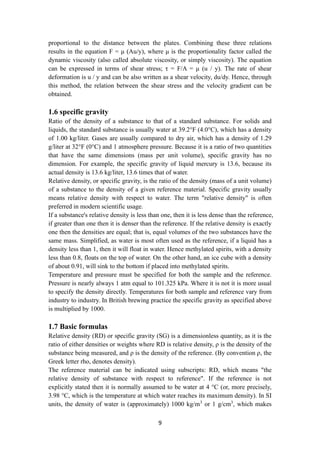
proportional to the distance between the plates. Combining these three relations
results in the equation F = μ (Au/y), where μ is the proportionality factor called the
dynamic viscosity (also called absolute viscosity, or simply viscosity). The equation
can be expressed in terms of shear stress; τ = F/A = μ (u / y). The rate of shear
deformation is u / y and can be also written as a shear velocity, du/dy. Hence, through
this method, the relation between the shear stress and the velocity gradient can be
obtained.
1.6 specific gravity
Ratio of the density of a substance to that of a standard substance. For solids and
liquids, the standard substance is usually water at 39.2°F (4.0°C), which has a density
of 1.00 kg/liter. Gases are usually compared to dry air, which has a density of 1.29
g/liter at 32°F (0°C) and 1 atmosphere pressure. Because it is a ratio of two quantities
that have the same dimensions (mass per unit volume), specific gravity has no
dimension. For example, the specific gravity of liquid mercury is 13.6, because its
actual density is 13.6 kg/liter, 13.6 times that of water.
Relative density, or specific gravity, is the ratio of the density (mass of a unit volume)
of a substance to the density of a given reference material. Specific gravity usually
means relative density with respect to water. The term "relative density" is often
preferred in modern scientific usage.
If a substance's relative density is less than one, then it is less dense than the reference,
if greater than one then it is denser than the reference. If the relative density is exactly
one then the densities are equal; that is, equal volumes of the two substances have the
same mass. Simplified, as water is most often used as the reference, if a liquid has a
density less than 1, then it will float in water. Hence methylated spirits, with a density
less than 0.8, floats on the top of water. On the other hand, an ice cube with a density
of about 0.91, will sink to the bottom if placed into methylated spirits.
Temperature and pressure must be specified for both the sample and the reference.
Pressure is nearly always 1 atm equal to 101.325 kPa. Where it is not it is more usual
to specify the density directly. Temperatures for both sample and reference vary from
industry to industry. In British brewing practice the specific gravity as specified above
is multiplied by 1000.
1.7 Basic formulas
Relative density (RD) or specific gravity (SG) is a dimensionless quantity, as it is the
ratio of either densities or weights where RD is relative density, ρ is the density of the
substance being measured, and ρ is the density of the reference. (By convention ρ, the
Greek letter rho, denotes density).
The reference material can be indicated using subscripts: RD, which means "the
relative density of substance with respect to reference". If the reference is not
explicitly stated then it is normally assumed to be water at 4 °C (or, more precisely,
3.98 °C, which is the temperature at which water reaches its maximum density). In SI
units, the density of water is (approximately) 1000 kg/m3
or 1 g/cm3
, which makes
10
relative density calculations particularly convenient: the density of the object only
needs to be divided by 1000 or 1, depending on the units.
The relative density of gases is often measured with respect to dry air at a temperature
of 20 °C and a pressure of 101.325 kPa absolute, which has a density of 1.205 kg/m3
.
Relative density with respect to air can be obtained by Where M is the molar mass,
and the approximately equal sign is used because equality pertains only if 1 mol of the
gas and 1 mol of air occupy the same volume at a given temperature and pressure i.e.,
they are both Ideal gasses. Ideal behaviour is usually only seen at very low pressure.
For example, one mol of an ideal gas occupies 22.414 L at 0 °C and 1 atmosphere
whereas carbon dioxide has a molar volume of 22.259 L under those same conditions.
Temperature dependence.
The density of substances varies with temperature and pressure so that it is necessary
to specify the temperatures and pressures at which the densities or weights were
determined. It is nearly always the case that measurements are made at nominally 1
atmosphere (101.325 kPa the variations caused by changing weather patterns) but as
specific gravity usually refers to highly incompressible aqueous solutions or other
incompressible substances (such as petroleum products) variations in density caused
by pressure are usually neglected at least where apparent specific gravity is being
measured. For true (in vacuo) specific gravity calculations air pressure must be
considered (see below). Temperatures are specified by the notation Ts/Tr) with Ts
representing the temperature at which the sample's density was determined and Tr the
temperature at which the reference (water) density is specified. For example, SG
(20°C/4°C) would be understood to mean that the density of the sample was
determined at 20 °C and of the water at 4 °C. Taking into account different sample
and reference temperatures we note that while SGH2O = 1.000000 (20°C/20°C) it is
also the case that SGH2O = 0.998203/0.998840 = 0.998363 (20°C/4°C). Here
temperature is being specified using the current ITS-90 scale and the densities used
here and in the rest of this article are based on that scale. On the previous IPTS-68
scale the densities at 20°C and 4°C respectively, 0.9982071 and 0.9999720 resulting
in an SG (20°C/4°C) value for water of 0.9982343. The temperatures of the two
materials may be explicitly stated in the density symbols.
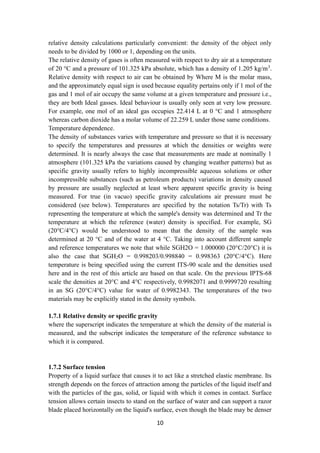
1.7.1 Relative density or specific gravity
where the superscript indicates the temperature at which the density of the material is
measured, and the subscript indicates the temperature of the reference substance to
which it is compared.
1.7.2 Surface tension
Property of a liquid surface that causes it to act like a stretched elastic membrane. Its
strength depends on the forces of attraction among the particles of the liquid itself and
with the particles of the gas, solid, or liquid with which it comes in contact. Surface
tension allows certain insects to stand on the surface of water and can support a razor
blade placed horizontally on the liquid's surface, even though the blade may be denser
11
than the liquid and unable to float. Surface tension results in spherical drops of liquid,
as the liquid tends to minimize its surface area.
Surface tension is a property of the surface of a liquid. It is what causes the surface
portion of liquid to be attracted to another surface, such as that of another portion of
liquid (as in connecting bits of water or as in a drop of mercury that forms a cohesive
ball).
Surface tension is caused by cohesion (the attraction of molecules to like molecules).
Since the molecules on the surface of the liquid are not surrounded by like molecules
on all sides, they are more attracted to their neighbors on the surface.
Applying Newtonian physics to the forces that arise due to surface tension accurately
predicts many liquid behaviors that are so commonplace that most people take them
for granted. Applying thermodynamics to those same forces further predicts other
more subtle liquid behaviors.
Surface tension has the dimension of force per unit length, or of energy per unit area.
The two are equivalent — but when referring to energy per unit of area, people use
the term surface energy — which is a more general term in the sense that it applies
also to solids and not just liquids.
In materials science, surface tension is used for either surface stress or surface free
energy.
1.7.3 Flash point
Flash point of a volatile liquid is the lowest temperature at which it can vaporize to
form an ignitable mixture in air. Measuring a liquid's flashpoint requires an ignition
source. This is not to be confused with the autoignition temperature, which requires
no ignition source. At the flash point, the vapour may cease to burn when the source
of ignition is removed. A slightly higher temperature, the fire point, is defined as the
temperature at which the vapour continues to burn after being ignited. Neither of these
parameters is related to the temperatures of the ignition source or of the burning liquid,
which are much higher. The flash point is often used as one descriptive characteristic
of liquid fuel, but it is also used to describe liquids that are not used intentionally as
fuels. Flash point refers to both flammable liquids as well as combustible liquids.
There are various international standards for defining each, but most agree that liquids
with a flash point less than 43°C is flammable, and those above this temperature are
combustible.
Surface tension is caused by the attraction between the liquid's molecules by various
intermolecular forces. In the bulk of the liquid, each molecule is pulled equally in
every direction by neighboring liquid molecules, resulting in a net force of zero. At
the surface of the liquid, the molecules are pulled inwards by other molecules deeper
inside the liquid and are not attracted as intensely by the molecules in the
neighbouring medium (be it vacuum, air or another liquid). Therefore, all of the
molecules at the surface are subject to an inward force of molecular attraction which
is balanced only by the liquid's resistance to compression, meaning there is no net
inward force. However, there is a driving force to diminish the surface area. Therefore,
12
the surface area of the liquid shrinks until it has the lowest surface area possible. That
explains the spherical shapes of water droplets.
Another way to view it is that a molecule in contact with a neighbor is in a lower state
of energy than if it weren't in contact with a neighbor. The interior molecules all have
as many neighbors as they can possibly have. But the boundary molecules have fewer
neighbors than interior molecules and are therefore in a higher state of energy. For the
liquid to minimize its energy state, it must minimize its number of boundary
molecules and must therefore minimize its surface area.
As a result of surface area minimization, a surface will assume the smoothest shape it
can (mathematical proof that "smooth" shapes minimize surface area relies on use of
the Euler–Lagrange equation). Since any curvature in the surface shape results in
greater area, a higher energy will also result. Consequently, the surface will push back
against any curvature in much the same way as a ball pushed uphill will push back to
minimize its gravitational potential energy.
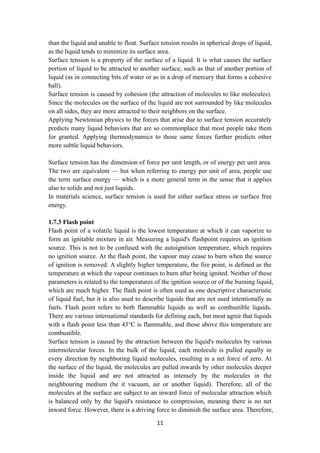
Surface tension, represented by the symbol γ is defined as the force along a line of
unit length, where the force is parallel to the surface but perpendicular to the line. One
way to picture this is to imagine a flat soap film bounded on one side by a taut thread
of length, L. The thread will be pulled toward the interior of the film by a force equal
to 2L (the factor of 2 is because the soap film has two sides, hence two surfaces).
Surface tension is therefore measured in forces per unit length. Its SI unit is newton
per meter but the cgs unit of dyne per cm is also used. One dyn/cm corresponds to
0.001 N/m.
An equivalent definition, one that is useful in thermodynamics, is work done per unit
area. As such, in order to increase the surface area of a mass of liquid by an amount,
δA, a quantity of work, δA, is needed. This work is stored as potential energy.
Consequently, surface tension can be also measured in SI system as joules per square
meter and in the cgs system as ergs per cm2. Since mechanical systems try to find a
state of minimum potential energy, a free droplet of liquid naturally assumes a
spherical shape, which has the minimum surface area for a given volume.
The equivalence of measurement of energy per unit area to force per unit length can
be proven by dimensional analysis.
Pond skaters use surface tension to walk on the surface of a pond—hydrophobic setae
on the tarsi keep the insect afloat while an apical hydrophilic claw penetrates the
surface, allowing it to "grip" the water. The surface of the water behaves like an
elastic film: the insect's feet cause indentations in the water's surface, increasing its
surface area. This represents an increase in potential energy through the surface
tension of the water equal to the loss of potential energy of the insect's lowered center
of mass.
1.7.4 Solubility
Degree to which a substance dissolves in a solvent to make a solution (usually
expressed as grams of solute per litre of solvent). Solubility of one fluid (liquid or gas)
in another may be complete (totally miscible, e.g., methanol and water) or partial (oil
and water dissolve only slightly). In general, "like dissolves like" (e.g., aromatic
13
hydrocarbons dissolve in each other but not in water). Some separation methods
(absorption, extraction) rely on differences in solubility, expressed as the distribution
coefficient (ratio of a material's solubilities in two solvents). Generally, solubilities of
solids in liquids increase with temperature and those of gases decrease with
temperature and increase with pressure. A solution in which no more solute can be
dissolved at a given temperature and pressure is said to be saturated.
Solubility is the property of a solid, liquid, or gaseous chemical substance called
solute to dissolve in a liquid solvent to form a homogeneous solution. The solubility
of a substance strongly depends on the used solvent as well as on temperature and
pressure. The pressure also affects the solution whether it is gas or liquid, like
temperature. So, in definition of solubility we always mention the pressure and
temperature "fixed". The extent of the solubility of a substance in a specific solvent is
measured as the saturation concentration where adding more solute does not increase
the concentration of the solution.
The solvent is generally a liquid, which can be a pure substance or a mixture. One
also speaks of solid solution, but rarely of solution in a gas.
The extent of solubility ranges widely, from infinitely soluble (fully miscible) such as
ethanol in water, to poorly soluble, such as silver chloride in water. The term insoluble
is often applied to poorly or very poorly soluble compounds.
Under certain conditions the equilibrium solubility can be exceeded to give a so-
called supersaturated solution, which is metastable.
1.8 Molecular view
Solubility occurs under dynamic equilibrium, which means that solubility results from
the simultaneous and opposing processes of dissolution and phase separation (e.g.
precipitation of solids). The solubility equilibrium occurs when the two processes
proceed at a constant rate.
The term solubility is also used in some fields where the solute is altered by solvolysis.
For example, many metals and their oxides are said to be "soluble in hydrochloric
acid," whereas the aqueous acid degrades the solid to irreversibly give soluble
products. It is also true that most ionic solids are degraded by polar solvents, but such
processes are reversible. In those cases where the solute is not recovered upon
evaporation of the solvent the process is referred to as solvolysis. The thermodynamic
concept of solubility does not apply straightforwardly to solvolysis.
When a solute dissolves, it may form several species in the solution. For example, an
aqueous suspension of ferrous hydroxide, Fe(OH)2, will contain the series [Fe(H2O)6
− x(OH)x](2 − x)+ as well as other oligomeric species. Furthermore, the solubility of
ferrous hydroxide and the composition of its soluble components depends on pH. In
general, solubility in the solvent phase can be given only for a specific solute which is
thermodynamically stable, and the value of the solubility will include all the species
in the solution (in the example above, all the iron-containing complexes).
Factors affecting solubility.
Solubility is defined for specific phases. For example, the solubility of aragonite and
14
calcite in water are expected to differ, even though they are both polymorphs of
calcium carbonate and have the same chemical formula.
The solubility of one substance in another is determined by the balance of
intermolecular forces between the solvent and solute, and the entropy change that
accompanies the solvation. Factors such as temperature and pressure will alter this
balance, thus changing the solubility.
Solubility may also strongly depend on the presence of other species dissolved in the
solvent, for example, complex-forming anions (ligands) in liquids. Solubility will also
depend on the excess or deficiency of a common ion in the solution, a phenomenon
known as the common-ion effect. To a lesser extent, solubility will depend on the
ionic strength of solutions. The last two effects can be quantified using the equation
for solubility equilibrium.
For a solid that dissolves in a redox reaction, solubility is expected to depend on the
potential (within the range of potentials under which the solid remains the
thermodynamically stable phase). For example, solubility of gold in high-temperature
water is observed to be almost an order of magnitude higher when the redox potential
is controlled using a highly oxidizing Fe3O4-Fe2O3 redox buffer than with a
moderately-oxidizing Ni-NiO buffer.
Solubility (metastable) also depends on the physical size of the crystal or droplet of
solute (or, strictly speaking, on the specific or molar surface area of the solute). For
quantification, see the equation in the article on solubility equilibrium. For highly
defective crystals, solubility may increase with the increasing degree of disorder. Both
of these effects occur because of the dependence of solubility constant on the Gibbs
energy of the crystal.
1.9 Oil
Petroleum (petroleum, from Greek πετρέλαιον, lit. "rock oil") or crude oil is a
naturally occurring, flammable liquid consisting of a complex mixture of
hydrocarbons of various molecular weights, and other organic compounds, that are
found in geologic formations beneath the earth's surface.
The term "petroleum" was first used in the treatise De Natura Fossilium, published in
1546 by the German mineralogist Georg Bauer, also known as Georgius Agricola.
1.9.1 Composition
In its strictest sense, petroleum includes only crude oil, but in common usage it
includes both crude oil and natural gas. Both crude oil and natural gas are
predominantly a mixture of hydrocarbons. Under surface pressure and temperature
conditions, the lighter hydrocarbons methane, ethane, propane and butane occur as
gases, while the heavier ones from pentane and up are in the form of liquids or solids.
However, in the underground oil reservoir the proportion which is gas or liquid varies
depending on the subsurface conditions, and on the phase diagram of the petroleum
mixture.
15
An oil well produces predominantly crude oil, with some natural gas dissolved in it.
Because the pressure is lower at the surface than underground, some of the gas will
come out of solution and be recovered (or burned) as associated gas or solution gas. A
gas well produces predominately natural gas. However, because the underground
temperature and pressure are higher than at the surface, the gas may contain heavier
hydrocarbons such as pentane, hexane, and heptane in the gaseous state. Under
surface conditions these will condense out of the gas and form natural gas condensate,
often shortened to condensate. Condensate resembles gasoline in appearance and is
similar in composition to some volatile light crude oils.
The proportion of hydrocarbons in the petroleum mixture is highly variable between
different oil fields and ranges from as much as 97% by weight in the lighter oils to as
little as 50% in the heavier oils and bitumens.
The hydrocarbons in crude oil are mostly alkanes, cycloalkanes and various aromatic
hydrocarbons while the other organic compounds contain nitrogen, oxygen and sulfur,
and trace amounts of metals such as iron, nickel, copper and vanadium. The exact
molecular composition varies widely from formation to formation, but the proportion
of chemical elements vary over fairly narrow limits as follows.
Table 2 Composition by weight
Element Percent range
Carbon 83 to 87%
Hydrogen 10 to 14%
Nitrogen 0.1 to 2%
Oxygen 0.1 to 1.5%
Sulphur 0.5 to 6%
Metals and less than 1000 ppm 0.5 to 6%
Four different types of hydrocarbon molecules appear in crude oil. The relative
percentage of each varies from oil to oil, determining the properties of each oil.
Table 3 Composition by weight
Hydrocarbon Average Percent range
Paraffins 30% 15 to 60%
Naphthenes 49% 30 to 60%
Aromatics 15% 3 to 30%
Asphaltenes 6% 0.1 to 6%
1.9.2 Paraffin
The common name for the alkane hydrocarbons with the general formula CnH2n+2.
Paraffin wax refers to the solids with 20 ≤ n ≤ 40.
The simplest paraffin molecule is that of methane, CH4, a gas at room temperature.
Heavier members of the series, such as that of octane, C8H18, and mineral oil appear
as liquids at room temperature. The solid forms of paraffin, called paraffin wax, are
16
from the heaviest molecules from C20H42 to C40H82. Paraffin wax was identified by
Carl Reichenbach in 1830.
Paraffin, or paraffin hydrocarbon, is also the technical name for an alkane in general,
but in most cases, it refers specifically to a linear, or normal alkane — whereas
branched, or iso-alkanes are also called iso-paraffins. It is distinct from the fuel
known in Ireland, Britain and South Africa as paraffin oil or just paraffin, which is
called kerosene in most of the U.S., Canada, Australia and New Zealand.
The name is derived from the Latin parum = barely + affinis with the meaning here of
"lacking affinity", or "lacking reactivity". This is because alkanes, being non-polar
and lacking in functional groups, are very unreactive.
1.9.3 Naphthene’s
Also called, Cycloalkanes especially if from petroleum sources are types of alkanes
which have one or more rings of carbon atoms in the chemical structure of their
molecules. Alkanes are types of organic hydrocarbon compounds which have only
single chemical bonds in their chemical structure. Cycloalkanes consist of only carbon
(C) and hydrogen (H) atoms and are saturated because there are no multiple C-C
bonds to hydrogenate (add more hydrogen to). A general chemical formula for
cycloalkanes would be CnH2(n+1-g) where n = number of C atoms and g = number of
rings in the molecule. Cycloalkanes with a single ring are named analogously to their
normal alkane counterpart of the same carbon count: cyclopropane, cyclobutane,
cyclopentane, cyclohexane, etc. The larger cycloalkanes, with greater than 20 carbon
atoms are typically called cycloparaffins.
Cycloalkanes are classified into small, common, medium, and large cycloalkanes,
where cyclopropane and cyclobutane are the small ones, cyclopentane, cyclohexane,
cycloheptane are the common ones, cyclooctane through cyclotridecane are the
medium ones, and the rest are the larger ones.
Cyclopropaneline.png Cyclopropane (unstable, lots of ring strain)
Cyclobutaneline.png Cyclobutane (ring strain)
Cyclopentaneline.png Cyclopentane (little ring strain)
Cyclohexaneline.png Cyclohexane (Next to no ring strain) Cyclodecaneline.png
Cyclodecane Rings with thirteen or more carbons have virtually no ring strain
Aromatic compound: (Meanings related to odor).
In organic chemistry, the structures of some rings of atoms are unexpectedly stable.
Aromaticity is a chemical property in which a conjugated ring of unsaturated bonds,
lone pairs, or empty orbitals exhibit a stabilization stronger than would be expected by
the stabilization of conjugation alone. It can also be considered a manifestation of
cyclic delocalization and of resonance.
This is usually considered to be because electrons are free to cycle around circular
arrangements of atoms, which are alternately single- and double-bonded to one
another. These bonds may be seen as a hybrid of a single bond and a double bond,
each bond in the ring identical to every other. This commonly seen model of aromatic
rings, namely the idea that benzene was formed from a six-membered carbon ring
with alternating single and double bonds (cyclohexatriene), was developed by Kekulé.
17
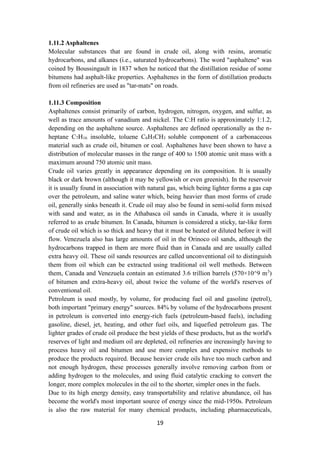
The model for benzene consists of two resonance forms, which corresponds to the
double and single bonds' switching positions. Benzene is a more stable molecule than
would be expected without accounting for charge delocalization.
1.10 Theory
As is standard for resonance diagrams, a double-headed arrow is used to indicate that
the two structures are not distinct entities, but merely hypothetical possibilities.
Neither is an accurate representation of the actual compound, which is best
represented by a hybrid (average) of these structures, which can be seen at right. A
C=C bond is shorter than a C−C bond, but benzene is perfectly hexagonal—all six
carbon-carbon bonds have the same length, intermediate between that of a single and
that of a double bond.
A better representation is that of the circular π bond (Armstrong's inner cycle), in
which the electron density is evenly distributed through a π-bond above and below the
ring. This model more correctly represents the location of electron density within the
aromatic ring.
The single bonds are formed with electrons in line between the carbon nuclei—these
are called σ-bonds. Double bonds consist of a σ-bond and a π-bond. The π-bonds are
formed from overlap of atomic p-orbitals above and below the plane of the ring.
Since they are out of the plane of the atoms, these orbitals can interact with each other
freely, and become delocalised. This means that instead of being tied to one atom of
carbon, each electron is shared by all six in the ring. Thus, there are not enough
electrons to form double bonds on all the carbon atoms, but the "extra" electrons
strengthen all of the bonds on the ring equally. The resulting molecular orbital has π
symmetry.
1.11 Importance of aromatic compounds
Aromatic compounds are important in industry. Key aromatic hydrocarbons of
commercial interest are benzene, toluene, ortho-xylene and para-xylene. About 35
million tonnes are produced worldwide every year. They are extracted from complex
mixtures obtained by the refining of oil or by distillation of coal tar and are used to
produce a range of important chemicals and polymers, including styrene, phenol,
aniline, polyester and nylon.
Other aromatic compounds play key roles in the biochemistry of all living things.
Three aromatic amino acids phenylalanine, tryptophan, and tyrosine, each serve as
one of the 20 basic building blocks of proteins. Further, all 5 nucleotides (adenine,
thymine, cytosine, guanine, and uracil) that make up the sequence of the genetic code
in DNA and RNA are aromatic purines or pyrimidines. As well as that, the molecule
haem contains an aromatic system with 22 π electrons. Chlorophyll also has a similar
aromatic system.
18
1.11.1 Types of aromatic compounds
The overwhelming majority of aromatic compounds are compounds of carbon, but
they need not be hydrocarbons.
a. Heterocyclics
In heterocyclic aromatics (heteroaromats), one or more of the atoms in the aromatic
ring is of an element other than carbon. This can lessen the ring's aromaticity, and thus
(as in the case of furan) increase its reactivity. Other examples include pyridine,
pyrazine, imidazole, pyrazole, oxazole, thiophene, and their benzannulated analogs
(benzimidazole, for example).
b. Polycyclics
Polycyclic aromatic hydrocarbons are molecules containing two or more simple
aromatic rings fused together by sharing two neighboring carbon atoms. Examples are
naphthalene, anthracene and phenanthrene.
Substituted aromatics Many chemical compounds are aromatic rings with other things
attached. Examples include trinitrotoluene (TNT), acetylsalicylic acid (aspirin),
paracetamol, and the nucleotides of DNA.
c. Atypical aromatic compounds
Aromaticity is found in ions as well: the cyclopropenyl cation (2e system), the
cyclopentadienyl anion (6e system), the tropylium ion (6e) and the cyclooctatetraene
dianion (10e). Aromatic properties have been attributed to non-benzenoid compounds
such as tropone. Aromatic properties are tested to the limit in a class of compounds
called cyclophanes.
A special case of aromaticity is found in homoaromaticity where conjugation is
interrupted by a single sp³ hybridized carbon atom.
When carbon in benzene is replaced by other elements in borabenzene, silabenzene,
germanabenzene, stannabenzene, phosphorine or pyrylium salts the aromaticity is still
retained. Aromaticity also occurs in compounds that are not carbon-based at all.
Inorganic 6 membered ring compounds analogous to benzene have been synthesized.
Silicazine (Si6H6) and borazine (B3N3H6) are structurally analogous to benzene, with
the carbon atoms replaced by another element or elements. In borazine, the boron and
nitrogen atoms alternate around the ring.
Metal aromaticity is believed to exist in certain metal clusters of aluminium. Möbius
aromaticity occurs when a cyclic system of molecular orbitals, formed from pπ atomic
orbitals and populated in a closed shell by 4n (n is an integer) electrons, is given a
single half-twist to correspond to a Möbius strip. Because the twist can be left-handed
or right-handed, the resulting Möbius aromatics are dissymmetric or chiral. Up to now
there is no doubtless proof that a Möbius aromatic molecule was synthesized.
Aromatics with two half-twists corresponding to the paradromic topologies, first
suggested by Johann Listing, have been proposed by Rzepa in 2005. In carbo-benzene
the ring bonds are extended with alkyne and allene groups [1]
.
19
1.11.2 Asphaltenes
Molecular substances that are found in crude oil, along with resins, aromatic
hydrocarbons, and alkanes (i.e., saturated hydrocarbons). The word "asphaltene" was
coined by Boussingault in 1837 when he noticed that the distillation residue of some
bitumens had asphalt-like properties. Asphaltenes in the form of distillation products
from oil refineries are used as "tar-mats" on roads.
1.11.3 Composition
Asphaltenes consist primarily of carbon, hydrogen, nitrogen, oxygen, and sulfur, as
well as trace amounts of vanadium and nickel. The C:H ratio is approximately 1:1.2,
depending on the asphaltene source. Asphaltenes are defined operationally as the n-
heptane C7H16 insoluble, toluene C6H5CH3 soluble component of a carbonaceous
material such as crude oil, bitumen or coal. Asphaltenes have been shown to have a
distribution of molecular masses in the range of 400 to 1500 atomic unit mass with a
maximum around 750 atomic unit mass.
Crude oil varies greatly in appearance depending on its composition. It is usually
black or dark brown (although it may be yellowish or even greenish). In the reservoir
it is usually found in association with natural gas, which being lighter forms a gas cap
over the petroleum, and saline water which, being heavier than most forms of crude
oil, generally sinks beneath it. Crude oil may also be found in semi-solid form mixed
with sand and water, as in the Athabasca oil sands in Canada, where it is usually
referred to as crude bitumen. In Canada, bitumen is considered a sticky, tar-like form
of crude oil which is so thick and heavy that it must be heated or diluted before it will
flow. Venezuela also has large amounts of oil in the Orinoco oil sands, although the
hydrocarbons trapped in them are more fluid than in Canada and are usually called
extra heavy oil. These oil sands resources are called unconventional oil to distinguish
them from oil which can be extracted using traditional oil well methods. Between
them, Canada and Venezuela contain an estimated 3.6 trillion barrels (570×10^9 m3
)
of bitumen and extra-heavy oil, about twice the volume of the world's reserves of
conventional oil.
Petroleum is used mostly, by volume, for producing fuel oil and gasoline (petrol),
both important "primary energy" sources. 84% by volume of the hydrocarbons present
in petroleum is converted into energy-rich fuels (petroleum-based fuels), including
gasoline, diesel, jet, heating, and other fuel oils, and liquefied petroleum gas. The
lighter grades of crude oil produce the best yields of these products, but as the world's
reserves of light and medium oil are depleted, oil refineries are increasingly having to
process heavy oil and bitumen and use more complex and expensive methods to
produce the products required. Because heavier crude oils have too much carbon and
not enough hydrogen, these processes generally involve removing carbon from or
adding hydrogen to the molecules, and using fluid catalytic cracking to convert the
longer, more complex molecules in the oil to the shorter, simpler ones in the fuels.
Due to its high energy density, easy transportability and relative abundance, oil has
become the world's most important source of energy since the mid-1950s. Petroleum
is also the raw material for many chemical products, including pharmaceuticals,
20
solvents, fertilizers, pesticides, and plastics; the 16% not used for energy production is
converted into these other materials. Petroleum is found in porous rock formations in
the upper strata of some areas of the Earth's crust. There is also petroleum in oil sands
(tar sands). Known reserves of petroleum are typically estimated at around 190 km3
(1.2 trillion (short scale) barrels) without oil sands, or 595 km3
(3.74 trillion barrels)
with oil sands. Consumption is currently around 84 million barrels (13.4×10^6 m) per
day, or 4.9 km3
per year.
1.12 Chemistry
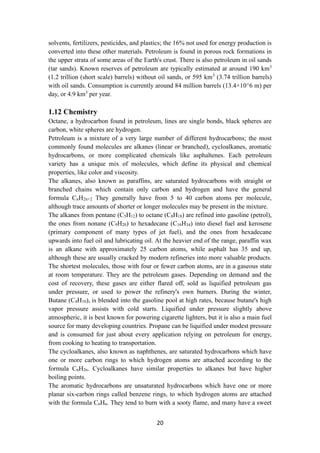
Octane, a hydrocarbon found in petroleum, lines are single bonds, black spheres are
carbon, white spheres are hydrogen.
Petroleum is a mixture of a very large number of different hydrocarbons; the most
commonly found molecules are alkanes (linear or branched), cycloalkanes, aromatic
hydrocarbons, or more complicated chemicals like asphaltenes. Each petroleum
variety has a unique mix of molecules, which define its physical and chemical
properties, like color and viscosity.
The alkanes, also known as paraffins, are saturated hydrocarbons with straight or
branched chains which contain only carbon and hydrogen and have the general
formula CnH2n+2 They generally have from 5 to 40 carbon atoms per molecule,
although trace amounts of shorter or longer molecules may be present in the mixture.
The alkanes from pentane (C5H12) to octane (C8H18) are refined into gasoline (petrol),
the ones from nonane (C9H20) to hexadecane (C16H34) into diesel fuel and kerosene
(primary component of many types of jet fuel), and the ones from hexadecane
upwards into fuel oil and lubricating oil. At the heavier end of the range, paraffin wax
is an alkane with approximately 25 carbon atoms, while asphalt has 35 and up,
although these are usually cracked by modern refineries into more valuable products.
The shortest molecules, those with four or fewer carbon atoms, are in a gaseous state
at room temperature. They are the petroleum gases. Depending on demand and the
cost of recovery, these gases are either flared off, sold as liquified petroleum gas
under pressure, or used to power the refinery's own burners. During the winter,
Butane (C4H10), is blended into the gasoline pool at high rates, because butane's high
vapor pressure assists with cold starts. Liquified under pressure slightly above
atmospheric, it is best known for powering cigarette lighters, but it is also a main fuel
source for many developing countries. Propane can be liquified under modest pressure
and is consumed for just about every application relying on petroleum for energy,
from cooking to heating to transportation.
The cycloalkanes, also known as naphthenes, are saturated hydrocarbons which have
one or more carbon rings to which hydrogen atoms are attached according to the
formula CnH2n. Cycloalkanes have similar properties to alkanes but have higher
boiling points.
The aromatic hydrocarbons are unsaturated hydrocarbons which have one or more
planar six-carbon rings called benzene rings, to which hydrogen atoms are attached
with the formula CnHn. They tend to burn with a sooty flame, and many have a sweet
21
aroma. Some are carcinogenic.
These different molecules are separated by fractional distillation at an oil refinery to
produce gasoline, jet fuel, kerosene, and other hydrocarbons. For example, 2,2,4-
trimethylpentane (isooctane), widely used in gasoline, has a chemical formula of
C8H18 and it reacts with oxygen exothermically:
a. The number of various molecules in an oil sample can be determined in
laboratory. The molecules are typically extracted in a solvent, then separated
in a gas chromatograph, and finally determined with a suitable detector, such
as a flame ionization detector or a mass spectrometer.
b. Incomplete combustion of petroleum or gasoline results in production of toxic
byproducts. Too little oxygen results in carbon monoxide. Due to the high
temperatures and high pressures involved, exhaust gases from gasoline
combustion in car engines usually include nitrogen oxides which are
responsible for creation of photochemical smog.
1.13 Heat of combustion
At a constant volume the heat of combustion of a petroleum product can be
approximated as follows:
Qv = 12,400 − 2,100g2
………………………….(4)
where [Qv] is measured in cal/gram and [g] is the specific gravity at 60°F.
1.13.1 Thermal conductivity
The thermal conductivity of petroleum-based liquids can be modeled as follows:
where K is measured in BTU. hr-1
ft-2
, t is measured in °F and g is the specific gravity
at 60°F.
1.13.2 Spreading
Oil that spreads and moves, when lighter than water, forming slicks that spread on the
surface, on streams, rivers and ponds in percentages that are influenced by gravity,
surface tension, viscosity, point of fluidity, winds and currents.
The temperature is another crucial variable to control spreading due to the
dependency that viscosity has on temperature. One should note that crude oils vary
widely in composition and their behavior on the ocean also varies. Even viscous crude
oils can spread quickly in thin layers. The action of the currents and wind spreads and
breaks the slicks into mobile portions of oil that will have the largest amounts (thicker)
near their leading edges.
Both wind and current affect the movement of the portions in the water. The effect of
the currents is 100% in rivers, while that of the wind is around 3% of the wind speed.
The effect of the wind is little felt in rivers, contrary to what happens in a pond where
the wind is the predominant element in oil displacement.
22
1.13.3 Evaporation
Evaporation due to the high percentage of volatile components in most crude oils and
the percentage for the loss of these oil volatiles in rivers and ponds is substantially
important. Such evaporation occurs quickly and is physically related to the process of
dissolution that is promoted by the spreading in high temperatures of water and fast-
moving rivers (that generate water spray and bubbles that pop and eject the oil into
the atmosphere). Studies have demonstrated that up to 50% of crude oil can be lost to
evaporation, usually within 24 to 48 hours. This compares to only 10% of heavy or
waste fuel oil, 75% of diesel and eventually 100% of kerosene or gasoline.
23
Chapter 2
Overview of refinery processes
2.1 Introduction
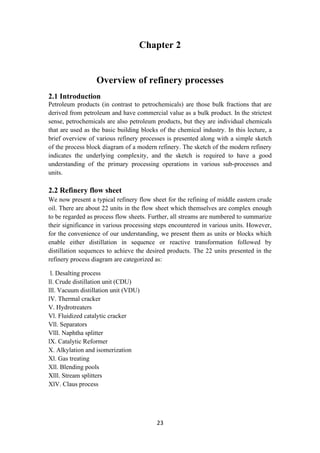
Petroleum products (in contrast to petrochemicals) are those bulk fractions that are
derived from petroleum and have commercial value as a bulk product. In the strictest
sense, petrochemicals are also petroleum products, but they are individual chemicals
that are used as the basic building blocks of the chemical industry. In this lecture, a
brief overview of various refinery processes is presented along with a simple sketch
of the process block diagram of a modern refinery. The sketch of the modern refinery
indicates the underlying complexity, and the sketch is required to have a good
understanding of the primary processing operations in various sub-processes and
units.
2.2 Refinery flow sheet
We now present a typical refinery flow sheet for the refining of middle eastern crude
oil. There are about 22 units in the flow sheet which themselves are complex enough
to be regarded as process flow sheets. Further, all streams are numbered to summarize
their significance in various processing steps encountered in various units. However,
for the convenience of our understanding, we present them as units or blocks which
enable either distillation in sequence or reactive transformation followed by
distillation sequences to achieve the desired products. The 22 units presented in the
refinery process diagram are categorized as:
l. Desalting process
ll. Crude distillation unit (CDU)
lll. Vacuum distillation unit (VDU)
lV. Thermal cracker
V. Hydrotreaters
Vl. Fluidized catalytic cracker
Vll. Separators
Vlll. Naphtha splitter
lX. Catalytic Reformer
X. Alkylation and isomerization
Xl. Gas treating
Xll. Blending pools
Xlll. Stream splitters
XlV. Claus process
24
A brief account of the above process units along with their functional role is presented
next with simple conceptual block diagrams representing the flows in and out of each
unit.
2.3 Desalting process
2.3.1 The purpose of crude oil desalting
Crude oil introduced to refinery processing contains many undesirable impurities,
such as sand, inorganic salts, drilling mud, polymer, corrosion byproduct, etc. The salt
content in the crude oil varies depending on source of the crude oil. When a mixture
from many crude oil sources is processed in refinery, the salt content can vary greatly.
The purpose of desalting is to remove these undesirable impurities, especially salts
and water, from the crude oil prior to distillation.
The most concerns of the impurities in crude oil:
a. The Inorganic salts can be decomposed in the crude oil pre-heat exchangers
and heaters. As a result, hydrogen chloride gas is formed which condenses to
liquid hydrochloric acid at overhead system of distillation column, that may cause
serious corrosion of equipment.
b. To avoid corrosion due to salts in the crude oil, corrosion control can be used.
But the byproduct from the corrosion control of oil field equipment consists of
particulate iron sulfide and oxide. Precipitation of these materials can cause
plugging of heat exchanger trains, tower trays, heater tubes, etc. In addition, these
materials can cause corrosion to any surface they are precipitated on.
c. The sand or silt can cause significant damage due to abrasion or erosion to
pumps, pipelines, etc.
d. The calcium naphthenate compound in the crude unit residue stream, if not
removed can result in the production of lower grade coke and deactivation of
catalyst of FCC unit.
Table 4 Kurdistan crude oils assay
Properties 1
TQ 2
TQ Kirkuk Zakho
A.P.I gravity (degree) 47.52 23.74 36.05 29.08
Pour point °C L-40 -27 -24 -30
Water content %V Nil Nil Nil 0.09
Flash point °C (C.O.C) Flammable Flammable Flammable 40
Water and sediment %V <0.05 0.08 0.2 0.3
Ash content %W 0.047 0.058 0.009 0.015
Salt content (ppm) 0.0024 0.02 5 0.0095
Viscosity at 37.8 °C/cst 1.93 67.28 5.2 13.24
Viscosity at 50 °C/cst 1.66 40.48 3.92 9.57
25
Benefits of crude oil desalting
1. Increase crude throughput.
2. Less plugging, scaling, coking of heat exchanger and furnace tubes.
3. Less corrosion in exchanger, fractionators, pipelines, etc.
4. Better corrosion control in CDU overhead
5. Less erosion by solids in control valves, exchanger, furnace, pumps.
6. Saving of oil from slops from waste oil.
Fig.2 Crude oil desalting process
The desalting process is completed in following steps:
a. Dilution water injection and dispersion.
b. Emulsification of diluted water in oil.
c. Distribution of the emulsion in the electrostatic field.
d. Electrostatic coalescence.
e. Water droplet settling.
Crude oil passes through the cold preheat train and is then pumped to the Desalters by
crude charge pumps. The recycled water from the desalters is injected in the crude oil
containing sediments and produced salty water. This fluid enters in the static mixer
which is a crude/water disperser, maximizing the interfacial surface area for optimal
contact between both liquids.
The wash water shall be injected as near as possible emulsifying device to avoid a
first separation with crude oil. Wash water can come from various sources including
relatively high salt sea water, stripping water, etc. The static mixers are installed
26
upstream the emulsifying devices to improve the contact between the salt in the crude
oil and the wash water injected in the line.
The oil/water mixture is homogenously emulsified in the emulsifying device. The
emulsifying device (as a valve) is used to emulsify the dilution water injected
upstream in the oil. The emulsification is important for contact between the salty
production water contained in the oil and the wash water. Then the emulsion enters
the Desalters where it separates into two phases by electrostatic coalescence.
The electrostatic coalescence is induced by the polarization effect resulting from an
external electric source. Polarization of water droplets pulls them out from oil-water
emulsion phase. Salt being dissolved in these water droplets, is also separated along
the way. The produced water is discharged to the water treatment system (effluent
water). It can also be used as wash water for mud washing process during operation.
2.4 Crude distillation unit
The unit comprising of an atmospheric distillation column, side strippers, heat
exchanger network, feed de-salter and furnace as main process technologies enables
the separation of the crude into its various products. Usually, five products are
generated from the CDU namely gas + naphtha, kerosene, light gas oil, heavy gas oil
and atmospheric residue (figure 3). In some refinery configurations, terminologies
such as gasoline, jet fuel and diesel are used to represent the CDU products which are
usually fractions emanating as portions of naphtha, kerosene and gas oil. Amongst the
crude distillation products, naphtha, kerosene has higher product values than gas oil
and residue. On the other hand, modern refineries tend to produce lighter components
from the heavy products. Therefore, reactive transformations (chemical processes) are
inevitable to convert the heavy intermediate refinery streams into lighter streams.
Operating Conditions: The temperature at the entrance of the furnace where the crude
enters is 200 – 280°C. It is then further heated to about 330 – 370°C inside the
furnace. The pressure maintained is about 1 bar gauge [2]
.
27
Fig.3 Crude oil atmospheric distillation process
Table 5 The properties of petroleum distillation products
Product Lower C limit Upper C limit Lower B.P Upper B.P
Refinery gas C₁ C4 -100 -1
L.P.G C3 C4 -42 -1
Naphtha C5 C17 36 202
Gasoline C4 C12 40 216
Kerosene C8 C18 126 230
Diesel C10 C22 220 255
Fuel oil C12 >C20 265 421
Lubricant oil >C20 - >343 -
wax C17 >C20 302 >343
Asphalt >C20 - >343 -
Coke >C50 - >1000 -
Refining end-products or the primary end-products produced in petroleum refining
may be grouped into four categories light distillates, middle distillates, heavy
distillates and others.
a. Light distillates products:
I. Refinery gases or off gas: density (0.20-0.38) gm/m³, draw off at
temperature (+65) °C.
II. Liquid petroleum gas (LPG): density (0.52-0.58) gm/m³, draw off at
temperature (+65) °C.
28
III. Naphtha: density (0.68-0.71) gm/m³, draw off at temperature (100-120)
°C.
IV. Kerosene: density (0.76-0.80) gm/m³, draw off at temperature (180-220)
°C.
V. Diesel: density (0.82-0.84) gm/m³, draw off at temperature (230-260) °C.
b. Middle distillates:
I. Light fuel oil: density (0.92-0.96) gm/m³, draw off at temperature (+265)
°C.
II. Heavy fuel oil: density (0.97-1) gm/m³, draw off at temperature (+300)
°C.
c. Heavy distillates:
I. Asphalt, carbon black and tar: density (2-2.36) gm/m³, draw off at
temperature (+360) °C.
II. Petroleum coke: density (1-1.7) gm/m³, draw off at temperature (+450)
°C.
III. Lubricating oil and transformer and cable oil: density (0.83-0.89)
gm/m³, product from solvent dewaxing process and thickening process.
IV. Waxes and greases: density (1.8-2) gm/m³, product from solvent
dewaxing process.
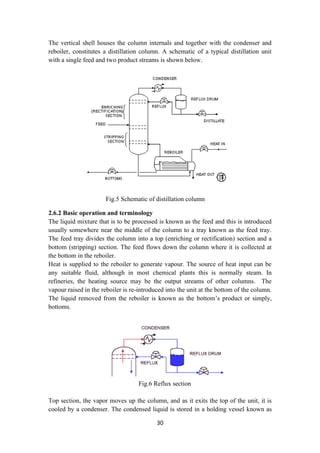
2.5 Distillation tower components
Distillation columns are made up of several components, each of which is used either
to transfer heat energy or enhance material transfer. A typical distillation contains
several major components:
I. Vertical shell where the separation of liquid components is carried out
column internals such as trays/plates and/or packing which are used to
enhance component separations as shown in (figure 2).
II. Re-boiler to provide the necessary vaporization for the distillation process.
III. Condenser to cool and condense the vapors leaving the top of the column.
IV. Reflux drum to hold the condensed vapors from the top of the column so
that liquid (reflux) can be recycled back to the column.
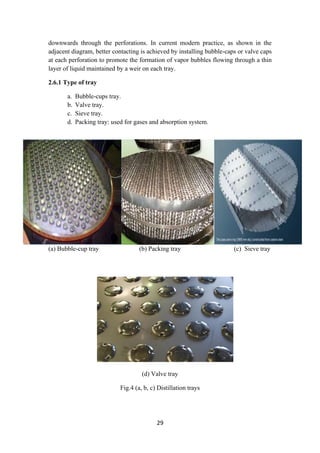
2.6 Distillation tower tray and packing tray
The trays or plates used in industrial distillation columns are fabricated of circular
steel plates and usually installed inside the column at intervals of about 60 to 75 cm
(24 to 30 inches) up the height of the column. That spacing is chosen primarily for
ease of installation and ease of access for future repair or maintenance. Typical bubble
cap trays used in industrial distillation columns. An example of a very simple tray is a
perforated tray. The desired contacting between vapor and liquid occurs as the vapor,
flowing upwards through the perforations, comes into contact with the liquid flowing
29
downwards through the perforations. In current modern practice, as shown in the
adjacent diagram, better contacting is achieved by installing bubble-caps or valve caps
at each perforation to promote the formation of vapor bubbles flowing through a thin
layer of liquid maintained by a weir on each tray.
2.6.1 Type of tray
a. Bubble-cups tray.
b. Valve tray.
c. Sieve tray.
d. Packing tray: used for gases and absorption system.
(a) Bubble-cup tray (b) Packing tray (c) Sieve tray
(d) Valve tray
Fig.4 (a, b, c) Distillation trays
30
The vertical shell houses the column internals and together with the condenser and
reboiler, constitutes a distillation column. A schematic of a typical distillation unit
with a single feed and two product streams is shown below.
Fig.5 Schematic of distillation column
2.6.2 Basic operation and terminology
The liquid mixture that is to be processed is known as the feed and this is introduced
usually somewhere near the middle of the column to a tray known as the feed tray.
The feed tray divides the column into a top (enriching or rectification) section and a
bottom (stripping) section. The feed flows down the column where it is collected at
the bottom in the reboiler.
Heat is supplied to the reboiler to generate vapour. The source of heat input can be
any suitable fluid, although in most chemical plants this is normally steam. In
refineries, the heating source may be the output streams of other columns. The
vapour raised in the reboiler is re-introduced into the unit at the bottom of the column.
The liquid removed from the reboiler is known as the bottom’s product or simply,
bottoms.
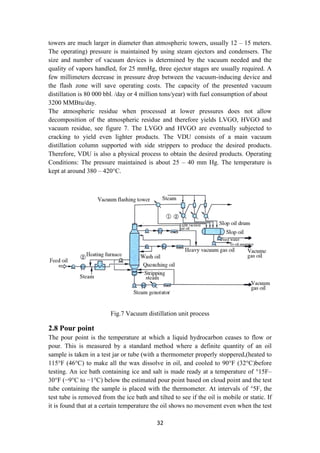
Fig.6 Reflux section
Top section, the vapor moves up the column, and as it exits the top of the unit, it is
cooled by a condenser. The condensed liquid is stored in a holding vessel known as
31
the reflux drum. Some of this liquid is recycled back to the top of the column and this
is called the reflux.
Reflux refers to the portion of the overhead liquid product from a distillation column
or fractionator that is returned to the upper part of the column as shown in the
schematic diagram of a typical industrial distillation column. Inside the column, the
down flowing reflux liquid provides cooling and condensation of the up flowing
vapors thereby increasing the efficiency of the distillation column.
The more reflux provided for a given number of theoretical plates, the better is the
column's separation of lower boiling materials from higher boiling materials.
Conversely, for a given desired separation, the more reflux is provided, the fewer
theoretical plates are required. The condensed liquid that is removed from the system
is known as the distillate or top product.
Thus, there are internal flows of vapors and liquid within the column as well as
external flows of feeds and product streams, into and out of the column.
2.7 Vacuum distillation unit (VDU)
2.7.1 Process overview
Refineries today are facing new challenges in order to meet the requirements with
respect to environment, health and safety of the plant personnel and the quality of the
finished products.
With increasing crude oil prices, refineries are processing heavier, lower quality
crudes that set new challenges to further develop the processes and maximize the
yield of valuable distillates in an energy efficient way. Plant run-time targets are
increasing which sets more challenges for equipment reliability and process control.
Hydrocarbons should not be heated to too high temperature due to cracking reactions
that take place above about 400 °C. Coke deposits on piping and equipment increase
maintenance costs and reduce process unit run-time. Therefore, crude distillation
bottom (residue) is further processed in a vacuum column to recover additional
distillates, light and heavy vacuum gasoil as feedstock to cracking units or lube-oil
processing [3]
.
2.7.2 Three types of vacuum towers are used
1. Dry (no steam).
2. Wet without stripping.
3. Wet with stripping.
Distillation is carried out with absolute pressures in the tower flash zone area of 25 to
40 mmHg. To improve vaporization, the effective pressure is lowered even further by
the addition of steam to the furnace inlet and at the bottom of the vacuum tower. The
amount of stripping steam used is a function of the boiling range of the feed and the
fraction vaporized as well as furnace outlet temperatures (380 – 420°C).) Vacuum
32
towers are much larger in diameter than atmospheric towers, usually 12 – 15 meters.
The operating) pressure is maintained by using steam ejectors and condensers. The
size and number of vacuum devices is determined by the vacuum needed and the
quality of vapors handled, for 25 mmHg, three ejector stages are usually required. A
few millimeters decrease in pressure drop between the vacuum-inducing device and
the flash zone will save operating costs. The capacity of the presented vacuum
distillation is 80 000 bbl. /day or 4 million tons/year) with fuel consumption of about
3200 MMBtu/day.
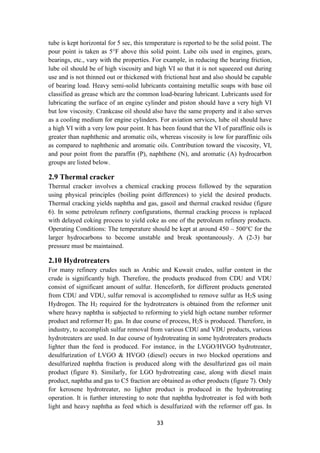
The atmospheric residue when processed at lower pressures does not allow
decomposition of the atmospheric residue and therefore yields LVGO, HVGO and
vacuum residue, see figure 7. The LVGO and HVGO are eventually subjected to
cracking to yield even lighter products. The VDU consists of a main vacuum
distillation column supported with side strippers to produce the desired products.
Therefore, VDU is also a physical process to obtain the desired products. Operating
Conditions: The pressure maintained is about 25 – 40 mm Hg. The temperature is
kept at around 380 – 420°C.
Fig.7 Vacuum distillation unit process
2.8 Pour point
The pour point is the temperature at which a liquid hydrocarbon ceases to flow or
pour. This is measured by a standard method where a definite quantity of an oil
sample is taken in a test jar or tube (with a thermometer properly stoppered,)heated to
115°F (46°C) to make all the wax dissolve in oil, and cooled to 90°F (32°C)before
testing. An ice bath containing ice and salt is made ready at a temperature of 15
° F–
30°F (−9°C to −1°C) below the estimated pour point based on cloud point and the test
tube containing the sample is placed with the thermometer. At intervals of 5
° F, the
test tube is removed from the ice bath and tilted to see if the oil is mobile or static. If
it is found that at a certain temperature the oil shows no movement even when the test
33
tube is kept horizontal for 5 sec, this temperature is reported to be the solid point. The
pour point is taken as 5°F above this solid point. Lube oils used in engines, gears,
bearings, etc., vary with the properties. For example, in reducing the bearing friction,
lube oil should be of high viscosity and high VI so that it is not squeezed out during
use and is not thinned out or thickened with frictional heat and also should be capable
of bearing load. Heavy semi-solid lubricants containing metallic soaps with base oil
classified as grease which are the common load-bearing lubricant. Lubricants used for
lubricating the surface of an engine cylinder and piston should have a very high VI
but low viscosity. Crankcase oil should also have the same property and it also serves
as a cooling medium for engine cylinders. For aviation services, lube oil should have
a high VI with a very low pour point. It has been found that the VI of paraffinic oils is
greater than naphthenic and aromatic oils, whereas viscosity is low for paraffinic oils
as compared to naphthenic and aromatic oils. Contribution toward the viscosity, VI,
and pour point from the paraffin (P), naphthene (N), and aromatic (A) hydrocarbon
groups are listed below.
2.9 Thermal cracker
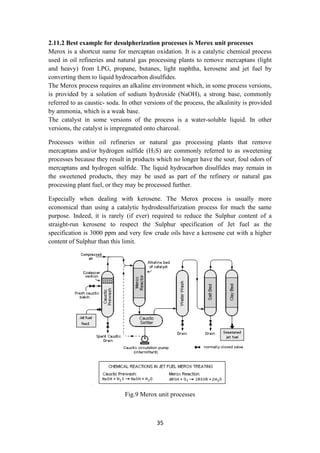
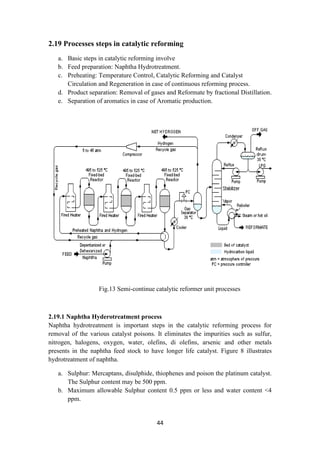
Thermal cracker involves a chemical cracking process followed by the separation
using physical principles (boiling point differences) to yield the desired products.
Thermal cracking yields naphtha and gas, gasoil and thermal cracked residue (figure
6). In some petroleum refinery configurations, thermal cracking process is replaced
with delayed coking process to yield coke as one of the petroleum refinery products.
Operating Conditions: The temperature should be kept at around 450 – 500°C for the
larger hydrocarbons to become unstable and break spontaneously. A (2-3) bar
pressure must be maintained.
2.10 Hydrotreaters
For many refinery crudes such as Arabic and Kuwait crudes, sulfur content in the
crude is significantly high. Therefore, the products produced from CDU and VDU
consist of significant amount of sulfur. Henceforth, for different products generated
from CDU and VDU, sulfur removal is accomplished to remove sulfur as H2S using
Hydrogen. The H2 required for the hydrotreaters is obtained from the reformer unit
where heavy naphtha is subjected to reforming to yield high octane number reformer
product and reformer H2 gas. In due course of process, H2S is produced. Therefore, in
industry, to accomplish sulfur removal from various CDU and VDU products, various
hydrotreaters are used. In due course of hydrotreating in some hydrotreaters products
lighter than the feed is produced. For instance, in the LVGO/HVGO hydrotreater,
desulfurization of LVGO & HVGO (diesel) occurs in two blocked operations and
desulfurized naphtha fraction is produced along with the desulfurized gas oil main
product (figure 8). Similarly, for LGO hydrotreating case, along with diesel main
product, naphtha and gas to C5 fraction are obtained as other products (figure 7). Only
for kerosene hydrotreater, no lighter product is produced in the hydrotreating
operation. It is further interesting to note that naphtha hydrotreater is fed with both
light and heavy naphtha as feed which is desulfurized with the reformer off gas. In
34
this process, light ends from the reformer gas are stripped to enhance the purity of
hydrogen to about 92 % (figure 8). Conceptually, hydrotreating is regarded as a
combination of chemical and physical processes [4-6]
.
2.11 Operating conditions
The operating condition of a hydrotreater varies with the type of feed. For Naphtha
feed, the temperature may be kept at around 280-425°C and the pressure be
maintained at 200 – 800 psig.
Fig.8 Hydro-desulfurization unit process
S
2
H + H
-
R
2
SH + H
-
R
H2S + NaOH NaSH + H2O
2.11.1 Corrosion
The presence of mercaptan sulfur may cause corrosion in the fuel pipes and the engine
cylinder and produce sulfur dioxide during combustion. In the past, Merox (a catalytic
mercaptan oxidation method) treatment was done to convert corrosive mercaptans to
non-corrosive disulfide, but this did not remove the sulfur originally present in the
fuel. However, it did give rise to the formation of sulfur dioxide during combustion.
Since emission of sulfur dioxide is prohibited by environmental protection laws,
nowadays mercaptans and other sulfur compounds are mostly removed.
by a catalytic hydrodesulfurization unit in a refinery. The corrosive effects of other
organic compounds along with traces of sulfur-bearing compounds and additives must
be tested in the laboratory. The copper corrosion test similar to that described in the
testing of LPG is also carried out in the laboratory at standard temperature (50°C) for
3 h.
Catalyst
Heat
35
2.11.2 Best example for desulpherization processes is Merox unit processes
Merox is a shortcut name for mercaptan oxidation. It is a catalytic chemical process
used in oil refineries and natural gas processing plants to remove mercaptans (light
and heavy) from LPG, propane, butanes, light naphtha, kerosene and jet fuel by
converting them to liquid hydrocarbon disulfides.
The Merox process requires an alkaline environment which, in some process versions,
is provided by a solution of sodium hydroxide (NaOH), a strong base, commonly
referred to as caustic- soda. In other versions of the process, the alkalinity is provided
by ammonia, which is a weak base.
The catalyst in some versions of the process is a water-soluble liquid. In other
versions, the catalyst is impregnated onto charcoal.
Processes within oil refineries or natural gas processing plants that remove
mercaptans and/or hydrogen sulfide (H2S) are commonly referred to as sweetening
processes because they result in products which no longer have the sour, foul odors of
mercaptans and hydrogen sulfide. The liquid hydrocarbon disulfides may remain in
the sweetened products, they may be used as part of the refinery or natural gas
processing plant fuel, or they may be processed further.
Especially when dealing with kerosene. The Merox process is usually more
economical than using a catalytic hydrodesulfurization process for much the same
purpose. Indeed, it is rarely (if ever) required to reduce the Sulphur content of a
straight-run kerosene to respect the Sulphur specification of Jet fuel as the
specification is 3000 ppm and very few crude oils have a kerosene cut with a higher
content of Sulphur than this limit.
Fig.9 Merox unit processes
36
The Merox reactor is a vertical vessel containing a bed of charcoal that have been
impregnated with the cobalt – base catalyst. The charcoal may be impregnated with
the catalyst in situ, or they may be purchased from market as pre-impregnated with
the catalyst. An alkaline environment is provided by caustic being pumped into
reactor on an intermittent, as needed basis.
The jet fuel or kerosene feedstock from the top of the caustic prewash vessel is
injected with compressed air and enters the top of the Merox reactor vessel along with
any injected caustic. The mercaptan oxidation reaction takes place as the feedstock
percolates downward over the catalyst. The reactor effluent flows through a caustic
settler vessel where it forms a bottom layer of caustic solution and an upper layer of
water-insoluble sweetened product.
The caustic solution remains in the caustic settler so that the vessel contains a
reservoir for the supply of caustic that is intermittently pumped into the reactor to
maintain the alkaline environment.
The sweetened product from the caustic settler vessel flows through a water wash
vessel to remove any entrained caustic as well as any other unwanted water-soluble
substances, followed by flowing through a salt bed vessel to remove any entrained
water and finally through a clay filter vessel. The clay filter removes any oil-soluble
substances, organometallic compounds (especially copper) and particulate matter,
which might prevent meeting jet fuel product specifications.
The pressure maintained in the reactor is chosen so that the injected air will
completely dissolve in the feedstock at the operating temperature [7-10]
.
The overall oxidation reaction that takes place in converting mercaptans to disulfides
is:
O
2
→ 2RSSR + 2H
2
RSH + O
4
The most common mercaptans removed are:
]
mercaptan
-
SH [m
3
CH
-
Methanethiol
]
]
mercaptan
-
SH [e
5
H
2
C
-
Ethanethiol
]
]
P mercaptan
-
SH [n
7
H
3
C
-
Propanethiol
-
1
]
]
mercaptan
3
[2C
3
CH(SH)CH
3
CH
-
Propanethiol
-
2
]
[Butanethiol - C4H9SH [n-butyl mercaptan]
37
2.12 Fluidized catalytic cracker
The unit is one of the most important units of the modern refinery. The unit enables
the successful transformation of desulfurized HVGO to lighter products such as
unsaturated light ends, light cracked naphtha, heavy cracked naphtha, cycle oil and
slurry, details in figure 11. Thereby, the unit is useful to generate lighter products
from a heavier lower value intermediate product stream. Conceptually, the unit can be
regarded as a combination of chemical and physical processes.
2.12.1 Operating conditions
The temperature should be maintained at 34°C with pressure ranging from 75 kPa to
180 kPa. Moreover, the process is to be carried out in a relatively wet environment.
2.13 Aviation fuels
The fuels used in aeroplanes are called aviation fuels. Depending on the type of
aircraft, like jet planes or turbine planes, different types of aviation fuels are used.
They are either gasoline based for jet planes or kerosene based for turbine planes.
Aviation gasoline is usually polymer gasoline or alkylated gasoline having an octane
number greater than 100, usually expressed as the performance number. Kerosene
based aviation fuel is known as aviation turbine fuel (ATF) and is mostly consumed
by passenger aeroplanes. This fuel is the hydrocarbon fraction boiling in the range of
150–250°C and is similar to the kerosene fraction. Though it resembles kerosene,
tests are carried out under stringent conditions for the safety of the airborne people in
the flying machines. A corrosion test is carried out using the copper strip test for 2 h
at 100°C and a silver strip test is carried out for 16 h at 45°C. Distillation tests are
conducted as for kerosene while the 20% recovery should be at 200°C and the FBP
should not be more than 300°C. Besides freezing point is to be below −50°C as the
sky temperature may be very low at high altitude.
Table 6 The properties of aviation fuels
Property of ATF Value
Final boiling 300°C
Flash point (Abel) min 38°C
Freezing point max −50°C
Smoke point minimum 20 mm
Viscosity, kinematic, at –34.4°C max 6 cst
Sulfur content, total max 0.20% wt
Carbon residue, Ramsbottom max 0.20% wt
Pour point max 6°C
Ash content max 0.01% wt
Aromatic percent vol. max 20
Olefin percent vol. max 5
38
2.14 Separators
The gas fractions from various units need consolidated separation and require stage
wise separation of the gas fraction. For instance, C4 separator separates the
desulfurized naphtha from all saturated light ends greater than or equal to C4s in
composition, details figure 11. On the other hand, C3 separator separates butanes
(both iso and n-butanes) from the gas fraction (figure 10). The butanes thus produced
are of necessity in isomerization reactions, LPG and gasoline product generation.
Similarly, the C2 separator separates the saturated C3 fraction that is required for LPG
product generation and generates the fuel gas + H2S product as well. All these units
are conceptually regarded as physical processes. Operating Conditions: Most oil and
gas separators operate in the pressure range of 20 – 1500 psi.
2.15 Cetane number
Cetane number or (CN) is an indicator of the combustion speed of diesel fuel. It is an
inverse of the similar octane rating for gasoline (petrol). The CN is an important
factor in determining the quality of diesel fuel, but not the only one; other
measurements of diesel's quality include (but are not limited to) energy content,
density, lubricity, cold-flow properties and Sulphur content.
Cetane number or CN is an inverse function of a fuel's ignition delay, the time period
between the start of injection and the first identifiable pressure increases during
combustion of the fuel. In a particular diesel engine, higher cetane fuels will have
shorter ignition delay periods than lower Cetane fuels. Cetane numbers are only used
Cetane is a chemical compound, alkane (named hexadecane, chemical formula n-
C16H34), molecules of which are un-branched and with open chain. Cetane ignites
very easily under compression, so it was assigned a cetane number of 100, while
alpha-methyl naphthalene was assigned a cetane number of 0. All other hydrocarbons
in diesel fuel are indexed to cetane as to how well they ignite under compression. The
cetane number therefore measures how quickly the fuel starts to burn (auto-ignites)
under diesel engine conditions. Since there are hundreds of components in diesel fuel,
with each having a different cetane quality, the overall
39
Fig.10 Diesel cycle, cutoff point and delay time
cetane number of the diesel is the average cetane quality of all the components
(strictly speaking high-cetane components will have disproportionate influence, hence
the use of high-cetane additives), for the relatively light distillate diesel oils.
Generally, diesel engines operate well with a CN from 40 to 55. Fuels with higher
cetane number have shorter ignition delays, providing more time for the fuel
combustion process to be completed. Hence, higher speed diesel engines operate more
effectively with higher cetane number fuels.
In Europe, diesel cetane numbers were set at a minimum of 38 in 1994 and 40 in
2000. The current standard for diesel sold in European Union, Iceland, Norway and
Switzerland is set in EN 590, with a minimum cetane index of 46 and a minimum
cetane number of 51. Premium diesel fuel can have a cetane number as high as 60.
40
Fig.11 Fluid catalyst cracking unit process
2.16 Naphtha splitter
The naphtha splitter unit consisting of a series of distillation columns enables the
successful separation of light naphtha and heavy naphtha from the consolidated
naphtha stream obtained from several sub-units of the refinery complex, details in
figure 13. The naphtha splitter is regarded as a physical process for modeling
purposes.
2.16.1 Operating conditions
The pressure is to be maintained between 1 kg/cm2
to 4.5 kg/cm2
. The operating
temperature range should be 167 – 250°C.
2.17 Catalytic reformer
Catalytic reforming is a major conversion process in petroleum refinery and
petrochemical industries. The reforming process is a catalytic process which converts
low octane naphtha into higher octane reformate products for gasoline blending and
aromatic rich reformate for aromatic production. Basically, the process re-arranges or
re-structures the hydrocarbon molecules in the naphtha feed stocks as well as breaking
some of the molecules into smaller molecules. Naphtha feeds to catalytic reforming
include heavy straight run naphtha. It transforms low octane naphtha into high-octane
motor gasoline blending stock and aromatics rich in benzene, toluene, and xylene with
hydrogen and liquefied petroleum gas as a byproduct. With the fast-growing demand
in aromatics and demand of high - octane numbers, catalytic reforming is likely to
remain one of the most important unit processes in the petroleum and petrochemical
industry. As shown in figure 13, Heavy naphtha which does not have high octane
number is subjected to reforming in the reformer unit to obtain reformate product
(with high octane number), light ends and reformer gas (hydrogen). Thereby, the unit
produces high octane number product that is essential to produce premium grade
41
gasoline as one of the major refinery products. A reformer is regarded as a
combination of chemical and physical processes.
2.17.1 Operating conditions
The initial liquid feed should be pumped at a reaction pressure of 5 – 45 atm. And the
preheated feed mixture should be heated to a reaction temperature of 495 – 520°C.
The four major catalytic reforming reactions are:
a. The dehydrogenation of naphthene’s to convert them into aromatics as
exemplified in the conversion methylcyclohexane (a naphthene) to toluene (an
aromatic), as shown below:
b. The dehydrogenation and aromatization of paraffins to aromatics (commonly
called dehydrocyclization) as exemplified in the conversion of normal heptane
to toluene, as shown below:
c. The hydrocracking of paraffins into smaller molecules as exemplified by the
cracking of normal heptane into iso-pentane and ethane, as shown below:
2.18 Octane number or octane rating
Octane rating or octane number is a standard measure of the performance of an engine
or aviation fuel by indicate anti-knock index or measure the rate of iso-octane in
gasoline structure. The higher the octane number, the more compression the fuel can
withstand before detonating (igniting). In broad terms, fuels with a higher-octane
rating are used in high performance petrol engines that require higher compression
42
ratios. In contrast, fuels with lower octane numbers means higher n- heptane rates.
Petrol engines (also referred to as gasoline engines) rely on ignition of air and fuel
compressed together as a mixture without ignition, which is then ignited at the end of
the compression stroke using spark plugs. Therefore, high compressibility of the fuel
matters mainly for petrol engines. Use of petrol (gasoline) with lower octane numbers
may lead to the problem of engine knocking.
a. Isooctane (upper) has an octane rating of 100.
b. n-heptane (bottom) has an octane rating of 0.
2.18.1 Method of measurement
a. Research Octane Number (RON)
The most common type of octane rating worldwide is the Research Octane Number
(RON). RON is determined by running the fuel in a test engine with a variable
compression ratio under controlled conditions and comparing the results with those
for mixtures of iso-octane and n-heptane.
b. Motor Octane Number (MON)
Another type of octane rating, called Motor Octane Number (MON), is determined at
900 rpm engine speed instead of the 600 rpm for RON.
MON testing uses a similar test engine to that used in RON testing, but with a
preheated fuel mixture, higher engine speed, and variable ignition timing to further
stress the fuel's knock resistance. Depending on the composition of the fuel, the MON
of a modern pump gasoline will be about 8 to 12 octanes lower than the RON, but
there is no direct link between RON and MON. Pump gasoline specifications
typically require both a minimum RON and a minimum MON.
c. Anti-Knock Index (AKI) or (R+M)/2
In most countries, including Australia, New Zealand and all of those in Europe, the
"headline" octane rating shown on the pump is the RON, but in Canada, the United
States, Brazil, and some other countries, the headline number is the average of the
RON and the MON, called the Anti-Knock Index (AKI), and often written on pumps
as (R+M)/2). It may also sometimes be called the Posted Octane Number (PON).
43
2.18.2 Difference between RON, MON, and AKI
Because of the 8 to 12 octane number difference between RON and MON noted
above, the AKI shown in Canada and the United States is 4 to 6 octane numbers lower
than elsewhere in the world for the same fuel. This difference between RON and
MON is known as the fuel's sensitivity and is not typically published for those
countries that use the Anti-Knock Index labelling system.
a. Observed Road Octane Number (RdON)
Another type of octane rating, called Observed Road Octane Number (RdON), is
derived from testing gasolines in real world multi-cylinder engines, normally at wide
open throttle. It was developed in the 1920s and is still reliable today. The original
testing was done in cars on the road but as technology developed the testing was
moved to chassis dynamometers with environmental controls to improve consistency.
Fig.12 Otto cycle, 4-stroke engine cycle
44
2.19 Processes steps in catalytic reforming
a. Basic steps in catalytic reforming involve
b. Feed preparation: Naphtha Hydrotreatment.
c. Preheating: Temperature Control, Catalytic Reforming and Catalyst
Circulation and Regeneration in case of continuous reforming process.
d. Product separation: Removal of gases and Reformate by fractional Distillation.
e. Separation of aromatics in case of Aromatic production.
Fig.13 Semi-continue catalytic reformer unit processes
2.19.1 Naphtha Hyderotreatment process
Naphtha hydrotreatment is important steps in the catalytic reforming process for
removal of the various catalyst poisons. It eliminates the impurities such as sulfur,
nitrogen, halogens, oxygen, water, olefins, di olefins, arsenic and other metals
presents in the naphtha feed stock to have longer life catalyst. Figure 8 illustrates
hydrotreatment of naphtha.
a. Sulphur: Mercaptans, disulphide, thiophenes and poison the platinum catalyst.
The Sulphur content may be 500 ppm.
b. Maximum allowable Sulphur content 0.5 ppm or less and water content <4
ppm.
45
c. Fixed bed reactor containing a nickel molybdenum where both hydro de
sulphurisation reactions and hydro de nitrification reactions take place.
d. The catalyst is continuously regenerated. Liquid product from the reactor is
then stripped to remove water and light hydrocarbons.
2.19.2 Alkylation and Isomerization
The unsaturated light ends generated from the FCC process are stabilized by
alkylation process using C4 generated from the C4 separator. The process yields
alkylate product which has higher octane number than the feed streams. As iso-butane
generated from the separator is enough to meet the demand in the alkylation unit,
isomerization reaction is carried out in the isomerization unit to yield the desired
make up C4.
2.19.3 Octane number of Hydrocarbons
Octane number is a measurement of antiknock characteristics of fuels
a. Among the same carbon number compounds, the order of RON is (Research
Octane Number) Paraffins < Naphthene’s < Aromatics
b. Branched paraffins also have high octane. It increases with degree of branching.
Therefore, octane number of naphtha can be improved by reforming the hydrocarbon
molecule (Molecular rearrangement).
Table 7 Octane Number of Various Hydrocarbons
Hydrocarbon Octane Number
n-Butane 94
i-Butane 102
n-pentane 63
i-Pentane 93
n-Heptane -
Octane 100
Toluene 119
46
2.19.4 Gas treating
The otherwise not useful fuel gas and H2S stream generated from the C2 separator has
significant amount of sulfur. In the gas treating process, H2S is successfully
transformed into sulfur along with the generation of fuel gas (figure 14). Eventually,
in many refineries, some fuel gas is used for furnace applications within the refinery
along with fuel oil (another refinery product generated from the fuel oil pool) in the
furnace associated to the CDU.
Fig.14 H₂S Gas treater unit process
2.19.5 Operating conditions
Gas treaters may operate at temperatures ranging from 150 psig (low pressure units)
to 3000 psig (high pressure units).
2.20 Blending pools
All refineries need to meet tight product specifications in the form of ASTM
temperatures, viscosities, octane numbers, flash point and pour point. To achieve
desired products with minimum specifications of these important parameters,
blending is carried out. There are four blending pools in a typical refinery. While the
LPG pool allows blending of saturated C3s and C4s to generate C3 LPG and C4 LPG,
which do not allow much blending of the feed streams with one another (figure 15).
The most important blending pool in the refinery complex is the gasoline pool where
47
in both premium and regular gasoline products are prepared by blending appropriate
amounts of n-butane, reformate, light naphtha, alkylate and light cracked naphtha as
shown in figure 15. These two products are by far the most profit-making products of
the modern refinery and henceforth emphasis is there to maximize their total products
while meeting the product specifications. The gasoil pool produces automotive diesel
and heating oil from kerosene (from CDU), LGO, LVGO and slurry [10]
. In the fuel oil
pool (figure 15), haring diesel, heavy fuel oil and bunker oil are produced from
LVGO, slurry and cracked residue.
Fig.15 Blending pools or Blending drum
2.21 Stream splitters
To facilitate stream splitting, various stream splitters are used in the refinery
configuration. A kerosene splitter is used to split kerosene between the kerosene
product and the stream that is sent to the gas oil pool as in figure 16. Similarly, butane
splitter splits the n-butane stream into butanes entering LPG pool, gasoline pool and
isomerization unit.
Unlike naphtha splitter, these two splitters facilitate stream distribution and do not
have any separation processes built within them. With these conceptual diagrams to
represent the refinery, the refinery block diagram with the complicated interaction of
streams is presented in figure 16.
48
Fig.16 Stream splitter
2.22 Claus process
The Claus process is the most significant gas desulfurizing process, recovering
elemental sulfur from gaseous hydrogen sulfide. First patented in 1883 by the scientist
Carl Friedrich Claus, the Claus process has become the industry standard.
The multi-step Claus process recovers sulfur from the gaseous hydrogen sulfide found
in raw natural gas and from the by-product gases containing hydrogen sulfide derived
from refining crude oil and other industrial processes. The by-product gases mainly
originate from physical and chemical gas treatment units (Selexol, Rectisol, Purisol
and amine scrubbers) in refineries, natural gas processing plants and gasification or
synthesis gas plants. These by-product gases may also contain hydrogen cyanide,
hydrocarbons, sulfur dioxide or ammonia.
49
Gases with an H2S content of over 25% are suitable for the recovery of sulfur in
straight-through Claus plants while alternate configurations such as a split-flow set up
or feed and air preheating can be used to process leaner feeds. Hydrogen sulfide
produced, for example, in the hydro-desulfurization of refinery naphtha and other
petroleum oils, is converted to sulfur in Claus plants. The overall main reaction
equation is:
2 H2S + O2 → S2 + 2 H2O
In fact, the vast majority of the 64,000,000 metric tons of sulfur produced worldwide
in 2005 was byproduct sulfur from refineries and other hydrocarbon processing
plants. Sulfur is used for manufacturing sulfuric acid, medicine, cosmetics, fertilizers
and rubber products. Elemental sulfur is used as fertilizer and pesticide.
Fig.17 The Claus technology, process description
2.22.1 Claus unit description
a. The hot combustion products from the furnace at 1000 - 1300°C enter the
waste heat boiler and are partially cooled by generating steam. Any steam
level from 3 to 45 bar g can be generated.
b. The combustion products are further cooled in the first Sulphur condenser,
usually by generating LP steam at 3 – 5 bar g. This cools the gas enough to
condense the Sulphur formed in the furnace, which is then separated from the
gas and drained to a collection pit.
c. In order to avoid Sulphur condensing in the downstream catalyst bed, the gas
leaving the Sulphur condenser must be heated before entering the reactor.
d. The heated stream enters the first reactor, containing a bed of Sulphur
conversion catalyst. About 70% of the remaining H2S and SO2 in the gas will
50
react to form Sulphur, which leaves the reactor with the gas as Sulphur
vapour.
e. The hot gas leaving the first reactor is cooled in the second Sulphur condenser,
where LP steam is again produced, and the Sulphur formed in the reactor is
condensed.
f. A further one or two more heating, reaction, and condensing stages follow to
react most of the remaining H2S and SO2.
g. The Sulphur plant tail gas is routed either to a Tail Gas treatment Unit for
further processing, or to a Thermal Oxidizer to incinerate all of the Sulphur
compounds in the tail gas to SO2 before dispersing the effluent to the
atmosphere.
51
Chapter 3
Lubricant production
3.1 Lubricant overview
The use of animal fats to reduce friction and wear and tear of mechanical parts has
been the practice from time immemorial. However, since the availability of petroleum
Sources, lubricants are now manufactured using petroleum stocks. Today’s
lubricating oil is mainly composed of base hydrocarbon oil, lubricating base oil stock
(LOBS), obtained from vacuum distillates after treatment in the refinery, as discussed
in Chapter 1, with some additives to meet the requirements for its end use. Synthetic
base oils, such as polyalphaolefins, alkylated aromatics and polybutenes, are also used
as base oils.
3.2 Industrial lubricants
Industries use a large number of lubricants, known as industrial oils, i.e., transmission
oils, turbine oils, compressor oils, seal oils, cooling oils, gear oils, bearing oils,
hydraulic oils, and cutting oils. Oils should be non-toxic and non-explosive.
Lubricating oil must satisfy the following needs:
I. Lubrication: it must reduce friction and wear within the engine. It improves
engine efficiency by reducing friction forces between moving parts.
II. Coolant
III. Removal of contaminants
IV. Enhancement of ring seal and reduction of blowby.
V. Slow corrosion
VI. Stability over a large temperature range
VII. Long life span
VIII. Low cost
The base ingredients in most lubricating oils are hydrocarbon components made from
crude oil. These are larger molecular weight species obtained from the distillation
process as in table 4. Various other components are added to create a several types of
lubricant include:
Table 8 Hydrocarbon components in lubricating oils
Type Number of Carbon Atoms in Components
Range Average number
SAE 10 25-35 28
SAE 20 30-80 38
SAE 30 40-100 41
52
a) Bearing lubricants
Bearings used in machineries face either sliding or rolling frictions. Usually, greases
or solid lubricants are used to lubricate the small bearing surfaces.
b) Hydraulic lubricants
Hydraulic fluids are viscous liquids used in power transmission for control, braking in
automobiles and machineries, raising or lowering loads by multiplying the transmitted
force, and so on. In addition to these activities, hydraulic fluids lubricate the mating
parts of machines and are used in a wide variety of environments, such as air, water,
gaseous, and high and low temperatures.
c) Compressor lubricant
Gases are compressed either in reciprocating or centrifugal compressors. In the
reciprocating compressor, the piston and cylinder are lubricated by lubricating oil,
which must have a low vapors pressure and a low carbon-forming tendency. Lube
vapour, especially petroleum base oil and carbon particles, may contaminate the
compressed gas and lead to explosion.
3.3 Definitions
a. Alkylation: the reaction of the double bond in an olefin with another
molecule.
b. Aromatic hydrocarbon: a compound of hydrogen and carbon containing one
or more benzene rings.
c. Base stock: the refined oil that is used to blend lubricants.
d. Catalyst: substance that causes or speeds up a reaction without changing
itself. Catalyst used now a day is platinum on alumina base.
The catalyst regeneration performance of the catalyst decreases with respect to time
due to deactivation. Reasons for de-activation:
I. Coke formation
II. Contamination on active sites
III. Agglomeration
IV. Catalyst poisoning
Activity could be restored if deactivation occurred because of coke formation or
temporary poisons. The objective of regeneration:
I. Surface area should be high
II. Metal Pt should be highly dispersed
III. Acidity must be at a proper level
IV. Regeneration changes by the severity of the operating conditions
53
V. Coke formation can be offset for a time by increasing reaction temperatures.
e. Cracking: breaking large molecules into smaller ones in the presence of heat
or catalyst. Examples are thermal cracking, catalytic cracking, or
hydrocracking (cracking in the presence of hydrogen) High Temperatures.
f. Crude oil: a naturally occurring mixture of petroleum hydrocarbons, with
small amounts of oxygen, nitrogen, sulfur and other impurities. It was formed
by the action of bacteria, heat and pressure on ancient plant and animal
remains and is usually found in layers of porous rock capped by a layer of
shale or clay that traps the oil.
g. Detergent: additive that prevents contaminants from contacting metal
surfaces. Detergents contain barium, calcium or magnesium, and other
compounds and they may leave an ash residue if burned.
h. Dewaxing: a refining step that removes wax from crude oil fractions.
i. Dispersant: additive that suspends very small contaminant particles
harmlessly in the oil. It prevents them from combining into large particles that
could cause sludge, varnish and wear. Dispersants generally do not contain
metals and are considered to be ash less when burned.
j. Distillation: a process where crude oil is heated so fractions start to boil; the
fractions are collected as they condense.
k. Extreme pressure (EP) additive: additive that prevents sliding metal
surfaces from seizing under conditions of extreme pressure. At high local
temperatures it combines chemically with the metal to form a surface film. EP
additives are commonly made of sulfur, phosphorus or chlorine.
l. Foam inhibitor: in turbulent systems it helps combine small air bubbles into
large bubbles which rise to the surface and burst. It spreads out on the bubble
wall to thin it out so that it pops.
m. Hydrocarbon: a molecule predominantly made up of hydrogens and carbons.
n. Hydrocracking: a process that cracks molecules in the presence of hydrogen.
o. Hydrotreating: a process where oil streams are treated with hydrogen at
elevated pressure and temperature in the presence of a catalyst to improve
color and stability and reduce sulfur content.
p. Naphthene: also called a (cycloparaffin): A hydrocarbon with the carbons
54
arranged in one or more rings.
q. Olefin: a hydrocarbon with one or more double bonds.
r. Oxidation: the combination of a substance with oxygen. Some products of
oxidation of oils include organic acids (which can cause corrosion), sludge and
varnish. The Oxidation inhibitor used as additive to extend the life of
lubricants. It can work in three ways:
I. It combines with peroxides (the first chemicals created in the oxidation
process) to make them harmless.
II. It decomposes the peroxides.
III. It makes metal surfaces less able to promote oxidation.
s. Paraffin: a hydrocarbon where the carbons are arranged in a straight line or
are branched off of each other.
t. Rust inhibitor: additive that prevents rust.
u. Saponification: process of converting certain chemicals into soaps, which are
the metallic salts of organic acids. It is usually accomplished through the
reaction of a fat, fatty acid, or ester with an alkali.
v. Saturated hydrocarbon: a compound of hydrogen and carbon with no double
bonds.
w. Solvent extraction: a method of removing unstable components of a refining
stream by dissolving them in solvent.
x. Synthetic base stock: fluid made by reacting specific chemical compounds to
produce a produce with planned and predictable properties. A number of
synthetically made oils are available that give better performance than those
made from crude oil. They are better at reducing friction and engine wear,
have good detergency properties which keep the engine cleaner, offer less
resistance for moving parts, and require less pumping power for distribution.
With good thermal properties, they provide better engine cooling and less
variation in viscosity.
Because of this, they contribute to better cold weather starting and can reduce
fuel consumption by as much as 15%. These oils cost several times as much as
those made from crude oil. However, they can be used longer in an engine,
with 24,000 km (15,000 miles) being the oil change period suggested by most
manufacturers.
y. Vacuum distillation: separation of crude oil fractions by applying heat under
a vacuum.
55
3.4 Base stock refining
Crude oil, as it comes from the ground, contains many substances other than gasoline,
diesel fuel and lubricant base stocks. The natural gas that is used to power many city
buses, or that heats burners can be dissolved in crude oil. You can find the building
blocks for plastics and chemicals in its mixture of molecules. It is also a source of
wax, asphalt, solvents, petroleum jelly and many other substances.
Fuels are the principal products that come from crude oil. Gasoline is the biggest
component, followed by diesel fuel and jet fuel. Lubricants and waxes only constitute
a little over 1% of the crude oil barrel.
Crude oil comes in many forms, depending upon its source. It can be as thin as
gasoline, or it can be so thick that it needs to be heated or pressurized to flow. It can
range from amber colored to pitch black.
The three major types of crude oil are paraffinic, naphthenic and asphaltic. Paraffinic
crudes are the primary source of “neutral” base oils, while naphthenic crudes produce
“coastal pale” oils. Asphaltic crudes are generally not acceptable for lubricant base
stocks other than some open gear compounds, highly viscous lubricants or rust
preventives. Crude oil is sold by the barrel (42 gallons per barrel) by pipeline or in
tanker ships.
From there, it is transported by barge or pipeline to a refinery, where it is processed
according to the steps described below. Lubricants are further processed in blending
plants. Crude oil is converted to lubricating oil through a series of refining steps
including distillation, vacuum distillation, solvent extraction, hydrotreating, dewaxing
and sometimes hydrocracking and alkylation. The yield of lubricating oil from a
gallon of crude can be increased first through de-bottlenecking steps, second by a
series of steps called cracking and alkylation.
When oil comes out of the ground, the first things that are released are gases. These
include methane, ethane, propane and butane, as well as the mixture called natural
gas.
a. Natural gas: These gases can generally be captured without heating the oil.
b. Distillation towers, of which the atmospheric tower is the tallest in the
refinery, work on the same principle as stills worked during Prohibition.
Alcohol was made by fermenting grain or another substance and then heating
it. Alcohol boils at a very low temperature, so it would start to boil, while the
rest of the mash was left in the pot. The alcohol vapors would rise and get
funneled into some coils, where they would cool and condense back into
liquid.
Gasoline is a liquid at room temperature, but it evaporates very fast, and it boils at a
very low temperature. In order to separate it from crude oil, the crude is heated until
the gasoline starts to boil. The vapors above the boiling liquid are collected and sold
56
as gasoline. Many of the solvents such as mineral spirits are collected at the same time
before they are further refined.
Once the gasoline fractions are removed, the crude oil is heated further. Kerosene, jet
fuel and diesel fuels are the next liquids that boil off. These fractions are also allowed
to condense and are collected and sold.
After most of the light fuels have been removed from crude oil, you would think that
they would just heat it up even more and boil off the lubricant fractions. But that is
not energy efficient, and besides, if they had to heat up lubricants to 600°F to boil
them off, they could destroy the lubricant.
Substances boil at a lower temperature if they are subject to a vacuum. Think of the
vacuum as trying to pull the molecules out of the liquid. A lot less heat is needed to
get them to boil. It is much more energy efficient to apply a vacuum to the oil to
remove lubricant fractions, and it is much less harmful to the lubricant. Vacuum
distillation prevents the cracking of lubricant fractions that would occur at higher
temperatures.
c. Vacuum distillation: separates lubricant fractions from crude oil. Re-refining
and reprocessing do not require this step because their feedstock, used
lubricants, should contain minimal amounts of fuels, waxes or asphalt.
The lubricant stream that is separated from crude oil still contains many
impurities and must be further refined. The next three refining steps,
hydrotreating, solvent extraction, and dewaxing, can occur in any order, or
may be optional depending upon the quality of the finished base oil.
d. Hydrotreating essentially bombards the stream with hydrogen to remove
sulfur and other impurities. It makes base stocks more stable. Treating base
stock with hydrogen has the following advantages.
1. Minimizes use of solvents.
2. Reduces solvent disposal.
3. Increases yield.
4. Permits use of different crude sources.
5. May reduce processing temperatures.
6. Produces base stocks with higher VI, which may increase fuel efficiency in
engine oils
7. Produces bases tock with lower volatility lower evaporative losses.
8. Base oils that have been severely hydrotreated don’t require a carcinogen
label.
e. Solvent extraction: dissolves reactive components such as aromatics to
improve the oil’s oxidation stability, viscosity index and response to additives.
Sulfur and nitrogen 26 compounds are also selectively extracted. The oil and
57
the solvent are mixed in a tower, which results in two distinct liquid phases.
The heavy components are dissolved in the solvent. The lighter phase, which
contains the clean, high-quality oil, is separated and the small amount of
solvent is distilled off.
f. Solvent dewaxing: removes wax, lowers the pour point, and improves the
low-temperature properties of the oil. The solvent dissolves the wax, and the
mixture is chilled until the wax turns solid. The wax is filtered out and
stripped of solvent and dried. The wax from this process can be used in
crayons, candles, paper cups and fire logs.
g. Hydrodewaxing (catalytic dewaxing): accomplishes the same result, but by a
different method. The oil is exposed to hydrogen at elevated temperature and
pressure. This cracks the normal paraffins, which are converted to light
compounds that can be used as building blocks for plastics and chemicals.
h. Finishing steps: can include acid treating and clay filtration to remove trace
impurities.
Refining severity is a compromise. Some of the more undesirable compounds,
asphaltenes and unsaturated, which reduce oxidation resistance, also tend to improve
boundary lubrication. An oil which has been only mildly refined may have poor
oxidation resistance but relatively good boundary lubrication. On the other hand,
severely refined oil has good oxidation resistance and a high viscosity index. The
other required properties are then obtained by the use of additives.
A lubricant formulator can specify a base stock by type, i.e., paraffinic, naphthenic,
synthetic, vegetable, and also by performance properties such as viscosity index,
viscosity, pour point, flash point, color, or sulfur level. Paraffinic base stocks
generally have higher viscosity index than naphthenic.
Base stocks also have varying natural resistance to oxidation. Here is a general guide
for oxidation resistance of petroleum base stocks.
I. Paraffin’s are most resistant.
II. Naphthenic, Aromatics, Asphaltenes and Unsaturated material are least
resistant.
As a rule, synthetic base stocks are designed to have better oxidation stability than
petroleum oils, while vegetable oils have significantly lower resistance to oxidation.
3.5 Automotive oils
The majority of automobiles include vehicles run on motor spirit (petrol) or diesel.
Different lubricants are used for petrol engines (which are spark ignition type) and
diesel engines (which are compression ignition type). These are known as engine oils,
58
which are suitable for use in high temperatures and the oxidizing environment of
engines. Load (weight to carry) and speed of the vehicles are also to be taken care of
before selecting a lube oil to apply. Usually, the temperature of an engine rises rapidly
during the startup and continues at that temperature during motion. Such a wide and
sudden change in temperature demands that the lubricant should have a high VI. In
addition to temperature fluctuations, lubricants are prone to oxidation and cracking,
leading to the formation of cokes, carbons, and gummy substances, which may
ultimately deposit on the engine, causing irreparable damage. In addition to engine
oils, different lubricants are applicable for other parts of the vehicle, such as the gears,
brake, clutch, and bearings. Gear boxes contain the gears immersed in lubricating oil
having low viscosity to reduce friction at high speed. The brake and clutch require
lubricating oils of low viscosity. Bearings are used in various parts of the automobile
from engine to wheels and require low to high viscous lubricants. At low temperatures
and high load, bearings at wheels are lubricated by grease. Since materials of
construction and type of engines vary with the make, appropriate lubricants are
selected and prescribed by the manufacturers. No single lubricant is therefore
applicable for all makes. Finished lubes are classified according to the Society of
Automotive Engineers’ (SAE). The viscosity of the lubricants and its variation with
temperature (VI) and the pour point are the important parameters to satisfy the
compatibility of application of lubes. Winter grades are classified as SAE numbers
from 0 to 25W as typical examples of cold temperatures and from 20 to 60 SAE
numbers for warming up the cranks of engines. A multigrade lubricant is a blend of
more than one type of lubricant. For example, SAE15W 50 is an example of a blend
of two grade oils. Usually, polymeric materials, such as ethylene propylene
copolymer, polymethyl acrylate, and butadiene, are added to these multigrade oils.
However, rigorous testing of appropriate lubes must be carried out on cars of different
makes in the testing laboratory or workshop for their suitability before prescribing
them for engines and other parts. Since the performance of these lubes may not be
satisfactory after a certain period of time due to degradation because of
contamination, reaction, physical and chemical changes in the property of the
ingredients or the base oils, it is inevitable that the lube must be drained out and
replaced with fresh stock. This drain out period must be specified for the prescribed
lubricants. The longer the drain out period, the more attractive the lubricant is in the
market [11][12]
.
3.6 Additives
Lubricants are comprised primarily of base oils and additives. Grease is comprised of
base oils and additives along with thickeners.
The following is a brief description of lubricant additives and their functions:
I. Anti-wear additive: Zinc dialkyldithiophosphate (ZDDP) is the most
common antiwear additive, although there are many zinc-free additives based
on sulfur and phosphorus that also impart anti-wear properties. The zinc-
59
sulfur-phosphorus end of the molecule is attracted to the metal surface
allowing the long chains of carbons and hydrogens on the other end of the
molecule to form a slippery carpet that prevents wear.
Not a chemical reaction, rather a super-strong attraction.
II. Demulsified: affects the interfacial tension of contaminants so they separate
out from oil rapidly.
III. Dispersant: additive that suspends very small contaminant particles
harmlessly in the oil. It prevents them from combining into large particles that
could cause sludge, varnish and wear. Dispersants generally do not contain
metals and are considered to be ash less when burned.
IV. Dye: any oil-soluble dye can be added to oils for leak detection. Water-soluble
dyes such as food coloring won’t work because oil and water don’t mix).
V. Emulsifier – added to some metalworking fluids, air tool oils and fire-
resistance hydraulic fluids to allow them to mix with water.
VI. Extreme pressure (EP) additive: additive that prevents sliding metal
surfaces from seizing under conditions of extreme pressures. At high local
temperatures it combines chemically with the metal to form a surface film. EP
additives are commonly made of sulfur, phosphorus, or chlorine. They become
reactive a high temp. (170°+F) and will attack yellow surfaces. Generally, it is
a good idea to stay away from extreme pressure additives if they are not
needed but when in doubt always use EP gear oils. EP additives are generally
pro-oxidants, in other words, they shorten the life of the oil. They also can be
slightly corrosive to some metals, especially at elevated temperatures.
VII. Foam inhibitor: in turbulent systems it helps combine small air bubbles into
large bubbles which rise to the surface and burst. It decreases the surface
tension of the bubble to thin and weaken it so that it pops.
VIII. Rust inhibitor: absorb onto metal surfaces to prevent attack by air and water.
IX. Oxidation inhibitor: antioxidants act by interrupting the free radical chain
reaction that results in oxidation. Essentially, as the oil starts to decompose in
the presence of oxygen, 28 these inhibitors interrupt the reaction. They also
keep metal from speeding up the oxidation reaction by deactivating the metal.
X. Oiliness agent: fatty materials that have two benefits. They add extra lubricity
at low to moderate temperatures, and they help prevent water from washing oil
off of surfaces.
60
XI. Pour depressant: disrupt the crystal structure of wax so that the oil will flow
at lower temperatures.
XII. Solid additives: graphite, moly and PTFE are added to some oil and grease
formulations
XIII. Tackiness additive: polymer added to allow oils to adhere to metal surfaces.
XIV. Viscosity index improvers: polymers that change shape with temperature. At
high temperatures they are somewhat bulky and prevent the oil from thinning
down as much. Lubricating oils are generally rated using a viscosity scale
established by the Society of Automotive Engineering (SAE). Dynamic
viscosity is defined from the equation:
Ts = 1/-t(dUjdy) ……………………………(5)
where:
Ts = shear force per unit area.
1/-t = dynamic viscosity.
(dUjdy) = velocity gradient.
The higher the viscosity value, the greater is the force needed to move adjacent
surfaces or to pump oil through a passage. Viscosity is highly dependent on
temperature, increasing with decreasing temperature figure 18-19. In the temperature
range of engine operation, the dynamic viscosity of the oil can change by more than
an order of magnitude. Oil viscosity also changes with shear, dUj dy, decreasing with
increasing shear. Shear rates within an engine range from very low values to
extremely high values in the bearings and between piston and cylinder walls. The
change of viscosity over these extremes can be several orders of magnitude. Common
viscosity grades used in engines are:
SAE 5
SAE 10
SAE 20
SAE 30
SAE 40
SAE 45
SAE 50
The oils with lower numbers are less viscous and are used in cold-weather operation.
Those with higher numbers are more viscous and are used in modern high-
temperature, high-speed, close-tolerance engines.
If oil viscosity is too high, more work is required to pump it and to shear it between
moving parts. This results in greater friction work and reduced brake work and power
61
output. Fuel consumption can be increased by as much as 15%. Starting a cold engine
lubricated with high-viscosity oil is very difficult (e.g., an automobile at - or a
C
°
20
lawn mower at 100e).
Multigrade oil was developed so that viscosity would be more constant over the
operating temperature range of an engine. When certain polymers are added to an oil,
the temperature dependency of the oil viscosity is reduced, as shown in figure17-18.
These oils have low-number viscosity values when they are cold and higher numbers
when they are hot. A value such as SAE 10W-30 means that the oil has properties of
10 viscosity when it is cold (W = winter) and 30 viscosities when it is hot. This gives
a more constant viscosity over the operating temperature range.
This is extremely important when starting a cold engine. When the engine and oil are
cold, the viscosity must be low enough so that the engine can be started without too
much difficulty. The oil flows with less resistance and the engine gets proper
lubrication. It would be very difficult to start a cold engine with high-viscosity oil,
because the oil would resist engine rotation and poor lubrication would result because
of the difficulty in pumping the oil. On the other hand, when the engine gets up to
operating temperature, it is desirable to have a higher viscosity oil. High temperature
reduces the viscosity, and oil with a low viscosity number would not give adequate
lubrication.
Some studies show that polymers added to modify viscosity do not lubricate as well
as the base hydrocarbon oils. At cold temperatures SAE 5 oil lubricates better than
SAE 5W-30, and at high temperatures SAE 30 oil lubricates better. However, if SAE
30 oil is used, starting a cold engine will be very difficult, and poor lubrication and
very high wear will result before the engine warms up. Common oils available
include:
SAE 5W-20 SAE 10W-40
SAE 5W-30 SAE l0W-50
SAE 5W-40 SAE 15W-40
SAE 5W-50 SAE 15W-50
SAE l0W-30 SAE 20W-50
62
Fig. 18 Dynamic viscosity as a function of temperature for common engine
oils
63
Fig. 19 Dynamic viscosity as a function of temperature for common multigrade
engine oils
64
3.7 Grease manufacturing
Lubricating grease is a solid or semisolid lubricant consisting of a thickening agent in
a liquid lubricant. Greases generally contain additives to enhance properties such as
oxidation stability and lubricity. Other ingredients imparting special properties may
be included.
Greases that are thickened with soap can be made according to the following steps.
The steps may vary according to manufacturing plant.
a. Charge kettle with fatty material, complexing agent and metallic hydroxide
b. Heat to dehydrate
c. Cut back with mineral oil
d. Quench and add additives
e. Mill
f. Deaerator
g. Filter
h. Package
Complexing agents are added to grease to increase their high temperature stability.
These are very stable soaps generated by reacting an alkali with a high and low
molecular weight fatty acid.
The reaction of a fatty acid and a base is very similar to the reaction of an acid and a
base. The acid and base react to form salt and water. The fatty acid and base forms
soap.
Acid + Base = Salt + Water
Fatty Acid + Base = Soap
Grease is typically made up of 75% to 96% percent oil. The oil is designed to separate
from the thickener, so it is not uncommon to see some oil separation if the grease has
been sitting. 12-hydroxy stearic acid is the most common type of fatty acid used in
grease manufacture.
3.7.1 Grease soaps and thickeners
In addition to conventional and complex soaps, other materials may be used to thicken
grease. Here is a partial list of thickeners.
a. Soap Base
I. Aluminum, Aluminum complex
II. Barium, Barium complex
III. Calcium, Calcium complex
IV. Lithium, Lithium complex
V. Sodium, Sodium complex mixed soap such as sodium calcium
65
b. Non-soap Base
Polyuria, Modified betonies and other clays like Colloidal, silica, Organic
compounds Fluorinated compounds
3.7.2 Grease additives
The additives used in greases are very similar to those used in lubricating oils, which
are listed below. Some additives that you would expect to find in grease include
Antioxidants or oxidation inhibitors.
a. Corrosion inhibitors
l. 30 Color stabilizers Dyes.
ll. Film strength agents metal deactivators rust inhibitors stringiness additive’s
structure modifiers for soap-oil systems.
3.7.3 Grease Fillers
In addition to soap, base oil and additives, solid fillers can be added to grease to
enhance its lubricity and load carrying ability. Some of the fillers used in lubricating
greases are listed below:
1. Graphite colloidal flake powdered.
2. Lead powder molybdenum disulfide.
3. Red lead powder.
4. Zinc oxide.
5. Copper flake.
6. Zinc dust.
3.8 Finished products
Using the above intermediates, a variety of plastics, rubber, fiber, solvent, paint, etc,.
are manufactured. Polymerisation reactions are carried out for these monomers or
intermediates to various polymers, resinous and liquid products. Plastics are available
in the form of extrudates, granules, powders, beads, etc., from the manufacturing units
as the finished products. These are converted into plastic commodities, such as bags,
films, furniture, and products of various shapes and sizes by casting, molding, or
blowing machines, as the marketable products. Plastics are classified ed into two
types, namely, thermoplastic (or thermoplast) and thermosetting plastics or
(thermoset). Thermoplasts, usually linear in molecular structure, can be melted (or
softened) by heating and solidify ed (or hardened) by cooling. This heating and
cooling cycle can be repeated indefinitely without loss of the original properties. But
thermosets will be permanently transformed to a chemically cross linked or non-linear
structure and cannot be returned to their original property during a heating and
cooling cycle [13]
.
66
Chapter 4
4.1 Methodology
4.1.1 CAD model
The design of process was implemented based on Howe baker 1D prototype using
advanced design software (Autodesk Inventor) a computer-aided design application
for 1D-3D mechanical design, simulation, visualization, documentation, and product
tools.
4.1.2 Basic refinery processes
Each refinery is uniquely designed to process specific crude oils into selected
products. In order to meet the business objectives of the refinery, the process designer
selects from an array of basic processing units. In general, these units perform one of
three functions: (1) separating the many types of hydrocarbons present in crude oils
into fractions of more closely related properties, (2) chemically converting the
separated hydrocarbons into more desirable reaction products, and (3) purifying the
products of unwanted elements and compounds.
4.1.2.1 Separation and Fractional distillation
The primary process for separating the hydrocarbon components of crude oil is
fractional distillation. Crude oil distillers separate crude oil into fractions for
subsequent processing in such units as catalytic reformers, cracking units, alkylation
units, or cokers. In turn, each of these more complex processing units also
incorporates a fractional distillation tower to separate its own reaction products.
Modern crude oil distillation units operate continuously over long periods of time and
are much larger than the fractional distillation units employed in chemical or other
industries. Process rates are commonly delineated in American barrels; units capable
of processing 100,000 barrels per day are commonplace, and the largest units are
capable of charging more than 200,000 barrels per day.
The principles of operation of a modern crude oil distillation unit are shown in the
figure 20. Crude oil is withdrawn from storage tanks at ambient temperature and
pumped at a constant rate through a series of heat exchangers in order to reach a
temperature of about 120 °C (250 °F). A controlled amount of fresh water is
67
introduced, and the mixture is pumped into a desalting drum, where it passes through
an electric field and a saltwater phase is separated. (If the salt were not removed at
this stage, it would be deposited later on the tubes of the furnace and cause plugging.)
The desalted crude oil passes through additional heat exchangers and then through
steel alloy tubes in a furnace. There it is heated to a temperature between 315 and 400
°C (600 and 750 °F), depending on the type of crude oil and the end products desired.
A mixture of vapour and un-vaporized oil passes from the furnace into the
fractionating column, a vertical cylindrical tower as much as 45 metres (150 feet) high
containing 20 to 40 fractionating trays spaced at regular intervals.
Table 9 Parameter of heater and heating system in scheme 20
Item number E-218
Service Fuel gas super heater
Duty (Kcal/hr) 30240 Kcal/hr
Area Bare / Extended 4.738 M2
Shell design P/T 10.342 bar G/ 121 °C
Tubes design P/T 41.368 G / 343 °C
MATL. Shell/Tube A-53
Item number V-122
Service Off gas K.O drum
Size 457 OD 1524 T.F/F
Shell THK/C.A 0.71mm / 3.175mm
Design P/T 2.75 BARG 2149 °C
Material S.R SA-53.GR B SMLS/NO
Type internals Steam coil
Item number P-311 A&B
Service Crude charge pumps
Capacity M3
/hr of ⸰C 77.22 m3
/hr 11.65 Bar
Head (m) 141.73
NPSH Read (m H2O) >3
MATL casing / Impeller CS/CI
H.P Pump / Driver 110/100
RPM Pump Driver 2950 / 3000
Item number H-241
Service Crude heater
ABS duty (kcal/hr) 7862372
Feed duty (kcal/hr) 10760362
RAD. Tube MATL 5 CR
68
Figure 20 Heating process of crude oil (feed)
69
Table 10 Parameter of heater and heating processes system in scheme 21
CONV. Tube MATL C.S
RAD. Tube design
P/T
13.79 BARG / 1010
°C
No. Burners 10
Item number E-216 E-211 E-215
Service Crude /Diesel
Exchanger
Crude /Diesel
Exchanger
Crude /Diesel
Exchanger
Duty (kcal/hr) 836637 3842735 898629
Area Bare / Extended 16.69 176.98 24.53
Shell design P/T ∆P 15.17 BARG 65 °C 14.4 BARG 238
°C
14.48BARG238
°C
Tube design P/T ∆P 7.9 BARG / 260 °C 11 BARG / 238
°C
2.76BARG/238
°C
MATL. Shell / Tube CS / A-214 CS/CS CS/5CR
Item number P-314 A&B P-341 A&B
Service Bottoms pumps Corrosion
inhibitor pumps
Capacity M3
/hr of ⸰C 51.56 / 288 0.061 / 38
Head (m) 96 39
MATL casing /
Impell
CS/ 11-13 CR CS
H.P Pump / Driver 40 V3 H.P
RPM Pump Driver 2900 1500
The most common fractionating trays are of the sieve or valve type. Sieve trays are
simple perforated plates with small holes about 5 to 6 mm (0.2 to 0.25 inch) in
diameter. Valve trays are similar, except the perforations are covered by small metal
disks that restrict the flow through the perforations under certain process conditions.
The oil vapours rise up through the column and are condensed to a liquid in a water-
or air-cooled condenser at the top of the tower. A small amount of gas remains
70
uncondensed and is piped into the refinery fuel-gas system. A pressure control valve
on the fuel-gas line maintains fractionating column pressure at the desired figure,
usually near one standard atmosphere pressure, measured as approximately 1 bar, 100
kilopascals (KPa), or 15 pounds per square inch (psi). Part of the condensed liquid,
called reflux, is pumped back into the top of the column and descends from tray to
tray, contacting rising vapours as they pass through the slots in the trays. The liquid
progressively absorbs heavier constituents from the vapour and, in turn, gives up
lighter constituents to the vapour phase. Condensation and re-evaporation take place
on each tray. Eventually an equilibrium is reached in which there is a continual
gradation of temperature and oil properties throughout the column, with the lightest
constituents on the top tray and the heaviest on the bottom. The use of reflux and
vapour-liquid contacting trays distinguishes fractional distillation from simple
distillation columns.
Table 11 Parameter of fractional distillation and pumping system in scheme 21
Item number V-111
Service Crude Tower
Design P/T 2.75 BARG 38 °C
Material S.R MONEL, CS, 4100
SS
Type internals Trays
Item number P-312 A&B P-313 A&B P-318 A&B
Service Kerosene product
pump
Diesel product /
Reflux pump
Heavy nathpha
pump
Capacity M3
/hr of ⸰C 17.03 m3
/hr 193 °C 29.53 m3
/hr 235
°C
10.67 m3
/hr 121
°C
Head (m) 112 64 114.6
MATL casing /
Impeller
CS/CI CS/CI CS/CI
H.P Pump / Driver 25 15 25
RPM Pump Driver 2900 2900 2900
71
Intermediate products, or “side streams,” are withdrawn at several points from the
column, as shown in the figure. In addition, modern crude distillation units employ
intermediate reflux streams. Side streams are known as intermediate products because
they have properties between those of the top or overhead product and those of
products issuing from the base of the column. Typical boiling ranges for various
streams are as follows: light straight-run naphtha (overhead), 20–95 °C (70–200 °F);
heavy naphtha (top side stream), 90–165 °C (195– 330 °F); crude kerosene (second
side stream), 150–245 °C (300–475 °F); light gas oil (third side stream), 215–315 °C
(420–600 °F).
Table 12 Parameter of stripping and cooling processes in scheme 22
Item number V-112 V-113
Service Diesel stripper Kerosene stripper
Size 762 ID 5791 T.T 762 ID 5182 T.T
Design P/T 2.76 BARG 315 °C 2.76 BARG 315 °C
Material S.R CS/No CS/No
Type internals Trays Trays
Item number E-213
Service Kerosene stripper reboiler
LMTD /U Bare 16
Duty (kcal/hr) 253007
Size mm 304.8 / 2438 BES
Area Bare / Extended 11.334 m2
Shell design P/T ∆P 10.34 BARG 327 °C
Tube design P/T ∆P 2.76 BARG / 260 °C
MATL. Shell / Tube CS / CS
72
Figure 21 Fractional distillation tower and preheat process
73
Un-vaporized gasoil and kerosene entering another tower flows upward over a similar
set of trays in another part of the unit, called stripping trays, which act to remove any
light constituents remaining in the liquid. Steam is injected into the bottom of the
stripper column in order to reduce the partial pressure of the hydrocarbons and assist
in the separation. Typically, a single side stream is withdrawn from the stripping
section: heavy gas oil, with a boiling range of 275–290 °C. The residue that passes
from the bottom of the column is suitable for blending into industrial fuels.
Alternately, it may be further distilled under vacuum conditions to yield quantities of
distilled oils for manufacture into lubricating oils or for use as a feedstock in a gas oil
cracking process.
Table 13 Parameter of cooling processes in scheme 22
Item number E-222 E-223 E-225
Service Kerosene cooler Diesel cooler Heavy naphtha
cooler
Duty (kcal/hr) 908457 1796753 364895
Area Bare /
Extended
43.75 / 977.43 m2
65.22 / 1455 m2
22.39 / 499.5 m2
Tube design P/T 8.96 BARG 260 °C 7.93 BARG 288 °C 10.34 BARG 190
°C
MATL. Shell /
Tube
CS CS CS
Drive No/H.P ONE <30/7.5> See E-222 See E-222
74
Figure 22 Stripping process of kerosene and diesel products
75
Figure 23 Cooling process of kerosene and diesel products
76
Table 14 Parameter of heat exchanger processes in scheme 23
Item number E-214 E-221
Service Kerosene trim cooler Overhead condenser
Duty (kcal/hr) 115415.6 4137825
Area Bare / Extended 30.85 m2
511/10628m2
Shell design P/T 10.342 BARG 85 °C
Tube design P/T 3.45 BARG 65 °C 2.76 Psig/149 °C
MATL. Shell / Tube CS/CS CS
Table 15 Parameter of reflux prosses system in scheme 23
Item number P-315 A&B
Service Naphtha product reflux pump
Capacity M3
/hr of °C 69.27 65 °C
Head (m) 74.7
MATL casing / Impeller CS/CI
H.P Pump / Driver 25
RPM Pump Driver 2900
Table 16 Parameter of accumulator system in scheme 23
Item number V-121
Service Overhead accumulator
Size mm 1829 ID/4572 T/T
Design P/T 2.76 BARG 177 °C
Material/ S.R SC
77
4.2 Related questions
1. The table shows the octane numbers of some hydrocarbons. Hexane has the
lowest octane number of the four compounds listed. What is the structural
feature of hexane contributing to this?
2. What two structural features of 2,2,4-trimethylpentane results in it having a
high-octane rating in same table above?
3. List Lead compounds were used in the past to increase the octane number of
fuels. Why are lead compounds unsuitable as additives for petrol in modern
cars?
4. What are the economic advantages of catalyst cracking (Reformer) support
you answer by chemical equation?
5. Why is sulfur removed from the petroleum products?
6. How we regenerate catalyst in catalytic reformer?
7. In catalytic reformer outlet naphtha temperature from furnace around (450-
500) °C why?
8. What’s meant by capacity of a refinery being 6 MMTPA?
9. Draw atmospheric distillation processes unit.
10. What are the advantages of stripper?
11. Draw a stripper process unit.
12. What is reflux? And what the advantage of reflux?
13. Draw a reflux processes unit.
14. Define catalyst reforming? And draw a semi-continues catalyst reforming
processes unit?
15. What is the product of catalyst reforming?
16. What is the difference between catalyst reforming reactor and distillation
column? Write three.
17. What’s meant by capacity of a refinery being 6 MMTPA ,16 MTPA and 16000
BPD?
18. What’s the difference between de-mineralized water (DM water) and boiler
feed water (BFW)?
19. Draw a steam boiler system and write the advantage of each part and
equipment that included in the system.
20. How many type of steam can generate in system of steam boiler and at which
temperature?
21. What is octane number meter? And what is the different between RON, MON
and AKI?
22. What are auto ignition phenomena? And why we use anti-knock additives?
23. Draw Otto cycle (P-V) and (T-S) diagram and show at which stroke auto
ignition occur?
Name Formula Octane No.
Hexane C6H16 25
Cyclohexane C6H12 83
Benzene C6H6 100
2,2,4Trimethylpentane C8H18 100
78
24. What is cetane number meter? And what is the chemical structure of cetane
compound?
25. What is standard range of cetane number? What will happen if it’s NOT
quality?
26. What is mean by delay time? Descript with drawing (P-V) and (T-S) diagrams
of diesel cycle?
27. Which phase is high speed of combustion gas /gasoline/gasoil?
28. Define pour point of crude oil and crude oil products?
29. In what material or content pour point depend on? Why?
30. Find out pour point of TAQ-TAQ crude oil? Why?
31. What is the different between freezing point and pour point?
32. In which condition or material freezing point equal to pour point?
33. Define sour crude oil?
34. How we manage sour crude oil?
35. What is disadvantage of Sulphur content?
36. Descript and draw the processes of removing H2S or Sulphur from crude oil.
37. What is the difference between kinematic viscosity and dynamic viscosity?
38. What are Newtonian fluids and non-Newtonian fluids?
39. What was the errors that happen during viscosity experiment?
79
References
1. Rzepa, H.S, (2005) Möbius Aromaticity and Delocalization, Chem. Rev. 105,
3697-3715. https://doi.org/10.1021/cr030092l
2. Gary J.H., Handwerk G.E., and Kaiser M.J. (2007) Petroleum Refining:
Technology and Economics, 4th
Edition, Marcel Dekker Inc., New York.
3. Jones D. S. D. and Pujado P. R. (2006) Handbook of Petroleum Processing,
Springer, Netherlands.
4. Amroune, S., Belaadi, A., Zaoui, M., Menaseri, N., Mohamad, B., Saada, Kh.,
Benyettou, R., (2021) Manufacturing of rapid prototypes of mechanical parts
using reverse engineering and 3D Printing, Journal of the Serbian Society for
Computational Mechanics, 15(1), pp. 167-176. DOI:
10.24874/jsscm.2021.15.01.11.
5. Mohamad, B., Abdelhussien, A. (2016) Remaining Life Assessment of
Refinery Furnace Tubes Using Finite Element Method, International Journal
of Research in Mechanical Engineering, 4(2), pp. 6-9.
6. Raseev, S. (2003) Thermal and catalytic Processes in Petroleum Refining,
Marcel Dekker, Inc, New York.
7. Bhaskara Rao, B.K. (2020) Modern Petroleum Refining Processes, 6th
Edition,
Oxford & IBH Publishing Company Pvt. Ltd. New Delhi.
8. Mohamad, B., Szepesi, G.L., Bollo, B. (2017). Combustion Optimization in
Spark Ignition Engines, MultiScience - XXXI. microCAD International
Multidisciplinary Scientific Conference
University of Miskolc, Hungary, 20-21 April 2017, DOI:
10.26649/musci.2017.065.
9. Мохамед Б, Кароли Я, Зеленцов А.А. (2020) Трехмерное моделирование
течения газа во впускной системе автомобиля «формулы студент»
Журнал Сибирского федерального университета, 13(5); pp. 597-610.
https://doi.org/10.17516/1999-494X-0249.
10. Mohamad B., Karoly J., Zelentsov A.A. (2020) Hangtompító akusztikai
tervezése hibrid módszerrel, Multidiszciplináris Tudományok, 9(4), pp. 548-
555. https://doi.org/10.35925/j.multi.2019.4.58.
11. Mohamad, B., Szepesi, G.L., Bollo, B. (2018). Review Article: Effect of
Ethanol-Gasoline Fuel Blends on the Exhaust Emissions and Characteristics
of SI Engines. In: Jármai, K., Bolló, B. (eds) Vehicle and Automotive
Engineering 2. VAE 2018. Lecture Notes in Mechanical Engineering.
Springer, Cham. https://doi.org/10.1007/978-3-319-75677-6_3.
12. Benkherbache, H., Amroune, S., Zaoui, M., Mohamad, B., Silema, M.,
Saidani, H. (2021) Characterization and mechanical behaviour of similar and
dissimilar parts joined by rotary friction welding, Growing Science;
Engineering Solid Mechanics, 9(1), pp. 23-30. DOI:
10.5267/j.esm.2020.6.002.
13. Farsi C., Amroune S., Moussaoui M., Mohamad B., Benkherbache H. (2019)
High-Gradient Magnetic Separation Method for Weakly Magnetic Particles:
an Industrial Application, Metallophysics and Advanced Technologies’ (i.e.
‘Metallofizika i Noveishie Tekhnologii’) 41(8); pp. 1103–1119.
https://doi.org/10.15407/mfint.41.08.1103.

Lecture Notes in Modern Petroleum Refining Processes

  • 1.
    1 Lecture Notes inModern Petroleum Refining Processes Barhm Abdullah Mohamad Erbil Polytechnic University LinkedIn: https://www.linkedin.com/in/barhm-mohamad-900b1b138/ Google Scholar: https://scholar.google.com/citations?user=KRQ96qgAAAAJ&hl=en ResearchGate: https://www.researchgate.net/profile/Barhm_Mohamad YouTube channel: https://www.youtube.com/channel/UC16-u0i4mxe6TmAUQH0kmNw
  • 2.
    2 PREFACE The most prolificand dynamic industries of this century are the petroleum and the petrochemical. Mankind consumes more than 2,500 million tons of oil yearly. This significantly reveals the magnitude, economic edifice, and necessity of industry. From the most primitive method of extraction and refining of petroleum, a great transformation has occurred throughout these years to materialize the modern refinery. This due to the timely inductions of the scientific and technological advancements into refinery operations. Advancements are many and knowledge is expanding, one has to keep abreast with these things. This lecture notes describes refinery processes in a concise manner which is necessary for students in engineering college and technical institute, also who working in petroleum refineries.
  • 3.
    3 Chapter 1 1.1 Unconventionaloil reservoirs Oil sands are reservoirs of partially biodegraded oil still in the process of escaping and being biodegraded, but they contain so much migrating oil that, although most of it has escaped, vast amounts are still present, more than can be found in conventional oil reservoirs. The lighter fractions of the crude oil are destroyed first, resulting in reservoirs containing an extremely heavy form of crude oil, called crude bitumen in Canada, or extra-heavy crude oil in Venezuela. These two countries have the world's largest deposits of oil sands. On the other hand, oil shales are source rocks that have not been exposed to heat or pressure long enough to convert their trapped hydrocarbons into crude oil. Technically speaking, oil shales are not really shales and do not really contain oil but are usually relatively hard rocks called marls containing a waxy substance called kerogen. The kerogen trapped in the rock can be converted into crude oil using heat and pressure to simulate natural processes. The method has been known for centuries and was patented in 1694 under British Crown Patent No. 330 covering, "A way to extract and make great quantities of pitch, tar, and oil out of a sort of stone." Although oil shales are found in many countries, the United States has the world's largest deposits. 1.2 Classification The petroleum industry generally classifies crude oil by the geographic location it is produced in (e.g., West Texas Intermediate, Brent, or Oman), its API gravity (an oil industry measure of density), and by its sulfur content. Crude oil may be considered light if it has low density or heavy if it has high density; and it may be referred to as sweet if it contains relatively little sulfur or sour if it contains substantial amounts of sulfur. 1.2.1 The American Petroleum Institute gravity, or API gravity The measurement of how heavy or light a petroleum liquid is compared to water. If its API gravity is greater than 10, it is lighter and floats on water; if less than 10, it is heavier and sinks. API gravity is thus a measure of the relative density of a petroleum liquid and the density of water, but it is used to compare the relative densities of petroleum liquids. For example, if one petroleum liquid floats on another and is therefore less dense, it has a greater API gravity. Although mathematically API gravity has no units (see the formula below), it is nevertheless referred to as being in “degrees”. API gravity is graduated in degrees on a hydrometer instrument and was designed so that most values would fall between 10 and 70 API gravity degrees. API gravity formulas, the formula used to obtain the API gravity of petroleum liquids is thus:
  • 4.
    4 API = (141.5/SG)-131.5 ……………………….(1) Conversely, the specific gravity of petroleum liquids can be derived from the API gravity value as Thus, a heavy oil with a specific gravity of 1.0 (i.e., with the same density as pure water at 60°F) would have an API gravity of: Fig. 1 Specific gravity – API curve The geographic location is important because it affects transportation costs to the refinery. Light crude oil is more desirable than heavy oil since it produces a higher yield of gasoline, while sweet oil commands a higher price than sour oil because it has fewer environmental problems and requires less refining to meet sulfur standards imposed on fuels in consuming countries. Each crude oil has unique molecular characteristics which are understood by the use of crude oil assay analysis in petroleum laboratories. Barrels from an area in which the crude oil's molecular characteristics have been determined and the oil has been classified are used as pricing references throughout the world. Some of the common reference crudes are: 1. West Texas Intermediate (WTI), a very high-quality, sweet, light oil delivered at Cushing, Oklahoma for North American oil 2. Brent Blend, comprising 15 oils from fields in the Brent and Ninian systems in the East Shetland Basin of the North Sea. The oil is landed at Sullom Voe terminal in the Shetlands. Oil production from Europe, Africa and Middle Eastern oil flowing West tends to be priced off this oil, which forms a benchmark 3. Dubai-Oman, used as benchmark for Middle East sour crude oil flowing to the Asia-Pacific region 4. Tapis (from Malaysia, used as a reference for light Far East oil) 5. Minas (from Indonesia, used as a reference for heavy Far East oil) API vs Specific gravity
  • 5.
    5 6. The OPECReference Basket, a weighted average of oil blends from various OPEC (The Organization of the Petroleum Exporting Countries) countries There are declining amounts of these benchmark oils being produced each year, so other oils are more commonly what is actually delivered. While the reference price may be for West Texas Intermediate delivered at Cushing, the actual oil being traded may be a discounted Canadian heavy oil delivered at Hardisty, Alberta, and for a Brent Blend delivered at the Shetlands, it may be a Russian Export Blend delivered at the port of Primorsk. 1.3 Petroleum industry The petroleum industry is involved in the global processes of exploration, extraction, refining, transporting (often with oil tankers and pipelines), and marketing petroleum products. The largest volume products of the industry are fuel oil and gasoline (petrol). Petroleum is also the raw material for many chemical products, including pharmaceuticals, solvents, fertilizers, pesticides, and plastics. The industry is usually divided into three major components: upstream, midstream and downstream. Midstream operations are usually included in the downstream category. Petroleum is vital to many industries and is of importance to the maintenance of industrialized civilization itself, and thus is critical concern to many nations. Oil accounts for a large percentage of the world's energy consumption, ranging from a low of 32% for Europe and Asia, up to a high of 53% for the Middle East. Other geographic regions' consumption patterns are as follows: South and Central America (44%), Africa (41%), and North America (40%). The world at large consumes 30 billion barrels (4.8 km³) of oil per year, and the top oil consumers largely consist of developed nations. In fact, 24% of the oil consumed in 2004 went to the United States alone, though by 2007 this had dropped to 21% of world oil consumed. 1.4 Oil characteristics 1.4.1 Pour Point The pour point of a liquid is the lowest temperature at which it will pour or flow under prescribed conditions. It is a rough indication of the lowest temperature at which oil is readily pumpable. Also, the pour point can be defined as the minimum temperature of a liquid, particularly a lubricant, after which, on decreasing the temperature, the liquid ceases to flow, the starting point is called pour point the ending point is called freezing point. a. Measuring the pour point of petroleum products The specimen is cooled inside a cooling bath to allow the formation of paraffin wax crystals. At about 9oC above the expected pour point, and for every subsequent 3, the test jar is removed and tilted to check for surface movement. When the specimen does not flow when tilted, the jar is held horizontally for 5 secs. If it does not flow, 3°C is added to the corresponding temperature and the result is the pour point temperature. It is also useful to note that failure to flow at the pour point may also be due to the effect of viscosity or the previous thermal history of the specimen. Therefore, the pour
  • 6.
    6 point may givea misleading view of the handling properties of the oil. Additional fluidity or pumpability tests may also be undertaken. An approximate range of pour point can be observed from the specimen's upper and lower pour point. Measuring the pour point of crude oils. Two pour points can be derived which can give an approximate temperature window depending on its thermal history. Within this temperature range, the sample may appear liquid or solid. This peculiarity happens because wax crystals form more readily when it has been heated within the past 24hrs and contributes to the lower pour point. The upper pour point is measured by pouring the test sample directly into a test jar. The sample is then cooled and then inspected for pour point as per the usual pour point method. The lower pour point is measured by first pouring the sample into a stainless-steel pressure vessel. The vessel is then screwed tight and heated to above 100°C in an oil bath. After a specified time, the vessel is removed and cooled for a short time. The sample is then poured into a test jar and immediately closed with a cork carrying the thermometer. The sample is then cooled and then inspected for pour point as per the usual pour point method the pour point and frizzing point are equal for water. Table 1 Several location petroleum properties Parameters Pennington, Nigeria Lalang, Indonesia Specific Gravity at 15ºC 0.85 0.84 Pour Point 6°C 35 °C Specification Group 2 Group 2 These two crude oil samples show the difference between pour points will need different responses. The Nigerian will lose approximately 35% to evaporation whereas the Indonesian will lose nothing. The Nigerian could be chemically dispersing whereas the Indonesian will need to be recovered completely. 1.4.2 Viscosity Viscosity is the resistance to flow. The higher the viscosity the slower the liquid will flow and the lower the quality. Resistance of a fluid to a change in shape, or movement of neighboring portions relative to one another. Viscosity denotes opposition to flow. It may also be thought of as internal friction between the molecules. Viscosity is a major factor in determining the forces that must be overcome when fluids are used in lubrication or transported in pipelines. It also determines the liquid flow in spraying, injection molding, and surface coating. The viscosity of liquids decreases rapidly with an increase in temperature, while that of gases increases with an increase in temperature. The SI unit for viscosity is the newton-second per square meter (N.s/m2 ).
  • 7.
    7 b. Standard TestMethod for Kinematic Viscosity This test method specifies a procedure for the determination of the kinematic viscosity, v, of liquid petroleum products, both transparent and opaque, by measuring the time for a volume of liquid to flow under gravity through a calibrated glass capillary viscometer. The dynamic viscosity, ŋ, can be obtained by multiplying the kinematic viscosity, v, by the density, p, of the liquid. ŋ= v × p ………………….………….(1) Viscosity a measure of the ability of a liquid to flow or a measure of its resistance to flow; the force required to move a plane surface of area 1 m2 over another parallel plane surface 1 m away at a rate of 1 m/sec when both surfaces are immersed in the fluid. Dynamic (shear) viscosity: of a fluid expresses its resistance to shearing flows, where adjacent layers move parallel to each other with different speeds. Physical unit of dynamic viscosity is the pascal second (Pa·s), (equivalent to (N·s)/m2 , or kg/(m·s)). Physical unit for dynamic viscosity is the poise: 1 P = 0.1 Pa·s, 1 cP = 1 mPa·s = 0.001 Pa·s. Kinematic viscosity: Kinematic viscosity the ratio of viscosity to density, both measured at the same temperature. The SI unit of kinematic viscosity is m2/s. It is sometimes expressed in terms of centistokes (cSt). 1 St = 1 cm2 ·s−1 = 10−4 m2 ·s−1 1 cSt = 1 mm2 ·s−1 = 10−6m2 ·s−1 Water at 20 °C has a kinematic viscosity of about 1 cSt. The time is measured for a fixed volume of liquid to flow under gravity through the capillary of a calibrated viscometer under a reproducible driving head and at a closely controlled and known temperature. The kinematic viscosity is the product of the measured flow time and the calibration constant of the viscometer. Uses and purpose of viscosity: Many petroleum products, and some non-petroleum materials, are used as lubricants, and the correct operation of the equipment depends upon the appropriate viscosity of the liquid being used. In addition, the viscosity of many petroleum fuels is important for the estimation of optimum storage, handling, and operational conditions. Thus, the accurate determination of viscosity is essential to many product specifications. Apparatus 1- Viscometers used only calibrated viscometers. 2- Viscometer Holders. 3- (0-100°C) thermometer.
  • 8.
    8 4- Timing Device Calculation: Calculatethe kinematic viscosity, v from the measured flow time, t, and the viscometer constant, C, by means of the following equation: V = C × t ……………..…………………(2) Where: v = kinematic viscosity, mm2 /s, C = calibration constant of the viscometer, (mm2 /s)/s, and T = mean flow time, s. Calculate the dynamic viscosity, h, from the calculated kinematic viscosity, n, and the density, r, by means of the following equation: ŋ = v× p× 10-3 ………………………….(3) where: ŋ = dynamic viscosity, mPa´s, p = density, kg/m3 , at the same temperature used for the determination of the kinematic viscosity, and v = kinematic viscosity, mm2 /s. The density of the sample can be determined at the test temperature of the kinematic viscosity determination by an appropriate method. 1.5 Newtons theory In general, in any flow, layers move at different velocities and the fluid's viscosity arises from the shear stress between the layers that ultimately opposes any applied force. Isaac Newton postulated that, for straight, parallel and uniform flow, the shear stress, τ, between layers is proportional to the velocity gradient, ∂u /∂y, in the direction perpendicular to the layers. Here, the constant μ is known as the coefficient of viscosity, the viscosity, the dynamic viscosity, or the Newtonian viscosity. The relationship between the shear stress and the velocity gradient can also be obtained by considering two plates closely spaced apart at a distance y and separated by a homogeneous substance. Assuming that the plates are very large, with a large area A, such that edge effects may be ignored, and that the lower plate is fixed, let a force F be applied to the upper plate. If this force causes the substance between the plates to undergo shear flow (as opposed to just shearing elastically until the shear stress in the substance balances the applied force), the substance is called a fluid. The applied force is proportional to the area and velocity of the plate and inversely
  • 9.
    9 proportional to thedistance between the plates. Combining these three relations results in the equation F = μ (Au/y), where μ is the proportionality factor called the dynamic viscosity (also called absolute viscosity, or simply viscosity). The equation can be expressed in terms of shear stress; τ = F/A = μ (u / y). The rate of shear deformation is u / y and can be also written as a shear velocity, du/dy. Hence, through this method, the relation between the shear stress and the velocity gradient can be obtained. 1.6 specific gravity Ratio of the density of a substance to that of a standard substance. For solids and liquids, the standard substance is usually water at 39.2°F (4.0°C), which has a density of 1.00 kg/liter. Gases are usually compared to dry air, which has a density of 1.29 g/liter at 32°F (0°C) and 1 atmosphere pressure. Because it is a ratio of two quantities that have the same dimensions (mass per unit volume), specific gravity has no dimension. For example, the specific gravity of liquid mercury is 13.6, because its actual density is 13.6 kg/liter, 13.6 times that of water. Relative density, or specific gravity, is the ratio of the density (mass of a unit volume) of a substance to the density of a given reference material. Specific gravity usually means relative density with respect to water. The term "relative density" is often preferred in modern scientific usage. If a substance's relative density is less than one, then it is less dense than the reference, if greater than one then it is denser than the reference. If the relative density is exactly one then the densities are equal; that is, equal volumes of the two substances have the same mass. Simplified, as water is most often used as the reference, if a liquid has a density less than 1, then it will float in water. Hence methylated spirits, with a density less than 0.8, floats on the top of water. On the other hand, an ice cube with a density of about 0.91, will sink to the bottom if placed into methylated spirits. Temperature and pressure must be specified for both the sample and the reference. Pressure is nearly always 1 atm equal to 101.325 kPa. Where it is not it is more usual to specify the density directly. Temperatures for both sample and reference vary from industry to industry. In British brewing practice the specific gravity as specified above is multiplied by 1000. 1.7 Basic formulas Relative density (RD) or specific gravity (SG) is a dimensionless quantity, as it is the ratio of either densities or weights where RD is relative density, ρ is the density of the substance being measured, and ρ is the density of the reference. (By convention ρ, the Greek letter rho, denotes density). The reference material can be indicated using subscripts: RD, which means "the relative density of substance with respect to reference". If the reference is not explicitly stated then it is normally assumed to be water at 4 °C (or, more precisely, 3.98 °C, which is the temperature at which water reaches its maximum density). In SI units, the density of water is (approximately) 1000 kg/m3 or 1 g/cm3 , which makes
  • 10.
    10 relative density calculationsparticularly convenient: the density of the object only needs to be divided by 1000 or 1, depending on the units. The relative density of gases is often measured with respect to dry air at a temperature of 20 °C and a pressure of 101.325 kPa absolute, which has a density of 1.205 kg/m3 . Relative density with respect to air can be obtained by Where M is the molar mass, and the approximately equal sign is used because equality pertains only if 1 mol of the gas and 1 mol of air occupy the same volume at a given temperature and pressure i.e., they are both Ideal gasses. Ideal behaviour is usually only seen at very low pressure. For example, one mol of an ideal gas occupies 22.414 L at 0 °C and 1 atmosphere whereas carbon dioxide has a molar volume of 22.259 L under those same conditions. Temperature dependence. The density of substances varies with temperature and pressure so that it is necessary to specify the temperatures and pressures at which the densities or weights were determined. It is nearly always the case that measurements are made at nominally 1 atmosphere (101.325 kPa the variations caused by changing weather patterns) but as specific gravity usually refers to highly incompressible aqueous solutions or other incompressible substances (such as petroleum products) variations in density caused by pressure are usually neglected at least where apparent specific gravity is being measured. For true (in vacuo) specific gravity calculations air pressure must be considered (see below). Temperatures are specified by the notation Ts/Tr) with Ts representing the temperature at which the sample's density was determined and Tr the temperature at which the reference (water) density is specified. For example, SG (20°C/4°C) would be understood to mean that the density of the sample was determined at 20 °C and of the water at 4 °C. Taking into account different sample and reference temperatures we note that while SGH2O = 1.000000 (20°C/20°C) it is also the case that SGH2O = 0.998203/0.998840 = 0.998363 (20°C/4°C). Here temperature is being specified using the current ITS-90 scale and the densities used here and in the rest of this article are based on that scale. On the previous IPTS-68 scale the densities at 20°C and 4°C respectively, 0.9982071 and 0.9999720 resulting in an SG (20°C/4°C) value for water of 0.9982343. The temperatures of the two materials may be explicitly stated in the density symbols. 1.7.1 Relative density or specific gravity where the superscript indicates the temperature at which the density of the material is measured, and the subscript indicates the temperature of the reference substance to which it is compared. 1.7.2 Surface tension Property of a liquid surface that causes it to act like a stretched elastic membrane. Its strength depends on the forces of attraction among the particles of the liquid itself and with the particles of the gas, solid, or liquid with which it comes in contact. Surface tension allows certain insects to stand on the surface of water and can support a razor blade placed horizontally on the liquid's surface, even though the blade may be denser
  • 11.
    11 than the liquidand unable to float. Surface tension results in spherical drops of liquid, as the liquid tends to minimize its surface area. Surface tension is a property of the surface of a liquid. It is what causes the surface portion of liquid to be attracted to another surface, such as that of another portion of liquid (as in connecting bits of water or as in a drop of mercury that forms a cohesive ball). Surface tension is caused by cohesion (the attraction of molecules to like molecules). Since the molecules on the surface of the liquid are not surrounded by like molecules on all sides, they are more attracted to their neighbors on the surface. Applying Newtonian physics to the forces that arise due to surface tension accurately predicts many liquid behaviors that are so commonplace that most people take them for granted. Applying thermodynamics to those same forces further predicts other more subtle liquid behaviors. Surface tension has the dimension of force per unit length, or of energy per unit area. The two are equivalent — but when referring to energy per unit of area, people use the term surface energy — which is a more general term in the sense that it applies also to solids and not just liquids. In materials science, surface tension is used for either surface stress or surface free energy. 1.7.3 Flash point Flash point of a volatile liquid is the lowest temperature at which it can vaporize to form an ignitable mixture in air. Measuring a liquid's flashpoint requires an ignition source. This is not to be confused with the autoignition temperature, which requires no ignition source. At the flash point, the vapour may cease to burn when the source of ignition is removed. A slightly higher temperature, the fire point, is defined as the temperature at which the vapour continues to burn after being ignited. Neither of these parameters is related to the temperatures of the ignition source or of the burning liquid, which are much higher. The flash point is often used as one descriptive characteristic of liquid fuel, but it is also used to describe liquids that are not used intentionally as fuels. Flash point refers to both flammable liquids as well as combustible liquids. There are various international standards for defining each, but most agree that liquids with a flash point less than 43°C is flammable, and those above this temperature are combustible. Surface tension is caused by the attraction between the liquid's molecules by various intermolecular forces. In the bulk of the liquid, each molecule is pulled equally in every direction by neighboring liquid molecules, resulting in a net force of zero. At the surface of the liquid, the molecules are pulled inwards by other molecules deeper inside the liquid and are not attracted as intensely by the molecules in the neighbouring medium (be it vacuum, air or another liquid). Therefore, all of the molecules at the surface are subject to an inward force of molecular attraction which is balanced only by the liquid's resistance to compression, meaning there is no net inward force. However, there is a driving force to diminish the surface area. Therefore,
  • 12.
    12 the surface areaof the liquid shrinks until it has the lowest surface area possible. That explains the spherical shapes of water droplets. Another way to view it is that a molecule in contact with a neighbor is in a lower state of energy than if it weren't in contact with a neighbor. The interior molecules all have as many neighbors as they can possibly have. But the boundary molecules have fewer neighbors than interior molecules and are therefore in a higher state of energy. For the liquid to minimize its energy state, it must minimize its number of boundary molecules and must therefore minimize its surface area. As a result of surface area minimization, a surface will assume the smoothest shape it can (mathematical proof that "smooth" shapes minimize surface area relies on use of the Euler–Lagrange equation). Since any curvature in the surface shape results in greater area, a higher energy will also result. Consequently, the surface will push back against any curvature in much the same way as a ball pushed uphill will push back to minimize its gravitational potential energy. Surface tension, represented by the symbol γ is defined as the force along a line of unit length, where the force is parallel to the surface but perpendicular to the line. One way to picture this is to imagine a flat soap film bounded on one side by a taut thread of length, L. The thread will be pulled toward the interior of the film by a force equal to 2L (the factor of 2 is because the soap film has two sides, hence two surfaces). Surface tension is therefore measured in forces per unit length. Its SI unit is newton per meter but the cgs unit of dyne per cm is also used. One dyn/cm corresponds to 0.001 N/m. An equivalent definition, one that is useful in thermodynamics, is work done per unit area. As such, in order to increase the surface area of a mass of liquid by an amount, δA, a quantity of work, δA, is needed. This work is stored as potential energy. Consequently, surface tension can be also measured in SI system as joules per square meter and in the cgs system as ergs per cm2. Since mechanical systems try to find a state of minimum potential energy, a free droplet of liquid naturally assumes a spherical shape, which has the minimum surface area for a given volume. The equivalence of measurement of energy per unit area to force per unit length can be proven by dimensional analysis. Pond skaters use surface tension to walk on the surface of a pond—hydrophobic setae on the tarsi keep the insect afloat while an apical hydrophilic claw penetrates the surface, allowing it to "grip" the water. The surface of the water behaves like an elastic film: the insect's feet cause indentations in the water's surface, increasing its surface area. This represents an increase in potential energy through the surface tension of the water equal to the loss of potential energy of the insect's lowered center of mass. 1.7.4 Solubility Degree to which a substance dissolves in a solvent to make a solution (usually expressed as grams of solute per litre of solvent). Solubility of one fluid (liquid or gas) in another may be complete (totally miscible, e.g., methanol and water) or partial (oil and water dissolve only slightly). In general, "like dissolves like" (e.g., aromatic
  • 13.
    13 hydrocarbons dissolve ineach other but not in water). Some separation methods (absorption, extraction) rely on differences in solubility, expressed as the distribution coefficient (ratio of a material's solubilities in two solvents). Generally, solubilities of solids in liquids increase with temperature and those of gases decrease with temperature and increase with pressure. A solution in which no more solute can be dissolved at a given temperature and pressure is said to be saturated. Solubility is the property of a solid, liquid, or gaseous chemical substance called solute to dissolve in a liquid solvent to form a homogeneous solution. The solubility of a substance strongly depends on the used solvent as well as on temperature and pressure. The pressure also affects the solution whether it is gas or liquid, like temperature. So, in definition of solubility we always mention the pressure and temperature "fixed". The extent of the solubility of a substance in a specific solvent is measured as the saturation concentration where adding more solute does not increase the concentration of the solution. The solvent is generally a liquid, which can be a pure substance or a mixture. One also speaks of solid solution, but rarely of solution in a gas. The extent of solubility ranges widely, from infinitely soluble (fully miscible) such as ethanol in water, to poorly soluble, such as silver chloride in water. The term insoluble is often applied to poorly or very poorly soluble compounds. Under certain conditions the equilibrium solubility can be exceeded to give a so- called supersaturated solution, which is metastable. 1.8 Molecular view Solubility occurs under dynamic equilibrium, which means that solubility results from the simultaneous and opposing processes of dissolution and phase separation (e.g. precipitation of solids). The solubility equilibrium occurs when the two processes proceed at a constant rate. The term solubility is also used in some fields where the solute is altered by solvolysis. For example, many metals and their oxides are said to be "soluble in hydrochloric acid," whereas the aqueous acid degrades the solid to irreversibly give soluble products. It is also true that most ionic solids are degraded by polar solvents, but such processes are reversible. In those cases where the solute is not recovered upon evaporation of the solvent the process is referred to as solvolysis. The thermodynamic concept of solubility does not apply straightforwardly to solvolysis. When a solute dissolves, it may form several species in the solution. For example, an aqueous suspension of ferrous hydroxide, Fe(OH)2, will contain the series [Fe(H2O)6 − x(OH)x](2 − x)+ as well as other oligomeric species. Furthermore, the solubility of ferrous hydroxide and the composition of its soluble components depends on pH. In general, solubility in the solvent phase can be given only for a specific solute which is thermodynamically stable, and the value of the solubility will include all the species in the solution (in the example above, all the iron-containing complexes). Factors affecting solubility. Solubility is defined for specific phases. For example, the solubility of aragonite and
  • 14.
    14 calcite in waterare expected to differ, even though they are both polymorphs of calcium carbonate and have the same chemical formula. The solubility of one substance in another is determined by the balance of intermolecular forces between the solvent and solute, and the entropy change that accompanies the solvation. Factors such as temperature and pressure will alter this balance, thus changing the solubility. Solubility may also strongly depend on the presence of other species dissolved in the solvent, for example, complex-forming anions (ligands) in liquids. Solubility will also depend on the excess or deficiency of a common ion in the solution, a phenomenon known as the common-ion effect. To a lesser extent, solubility will depend on the ionic strength of solutions. The last two effects can be quantified using the equation for solubility equilibrium. For a solid that dissolves in a redox reaction, solubility is expected to depend on the potential (within the range of potentials under which the solid remains the thermodynamically stable phase). For example, solubility of gold in high-temperature water is observed to be almost an order of magnitude higher when the redox potential is controlled using a highly oxidizing Fe3O4-Fe2O3 redox buffer than with a moderately-oxidizing Ni-NiO buffer. Solubility (metastable) also depends on the physical size of the crystal or droplet of solute (or, strictly speaking, on the specific or molar surface area of the solute). For quantification, see the equation in the article on solubility equilibrium. For highly defective crystals, solubility may increase with the increasing degree of disorder. Both of these effects occur because of the dependence of solubility constant on the Gibbs energy of the crystal. 1.9 Oil Petroleum (petroleum, from Greek πετρέλαιον, lit. "rock oil") or crude oil is a naturally occurring, flammable liquid consisting of a complex mixture of hydrocarbons of various molecular weights, and other organic compounds, that are found in geologic formations beneath the earth's surface. The term "petroleum" was first used in the treatise De Natura Fossilium, published in 1546 by the German mineralogist Georg Bauer, also known as Georgius Agricola. 1.9.1 Composition In its strictest sense, petroleum includes only crude oil, but in common usage it includes both crude oil and natural gas. Both crude oil and natural gas are predominantly a mixture of hydrocarbons. Under surface pressure and temperature conditions, the lighter hydrocarbons methane, ethane, propane and butane occur as gases, while the heavier ones from pentane and up are in the form of liquids or solids. However, in the underground oil reservoir the proportion which is gas or liquid varies depending on the subsurface conditions, and on the phase diagram of the petroleum mixture.
  • 15.
    15 An oil wellproduces predominantly crude oil, with some natural gas dissolved in it. Because the pressure is lower at the surface than underground, some of the gas will come out of solution and be recovered (or burned) as associated gas or solution gas. A gas well produces predominately natural gas. However, because the underground temperature and pressure are higher than at the surface, the gas may contain heavier hydrocarbons such as pentane, hexane, and heptane in the gaseous state. Under surface conditions these will condense out of the gas and form natural gas condensate, often shortened to condensate. Condensate resembles gasoline in appearance and is similar in composition to some volatile light crude oils. The proportion of hydrocarbons in the petroleum mixture is highly variable between different oil fields and ranges from as much as 97% by weight in the lighter oils to as little as 50% in the heavier oils and bitumens. The hydrocarbons in crude oil are mostly alkanes, cycloalkanes and various aromatic hydrocarbons while the other organic compounds contain nitrogen, oxygen and sulfur, and trace amounts of metals such as iron, nickel, copper and vanadium. The exact molecular composition varies widely from formation to formation, but the proportion of chemical elements vary over fairly narrow limits as follows. Table 2 Composition by weight Element Percent range Carbon 83 to 87% Hydrogen 10 to 14% Nitrogen 0.1 to 2% Oxygen 0.1 to 1.5% Sulphur 0.5 to 6% Metals and less than 1000 ppm 0.5 to 6% Four different types of hydrocarbon molecules appear in crude oil. The relative percentage of each varies from oil to oil, determining the properties of each oil. Table 3 Composition by weight Hydrocarbon Average Percent range Paraffins 30% 15 to 60% Naphthenes 49% 30 to 60% Aromatics 15% 3 to 30% Asphaltenes 6% 0.1 to 6% 1.9.2 Paraffin The common name for the alkane hydrocarbons with the general formula CnH2n+2. Paraffin wax refers to the solids with 20 ≤ n ≤ 40. The simplest paraffin molecule is that of methane, CH4, a gas at room temperature. Heavier members of the series, such as that of octane, C8H18, and mineral oil appear as liquids at room temperature. The solid forms of paraffin, called paraffin wax, are
  • 16.
    16 from the heaviestmolecules from C20H42 to C40H82. Paraffin wax was identified by Carl Reichenbach in 1830. Paraffin, or paraffin hydrocarbon, is also the technical name for an alkane in general, but in most cases, it refers specifically to a linear, or normal alkane — whereas branched, or iso-alkanes are also called iso-paraffins. It is distinct from the fuel known in Ireland, Britain and South Africa as paraffin oil or just paraffin, which is called kerosene in most of the U.S., Canada, Australia and New Zealand. The name is derived from the Latin parum = barely + affinis with the meaning here of "lacking affinity", or "lacking reactivity". This is because alkanes, being non-polar and lacking in functional groups, are very unreactive. 1.9.3 Naphthene’s Also called, Cycloalkanes especially if from petroleum sources are types of alkanes which have one or more rings of carbon atoms in the chemical structure of their molecules. Alkanes are types of organic hydrocarbon compounds which have only single chemical bonds in their chemical structure. Cycloalkanes consist of only carbon (C) and hydrogen (H) atoms and are saturated because there are no multiple C-C bonds to hydrogenate (add more hydrogen to). A general chemical formula for cycloalkanes would be CnH2(n+1-g) where n = number of C atoms and g = number of rings in the molecule. Cycloalkanes with a single ring are named analogously to their normal alkane counterpart of the same carbon count: cyclopropane, cyclobutane, cyclopentane, cyclohexane, etc. The larger cycloalkanes, with greater than 20 carbon atoms are typically called cycloparaffins. Cycloalkanes are classified into small, common, medium, and large cycloalkanes, where cyclopropane and cyclobutane are the small ones, cyclopentane, cyclohexane, cycloheptane are the common ones, cyclooctane through cyclotridecane are the medium ones, and the rest are the larger ones. Cyclopropaneline.png Cyclopropane (unstable, lots of ring strain) Cyclobutaneline.png Cyclobutane (ring strain) Cyclopentaneline.png Cyclopentane (little ring strain) Cyclohexaneline.png Cyclohexane (Next to no ring strain) Cyclodecaneline.png Cyclodecane Rings with thirteen or more carbons have virtually no ring strain Aromatic compound: (Meanings related to odor). In organic chemistry, the structures of some rings of atoms are unexpectedly stable. Aromaticity is a chemical property in which a conjugated ring of unsaturated bonds, lone pairs, or empty orbitals exhibit a stabilization stronger than would be expected by the stabilization of conjugation alone. It can also be considered a manifestation of cyclic delocalization and of resonance. This is usually considered to be because electrons are free to cycle around circular arrangements of atoms, which are alternately single- and double-bonded to one another. These bonds may be seen as a hybrid of a single bond and a double bond, each bond in the ring identical to every other. This commonly seen model of aromatic rings, namely the idea that benzene was formed from a six-membered carbon ring with alternating single and double bonds (cyclohexatriene), was developed by Kekulé.
  • 17.
    17 The model forbenzene consists of two resonance forms, which corresponds to the double and single bonds' switching positions. Benzene is a more stable molecule than would be expected without accounting for charge delocalization. 1.10 Theory As is standard for resonance diagrams, a double-headed arrow is used to indicate that the two structures are not distinct entities, but merely hypothetical possibilities. Neither is an accurate representation of the actual compound, which is best represented by a hybrid (average) of these structures, which can be seen at right. A C=C bond is shorter than a C−C bond, but benzene is perfectly hexagonal—all six carbon-carbon bonds have the same length, intermediate between that of a single and that of a double bond. A better representation is that of the circular π bond (Armstrong's inner cycle), in which the electron density is evenly distributed through a π-bond above and below the ring. This model more correctly represents the location of electron density within the aromatic ring. The single bonds are formed with electrons in line between the carbon nuclei—these are called σ-bonds. Double bonds consist of a σ-bond and a π-bond. The π-bonds are formed from overlap of atomic p-orbitals above and below the plane of the ring. Since they are out of the plane of the atoms, these orbitals can interact with each other freely, and become delocalised. This means that instead of being tied to one atom of carbon, each electron is shared by all six in the ring. Thus, there are not enough electrons to form double bonds on all the carbon atoms, but the "extra" electrons strengthen all of the bonds on the ring equally. The resulting molecular orbital has π symmetry. 1.11 Importance of aromatic compounds Aromatic compounds are important in industry. Key aromatic hydrocarbons of commercial interest are benzene, toluene, ortho-xylene and para-xylene. About 35 million tonnes are produced worldwide every year. They are extracted from complex mixtures obtained by the refining of oil or by distillation of coal tar and are used to produce a range of important chemicals and polymers, including styrene, phenol, aniline, polyester and nylon. Other aromatic compounds play key roles in the biochemistry of all living things. Three aromatic amino acids phenylalanine, tryptophan, and tyrosine, each serve as one of the 20 basic building blocks of proteins. Further, all 5 nucleotides (adenine, thymine, cytosine, guanine, and uracil) that make up the sequence of the genetic code in DNA and RNA are aromatic purines or pyrimidines. As well as that, the molecule haem contains an aromatic system with 22 π electrons. Chlorophyll also has a similar aromatic system.
  • 18.
    18 1.11.1 Types ofaromatic compounds The overwhelming majority of aromatic compounds are compounds of carbon, but they need not be hydrocarbons. a. Heterocyclics In heterocyclic aromatics (heteroaromats), one or more of the atoms in the aromatic ring is of an element other than carbon. This can lessen the ring's aromaticity, and thus (as in the case of furan) increase its reactivity. Other examples include pyridine, pyrazine, imidazole, pyrazole, oxazole, thiophene, and their benzannulated analogs (benzimidazole, for example). b. Polycyclics Polycyclic aromatic hydrocarbons are molecules containing two or more simple aromatic rings fused together by sharing two neighboring carbon atoms. Examples are naphthalene, anthracene and phenanthrene. Substituted aromatics Many chemical compounds are aromatic rings with other things attached. Examples include trinitrotoluene (TNT), acetylsalicylic acid (aspirin), paracetamol, and the nucleotides of DNA. c. Atypical aromatic compounds Aromaticity is found in ions as well: the cyclopropenyl cation (2e system), the cyclopentadienyl anion (6e system), the tropylium ion (6e) and the cyclooctatetraene dianion (10e). Aromatic properties have been attributed to non-benzenoid compounds such as tropone. Aromatic properties are tested to the limit in a class of compounds called cyclophanes. A special case of aromaticity is found in homoaromaticity where conjugation is interrupted by a single sp³ hybridized carbon atom. When carbon in benzene is replaced by other elements in borabenzene, silabenzene, germanabenzene, stannabenzene, phosphorine or pyrylium salts the aromaticity is still retained. Aromaticity also occurs in compounds that are not carbon-based at all. Inorganic 6 membered ring compounds analogous to benzene have been synthesized. Silicazine (Si6H6) and borazine (B3N3H6) are structurally analogous to benzene, with the carbon atoms replaced by another element or elements. In borazine, the boron and nitrogen atoms alternate around the ring. Metal aromaticity is believed to exist in certain metal clusters of aluminium. Möbius aromaticity occurs when a cyclic system of molecular orbitals, formed from pπ atomic orbitals and populated in a closed shell by 4n (n is an integer) electrons, is given a single half-twist to correspond to a Möbius strip. Because the twist can be left-handed or right-handed, the resulting Möbius aromatics are dissymmetric or chiral. Up to now there is no doubtless proof that a Möbius aromatic molecule was synthesized. Aromatics with two half-twists corresponding to the paradromic topologies, first suggested by Johann Listing, have been proposed by Rzepa in 2005. In carbo-benzene the ring bonds are extended with alkyne and allene groups [1] .
  • 19.
    19 1.11.2 Asphaltenes Molecular substancesthat are found in crude oil, along with resins, aromatic hydrocarbons, and alkanes (i.e., saturated hydrocarbons). The word "asphaltene" was coined by Boussingault in 1837 when he noticed that the distillation residue of some bitumens had asphalt-like properties. Asphaltenes in the form of distillation products from oil refineries are used as "tar-mats" on roads. 1.11.3 Composition Asphaltenes consist primarily of carbon, hydrogen, nitrogen, oxygen, and sulfur, as well as trace amounts of vanadium and nickel. The C:H ratio is approximately 1:1.2, depending on the asphaltene source. Asphaltenes are defined operationally as the n- heptane C7H16 insoluble, toluene C6H5CH3 soluble component of a carbonaceous material such as crude oil, bitumen or coal. Asphaltenes have been shown to have a distribution of molecular masses in the range of 400 to 1500 atomic unit mass with a maximum around 750 atomic unit mass. Crude oil varies greatly in appearance depending on its composition. It is usually black or dark brown (although it may be yellowish or even greenish). In the reservoir it is usually found in association with natural gas, which being lighter forms a gas cap over the petroleum, and saline water which, being heavier than most forms of crude oil, generally sinks beneath it. Crude oil may also be found in semi-solid form mixed with sand and water, as in the Athabasca oil sands in Canada, where it is usually referred to as crude bitumen. In Canada, bitumen is considered a sticky, tar-like form of crude oil which is so thick and heavy that it must be heated or diluted before it will flow. Venezuela also has large amounts of oil in the Orinoco oil sands, although the hydrocarbons trapped in them are more fluid than in Canada and are usually called extra heavy oil. These oil sands resources are called unconventional oil to distinguish them from oil which can be extracted using traditional oil well methods. Between them, Canada and Venezuela contain an estimated 3.6 trillion barrels (570×10^9 m3 ) of bitumen and extra-heavy oil, about twice the volume of the world's reserves of conventional oil. Petroleum is used mostly, by volume, for producing fuel oil and gasoline (petrol), both important "primary energy" sources. 84% by volume of the hydrocarbons present in petroleum is converted into energy-rich fuels (petroleum-based fuels), including gasoline, diesel, jet, heating, and other fuel oils, and liquefied petroleum gas. The lighter grades of crude oil produce the best yields of these products, but as the world's reserves of light and medium oil are depleted, oil refineries are increasingly having to process heavy oil and bitumen and use more complex and expensive methods to produce the products required. Because heavier crude oils have too much carbon and not enough hydrogen, these processes generally involve removing carbon from or adding hydrogen to the molecules, and using fluid catalytic cracking to convert the longer, more complex molecules in the oil to the shorter, simpler ones in the fuels. Due to its high energy density, easy transportability and relative abundance, oil has become the world's most important source of energy since the mid-1950s. Petroleum is also the raw material for many chemical products, including pharmaceuticals,
  • 20.
    20 solvents, fertilizers, pesticides,and plastics; the 16% not used for energy production is converted into these other materials. Petroleum is found in porous rock formations in the upper strata of some areas of the Earth's crust. There is also petroleum in oil sands (tar sands). Known reserves of petroleum are typically estimated at around 190 km3 (1.2 trillion (short scale) barrels) without oil sands, or 595 km3 (3.74 trillion barrels) with oil sands. Consumption is currently around 84 million barrels (13.4×10^6 m) per day, or 4.9 km3 per year. 1.12 Chemistry Octane, a hydrocarbon found in petroleum, lines are single bonds, black spheres are carbon, white spheres are hydrogen. Petroleum is a mixture of a very large number of different hydrocarbons; the most commonly found molecules are alkanes (linear or branched), cycloalkanes, aromatic hydrocarbons, or more complicated chemicals like asphaltenes. Each petroleum variety has a unique mix of molecules, which define its physical and chemical properties, like color and viscosity. The alkanes, also known as paraffins, are saturated hydrocarbons with straight or branched chains which contain only carbon and hydrogen and have the general formula CnH2n+2 They generally have from 5 to 40 carbon atoms per molecule, although trace amounts of shorter or longer molecules may be present in the mixture. The alkanes from pentane (C5H12) to octane (C8H18) are refined into gasoline (petrol), the ones from nonane (C9H20) to hexadecane (C16H34) into diesel fuel and kerosene (primary component of many types of jet fuel), and the ones from hexadecane upwards into fuel oil and lubricating oil. At the heavier end of the range, paraffin wax is an alkane with approximately 25 carbon atoms, while asphalt has 35 and up, although these are usually cracked by modern refineries into more valuable products. The shortest molecules, those with four or fewer carbon atoms, are in a gaseous state at room temperature. They are the petroleum gases. Depending on demand and the cost of recovery, these gases are either flared off, sold as liquified petroleum gas under pressure, or used to power the refinery's own burners. During the winter, Butane (C4H10), is blended into the gasoline pool at high rates, because butane's high vapor pressure assists with cold starts. Liquified under pressure slightly above atmospheric, it is best known for powering cigarette lighters, but it is also a main fuel source for many developing countries. Propane can be liquified under modest pressure and is consumed for just about every application relying on petroleum for energy, from cooking to heating to transportation. The cycloalkanes, also known as naphthenes, are saturated hydrocarbons which have one or more carbon rings to which hydrogen atoms are attached according to the formula CnH2n. Cycloalkanes have similar properties to alkanes but have higher boiling points. The aromatic hydrocarbons are unsaturated hydrocarbons which have one or more planar six-carbon rings called benzene rings, to which hydrogen atoms are attached with the formula CnHn. They tend to burn with a sooty flame, and many have a sweet
  • 21.
    21 aroma. Some arecarcinogenic. These different molecules are separated by fractional distillation at an oil refinery to produce gasoline, jet fuel, kerosene, and other hydrocarbons. For example, 2,2,4- trimethylpentane (isooctane), widely used in gasoline, has a chemical formula of C8H18 and it reacts with oxygen exothermically: a. The number of various molecules in an oil sample can be determined in laboratory. The molecules are typically extracted in a solvent, then separated in a gas chromatograph, and finally determined with a suitable detector, such as a flame ionization detector or a mass spectrometer. b. Incomplete combustion of petroleum or gasoline results in production of toxic byproducts. Too little oxygen results in carbon monoxide. Due to the high temperatures and high pressures involved, exhaust gases from gasoline combustion in car engines usually include nitrogen oxides which are responsible for creation of photochemical smog. 1.13 Heat of combustion At a constant volume the heat of combustion of a petroleum product can be approximated as follows: Qv = 12,400 − 2,100g2 ………………………….(4) where [Qv] is measured in cal/gram and [g] is the specific gravity at 60°F. 1.13.1 Thermal conductivity The thermal conductivity of petroleum-based liquids can be modeled as follows: where K is measured in BTU. hr-1 ft-2 , t is measured in °F and g is the specific gravity at 60°F. 1.13.2 Spreading Oil that spreads and moves, when lighter than water, forming slicks that spread on the surface, on streams, rivers and ponds in percentages that are influenced by gravity, surface tension, viscosity, point of fluidity, winds and currents. The temperature is another crucial variable to control spreading due to the dependency that viscosity has on temperature. One should note that crude oils vary widely in composition and their behavior on the ocean also varies. Even viscous crude oils can spread quickly in thin layers. The action of the currents and wind spreads and breaks the slicks into mobile portions of oil that will have the largest amounts (thicker) near their leading edges. Both wind and current affect the movement of the portions in the water. The effect of the currents is 100% in rivers, while that of the wind is around 3% of the wind speed. The effect of the wind is little felt in rivers, contrary to what happens in a pond where the wind is the predominant element in oil displacement.
  • 22.
    22 1.13.3 Evaporation Evaporation dueto the high percentage of volatile components in most crude oils and the percentage for the loss of these oil volatiles in rivers and ponds is substantially important. Such evaporation occurs quickly and is physically related to the process of dissolution that is promoted by the spreading in high temperatures of water and fast- moving rivers (that generate water spray and bubbles that pop and eject the oil into the atmosphere). Studies have demonstrated that up to 50% of crude oil can be lost to evaporation, usually within 24 to 48 hours. This compares to only 10% of heavy or waste fuel oil, 75% of diesel and eventually 100% of kerosene or gasoline.
  • 23.
    23 Chapter 2 Overview ofrefinery processes 2.1 Introduction Petroleum products (in contrast to petrochemicals) are those bulk fractions that are derived from petroleum and have commercial value as a bulk product. In the strictest sense, petrochemicals are also petroleum products, but they are individual chemicals that are used as the basic building blocks of the chemical industry. In this lecture, a brief overview of various refinery processes is presented along with a simple sketch of the process block diagram of a modern refinery. The sketch of the modern refinery indicates the underlying complexity, and the sketch is required to have a good understanding of the primary processing operations in various sub-processes and units. 2.2 Refinery flow sheet We now present a typical refinery flow sheet for the refining of middle eastern crude oil. There are about 22 units in the flow sheet which themselves are complex enough to be regarded as process flow sheets. Further, all streams are numbered to summarize their significance in various processing steps encountered in various units. However, for the convenience of our understanding, we present them as units or blocks which enable either distillation in sequence or reactive transformation followed by distillation sequences to achieve the desired products. The 22 units presented in the refinery process diagram are categorized as: l. Desalting process ll. Crude distillation unit (CDU) lll. Vacuum distillation unit (VDU) lV. Thermal cracker V. Hydrotreaters Vl. Fluidized catalytic cracker Vll. Separators Vlll. Naphtha splitter lX. Catalytic Reformer X. Alkylation and isomerization Xl. Gas treating Xll. Blending pools Xlll. Stream splitters XlV. Claus process
  • 24.
    24 A brief accountof the above process units along with their functional role is presented next with simple conceptual block diagrams representing the flows in and out of each unit. 2.3 Desalting process 2.3.1 The purpose of crude oil desalting Crude oil introduced to refinery processing contains many undesirable impurities, such as sand, inorganic salts, drilling mud, polymer, corrosion byproduct, etc. The salt content in the crude oil varies depending on source of the crude oil. When a mixture from many crude oil sources is processed in refinery, the salt content can vary greatly. The purpose of desalting is to remove these undesirable impurities, especially salts and water, from the crude oil prior to distillation. The most concerns of the impurities in crude oil: a. The Inorganic salts can be decomposed in the crude oil pre-heat exchangers and heaters. As a result, hydrogen chloride gas is formed which condenses to liquid hydrochloric acid at overhead system of distillation column, that may cause serious corrosion of equipment. b. To avoid corrosion due to salts in the crude oil, corrosion control can be used. But the byproduct from the corrosion control of oil field equipment consists of particulate iron sulfide and oxide. Precipitation of these materials can cause plugging of heat exchanger trains, tower trays, heater tubes, etc. In addition, these materials can cause corrosion to any surface they are precipitated on. c. The sand or silt can cause significant damage due to abrasion or erosion to pumps, pipelines, etc. d. The calcium naphthenate compound in the crude unit residue stream, if not removed can result in the production of lower grade coke and deactivation of catalyst of FCC unit. Table 4 Kurdistan crude oils assay Properties 1 TQ 2 TQ Kirkuk Zakho A.P.I gravity (degree) 47.52 23.74 36.05 29.08 Pour point °C L-40 -27 -24 -30 Water content %V Nil Nil Nil 0.09 Flash point °C (C.O.C) Flammable Flammable Flammable 40 Water and sediment %V <0.05 0.08 0.2 0.3 Ash content %W 0.047 0.058 0.009 0.015 Salt content (ppm) 0.0024 0.02 5 0.0095 Viscosity at 37.8 °C/cst 1.93 67.28 5.2 13.24 Viscosity at 50 °C/cst 1.66 40.48 3.92 9.57
  • 25.
    25 Benefits of crudeoil desalting 1. Increase crude throughput. 2. Less plugging, scaling, coking of heat exchanger and furnace tubes. 3. Less corrosion in exchanger, fractionators, pipelines, etc. 4. Better corrosion control in CDU overhead 5. Less erosion by solids in control valves, exchanger, furnace, pumps. 6. Saving of oil from slops from waste oil. Fig.2 Crude oil desalting process The desalting process is completed in following steps: a. Dilution water injection and dispersion. b. Emulsification of diluted water in oil. c. Distribution of the emulsion in the electrostatic field. d. Electrostatic coalescence. e. Water droplet settling. Crude oil passes through the cold preheat train and is then pumped to the Desalters by crude charge pumps. The recycled water from the desalters is injected in the crude oil containing sediments and produced salty water. This fluid enters in the static mixer which is a crude/water disperser, maximizing the interfacial surface area for optimal contact between both liquids. The wash water shall be injected as near as possible emulsifying device to avoid a first separation with crude oil. Wash water can come from various sources including relatively high salt sea water, stripping water, etc. The static mixers are installed
  • 26.
    26 upstream the emulsifyingdevices to improve the contact between the salt in the crude oil and the wash water injected in the line. The oil/water mixture is homogenously emulsified in the emulsifying device. The emulsifying device (as a valve) is used to emulsify the dilution water injected upstream in the oil. The emulsification is important for contact between the salty production water contained in the oil and the wash water. Then the emulsion enters the Desalters where it separates into two phases by electrostatic coalescence. The electrostatic coalescence is induced by the polarization effect resulting from an external electric source. Polarization of water droplets pulls them out from oil-water emulsion phase. Salt being dissolved in these water droplets, is also separated along the way. The produced water is discharged to the water treatment system (effluent water). It can also be used as wash water for mud washing process during operation. 2.4 Crude distillation unit The unit comprising of an atmospheric distillation column, side strippers, heat exchanger network, feed de-salter and furnace as main process technologies enables the separation of the crude into its various products. Usually, five products are generated from the CDU namely gas + naphtha, kerosene, light gas oil, heavy gas oil and atmospheric residue (figure 3). In some refinery configurations, terminologies such as gasoline, jet fuel and diesel are used to represent the CDU products which are usually fractions emanating as portions of naphtha, kerosene and gas oil. Amongst the crude distillation products, naphtha, kerosene has higher product values than gas oil and residue. On the other hand, modern refineries tend to produce lighter components from the heavy products. Therefore, reactive transformations (chemical processes) are inevitable to convert the heavy intermediate refinery streams into lighter streams. Operating Conditions: The temperature at the entrance of the furnace where the crude enters is 200 – 280°C. It is then further heated to about 330 – 370°C inside the furnace. The pressure maintained is about 1 bar gauge [2] .
  • 27.
    27 Fig.3 Crude oilatmospheric distillation process Table 5 The properties of petroleum distillation products Product Lower C limit Upper C limit Lower B.P Upper B.P Refinery gas C₁ C4 -100 -1 L.P.G C3 C4 -42 -1 Naphtha C5 C17 36 202 Gasoline C4 C12 40 216 Kerosene C8 C18 126 230 Diesel C10 C22 220 255 Fuel oil C12 >C20 265 421 Lubricant oil >C20 - >343 - wax C17 >C20 302 >343 Asphalt >C20 - >343 - Coke >C50 - >1000 - Refining end-products or the primary end-products produced in petroleum refining may be grouped into four categories light distillates, middle distillates, heavy distillates and others. a. Light distillates products: I. Refinery gases or off gas: density (0.20-0.38) gm/m³, draw off at temperature (+65) °C. II. Liquid petroleum gas (LPG): density (0.52-0.58) gm/m³, draw off at temperature (+65) °C.
  • 28.
    28 III. Naphtha: density(0.68-0.71) gm/m³, draw off at temperature (100-120) °C. IV. Kerosene: density (0.76-0.80) gm/m³, draw off at temperature (180-220) °C. V. Diesel: density (0.82-0.84) gm/m³, draw off at temperature (230-260) °C. b. Middle distillates: I. Light fuel oil: density (0.92-0.96) gm/m³, draw off at temperature (+265) °C. II. Heavy fuel oil: density (0.97-1) gm/m³, draw off at temperature (+300) °C. c. Heavy distillates: I. Asphalt, carbon black and tar: density (2-2.36) gm/m³, draw off at temperature (+360) °C. II. Petroleum coke: density (1-1.7) gm/m³, draw off at temperature (+450) °C. III. Lubricating oil and transformer and cable oil: density (0.83-0.89) gm/m³, product from solvent dewaxing process and thickening process. IV. Waxes and greases: density (1.8-2) gm/m³, product from solvent dewaxing process. 2.5 Distillation tower components Distillation columns are made up of several components, each of which is used either to transfer heat energy or enhance material transfer. A typical distillation contains several major components: I. Vertical shell where the separation of liquid components is carried out column internals such as trays/plates and/or packing which are used to enhance component separations as shown in (figure 2). II. Re-boiler to provide the necessary vaporization for the distillation process. III. Condenser to cool and condense the vapors leaving the top of the column. IV. Reflux drum to hold the condensed vapors from the top of the column so that liquid (reflux) can be recycled back to the column. 2.6 Distillation tower tray and packing tray The trays or plates used in industrial distillation columns are fabricated of circular steel plates and usually installed inside the column at intervals of about 60 to 75 cm (24 to 30 inches) up the height of the column. That spacing is chosen primarily for ease of installation and ease of access for future repair or maintenance. Typical bubble cap trays used in industrial distillation columns. An example of a very simple tray is a perforated tray. The desired contacting between vapor and liquid occurs as the vapor, flowing upwards through the perforations, comes into contact with the liquid flowing
  • 29.
    29 downwards through theperforations. In current modern practice, as shown in the adjacent diagram, better contacting is achieved by installing bubble-caps or valve caps at each perforation to promote the formation of vapor bubbles flowing through a thin layer of liquid maintained by a weir on each tray. 2.6.1 Type of tray a. Bubble-cups tray. b. Valve tray. c. Sieve tray. d. Packing tray: used for gases and absorption system. (a) Bubble-cup tray (b) Packing tray (c) Sieve tray (d) Valve tray Fig.4 (a, b, c) Distillation trays
  • 30.
    30 The vertical shellhouses the column internals and together with the condenser and reboiler, constitutes a distillation column. A schematic of a typical distillation unit with a single feed and two product streams is shown below. Fig.5 Schematic of distillation column 2.6.2 Basic operation and terminology The liquid mixture that is to be processed is known as the feed and this is introduced usually somewhere near the middle of the column to a tray known as the feed tray. The feed tray divides the column into a top (enriching or rectification) section and a bottom (stripping) section. The feed flows down the column where it is collected at the bottom in the reboiler. Heat is supplied to the reboiler to generate vapour. The source of heat input can be any suitable fluid, although in most chemical plants this is normally steam. In refineries, the heating source may be the output streams of other columns. The vapour raised in the reboiler is re-introduced into the unit at the bottom of the column. The liquid removed from the reboiler is known as the bottom’s product or simply, bottoms. Fig.6 Reflux section Top section, the vapor moves up the column, and as it exits the top of the unit, it is cooled by a condenser. The condensed liquid is stored in a holding vessel known as
  • 31.
    31 the reflux drum.Some of this liquid is recycled back to the top of the column and this is called the reflux. Reflux refers to the portion of the overhead liquid product from a distillation column or fractionator that is returned to the upper part of the column as shown in the schematic diagram of a typical industrial distillation column. Inside the column, the down flowing reflux liquid provides cooling and condensation of the up flowing vapors thereby increasing the efficiency of the distillation column. The more reflux provided for a given number of theoretical plates, the better is the column's separation of lower boiling materials from higher boiling materials. Conversely, for a given desired separation, the more reflux is provided, the fewer theoretical plates are required. The condensed liquid that is removed from the system is known as the distillate or top product. Thus, there are internal flows of vapors and liquid within the column as well as external flows of feeds and product streams, into and out of the column. 2.7 Vacuum distillation unit (VDU) 2.7.1 Process overview Refineries today are facing new challenges in order to meet the requirements with respect to environment, health and safety of the plant personnel and the quality of the finished products. With increasing crude oil prices, refineries are processing heavier, lower quality crudes that set new challenges to further develop the processes and maximize the yield of valuable distillates in an energy efficient way. Plant run-time targets are increasing which sets more challenges for equipment reliability and process control. Hydrocarbons should not be heated to too high temperature due to cracking reactions that take place above about 400 °C. Coke deposits on piping and equipment increase maintenance costs and reduce process unit run-time. Therefore, crude distillation bottom (residue) is further processed in a vacuum column to recover additional distillates, light and heavy vacuum gasoil as feedstock to cracking units or lube-oil processing [3] . 2.7.2 Three types of vacuum towers are used 1. Dry (no steam). 2. Wet without stripping. 3. Wet with stripping. Distillation is carried out with absolute pressures in the tower flash zone area of 25 to 40 mmHg. To improve vaporization, the effective pressure is lowered even further by the addition of steam to the furnace inlet and at the bottom of the vacuum tower. The amount of stripping steam used is a function of the boiling range of the feed and the fraction vaporized as well as furnace outlet temperatures (380 – 420°C).) Vacuum
  • 32.
    32 towers are muchlarger in diameter than atmospheric towers, usually 12 – 15 meters. The operating) pressure is maintained by using steam ejectors and condensers. The size and number of vacuum devices is determined by the vacuum needed and the quality of vapors handled, for 25 mmHg, three ejector stages are usually required. A few millimeters decrease in pressure drop between the vacuum-inducing device and the flash zone will save operating costs. The capacity of the presented vacuum distillation is 80 000 bbl. /day or 4 million tons/year) with fuel consumption of about 3200 MMBtu/day. The atmospheric residue when processed at lower pressures does not allow decomposition of the atmospheric residue and therefore yields LVGO, HVGO and vacuum residue, see figure 7. The LVGO and HVGO are eventually subjected to cracking to yield even lighter products. The VDU consists of a main vacuum distillation column supported with side strippers to produce the desired products. Therefore, VDU is also a physical process to obtain the desired products. Operating Conditions: The pressure maintained is about 25 – 40 mm Hg. The temperature is kept at around 380 – 420°C. Fig.7 Vacuum distillation unit process 2.8 Pour point The pour point is the temperature at which a liquid hydrocarbon ceases to flow or pour. This is measured by a standard method where a definite quantity of an oil sample is taken in a test jar or tube (with a thermometer properly stoppered,)heated to 115°F (46°C) to make all the wax dissolve in oil, and cooled to 90°F (32°C)before testing. An ice bath containing ice and salt is made ready at a temperature of 15 ° F– 30°F (−9°C to −1°C) below the estimated pour point based on cloud point and the test tube containing the sample is placed with the thermometer. At intervals of 5 ° F, the test tube is removed from the ice bath and tilted to see if the oil is mobile or static. If it is found that at a certain temperature the oil shows no movement even when the test
  • 33.
    33 tube is kepthorizontal for 5 sec, this temperature is reported to be the solid point. The pour point is taken as 5°F above this solid point. Lube oils used in engines, gears, bearings, etc., vary with the properties. For example, in reducing the bearing friction, lube oil should be of high viscosity and high VI so that it is not squeezed out during use and is not thinned out or thickened with frictional heat and also should be capable of bearing load. Heavy semi-solid lubricants containing metallic soaps with base oil classified as grease which are the common load-bearing lubricant. Lubricants used for lubricating the surface of an engine cylinder and piston should have a very high VI but low viscosity. Crankcase oil should also have the same property and it also serves as a cooling medium for engine cylinders. For aviation services, lube oil should have a high VI with a very low pour point. It has been found that the VI of paraffinic oils is greater than naphthenic and aromatic oils, whereas viscosity is low for paraffinic oils as compared to naphthenic and aromatic oils. Contribution toward the viscosity, VI, and pour point from the paraffin (P), naphthene (N), and aromatic (A) hydrocarbon groups are listed below. 2.9 Thermal cracker Thermal cracker involves a chemical cracking process followed by the separation using physical principles (boiling point differences) to yield the desired products. Thermal cracking yields naphtha and gas, gasoil and thermal cracked residue (figure 6). In some petroleum refinery configurations, thermal cracking process is replaced with delayed coking process to yield coke as one of the petroleum refinery products. Operating Conditions: The temperature should be kept at around 450 – 500°C for the larger hydrocarbons to become unstable and break spontaneously. A (2-3) bar pressure must be maintained. 2.10 Hydrotreaters For many refinery crudes such as Arabic and Kuwait crudes, sulfur content in the crude is significantly high. Therefore, the products produced from CDU and VDU consist of significant amount of sulfur. Henceforth, for different products generated from CDU and VDU, sulfur removal is accomplished to remove sulfur as H2S using Hydrogen. The H2 required for the hydrotreaters is obtained from the reformer unit where heavy naphtha is subjected to reforming to yield high octane number reformer product and reformer H2 gas. In due course of process, H2S is produced. Therefore, in industry, to accomplish sulfur removal from various CDU and VDU products, various hydrotreaters are used. In due course of hydrotreating in some hydrotreaters products lighter than the feed is produced. For instance, in the LVGO/HVGO hydrotreater, desulfurization of LVGO & HVGO (diesel) occurs in two blocked operations and desulfurized naphtha fraction is produced along with the desulfurized gas oil main product (figure 8). Similarly, for LGO hydrotreating case, along with diesel main product, naphtha and gas to C5 fraction are obtained as other products (figure 7). Only for kerosene hydrotreater, no lighter product is produced in the hydrotreating operation. It is further interesting to note that naphtha hydrotreater is fed with both light and heavy naphtha as feed which is desulfurized with the reformer off gas. In
  • 34.
    34 this process, lightends from the reformer gas are stripped to enhance the purity of hydrogen to about 92 % (figure 8). Conceptually, hydrotreating is regarded as a combination of chemical and physical processes [4-6] . 2.11 Operating conditions The operating condition of a hydrotreater varies with the type of feed. For Naphtha feed, the temperature may be kept at around 280-425°C and the pressure be maintained at 200 – 800 psig. Fig.8 Hydro-desulfurization unit process S 2 H + H - R 2 SH + H - R H2S + NaOH NaSH + H2O 2.11.1 Corrosion The presence of mercaptan sulfur may cause corrosion in the fuel pipes and the engine cylinder and produce sulfur dioxide during combustion. In the past, Merox (a catalytic mercaptan oxidation method) treatment was done to convert corrosive mercaptans to non-corrosive disulfide, but this did not remove the sulfur originally present in the fuel. However, it did give rise to the formation of sulfur dioxide during combustion. Since emission of sulfur dioxide is prohibited by environmental protection laws, nowadays mercaptans and other sulfur compounds are mostly removed. by a catalytic hydrodesulfurization unit in a refinery. The corrosive effects of other organic compounds along with traces of sulfur-bearing compounds and additives must be tested in the laboratory. The copper corrosion test similar to that described in the testing of LPG is also carried out in the laboratory at standard temperature (50°C) for 3 h. Catalyst Heat
  • 35.
    35 2.11.2 Best examplefor desulpherization processes is Merox unit processes Merox is a shortcut name for mercaptan oxidation. It is a catalytic chemical process used in oil refineries and natural gas processing plants to remove mercaptans (light and heavy) from LPG, propane, butanes, light naphtha, kerosene and jet fuel by converting them to liquid hydrocarbon disulfides. The Merox process requires an alkaline environment which, in some process versions, is provided by a solution of sodium hydroxide (NaOH), a strong base, commonly referred to as caustic- soda. In other versions of the process, the alkalinity is provided by ammonia, which is a weak base. The catalyst in some versions of the process is a water-soluble liquid. In other versions, the catalyst is impregnated onto charcoal. Processes within oil refineries or natural gas processing plants that remove mercaptans and/or hydrogen sulfide (H2S) are commonly referred to as sweetening processes because they result in products which no longer have the sour, foul odors of mercaptans and hydrogen sulfide. The liquid hydrocarbon disulfides may remain in the sweetened products, they may be used as part of the refinery or natural gas processing plant fuel, or they may be processed further. Especially when dealing with kerosene. The Merox process is usually more economical than using a catalytic hydrodesulfurization process for much the same purpose. Indeed, it is rarely (if ever) required to reduce the Sulphur content of a straight-run kerosene to respect the Sulphur specification of Jet fuel as the specification is 3000 ppm and very few crude oils have a kerosene cut with a higher content of Sulphur than this limit. Fig.9 Merox unit processes
  • 36.
    36 The Merox reactoris a vertical vessel containing a bed of charcoal that have been impregnated with the cobalt – base catalyst. The charcoal may be impregnated with the catalyst in situ, or they may be purchased from market as pre-impregnated with the catalyst. An alkaline environment is provided by caustic being pumped into reactor on an intermittent, as needed basis. The jet fuel or kerosene feedstock from the top of the caustic prewash vessel is injected with compressed air and enters the top of the Merox reactor vessel along with any injected caustic. The mercaptan oxidation reaction takes place as the feedstock percolates downward over the catalyst. The reactor effluent flows through a caustic settler vessel where it forms a bottom layer of caustic solution and an upper layer of water-insoluble sweetened product. The caustic solution remains in the caustic settler so that the vessel contains a reservoir for the supply of caustic that is intermittently pumped into the reactor to maintain the alkaline environment. The sweetened product from the caustic settler vessel flows through a water wash vessel to remove any entrained caustic as well as any other unwanted water-soluble substances, followed by flowing through a salt bed vessel to remove any entrained water and finally through a clay filter vessel. The clay filter removes any oil-soluble substances, organometallic compounds (especially copper) and particulate matter, which might prevent meeting jet fuel product specifications. The pressure maintained in the reactor is chosen so that the injected air will completely dissolve in the feedstock at the operating temperature [7-10] . The overall oxidation reaction that takes place in converting mercaptans to disulfides is: O 2 → 2RSSR + 2H 2 RSH + O 4 The most common mercaptans removed are: ] mercaptan - SH [m 3 CH - Methanethiol ] ] mercaptan - SH [e 5 H 2 C - Ethanethiol ] ] P mercaptan - SH [n 7 H 3 C - Propanethiol - 1 ] ] mercaptan 3 [2C 3 CH(SH)CH 3 CH - Propanethiol - 2 ] [Butanethiol - C4H9SH [n-butyl mercaptan]
  • 37.
    37 2.12 Fluidized catalyticcracker The unit is one of the most important units of the modern refinery. The unit enables the successful transformation of desulfurized HVGO to lighter products such as unsaturated light ends, light cracked naphtha, heavy cracked naphtha, cycle oil and slurry, details in figure 11. Thereby, the unit is useful to generate lighter products from a heavier lower value intermediate product stream. Conceptually, the unit can be regarded as a combination of chemical and physical processes. 2.12.1 Operating conditions The temperature should be maintained at 34°C with pressure ranging from 75 kPa to 180 kPa. Moreover, the process is to be carried out in a relatively wet environment. 2.13 Aviation fuels The fuels used in aeroplanes are called aviation fuels. Depending on the type of aircraft, like jet planes or turbine planes, different types of aviation fuels are used. They are either gasoline based for jet planes or kerosene based for turbine planes. Aviation gasoline is usually polymer gasoline or alkylated gasoline having an octane number greater than 100, usually expressed as the performance number. Kerosene based aviation fuel is known as aviation turbine fuel (ATF) and is mostly consumed by passenger aeroplanes. This fuel is the hydrocarbon fraction boiling in the range of 150–250°C and is similar to the kerosene fraction. Though it resembles kerosene, tests are carried out under stringent conditions for the safety of the airborne people in the flying machines. A corrosion test is carried out using the copper strip test for 2 h at 100°C and a silver strip test is carried out for 16 h at 45°C. Distillation tests are conducted as for kerosene while the 20% recovery should be at 200°C and the FBP should not be more than 300°C. Besides freezing point is to be below −50°C as the sky temperature may be very low at high altitude. Table 6 The properties of aviation fuels Property of ATF Value Final boiling 300°C Flash point (Abel) min 38°C Freezing point max −50°C Smoke point minimum 20 mm Viscosity, kinematic, at –34.4°C max 6 cst Sulfur content, total max 0.20% wt Carbon residue, Ramsbottom max 0.20% wt Pour point max 6°C Ash content max 0.01% wt Aromatic percent vol. max 20 Olefin percent vol. max 5
  • 38.
    38 2.14 Separators The gasfractions from various units need consolidated separation and require stage wise separation of the gas fraction. For instance, C4 separator separates the desulfurized naphtha from all saturated light ends greater than or equal to C4s in composition, details figure 11. On the other hand, C3 separator separates butanes (both iso and n-butanes) from the gas fraction (figure 10). The butanes thus produced are of necessity in isomerization reactions, LPG and gasoline product generation. Similarly, the C2 separator separates the saturated C3 fraction that is required for LPG product generation and generates the fuel gas + H2S product as well. All these units are conceptually regarded as physical processes. Operating Conditions: Most oil and gas separators operate in the pressure range of 20 – 1500 psi. 2.15 Cetane number Cetane number or (CN) is an indicator of the combustion speed of diesel fuel. It is an inverse of the similar octane rating for gasoline (petrol). The CN is an important factor in determining the quality of diesel fuel, but not the only one; other measurements of diesel's quality include (but are not limited to) energy content, density, lubricity, cold-flow properties and Sulphur content. Cetane number or CN is an inverse function of a fuel's ignition delay, the time period between the start of injection and the first identifiable pressure increases during combustion of the fuel. In a particular diesel engine, higher cetane fuels will have shorter ignition delay periods than lower Cetane fuels. Cetane numbers are only used Cetane is a chemical compound, alkane (named hexadecane, chemical formula n- C16H34), molecules of which are un-branched and with open chain. Cetane ignites very easily under compression, so it was assigned a cetane number of 100, while alpha-methyl naphthalene was assigned a cetane number of 0. All other hydrocarbons in diesel fuel are indexed to cetane as to how well they ignite under compression. The cetane number therefore measures how quickly the fuel starts to burn (auto-ignites) under diesel engine conditions. Since there are hundreds of components in diesel fuel, with each having a different cetane quality, the overall
  • 39.
    39 Fig.10 Diesel cycle,cutoff point and delay time cetane number of the diesel is the average cetane quality of all the components (strictly speaking high-cetane components will have disproportionate influence, hence the use of high-cetane additives), for the relatively light distillate diesel oils. Generally, diesel engines operate well with a CN from 40 to 55. Fuels with higher cetane number have shorter ignition delays, providing more time for the fuel combustion process to be completed. Hence, higher speed diesel engines operate more effectively with higher cetane number fuels. In Europe, diesel cetane numbers were set at a minimum of 38 in 1994 and 40 in 2000. The current standard for diesel sold in European Union, Iceland, Norway and Switzerland is set in EN 590, with a minimum cetane index of 46 and a minimum cetane number of 51. Premium diesel fuel can have a cetane number as high as 60.
  • 40.
    40 Fig.11 Fluid catalystcracking unit process 2.16 Naphtha splitter The naphtha splitter unit consisting of a series of distillation columns enables the successful separation of light naphtha and heavy naphtha from the consolidated naphtha stream obtained from several sub-units of the refinery complex, details in figure 13. The naphtha splitter is regarded as a physical process for modeling purposes. 2.16.1 Operating conditions The pressure is to be maintained between 1 kg/cm2 to 4.5 kg/cm2 . The operating temperature range should be 167 – 250°C. 2.17 Catalytic reformer Catalytic reforming is a major conversion process in petroleum refinery and petrochemical industries. The reforming process is a catalytic process which converts low octane naphtha into higher octane reformate products for gasoline blending and aromatic rich reformate for aromatic production. Basically, the process re-arranges or re-structures the hydrocarbon molecules in the naphtha feed stocks as well as breaking some of the molecules into smaller molecules. Naphtha feeds to catalytic reforming include heavy straight run naphtha. It transforms low octane naphtha into high-octane motor gasoline blending stock and aromatics rich in benzene, toluene, and xylene with hydrogen and liquefied petroleum gas as a byproduct. With the fast-growing demand in aromatics and demand of high - octane numbers, catalytic reforming is likely to remain one of the most important unit processes in the petroleum and petrochemical industry. As shown in figure 13, Heavy naphtha which does not have high octane number is subjected to reforming in the reformer unit to obtain reformate product (with high octane number), light ends and reformer gas (hydrogen). Thereby, the unit produces high octane number product that is essential to produce premium grade
  • 41.
    41 gasoline as oneof the major refinery products. A reformer is regarded as a combination of chemical and physical processes. 2.17.1 Operating conditions The initial liquid feed should be pumped at a reaction pressure of 5 – 45 atm. And the preheated feed mixture should be heated to a reaction temperature of 495 – 520°C. The four major catalytic reforming reactions are: a. The dehydrogenation of naphthene’s to convert them into aromatics as exemplified in the conversion methylcyclohexane (a naphthene) to toluene (an aromatic), as shown below: b. The dehydrogenation and aromatization of paraffins to aromatics (commonly called dehydrocyclization) as exemplified in the conversion of normal heptane to toluene, as shown below: c. The hydrocracking of paraffins into smaller molecules as exemplified by the cracking of normal heptane into iso-pentane and ethane, as shown below: 2.18 Octane number or octane rating Octane rating or octane number is a standard measure of the performance of an engine or aviation fuel by indicate anti-knock index or measure the rate of iso-octane in gasoline structure. The higher the octane number, the more compression the fuel can withstand before detonating (igniting). In broad terms, fuels with a higher-octane rating are used in high performance petrol engines that require higher compression
  • 42.
    42 ratios. In contrast,fuels with lower octane numbers means higher n- heptane rates. Petrol engines (also referred to as gasoline engines) rely on ignition of air and fuel compressed together as a mixture without ignition, which is then ignited at the end of the compression stroke using spark plugs. Therefore, high compressibility of the fuel matters mainly for petrol engines. Use of petrol (gasoline) with lower octane numbers may lead to the problem of engine knocking. a. Isooctane (upper) has an octane rating of 100. b. n-heptane (bottom) has an octane rating of 0. 2.18.1 Method of measurement a. Research Octane Number (RON) The most common type of octane rating worldwide is the Research Octane Number (RON). RON is determined by running the fuel in a test engine with a variable compression ratio under controlled conditions and comparing the results with those for mixtures of iso-octane and n-heptane. b. Motor Octane Number (MON) Another type of octane rating, called Motor Octane Number (MON), is determined at 900 rpm engine speed instead of the 600 rpm for RON. MON testing uses a similar test engine to that used in RON testing, but with a preheated fuel mixture, higher engine speed, and variable ignition timing to further stress the fuel's knock resistance. Depending on the composition of the fuel, the MON of a modern pump gasoline will be about 8 to 12 octanes lower than the RON, but there is no direct link between RON and MON. Pump gasoline specifications typically require both a minimum RON and a minimum MON. c. Anti-Knock Index (AKI) or (R+M)/2 In most countries, including Australia, New Zealand and all of those in Europe, the "headline" octane rating shown on the pump is the RON, but in Canada, the United States, Brazil, and some other countries, the headline number is the average of the RON and the MON, called the Anti-Knock Index (AKI), and often written on pumps as (R+M)/2). It may also sometimes be called the Posted Octane Number (PON).
  • 43.
    43 2.18.2 Difference betweenRON, MON, and AKI Because of the 8 to 12 octane number difference between RON and MON noted above, the AKI shown in Canada and the United States is 4 to 6 octane numbers lower than elsewhere in the world for the same fuel. This difference between RON and MON is known as the fuel's sensitivity and is not typically published for those countries that use the Anti-Knock Index labelling system. a. Observed Road Octane Number (RdON) Another type of octane rating, called Observed Road Octane Number (RdON), is derived from testing gasolines in real world multi-cylinder engines, normally at wide open throttle. It was developed in the 1920s and is still reliable today. The original testing was done in cars on the road but as technology developed the testing was moved to chassis dynamometers with environmental controls to improve consistency. Fig.12 Otto cycle, 4-stroke engine cycle
  • 44.
    44 2.19 Processes stepsin catalytic reforming a. Basic steps in catalytic reforming involve b. Feed preparation: Naphtha Hydrotreatment. c. Preheating: Temperature Control, Catalytic Reforming and Catalyst Circulation and Regeneration in case of continuous reforming process. d. Product separation: Removal of gases and Reformate by fractional Distillation. e. Separation of aromatics in case of Aromatic production. Fig.13 Semi-continue catalytic reformer unit processes 2.19.1 Naphtha Hyderotreatment process Naphtha hydrotreatment is important steps in the catalytic reforming process for removal of the various catalyst poisons. It eliminates the impurities such as sulfur, nitrogen, halogens, oxygen, water, olefins, di olefins, arsenic and other metals presents in the naphtha feed stock to have longer life catalyst. Figure 8 illustrates hydrotreatment of naphtha. a. Sulphur: Mercaptans, disulphide, thiophenes and poison the platinum catalyst. The Sulphur content may be 500 ppm. b. Maximum allowable Sulphur content 0.5 ppm or less and water content <4 ppm.
  • 45.
    45 c. Fixed bedreactor containing a nickel molybdenum where both hydro de sulphurisation reactions and hydro de nitrification reactions take place. d. The catalyst is continuously regenerated. Liquid product from the reactor is then stripped to remove water and light hydrocarbons. 2.19.2 Alkylation and Isomerization The unsaturated light ends generated from the FCC process are stabilized by alkylation process using C4 generated from the C4 separator. The process yields alkylate product which has higher octane number than the feed streams. As iso-butane generated from the separator is enough to meet the demand in the alkylation unit, isomerization reaction is carried out in the isomerization unit to yield the desired make up C4. 2.19.3 Octane number of Hydrocarbons Octane number is a measurement of antiknock characteristics of fuels a. Among the same carbon number compounds, the order of RON is (Research Octane Number) Paraffins < Naphthene’s < Aromatics b. Branched paraffins also have high octane. It increases with degree of branching. Therefore, octane number of naphtha can be improved by reforming the hydrocarbon molecule (Molecular rearrangement). Table 7 Octane Number of Various Hydrocarbons Hydrocarbon Octane Number n-Butane 94 i-Butane 102 n-pentane 63 i-Pentane 93 n-Heptane - Octane 100 Toluene 119
  • 46.
    46 2.19.4 Gas treating Theotherwise not useful fuel gas and H2S stream generated from the C2 separator has significant amount of sulfur. In the gas treating process, H2S is successfully transformed into sulfur along with the generation of fuel gas (figure 14). Eventually, in many refineries, some fuel gas is used for furnace applications within the refinery along with fuel oil (another refinery product generated from the fuel oil pool) in the furnace associated to the CDU. Fig.14 H₂S Gas treater unit process 2.19.5 Operating conditions Gas treaters may operate at temperatures ranging from 150 psig (low pressure units) to 3000 psig (high pressure units). 2.20 Blending pools All refineries need to meet tight product specifications in the form of ASTM temperatures, viscosities, octane numbers, flash point and pour point. To achieve desired products with minimum specifications of these important parameters, blending is carried out. There are four blending pools in a typical refinery. While the LPG pool allows blending of saturated C3s and C4s to generate C3 LPG and C4 LPG, which do not allow much blending of the feed streams with one another (figure 15). The most important blending pool in the refinery complex is the gasoline pool where
  • 47.
    47 in both premiumand regular gasoline products are prepared by blending appropriate amounts of n-butane, reformate, light naphtha, alkylate and light cracked naphtha as shown in figure 15. These two products are by far the most profit-making products of the modern refinery and henceforth emphasis is there to maximize their total products while meeting the product specifications. The gasoil pool produces automotive diesel and heating oil from kerosene (from CDU), LGO, LVGO and slurry [10] . In the fuel oil pool (figure 15), haring diesel, heavy fuel oil and bunker oil are produced from LVGO, slurry and cracked residue. Fig.15 Blending pools or Blending drum 2.21 Stream splitters To facilitate stream splitting, various stream splitters are used in the refinery configuration. A kerosene splitter is used to split kerosene between the kerosene product and the stream that is sent to the gas oil pool as in figure 16. Similarly, butane splitter splits the n-butane stream into butanes entering LPG pool, gasoline pool and isomerization unit. Unlike naphtha splitter, these two splitters facilitate stream distribution and do not have any separation processes built within them. With these conceptual diagrams to represent the refinery, the refinery block diagram with the complicated interaction of streams is presented in figure 16.
  • 48.
    48 Fig.16 Stream splitter 2.22Claus process The Claus process is the most significant gas desulfurizing process, recovering elemental sulfur from gaseous hydrogen sulfide. First patented in 1883 by the scientist Carl Friedrich Claus, the Claus process has become the industry standard. The multi-step Claus process recovers sulfur from the gaseous hydrogen sulfide found in raw natural gas and from the by-product gases containing hydrogen sulfide derived from refining crude oil and other industrial processes. The by-product gases mainly originate from physical and chemical gas treatment units (Selexol, Rectisol, Purisol and amine scrubbers) in refineries, natural gas processing plants and gasification or synthesis gas plants. These by-product gases may also contain hydrogen cyanide, hydrocarbons, sulfur dioxide or ammonia.
  • 49.
    49 Gases with anH2S content of over 25% are suitable for the recovery of sulfur in straight-through Claus plants while alternate configurations such as a split-flow set up or feed and air preheating can be used to process leaner feeds. Hydrogen sulfide produced, for example, in the hydro-desulfurization of refinery naphtha and other petroleum oils, is converted to sulfur in Claus plants. The overall main reaction equation is: 2 H2S + O2 → S2 + 2 H2O In fact, the vast majority of the 64,000,000 metric tons of sulfur produced worldwide in 2005 was byproduct sulfur from refineries and other hydrocarbon processing plants. Sulfur is used for manufacturing sulfuric acid, medicine, cosmetics, fertilizers and rubber products. Elemental sulfur is used as fertilizer and pesticide. Fig.17 The Claus technology, process description 2.22.1 Claus unit description a. The hot combustion products from the furnace at 1000 - 1300°C enter the waste heat boiler and are partially cooled by generating steam. Any steam level from 3 to 45 bar g can be generated. b. The combustion products are further cooled in the first Sulphur condenser, usually by generating LP steam at 3 – 5 bar g. This cools the gas enough to condense the Sulphur formed in the furnace, which is then separated from the gas and drained to a collection pit. c. In order to avoid Sulphur condensing in the downstream catalyst bed, the gas leaving the Sulphur condenser must be heated before entering the reactor. d. The heated stream enters the first reactor, containing a bed of Sulphur conversion catalyst. About 70% of the remaining H2S and SO2 in the gas will
  • 50.
    50 react to formSulphur, which leaves the reactor with the gas as Sulphur vapour. e. The hot gas leaving the first reactor is cooled in the second Sulphur condenser, where LP steam is again produced, and the Sulphur formed in the reactor is condensed. f. A further one or two more heating, reaction, and condensing stages follow to react most of the remaining H2S and SO2. g. The Sulphur plant tail gas is routed either to a Tail Gas treatment Unit for further processing, or to a Thermal Oxidizer to incinerate all of the Sulphur compounds in the tail gas to SO2 before dispersing the effluent to the atmosphere.
  • 51.
    51 Chapter 3 Lubricant production 3.1Lubricant overview The use of animal fats to reduce friction and wear and tear of mechanical parts has been the practice from time immemorial. However, since the availability of petroleum Sources, lubricants are now manufactured using petroleum stocks. Today’s lubricating oil is mainly composed of base hydrocarbon oil, lubricating base oil stock (LOBS), obtained from vacuum distillates after treatment in the refinery, as discussed in Chapter 1, with some additives to meet the requirements for its end use. Synthetic base oils, such as polyalphaolefins, alkylated aromatics and polybutenes, are also used as base oils. 3.2 Industrial lubricants Industries use a large number of lubricants, known as industrial oils, i.e., transmission oils, turbine oils, compressor oils, seal oils, cooling oils, gear oils, bearing oils, hydraulic oils, and cutting oils. Oils should be non-toxic and non-explosive. Lubricating oil must satisfy the following needs: I. Lubrication: it must reduce friction and wear within the engine. It improves engine efficiency by reducing friction forces between moving parts. II. Coolant III. Removal of contaminants IV. Enhancement of ring seal and reduction of blowby. V. Slow corrosion VI. Stability over a large temperature range VII. Long life span VIII. Low cost The base ingredients in most lubricating oils are hydrocarbon components made from crude oil. These are larger molecular weight species obtained from the distillation process as in table 4. Various other components are added to create a several types of lubricant include: Table 8 Hydrocarbon components in lubricating oils Type Number of Carbon Atoms in Components Range Average number SAE 10 25-35 28 SAE 20 30-80 38 SAE 30 40-100 41
  • 52.
    52 a) Bearing lubricants Bearingsused in machineries face either sliding or rolling frictions. Usually, greases or solid lubricants are used to lubricate the small bearing surfaces. b) Hydraulic lubricants Hydraulic fluids are viscous liquids used in power transmission for control, braking in automobiles and machineries, raising or lowering loads by multiplying the transmitted force, and so on. In addition to these activities, hydraulic fluids lubricate the mating parts of machines and are used in a wide variety of environments, such as air, water, gaseous, and high and low temperatures. c) Compressor lubricant Gases are compressed either in reciprocating or centrifugal compressors. In the reciprocating compressor, the piston and cylinder are lubricated by lubricating oil, which must have a low vapors pressure and a low carbon-forming tendency. Lube vapour, especially petroleum base oil and carbon particles, may contaminate the compressed gas and lead to explosion. 3.3 Definitions a. Alkylation: the reaction of the double bond in an olefin with another molecule. b. Aromatic hydrocarbon: a compound of hydrogen and carbon containing one or more benzene rings. c. Base stock: the refined oil that is used to blend lubricants. d. Catalyst: substance that causes or speeds up a reaction without changing itself. Catalyst used now a day is platinum on alumina base. The catalyst regeneration performance of the catalyst decreases with respect to time due to deactivation. Reasons for de-activation: I. Coke formation II. Contamination on active sites III. Agglomeration IV. Catalyst poisoning Activity could be restored if deactivation occurred because of coke formation or temporary poisons. The objective of regeneration: I. Surface area should be high II. Metal Pt should be highly dispersed III. Acidity must be at a proper level IV. Regeneration changes by the severity of the operating conditions
  • 53.
    53 V. Coke formationcan be offset for a time by increasing reaction temperatures. e. Cracking: breaking large molecules into smaller ones in the presence of heat or catalyst. Examples are thermal cracking, catalytic cracking, or hydrocracking (cracking in the presence of hydrogen) High Temperatures. f. Crude oil: a naturally occurring mixture of petroleum hydrocarbons, with small amounts of oxygen, nitrogen, sulfur and other impurities. It was formed by the action of bacteria, heat and pressure on ancient plant and animal remains and is usually found in layers of porous rock capped by a layer of shale or clay that traps the oil. g. Detergent: additive that prevents contaminants from contacting metal surfaces. Detergents contain barium, calcium or magnesium, and other compounds and they may leave an ash residue if burned. h. Dewaxing: a refining step that removes wax from crude oil fractions. i. Dispersant: additive that suspends very small contaminant particles harmlessly in the oil. It prevents them from combining into large particles that could cause sludge, varnish and wear. Dispersants generally do not contain metals and are considered to be ash less when burned. j. Distillation: a process where crude oil is heated so fractions start to boil; the fractions are collected as they condense. k. Extreme pressure (EP) additive: additive that prevents sliding metal surfaces from seizing under conditions of extreme pressure. At high local temperatures it combines chemically with the metal to form a surface film. EP additives are commonly made of sulfur, phosphorus or chlorine. l. Foam inhibitor: in turbulent systems it helps combine small air bubbles into large bubbles which rise to the surface and burst. It spreads out on the bubble wall to thin it out so that it pops. m. Hydrocarbon: a molecule predominantly made up of hydrogens and carbons. n. Hydrocracking: a process that cracks molecules in the presence of hydrogen. o. Hydrotreating: a process where oil streams are treated with hydrogen at elevated pressure and temperature in the presence of a catalyst to improve color and stability and reduce sulfur content. p. Naphthene: also called a (cycloparaffin): A hydrocarbon with the carbons
  • 54.
    54 arranged in oneor more rings. q. Olefin: a hydrocarbon with one or more double bonds. r. Oxidation: the combination of a substance with oxygen. Some products of oxidation of oils include organic acids (which can cause corrosion), sludge and varnish. The Oxidation inhibitor used as additive to extend the life of lubricants. It can work in three ways: I. It combines with peroxides (the first chemicals created in the oxidation process) to make them harmless. II. It decomposes the peroxides. III. It makes metal surfaces less able to promote oxidation. s. Paraffin: a hydrocarbon where the carbons are arranged in a straight line or are branched off of each other. t. Rust inhibitor: additive that prevents rust. u. Saponification: process of converting certain chemicals into soaps, which are the metallic salts of organic acids. It is usually accomplished through the reaction of a fat, fatty acid, or ester with an alkali. v. Saturated hydrocarbon: a compound of hydrogen and carbon with no double bonds. w. Solvent extraction: a method of removing unstable components of a refining stream by dissolving them in solvent. x. Synthetic base stock: fluid made by reacting specific chemical compounds to produce a produce with planned and predictable properties. A number of synthetically made oils are available that give better performance than those made from crude oil. They are better at reducing friction and engine wear, have good detergency properties which keep the engine cleaner, offer less resistance for moving parts, and require less pumping power for distribution. With good thermal properties, they provide better engine cooling and less variation in viscosity. Because of this, they contribute to better cold weather starting and can reduce fuel consumption by as much as 15%. These oils cost several times as much as those made from crude oil. However, they can be used longer in an engine, with 24,000 km (15,000 miles) being the oil change period suggested by most manufacturers. y. Vacuum distillation: separation of crude oil fractions by applying heat under a vacuum.
  • 55.
    55 3.4 Base stockrefining Crude oil, as it comes from the ground, contains many substances other than gasoline, diesel fuel and lubricant base stocks. The natural gas that is used to power many city buses, or that heats burners can be dissolved in crude oil. You can find the building blocks for plastics and chemicals in its mixture of molecules. It is also a source of wax, asphalt, solvents, petroleum jelly and many other substances. Fuels are the principal products that come from crude oil. Gasoline is the biggest component, followed by diesel fuel and jet fuel. Lubricants and waxes only constitute a little over 1% of the crude oil barrel. Crude oil comes in many forms, depending upon its source. It can be as thin as gasoline, or it can be so thick that it needs to be heated or pressurized to flow. It can range from amber colored to pitch black. The three major types of crude oil are paraffinic, naphthenic and asphaltic. Paraffinic crudes are the primary source of “neutral” base oils, while naphthenic crudes produce “coastal pale” oils. Asphaltic crudes are generally not acceptable for lubricant base stocks other than some open gear compounds, highly viscous lubricants or rust preventives. Crude oil is sold by the barrel (42 gallons per barrel) by pipeline or in tanker ships. From there, it is transported by barge or pipeline to a refinery, where it is processed according to the steps described below. Lubricants are further processed in blending plants. Crude oil is converted to lubricating oil through a series of refining steps including distillation, vacuum distillation, solvent extraction, hydrotreating, dewaxing and sometimes hydrocracking and alkylation. The yield of lubricating oil from a gallon of crude can be increased first through de-bottlenecking steps, second by a series of steps called cracking and alkylation. When oil comes out of the ground, the first things that are released are gases. These include methane, ethane, propane and butane, as well as the mixture called natural gas. a. Natural gas: These gases can generally be captured without heating the oil. b. Distillation towers, of which the atmospheric tower is the tallest in the refinery, work on the same principle as stills worked during Prohibition. Alcohol was made by fermenting grain or another substance and then heating it. Alcohol boils at a very low temperature, so it would start to boil, while the rest of the mash was left in the pot. The alcohol vapors would rise and get funneled into some coils, where they would cool and condense back into liquid. Gasoline is a liquid at room temperature, but it evaporates very fast, and it boils at a very low temperature. In order to separate it from crude oil, the crude is heated until the gasoline starts to boil. The vapors above the boiling liquid are collected and sold
  • 56.
    56 as gasoline. Manyof the solvents such as mineral spirits are collected at the same time before they are further refined. Once the gasoline fractions are removed, the crude oil is heated further. Kerosene, jet fuel and diesel fuels are the next liquids that boil off. These fractions are also allowed to condense and are collected and sold. After most of the light fuels have been removed from crude oil, you would think that they would just heat it up even more and boil off the lubricant fractions. But that is not energy efficient, and besides, if they had to heat up lubricants to 600°F to boil them off, they could destroy the lubricant. Substances boil at a lower temperature if they are subject to a vacuum. Think of the vacuum as trying to pull the molecules out of the liquid. A lot less heat is needed to get them to boil. It is much more energy efficient to apply a vacuum to the oil to remove lubricant fractions, and it is much less harmful to the lubricant. Vacuum distillation prevents the cracking of lubricant fractions that would occur at higher temperatures. c. Vacuum distillation: separates lubricant fractions from crude oil. Re-refining and reprocessing do not require this step because their feedstock, used lubricants, should contain minimal amounts of fuels, waxes or asphalt. The lubricant stream that is separated from crude oil still contains many impurities and must be further refined. The next three refining steps, hydrotreating, solvent extraction, and dewaxing, can occur in any order, or may be optional depending upon the quality of the finished base oil. d. Hydrotreating essentially bombards the stream with hydrogen to remove sulfur and other impurities. It makes base stocks more stable. Treating base stock with hydrogen has the following advantages. 1. Minimizes use of solvents. 2. Reduces solvent disposal. 3. Increases yield. 4. Permits use of different crude sources. 5. May reduce processing temperatures. 6. Produces base stocks with higher VI, which may increase fuel efficiency in engine oils 7. Produces bases tock with lower volatility lower evaporative losses. 8. Base oils that have been severely hydrotreated don’t require a carcinogen label. e. Solvent extraction: dissolves reactive components such as aromatics to improve the oil’s oxidation stability, viscosity index and response to additives. Sulfur and nitrogen 26 compounds are also selectively extracted. The oil and
  • 57.
    57 the solvent aremixed in a tower, which results in two distinct liquid phases. The heavy components are dissolved in the solvent. The lighter phase, which contains the clean, high-quality oil, is separated and the small amount of solvent is distilled off. f. Solvent dewaxing: removes wax, lowers the pour point, and improves the low-temperature properties of the oil. The solvent dissolves the wax, and the mixture is chilled until the wax turns solid. The wax is filtered out and stripped of solvent and dried. The wax from this process can be used in crayons, candles, paper cups and fire logs. g. Hydrodewaxing (catalytic dewaxing): accomplishes the same result, but by a different method. The oil is exposed to hydrogen at elevated temperature and pressure. This cracks the normal paraffins, which are converted to light compounds that can be used as building blocks for plastics and chemicals. h. Finishing steps: can include acid treating and clay filtration to remove trace impurities. Refining severity is a compromise. Some of the more undesirable compounds, asphaltenes and unsaturated, which reduce oxidation resistance, also tend to improve boundary lubrication. An oil which has been only mildly refined may have poor oxidation resistance but relatively good boundary lubrication. On the other hand, severely refined oil has good oxidation resistance and a high viscosity index. The other required properties are then obtained by the use of additives. A lubricant formulator can specify a base stock by type, i.e., paraffinic, naphthenic, synthetic, vegetable, and also by performance properties such as viscosity index, viscosity, pour point, flash point, color, or sulfur level. Paraffinic base stocks generally have higher viscosity index than naphthenic. Base stocks also have varying natural resistance to oxidation. Here is a general guide for oxidation resistance of petroleum base stocks. I. Paraffin’s are most resistant. II. Naphthenic, Aromatics, Asphaltenes and Unsaturated material are least resistant. As a rule, synthetic base stocks are designed to have better oxidation stability than petroleum oils, while vegetable oils have significantly lower resistance to oxidation. 3.5 Automotive oils The majority of automobiles include vehicles run on motor spirit (petrol) or diesel. Different lubricants are used for petrol engines (which are spark ignition type) and diesel engines (which are compression ignition type). These are known as engine oils,
  • 58.
    58 which are suitablefor use in high temperatures and the oxidizing environment of engines. Load (weight to carry) and speed of the vehicles are also to be taken care of before selecting a lube oil to apply. Usually, the temperature of an engine rises rapidly during the startup and continues at that temperature during motion. Such a wide and sudden change in temperature demands that the lubricant should have a high VI. In addition to temperature fluctuations, lubricants are prone to oxidation and cracking, leading to the formation of cokes, carbons, and gummy substances, which may ultimately deposit on the engine, causing irreparable damage. In addition to engine oils, different lubricants are applicable for other parts of the vehicle, such as the gears, brake, clutch, and bearings. Gear boxes contain the gears immersed in lubricating oil having low viscosity to reduce friction at high speed. The brake and clutch require lubricating oils of low viscosity. Bearings are used in various parts of the automobile from engine to wheels and require low to high viscous lubricants. At low temperatures and high load, bearings at wheels are lubricated by grease. Since materials of construction and type of engines vary with the make, appropriate lubricants are selected and prescribed by the manufacturers. No single lubricant is therefore applicable for all makes. Finished lubes are classified according to the Society of Automotive Engineers’ (SAE). The viscosity of the lubricants and its variation with temperature (VI) and the pour point are the important parameters to satisfy the compatibility of application of lubes. Winter grades are classified as SAE numbers from 0 to 25W as typical examples of cold temperatures and from 20 to 60 SAE numbers for warming up the cranks of engines. A multigrade lubricant is a blend of more than one type of lubricant. For example, SAE15W 50 is an example of a blend of two grade oils. Usually, polymeric materials, such as ethylene propylene copolymer, polymethyl acrylate, and butadiene, are added to these multigrade oils. However, rigorous testing of appropriate lubes must be carried out on cars of different makes in the testing laboratory or workshop for their suitability before prescribing them for engines and other parts. Since the performance of these lubes may not be satisfactory after a certain period of time due to degradation because of contamination, reaction, physical and chemical changes in the property of the ingredients or the base oils, it is inevitable that the lube must be drained out and replaced with fresh stock. This drain out period must be specified for the prescribed lubricants. The longer the drain out period, the more attractive the lubricant is in the market [11][12] . 3.6 Additives Lubricants are comprised primarily of base oils and additives. Grease is comprised of base oils and additives along with thickeners. The following is a brief description of lubricant additives and their functions: I. Anti-wear additive: Zinc dialkyldithiophosphate (ZDDP) is the most common antiwear additive, although there are many zinc-free additives based on sulfur and phosphorus that also impart anti-wear properties. The zinc-
  • 59.
    59 sulfur-phosphorus end ofthe molecule is attracted to the metal surface allowing the long chains of carbons and hydrogens on the other end of the molecule to form a slippery carpet that prevents wear. Not a chemical reaction, rather a super-strong attraction. II. Demulsified: affects the interfacial tension of contaminants so they separate out from oil rapidly. III. Dispersant: additive that suspends very small contaminant particles harmlessly in the oil. It prevents them from combining into large particles that could cause sludge, varnish and wear. Dispersants generally do not contain metals and are considered to be ash less when burned. IV. Dye: any oil-soluble dye can be added to oils for leak detection. Water-soluble dyes such as food coloring won’t work because oil and water don’t mix). V. Emulsifier – added to some metalworking fluids, air tool oils and fire- resistance hydraulic fluids to allow them to mix with water. VI. Extreme pressure (EP) additive: additive that prevents sliding metal surfaces from seizing under conditions of extreme pressures. At high local temperatures it combines chemically with the metal to form a surface film. EP additives are commonly made of sulfur, phosphorus, or chlorine. They become reactive a high temp. (170°+F) and will attack yellow surfaces. Generally, it is a good idea to stay away from extreme pressure additives if they are not needed but when in doubt always use EP gear oils. EP additives are generally pro-oxidants, in other words, they shorten the life of the oil. They also can be slightly corrosive to some metals, especially at elevated temperatures. VII. Foam inhibitor: in turbulent systems it helps combine small air bubbles into large bubbles which rise to the surface and burst. It decreases the surface tension of the bubble to thin and weaken it so that it pops. VIII. Rust inhibitor: absorb onto metal surfaces to prevent attack by air and water. IX. Oxidation inhibitor: antioxidants act by interrupting the free radical chain reaction that results in oxidation. Essentially, as the oil starts to decompose in the presence of oxygen, 28 these inhibitors interrupt the reaction. They also keep metal from speeding up the oxidation reaction by deactivating the metal. X. Oiliness agent: fatty materials that have two benefits. They add extra lubricity at low to moderate temperatures, and they help prevent water from washing oil off of surfaces.
  • 60.
    60 XI. Pour depressant:disrupt the crystal structure of wax so that the oil will flow at lower temperatures. XII. Solid additives: graphite, moly and PTFE are added to some oil and grease formulations XIII. Tackiness additive: polymer added to allow oils to adhere to metal surfaces. XIV. Viscosity index improvers: polymers that change shape with temperature. At high temperatures they are somewhat bulky and prevent the oil from thinning down as much. Lubricating oils are generally rated using a viscosity scale established by the Society of Automotive Engineering (SAE). Dynamic viscosity is defined from the equation: Ts = 1/-t(dUjdy) ……………………………(5) where: Ts = shear force per unit area. 1/-t = dynamic viscosity. (dUjdy) = velocity gradient. The higher the viscosity value, the greater is the force needed to move adjacent surfaces or to pump oil through a passage. Viscosity is highly dependent on temperature, increasing with decreasing temperature figure 18-19. In the temperature range of engine operation, the dynamic viscosity of the oil can change by more than an order of magnitude. Oil viscosity also changes with shear, dUj dy, decreasing with increasing shear. Shear rates within an engine range from very low values to extremely high values in the bearings and between piston and cylinder walls. The change of viscosity over these extremes can be several orders of magnitude. Common viscosity grades used in engines are: SAE 5 SAE 10 SAE 20 SAE 30 SAE 40 SAE 45 SAE 50 The oils with lower numbers are less viscous and are used in cold-weather operation. Those with higher numbers are more viscous and are used in modern high- temperature, high-speed, close-tolerance engines. If oil viscosity is too high, more work is required to pump it and to shear it between moving parts. This results in greater friction work and reduced brake work and power
  • 61.
    61 output. Fuel consumptioncan be increased by as much as 15%. Starting a cold engine lubricated with high-viscosity oil is very difficult (e.g., an automobile at - or a C ° 20 lawn mower at 100e). Multigrade oil was developed so that viscosity would be more constant over the operating temperature range of an engine. When certain polymers are added to an oil, the temperature dependency of the oil viscosity is reduced, as shown in figure17-18. These oils have low-number viscosity values when they are cold and higher numbers when they are hot. A value such as SAE 10W-30 means that the oil has properties of 10 viscosity when it is cold (W = winter) and 30 viscosities when it is hot. This gives a more constant viscosity over the operating temperature range. This is extremely important when starting a cold engine. When the engine and oil are cold, the viscosity must be low enough so that the engine can be started without too much difficulty. The oil flows with less resistance and the engine gets proper lubrication. It would be very difficult to start a cold engine with high-viscosity oil, because the oil would resist engine rotation and poor lubrication would result because of the difficulty in pumping the oil. On the other hand, when the engine gets up to operating temperature, it is desirable to have a higher viscosity oil. High temperature reduces the viscosity, and oil with a low viscosity number would not give adequate lubrication. Some studies show that polymers added to modify viscosity do not lubricate as well as the base hydrocarbon oils. At cold temperatures SAE 5 oil lubricates better than SAE 5W-30, and at high temperatures SAE 30 oil lubricates better. However, if SAE 30 oil is used, starting a cold engine will be very difficult, and poor lubrication and very high wear will result before the engine warms up. Common oils available include: SAE 5W-20 SAE 10W-40 SAE 5W-30 SAE l0W-50 SAE 5W-40 SAE 15W-40 SAE 5W-50 SAE 15W-50 SAE l0W-30 SAE 20W-50
  • 62.
    62 Fig. 18 Dynamicviscosity as a function of temperature for common engine oils
  • 63.
    63 Fig. 19 Dynamicviscosity as a function of temperature for common multigrade engine oils
  • 64.
    64 3.7 Grease manufacturing Lubricatinggrease is a solid or semisolid lubricant consisting of a thickening agent in a liquid lubricant. Greases generally contain additives to enhance properties such as oxidation stability and lubricity. Other ingredients imparting special properties may be included. Greases that are thickened with soap can be made according to the following steps. The steps may vary according to manufacturing plant. a. Charge kettle with fatty material, complexing agent and metallic hydroxide b. Heat to dehydrate c. Cut back with mineral oil d. Quench and add additives e. Mill f. Deaerator g. Filter h. Package Complexing agents are added to grease to increase their high temperature stability. These are very stable soaps generated by reacting an alkali with a high and low molecular weight fatty acid. The reaction of a fatty acid and a base is very similar to the reaction of an acid and a base. The acid and base react to form salt and water. The fatty acid and base forms soap. Acid + Base = Salt + Water Fatty Acid + Base = Soap Grease is typically made up of 75% to 96% percent oil. The oil is designed to separate from the thickener, so it is not uncommon to see some oil separation if the grease has been sitting. 12-hydroxy stearic acid is the most common type of fatty acid used in grease manufacture. 3.7.1 Grease soaps and thickeners In addition to conventional and complex soaps, other materials may be used to thicken grease. Here is a partial list of thickeners. a. Soap Base I. Aluminum, Aluminum complex II. Barium, Barium complex III. Calcium, Calcium complex IV. Lithium, Lithium complex V. Sodium, Sodium complex mixed soap such as sodium calcium
  • 65.
    65 b. Non-soap Base Polyuria,Modified betonies and other clays like Colloidal, silica, Organic compounds Fluorinated compounds 3.7.2 Grease additives The additives used in greases are very similar to those used in lubricating oils, which are listed below. Some additives that you would expect to find in grease include Antioxidants or oxidation inhibitors. a. Corrosion inhibitors l. 30 Color stabilizers Dyes. ll. Film strength agents metal deactivators rust inhibitors stringiness additive’s structure modifiers for soap-oil systems. 3.7.3 Grease Fillers In addition to soap, base oil and additives, solid fillers can be added to grease to enhance its lubricity and load carrying ability. Some of the fillers used in lubricating greases are listed below: 1. Graphite colloidal flake powdered. 2. Lead powder molybdenum disulfide. 3. Red lead powder. 4. Zinc oxide. 5. Copper flake. 6. Zinc dust. 3.8 Finished products Using the above intermediates, a variety of plastics, rubber, fiber, solvent, paint, etc,. are manufactured. Polymerisation reactions are carried out for these monomers or intermediates to various polymers, resinous and liquid products. Plastics are available in the form of extrudates, granules, powders, beads, etc., from the manufacturing units as the finished products. These are converted into plastic commodities, such as bags, films, furniture, and products of various shapes and sizes by casting, molding, or blowing machines, as the marketable products. Plastics are classified ed into two types, namely, thermoplastic (or thermoplast) and thermosetting plastics or (thermoset). Thermoplasts, usually linear in molecular structure, can be melted (or softened) by heating and solidify ed (or hardened) by cooling. This heating and cooling cycle can be repeated indefinitely without loss of the original properties. But thermosets will be permanently transformed to a chemically cross linked or non-linear structure and cannot be returned to their original property during a heating and cooling cycle [13] .
  • 66.
    66 Chapter 4 4.1 Methodology 4.1.1CAD model The design of process was implemented based on Howe baker 1D prototype using advanced design software (Autodesk Inventor) a computer-aided design application for 1D-3D mechanical design, simulation, visualization, documentation, and product tools. 4.1.2 Basic refinery processes Each refinery is uniquely designed to process specific crude oils into selected products. In order to meet the business objectives of the refinery, the process designer selects from an array of basic processing units. In general, these units perform one of three functions: (1) separating the many types of hydrocarbons present in crude oils into fractions of more closely related properties, (2) chemically converting the separated hydrocarbons into more desirable reaction products, and (3) purifying the products of unwanted elements and compounds. 4.1.2.1 Separation and Fractional distillation The primary process for separating the hydrocarbon components of crude oil is fractional distillation. Crude oil distillers separate crude oil into fractions for subsequent processing in such units as catalytic reformers, cracking units, alkylation units, or cokers. In turn, each of these more complex processing units also incorporates a fractional distillation tower to separate its own reaction products. Modern crude oil distillation units operate continuously over long periods of time and are much larger than the fractional distillation units employed in chemical or other industries. Process rates are commonly delineated in American barrels; units capable of processing 100,000 barrels per day are commonplace, and the largest units are capable of charging more than 200,000 barrels per day. The principles of operation of a modern crude oil distillation unit are shown in the figure 20. Crude oil is withdrawn from storage tanks at ambient temperature and pumped at a constant rate through a series of heat exchangers in order to reach a temperature of about 120 °C (250 °F). A controlled amount of fresh water is
  • 67.
    67 introduced, and themixture is pumped into a desalting drum, where it passes through an electric field and a saltwater phase is separated. (If the salt were not removed at this stage, it would be deposited later on the tubes of the furnace and cause plugging.) The desalted crude oil passes through additional heat exchangers and then through steel alloy tubes in a furnace. There it is heated to a temperature between 315 and 400 °C (600 and 750 °F), depending on the type of crude oil and the end products desired. A mixture of vapour and un-vaporized oil passes from the furnace into the fractionating column, a vertical cylindrical tower as much as 45 metres (150 feet) high containing 20 to 40 fractionating trays spaced at regular intervals. Table 9 Parameter of heater and heating system in scheme 20 Item number E-218 Service Fuel gas super heater Duty (Kcal/hr) 30240 Kcal/hr Area Bare / Extended 4.738 M2 Shell design P/T 10.342 bar G/ 121 °C Tubes design P/T 41.368 G / 343 °C MATL. Shell/Tube A-53 Item number V-122 Service Off gas K.O drum Size 457 OD 1524 T.F/F Shell THK/C.A 0.71mm / 3.175mm Design P/T 2.75 BARG 2149 °C Material S.R SA-53.GR B SMLS/NO Type internals Steam coil Item number P-311 A&B Service Crude charge pumps Capacity M3 /hr of ⸰C 77.22 m3 /hr 11.65 Bar Head (m) 141.73 NPSH Read (m H2O) >3 MATL casing / Impeller CS/CI H.P Pump / Driver 110/100 RPM Pump Driver 2950 / 3000 Item number H-241 Service Crude heater ABS duty (kcal/hr) 7862372 Feed duty (kcal/hr) 10760362 RAD. Tube MATL 5 CR
  • 68.
    68 Figure 20 Heatingprocess of crude oil (feed)
  • 69.
    69 Table 10 Parameterof heater and heating processes system in scheme 21 CONV. Tube MATL C.S RAD. Tube design P/T 13.79 BARG / 1010 °C No. Burners 10 Item number E-216 E-211 E-215 Service Crude /Diesel Exchanger Crude /Diesel Exchanger Crude /Diesel Exchanger Duty (kcal/hr) 836637 3842735 898629 Area Bare / Extended 16.69 176.98 24.53 Shell design P/T ∆P 15.17 BARG 65 °C 14.4 BARG 238 °C 14.48BARG238 °C Tube design P/T ∆P 7.9 BARG / 260 °C 11 BARG / 238 °C 2.76BARG/238 °C MATL. Shell / Tube CS / A-214 CS/CS CS/5CR Item number P-314 A&B P-341 A&B Service Bottoms pumps Corrosion inhibitor pumps Capacity M3 /hr of ⸰C 51.56 / 288 0.061 / 38 Head (m) 96 39 MATL casing / Impell CS/ 11-13 CR CS H.P Pump / Driver 40 V3 H.P RPM Pump Driver 2900 1500 The most common fractionating trays are of the sieve or valve type. Sieve trays are simple perforated plates with small holes about 5 to 6 mm (0.2 to 0.25 inch) in diameter. Valve trays are similar, except the perforations are covered by small metal disks that restrict the flow through the perforations under certain process conditions. The oil vapours rise up through the column and are condensed to a liquid in a water- or air-cooled condenser at the top of the tower. A small amount of gas remains
  • 70.
    70 uncondensed and ispiped into the refinery fuel-gas system. A pressure control valve on the fuel-gas line maintains fractionating column pressure at the desired figure, usually near one standard atmosphere pressure, measured as approximately 1 bar, 100 kilopascals (KPa), or 15 pounds per square inch (psi). Part of the condensed liquid, called reflux, is pumped back into the top of the column and descends from tray to tray, contacting rising vapours as they pass through the slots in the trays. The liquid progressively absorbs heavier constituents from the vapour and, in turn, gives up lighter constituents to the vapour phase. Condensation and re-evaporation take place on each tray. Eventually an equilibrium is reached in which there is a continual gradation of temperature and oil properties throughout the column, with the lightest constituents on the top tray and the heaviest on the bottom. The use of reflux and vapour-liquid contacting trays distinguishes fractional distillation from simple distillation columns. Table 11 Parameter of fractional distillation and pumping system in scheme 21 Item number V-111 Service Crude Tower Design P/T 2.75 BARG 38 °C Material S.R MONEL, CS, 4100 SS Type internals Trays Item number P-312 A&B P-313 A&B P-318 A&B Service Kerosene product pump Diesel product / Reflux pump Heavy nathpha pump Capacity M3 /hr of ⸰C 17.03 m3 /hr 193 °C 29.53 m3 /hr 235 °C 10.67 m3 /hr 121 °C Head (m) 112 64 114.6 MATL casing / Impeller CS/CI CS/CI CS/CI H.P Pump / Driver 25 15 25 RPM Pump Driver 2900 2900 2900
  • 71.
    71 Intermediate products, or“side streams,” are withdrawn at several points from the column, as shown in the figure. In addition, modern crude distillation units employ intermediate reflux streams. Side streams are known as intermediate products because they have properties between those of the top or overhead product and those of products issuing from the base of the column. Typical boiling ranges for various streams are as follows: light straight-run naphtha (overhead), 20–95 °C (70–200 °F); heavy naphtha (top side stream), 90–165 °C (195– 330 °F); crude kerosene (second side stream), 150–245 °C (300–475 °F); light gas oil (third side stream), 215–315 °C (420–600 °F). Table 12 Parameter of stripping and cooling processes in scheme 22 Item number V-112 V-113 Service Diesel stripper Kerosene stripper Size 762 ID 5791 T.T 762 ID 5182 T.T Design P/T 2.76 BARG 315 °C 2.76 BARG 315 °C Material S.R CS/No CS/No Type internals Trays Trays Item number E-213 Service Kerosene stripper reboiler LMTD /U Bare 16 Duty (kcal/hr) 253007 Size mm 304.8 / 2438 BES Area Bare / Extended 11.334 m2 Shell design P/T ∆P 10.34 BARG 327 °C Tube design P/T ∆P 2.76 BARG / 260 °C MATL. Shell / Tube CS / CS
  • 72.
    72 Figure 21 Fractionaldistillation tower and preheat process
  • 73.
    73 Un-vaporized gasoil andkerosene entering another tower flows upward over a similar set of trays in another part of the unit, called stripping trays, which act to remove any light constituents remaining in the liquid. Steam is injected into the bottom of the stripper column in order to reduce the partial pressure of the hydrocarbons and assist in the separation. Typically, a single side stream is withdrawn from the stripping section: heavy gas oil, with a boiling range of 275–290 °C. The residue that passes from the bottom of the column is suitable for blending into industrial fuels. Alternately, it may be further distilled under vacuum conditions to yield quantities of distilled oils for manufacture into lubricating oils or for use as a feedstock in a gas oil cracking process. Table 13 Parameter of cooling processes in scheme 22 Item number E-222 E-223 E-225 Service Kerosene cooler Diesel cooler Heavy naphtha cooler Duty (kcal/hr) 908457 1796753 364895 Area Bare / Extended 43.75 / 977.43 m2 65.22 / 1455 m2 22.39 / 499.5 m2 Tube design P/T 8.96 BARG 260 °C 7.93 BARG 288 °C 10.34 BARG 190 °C MATL. Shell / Tube CS CS CS Drive No/H.P ONE <30/7.5> See E-222 See E-222
  • 74.
    74 Figure 22 Strippingprocess of kerosene and diesel products
  • 75.
    75 Figure 23 Coolingprocess of kerosene and diesel products
  • 76.
    76 Table 14 Parameterof heat exchanger processes in scheme 23 Item number E-214 E-221 Service Kerosene trim cooler Overhead condenser Duty (kcal/hr) 115415.6 4137825 Area Bare / Extended 30.85 m2 511/10628m2 Shell design P/T 10.342 BARG 85 °C Tube design P/T 3.45 BARG 65 °C 2.76 Psig/149 °C MATL. Shell / Tube CS/CS CS Table 15 Parameter of reflux prosses system in scheme 23 Item number P-315 A&B Service Naphtha product reflux pump Capacity M3 /hr of °C 69.27 65 °C Head (m) 74.7 MATL casing / Impeller CS/CI H.P Pump / Driver 25 RPM Pump Driver 2900 Table 16 Parameter of accumulator system in scheme 23 Item number V-121 Service Overhead accumulator Size mm 1829 ID/4572 T/T Design P/T 2.76 BARG 177 °C Material/ S.R SC
  • 77.
    77 4.2 Related questions 1.The table shows the octane numbers of some hydrocarbons. Hexane has the lowest octane number of the four compounds listed. What is the structural feature of hexane contributing to this? 2. What two structural features of 2,2,4-trimethylpentane results in it having a high-octane rating in same table above? 3. List Lead compounds were used in the past to increase the octane number of fuels. Why are lead compounds unsuitable as additives for petrol in modern cars? 4. What are the economic advantages of catalyst cracking (Reformer) support you answer by chemical equation? 5. Why is sulfur removed from the petroleum products? 6. How we regenerate catalyst in catalytic reformer? 7. In catalytic reformer outlet naphtha temperature from furnace around (450- 500) °C why? 8. What’s meant by capacity of a refinery being 6 MMTPA? 9. Draw atmospheric distillation processes unit. 10. What are the advantages of stripper? 11. Draw a stripper process unit. 12. What is reflux? And what the advantage of reflux? 13. Draw a reflux processes unit. 14. Define catalyst reforming? And draw a semi-continues catalyst reforming processes unit? 15. What is the product of catalyst reforming? 16. What is the difference between catalyst reforming reactor and distillation column? Write three. 17. What’s meant by capacity of a refinery being 6 MMTPA ,16 MTPA and 16000 BPD? 18. What’s the difference between de-mineralized water (DM water) and boiler feed water (BFW)? 19. Draw a steam boiler system and write the advantage of each part and equipment that included in the system. 20. How many type of steam can generate in system of steam boiler and at which temperature? 21. What is octane number meter? And what is the different between RON, MON and AKI? 22. What are auto ignition phenomena? And why we use anti-knock additives? 23. Draw Otto cycle (P-V) and (T-S) diagram and show at which stroke auto ignition occur? Name Formula Octane No. Hexane C6H16 25 Cyclohexane C6H12 83 Benzene C6H6 100 2,2,4Trimethylpentane C8H18 100
  • 78.
    78 24. What iscetane number meter? And what is the chemical structure of cetane compound? 25. What is standard range of cetane number? What will happen if it’s NOT quality? 26. What is mean by delay time? Descript with drawing (P-V) and (T-S) diagrams of diesel cycle? 27. Which phase is high speed of combustion gas /gasoline/gasoil? 28. Define pour point of crude oil and crude oil products? 29. In what material or content pour point depend on? Why? 30. Find out pour point of TAQ-TAQ crude oil? Why? 31. What is the different between freezing point and pour point? 32. In which condition or material freezing point equal to pour point? 33. Define sour crude oil? 34. How we manage sour crude oil? 35. What is disadvantage of Sulphur content? 36. Descript and draw the processes of removing H2S or Sulphur from crude oil. 37. What is the difference between kinematic viscosity and dynamic viscosity? 38. What are Newtonian fluids and non-Newtonian fluids? 39. What was the errors that happen during viscosity experiment?
  • 79.
    79 References 1. Rzepa, H.S,(2005) Möbius Aromaticity and Delocalization, Chem. Rev. 105, 3697-3715. https://doi.org/10.1021/cr030092l 2. Gary J.H., Handwerk G.E., and Kaiser M.J. (2007) Petroleum Refining: Technology and Economics, 4th Edition, Marcel Dekker Inc., New York. 3. Jones D. S. D. and Pujado P. R. (2006) Handbook of Petroleum Processing, Springer, Netherlands. 4. Amroune, S., Belaadi, A., Zaoui, M., Menaseri, N., Mohamad, B., Saada, Kh., Benyettou, R., (2021) Manufacturing of rapid prototypes of mechanical parts using reverse engineering and 3D Printing, Journal of the Serbian Society for Computational Mechanics, 15(1), pp. 167-176. DOI: 10.24874/jsscm.2021.15.01.11. 5. Mohamad, B., Abdelhussien, A. (2016) Remaining Life Assessment of Refinery Furnace Tubes Using Finite Element Method, International Journal of Research in Mechanical Engineering, 4(2), pp. 6-9. 6. Raseev, S. (2003) Thermal and catalytic Processes in Petroleum Refining, Marcel Dekker, Inc, New York. 7. Bhaskara Rao, B.K. (2020) Modern Petroleum Refining Processes, 6th Edition, Oxford & IBH Publishing Company Pvt. Ltd. New Delhi. 8. Mohamad, B., Szepesi, G.L., Bollo, B. (2017). Combustion Optimization in Spark Ignition Engines, MultiScience - XXXI. microCAD International Multidisciplinary Scientific Conference University of Miskolc, Hungary, 20-21 April 2017, DOI: 10.26649/musci.2017.065. 9. Мохамед Б, Кароли Я, Зеленцов А.А. (2020) Трехмерное моделирование течения газа во впускной системе автомобиля «формулы студент» Журнал Сибирского федерального университета, 13(5); pp. 597-610. https://doi.org/10.17516/1999-494X-0249. 10. Mohamad B., Karoly J., Zelentsov A.A. (2020) Hangtompító akusztikai tervezése hibrid módszerrel, Multidiszciplináris Tudományok, 9(4), pp. 548- 555. https://doi.org/10.35925/j.multi.2019.4.58. 11. Mohamad, B., Szepesi, G.L., Bollo, B. (2018). Review Article: Effect of Ethanol-Gasoline Fuel Blends on the Exhaust Emissions and Characteristics of SI Engines. In: Jármai, K., Bolló, B. (eds) Vehicle and Automotive Engineering 2. VAE 2018. Lecture Notes in Mechanical Engineering. Springer, Cham. https://doi.org/10.1007/978-3-319-75677-6_3. 12. Benkherbache, H., Amroune, S., Zaoui, M., Mohamad, B., Silema, M., Saidani, H. (2021) Characterization and mechanical behaviour of similar and dissimilar parts joined by rotary friction welding, Growing Science; Engineering Solid Mechanics, 9(1), pp. 23-30. DOI: 10.5267/j.esm.2020.6.002. 13. Farsi C., Amroune S., Moussaoui M., Mohamad B., Benkherbache H. (2019) High-Gradient Magnetic Separation Method for Weakly Magnetic Particles: an Industrial Application, Metallophysics and Advanced Technologies’ (i.e. ‘Metallofizika i Noveishie Tekhnologii’) 41(8); pp. 1103–1119. https://doi.org/10.15407/mfint.41.08.1103.