SEPARATORS
 Used to separate oil,gas and water.
 Used for efficient transportation and storage of oil and gas,as they need to be
stored separately.
 Prevent corrosion in transportation media by the removal of salts,if present in
water.
 Two types based on the fluid flow:
 2 phase separators (Oil+Water / Oil+Gas)
 3 phase separators(Oil+Water+Gas)
 Two types based on the arrangement :
 Vertical Separatos
 Horizontal Separators
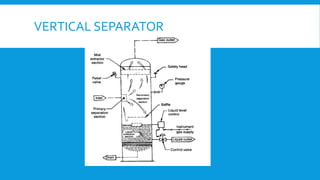
VERTICAL SEPARATOR
VERTICAL SEPARATOR
 Mainly useful for offshore wells because of limited space.
 Can handle foamy or sluggish fluid.
 Difficult to repair and clean.
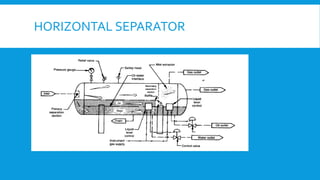
HORIZONTAL SEPARATOR
 Mailny used in onshore fields because they occupy large area.
 Can handle high flow rates.
 Easy to clean and maintain.
 Can handle foamy fluids,muds,slugs.
COMPONENTS OF SEPATATOR
 Separator has following main components :
 Primary Separation Section
 Baffles
 Oil Settling Section
 Water Drain Section
 Oil,Water and Gas outlets.
 Mist Extractor
PRIMARY SEPARATION SECTION
 Present at the entry to the separator.
 Most of the separation takes place here, as oil entering at high speed strikes
here,and oil,gas and water separate due to inertia.
OIL SETTLING SECTION
 Oil settles here, and gas, if present, separates from the top of the oil layer.
 At the bottom of this section, oil outlet pipe is present to extract separated oil and
is sent to transportation media.
BAFFLES
 Present between the oil and water settling section.
 Prevent backflow of fluids.
 Also separates particles with size between 140-300 microns.
MIST EXTRACTOR
 Present just before the gas outlet.
 Absorbs small oil molecules of size less than 140 microns.
 Categorised in 2 types:
 Mesh type
 Vein type

Oil and gas separators

  • 2.
    SEPARATORS  Used toseparate oil,gas and water.  Used for efficient transportation and storage of oil and gas,as they need to be stored separately.  Prevent corrosion in transportation media by the removal of salts,if present in water.  Two types based on the fluid flow:  2 phase separators (Oil+Water / Oil+Gas)  3 phase separators(Oil+Water+Gas)  Two types based on the arrangement :  Vertical Separatos  Horizontal Separators
  • 3.
  • 4.
    VERTICAL SEPARATOR  Mainlyuseful for offshore wells because of limited space.  Can handle foamy or sluggish fluid.  Difficult to repair and clean.
  • 5.
  • 6.
    HORIZONTAL SEPARATOR  Mailnyused in onshore fields because they occupy large area.  Can handle high flow rates.  Easy to clean and maintain.  Can handle foamy fluids,muds,slugs.
  • 7.
    COMPONENTS OF SEPATATOR Separator has following main components :  Primary Separation Section  Baffles  Oil Settling Section  Water Drain Section  Oil,Water and Gas outlets.  Mist Extractor
  • 8.
    PRIMARY SEPARATION SECTION Present at the entry to the separator.  Most of the separation takes place here, as oil entering at high speed strikes here,and oil,gas and water separate due to inertia.
  • 9.
    OIL SETTLING SECTION Oil settles here, and gas, if present, separates from the top of the oil layer.  At the bottom of this section, oil outlet pipe is present to extract separated oil and is sent to transportation media.
  • 10.
    BAFFLES  Present betweenthe oil and water settling section.  Prevent backflow of fluids.  Also separates particles with size between 140-300 microns.
  • 11.
    MIST EXTRACTOR  Presentjust before the gas outlet.  Absorbs small oil molecules of size less than 140 microns.  Categorised in 2 types:  Mesh type  Vein type