GOLD & GINA:
Updates in 2018 guidelines
Presenter: Dr Pranav Sopory
All India Institute of Medical Sciences
New Delhi
+91-9999491690
mdpharmacology@outlook.com
1
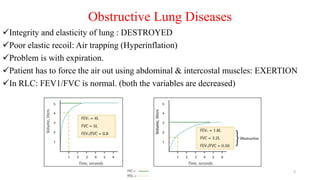
Obstructive Lung Diseases
Integrity and elasticity of lung : DESTROYED
Poor elastic recoil: Air trapping (Hyperinflation)
Problem is with expiration.
Patient has to force the air out using abdominal & intercostal muscles: EXERTION
In RLC: FEV1/FVC is normal. (both the variables are decreased)
2
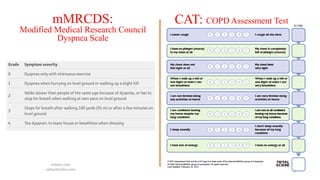
CAT: COPD Assessment Test
mdcalc.com
cattestonline.com
3
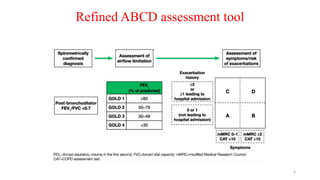
mMRCDS:
Modified Medical Research Council
Dyspnea Scale
Refined ABCD assessment tool
4
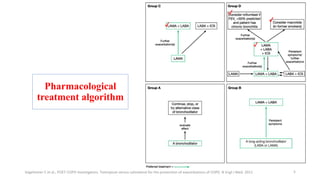
Pharmacological
treatment algorithm
Vogelmeier C et al., POET-COPD Investigators. Tiotropium versus salmeterol for the prevention of exacerbations of COPD. N Engl J Med. 2011 5
✓
✓
✓
✓
GOLD
• Launched in 1997 in collaboration with the NHLBI, NIH and WHO.
• Non-biased review of the current evidence for assessment, diagnosis
and treatment of patients with COPD that can aid the clinician.
Objectives
Recommend effective management and prevention strategies.
Increase awareness among medical community, health officials and the
general public
Decrease morbidity and mortality through implementation of effective
programs
6
Descriptive levels of Evidence
7
Evidence
category
Sources of Evidence
A • RCT with a rich body of data
B • RCT with a limited body of data
• Meta-analysis of RCTs
C • Non-randomized trials
• Observational studies
D • Panel Consensus Judgment
Updates in Pharmacotherapy in GOLD 2018
8
Current problems with drug administration
pMDI
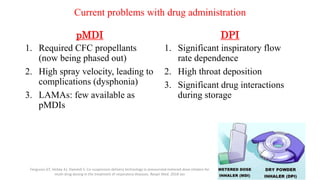
1. Required CFC propellants
(now being phased out)
2. High spray velocity, leading to
complications (dysphonia)
3. LAMAs: few available as
pMDIs
DPI
1. Significant inspiratory flow
rate dependence
2. High throat deposition
3. Significant drug interactions
during storage
Ferguson GT, Hickey AJ, Dwivedi S. Co-suspension delivery technology in pressurized metered-dose inhalers for
multi-drug dosing in the treatment of respiratory diseases. Respir Med. 2018 Jan
9
Co-suspension technique
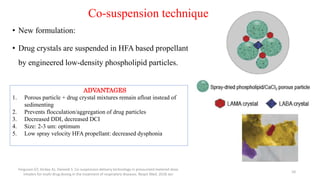
• New formulation:
• Drug crystals are suspended in HFA based propellant
by engineered low-density phospholipid particles.
Ferguson GT, Hickey AJ, Dwivedi S. Co-suspension delivery technology in pressurized metered-dose
inhalers for multi-drug dosing in the treatment of respiratory diseases. Respir Med. 2018 Jan
10
ADVANTAGES
1. Porous particle + drug crystal mixtures remain afloat instead of
sedimenting
2. Prevents flocculation/aggregation of drug particles
3. Decreased DDI, decreased DCI
4. Size: 2-3 um: optimum
5. Low spray velocity HFA propellant: decreased dysphonia
1. LABA+LAMA has greater improvement in quality of life
compared to placebo or its individual bronchodilator
components
Martinez FJ et al., Efficacy and Safety of Glycopyrrolate/Formoterol Metered Dose Inhaler Formulated
Using Co-Suspension Delivery Technology in Patients With COPD. Chest. 2017 Feb 11
LABA+LAMA combination
Martinez FJ et al., Efficacy and Safety of Glycopyrrolate/Formoterol Metered Dose Inhaler Formulated
Using Co-Suspension Delivery Technology in Patients With COPD. Chest. 2017 Feb 12
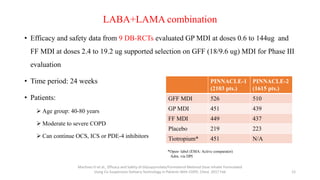
• Efficacy and safety data from 9 DB-RCTs evaluated GP MDI at doses 0.6 to 144ug and
FF MDI at doses 2.4 to 19.2 ug supported selection on GFF (18/9.6 ug) MDI for Phase III
evaluation
• Time period: 24 weeks
• Patients:
 Age group: 40-80 years
 Moderate to severe COPD
 Can continue OCS, ICS or PDE-4 inhibitors
PINNACLE-1
(2103 pts.)
PINNACLE-2
(1615 pts.)
GFF MDI 526 510
GP MDI 451 439
FF MDI 449 437
Placebo 219 223
Tiotropium* 451 N/A
*Open- label (EMA: Active comparator)
Adm. via DPI
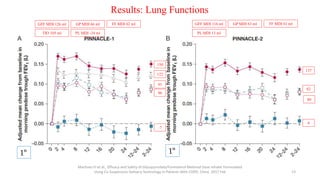
Results: Lung Functions
Martinez FJ et al., Efficacy and Safety of Glycopyrrolate/Formoterol Metered Dose Inhaler Formulated
Using Co-Suspension Delivery Technology in Patients With COPD. Chest. 2017 Feb 13
GFF MDI 126 ml GP MDI 66 ml FF MDI 62 ml
PL MDI -24 mlTIO 105 ml
GFF MDI 116 ml GP MDI 63 ml FF MDI 61 ml
PL MDI 13 ml
150
91
86
-7
122
137
80
8
82
1º 1º
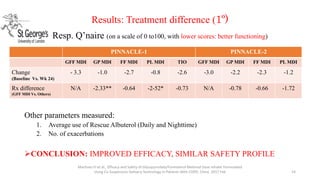
Results: Treatment difference (1º)
Martinez FJ et al., Efficacy and Safety of Glycopyrrolate/Formoterol Metered Dose Inhaler Formulated
Using Co-Suspension Delivery Technology in Patients With COPD. Chest. 2017 Feb 14
Resp. Q’naire (on a scale of 0 to100, with lower scores: better functioning)
Other parameters measured:
1. Average use of Rescue Albuterol (Daily and Nighttime)
2. No. of exacerbations
CONCLUSION: IMPROVED EFFICACY, SIMILAR SAFETY PROFILE
PINNACLE-1 PINNACLE-2
GFF MDI GP MDI FF MDI PL MDI TIO GFF MDI GP MDI FF MDI PL MDI
Change
(Baseline Vs. Wk 24)
- 3.3 -1.0 -2.7 -0.8 -2.6 -3.0 -2.2 -2.3 -1.2
Rx difference
(GFF MDI Vs. Others)
N/A -2.33** -0.64 -2-52* -0.73 N/A -0.78 -0.66 -1.72
2. Double blind RCT reported benefits of single-inhaler triple therapy
compared with ICS/LABA therapy in patients with advanced COPD
Lipson DA et al., FULFIL Trial: Once-Daily Triple Therapy for Patients with Chronic
Obstructive Pulmonary Disease. Am J Respir Crit Care Med. 2017 Aug 15
FULFIL: Lung Function and Quality of Life Assessment in COPD with Closed Triple Therapy
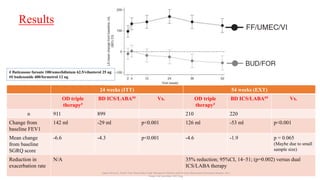
Results
16
24 weeks (ITT) 54 weeks (EXT)
OD triple
therapy#
BD ICS/LABA## Vs. OD triple
therapy#
BD ICS/LABA## Vs.
n 911 899 210 220
Change from
baseline FEV1
142 ml -29 ml p<0.001 126 ml -53 ml p<0.001
Mean change
from baseline
SGRQ score
-6.6 -4.3 p<0.001 -4.6 -1.9 p = 0.065
(Maybe due to small
sample size)
Reduction in
exacerbation rate
N/A 35% reduction; 95%CI, 14–51; (p=0.002) versus dual
ICS/LABA therapy
Lipson DA et al., FULFIL Trial: Once-Daily Triple Therapy for Patients with Chronic Obstructive Pulmonary Disease. Am J
Respir Crit Care Med. 2017 Aug
# fluticasone furoate 100/umeclidinium 62.5/vilanterol 25 ug
## budesonide 400/formetrol 12 ug
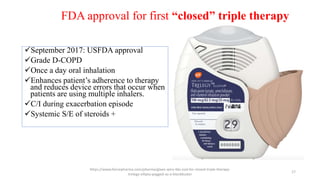
September 2017: USFDA approval
Grade D-COPD
Once a day oral inhalation
Enhances patient’s adherence to therapy
and reduces device errors that occur when
patients are using multiple inhalers.
C/I during exacerbation episode
Systemic S/E of steroids +
https://www.fiercepharma.com/pharma/glaxo-wins-fda-nod-for-closed-triple-therapy-
trelegy-ellipta-pegged-as-a-blockbuster
17
FDA approval for first “closed” triple therapy
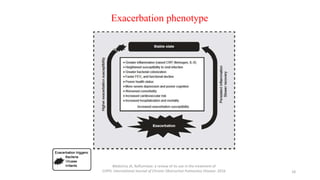
Exacerbation phenotype
Wedzicha JA, Roflumilast: a review of its use in the treatment of
COPD. International Journal of Chronic Obstructive Pulmonary Disease. 2016 18
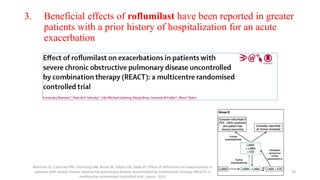
3. Beneficial effects of roflumilast have been reported in greater
patients with a prior history of hospitalization for an acute
exacerbation
Martinez FJ, Calverley PM, Goehring UM, Brose M, Fabbri LM, Rabe KF. Effect of roflumilast on exacerbations in
patients with severe chronic obstructive pulmonary disease uncontrolled by combination therapy (REACT): a
multicentre randomised controlled trial. Lancet. 2015
19
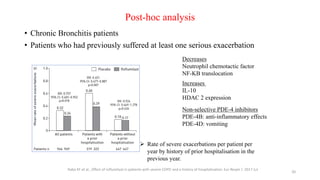
Post-hoc analysis
• Chronic Bronchitis patients
• Patients who had previously suffered at least one serious exacerbation
Rabe KF et al., Effect of roflumilast in patients with severe COPD and a history of hospitalisation. Eur Respir J. 2017 Jul
20
 Rate of severe exacerbations per patient per
year by history of prior hospitalisation in the
previous year.
Decreases
Neutrophil chemotactic factor
NF-KB translocation
Non-selective PDE-4 inhibitors
PDE-4B: anti-inflammatory effects
PDE-4D: vomiting
Increases
IL-10
HDAC 2 expression
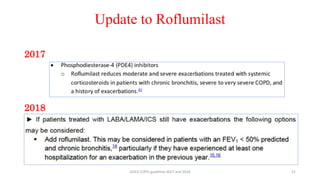
Update to Roflumilast
2017
2018
GOLD COPD guideline 2017 and 2018 21
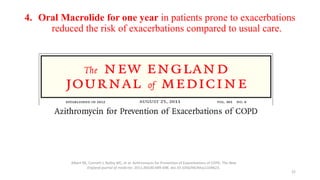
4. Oral Macrolide for one year in patients prone to exacerbations
reduced the risk of exacerbations compared to usual care.
Albert RK, Connett J, Bailey WC, et al. Azithromycin for Prevention of Exacerbations of COPD. The New
England journal of medicine. 2011;365(8):689-698. doi:10.1056/NEJMoa1104623.
22
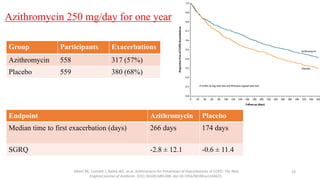
Azithromycin 250 mg/day for one year
Albert RK, Connett J, Bailey WC, et al. Azithromycin for Prevention of Exacerbations of COPD. The New
England journal of medicine. 2011;365(8):689-698. doi:10.1056/NEJMoa1104623.
23
Endpoint Azithromycin Placebo
Median time to first exacerbation (days) 266 days 174 days
SGRQ -2.8 ± 12.1 -0.6 ± 11.4
Group Participants Exacerbations
Azithromycin 558 317 (57%)
Placebo 559 380 (68%)
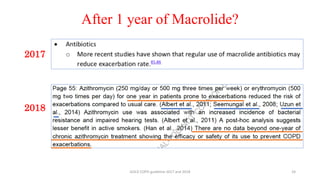
After 1 year of Macrolide?
2017
2018
GOLD COPD guideline 2017 and 2018 24
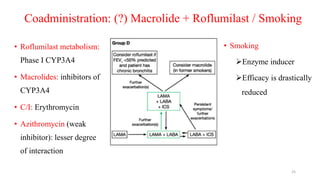
Coadministration: (?) Macrolide + Roflumilast / Smoking
• Roflumilast metabolism:
Phase I CYP3A4
• Macrolides: inhibitors of
CYP3A4
• C/I: Erythromycin
• Azithromycin (weak
inhibitor): lesser degree
of interaction
25
• Smoking
Enzyme inducer
Efficacy is drastically
reduced
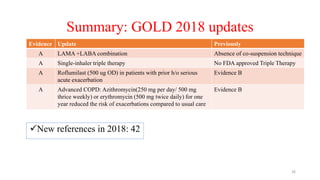
Summary: GOLD 2018 updates
New references in 2018: 42
26
Evidence Update Previously
A LAMA +LABA combination Absence of co-suspension technique
A Single-inhaler triple therapy No FDA approved Triple Therapy
A Roflumilast (500 ug OD) in patients with prior h/o serious
acute exacerbation
Evidence B
A Advanced COPD: Azithromycin(250 mg per day/ 500 mg
thrice weekly) or erythromycin (500 mg twice daily) for one
year reduced the risk of exacerbations compared to usual care
Evidence B
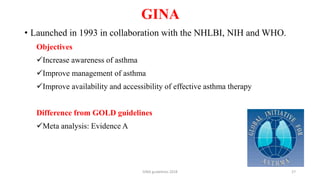
GINA
GINA guidelines 2018 27
• Launched in 1993 in collaboration with the NHLBI, NIH and WHO.
Objectives
Increase awareness of asthma
Improve management of asthma
Improve availability and accessibility of effective asthma therapy
Difference from GOLD guidelines
Meta analysis: Evidence A
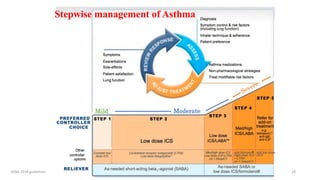
GINA 2018 guidelines 28
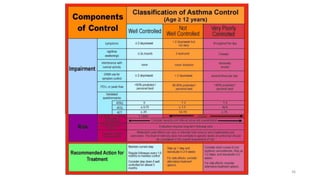
Stepwise management of Asthma
Mild Moderate
29
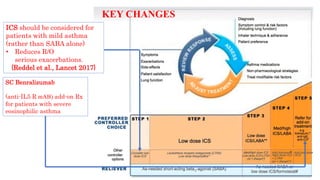
KEY CHANGES
ICS should be considered for
patients with mild asthma
(rather than SABA alone)
• Reduces R/O
serious exacerbations.
{Reddel et al., Lancet 2017}
SC Benralizumab
(anti-IL5 R mAB) add-on Rx
for patients with severe
eosinophilic asthma
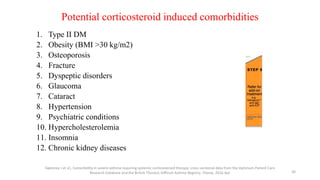
Potential corticosteroid induced comorbidities
1. Type II DM
2. Obesity (BMI >30 kg/m2)
3. Osteoporosis
4. Fracture
5. Dyspeptic disorders
6. Glaucoma
7. Cataract
8. Hypertension
9. Psychiatric conditions
10. Hypercholesterolemia
11. Insomnia
12. Chronic kidney diseases
Sweeney J et al., Comorbidity in severe asthma requiring systemic corticosteroid therapy: cross-sectional data from the Optimum Patient Care
Research Database and the British Thoracic Difficult Asthma Registry. Thorax. 2016 Apr 30
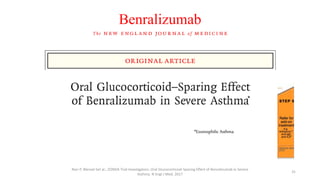
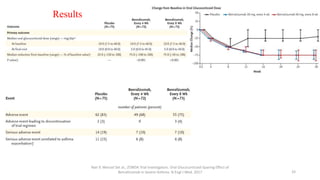
Benralizumab
Nair P, Wenzel Set al.; ZONDA Trial Investigators. Oral Glucocorticoid-Sparing Effect of Benralizumab in Severe
Asthma. N Engl J Med. 2017
31
*Eosinophilic Asthma
*
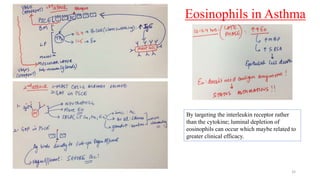
Eosinophils in Asthma
32
By targeting the interleukin receptor rather
than the cytokine; luminal depletion of
eosinophils can occur which maybe related to
greater clinical efficacy.
Nair P, Wenzel Set al.; ZONDA Trial Investigators. Oral Glucocorticoid-Sparing Effect of
Benralizumab in Severe Asthma. N Engl J Med. 2017 33
Results
Other key updates: GINA 2018
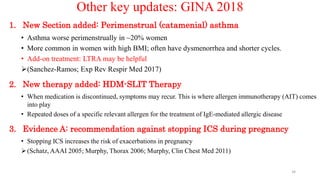
1. New Section added: Perimenstrual (catamenial) asthma
• Asthma worse perimenstrually in ~20% women
• More common in women with high BMI; often have dysmenorrhea and shorter cycles.
• Add-on treatment: LTRA may be helpful
(Sanchez-Ramos; Exp Rev Respir Med 2017)
2. New therapy added: HDM-SLIT Therapy
• When medication is discontinued, symptoms may recur. This is where allergen immunotherapy (AIT) comes
into play
• Repeated doses of a specific relevant allergen for the treatment of IgE-mediated allergic disease

3. Evidence A: recommendation against stopping ICS during pregnancy
• Stopping ICS increases the risk of exacerbations in pregnancy
(Schatz, AAAI 2005; Murphy, Thorax 2006; Murphy, Clin Chest Med 2011)
34
To sum up,
1. Quality of life (QoL)
2. EBM
3. Road to future discoveries
35
36
Thank You
37

GOLD (COPD) & GINA (Asthma) guidelines: 2018 update

  • 1.
    GOLD & GINA: Updatesin 2018 guidelines Presenter: Dr Pranav Sopory All India Institute of Medical Sciences New Delhi +91-9999491690 mdpharmacology@outlook.com 1
  • 2.
    Obstructive Lung Diseases Integrityand elasticity of lung : DESTROYED Poor elastic recoil: Air trapping (Hyperinflation) Problem is with expiration. Patient has to force the air out using abdominal & intercostal muscles: EXERTION In RLC: FEV1/FVC is normal. (both the variables are decreased) 2
  • 3.
    CAT: COPD AssessmentTest mdcalc.com cattestonline.com 3 mMRCDS: Modified Medical Research Council Dyspnea Scale
  • 4.
  • 5.
    Pharmacological treatment algorithm Vogelmeier Cet al., POET-COPD Investigators. Tiotropium versus salmeterol for the prevention of exacerbations of COPD. N Engl J Med. 2011 5 ✓ ✓ ✓ ✓
  • 6.
    GOLD • Launched in1997 in collaboration with the NHLBI, NIH and WHO. • Non-biased review of the current evidence for assessment, diagnosis and treatment of patients with COPD that can aid the clinician. Objectives Recommend effective management and prevention strategies. Increase awareness among medical community, health officials and the general public Decrease morbidity and mortality through implementation of effective programs 6
  • 7.
    Descriptive levels ofEvidence 7 Evidence category Sources of Evidence A • RCT with a rich body of data B • RCT with a limited body of data • Meta-analysis of RCTs C • Non-randomized trials • Observational studies D • Panel Consensus Judgment
  • 8.
  • 9.
    Current problems withdrug administration pMDI 1. Required CFC propellants (now being phased out) 2. High spray velocity, leading to complications (dysphonia) 3. LAMAs: few available as pMDIs DPI 1. Significant inspiratory flow rate dependence 2. High throat deposition 3. Significant drug interactions during storage Ferguson GT, Hickey AJ, Dwivedi S. Co-suspension delivery technology in pressurized metered-dose inhalers for multi-drug dosing in the treatment of respiratory diseases. Respir Med. 2018 Jan 9
  • 10.
    Co-suspension technique • Newformulation: • Drug crystals are suspended in HFA based propellant by engineered low-density phospholipid particles. Ferguson GT, Hickey AJ, Dwivedi S. Co-suspension delivery technology in pressurized metered-dose inhalers for multi-drug dosing in the treatment of respiratory diseases. Respir Med. 2018 Jan 10 ADVANTAGES 1. Porous particle + drug crystal mixtures remain afloat instead of sedimenting 2. Prevents flocculation/aggregation of drug particles 3. Decreased DDI, decreased DCI 4. Size: 2-3 um: optimum 5. Low spray velocity HFA propellant: decreased dysphonia
  • 11.
    1. LABA+LAMA hasgreater improvement in quality of life compared to placebo or its individual bronchodilator components Martinez FJ et al., Efficacy and Safety of Glycopyrrolate/Formoterol Metered Dose Inhaler Formulated Using Co-Suspension Delivery Technology in Patients With COPD. Chest. 2017 Feb 11
  • 12.
    LABA+LAMA combination Martinez FJet al., Efficacy and Safety of Glycopyrrolate/Formoterol Metered Dose Inhaler Formulated Using Co-Suspension Delivery Technology in Patients With COPD. Chest. 2017 Feb 12 • Efficacy and safety data from 9 DB-RCTs evaluated GP MDI at doses 0.6 to 144ug and FF MDI at doses 2.4 to 19.2 ug supported selection on GFF (18/9.6 ug) MDI for Phase III evaluation • Time period: 24 weeks • Patients:  Age group: 40-80 years  Moderate to severe COPD  Can continue OCS, ICS or PDE-4 inhibitors PINNACLE-1 (2103 pts.) PINNACLE-2 (1615 pts.) GFF MDI 526 510 GP MDI 451 439 FF MDI 449 437 Placebo 219 223 Tiotropium* 451 N/A *Open- label (EMA: Active comparator) Adm. via DPI
  • 13.
    Results: Lung Functions MartinezFJ et al., Efficacy and Safety of Glycopyrrolate/Formoterol Metered Dose Inhaler Formulated Using Co-Suspension Delivery Technology in Patients With COPD. Chest. 2017 Feb 13 GFF MDI 126 ml GP MDI 66 ml FF MDI 62 ml PL MDI -24 mlTIO 105 ml GFF MDI 116 ml GP MDI 63 ml FF MDI 61 ml PL MDI 13 ml 150 91 86 -7 122 137 80 8 82 1º 1º
  • 14.
    Results: Treatment difference(1º) Martinez FJ et al., Efficacy and Safety of Glycopyrrolate/Formoterol Metered Dose Inhaler Formulated Using Co-Suspension Delivery Technology in Patients With COPD. Chest. 2017 Feb 14 Resp. Q’naire (on a scale of 0 to100, with lower scores: better functioning) Other parameters measured: 1. Average use of Rescue Albuterol (Daily and Nighttime) 2. No. of exacerbations CONCLUSION: IMPROVED EFFICACY, SIMILAR SAFETY PROFILE PINNACLE-1 PINNACLE-2 GFF MDI GP MDI FF MDI PL MDI TIO GFF MDI GP MDI FF MDI PL MDI Change (Baseline Vs. Wk 24) - 3.3 -1.0 -2.7 -0.8 -2.6 -3.0 -2.2 -2.3 -1.2 Rx difference (GFF MDI Vs. Others) N/A -2.33** -0.64 -2-52* -0.73 N/A -0.78 -0.66 -1.72
  • 15.
    2. Double blindRCT reported benefits of single-inhaler triple therapy compared with ICS/LABA therapy in patients with advanced COPD Lipson DA et al., FULFIL Trial: Once-Daily Triple Therapy for Patients with Chronic Obstructive Pulmonary Disease. Am J Respir Crit Care Med. 2017 Aug 15 FULFIL: Lung Function and Quality of Life Assessment in COPD with Closed Triple Therapy
  • 16.
    Results 16 24 weeks (ITT)54 weeks (EXT) OD triple therapy# BD ICS/LABA## Vs. OD triple therapy# BD ICS/LABA## Vs. n 911 899 210 220 Change from baseline FEV1 142 ml -29 ml p<0.001 126 ml -53 ml p<0.001 Mean change from baseline SGRQ score -6.6 -4.3 p<0.001 -4.6 -1.9 p = 0.065 (Maybe due to small sample size) Reduction in exacerbation rate N/A 35% reduction; 95%CI, 14–51; (p=0.002) versus dual ICS/LABA therapy Lipson DA et al., FULFIL Trial: Once-Daily Triple Therapy for Patients with Chronic Obstructive Pulmonary Disease. Am J Respir Crit Care Med. 2017 Aug # fluticasone furoate 100/umeclidinium 62.5/vilanterol 25 ug ## budesonide 400/formetrol 12 ug
  • 17.
    September 2017: USFDAapproval Grade D-COPD Once a day oral inhalation Enhances patient’s adherence to therapy and reduces device errors that occur when patients are using multiple inhalers. C/I during exacerbation episode Systemic S/E of steroids + https://www.fiercepharma.com/pharma/glaxo-wins-fda-nod-for-closed-triple-therapy- trelegy-ellipta-pegged-as-a-blockbuster 17 FDA approval for first “closed” triple therapy
  • 18.
    Exacerbation phenotype Wedzicha JA,Roflumilast: a review of its use in the treatment of COPD. International Journal of Chronic Obstructive Pulmonary Disease. 2016 18
  • 19.
    3. Beneficial effectsof roflumilast have been reported in greater patients with a prior history of hospitalization for an acute exacerbation Martinez FJ, Calverley PM, Goehring UM, Brose M, Fabbri LM, Rabe KF. Effect of roflumilast on exacerbations in patients with severe chronic obstructive pulmonary disease uncontrolled by combination therapy (REACT): a multicentre randomised controlled trial. Lancet. 2015 19
  • 20.
    Post-hoc analysis • ChronicBronchitis patients • Patients who had previously suffered at least one serious exacerbation Rabe KF et al., Effect of roflumilast in patients with severe COPD and a history of hospitalisation. Eur Respir J. 2017 Jul 20  Rate of severe exacerbations per patient per year by history of prior hospitalisation in the previous year. Decreases Neutrophil chemotactic factor NF-KB translocation Non-selective PDE-4 inhibitors PDE-4B: anti-inflammatory effects PDE-4D: vomiting Increases IL-10 HDAC 2 expression
  • 21.
    Update to Roflumilast 2017 2018 GOLDCOPD guideline 2017 and 2018 21
  • 22.
    4. Oral Macrolidefor one year in patients prone to exacerbations reduced the risk of exacerbations compared to usual care. Albert RK, Connett J, Bailey WC, et al. Azithromycin for Prevention of Exacerbations of COPD. The New England journal of medicine. 2011;365(8):689-698. doi:10.1056/NEJMoa1104623. 22
  • 23.
    Azithromycin 250 mg/dayfor one year Albert RK, Connett J, Bailey WC, et al. Azithromycin for Prevention of Exacerbations of COPD. The New England journal of medicine. 2011;365(8):689-698. doi:10.1056/NEJMoa1104623. 23 Endpoint Azithromycin Placebo Median time to first exacerbation (days) 266 days 174 days SGRQ -2.8 ± 12.1 -0.6 ± 11.4 Group Participants Exacerbations Azithromycin 558 317 (57%) Placebo 559 380 (68%)
  • 24.
    After 1 yearof Macrolide? 2017 2018 GOLD COPD guideline 2017 and 2018 24
  • 25.
    Coadministration: (?) Macrolide+ Roflumilast / Smoking • Roflumilast metabolism: Phase I CYP3A4 • Macrolides: inhibitors of CYP3A4 • C/I: Erythromycin • Azithromycin (weak inhibitor): lesser degree of interaction 25 • Smoking Enzyme inducer Efficacy is drastically reduced
  • 26.
    Summary: GOLD 2018updates New references in 2018: 42 26 Evidence Update Previously A LAMA +LABA combination Absence of co-suspension technique A Single-inhaler triple therapy No FDA approved Triple Therapy A Roflumilast (500 ug OD) in patients with prior h/o serious acute exacerbation Evidence B A Advanced COPD: Azithromycin(250 mg per day/ 500 mg thrice weekly) or erythromycin (500 mg twice daily) for one year reduced the risk of exacerbations compared to usual care Evidence B
  • 27.
    GINA GINA guidelines 201827 • Launched in 1993 in collaboration with the NHLBI, NIH and WHO. Objectives Increase awareness of asthma Improve management of asthma Improve availability and accessibility of effective asthma therapy Difference from GOLD guidelines Meta analysis: Evidence A
  • 28.
    GINA 2018 guidelines28 Stepwise management of Asthma Mild Moderate
  • 29.
    29 KEY CHANGES ICS shouldbe considered for patients with mild asthma (rather than SABA alone) • Reduces R/O serious exacerbations. {Reddel et al., Lancet 2017} SC Benralizumab (anti-IL5 R mAB) add-on Rx for patients with severe eosinophilic asthma
  • 30.
    Potential corticosteroid inducedcomorbidities 1. Type II DM 2. Obesity (BMI >30 kg/m2) 3. Osteoporosis 4. Fracture 5. Dyspeptic disorders 6. Glaucoma 7. Cataract 8. Hypertension 9. Psychiatric conditions 10. Hypercholesterolemia 11. Insomnia 12. Chronic kidney diseases Sweeney J et al., Comorbidity in severe asthma requiring systemic corticosteroid therapy: cross-sectional data from the Optimum Patient Care Research Database and the British Thoracic Difficult Asthma Registry. Thorax. 2016 Apr 30
  • 31.
    Benralizumab Nair P, WenzelSet al.; ZONDA Trial Investigators. Oral Glucocorticoid-Sparing Effect of Benralizumab in Severe Asthma. N Engl J Med. 2017 31 *Eosinophilic Asthma *
  • 32.
    Eosinophils in Asthma 32 Bytargeting the interleukin receptor rather than the cytokine; luminal depletion of eosinophils can occur which maybe related to greater clinical efficacy.
  • 33.
    Nair P, WenzelSet al.; ZONDA Trial Investigators. Oral Glucocorticoid-Sparing Effect of Benralizumab in Severe Asthma. N Engl J Med. 2017 33 Results
  • 34.
    Other key updates:GINA 2018 1. New Section added: Perimenstrual (catamenial) asthma • Asthma worse perimenstrually in ~20% women • More common in women with high BMI; often have dysmenorrhea and shorter cycles. • Add-on treatment: LTRA may be helpful (Sanchez-Ramos; Exp Rev Respir Med 2017) 2. New therapy added: HDM-SLIT Therapy • When medication is discontinued, symptoms may recur. This is where allergen immunotherapy (AIT) comes into play • Repeated doses of a specific relevant allergen for the treatment of IgE-mediated allergic disease 3. Evidence A: recommendation against stopping ICS during pregnancy • Stopping ICS increases the risk of exacerbations in pregnancy (Schatz, AAAI 2005; Murphy, Thorax 2006; Murphy, Clin Chest Med 2011) 34
  • 35.
    To sum up, 1.Quality of life (QoL) 2. EBM 3. Road to future discoveries 35
  • 36.
  • 37.

Editor's Notes

  • #8 Category A: Rich body of data: substantial number of studies involving a substantial number of participants Category B: limited number of patients, post-hoc or subgroup analysis of RCTs, meta-analysis of RCTs
  • #21 Moderate exacerbations were defined as those requiring treatment with systemic steroids. Severe exacerbations were defined as those that led to hospital admission and/or death.
  • #30 Step 1: No night awakening symptoms No exacerbation in the last 1 year
  • #36 Qulaity of life (QoL) is the end-point around which newer therapeutic targets are being designed. Mimics Rx guidelines for other chronic diseases: HTN, diabetes & cancer. GOLD & GINA reinforce our “faith” in EBM. ICS: forms the basis of therapy in Asthma is C/I as a single agent in COPD due to fatal pneumonia. Theophylline (non-selective PDE #) removed from Rx protocol – No effect on exacerbation rates and minor Bd effect at near toxic doses Road to future discoveries: Inventing newer formulations (e.g. HFA-propellant based co-suspension) Aiming newer therapeutic targets (e.e.IL-5⍺ R)