C
O
P
D
R
E
C
E
N
T
2
0
2
0
Parthiv MEHTA
parthivmehta@hotmail.com
C
O
P
D
R
E
C
E
N
T
2
0
2
0
C
O
P
D
R
E
C
E
N
T
2
0
2
0
C
O
P
D
R
E
C
E
N
T
2
0
2
0
C
O
P
D
R
E
C
E
N
T
2
0
2
0
C
O
P
D
R
E
C
E
N
T
2
0
2
0
C
O
P
D
R
E
C
E
N
T
2
0
2
0
C
O
P
D
R
E
C
E
N
T
2
0
2
0
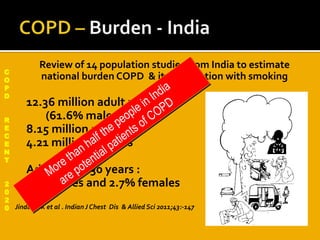
 Review of 14 population studies from India to estimate
national burden COPD & its association with smoking
 12.36 million adult patients
(61.6% males)
 8.15 million males
 4.21 million females
 Adults over 30 years :
5% males and 2.7% females
Jindal S K et al . IndianJ Chest Dis & Allied Sci 2011;43:-147
C
O
P
D
R
E
C
E
N
T
2
0
2
0
 Review of 14 population studies from India to estimate
national burden COPD & its association with smoking
 12.36 million adult patients
(61.6% males)
 8.15 million males
 4.21 million females
 Adults over 30 years :
5% males and 2.7% females
Jindal S K et al . IndianJ Chest Dis & Allied Sci 2011;43:-147
C
O
P
D
R
E
C
E
N
T
2
0
2
0
C
O
P
D
R
E
C
E
N
T
2
0
2
0
C
O
P
D
R
E
C
E
N
T
2
0
2
0
C
O
P
D
R
E
C
E
N
T
2
0
2
0
C
O
P
D
R
E
C
E
N
T
2
0
2
0
C
O
P
D
R
E
C
E
N
T
2
0
2
0
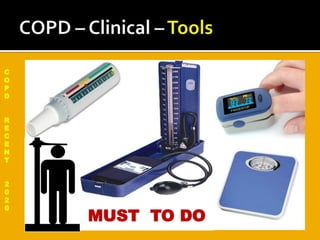
MUST TO DO
C
O
P
D
R
E
C
E
N
T
2
0
2
0
C
O
P
D
R
E
C
E
N
T
2
0
2
0
C
O
P
D
R
E
C
E
N
T
2
0
2
0
“Recent -1”
C
O
P
D
R
E
C
E
N
T
2
0
2
0
 C O P D : Persistent Symptoms
 FEV1 / FVC - </= 70%
 Poor Reversibility
 Neutrophilic Inflammation
 (Bronchial and systemic)
 ASTHMA: Intermittent Symptoms
 Reversible Obstruction
 Eosinophilic Inflammation (Bronchial)
 A C O S : Persistent Symptoms
 More response to bronchodilators
 Increased reversibility
 Eosinophilic inflammation
 (Bronchial and systemic)
C
O
P
D
R
E
C
E
N
T
2
0
2
0
 C O P D : Persistent Symptoms
 FEV1 / FVC - </= 70%
 Poor Reversibility
 Neutrophilic Inflammation
 (Bronchial and systemic)
 ASTHMA: Intermittent Symptoms
 Reversible Obstruction
 Eosinophilic Inflammation (Bronchial)
 A C O S : Persistent Symptoms
 More response to bronchodilators
 Increased reversibility
 Eosinophilic inflammation
 (Bronchial and systemic)
“Recent - 2”
C
O
P
D
R
E
C
E
N
T
2
0
2
0
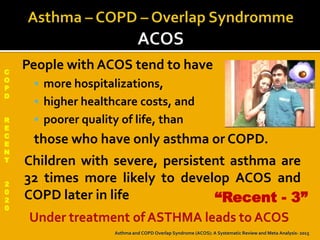
People with ACOS tend to have
 more hospitalizations,
 higher healthcare costs, and
 poorer quality of life, than
those who have only asthma or COPD.
Children with severe, persistent asthma are
32 times more likely to develop ACOS and
COPD later in life “Recent - 3”
Asthma and COPD Overlap Syndrome (ACOS): A Systematic Review and Meta Analysis- 2015
C
O
P
D
R
E
C
E
N
T
2
0
2
0
50%
C
O
P
D
R
E
C
E
N
T
2
0
2
0
C
O
P
D
R
E
C
E
N
T
2
0
2
0
C
O
P
D
R
E
C
E
N
T
2
0
2
0
C
O
P
D
R
E
C
E
N
T
2
0
2
0
C
O
P
D
R
E
C
E
N
T
2
0
2
0
C
O
P
D
R
E
C
E
N
T
2
0
2
0
C
O
P
D
R
E
C
E
N
T
2
0
2
0
C
O
P
D
R
E
C
E
N
T
2
0
2
0
 LABAs are more effective than LAMAs if we
consider symptoms or health-related
quality of life (HRQOL) as the primary
outcome
 In the symptomatic patient, there is no
substantial difference between LABAs or
LAMAs
 Whereas in frequent exacerbators, it seems
preferable to use a LAMA.
Rodrigo GJ et al; Comparison of Indacaterol withTiotropium or twice-daily long-acting β -agonists for stable COPD: a
systematic review. Chest. 2012;142(5):1104–10.
C
O
P
D
R
E
C
E
N
T
2
0
2
0
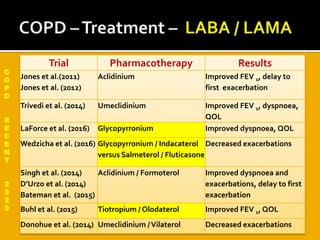
Trial Pharmacotherapy Results
Jones et al.(2011)
Jones et al. (2012)
Aclidinium Improved FEV 1, delay to
first exacerbation
Trivedi et al. (2014) Umeclidinium Improved FEV 1, dyspnoea,
QOL
LaForce et al. (2016) Glycopyrronium Improved dyspnoea, QOL
Wedzicha et al. (2016) Glycopyrronium / Indacaterol
versus Salmeterol / Fluticasone
Decreased exacerbations
Singh et al. (2014)
D’Urzo et al. (2014)
Bateman et al. (2015)
Aclidinium / Formoterol Improved dyspnoea and
exacerbations, delay to first
exacerbation
Buhl et al. (2015) Tiotropium / Olodaterol Improved FEV 1, QOL
Donohue et al. (2014) Umeclidinium /Vilaterol Decreased exacerbations
C
O
P
D
R
E
C
E
N
T
2
0
2
0
Trial Pharmacotherapy Results
Jones et al.(2011)
Jones et al. (2012)
Aclidinium Improved FEV 1, delay to
first exacerbation
Trivedi et al. (2014) Umeclidinium Improved FEV 1, dyspnoea,
QOL
LaForce et al. (2016) Glycopyrronium Improved dyspnoea, QOL
Wedzicha et al. (2016) Glycopyrronium / Indacaterol
versus Salmeterol / Fluticasone
Decreased exacerbations
Singh et al. (2014)
D’Urzo et al. (2014)
Bateman et al. (2015)
Aclidinium / Formoterol Improved dyspnoea and
exacerbations, delay to first
exacerbation
Buhl et al. (2015) Tiotropium / Olodaterol Improved FEV 1, QOL
Donohue et al. (2014) Umeclidinium /Vilaterol Decreased exacerbations
C
O
P
D
R
E
C
E
N
T
2
0
2
0
Tiotropium was the only globally available ultra LAMA
Glycopyrronium - GEM 1 and 2 studies (Glycopyrrolate Effect on
Symptoms and Lung Function) show improvements in FEV1 ,
dyspnoea, QOL scores, and rescue medication use in patients
with moderate to severe airflow limitation
 In studies, the nebulized LAMA formulation was reported to be
safe and well tolerated, and there were no significant changes in
cardiovascular signs and electrocardiography parameters
 There was a dose-related and clinically significant improvement in
FEV1 following nebulized Glycopyrrolate
 Availability of a nebulized LAMA greatly complement the
currently available nebulized LABA medications ( Formoterol).
 Overwhelming majority were satisfied with traditional
nebulization therapy, reporting benefits in symptom relief,
ease of use, and improved QOL
LaForce C et al. : Efficacy and safety of twice-daily Glycopyrrolate in patients with stable, symptomatic COPD with moderate-
to-severe airflow limitation: the GEM1 study. Int J Chron Obstruct Pulmon Dis. 2016;11(1):1233–43.
C
O
P
D
R
E
C
E
N
T
2
0
2
0
 In patients with moderate COPD and no
prior exacerbation history - switching from
a fixed-dose combination of ICS/LABA to a
LABA was not associated with any
differences in lung function, symptoms,
health status, and exacerbations
INSTEAD: a randomised switch trial of Indacaterol versus Salmeterol / Fluticasone
in moderate COPD. Eur Respir J. 2014;44(6):1548–56.
“Recent -4”
C
O
P
D
R
E
C
E
N
T
2
0
2
0
Indacaterol is an once-daily LABA with a rapid onset of action
(within 5 minutes), a peak effect at approximately 3 hours,
and a duration of bronchodilatation lasting at least 24 hours.
Once-daily dosing improves adherence.
It provides a level of bronchodilatation that is similar to
Tiotropium but greater than the twice-daily agents,
Formoterol and Salmeterol.
Indacaterol has a good safety profile.
Indacaterol is an effective and beneficial maintenance
bronchodilator treatment for patients with moderate-to-
severe COPD.
Indacaterol would be a reasonable first choice for
maintenance bronchodilator therapy.
“Recent -5”
C
O
P
D
R
E
C
E
N
T
2
0
2
0
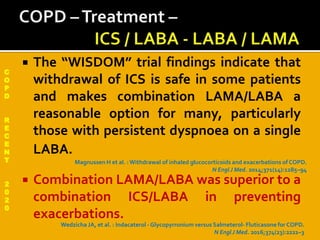
 The “WISDOM” trial findings indicate that
withdrawal of ICS is safe in some patients
and makes combination LAMA/LABA a
reasonable option for many, particularly
those with persistent dyspnoea on a single
LABA.
 Combination LAMA/LABA was superior to a
combination ICS/LABA in preventing
exacerbations.
Wedzicha JA, et al. : Indacaterol - Glycopyrronium versus Salmeterol- Fluticasone for COPD.
N EnglJ Med. 2016;374(23):2222–3
Magnussen H et al. : Withdrawal of inhaled glucocorticoids and exacerbations of COPD.
N EnglJ Med. 2014;371(14):1285–94
C
O
P
D
R
E
C
E
N
T
2
0
2
0
 Glycopyrronium / Indacaterol reduced the
rate of mild to severe COPD exacerbations
by 11% compared with Fluticasone /
Salmeterol over the 52-week trial and was
associated with slightly fewer episodes of
pneumonia
Wedzicha JA, Banerji D, Chapman KR, et al. : Indacaterol-Glycopyrronium versus Salmeterol-Fluticasone for COPD. N
EnglJ Med. 2016;374(23):2222–34.
COPD OUTCOMES ARE SLOW TO COME UP –
NEED TO WAIT FOR 6 – 12 MONTHS ATLEAST!
C
O
P
D
R
E
C
E
N
T
2
0
2
0
 Phase III results from the KRONOS trial and
TRIBUTE trial, showed treatment with the
fixed-dose combination of Budesonide,
Glycopyrrolate, and Formoterol to be
associated with improved lung function and
reduced exacerbations.
Alberto Papi et al; Extra fine inhaled triple therapy versus dual bronchodilator therapy in chronic obstructive pulmonary disease
(TRIBUTE): a double-blind, parallel group, randomised controlled trial.The Lancet, 391, 10125, 1076-1084, March 2018
Gary T Ferguson et al; Triple therapy with Budesonide / Glycopyrrolate / Formoterol Fumarate with co-suspension delivery
technology versus dual therapies in chronic obstructive pulmonary disease (KRONOS): a double-blind, parallel-group,
multicentre, phase 3 randomised controlled trial.The Lancet,Volume 6, 10, 747-758, October 2018
The pneumonia rate was more than 50% higher in the patients
receiving the triple therapy than in patients receiving the
LABA / LAMA combination D.A. Lipson et al, Once-Daily Single-InhalerTriple versus DualTherapy
in Patients with COPD N Engl J Med 2018; 378:1671-1680
C
O
P
D
R
E
C
E
N
T
2
0
2
0
 In the SUNSET study,
 COPD patients without a high Eosinophil burden who
were doing well on triple therapy had no increase in
exacerbations when switched to step-down
treatment with the dual-bronchodilator therapy
Indacaterol / Glycopyrronium
 Patients in with consistent blood Eosinophil counts of
300 μl or above, however, showed significant declines
in lung function and increased risk for exacerbation
on the fixed-dose dual therapy, suggesting they are
more likely to benefit from continued triple therapy.
Chapman KR et al; Long-Term Triple Therapy De-escalation to Indacaterol/Glycopyrronium in Patients with Chronic Obstructive
Pulmonary Disease (SUNSET): A Randomized, Double-Blind, Triple-Dummy Clinical Trial. Am J Respir Crit Care Med.
2018Aug 1;198(3):329-339.
C
O
P
D
R
E
C
E
N
T
2
0
2
0
 Triple Combination is indicated for COPD
patients with bronchitis and/or emphysema
whose disease is not adequately controlled or
with Eosinophil counts higher (ACOS)
 Triple Combination is to be used sparingly in
highly indicated patients only - patients with
GOLD group D COPD with frequent
exacerbations.
“Recent -5”
C
O
P
D
R
E
C
E
N
T
2
0
2
0
LAMA - Revefenacin (TD4208), a once-daily
LABA - Abediterol, a once-daily
MABA- Muscarinic antagonist–β2 agonists
(combining two pharmacophores LABA – LAMA by
an inactive spine, are in development.)
Batefenterol (GSK961081), AZD2115, and AZD8871, are
already in clinical trials.
A major problem is that it is difficult to balance the
LABA and LAMA activities, so that most MABAs tend to
have a predominance of either LABA or LAMA activity.
MABAs combined with an ICS are also in development
as functional triple combinations.
Nebulization route is preferred in these molecules
“Recent -6”
C
O
P
D
R
E
C
E
N
T
2
0
2
0
Theophylline
 Bronchodilator (PDE3) and anti-inflammatory
effects (PDE4) of Theophylline are mediated
mainly through inhibition of Phospho-Di-
Esterases (PDEs).
 PDEs include 11 major families of enzyme, each of
which may have several isoforms, this has led to
the development of selective PDE inhibitors in
the hope that efficacy may be enhanced and side
effects reduced.
Nicholas J. Gross; NewTherapies for Asthma and Chronic Obstructive Pulmonary Disease
C
O
P
D
R
E
C
E
N
T
2
0
2
0
Roflumilast
 Selective PDE4 inhibitors have a wide spectrum of anti-
inflammatory effects in the lung and are more effective
against Neutrophilic inflammation than are
corticosteroids.
 Roflumilast - has a narrow therapeutic window as the
dose is limited by side effects that include diarrhoea,
nausea, and headaches
 Roflumilast on a maintenance basis is currently indicated
for the prevention of severe exacerbations in patients
with severe COPD, frequent exacerbations, and chronic
bronchitis.
 It may also have a future role in acute management of
exacerbations as they are associated with a flare-up of
inflammation
Beghè B et al. Phosphodiesterase-4 inhibitor therapy for lung diseases. AmJ Respir Crit Care Med 2013;188: 271–278.
“Recent - 7”
C
O
P
D
R
E
C
E
N
T
2
0
2
0
Kinases are known to be driving lung inflammation and
remodeling. Several kinase inhibitors have been targeted for
the treatment of asthma and COPD - none have yet come!
Barnes PJ. Kinases as novel therapeutic targets in asthma and COPD. Pharmacol Rev 2016;68:788–815.
“Recent –8”
C
O
P
D
R
E
C
E
N
T
2
0
2
0
 A poor response to the anti-inflammatory effects of
corticosteroids is a major barrier to effective therapy
in severe ACOS and COPD.
 Understanding the molecular mechanisms involved in
corticosteroid resistance in these diseases has
identified new therapeutic targets, with the prospect
that drugs to reverse corticosteroid resistance may be
developed in the future.
 Existing drugs, including Theophylline, Nortriptyline,
and Macrolides, already have this property in vitro,
and therefore could be used
 Some large clinical trials are already underway with
low-dose oralTheophylline.
Barnes PJ. Corticosteroid resistance in patients with asthma and chronic obstructive pulmonary disease.
J Allergy Clin Immunol 2013;131:636–645.
C
O
P
D
R
E
C
E
N
T
2
0
2
0
 A poor response to the anti-inflammatory effects of
corticosteroids is a major barrier to effective therapy
in severe ACOS and COPD.
 Understanding the molecular mechanisms involved in
corticosteroid resistance in these diseases has
identified new therapeutic targets, with the prospect
that drugs to reverse corticosteroid resistance may be
developed in the future.
 Existing drugs, including Theophylline, Nortriptyline,
and Macrolides, already have this property in vitro,
and therefore could be used
 Some large clinical trials are already underway with
low-dose oralTheophylline.
Barnes PJ. Corticosteroid resistance in patients with asthma and chronic obstructive pulmonary disease.
J Allergy Clin Immunol 2013;131:636–645.
C
O
P
D
R
E
C
E
N
T
2
0
2
0
C
O
P
D
R
E
C
E
N
T
2
0
2
0
C
O
P
D
R
E
C
E
N
T
2
0
2
0
C
O
P
D
R
E
C
E
N
T
2
0
2
0
C
O
P
D
R
E
C
E
N
T
2
0
2
0
C
O
P
D
R
E
C
E
N
T
2
0
2
0
Inflammation - Persistence with Flare
Bronchodilatation - LABA – LAMA
Air way remodelling - ICS /Theophyllines
Steroid Resistance -Theophylline / Macrolides
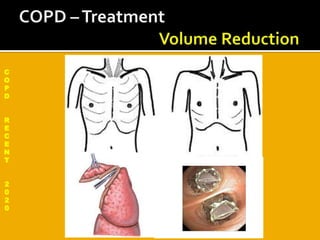
Volume Reduction - Surgical / Endoscopic
C
O
P
D
R
E
C
E
N
T
2
0
2
0
parthivmehta@hotmail.com / 079 2685 4849
C
O
P
D
R
E
C
E
N
T
2
0
2
0

COPD easy understanding 2020_march

  • 1.
  • 2.
  • 3.
  • 4.
  • 5.
  • 6.
  • 7.
  • 8.
    C O P D R E C E N T 2 0 2 0  Review of14 population studies from India to estimate national burden COPD & its association with smoking  12.36 million adult patients (61.6% males)  8.15 million males  4.21 million females  Adults over 30 years : 5% males and 2.7% females Jindal S K et al . IndianJ Chest Dis & Allied Sci 2011;43:-147
  • 9.
    C O P D R E C E N T 2 0 2 0  Review of14 population studies from India to estimate national burden COPD & its association with smoking  12.36 million adult patients (61.6% males)  8.15 million males  4.21 million females  Adults over 30 years : 5% males and 2.7% females Jindal S K et al . IndianJ Chest Dis & Allied Sci 2011;43:-147
  • 10.
  • 11.
  • 12.
  • 13.
  • 14.
  • 15.
  • 16.
  • 17.
  • 18.
  • 19.
    C O P D R E C E N T 2 0 2 0  C OP D : Persistent Symptoms  FEV1 / FVC - </= 70%  Poor Reversibility  Neutrophilic Inflammation  (Bronchial and systemic)  ASTHMA: Intermittent Symptoms  Reversible Obstruction  Eosinophilic Inflammation (Bronchial)  A C O S : Persistent Symptoms  More response to bronchodilators  Increased reversibility  Eosinophilic inflammation  (Bronchial and systemic)
  • 20.
    C O P D R E C E N T 2 0 2 0  C OP D : Persistent Symptoms  FEV1 / FVC - </= 70%  Poor Reversibility  Neutrophilic Inflammation  (Bronchial and systemic)  ASTHMA: Intermittent Symptoms  Reversible Obstruction  Eosinophilic Inflammation (Bronchial)  A C O S : Persistent Symptoms  More response to bronchodilators  Increased reversibility  Eosinophilic inflammation  (Bronchial and systemic) “Recent - 2”
  • 21.
    C O P D R E C E N T 2 0 2 0 People with ACOStend to have  more hospitalizations,  higher healthcare costs, and  poorer quality of life, than those who have only asthma or COPD. Children with severe, persistent asthma are 32 times more likely to develop ACOS and COPD later in life “Recent - 3” Asthma and COPD Overlap Syndrome (ACOS): A Systematic Review and Meta Analysis- 2015
  • 22.
  • 23.
  • 24.
  • 25.
  • 26.
  • 27.
  • 28.
  • 29.
  • 30.
    C O P D R E C E N T 2 0 2 0  LABAs aremore effective than LAMAs if we consider symptoms or health-related quality of life (HRQOL) as the primary outcome  In the symptomatic patient, there is no substantial difference between LABAs or LAMAs  Whereas in frequent exacerbators, it seems preferable to use a LAMA. Rodrigo GJ et al; Comparison of Indacaterol withTiotropium or twice-daily long-acting β -agonists for stable COPD: a systematic review. Chest. 2012;142(5):1104–10.
  • 31.
    C O P D R E C E N T 2 0 2 0 Trial Pharmacotherapy Results Joneset al.(2011) Jones et al. (2012) Aclidinium Improved FEV 1, delay to first exacerbation Trivedi et al. (2014) Umeclidinium Improved FEV 1, dyspnoea, QOL LaForce et al. (2016) Glycopyrronium Improved dyspnoea, QOL Wedzicha et al. (2016) Glycopyrronium / Indacaterol versus Salmeterol / Fluticasone Decreased exacerbations Singh et al. (2014) D’Urzo et al. (2014) Bateman et al. (2015) Aclidinium / Formoterol Improved dyspnoea and exacerbations, delay to first exacerbation Buhl et al. (2015) Tiotropium / Olodaterol Improved FEV 1, QOL Donohue et al. (2014) Umeclidinium /Vilaterol Decreased exacerbations
  • 32.
    C O P D R E C E N T 2 0 2 0 Trial Pharmacotherapy Results Joneset al.(2011) Jones et al. (2012) Aclidinium Improved FEV 1, delay to first exacerbation Trivedi et al. (2014) Umeclidinium Improved FEV 1, dyspnoea, QOL LaForce et al. (2016) Glycopyrronium Improved dyspnoea, QOL Wedzicha et al. (2016) Glycopyrronium / Indacaterol versus Salmeterol / Fluticasone Decreased exacerbations Singh et al. (2014) D’Urzo et al. (2014) Bateman et al. (2015) Aclidinium / Formoterol Improved dyspnoea and exacerbations, delay to first exacerbation Buhl et al. (2015) Tiotropium / Olodaterol Improved FEV 1, QOL Donohue et al. (2014) Umeclidinium /Vilaterol Decreased exacerbations
  • 33.
    C O P D R E C E N T 2 0 2 0 Tiotropium was theonly globally available ultra LAMA Glycopyrronium - GEM 1 and 2 studies (Glycopyrrolate Effect on Symptoms and Lung Function) show improvements in FEV1 , dyspnoea, QOL scores, and rescue medication use in patients with moderate to severe airflow limitation  In studies, the nebulized LAMA formulation was reported to be safe and well tolerated, and there were no significant changes in cardiovascular signs and electrocardiography parameters  There was a dose-related and clinically significant improvement in FEV1 following nebulized Glycopyrrolate  Availability of a nebulized LAMA greatly complement the currently available nebulized LABA medications ( Formoterol).  Overwhelming majority were satisfied with traditional nebulization therapy, reporting benefits in symptom relief, ease of use, and improved QOL LaForce C et al. : Efficacy and safety of twice-daily Glycopyrrolate in patients with stable, symptomatic COPD with moderate- to-severe airflow limitation: the GEM1 study. Int J Chron Obstruct Pulmon Dis. 2016;11(1):1233–43.
  • 34.
    C O P D R E C E N T 2 0 2 0  In patientswith moderate COPD and no prior exacerbation history - switching from a fixed-dose combination of ICS/LABA to a LABA was not associated with any differences in lung function, symptoms, health status, and exacerbations INSTEAD: a randomised switch trial of Indacaterol versus Salmeterol / Fluticasone in moderate COPD. Eur Respir J. 2014;44(6):1548–56. “Recent -4”
  • 35.
    C O P D R E C E N T 2 0 2 0 Indacaterol is anonce-daily LABA with a rapid onset of action (within 5 minutes), a peak effect at approximately 3 hours, and a duration of bronchodilatation lasting at least 24 hours. Once-daily dosing improves adherence. It provides a level of bronchodilatation that is similar to Tiotropium but greater than the twice-daily agents, Formoterol and Salmeterol. Indacaterol has a good safety profile. Indacaterol is an effective and beneficial maintenance bronchodilator treatment for patients with moderate-to- severe COPD. Indacaterol would be a reasonable first choice for maintenance bronchodilator therapy. “Recent -5”
  • 36.
    C O P D R E C E N T 2 0 2 0  The “WISDOM”trial findings indicate that withdrawal of ICS is safe in some patients and makes combination LAMA/LABA a reasonable option for many, particularly those with persistent dyspnoea on a single LABA.  Combination LAMA/LABA was superior to a combination ICS/LABA in preventing exacerbations. Wedzicha JA, et al. : Indacaterol - Glycopyrronium versus Salmeterol- Fluticasone for COPD. N EnglJ Med. 2016;374(23):2222–3 Magnussen H et al. : Withdrawal of inhaled glucocorticoids and exacerbations of COPD. N EnglJ Med. 2014;371(14):1285–94
  • 37.
    C O P D R E C E N T 2 0 2 0  Glycopyrronium /Indacaterol reduced the rate of mild to severe COPD exacerbations by 11% compared with Fluticasone / Salmeterol over the 52-week trial and was associated with slightly fewer episodes of pneumonia Wedzicha JA, Banerji D, Chapman KR, et al. : Indacaterol-Glycopyrronium versus Salmeterol-Fluticasone for COPD. N EnglJ Med. 2016;374(23):2222–34. COPD OUTCOMES ARE SLOW TO COME UP – NEED TO WAIT FOR 6 – 12 MONTHS ATLEAST!
  • 38.
    C O P D R E C E N T 2 0 2 0  Phase IIIresults from the KRONOS trial and TRIBUTE trial, showed treatment with the fixed-dose combination of Budesonide, Glycopyrrolate, and Formoterol to be associated with improved lung function and reduced exacerbations. Alberto Papi et al; Extra fine inhaled triple therapy versus dual bronchodilator therapy in chronic obstructive pulmonary disease (TRIBUTE): a double-blind, parallel group, randomised controlled trial.The Lancet, 391, 10125, 1076-1084, March 2018 Gary T Ferguson et al; Triple therapy with Budesonide / Glycopyrrolate / Formoterol Fumarate with co-suspension delivery technology versus dual therapies in chronic obstructive pulmonary disease (KRONOS): a double-blind, parallel-group, multicentre, phase 3 randomised controlled trial.The Lancet,Volume 6, 10, 747-758, October 2018 The pneumonia rate was more than 50% higher in the patients receiving the triple therapy than in patients receiving the LABA / LAMA combination D.A. Lipson et al, Once-Daily Single-InhalerTriple versus DualTherapy in Patients with COPD N Engl J Med 2018; 378:1671-1680
  • 39.
    C O P D R E C E N T 2 0 2 0  In theSUNSET study,  COPD patients without a high Eosinophil burden who were doing well on triple therapy had no increase in exacerbations when switched to step-down treatment with the dual-bronchodilator therapy Indacaterol / Glycopyrronium  Patients in with consistent blood Eosinophil counts of 300 μl or above, however, showed significant declines in lung function and increased risk for exacerbation on the fixed-dose dual therapy, suggesting they are more likely to benefit from continued triple therapy. Chapman KR et al; Long-Term Triple Therapy De-escalation to Indacaterol/Glycopyrronium in Patients with Chronic Obstructive Pulmonary Disease (SUNSET): A Randomized, Double-Blind, Triple-Dummy Clinical Trial. Am J Respir Crit Care Med. 2018Aug 1;198(3):329-339.
  • 40.
    C O P D R E C E N T 2 0 2 0  Triple Combinationis indicated for COPD patients with bronchitis and/or emphysema whose disease is not adequately controlled or with Eosinophil counts higher (ACOS)  Triple Combination is to be used sparingly in highly indicated patients only - patients with GOLD group D COPD with frequent exacerbations. “Recent -5”
  • 41.
    C O P D R E C E N T 2 0 2 0 LAMA - Revefenacin(TD4208), a once-daily LABA - Abediterol, a once-daily MABA- Muscarinic antagonist–β2 agonists (combining two pharmacophores LABA – LAMA by an inactive spine, are in development.) Batefenterol (GSK961081), AZD2115, and AZD8871, are already in clinical trials. A major problem is that it is difficult to balance the LABA and LAMA activities, so that most MABAs tend to have a predominance of either LABA or LAMA activity. MABAs combined with an ICS are also in development as functional triple combinations. Nebulization route is preferred in these molecules “Recent -6”
  • 42.
    C O P D R E C E N T 2 0 2 0 Theophylline  Bronchodilator (PDE3)and anti-inflammatory effects (PDE4) of Theophylline are mediated mainly through inhibition of Phospho-Di- Esterases (PDEs).  PDEs include 11 major families of enzyme, each of which may have several isoforms, this has led to the development of selective PDE inhibitors in the hope that efficacy may be enhanced and side effects reduced. Nicholas J. Gross; NewTherapies for Asthma and Chronic Obstructive Pulmonary Disease
  • 43.
    C O P D R E C E N T 2 0 2 0 Roflumilast  Selective PDE4inhibitors have a wide spectrum of anti- inflammatory effects in the lung and are more effective against Neutrophilic inflammation than are corticosteroids.  Roflumilast - has a narrow therapeutic window as the dose is limited by side effects that include diarrhoea, nausea, and headaches  Roflumilast on a maintenance basis is currently indicated for the prevention of severe exacerbations in patients with severe COPD, frequent exacerbations, and chronic bronchitis.  It may also have a future role in acute management of exacerbations as they are associated with a flare-up of inflammation Beghè B et al. Phosphodiesterase-4 inhibitor therapy for lung diseases. AmJ Respir Crit Care Med 2013;188: 271–278. “Recent - 7”
  • 44.
    C O P D R E C E N T 2 0 2 0 Kinases are knownto be driving lung inflammation and remodeling. Several kinase inhibitors have been targeted for the treatment of asthma and COPD - none have yet come! Barnes PJ. Kinases as novel therapeutic targets in asthma and COPD. Pharmacol Rev 2016;68:788–815. “Recent –8”
  • 45.
    C O P D R E C E N T 2 0 2 0  A poorresponse to the anti-inflammatory effects of corticosteroids is a major barrier to effective therapy in severe ACOS and COPD.  Understanding the molecular mechanisms involved in corticosteroid resistance in these diseases has identified new therapeutic targets, with the prospect that drugs to reverse corticosteroid resistance may be developed in the future.  Existing drugs, including Theophylline, Nortriptyline, and Macrolides, already have this property in vitro, and therefore could be used  Some large clinical trials are already underway with low-dose oralTheophylline. Barnes PJ. Corticosteroid resistance in patients with asthma and chronic obstructive pulmonary disease. J Allergy Clin Immunol 2013;131:636–645.
  • 46.
    C O P D R E C E N T 2 0 2 0  A poorresponse to the anti-inflammatory effects of corticosteroids is a major barrier to effective therapy in severe ACOS and COPD.  Understanding the molecular mechanisms involved in corticosteroid resistance in these diseases has identified new therapeutic targets, with the prospect that drugs to reverse corticosteroid resistance may be developed in the future.  Existing drugs, including Theophylline, Nortriptyline, and Macrolides, already have this property in vitro, and therefore could be used  Some large clinical trials are already underway with low-dose oralTheophylline. Barnes PJ. Corticosteroid resistance in patients with asthma and chronic obstructive pulmonary disease. J Allergy Clin Immunol 2013;131:636–645.
  • 47.
  • 48.
  • 49.
  • 50.
  • 51.
  • 52.
    C O P D R E C E N T 2 0 2 0 Inflammation - Persistencewith Flare Bronchodilatation - LABA – LAMA Air way remodelling - ICS /Theophyllines Steroid Resistance -Theophylline / Macrolides Volume Reduction - Surgical / Endoscopic
  • 53.
  • 54.