Gender Equality and Empowerment of
Women in the Context of
the Implementation of the Millennium
Development Goals
2010 High-level Segment
Economic and Social Council
New York, 28 June – 2 July
Annual Ministerial Review : Nacional Voluntary Presentation
GUATEMALA
Guatemala: an unequal and
diverse country
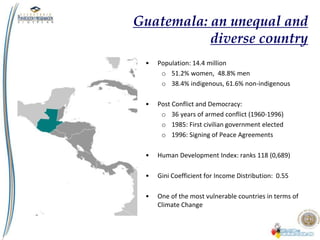
• Population: 14.4 million
o 51.2% women, 48.8% men
o 38.4% indigenous, 61.6% non-indigenous
• Post Conflict and Democracy:
o 36 years of armed conflict (1960-1996)
o 1985: First civilian government elected
o 1996: Signing of Peace Agreements
• Human Development Index: ranks 118 (0,689)
• Gini Coefficient for Income Distribution: 0.55
• One of the most vulnerable countries in terms of
Climate Change
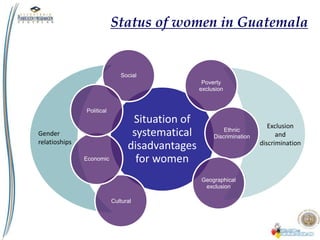
Status of women in Guatemala
Situation of
systematical
disadvantages
for women
Social
Poverty
exclusion
Ethnic
Discrimination
Geographical
exclusion
Cultural
Economic
Political
Gender
relatioships
Exclusion
and
discrimination
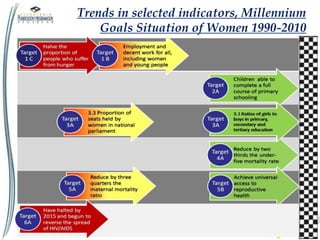
Trends in selected indicators, Millennium
Goals Situation of Women 1990-2010
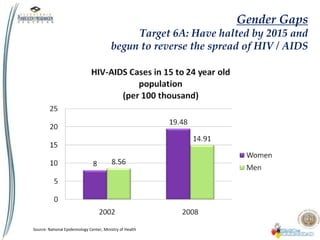
Source: National Epidemiology Center, Ministry of Health
Gender Gaps
Target 6A: Have halted by 2015 and
begun to reverse the spread of HIV / AIDS
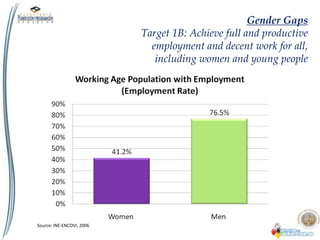
Source: INE-ENCOVI, 2006
Gender Gaps
Target 1B: Achieve full and productive
employment and decent work for all,
including women and young people
Gender Gaps
Target 1B: Achieve full and productive
employment and decent work for all,
including women and young people
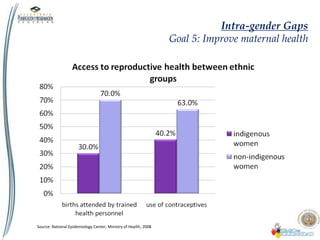
Intra-gender Gaps
Goal 5: Improve maternal health
Source: National Epidemiology Center, Ministry of Health, 2008
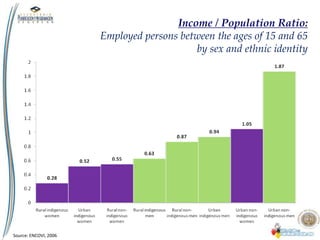
Income / Population Ratio:
Employed persons between the ages of 15 and 65
by sex and ethnic identity
Source: ENCOVI, 2006
Sustained increase of women
meeting violent deaths
Harassment
Prolonged abuse
Psychological pressure
Physical and sexual
violence
Femicide
Social Indifference
Limited institutional
response capacity
Four decades of
internal armed conflict
A total of 4,602 cases of
women meeting violent
deaths are registered
between 2001 to 2009 Source: PNC, 2007.
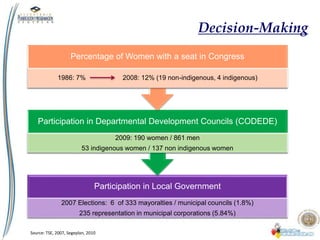
Decision-Making
Participation in Local Government
2007 Elections: 6 of 333 mayoralties / municipal councils (1.8%)
235 representation in municipal corporations (5.84%)
Participation in Departmental Development Councils (CODEDE)
2009: 190 women / 861 men
53 indigenous women / 137 non indigenous women
Percentage of Women with a seat in Congress
1986: 7% 2008: 12% (19 non-indigenous, 4 indigenous)
Source: TSE, 2007, Segeplan, 2010
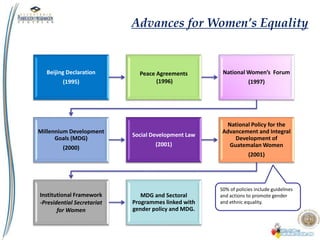
Beijing Declaration
(1995)
Peace Agreements
(1996)
National Women’s Forum
(1997)
Millennium Development
Goals (MDG)
(2000)
Social Development Law
(2001)
National Policy for the
Advancement and Integral
Development of
Guatemalan Women
(2001)
Institutional Framework
-Presidential Secretariat
for Women
MDG and Sectoral
Programmes linked with
gender policy and MDG.
50% of policies include guidelines
and actions to promote gender
and ethnic equality.
Advances for Women’s Equality
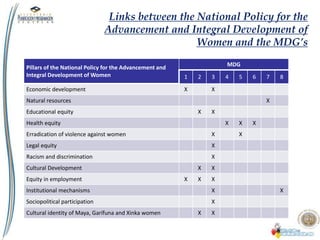
Links between the National Policy for the
Advancement and Integral Development of
Women and the MDG’s
Pillars of the National Policy for the Advancement and
Integral Development of Women
MDG
1 2 3 4 5 6 7 8
Economic development X X
Natural resources X
Educational equity X X
Health equity X X X
Erradication of violence against women X X
Legal equity X
Racism and discrimination X
Cultural Development X X
Equity in employment X X X
Institutional mechanisms X X
Sociopolitical participation X
Cultural identity of Maya, Garífuna and Xinka women X X
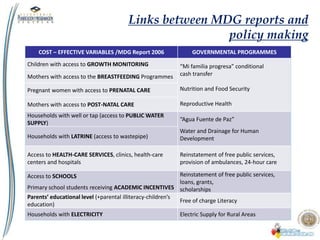
Links between MDG reports and
policy making
COST – EFFECTIVE VARIABLES /MDG Report 2006 GOVERNMENTAL PROGRAMMES
Children with access to GROWTH MONITORING “Mi familia progresa” conditional
cash transfer
Nutrition and Food Security
Reproductive Health
Mothers with access to the BREASTFEEDING Programmes
Pregnant women with access to PRENATAL CARE
Mothers with access to POST-NATAL CARE
Households with well or tap (access to PUBLIC WATER
SUPPLY)
“Agua Fuente de Paz”
Water and Drainage for Human
Development
Households with LATRINE (access to wastepipe)
Access to HEALTH-CARE SERVICES, clinics, health-care
centers and hospitals
Reinstatement of free public services,
provision of ambulances, 24-hour care
Access to SCHOOLS Reinstatement of free public services,
loans, grants,
scholarships
Primary school students receiving ACADEMIC INCENTIVES
Parents’ educational level (+parental illiteracy-children’s
education)
Free of charge Literacy
Households with ELECTRICITY Electric Supply for Rural Areas
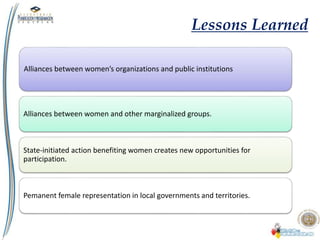
Lessons Learned
Alliances between women’s organizations and public institutions
Alliances between women and other marginalized groups.
State-initiated action benefiting women creates new opportunities for
participation.
Pemanent female representation in local governments and territories.
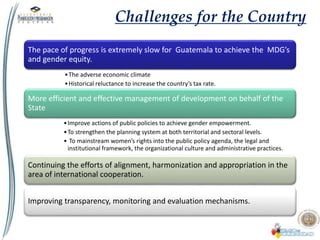
The pace of progress is extremely slow for Guatemala to achieve the MDG’s
and gender equity.
•The adverse economic climate
•Historical reluctance to increase the country’s tax rate.
More efficient and effective management of development on behalf of the
State
•Improve actions of public policies to achieve gender empowerment.
•To strengthen the planning system at both territorial and sectoral levels.
• To mainstream women’s rights into the public policy agenda, the legal and
institutional framework, the organizational culture and administrative practices.
Continuing the efforts of alignment, harmonization and appropriation in the
area of international cooperation.
Improving transparency, monitoring and evaluation mechanisms.
Challenges for the Country
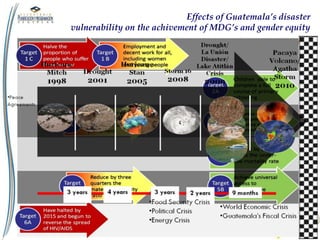
Effects of Guatemala’s disaster
vulnerability on the achivement of MDG’s and gender equity
Secretariat for Planning and Programming
Republic of Guatemala
–Segeplan-
www.segeplan.gob.gt

guatemala_english_ecosoc_final.ppt

  • 1.
    Gender Equality andEmpowerment of Women in the Context of the Implementation of the Millennium Development Goals 2010 High-level Segment Economic and Social Council New York, 28 June – 2 July Annual Ministerial Review : Nacional Voluntary Presentation GUATEMALA
  • 2.
    Guatemala: an unequaland diverse country • Population: 14.4 million o 51.2% women, 48.8% men o 38.4% indigenous, 61.6% non-indigenous • Post Conflict and Democracy: o 36 years of armed conflict (1960-1996) o 1985: First civilian government elected o 1996: Signing of Peace Agreements • Human Development Index: ranks 118 (0,689) • Gini Coefficient for Income Distribution: 0.55 • One of the most vulnerable countries in terms of Climate Change
  • 3.
    Status of womenin Guatemala Situation of systematical disadvantages for women Social Poverty exclusion Ethnic Discrimination Geographical exclusion Cultural Economic Political Gender relatioships Exclusion and discrimination
  • 4.
    Trends in selectedindicators, Millennium Goals Situation of Women 1990-2010
  • 5.
    Source: National EpidemiologyCenter, Ministry of Health Gender Gaps Target 6A: Have halted by 2015 and begun to reverse the spread of HIV / AIDS
  • 6.
    Source: INE-ENCOVI, 2006 GenderGaps Target 1B: Achieve full and productive employment and decent work for all, including women and young people
  • 7.
    Gender Gaps Target 1B:Achieve full and productive employment and decent work for all, including women and young people
  • 8.
    Intra-gender Gaps Goal 5:Improve maternal health Source: National Epidemiology Center, Ministry of Health, 2008
  • 9.
    Income / PopulationRatio: Employed persons between the ages of 15 and 65 by sex and ethnic identity Source: ENCOVI, 2006
  • 10.
    Sustained increase ofwomen meeting violent deaths Harassment Prolonged abuse Psychological pressure Physical and sexual violence Femicide Social Indifference Limited institutional response capacity Four decades of internal armed conflict A total of 4,602 cases of women meeting violent deaths are registered between 2001 to 2009 Source: PNC, 2007.
  • 11.
    Decision-Making Participation in LocalGovernment 2007 Elections: 6 of 333 mayoralties / municipal councils (1.8%) 235 representation in municipal corporations (5.84%) Participation in Departmental Development Councils (CODEDE) 2009: 190 women / 861 men 53 indigenous women / 137 non indigenous women Percentage of Women with a seat in Congress 1986: 7% 2008: 12% (19 non-indigenous, 4 indigenous) Source: TSE, 2007, Segeplan, 2010
  • 12.
    Beijing Declaration (1995) Peace Agreements (1996) NationalWomen’s Forum (1997) Millennium Development Goals (MDG) (2000) Social Development Law (2001) National Policy for the Advancement and Integral Development of Guatemalan Women (2001) Institutional Framework -Presidential Secretariat for Women MDG and Sectoral Programmes linked with gender policy and MDG. 50% of policies include guidelines and actions to promote gender and ethnic equality. Advances for Women’s Equality
  • 13.
    Links between theNational Policy for the Advancement and Integral Development of Women and the MDG’s Pillars of the National Policy for the Advancement and Integral Development of Women MDG 1 2 3 4 5 6 7 8 Economic development X X Natural resources X Educational equity X X Health equity X X X Erradication of violence against women X X Legal equity X Racism and discrimination X Cultural Development X X Equity in employment X X X Institutional mechanisms X X Sociopolitical participation X Cultural identity of Maya, Garífuna and Xinka women X X
  • 14.
    Links between MDGreports and policy making COST – EFFECTIVE VARIABLES /MDG Report 2006 GOVERNMENTAL PROGRAMMES Children with access to GROWTH MONITORING “Mi familia progresa” conditional cash transfer Nutrition and Food Security Reproductive Health Mothers with access to the BREASTFEEDING Programmes Pregnant women with access to PRENATAL CARE Mothers with access to POST-NATAL CARE Households with well or tap (access to PUBLIC WATER SUPPLY) “Agua Fuente de Paz” Water and Drainage for Human Development Households with LATRINE (access to wastepipe) Access to HEALTH-CARE SERVICES, clinics, health-care centers and hospitals Reinstatement of free public services, provision of ambulances, 24-hour care Access to SCHOOLS Reinstatement of free public services, loans, grants, scholarships Primary school students receiving ACADEMIC INCENTIVES Parents’ educational level (+parental illiteracy-children’s education) Free of charge Literacy Households with ELECTRICITY Electric Supply for Rural Areas
  • 15.
    Lessons Learned Alliances betweenwomen’s organizations and public institutions Alliances between women and other marginalized groups. State-initiated action benefiting women creates new opportunities for participation. Pemanent female representation in local governments and territories.
  • 16.
    The pace ofprogress is extremely slow for Guatemala to achieve the MDG’s and gender equity. •The adverse economic climate •Historical reluctance to increase the country’s tax rate. More efficient and effective management of development on behalf of the State •Improve actions of public policies to achieve gender empowerment. •To strengthen the planning system at both territorial and sectoral levels. • To mainstream women’s rights into the public policy agenda, the legal and institutional framework, the organizational culture and administrative practices. Continuing the efforts of alignment, harmonization and appropriation in the area of international cooperation. Improving transparency, monitoring and evaluation mechanisms. Challenges for the Country
  • 17.
    Effects of Guatemala’sdisaster vulnerability on the achivement of MDG’s and gender equity
  • 18.
    Secretariat for Planningand Programming Republic of Guatemala –Segeplan- www.segeplan.gob.gt

Editor's Notes

  • #11 Acoso Abuso continuo Presión psicológica Violencia física y sexual Femicidios
  • #13 Las políticas públicas han sido posibles gracias a: Acciones desarrolladas por mujeres organizadas Apertura a la democracia Firma de los Acuerdos de Paz Avances a nivel internacional expresados en documentos específicos. Leyes y Políticas: De 1982 al 2008 se han generado 18 Propuestas, leyes o políticas a favor de la mujer. Este proceso empieza a tener un repunte luego de los acuerdos de paz en el año 1996. Pendiente: Reformas a la Ley Electoral y de Partidos Políticos Institucionalidad: 1981 Oficina Nacional de la Mujer 1994 Defensoría de los Derechos Humanos de las Mujeres en la Procuraduría de Derechos Humanos. 1999 Defensoría de la Mujer Indígena 2000 Secretaría Presidencial de la Mujer 2000 Coordinadora Nacional para la Prevención de la Violencia Intrafamiliar y contra las Mujeres. 1997 Foro Nacional de la Mujer Incluye en su estructura representación de mujeres de todas las comunidades lingüísticas