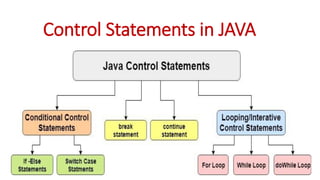
Control Statements in JAVA
if Statements
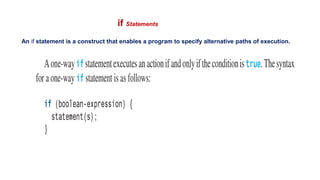
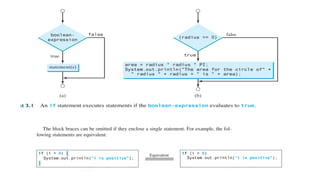
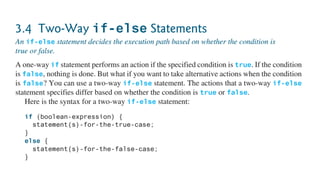
An if statement is a construct that enables a program to specify alternative paths of execution.
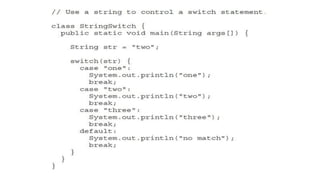
Switch
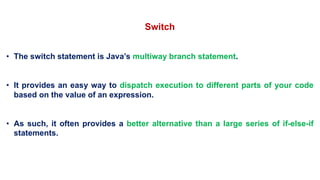
• The switch statement is Java’s multiway branch statement.
• It provides an easy way to dispatch execution to different parts of your code
based on the value of an expression.
• As such, it often provides a better alternative than a large series of if-else-if
statements.
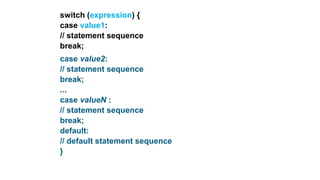
switch (expression) {
case value1:
// statement sequence
break;
case value2:
// statement sequence
break;
...
case valueN :
// statement sequence
break;
default:
// default statement sequence
}
• Each value specified in the case statements must be a unique constant expression
(such as a literal value).
• Duplicate case values are not allowed. The type of each value must be compatible with
the type of expression.
• The switch statement works like this: The value of the expression is compared with
each of the values in the case statements.
• If a match is found, the code sequence following that case statement is executed. If none
of the constants matches the value of the expression, then the default statement is
executed.
• However, the default statement is optional. If no case matches and no default is present,
then no further action is taken.
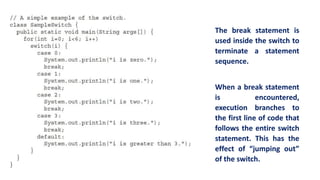
The break statement is
used inside the switch to
terminate a statement
sequence.
When a break statement
is encountered,
execution branches to
the first line of code that
follows the entire switch
statement. This has the
effect of “jumping out”
of the switch.
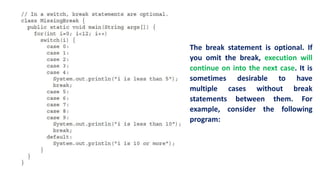
The break statement is optional. If
you omit the break, execution will
continue on into the next case. It is
sometimes desirable to have
multiple cases without break
statements between them. For
example, consider the following
program:
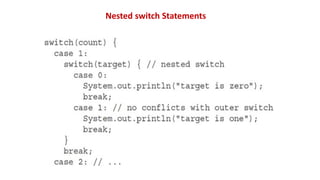
Nested switch Statements
Iteration Statements
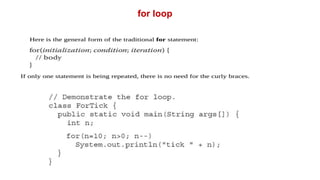
for loop
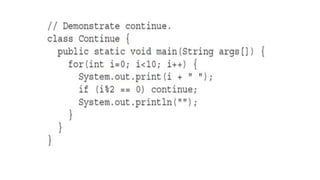
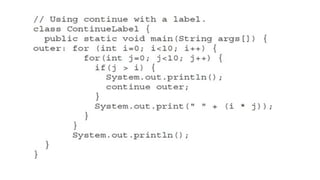
Using continue
• Sometimes it is useful to force an early iteration of a loop. That is, you might want to
continue running the loop but stop processing the remainder of the code in its body for
this particular iteration.
• In while and do-while loops, a continue statement causes control to be transferred directly
to the conditional expression that controls the loop.
• In a for loop, control goes first to the iteration portion of the for statement and then to the
conditional expression.
Lecture 7 Control Statements.pdf

Lecture 7 Control Statements.pdf

  • 1.
  • 2.
    if Statements An ifstatement is a construct that enables a program to specify alternative paths of execution.
  • 7.
    Switch • The switchstatement is Java’s multiway branch statement. • It provides an easy way to dispatch execution to different parts of your code based on the value of an expression. • As such, it often provides a better alternative than a large series of if-else-if statements.
  • 8.
    switch (expression) { casevalue1: // statement sequence break; case value2: // statement sequence break; ... case valueN : // statement sequence break; default: // default statement sequence }
  • 9.
    • Each valuespecified in the case statements must be a unique constant expression (such as a literal value). • Duplicate case values are not allowed. The type of each value must be compatible with the type of expression. • The switch statement works like this: The value of the expression is compared with each of the values in the case statements.
  • 10.
    • If amatch is found, the code sequence following that case statement is executed. If none of the constants matches the value of the expression, then the default statement is executed. • However, the default statement is optional. If no case matches and no default is present, then no further action is taken.
  • 11.
    The break statementis used inside the switch to terminate a statement sequence. When a break statement is encountered, execution branches to the first line of code that follows the entire switch statement. This has the effect of “jumping out” of the switch.
  • 12.
    The break statementis optional. If you omit the break, execution will continue on into the next case. It is sometimes desirable to have multiple cases without break statements between them. For example, consider the following program:
  • 15.
  • 16.
  • 22.
  • 26.
    Using continue • Sometimesit is useful to force an early iteration of a loop. That is, you might want to continue running the loop but stop processing the remainder of the code in its body for this particular iteration. • In while and do-while loops, a continue statement causes control to be transferred directly to the conditional expression that controls the loop. • In a for loop, control goes first to the iteration portion of the for statement and then to the conditional expression.