Constructor
Compiled by:
Vinod Kumar(Asst. prof.)
Constructor
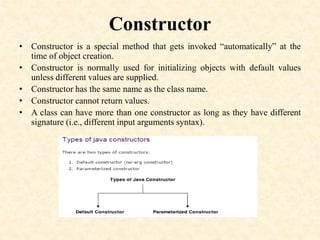
• Constructor is a special method that gets invoked “automatically” at the
time of object creation.
• Constructor is normally used for initializing objects with default values
unless different values are supplied.
• Constructor has the same name as the class name.
• Constructor cannot return values.
• A class can have more than one constructor as long as they have different
signature (i.e., different input arguments syntax).
3
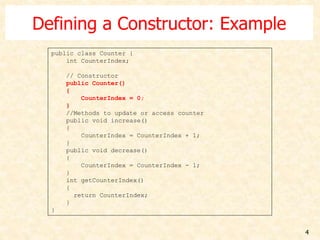
Defining a Constructor: Example
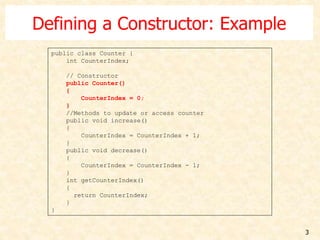
public class Counter {
int CounterIndex;
// Constructor
public Counter()
{
CounterIndex = 0;
}
//Methods to update or access counter
public void increase()
{
CounterIndex = CounterIndex + 1;
}
public void decrease()
{
CounterIndex = CounterIndex - 1;
}
int getCounterIndex()
{
return CounterIndex;
}
}
4
Defining a Constructor: Example
public class Counter {
int CounterIndex;
// Constructor
public Counter()
{
CounterIndex = 0;
}
//Methods to update or access counter
public void increase()
{
CounterIndex = CounterIndex + 1;
}
public void decrease()
{
CounterIndex = CounterIndex - 1;
}
int getCounterIndex()
{
return CounterIndex;
}
}
5
Trace counter value at each
statement and What is the output ?
class MyClass {
public static void main(String args[])
{
Counter counter1 = new Counter();
counter1.increase();
int a = counter1.getCounterIndex();
counter1.increase();
int b = counter1.getCounterIndex();
if ( a > b )
counter1.increase();
else
counter1.decrease();
System.out.println(counter1.getCounterIndex());
}
}
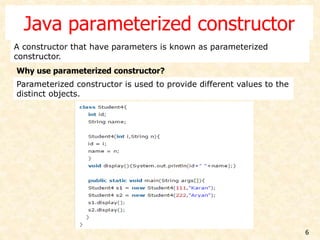
Java parameterized constructor
A constructor that have parameters is known as parameterized
constructor.
6
Why use parameterized constructor?
Parameterized constructor is used to provide different values to the
distinct objects.
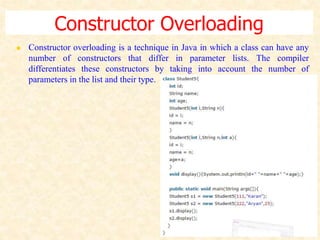
Constructor Overloading
 Constructor overloading is a technique in Java in which a class can have any
number of constructors that differ in parameter lists. The compiler
differentiates these constructors by taking into account the number of
parameters in the list and their type.
7
8
Multiple Constructors
 Sometimes want to initialize in a number
of different ways, depending on
circumstance.
 This can be supported by having multiple
constructors having different input
arguments.
9
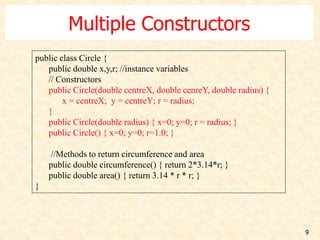
Multiple Constructors
public class Circle {
public double x,y,r; //instance variables
// Constructors
public Circle(double centreX, double cenreY, double radius) {
x = centreX; y = centreY; r = radius;
}
public Circle(double radius) { x=0; y=0; r = radius; }
public Circle() { x=0; y=0; r=1.0; }
//Methods to return circumference and area
public double circumference() { return 2*3.14*r; }
public double area() { return 3.14 * r * r; }
}
10
Initializing with constructors
public class TestCircles {
public static void main(String args[]){
Circle circleA = new Circle( 10.0, 12.0, 20.0);
Circle circleB = new Circle(10.0);
Circle circleC = new Circle();
}
}
circleA = new Circle(10, 12, 20) circleB = new Circle(10)
Centre = (0,0)
Radius=10
circleC = new Circle()
Centre = (0,0)
Radius = 1
Centre = (10,12)
Radius = 20
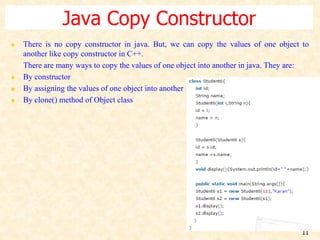
Java Copy Constructor
11
 There is no copy constructor in java. But, we can copy the values of one object to
another like copy constructor in C++.
There are many ways to copy the values of one object into another in java. They are:
 By constructor
 By assigning the values of one object into another
 By clone() method of Object class
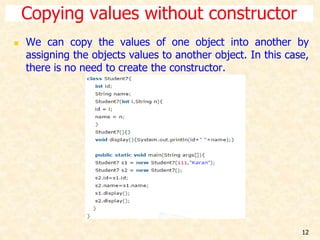
Copying values without constructor
12
 We can copy the values of one object into another by
assigning the objects values to another object. In this case,
there is no need to create the constructor.
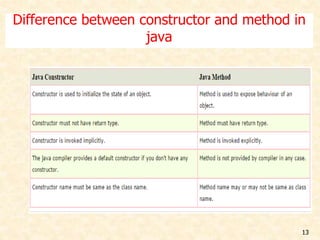
Difference between constructor and method in
java
13

Constructor ppt

  • 1.
  • 2.
    Constructor • Constructor isa special method that gets invoked “automatically” at the time of object creation. • Constructor is normally used for initializing objects with default values unless different values are supplied. • Constructor has the same name as the class name. • Constructor cannot return values. • A class can have more than one constructor as long as they have different signature (i.e., different input arguments syntax).
  • 3.
    3 Defining a Constructor:Example public class Counter { int CounterIndex; // Constructor public Counter() { CounterIndex = 0; } //Methods to update or access counter public void increase() { CounterIndex = CounterIndex + 1; } public void decrease() { CounterIndex = CounterIndex - 1; } int getCounterIndex() { return CounterIndex; } }
  • 4.
    4 Defining a Constructor:Example public class Counter { int CounterIndex; // Constructor public Counter() { CounterIndex = 0; } //Methods to update or access counter public void increase() { CounterIndex = CounterIndex + 1; } public void decrease() { CounterIndex = CounterIndex - 1; } int getCounterIndex() { return CounterIndex; } }
  • 5.
    5 Trace counter valueat each statement and What is the output ? class MyClass { public static void main(String args[]) { Counter counter1 = new Counter(); counter1.increase(); int a = counter1.getCounterIndex(); counter1.increase(); int b = counter1.getCounterIndex(); if ( a > b ) counter1.increase(); else counter1.decrease(); System.out.println(counter1.getCounterIndex()); } }
  • 6.
    Java parameterized constructor Aconstructor that have parameters is known as parameterized constructor. 6 Why use parameterized constructor? Parameterized constructor is used to provide different values to the distinct objects.
  • 7.
    Constructor Overloading  Constructoroverloading is a technique in Java in which a class can have any number of constructors that differ in parameter lists. The compiler differentiates these constructors by taking into account the number of parameters in the list and their type. 7
  • 8.
    8 Multiple Constructors  Sometimeswant to initialize in a number of different ways, depending on circumstance.  This can be supported by having multiple constructors having different input arguments.
  • 9.
    9 Multiple Constructors public classCircle { public double x,y,r; //instance variables // Constructors public Circle(double centreX, double cenreY, double radius) { x = centreX; y = centreY; r = radius; } public Circle(double radius) { x=0; y=0; r = radius; } public Circle() { x=0; y=0; r=1.0; } //Methods to return circumference and area public double circumference() { return 2*3.14*r; } public double area() { return 3.14 * r * r; } }
  • 10.
    10 Initializing with constructors publicclass TestCircles { public static void main(String args[]){ Circle circleA = new Circle( 10.0, 12.0, 20.0); Circle circleB = new Circle(10.0); Circle circleC = new Circle(); } } circleA = new Circle(10, 12, 20) circleB = new Circle(10) Centre = (0,0) Radius=10 circleC = new Circle() Centre = (0,0) Radius = 1 Centre = (10,12) Radius = 20
  • 11.
    Java Copy Constructor 11 There is no copy constructor in java. But, we can copy the values of one object to another like copy constructor in C++. There are many ways to copy the values of one object into another in java. They are:  By constructor  By assigning the values of one object into another  By clone() method of Object class
  • 12.
    Copying values withoutconstructor 12  We can copy the values of one object into another by assigning the objects values to another object. In this case, there is no need to create the constructor.
  • 13.
    Difference between constructorand method in java 13