KNOWLEDGE
REPRESENTATION
Dr.M.karthika
Head/ Information Technology
What is knowledge representation?
• Humans are best at understanding, reasoning,
and interpreting knowledge. Human knows
things, which is knowledge and as per their
knowledge they perform various actions in the
real world.
• But how machines do all these things comes
under knowledge representation and
reasoning.
What to Represent?
• Object: All the facts about objects in our world domain. E.g., Guitars contains strings,
trumpets are brass instruments.
• Events: Events are the actions which occur in our world.
• Performance: It describe behavior which involves knowledge about how to do things.
• Meta-knowledge: It is knowledge about what we know.
• Facts: Facts are the truths about the real world and what we represent.
• Knowledge-Base: The central component of the knowledge-based agents is the
knowledge base. It is represented as KB. The Knowledgebase is a group of the
Sentences (Here, sentences are used as a technical term and not identical with the
English language).
• Knowledge: Knowledge is awareness or familiarity gained by experiences of facts,
data, and situations. Following are the types of knowledge in artificial intelligence:
Types of knowledge
Types of knowledge
Declarative Knowledge:
• Declarative knowledge is to know about something.
• It includes concepts, facts, and objects.
• It is also called descriptive knowledge and expressed
in declarative sentences.
• It is simpler than procedural language.
Procedural Knowledge
• It is also known as imperative knowledge.
• Procedural knowledge is a type of knowledge which is
responsible for knowing how to do something.
• It can be directly applied to any task.
• It includes rules, strategies, procedures, agendas, etc.
• Procedural knowledge depends on the task on which it
can be applied.
Meta-knowledge:
• Knowledge about the other types of knowledge is
called Meta-knowledge.
Heuristic knowledge:
• Heuristic knowledge is representing knowledge of
some experts in a filed or subject.
• Heuristic knowledge is rules of thumb based on
previous experiences, awareness of approaches, and
which are good to work but not guaranteed.
Structural knowledge:
• Structural knowledge is basic knowledge to problem-
solving.
• It describes relationships between various concepts
such as kind of, part of, and grouping of something.
• It describes the relationship that exists between
concepts or objects.
How to represent knowledge?
The Synergy of Knowledge and
Intelligence
Knowledge and intelligence in AI share a symbiotic relationship:
 Knowledge as a Foundation: Knowledge provides facts, rules, and data (e.g., traffic laws
for self-driving cars). Without it, intelligence lacks the raw material to act.
 Intelligence as Application: Intelligence applies knowledge to solve problems (e.g., a
robot using physics principles to navigate terrain).
 Interdependence: Static knowledge becomes obsolete without adaptive intelligence.
Conversely, intelligence without knowledge cannot reason or learn (e.g., an AI with no
medical database cannot diagnose diseases).
 Synergy: Effective AI systems merge robust knowledge bases (the what) with reasoning
algorithms (the how). For example, ChatGPT combines vast language data (knowledge)
with transformer models (intelligence) to generate coherent text.
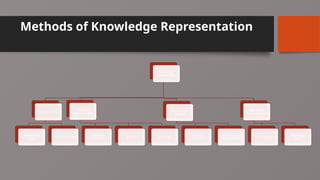
Methods of Knowledge Representation
Knowledge
Representation
Logic Based
Propositional
Logic
First order Logic
Structured
Representation
Semantic
Networks
Frames Ontologies
Probabilistic
Models
Bayesian
Networks
Markov Decision
Processes(MDPs)
Distribution
Representations
Embeddings
Knowledge
graphs
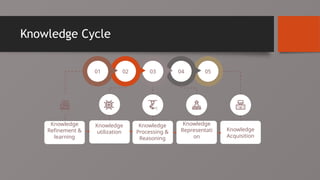
Knowledge Cycle
05
04
03
02
01
Knowledge
utilization
Knowledge
Processing &
Reasoning
Knowledge
Representati
on
Knowledge
Acquisition
Knowledge
Refinement &
learning
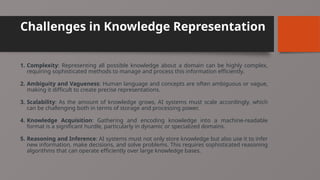
Challenges in Knowledge Representation
1. Complexity: Representing all possible knowledge about a domain can be highly complex,
requiring sophisticated methods to manage and process this information efficiently.
2. Ambiguity and Vagueness: Human language and concepts are often ambiguous or vague,
making it difficult to create precise representations.
3. Scalability: As the amount of knowledge grows, AI systems must scale accordingly, which
can be challenging both in terms of storage and processing power.
4. Knowledge Acquisition: Gathering and encoding knowledge into a machine-readable
format is a significant hurdle, particularly in dynamic or specialized domains.
5. Reasoning and Inference: AI systems must not only store knowledge but also use it to infer
new information, make decisions, and solve problems. This requires sophisticated reasoning
algorithms that can operate efficiently over large knowledge bases.
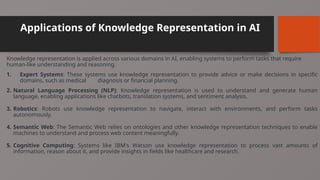
Applications of Knowledge Representation in AI
Knowledge representation is applied across various domains in AI, enabling systems to perform tasks that require
human-like understanding and reasoning.
1. Expert Systems: These systems use knowledge representation to provide advice or make decisions in specific
domains, such as medical diagnosis or financial planning.
2. Natural Language Processing (NLP): Knowledge representation is used to understand and generate human
language, enabling applications like chatbots, translation systems, and sentiment analysis.
3. Robotics: Robots use knowledge representation to navigate, interact with environments, and perform tasks
autonomously.
4. Semantic Web: The Semantic Web relies on ontologies and other knowledge representation techniques to enable
machines to understand and process web content meaningfully.
5. Cognitive Computing: Systems like IBM's Watson use knowledge representation to process vast amounts of
information, reason about it, and provide insights in fields like healthcare and research.
Thank you

AI-KNOWLEDGE REPRESENTATION - CONTE .pptx

  • 1.
  • 2.
    What is knowledgerepresentation? • Humans are best at understanding, reasoning, and interpreting knowledge. Human knows things, which is knowledge and as per their knowledge they perform various actions in the real world. • But how machines do all these things comes under knowledge representation and reasoning.
  • 3.
    What to Represent? •Object: All the facts about objects in our world domain. E.g., Guitars contains strings, trumpets are brass instruments. • Events: Events are the actions which occur in our world. • Performance: It describe behavior which involves knowledge about how to do things. • Meta-knowledge: It is knowledge about what we know. • Facts: Facts are the truths about the real world and what we represent. • Knowledge-Base: The central component of the knowledge-based agents is the knowledge base. It is represented as KB. The Knowledgebase is a group of the Sentences (Here, sentences are used as a technical term and not identical with the English language). • Knowledge: Knowledge is awareness or familiarity gained by experiences of facts, data, and situations. Following are the types of knowledge in artificial intelligence:
  • 4.
  • 5.
    Types of knowledge DeclarativeKnowledge: • Declarative knowledge is to know about something. • It includes concepts, facts, and objects. • It is also called descriptive knowledge and expressed in declarative sentences. • It is simpler than procedural language. Procedural Knowledge • It is also known as imperative knowledge. • Procedural knowledge is a type of knowledge which is responsible for knowing how to do something. • It can be directly applied to any task. • It includes rules, strategies, procedures, agendas, etc. • Procedural knowledge depends on the task on which it can be applied. Meta-knowledge: • Knowledge about the other types of knowledge is called Meta-knowledge. Heuristic knowledge: • Heuristic knowledge is representing knowledge of some experts in a filed or subject. • Heuristic knowledge is rules of thumb based on previous experiences, awareness of approaches, and which are good to work but not guaranteed. Structural knowledge: • Structural knowledge is basic knowledge to problem- solving. • It describes relationships between various concepts such as kind of, part of, and grouping of something. • It describes the relationship that exists between concepts or objects.
  • 6.
    How to representknowledge?
  • 7.
    The Synergy ofKnowledge and Intelligence Knowledge and intelligence in AI share a symbiotic relationship:  Knowledge as a Foundation: Knowledge provides facts, rules, and data (e.g., traffic laws for self-driving cars). Without it, intelligence lacks the raw material to act.  Intelligence as Application: Intelligence applies knowledge to solve problems (e.g., a robot using physics principles to navigate terrain).  Interdependence: Static knowledge becomes obsolete without adaptive intelligence. Conversely, intelligence without knowledge cannot reason or learn (e.g., an AI with no medical database cannot diagnose diseases).  Synergy: Effective AI systems merge robust knowledge bases (the what) with reasoning algorithms (the how). For example, ChatGPT combines vast language data (knowledge) with transformer models (intelligence) to generate coherent text.
  • 8.
    Methods of KnowledgeRepresentation Knowledge Representation Logic Based Propositional Logic First order Logic Structured Representation Semantic Networks Frames Ontologies Probabilistic Models Bayesian Networks Markov Decision Processes(MDPs) Distribution Representations Embeddings Knowledge graphs
  • 9.
  • 10.
    Challenges in KnowledgeRepresentation 1. Complexity: Representing all possible knowledge about a domain can be highly complex, requiring sophisticated methods to manage and process this information efficiently. 2. Ambiguity and Vagueness: Human language and concepts are often ambiguous or vague, making it difficult to create precise representations. 3. Scalability: As the amount of knowledge grows, AI systems must scale accordingly, which can be challenging both in terms of storage and processing power. 4. Knowledge Acquisition: Gathering and encoding knowledge into a machine-readable format is a significant hurdle, particularly in dynamic or specialized domains. 5. Reasoning and Inference: AI systems must not only store knowledge but also use it to infer new information, make decisions, and solve problems. This requires sophisticated reasoning algorithms that can operate efficiently over large knowledge bases.
  • 11.
    Applications of KnowledgeRepresentation in AI Knowledge representation is applied across various domains in AI, enabling systems to perform tasks that require human-like understanding and reasoning. 1. Expert Systems: These systems use knowledge representation to provide advice or make decisions in specific domains, such as medical diagnosis or financial planning. 2. Natural Language Processing (NLP): Knowledge representation is used to understand and generate human language, enabling applications like chatbots, translation systems, and sentiment analysis. 3. Robotics: Robots use knowledge representation to navigate, interact with environments, and perform tasks autonomously. 4. Semantic Web: The Semantic Web relies on ontologies and other knowledge representation techniques to enable machines to understand and process web content meaningfully. 5. Cognitive Computing: Systems like IBM's Watson use knowledge representation to process vast amounts of information, reason about it, and provide insights in fields like healthcare and research.
  • 12.