BASIC
Humans arebest at understanding, reasoning, and
interpreting knowledge.
Human knows things, which is knowledge and as per
their knowledge they perform various actions in the
real world.
But how machines do all these things comes under
knowledge representation and reasoning.
2
By-
Ms.
Richa
Singh
01/28/26
3.
CONTI…
Hence we candescribe Knowledge representation as
following:
Knowledge representation and reasoning is the part
of Artificial intelligence which concerned with AI
agents thinking and how thinking contributes to
intelligent behavior of agents.
3
By-
Ms.
Richa
Singh
01/28/26
4.
CONTI…
It isresponsible for representing information
about the real world so that a computer can
understand and can utilize this knowledge to solve
the complex real world problems such as diagnosis a
medical condition or communicating with humans in
natural language.
4
By-
Ms.
Richa
Singh
01/28/26
5.
CONTI…
It isalso a way which describes how we can
represent knowledge in artificial intelligence.
Knowledge representation is not just storing data
into some database,
but it also enables an intelligent
machine to learn from that knowledge and
experiences so that it can behave intelligently like a
human.
5
By-
Ms.
Richa
Singh
01/28/26
6.
CONTI…
Following are thekind of knowledge which needs to be
represented in AI systems:
Object
Events
Performance
Meta-knowledge
Facts
Knowledge-Base
Knowledge
6
By-
Ms.
Richa
Singh
01/28/26
7.
CONTI…
Object: Allthe facts about objects in our world
domain. E.g., Guitars contains strings, trumpets are
brass instruments.
Events: Events are the actions which occur in our
world.
Performance: It describe behavior which involves
knowledge about how to do things.
Meta-knowledge: It is knowledge about what we
know.
7
By-
Ms.
Richa
Singh
01/28/26
8.
CONTI…
Facts: Factsare the truths about the real world and
what we represent.
Knowledge-Base: The central component of the
knowledge-based agents is the knowledge base. It is
represented as KB. The Knowledgebase is a group of
the Sentences (Here, sentences are used as a
technical term and not identical with the English
language).
Knowledge: Knowledge is awareness or familiarity
gained by experiences of facts, data, and situations. 8
By-
Ms.
Richa
Singh
01/28/26
9.
REQUIREMENTS FOR KNOWLEDGE
REPRESENTATIONSYSTEM
A good knowledge representation system must possess
the following properties.
1. Representational Accuracy: KR system should have
the ability to represent all kind of required knowledge.
2. Inferential Adequacy: KR system should have
ability to manipulate the representational structures to
produce new knowledge corresponding to existing
structure.
3. Inferential Efficiency: The ability to direct the
inferential knowledge mechanism into the most
productive directions by storing appropriate guides.
4. Acquisitional efficiency: The ability to acquire the
new knowledge easily using automatic methods. 9
By-
Ms.
Richa
Singh
01/28/26
10.
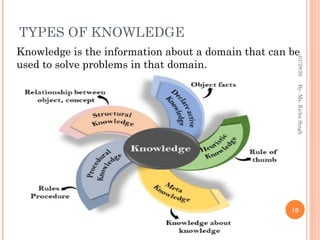
TYPES OF KNOWLEDGE
10
Knowledgeis the information about a domain that can be
used to solve problems in that domain.
By-
Ms.
Richa
Singh
01/28/26
11.
CONTI…
1. Declarative Knowledge:
Declarativeknowledge is to know about something.
It includes concepts, facts, and objects.
It is also called descriptive knowledge and expressed
in declarative sentences.
It is simpler than procedural language.
11
By-
Ms.
Richa
Singh
01/28/26
12.
CONTI…
2. Procedural Knowledge
Itis also known as imperative knowledge.
Procedural knowledge is a type of knowledge which is
responsible for knowing how to do something.
It can be directly applied to any task.
It includes rules, strategies, procedures, agendas, etc.
Procedural knowledge depends on the task on which it
can be applied.
12
By-
Ms.
Richa
Singh
01/28/26
13.
CONTI…
3. Meta-knowledge:
Knowledge aboutthe other types of knowledge is
called Meta-knowledge.
4. Heuristic knowledge:
Heuristic knowledge is representing knowledge of
some experts in a filed or subject.
Heuristic knowledge is rules of thumb based on
previous experiences, awareness of approaches, and
which are good to work but not guaranteed. 13
By-
Ms.
Richa
Singh
01/28/26
14.
CONTI…
5. Structural knowledge:
Structuralknowledge is basic knowledge to problem-
solving.
It describes relationships between various concepts
such as kind of, part of, and grouping of something.
It describes the relationship that exists between
concepts or objects.
14
By-
Ms.
Richa
Singh
01/28/26
15.
KNOWLEDGE REPRESENTATION
KnowledgeRepresentation in AI describes the
representation of knowledge.
Basically, it is a study of how the beliefs,
intentions, and judgments of an intelligent
agent can be expressed suitably for automated
reasoning.
One of the primary purposes of Knowledge
Representation includes modeling intelligent
behavior for an agent.
15
By-
Ms.
Richa
Singh
01/28/26
CONTI…
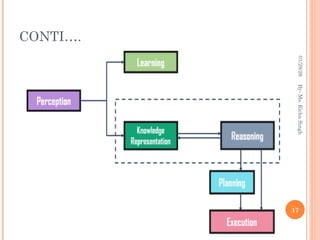
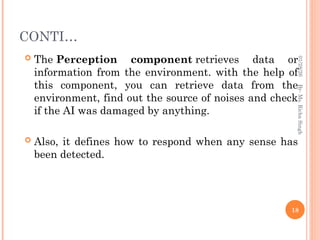
The Perceptioncomponent retrieves data or
information from the environment. with the help of
this component, you can retrieve data from the
environment, find out the source of noises and check
if the AI was damaged by anything.
Also, it defines how to respond when any sense has
been detected.
18
By-
Ms.
Richa
Singh
01/28/26
19.
CONTI…
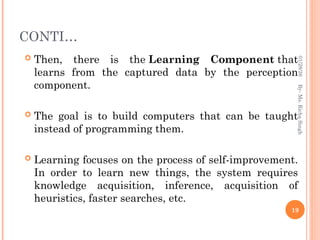
Then, thereis the Learning Component that
learns from the captured data by the perception
component.
The goal is to build computers that can be taught
instead of programming them.
Learning focuses on the process of self-improvement.
In order to learn new things, the system requires
knowledge acquisition, inference, acquisition of
heuristics, faster searches, etc.
19
By-
Ms.
Richa
Singh
01/28/26
20.
CONTI…
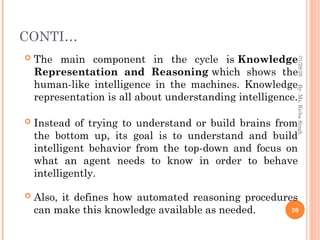
The maincomponent in the cycle is Knowledge
Representation and Reasoning which shows the
human-like intelligence in the machines. Knowledge
representation is all about understanding intelligence.
Instead of trying to understand or build brains from
the bottom up, its goal is to understand and build
intelligent behavior from the top-down and focus on
what an agent needs to know in order to behave
intelligently.
Also, it defines how automated reasoning procedures
can make this knowledge available as needed. 20
By-
Ms.
Richa
Singh
01/28/26
21.
CONTI…
The Planningand Execution components depend
on the analysis of knowledge representation and
reasoning.
Here, planning includes giving an initial state,
finding their preconditions and effects, and a
sequence of actions to achieve a state in which a
particular goal holds.
Now once the planning is completed, the final stage
is the execution of the entire process.
21
By-
Ms.
Richa
Singh
01/28/26
22.
TYPES OF KNOWLEDGE
REPRESENTATION
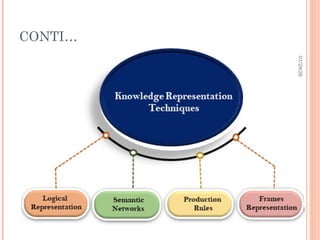
FourFundamental Types of Knowledge Representation
Logical Representation
Semantic Network
Frame Representation
Production Rules
22
By-
Ms.
Richa
Singh
01/28/26
CONTI…
1. Logical Representation
Logical representation is a language with some concrete
rules which deals with propositions and has no
ambiguity in representation.
Logical representation means drawing a conclusion based
on various conditions. This representation lays down
some important communication rules.
It consists of precisely defined syntax and semantics
which supports the sound inference.
Each sentence can be translated into logics using syntax
and semantics.
24
By-
Ms.
Richa
Singh
01/28/26
25.
CONTI…
Syntax
Syntaxes arethe rules which decide how we can
construct legal sentences in the logic.
It determines which symbol we can use in knowledge
representation.
How to write those symbols.
Semantics
Semantics are the rules by which we can interpret
the sentence in the logic.
Semantic also involves assigning a meaning to each
sentence. 25
By-
Ms.
Richa
Singh
01/28/26
26.
CONTI…
Logical representation canbe categorized into mainly two logics:
Propositional Logics
Predicate logics
Advantages
Logical representation enables us to do logical reasoning.
Logical representation is the basis for the programming
languages.
Disadvantages
Logical representations have some restrictions and are
challenging to work with.
Logical representation technique may not be very natural, and
inference may not be so efficient. 26
By-
Ms.
Richa
Singh
01/28/26
27.
CONTI…
2. Semantic NetworkRepresentation
Semantic networks are alternative of predicate logic
for knowledge representation.
In Semantic networks, we can represent our
knowledge in the form of graphical networks.
This network consists of nodes representing objects
and arcs which describe the relationship between
those objects.
Semantic networks can categorize the object in
different forms and can also link those objects.
Semantic networks are easy to understand and can
be easily extended. 27
By-
Ms.
Richa
Singh
01/28/26
28.
CONTI…
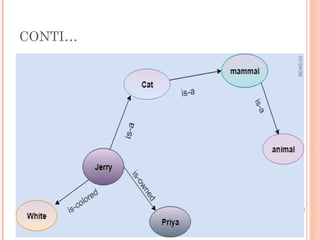
Example: Following aresome statements which we need
to represent in the form of nodes and arcs.
Statements:
Jerry is a cat.
Jerry is a mammal
Jerry is owned by Priya.
Jerry is White colored.
All Mammals are animal.
Here, represented the different type of knowledge in the
form of nodes and arcs. Each object is connected with
another object by some relation.
28
By-
Ms.
Richa
Singh
01/28/26
CONTI…
Advantages
Semantic networksare a natural representation of
knowledge.
Semantic networks convey meaning in a transparent
manner.
These networks are simple and easily understandable.
Drawbacks
Semantic networks try to model human-like memory
(Which has millions of neurons and links) to store the
information, but in practice, it is not possible to build
such a vast semantic network. 30
By-
Ms.
Richa
Singh
01/28/26
31.
CONTI…
Drawbacks
Semantic networkstake more computational time at
runtime as we need to traverse the complete network
tree to answer some questions. It might be possible in the
worst case scenario that after traversing the entire tree,
we find that the solution does not exist in this network.
These types of representations are inadequate as they do
not have any equivalent quantifier, e.g., for all, for some,
none, etc.
Semantic networks do not have any standard definition
for the link names.
These networks are not intelligent and depend on the
creator of the system. 31
By-
Ms.
Richa
Singh
01/28/26
32.
CONTI…
3. Frame Representation
A frame is a record like structure which consists of a
collection of attributes and its values to describe an
entity in the world.
Frames are the AI data structure which divides
knowledge into substructures by representing
stereotypes situations.
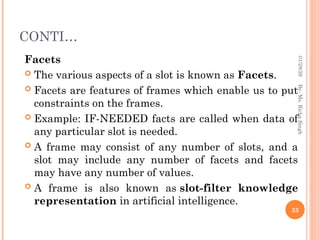
It consists of a collection of slots and slot values.
These slots may be of any type and sizes.
Slots have names and values which are called facets.
32
By-
Ms.
Richa
Singh
01/28/26
33.
CONTI…
Facets
The variousaspects of a slot is known as Facets.
Facets are features of frames which enable us to put
constraints on the frames.
Example: IF-NEEDED facts are called when data of
any particular slot is needed.
A frame may consist of any number of slots, and a
slot may include any number of facets and facets
may have any number of values.
A frame is also known as slot-filter knowledge
representation in artificial intelligence.
33
By-
Ms.
Richa
Singh
01/28/26
34.
CONTI…
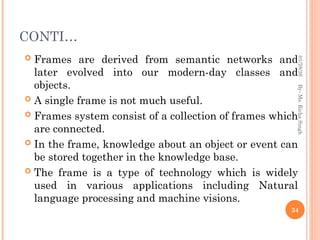
Frames arederived from semantic networks and
later evolved into our modern-day classes and
objects.
A single frame is not much useful.
Frames system consist of a collection of frames which
are connected.
In the frame, knowledge about an object or event can
be stored together in the knowledge base.
The frame is a type of technology which is widely
used in various applications including Natural
language processing and machine visions.
34
By-
Ms.
Richa
Singh
01/28/26
35.
CONTI…
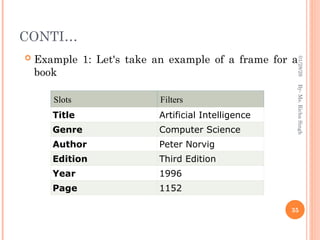
Example 1:Let's take an example of a frame for a
book
35
By-
Ms.
Richa
Singh
Slots Filters
Title Artificial Intelligence
Genre Computer Science
Author Peter Norvig
Edition Third Edition
Year 1996
Page 1152
01/28/26
36.
CONTI…
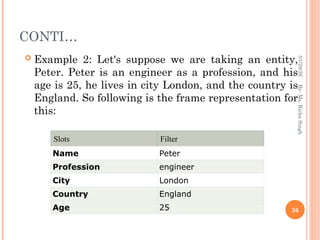
Example 2:Let's suppose we are taking an entity,
Peter. Peter is an engineer as a profession, and his
age is 25, he lives in city London, and the country is
England. So following is the frame representation for
this:
36
By-
Ms.
Richa
Singh
Slots Filter
Name Peter
Profession engineer
City London
Country England
Age 25
01/28/26
37.
CONTI…
Advantages
The frameknowledge representation makes the
programming easier by grouping the related data.
The frame representation is comparably flexible and
used by many applications in AI.
It is very easy to add slots for new attribute and
relations.
It is easy to include default data and to search for
missing values.
Frame representation is easy to understand and
visualize.
37
By-
Ms.
Richa
Singh
01/28/26
38.
CONTI…
Disadvantages
In framesystem inference mechanism is not be
easily processed.
Inference mechanism cannot be smoothly proceeded
by frame representation.
Frame representation has a much generalized
approach.
38
By-
Ms.
Richa
Singh
01/28/26
39.
CONTI…
4. Production Rules
Production rules system consist of (condition,
action) pairs which mean, "If condition then action".
It has mainly three parts:
The set of production rules
Working Memory
The recognize-act-cycle
39
By-
Ms.
Richa
Singh
01/28/26
40.
CONTI…
In productionrules agent checks for the condition
and if the condition exists then production rule fires
and corresponding action is carried out.
The condition part of the rule determines which rule
may be applied to a problem.
And the action part carries out the associated
problem-solving steps.
This complete process is called a recognize-act cycle.
40
By-
Ms.
Richa
Singh
01/28/26
41.
CONTI…
The workingmemory contains the description of the
current state of problems-solving and rule can write
knowledge to the working memory.
This knowledge match and may fire other rules.
If there is a new situation (state) generates, then
multiple production rules will be fired together, this
is called conflict set.
In this situation, the agent needs to select a rule
from these sets, and it is called a conflict resolution.
41
By-
Ms.
Richa
Singh
01/28/26
42.
CONTI…
Example
IF (atbus stop AND bus arrives) THEN action (get
into the bus)
IF (on the bus AND paid AND empty seat) THEN
action (sit down).
IF (on bus AND unpaid) THEN action (pay charges).
IF (bus arrives at destination) THEN action (get
down from the bus).
42
By-
Ms.
Richa
Singh
01/28/26
43.
CONTI…
Advantages
The productionrules are expressed in natural language.
The production rules are highly modular, so we can
easily remove, add or modify an individual rule.
Disadvantages
Production rule system does not exhibit any learning
capabilities, as it does not store the result of the
problem for the future uses.
During the execution of the program, many rules may
be active hence rule-based production systems are
inefficient. 43
By-
Ms.
Richa
Singh
01/28/26
44.
APPROACHES TO KNOWLEDGE
REPRESENTATION
There are mainly four approaches to knowledge
representation, which are given below:
1. Simple relational knowledge
2. Inheritable knowledge
3. Inferential knowledge
4. Procedural knowledge
44
By-
Ms.
Richa
Singh
01/28/26
45.
CONTI…
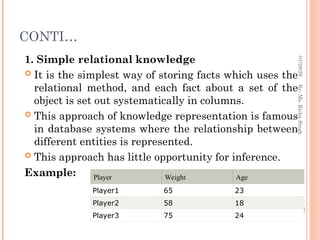
1. Simple relationalknowledge
It is the simplest way of storing facts which uses the
relational method, and each fact about a set of the
object is set out systematically in columns.
This approach of knowledge representation is famous
in database systems where the relationship between
different entities is represented.
This approach has little opportunity for inference.
Example:
45
By-
Ms.
Richa
Singh
Player Weight Age
Player1 65 23
Player2 58 18
Player3 75 24
01/28/26
46.
CONTI…
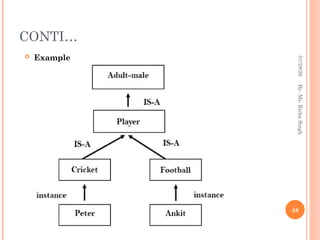
2. Inheritable knowledge
In the inheritable knowledge approach, all data must
be stored into a hierarchy of classes.
All classes should be arranged in a generalized form
or a hierarchal manner.
In this approach, we apply inheritance property.
Elements inherit values from other members of a
class.
This approach contains inheritable knowledge which
shows a relation between instance and class, and it is
called instance relation.
46
By-
Ms.
Richa
Singh
01/28/26
47.
CONTI…
Every individualframe can represent the collection
of attributes and its value.
In this approach, objects and values are represented
in Boxed nodes.
We use Arrows which point from objects to their
values.
47
By-
Ms.
Richa
Singh
01/28/26
CONTI…
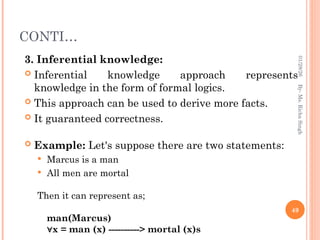
3. Inferential knowledge:
Inferential knowledge approach represents
knowledge in the form of formal logics.
This approach can be used to derive more facts.
It guaranteed correctness.
Example: Let's suppose there are two statements:
Marcus is a man
All men are mortal
Then it can represent as;
man(Marcus)
x = man (x) ----------> mortal (x)s
∀
49
By-
Ms.
Richa
Singh
01/28/26
50.
CONTI…
4. Procedural knowledge
Procedural knowledge approach uses small programs
and codes which describes how to do specific things,
and how to proceed.
In this approach, one important rule is used which
is If-Then rule.
In this knowledge, we can use various coding languages
such as LISP language and Prolog language.
We can easily represent heuristic or domain-specific
knowledge using this approach.
But it is not necessary that we can represent all cases
in this approach. 50
By-
Ms.
Richa
Singh
01/28/26
51.
REASONING
Reasoning isa way to infer facts from existing
data
It is a general process of thinking rationally, to find
valid conclusions.
In artificial intelligence, the reasoning is essential so
that the machine can also think rationally as a
human brain, and can perform like a human.
51
By-
Ms.
Richa
Singh
01/28/26
52.
TYPES OF REASONING
Inartificial intelligence, reasoning can be divided into
the following categories:
1.Deductive reasoning
2.Inductive reasoning
3.Abductive reasoning
4.Common Sense Reasoning
5.Monotonic Reasoning
6.Non-monotonic Reasoning
52
By-
Ms.
Richa
Singh
01/28/26
53.
CONTI…
1. Deductive reasoning
Deductivereasoning is deducing new information
from logically related known information.
It is the form of valid reasoning, which means the
argument's conclusion must be true when the premises
are true.
Deductive reasoning is a type of propositional logic in
AI, and it requires various rules and facts.
It is sometimes referred to as top-down reasoning,
and contradictory to inductive reasoning.
In deductive reasoning, the truth of the premises
guarantees the truth of the conclusion. 53
By-
Ms.
Richa
Singh
01/28/26
54.
CONTI…
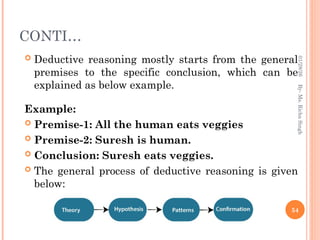
Deductive reasoningmostly starts from the general
premises to the specific conclusion, which can be
explained as below example.
Example:
Premise-1: All the human eats veggies
Premise-2: Suresh is human.
Conclusion: Suresh eats veggies.
The general process of deductive reasoning is given
below:
54
By-
Ms.
Richa
Singh
01/28/26
55.
CONTI…
2. Inductive Reasoning
Inductivereasoning is a form of reasoning to arrive at
a conclusion using limited sets of facts by the process
of generalization.
It starts with the series of specific facts or data and
reaches to a general statement or conclusion.
Inductive reasoning is a type of propositional logic,
which is also known as cause-effect reasoning or
bottom-up reasoning.
In inductive reasoning, we use historical data or
various premises to generate a generic rule, for which
premises support the conclusion. 55
By-
Ms.
Richa
Singh
01/28/26
56.
CONTI…
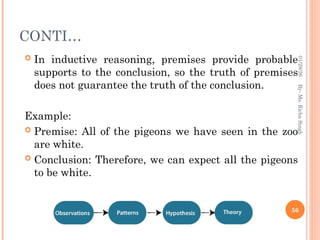
In inductivereasoning, premises provide probable
supports to the conclusion, so the truth of premises
does not guarantee the truth of the conclusion.
Example:
Premise: All of the pigeons we have seen in the zoo
are white.
Conclusion: Therefore, we can expect all the pigeons
to be white.
56
By-
Ms.
Richa
Singh
01/28/26
57.
CONTI…
3. Abductive reasoning
Abductivereasoning is a form of logical reasoning which
starts with single or multiple observations then seeks to
find the most likely explanation or conclusion for the
observation.
Abductive reasoning is an extension of deductive
reasoning, but in abductive reasoning, the premises do not
guarantee the conclusion.
Example
Implication: Cricket ground is wet if it is raining
Axiom: Cricket ground is wet.
Conclusion It is raining.
57
By-
Ms.
Richa
Singh
01/28/26
58.
CONTI…
4. Common SenseReasoning
Common sense reasoning is an informal form of
reasoning, which can be gained through experiences.
Common Sense reasoning simulates the human
ability to make presumptions about events which
occurs on every day.
It relies on good judgment rather than exact logic and
operates on heuristic knowledge and heuristic
rules.
58
By-
Ms.
Richa
Singh
01/28/26
59.
CONTI…
Example
One personcan be at one place at a time.
If I put my hand in a fire, then it will burn.
The above two statements are the examples of common
sense reasoning which a human mind can easily
understand and assume.
59
By-
Ms.
Richa
Singh
01/28/26
60.
CONTI…
5. Monotonic Reasoning
Inmonotonic reasoning, once the conclusion is taken,
then it will remain the same even if we add some other
information to existing information in our knowledge
base.
In monotonic reasoning, adding knowledge does not
decrease the set of prepositions that can be derived.
To solve monotonic problems, we can derive the valid
conclusion from the available facts only, and it will not
be affected by new facts.
Monotonic reasoning is not useful for the real-time
systems, as in real time, facts get changed, so we cannot
use monotonic reasoning.
60
By-
Ms.
Richa
Singh
01/28/26
61.
CONTI…
Monotonic reasoningis used in conventional reasoning
systems, and a logic-based system is monotonic.
Any theorem proving is an example of monotonic
reasoning.
Example
Earth revolves around the Sun.
It is a true fact, and it cannot be changed even if we add
another sentence in knowledge base like, "The moon
revolves around the earth" Or "Earth is not round,"
etc. 61
By-
Ms.
Richa
Singh
01/28/26
62.
CONTI..
Advantages
In monotonicreasoning, each old proof will always
remain valid.
If we deduce some facts from available facts, then it will
remain valid for always.
Disadvantages
We cannot represent the real world scenarios using
Monotonic reasoning.
Hypothesis knowledge cannot be expressed with
monotonic reasoning, means facts should be true.
Since we can only derive conclusions from the old proofs,
so new knowledge from the real world cannot be added.
62
By-
Ms.
Richa
Singh
01/28/26
63.
CONTI…
6. Non-monotonic Reasoning
InNon-monotonic reasoning, some conclusions may
be invalidated if we add some more information to our
knowledge base.
Logic will be said as non-monotonic if some
conclusions can be invalidated by adding more
knowledge into our knowledge base.
Non-monotonic reasoning deals with incomplete and
uncertain models.
"Human perceptions for various things in daily life,
"is a general example of non-monotonic reasoning.
63
By-
Ms.
Richa
Singh
01/28/26
64.
CONTI…
Example
Let suppose theknowledge base contains the following
knowledge:
Birds can fly
Penguins cannot fly
Pitty is a bird
So from the above sentences, we can conclude that Pitty
can fly.
However, if we add one another sentence into knowledge
base "Pitty is a penguin", which concludes "Pitty
cannot fly", so it invalidates the above conclusion.
64
By-
Ms.
Richa
Singh
01/28/26
65.
CONTI…
Advantages
For real-worldsystems such as Robot navigation, we
can use non-monotonic reasoning.
In Non-monotonic reasoning, we can choose
probabilistic facts or can make assumptions.
Disadvantages
In non-monotonic reasoning, the old facts may be
invalidated by adding new sentences.
It cannot be used for theorem proving.
65
By-
Ms.
Richa
Singh
01/28/26