DNA REPAIR, GENETIC CODE
& Translation
DR. Vishnu Kumar
PROFESSOR & HEAD,
DEPT.OF BIOCHEMISTRY
MPTMC, SIDDHARTH NAGAR
COMPETENCY NUMBER BI 7.2
LEARNING OBJECTIVES
After completion of this lecture learner
should be able to define/ describe:
• DNA Repair
• Genetic Code
• Mutation
DNA Repair
• The most serious outcome of DNA
damage is mutation i.e. permanent and
heritable change in the genome which
may cause cancer, genetic disease.
• In addition to proof reading activity an
elaborate system of DNA repair exists in
the body.
Types of DNA repair
• 1) Mismatch repair.
• 2) Base excision repair
• 3) Nucleotide excision repair.
• 4) Double strand break repair.
Mismatch repair
• These are rare mistakes left over even
after proof reading, e.g. C could be
present opposite A.
• The repairing system must distinguish
between the template strand and the
new strand containing the wrong base.
This is accomplished by tagging the
template strand with methyl group (
CH3).
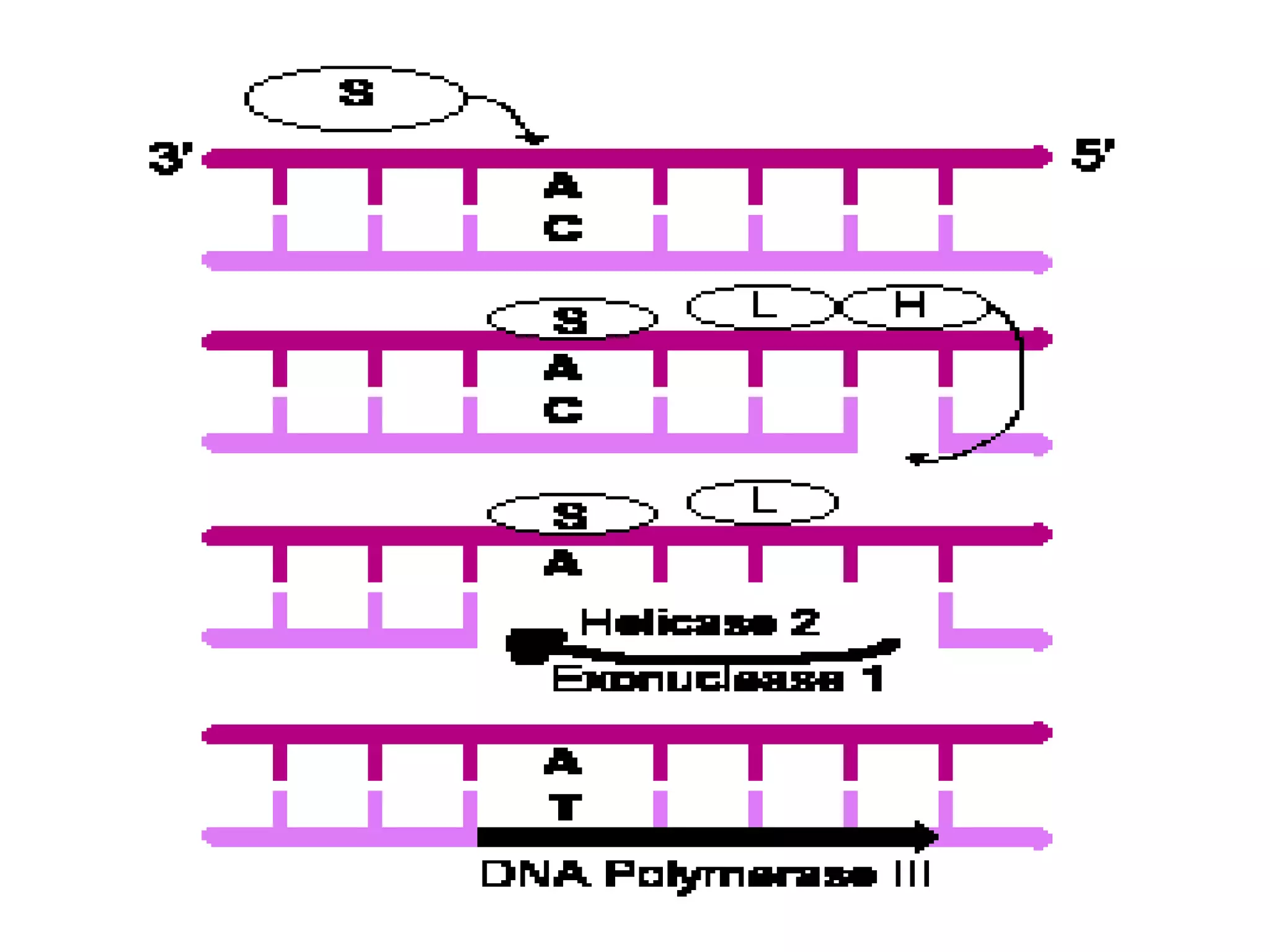
• Three proteins Mut S, MutL and Mut H
are needed for strand recognition.
Mismatch repair
• DAM methylase methylates the
template strand.
• An endonuclease will cut the strand
near the defect.
• An exonuclease will digest the strand
removing the faulty sequence.
• The gap is filled up by DNAP III, SSB,
helicase and ligase.
Base excision repair
• Spontaneous, chemical, radiation or
heat may damage a single base, e.g.
• Deamination of adenine to
hypoxanthine.
• Guanine to 6 methyl guanine.
• Uracil to 5 bromo uracil.
• Purine to amino purine.
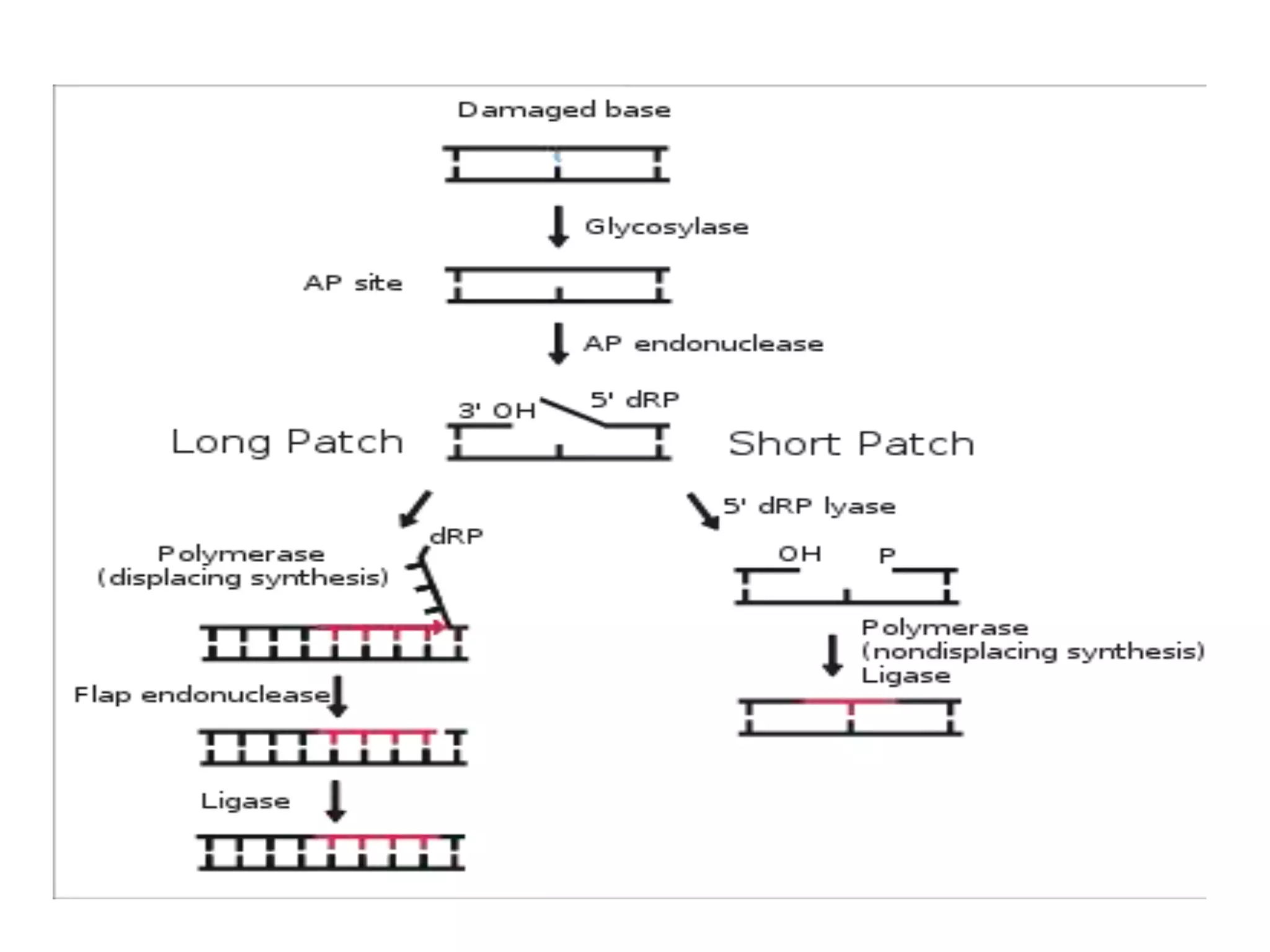
• There is a class of enzyme called DNA
glycosylase that removes the affected
base. This creates an apurinic or
apyrimidinic site ( AP site ).
• AP endonuclease cuts the strand
containing the defective site.
• Proper base is replaced by DNA
polymerase 1 ( DNAPβ in eukaryotes.)
• DNA ligase causes final ligation.
Base excision repair
Nucleotide excision repair
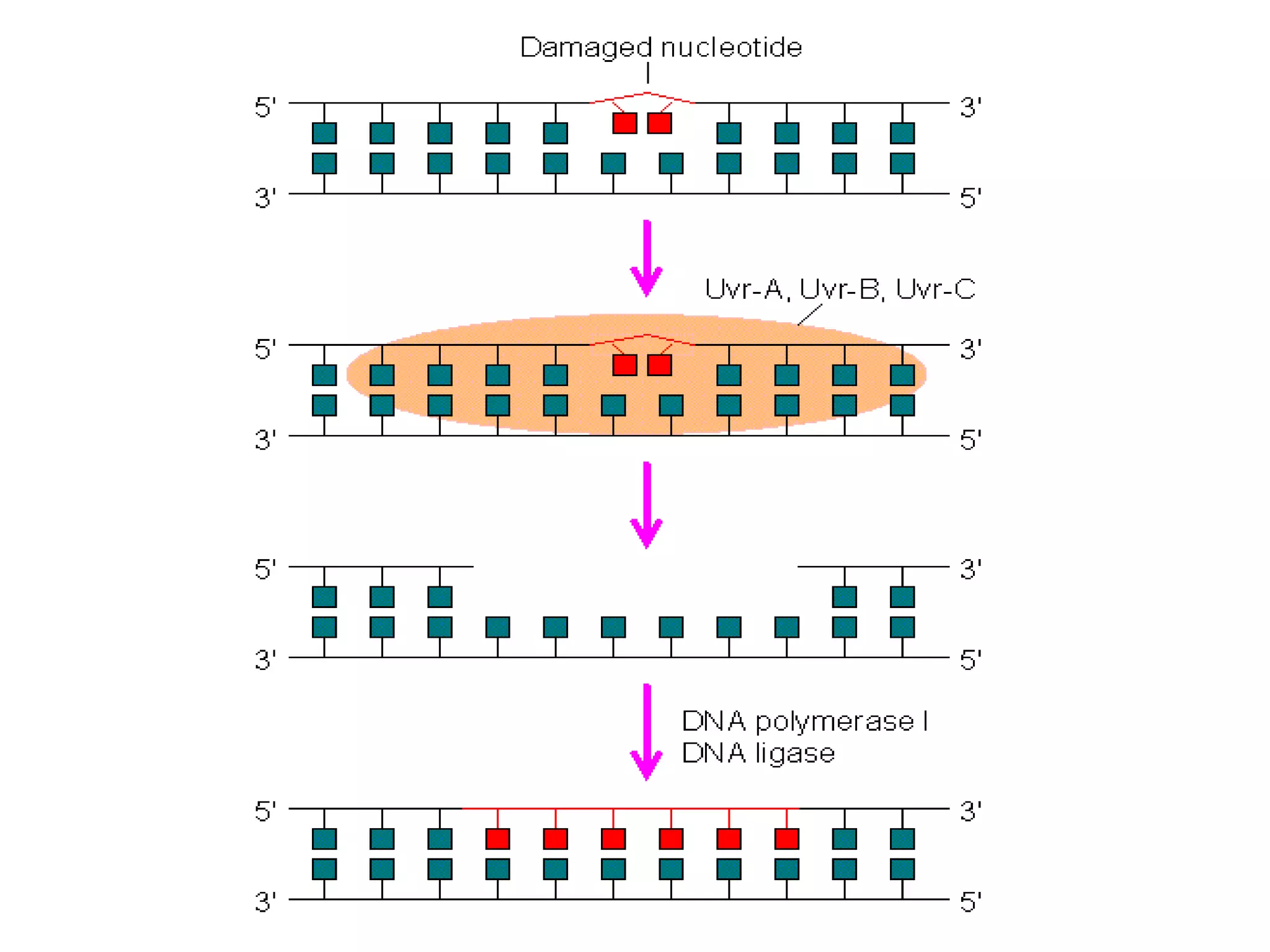
• Chemicals, radiation or heat may
damage a segment of DNA up to 30
bases.
• The enzyme is ABC exonuclease.
• The enzyme hydrolyzes two phospho
diester bonds containing the defect.
• Synthesis of new strand by DNAP1 ( β
in eukaryotes).
• Final joining by DNA ligase.
Double strand break repair
• May occur by ionising radiation, chemo
therapeutic agents.
• Two proteins are involved KU, and DNA
PK which bind to the free ends and
allow approximation of two ends.
• Unwinding of the ends by helicase
activity of KU. Unwound approximated
ends form base pairs, the extra tails are
removed by exonuclease.
.
DNA repair and Cancer
• Human cancer develops when certain
genes that regulate normal cell division
(tumor suppressor gene or proto
oncogene) fail or altered.
• Cells may grow out of control and form
a tumor.
• Defects in the genes encoding the
proteins of different repair systems
have been linked to human cancer.
Xeroderma pigmentosa
• Defective nucleotide excision repair.
• UV light  damaged DNA. not
repaired due to defective NE repair 
replication of damaged DNA 
daughter DNA with mutation  mutated
DNA mediates cancer by activation of
proto oncogens multiple skin cancer.
Other cancers
• HNPCC  defective mismatch repair
• Cockayne’s syndrome  defective NE
repair.
• Ataxia telangiectasia  defect in
double strand break repair.
• Fanconi’s anemia  lethal aplastic
anemia due to defective double strand
break repair.
Genetic code
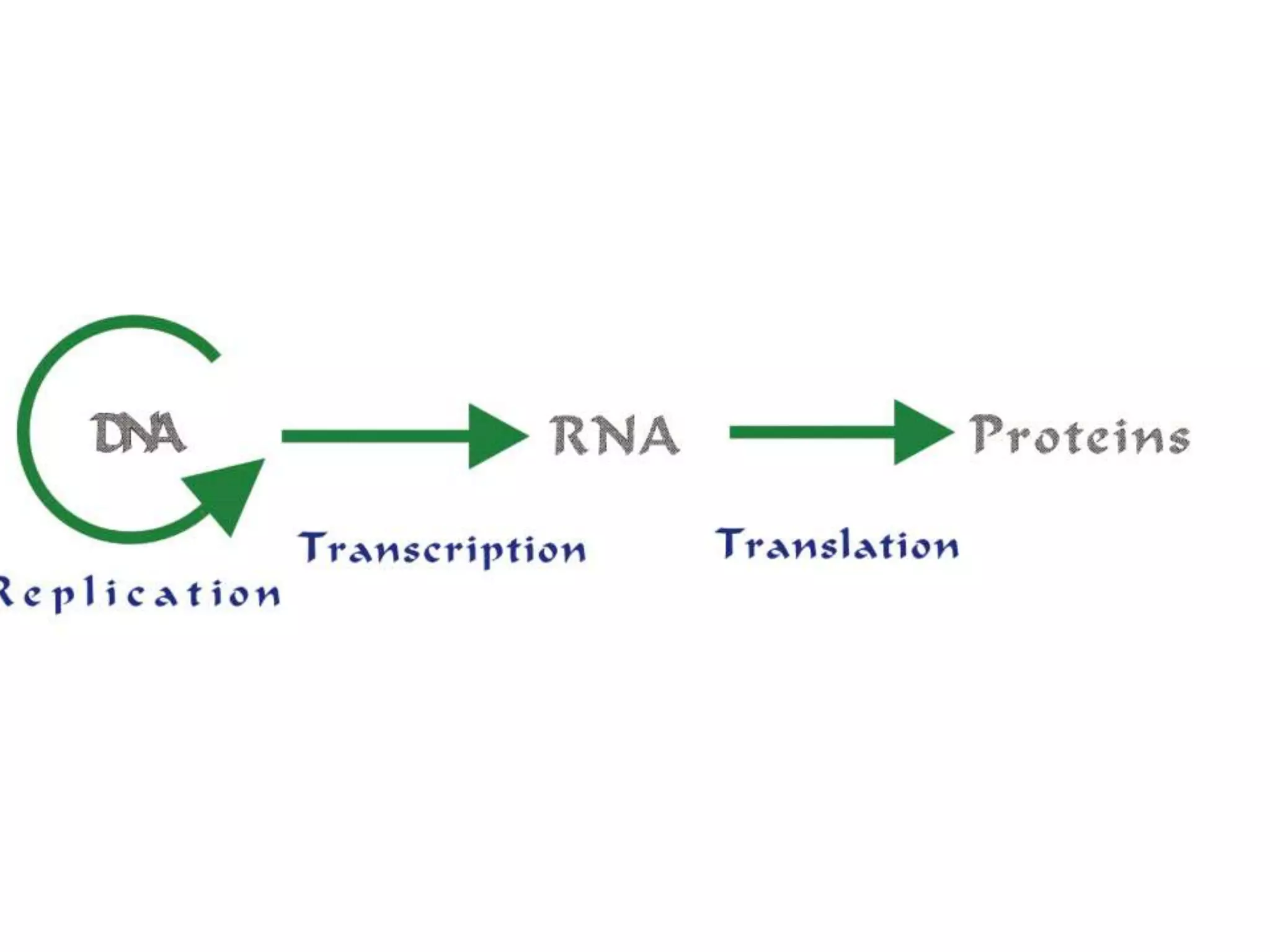
• Genetic information is stored in the
chromosome and transmitted to
daughter cells through replication. It
is expressed to RNA through
transcription.
• From the mRNA genetic information
is translated to polypeptides.
• the flow of information from DNA 
RNA  protein is called Central
Dogma of Molecular Biology.
Genetic code
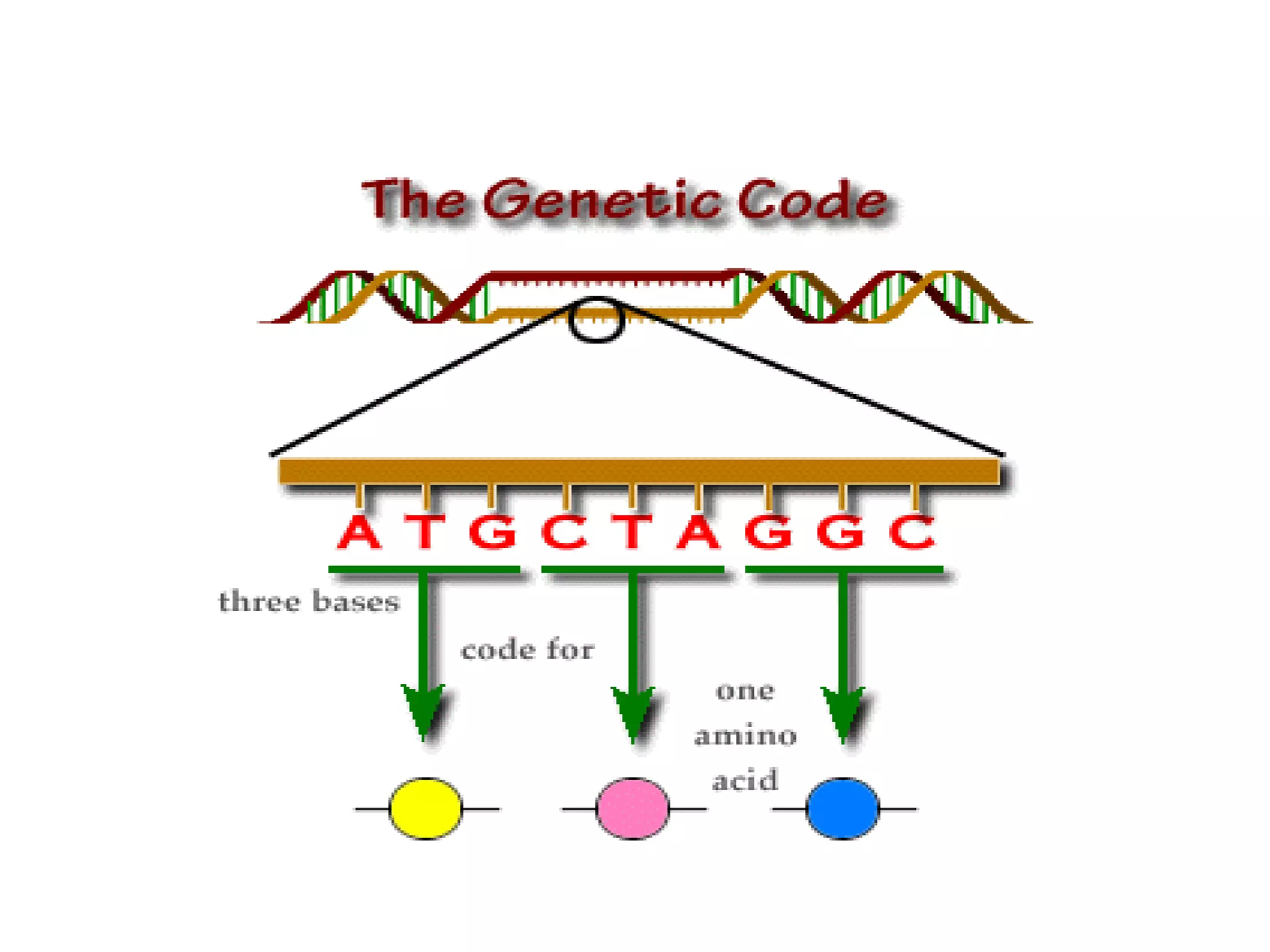
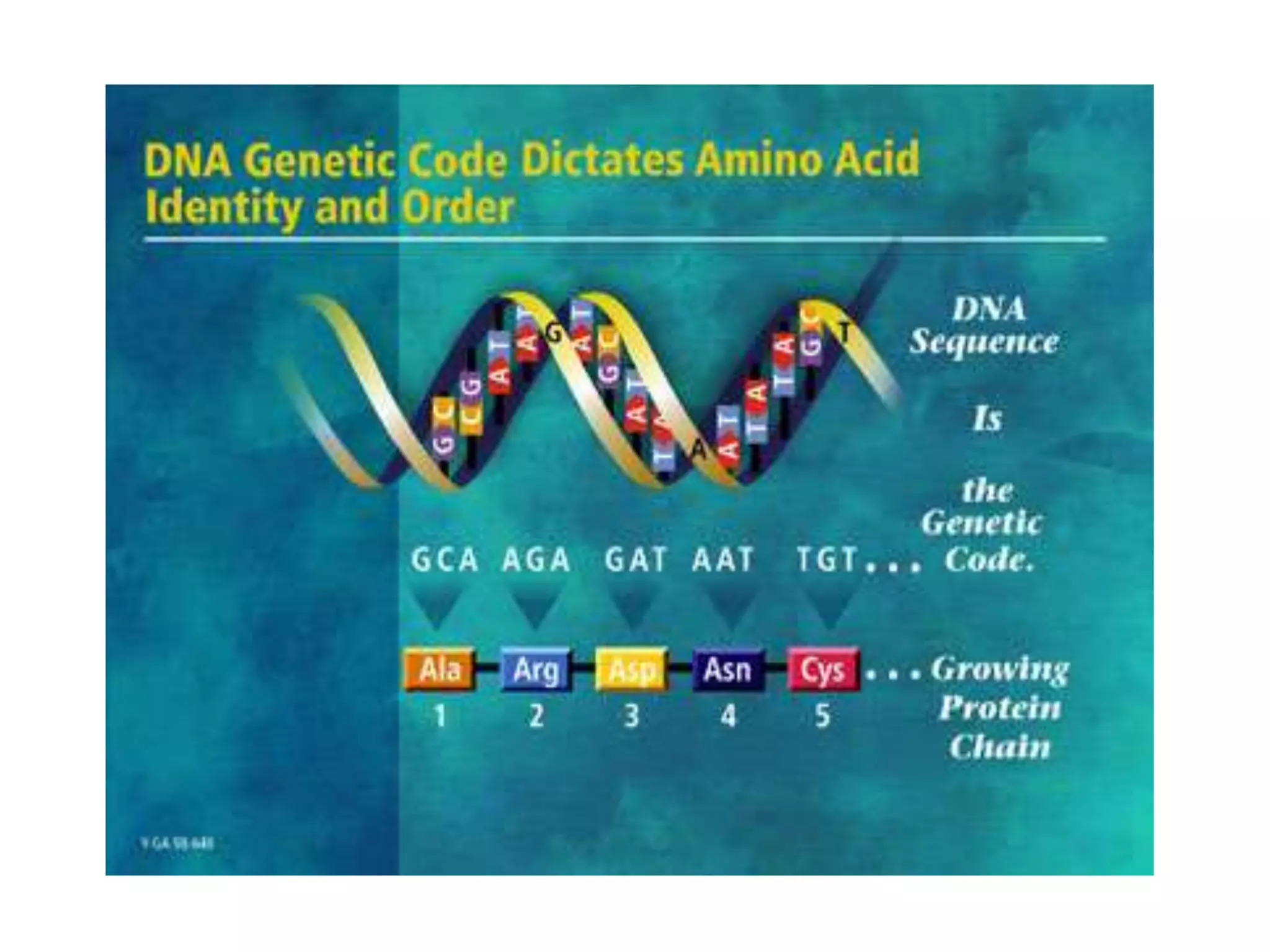
Definition The set of triplet code
words in DNA or mRNA coding for
amino acids of protein. This is the
dictionary that gives correspondence
between a sequence of nucleotide
bases and a sequence of amino acids
in a protein. Each individual word in the
code is composed 3 nucleotides. These
genetic words are called codons.
Genetic code
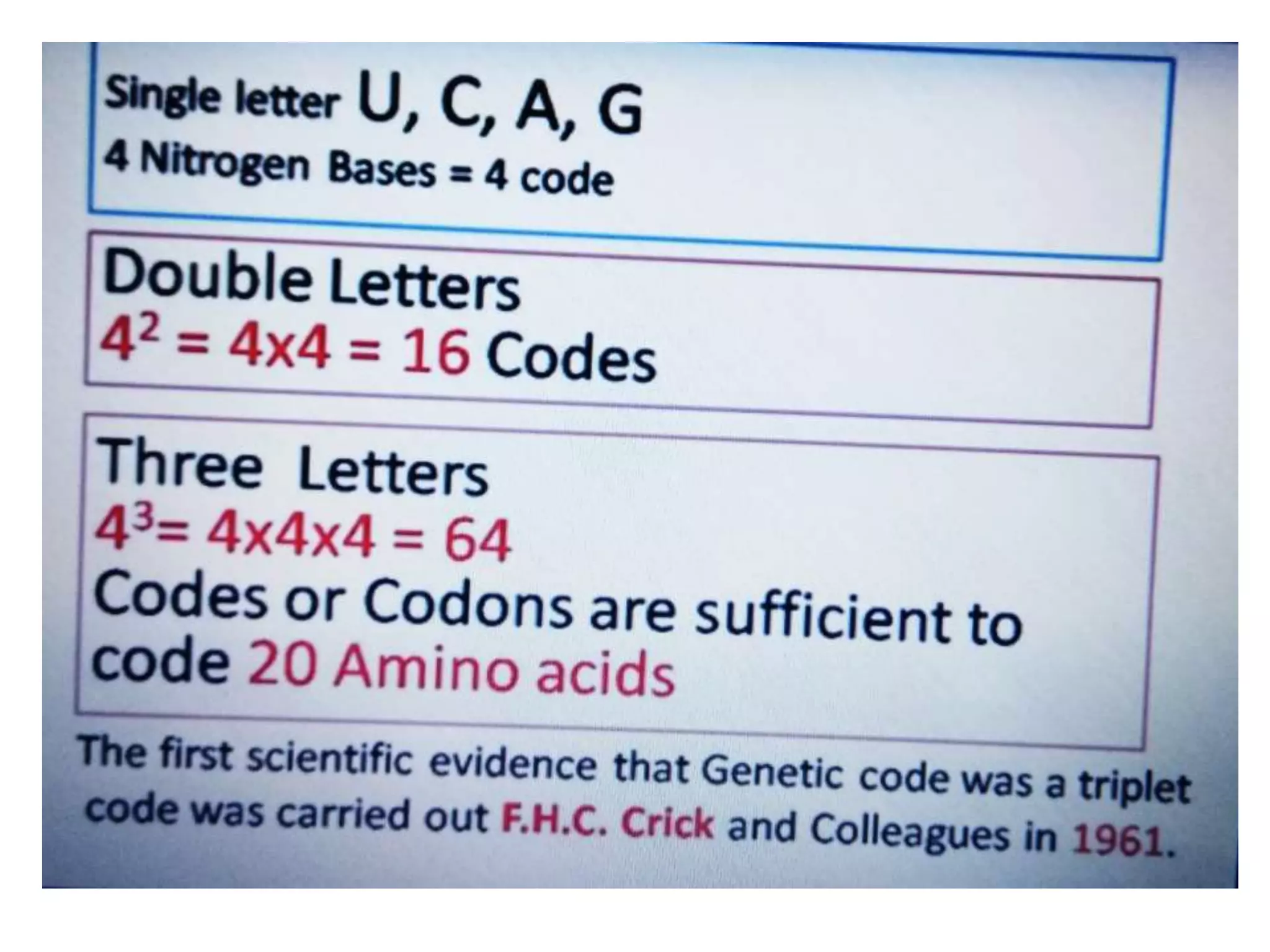
• Altogether there are 64 codons of
which 61 codons code for 20 amino
acids in a protein. 3 codons act as
termination signal.
• 61 codons coding for amino acids are
called sense codons and the rest {UAG
(amber), UGA (opal) and UAA (ochre)}
are called nonsense codons.
Characteristics of genetic code
• Degenerate.
• Unambiguous.
• Non overlapping.
• Non punctuated.
• Universal.
Degeneracy
• This means multiple codons code for a
single amino acid. There are six codons
for serine, four for glycine and one for
methionine.
• AUG for methionine.
• GGA, GGC, GGG and GGG for glycine.
Unambiguity
• One specific codon codes for only one
specific amino acid.
• For example phenylalanine is coded
by both UUU and UUC but UUU will
code only for phenylalanine.
• So given a specific codon only a
specific amino acid will come although
given a specific amino acid, more than
one codon may be called.
Non overlapping & non
punctuation
• Non overlapping codons are
consecutive. They are read one after
another in a continuous manner.
• Non punctuation no comma between
two codons.
Universal
• Until recently the genetic code was
thought to be universal that means one
specific codon will code for one
specific amino acid in all the
organisms.
• Recently it has been shown that four
codons behave differently in cytoplasm
and mitochondria of the same cell. For
example UGA codes for termination
codon in cytoplasm and tryptophan in
mitochondria
Wobble
• The degeneracy of genetic code
resides mostly in the last base of the
codon, suggesting that the base pairing
between the last nucleotide of the
codon and the corresponding
nucleotide in the anticodon is not strict
and less strong. This phenomenon is
called Wobble.
Example of wobble
• The two codons for arginine AGA and
AGG can bind to the same anticodon
having uracil at the 5’ end. Similarly
three codons for glycine GGC, GGU,
and GGA can form base pair with the
same anticodon CCI.
Mutation
• Definition. Permanent and heritable
change in the genome which will
appear in the daughter DNA , after
replication, in the RNA after
transcription and in the protein after
translation.
• Types 1) Point mutation
2) Frame shift mutation.
Point Mutation
• Definition. single base alteration in
the gene.
• Classification.
• 2 classifications.
1) transition and transversion.
2) silent mutation, nonsense mutation
and missense mutation.
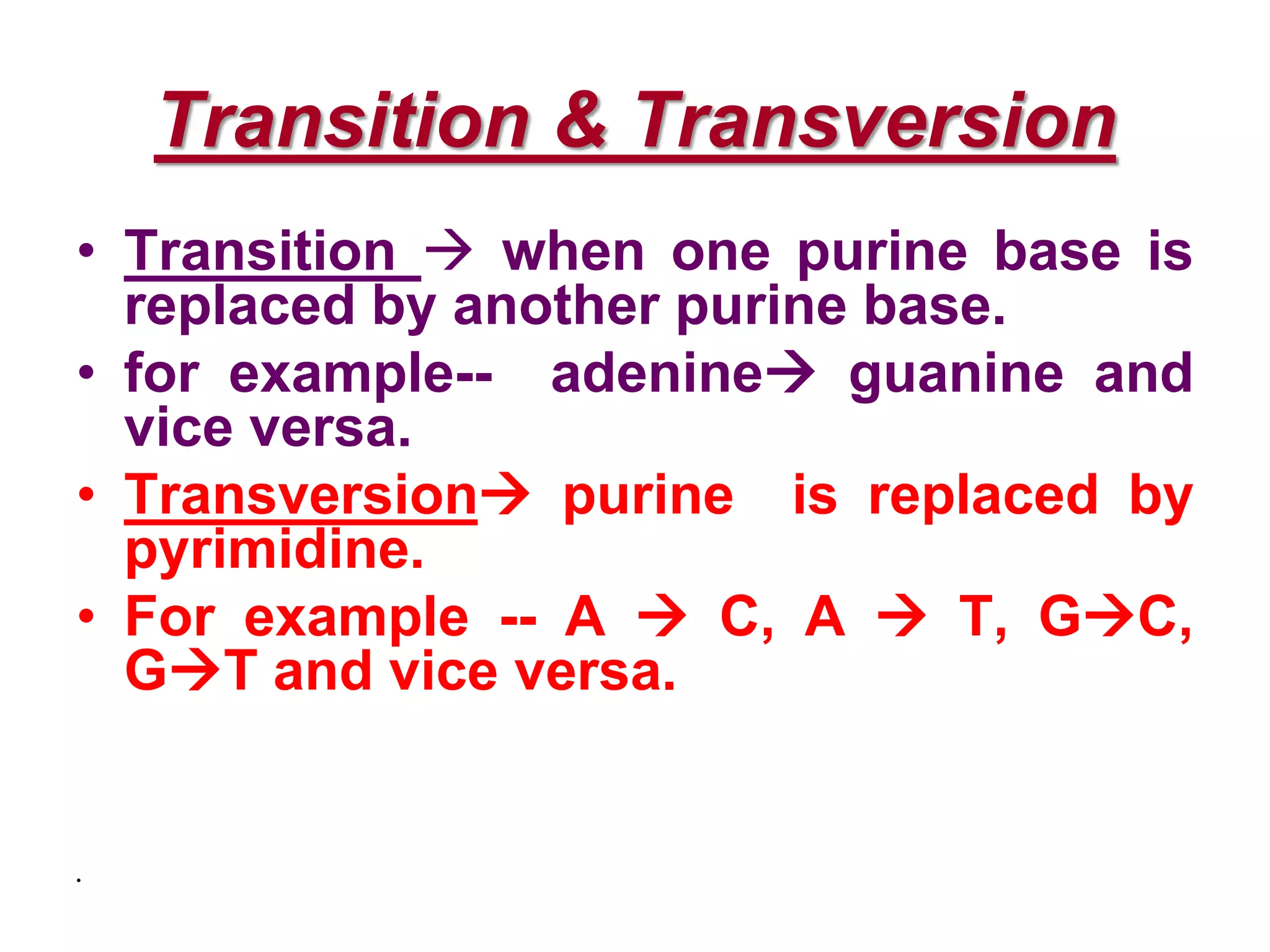
Transition & Transversion
• Transition  when one purine base is
replaced by another purine base.
• for example-- adenine guanine and
vice versa.
• Transversion purine is replaced by
pyrimidine.
• For example -- A  C, A  T, GC,
GT and vice versa.
•
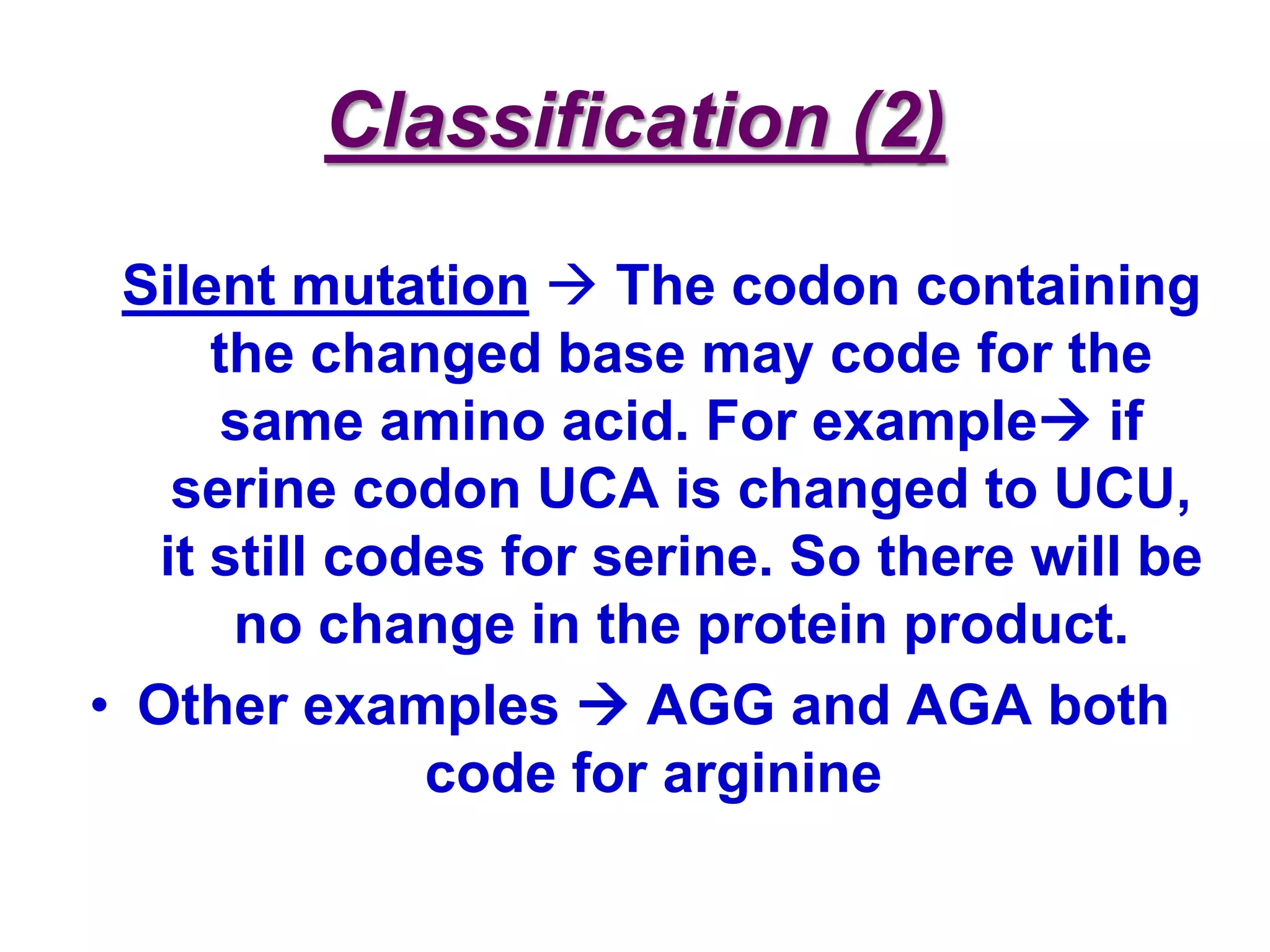
Classification (2)
Silent mutation  The codon containing
the changed base may code for the
same amino acid. For example if
serine codon UCA is changed to UCU,
it still codes for serine. So there will be
no change in the protein product.
• Other examples  AGG and AGA both
code for arginine
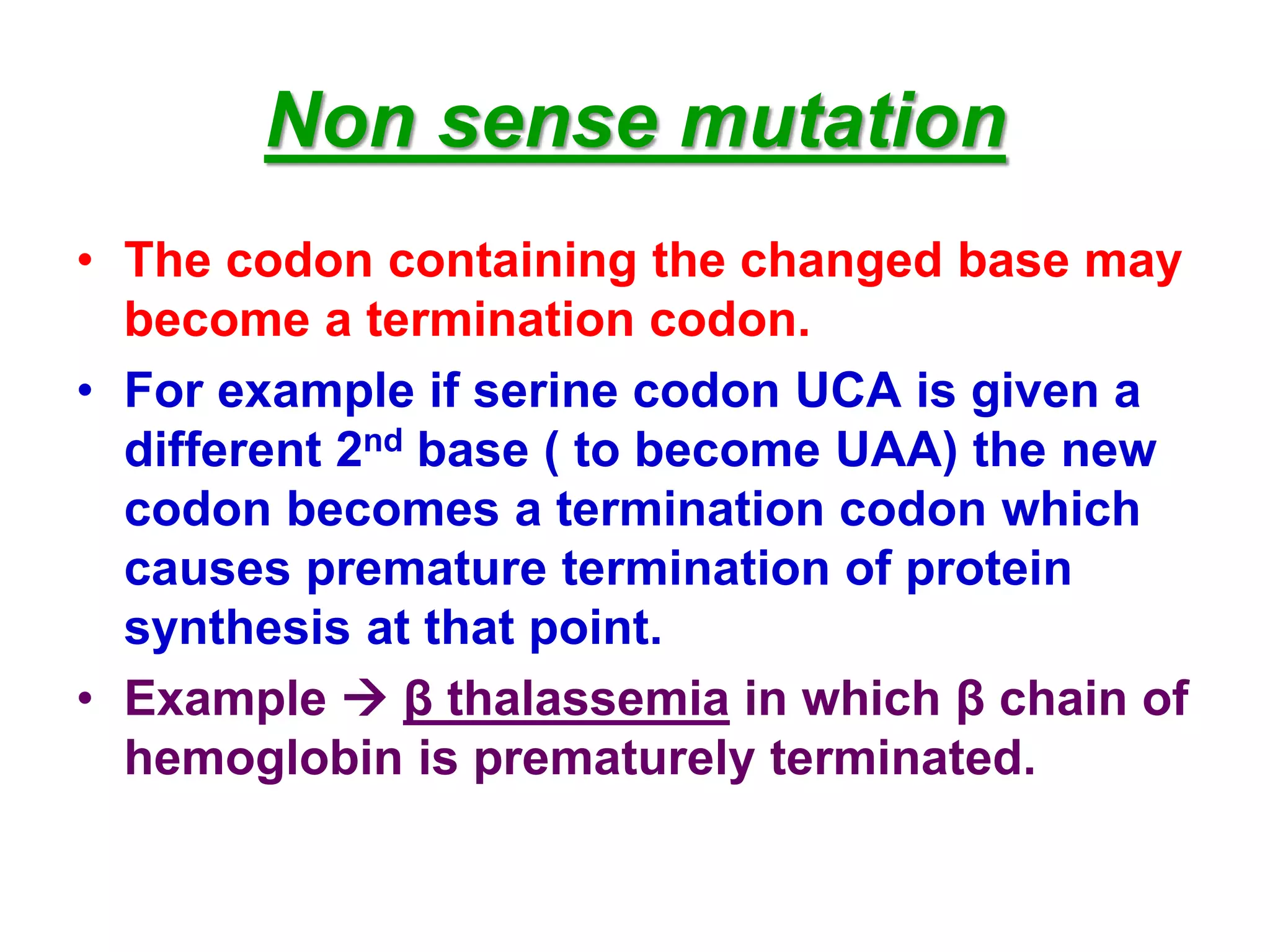
Non sense mutation
• The codon containing the changed base may
become a termination codon.
• For example if serine codon UCA is given a
different 2nd base ( to become UAA) the new
codon becomes a termination codon which
causes premature termination of protein
synthesis at that point.
• Example  β thalassemia in which β chain of
hemoglobin is prematurely terminated.
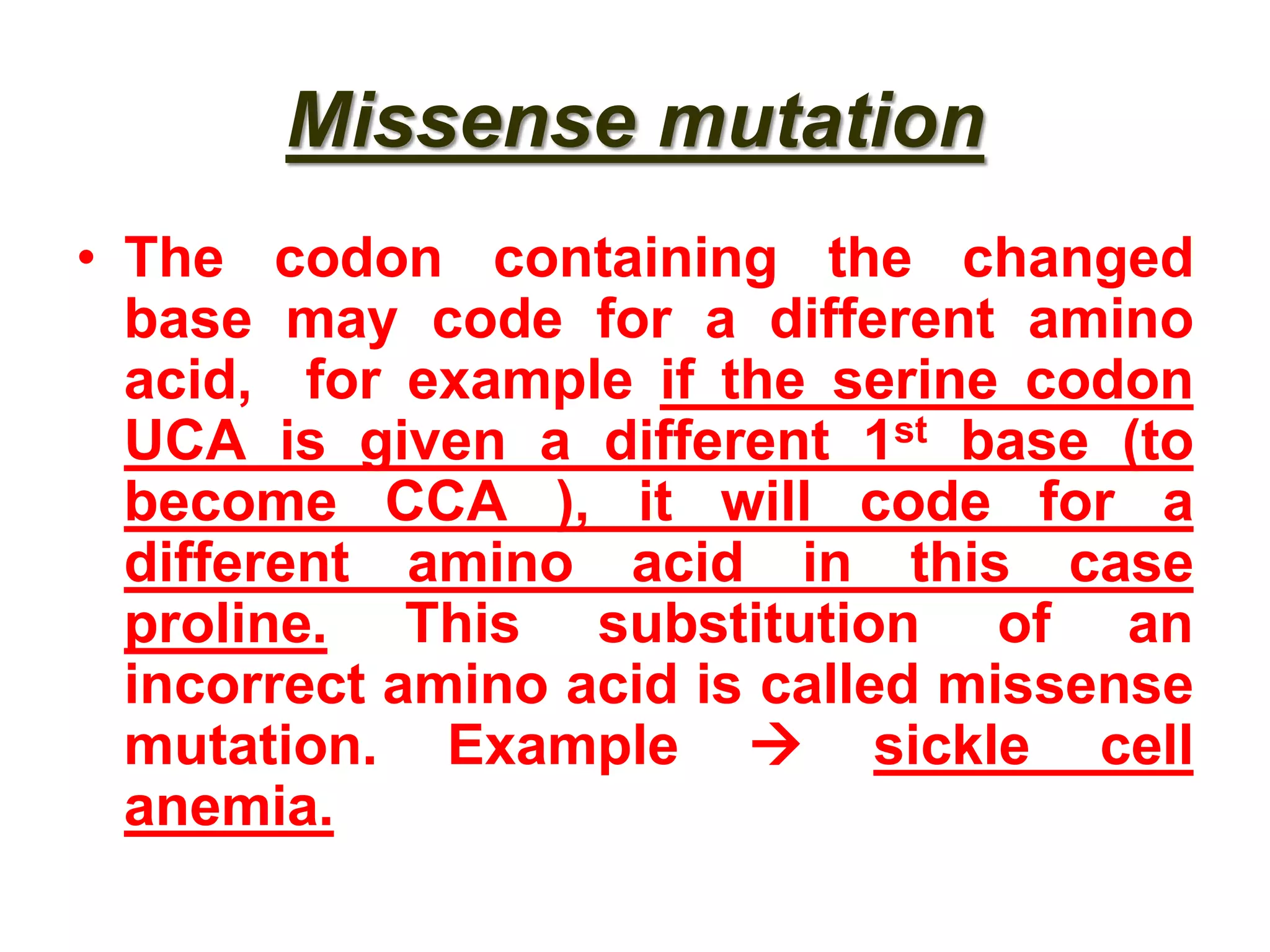
Missense mutation
• The codon containing the changed
base may code for a different amino
acid, for example if the serine codon
UCA is given a different 1st base (to
become CCA ), it will code for a
different amino acid in this case
proline. This substitution of an
incorrect amino acid is called missense
mutation. Example  sickle cell
anemia.
Frame shift mutation
• The deletion or addition of a single
nucleotide in the coding strand of a gene
results in an altered reading frame in the
mRNA. When the mRNA is translated to
protein the machinery does not recognize
that a base is missing or extra since there is
no punctuation in the reading frame. Thus
three will be major alteration in the sequence
of amino acids distal to the deletion or
addition.
Example of mutation
• Point mutation ( missense)  sickle
cell anemia.
• Point mutation ( nonsense)  α and β
thalassemias.
• Frame shift mutation  thalassemias
Effects of mutation
• Lethal effect  if the mutation is
incompatible to the life. For example 
β-thalassemia major.
• Carcinogenic effect mutation may
result in uncontrolled cell division
leading to cancer.
• Disease  sickle cell anemia ,
thalassemia.
Lecture 2. DNA Repair- Genetic code and mutation.ppt

Lecture 2. DNA Repair- Genetic code and mutation.ppt

  • 1.
    DNA REPAIR, GENETICCODE & Translation DR. Vishnu Kumar PROFESSOR & HEAD, DEPT.OF BIOCHEMISTRY MPTMC, SIDDHARTH NAGAR COMPETENCY NUMBER BI 7.2
  • 2.
    LEARNING OBJECTIVES After completionof this lecture learner should be able to define/ describe: • DNA Repair • Genetic Code • Mutation
  • 3.
    DNA Repair • Themost serious outcome of DNA damage is mutation i.e. permanent and heritable change in the genome which may cause cancer, genetic disease. • In addition to proof reading activity an elaborate system of DNA repair exists in the body.
  • 4.
    Types of DNArepair • 1) Mismatch repair. • 2) Base excision repair • 3) Nucleotide excision repair. • 4) Double strand break repair.
  • 5.
    Mismatch repair • Theseare rare mistakes left over even after proof reading, e.g. C could be present opposite A. • The repairing system must distinguish between the template strand and the new strand containing the wrong base. This is accomplished by tagging the template strand with methyl group ( CH3). • Three proteins Mut S, MutL and Mut H are needed for strand recognition.
  • 7.
    Mismatch repair • DAMmethylase methylates the template strand. • An endonuclease will cut the strand near the defect. • An exonuclease will digest the strand removing the faulty sequence. • The gap is filled up by DNAP III, SSB, helicase and ligase.
  • 8.
    Base excision repair •Spontaneous, chemical, radiation or heat may damage a single base, e.g. • Deamination of adenine to hypoxanthine. • Guanine to 6 methyl guanine. • Uracil to 5 bromo uracil. • Purine to amino purine.
  • 9.
    • There isa class of enzyme called DNA glycosylase that removes the affected base. This creates an apurinic or apyrimidinic site ( AP site ). • AP endonuclease cuts the strand containing the defective site. • Proper base is replaced by DNA polymerase 1 ( DNAPβ in eukaryotes.) • DNA ligase causes final ligation. Base excision repair
  • 11.
    Nucleotide excision repair •Chemicals, radiation or heat may damage a segment of DNA up to 30 bases. • The enzyme is ABC exonuclease. • The enzyme hydrolyzes two phospho diester bonds containing the defect. • Synthesis of new strand by DNAP1 ( β in eukaryotes). • Final joining by DNA ligase.
  • 13.
    Double strand breakrepair • May occur by ionising radiation, chemo therapeutic agents. • Two proteins are involved KU, and DNA PK which bind to the free ends and allow approximation of two ends. • Unwinding of the ends by helicase activity of KU. Unwound approximated ends form base pairs, the extra tails are removed by exonuclease. .
  • 14.
    DNA repair andCancer • Human cancer develops when certain genes that regulate normal cell division (tumor suppressor gene or proto oncogene) fail or altered. • Cells may grow out of control and form a tumor. • Defects in the genes encoding the proteins of different repair systems have been linked to human cancer.
  • 15.
    Xeroderma pigmentosa • Defectivenucleotide excision repair. • UV light  damaged DNA. not repaired due to defective NE repair  replication of damaged DNA  daughter DNA with mutation  mutated DNA mediates cancer by activation of proto oncogens multiple skin cancer.
  • 16.
    Other cancers • HNPCC defective mismatch repair • Cockayne’s syndrome  defective NE repair. • Ataxia telangiectasia  defect in double strand break repair. • Fanconi’s anemia  lethal aplastic anemia due to defective double strand break repair.
  • 17.
    Genetic code • Geneticinformation is stored in the chromosome and transmitted to daughter cells through replication. It is expressed to RNA through transcription. • From the mRNA genetic information is translated to polypeptides. • the flow of information from DNA  RNA  protein is called Central Dogma of Molecular Biology.
  • 19.
    Genetic code Definition Theset of triplet code words in DNA or mRNA coding for amino acids of protein. This is the dictionary that gives correspondence between a sequence of nucleotide bases and a sequence of amino acids in a protein. Each individual word in the code is composed 3 nucleotides. These genetic words are called codons.
  • 21.
    Genetic code • Altogetherthere are 64 codons of which 61 codons code for 20 amino acids in a protein. 3 codons act as termination signal. • 61 codons coding for amino acids are called sense codons and the rest {UAG (amber), UGA (opal) and UAA (ochre)} are called nonsense codons.
  • 24.
    Characteristics of geneticcode • Degenerate. • Unambiguous. • Non overlapping. • Non punctuated. • Universal.
  • 25.
    Degeneracy • This meansmultiple codons code for a single amino acid. There are six codons for serine, four for glycine and one for methionine. • AUG for methionine. • GGA, GGC, GGG and GGG for glycine.
  • 26.
    Unambiguity • One specificcodon codes for only one specific amino acid. • For example phenylalanine is coded by both UUU and UUC but UUU will code only for phenylalanine. • So given a specific codon only a specific amino acid will come although given a specific amino acid, more than one codon may be called.
  • 27.
    Non overlapping &non punctuation • Non overlapping codons are consecutive. They are read one after another in a continuous manner. • Non punctuation no comma between two codons.
  • 28.
    Universal • Until recentlythe genetic code was thought to be universal that means one specific codon will code for one specific amino acid in all the organisms. • Recently it has been shown that four codons behave differently in cytoplasm and mitochondria of the same cell. For example UGA codes for termination codon in cytoplasm and tryptophan in mitochondria
  • 29.
    Wobble • The degeneracyof genetic code resides mostly in the last base of the codon, suggesting that the base pairing between the last nucleotide of the codon and the corresponding nucleotide in the anticodon is not strict and less strong. This phenomenon is called Wobble.
  • 30.
    Example of wobble •The two codons for arginine AGA and AGG can bind to the same anticodon having uracil at the 5’ end. Similarly three codons for glycine GGC, GGU, and GGA can form base pair with the same anticodon CCI.
  • 31.
    Mutation • Definition. Permanentand heritable change in the genome which will appear in the daughter DNA , after replication, in the RNA after transcription and in the protein after translation. • Types 1) Point mutation 2) Frame shift mutation.
  • 32.
    Point Mutation • Definition.single base alteration in the gene. • Classification. • 2 classifications. 1) transition and transversion. 2) silent mutation, nonsense mutation and missense mutation.
  • 33.
    Transition & Transversion •Transition  when one purine base is replaced by another purine base. • for example-- adenine guanine and vice versa. • Transversion purine is replaced by pyrimidine. • For example -- A  C, A  T, GC, GT and vice versa. •
  • 34.
    Classification (2) Silent mutation The codon containing the changed base may code for the same amino acid. For example if serine codon UCA is changed to UCU, it still codes for serine. So there will be no change in the protein product. • Other examples  AGG and AGA both code for arginine
  • 35.
    Non sense mutation •The codon containing the changed base may become a termination codon. • For example if serine codon UCA is given a different 2nd base ( to become UAA) the new codon becomes a termination codon which causes premature termination of protein synthesis at that point. • Example  β thalassemia in which β chain of hemoglobin is prematurely terminated.
  • 36.
    Missense mutation • Thecodon containing the changed base may code for a different amino acid, for example if the serine codon UCA is given a different 1st base (to become CCA ), it will code for a different amino acid in this case proline. This substitution of an incorrect amino acid is called missense mutation. Example  sickle cell anemia.
  • 37.
    Frame shift mutation •The deletion or addition of a single nucleotide in the coding strand of a gene results in an altered reading frame in the mRNA. When the mRNA is translated to protein the machinery does not recognize that a base is missing or extra since there is no punctuation in the reading frame. Thus three will be major alteration in the sequence of amino acids distal to the deletion or addition.
  • 38.
    Example of mutation •Point mutation ( missense)  sickle cell anemia. • Point mutation ( nonsense)  α and β thalassemias. • Frame shift mutation  thalassemias
  • 39.
    Effects of mutation •Lethal effect  if the mutation is incompatible to the life. For example  β-thalassemia major. • Carcinogenic effect mutation may result in uncontrolled cell division leading to cancer. • Disease  sickle cell anemia , thalassemia.