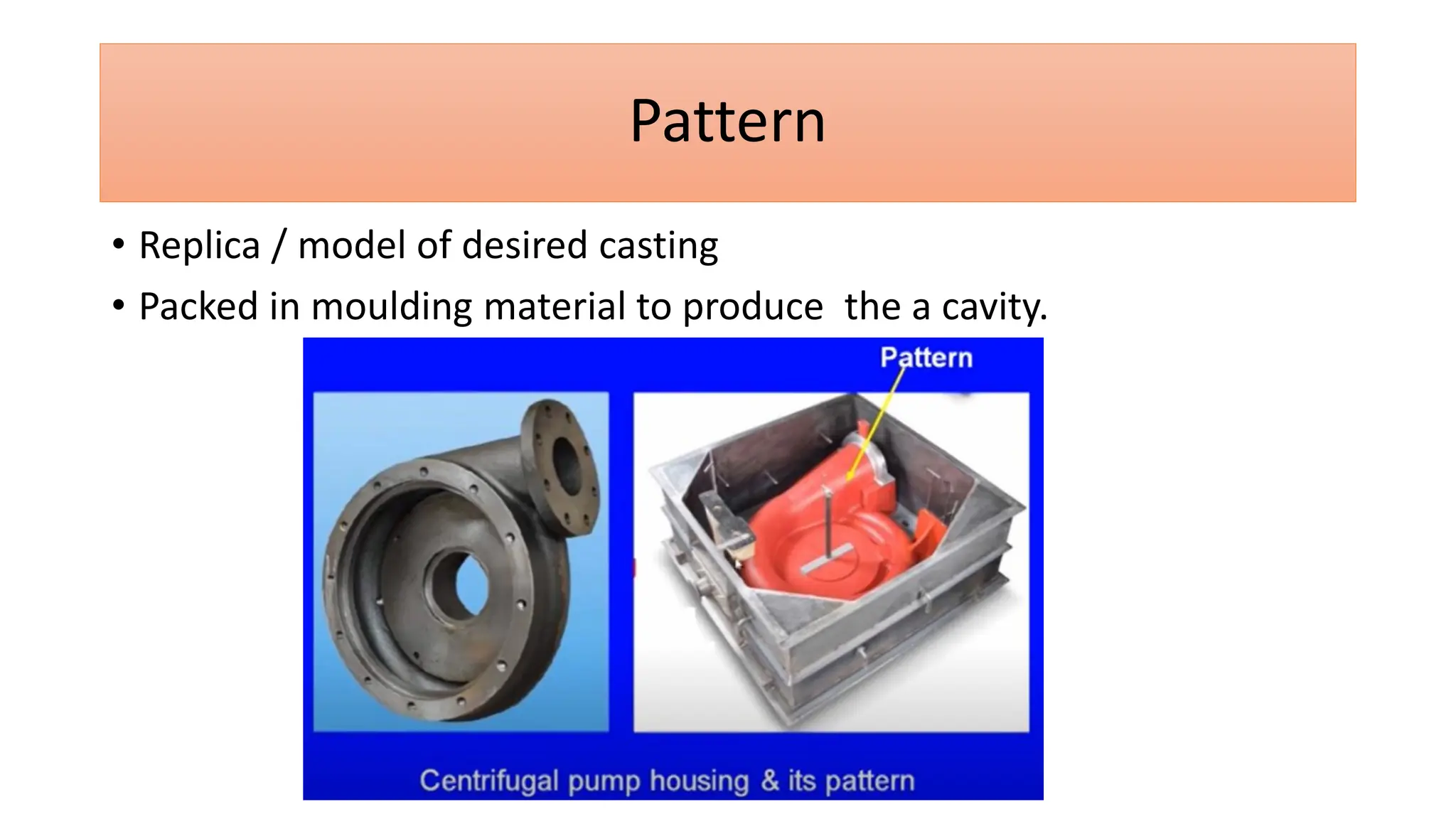
Casting
• Manufacturing Process – liquid metal is going to solidify in given
shape and size to get the desired product.
Casting Term ology
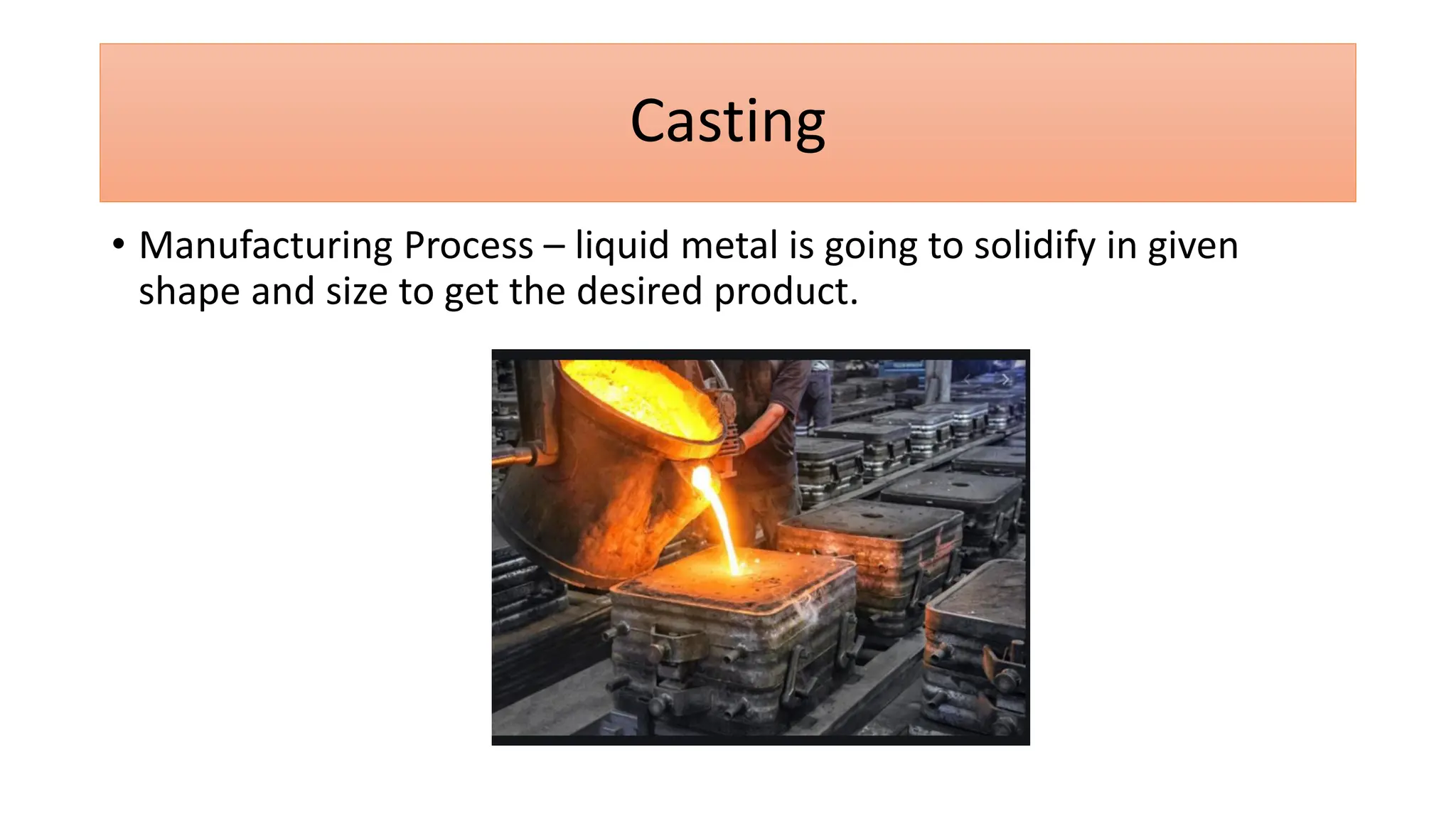
• Mould / Mold – A void created in compact sand / metal / wax mass
• Filled with molten metal to produce the casting.
• Moulding / Molding – the process of producing the mould.
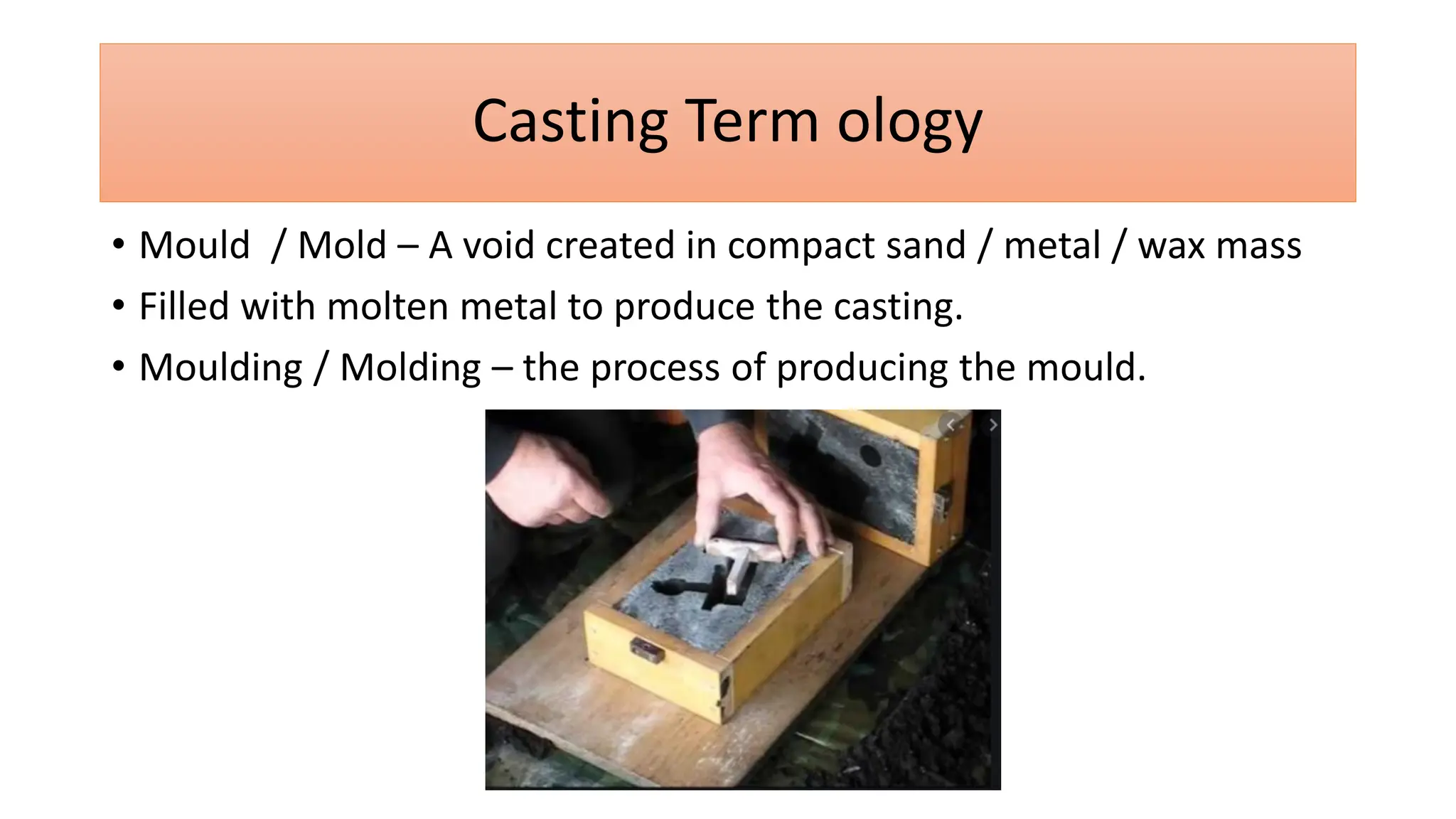
Pattern
• Replica / model of desired casting
• Packed in moulding material to produce the a cavity.
Flask
• Hold the sand the intact.
• Material – upper moulding flask
• Cope – upper moulding flask
• Drag- lower
• Runner – is the passage trough which molten metal reach up to
cavity.
• Parting Line – drag cope surface meet each other.
• Riser – Reservoir of molten metal – to compensate the reduction in
volume of liquid metal due to contraction.
Mould
• M
Mould making Procedure
• M
Pattern Allowance
• The difference in dimension of pattern to final dimension of casting.
• Reason
• 1. Shrinkage or contraction allowance– cooling from pouring temp to
room temp.
• Liquid Contraction of riser – compensated by riser
• Solidifying Contraction - compensated by riser
• Solid Contraction --- compensated by pattern
• Influencing Factor - pouring temp
• Design and dimension of casting
• Type of metal
Machining Allowance
• M
Draft allowance
• Purpose – to facilitate easy withdrawal of pattern from the mould without
damaging the surface and edge.
Distortion allowance
• D
Rapping or shake allowance
• R
Pattern Material
• Number of casting
• Dimensional accuracy required
• Surface Finishing
• Casting method
Pattern Material
• Wood – cheap and abundance
• Shaped in different shape
• Light in weight
• Good surface finishing
• Wear out quickly
• Susceptible to moisture
Metals
• Casting – large in number
• Closer dimensional accuracy
• Longer life
• Costlier
• Machining required
• Heavy in weight
• Rusted
• Ex- cast iron, brass, Al etc.
plastics
• Lightness in weight
• High strength
• Resistance to wear
• Fine surface finish
• Resistance to corrosion
• Reasonable cost
plaster
• Plaster of paris or gypsum cement
• Easily shaped
• Carries high compression strength
• Closer dimensional accuracy.
wax
• Used in investment casting
• For complicated shape
Master pattern
• Used for preparing the moulds for metal castings which are later used
as metal pattern for further moulding work.
• Carry double shrinkage allowance.
Type of pattern
• Solid and single piece pattern
• Simplest in all type , made in one piece and carries no joint , partition
or loose pieces.
• Cheapest
Two piece or split pattern
• Difficulty in mould making and withdrawn of pattern
• Made in two parts joint at the parting line
• Can be multiple piece
Match plate pattern
• Objective – rapid production of small and accurate casting on large scale.
• Greater dimensional accuracy
• Construction cost is high but compensated by high production.
• Pattern made in two parts.
• One piece is mounted one side and other on the side of plate called
match plate.
Match plate pattern
• M
Gated Pattern
Objective – mass production of small casting
Multi cavity moulds are prepared
Patterns are connected to each other by gate former which provide
suitable channels.
Sweep pattern
• Used for preparing mould of large symmetrical casting.
• Large saving in time, labour and material.
• Consists – base, spindle, wooden template
• Sweep rotated about the spindle to form the
cavity.
Pattern with loose piece
• Have loose piece in order to enables their easy withdrawal from the
mold.
Segmental pattern
• Used for large circular casting
• Avoiding the use of solid pattern of exact size.
• Segment is moved from one position to second in mold
.
Skeleton pattern- casting size very large and
heavy, hollow pattern
Only out side features
Cope and drag pattern- riser, runner and
ingate are integral part of pattern
Properties required in the Foundry sand
• Refractoriness – with stand high temp. of molten temp. without
fusing.
• Depend upon – silicon oxide quantity in sand (melting temp. 1710 C)
• Shape and size of sand grain
• Presence of iron oxide, calcium, potassium and sodium.
Permeability
• Allows the gases and steam to escape
• Reason – casting unsound or blast
• Depend upon – grain size and shape, proportion of water and clay,
ramming of sand.
• Increase by venting
Adhesiveness and Cohesiveness
• Ad. – capability of adhering to the surface of other material
• Objective- adhering to the moulding flask.
• Coh.- rammed grain particle bind together
• Depends upon- grain size, clay, and moisture content.
collapsibility
• Sand mould automatically collapses after solidification of casting.
• Reason – tear and cracking in casting.
Sand term ology- Green sand
• Freshly prepared mould sand in which there is enough moisture to
give it sufficient bond.
• Composition – 70-85% silica, 10- 20% clay, 3-6% water, 1-6% additives
Effect of ramming on the moulding sand
• Increase the density of mould
• Increase the mould hardness and strength.
• Decrease the permeability.
Other sand term ology
• O
Gating system
• G
Solidification of liquid metal
• Skim forming
• Dendritic growth
Chills
• To provide unidirectional solidification in casting.
Gating system
variable – Temp. Gradient, unidirectional solidification, erosion of
sand, absorption of air
* Top * Bottom * Side
Core
• A solid body of sand used to form a cavity of desired shape and size in
casting
Investment casting
Investment casting
• I
Permanent Mould
• Mould is not destroyed after each casting.
• Economical –High production rate
• Used for low melting point material
• Better dimensional accuracy , surface finishing
• Less skilled labour
• 2.4 mm thickness
Gravity Die casting
• I
Die casting or pressure die casting
• Liquid metal injected in to permanent mould under pressure.
Cold chamber die casting
• I
Hot Chamber die casting
• I
Centrifugal casting
• Rotating the mould at a high speed with molten metal.
• Adv. – impurities separation
• Better dimensional accuracy
• Proper directional solidification
•
True Centrifugal casting
Semi Centrifugal casting
Centrifuging casting
casting defect
• I
Blow holes and cold shut
• I
Mould Shift
• I
Cupola
• Furnace used for melting of cast iron.
• I
Casting manufacturing process guru Gobind Singh indraprastha university

Casting manufacturing process guru Gobind Singh indraprastha university

  • 1.
    Casting • Manufacturing Process– liquid metal is going to solidify in given shape and size to get the desired product.
  • 2.
    Casting Term ology •Mould / Mold – A void created in compact sand / metal / wax mass • Filled with molten metal to produce the casting. • Moulding / Molding – the process of producing the mould.
  • 3.
    Pattern • Replica /model of desired casting • Packed in moulding material to produce the a cavity.
  • 5.
    Flask • Hold thesand the intact. • Material – upper moulding flask • Cope – upper moulding flask • Drag- lower • Runner – is the passage trough which molten metal reach up to cavity. • Parting Line – drag cope surface meet each other. • Riser – Reservoir of molten metal – to compensate the reduction in volume of liquid metal due to contraction.
  • 6.
  • 7.
  • 8.
    Pattern Allowance • Thedifference in dimension of pattern to final dimension of casting. • Reason • 1. Shrinkage or contraction allowance– cooling from pouring temp to room temp.
  • 9.
    • Liquid Contractionof riser – compensated by riser • Solidifying Contraction - compensated by riser • Solid Contraction --- compensated by pattern • Influencing Factor - pouring temp • Design and dimension of casting • Type of metal
  • 10.
  • 11.
    Draft allowance • Purpose– to facilitate easy withdrawal of pattern from the mould without damaging the surface and edge.
  • 13.
  • 15.
    Rapping or shakeallowance • R
  • 16.
    Pattern Material • Numberof casting • Dimensional accuracy required • Surface Finishing • Casting method
  • 17.
    Pattern Material • Wood– cheap and abundance • Shaped in different shape • Light in weight • Good surface finishing • Wear out quickly • Susceptible to moisture
  • 19.
    Metals • Casting –large in number • Closer dimensional accuracy • Longer life • Costlier • Machining required • Heavy in weight • Rusted • Ex- cast iron, brass, Al etc.
  • 20.
    plastics • Lightness inweight • High strength • Resistance to wear • Fine surface finish • Resistance to corrosion • Reasonable cost
  • 21.
    plaster • Plaster ofparis or gypsum cement • Easily shaped • Carries high compression strength • Closer dimensional accuracy.
  • 22.
    wax • Used ininvestment casting • For complicated shape
  • 24.
    Master pattern • Usedfor preparing the moulds for metal castings which are later used as metal pattern for further moulding work. • Carry double shrinkage allowance.
  • 25.
    Type of pattern •Solid and single piece pattern • Simplest in all type , made in one piece and carries no joint , partition or loose pieces. • Cheapest
  • 27.
    Two piece orsplit pattern • Difficulty in mould making and withdrawn of pattern • Made in two parts joint at the parting line • Can be multiple piece
  • 31.
    Match plate pattern •Objective – rapid production of small and accurate casting on large scale. • Greater dimensional accuracy • Construction cost is high but compensated by high production. • Pattern made in two parts. • One piece is mounted one side and other on the side of plate called match plate.
  • 32.
  • 34.
    Gated Pattern Objective –mass production of small casting Multi cavity moulds are prepared Patterns are connected to each other by gate former which provide suitable channels.
  • 35.
    Sweep pattern • Usedfor preparing mould of large symmetrical casting. • Large saving in time, labour and material. • Consists – base, spindle, wooden template • Sweep rotated about the spindle to form the cavity.
  • 38.
    Pattern with loosepiece • Have loose piece in order to enables their easy withdrawal from the mold.
  • 39.
    Segmental pattern • Usedfor large circular casting • Avoiding the use of solid pattern of exact size. • Segment is moved from one position to second in mold .
  • 40.
    Skeleton pattern- castingsize very large and heavy, hollow pattern
  • 41.
    Only out sidefeatures
  • 43.
    Cope and dragpattern- riser, runner and ingate are integral part of pattern
  • 44.
    Properties required inthe Foundry sand • Refractoriness – with stand high temp. of molten temp. without fusing. • Depend upon – silicon oxide quantity in sand (melting temp. 1710 C) • Shape and size of sand grain • Presence of iron oxide, calcium, potassium and sodium.
  • 46.
    Permeability • Allows thegases and steam to escape • Reason – casting unsound or blast • Depend upon – grain size and shape, proportion of water and clay, ramming of sand. • Increase by venting
  • 50.
    Adhesiveness and Cohesiveness •Ad. – capability of adhering to the surface of other material • Objective- adhering to the moulding flask. • Coh.- rammed grain particle bind together • Depends upon- grain size, clay, and moisture content.
  • 52.
    collapsibility • Sand mouldautomatically collapses after solidification of casting. • Reason – tear and cracking in casting.
  • 53.
    Sand term ology-Green sand • Freshly prepared mould sand in which there is enough moisture to give it sufficient bond. • Composition – 70-85% silica, 10- 20% clay, 3-6% water, 1-6% additives
  • 57.
    Effect of rammingon the moulding sand • Increase the density of mould • Increase the mould hardness and strength. • Decrease the permeability.
  • 58.
    Other sand termology • O
  • 59.
  • 60.
    Solidification of liquidmetal • Skim forming • Dendritic growth
  • 61.
    Chills • To provideunidirectional solidification in casting.
  • 62.
    Gating system variable –Temp. Gradient, unidirectional solidification, erosion of sand, absorption of air * Top * Bottom * Side
  • 63.
    Core • A solidbody of sand used to form a cavity of desired shape and size in casting
  • 64.
  • 65.
  • 66.
    Permanent Mould • Mouldis not destroyed after each casting. • Economical –High production rate • Used for low melting point material • Better dimensional accuracy , surface finishing • Less skilled labour • 2.4 mm thickness
  • 67.
  • 68.
    Die casting orpressure die casting • Liquid metal injected in to permanent mould under pressure.
  • 69.
    Cold chamber diecasting • I
  • 70.
    Hot Chamber diecasting • I
  • 71.
    Centrifugal casting • Rotatingthe mould at a high speed with molten metal. • Adv. – impurities separation • Better dimensional accuracy • Proper directional solidification •
  • 72.
  • 73.
  • 74.
  • 75.
  • 76.
  • 77.
    Blow holes andcold shut • I
  • 78.
  • 79.
    Cupola • Furnace usedfor melting of cast iron.
  • 80.