PERFORMANCE APPRAISAL TIPS AND TECHNIQUES
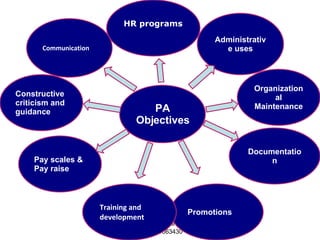
PA Objectives Documentation Organizational Maintenance Promotions Training and development Pay scales & Pay raise Constructive criticism and guidance Administrative uses HR programs Communication
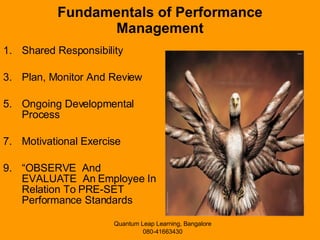
Fundamentals of Performance Management Shared Responsibility Plan, Monitor And Review Ongoing Developmental Process  Motivational Exercise “ OBSERVE  And  EVALUATE  An Employee In Relation To PRE-SET  Performance Standards
What Is Appraised? Individual Task Outcomes Behaviour Traits Collective Outcomes Collective Processes
Appraisal By Objectives Set the organization’s goals Set the departmental goals Discuss developmental goals Define expected results Performance reviews Provide feedback
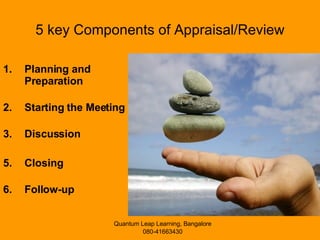
5 key Components of Appraisal/Review Planning and Preparation  Starting the Meeting   Discussion  Closing  Follow-up
Planning and Preparation Gather Your Appraisal Information and Materials in Advance Make a List, Organize the form and your examples Appraises should look at their last review notes, and collate any "well done" emails from suppliers, clients or co-workers as ammo.  Be familiar enough with your ratings and comments to talk about them without reading them Prepare for atleast two weeks before the appraisal meeting
Planning and Preparation Take responsibility   "How can you and I help to move my career forward  What knowledge, skills and attitude do you need to be successful?  What has gone less well? What do you feel were the reasons for this?  What have you learned as a result of these difficulties?
“ How performance appraisal meetings are conducted dictates the effectiveness of the entire process”
Appraisal Discussion “ Only 13% of employees and managers, and 6% of CEOs, think their organization's performance appraisal is useful” "The manager and you should spend only about 30% of the time discussing the past and 70% talking about future performance,"
Appraisal Discussion Opening the appraisal discussion  Using questioning techniques  Self-assessment  Closing the appraisal discussion
Handling the Appraisal Discussion Remember that the appraisal meeting is a discussion and a dialog between you and your supervisor. Ensure that you understand the purpose and format of your performance appraisal discussion  Maintain good eye-contact, attentive posture, and a professional manner. Listen and take notes. Reflect back to your supervisor your understanding of what your supervisor said. Compare the actual specific performance results and behaviors to the standards. Stay away from blaming others and making excuses.
Handling the Appraisal Discussion Emphasize strengths, as well as areas that need improvement. Be honest and take responsibility. Provide your ideas on how to resolve problems. If you don't agree with your supervisor, ask for specific examples. Set goals, expectations, and standards together for the next appraisal. Discuss development and training needs. Tell your supervisor what you need to do your job more efficiently.
Q uestioning Techniques in Appraisal For testing their understanding (asking yes/no questions) - closed question  -They give you  facts   Open questions -They ask the respondent to think and reflect, they will give you  opinions  and  feelings , they hand control of the conversation to the respondent Funnel Questions-Finding out more detail about a specific point by starting on a general discussion Probing Questions- to help you understand a statement they have made. At other times, you need additional information for clarification
5.  Leading Questions With an assumption By adding a personal appeal to agree at the end Phrasing the question so that the "easiest" response is  "yes“ giving people a choice between two options, both of  which you would be happy with, rather than the choice of one option or not doing anything at all.  leading questions tend to be closed.  6.  Rhetorical Questions People use rhetorical questions because they are engaging for the listener - as they are drawn into agreeing
Closing an Appraisal Discussion Have a long-term plan -What are you going to work on during the next period, to improve yourself within these areas?  A performance review is NOT a day-long workshop mixed with therapy  It's better to split money from personal development  What additional responsibilities would you like to assume, to help you to develop yourself?  Agree to the SMART objectives for the next period.
Follow up Agree to SMART objectives for the next period.  Discuss the individual’s personal development-your needs to support the achievement of these objectives.  Discuss the support you  would like from them

Performance Appraisals

  • 1.
  • 2.
    PA Objectives DocumentationOrganizational Maintenance Promotions Training and development Pay scales & Pay raise Constructive criticism and guidance Administrative uses HR programs Communication
  • 3.
    Fundamentals of PerformanceManagement Shared Responsibility Plan, Monitor And Review Ongoing Developmental Process Motivational Exercise “ OBSERVE And EVALUATE An Employee In Relation To PRE-SET Performance Standards
  • 4.
    What Is Appraised?Individual Task Outcomes Behaviour Traits Collective Outcomes Collective Processes
  • 5.
    Appraisal By ObjectivesSet the organization’s goals Set the departmental goals Discuss developmental goals Define expected results Performance reviews Provide feedback
  • 6.
    5 key Componentsof Appraisal/Review Planning and Preparation Starting the Meeting Discussion Closing Follow-up
  • 7.
    Planning and PreparationGather Your Appraisal Information and Materials in Advance Make a List, Organize the form and your examples Appraises should look at their last review notes, and collate any "well done" emails from suppliers, clients or co-workers as ammo. Be familiar enough with your ratings and comments to talk about them without reading them Prepare for atleast two weeks before the appraisal meeting
  • 8.
    Planning and PreparationTake responsibility "How can you and I help to move my career forward What knowledge, skills and attitude do you need to be successful? What has gone less well? What do you feel were the reasons for this? What have you learned as a result of these difficulties?
  • 9.
    “ How performanceappraisal meetings are conducted dictates the effectiveness of the entire process”
  • 10.
    Appraisal Discussion “Only 13% of employees and managers, and 6% of CEOs, think their organization's performance appraisal is useful” "The manager and you should spend only about 30% of the time discussing the past and 70% talking about future performance,"
  • 11.
    Appraisal Discussion Openingthe appraisal discussion Using questioning techniques Self-assessment Closing the appraisal discussion
  • 12.
    Handling the AppraisalDiscussion Remember that the appraisal meeting is a discussion and a dialog between you and your supervisor. Ensure that you understand the purpose and format of your performance appraisal discussion Maintain good eye-contact, attentive posture, and a professional manner. Listen and take notes. Reflect back to your supervisor your understanding of what your supervisor said. Compare the actual specific performance results and behaviors to the standards. Stay away from blaming others and making excuses.
  • 13.
    Handling the AppraisalDiscussion Emphasize strengths, as well as areas that need improvement. Be honest and take responsibility. Provide your ideas on how to resolve problems. If you don't agree with your supervisor, ask for specific examples. Set goals, expectations, and standards together for the next appraisal. Discuss development and training needs. Tell your supervisor what you need to do your job more efficiently.
  • 14.
    Q uestioning Techniquesin Appraisal For testing their understanding (asking yes/no questions) - closed question -They give you facts Open questions -They ask the respondent to think and reflect, they will give you opinions and feelings , they hand control of the conversation to the respondent Funnel Questions-Finding out more detail about a specific point by starting on a general discussion Probing Questions- to help you understand a statement they have made. At other times, you need additional information for clarification
  • 15.
    5. LeadingQuestions With an assumption By adding a personal appeal to agree at the end Phrasing the question so that the "easiest" response is "yes“ giving people a choice between two options, both of which you would be happy with, rather than the choice of one option or not doing anything at all. leading questions tend to be closed. 6. Rhetorical Questions People use rhetorical questions because they are engaging for the listener - as they are drawn into agreeing
  • 16.
    Closing an AppraisalDiscussion Have a long-term plan -What are you going to work on during the next period, to improve yourself within these areas? A performance review is NOT a day-long workshop mixed with therapy It's better to split money from personal development What additional responsibilities would you like to assume, to help you to develop yourself? Agree to the SMART objectives for the next period.
  • 17.
    Follow up Agreeto SMART objectives for the next period. Discuss the individual’s personal development-your needs to support the achievement of these objectives. Discuss the support you would like from them