


Experimental Techniques for
Interdisciplinary Research Work
(Vacuum Technology)
By
Dr. C.L. Saini
(clsaini52@gmail.com, clsaini52@uniraj.ac.in)
(Mobile No. : +91-9413119927)
(Assistant Professor)
Solar and H2 storage Laboratory
Department of Physics
University of Rajasthan, Jaipur
JLN Marg Jaipur, Rajasthan – 302004, India
4/7/2020 1UOR Jaipur
4/7/2020 2UOR Jaipur
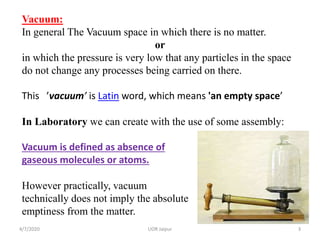
Vacuum:
In general The Vacuum space in which there is no matter.
or
in which the pressure is very low that any particles in the space
do not change any processes being carried on there.
This ’vacuum’ is Latin word, which means 'an empty space’
In Laboratory we can create with the use of some assembly:
Vacuum is defined as absence of
gaseous molecules or atoms.
However practically, vacuum
technically does not imply the absolute
emptiness from the matter.
4/7/2020 3UOR Jaipur
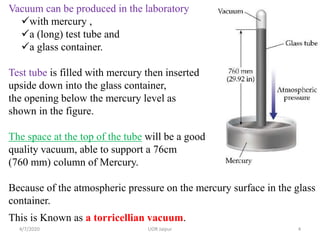
Vacuum can be produced in the laboratory
with mercury ,
a (long) test tube and
a glass container.
Test tube is filled with mercury then inserted
upside down into the glass container,
the opening below the mercury level as
shown in the figure.
The space at the top of the tube will be a good
quality vacuum, able to support a 76cm
(760 mm) column of Mercury.
Because of the atmospheric pressure on the mercury surface in the glass
container.
This is Known as a torricellian vacuum.
4/7/2020 4UOR Jaipur
4/7/2020 5UOR Jaipur
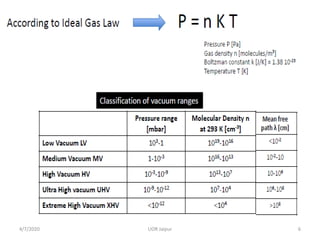
4/7/2020 6UOR Jaipur
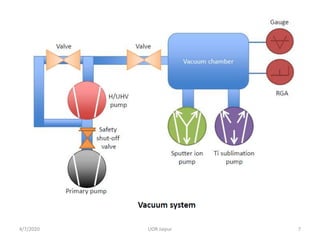
4/7/2020 7UOR Jaipur
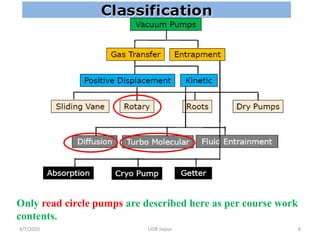
Only read circle pumps are described here as per course work
contents.
4/7/2020 8UOR Jaipur
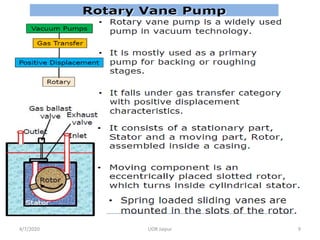
4/7/2020 9UOR Jaipur
4/7/2020 10UOR Jaipur
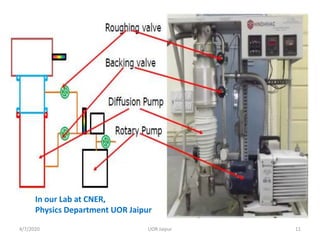
In our Lab at CNER,
Physics Department UOR Jaipur
4/7/2020 11UOR Jaipur
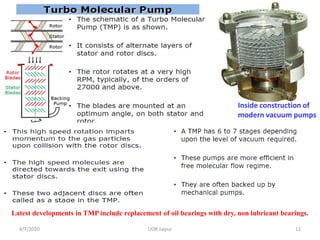
Inside construction of
modern vacuum pumps
Latest developments in TMP include replacement of oil bearings with dry, non lubricant bearings.
4/7/2020 12UOR Jaipur
4/7/2020 13UOR Jaipur
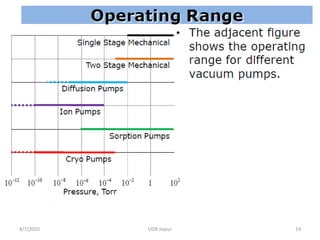
4/7/2020 14UOR Jaipur
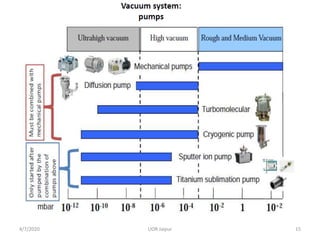
4/7/2020 15UOR Jaipur
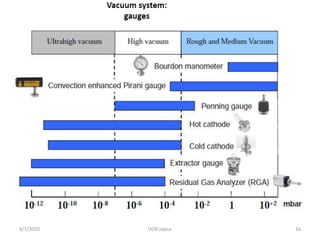
4/7/2020 16UOR Jaipur
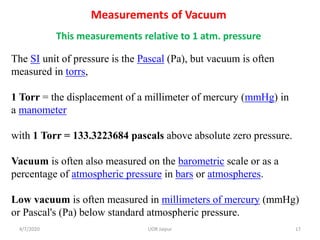
Measurements of Vacuum
This measurements relative to 1 atm. pressure
The SI unit of pressure is the Pascal (Pa), but vacuum is often
measured in torrs,
1 Torr = the displacement of a millimeter of mercury (mmHg) in
a manometer
with 1 Torr = 133.3223684 pascals above absolute zero pressure.
Vacuum is often also measured on the barometric scale or as a
percentage of atmospheric pressure in bars or atmospheres.
Low vacuum is often measured in millimeters of mercury (mmHg)
or Pascal's (Pa) below standard atmospheric pressure.
4/7/2020 17UOR Jaipur
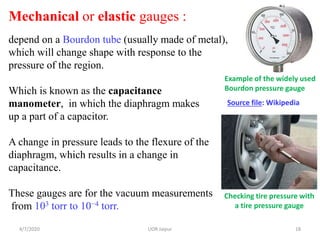
Mechanical or elastic gauges :
depend on a Bourdon tube (usually made of metal),
which will change shape with response to the
pressure of the region.
Which is known as the capacitance
manometer, in which the diaphragm makes
up a part of a capacitor.
A change in pressure leads to the flexure of the
diaphragm, which results in a change in
capacitance.
These gauges are for the vacuum measurements
from 103 torr to 10−4 torr.
4/7/2020 18UOR Jaipur
Example of the widely used
Bourdon pressure gauge
Checking tire pressure with
a tire pressure gauge
Source file: Wikipedia
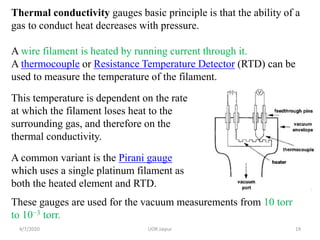
Thermal conductivity gauges basic principle is that the ability of a
gas to conduct heat decreases with pressure.
A wire filament is heated by running current through it.
A thermocouple or Resistance Temperature Detector (RTD) can be
used to measure the temperature of the filament.
This temperature is dependent on the rate
at which the filament loses heat to the
surrounding gas, and therefore on the
thermal conductivity.
A common variant is the Pirani gauge
which uses a single platinum filament as
both the heated element and RTD.
These gauges are used for the vacuum measurements from 10 torr
to 10−3 torr.
4/7/2020 19UOR Jaipur
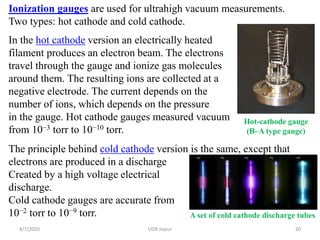
Ionization gauges are used for ultrahigh vacuum measurements.
Two types: hot cathode and cold cathode.
In the hot cathode version an electrically heated
filament produces an electron beam. The electrons
travel through the gauge and ionize gas molecules
around them. The resulting ions are collected at a
negative electrode. The current depends on the
number of ions, which depends on the pressure
in the gauge. Hot cathode gauges measured vacuum
from 10−3 torr to 10−10 torr.
The principle behind cold cathode version is the same, except that
electrons are produced in a discharge
Created by a high voltage electrical
discharge.
Cold cathode gauges are accurate from
10−2 torr to 10−9 torr.
Hot-cathode gauge
(B–A type gauge)
A set of cold cathode discharge tubes
4/7/2020 20UOR Jaipur
4/7/2020 21UOR Jaipur
4/7/2020 22UOR Jaipur
Thank you
very much
Suggestions are invited for improvement in the ppt file.
Send your feedbacks at Email: clsaini52@gmail.com

Lecture 1 (vacuum technology)

  • 1.
    Experimental Techniques for InterdisciplinaryResearch Work (Vacuum Technology) By Dr. C.L. Saini (clsaini52@gmail.com, clsaini52@uniraj.ac.in) (Mobile No. : +91-9413119927) (Assistant Professor) Solar and H2 storage Laboratory Department of Physics University of Rajasthan, Jaipur JLN Marg Jaipur, Rajasthan – 302004, India 4/7/2020 1UOR Jaipur
  • 2.
  • 3.
    Vacuum: In general TheVacuum space in which there is no matter. or in which the pressure is very low that any particles in the space do not change any processes being carried on there. This ’vacuum’ is Latin word, which means 'an empty space’ In Laboratory we can create with the use of some assembly: Vacuum is defined as absence of gaseous molecules or atoms. However practically, vacuum technically does not imply the absolute emptiness from the matter. 4/7/2020 3UOR Jaipur
  • 4.
    Vacuum can beproduced in the laboratory with mercury , a (long) test tube and a glass container. Test tube is filled with mercury then inserted upside down into the glass container, the opening below the mercury level as shown in the figure. The space at the top of the tube will be a good quality vacuum, able to support a 76cm (760 mm) column of Mercury. Because of the atmospheric pressure on the mercury surface in the glass container. This is Known as a torricellian vacuum. 4/7/2020 4UOR Jaipur
  • 5.
  • 6.
  • 7.
  • 8.
    Only read circlepumps are described here as per course work contents. 4/7/2020 8UOR Jaipur
  • 9.
  • 10.
  • 11.
    In our Labat CNER, Physics Department UOR Jaipur 4/7/2020 11UOR Jaipur
  • 12.
    Inside construction of modernvacuum pumps Latest developments in TMP include replacement of oil bearings with dry, non lubricant bearings. 4/7/2020 12UOR Jaipur
  • 13.
  • 14.
  • 15.
  • 16.
  • 17.
    Measurements of Vacuum Thismeasurements relative to 1 atm. pressure The SI unit of pressure is the Pascal (Pa), but vacuum is often measured in torrs, 1 Torr = the displacement of a millimeter of mercury (mmHg) in a manometer with 1 Torr = 133.3223684 pascals above absolute zero pressure. Vacuum is often also measured on the barometric scale or as a percentage of atmospheric pressure in bars or atmospheres. Low vacuum is often measured in millimeters of mercury (mmHg) or Pascal's (Pa) below standard atmospheric pressure. 4/7/2020 17UOR Jaipur
  • 18.
    Mechanical or elasticgauges : depend on a Bourdon tube (usually made of metal), which will change shape with response to the pressure of the region. Which is known as the capacitance manometer, in which the diaphragm makes up a part of a capacitor. A change in pressure leads to the flexure of the diaphragm, which results in a change in capacitance. These gauges are for the vacuum measurements from 103 torr to 10−4 torr. 4/7/2020 18UOR Jaipur Example of the widely used Bourdon pressure gauge Checking tire pressure with a tire pressure gauge Source file: Wikipedia
  • 19.
    Thermal conductivity gaugesbasic principle is that the ability of a gas to conduct heat decreases with pressure. A wire filament is heated by running current through it. A thermocouple or Resistance Temperature Detector (RTD) can be used to measure the temperature of the filament. This temperature is dependent on the rate at which the filament loses heat to the surrounding gas, and therefore on the thermal conductivity. A common variant is the Pirani gauge which uses a single platinum filament as both the heated element and RTD. These gauges are used for the vacuum measurements from 10 torr to 10−3 torr. 4/7/2020 19UOR Jaipur
  • 20.
    Ionization gauges areused for ultrahigh vacuum measurements. Two types: hot cathode and cold cathode. In the hot cathode version an electrically heated filament produces an electron beam. The electrons travel through the gauge and ionize gas molecules around them. The resulting ions are collected at a negative electrode. The current depends on the number of ions, which depends on the pressure in the gauge. Hot cathode gauges measured vacuum from 10−3 torr to 10−10 torr. The principle behind cold cathode version is the same, except that electrons are produced in a discharge Created by a high voltage electrical discharge. Cold cathode gauges are accurate from 10−2 torr to 10−9 torr. Hot-cathode gauge (B–A type gauge) A set of cold cathode discharge tubes 4/7/2020 20UOR Jaipur
  • 21.
  • 22.
    4/7/2020 22UOR Jaipur Thankyou very much Suggestions are invited for improvement in the ppt file. Send your feedbacks at Email: clsaini52@gmail.com