Basic Vacuum Physics
&
Technologies
Mohd Irshad Alam
Sales Engineer
me_irshad@yahoo.com
What is a Vacuum?
• Ideal Vacuum
– A space totally devoid of all matter.
– Does not exist, even in outer space!
• Actual Vacuum (Partial Vacuum)
– A space containing gas at a pressure below the
surrounding atmosphere or atmospheric pressure
less than 760 Torr @ sea level and 00 C with no
humidity
Why is a Vacuum Needed?
To move a particle in a (straight) line over a large distance
(irshad_alam@aol.com)
Why is a Vacuum Needed?
Contamination
(usually water)
Clean surface
Atmosphere (High)Vacuum
To provide a clean surface
BAROMETER
WATER MERCURY
760
mm
Mercury: 13.58 times
heavier than water:
Column is 13.58 x
shorter :
10321 mm/13.58=760
mm (= 760 Torr)
10.321
mm
29,9
in
(irshad_alam@aol.com)
PRESSURE OF 1 STANDARD
ATMOSPHERE:
760 TORR, 1013 mbar
AT SEA LEVEL, 0O C AND 45O LATITUDE
Pressure Equivalents
Atmospheric Pressure (Standard) =
0
14.7
29.9
760
760
760,000
101,325
1.013
1013
Gauge pressure (psig)
Pounds per square inch (psia)
Inches of mercury
Millimeter of mercury
Torr
Millitorr or microns
Pascal
Bar
Millibar
THE ATMOSPHERE IS A MIXTURE OF GASES
PARTIAL PRESSURES OF GASES CORRESPOND TO THEIR RELATIVE VOLUMES
GAS SYMBOL
PERCENT BY
VOLUME
PARTIAL PRESSURE
TORR PASCAL
Nitrogen
Oxygen
Argon
Carbon Dioxide
Neon
Helium
Krypton
Hydrogen
Xenon
Water
N2
O2
A
CO2
Ne
He
Kr
H2
X
H2O
78
21
0.93
0.03
0.0018
0.0005
0.0001
0.00005
0.0000087
Variable
593
158
7.1
0.25
1.4 x 10⁻²
4.0 x 10⁻³
8.7 x 10⁻⁴
4.0 x 10⁻⁴
6.6 x 10⁻⁵
5 to 50
79,000
21,000
940
33
1.8
5.3 x 10⁻¹
1.1 x 10⁻¹
5.1 x 10⁻²
8.7 x 10⁻³
665 to 6650
(irshad_alam@aol.com)
VAPOR PRESSURE OF WATER AT
VARIOUS TEMPERATURES
T (O C)
100
25
0
-40
-78.5
-196
P (mbar)
1013
32
6.4
0.13
6.6 x 10 -4
10 -24
(BOILING)
(FREEZING)
(DRY ICE)
(LIQUID NITROGEN)
(irshad_alam@aol.com)
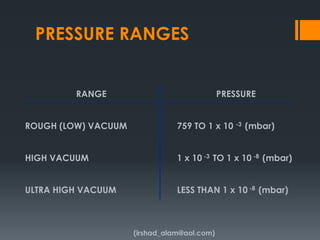
PRESSURE RANGES
RANGE
ROUGH (LOW) VACUUM
HIGH VACUUM
ULTRA HIGH VACUUM
PRESSURE
759 TO 1 x 10 -3 (mbar)
1 x 10 -3 TO 1 x 10 -8 (mbar)
LESS THAN 1 x 10 -8 (mbar)
(irshad_alam@aol.com)
GAS FLOW
CONDUCTANCE
(irshad_alam@aol.com)
Viscous and Molecular Flow
Viscous Flow
(momentum transfer
between molecules)
Molecular Flow
(molecules move
independently)
FLOW REGIMES
Viscous Flow:
Distance between molecules is small; collisions between
molecules dominate; flow through momentum transfer;
generally P greater than 0.1 mbar
Transition Flow:
Region between viscous and molecular flow
Molecular Flow:
Distance between molecules is large; collisions between
molecules and wall dominate; flow through random motion;
generally P smaller than 10 mbar
(irshad_alam@aol.com)
MEAN FREE PATH
MOLECULAR DENSITY AND MEAN FREE PATH
1013 mbar (atm) 1 x 10⁻³ mbar 1 x 10⁻⁹ mbar
#
mol/cm3
MFP
3 x 10 19
(30 million trillion)
4 x 10 13
(40 trillion)
4 x 10 7
(40 million)
2.5 x 10⁻⁶ in
6.4 x 10⁻⁵ mm
2 inches
5.1 cm
31 miles
50 km
FLOW REGIMES
Mean Free Path
Characteristic Dimension
Viscous Flow: is less than 0.01
Mean Free Path
Characteristic Dimension
Molecular Flow: is greater than 1
Mean Free Path
Characteristic Dimension
Transition Flow: is between 0.01 and 1
Conductance in Viscous Flow
Under viscous flow conditions doubling the
pipe diameter increases the conductance
sixteen times.
The conductance is INVERSELY related to
the pipe length
(irshad_alam@aol.com)
Conductance in Molecular Flow
Under molecular flow conditions doubling
the pipe diameter increases the conductance
eight times.
The conductance is INVERSELY related to
the pipe length.
SYSTEM
PUMP
C1
C2
Series Conductance
RT = R1 + R2
1 = 1 + 1
C1 C2CT
1 = C1 + C2
C1 x C2CT
CT = C1 x C2
C1 + C2
(irshad_alam@aol.com)
GAS LOAD
Outgassing
Leaks
Virtual
Real
Backstreaming
Diffusion
Permeation
GAS LOAD (Q) IS EXPRESSED IN:
mbar liters per second
Pump down Curve
Pressure(mbar)
Time (sec)
10-11
10 1 10 3 10 5 10 7 10 9 10 11 10 13 10 15 10 17
10+1
10-1
10-3
10-5
10-7
10-9
Volume
Surface Desorption
Diffusion
Permeation
HOW DO WE CREATE A
VACUUM?
VACUUM PUMPING METHODS
Sliding Vane
Rotary Pump
Molecular
Drag Pump
Turbomolecular
Pump
Fluid Entrainment
Pump
VACUUM PUMPS
(METHODS)
Reciprocating
Displacement Pump
Gas Transfer
Vacuum Pump
Drag
Pump
Entrapment
Vacuum Pump
Positive Displacement
Vacuum Pump
Kinetic
Vacuum Pump
Rotary
Pump
Diaphragm
Pump
Piston
Pump
Liquid Ring
Pump
Rotary
Piston Pump
Rotary
Plunger Pump
Roots
Pump
Multiple Vane
Rotary Pump
Dry
Pump
Adsorption
Pump
Cryopump
Getter
Pump
Getter Ion
Pump
Sputter Ion
Pump
Evaporation
Ion Pump
Bulk Getter
Pump
Cold TrapIon Transfer
Pump
Gaseous
Ring Pump
Turbine
Pump
Axial Flow
Pump
Radial Flow
Pump
Ejector
Pump
Liquid Jet
Pump
Gas Jet
Pump
Vapor Jet
Pump
Diffusion
Pump
Diffusion
Ejector Pump
Self Purifying
Diffusion Pump
Fractionating
Diffusion Pump
Condenser
Sublimation
Pump
PUMP OPERATING RANGES
10-12 10-10 10-8 10-6 10-4 10-2 1 10+2
P (mbar)
Rough VacuumHigh VacuumUltra High Vacuum
Venturi Pump
Rotary Vane Mechanical Pump
Rotary Piston Mechanical Pump
Sorption Pump
Dry Mechanical Pump
Blower/Booster Pump
High Vac. Pumps
Ultra-High Vac. Pumps
ROTARY VANE TECHNOLOGY
Principles of Operation:
A lubricated rotary vane pump has a series of sliding vanes attached to a rotor
in the pump cylinder. As the rotor spins, centrifugal force causes the vanes to
slide outward to form a seal on the cylinder wall with oil that is injected into the
pumping chamber. Air is pulled in to the pump inlet which is then compressed
and discharged into the exhaust box. The sealing oil is filtered and re-circulated
within the pump via oil filters which eliminates 99.9% of lubricating oil from the
exhaust.
Benefits:
Air cooled design
Direct drive
29.3" Hg end vacuum
Anti suck back valve
Oil flooded for lubrication and heat dissipation
OIL LUBRICATED ROTARY VANE TECHNOLOGY
OIL SEALED ROTARY VANE TECHNOLOGY
How the Pump Works at Double Stage
(irshad_alam@aol.com)
Why Vacuum?
Using vacuums ranks as one of the
traditional interface technologies.
Vacuums are used in industry and
commerce for packaging, drying,
suction and pick-and-place. Some
process engineering operations are
carried out in a vacuum because low
pressure is an advantage on
temperature-sensitive products.
How to select a Vacuum Pump
First, you have to create the vacuum:
And this is where the vacuum pumps
come in. However, it’s worth clearing up
a few key questions right at the outset.
What volume of what end-pressure
needs to be achieved, and in what
time? Are there application-specific
parameters which need to be taken
into account? And what compression
principle is best suited for a specific
application?
Dry Vacuum Pumps
Principles of Operation:
A rotor is mounted eccentrically in the pump cylinder and
contains several sliding vanes. As the rotor turns, centrifugal
force causes the vanes to slide outward, creating a seal against
the cylinder wall. The vanes are constructed of a self-lubricating
graphite composite material which allows them to operate
against the cylinder wall without the need for any other sealing
or lubricating liquid. As a result of the offset rotor, a succession of
variable volumes is formed in the cylinder housing creating the
flow of vapor through the pump. Vapor is pulled into the pump
inlet which is then compressed and discharged through the
exhaust to atmosphere.
Benefits:
No oil anywhere
Long vane life
Low vibration
Graphite composite vanes
Oil-less Rotary Vane Technology
The impeller sits between two end plates (port plates)
which have shaped holes cut into them called ports.
The pump requires a liquid (also called the sealant) to
create vacuum as follows. ... This is the suction of
the pump, drawing in air, gases, or vapors thru the "inlet
port" at the sides of the impeller.
Application Area
Pharmaceutical
Food & Confectionery
Petro-chemicals
Textile
Plastic industries
Paper and Sugar mills
Cement
Metallurgical Laboratories and Furnaces
Refrigeration Plants
Distilleries
Liquid/Water Ring Vacuum Pumps
(irshad_alam@aol.com)
Liquid Ring Vacuum Pumps
Blower/Booster Pump
(irshad_alam@aol.com)
One Stage Roots Blower Pump
Assembly
VACUUM SYSTEM USE
1
2
3
4
5
6
7
8
9
10
11
12
Chamber
Foreline
Roughing Valve
Roughing Gauge
Roughing Pump
Foreline
Foreline Valve
Foreline Gauge
High Vacuum Valve
Booster/Blower
Vent Valve
High Vacuum Gauge
1
9
3
12
4
11
5
2
67
8
10
(irshad_alam@aol.com)
Vacuum Gauges
(irshad_alam@aol.com)
Gauge Operating Ranges
10-12 10-10 10-8 10-6 10-4 10-2 1 10+2
P (mbar)
Rough VacuumHigh Vacuum
Ultra High
Vacuum
Bourdon Gauge
Thermocouple Gauge
Cold Cathode Gauge
Capacitance Manometer
Hot Fil. Ion Gauge
Residual Gas Analyzer
Pirani Gauge
Spinning Rotor Gauge
McLeod Gauge
Bourdon Gauge
How the gauge works
Heat Transfer Gauges
Thermocouple gauge
and
Pirani Gauge
Thermocouple Gauge
How the gauge works
Ionization gauges
Ionization current is the
measure of vacuum
Vacuum Pumps are best suited for Pharmaceutical,
Semiconductor, Aircraft, Automobile, Glass, Printing,
Packaging, Chemical, Food Processing,
Confectionary, Breweries, Distilleries, Plastic, Garment
& Leather Processing Industries, Textiles, Paper &
Sugar Mills, Power Plants, Furnaces, Cement &
Fertilizer Plants, Metallurgical Laboratories and
Vacuum Conveying, Extrusion, Priming, Dehydration,
Filtration, Sterilizing, Tiles and Ceramics Industries and
host of other industrial applications.
APPLICATIONS
Thank You So Much for Your
Valuable Time
Most Welcome to Your
Suggestion and Discussion
With Warm Regards
Mohammad Irshad Alam
Sales Engineer
Email: me_irshad@yahoo.com

Basic Vacuum Aspects

  • 1.
    Basic Vacuum Physics & Technologies MohdIrshad Alam Sales Engineer me_irshad@yahoo.com
  • 2.
    What is aVacuum? • Ideal Vacuum – A space totally devoid of all matter. – Does not exist, even in outer space! • Actual Vacuum (Partial Vacuum) – A space containing gas at a pressure below the surrounding atmosphere or atmospheric pressure less than 760 Torr @ sea level and 00 C with no humidity
  • 3.
    Why is aVacuum Needed? To move a particle in a (straight) line over a large distance (irshad_alam@aol.com)
  • 4.
    Why is aVacuum Needed? Contamination (usually water) Clean surface Atmosphere (High)Vacuum To provide a clean surface
  • 5.
    BAROMETER WATER MERCURY 760 mm Mercury: 13.58times heavier than water: Column is 13.58 x shorter : 10321 mm/13.58=760 mm (= 760 Torr) 10.321 mm 29,9 in (irshad_alam@aol.com)
  • 6.
    PRESSURE OF 1STANDARD ATMOSPHERE: 760 TORR, 1013 mbar AT SEA LEVEL, 0O C AND 45O LATITUDE
  • 7.
    Pressure Equivalents Atmospheric Pressure(Standard) = 0 14.7 29.9 760 760 760,000 101,325 1.013 1013 Gauge pressure (psig) Pounds per square inch (psia) Inches of mercury Millimeter of mercury Torr Millitorr or microns Pascal Bar Millibar
  • 8.
    THE ATMOSPHERE ISA MIXTURE OF GASES PARTIAL PRESSURES OF GASES CORRESPOND TO THEIR RELATIVE VOLUMES GAS SYMBOL PERCENT BY VOLUME PARTIAL PRESSURE TORR PASCAL Nitrogen Oxygen Argon Carbon Dioxide Neon Helium Krypton Hydrogen Xenon Water N2 O2 A CO2 Ne He Kr H2 X H2O 78 21 0.93 0.03 0.0018 0.0005 0.0001 0.00005 0.0000087 Variable 593 158 7.1 0.25 1.4 x 10⁻² 4.0 x 10⁻³ 8.7 x 10⁻⁴ 4.0 x 10⁻⁴ 6.6 x 10⁻⁵ 5 to 50 79,000 21,000 940 33 1.8 5.3 x 10⁻¹ 1.1 x 10⁻¹ 5.1 x 10⁻² 8.7 x 10⁻³ 665 to 6650 (irshad_alam@aol.com)
  • 9.
    VAPOR PRESSURE OFWATER AT VARIOUS TEMPERATURES T (O C) 100 25 0 -40 -78.5 -196 P (mbar) 1013 32 6.4 0.13 6.6 x 10 -4 10 -24 (BOILING) (FREEZING) (DRY ICE) (LIQUID NITROGEN) (irshad_alam@aol.com)
  • 10.
    PRESSURE RANGES RANGE ROUGH (LOW)VACUUM HIGH VACUUM ULTRA HIGH VACUUM PRESSURE 759 TO 1 x 10 -3 (mbar) 1 x 10 -3 TO 1 x 10 -8 (mbar) LESS THAN 1 x 10 -8 (mbar) (irshad_alam@aol.com)
  • 11.
  • 12.
    Viscous and MolecularFlow Viscous Flow (momentum transfer between molecules) Molecular Flow (molecules move independently)
  • 13.
    FLOW REGIMES Viscous Flow: Distancebetween molecules is small; collisions between molecules dominate; flow through momentum transfer; generally P greater than 0.1 mbar Transition Flow: Region between viscous and molecular flow Molecular Flow: Distance between molecules is large; collisions between molecules and wall dominate; flow through random motion; generally P smaller than 10 mbar (irshad_alam@aol.com)
  • 14.
    MEAN FREE PATH MOLECULARDENSITY AND MEAN FREE PATH 1013 mbar (atm) 1 x 10⁻³ mbar 1 x 10⁻⁹ mbar # mol/cm3 MFP 3 x 10 19 (30 million trillion) 4 x 10 13 (40 trillion) 4 x 10 7 (40 million) 2.5 x 10⁻⁶ in 6.4 x 10⁻⁵ mm 2 inches 5.1 cm 31 miles 50 km
  • 15.
    FLOW REGIMES Mean FreePath Characteristic Dimension Viscous Flow: is less than 0.01 Mean Free Path Characteristic Dimension Molecular Flow: is greater than 1 Mean Free Path Characteristic Dimension Transition Flow: is between 0.01 and 1
  • 16.
    Conductance in ViscousFlow Under viscous flow conditions doubling the pipe diameter increases the conductance sixteen times. The conductance is INVERSELY related to the pipe length (irshad_alam@aol.com)
  • 17.
    Conductance in MolecularFlow Under molecular flow conditions doubling the pipe diameter increases the conductance eight times. The conductance is INVERSELY related to the pipe length.
  • 18.
    SYSTEM PUMP C1 C2 Series Conductance RT =R1 + R2 1 = 1 + 1 C1 C2CT 1 = C1 + C2 C1 x C2CT CT = C1 x C2 C1 + C2 (irshad_alam@aol.com)
  • 19.
  • 20.
    Pump down Curve Pressure(mbar) Time(sec) 10-11 10 1 10 3 10 5 10 7 10 9 10 11 10 13 10 15 10 17 10+1 10-1 10-3 10-5 10-7 10-9 Volume Surface Desorption Diffusion Permeation
  • 21.
    HOW DO WECREATE A VACUUM?
  • 22.
    VACUUM PUMPING METHODS SlidingVane Rotary Pump Molecular Drag Pump Turbomolecular Pump Fluid Entrainment Pump VACUUM PUMPS (METHODS) Reciprocating Displacement Pump Gas Transfer Vacuum Pump Drag Pump Entrapment Vacuum Pump Positive Displacement Vacuum Pump Kinetic Vacuum Pump Rotary Pump Diaphragm Pump Piston Pump Liquid Ring Pump Rotary Piston Pump Rotary Plunger Pump Roots Pump Multiple Vane Rotary Pump Dry Pump Adsorption Pump Cryopump Getter Pump Getter Ion Pump Sputter Ion Pump Evaporation Ion Pump Bulk Getter Pump Cold TrapIon Transfer Pump Gaseous Ring Pump Turbine Pump Axial Flow Pump Radial Flow Pump Ejector Pump Liquid Jet Pump Gas Jet Pump Vapor Jet Pump Diffusion Pump Diffusion Ejector Pump Self Purifying Diffusion Pump Fractionating Diffusion Pump Condenser Sublimation Pump
  • 23.
    PUMP OPERATING RANGES 10-1210-10 10-8 10-6 10-4 10-2 1 10+2 P (mbar) Rough VacuumHigh VacuumUltra High Vacuum Venturi Pump Rotary Vane Mechanical Pump Rotary Piston Mechanical Pump Sorption Pump Dry Mechanical Pump Blower/Booster Pump High Vac. Pumps Ultra-High Vac. Pumps
  • 24.
    ROTARY VANE TECHNOLOGY Principlesof Operation: A lubricated rotary vane pump has a series of sliding vanes attached to a rotor in the pump cylinder. As the rotor spins, centrifugal force causes the vanes to slide outward to form a seal on the cylinder wall with oil that is injected into the pumping chamber. Air is pulled in to the pump inlet which is then compressed and discharged into the exhaust box. The sealing oil is filtered and re-circulated within the pump via oil filters which eliminates 99.9% of lubricating oil from the exhaust. Benefits: Air cooled design Direct drive 29.3" Hg end vacuum Anti suck back valve Oil flooded for lubrication and heat dissipation
  • 25.
    OIL LUBRICATED ROTARYVANE TECHNOLOGY
  • 26.
    OIL SEALED ROTARYVANE TECHNOLOGY
  • 27.
    How the PumpWorks at Double Stage (irshad_alam@aol.com)
  • 28.
    Why Vacuum? Using vacuumsranks as one of the traditional interface technologies. Vacuums are used in industry and commerce for packaging, drying, suction and pick-and-place. Some process engineering operations are carried out in a vacuum because low pressure is an advantage on temperature-sensitive products.
  • 29.
    How to selecta Vacuum Pump First, you have to create the vacuum: And this is where the vacuum pumps come in. However, it’s worth clearing up a few key questions right at the outset. What volume of what end-pressure needs to be achieved, and in what time? Are there application-specific parameters which need to be taken into account? And what compression principle is best suited for a specific application?
  • 30.
  • 31.
    Principles of Operation: Arotor is mounted eccentrically in the pump cylinder and contains several sliding vanes. As the rotor turns, centrifugal force causes the vanes to slide outward, creating a seal against the cylinder wall. The vanes are constructed of a self-lubricating graphite composite material which allows them to operate against the cylinder wall without the need for any other sealing or lubricating liquid. As a result of the offset rotor, a succession of variable volumes is formed in the cylinder housing creating the flow of vapor through the pump. Vapor is pulled into the pump inlet which is then compressed and discharged through the exhaust to atmosphere. Benefits: No oil anywhere Long vane life Low vibration Graphite composite vanes Oil-less Rotary Vane Technology
  • 32.
  • 33.
    The impeller sitsbetween two end plates (port plates) which have shaped holes cut into them called ports. The pump requires a liquid (also called the sealant) to create vacuum as follows. ... This is the suction of the pump, drawing in air, gases, or vapors thru the "inlet port" at the sides of the impeller. Application Area Pharmaceutical Food & Confectionery Petro-chemicals Textile Plastic industries Paper and Sugar mills Cement Metallurgical Laboratories and Furnaces Refrigeration Plants Distilleries Liquid/Water Ring Vacuum Pumps
  • 34.
  • 35.
  • 36.
    One Stage RootsBlower Pump Assembly
  • 37.
    VACUUM SYSTEM USE 1 2 3 4 5 6 7 8 9 10 11 12 Chamber Foreline RoughingValve Roughing Gauge Roughing Pump Foreline Foreline Valve Foreline Gauge High Vacuum Valve Booster/Blower Vent Valve High Vacuum Gauge 1 9 3 12 4 11 5 2 67 8 10 (irshad_alam@aol.com)
  • 38.
  • 39.
    Gauge Operating Ranges 10-1210-10 10-8 10-6 10-4 10-2 1 10+2 P (mbar) Rough VacuumHigh Vacuum Ultra High Vacuum Bourdon Gauge Thermocouple Gauge Cold Cathode Gauge Capacitance Manometer Hot Fil. Ion Gauge Residual Gas Analyzer Pirani Gauge Spinning Rotor Gauge McLeod Gauge
  • 40.
  • 41.
  • 42.
    Heat Transfer Gauges Thermocouplegauge and Pirani Gauge
  • 43.
  • 44.
  • 45.
  • 46.
    Ionization current isthe measure of vacuum
  • 47.
    Vacuum Pumps arebest suited for Pharmaceutical, Semiconductor, Aircraft, Automobile, Glass, Printing, Packaging, Chemical, Food Processing, Confectionary, Breweries, Distilleries, Plastic, Garment & Leather Processing Industries, Textiles, Paper & Sugar Mills, Power Plants, Furnaces, Cement & Fertilizer Plants, Metallurgical Laboratories and Vacuum Conveying, Extrusion, Priming, Dehydration, Filtration, Sterilizing, Tiles and Ceramics Industries and host of other industrial applications. APPLICATIONS
  • 48.
    Thank You SoMuch for Your Valuable Time Most Welcome to Your Suggestion and Discussion With Warm Regards Mohammad Irshad Alam Sales Engineer Email: me_irshad@yahoo.com