Design & Analysis of Algorithms
(ECE503)
Jayavignesh T
Asst Professor
SENSE
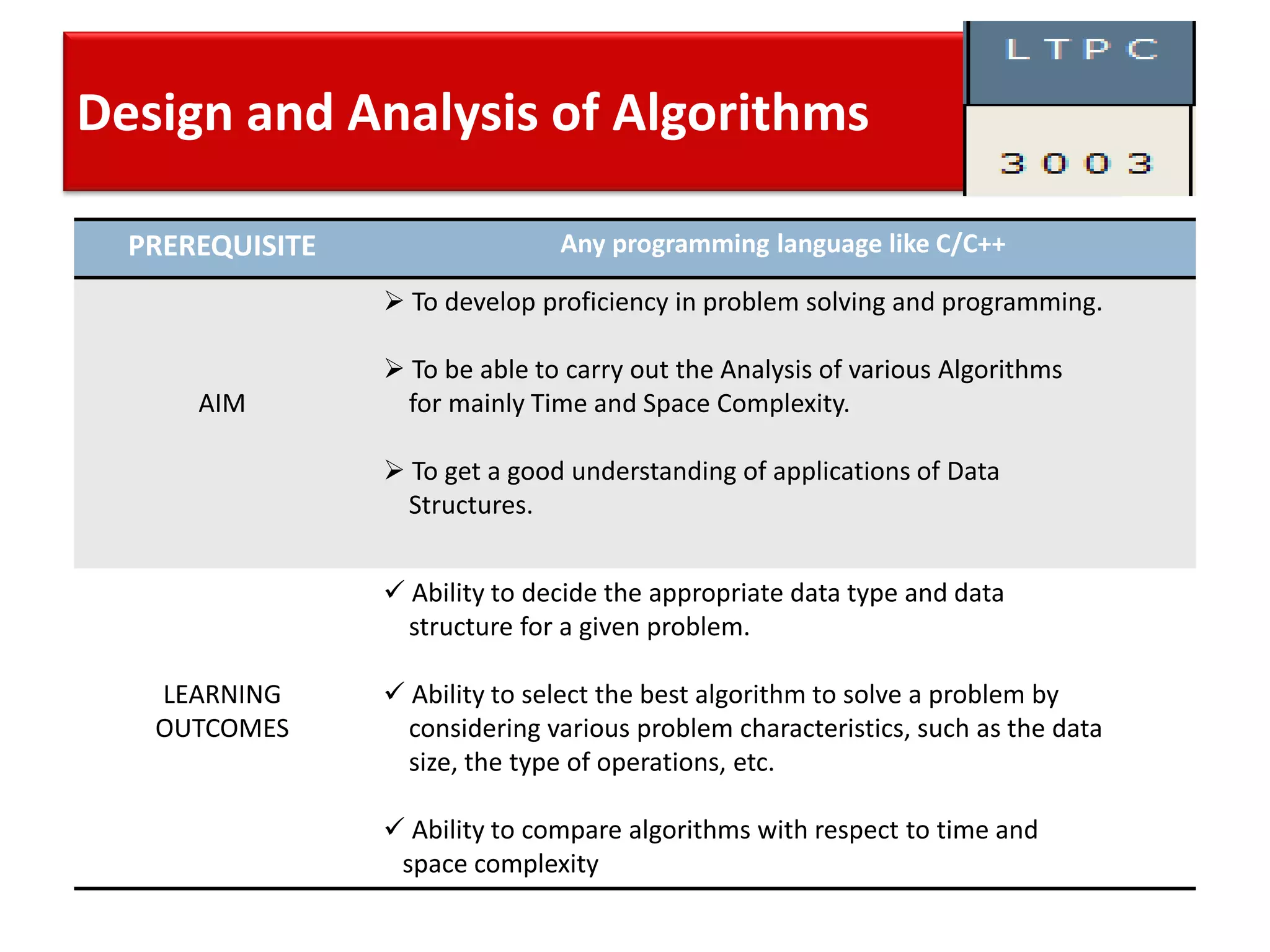
PREREQUISITE Any programming language like C/C++
AIM
 To develop proficiency in problem solving and programming.
 To be able to carry out the Analysis of various Algorithms
for mainly Time and Space Complexity.
 To get a good understanding of applications of Data
Structures.
LEARNING
OUTCOMES
 Ability to decide the appropriate data type and data
structure for a given problem.
 Ability to select the best algorithm to solve a problem by
considering various problem characteristics, such as the data
size, the type of operations, etc.
 Ability to compare algorithms with respect to time and
space complexity
Design and Analysis of Algorithms
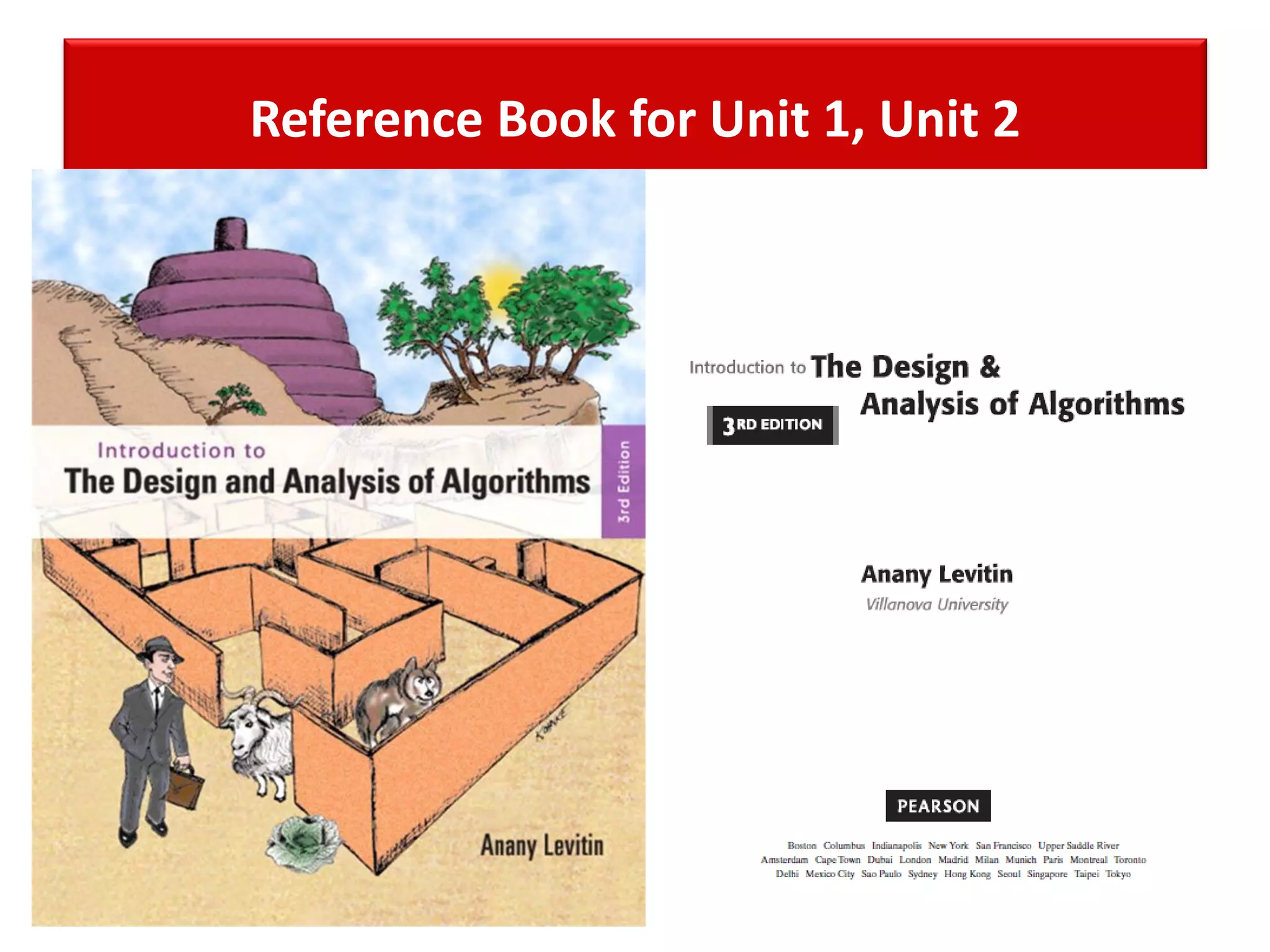
Reference Book for Unit 1, Unit 2
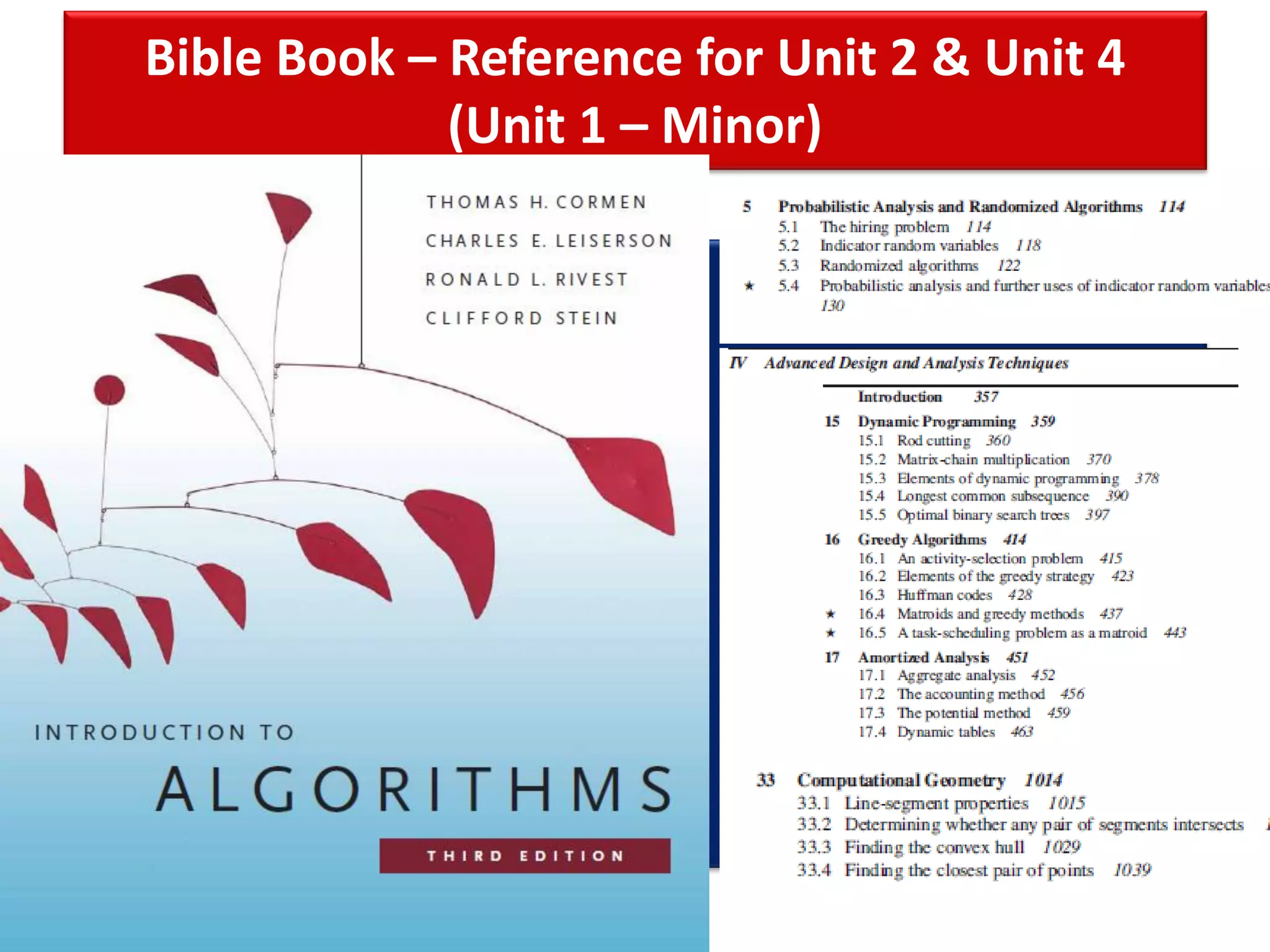
Bible Book – Reference for Unit 2 & Unit 4
(Unit 1 – Minor)
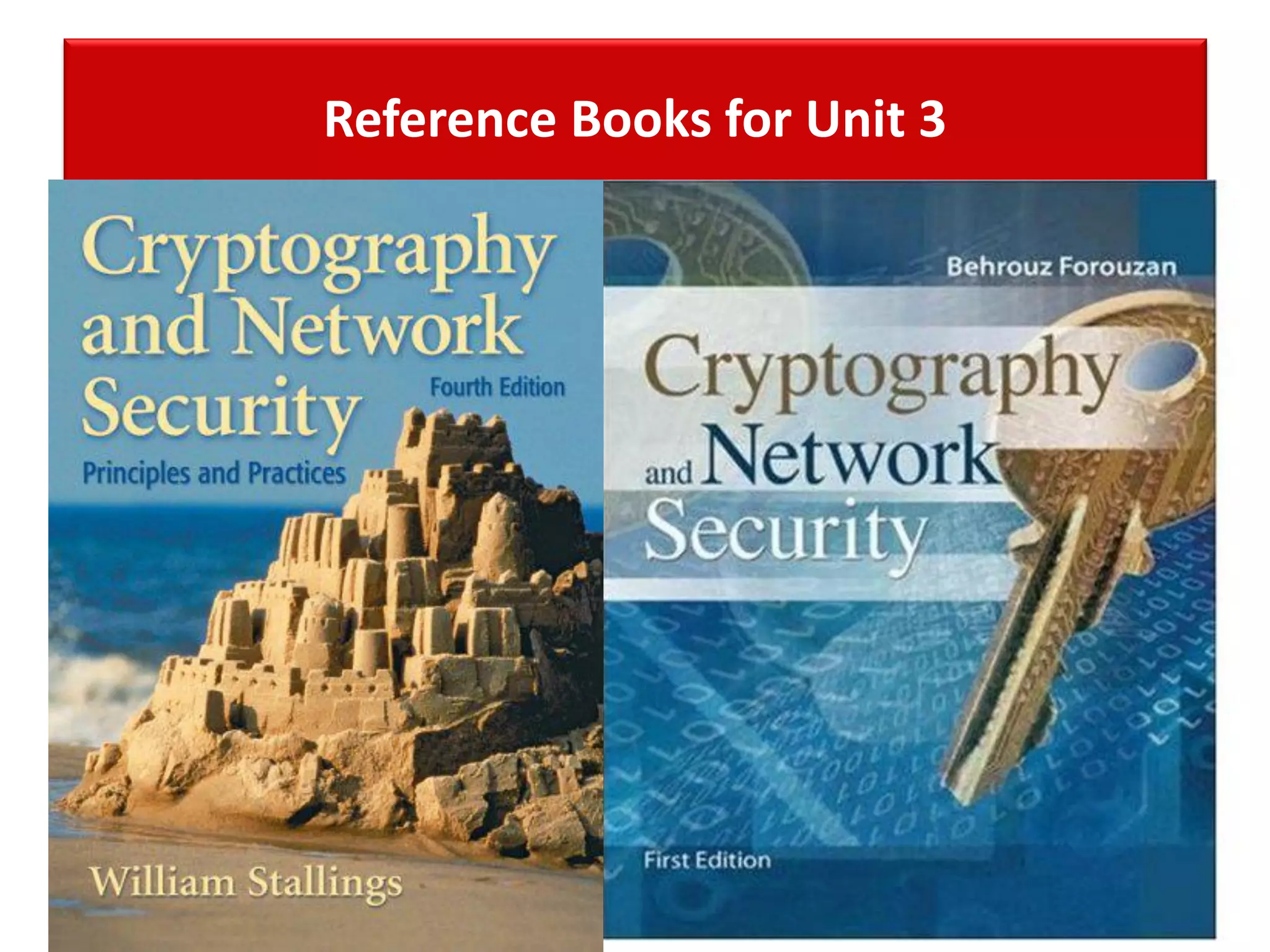
Reference Books for Unit 3
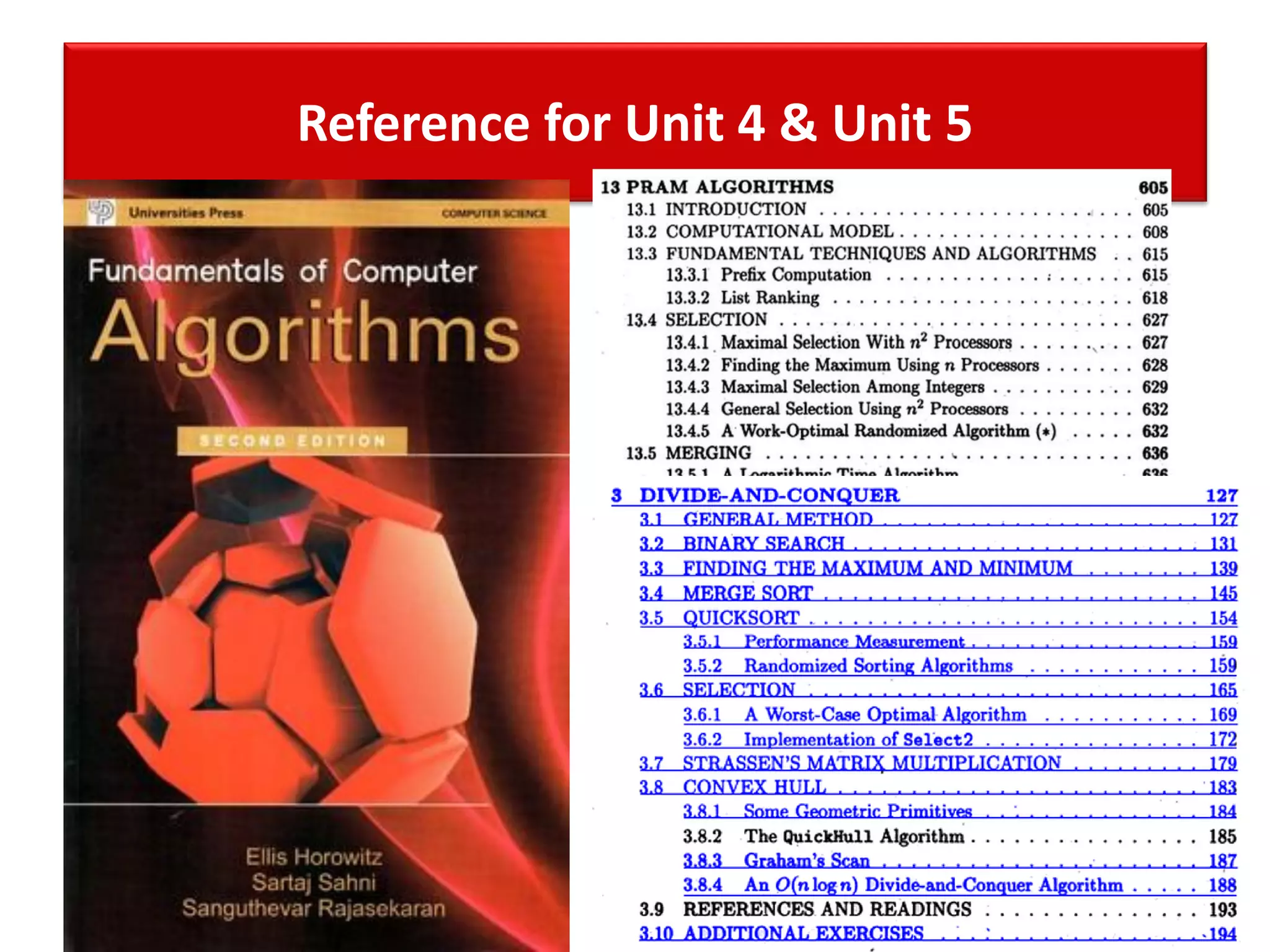
Reference for Unit 4 & Unit 5
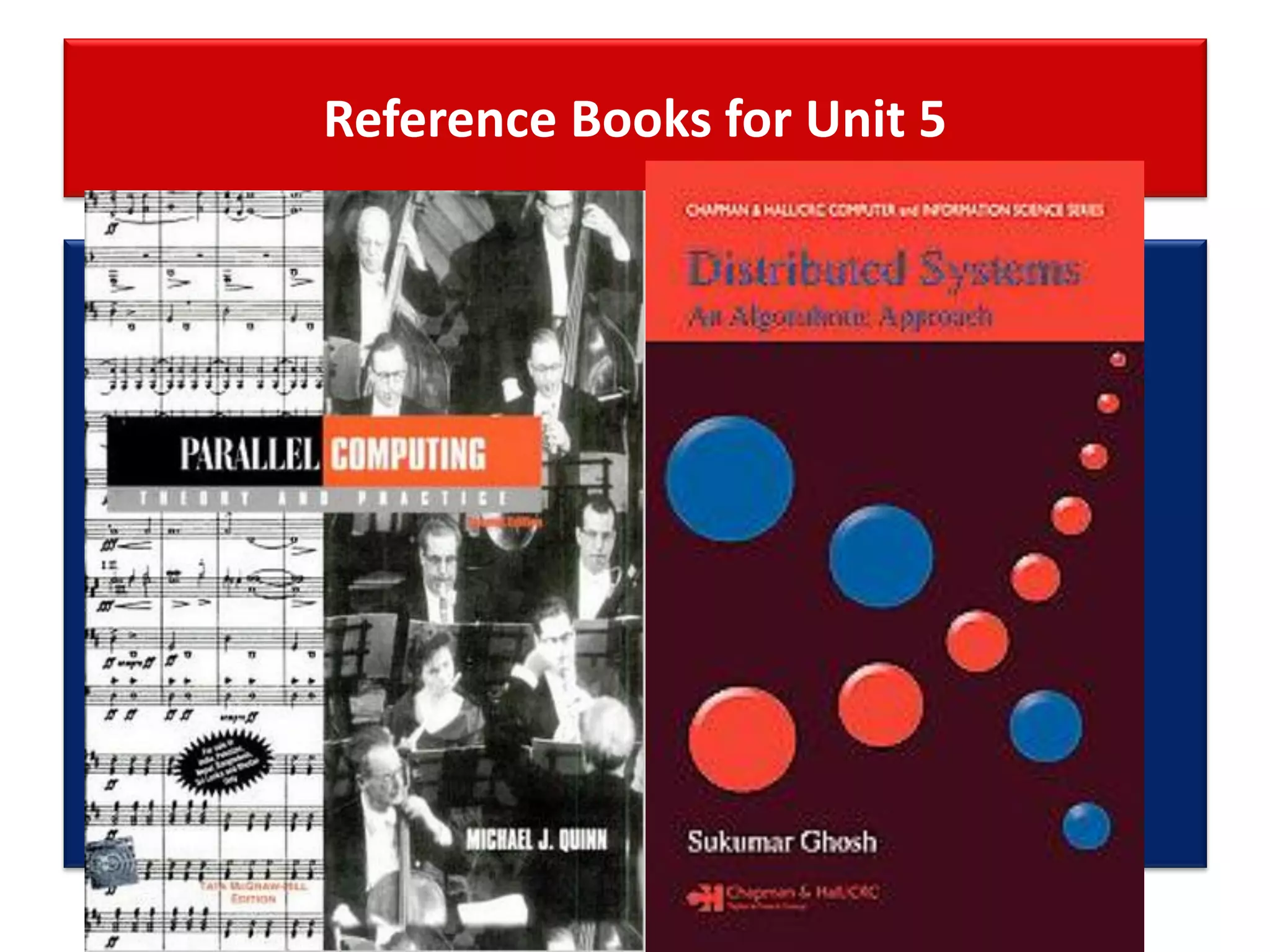
Reference Books for Unit 5
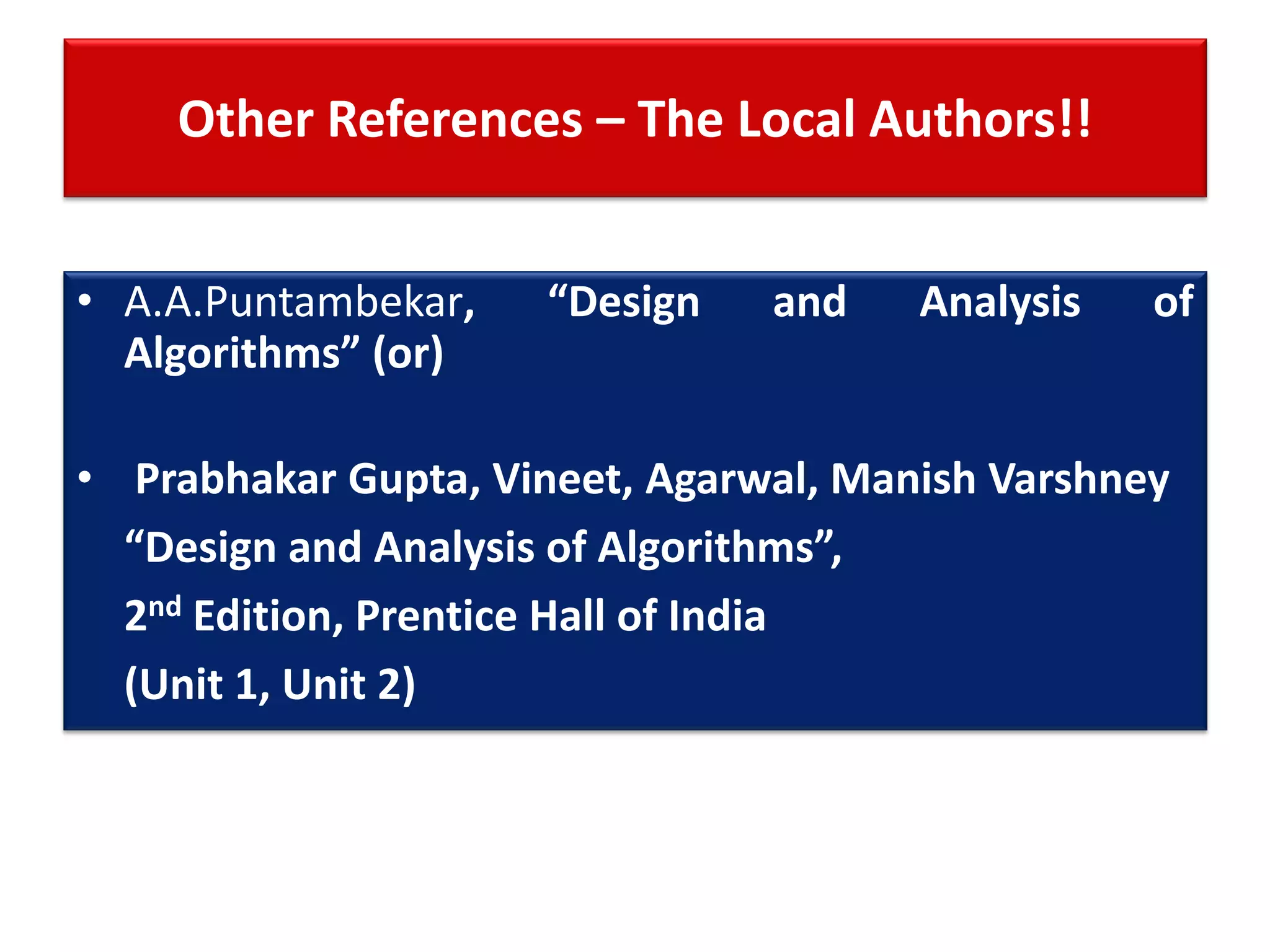
Other References – The Local Authors!!
• A.A.Puntambekar, “Design and Analysis of
Algorithms” (or)
• Prabhakar Gupta, Vineet, Agarwal, Manish Varshney
“Design and Analysis of Algorithms”,
2nd Edition, Prentice Hall of India
(Unit 1, Unit 2)
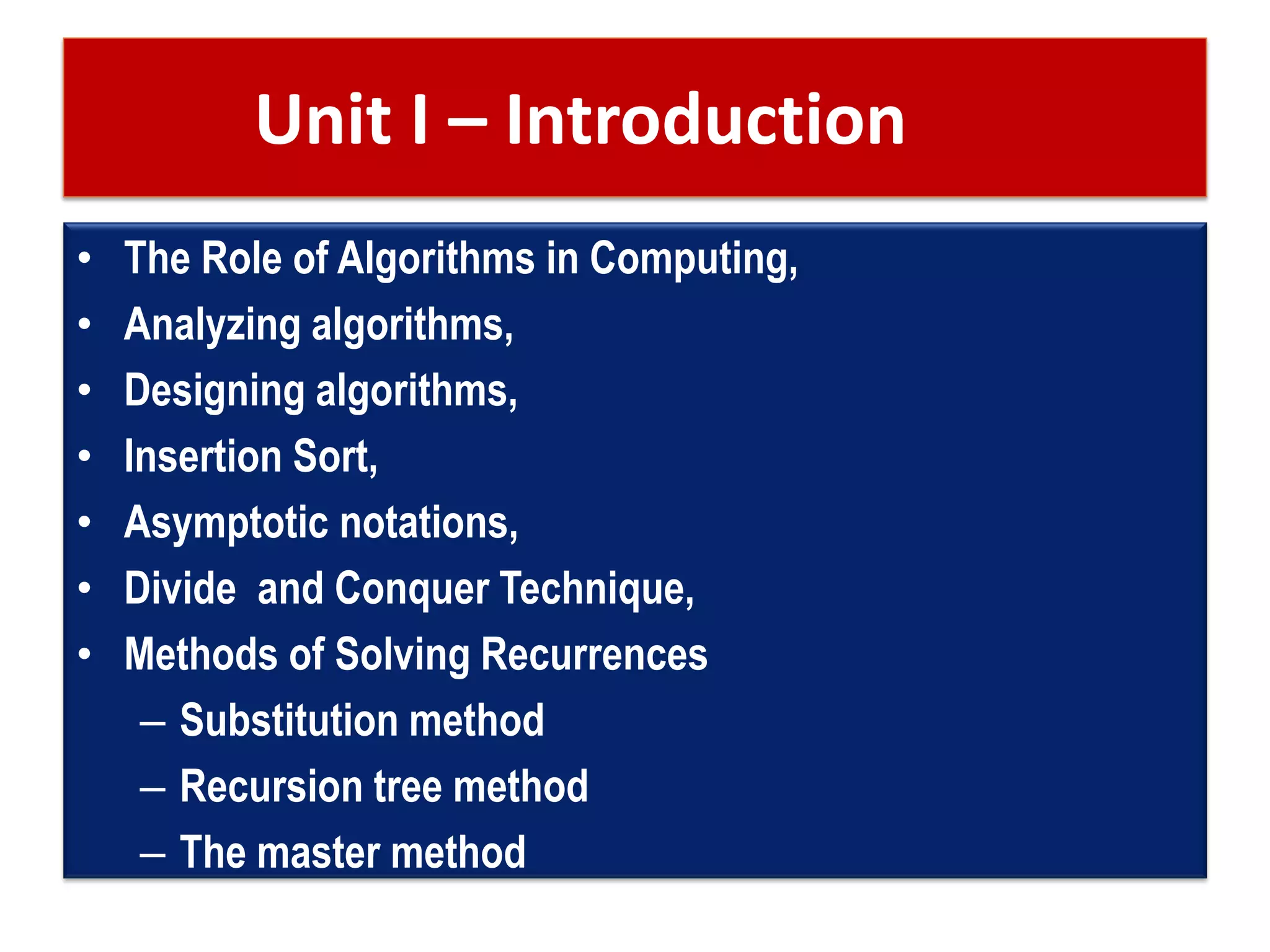
Unit I – Introduction
• The Role of Algorithms in Computing,
• Analyzing algorithms,
• Designing algorithms,
• Insertion Sort,
• Asymptotic notations,
• Divide and Conquer Technique,
• Methods of Solving Recurrences
– Substitution method
– Recursion tree method
– The master method
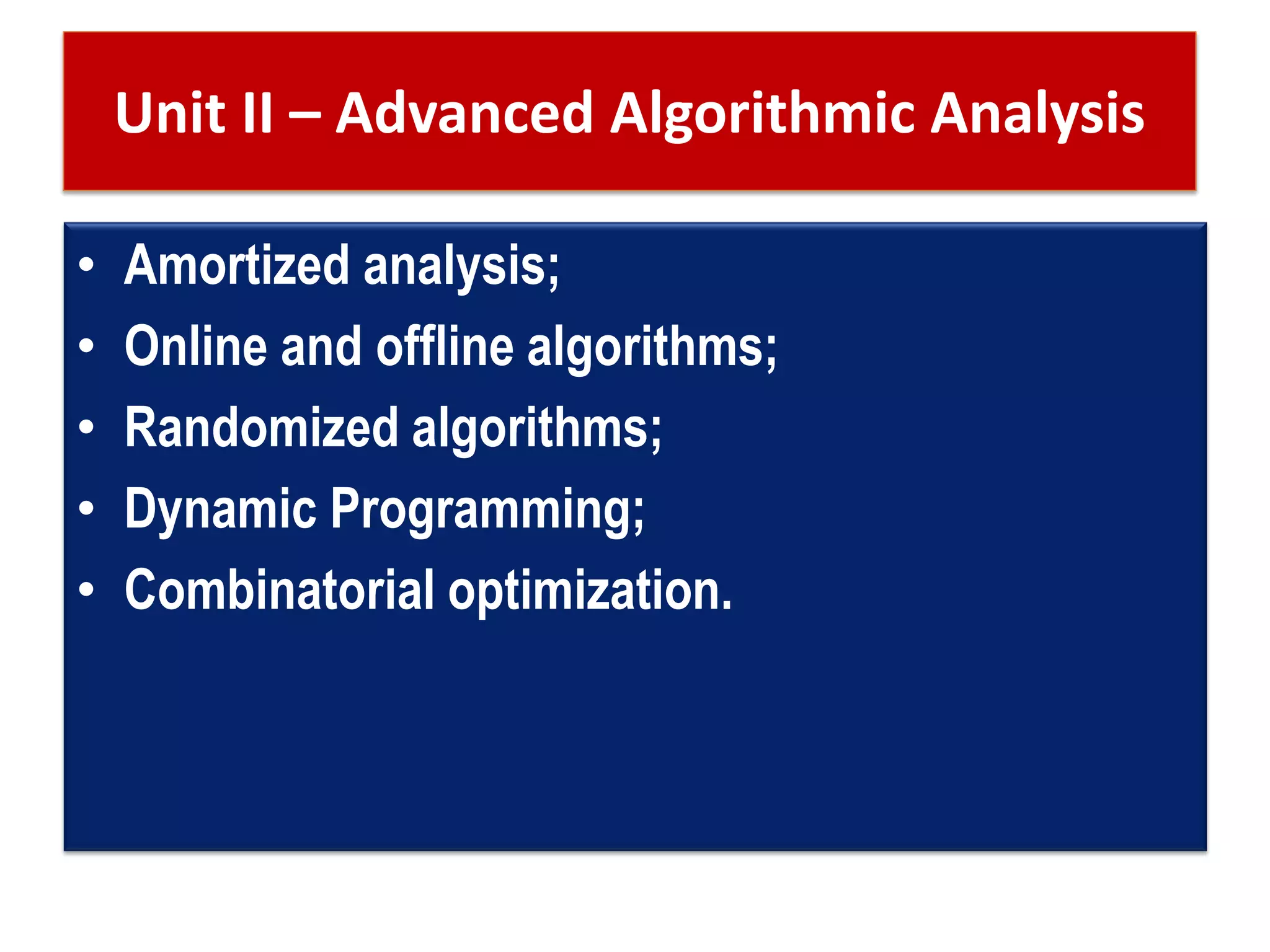
Unit II – Advanced Algorithmic Analysis
• Amortized analysis;
• Online and offline algorithms;
• Randomized algorithms;
• Dynamic Programming;
• Combinatorial optimization.
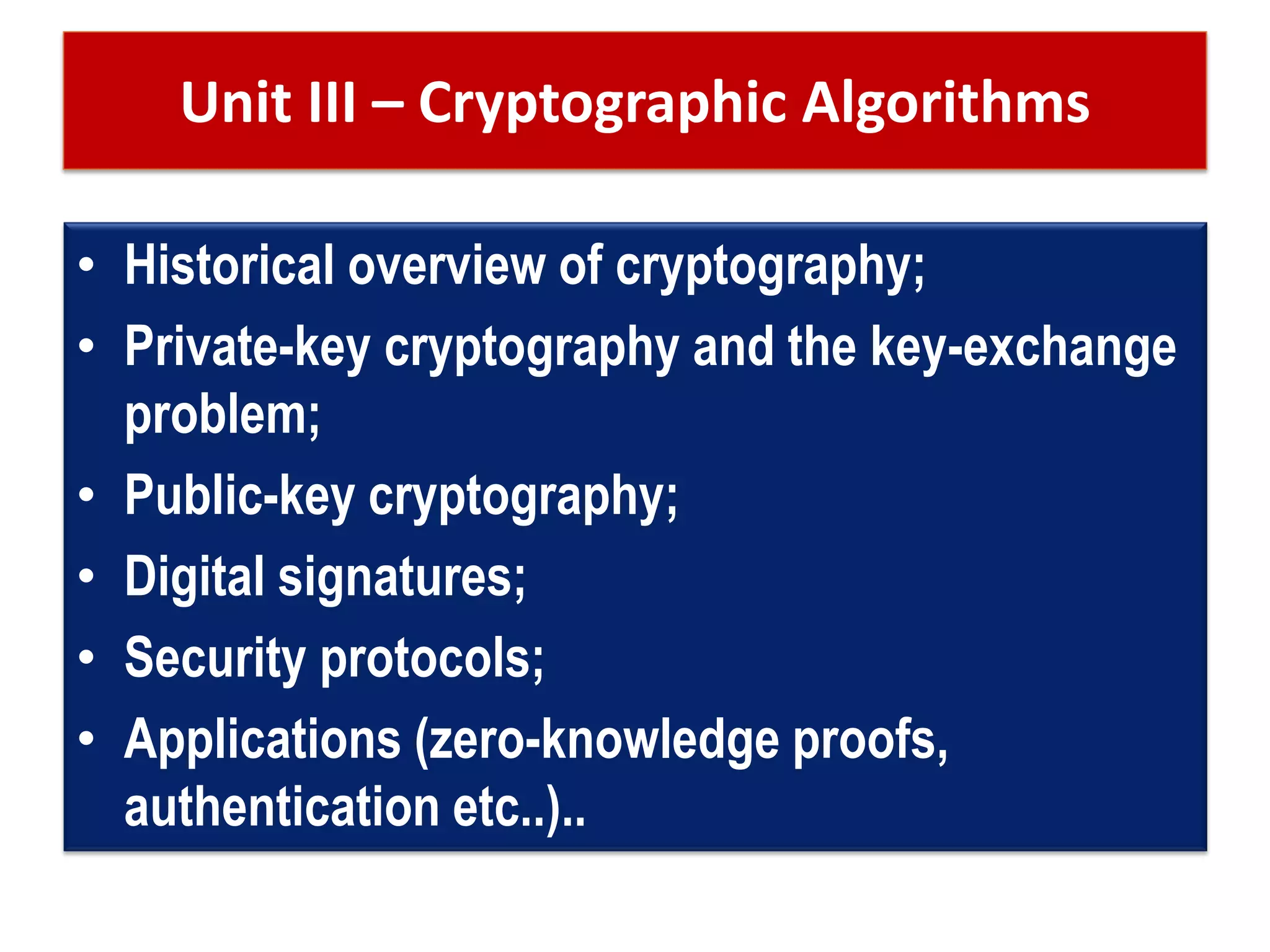
Unit III – Cryptographic Algorithms
• Historical overview of cryptography;
• Private-key cryptography and the key-exchange
problem;
• Public-key cryptography;
• Digital signatures;
• Security protocols;
• Applications (zero-knowledge proofs,
authentication etc..)..
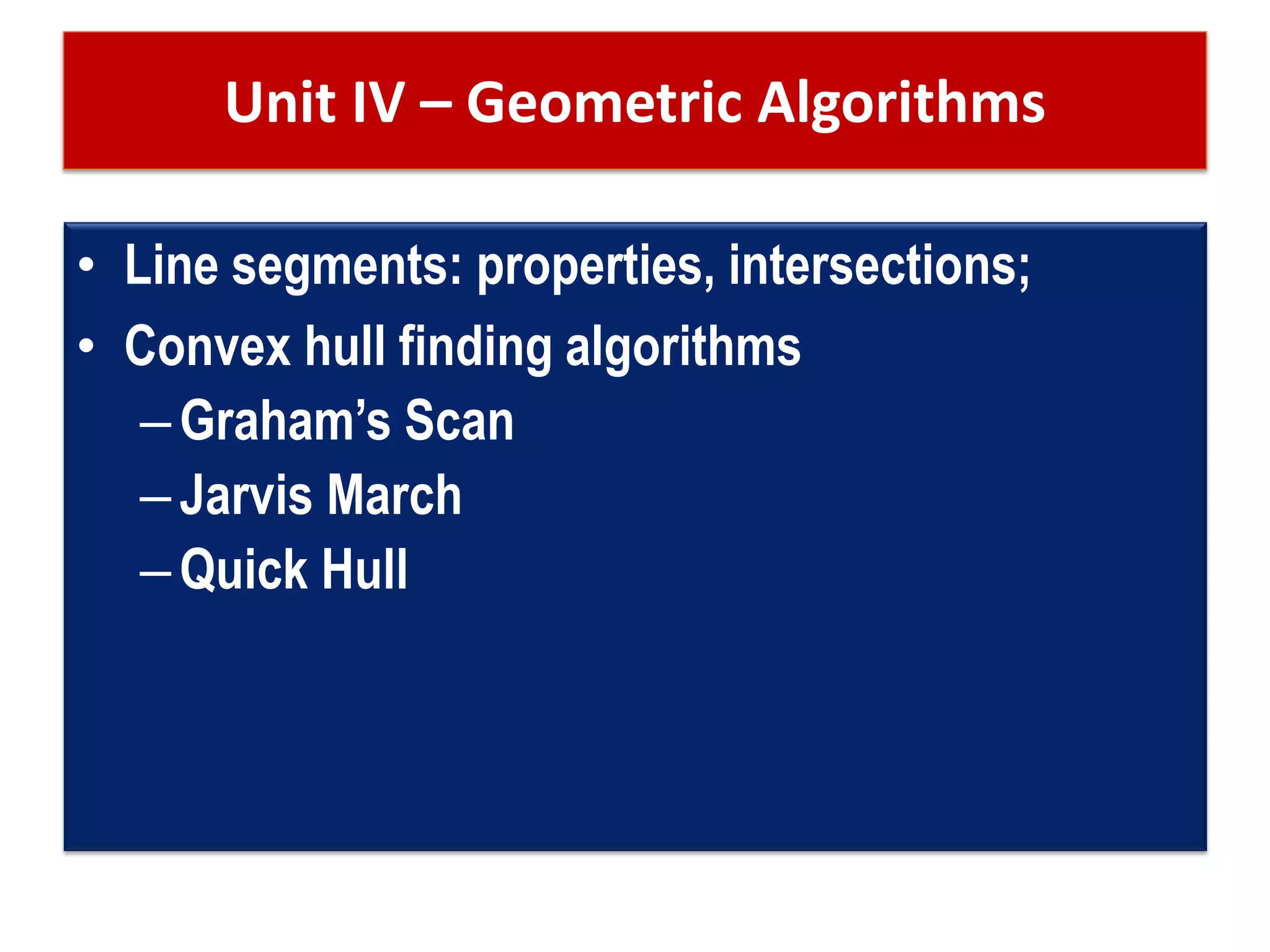
Unit IV – Geometric Algorithms
• Line segments: properties, intersections;
• Convex hull finding algorithms
–Graham’s Scan
–Jarvis March
–Quick Hull
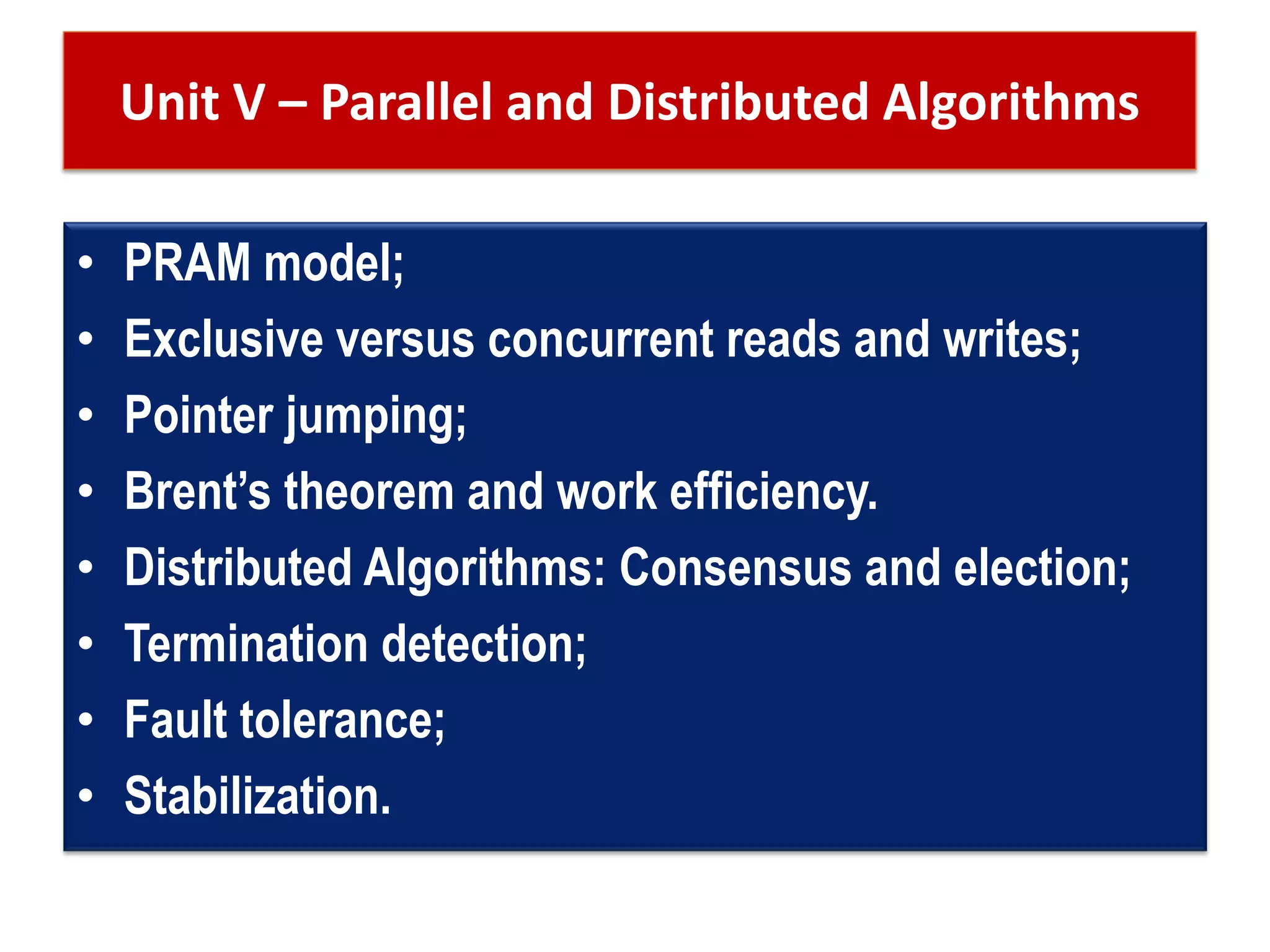
Unit V – Parallel and Distributed Algorithms
• PRAM model;
• Exclusive versus concurrent reads and writes;
• Pointer jumping;
• Brent’s theorem and work efficiency.
• Distributed Algorithms: Consensus and election;
• Termination detection;
• Fault tolerance;
• Stabilization.
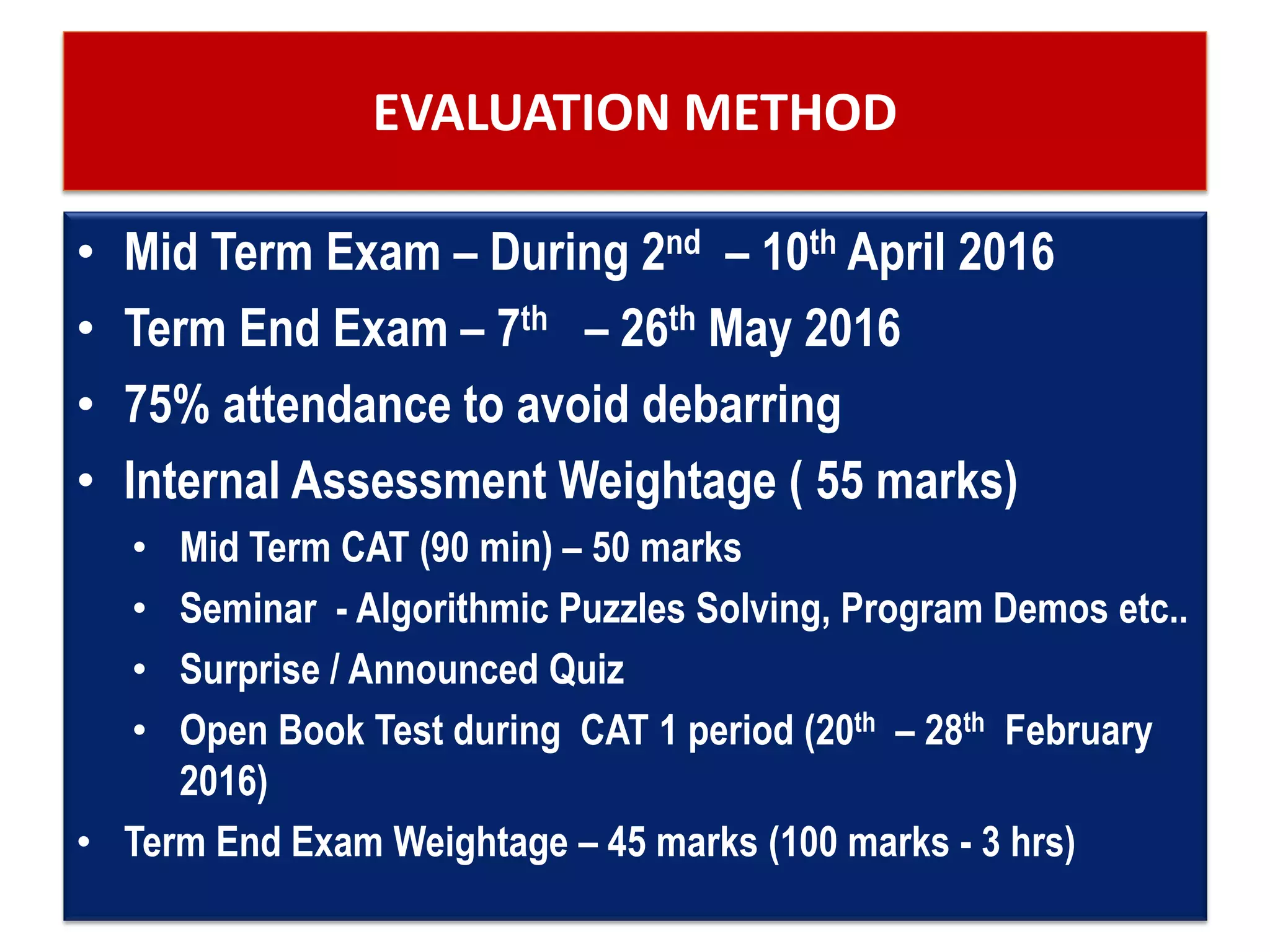
EVALUATION METHOD
• Mid Term Exam – During 2nd – 10th April 2016
• Term End Exam – 7th – 26th May 2016
• 75% attendance to avoid debarring
• Internal Assessment Weightage ( 55 marks)
• Mid Term CAT (90 min) – 50 marks
• Seminar - Algorithmic Puzzles Solving, Program Demos etc..
• Surprise / Announced Quiz
• Open Book Test during CAT 1 period (20th – 28th February
2016)
• Term End Exam Weightage – 45 marks (100 marks - 3 hrs)
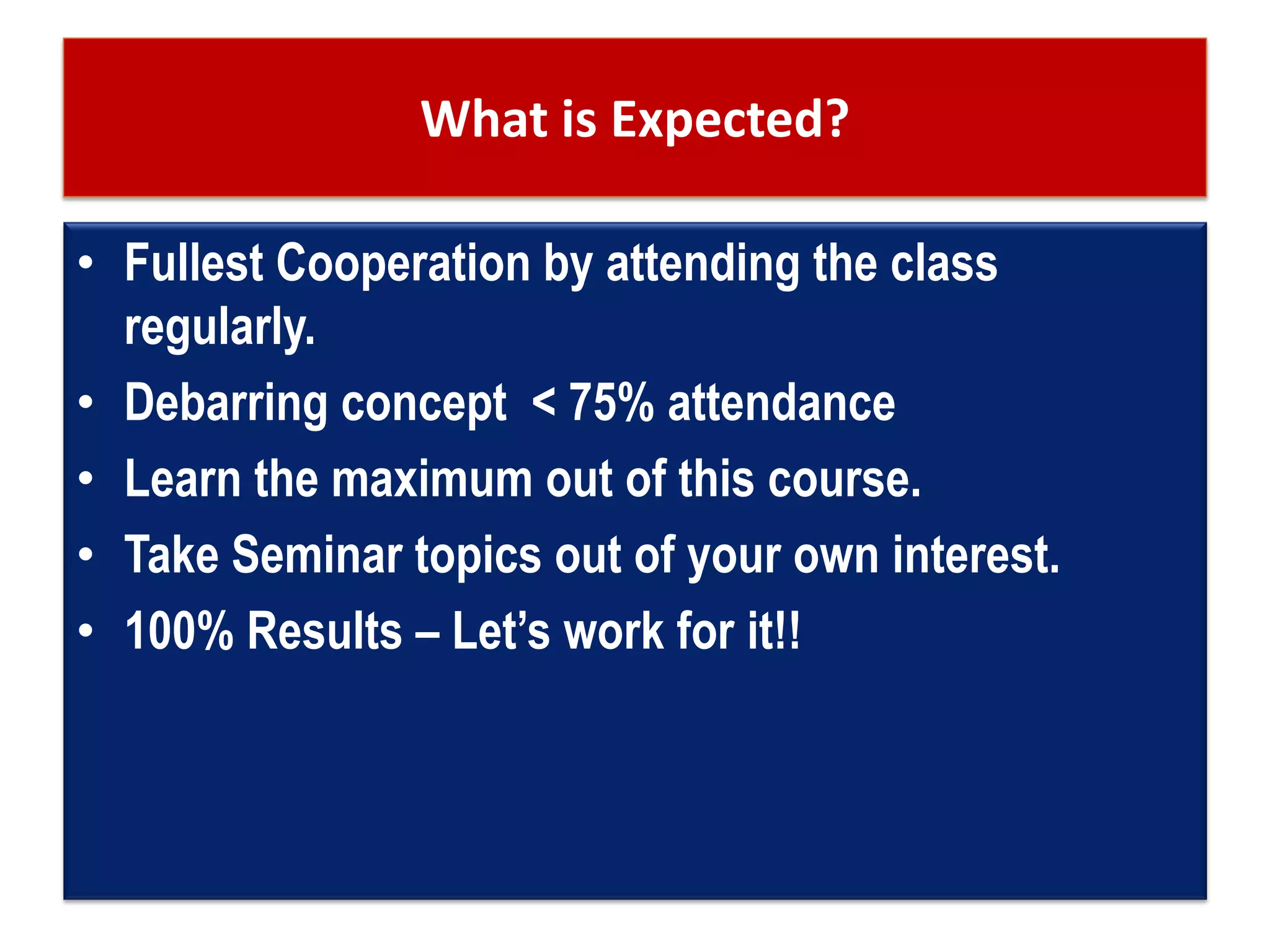
What is Expected?
• Fullest Cooperation by attending the class
regularly.
• Debarring concept < 75% attendance
• Learn the maximum out of this course.
• Take Seminar topics out of your own interest.
• 100% Results – Let’s work for it!!

Lecture 1 objective and course plan

  • 1.
    Design & Analysisof Algorithms (ECE503) Jayavignesh T Asst Professor SENSE
  • 2.
    PREREQUISITE Any programminglanguage like C/C++ AIM  To develop proficiency in problem solving and programming.  To be able to carry out the Analysis of various Algorithms for mainly Time and Space Complexity.  To get a good understanding of applications of Data Structures. LEARNING OUTCOMES  Ability to decide the appropriate data type and data structure for a given problem.  Ability to select the best algorithm to solve a problem by considering various problem characteristics, such as the data size, the type of operations, etc.  Ability to compare algorithms with respect to time and space complexity Design and Analysis of Algorithms
  • 3.
    Reference Book forUnit 1, Unit 2
  • 4.
    Bible Book –Reference for Unit 2 & Unit 4 (Unit 1 – Minor)
  • 5.
  • 6.
  • 7.
  • 8.
    Other References –The Local Authors!! • A.A.Puntambekar, “Design and Analysis of Algorithms” (or) • Prabhakar Gupta, Vineet, Agarwal, Manish Varshney “Design and Analysis of Algorithms”, 2nd Edition, Prentice Hall of India (Unit 1, Unit 2)
  • 9.
    Unit I –Introduction • The Role of Algorithms in Computing, • Analyzing algorithms, • Designing algorithms, • Insertion Sort, • Asymptotic notations, • Divide and Conquer Technique, • Methods of Solving Recurrences – Substitution method – Recursion tree method – The master method
  • 10.
    Unit II –Advanced Algorithmic Analysis • Amortized analysis; • Online and offline algorithms; • Randomized algorithms; • Dynamic Programming; • Combinatorial optimization.
  • 11.
    Unit III –Cryptographic Algorithms • Historical overview of cryptography; • Private-key cryptography and the key-exchange problem; • Public-key cryptography; • Digital signatures; • Security protocols; • Applications (zero-knowledge proofs, authentication etc..)..
  • 12.
    Unit IV –Geometric Algorithms • Line segments: properties, intersections; • Convex hull finding algorithms –Graham’s Scan –Jarvis March –Quick Hull
  • 13.
    Unit V –Parallel and Distributed Algorithms • PRAM model; • Exclusive versus concurrent reads and writes; • Pointer jumping; • Brent’s theorem and work efficiency. • Distributed Algorithms: Consensus and election; • Termination detection; • Fault tolerance; • Stabilization.
  • 14.
    EVALUATION METHOD • MidTerm Exam – During 2nd – 10th April 2016 • Term End Exam – 7th – 26th May 2016 • 75% attendance to avoid debarring • Internal Assessment Weightage ( 55 marks) • Mid Term CAT (90 min) – 50 marks • Seminar - Algorithmic Puzzles Solving, Program Demos etc.. • Surprise / Announced Quiz • Open Book Test during CAT 1 period (20th – 28th February 2016) • Term End Exam Weightage – 45 marks (100 marks - 3 hrs)
  • 15.
    What is Expected? •Fullest Cooperation by attending the class regularly. • Debarring concept < 75% attendance • Learn the maximum out of this course. • Take Seminar topics out of your own interest. • 100% Results – Let’s work for it!!