Syllabus for MCA First Year Semester – I (with effect from the academic year 2007-2008)

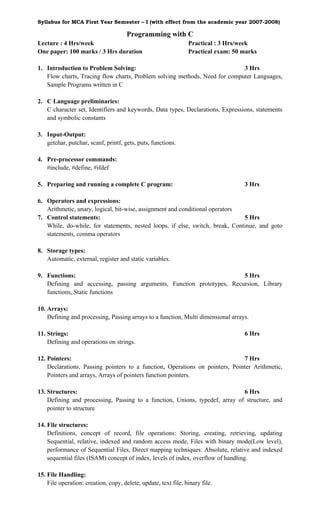
                                      Programming with C
Lecture : 4 Hrs/week                                            Practical : 3 Hrs/week
One paper: 100 marks / 3 Hrs duration                           Practical exam: 50 marks

1. Introduction to Problem Solving:                                         3 Hrs
   Flow charts, Tracing flow charts, Problem solving methods, Need for computer Languages,
   Sample Programs written in C

2. C Language preliminaries:
   C character set, Identifiers and keywords, Data types, Declarations, Expressions, statements
   and symbolic constants

3. Input-Output:
   getchar, putchar, scanf, printf, gets, puts, functions.

4. Pre-processor commands:
   #include, #define, #ifdef

5. Preparing and running a complete C program:                                     3 Hrs

6. Operators and expressions:
   Arithmetic, unary, logical, bit-wise, assignment and conditional operators
7. Control statements:                                                        5 Hrs
   While, do-while, for statements, nested loops, if else, switch, break, Continue, and goto
   statements, comma operators

8. Storage types:
   Automatic, external, register and static variables.

9. Functions:                                                          5 Hrs
   Defining and accessing, passing arguments, Function prototypes, Recursion, Library
   functions, Static functions

10. Arrays:
    Defining and processing, Passing arrays to a function, Multi dimensional arrays.

11. Strings:                                                                       6 Hrs
    Defining and operations on strings.

12. Pointers:                                                                 7 Hrs
    Declarations, Passing pointers to a function, Operations on pointers, Pointer Arithmetic,
    Pointers and arrays, Arrays of pointers function pointers.

13. Structures:                                                              6 Hrs
    Defining and processing, Passing to a function, Unions, typedef, array of structure, and
    pointer to structure

14. File structures:
    Definitions, concept of record, file operations: Storing, creating, retrieving, updating
    Sequential, relative, indexed and random access mode, Files with binary mode(Low level),
    performance of Sequential Files, Direct mapping techniques: Absolute, relative and indexed
    sequential files (ISAM) concept of index, levels of index, overflow of handling.

15. File Handling:
    File operation: creation, copy, delete, update, text file, binary file.
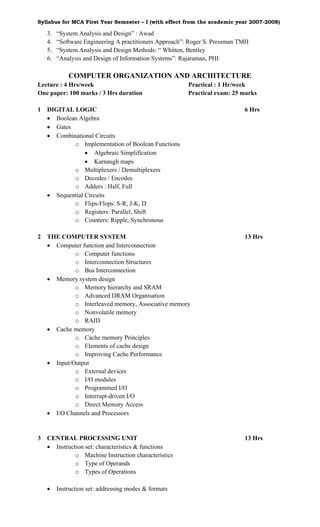
Syllabus for MCA First Year Semester – I (with effect from the academic year 2007-2008)

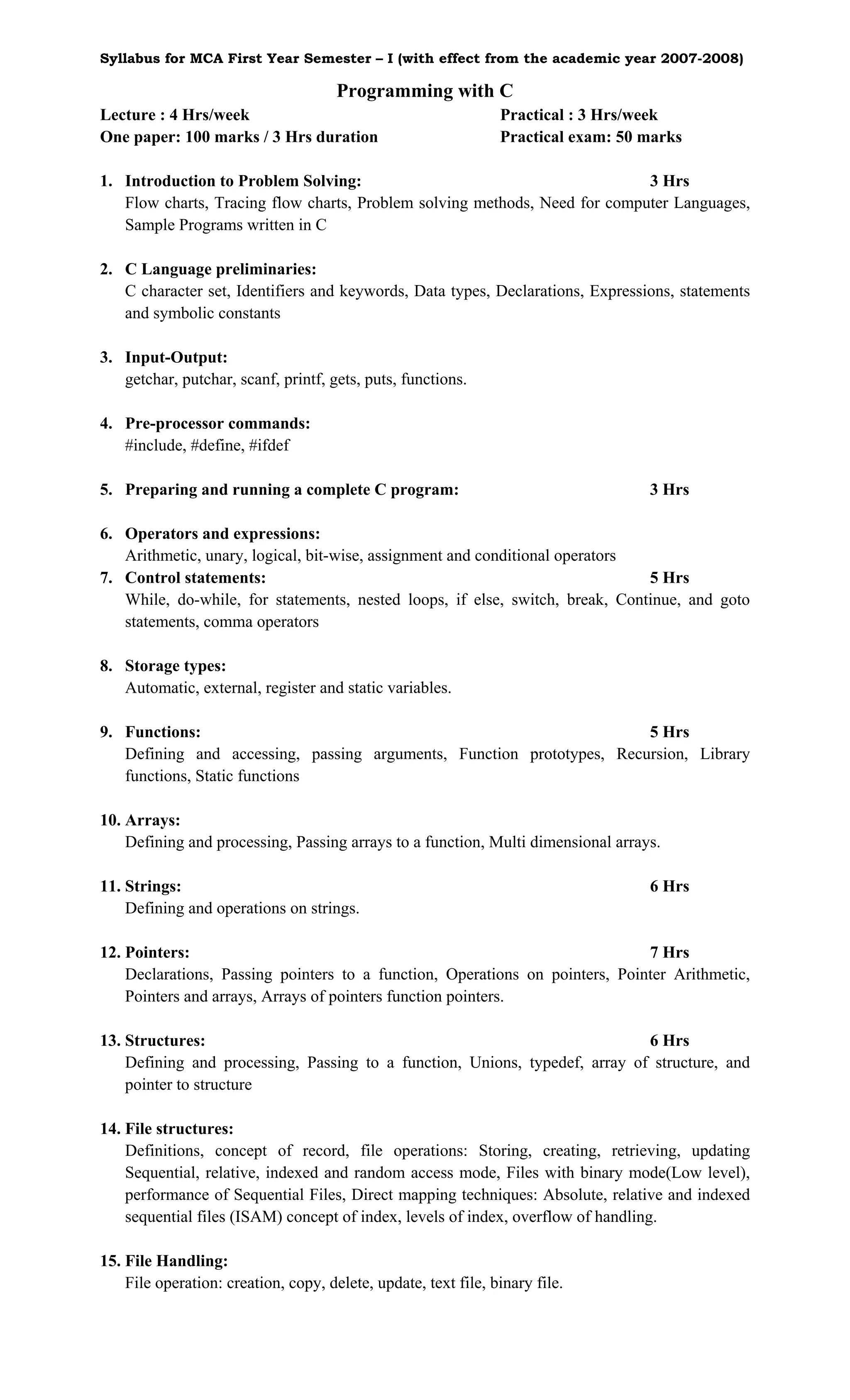
Term work/ Practical: Each candidate will submit a journal in which at least 12 practical
assignments based on the above syllabus along with the flow chart and program listing will be
submitted with the internal test paper. Test graded for 10 marks and Practical graded for 15
marks.

List of Practical
Two programs based on functions.
Two programs based on pointers.
Four programs based on Remaining portion eg. Control statements, Structures and Unions etc.
Three programs based on Different File Operations (File Handling)

References :
   1. Mastering C by Venugopal, Prasad – TMH
   2. Complete reference with C Tata McGraw Hill
   3. C – programming E.Balagurusamy Tata McGray Hill
   4. How to solve it by Computer : Dromey, PHI
   5. Schaums outline of Theory and Problems of programming with C : Gottfried
   6. The C programming language : Kerninghan and Ritchie
   7. Programming in ANSI C : Ramkumar Agarwal
   8. Mastering C by Venugopal, Prasad – TMH
   9. Let Us C by kanetkar
   10. An introduction to data structures with applications, Jean-Paul Trembly and Paul
       Sorenson, (2nd edition), 1884

                          SYSTEM ANALYSIS & DESIGN
Lecture : 4 Hrs/week                                     Practical : 1 Hr/week
One paper: 100 marks / 3 Hrs duration                    Practical exam: 25 marks

1. Introduction                                                                3 Hrs
   • Systems & computer based systems, types of information system
   • System analysis & design
   • Role, task & attribute of the system analyst

2. Approaches to system development                                            5 Hrs
   • SDLC
   • Explanation of the phases
   • Different models their advantages and disadvantages
         o Waterfall approach
         o Iterative approach
         o Extreme programming
         o RAD model
         o Unified process
         o Evolutionary software process model
                • Incremental model
                • Spiral model
                • Concurrent development model

3. Analysis: investigating system requirements                                 4 Hrs
   • Activities of the analysis phase
   • Fact finding methods
         o Review existing reports, forms and procedure descriptions
         o Conduct interviews
         o Observe & document business processes
         o Build prototypes
         o Questionnaires
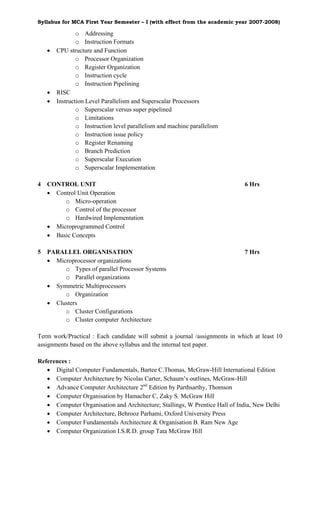
Syllabus for MCA First Year Semester – I (with effect from the academic year 2007-2008)

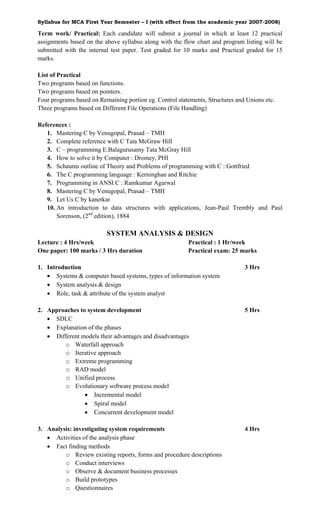
          o Conduct jad sessions
   •   Validate the requirements
          o Structured walkthroughs

4. Feasibility analysis                                                   4 Hrs
   • Feasibility study and cost estimates
   • Cost benefit analysis
   • Identification of list of deliverables

5. Modeling system requirements                                           7 Hrs
   • Data flow diagrams logical and physical
   • Structured English
   • Decision tables
   • Decision trees
   • Entity relationship diagram
   • Data dictionary

6. Design                                                                 7 Hrs
   • Design phase activities
   • Develop system flowchart
   • Structure chart
          o Transaction analysis
          o Transform analysis
   Software design and documentation tools
   • Hipo chart
   • Warnier orr diagram
   Designing databases
   • Entities
   • Relationships
   • Attributes
   • Normalization

7. Designing input, output & user interface                               4 Hrs
   • Input design
   • Output design
   • User interface design

8. Testing                                                                6 Hrs
   • Strategic approach to software testing
   • Test series for conventional software
   • Test strategies for object-oriented software
   • Validation testing
   • System testing
   • Debugging

9. Implementation & maintenance                                           2 Hrs
   • Activities of the implementation & support phase

10. Documentation                                                         3 Hrs
    Use of case tools,
    Documentation-importance, types of documentation
Books:
    1. “Analysis and Design of Information Systems”: Senn, TMH
    2. System Analysis and Design: : Howryskiewycz, PHI
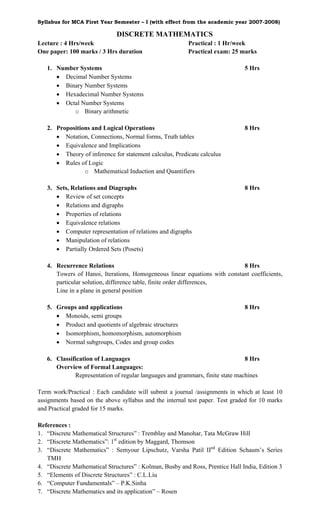
Syllabus for MCA First Year Semester – I (with effect from the academic year 2007-2008)

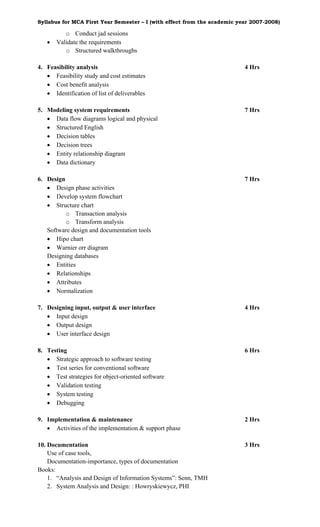
    3.   “System Analysis and Design” : Awad
    4.   “Software Engineering A practitioners Approach”: Roger S. Pressman TMH
    5.   “System Analysis and Design Methods: “ Whitten, Bentley
    6.   “Analysis and Design of Information Systems”: Rajaraman, PHI

             COMPUTER ORGANIZATION AND ARCHITECTURE
Lecture : 4 Hrs/week                                    Practical : 1 Hr/week
One paper: 100 marks / 3 Hrs duration                   Practical exam: 25 marks

1   DIGITAL LOGIC                                                            6 Hrs
    • Boolean Algebra
    • Gates
    • Combinational Circuits
            o Implementation of Boolean Functions
                 • Algebraic Simplification
                 • Karnaugh maps
            o Multiplexers / Demultiplexers
            o Decodes / Encodes
            o Adders : Half, Full
    • Sequential Circuits
            o Flips-Flops: S-R, J-K, D
            o Registers: Parallel, Shift
            o Counters: Ripple, Synchronous

2   THE COMPUTER SYSTEM                                                      13 Hrs
    • Computer function and Interconnection
             o Computer functions
             o Interconnection Structures
             o Bus Interconnection
    • Memory system design
             o Memory hierarchy and SRAM
             o Advanced DRAM Organisation
             o Interleaved memory, Associative memory
             o Nonvolatile memory
             o RAID
    • Cache memory
             o Cache memory Principles
             o Elements of cache design
             o Improving Cache Performance
    • Input/Output
             o External devices
             o I/O modules
             o Programmed I/O
             o Interrupt-driven I/O
             o Direct Memory Access
    • I/O Channels and Processors


3   CENTRAL PROCESSING UNIT                                                  13 Hrs
    • Instruction set: characteristics & functions
              o Machine Instruction characteristics
              o Type of Operands
              o Types of Operations

    •    Instruction set: addressing modes & formats
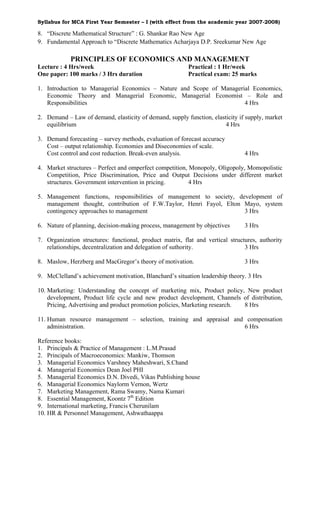
Syllabus for MCA First Year Semester – I (with effect from the academic year 2007-2008)

                o Addressing
                o Instruction Formats
    •   CPU structure and Function
                o Processor Organization
                o Register Organization
                o Instruction cycle
                o Instruction Pipelining
    •   RISC
    •   Instruction Level Parallelism and Superscalar Processors
                o Superscalar versus super pipelined
                o Limitations
                o Instruction level parallelism and machine parallelism
                o Instruction issue policy
                o Register Renaming
                o Branch Prediction
                o Superscalar Execution
                o Superscalar Implementation

4   CONTROL UNIT                                                             6 Hrs
    • Control Unit Operation
         o Micro-operation
         o Control of the processor
         o Hardwired Implementation
    • Microprogrammed Control
    • Basic Concepts

5   PARALLEL ORGANISATION                                                    7 Hrs
    • Microprocessor organizations
         o Types of parallel Processor Systems
         o Parallel organizations
    • Symmetric Multiprocessors
         o Organization
    • Clusters
         o Cluster Configurations
         o Cluster computer Architecture

Term work/Practical : Each candidate will submit a journal /assignments in which at least 10
assignments based on the above syllabus and the internal test paper.

References :
   • Digital Computer Fundamentals, Bartee C.Thomas, McGraw-Hill International Edition
   • Computer Architecture by Nicolas Carter, Schaum’s outlines, McGraw-Hill
   • Advance Computer Architecture 2nd Edition by Parthsarthy, Thomson
   • Computer Organisation by Hamacher C, Zaky S. McGraw Hill
   • Computer Organisation and Architecture; Stallings, W Prentice Hall of India, New Delhi
   • Computer Architecture, Behrooz Parhami, Oxford University Press
   • Computer Fundamentals Architecture & Organisation B. Ram New Age
   • Computer Organization I.S.R.D. group Tata McGraw Hill
Syllabus for MCA First Year Semester – I (with effect from the academic year 2007-2008)

                              DISCRETE MATHEMATICS
Lecture : 4 Hrs/week                                     Practical : 1 Hr/week
One paper: 100 marks / 3 Hrs duration                    Practical exam: 25 marks

   1. Number Systems                                                           5 Hrs
      • Decimal Number Systems
      • Binary Number Systems
      • Hexadecimal Number Systems
      • Octal Number Systems
           o Binary arithmetic

   2. Propositions and Logical Operations                                      8 Hrs
      • Notation, Connections, Normal forms, Truth tables
      • Equivalence and Implications
      • Theory of inference for statement calculus, Predicate calculus
      • Rules of Logic
                o Mathematical Induction and Quantifiers

   3. Sets, Relations and Diagraphs                                            8 Hrs
      • Review of set concepts
      • Relations and digraphs
      • Properties of relations
      • Equivalence relations
      • Computer representation of relations and digraphs
      • Manipulation of relations
      • Partially Ordered Sets (Posets)

   4. Recurrence Relations                                                 8 Hrs
      Towers of Hanoi, Iterations, Homogeneous linear equations with constant coefficients,
      particular solution, difference table, finite order differences,
      Line in a plane in general position

   5. Groups and applications                                                  8 Hrs
      • Monoids, semi groups
      • Product and quotients of algebraic structures
      • Isomorphism, homomorphism, automorphism
      • Normal subgroups, Codes and group codes

   6. Classification of Languages                                              8 Hrs
      Overview of Formal Languages:
             Representation of regular languages and grammars, finite state machines

Term work/Practical : Each candidate will submit a journal /assignments in which at least 10
assignments based on the above syllabus and the internal test paper. Test graded for 10 marks
and Practical graded for 15 marks.

References :
1. “Discrete Mathematical Structures” : Tremblay and Manohar, Tata McGraw Hill
2. “Discrete Mathematics”: 1st edition by Maggard, Thomson
3. “Discrete Mathematics” : Semyour Lipschutz, Varsha Patil IInd Edition Schaum’s Series
   TMH
4. “Discrete Mathematical Structures” : Kolman, Busby and Ross, Prentice Hall India, Edition 3
5. “Elements of Discrete Structures” : C.L.Liu
6. “Computer Fundamentals” – P.K.Sinha
7. “Discrete Mathematics and its application” – Rosen
Syllabus for MCA First Year Semester – I (with effect from the academic year 2007-2008)

8. “Discrete Mathematical Structure” : G. Shankar Rao New Age
9. Fundamental Approach to “Discrete Mathematics Acharjaya D.P. Sreekumar New Age

            PRINCIPLES OF ECONOMICS AND MANAGEMENT
Lecture : 4 Hrs/week                                      Practical : 1 Hr/week
One paper: 100 marks / 3 Hrs duration                     Practical exam: 25 marks

1. Introduction to Managerial Economics – Nature and Scope of Managerial Economics,
   Economic Theory and Managerial Economic, Managerial Economist – Role and
   Responsibilities                                                   4 Hrs

2. Demand – Law of demand, elasticity of demand, supply function, elasticity if supply, market
   equilibrium                                                         4 Hrs

3. Demand forecasting – survey methods, evaluation of forecast accuracy
   Cost – output relationship. Economies and Diseconomies of scale.
   Cost control and cost reduction. Break-even analysis.                        4 Hrs

4. Market structures – Perfect and omperfect competition, Monopoly, Oligopoly, Momopolistic
   Competition, Price Discrimination, Price and Output Decisions under different market
   structures. Government intervention in pricing.        4 Hrs

5. Management functions, responsibilities of management to society, development of
   management thought, contribution of F.W.Taylor, Henri Fayol, Elton Mayo, system
   contingency approaches to management                               3 Hrs

6. Nature of planning, decision-making process, management by objectives        3 Hrs

7. Organization structures: functional, product matrix, flat and vertical structures, authority
   relationships, decentralization and delegation of suthority.                 3 Hrs

8. Maslow, Herzberg and MacGregor’s theory of motivation.                       3 Hrs

9. McClelland’s achievement motivation, Blanchard’s situation leadership theory. 3 Hrs

10. Marketing: Understanding the concept of marketing mix, Product policy, New product
    development, Product life cycle and new product development, Channels of distribution,
    Pricing, Advertising and product promotion policies, Marketing research. 8 Hrs

11. Human resource management – selection, training and appraisal and compensation
    administration.                                                  6 Hrs

Reference books:
1. Principals & Practice of Management : L.M.Prasad
2. Principals of Macroeconomics: Mankiw, Thomson
3. Managerial Economics Varshney Maheshwari, S.Chand
4. Managerial Economics Dean Joel PHI
5. Managerial Economics D.N. Divedi, Vikas Publishing house
6. Managerial Economics Naylorm Vernon, Wertz
7. Marketing Management, Rama Swamy, Nama Kumari
8. Essential Management, Koontz 7th Edition
9. International marketing, Francis Cherunilam
10. HR & Personnel Management, Ashwathaappa
Syllabus for MCA First Year Semester – I (with effect from the academic year 2007-2008)

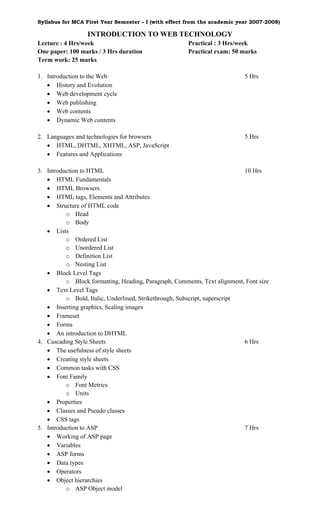
                  INTRODUCTION TO WEB TECHNOLOGY
Lecture : 4 Hrs/week                                   Practical : 3 Hrs/week
One paper: 100 marks / 3 Hrs duration                  Practical exam: 50 marks
Term work: 25 marks

1. Introduction to the Web                                                  5 Hrs
   • History and Evolution
   • Web development cycle
   • Web publishing
   • Web contents
   • Dynamic Web contents

2. Languages and technologies for browsers                                  5 Hrs
   • HTML, DHTML, XHTML, ASP, JavaScript
   • Features and Applications

3. Introduction to HTML                                                     10 Hrs
   • HTML Fundamentals
   • HTML Browsers
   • HTML tags, Elements and Attributes
   • Structure of HTML code
          o Head
          o Body
   • Lists
          o Ordered List
          o Unordered List
          o Definition List
          o Nesting List
   • Block Level Tags
          o Block formatting, Heading, Paragraph, Comments, Text alignment, Font size
   • Text Level Tags
          o Bold, Italic, Underlined, Strikethrough, Subscript, superscript
   • Inserting graphics, Scaling images
   • Frameset
   • Forms
   • An introduction to DHTML
4. Cascading Style Sheets                                                   6 Hrs
   • The usefulness of style sheets
   • Creating style sheets
   • Common tasks with CSS
   • Font Family
          o Font Metrics
          o Units
   • Properties
   • Classes and Pseudo classes
   • CSS tags
5. Introduction to ASP                                                      7 Hrs
   • Working of ASP page
   • Variables
   • ASP forms
   • Data types
   • Operators
   • Object hierarchies
          o ASP Object model
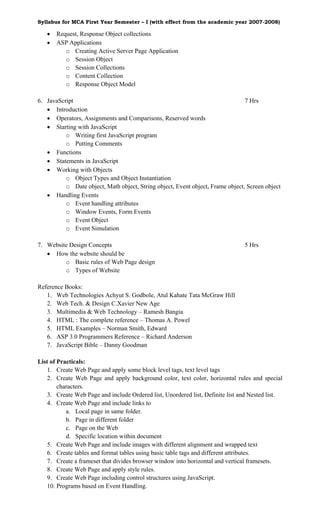
Syllabus for MCA First Year Semester – I (with effect from the academic year 2007-2008)

   •   Request, Response Object collections
   •   ASP Applications
          o Creating Active Server Page Application
          o Session Object
          o Session Collections
          o Content Collection
          o Response Object Model

6. JavaScript                                                                   7 Hrs
   • Introduction
   • Operators, Assignments and Comparisons, Reserved words
   • Starting with JavaScript
          o Writing first JavaScript program
          o Putting Comments
   • Functions
   • Statements in JavaScript
   • Working with Objects
          o Object Types and Object Instantiation
          o Date object, Math object, String object, Event object, Frame object, Screen object
   • Handling Events
          o Event handling attributes
          o Window Events, Form Events
          o Event Object
          o Event Simulation

7. Website Design Concepts                                                      5 Hrs
   • How the website should be
         o Basic rules of Web Page design
         o Types of Website

Reference Books:
   1. Web Technologies Achyut S. Godbole, Atul Kahate Tata McGraw Hill
   2. Web Tech. & Design C.Xavier New Age
   3. Multimedia & Web Technology – Ramesh Bangia
   4. HTML : The complete reference – Thomas A. Powel
   5. HTML Examples – Norman Smith, Edward
   6. ASP 3.0 Programmers Reference – Richard Anderson
   7. JavaScript Bible – Danny Goodman

List of Practicals:
   1. Create Web Page and apply some block level tags, text level tags
   2. Create Web Page and apply background color, text color, horizontal rules and special
        characters.
   3. Create Web Page and include Ordered list, Unordered list, Definite list and Nested list.
   4. Create Web Page and include links to
           a. Local page in same folder.
           b. Page in different folder
           c. Page on the Web
           d. Specific location within document
   5. Create Web Page and include images with different alignment and wrapped text
   6. Create tables and format tables using basic table tags and different attributes.
   7. Create a frameset that divides browser window into horizontal and vertical framesets.
   8. Create Web Page and apply style rules.
   9. Create Web Page including control structures using JavaScript.
   10. Programs based on Event Handling.

Mca sem1syll

  • 1.
    Syllabus for MCAFirst Year Semester – I (with effect from the academic year 2007-2008) Programming with C Lecture : 4 Hrs/week Practical : 3 Hrs/week One paper: 100 marks / 3 Hrs duration Practical exam: 50 marks 1. Introduction to Problem Solving: 3 Hrs Flow charts, Tracing flow charts, Problem solving methods, Need for computer Languages, Sample Programs written in C 2. C Language preliminaries: C character set, Identifiers and keywords, Data types, Declarations, Expressions, statements and symbolic constants 3. Input-Output: getchar, putchar, scanf, printf, gets, puts, functions. 4. Pre-processor commands: #include, #define, #ifdef 5. Preparing and running a complete C program: 3 Hrs 6. Operators and expressions: Arithmetic, unary, logical, bit-wise, assignment and conditional operators 7. Control statements: 5 Hrs While, do-while, for statements, nested loops, if else, switch, break, Continue, and goto statements, comma operators 8. Storage types: Automatic, external, register and static variables. 9. Functions: 5 Hrs Defining and accessing, passing arguments, Function prototypes, Recursion, Library functions, Static functions 10. Arrays: Defining and processing, Passing arrays to a function, Multi dimensional arrays. 11. Strings: 6 Hrs Defining and operations on strings. 12. Pointers: 7 Hrs Declarations, Passing pointers to a function, Operations on pointers, Pointer Arithmetic, Pointers and arrays, Arrays of pointers function pointers. 13. Structures: 6 Hrs Defining and processing, Passing to a function, Unions, typedef, array of structure, and pointer to structure 14. File structures: Definitions, concept of record, file operations: Storing, creating, retrieving, updating Sequential, relative, indexed and random access mode, Files with binary mode(Low level), performance of Sequential Files, Direct mapping techniques: Absolute, relative and indexed sequential files (ISAM) concept of index, levels of index, overflow of handling. 15. File Handling: File operation: creation, copy, delete, update, text file, binary file.
  • 2.
    Syllabus for MCAFirst Year Semester – I (with effect from the academic year 2007-2008) Term work/ Practical: Each candidate will submit a journal in which at least 12 practical assignments based on the above syllabus along with the flow chart and program listing will be submitted with the internal test paper. Test graded for 10 marks and Practical graded for 15 marks. List of Practical Two programs based on functions. Two programs based on pointers. Four programs based on Remaining portion eg. Control statements, Structures and Unions etc. Three programs based on Different File Operations (File Handling) References : 1. Mastering C by Venugopal, Prasad – TMH 2. Complete reference with C Tata McGraw Hill 3. C – programming E.Balagurusamy Tata McGray Hill 4. How to solve it by Computer : Dromey, PHI 5. Schaums outline of Theory and Problems of programming with C : Gottfried 6. The C programming language : Kerninghan and Ritchie 7. Programming in ANSI C : Ramkumar Agarwal 8. Mastering C by Venugopal, Prasad – TMH 9. Let Us C by kanetkar 10. An introduction to data structures with applications, Jean-Paul Trembly and Paul Sorenson, (2nd edition), 1884 SYSTEM ANALYSIS & DESIGN Lecture : 4 Hrs/week Practical : 1 Hr/week One paper: 100 marks / 3 Hrs duration Practical exam: 25 marks 1. Introduction 3 Hrs • Systems & computer based systems, types of information system • System analysis & design • Role, task & attribute of the system analyst 2. Approaches to system development 5 Hrs • SDLC • Explanation of the phases • Different models their advantages and disadvantages o Waterfall approach o Iterative approach o Extreme programming o RAD model o Unified process o Evolutionary software process model • Incremental model • Spiral model • Concurrent development model 3. Analysis: investigating system requirements 4 Hrs • Activities of the analysis phase • Fact finding methods o Review existing reports, forms and procedure descriptions o Conduct interviews o Observe & document business processes o Build prototypes o Questionnaires
  • 3.
    Syllabus for MCAFirst Year Semester – I (with effect from the academic year 2007-2008) o Conduct jad sessions • Validate the requirements o Structured walkthroughs 4. Feasibility analysis 4 Hrs • Feasibility study and cost estimates • Cost benefit analysis • Identification of list of deliverables 5. Modeling system requirements 7 Hrs • Data flow diagrams logical and physical • Structured English • Decision tables • Decision trees • Entity relationship diagram • Data dictionary 6. Design 7 Hrs • Design phase activities • Develop system flowchart • Structure chart o Transaction analysis o Transform analysis Software design and documentation tools • Hipo chart • Warnier orr diagram Designing databases • Entities • Relationships • Attributes • Normalization 7. Designing input, output & user interface 4 Hrs • Input design • Output design • User interface design 8. Testing 6 Hrs • Strategic approach to software testing • Test series for conventional software • Test strategies for object-oriented software • Validation testing • System testing • Debugging 9. Implementation & maintenance 2 Hrs • Activities of the implementation & support phase 10. Documentation 3 Hrs Use of case tools, Documentation-importance, types of documentation Books: 1. “Analysis and Design of Information Systems”: Senn, TMH 2. System Analysis and Design: : Howryskiewycz, PHI
  • 4.
    Syllabus for MCAFirst Year Semester – I (with effect from the academic year 2007-2008) 3. “System Analysis and Design” : Awad 4. “Software Engineering A practitioners Approach”: Roger S. Pressman TMH 5. “System Analysis and Design Methods: “ Whitten, Bentley 6. “Analysis and Design of Information Systems”: Rajaraman, PHI COMPUTER ORGANIZATION AND ARCHITECTURE Lecture : 4 Hrs/week Practical : 1 Hr/week One paper: 100 marks / 3 Hrs duration Practical exam: 25 marks 1 DIGITAL LOGIC 6 Hrs • Boolean Algebra • Gates • Combinational Circuits o Implementation of Boolean Functions • Algebraic Simplification • Karnaugh maps o Multiplexers / Demultiplexers o Decodes / Encodes o Adders : Half, Full • Sequential Circuits o Flips-Flops: S-R, J-K, D o Registers: Parallel, Shift o Counters: Ripple, Synchronous 2 THE COMPUTER SYSTEM 13 Hrs • Computer function and Interconnection o Computer functions o Interconnection Structures o Bus Interconnection • Memory system design o Memory hierarchy and SRAM o Advanced DRAM Organisation o Interleaved memory, Associative memory o Nonvolatile memory o RAID • Cache memory o Cache memory Principles o Elements of cache design o Improving Cache Performance • Input/Output o External devices o I/O modules o Programmed I/O o Interrupt-driven I/O o Direct Memory Access • I/O Channels and Processors 3 CENTRAL PROCESSING UNIT 13 Hrs • Instruction set: characteristics & functions o Machine Instruction characteristics o Type of Operands o Types of Operations • Instruction set: addressing modes & formats
  • 5.
    Syllabus for MCAFirst Year Semester – I (with effect from the academic year 2007-2008) o Addressing o Instruction Formats • CPU structure and Function o Processor Organization o Register Organization o Instruction cycle o Instruction Pipelining • RISC • Instruction Level Parallelism and Superscalar Processors o Superscalar versus super pipelined o Limitations o Instruction level parallelism and machine parallelism o Instruction issue policy o Register Renaming o Branch Prediction o Superscalar Execution o Superscalar Implementation 4 CONTROL UNIT 6 Hrs • Control Unit Operation o Micro-operation o Control of the processor o Hardwired Implementation • Microprogrammed Control • Basic Concepts 5 PARALLEL ORGANISATION 7 Hrs • Microprocessor organizations o Types of parallel Processor Systems o Parallel organizations • Symmetric Multiprocessors o Organization • Clusters o Cluster Configurations o Cluster computer Architecture Term work/Practical : Each candidate will submit a journal /assignments in which at least 10 assignments based on the above syllabus and the internal test paper. References : • Digital Computer Fundamentals, Bartee C.Thomas, McGraw-Hill International Edition • Computer Architecture by Nicolas Carter, Schaum’s outlines, McGraw-Hill • Advance Computer Architecture 2nd Edition by Parthsarthy, Thomson • Computer Organisation by Hamacher C, Zaky S. McGraw Hill • Computer Organisation and Architecture; Stallings, W Prentice Hall of India, New Delhi • Computer Architecture, Behrooz Parhami, Oxford University Press • Computer Fundamentals Architecture & Organisation B. Ram New Age • Computer Organization I.S.R.D. group Tata McGraw Hill
  • 6.
    Syllabus for MCAFirst Year Semester – I (with effect from the academic year 2007-2008) DISCRETE MATHEMATICS Lecture : 4 Hrs/week Practical : 1 Hr/week One paper: 100 marks / 3 Hrs duration Practical exam: 25 marks 1. Number Systems 5 Hrs • Decimal Number Systems • Binary Number Systems • Hexadecimal Number Systems • Octal Number Systems o Binary arithmetic 2. Propositions and Logical Operations 8 Hrs • Notation, Connections, Normal forms, Truth tables • Equivalence and Implications • Theory of inference for statement calculus, Predicate calculus • Rules of Logic o Mathematical Induction and Quantifiers 3. Sets, Relations and Diagraphs 8 Hrs • Review of set concepts • Relations and digraphs • Properties of relations • Equivalence relations • Computer representation of relations and digraphs • Manipulation of relations • Partially Ordered Sets (Posets) 4. Recurrence Relations 8 Hrs Towers of Hanoi, Iterations, Homogeneous linear equations with constant coefficients, particular solution, difference table, finite order differences, Line in a plane in general position 5. Groups and applications 8 Hrs • Monoids, semi groups • Product and quotients of algebraic structures • Isomorphism, homomorphism, automorphism • Normal subgroups, Codes and group codes 6. Classification of Languages 8 Hrs Overview of Formal Languages: Representation of regular languages and grammars, finite state machines Term work/Practical : Each candidate will submit a journal /assignments in which at least 10 assignments based on the above syllabus and the internal test paper. Test graded for 10 marks and Practical graded for 15 marks. References : 1. “Discrete Mathematical Structures” : Tremblay and Manohar, Tata McGraw Hill 2. “Discrete Mathematics”: 1st edition by Maggard, Thomson 3. “Discrete Mathematics” : Semyour Lipschutz, Varsha Patil IInd Edition Schaum’s Series TMH 4. “Discrete Mathematical Structures” : Kolman, Busby and Ross, Prentice Hall India, Edition 3 5. “Elements of Discrete Structures” : C.L.Liu 6. “Computer Fundamentals” – P.K.Sinha 7. “Discrete Mathematics and its application” – Rosen
  • 7.
    Syllabus for MCAFirst Year Semester – I (with effect from the academic year 2007-2008) 8. “Discrete Mathematical Structure” : G. Shankar Rao New Age 9. Fundamental Approach to “Discrete Mathematics Acharjaya D.P. Sreekumar New Age PRINCIPLES OF ECONOMICS AND MANAGEMENT Lecture : 4 Hrs/week Practical : 1 Hr/week One paper: 100 marks / 3 Hrs duration Practical exam: 25 marks 1. Introduction to Managerial Economics – Nature and Scope of Managerial Economics, Economic Theory and Managerial Economic, Managerial Economist – Role and Responsibilities 4 Hrs 2. Demand – Law of demand, elasticity of demand, supply function, elasticity if supply, market equilibrium 4 Hrs 3. Demand forecasting – survey methods, evaluation of forecast accuracy Cost – output relationship. Economies and Diseconomies of scale. Cost control and cost reduction. Break-even analysis. 4 Hrs 4. Market structures – Perfect and omperfect competition, Monopoly, Oligopoly, Momopolistic Competition, Price Discrimination, Price and Output Decisions under different market structures. Government intervention in pricing. 4 Hrs 5. Management functions, responsibilities of management to society, development of management thought, contribution of F.W.Taylor, Henri Fayol, Elton Mayo, system contingency approaches to management 3 Hrs 6. Nature of planning, decision-making process, management by objectives 3 Hrs 7. Organization structures: functional, product matrix, flat and vertical structures, authority relationships, decentralization and delegation of suthority. 3 Hrs 8. Maslow, Herzberg and MacGregor’s theory of motivation. 3 Hrs 9. McClelland’s achievement motivation, Blanchard’s situation leadership theory. 3 Hrs 10. Marketing: Understanding the concept of marketing mix, Product policy, New product development, Product life cycle and new product development, Channels of distribution, Pricing, Advertising and product promotion policies, Marketing research. 8 Hrs 11. Human resource management – selection, training and appraisal and compensation administration. 6 Hrs Reference books: 1. Principals & Practice of Management : L.M.Prasad 2. Principals of Macroeconomics: Mankiw, Thomson 3. Managerial Economics Varshney Maheshwari, S.Chand 4. Managerial Economics Dean Joel PHI 5. Managerial Economics D.N. Divedi, Vikas Publishing house 6. Managerial Economics Naylorm Vernon, Wertz 7. Marketing Management, Rama Swamy, Nama Kumari 8. Essential Management, Koontz 7th Edition 9. International marketing, Francis Cherunilam 10. HR & Personnel Management, Ashwathaappa
  • 8.
    Syllabus for MCAFirst Year Semester – I (with effect from the academic year 2007-2008) INTRODUCTION TO WEB TECHNOLOGY Lecture : 4 Hrs/week Practical : 3 Hrs/week One paper: 100 marks / 3 Hrs duration Practical exam: 50 marks Term work: 25 marks 1. Introduction to the Web 5 Hrs • History and Evolution • Web development cycle • Web publishing • Web contents • Dynamic Web contents 2. Languages and technologies for browsers 5 Hrs • HTML, DHTML, XHTML, ASP, JavaScript • Features and Applications 3. Introduction to HTML 10 Hrs • HTML Fundamentals • HTML Browsers • HTML tags, Elements and Attributes • Structure of HTML code o Head o Body • Lists o Ordered List o Unordered List o Definition List o Nesting List • Block Level Tags o Block formatting, Heading, Paragraph, Comments, Text alignment, Font size • Text Level Tags o Bold, Italic, Underlined, Strikethrough, Subscript, superscript • Inserting graphics, Scaling images • Frameset • Forms • An introduction to DHTML 4. Cascading Style Sheets 6 Hrs • The usefulness of style sheets • Creating style sheets • Common tasks with CSS • Font Family o Font Metrics o Units • Properties • Classes and Pseudo classes • CSS tags 5. Introduction to ASP 7 Hrs • Working of ASP page • Variables • ASP forms • Data types • Operators • Object hierarchies o ASP Object model
  • 9.
    Syllabus for MCAFirst Year Semester – I (with effect from the academic year 2007-2008) • Request, Response Object collections • ASP Applications o Creating Active Server Page Application o Session Object o Session Collections o Content Collection o Response Object Model 6. JavaScript 7 Hrs • Introduction • Operators, Assignments and Comparisons, Reserved words • Starting with JavaScript o Writing first JavaScript program o Putting Comments • Functions • Statements in JavaScript • Working with Objects o Object Types and Object Instantiation o Date object, Math object, String object, Event object, Frame object, Screen object • Handling Events o Event handling attributes o Window Events, Form Events o Event Object o Event Simulation 7. Website Design Concepts 5 Hrs • How the website should be o Basic rules of Web Page design o Types of Website Reference Books: 1. Web Technologies Achyut S. Godbole, Atul Kahate Tata McGraw Hill 2. Web Tech. & Design C.Xavier New Age 3. Multimedia & Web Technology – Ramesh Bangia 4. HTML : The complete reference – Thomas A. Powel 5. HTML Examples – Norman Smith, Edward 6. ASP 3.0 Programmers Reference – Richard Anderson 7. JavaScript Bible – Danny Goodman List of Practicals: 1. Create Web Page and apply some block level tags, text level tags 2. Create Web Page and apply background color, text color, horizontal rules and special characters. 3. Create Web Page and include Ordered list, Unordered list, Definite list and Nested list. 4. Create Web Page and include links to a. Local page in same folder. b. Page in different folder c. Page on the Web d. Specific location within document 5. Create Web Page and include images with different alignment and wrapped text 6. Create tables and format tables using basic table tags and different attributes. 7. Create a frameset that divides browser window into horizontal and vertical framesets. 8. Create Web Page and apply style rules. 9. Create Web Page including control structures using JavaScript. 10. Programs based on Event Handling.