Introduction to RoboticsCSCI 4830/7000January 11, 2010NikolausCorrell
SyllabusTheoryLocomotionKinematicsPerceptionLocalizationPlanning and NavigationPracticeSimulation exercisesDesign reviewsDebatesParticipation in online competition
Links and PlacesClass wikihttp://correll.cs.colorado.edu/pmwikiCodeHow-Tos and exercisesCU Learnhttp://culearn.colorado.eduSubmission of assignmentsExercisesCSEL 128http://sac.colorado.eduContactECOT 733 (my office)Phone: (303) 492-2233nikolaus.correll@colorado.eduTry this out asap!Try this out asap!
TextbookIntroduction to Autonomous Mobile Robots, Roland Siegwart and Illah R. Nourbakhsh, MIT PressAvailable from CU Bookstore next weekWeekly reading assignmentsLecture is complementing the book
Activities and GradingOral exam*			DeliverablesWeekly reading assignmentsDesign reviewsDebateMust attend to lectures and seminars* Graduate students will also be required to write a term paper50%20%20%10%
What will you learn?What are robots, what is the science and technology behind building robots and programming them?Why is robotics hard?Hands-on experience programming of driving, walking and crawling robots
What will not be covered?Because we will be working in simulation, we will not coverComponents you build are less likely to work than those that you buyComponents you bought are much harder to debug than those you builtRobots is the science of connectors and cablingIntroduction to Robotics II
Why robots?Robots will work more efficient and safer than humansFrom repetitive tasks to true autonomyImprove lifestyle and educationPotentially as disruptive as the wheel, printing press, steam engine, internet
Early robotsGeorge Devol, *1912~1940~1950Are these robots or automatons?Which are more robots than others and why?“Unimate”, shipped to GM in 1961
What is a robot?SensingperceptionComputationmaking sense of your sensesActuation and Mechanismmoving and manipulationCommunicationcommunicating with people, objects and other robots
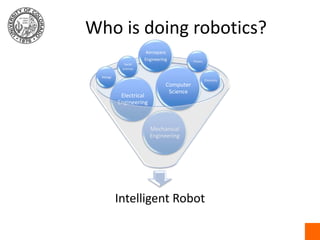
Who is doing robotics?SocialSciencesBiologyChemistryAerospaceEngineeringPhysics
Athlete Robot, NASA/JPL. Videos © California Institute of Technology, Simulation MarsetteVona
AthleteSensingJoint positionsComputationOff-lineActuation/Mechanism6x6 DOF legs, wheelsCommunicationRemote controlhttp://www.mit.edu/~vona
“Big Dog”, Boston Dynamics, AP Photo/ApichartWeerawongYoutube 4min
Big DogSensingLegs: Joint positions and force, ground contactBody: Gyroscope, StereovisionComputation/ControlHigh-frequency closed-loop controlActuation/Mechanism4 x 4 DOF hydraulic legsCommunicationRemote Control
Rollin’ Justin, 2009, DeutschesLuft und RaumfahrtzentrumRonny Hartmann/AFP/Getty Images					 			        Youtube 3min
JustinSensingArms/torso/fingers: position, force/torqueHead: vision, hearingComputationCompliant control of fingers and armObject recognition and language processingMotion planning for collision-free pathsActuation2 x 6 DOF Kuka arm, torso, legs, 2 x 4 x 3 DOF handCommunicationAural and speech
Kiva Systems, Picture: Josh Reynolds for The Boston Globe 			Youtube	(4min)
KivaSensingBar codes on the floor (localization), odometryComputationCentralized, grid-based algorithmActuationMoving on the grid, lift cupboardsCommunicationMany-to-one (centralized), user to server
This courseTheoryHow do sensors and actuators workHow can we describe and control a robot’s motionAlgorithms for localization and navigationPracticeProgramming Robots in WebotsDesigning a robot soccer playerDebating about robot technology in class
WebotsRealistic, physics-based simulationSimulates robot dynamics, sensor noiseWrite controllers in Java or CGoal: write a competitive soccer player
RobotstadiumUpload your controller to www.robotstadium.orgController is evaluated nightly against other players worldwideDownload a video of the competition the next day
RobotstadiumYou will design a controller in teams and present it to the class (design review)You will implement this controller and evaluate it against your peersWe will create a CU team that will be frozen the last day of classes$1000 cash prize -> Dinner
Competition
SummaryA robot becomes autonomous due to a combination ofActuationSensingComputationCommunicationRobotics is an interdisciplinary effortComputer science research makes robots intelligent
Next Meetings / AssignmentsWednesday/Friday, January 13/15, 5pm, ECCS 128First steps in WebotsMonday, January 18, NO CLASSReadingWebots User Manual (wiki)Questions on Chapter 2, pages 13 – 32 (culearn), due Sunday, January 24.
AcknowledgmentsThe acquisition of Webots was sponsored by

Lecture 01: Introduction

  • 1.
  • 2.
    SyllabusTheoryLocomotionKinematicsPerceptionLocalizationPlanning and NavigationPracticeSimulationexercisesDesign reviewsDebatesParticipation in online competition
  • 3.
    Links and PlacesClasswikihttp://correll.cs.colorado.edu/pmwikiCodeHow-Tos and exercisesCU Learnhttp://culearn.colorado.eduSubmission of assignmentsExercisesCSEL 128http://sac.colorado.eduContactECOT 733 (my office)Phone: (303) 492-2233nikolaus.correll@colorado.eduTry this out asap!Try this out asap!
  • 4.
    TextbookIntroduction to AutonomousMobile Robots, Roland Siegwart and Illah R. Nourbakhsh, MIT PressAvailable from CU Bookstore next weekWeekly reading assignmentsLecture is complementing the book
  • 5.
    Activities and GradingOralexam* DeliverablesWeekly reading assignmentsDesign reviewsDebateMust attend to lectures and seminars* Graduate students will also be required to write a term paper50%20%20%10%
  • 6.
    What will youlearn?What are robots, what is the science and technology behind building robots and programming them?Why is robotics hard?Hands-on experience programming of driving, walking and crawling robots
  • 7.
    What will notbe covered?Because we will be working in simulation, we will not coverComponents you build are less likely to work than those that you buyComponents you bought are much harder to debug than those you builtRobots is the science of connectors and cablingIntroduction to Robotics II
  • 8.
    Why robots?Robots willwork more efficient and safer than humansFrom repetitive tasks to true autonomyImprove lifestyle and educationPotentially as disruptive as the wheel, printing press, steam engine, internet
  • 9.
    Early robotsGeorge Devol,*1912~1940~1950Are these robots or automatons?Which are more robots than others and why?“Unimate”, shipped to GM in 1961
  • 10.
    What is arobot?SensingperceptionComputationmaking sense of your sensesActuation and Mechanismmoving and manipulationCommunicationcommunicating with people, objects and other robots
  • 11.
    Who is doingrobotics?SocialSciencesBiologyChemistryAerospaceEngineeringPhysics
  • 12.
    Athlete Robot, NASA/JPL.Videos © California Institute of Technology, Simulation MarsetteVona
  • 13.
    AthleteSensingJoint positionsComputationOff-lineActuation/Mechanism6x6 DOFlegs, wheelsCommunicationRemote controlhttp://www.mit.edu/~vona
  • 14.
    “Big Dog”, BostonDynamics, AP Photo/ApichartWeerawongYoutube 4min
  • 15.
    Big DogSensingLegs: Jointpositions and force, ground contactBody: Gyroscope, StereovisionComputation/ControlHigh-frequency closed-loop controlActuation/Mechanism4 x 4 DOF hydraulic legsCommunicationRemote Control
  • 16.
    Rollin’ Justin, 2009,DeutschesLuft und RaumfahrtzentrumRonny Hartmann/AFP/Getty Images Youtube 3min
  • 17.
    JustinSensingArms/torso/fingers: position, force/torqueHead:vision, hearingComputationCompliant control of fingers and armObject recognition and language processingMotion planning for collision-free pathsActuation2 x 6 DOF Kuka arm, torso, legs, 2 x 4 x 3 DOF handCommunicationAural and speech
  • 18.
    Kiva Systems, Picture:Josh Reynolds for The Boston Globe Youtube (4min)
  • 19.
    KivaSensingBar codes onthe floor (localization), odometryComputationCentralized, grid-based algorithmActuationMoving on the grid, lift cupboardsCommunicationMany-to-one (centralized), user to server
  • 20.
    This courseTheoryHow dosensors and actuators workHow can we describe and control a robot’s motionAlgorithms for localization and navigationPracticeProgramming Robots in WebotsDesigning a robot soccer playerDebating about robot technology in class
  • 21.
    WebotsRealistic, physics-based simulationSimulatesrobot dynamics, sensor noiseWrite controllers in Java or CGoal: write a competitive soccer player
  • 22.
    RobotstadiumUpload your controllerto www.robotstadium.orgController is evaluated nightly against other players worldwideDownload a video of the competition the next day
  • 23.
    RobotstadiumYou will designa controller in teams and present it to the class (design review)You will implement this controller and evaluate it against your peersWe will create a CU team that will be frozen the last day of classes$1000 cash prize -> Dinner
  • 24.
  • 25.
    SummaryA robot becomesautonomous due to a combination ofActuationSensingComputationCommunicationRobotics is an interdisciplinary effortComputer science research makes robots intelligent
  • 26.
    Next Meetings /AssignmentsWednesday/Friday, January 13/15, 5pm, ECCS 128First steps in WebotsMonday, January 18, NO CLASSReadingWebots User Manual (wiki)Questions on Chapter 2, pages 13 – 32 (culearn), due Sunday, January 24.
  • 27.
    AcknowledgmentsThe acquisition ofWebots was sponsored by

Editor's Notes

  • #4 2 min
  • #6 3 min: goal of the presentation: teach your peers
  • #7 3: algorithms, mechanisms, sensors, signal processing, focus on multi-robot systems
  • #12 2 min: Intelligence is a function of ALL things coming together: sensors, algorithms, mechanisms and communication
  • #13 2 min – The Athlete robot is no doubt a robot. Focus, however, is on the mechanical design. The robot has 6 legs that can have the robot move, act as pinchers and pick up stuff, or manipulate the environments with add-on tools. There is little sensing, little computation, and little autonomy on this robot. In fact, nobody even bothered thinking about how to coordinate all the different joints (6 x6 ) to actually perform all the actions that the robot theoretically could do.
  • #14 4 min. Explain Sensing actuation computation and communication. Again: focus is on a revolutionary mechanical design. My labmate at MIT MarsetteVona – a computer scientist like you – built the interface for controlling the robot. He also developed computational tools that allow to calculate all the joint positions of a robot as a function of a virtual articulation. For pinching, e.g., you can think about calculating all your joint positions as a function of contact points with a virtual object. Show video.
  • #15 6 min – Big Dog, what it can do, why it was build. Interesting mechanical design (four legs with 4 DOF each). Focus here is on control: how to create a gait to move the robot forwards, and – more difficult – how to react so that the robot remains stable
  • #16 2 min : explain where the meat is in the big dog
  • #17 5 min : justin is putting it all together, massive sensing, state-of-the art control, mechanism, computation and communication
  • #18 2 min
  • #19 4 min