








FUNDAMENTALS OF TESTING
       Hoang V. Nguyen
       startnewday85@gmail.com
       startnewday85.blogspot.com
       Dept. of Computer Science – FIT - HUA


Tester Training Course
Tester Training Course   2011
Explorapedia, World of Nature, version 1.0


Tester Training Course                       2011
Tester Training Course   2011
Pepsi 349 Scandal


 Tester Training Course   2011
European Space Agency Ariane 5


              After 37 ½ seconds, was destroyed
                         $370 millions

Tester Training Course                            2011
London Ambulance Service


Tester Training Course     2011
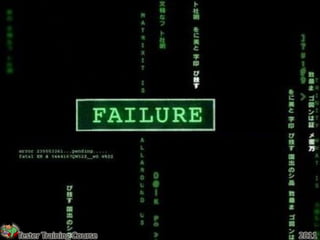
What happened?


Tester Training Course   2011
What Failures’ effects?


Tester Training Course   2011
What Failures’ effects?
             Can harm:
                 • people
                 • companies
                 • the environment


             Can lead to:
                 • Loss of money
                 • Loss of time
                 • Loss of business reputation
                 • Injury
                 • Death


Tester Training Course                           2011
Tester Training Course   2011
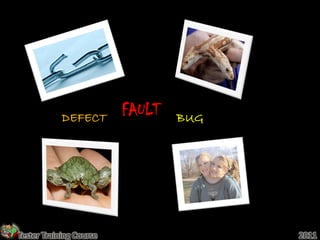
DEFECT
                         FAULT   BUG


Tester Training Course                 2011
Tester Training Course   2011
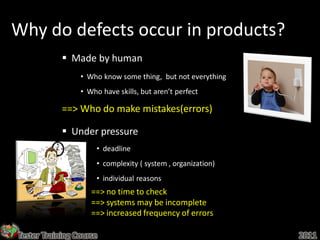
Why do defects occur in products?
             Made by human
                 • Who know some thing, but not everything
                 • Who have skills, but aren’t perfect

            ==> Who do make mistakes(errors)

             Under pressure
                      • deadline
                      • complexity ( system , organization)
                      • individual reasons
                    ==> no time to check
                    ==> systems may be incomplete
                    ==> increased frequency of errors

Tester Training Course                                        2011
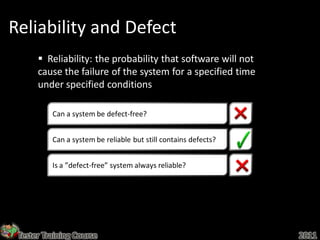
Reliability and Defect
       Reliability: the probability that software will not
      cause the failure of the system for a specified time
      under specified conditions

          Can a system be defect-free?


          Can a system be reliable but still contains defects?


          Is a ”defect-free” system always reliable?


 Tester Training Course                                          2011
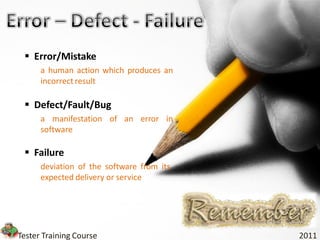
 Error/Mistake
      a human action which produces an
      incorrect result

  Defect/Fault/Bug
      a manifestation of an error in
      software

  Failure
      deviation of the software from its
      expected delivery or service


Tester Training Course                     2011
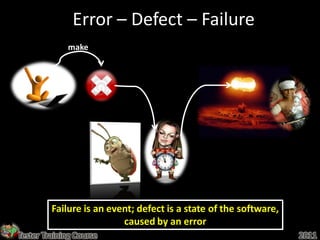
Error – Defect – Failure
             make


         Failure is an event; defect is a state of the software,
                          caused by an error
Tester Training Course                                             2011
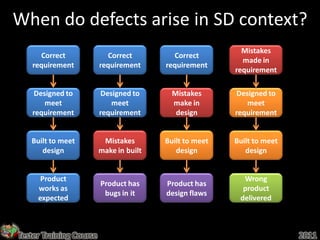
When do defects arise in SD context?
                                                           Mistakes
      Correct              Correct         Correct
                                                           made in
    requirement          requirement     requirement
                                                         requirement

    Designed to          Designed to       Mistakes      Designed to
       meet                 meet           make in          meet
    requirement          requirement        design       requirement


   Built to meet          Mistakes       Built to meet   Built to meet
      design             make in built      design          design


      Product                                              Wrong
                         Product has     Product has
     works as                                              product
                          bugs in it     design flaws
     expected                                             delivered


Tester Training Course                                                   2011
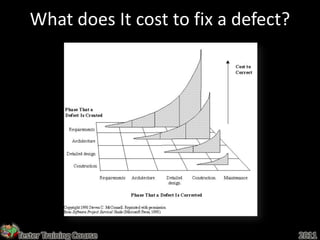
What does It cost to fix a defect?


Tester Training Course                  2011
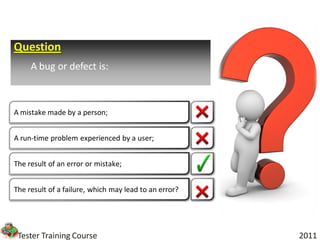
Question
     A bug or defect is:


A mistake made by a person;


A run-time problem experienced by a user;


The result of an error or mistake;


The result of a failure, which may lead to an error?


 Tester Training Course                                2011
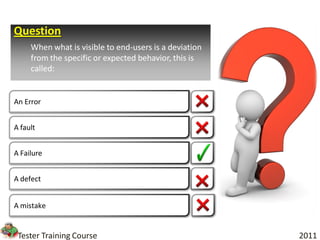
Question
     When what is visible to end-users is a deviation
     from the specific or expected behavior, this is
     called:


An Error


A fault


A Failure


A defect


A mistake


 Tester Training Course                                 2011
Tester Training Course   2011
Question
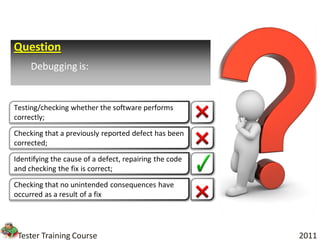
     Debugging is:


Testing/checking whether the software performs
correctly;

Checking that a previously reported defect has been
corrected;

Identifying the cause of a defect, repairing the code
and checking the fix is correct;

Checking that no unintended consequences have
occurred as a result of a fix


 Tester Training Course                                 2011
Why is testing necessary?


Tester Training Course      2011
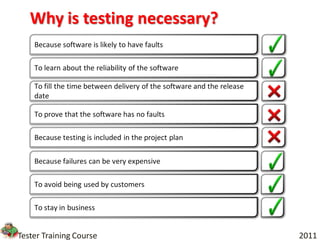
Why is testing necessary?
    Because software is likely to have faults

    To learn about the reliability of the software

    To fill the time between delivery of the software and the release
    date

    To prove that the software has no faults

    Because testing is included in the project plan

    Because failures can be very expensive

    To avoid being used by customers

    To stay in business


Tester Training Course                                                  2011
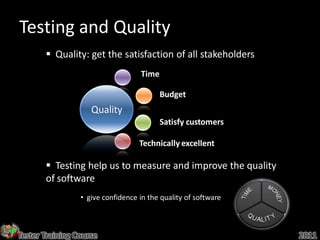
Testing and Quality
        Quality: get the satisfaction of all stakeholders
                                   Time

                                          Budget
                    Quality
                                          Satisfy customers

                                   Technically excellent

        Testing help us to measure and improve the quality
       of software
                 • give confidence in the quality of software


Tester Training Course                                          2011
What is testing?
  The process consisting of all lifecycle activities, both static and
  dynamic, concerned with planning, preparation and evaluation
  of software products and related work products

  to determine that they satisfy specified requirements, to
  demonstrate that they are fit for purpose and to detect defects


    This is a suitable definition of testing for any level of testing.


 Tester Training Course                                                  2011
Tester Training Course   2011
How much testing is enough?


 Tester Training Course       2011
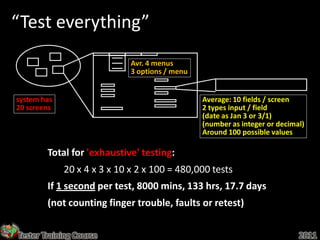
“Test everything”
                             Avr. 4 menus
                             3 options / menu


system has                                      Average: 10 fields / screen
20 screens                                      2 types input / field
                                                (date as Jan 3 or 3/1)
                                                (number as integer or decimal)
                                                Around 100 possible values

        Total for 'exhaustive' testing:
             20 x 4 x 3 x 10 x 2 x 100 = 480,000 tests
        If 1 second per test, 8000 mins, 133 hrs, 17.7 days
        (not counting finger trouble, faults or retest)


Tester Training Course                                                      2011
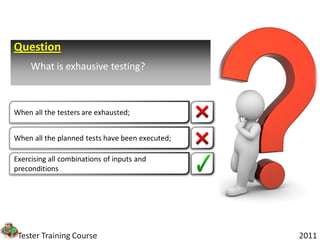
Question
     What is exhausive testing?


When all the testers are exhausted;


When all the planned tests have been executed;

Exercising all combinations of inputs and
preconditions


 Tester Training Course                          2011
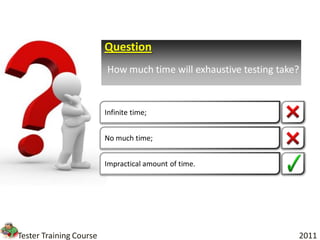
Question
                         How much time will exhaustive testing take?


                         Infinite time;


                         No much time;


                         Impractical amount of time.


Tester Training Course                                             2011
How much testing is enough?
         Testing principle


           Exhaustive testing is impossible

         Testing everything (all combinations of inputs and
         preconditions) is not feasible except for trivial
         cases. Instead of exhaustive testing, we use risks
         and priorities to focus testing efforts.


 Tester Training Course                                       2011
How much testing is enough?
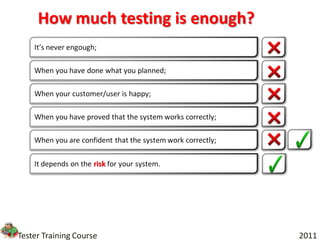
    It’s never engough;

    When you have done what you planned;

    When your customer/user is happy;

    When you have proved that the system works correctly;

    When you are confident that the system work correctly;

    It depends on the risk for your system.


Tester Training Course                                       2011
Tester Training Course   2011
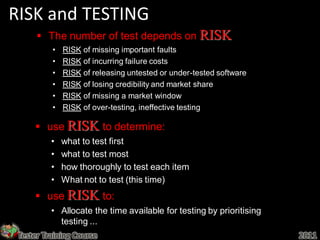
RISK and TESTING
       The number of test depends on RISK
          •   RISK of missing important faults
          •   RISK of incurring failure costs
          •   RISK of releasing untested or under-tested software
          •   RISK of losing credibility and market share
          •   RISK of missing a market window
          •   RISK of over-testing, ineffective testing

      use RISK to determine:
          •   what to test first
          •   what to test most
          •   how thoroughly to test each item
          •   What not to test (this time)
      use RISK to:
          • Allocate the time available for testing by prioritising
            testing ...
 Tester Training Course                                               2011
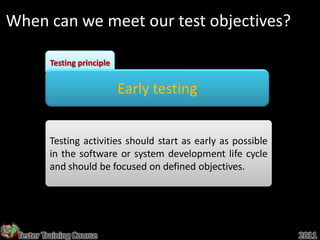
When can we meet our test objectives?

         Testing principle


                             Early testing


         Testing activities should start as early as possible
         in the software or system development life cycle
         and should be focused on defined objectives.


 Tester Training Course                                         2011
Tester Training Course   2011
Is the software defect free?

          Testing principle


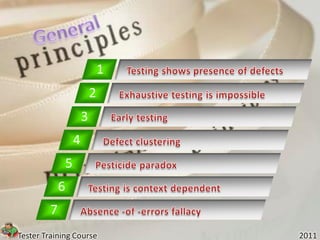
            Testing shows presence of defects

         Testing can show that defects are present, but
         cannot prove that there are no defects. Testing
         reduces the probability of undiscovered defects
         remaining in the software but, even if no defects
         are found, it is not a proof of correctness.


 Tester Training Course                                      2011
How are defects distributed?

         Testing principle


                          Defect clustering


         A small number of modules contain most of the
         defects discovered during pre-release testing or
         show the most operational failures.


 Tester Training Course                                     2011
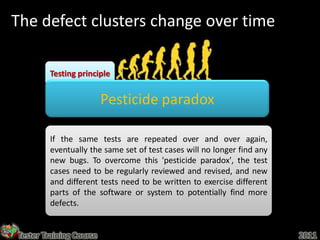
The defect clusters change over time

        Testing principle


                         Pesticide paradox

        If the same tests are repeated over and over again,
        eventually the same set of test cases will no longer find any
        new bugs. To overcome this 'pesticide paradox', the test
        cases need to be regularly reviewed and revised, and new
        and different tests need to be written to exercise different
        parts of the software or system to potentially find more
        defects.


Tester Training Course                                                  2011
Tester Training Course   2011
Testing principle


             Absence-of-errors fallacy

        Finding and fixing defects does not help if the
        system built is unusable and does not fulfill the
        users' needs and expectations.


Tester Training Course                                      2011
Testing principle


          Testing is context dependent

        Testing is done differently in different contexts.
        For example, safety-critical software is tested
        differently from an e-commerce site.


Tester Training Course                                       2011
1
                             2
                         3
                     4
                 5
             6
         7
Tester Training Course               2011
Question
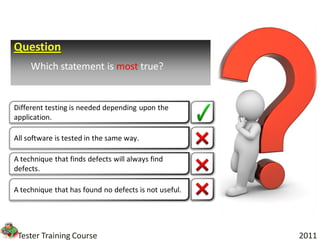
     Which statement is most true?


Different testing is needed depending upon the
application.

All software is tested in the same way.

A technique that finds defects will always find
defects.

A technique that has found no defects is not useful.


 Tester Training Course                                2011
Question
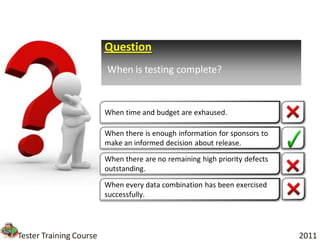
                         When is testing complete?


                         When time and budget are exhaused.

                         When there is enough information for sponsors to
                         make an informed decision about release.

                         When there are no remaining high priority defects
                         outstanding.

                         When every data combination has been exercised
                         successfully.


Tester Training Course                                                       2011
• Why testing is necessary?
                         • Failure, Fault, Bug, Defect, Error, Mistake
                         • What is testing?
                         • 7 general testing principles
                         • Testing and Reliability
                         • Testing and Quality
                         • Testing and Debugging


Tester Training Course                                               2011

Fundamentals of testing 1

  • 1.
    FUNDAMENTALS OF TESTING Hoang V. Nguyen startnewday85@gmail.com startnewday85.blogspot.com Dept. of Computer Science – FIT - HUA Tester Training Course
  • 2.
  • 3.
    Explorapedia, World ofNature, version 1.0 Tester Training Course 2011
  • 4.
  • 5.
    Pepsi 349 Scandal Tester Training Course 2011
  • 6.
    European Space AgencyAriane 5 After 37 ½ seconds, was destroyed $370 millions Tester Training Course 2011
  • 7.
    London Ambulance Service TesterTraining Course 2011
  • 8.
  • 9.
  • 10.
  • 11.
    What Failures’ effects?  Can harm: • people • companies • the environment  Can lead to: • Loss of money • Loss of time • Loss of business reputation • Injury • Death Tester Training Course 2011
  • 12.
  • 13.
  • 14.
    DEFECT FAULT BUG Tester Training Course 2011
  • 15.
  • 16.
    Why do defectsoccur in products?  Made by human • Who know some thing, but not everything • Who have skills, but aren’t perfect ==> Who do make mistakes(errors)  Under pressure • deadline • complexity ( system , organization) • individual reasons ==> no time to check ==> systems may be incomplete ==> increased frequency of errors Tester Training Course 2011
  • 17.
    Reliability and Defect  Reliability: the probability that software will not cause the failure of the system for a specified time under specified conditions Can a system be defect-free? Can a system be reliable but still contains defects? Is a ”defect-free” system always reliable? Tester Training Course 2011
  • 18.
     Error/Mistake a human action which produces an incorrect result  Defect/Fault/Bug a manifestation of an error in software  Failure deviation of the software from its expected delivery or service Tester Training Course 2011
  • 19.
    Error – Defect– Failure make Failure is an event; defect is a state of the software, caused by an error Tester Training Course 2011
  • 20.
    When do defectsarise in SD context? Mistakes Correct Correct Correct made in requirement requirement requirement requirement Designed to Designed to Mistakes Designed to meet meet make in meet requirement requirement design requirement Built to meet Mistakes Built to meet Built to meet design make in built design design Product Wrong Product has Product has works as product bugs in it design flaws expected delivered Tester Training Course 2011
  • 21.
    What does Itcost to fix a defect? Tester Training Course 2011
  • 22.
    Question A bug or defect is: A mistake made by a person; A run-time problem experienced by a user; The result of an error or mistake; The result of a failure, which may lead to an error? Tester Training Course 2011
  • 23.
    Question When what is visible to end-users is a deviation from the specific or expected behavior, this is called: An Error A fault A Failure A defect A mistake Tester Training Course 2011
  • 24.
  • 25.
    Question Debugging is: Testing/checking whether the software performs correctly; Checking that a previously reported defect has been corrected; Identifying the cause of a defect, repairing the code and checking the fix is correct; Checking that no unintended consequences have occurred as a result of a fix Tester Training Course 2011
  • 26.
    Why is testingnecessary? Tester Training Course 2011
  • 27.
    Why is testingnecessary? Because software is likely to have faults To learn about the reliability of the software To fill the time between delivery of the software and the release date To prove that the software has no faults Because testing is included in the project plan Because failures can be very expensive To avoid being used by customers To stay in business Tester Training Course 2011
  • 28.
    Testing and Quality  Quality: get the satisfaction of all stakeholders Time Budget Quality Satisfy customers Technically excellent  Testing help us to measure and improve the quality of software • give confidence in the quality of software Tester Training Course 2011
  • 29.
    What is testing? The process consisting of all lifecycle activities, both static and dynamic, concerned with planning, preparation and evaluation of software products and related work products to determine that they satisfy specified requirements, to demonstrate that they are fit for purpose and to detect defects This is a suitable definition of testing for any level of testing. Tester Training Course 2011
  • 30.
  • 31.
    How much testingis enough? Tester Training Course 2011
  • 32.
    “Test everything” Avr. 4 menus 3 options / menu system has Average: 10 fields / screen 20 screens 2 types input / field (date as Jan 3 or 3/1) (number as integer or decimal) Around 100 possible values Total for 'exhaustive' testing: 20 x 4 x 3 x 10 x 2 x 100 = 480,000 tests If 1 second per test, 8000 mins, 133 hrs, 17.7 days (not counting finger trouble, faults or retest) Tester Training Course 2011
  • 33.
    Question What is exhausive testing? When all the testers are exhausted; When all the planned tests have been executed; Exercising all combinations of inputs and preconditions Tester Training Course 2011
  • 34.
    Question How much time will exhaustive testing take? Infinite time; No much time; Impractical amount of time. Tester Training Course 2011
  • 35.
    How much testingis enough? Testing principle Exhaustive testing is impossible Testing everything (all combinations of inputs and preconditions) is not feasible except for trivial cases. Instead of exhaustive testing, we use risks and priorities to focus testing efforts. Tester Training Course 2011
  • 36.
    How much testingis enough? It’s never engough; When you have done what you planned; When your customer/user is happy; When you have proved that the system works correctly; When you are confident that the system work correctly; It depends on the risk for your system. Tester Training Course 2011
  • 37.
  • 38.
    RISK and TESTING  The number of test depends on RISK • RISK of missing important faults • RISK of incurring failure costs • RISK of releasing untested or under-tested software • RISK of losing credibility and market share • RISK of missing a market window • RISK of over-testing, ineffective testing  use RISK to determine: • what to test first • what to test most • how thoroughly to test each item • What not to test (this time)  use RISK to: • Allocate the time available for testing by prioritising testing ... Tester Training Course 2011
  • 39.
    When can wemeet our test objectives? Testing principle Early testing Testing activities should start as early as possible in the software or system development life cycle and should be focused on defined objectives. Tester Training Course 2011
  • 40.
  • 41.
    Is the softwaredefect free? Testing principle Testing shows presence of defects Testing can show that defects are present, but cannot prove that there are no defects. Testing reduces the probability of undiscovered defects remaining in the software but, even if no defects are found, it is not a proof of correctness. Tester Training Course 2011
  • 42.
    How are defectsdistributed? Testing principle Defect clustering A small number of modules contain most of the defects discovered during pre-release testing or show the most operational failures. Tester Training Course 2011
  • 43.
    The defect clusterschange over time Testing principle Pesticide paradox If the same tests are repeated over and over again, eventually the same set of test cases will no longer find any new bugs. To overcome this 'pesticide paradox', the test cases need to be regularly reviewed and revised, and new and different tests need to be written to exercise different parts of the software or system to potentially find more defects. Tester Training Course 2011
  • 44.
  • 45.
    Testing principle Absence-of-errors fallacy Finding and fixing defects does not help if the system built is unusable and does not fulfill the users' needs and expectations. Tester Training Course 2011
  • 46.
    Testing principle Testing is context dependent Testing is done differently in different contexts. For example, safety-critical software is tested differently from an e-commerce site. Tester Training Course 2011
  • 47.
    1 2 3 4 5 6 7 Tester Training Course 2011
  • 48.
    Question Which statement is most true? Different testing is needed depending upon the application. All software is tested in the same way. A technique that finds defects will always find defects. A technique that has found no defects is not useful. Tester Training Course 2011
  • 49.
    Question When is testing complete? When time and budget are exhaused. When there is enough information for sponsors to make an informed decision about release. When there are no remaining high priority defects outstanding. When every data combination has been exercised successfully. Tester Training Course 2011
  • 50.
    • Why testingis necessary? • Failure, Fault, Bug, Defect, Error, Mistake • What is testing? • 7 general testing principles • Testing and Reliability • Testing and Quality • Testing and Debugging Tester Training Course 2011