









Hoang Nguyen
hoangnvvnua@gmail.com
An Overview
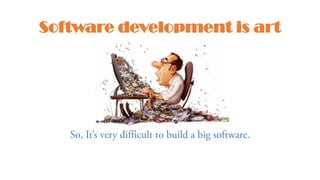
Software development is art
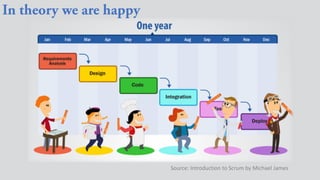
You want to manage well
Must be understandable and predicable
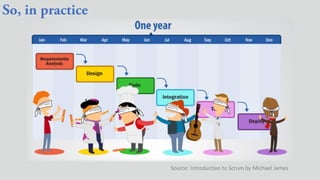
Source: Introduction to Scrum by Michael James
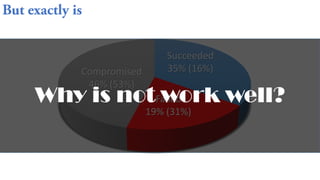
Succeeded
35% (16%)
Failed
19% (31%)
Compromised
46% (53%)
Why is not work well?
Source: Introduction to Scrum by Michael James
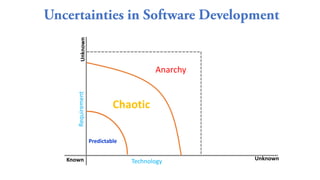
The world is full of uncertainties
Known Unknown
Unknown
Predictable
Anarchy
Chaotic
Technology
Requirement
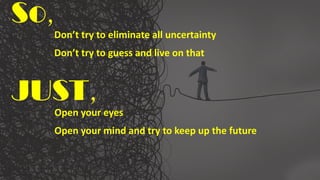
So
Don’t try to eliminate all uncertainty
Don’t try to guess and live on that
JUST
Open your eyes
Open your mind and try to keep up the future
Late 1980s/ Early 1990s
Iterative, Collaborative, Light on planning and
process
Just is right idea
Poorly implemented …
because: lack of discipline, awful quality, prohibitive cost of solution ownership
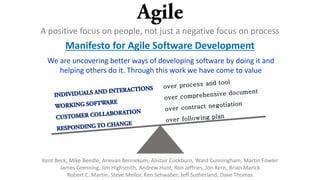
A positive focus on people, not just a negative focus on process
Manifesto for Agile Software Development
We are uncovering better ways of developing software by doing it and
helping others do it. Through this work we have come to value
Kent Beck, Mike Beedle, Arievan Bennekum, Alistair Cockburn, Ward Cunningham, Martin Fowler
James Grenning, Jim Highsmith, Andrew Hunt, Ron Jeffries, Jon Kern, Brian Marick
Robert C. Martin, Steve Mellor, Ken Schwaber, Jeff Sutherland, Dave Thomas
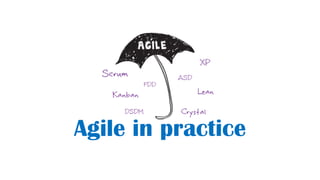
Agile in practice
An Overview
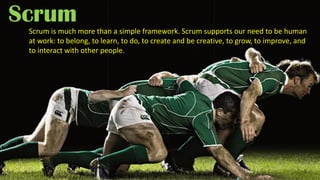
Scrum
Scrum is much more than a simple framework. Scrum supports our need to be human
at work: to belong, to learn, to do, to create and be creative, to grow, to improve, and
to interact with other people.
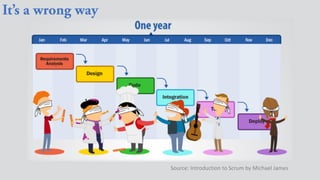
Source: Introduction to Scrum by Michael James
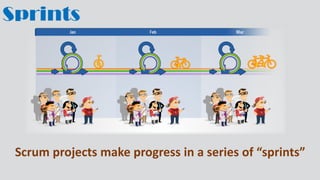
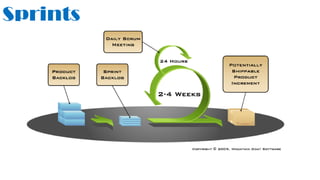
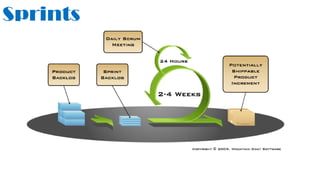
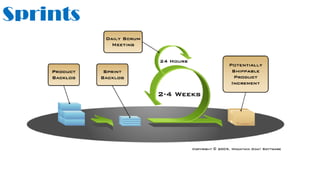
Sprints
Scrum projects make progress in a series of “sprints”
Scrum Elements
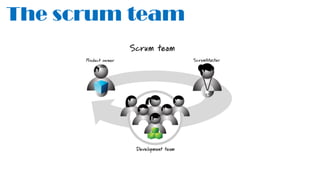
The Scrum Team The meetings
Artifacts
The scrum team
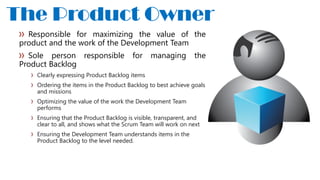
Responsible for maximizing the value of the
product and the work of the Development Team
Sole person responsible for managing the
Product Backlog
Clearly expressing Product Backlog items
Ordering the items in the Product Backlog to best achieve goals
and missions
Optimizing the value of the work the Development Team
performs
Ensuring that the Product Backlog is visible, transparent, and
clear to all, and shows what the Scrum Team will work on next
Ensuring the Development Team understands items in the
Product Backlog to the level needed.
The Product Owner
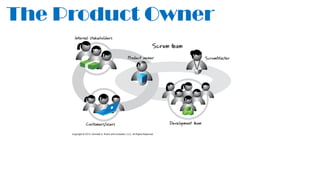
The Product Owner
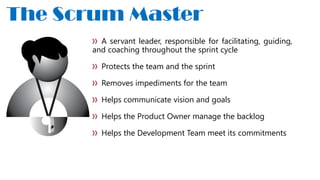
A servant leader, responsible for facilitating, guiding,
and coaching throughout the sprint cycle
Protects the team and the sprint
Removes impediments for the team
Helps communicate vision and goals
Helps the Product Owner manage the backlog
Helps the Development Team meet its commitments
The Scrum Master
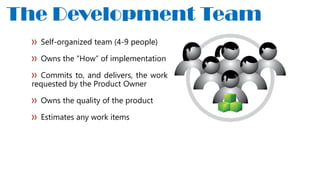
The Development Team
Self-organized team (4-9 people)
Owns the “How” of implementation
Commits to, and delivers, the work
requested by the Product Owner
Owns the quality of the product
Estimates any work items
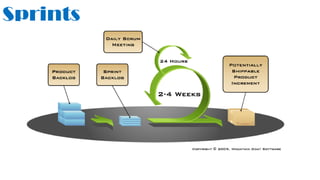
Sprints
Product Backlog
Created and prioritized by the product owner
A list of requirement items
Ideally expressed such that each item has value to the
users or customers of the product
Reprioritized at the start of each sprint
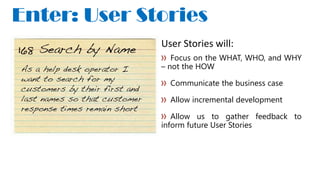
User Stories will:
Focus on the WHAT, WHO, and WHY
– not the HOW
Communicate the business case
Allow incremental development
Allow us to gather feedback to
inform future User Stories
Enter: User Stories
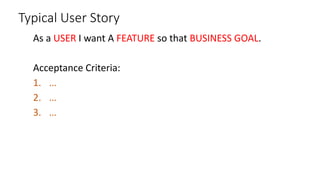
Typical User Story
As a USER I want A FEATURE so that BUSINESS GOAL.
Acceptance Criteria:
1. …
2. …
3. …
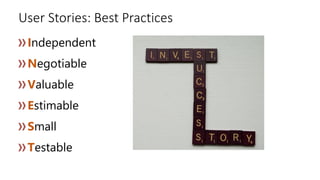
User Stories: Best Practices
Independent
Negotiable
Valuable
Estimable
Small
Testable
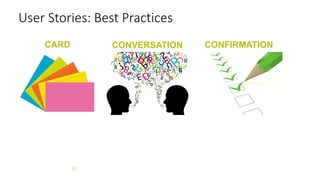
User Stories: Best Practices
• The Three Cs
32
CARD CONVERSATION CONFIRMATION
Sprints
Sprint Backlog
Is the work that the dev. team needs to
address during a sprint
Is constructed from the product backlog
The decision should be taken by the dev. team
The decision should be taken depending on
the velocity of its previous sprints (the total
effort that the team is capable of delivering in a
sprint.
Sprints
Product backlog grooming
Should be grooming
Writing, prioritizing, splitting stories
Refining the acceptance criteria of individual stories
Should not be longer than an hour
Don’t break stories into tasks
Product Owner owns this, but everyone contributes
Sprint planning
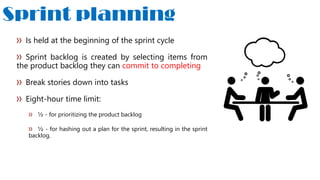
Is held at the beginning of the sprint cycle
Sprint backlog is created by selecting items from
the product backlog they can commit to completing
Break stories down into tasks
Eight-hour time limit:
½ - for prioritizing the product backlog
½ - for hashing out a plan for the sprint, resulting in the sprint
backlog.
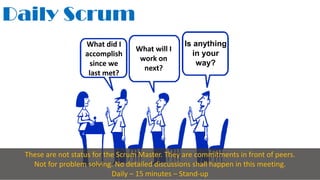
Daily Scrum
What did I
accomplish
since we
last met?
What will I
work on
next?
Is anything
in your
way?
These are not status for the Scrum Master. They are commitments in front of peers.
Not for problem solving. No detailed discussions shall happen in this meeting.
Daily – 15 minutes – Stand-up
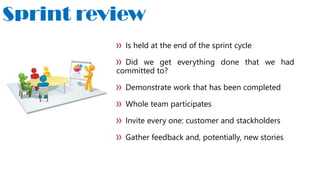
Sprint review
Is held at the end of the sprint cycle
Did we get everything done that we had
committed to?
Demonstrate work that has been completed
Whole team participates
Invite every one: customer and stackholders
Gather feedback and, potentially, new stories
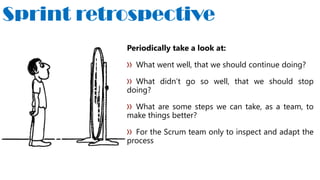
Sprint retrospective
Periodically take a look at:
What went well, that we should continue doing?
What didn’t go so well, that we should stop
doing?
What are some steps we can take, as a team, to
make things better?
For the Scrum team only to inspect and adapt the
process
Sprints
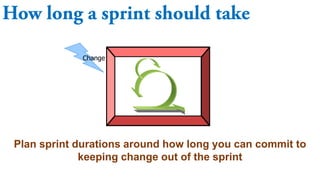
Change
Plan sprint durations around how long you can commit to
keeping change out of the sprint
How to implement

Scrum - An introduction

  • 1.
  • 2.
  • 3.
  • 4.
    You want tomanage well Must be understandable and predicable
  • 5.
    Source: Introduction toScrum by Michael James
  • 6.
  • 10.
    Source: Introduction toScrum by Michael James
  • 11.
    The world isfull of uncertainties
  • 12.
  • 13.
    So Don’t try toeliminate all uncertainty Don’t try to guess and live on that JUST Open your eyes Open your mind and try to keep up the future
  • 14.
    Late 1980s/ Early1990s Iterative, Collaborative, Light on planning and process Just is right idea Poorly implemented … because: lack of discipline, awful quality, prohibitive cost of solution ownership
  • 15.
    A positive focuson people, not just a negative focus on process Manifesto for Agile Software Development We are uncovering better ways of developing software by doing it and helping others do it. Through this work we have come to value Kent Beck, Mike Beedle, Arievan Bennekum, Alistair Cockburn, Ward Cunningham, Martin Fowler James Grenning, Jim Highsmith, Andrew Hunt, Ron Jeffries, Jon Kern, Brian Marick Robert C. Martin, Steve Mellor, Ken Schwaber, Jeff Sutherland, Dave Thomas
  • 16.
  • 17.
  • 18.
    Scrum Scrum is muchmore than a simple framework. Scrum supports our need to be human at work: to belong, to learn, to do, to create and be creative, to grow, to improve, and to interact with other people.
  • 19.
    Source: Introduction toScrum by Michael James
  • 20.
    Sprints Scrum projects makeprogress in a series of “sprints”
  • 21.
    Scrum Elements The ScrumTeam The meetings Artifacts
  • 22.
  • 23.
    Responsible for maximizingthe value of the product and the work of the Development Team Sole person responsible for managing the Product Backlog Clearly expressing Product Backlog items Ordering the items in the Product Backlog to best achieve goals and missions Optimizing the value of the work the Development Team performs Ensuring that the Product Backlog is visible, transparent, and clear to all, and shows what the Scrum Team will work on next Ensuring the Development Team understands items in the Product Backlog to the level needed. The Product Owner
  • 24.
  • 25.
    A servant leader,responsible for facilitating, guiding, and coaching throughout the sprint cycle Protects the team and the sprint Removes impediments for the team Helps communicate vision and goals Helps the Product Owner manage the backlog Helps the Development Team meet its commitments The Scrum Master
  • 26.
    The Development Team Self-organizedteam (4-9 people) Owns the “How” of implementation Commits to, and delivers, the work requested by the Product Owner Owns the quality of the product Estimates any work items
  • 27.
  • 28.
    Product Backlog Created andprioritized by the product owner A list of requirement items Ideally expressed such that each item has value to the users or customers of the product Reprioritized at the start of each sprint
  • 29.
    User Stories will: Focuson the WHAT, WHO, and WHY – not the HOW Communicate the business case Allow incremental development Allow us to gather feedback to inform future User Stories Enter: User Stories
  • 30.
    Typical User Story Asa USER I want A FEATURE so that BUSINESS GOAL. Acceptance Criteria: 1. … 2. … 3. …
  • 31.
    User Stories: BestPractices Independent Negotiable Valuable Estimable Small Testable
  • 32.
    User Stories: BestPractices • The Three Cs 32 CARD CONVERSATION CONFIRMATION
  • 33.
  • 34.
    Sprint Backlog Is thework that the dev. team needs to address during a sprint Is constructed from the product backlog The decision should be taken by the dev. team The decision should be taken depending on the velocity of its previous sprints (the total effort that the team is capable of delivering in a sprint.
  • 35.
  • 36.
    Product backlog grooming Shouldbe grooming Writing, prioritizing, splitting stories Refining the acceptance criteria of individual stories Should not be longer than an hour Don’t break stories into tasks Product Owner owns this, but everyone contributes
  • 37.
    Sprint planning Is heldat the beginning of the sprint cycle Sprint backlog is created by selecting items from the product backlog they can commit to completing Break stories down into tasks Eight-hour time limit: ½ - for prioritizing the product backlog ½ - for hashing out a plan for the sprint, resulting in the sprint backlog.
  • 38.
    Daily Scrum What didI accomplish since we last met? What will I work on next? Is anything in your way? These are not status for the Scrum Master. They are commitments in front of peers. Not for problem solving. No detailed discussions shall happen in this meeting. Daily – 15 minutes – Stand-up
  • 39.
    Sprint review Is heldat the end of the sprint cycle Did we get everything done that we had committed to? Demonstrate work that has been completed Whole team participates Invite every one: customer and stackholders Gather feedback and, potentially, new stories
  • 40.
    Sprint retrospective Periodically takea look at: What went well, that we should continue doing? What didn’t go so well, that we should stop doing? What are some steps we can take, as a team, to make things better? For the Scrum team only to inspect and adapt the process
  • 41.
  • 42.
    Change Plan sprint durationsaround how long you can commit to keeping change out of the sprint
  • 43.