CHAPTER 1. FUNDAMENTALS OF TESTING
 why testing is necessary providing explanation with examples (pesticides, family tree
website)
 examples of negative consequesces of a bug
 defect's symptoms
 how testing improve the quality
 bug, defect, error, failure, fault, mistake, quality, risk, software, testing and exhaustive
testing.
1. bug - is an error, flaw, failure or fault in a computer program or system that causes it to produce
an incorrect or unexpected result, or to behave in unintended ways.
2. defect - are flaws in the software, also called faults. An imperfection or deficiency in a work
product where it does not meet its requirements or specifications.
3. error - A human action that produces an incorrect result.
4. failure - An event in which a component or system does not perform a required function within
specified limits.
5. fault - the fact of being responsible for a bad or unpleasant situation.
6. mistake - something that you have not done correctly, or something you say or think that is not
correct.
7. quality - The degree to which a component, system or process meets specified requirements and/or
user/customer needs and expectations.
8. risk - is something that has not happened yet and it may never happen, it is a potential problem.
9. software - Computer programs, procedures, and possibly associated documentation and data
pertaining to the operation of a computer system.
10. testing - The process consisting of all lifecycle activities, both static and dynamic, concerned with
planning, preparation and evaluation of software products and related work products to determine
that they satisfy specified requirements, to demonstrate that they are fit for purpose and to detect
defects.
11. exhaustive testing - A test approach in which the test suite comprises all combinations of input
values and preconditions.
OUR FALLIABILIY is compounded when:
 we lack experience, don't have the right information, misunderstand, or if we are careless, tired or
under time pressure;
 dealing with perplexing technical or business problems, complex business processes, code or
infrastructure, changing technologies, or many system interactions;
 human error in interacting with the software
 someone trying to cause a failure in a system - malicious damage
Failures can also be caused by environmental conditions as well:
 a radiation burst,
 a strong magnetic field,
 electronic fields,
 pollution.
Defects and Failures arising from:
 errors in the specification, design and implementation of the software and system;
 errors in use of the system;
 environmental conditions;
 intentional damage;
 potential consequences of earlier errors, intentional damage, defects and failures.
COST OF FINDING AND FIXING DEFECTS INCREASES OVER TIME !
VALIDATION -> is this the right specification?
VERIFICATION -> is the system correct to specification?
We use testing to help us find faults and (potential) failures during software development,
maintenance and operations. We do this to help reduce the risk of failures occurring in an
operational environment - in other words once the system is being used - and to contribute to the
quality of the software system.
We saw earlier that one strategy for dealing with errors, faults and failures is to try to prevent
them, and we looked at identifying the causes of defects and failures.
Deciding how much testing is enough should take account of the level of risk, including technical and
business risks related to the product and project constraints such as time and budget.
********************************************************
Code – is a term used for both the statements written in a particular programming language.
Debugging – The process of finding, analyzing and removing the causes of failures in software.
Development of software - is the process of conceiving, specifying, designing, programming,
documenting, testing, and bug fixing involved in creating and maintaining applications, frameworks,
or other software components.
Requirement – A provision that contains criteria to be fulfilled.
Review– A type of static testing during which a work product or process is evaluated by one or more
individuals to detect issues and to provide improvements.
Test basis – is the information needed in order to start the test analysis and create our Test Cases.
Test case – is a set of conditions or variables under which a tester will determine whether a system
under test satisfies requirements or works correctly.
Testing - The process consisting of all lifecycle activities, both static and dynamic, concerned with
planning, preparation and evaluation of software products and related work products to determine that
they satisfy specified requirements, to demonstrate that they are fit for purpose and to detect defects.
Test objective - A reason or purpose for designing and executing a test.
STATIC TESTING: Testing a work product without code being executed.
DYNAMIC TESTING: Testing that involves the execution of the software of a component or system.
the static and dynamic testing goals and objectives:
 finding defects;
 gaining confidence in and providing information about the levelof quality;
 preventing defects.
OBJECTIVES for testing:
 determine that software products satisfy specified requirements
 demonstrate that software products are fit for purpose (help the users to carry out their tasks)
 detect defects
Early testing - such as early test design and review activities - finds defects early on when they are
cheap to find and fix.
Development testing - component, integration and system testing - Once the code is written,
programmers and testers run a set of tests so that they can identify and fix defects in the software.
Acceptance testing - - the users of the software may confirm that the system works as expected and
to gain confidence that it has met the requirements.
Regression testing - - testing to ensure nothing has changed that should not have changed.
We may continue to test the systemonce it is in operational use. In this case, the main objective may
be to assess system characteristics such as reliability or availability.
!!! defects tend to cluster !!! Testers will often use this information when making their risk
assessment for planning the tests, and will focus on known 'hot spots'.
Debugging - a programmer will examine the code for the immediate cause of the problem, repair the
code and check that the code now executes as expected.
How many tests we execute without finding a bug, we have not shown 'There are no bugs'. As soon
as we find a bug, we have shown 'This code is not bug-free'.
TESTING PRINCIPLES:
1. TESTING SHOWS PRESENCE OF DEFECTS - testing can show that defects are present, but
cannot prove that there are no defects. Testing reduces the probability of undiscovered defects
remaining in the software but, even if no defects are found, it is not a proof of correctness.
2. EXHAUSTIVE TESTING IS IMPOSSIBLE - testing everything is not feasible except for trivial
cases. Instead of exhaustive testing, we use risks and priorities to focus testing efforts.
3. EARLY TESTING - Testing activities should start as early as possible in the software or system
development life cycle and should be focused on defined objectives.
4. DEFECT CLUSTERING - A small number of modules contain most of the defects discovered
during prerelease testing or show the most operational failures.
5. PESTICIDE PARADOX - If the same tests are repeated over and over again, eventually the same
set of test cases will no longer find any new bugs. To overcome this 'pesticide paradox', the test cases
need to be regularly reviewed and revised, and new and different tests need to be written to exercise
different parts of the software or system to potentially find more defects.
6. TESTING IS CONTEXT DEPENDENT - Testing is done differently in different contexts. For
example, safety-critical software is tested differently from an e-commerce site.
7. ABSENCE-OF-ERRORS FALLACY - Finding and fixing defects not help if the system built is
unusable and does not fulfill the users' needs and expectation.
********************************************************
1. Confirmation testing – when we test again to confirm that whether the defect got actually
fixed or not.
2. Exit Criteria – The set of conditions for officially completing a defined task.
3. Incident – An event occurring that requires investigation.
4. Regression Testing – Testing of a previously tested component or system following
modification to ensure that defects have not been introduced or have been uncovered in
unchanged areas of the software, as a result of the changes made.
5. Test Basis – The body of knowledge used as the basis for test analysis and design.
6. Test Condition – An aspect of the test basis that is relevant in order to achieve specific test
objectives.
7. Test Coverage – is defined as a metric in Software Testing that -measures the amount of
testing performed by a set of test. It will include gathering information about which parts of a
program are actually executed when running the test suite in order to determine which
branches of conditional statements have been taken.
8. Test Data – Data created or selected to satisfy the execution preconditions and inputs to
execute one or more test cases.
TestCoverage isdefinedasatechnique whichdetermineswhether our test cases are actually covering
the application code and how much code is exercised when we run those test cases.
Code coverage measureshow muchcode of the applicationisbeing exercised when the tests are run.
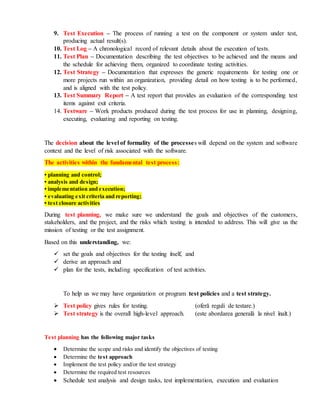
9. Test Execution – The process of running a test on the component or system under test,
producing actual result(s).
10. Test Log – A chronological record of relevant details about the execution of tests.
11. Test Plan – Documentation describing the test objectives to be achieved and the means and
the schedule for achieving them, organized to coordinate testing activities.
12. Test Strategy – Documentation that expresses the generic requirements for testing one or
more projects run within an organization, providing detail on how testing is to be performed,
and is aligned with the test policy.
13. Test Summary Report – A test report that provides an evaluation of the corresponding test
items against exit criteria.
14. Testware – Work products produced during the test process for use in planning, designing,
executing, evaluating and reporting on testing.
The decision about the level of formality of the processes will depend on the system and software
context and the level of risk associated with the software.
The activities within the fundamental test process:
• planning and control;
• analysis and design;
• implementation and execution;
• evaluating exit criteria and reporting;
• test closure activities
During test planning, we make sure we understand the goals and objectives of the customers,
stakeholders, and the project, and the risks which testing is intended to address. This will give us the
mission of testing or the test assignment.
Based on this understanding, we:
 set the goals and objectives for the testing itself, and
 derive an approach and
 plan for the tests, including specification of test activities.
To help us we may have organization or program test policies and a test strategy.
 Test policy gives rules for testing. (oferă reguli de testare.)
 Test strategy is the overall high-level approach. (este abordarea generală la nivel înalt.)
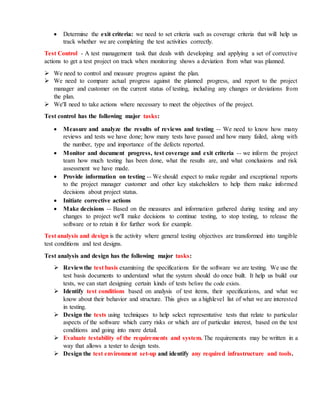
Test planning has the following major tasks
 Determine the scope and risks and identify the objectives of testing
 Determine the test approach
 Implement the test policy and/or the test strategy
 Determine the required test resources
 Schedule test analysis and design tasks, test implementation, execution and evaluation
 Determine the exit criteria: we need to set criteria such as coverage criteria that will help us
track whether we are completing the test activities correctly.
Test Control - A test management task that deals with developing and applying a set of corrective
actions to get a test project on track when monitoring shows a deviation from what was planned.
 We need to control and measure progress against the plan.
 We need to compare actual progress against the planned progress, and report to the project
manager and customer on the current status of testing, including any changes or deviations from
the plan.
 We'll need to take actions where necessary to meet the objectives of the project.
Test control has the following major tasks:
 Measure and analyze the results of reviews and testing -- We need to know how many
reviews and tests we have done; how many tests have passed and how many failed, along with
the number, type and importance of the defects reported.
 Monitor and document progress, test coverage and exit criteria -- we inform the project
team how much testing has been done, what the results are, and what conclusions and risk
assessment we have made.
 Provide information on testing -- We should expect to make regular and exceptional reports
to the project manager customer and other key stakeholders to help them make informed
decisions about project status.
 Initiate corrective actions
 Make decisions -- Based on the measures and information gathered during testing and any
changes to project we'll make decisions to continue testing, to stop testing, to release the
software or to retain it for further work for example.
Test analysis and design is the activity where general testing objectives are transformed into tangible
test conditions and test designs.
Test analysis and design has the following major tasks:
 Reviewthe test basis examining the specifications for the software we are testing. We use the
test basis documents to understand what the system should do once built. It help us build our
tests, we can start designing certain kinds of tests before the code exists.
 Identify test conditions based on analysis of test items, their specifications, and what we
know about their behavior and structure. This gives us a highlevel list of what we are interested
in testing.
 Design the tests using techniques to help select representative tests that relate to particular
aspects of the software which carry risks or which are of particular interest, based on the test
conditions and going into more detail.
 Evaluate testability of the requirements and system. The requirements may be written in a
way that allows a tester to design tests.
 Design the test environment set-up and identify any required infrastructure and tools.
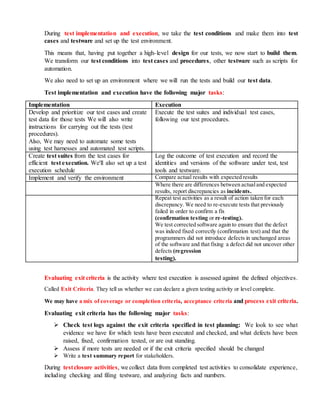
During test implementation and execution, we take the test conditions and make them into test
cases and testware and set up the test environment.
This means that, having put together a high-level design for our tests, we now start to build them.
We transform our test conditions into test cases and procedures, other testware such as scripts for
automation.
We also need to set up an environment where we will run the tests and build our test data.
Test implementation and execution have the following major tasks:
Implementation Execution
Develop and prioritize our test cases and create
test data for those tests We will also write
instructions for carrying out the tests (test
procedures).
Also, We may need to automate some tests
using test harnesses and automated test scripts.
Execute the test suites and individual test cases,
following our test procedures.
Create test suites from the test cases for
efficient test execution. We'll also set up a test
execution schedule
Log the outcome of test execution and record the
identities and versions of the software under test, test
tools and testware.
Implement and verify the environment Compare actual results with expected results
Where there are differences between actualand expected
results, report discrepancies as incidents.
Repeat test activities as a result of action taken for each
discrepancy. We need to re-execute tests that previously
failed in order to confirm a fix
(confirmation testing or re-testing).
We test corrected software again to ensure that the defect
was indeed fixed correctly (confirmation test) and that the
programmers did not introduce defects in unchanged areas
of the software and that fixing a defect did not uncover other
defects (regression
testing).
Evaluating exit criteria is the activity where test execution is assessed against the defined objectives.
Called Exit Criteria. They tell us whether we can declare a given testing activity or level complete.
We may have a mix of coverage or completion criteria, acceptance criteria and process exit criteria.
Evaluating exit criteria has the following major tasks:
 Check test logs against the exit criteria specified in test planning: We look to see what
evidence we have for which tests have been executed and checked, and what defects have been
raised, fixed, confirmation tested, or are out standing.
 Assess if more tests are needed or if the exit criteria specified should be changed
 Write a test summary report for stakeholders.
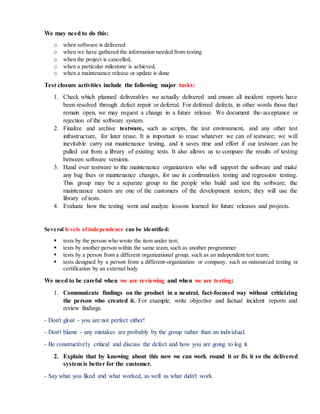
During testclosure activities, we collect data from completed test activities to consolidate experience,
including checking and filing testware, and analyzing facts and numbers.
We may need to do this:
o when software is delivered
o when we have gathered the information needed from testing
o when the project is cancelled,
o when a particular milestone is achieved,
o when a maintenance release or update is done
Test closure activities include the following major tasks:
1. Check which planned deliverables we actually delivered and ensure all incident reports have
been resolved through defect repair or deferral. For deferred defects, in other words those that
remain open, we may request a change in a future release. We document the-acceptance or
rejection of the software system.
2. Finalize and archive testware, such as scripts, the test environment, and any other test
infrastructure, for later reuse. It is important to reuse whatever we can of testware; we will
inevitable carry out maintenance testing, and it saves time and effort if our testware can be
pulled out from a library of existing tests. It also allows us to compare the results of testing
between software versions.
3. Hand over testware to the maintenance organization who will support the software and make
any bug fixes or maintenance changes, for use in confirmation testing and regression testing.
This group may be a separate group to the people who build and test the software; the
maintenance testers are one of the customers of the development testers; they will use the
library of tests.
4. Evaluate how the testing went and analyze lessons learned for future releases and projects.
Several levels of independence can be identified:
 tests by the person who wrote the item under test;
 tests by another person within the same team, such as another programmer
 tests by a person from a different organizational group, such as an independent test team;
 tests designed by a person from a different-organization or company, such as outsourced testing or
certification by an external body
We need to be careful when we are reviewing and when we are testing:
1. Communicate findings on the product in a neutral, fact-focused way without criticizing
the person who created it. For example, write objective and factual incident reports and
review findings.
- Don't gloat - you are not perfect either!
- Don't blame - any mistakes are probably by the group rather than an individual.
- Be constructively critical and discuss the defect and how you are going to log it.
2. Explain that by knowing about this now we can work round it or fix it so the delivered
system is better for the customer.
- Say what you liked and what worked, as well as what didn't work.
- Show what the risk is honestly - not everything is high priority.
- Don't just see the pessimistic side - give praise as well as criticism.
- Show what risks have been uncovered and the benefits of the review or test.
3. Start with collaboration rather than battles. Remind everyone of the common goal of better
quality systems.
- Be polite and helpful, collaborate with your colleagues.
- Try to understand how the other person feels and why they react as they do.
- Confirm that the other person has understood what you have said and vice versa.
- Explain how the test or review helps the author - what's in it for him or her.
- Offer your work to be reviewed, too.
CHAPTER 2. TESTING THROUGHOUT THE SOFTWARE LIFE CYCLE
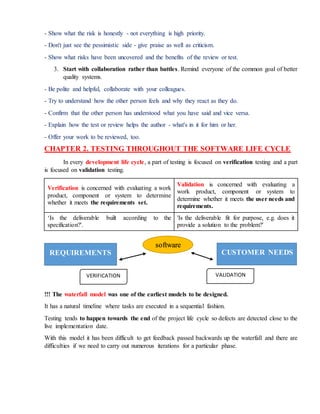
In every development life cycle, a part of testing is focused on verification testing and a part
is focused on validation testing.
Verification is concerned with evaluating a work
product, component or system to determine
whether it meets the requirements set.
Validation is concerned with evaluating a
work product, component or system to
determine whether it meets the user needs and
requirements.
‘Is the deliverable built according to the
specification?'.
'Is the deliverable fit for purpose, e.g. does it
provide a solution to the problem?'
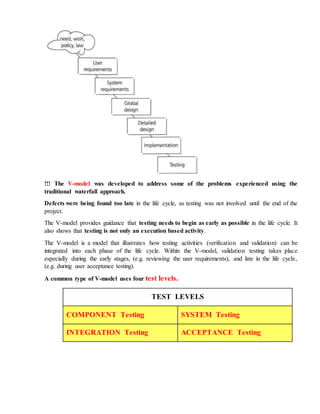
!!! The waterfall model was one of the earliest models to be designed.
It has a natural timeline where tasks are executed in a sequential fashion.
Testing tends to happen towards the end of the project life cycle so defects are detected close to the
live implementation date.
With this model it has been difficult to get feedback passed backwards up the waterfall and there are
difficulties if we need to carry out numerous iterations for a particular phase.
REQUIREMENTS CUSTOMER NEEDS
software
VERIFICATION VALIDATION
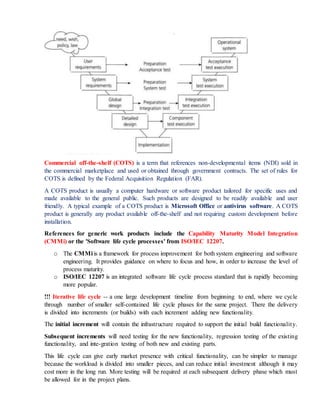
!!! The V-model was developed to address some of the problems experienced using the
traditional waterfall approach.
Defects were being found too late in the life cycle, as testing was not involved until the end of the
project.
The V-model provides guidance that testing needs to begin as early as possible in the life cycle. It
also shows that testing is not only an execution based activity.
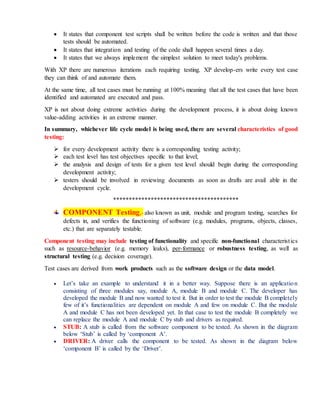
The V-model is a model that illustrates how testing activities (verification and validation) can be
integrated into each phase of the life cycle. Within the V-model, validation testing takes place
especially during the early stages, (e.g. reviewing the user requirements), and late in the life cycle,
(e.g. during user acceptance testing).
A common type of V-model uses four test levels.
TEST LEVELS
COMPONENT Testing SYSTEM Testing
INTEGRATION Testing ACCEPTANCE Testing
Commercial off-the-shelf (COTS) is a term that references non-developmental items (NDI) sold in
the commercial marketplace and used or obtained through government contracts. The set of rules for
COTS is defined by the Federal Acquisition Regulation (FAR).
A COTS product is usually a computer hardware or software product tailored for specific uses and
made available to the general public. Such products are designed to be readily available and user
friendly. A typical example of a COTS product is Microsoft Office or antivirus software. A COTS
product is generally any product available off-the-shelf and not requiring custom development before
installation.
References for generic work products include the Capability Maturity Model Integration
(CMMi) or the 'Software life cycle processes' from ISO/IEC 12207.
o The CMMi is a framework for process improvement for both system engineering and software
engineering. It provides guidance on where to focus and how, in order to increase the level of
process maturity.
o ISO/IEC 12207 is an integrated software life cycle process standard that is rapidly becoming
more popular.
!!! Iterative life cycle -- a one large development timeline from beginning to end, where we cycle
through number of smaller self-contained life cycle phases for the same project. There the delivery
is divided into increments (or builds) with each increment adding new functionality.
The initial increment will contain the infrastructure required to support the initial build functionality.
Subsequent increments will need testing for the new functionality, regression testing of the existing
functionality, and inte-gration testing of both new and existing parts.
This life cycle can give early market presence with critical functionality, can be simpler to manage
because the workload is divided into smaller pieces, and can reduce initial investment although it may
cost more in the long run. More testing will be required at each subsequent delivery phase which must
be allowed for in the project plans.
Examples of iterative or incremental development models are:
 prototyping,
 Rapid Application Development (RAD),
 Rational Unified Process (RUP)
 Agile development.
1) Rapid Application Development (RAD) is formally a parallel development of functions and
subsequent integration.
Components/functions are developed in parallel as if they were mini projects, the developments are
time-boxed, delivered, and then assembled into a working prototype. This can very quickly give the
customer something to see and use and to provide feedback regarding the delivery and their
requirements. Rapid change and development of the product is possible there.
However the product specification will need to be developed for the product at some point, and the
project will need to be placed under more formal controls prior to going into production.
This methodology allows early validation of technology risks and a rapid response to changing
customer requirements.
Dynamic System Development Methodology [DSDM] is a refined RAD process that allows
controls to be put in place in order to stop the process from getting out of control.
2) Extreme Programming (XP) is currently one of the most well-known Agile Development
life cycle models. The methodology claims to be more human friendly than traditional
develop-ment methods.
Some characteristics of XP are:
 It promotes the generation of business stories to define the functionality.
 It demands an on-site customer for continual feedback and to define and carry out functional
acceptance testing.
 It promotes pair programming and shared code ownership amongst the developers.
 It states that component test scripts shall be written before the code is written and that those
tests should be automated.
 It states that integration and testing of the code shall happen several times a day.
 It states that we always implement the simplest solution to meet today's problems.
With XP there are numerous iterations each requiring testing. XP develop-ers write every test case
they can think of and automate them.
At the same time, all test cases must be running at 100% meaning that all the test cases that have been
identified and automated are executed and pass.
XP is not about doing extreme activities during the development process, it is about doing known
value-adding activities in an extreme manner.
In summary, whichever life cycle model is being used, there are several characteristics of good
testing:
 for every development activity there is a corresponding testing activity;
 each test level has test objectives specific to that level;
 the analysis and design of tests for a given test level should begin during the corresponding
development activity;
 testers should be involved in reviewing documents as soon as drafts are avail able in the
development cycle.
****************************************
COMPONENT Testing,- also known as unit, module and program testing, searches for
defects in, and verifies the functioning of software (e.g. modules, programs, objects, classes,
etc.) that are separately testable.
Component testing may include testing of functionality and specific non-functional characteristics
such as resource-behavior (e.g. memory leaks), per-formance or robustness testing, as well as
structural testing (e.g. decision coverage).
Test cases are derived from work products such as the software design or the data model.
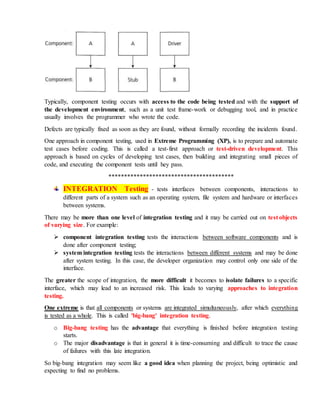
 Let’s take an example to understand it in a better way. Suppose there is an application
consisting of three modules say, module A, module B and module C. The developer has
developed the module B and now wanted to test it. But in order to test the module B completely
few of it’s functionalities are dependent on module A and few on module C. But the module
A and module C has not been developed yet. In that case to test the module B completely we
can replace the module A and module C by stub and drivers as required.
 STUB: A stub is called from the software component to be tested. As shown in the diagram
below ‘Stub’ is called by ‘component A’.
 DRIVER: A driver calls the component to be tested. As shown in the diagram below
‘component B’ is called by the ‘Driver’.
Typically, component testing occurs with access to the code being tested and with the support of
the development environment, such as a unit test frame-work or debugging tool, and in practice
usually involves the programmer who wrote the code.
Defects are typically fixed as soon as they are found, without formally recording the incidents found.
One approach in component testing, used in Extreme Programming (XP), is to prepare and automate
test cases before coding. This is called a test-first approach or test-driven development. This
approach is based on cycles of developing test cases, then building and integrating small pieces of
code, and executing the component tests until hey pass.
****************************************
INTEGRATION Testing - tests interfaces between components, interactions to
different parts of a system such as an operating system, file system and hardware or interfaces
between systems.
There may be more than one level of integration testing and it may be carried out on test objects
of varying size. For example:
 component integration testing tests the interactions between software components and is
done after component testing;
 system integration testing tests the interactions between different systems and may be done
after system testing. In this case, the developer organization may control only one side of the
interface.
The greater the scope of integration, the more difficult it becomes to isolate failures to a specific
interface, which may lead to an increased risk. This leads to varying approaches to integration
testing.
One extreme is that all components or systems are integrated simultaneously, after which everything
is tested as a whole. This is called 'big-bang' integration testing.
o Big-bang testing has the advantage that everything is finished before integration testing
starts.
o The major disadvantage is that in general it is time-consuming and difficult to trace the cause
of failures with this late integration.
So big-bang integration may seem like a good idea when planning the project, being optimistic and
expecting to find no problems.
Another extreme is that all programs are integrated one by one, and a test is carried out after each
step (incremental testing).
Between these two extremes, there is a range of variants.
The incremental approach has the advantage that the defects are found early in a smaller assembly
when it is relatively easy to detect the cause.
A disadvantage is that it can be time-consuming since stubs and drivers have to be developed and
used in the test.
Within incremental integration testing a range of possibilities exist, partly depending on the system
architecture:
 Top-down: testing takes place from top to bottom, following the control flow or architectural
structure (e.g. starting from the GUI or main menu). Components or systems are substituted
by stubs.
 Bottom-up: testing takes place from the bottom of the control flow upwards. Components or
systems are substituted by drivers.
 Functional incremental: integration and testing takes place on the basis of the functions or
functionality, as documented in the functional specification.
The best choice is to start integration with those interfaces that are expected to cause most
problems. Doing so prevents major defects at the end of the integration test stage.
Integration testing may be carried out by the developers, but can be done by a separate team.
****************************************
SYSTEM Testing - is concerned ( se refera la ) with the behavior of the whole
system/product as defined by the scope of a development project or product.
It may include tests based on:
 risks and/or requirements specification
 business processes,
 use cases,
 or other high level descriptions of system behavior,
 interactions with the operating system,
 and system resources.
System testing is most often the final test on behalf of development to verify that the systemto be
delivered meets the specification and its purpose may be to find as many defects as possible.
Most often it is carried out by testers reporting to the project manager. In some organizations it is
carried out by a third party team or by business analysts.
System testing should investigate both functional and non-functional requirements of the system.
System testing of functional requirements starts
by using the most appropriate specification-
Non-functional tests include performance and
reliability. Testers may also need to deal with
incomplete or undocumented requirements.
based techniques for the aspect of the system to
be tested.
There may also be used structure-based
techniques to assess the thoroughness
( seriozitatea ) of testing elements such as menu
dialog structure or web page navigation.
System testing requires a controlled testenvironment with regard to, control of the software versions,
testware and the test data. It should correspond to the final production environment as much as
possible in order to minimize the risk of environment-specific failures not being found by testing.
****************************************
ACCEPTANCE Testing - When the development organization has performed its system
test and has corrected all or most defects, the system will be delivered to the user or customer
for acceptance testing.
Acceptance testing is most often the responsibility of the user or customer (stakeholders). In result
of testing, they answer to the next questions:
 'Can the system be released?',
 'What, if any, are the outstanding (business) risks?'
 'Has development met their obligations?'.
The goal of acceptance testing is to establish confidence in the system. Acceptance testing is most
often focused on a validation type of testing, whereby we are trying to determine whether the
system is fit for purpose.
Acceptance testing may occur at more than just a single level, for example:
 A Commercial Off The Shelf (COTS) software product may be acceptance tested when it is
installed or integrated.
 Acceptance testing of the usability of a component may be done during component testing.
 Acceptance testing of a new functional enhancement may come before system testing.
Inside of acceptance test for a business-supporting system, there are two main test types that can
be distinguished; ( they are usually prepared and executed separately ):
 The user acceptance test
It focuses mainly on the functionality thereby validating the fitness-for-use of the system by the
business user.
It is performed by the users and application managers.
In terms of planning, the user acceptance test usually links tightly to the SYSTEM Test and will be
organized partially overlapping in time.
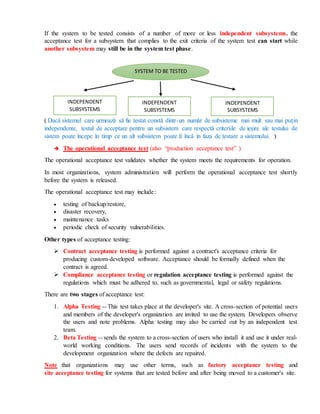
If the system to be tested consists of a number of more or less independent subsystems, the
acceptance test for a subsystem that complies to the exit criteria of the system test can start while
another subsystem may still be in the system test phase.
( Dacă sistemul care urmează să fie testat constă dintr-un număr de subsisteme mai mult sau mai puțin
independente, testul de acceptare pentru un subsistem care respectă criteriile de ieșire ale testului de
sistem poate începe în timp ce un alt subsistem poate fi încă în faza de testare a sistemului. )
 The operational acceptance test (also “production acceptance test” )
The operational acceptance test validates whether the system meets the requirements for operation.
In most organizations, system administration will perform the operational acceptance test shortly
before the system is released.
The operational acceptance test may include:
 testing of backup/restore,
 disaster recovery,
 maintenance tasks
 periodic check of security vulnerabilities.
Other types of acceptance testing:
 Contract acceptance testing is performed against a contract's acceptance criteria for
producing custom-developed software. Acceptance should be formally defined when the
contract is agreed.
 Compliance acceptance testing or regulation acceptance testing is performed against the
regulations which must be adhered to, such as governmental, legal or safety regulations.
There are two stages of acceptance test:
1. Alpha Testing -- This test takes place at the developer's site. A cross-section of potential users
and members of the developer's organization are invited to use the system. Developers observe
the users and note problems. Alpha testing may also be carried out by an independent test
team.
2. Beta Testing -- sends the system to a cross-section of users who install it and use it under real-
world working conditions. The users send records of incidents with the system to the
development organization where the defects are repaired.
Note that organizations may use other terms, such as factory acceptance testing and
site acceptance testing for systems that are tested before and after being moved to a customer's site.
SYSTEM TO BE TESTED
INDEPENDENT
SUBSYSTEMS
INDEPENDENT
SUBSYSTEMS
INDEPENDENT
SUBSYSTEMS
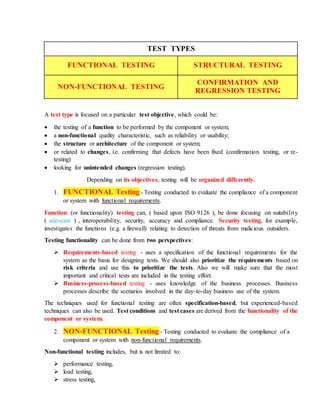
TEST TYPES
FUNCTIONAL TESTING STRUCTURAL TESTING
NON-FUNCTIONAL TESTING
CONFIRMATION AND
REGRESSION TESTING
A test type is focused on a particular test objective, which could be:
 the testing of a function to be performed by the component or system;
 a non-functional quality characteristic, such as reliability or usability;
 the structure or architecture of the component or system;
 or related to changes, i.e. confirming that defects have been fixed (confirmation testing, or re-
testing)
 looking for unintended changes (regression testing).
Depending on its objectives, testing will be organized differently.
1. FUNCTIONAL Testing - Testing conducted to evaluate the compliance of a component
or system with functional requirements.
Function (or functionality) testing can, ( based upon ISO 9126 ), be done focusing on suitability
( adevcare ) , interoperability, security, accuracy and compliance. Security testing, for example,
investigates the functions (e.g. a firewall) relating to detection of threats from malicious outsiders.
Testing functionality can be done from two perspectives:
 Requirements-based testing - uses a specification of the functional requirements for the
system as the basis for designing tests. We should also prioritize the requirements based on
risk criteria and use this to prioritize the tests. Also we will make sure that the most
important and critical tests are included in the testing effort.
 Business-process-based testing - uses knowledge of the business processes. Business
processes describe the scenarios involved in the day-to-day business use of the system.
The techniques used for functional testing are often specification-based, but experienced-based
techniques can also be used. Test conditions and test cases are derived from the functionality of the
component or system.
2. NON-FUNCTIONAL Testing - Testing conducted to evaluate the compliance of a
component or system with non-functional requirements.
Non-functional testing includes, but is not limited to:
 performance testing,
 load testing,
 stress testing,
 usability testing,
 maintainability testing,
 reliability testing
 portability testing.
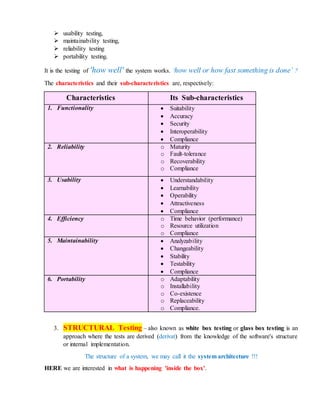
It is the testing of 'how well' the system works. ‘how well or how fast something is done’ ?
The characteristics and their sub-characteristics are, respectively:
Characteristics Its Sub-characteristics
1. Functionality  Suitability
 Accuracy
 Security
 Interoperability
 Compliance
2. Reliability o Maturity
o Fault-tolerance
o Recoverability
o Compliance
3. Usability  Understandability
 Learnability
 Operability
 Attractiveness
 Compliance
4. Efficiency o Time behavior (performance)
o Resource utilization
o Compliance
5. Maintainability  Analyzability
 Changeability
 Stability
 Testability
 Compliance
6. Portability o Adaptability
o Installability
o Co-existence
o Replaceability
o Compliance.
3. STRUCTURAL Testing – also known as white box testing or glass box testing is an
approach where the tests are derived (derivat) from the knowledge of the software's structure
or internal implementation.
The structure of a system, we may call it the system architecture !!!
HERE we are interested in what is happening 'inside the box'.
At component level, and at component integration testing, there is good tool support to measure
code coverage. Coverage measurement tools assess the percentage of executable elements that have
been exercised (i.e. covered) by a test suite. If coverage is not 100%, then additional tests may need
to be written and run to cover those parts that have not yet been exercised. This of course depends on
the exit criteria.
What is Structural Testing ?
Structural testing, also known as glass box testing or white box testing is an approach where the tests
are derived from the knowledge of the software's structure or internal implementation.
The other names of structural testing includes clear box testing, open box testing, logic driven testing
or path driven testing.
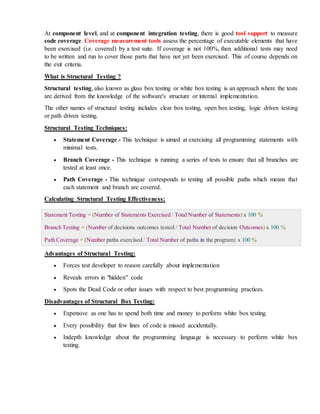
Structural Testing Techniques:
 Statement Coverage - This technique is aimed at exercising all programming statements with
minimal tests.
 Branch Coverage - This technique is running a series of tests to ensure that all branches are
tested at least once.
 Path Coverage - This technique corresponds to testing all possible paths which means that
each statement and branch are covered.
Calculating Structural Testing Effectiveness:
Statement Testing = (Number of Statements Exercised / Total Number of Statements) x 100 %
Branch Testing = (Number of decisions outcomes tested / Total Number of decision Outcomes) x 100 %
Path Coverage = (Number paths exercised / Total Number of paths in the program) x 100 %
Advantages of Structural Testing:
 Forces test developer to reason carefully about implementation
 Reveals errors in "hidden" code
 Spots the Dead Code or other issues with respect to best programming practices.
Disadvantages of Structural Box Testing:
 Expensive as one has to spend both time and money to perform white box testing.
 Every possibility that few lines of code is missed accidentally.
 Indepth knowledge about the programming language is necessary to perform white box
testing.
4. CONFIRMATION AND REGRESSION Testing
CONFIRMATION Testing - Dynamic testing conducted after fixing defects with the objective to
confirm that failures caused by those defects do not occur anymore.
When a test fails and we determine that the cause of the failure is a software defect, the defect is
reported, and we can expect a new version of the software that has had the defect fixed. In this case
we will need to execute the test again to confirm that the defect has indeed been fixed. This is known
as confirmation testing (also known as re-testing).
When doing confirmation testing, it is important to ensure that the test is executed in exactly the same
way as it was the first time, using the same inputs, data and environment.
REGRESSION Testing - Regression testing a black box testing technique that consists of re-
executing those tests that are impacted by the code changes. These tests should be executed as often
as possible throughout the software development life cycle.
More specifically, the purpose of regression testing is to verify that modifications in the software or
the environment have not caused unintended adverse side effects and that the system still meets its
requirements.
!!! eliminate some test cases from a large regression test suite for example if they are repetitive or
can be combined. Also eliminate test cases that have not found a defect for a long time.
********************************************************************************
Maintenance Testing - The process of modifying a component or system after delivery to correct
defects, improve quality attributes, or adapt to a changed environment.
According to ISTQB glossary, "maintenance testing is testing the changes to an operational
system or the impact of a changed environment to an operational system"
Once deployed, a system is often in service for years or even decades. During this time the system
and its operational environment is often corrected, changed or extended. Testing that is executed
during this life cycle phase is called 'maintenance testing'.
Note that maintenance testing is different from maintainability testing, which defines how
easy it is to maintain the system.
The development and test process applicable to new developments does not change fundamentally
for maintenance purposes.
The same test process steps will apply and, depending on the size and risk of the changes made, several
levels of testing are carried out:
 a component test,
 an integration test,
 a system test
 an acceptance test.
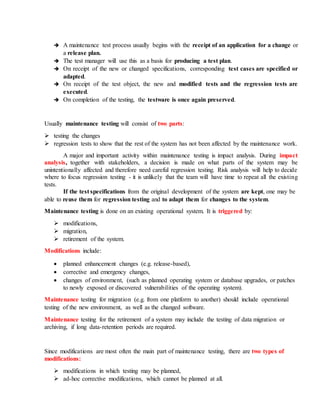
 A maintenance test process usually begins with the receipt of an application for a change or
a release plan.
 The test manager will use this as a basis for producing a test plan.
 On receipt of the new or changed specifications, corresponding test cases are specified or
adapted.
 On receipt of the test object, the new and modified tests and the regression tests are
executed.
 On completion of the testing, the testware is once again preserved.
Usually maintenance testing will consist of two parts:
 testing the changes
 regression tests to show that the rest of the system has not been affected by the maintenance work.
A major and important activity within maintenance testing is impact analysis. During impact
analysis, together with stakeholders, a decision is made on what parts of the system may be
unintentionally affected and therefore need careful regression testing. Risk analysis will help to decide
where to focus regression testing - it is unlikely that the team will have time to repeat all the existing
tests.
If the test specifications from the original development of the system are kept, one may be
able to reuse them for regression testing and to adapt them for changes to the system.
Maintenance testing is done on an existing operational system. It is triggered by:
 modifications,
 migration,
 retirement of the system.
Modifications include:
 planned enhancement changes (e.g. release-based),
 corrective and emergency changes,
 changes of environment, (such as planned operating system or database upgrades, or patches
to newly exposed or discovered vulnerabilities of the operating system).
Maintenance testing for migration (e.g. from one platform to another) should include operational
testing of the new environment, as well as the changed software.
Maintenance testing for the retirement of a system may include the testing of data migration or
archiving, if long data-retention periods are required.
Since modifications are most often the main part of maintenance testing, there are two types of
modifications:
 modifications in which testing may be planned,
 ad-hoc corrective modifications, which cannot be planned at all.
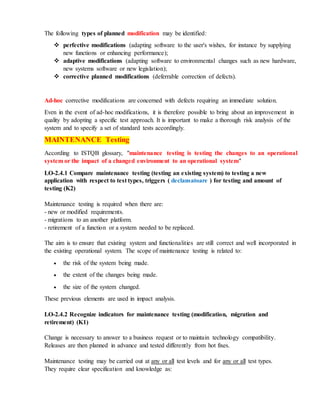
The following types of planned modification may be identified:
 perfective modifications (adapting software to the user's wishes, for instance by supplying
new functions or enhancing performance);
 adaptive modifications (adapting software to environmental changes such as new hardware,
new systems software or new legislation);
 corrective planned modifications (deferrable correction of defects).
Ad-hoc corrective modifications are concerned with defects requiring an immediate solution.
Even in the event of ad-hoc modifications, it is therefore possible to bring about an improvement in
quality by adopting a specific test approach. It is important to make a thorough risk analysis of the
system and to specify a set of standard tests accordingly.
MAINTENANCE Testing
According to ISTQB glossary, "maintenance testing is testing the changes to an operational
system or the impact of a changed environment to an operational system"
LO-2.4.1 Compare maintenance testing (testing an existing system) to testing a new
application with respect to test types, triggers ( declansatoare ) for testing and amount of
testing (K2)
Maintenance testing is required when there are:
- new or modified requirements.
- migrations to an another platform.
- retirement of a function or a system needed to be replaced.
The aim is to ensure that existing system and functionalities are still correct and well incorporated in
the existing operational system. The scope of maintenance testing is related to:
 the risk of the system being made.
 the extent of the changes being made.
 the size of the system changed.
These previous elements are used in impact analysis.
LO-2.4.2 Recognize indicators for maintenance testing (modification, migration and
retirement) (K1)
Change is necessary to answer to a business request or to maintain technology compatibility.
Releases are then planned in advance and tested differently from hot fixes.
Maintenance testing may be carried out at any or all test levels and for any or all test types.
They require clear specification and knowledge as:
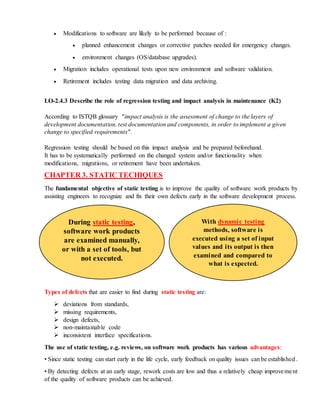
 Modifications to software are likely to be performed because of :
 planned enhancement changes or corrective patches needed for emergency changes.
 environment changes (OS/database upgrades).
 Migration includes operational tests upon new environment and software validation.
 Retirement includes testing data migration and data archiving.
LO-2.4.3 Describe the role of regression testing and impact analysis in maintenance (K2)
According to ISTQB glossary "impact analysis is the assessment of change to the layers of
development documentation, test documentation and components, in order to implement a given
change to specified requirements".
Regression testing should be based on this impact analysis and be prepared beforehand.
It has to be systematically performed on the changed system and/or functionality when
modifications, migrations, or retirement have been undertaken.
CHAPTER 3. STATIC TECHIQUES
The fundamental objective of static testing is to improve the quality of software work products by
assisting engineers to recognize and fix their own defects early in the software development process.
Types of defects that are easier to find during static testing are:
 deviations from standards,
 missing requirements,
 design defects,
 non-maintainable code
 inconsistent interface specifications.
The use of static testing, e.g. reviews, on software work products has various advantages:
• Since static testing can start early in the life cycle, early feedback on quality issues can be established .
• By detecting defects at an early stage, rework costs are low and thus a relatively cheap improvement
of the quality of software products can be achieved.
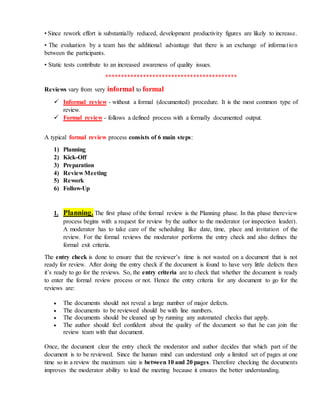
During static testing,
software work products
are examined manually,
or with a set of tools, but
not executed.
With dynamic testing
methods, software is
executed using a set of input
values and its output is then
examined and compared to
what is expected.
• Since rework effort is substantially reduced, development productivity figures are likely to increase.
• The evaluation by a team has the additional advantage that there is an exchange of information
between the participants.
• Static tests contribute to an increased awareness of quality issues.
******************************************
Reviews vary from very informal to formal
 Informal review - without a formal (documented) procedure. It is the most common type of
review.
 Formal review - follows a defined process with a formally documented output.
A typical formal review process consists of 6 main steps:
1) Planning
2) Kick-Off
3) Preparation
4) Review Meeting
5) Rework
6) Follow-Up
1. Planning. The first phase of the formal review is the Planning phase. In this phase thereview
process begins with a request for review by the author to the moderator (or inspection leader).
A moderator has to take care of the scheduling like date, time, place and invitation of the
review. For the formal reviews the moderator performs the entry check and also defines the
formal exit criteria.
The entry check is done to ensure that the reviewer’s time is not wasted on a document that is not
ready for review. After doing the entry check if the document is found to have very little defects then
it’s ready to go for the reviews. So, the entry criteria are to check that whether the document is ready
to enter the formal review process or not. Hence the entry criteria for any document to go for the
reviews are:
 The documents should not reveal a large number of major defects.
 The documents to be reviewed should be with line numbers.
 The documents should be cleaned up by running any automated checks that apply.
 The author should feel confident about the quality of the document so that he can join the
review team with that document.
Once, the document clear the entry check the moderator and author decides that which part of the
document is to be reviewed. Since the human mind can understand only a limited set of pages at one
time so in a review the maximum size is between 10 and 20 pages. Therefore checking the documents
improves the moderator ability to lead the meeting because it ensures the better understanding.
2. Kick-Off. This kick-off meeting is an optional step in a review procedure. The goal of this
step is to give a short introduction on the objectives of the review and the documents to
everyone in the meeting. The relationships between the document under review and the other
documents are also explained, especially if the numbers of related documents are high. At
customer sites, we have measured results up to 70% more major defects found per page as a
result of performing a kick-off.
3. Preparation. In this step the reviewers review the document individually using the related
documents, procedures, rules and checklists provided. Each participant while reviewing
individually identifies the defects, questions and comments according to their understanding
of the document and role. After that all issues are recorded using a logging form. The success
factor for a thorough preparation is the number of pages checked per hour. This is called
the checking rate. Usually the checking rate is in the range of 5 to 10 pages per hour.
4. Review meeting. The review meeting consists of three phases:
 Logging phase: In this phase the issues and the defects that have been identified during the
preparation step are logged page by page. The logging is basically done by the author or by
a scribe. Scribe is a separate person to do the logging and is especially useful for the formal
review types such as an inspection. Every defects and it’s severity should be logged in any of
the three severity classes given below:
— Critical:The defects will cause downstream damage.
— Major: The defects could cause a downstream damage.
— Minor: The defects are highly unlikely to cause the downstream damage.
During the logging phase the moderator focuses on logging as many defects as possible within a
certain time frame and tries to keep a good logging rate (number of defects logged per minute). In
formal review meeting the good logging rate should be between one and two defects logged per
minute.
 Discussion phase: If any issue needs discussion then the item is logged and then handled in the
discussion phase. As chairman of the discussion meeting, the moderator takes care of the people
issues and prevents discussion from getting too personal and calls for a break to cool down the
heated discussion. The outcome of the discussions is documented for the future reference.
 Decision phase: At the end of the meeting a decision on the document under review has to be
made by the participants, sometimes based on formal exit criteria. Exit criteria are the average
number of critical and/or major defects found per page (for example no more than three
critical/major defects per page). If the number of defects found per page is more than a certain
level then the document must be reviewed again, after it has been reworked.
5. Rework. In this step if the number of defects found per page exceeds the certain level then
the document has to be reworked. Not every defect that is found leads to rework. It is the
author’s responsibility to judge whether the defect has to be fixed. If nothing can be done about
an issue then at least it should be indicated that the author has considered the issue.
6. Follow Up. In this step the moderator check to make sure that the author has taken action
on all known defects. If it is decided that all participants will check the updated documents
then the moderator takes care of the distribution and collects the feedback. It is the
responsibility of the moderator to ensure that the information is correct and stored for future
analysis.
The best formal reviews come from well-organized teams, guided by trained moderators (or
review leaders).
There four types of participants can be distinguished:
1) moderator,
2) author,
3) scribe,
4) reviewer.
The moderator:
 Also known as review leader
 Performs entry check
 Follow-up on the rework
 Schedules the meeting
 Coaches other team
 Leads the possible discussion and stores the data that is collected
The author:
 Illuminate the unclear areas and understand the defects found
 Basic goal should be to learn as much as possible with regard to improving the quality of the
document.
The scribe:
 Scribe is a separate person to do the logging of the defects found during the review.
The reviewers:
 Also known as checkers or inspectors
 Check any material for defects, mostly prior to the meeting
 The manager can also be involved in the review depending on his or her background.
The managers:
 Manager decides on the execution of reviews
 Allocates time in project schedules and determines whether review process objectives have
been met
Types of review
The main review types that come under the static testing are mentioned below:
1. Walkthrough
 It is not a formal process
 It is led by the authors
 Author guide the participants through the document according to his or her thought process to
achieve a common understanding and to gather feedback.
 Useful for the people if they are not from the software discipline, who are not used to or cannot
easily understand software development process.
 Is especially useful for higher level documents like requirement specification, etc.
The goals of a walkthrough:
 To present the documents both within and outside the software discipline in order to gather
the information regarding the topic under documentation.
 To explain or do the knowledge transfer and evaluate the contents of the document
 To achieve a common understanding and to gather feedback.
 To examine and discuss the validity of the proposed solutions
2. Technical review
 It is less formal review
 It is led by the trained moderator but can also be led by a technical expert
 It is often performed as a peer review without management participation
 Defects are found by the experts (such as architects, designers, key users) who focus on the content
of the document.
 In practice, technical reviews vary from quite informal to very formal
The goals of the technical review are:
 To ensure that an early stage the technical concepts are used correctly
 To access the value of technical concepts and alternatives in the product
 To have consistency in the use and representation of technical concepts
 To inform participants about the technical content of the document
3. Inspection
 It is the most formal review type
 It is led by the trained moderators
 During inspection the documents are prepared and checked thoroughly by the reviewers before
the meeting
 It involves peers to examine the product
 A separate preparation is carried out during which the product is examined and the defects are
found
 The defects found are documented in a logging list or issue log
 A formal follow-up is carried out by the moderator applying exit criteria
The goals of inspection are:
 It helps the author to improve the quality of the document under inspection
 It removes defects efficiently and as early as possible
 It improve product quality
 It create common understanding by exchanging information
 It learn from defects found and prevent the occurrence of similar defects
Success factors for reviews
 Find a 'champion' -- A champion is needed, one who will lead the process on a project or
organizational level.
 Pick things that really count -- Select the documents for review that are most important in a
project. Reviewing highly critical, upstream documents like requirements and architecture will
most certainly show the benefits of the review process to the project.
 Explicitly plan and track review activities -- To ensure that reviews become part of the day-
to-day activities, the hours to be spent should be made visible within each project plan.
 Train participants
 Manage people issues -- Reviews are about evaluating someone's document. People issues
and psychological aspects should be dealt with by the moderator and should be part of the
review training, thus making the review a positive experience for the author.
 Follow the rules but keep it simple -- Do not become too theoretical or too detailed.
 Continuously improve process and tools -- Continuous improvement of process and
supporting tools (e.g. checklists), based upon the ideas of participants, ensures the motivation
of the engineers involved.
 Report results
 Just do it! -- The process is simple but not easy. Each step of the process is clear, but
experience is needed to execute them correctly.

Istqb v.1.2

  • 1.
    CHAPTER 1. FUNDAMENTALSOF TESTING  why testing is necessary providing explanation with examples (pesticides, family tree website)  examples of negative consequesces of a bug  defect's symptoms  how testing improve the quality  bug, defect, error, failure, fault, mistake, quality, risk, software, testing and exhaustive testing. 1. bug - is an error, flaw, failure or fault in a computer program or system that causes it to produce an incorrect or unexpected result, or to behave in unintended ways. 2. defect - are flaws in the software, also called faults. An imperfection or deficiency in a work product where it does not meet its requirements or specifications. 3. error - A human action that produces an incorrect result. 4. failure - An event in which a component or system does not perform a required function within specified limits. 5. fault - the fact of being responsible for a bad or unpleasant situation. 6. mistake - something that you have not done correctly, or something you say or think that is not correct. 7. quality - The degree to which a component, system or process meets specified requirements and/or user/customer needs and expectations. 8. risk - is something that has not happened yet and it may never happen, it is a potential problem. 9. software - Computer programs, procedures, and possibly associated documentation and data pertaining to the operation of a computer system. 10. testing - The process consisting of all lifecycle activities, both static and dynamic, concerned with planning, preparation and evaluation of software products and related work products to determine that they satisfy specified requirements, to demonstrate that they are fit for purpose and to detect defects. 11. exhaustive testing - A test approach in which the test suite comprises all combinations of input values and preconditions. OUR FALLIABILIY is compounded when:  we lack experience, don't have the right information, misunderstand, or if we are careless, tired or under time pressure;  dealing with perplexing technical or business problems, complex business processes, code or infrastructure, changing technologies, or many system interactions;  human error in interacting with the software  someone trying to cause a failure in a system - malicious damage Failures can also be caused by environmental conditions as well:  a radiation burst,
  • 2.
     a strongmagnetic field,  electronic fields,  pollution. Defects and Failures arising from:  errors in the specification, design and implementation of the software and system;  errors in use of the system;  environmental conditions;  intentional damage;  potential consequences of earlier errors, intentional damage, defects and failures. COST OF FINDING AND FIXING DEFECTS INCREASES OVER TIME ! VALIDATION -> is this the right specification? VERIFICATION -> is the system correct to specification? We use testing to help us find faults and (potential) failures during software development, maintenance and operations. We do this to help reduce the risk of failures occurring in an operational environment - in other words once the system is being used - and to contribute to the quality of the software system. We saw earlier that one strategy for dealing with errors, faults and failures is to try to prevent them, and we looked at identifying the causes of defects and failures. Deciding how much testing is enough should take account of the level of risk, including technical and business risks related to the product and project constraints such as time and budget. ******************************************************** Code – is a term used for both the statements written in a particular programming language. Debugging – The process of finding, analyzing and removing the causes of failures in software. Development of software - is the process of conceiving, specifying, designing, programming, documenting, testing, and bug fixing involved in creating and maintaining applications, frameworks, or other software components. Requirement – A provision that contains criteria to be fulfilled. Review– A type of static testing during which a work product or process is evaluated by one or more individuals to detect issues and to provide improvements. Test basis – is the information needed in order to start the test analysis and create our Test Cases. Test case – is a set of conditions or variables under which a tester will determine whether a system under test satisfies requirements or works correctly. Testing - The process consisting of all lifecycle activities, both static and dynamic, concerned with planning, preparation and evaluation of software products and related work products to determine that they satisfy specified requirements, to demonstrate that they are fit for purpose and to detect defects.
  • 3.
    Test objective -A reason or purpose for designing and executing a test. STATIC TESTING: Testing a work product without code being executed. DYNAMIC TESTING: Testing that involves the execution of the software of a component or system. the static and dynamic testing goals and objectives:  finding defects;  gaining confidence in and providing information about the levelof quality;  preventing defects. OBJECTIVES for testing:  determine that software products satisfy specified requirements  demonstrate that software products are fit for purpose (help the users to carry out their tasks)  detect defects Early testing - such as early test design and review activities - finds defects early on when they are cheap to find and fix. Development testing - component, integration and system testing - Once the code is written, programmers and testers run a set of tests so that they can identify and fix defects in the software. Acceptance testing - - the users of the software may confirm that the system works as expected and to gain confidence that it has met the requirements. Regression testing - - testing to ensure nothing has changed that should not have changed. We may continue to test the systemonce it is in operational use. In this case, the main objective may be to assess system characteristics such as reliability or availability. !!! defects tend to cluster !!! Testers will often use this information when making their risk assessment for planning the tests, and will focus on known 'hot spots'. Debugging - a programmer will examine the code for the immediate cause of the problem, repair the code and check that the code now executes as expected. How many tests we execute without finding a bug, we have not shown 'There are no bugs'. As soon as we find a bug, we have shown 'This code is not bug-free'. TESTING PRINCIPLES:
  • 4.
    1. TESTING SHOWSPRESENCE OF DEFECTS - testing can show that defects are present, but cannot prove that there are no defects. Testing reduces the probability of undiscovered defects remaining in the software but, even if no defects are found, it is not a proof of correctness. 2. EXHAUSTIVE TESTING IS IMPOSSIBLE - testing everything is not feasible except for trivial cases. Instead of exhaustive testing, we use risks and priorities to focus testing efforts. 3. EARLY TESTING - Testing activities should start as early as possible in the software or system development life cycle and should be focused on defined objectives. 4. DEFECT CLUSTERING - A small number of modules contain most of the defects discovered during prerelease testing or show the most operational failures. 5. PESTICIDE PARADOX - If the same tests are repeated over and over again, eventually the same set of test cases will no longer find any new bugs. To overcome this 'pesticide paradox', the test cases need to be regularly reviewed and revised, and new and different tests need to be written to exercise different parts of the software or system to potentially find more defects. 6. TESTING IS CONTEXT DEPENDENT - Testing is done differently in different contexts. For example, safety-critical software is tested differently from an e-commerce site. 7. ABSENCE-OF-ERRORS FALLACY - Finding and fixing defects not help if the system built is unusable and does not fulfill the users' needs and expectation. ******************************************************** 1. Confirmation testing – when we test again to confirm that whether the defect got actually fixed or not. 2. Exit Criteria – The set of conditions for officially completing a defined task. 3. Incident – An event occurring that requires investigation. 4. Regression Testing – Testing of a previously tested component or system following modification to ensure that defects have not been introduced or have been uncovered in unchanged areas of the software, as a result of the changes made. 5. Test Basis – The body of knowledge used as the basis for test analysis and design. 6. Test Condition – An aspect of the test basis that is relevant in order to achieve specific test objectives. 7. Test Coverage – is defined as a metric in Software Testing that -measures the amount of testing performed by a set of test. It will include gathering information about which parts of a program are actually executed when running the test suite in order to determine which branches of conditional statements have been taken. 8. Test Data – Data created or selected to satisfy the execution preconditions and inputs to execute one or more test cases. TestCoverage isdefinedasatechnique whichdetermineswhether our test cases are actually covering the application code and how much code is exercised when we run those test cases. Code coverage measureshow muchcode of the applicationisbeing exercised when the tests are run.
  • 5.
    9. Test Execution– The process of running a test on the component or system under test, producing actual result(s). 10. Test Log – A chronological record of relevant details about the execution of tests. 11. Test Plan – Documentation describing the test objectives to be achieved and the means and the schedule for achieving them, organized to coordinate testing activities. 12. Test Strategy – Documentation that expresses the generic requirements for testing one or more projects run within an organization, providing detail on how testing is to be performed, and is aligned with the test policy. 13. Test Summary Report – A test report that provides an evaluation of the corresponding test items against exit criteria. 14. Testware – Work products produced during the test process for use in planning, designing, executing, evaluating and reporting on testing. The decision about the level of formality of the processes will depend on the system and software context and the level of risk associated with the software. The activities within the fundamental test process: • planning and control; • analysis and design; • implementation and execution; • evaluating exit criteria and reporting; • test closure activities During test planning, we make sure we understand the goals and objectives of the customers, stakeholders, and the project, and the risks which testing is intended to address. This will give us the mission of testing or the test assignment. Based on this understanding, we:  set the goals and objectives for the testing itself, and  derive an approach and  plan for the tests, including specification of test activities. To help us we may have organization or program test policies and a test strategy.  Test policy gives rules for testing. (oferă reguli de testare.)  Test strategy is the overall high-level approach. (este abordarea generală la nivel înalt.) Test planning has the following major tasks  Determine the scope and risks and identify the objectives of testing  Determine the test approach  Implement the test policy and/or the test strategy  Determine the required test resources  Schedule test analysis and design tasks, test implementation, execution and evaluation
  • 6.
     Determine theexit criteria: we need to set criteria such as coverage criteria that will help us track whether we are completing the test activities correctly. Test Control - A test management task that deals with developing and applying a set of corrective actions to get a test project on track when monitoring shows a deviation from what was planned.  We need to control and measure progress against the plan.  We need to compare actual progress against the planned progress, and report to the project manager and customer on the current status of testing, including any changes or deviations from the plan.  We'll need to take actions where necessary to meet the objectives of the project. Test control has the following major tasks:  Measure and analyze the results of reviews and testing -- We need to know how many reviews and tests we have done; how many tests have passed and how many failed, along with the number, type and importance of the defects reported.  Monitor and document progress, test coverage and exit criteria -- we inform the project team how much testing has been done, what the results are, and what conclusions and risk assessment we have made.  Provide information on testing -- We should expect to make regular and exceptional reports to the project manager customer and other key stakeholders to help them make informed decisions about project status.  Initiate corrective actions  Make decisions -- Based on the measures and information gathered during testing and any changes to project we'll make decisions to continue testing, to stop testing, to release the software or to retain it for further work for example. Test analysis and design is the activity where general testing objectives are transformed into tangible test conditions and test designs. Test analysis and design has the following major tasks:  Reviewthe test basis examining the specifications for the software we are testing. We use the test basis documents to understand what the system should do once built. It help us build our tests, we can start designing certain kinds of tests before the code exists.  Identify test conditions based on analysis of test items, their specifications, and what we know about their behavior and structure. This gives us a highlevel list of what we are interested in testing.  Design the tests using techniques to help select representative tests that relate to particular aspects of the software which carry risks or which are of particular interest, based on the test conditions and going into more detail.  Evaluate testability of the requirements and system. The requirements may be written in a way that allows a tester to design tests.  Design the test environment set-up and identify any required infrastructure and tools.
  • 7.
    During test implementationand execution, we take the test conditions and make them into test cases and testware and set up the test environment. This means that, having put together a high-level design for our tests, we now start to build them. We transform our test conditions into test cases and procedures, other testware such as scripts for automation. We also need to set up an environment where we will run the tests and build our test data. Test implementation and execution have the following major tasks: Implementation Execution Develop and prioritize our test cases and create test data for those tests We will also write instructions for carrying out the tests (test procedures). Also, We may need to automate some tests using test harnesses and automated test scripts. Execute the test suites and individual test cases, following our test procedures. Create test suites from the test cases for efficient test execution. We'll also set up a test execution schedule Log the outcome of test execution and record the identities and versions of the software under test, test tools and testware. Implement and verify the environment Compare actual results with expected results Where there are differences between actualand expected results, report discrepancies as incidents. Repeat test activities as a result of action taken for each discrepancy. We need to re-execute tests that previously failed in order to confirm a fix (confirmation testing or re-testing). We test corrected software again to ensure that the defect was indeed fixed correctly (confirmation test) and that the programmers did not introduce defects in unchanged areas of the software and that fixing a defect did not uncover other defects (regression testing). Evaluating exit criteria is the activity where test execution is assessed against the defined objectives. Called Exit Criteria. They tell us whether we can declare a given testing activity or level complete. We may have a mix of coverage or completion criteria, acceptance criteria and process exit criteria. Evaluating exit criteria has the following major tasks:  Check test logs against the exit criteria specified in test planning: We look to see what evidence we have for which tests have been executed and checked, and what defects have been raised, fixed, confirmation tested, or are out standing.  Assess if more tests are needed or if the exit criteria specified should be changed  Write a test summary report for stakeholders. During testclosure activities, we collect data from completed test activities to consolidate experience, including checking and filing testware, and analyzing facts and numbers.
  • 8.
    We may needto do this: o when software is delivered o when we have gathered the information needed from testing o when the project is cancelled, o when a particular milestone is achieved, o when a maintenance release or update is done Test closure activities include the following major tasks: 1. Check which planned deliverables we actually delivered and ensure all incident reports have been resolved through defect repair or deferral. For deferred defects, in other words those that remain open, we may request a change in a future release. We document the-acceptance or rejection of the software system. 2. Finalize and archive testware, such as scripts, the test environment, and any other test infrastructure, for later reuse. It is important to reuse whatever we can of testware; we will inevitable carry out maintenance testing, and it saves time and effort if our testware can be pulled out from a library of existing tests. It also allows us to compare the results of testing between software versions. 3. Hand over testware to the maintenance organization who will support the software and make any bug fixes or maintenance changes, for use in confirmation testing and regression testing. This group may be a separate group to the people who build and test the software; the maintenance testers are one of the customers of the development testers; they will use the library of tests. 4. Evaluate how the testing went and analyze lessons learned for future releases and projects. Several levels of independence can be identified:  tests by the person who wrote the item under test;  tests by another person within the same team, such as another programmer  tests by a person from a different organizational group, such as an independent test team;  tests designed by a person from a different-organization or company, such as outsourced testing or certification by an external body We need to be careful when we are reviewing and when we are testing: 1. Communicate findings on the product in a neutral, fact-focused way without criticizing the person who created it. For example, write objective and factual incident reports and review findings. - Don't gloat - you are not perfect either! - Don't blame - any mistakes are probably by the group rather than an individual. - Be constructively critical and discuss the defect and how you are going to log it. 2. Explain that by knowing about this now we can work round it or fix it so the delivered system is better for the customer. - Say what you liked and what worked, as well as what didn't work.
  • 9.
    - Show whatthe risk is honestly - not everything is high priority. - Don't just see the pessimistic side - give praise as well as criticism. - Show what risks have been uncovered and the benefits of the review or test. 3. Start with collaboration rather than battles. Remind everyone of the common goal of better quality systems. - Be polite and helpful, collaborate with your colleagues. - Try to understand how the other person feels and why they react as they do. - Confirm that the other person has understood what you have said and vice versa. - Explain how the test or review helps the author - what's in it for him or her. - Offer your work to be reviewed, too. CHAPTER 2. TESTING THROUGHOUT THE SOFTWARE LIFE CYCLE In every development life cycle, a part of testing is focused on verification testing and a part is focused on validation testing. Verification is concerned with evaluating a work product, component or system to determine whether it meets the requirements set. Validation is concerned with evaluating a work product, component or system to determine whether it meets the user needs and requirements. ‘Is the deliverable built according to the specification?'. 'Is the deliverable fit for purpose, e.g. does it provide a solution to the problem?' !!! The waterfall model was one of the earliest models to be designed. It has a natural timeline where tasks are executed in a sequential fashion. Testing tends to happen towards the end of the project life cycle so defects are detected close to the live implementation date. With this model it has been difficult to get feedback passed backwards up the waterfall and there are difficulties if we need to carry out numerous iterations for a particular phase. REQUIREMENTS CUSTOMER NEEDS software VERIFICATION VALIDATION
  • 10.
    !!! The V-modelwas developed to address some of the problems experienced using the traditional waterfall approach. Defects were being found too late in the life cycle, as testing was not involved until the end of the project. The V-model provides guidance that testing needs to begin as early as possible in the life cycle. It also shows that testing is not only an execution based activity. The V-model is a model that illustrates how testing activities (verification and validation) can be integrated into each phase of the life cycle. Within the V-model, validation testing takes place especially during the early stages, (e.g. reviewing the user requirements), and late in the life cycle, (e.g. during user acceptance testing). A common type of V-model uses four test levels. TEST LEVELS COMPONENT Testing SYSTEM Testing INTEGRATION Testing ACCEPTANCE Testing
  • 11.
    Commercial off-the-shelf (COTS)is a term that references non-developmental items (NDI) sold in the commercial marketplace and used or obtained through government contracts. The set of rules for COTS is defined by the Federal Acquisition Regulation (FAR). A COTS product is usually a computer hardware or software product tailored for specific uses and made available to the general public. Such products are designed to be readily available and user friendly. A typical example of a COTS product is Microsoft Office or antivirus software. A COTS product is generally any product available off-the-shelf and not requiring custom development before installation. References for generic work products include the Capability Maturity Model Integration (CMMi) or the 'Software life cycle processes' from ISO/IEC 12207. o The CMMi is a framework for process improvement for both system engineering and software engineering. It provides guidance on where to focus and how, in order to increase the level of process maturity. o ISO/IEC 12207 is an integrated software life cycle process standard that is rapidly becoming more popular. !!! Iterative life cycle -- a one large development timeline from beginning to end, where we cycle through number of smaller self-contained life cycle phases for the same project. There the delivery is divided into increments (or builds) with each increment adding new functionality. The initial increment will contain the infrastructure required to support the initial build functionality. Subsequent increments will need testing for the new functionality, regression testing of the existing functionality, and inte-gration testing of both new and existing parts. This life cycle can give early market presence with critical functionality, can be simpler to manage because the workload is divided into smaller pieces, and can reduce initial investment although it may cost more in the long run. More testing will be required at each subsequent delivery phase which must be allowed for in the project plans.
  • 12.
    Examples of iterativeor incremental development models are:  prototyping,  Rapid Application Development (RAD),  Rational Unified Process (RUP)  Agile development. 1) Rapid Application Development (RAD) is formally a parallel development of functions and subsequent integration. Components/functions are developed in parallel as if they were mini projects, the developments are time-boxed, delivered, and then assembled into a working prototype. This can very quickly give the customer something to see and use and to provide feedback regarding the delivery and their requirements. Rapid change and development of the product is possible there. However the product specification will need to be developed for the product at some point, and the project will need to be placed under more formal controls prior to going into production. This methodology allows early validation of technology risks and a rapid response to changing customer requirements. Dynamic System Development Methodology [DSDM] is a refined RAD process that allows controls to be put in place in order to stop the process from getting out of control. 2) Extreme Programming (XP) is currently one of the most well-known Agile Development life cycle models. The methodology claims to be more human friendly than traditional develop-ment methods. Some characteristics of XP are:  It promotes the generation of business stories to define the functionality.  It demands an on-site customer for continual feedback and to define and carry out functional acceptance testing.  It promotes pair programming and shared code ownership amongst the developers.
  • 13.
     It statesthat component test scripts shall be written before the code is written and that those tests should be automated.  It states that integration and testing of the code shall happen several times a day.  It states that we always implement the simplest solution to meet today's problems. With XP there are numerous iterations each requiring testing. XP develop-ers write every test case they can think of and automate them. At the same time, all test cases must be running at 100% meaning that all the test cases that have been identified and automated are executed and pass. XP is not about doing extreme activities during the development process, it is about doing known value-adding activities in an extreme manner. In summary, whichever life cycle model is being used, there are several characteristics of good testing:  for every development activity there is a corresponding testing activity;  each test level has test objectives specific to that level;  the analysis and design of tests for a given test level should begin during the corresponding development activity;  testers should be involved in reviewing documents as soon as drafts are avail able in the development cycle. **************************************** COMPONENT Testing,- also known as unit, module and program testing, searches for defects in, and verifies the functioning of software (e.g. modules, programs, objects, classes, etc.) that are separately testable. Component testing may include testing of functionality and specific non-functional characteristics such as resource-behavior (e.g. memory leaks), per-formance or robustness testing, as well as structural testing (e.g. decision coverage). Test cases are derived from work products such as the software design or the data model.  Let’s take an example to understand it in a better way. Suppose there is an application consisting of three modules say, module A, module B and module C. The developer has developed the module B and now wanted to test it. But in order to test the module B completely few of it’s functionalities are dependent on module A and few on module C. But the module A and module C has not been developed yet. In that case to test the module B completely we can replace the module A and module C by stub and drivers as required.  STUB: A stub is called from the software component to be tested. As shown in the diagram below ‘Stub’ is called by ‘component A’.  DRIVER: A driver calls the component to be tested. As shown in the diagram below ‘component B’ is called by the ‘Driver’.
  • 14.
    Typically, component testingoccurs with access to the code being tested and with the support of the development environment, such as a unit test frame-work or debugging tool, and in practice usually involves the programmer who wrote the code. Defects are typically fixed as soon as they are found, without formally recording the incidents found. One approach in component testing, used in Extreme Programming (XP), is to prepare and automate test cases before coding. This is called a test-first approach or test-driven development. This approach is based on cycles of developing test cases, then building and integrating small pieces of code, and executing the component tests until hey pass. **************************************** INTEGRATION Testing - tests interfaces between components, interactions to different parts of a system such as an operating system, file system and hardware or interfaces between systems. There may be more than one level of integration testing and it may be carried out on test objects of varying size. For example:  component integration testing tests the interactions between software components and is done after component testing;  system integration testing tests the interactions between different systems and may be done after system testing. In this case, the developer organization may control only one side of the interface. The greater the scope of integration, the more difficult it becomes to isolate failures to a specific interface, which may lead to an increased risk. This leads to varying approaches to integration testing. One extreme is that all components or systems are integrated simultaneously, after which everything is tested as a whole. This is called 'big-bang' integration testing. o Big-bang testing has the advantage that everything is finished before integration testing starts. o The major disadvantage is that in general it is time-consuming and difficult to trace the cause of failures with this late integration. So big-bang integration may seem like a good idea when planning the project, being optimistic and expecting to find no problems.
  • 15.
    Another extreme isthat all programs are integrated one by one, and a test is carried out after each step (incremental testing). Between these two extremes, there is a range of variants. The incremental approach has the advantage that the defects are found early in a smaller assembly when it is relatively easy to detect the cause. A disadvantage is that it can be time-consuming since stubs and drivers have to be developed and used in the test. Within incremental integration testing a range of possibilities exist, partly depending on the system architecture:  Top-down: testing takes place from top to bottom, following the control flow or architectural structure (e.g. starting from the GUI or main menu). Components or systems are substituted by stubs.  Bottom-up: testing takes place from the bottom of the control flow upwards. Components or systems are substituted by drivers.  Functional incremental: integration and testing takes place on the basis of the functions or functionality, as documented in the functional specification. The best choice is to start integration with those interfaces that are expected to cause most problems. Doing so prevents major defects at the end of the integration test stage. Integration testing may be carried out by the developers, but can be done by a separate team. **************************************** SYSTEM Testing - is concerned ( se refera la ) with the behavior of the whole system/product as defined by the scope of a development project or product. It may include tests based on:  risks and/or requirements specification  business processes,  use cases,  or other high level descriptions of system behavior,  interactions with the operating system,  and system resources. System testing is most often the final test on behalf of development to verify that the systemto be delivered meets the specification and its purpose may be to find as many defects as possible. Most often it is carried out by testers reporting to the project manager. In some organizations it is carried out by a third party team or by business analysts. System testing should investigate both functional and non-functional requirements of the system. System testing of functional requirements starts by using the most appropriate specification- Non-functional tests include performance and reliability. Testers may also need to deal with incomplete or undocumented requirements.
  • 16.
    based techniques forthe aspect of the system to be tested. There may also be used structure-based techniques to assess the thoroughness ( seriozitatea ) of testing elements such as menu dialog structure or web page navigation. System testing requires a controlled testenvironment with regard to, control of the software versions, testware and the test data. It should correspond to the final production environment as much as possible in order to minimize the risk of environment-specific failures not being found by testing. **************************************** ACCEPTANCE Testing - When the development organization has performed its system test and has corrected all or most defects, the system will be delivered to the user or customer for acceptance testing. Acceptance testing is most often the responsibility of the user or customer (stakeholders). In result of testing, they answer to the next questions:  'Can the system be released?',  'What, if any, are the outstanding (business) risks?'  'Has development met their obligations?'. The goal of acceptance testing is to establish confidence in the system. Acceptance testing is most often focused on a validation type of testing, whereby we are trying to determine whether the system is fit for purpose. Acceptance testing may occur at more than just a single level, for example:  A Commercial Off The Shelf (COTS) software product may be acceptance tested when it is installed or integrated.  Acceptance testing of the usability of a component may be done during component testing.  Acceptance testing of a new functional enhancement may come before system testing. Inside of acceptance test for a business-supporting system, there are two main test types that can be distinguished; ( they are usually prepared and executed separately ):  The user acceptance test It focuses mainly on the functionality thereby validating the fitness-for-use of the system by the business user. It is performed by the users and application managers. In terms of planning, the user acceptance test usually links tightly to the SYSTEM Test and will be organized partially overlapping in time.
  • 17.
    If the systemto be tested consists of a number of more or less independent subsystems, the acceptance test for a subsystem that complies to the exit criteria of the system test can start while another subsystem may still be in the system test phase. ( Dacă sistemul care urmează să fie testat constă dintr-un număr de subsisteme mai mult sau mai puțin independente, testul de acceptare pentru un subsistem care respectă criteriile de ieșire ale testului de sistem poate începe în timp ce un alt subsistem poate fi încă în faza de testare a sistemului. )  The operational acceptance test (also “production acceptance test” ) The operational acceptance test validates whether the system meets the requirements for operation. In most organizations, system administration will perform the operational acceptance test shortly before the system is released. The operational acceptance test may include:  testing of backup/restore,  disaster recovery,  maintenance tasks  periodic check of security vulnerabilities. Other types of acceptance testing:  Contract acceptance testing is performed against a contract's acceptance criteria for producing custom-developed software. Acceptance should be formally defined when the contract is agreed.  Compliance acceptance testing or regulation acceptance testing is performed against the regulations which must be adhered to, such as governmental, legal or safety regulations. There are two stages of acceptance test: 1. Alpha Testing -- This test takes place at the developer's site. A cross-section of potential users and members of the developer's organization are invited to use the system. Developers observe the users and note problems. Alpha testing may also be carried out by an independent test team. 2. Beta Testing -- sends the system to a cross-section of users who install it and use it under real- world working conditions. The users send records of incidents with the system to the development organization where the defects are repaired. Note that organizations may use other terms, such as factory acceptance testing and site acceptance testing for systems that are tested before and after being moved to a customer's site. SYSTEM TO BE TESTED INDEPENDENT SUBSYSTEMS INDEPENDENT SUBSYSTEMS INDEPENDENT SUBSYSTEMS
  • 18.
    TEST TYPES FUNCTIONAL TESTINGSTRUCTURAL TESTING NON-FUNCTIONAL TESTING CONFIRMATION AND REGRESSION TESTING A test type is focused on a particular test objective, which could be:  the testing of a function to be performed by the component or system;  a non-functional quality characteristic, such as reliability or usability;  the structure or architecture of the component or system;  or related to changes, i.e. confirming that defects have been fixed (confirmation testing, or re- testing)  looking for unintended changes (regression testing). Depending on its objectives, testing will be organized differently. 1. FUNCTIONAL Testing - Testing conducted to evaluate the compliance of a component or system with functional requirements. Function (or functionality) testing can, ( based upon ISO 9126 ), be done focusing on suitability ( adevcare ) , interoperability, security, accuracy and compliance. Security testing, for example, investigates the functions (e.g. a firewall) relating to detection of threats from malicious outsiders. Testing functionality can be done from two perspectives:  Requirements-based testing - uses a specification of the functional requirements for the system as the basis for designing tests. We should also prioritize the requirements based on risk criteria and use this to prioritize the tests. Also we will make sure that the most important and critical tests are included in the testing effort.  Business-process-based testing - uses knowledge of the business processes. Business processes describe the scenarios involved in the day-to-day business use of the system. The techniques used for functional testing are often specification-based, but experienced-based techniques can also be used. Test conditions and test cases are derived from the functionality of the component or system. 2. NON-FUNCTIONAL Testing - Testing conducted to evaluate the compliance of a component or system with non-functional requirements. Non-functional testing includes, but is not limited to:  performance testing,  load testing,  stress testing,
  • 19.
     usability testing, maintainability testing,  reliability testing  portability testing. It is the testing of 'how well' the system works. ‘how well or how fast something is done’ ? The characteristics and their sub-characteristics are, respectively: Characteristics Its Sub-characteristics 1. Functionality  Suitability  Accuracy  Security  Interoperability  Compliance 2. Reliability o Maturity o Fault-tolerance o Recoverability o Compliance 3. Usability  Understandability  Learnability  Operability  Attractiveness  Compliance 4. Efficiency o Time behavior (performance) o Resource utilization o Compliance 5. Maintainability  Analyzability  Changeability  Stability  Testability  Compliance 6. Portability o Adaptability o Installability o Co-existence o Replaceability o Compliance. 3. STRUCTURAL Testing – also known as white box testing or glass box testing is an approach where the tests are derived (derivat) from the knowledge of the software's structure or internal implementation. The structure of a system, we may call it the system architecture !!! HERE we are interested in what is happening 'inside the box'.
  • 20.
    At component level,and at component integration testing, there is good tool support to measure code coverage. Coverage measurement tools assess the percentage of executable elements that have been exercised (i.e. covered) by a test suite. If coverage is not 100%, then additional tests may need to be written and run to cover those parts that have not yet been exercised. This of course depends on the exit criteria. What is Structural Testing ? Structural testing, also known as glass box testing or white box testing is an approach where the tests are derived from the knowledge of the software's structure or internal implementation. The other names of structural testing includes clear box testing, open box testing, logic driven testing or path driven testing. Structural Testing Techniques:  Statement Coverage - This technique is aimed at exercising all programming statements with minimal tests.  Branch Coverage - This technique is running a series of tests to ensure that all branches are tested at least once.  Path Coverage - This technique corresponds to testing all possible paths which means that each statement and branch are covered. Calculating Structural Testing Effectiveness: Statement Testing = (Number of Statements Exercised / Total Number of Statements) x 100 % Branch Testing = (Number of decisions outcomes tested / Total Number of decision Outcomes) x 100 % Path Coverage = (Number paths exercised / Total Number of paths in the program) x 100 % Advantages of Structural Testing:  Forces test developer to reason carefully about implementation  Reveals errors in "hidden" code  Spots the Dead Code or other issues with respect to best programming practices. Disadvantages of Structural Box Testing:  Expensive as one has to spend both time and money to perform white box testing.  Every possibility that few lines of code is missed accidentally.  Indepth knowledge about the programming language is necessary to perform white box testing.
  • 21.
    4. CONFIRMATION ANDREGRESSION Testing CONFIRMATION Testing - Dynamic testing conducted after fixing defects with the objective to confirm that failures caused by those defects do not occur anymore. When a test fails and we determine that the cause of the failure is a software defect, the defect is reported, and we can expect a new version of the software that has had the defect fixed. In this case we will need to execute the test again to confirm that the defect has indeed been fixed. This is known as confirmation testing (also known as re-testing). When doing confirmation testing, it is important to ensure that the test is executed in exactly the same way as it was the first time, using the same inputs, data and environment. REGRESSION Testing - Regression testing a black box testing technique that consists of re- executing those tests that are impacted by the code changes. These tests should be executed as often as possible throughout the software development life cycle. More specifically, the purpose of regression testing is to verify that modifications in the software or the environment have not caused unintended adverse side effects and that the system still meets its requirements. !!! eliminate some test cases from a large regression test suite for example if they are repetitive or can be combined. Also eliminate test cases that have not found a defect for a long time. ******************************************************************************** Maintenance Testing - The process of modifying a component or system after delivery to correct defects, improve quality attributes, or adapt to a changed environment. According to ISTQB glossary, "maintenance testing is testing the changes to an operational system or the impact of a changed environment to an operational system" Once deployed, a system is often in service for years or even decades. During this time the system and its operational environment is often corrected, changed or extended. Testing that is executed during this life cycle phase is called 'maintenance testing'. Note that maintenance testing is different from maintainability testing, which defines how easy it is to maintain the system. The development and test process applicable to new developments does not change fundamentally for maintenance purposes. The same test process steps will apply and, depending on the size and risk of the changes made, several levels of testing are carried out:  a component test,  an integration test,  a system test  an acceptance test.
  • 22.
     A maintenancetest process usually begins with the receipt of an application for a change or a release plan.  The test manager will use this as a basis for producing a test plan.  On receipt of the new or changed specifications, corresponding test cases are specified or adapted.  On receipt of the test object, the new and modified tests and the regression tests are executed.  On completion of the testing, the testware is once again preserved. Usually maintenance testing will consist of two parts:  testing the changes  regression tests to show that the rest of the system has not been affected by the maintenance work. A major and important activity within maintenance testing is impact analysis. During impact analysis, together with stakeholders, a decision is made on what parts of the system may be unintentionally affected and therefore need careful regression testing. Risk analysis will help to decide where to focus regression testing - it is unlikely that the team will have time to repeat all the existing tests. If the test specifications from the original development of the system are kept, one may be able to reuse them for regression testing and to adapt them for changes to the system. Maintenance testing is done on an existing operational system. It is triggered by:  modifications,  migration,  retirement of the system. Modifications include:  planned enhancement changes (e.g. release-based),  corrective and emergency changes,  changes of environment, (such as planned operating system or database upgrades, or patches to newly exposed or discovered vulnerabilities of the operating system). Maintenance testing for migration (e.g. from one platform to another) should include operational testing of the new environment, as well as the changed software. Maintenance testing for the retirement of a system may include the testing of data migration or archiving, if long data-retention periods are required. Since modifications are most often the main part of maintenance testing, there are two types of modifications:  modifications in which testing may be planned,  ad-hoc corrective modifications, which cannot be planned at all.
  • 23.
    The following typesof planned modification may be identified:  perfective modifications (adapting software to the user's wishes, for instance by supplying new functions or enhancing performance);  adaptive modifications (adapting software to environmental changes such as new hardware, new systems software or new legislation);  corrective planned modifications (deferrable correction of defects). Ad-hoc corrective modifications are concerned with defects requiring an immediate solution. Even in the event of ad-hoc modifications, it is therefore possible to bring about an improvement in quality by adopting a specific test approach. It is important to make a thorough risk analysis of the system and to specify a set of standard tests accordingly. MAINTENANCE Testing According to ISTQB glossary, "maintenance testing is testing the changes to an operational system or the impact of a changed environment to an operational system" LO-2.4.1 Compare maintenance testing (testing an existing system) to testing a new application with respect to test types, triggers ( declansatoare ) for testing and amount of testing (K2) Maintenance testing is required when there are: - new or modified requirements. - migrations to an another platform. - retirement of a function or a system needed to be replaced. The aim is to ensure that existing system and functionalities are still correct and well incorporated in the existing operational system. The scope of maintenance testing is related to:  the risk of the system being made.  the extent of the changes being made.  the size of the system changed. These previous elements are used in impact analysis. LO-2.4.2 Recognize indicators for maintenance testing (modification, migration and retirement) (K1) Change is necessary to answer to a business request or to maintain technology compatibility. Releases are then planned in advance and tested differently from hot fixes. Maintenance testing may be carried out at any or all test levels and for any or all test types. They require clear specification and knowledge as:
  • 24.
     Modifications tosoftware are likely to be performed because of :  planned enhancement changes or corrective patches needed for emergency changes.  environment changes (OS/database upgrades).  Migration includes operational tests upon new environment and software validation.  Retirement includes testing data migration and data archiving. LO-2.4.3 Describe the role of regression testing and impact analysis in maintenance (K2) According to ISTQB glossary "impact analysis is the assessment of change to the layers of development documentation, test documentation and components, in order to implement a given change to specified requirements". Regression testing should be based on this impact analysis and be prepared beforehand. It has to be systematically performed on the changed system and/or functionality when modifications, migrations, or retirement have been undertaken. CHAPTER 3. STATIC TECHIQUES The fundamental objective of static testing is to improve the quality of software work products by assisting engineers to recognize and fix their own defects early in the software development process. Types of defects that are easier to find during static testing are:  deviations from standards,  missing requirements,  design defects,  non-maintainable code  inconsistent interface specifications. The use of static testing, e.g. reviews, on software work products has various advantages: • Since static testing can start early in the life cycle, early feedback on quality issues can be established . • By detecting defects at an early stage, rework costs are low and thus a relatively cheap improvement of the quality of software products can be achieved. During static testing, software work products are examined manually, or with a set of tools, but not executed. With dynamic testing methods, software is executed using a set of input values and its output is then examined and compared to what is expected.
  • 25.
    • Since reworkeffort is substantially reduced, development productivity figures are likely to increase. • The evaluation by a team has the additional advantage that there is an exchange of information between the participants. • Static tests contribute to an increased awareness of quality issues. ****************************************** Reviews vary from very informal to formal  Informal review - without a formal (documented) procedure. It is the most common type of review.  Formal review - follows a defined process with a formally documented output. A typical formal review process consists of 6 main steps: 1) Planning 2) Kick-Off 3) Preparation 4) Review Meeting 5) Rework 6) Follow-Up 1. Planning. The first phase of the formal review is the Planning phase. In this phase thereview process begins with a request for review by the author to the moderator (or inspection leader). A moderator has to take care of the scheduling like date, time, place and invitation of the review. For the formal reviews the moderator performs the entry check and also defines the formal exit criteria. The entry check is done to ensure that the reviewer’s time is not wasted on a document that is not ready for review. After doing the entry check if the document is found to have very little defects then it’s ready to go for the reviews. So, the entry criteria are to check that whether the document is ready to enter the formal review process or not. Hence the entry criteria for any document to go for the reviews are:  The documents should not reveal a large number of major defects.  The documents to be reviewed should be with line numbers.  The documents should be cleaned up by running any automated checks that apply.  The author should feel confident about the quality of the document so that he can join the review team with that document. Once, the document clear the entry check the moderator and author decides that which part of the document is to be reviewed. Since the human mind can understand only a limited set of pages at one time so in a review the maximum size is between 10 and 20 pages. Therefore checking the documents improves the moderator ability to lead the meeting because it ensures the better understanding.
  • 26.
    2. Kick-Off. Thiskick-off meeting is an optional step in a review procedure. The goal of this step is to give a short introduction on the objectives of the review and the documents to everyone in the meeting. The relationships between the document under review and the other documents are also explained, especially if the numbers of related documents are high. At customer sites, we have measured results up to 70% more major defects found per page as a result of performing a kick-off. 3. Preparation. In this step the reviewers review the document individually using the related documents, procedures, rules and checklists provided. Each participant while reviewing individually identifies the defects, questions and comments according to their understanding of the document and role. After that all issues are recorded using a logging form. The success factor for a thorough preparation is the number of pages checked per hour. This is called the checking rate. Usually the checking rate is in the range of 5 to 10 pages per hour. 4. Review meeting. The review meeting consists of three phases:  Logging phase: In this phase the issues and the defects that have been identified during the preparation step are logged page by page. The logging is basically done by the author or by a scribe. Scribe is a separate person to do the logging and is especially useful for the formal review types such as an inspection. Every defects and it’s severity should be logged in any of the three severity classes given below: — Critical:The defects will cause downstream damage. — Major: The defects could cause a downstream damage. — Minor: The defects are highly unlikely to cause the downstream damage. During the logging phase the moderator focuses on logging as many defects as possible within a certain time frame and tries to keep a good logging rate (number of defects logged per minute). In formal review meeting the good logging rate should be between one and two defects logged per minute.  Discussion phase: If any issue needs discussion then the item is logged and then handled in the discussion phase. As chairman of the discussion meeting, the moderator takes care of the people issues and prevents discussion from getting too personal and calls for a break to cool down the heated discussion. The outcome of the discussions is documented for the future reference.  Decision phase: At the end of the meeting a decision on the document under review has to be made by the participants, sometimes based on formal exit criteria. Exit criteria are the average number of critical and/or major defects found per page (for example no more than three critical/major defects per page). If the number of defects found per page is more than a certain level then the document must be reviewed again, after it has been reworked. 5. Rework. In this step if the number of defects found per page exceeds the certain level then the document has to be reworked. Not every defect that is found leads to rework. It is the author’s responsibility to judge whether the defect has to be fixed. If nothing can be done about an issue then at least it should be indicated that the author has considered the issue. 6. Follow Up. In this step the moderator check to make sure that the author has taken action on all known defects. If it is decided that all participants will check the updated documents then the moderator takes care of the distribution and collects the feedback. It is the
  • 27.
    responsibility of themoderator to ensure that the information is correct and stored for future analysis. The best formal reviews come from well-organized teams, guided by trained moderators (or review leaders). There four types of participants can be distinguished: 1) moderator, 2) author, 3) scribe, 4) reviewer. The moderator:  Also known as review leader  Performs entry check  Follow-up on the rework  Schedules the meeting  Coaches other team  Leads the possible discussion and stores the data that is collected The author:  Illuminate the unclear areas and understand the defects found  Basic goal should be to learn as much as possible with regard to improving the quality of the document. The scribe:  Scribe is a separate person to do the logging of the defects found during the review. The reviewers:  Also known as checkers or inspectors  Check any material for defects, mostly prior to the meeting  The manager can also be involved in the review depending on his or her background. The managers:  Manager decides on the execution of reviews  Allocates time in project schedules and determines whether review process objectives have been met Types of review The main review types that come under the static testing are mentioned below: 1. Walkthrough  It is not a formal process  It is led by the authors
  • 28.
     Author guidethe participants through the document according to his or her thought process to achieve a common understanding and to gather feedback.  Useful for the people if they are not from the software discipline, who are not used to or cannot easily understand software development process.  Is especially useful for higher level documents like requirement specification, etc. The goals of a walkthrough:  To present the documents both within and outside the software discipline in order to gather the information regarding the topic under documentation.  To explain or do the knowledge transfer and evaluate the contents of the document  To achieve a common understanding and to gather feedback.  To examine and discuss the validity of the proposed solutions 2. Technical review  It is less formal review  It is led by the trained moderator but can also be led by a technical expert  It is often performed as a peer review without management participation  Defects are found by the experts (such as architects, designers, key users) who focus on the content of the document.  In practice, technical reviews vary from quite informal to very formal The goals of the technical review are:  To ensure that an early stage the technical concepts are used correctly  To access the value of technical concepts and alternatives in the product  To have consistency in the use and representation of technical concepts  To inform participants about the technical content of the document 3. Inspection  It is the most formal review type  It is led by the trained moderators  During inspection the documents are prepared and checked thoroughly by the reviewers before the meeting  It involves peers to examine the product  A separate preparation is carried out during which the product is examined and the defects are found  The defects found are documented in a logging list or issue log  A formal follow-up is carried out by the moderator applying exit criteria The goals of inspection are:  It helps the author to improve the quality of the document under inspection  It removes defects efficiently and as early as possible  It improve product quality  It create common understanding by exchanging information
  • 29.
     It learnfrom defects found and prevent the occurrence of similar defects Success factors for reviews  Find a 'champion' -- A champion is needed, one who will lead the process on a project or organizational level.  Pick things that really count -- Select the documents for review that are most important in a project. Reviewing highly critical, upstream documents like requirements and architecture will most certainly show the benefits of the review process to the project.  Explicitly plan and track review activities -- To ensure that reviews become part of the day- to-day activities, the hours to be spent should be made visible within each project plan.  Train participants  Manage people issues -- Reviews are about evaluating someone's document. People issues and psychological aspects should be dealt with by the moderator and should be part of the review training, thus making the review a positive experience for the author.  Follow the rules but keep it simple -- Do not become too theoretical or too detailed.  Continuously improve process and tools -- Continuous improvement of process and supporting tools (e.g. checklists), based upon the ideas of participants, ensures the motivation of the engineers involved.  Report results  Just do it! -- The process is simple but not easy. Each step of the process is clear, but experience is needed to execute them correctly.