R.K. Panse
Asstt. Prof. (Entomology)
Lecture no. 7
INSECT PESTS OF SUGARCANE
Subject: Pests of crop and stored grain and their Management
INTRODUCTION
There are approximately 288 insects that infest
sugarcane of which about 24 of them cause heavy
losses in quality as well as in quantity.
Long growth duration that sugarcane crop needs, it
is extremely vulnerable to insect pests, some
estimates suggest that 20.0% is the actual decline
in production due to pests.
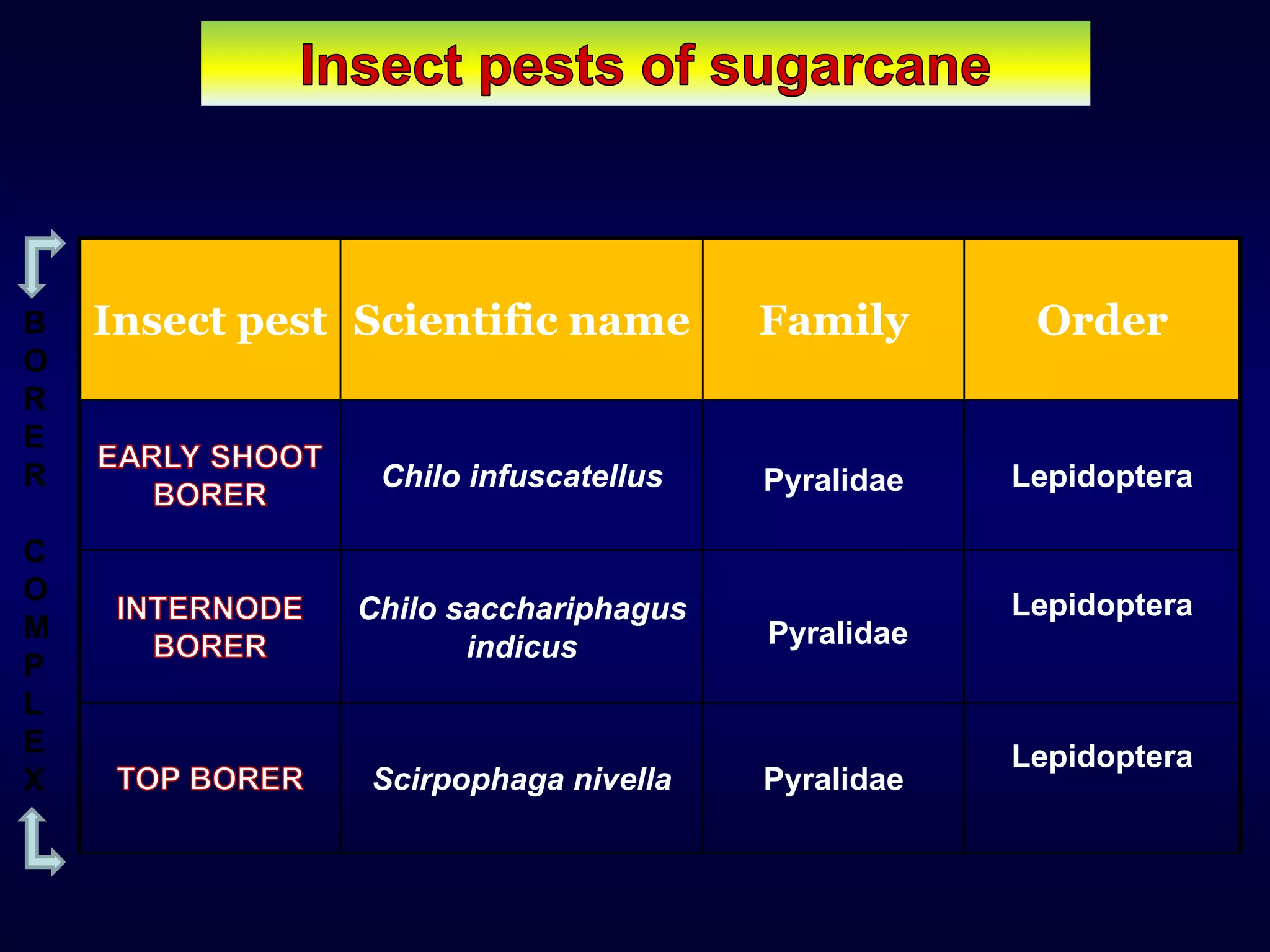
Insect pest Scientific name Family Order
Chilo infuscatellus Pyralidae Lepidoptera
Chilo sacchariphagus
indicus Pyralidae
Lepidoptera
Scirpophaga nivella Pyralidae
Lepidoptera
B
O
R
E
R
C
O
M
P
L
E
X
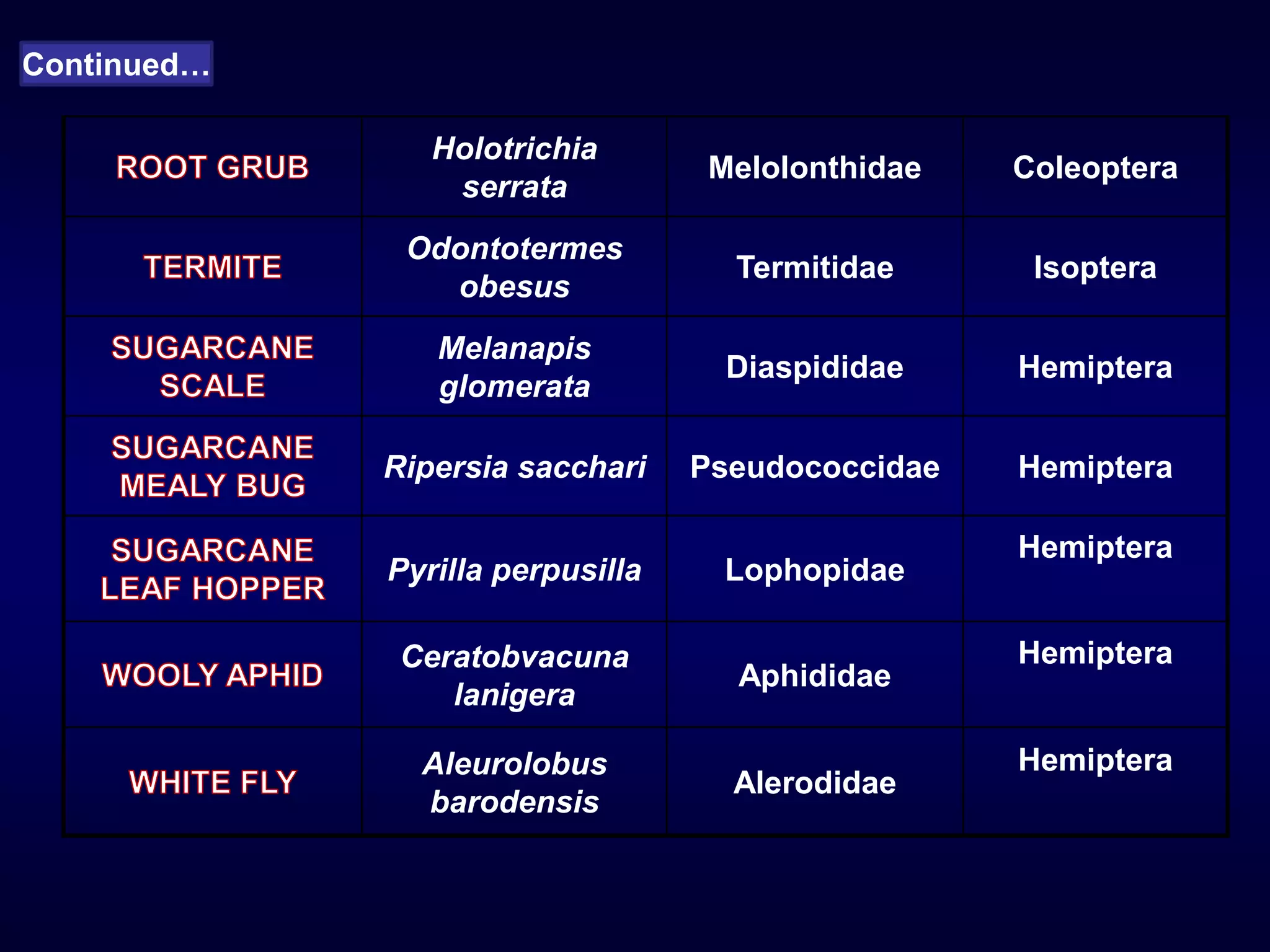
Holotrichia
serrata
Melolonthidae Coleoptera
Odontotermes
obesus
Termitidae Isoptera
Melanapis
glomerata
Diaspididae Hemiptera
Ripersia sacchari Pseudococcidae Hemiptera
Pyrilla perpusilla Lophopidae
Hemiptera
Ceratobvacuna
lanigera
Aphididae
Hemiptera
Aleurolobus
barodensis
Alerodidae
Hemiptera
Continued…
Host range: Pearl millet, oat, barley and maize
Distribution: India, Pakistan, Indonesia, Thiawan,
Philippines, Korea, Afghanistan and Burma.
Systematic position
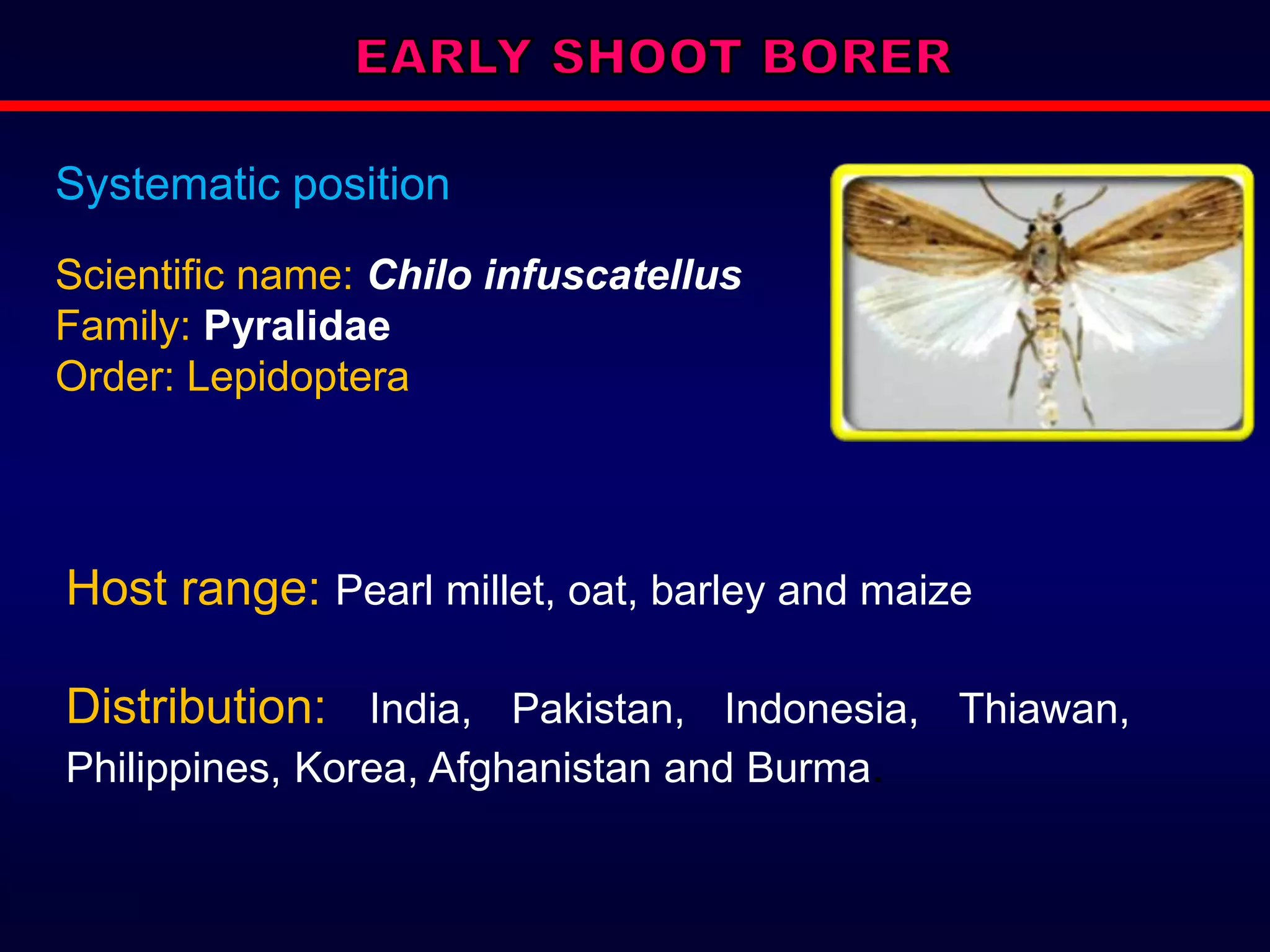
Scientific name: Chilo infuscatellus
Family: Pyralidae
Order: Lepidoptera
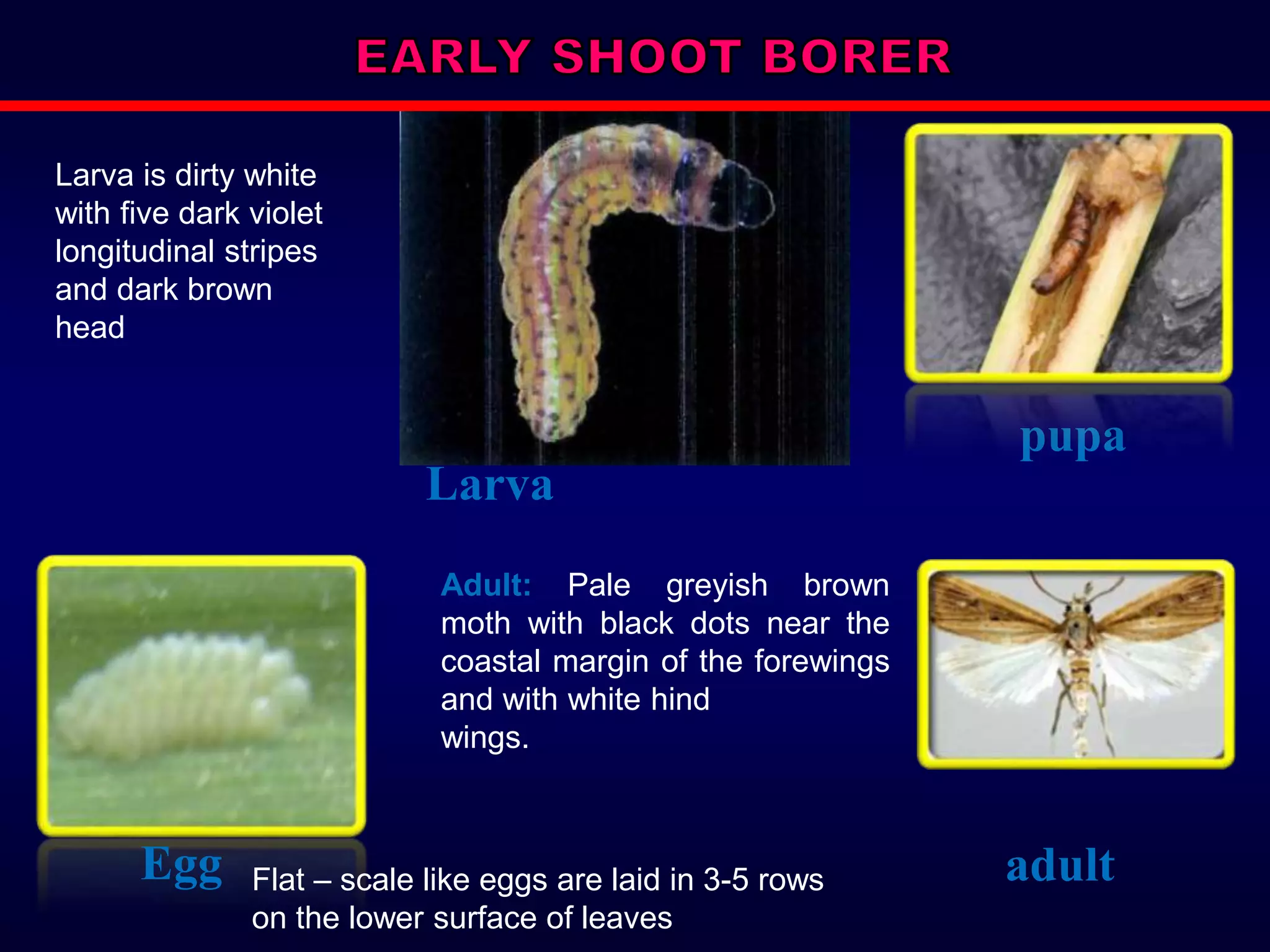
Larva
pupa
adult
Egg Flat – scale like eggs are laid in 3-5 rows
on the lower surface of leaves
Larva is dirty white
with five dark violet
longitudinal stripes
and dark brown
head
Adult: Pale greyish brown
moth with black dots near the
coastal margin of the forewings
and with white hind
wings.
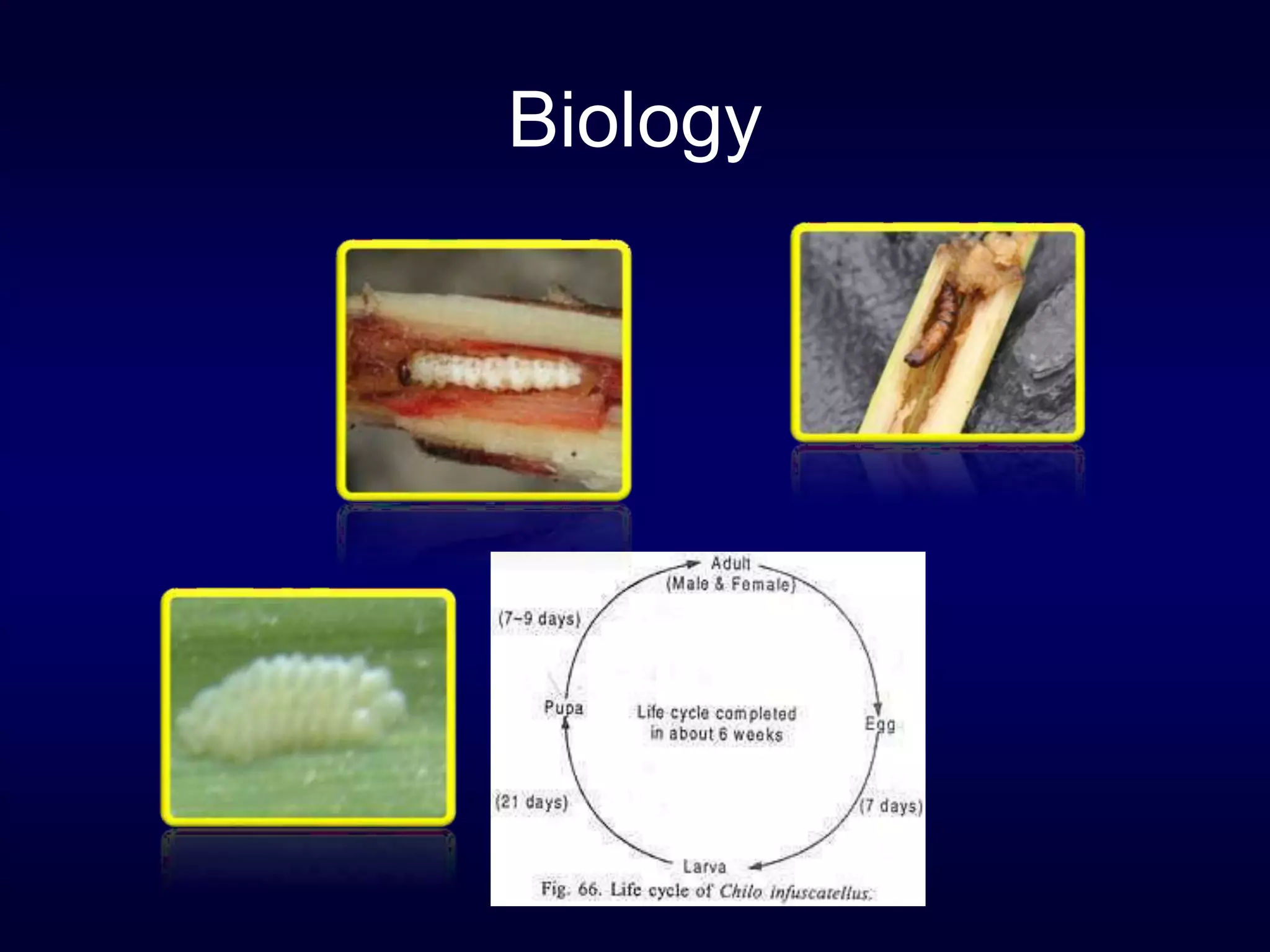
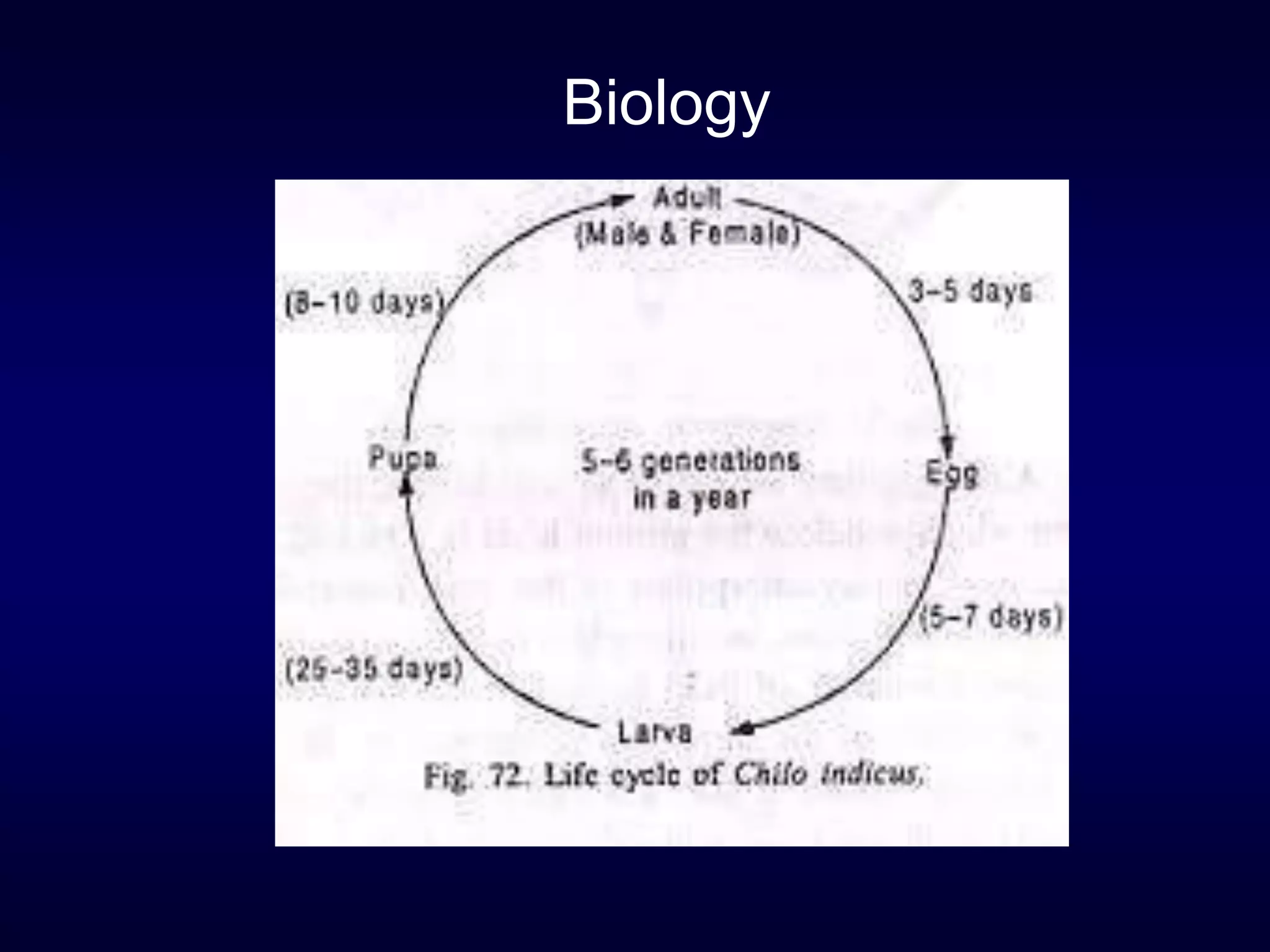
Biology
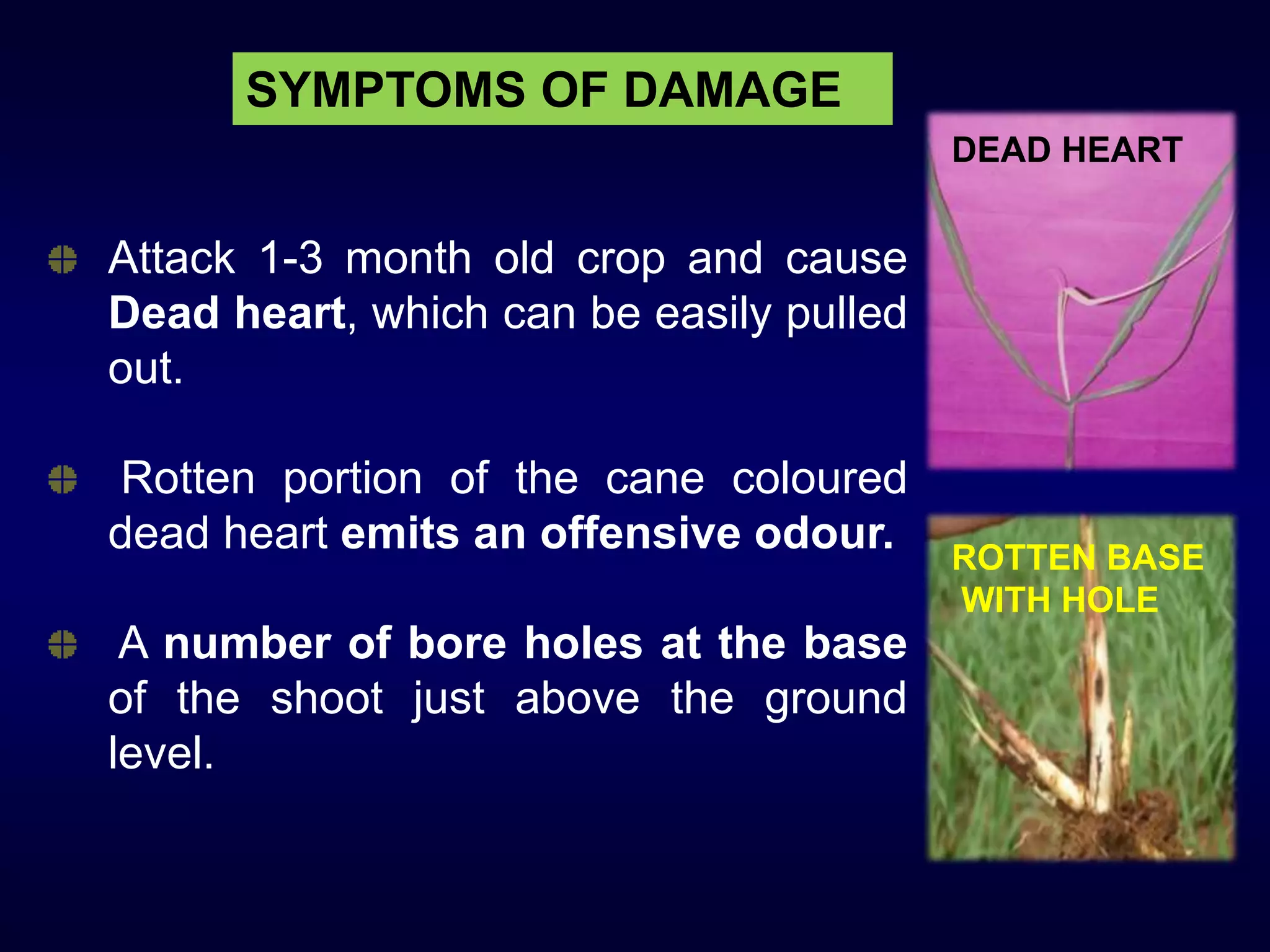
Attack 1-3 month old crop and cause
Dead heart, which can be easily pulled
out.
Rotten portion of the cane coloured
dead heart emits an offensive odour.
A number of bore holes at the base
of the shoot just above the ground
level.
DEAD HEART
ROTTEN BASE
WITH HOLE
SYMPTOMS OF DAMAGE
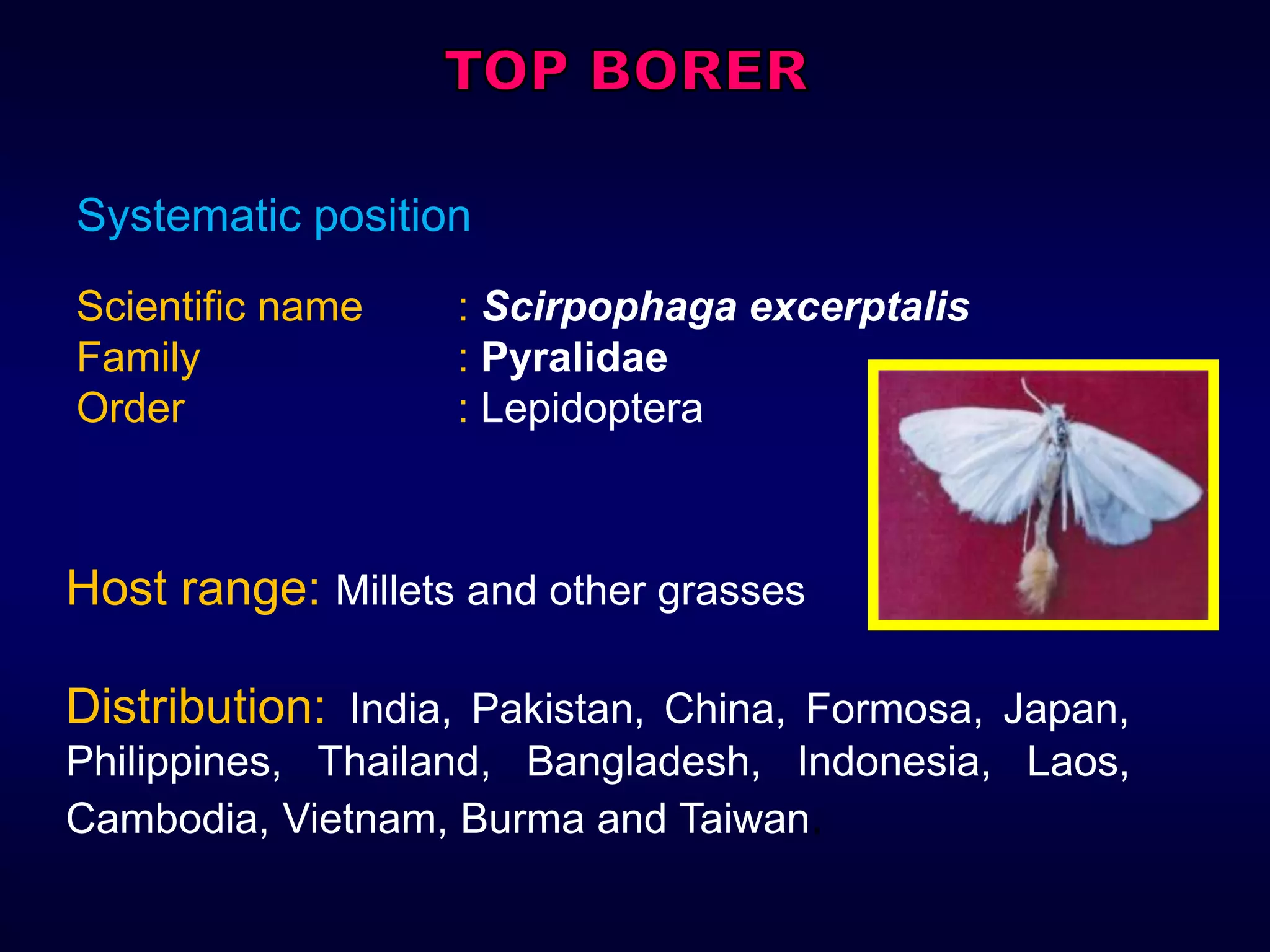
Systematic position
Scientific name : Scirpophaga excerptalis
Family : Pyralidae
Order : Lepidoptera
Host range: Millets and other grasses
Distribution: India, Pakistan, China, Formosa, Japan,
Philippines, Thailand, Bangladesh, Indonesia, Laos,
Cambodia, Vietnam, Burma and Taiwan.
Biology
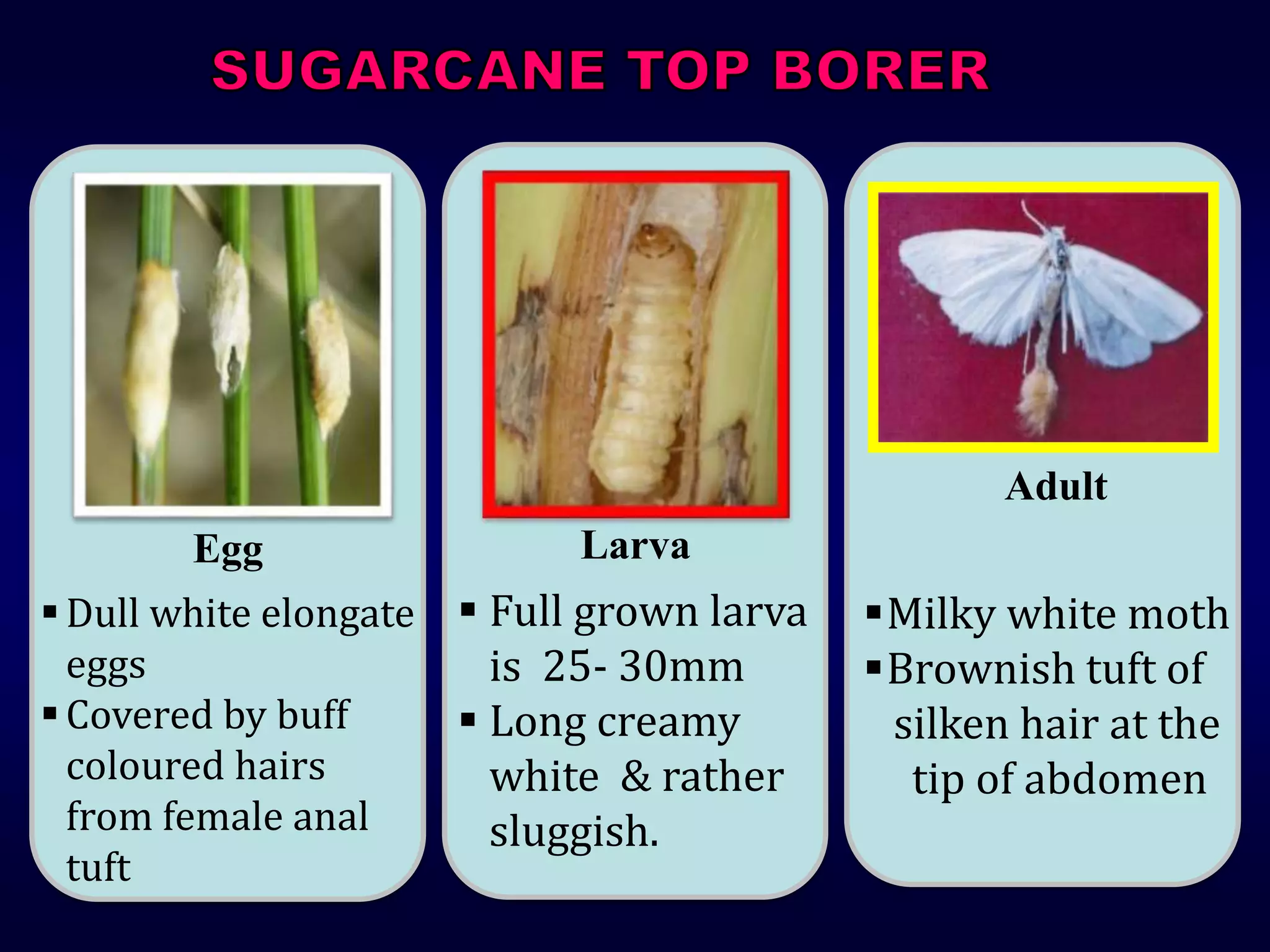
Adult
Larva
Egg
Milky white moth
Brownish tuft of
silken hair at the
tip of abdomen
 Full grown larva
is 25- 30mm
 Long creamy
white & rather
sluggish.
Adult
Dull white elongate
eggs
Covered by buff
coloured hairs
from female anal
tuft
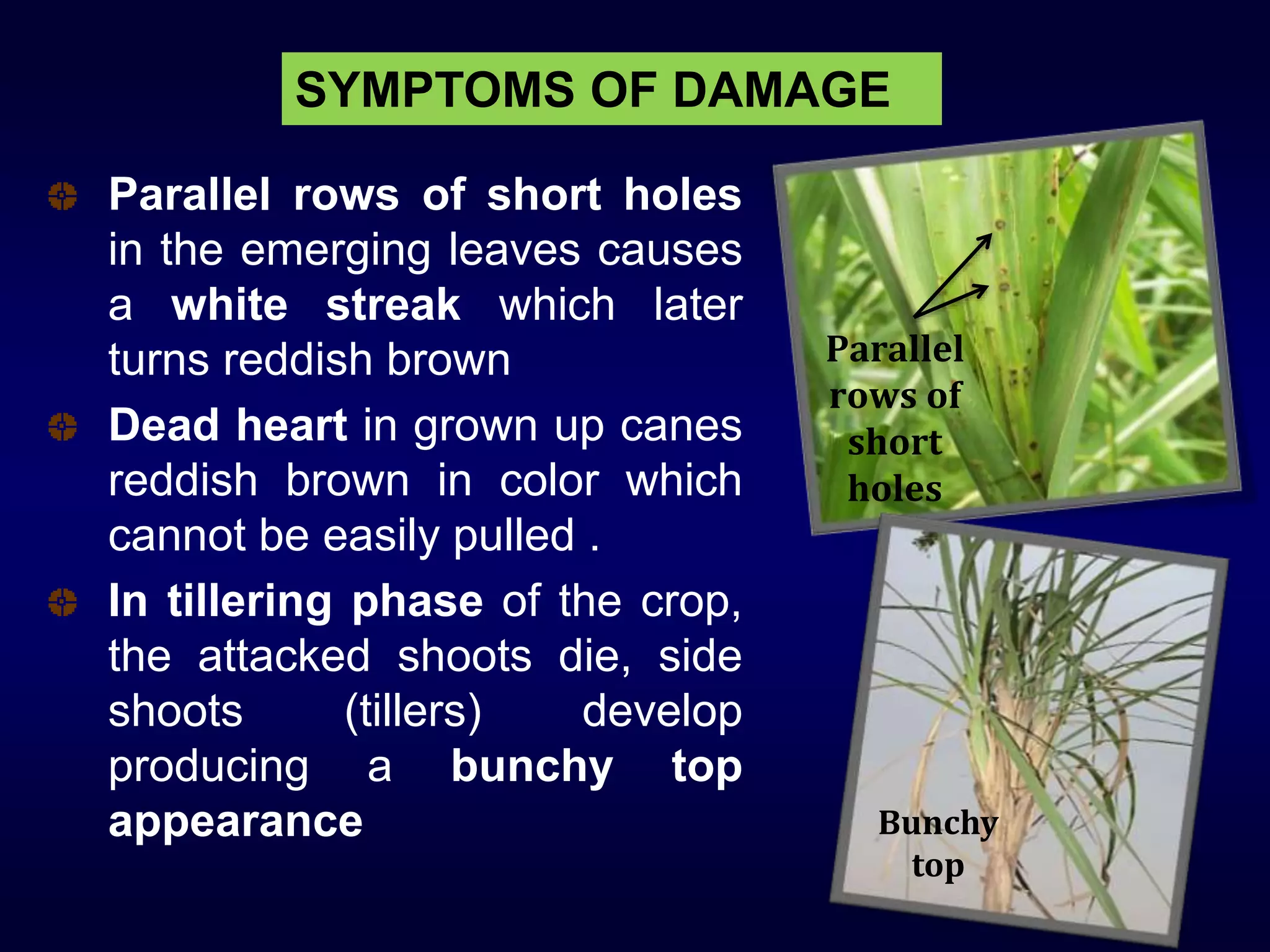
SYMPTOMS OF DAMAGE
Parallel rows of short holes
in the emerging leaves causes
a white streak which later
turns reddish brown
Dead heart in grown up canes
reddish brown in color which
cannot be easily pulled .
In tillering phase of the crop,
the attacked shoots die, side
shoots (tillers) develop
producing a bunchy top
appearance Bunchy
top
Parallel
rows of
short
holes
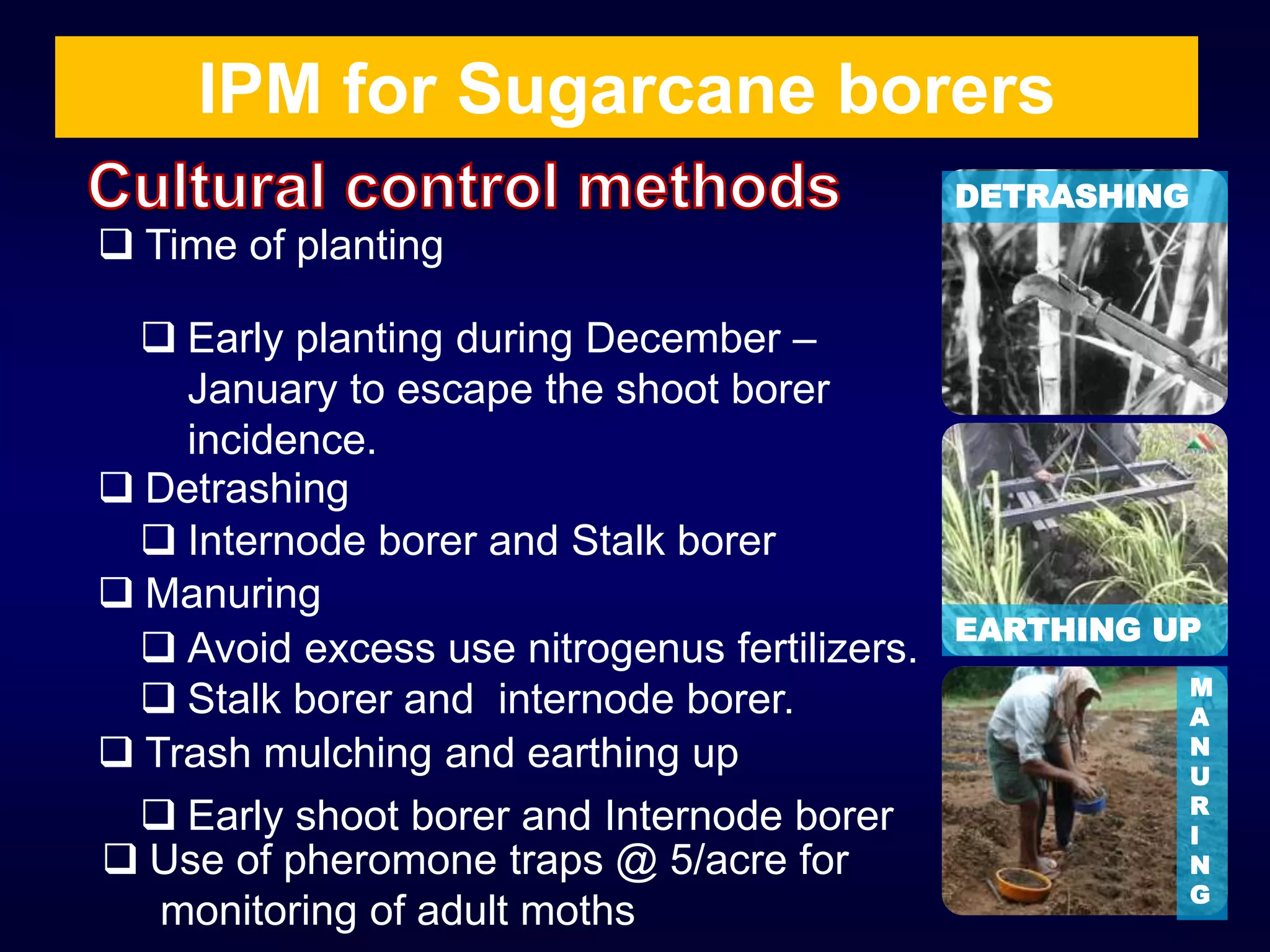
 Time of planting
 Early planting during December –
January to escape the shoot borer
incidence.
 Manuring
 Avoid excess use nitrogenus fertilizers.
 Stalk borer and internode borer.
 Trash mulching and earthing up
 Early shoot borer and Internode borer
 Detrashing
 Internode borer and Stalk borer
IPM for Sugarcane borers
EARTHING UP
DETRASHING
M
A
N
U
R
I
N
G
 Use of pheromone traps @ 5/acre for
monitoring of adult moths
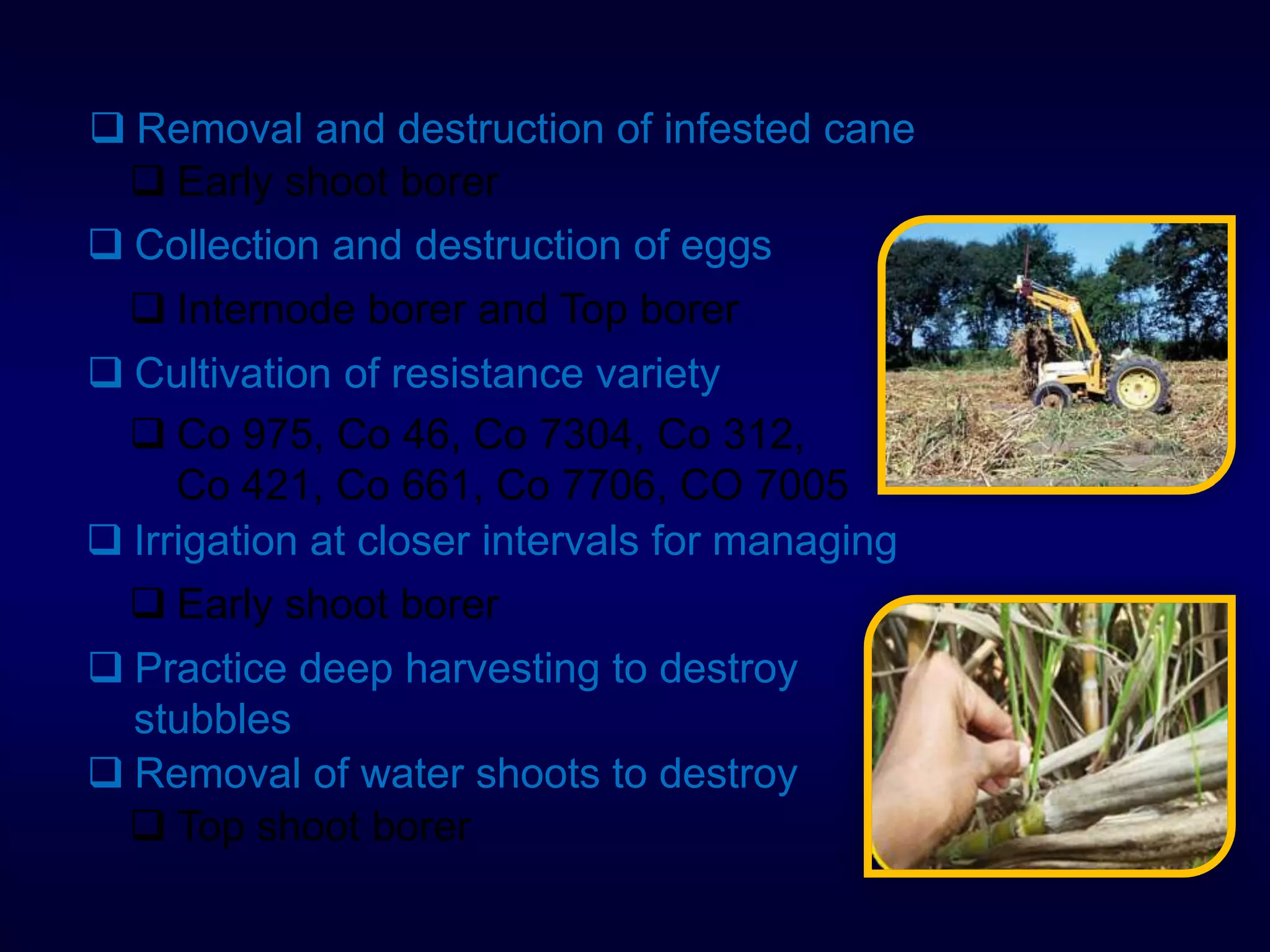
 Removal and destruction of infested cane
 Early shoot borer
 Collection and destruction of eggs
 Internode borer and Top borer
 Cultivation of resistance variety
 Co 975, Co 46, Co 7304, Co 312,
Co 421, Co 661, Co 7706, CO 7005
 Irrigation at closer intervals for managing
 Practice deep harvesting to destroy
stubbles
 Early shoot borer
 Removal of water shoots to destroy
 Top shoot borer
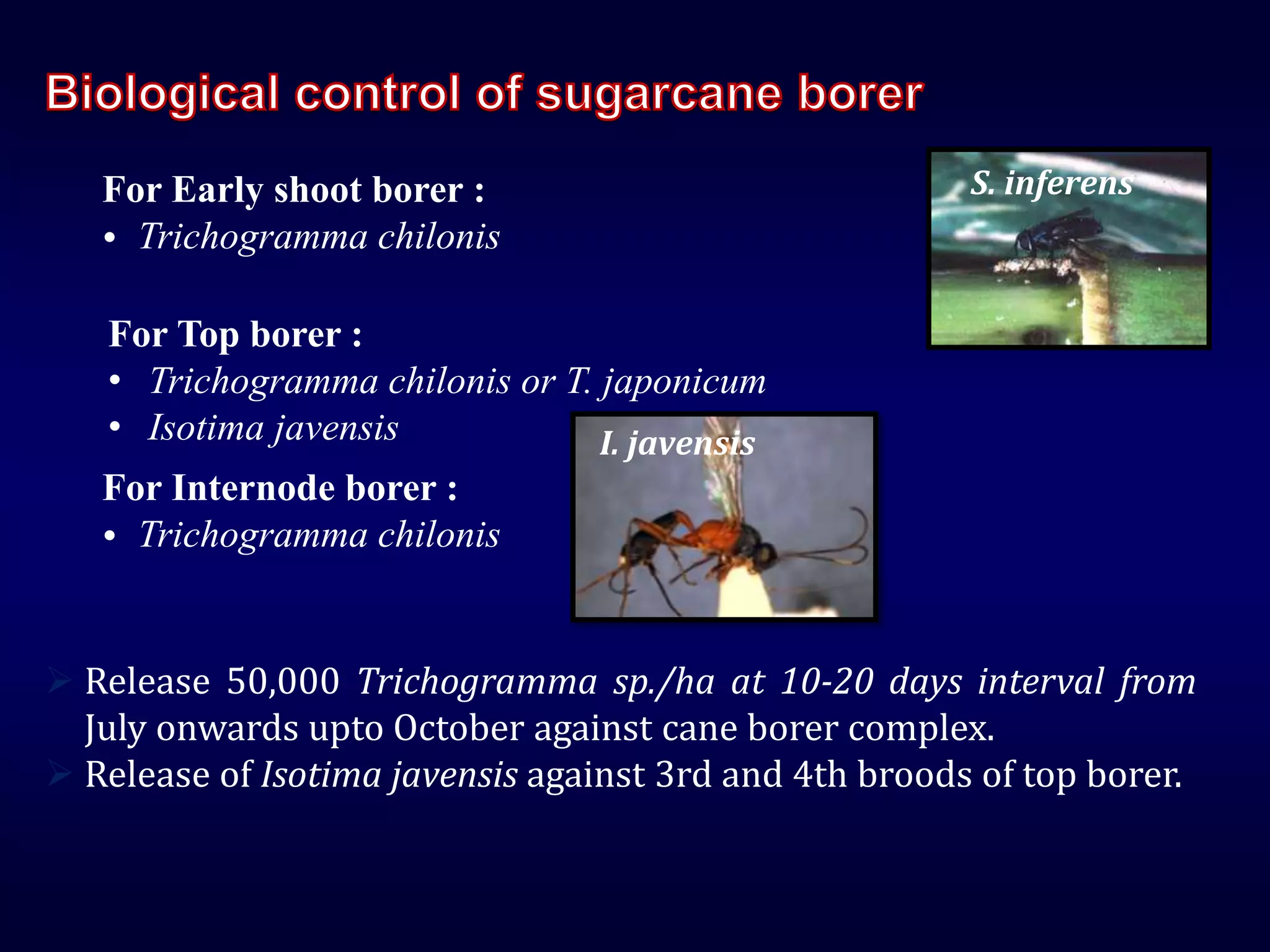
For Early shoot borer :
• Trichogramma chilonis
For Internode borer :
• Trichogramma chilonis
For Top borer :
• Trichogramma chilonis or T. japonicum
• Isotima javensis
 Release 50,000 Trichogramma sp./ha at 10-20 days interval from
July onwards upto October against cane borer complex.
 Release of Isotima javensis against 3rd and 4th broods of top borer.
S. inferens
I. javensis
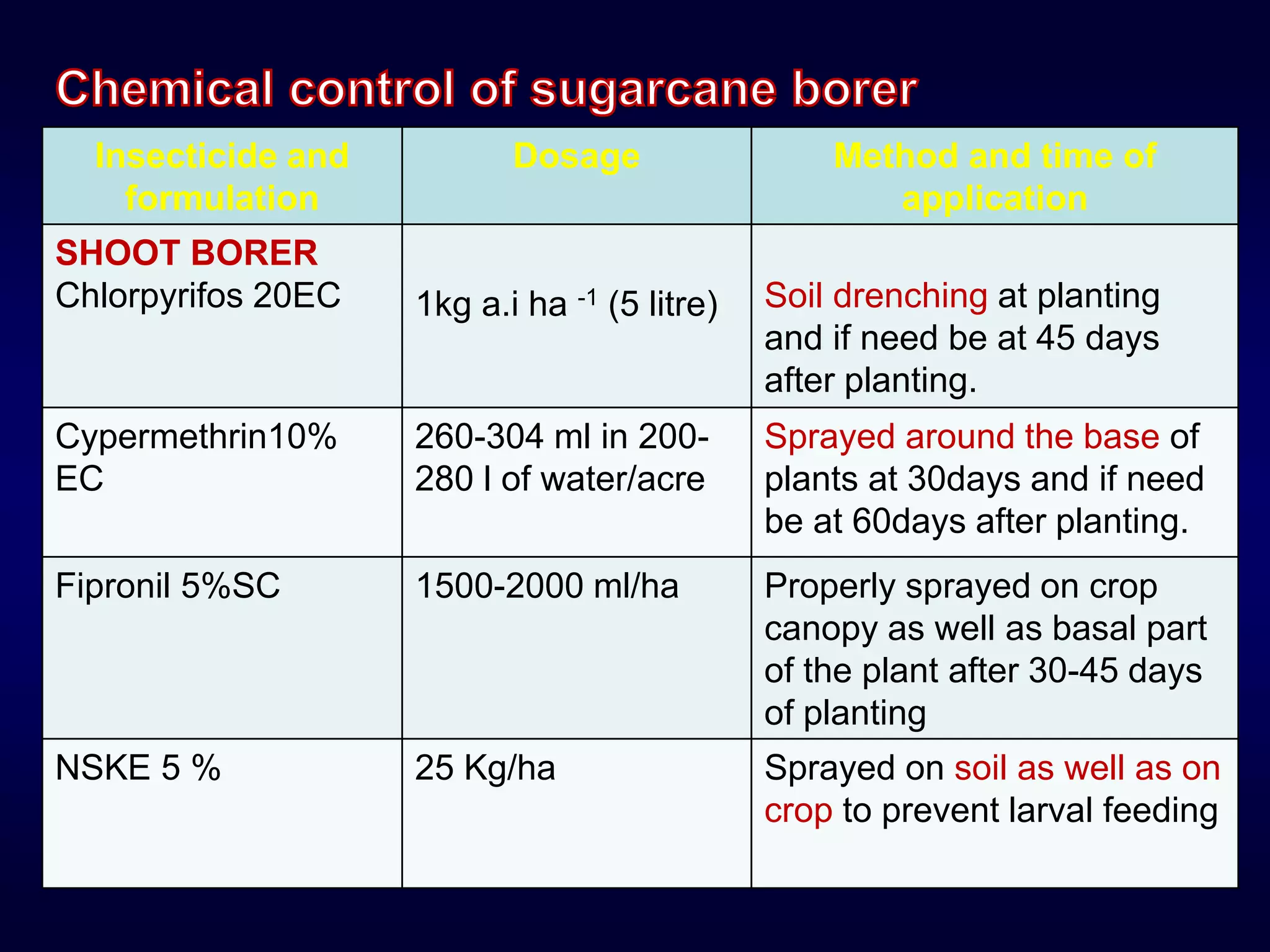
Insecticide and
formulation
Dosage Method and time of
application
SHOOT BORER
Chlorpyrifos 20EC 1kg a.i ha -1 (5 litre) Soil drenching at planting
and if need be at 45 days
after planting.
Cypermethrin10%
EC
260-304 ml in 200-
280 l of water/acre
Sprayed around the base of
plants at 30days and if need
be at 60days after planting.
Fipronil 5%SC 1500-2000 ml/ha Properly sprayed on crop
canopy as well as basal part
of the plant after 30-45 days
of planting
NSKE 5 % 25 Kg/ha Sprayed on soil as well as on
crop to prevent larval feeding
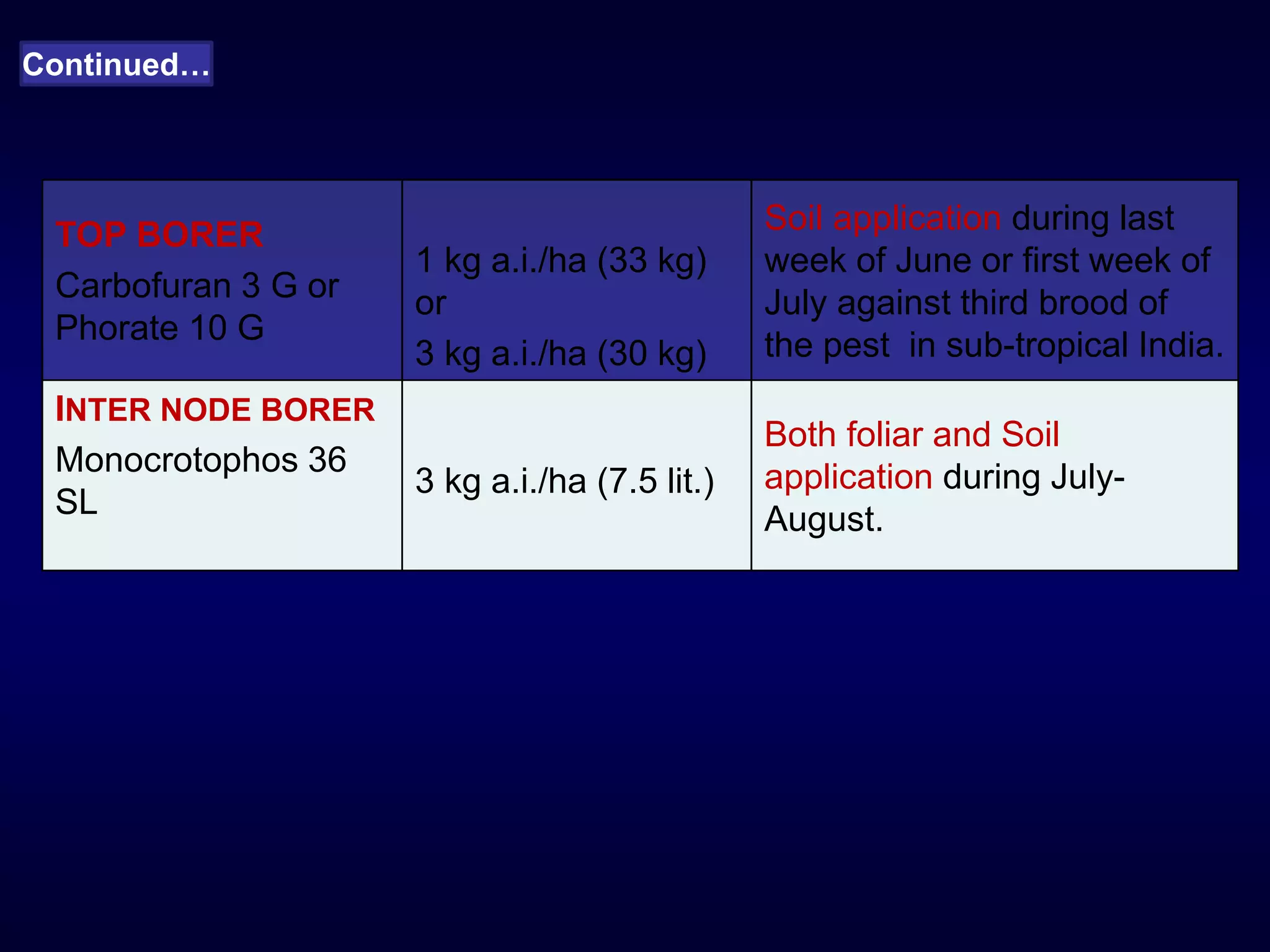
TOP BORER
Carbofuran 3 G or
Phorate 10 G
1 kg a.i./ha (33 kg)
or
3 kg a.i./ha (30 kg)
Soil application during last
week of June or first week of
July against third brood of
the pest in sub-tropical India.
INTER NODE BORER
Monocrotophos 36
SL
3 kg a.i./ha (7.5 lit.)
Both foliar and Soil
application during July-
August.
Continued…
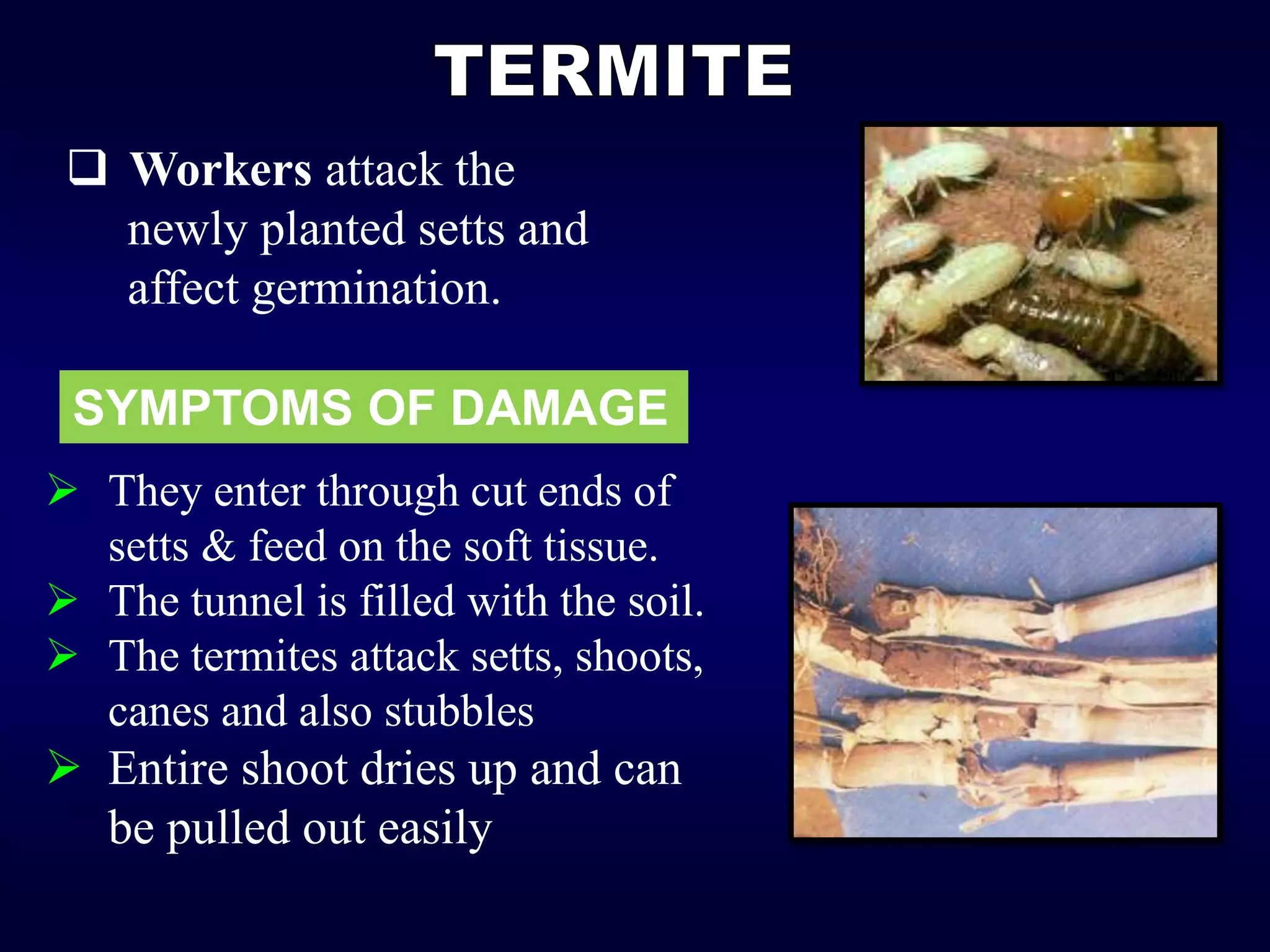
 Workers attack the
newly planted setts and
affect germination.
 They enter through cut ends of
setts & feed on the soft tissue.
 The tunnel is filled with the soil.
 The termites attack setts, shoots,
canes and also stubbles
 Entire shoot dries up and can
be pulled out easily
SYMPTOMS OF DAMAGE
The use of partially decomposed manure should be
avoided
Locate and destroy the termite colony near by field
Irrigation water with crude oil emulsion.
 The removal of decaying organic matters cow dung,
wood or dry stubbles from the field.
 Setts treatment with Imidacloprid (0.1%) or
Chlorpyriphos 20 EC 0.04 % for 5 min.
 Application of well rotten Neem cake manure @ 60
Cartloads/ ha.
Spray Chlorpyriphos 20%EC 750 ml/ha
IPM strategy for Termite
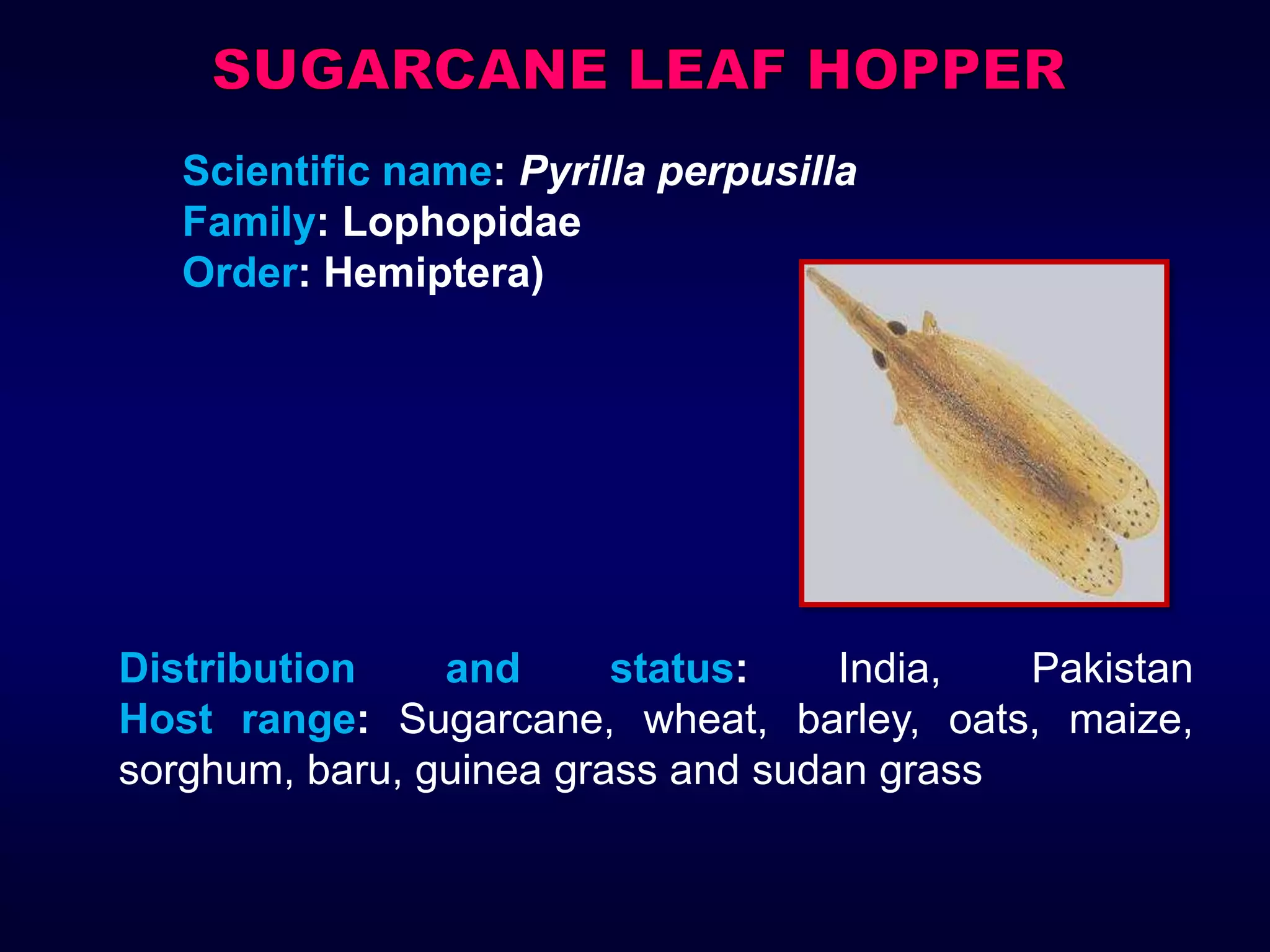
Scientific name: Pyrilla perpusilla
Family: Lophopidae
Order: Hemiptera)
Distribution and status: India, Pakistan
Host range: Sugarcane, wheat, barley, oats, maize,
sorghum, baru, guinea grass and sudan grass
Bionomics
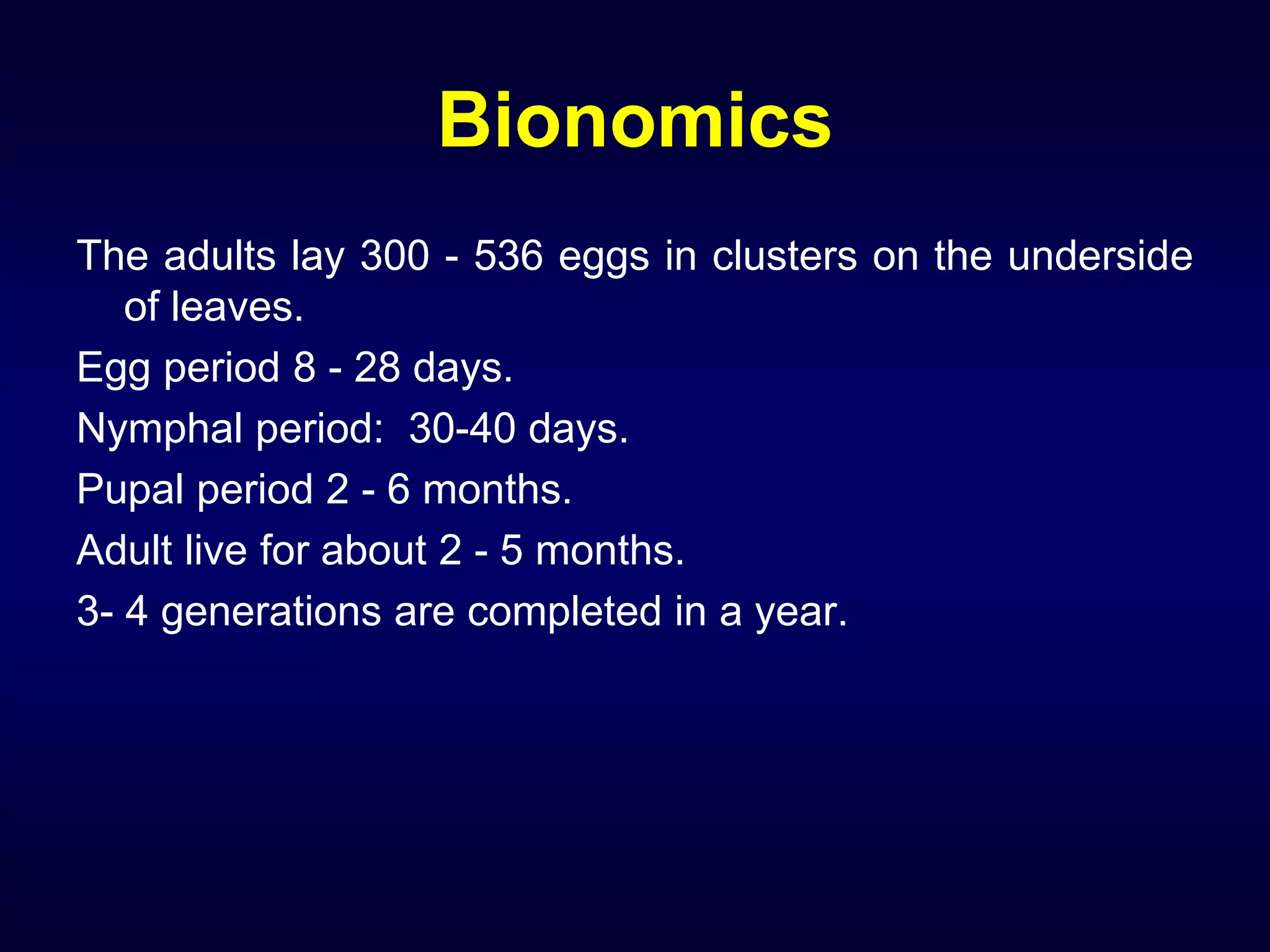
The adults lay 300 - 536 eggs in clusters on the underside
of leaves.
Egg period 8 - 28 days.
Nymphal period: 30-40 days.
Pupal period 2 - 6 months.
Adult live for about 2 - 5 months.
3- 4 generations are completed in a year.
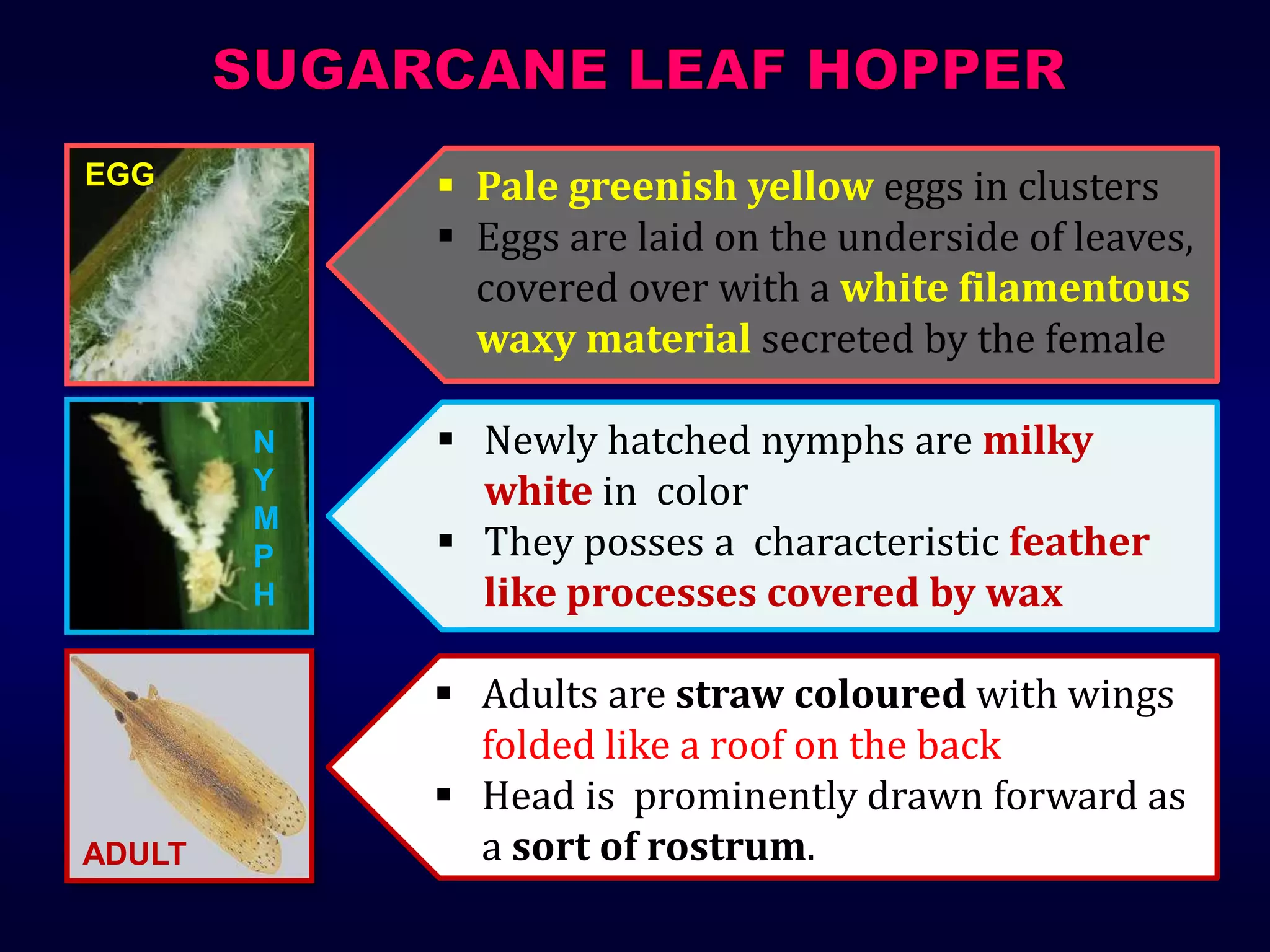
 Pale greenish yellow eggs in clusters
 Eggs are laid on the underside of leaves,
covered over with a white filamentous
waxy material secreted by the female
 Newly hatched nymphs are milky
white in color
 They posses a characteristic feather
like processes covered by wax
 Adults are straw coloured with wings
folded like a roof on the back
 Head is prominently drawn forward as
a sort of rostrum.
EGG
N
Y
M
P
H
ADULT
SYMPTOMS OF DAMAGE
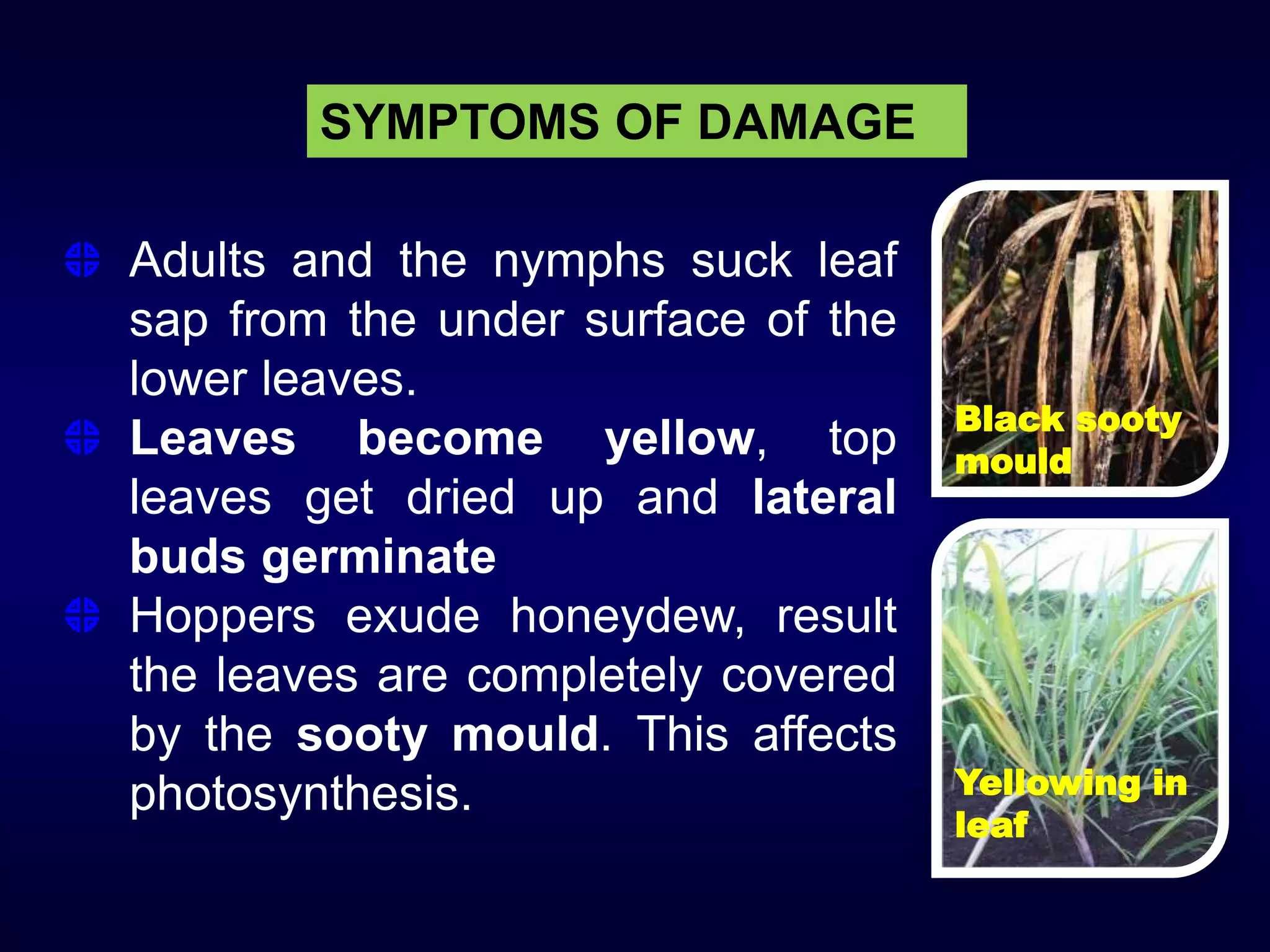
Adults and the nymphs suck leaf
sap from the under surface of the
lower leaves.
Leaves become yellow, top
leaves get dried up and lateral
buds germinate
Hoppers exude honeydew, result
the leaves are completely covered
by the sooty mould. This affects
photosynthesis.
Black sooty
mould
Yellowing in
leaf
 Burn trashes after harvesting canes
 Remove lower leaves bearing egg cluster.
 Ratooning should be avoided
 Balance Nitrogen should be applied.
 Dust malathion 5% @ 40kg/ha. or
Spray malathion 50 EC @ 1.25kga.i./ha.
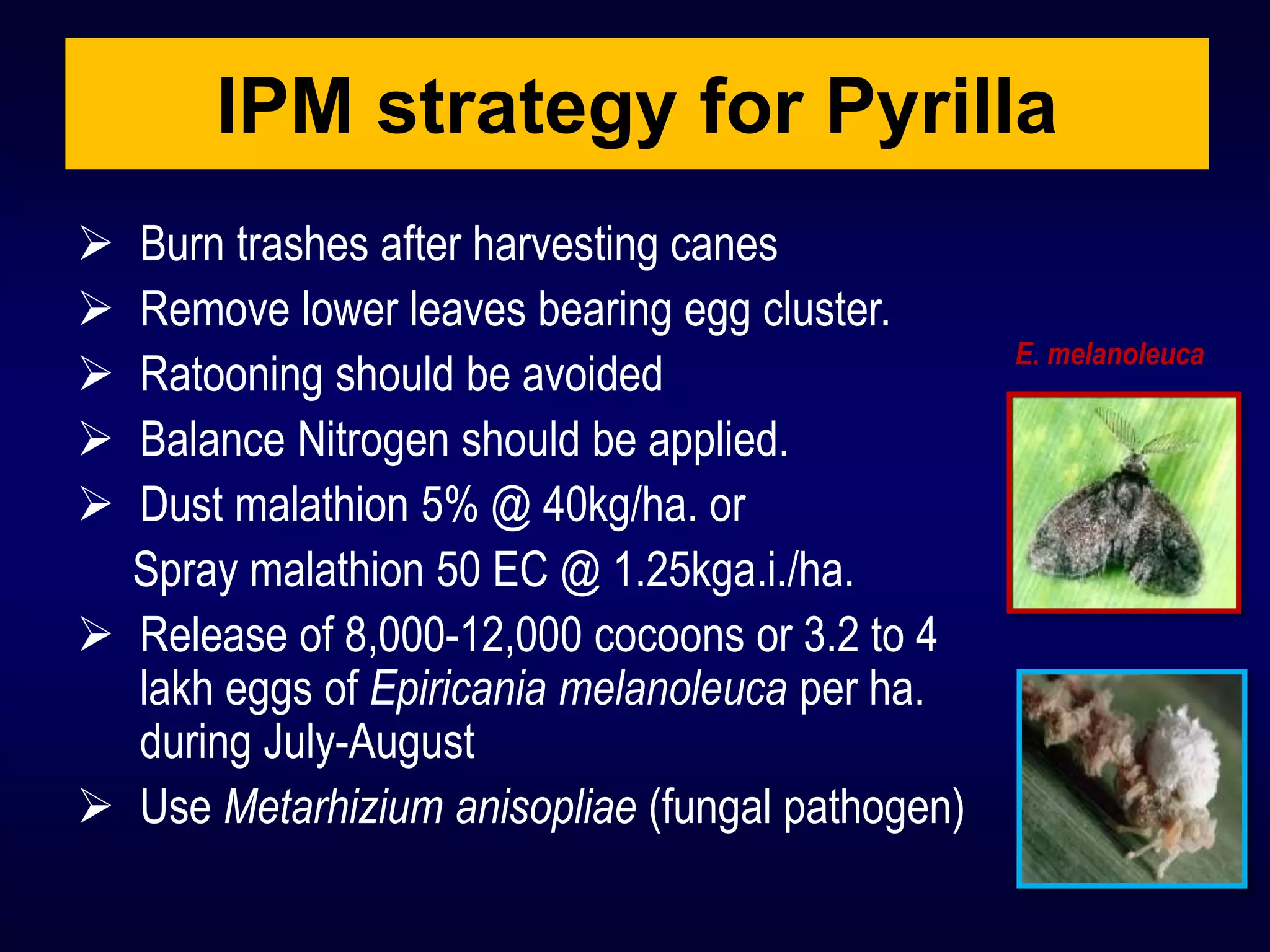
 Release of 8,000-12,000 cocoons or 3.2 to 4
lakh eggs of Epiricania melanoleuca per ha.
during July-August
 Use Metarhizium anisopliae (fungal pathogen)
IPM strategy for Pyrilla
E. melanoleuca
 Nymphs and adults feed by sucking
the juice and cause shrivelling up
and stunting of canes.
 Nodal region is more infested than
internodal region.
 Infested crop losses its vigour, canes
shrivel, non-opening of leaves &
ultimately cane dries up
 Such canes when slit open appear
brownish red
SYMPTOMS OF DAMAGE
Node
Melanaspis glomerata (Diaspididae:
Hemiptera)
 Stripping of cane leaves may minimize attack
 Select and plant the scale insect free setts
 Avoid water stagnation for the longer period
 Detrash the crop at 150th and 210th day of planting.
 Give hot water treatment before planting
 Presoak the setts in 0.1% solution Malathion 50 EC
 Spray 1.25 litres of Malathion 50 EC or 2 litres of
Di-methoate 30 EC in 1250 litres of water per ha
 Spray methyl demeton 25 EC @ 2ml/lit of water
IPM strategy for Sugarcane Scale
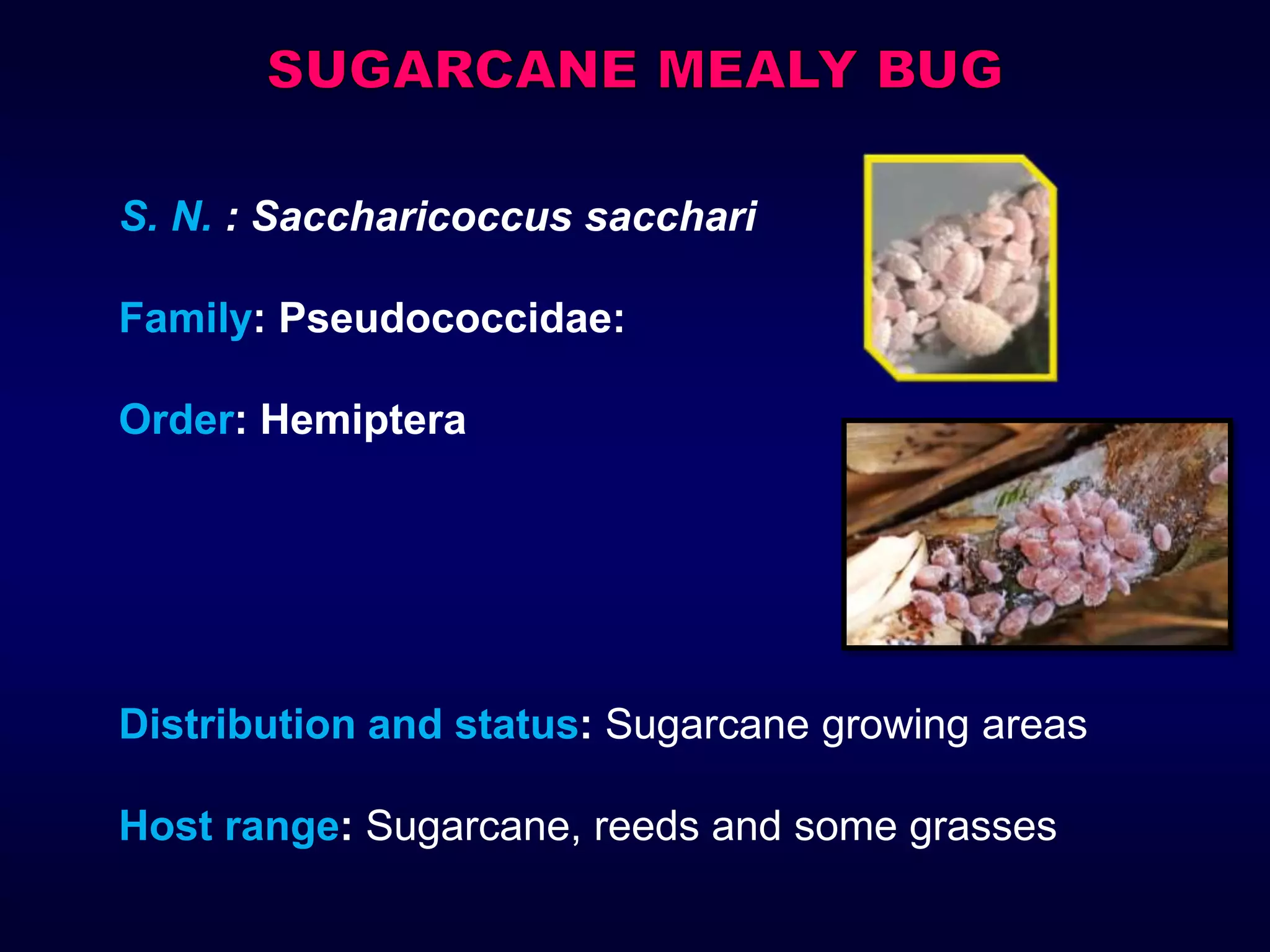
S. N. : Saccharicoccus sacchari
Family: Pseudococcidae:
Order: Hemiptera
Distribution and status: Sugarcane growing areas
Host range: Sugarcane, reeds and some grasses
SYMPTOMS OF DAMAGE
Pinkish oval insects beneath leaf
sheath & on the nodes, with whitish
waxy coating.
 Nymph and adult suck juice from cane in group
& reduces vigour of the plant
 It also attack roots
 Honey dew secretion leads to development of
Sooty mould which gives blackish appearance
to canes.
IPM strategy for Sugarcane Mealy bug
 Use resistant varieties like CO 439, CO 443, CO 720, CO 730
 Drain excess water from the field
 Detrash the crop on 150 and 210 Days After Planting.
 Apply methyl parathion 50 EC 1000 ml.
 Rubbing of setts with gunny bag pieces dipped in Malathion
(0.1% solution.)
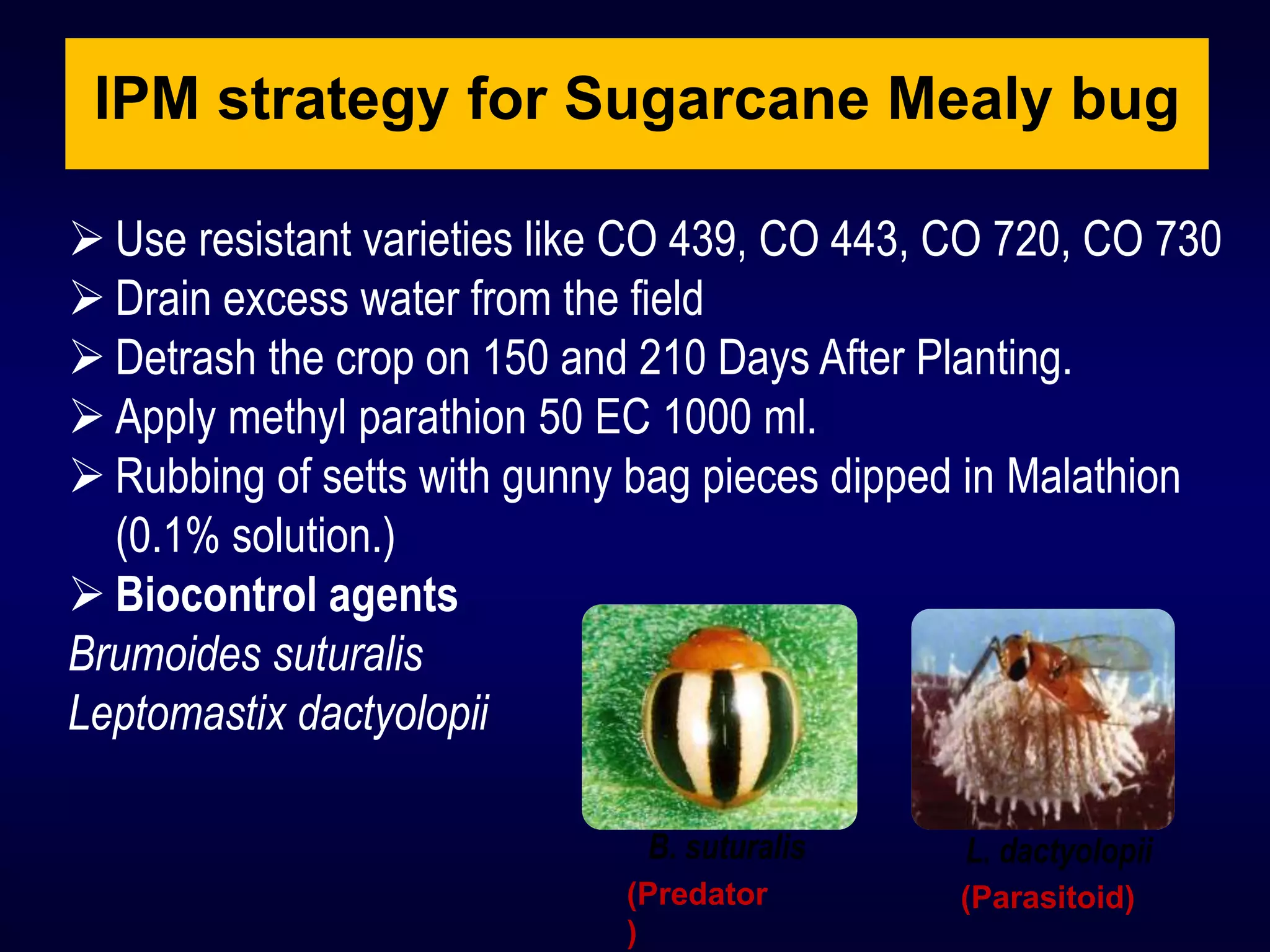
 Biocontrol agents
Brumoides suturalis
Leptomastix dactyolopii
B. suturalis L. dactyolopii
(Predator
)
(Parasitoid)
Lec. 7 rkp pcgm_sugarcane

Lec. 7 rkp pcgm_sugarcane

  • 1.
    R.K. Panse Asstt. Prof.(Entomology) Lecture no. 7 INSECT PESTS OF SUGARCANE Subject: Pests of crop and stored grain and their Management
  • 2.
    INTRODUCTION There are approximately288 insects that infest sugarcane of which about 24 of them cause heavy losses in quality as well as in quantity. Long growth duration that sugarcane crop needs, it is extremely vulnerable to insect pests, some estimates suggest that 20.0% is the actual decline in production due to pests.
  • 3.
    Insect pest Scientificname Family Order Chilo infuscatellus Pyralidae Lepidoptera Chilo sacchariphagus indicus Pyralidae Lepidoptera Scirpophaga nivella Pyralidae Lepidoptera B O R E R C O M P L E X
  • 4.
    Holotrichia serrata Melolonthidae Coleoptera Odontotermes obesus Termitidae Isoptera Melanapis glomerata DiaspididaeHemiptera Ripersia sacchari Pseudococcidae Hemiptera Pyrilla perpusilla Lophopidae Hemiptera Ceratobvacuna lanigera Aphididae Hemiptera Aleurolobus barodensis Alerodidae Hemiptera Continued…
  • 5.
    Host range: Pearlmillet, oat, barley and maize Distribution: India, Pakistan, Indonesia, Thiawan, Philippines, Korea, Afghanistan and Burma. Systematic position Scientific name: Chilo infuscatellus Family: Pyralidae Order: Lepidoptera
  • 6.
    Larva pupa adult Egg Flat –scale like eggs are laid in 3-5 rows on the lower surface of leaves Larva is dirty white with five dark violet longitudinal stripes and dark brown head Adult: Pale greyish brown moth with black dots near the coastal margin of the forewings and with white hind wings.
  • 7.
  • 8.
    Attack 1-3 monthold crop and cause Dead heart, which can be easily pulled out. Rotten portion of the cane coloured dead heart emits an offensive odour. A number of bore holes at the base of the shoot just above the ground level. DEAD HEART ROTTEN BASE WITH HOLE SYMPTOMS OF DAMAGE
  • 9.
    Systematic position Scientific name: Scirpophaga excerptalis Family : Pyralidae Order : Lepidoptera Host range: Millets and other grasses Distribution: India, Pakistan, China, Formosa, Japan, Philippines, Thailand, Bangladesh, Indonesia, Laos, Cambodia, Vietnam, Burma and Taiwan.
  • 10.
  • 11.
    Adult Larva Egg Milky white moth Brownishtuft of silken hair at the tip of abdomen  Full grown larva is 25- 30mm  Long creamy white & rather sluggish. Adult Dull white elongate eggs Covered by buff coloured hairs from female anal tuft
  • 12.
    SYMPTOMS OF DAMAGE Parallelrows of short holes in the emerging leaves causes a white streak which later turns reddish brown Dead heart in grown up canes reddish brown in color which cannot be easily pulled . In tillering phase of the crop, the attacked shoots die, side shoots (tillers) develop producing a bunchy top appearance Bunchy top Parallel rows of short holes
  • 13.
     Time ofplanting  Early planting during December – January to escape the shoot borer incidence.  Manuring  Avoid excess use nitrogenus fertilizers.  Stalk borer and internode borer.  Trash mulching and earthing up  Early shoot borer and Internode borer  Detrashing  Internode borer and Stalk borer IPM for Sugarcane borers EARTHING UP DETRASHING M A N U R I N G  Use of pheromone traps @ 5/acre for monitoring of adult moths
  • 14.
     Removal anddestruction of infested cane  Early shoot borer  Collection and destruction of eggs  Internode borer and Top borer  Cultivation of resistance variety  Co 975, Co 46, Co 7304, Co 312, Co 421, Co 661, Co 7706, CO 7005  Irrigation at closer intervals for managing  Practice deep harvesting to destroy stubbles  Early shoot borer  Removal of water shoots to destroy  Top shoot borer
  • 15.
    For Early shootborer : • Trichogramma chilonis For Internode borer : • Trichogramma chilonis For Top borer : • Trichogramma chilonis or T. japonicum • Isotima javensis  Release 50,000 Trichogramma sp./ha at 10-20 days interval from July onwards upto October against cane borer complex.  Release of Isotima javensis against 3rd and 4th broods of top borer. S. inferens I. javensis
  • 16.
    Insecticide and formulation Dosage Methodand time of application SHOOT BORER Chlorpyrifos 20EC 1kg a.i ha -1 (5 litre) Soil drenching at planting and if need be at 45 days after planting. Cypermethrin10% EC 260-304 ml in 200- 280 l of water/acre Sprayed around the base of plants at 30days and if need be at 60days after planting. Fipronil 5%SC 1500-2000 ml/ha Properly sprayed on crop canopy as well as basal part of the plant after 30-45 days of planting NSKE 5 % 25 Kg/ha Sprayed on soil as well as on crop to prevent larval feeding
  • 17.
    TOP BORER Carbofuran 3G or Phorate 10 G 1 kg a.i./ha (33 kg) or 3 kg a.i./ha (30 kg) Soil application during last week of June or first week of July against third brood of the pest in sub-tropical India. INTER NODE BORER Monocrotophos 36 SL 3 kg a.i./ha (7.5 lit.) Both foliar and Soil application during July- August. Continued…
  • 18.
     Workers attackthe newly planted setts and affect germination.  They enter through cut ends of setts & feed on the soft tissue.  The tunnel is filled with the soil.  The termites attack setts, shoots, canes and also stubbles  Entire shoot dries up and can be pulled out easily SYMPTOMS OF DAMAGE
  • 19.
    The use ofpartially decomposed manure should be avoided Locate and destroy the termite colony near by field Irrigation water with crude oil emulsion.  The removal of decaying organic matters cow dung, wood or dry stubbles from the field.  Setts treatment with Imidacloprid (0.1%) or Chlorpyriphos 20 EC 0.04 % for 5 min.  Application of well rotten Neem cake manure @ 60 Cartloads/ ha. Spray Chlorpyriphos 20%EC 750 ml/ha IPM strategy for Termite
  • 20.
    Scientific name: Pyrillaperpusilla Family: Lophopidae Order: Hemiptera) Distribution and status: India, Pakistan Host range: Sugarcane, wheat, barley, oats, maize, sorghum, baru, guinea grass and sudan grass
  • 21.
    Bionomics The adults lay300 - 536 eggs in clusters on the underside of leaves. Egg period 8 - 28 days. Nymphal period: 30-40 days. Pupal period 2 - 6 months. Adult live for about 2 - 5 months. 3- 4 generations are completed in a year.
  • 22.
     Pale greenishyellow eggs in clusters  Eggs are laid on the underside of leaves, covered over with a white filamentous waxy material secreted by the female  Newly hatched nymphs are milky white in color  They posses a characteristic feather like processes covered by wax  Adults are straw coloured with wings folded like a roof on the back  Head is prominently drawn forward as a sort of rostrum. EGG N Y M P H ADULT
  • 23.
    SYMPTOMS OF DAMAGE Adultsand the nymphs suck leaf sap from the under surface of the lower leaves. Leaves become yellow, top leaves get dried up and lateral buds germinate Hoppers exude honeydew, result the leaves are completely covered by the sooty mould. This affects photosynthesis. Black sooty mould Yellowing in leaf
  • 24.
     Burn trashesafter harvesting canes  Remove lower leaves bearing egg cluster.  Ratooning should be avoided  Balance Nitrogen should be applied.  Dust malathion 5% @ 40kg/ha. or Spray malathion 50 EC @ 1.25kga.i./ha.  Release of 8,000-12,000 cocoons or 3.2 to 4 lakh eggs of Epiricania melanoleuca per ha. during July-August  Use Metarhizium anisopliae (fungal pathogen) IPM strategy for Pyrilla E. melanoleuca
  • 25.
     Nymphs andadults feed by sucking the juice and cause shrivelling up and stunting of canes.  Nodal region is more infested than internodal region.  Infested crop losses its vigour, canes shrivel, non-opening of leaves & ultimately cane dries up  Such canes when slit open appear brownish red SYMPTOMS OF DAMAGE Node Melanaspis glomerata (Diaspididae: Hemiptera)
  • 26.
     Stripping ofcane leaves may minimize attack  Select and plant the scale insect free setts  Avoid water stagnation for the longer period  Detrash the crop at 150th and 210th day of planting.  Give hot water treatment before planting  Presoak the setts in 0.1% solution Malathion 50 EC  Spray 1.25 litres of Malathion 50 EC or 2 litres of Di-methoate 30 EC in 1250 litres of water per ha  Spray methyl demeton 25 EC @ 2ml/lit of water IPM strategy for Sugarcane Scale
  • 27.
    S. N. :Saccharicoccus sacchari Family: Pseudococcidae: Order: Hemiptera Distribution and status: Sugarcane growing areas Host range: Sugarcane, reeds and some grasses
  • 28.
    SYMPTOMS OF DAMAGE Pinkishoval insects beneath leaf sheath & on the nodes, with whitish waxy coating.  Nymph and adult suck juice from cane in group & reduces vigour of the plant  It also attack roots  Honey dew secretion leads to development of Sooty mould which gives blackish appearance to canes.
  • 29.
    IPM strategy forSugarcane Mealy bug  Use resistant varieties like CO 439, CO 443, CO 720, CO 730  Drain excess water from the field  Detrash the crop on 150 and 210 Days After Planting.  Apply methyl parathion 50 EC 1000 ml.  Rubbing of setts with gunny bag pieces dipped in Malathion (0.1% solution.)  Biocontrol agents Brumoides suturalis Leptomastix dactyolopii B. suturalis L. dactyolopii (Predator ) (Parasitoid)