Learning TheoriesBy: Courtney
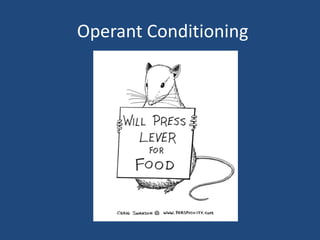
Operant Conditioning
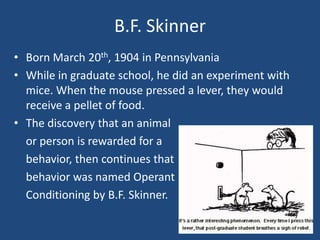
B.F. SkinnerBorn March 20th, 1904 in PennsylvaniaWhile in graduate school, he did an experiment with mice. When the mouse pressed a lever, they would receive a pellet of food. The discovery that an animal or person is rewarded for a behavior, then continues that behavior was named Operant Conditioning by B.F. Skinner.
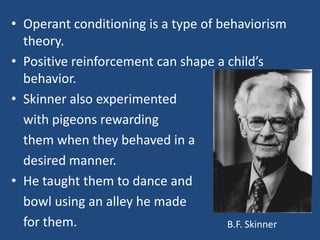
Operant conditioning is a type of behaviorism theory.Positive reinforcement can shape a child’s behavior.  Skinner also experimented with pigeons rewarding them when they behaved in a desired manner. He taught them to dance and bowl using an alley he made for them. B.F. Skinner
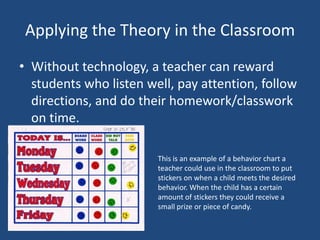
Applying the Theory in the ClassroomWithout technology, a teacher can reward students who listen well, pay attention, follow directions, and do their homework/classwork on time. This is an example of a behavior chart a teacher could use in the classroom to put stickers on when a child meets the desired behavior. When the child has a certain amount of stickers they could receive a small prize or piece of candy.
Using TechnologyIn the classroom a teacher creating a powerpoint quiz can create a “correct” slide and an “incorrect” slide for when the child answers a question correctly or incorrectly. This gives the child positive reinforcement when the student provides the desired behavior (answering the question right). Another way a teacher could use technology is having the child read a book and when they are done reading it, they take a test on the computer. If they pass the test, that gives them “reading points”, which adds up to a prize once the student earns a certain amount.
Student RoleWithout technology a student follows directions, listens, pays attention and are rewarded for this desired behavior. This makes the child want to do more of this behavior and less of the “bad” behavior. With technology, a student taking the powerpoint quiz learns that clicking the right answer results in positive attention, making them want to repeat that action. Also, a student playing software programs reinforce children just like the powerpoint quiz does. It gives the student positive visual and verbal feedback when they give a correct answer allowing the student to understand that behavior is good.
My OpinionI think this theory is a great way to manage your class behavior and to create your lesson plans using technology or without technology. Positively reinforcing students is important to me because it builds self-assurance and self-confidence, while showing them what good behavior entails and good study actions. For example, if a student answers a question correctly from the overhead I will positively reinforce them smiling and telling them “Great job!”, “Wonderful!”, etc. This theory is important for all teachers to understand to be successful.
CreditsImages: http://www.cognitivedesignsolutions.com/Instruction/LearningTheory.htmhttp://blog.aboutbehavior.com/http://www.squidoo.com/HIchildrenhttps://intro2psych.wikispaces.com/chaptereight1?f=printInformation: http://www.cognitivedesignsolutions.com/Instruction/LearningTheory.htm#Skinnerhttp://www.bfskinner.org/BFSkinner/AboutSkinner.html

Learning Theories

  • 1.
  • 2.
  • 3.
    B.F. SkinnerBorn March20th, 1904 in PennsylvaniaWhile in graduate school, he did an experiment with mice. When the mouse pressed a lever, they would receive a pellet of food. The discovery that an animal or person is rewarded for a behavior, then continues that behavior was named Operant Conditioning by B.F. Skinner.
  • 4.
    Operant conditioning isa type of behaviorism theory.Positive reinforcement can shape a child’s behavior. Skinner also experimented with pigeons rewarding them when they behaved in a desired manner. He taught them to dance and bowl using an alley he made for them. B.F. Skinner
  • 5.
    Applying the Theoryin the ClassroomWithout technology, a teacher can reward students who listen well, pay attention, follow directions, and do their homework/classwork on time. This is an example of a behavior chart a teacher could use in the classroom to put stickers on when a child meets the desired behavior. When the child has a certain amount of stickers they could receive a small prize or piece of candy.
  • 6.
    Using TechnologyIn theclassroom a teacher creating a powerpoint quiz can create a “correct” slide and an “incorrect” slide for when the child answers a question correctly or incorrectly. This gives the child positive reinforcement when the student provides the desired behavior (answering the question right). Another way a teacher could use technology is having the child read a book and when they are done reading it, they take a test on the computer. If they pass the test, that gives them “reading points”, which adds up to a prize once the student earns a certain amount.
  • 7.
    Student RoleWithout technologya student follows directions, listens, pays attention and are rewarded for this desired behavior. This makes the child want to do more of this behavior and less of the “bad” behavior. With technology, a student taking the powerpoint quiz learns that clicking the right answer results in positive attention, making them want to repeat that action. Also, a student playing software programs reinforce children just like the powerpoint quiz does. It gives the student positive visual and verbal feedback when they give a correct answer allowing the student to understand that behavior is good.
  • 8.
    My OpinionI thinkthis theory is a great way to manage your class behavior and to create your lesson plans using technology or without technology. Positively reinforcing students is important to me because it builds self-assurance and self-confidence, while showing them what good behavior entails and good study actions. For example, if a student answers a question correctly from the overhead I will positively reinforce them smiling and telling them “Great job!”, “Wonderful!”, etc. This theory is important for all teachers to understand to be successful.
  • 9.