Taking the “work”
out of homework
Presented by:
Dr. Yul D. Whitney
School Psychologist
1
Perceptions of Homework
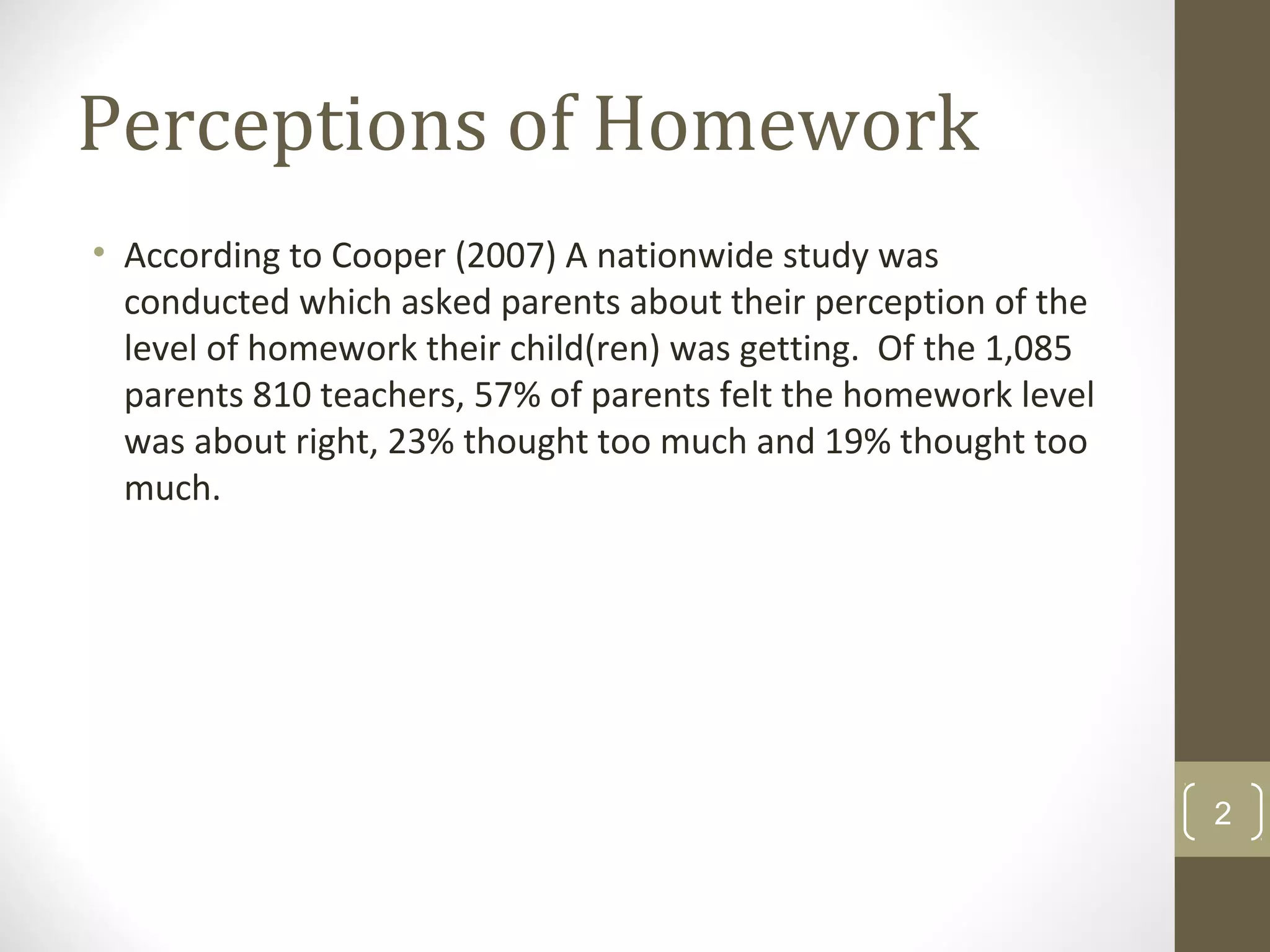
• According to Cooper (2007) A nationwide study was
conducted which asked parents about their perception of the
level of homework their child(ren) was getting. Of the 1,085
parents 810 teachers, 57% of parents felt the homework level
was about right, 23% thought too much and 19% thought too
much.
2
Teacher Perceptions
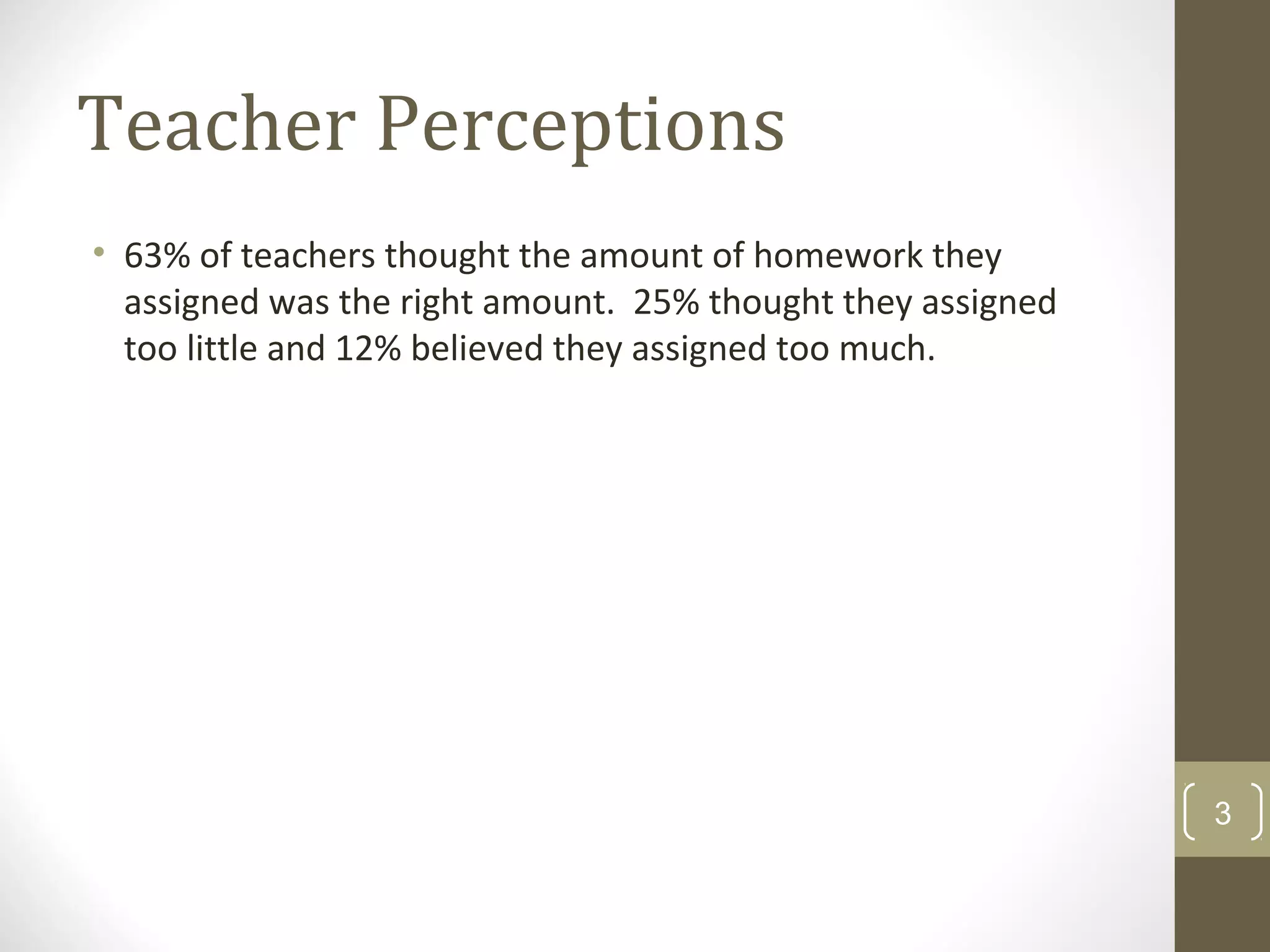
• 63% of teachers thought the amount of homework they
assigned was the right amount. 25% thought they assigned
too little and 12% believed they assigned too much.
3
Do children have more homework
than before?
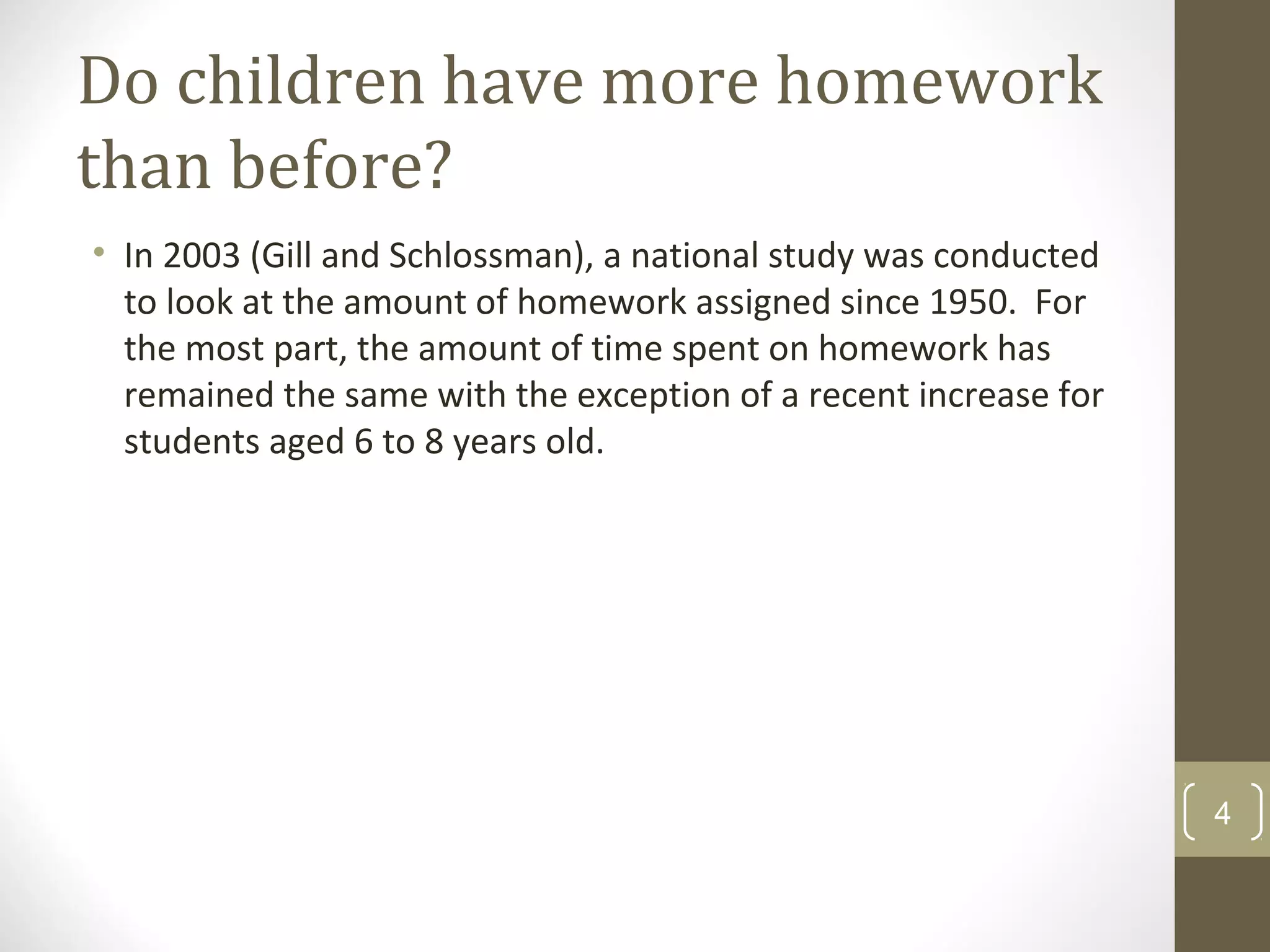
• In 2003 (Gill and Schlossman), a national study was conducted
to look at the amount of homework assigned since 1950. For
the most part, the amount of time spent on homework has
remained the same with the exception of a recent increase for
students aged 6 to 8 years old.
4
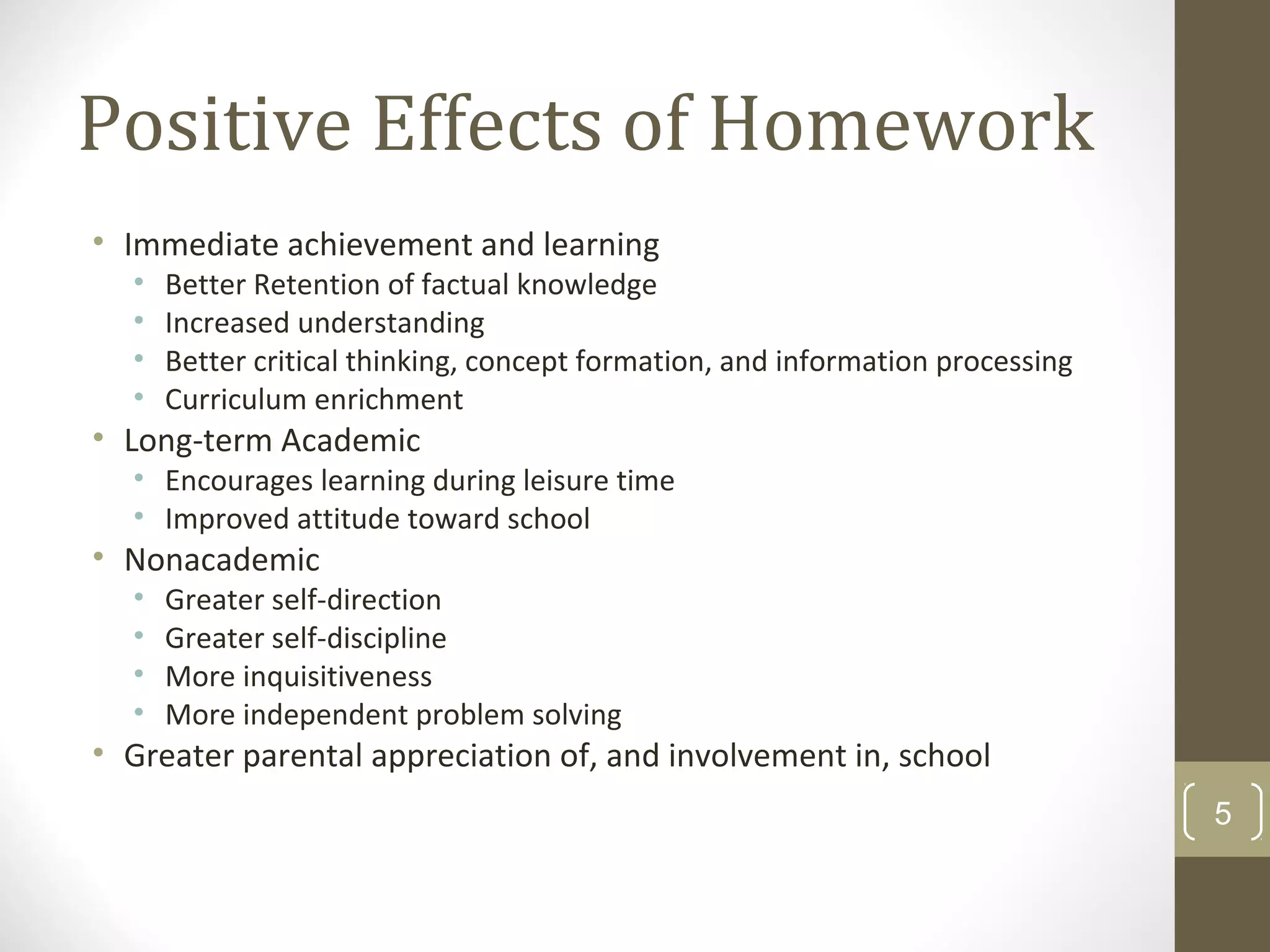
Positive Effects of Homework
• Immediate achievement and learning
• Better Retention of factual knowledge
• Increased understanding
• Better critical thinking, concept formation, and information processing
• Curriculum enrichment
• Long-term Academic
• Encourages learning during leisure time
• Improved attitude toward school
• Nonacademic
• Greater self-direction
• Greater self-discipline
• More inquisitiveness
• More independent problem solving
• Greater parental appreciation of, and involvement in, school
5
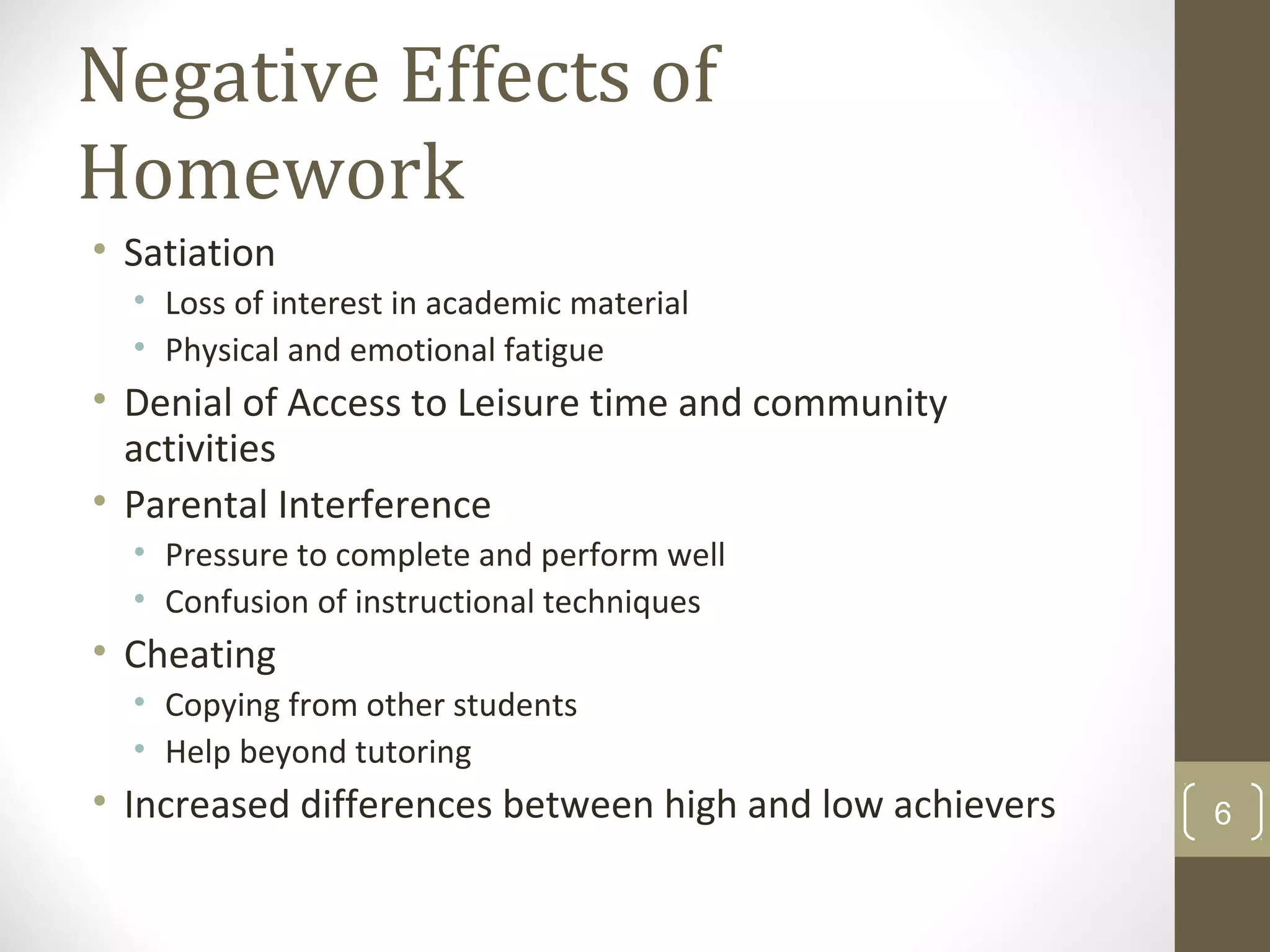
Negative Effects of
Homework
• Satiation
• Loss of interest in academic material
• Physical and emotional fatigue
• Denial of Access to Leisure time and community
activities
• Parental Interference
• Pressure to complete and perform well
• Confusion of instructional techniques
• Cheating
• Copying from other students
• Help beyond tutoring
• Increased differences between high and low achievers 6
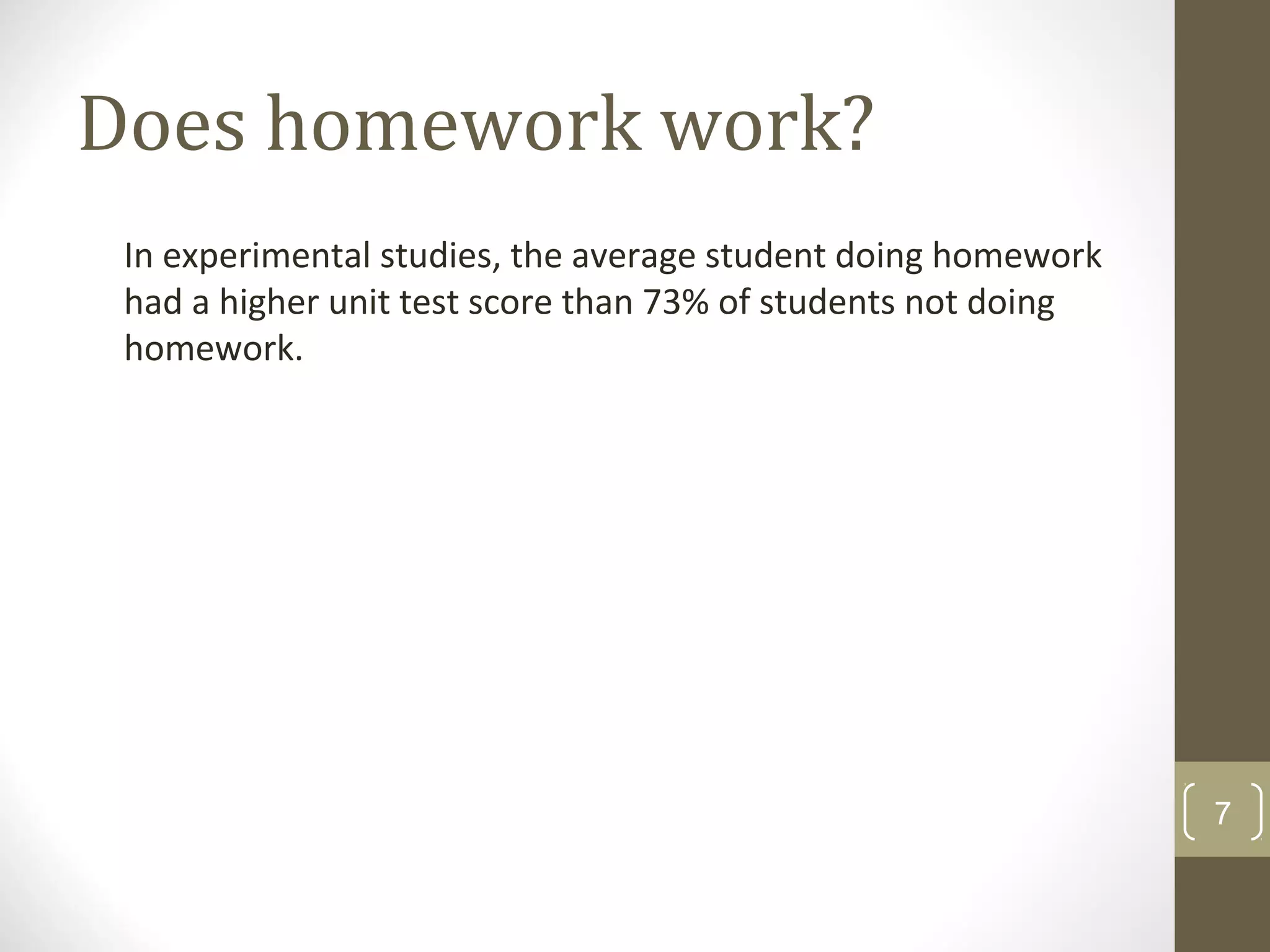
Does homework work?
In experimental studies, the average student doing homework
had a higher unit test score than 73% of students not doing
homework.
7
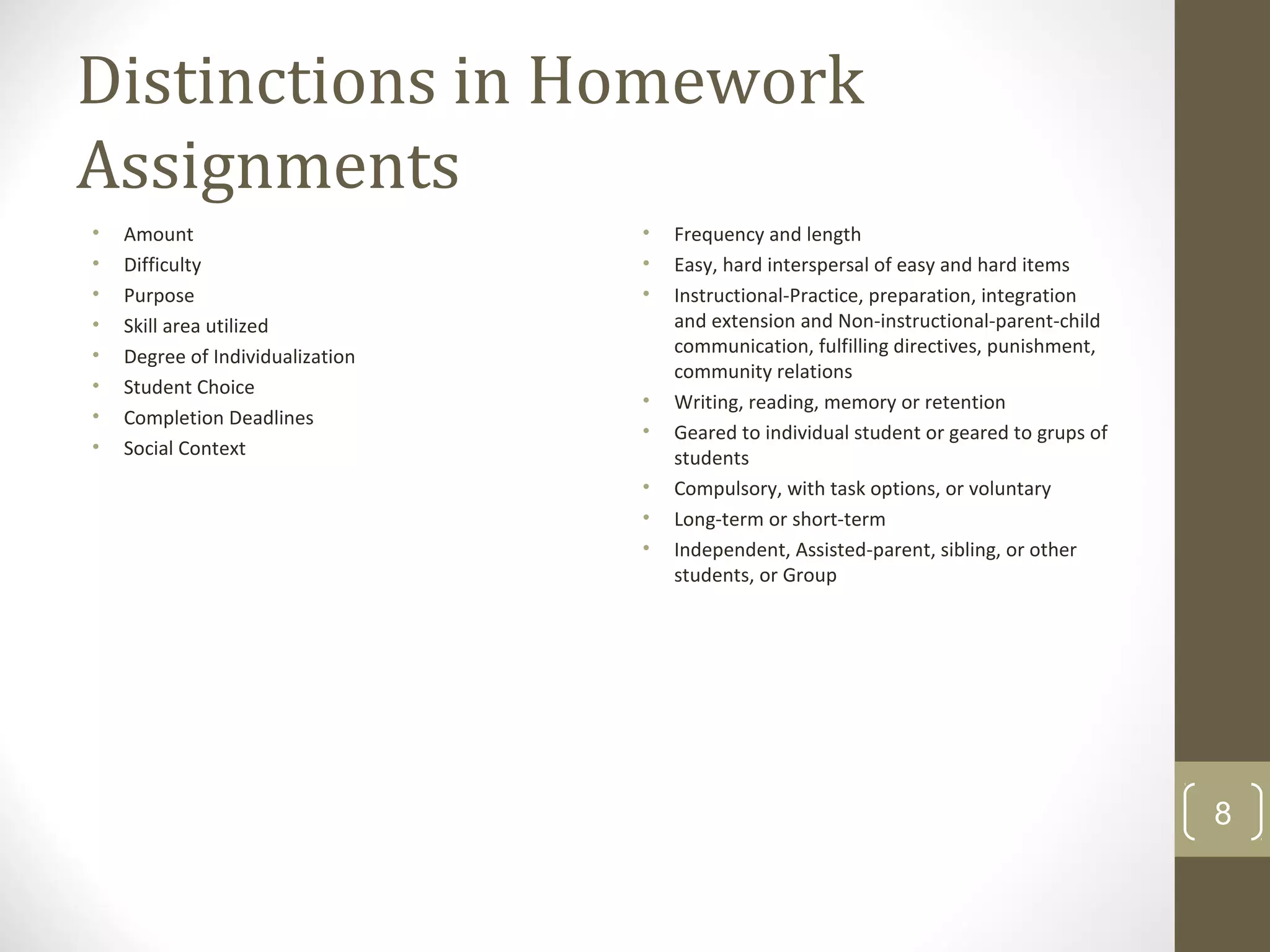
Distinctions in Homework
Assignments
• Amount
• Difficulty
• Purpose
• Skill area utilized
• Degree of Individualization
• Student Choice
• Completion Deadlines
• Social Context
• Frequency and length
• Easy, hard interspersal of easy and hard items
• Instructional-Practice, preparation, integration
and extension and Non-instructional-parent-child
communication, fulfilling directives, punishment,
community relations
• Writing, reading, memory or retention
• Geared to individual student or geared to grups of
students
• Compulsory, with task options, or voluntary
• Long-term or short-term
• Independent, Assisted-parent, sibling, or other
students, or Group
8
Instructional Purposes for
Homework
• Practice
• Preparation
• Extension
• Skill integration
9
Should Special Education
Students Have Homework?
• Studies have shown that the positive effects of homework for
general education students are also positive for students with
special needs. However, research also shows that homework
assignments are more difficult for students with learning
disabilities.
10
Reasons for increased difficulty
for homework completion
• The same level material might be more challenging
• Learning disabilities are accompanied by other deficits in
attention, memory, or organizational skills that are necessary
for successful homework completion.
11
Methods to overcome these issues
• Homework assignments should be short and should focus on
reinforcement of skills and class lessons as opposed to
integrating different skill areas or extending class lessons into
new domains.
12
Teacher assistance with
successful homework completion
• Use a portion of the class time to begin homework to ensure
the student knows how to do it.
• Frequent contact between teachers and parents to make sure
parents understand assignments and things are running
smoothly.
• Prompt in-class review
• Use of rewards for completion or accuracy
13
Parent assistance with successful
homework completion
• Creation of a proper physical environment
• Creation of a proper emotional environment (physical and
emotional)
14
Physical environment
• Comfortable place
• Well-lit location
• A clutter-free area
• A place for all of the necessary tools to complete homework
15
Emotional Environment
• Expectations
• Consistency
• Reinforcement
• Punishment
16
Grandma’s Rule
• The following are examples of Grandma’s Rule.
See if you can figure it out.
• “You can play ball when you finish your
homework”
• “Eat your vegetables and then you can have
some pie”
• “Take your bath and then you can have some
cookies.
• “You can go out to play after you have taken out
the trash 17
Grandma’s Rule
• You do what I want you to do, before you get to do what you
want to do.
• To teach a child to carry out his/her responsibilities, require
the less preferred activity to come before the more preferred
activity (fun).
• Activities a child likes to do can be used to reinforce things a
child cares less about.
18
Rule
19
To make some event (such as praise, a checkmark
on a chart, or money) a reinforcer, closely follow
in time such events with something that is
currently reinforcing to the child.
Kinds of Reinforcers and
Punishers
• Unlearned reinforcers and Punishers
Unlearned reinforcers include such things as food,
candy, toy, water, warmth, activity, and the like.
Events such as these will usually strengthen
behaviors they follow without having to be
paired with an effective reinforcer.
Unlearned Punishers include such events as loud
noises, pain-producing events, excessive heat or
cold, and the like. Unpleasant events such as
these will usually weaken behaviors they follow
without having to be associated with an effective
punisher at first. 20
Learned reinforcers and
Punishers
Events which at first have no effect on behavior
can become reinforcers or punishers.
Praise from parents like “good job,” “that’s pretty
good” become reinforcers for most children if
they are closely followed in time by other “good
things” (food, warmth, affection, special
privileges, fun activites).
Similarly, words like “No,” “Don’t,” “Stop that”
become punishers if they are closely followed by
a slap on the wrist, a spanking or a loss of
privileges. 21
When to reinforce?
• There are three rules about when to reinforce which
are important for parents:
1. In teaching new tasks, reinforce immediately rather
than permitting a delay between the response and
reinforcement.
2. In the early stages of learning a task, reinforce every
correct response. As the behavior becomes stronger,
require more and more correct responses before
reinforcing (gradually shift to unpredictable,
intermittent reinforcement.
3. Reinforce improvement or steps in the right direction.
Do not insist on perfect performance on the first try.
22
Criticism Trap
Imagine the situation of the parent who tries to teach her
child mainly by scolding rather than praising. A child
misbehaves, she catches him and scolds him, and he
stops for now. Scolding and criticizing seems to work.
The parent is reinforced for scolding, by the child
stopping his misbehavior for awhile. She is trapped by
being reinforced for scolding. The very same behaviors
she does not want may be increased. It will then be
necessary to scold more. It is a trap. Only by clearly
seeing what is going on can the parent avoid this trap
and behave in ways which will help her child best.
23
How to escape the criticism
trap
To escape the criticism trap, it is ncecessary for the
parent to make it possible to praise more and
criticize less. This can be done by:
1. Providing for cues or reminders to praise more.
2. Getting practice in how to praise.
3. Making it possible to be reinforced for praise
more (Usually the improvement in your child is
the best reinforcer, but that may take a little
time).
24
How to reinforce
Step 1 involves getting out of the criticism trap. This may
require lots of practice with new ways of reacting in situations
where you have used criticism in the past. You must take the
role of an actor playiing at being a positive parent until you
are that parent.
25
How to Reinforce
Step 2 involves learning to communicate emotionally (letting
children know you care for them and are interested in them as
you teach them) with children while giving reinforcers.
Reinforcers can be used in such a way that we can get a child
to behave, but at the same time we may convey the attitude
that we don’t care about the child.
26
Social reinforcers, activity reinforcers, and token reinforcers can
be used skillfully or they can be misused. When reinforcers
are skillfully used, one hardly notices they are being used.
• *Make praise descriptive. Praise the behavior, not the whole
child.
27
References:Cooper, H. (2007) The Battle Over Homework 3rd
Edition. Corwin Press. Thousand Oaks, Ca.
Becker, W (1971) Parents are Teachers-A Child Management Program. Research Press. Champaign, IL.
28

Taking the “work” out of homework

  • 1.
    Taking the “work” outof homework Presented by: Dr. Yul D. Whitney School Psychologist 1
  • 2.
    Perceptions of Homework •According to Cooper (2007) A nationwide study was conducted which asked parents about their perception of the level of homework their child(ren) was getting. Of the 1,085 parents 810 teachers, 57% of parents felt the homework level was about right, 23% thought too much and 19% thought too much. 2
  • 3.
    Teacher Perceptions • 63%of teachers thought the amount of homework they assigned was the right amount. 25% thought they assigned too little and 12% believed they assigned too much. 3
  • 4.
    Do children havemore homework than before? • In 2003 (Gill and Schlossman), a national study was conducted to look at the amount of homework assigned since 1950. For the most part, the amount of time spent on homework has remained the same with the exception of a recent increase for students aged 6 to 8 years old. 4
  • 5.
    Positive Effects ofHomework • Immediate achievement and learning • Better Retention of factual knowledge • Increased understanding • Better critical thinking, concept formation, and information processing • Curriculum enrichment • Long-term Academic • Encourages learning during leisure time • Improved attitude toward school • Nonacademic • Greater self-direction • Greater self-discipline • More inquisitiveness • More independent problem solving • Greater parental appreciation of, and involvement in, school 5
  • 6.
    Negative Effects of Homework •Satiation • Loss of interest in academic material • Physical and emotional fatigue • Denial of Access to Leisure time and community activities • Parental Interference • Pressure to complete and perform well • Confusion of instructional techniques • Cheating • Copying from other students • Help beyond tutoring • Increased differences between high and low achievers 6
  • 7.
    Does homework work? Inexperimental studies, the average student doing homework had a higher unit test score than 73% of students not doing homework. 7
  • 8.
    Distinctions in Homework Assignments •Amount • Difficulty • Purpose • Skill area utilized • Degree of Individualization • Student Choice • Completion Deadlines • Social Context • Frequency and length • Easy, hard interspersal of easy and hard items • Instructional-Practice, preparation, integration and extension and Non-instructional-parent-child communication, fulfilling directives, punishment, community relations • Writing, reading, memory or retention • Geared to individual student or geared to grups of students • Compulsory, with task options, or voluntary • Long-term or short-term • Independent, Assisted-parent, sibling, or other students, or Group 8
  • 9.
    Instructional Purposes for Homework •Practice • Preparation • Extension • Skill integration 9
  • 10.
    Should Special Education StudentsHave Homework? • Studies have shown that the positive effects of homework for general education students are also positive for students with special needs. However, research also shows that homework assignments are more difficult for students with learning disabilities. 10
  • 11.
    Reasons for increaseddifficulty for homework completion • The same level material might be more challenging • Learning disabilities are accompanied by other deficits in attention, memory, or organizational skills that are necessary for successful homework completion. 11
  • 12.
    Methods to overcomethese issues • Homework assignments should be short and should focus on reinforcement of skills and class lessons as opposed to integrating different skill areas or extending class lessons into new domains. 12
  • 13.
    Teacher assistance with successfulhomework completion • Use a portion of the class time to begin homework to ensure the student knows how to do it. • Frequent contact between teachers and parents to make sure parents understand assignments and things are running smoothly. • Prompt in-class review • Use of rewards for completion or accuracy 13
  • 14.
    Parent assistance withsuccessful homework completion • Creation of a proper physical environment • Creation of a proper emotional environment (physical and emotional) 14
  • 15.
    Physical environment • Comfortableplace • Well-lit location • A clutter-free area • A place for all of the necessary tools to complete homework 15
  • 16.
    Emotional Environment • Expectations •Consistency • Reinforcement • Punishment 16
  • 17.
    Grandma’s Rule • Thefollowing are examples of Grandma’s Rule. See if you can figure it out. • “You can play ball when you finish your homework” • “Eat your vegetables and then you can have some pie” • “Take your bath and then you can have some cookies. • “You can go out to play after you have taken out the trash 17
  • 18.
    Grandma’s Rule • Youdo what I want you to do, before you get to do what you want to do. • To teach a child to carry out his/her responsibilities, require the less preferred activity to come before the more preferred activity (fun). • Activities a child likes to do can be used to reinforce things a child cares less about. 18
  • 19.
    Rule 19 To make someevent (such as praise, a checkmark on a chart, or money) a reinforcer, closely follow in time such events with something that is currently reinforcing to the child.
  • 20.
    Kinds of Reinforcersand Punishers • Unlearned reinforcers and Punishers Unlearned reinforcers include such things as food, candy, toy, water, warmth, activity, and the like. Events such as these will usually strengthen behaviors they follow without having to be paired with an effective reinforcer. Unlearned Punishers include such events as loud noises, pain-producing events, excessive heat or cold, and the like. Unpleasant events such as these will usually weaken behaviors they follow without having to be associated with an effective punisher at first. 20
  • 21.
    Learned reinforcers and Punishers Eventswhich at first have no effect on behavior can become reinforcers or punishers. Praise from parents like “good job,” “that’s pretty good” become reinforcers for most children if they are closely followed in time by other “good things” (food, warmth, affection, special privileges, fun activites). Similarly, words like “No,” “Don’t,” “Stop that” become punishers if they are closely followed by a slap on the wrist, a spanking or a loss of privileges. 21
  • 22.
    When to reinforce? •There are three rules about when to reinforce which are important for parents: 1. In teaching new tasks, reinforce immediately rather than permitting a delay between the response and reinforcement. 2. In the early stages of learning a task, reinforce every correct response. As the behavior becomes stronger, require more and more correct responses before reinforcing (gradually shift to unpredictable, intermittent reinforcement. 3. Reinforce improvement or steps in the right direction. Do not insist on perfect performance on the first try. 22
  • 23.
    Criticism Trap Imagine thesituation of the parent who tries to teach her child mainly by scolding rather than praising. A child misbehaves, she catches him and scolds him, and he stops for now. Scolding and criticizing seems to work. The parent is reinforced for scolding, by the child stopping his misbehavior for awhile. She is trapped by being reinforced for scolding. The very same behaviors she does not want may be increased. It will then be necessary to scold more. It is a trap. Only by clearly seeing what is going on can the parent avoid this trap and behave in ways which will help her child best. 23
  • 24.
    How to escapethe criticism trap To escape the criticism trap, it is ncecessary for the parent to make it possible to praise more and criticize less. This can be done by: 1. Providing for cues or reminders to praise more. 2. Getting practice in how to praise. 3. Making it possible to be reinforced for praise more (Usually the improvement in your child is the best reinforcer, but that may take a little time). 24
  • 25.
    How to reinforce Step1 involves getting out of the criticism trap. This may require lots of practice with new ways of reacting in situations where you have used criticism in the past. You must take the role of an actor playiing at being a positive parent until you are that parent. 25
  • 26.
    How to Reinforce Step2 involves learning to communicate emotionally (letting children know you care for them and are interested in them as you teach them) with children while giving reinforcers. Reinforcers can be used in such a way that we can get a child to behave, but at the same time we may convey the attitude that we don’t care about the child. 26
  • 27.
    Social reinforcers, activityreinforcers, and token reinforcers can be used skillfully or they can be misused. When reinforcers are skillfully used, one hardly notices they are being used. • *Make praise descriptive. Praise the behavior, not the whole child. 27
  • 28.
    References:Cooper, H. (2007)The Battle Over Homework 3rd Edition. Corwin Press. Thousand Oaks, Ca. Becker, W (1971) Parents are Teachers-A Child Management Program. Research Press. Champaign, IL. 28

Editor's Notes

  • #10 The most common purpose of homework is to practice or review material. Extension involves transfer of previously learned skills to new situations. Skill integration requires the student to apply many separately learned skills and concepts to produce a single product such as book reports, sciences projects, or creative writing.