/ 56
Generativity and Data Science
1
Akın Kazakçı (Mines Paristech)
akin.kazakci@mines-paristech.fr
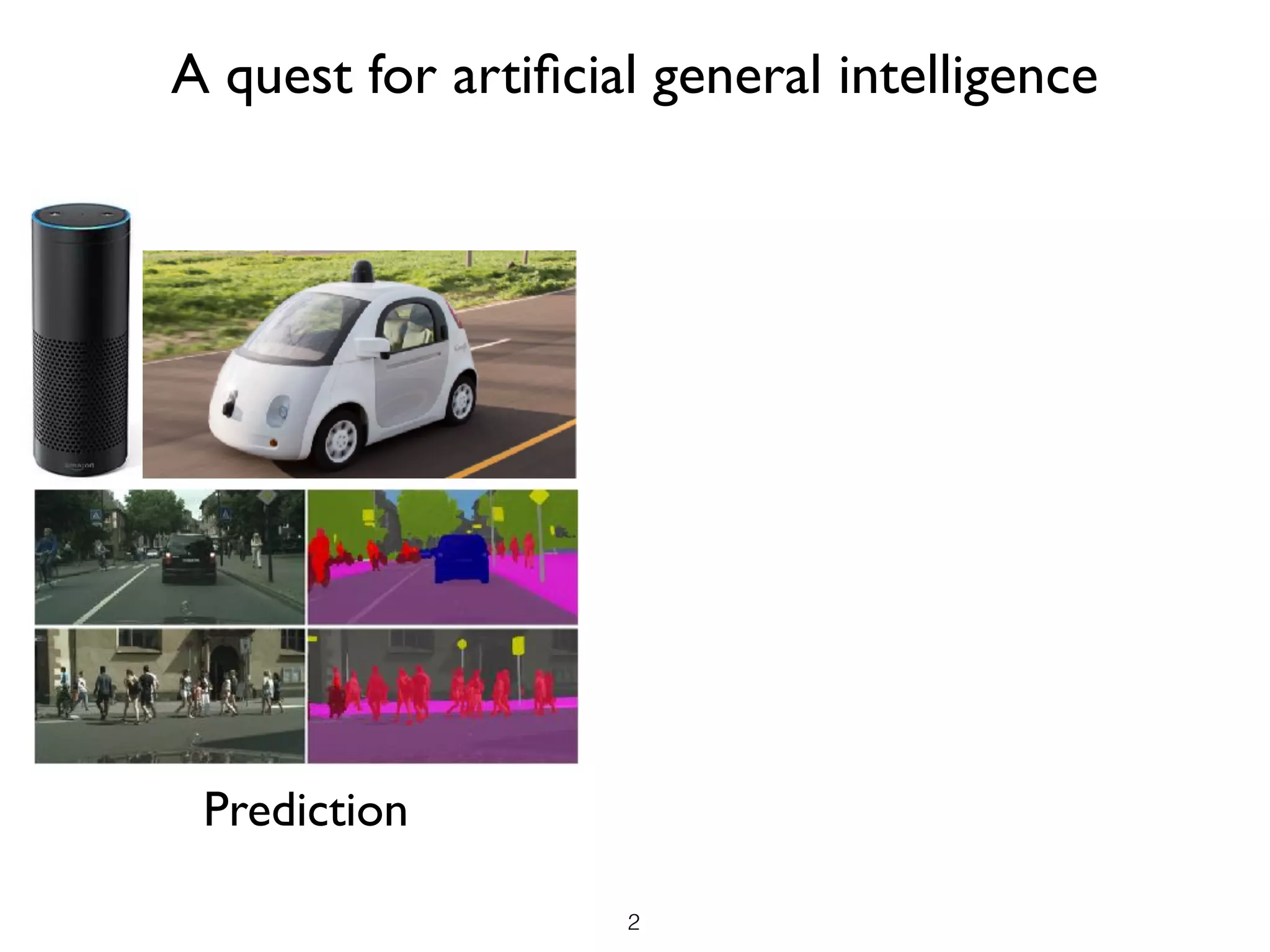
2
Prediction
A quest for artificial general intelligence
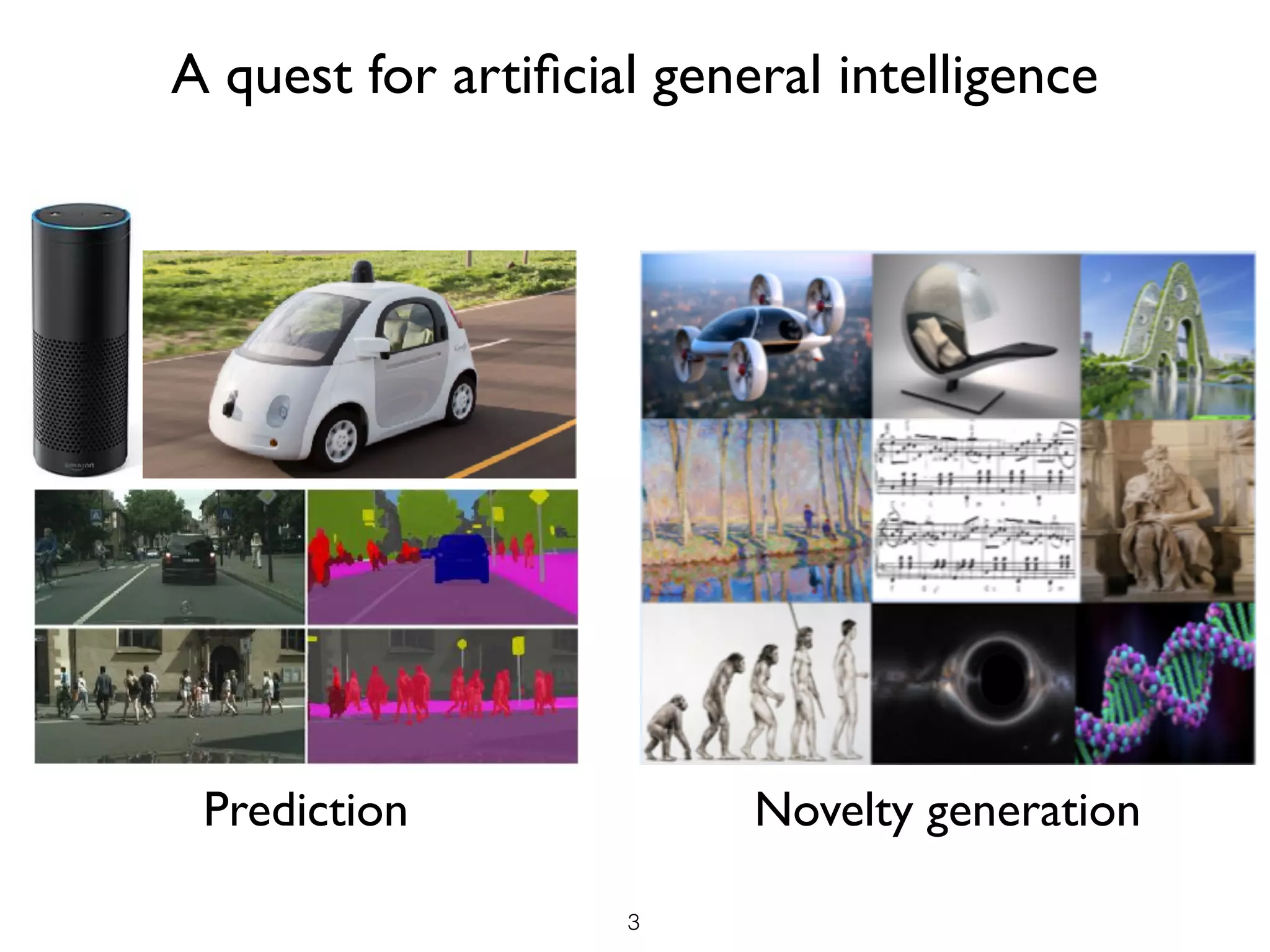
3
Prediction Novelty generation
A quest for artificial general intelligence
/ 56
Plan
• Representation and learning
• Impact of representations on generation
• A naive bayes generator
• Generating novelty with neural networks
4
/ 56
How do you
represent this
“object”?
5
Representing an object
A
/ 56
What is a
representation?
6
Representing an object
A
/ 567
Representing an object
A
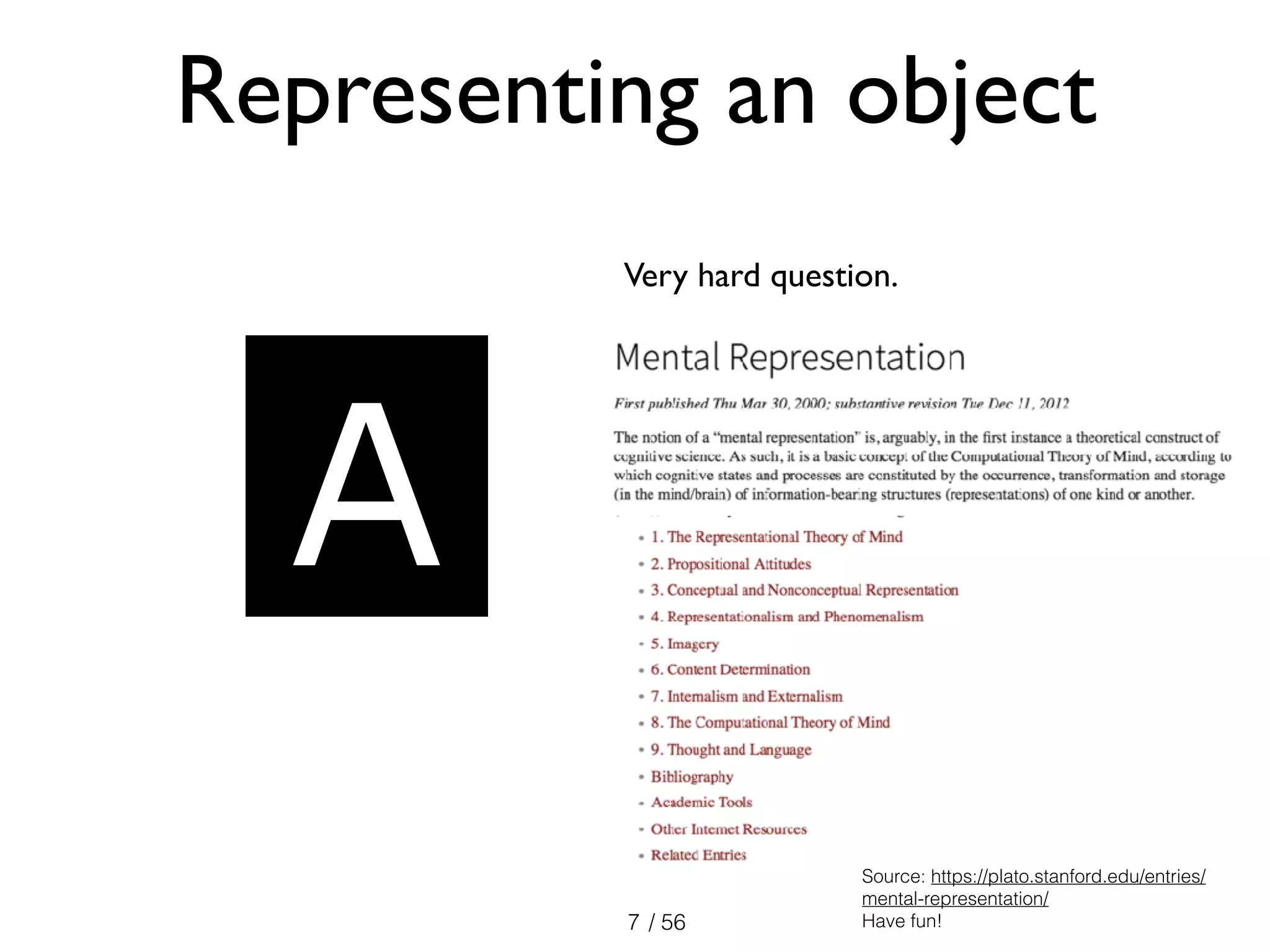
Source: https://plato.stanford.edu/entries/
mental-representation/
Have fun!
Very hard question.
/ 568
Representing an object
A
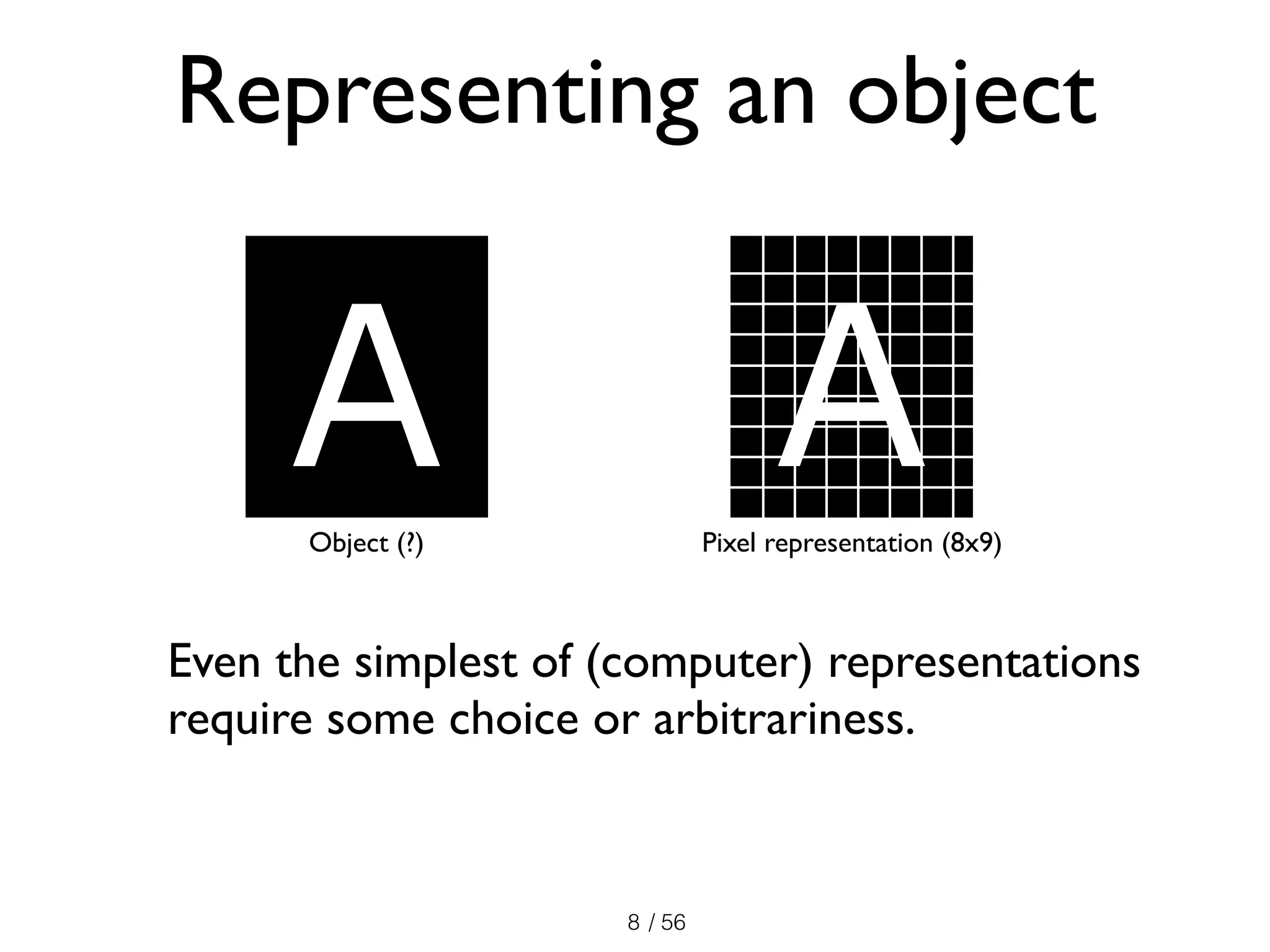
Even the simplest of (computer) representations
require some choice or arbitrariness.
AObject (?) Pixel representation (8x9)
/ 569
To process any “object” (e.g. by computers)
you need to “represent” it.
/ 5610
Representation are not “neutral” and
“independent” of the observer.
/ 56
What effect a representation have
on learning and (or) generation?
/ 56
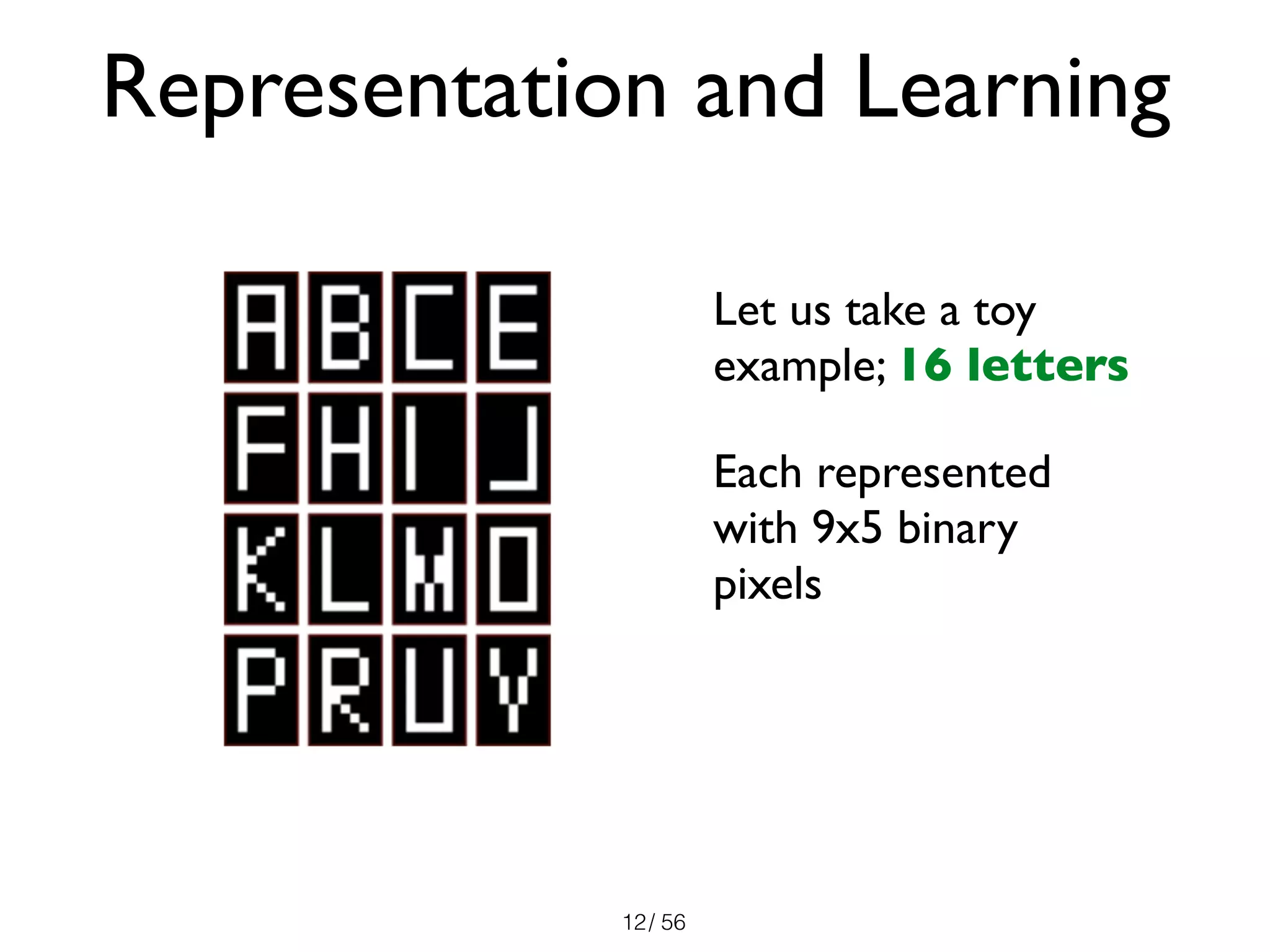
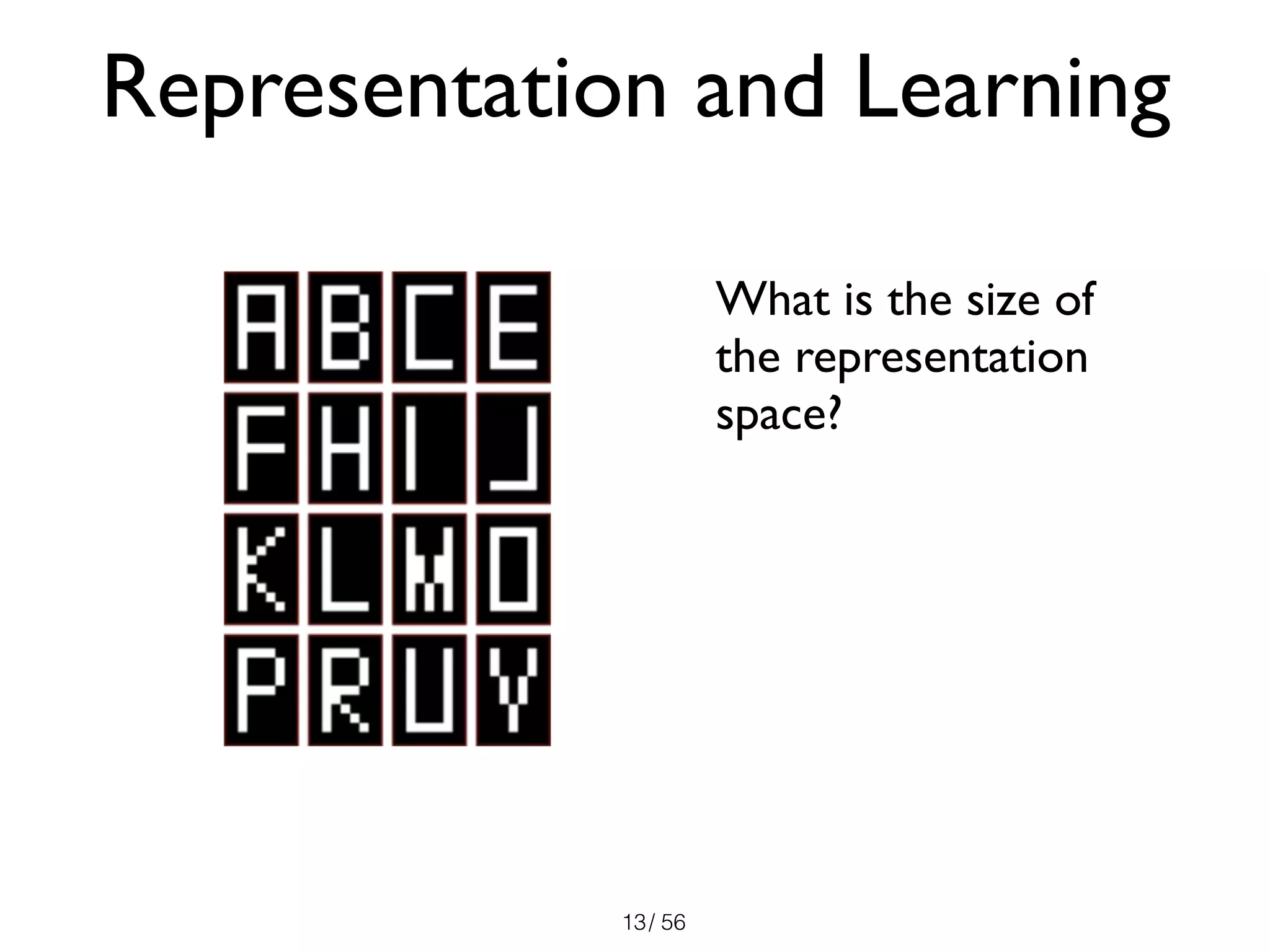
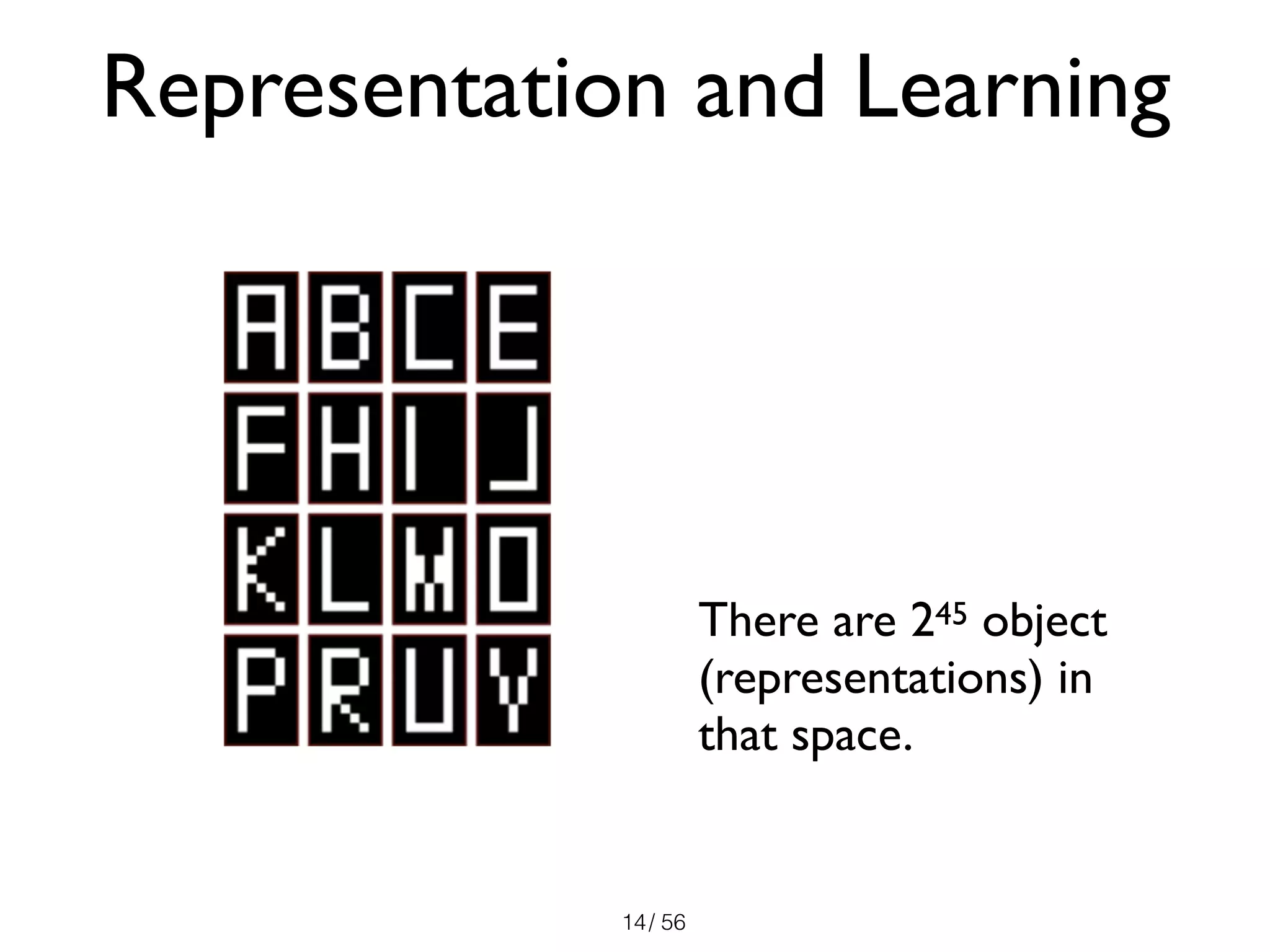
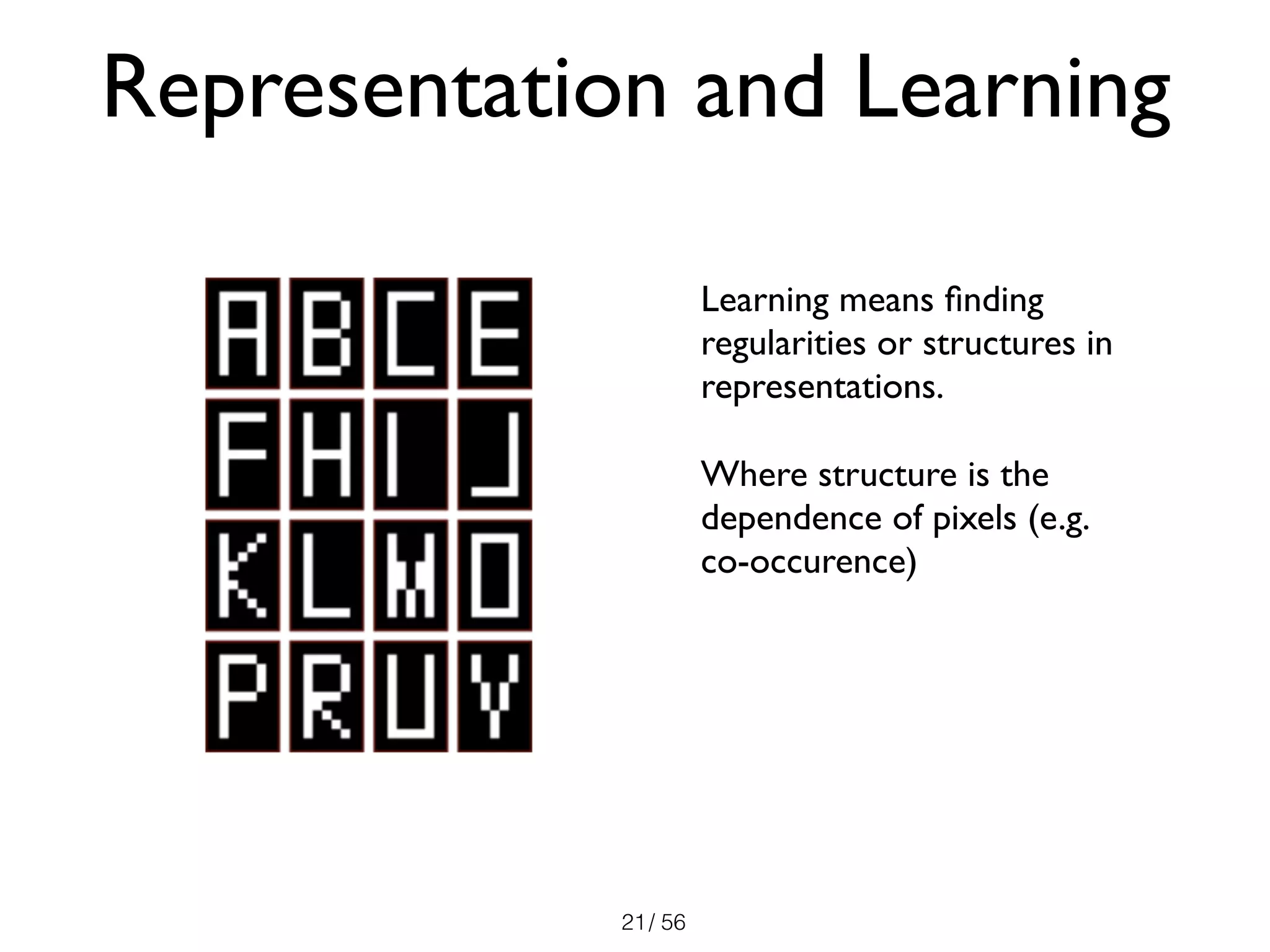
Let us take a toy
example; 16 letters
Each represented
with 9x5 binary
pixels
12
Representation and Learning
/ 56
What is the size of
the representation
space?
13
Representation and Learning
/ 56
There are 245 object
(representations) in
that space.
14
Representation and Learning
/ 56
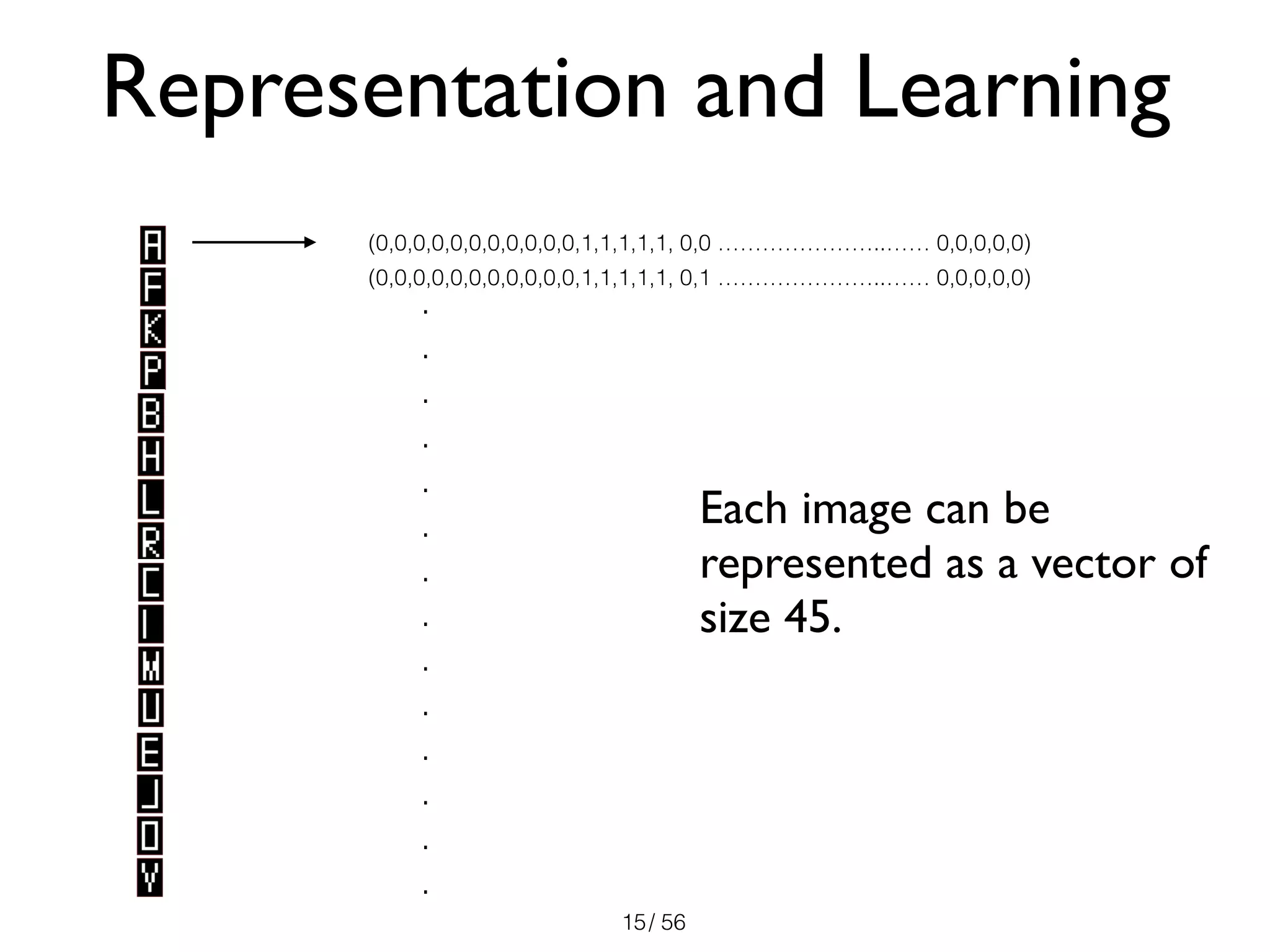
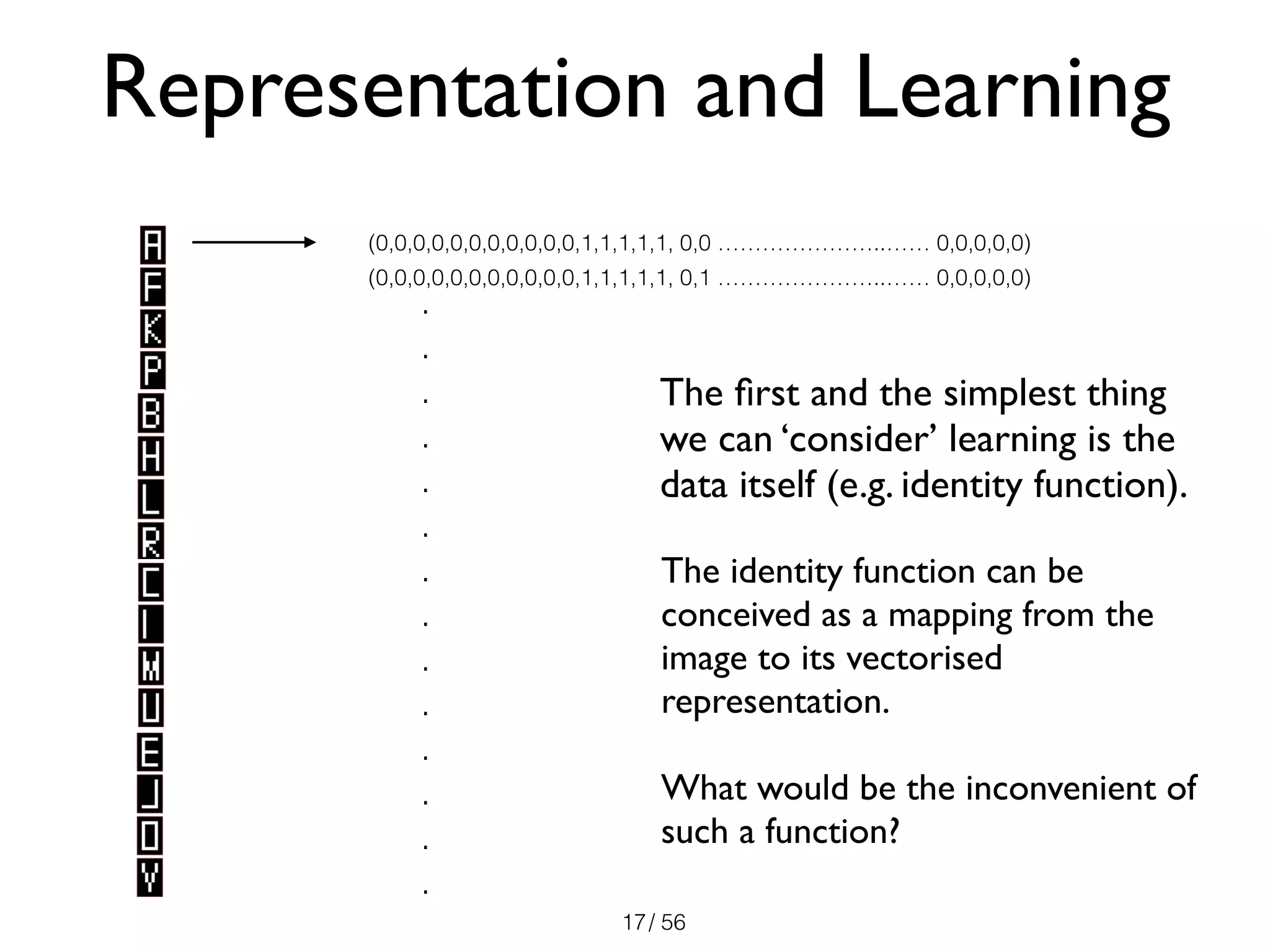
Each image can be
represented as a vector of
size 45.
15
Representation and Learning
(0,0,0,0,0,0,0,0,0,0,0,1,1,1,1,1, 0,0 …………………..…… 0,0,0,0,0)
(0,0,0,0,0,0,0,0,0,0,0,1,1,1,1,1, 0,1 …………………..…… 0,0,0,0,0)
.
.
.
.
.
.
.
.
.
.
.
.
.
.
/ 56
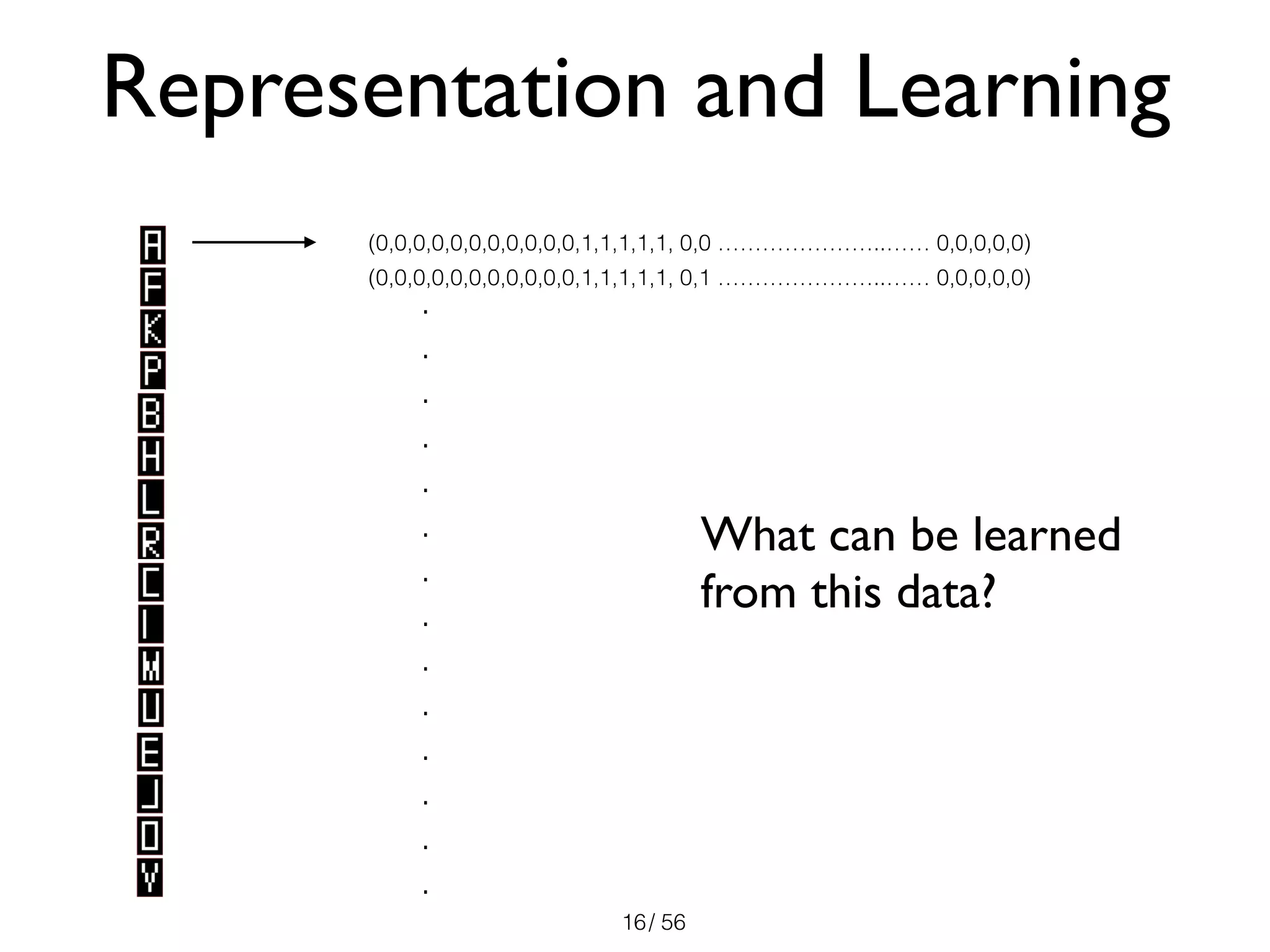
What can be learned
from this data?
16
Representation and Learning
(0,0,0,0,0,0,0,0,0,0,0,1,1,1,1,1, 0,0 …………………..…… 0,0,0,0,0)
(0,0,0,0,0,0,0,0,0,0,0,1,1,1,1,1, 0,1 …………………..…… 0,0,0,0,0)
.
.
.
.
.
.
.
.
.
.
.
.
.
.
/ 56
The first and the simplest thing
we can ‘consider’ learning is the
data itself (e.g. identity function).
17
Representation and Learning
(0,0,0,0,0,0,0,0,0,0,0,1,1,1,1,1, 0,0 …………………..…… 0,0,0,0,0)
(0,0,0,0,0,0,0,0,0,0,0,1,1,1,1,1, 0,1 …………………..…… 0,0,0,0,0)
.
.
.
.
.
.
.
.
.
.
.
.
.
.
The identity function can be
conceived as a mapping from the
image to its vectorised
representation.
What would be the inconvenient of
such a function?
/ 5618
Representation and Learning
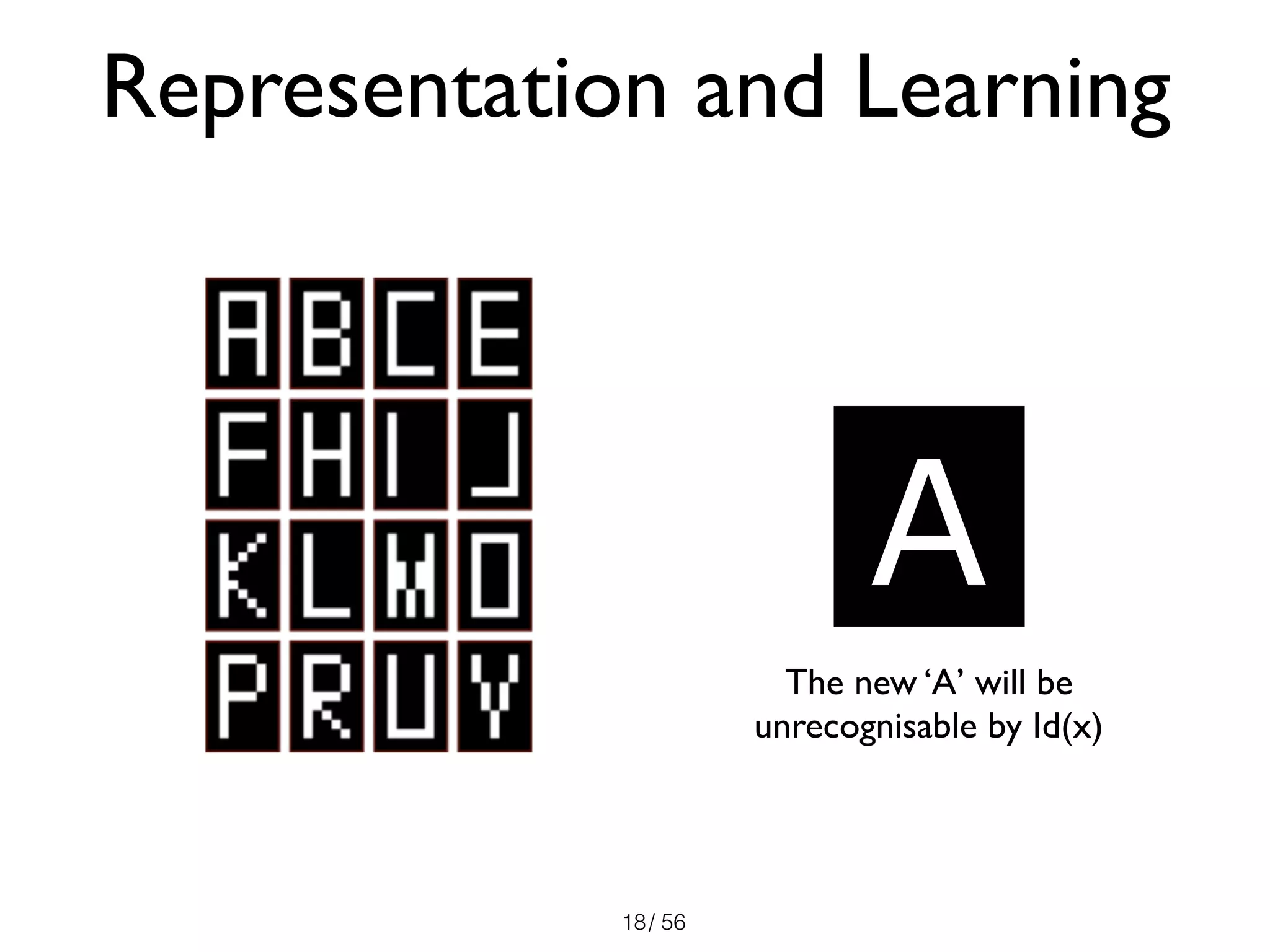
A
The new ‘A’ will be
unrecognisable by Id(x)
/ 5619
Learning assumes a notion of
‘generalisation’
/ 5620
Representation and Learning
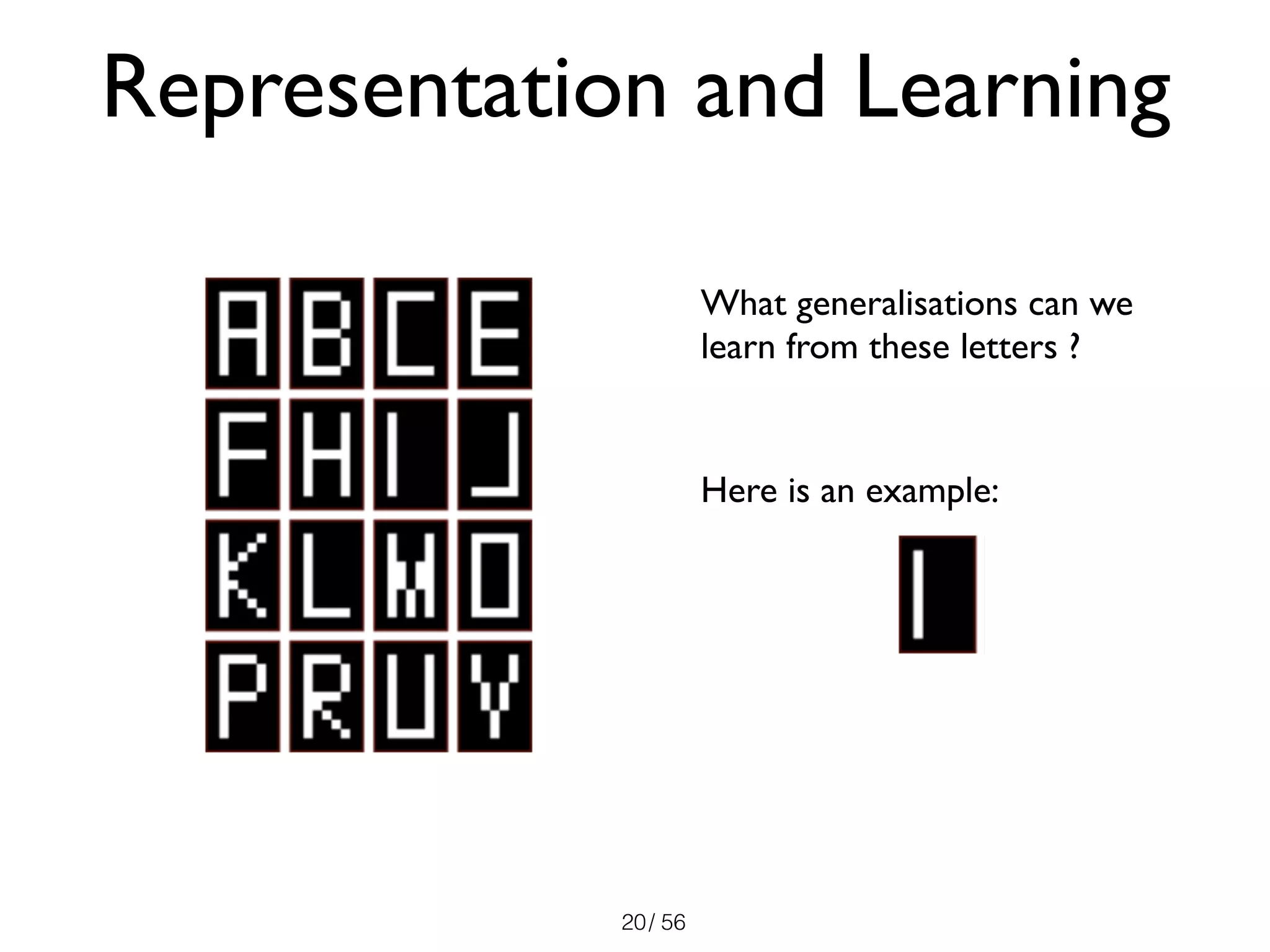
What generalisations can we
learn from these letters ?
Here is an example:
/ 5621
Representation and Learning
Learning means finding
regularities or structures in
representations.
Where structure is the
dependence of pixels (e.g.
co-occurence)
/ 5622
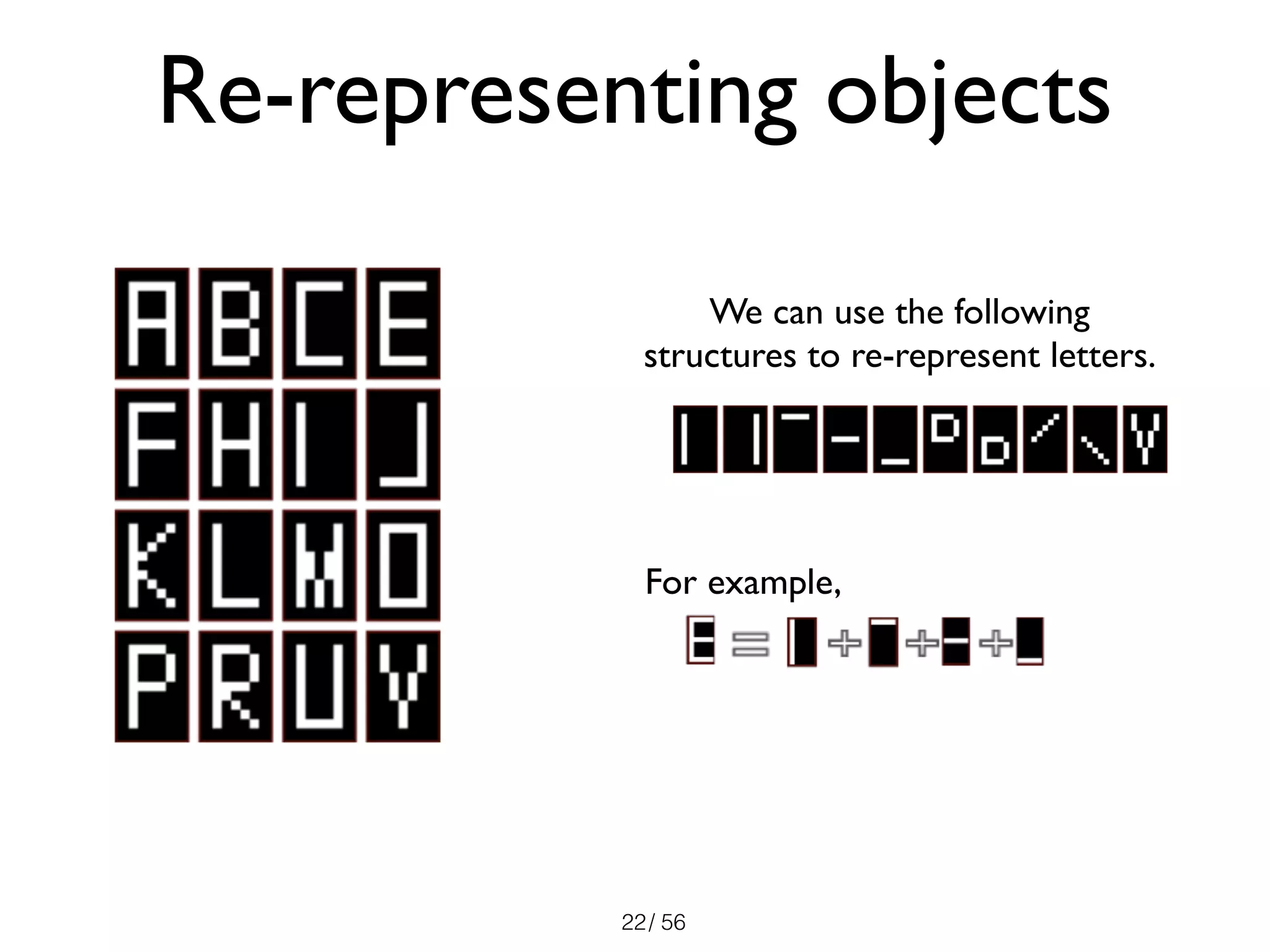
Re-representing objects
We can use the following
structures to re-represent letters.
For example,
/ 56
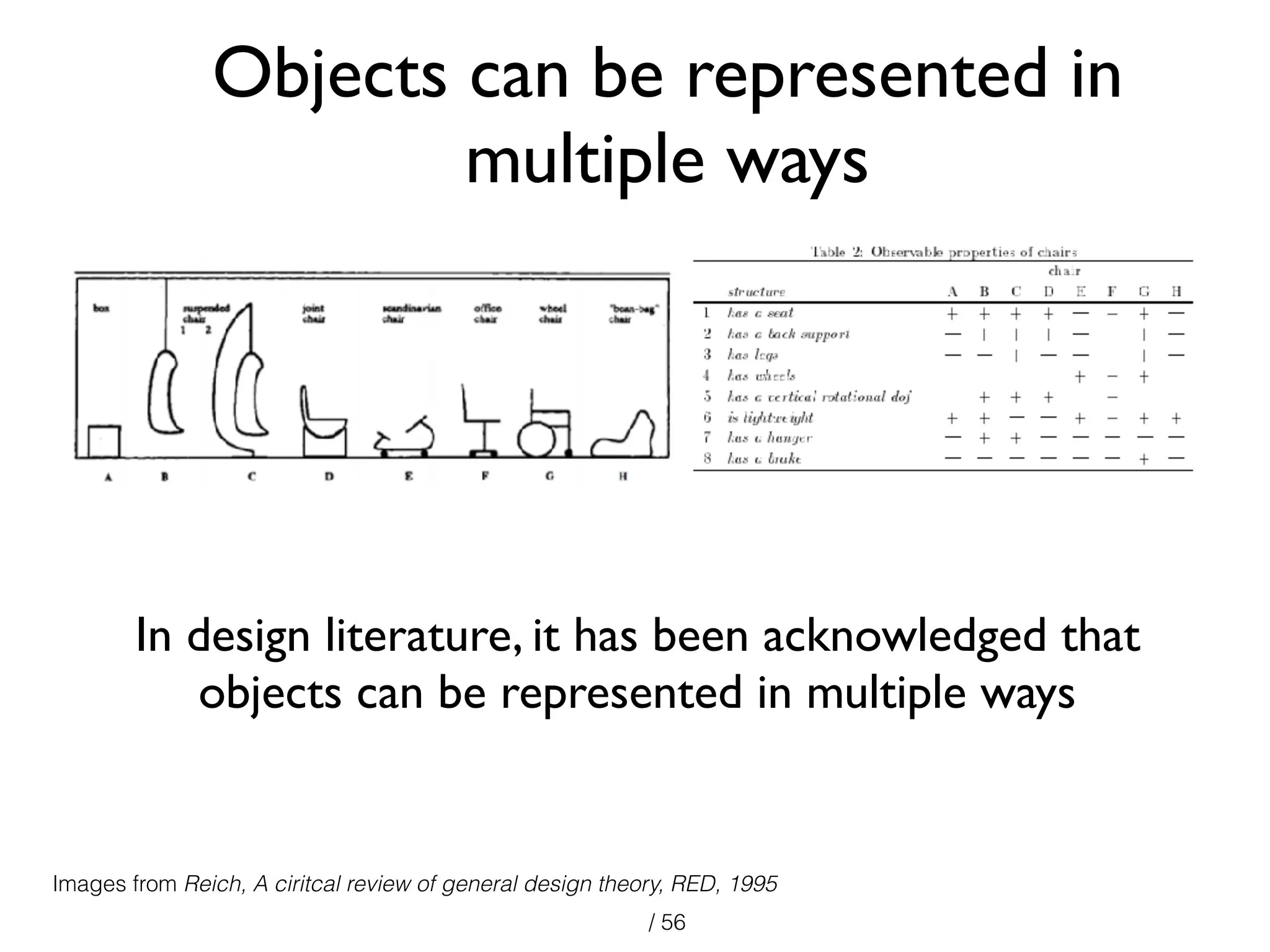
Objects can be represented in
multiple ways
In design literature, it has been acknowledged that
objects can be represented in multiple ways
Images from Reich, A ciritcal review of general design theory, RED, 1995
/ 5624
Re-representing objects
/ 56
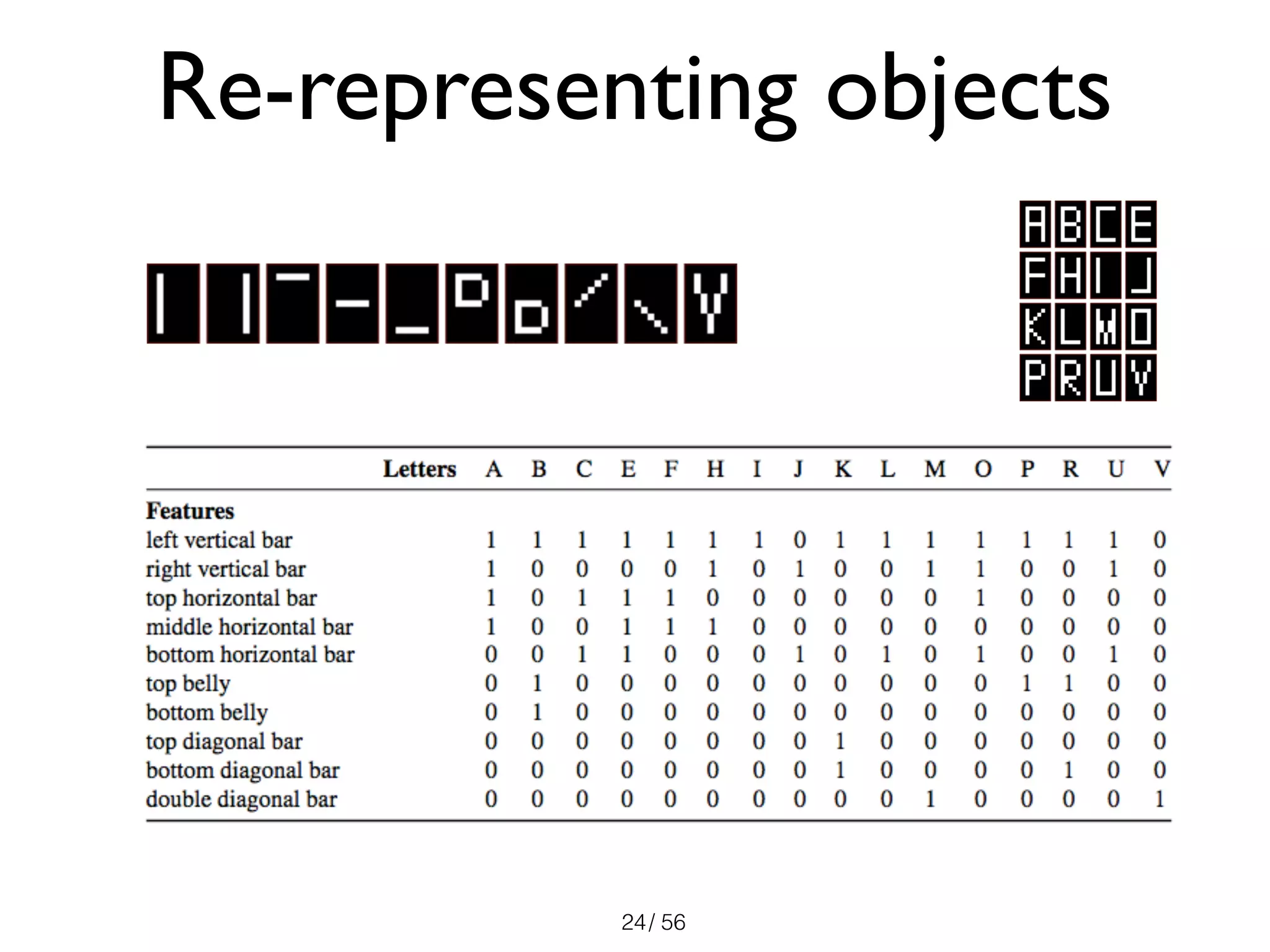
Strokes gives us a shorter
representation (or code) for the
letter domain.
25
/ 56
This new representation is
lossless compression (no
information lost)
26
/ 56
Each representation is a model
And the set of models of a given
agent is its knowledge.
27
/ 56
Models can be imperfect
(e.g. lossy).
28
/ 56
One example of imperfect
models are probabilistic models.
29
/ 56
Plan
• Representation and learning
• Impact of representations on (probabilistic)
generation
• A naive bayes generator
• Generating novelty with neural networks
30
/ 56
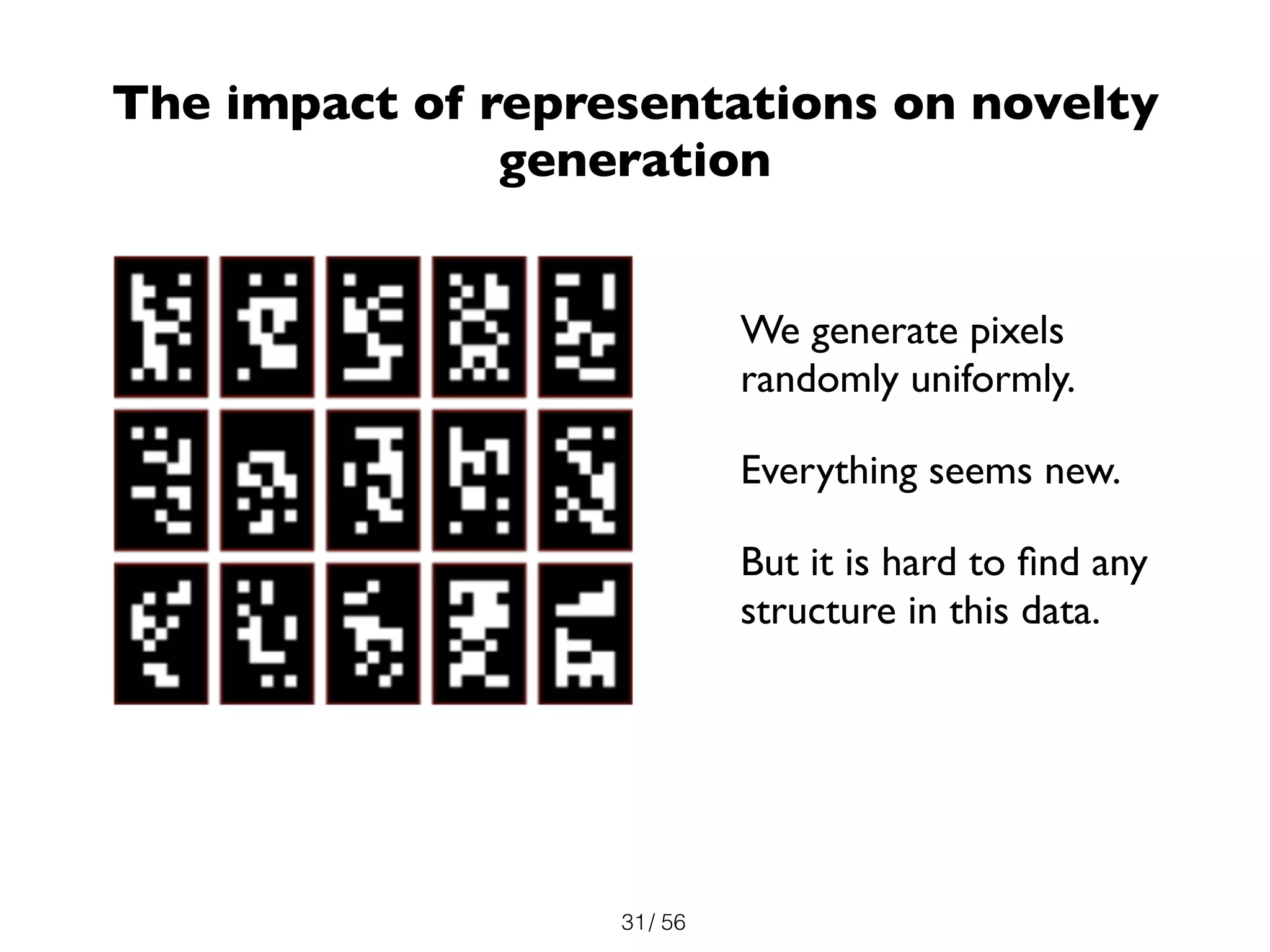
We generate pixels
randomly uniformly.
Everything seems new.
But it is hard to find any
structure in this data.
31
The impact of representations on novelty
generation
/ 5632
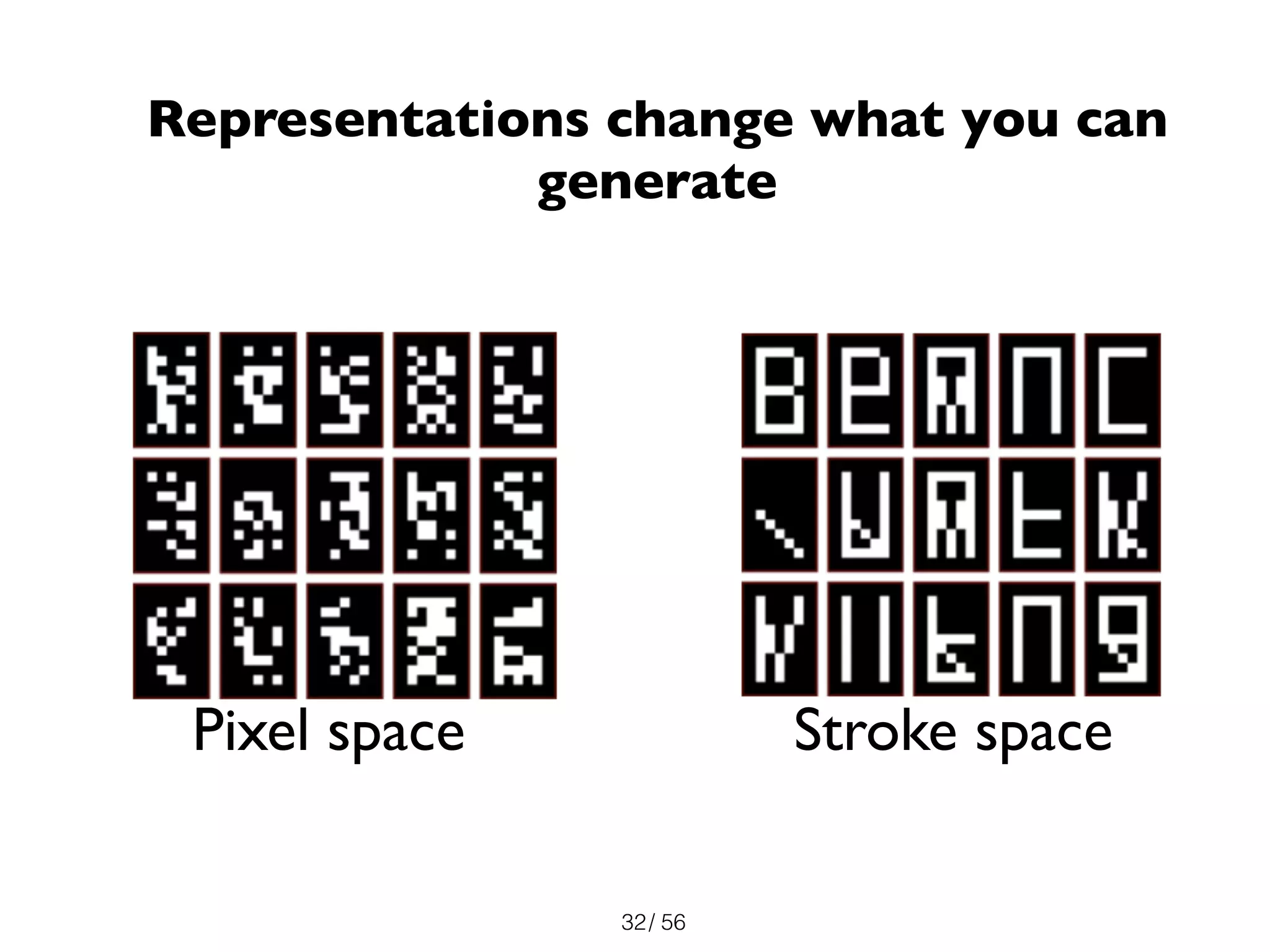
Pixel space Stroke space
Representations change what you can
generate
/ 56
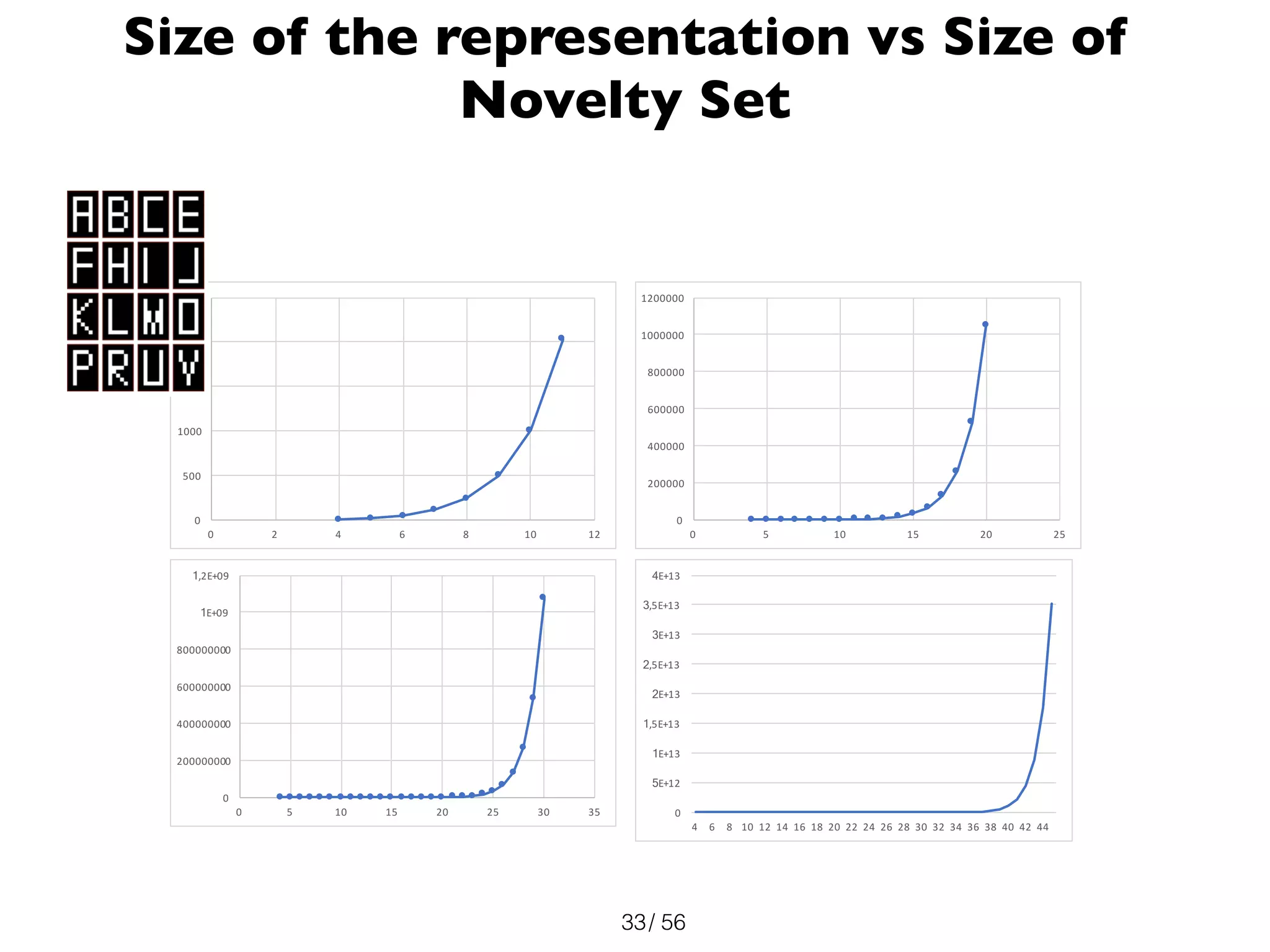
Size of the representation vs Size of
Novelty Set
33
0
500
1000
1500
2000
2500
0 2 4 6 8 10 12
0
5E+12
1E+13
1,5E+13
2E+13
2,5E+13
3E+13
3,5E+13
4E+13
4 6 8 10 12 14 16 18 20 22 24 26 28 30 32 34 36 38 40 42 44
0
200000000
400000000
600000000
800000000
1E+09
1,2E+09
0 5 10 15 20 25 30 35
0
200000
400000
600000
800000
1000000
1200000
0 5 10 15 20 25
/ 56
Plan
• Representation and learning
• Impact of representations on (probabilistic) generation
• A naive bayes generator
• Generating novelty with neural networks
34
/ 5635
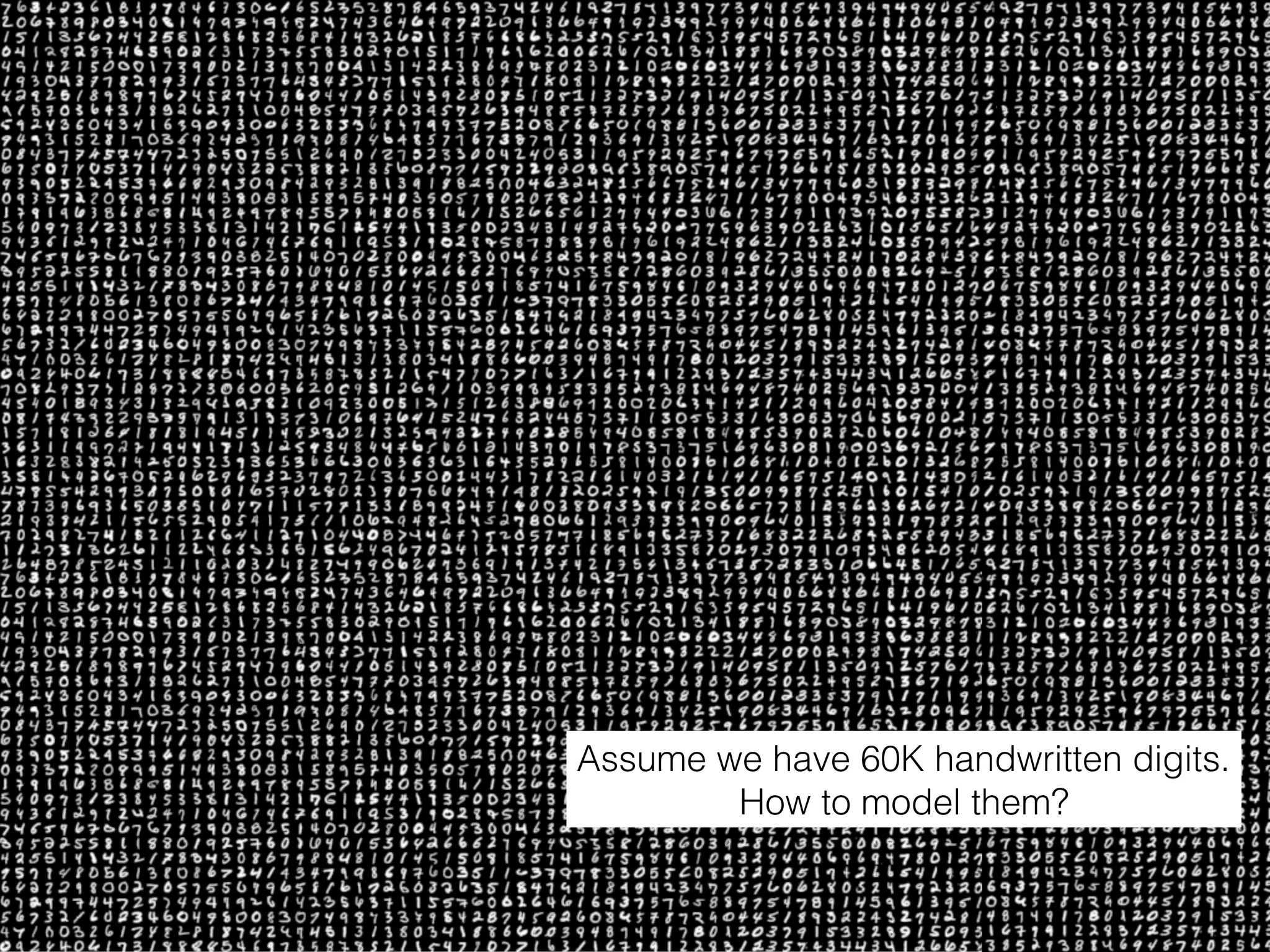
Assume we have 60K handwritten digits.
How to model them?
/ 56
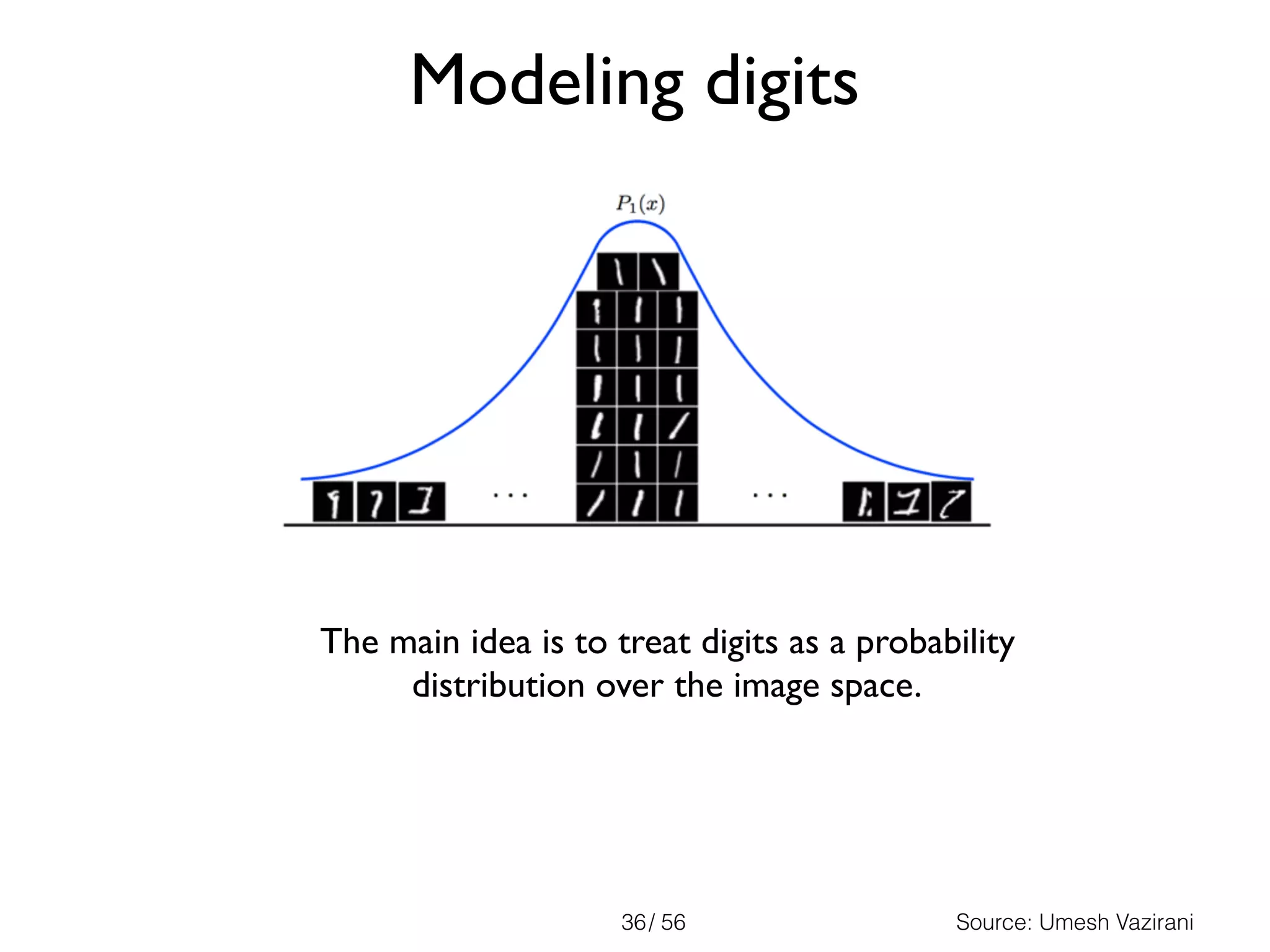
Modeling digits
36
The main idea is to treat digits as a probability
distribution over the image space.
Source: Umesh Vazirani
/ 5637
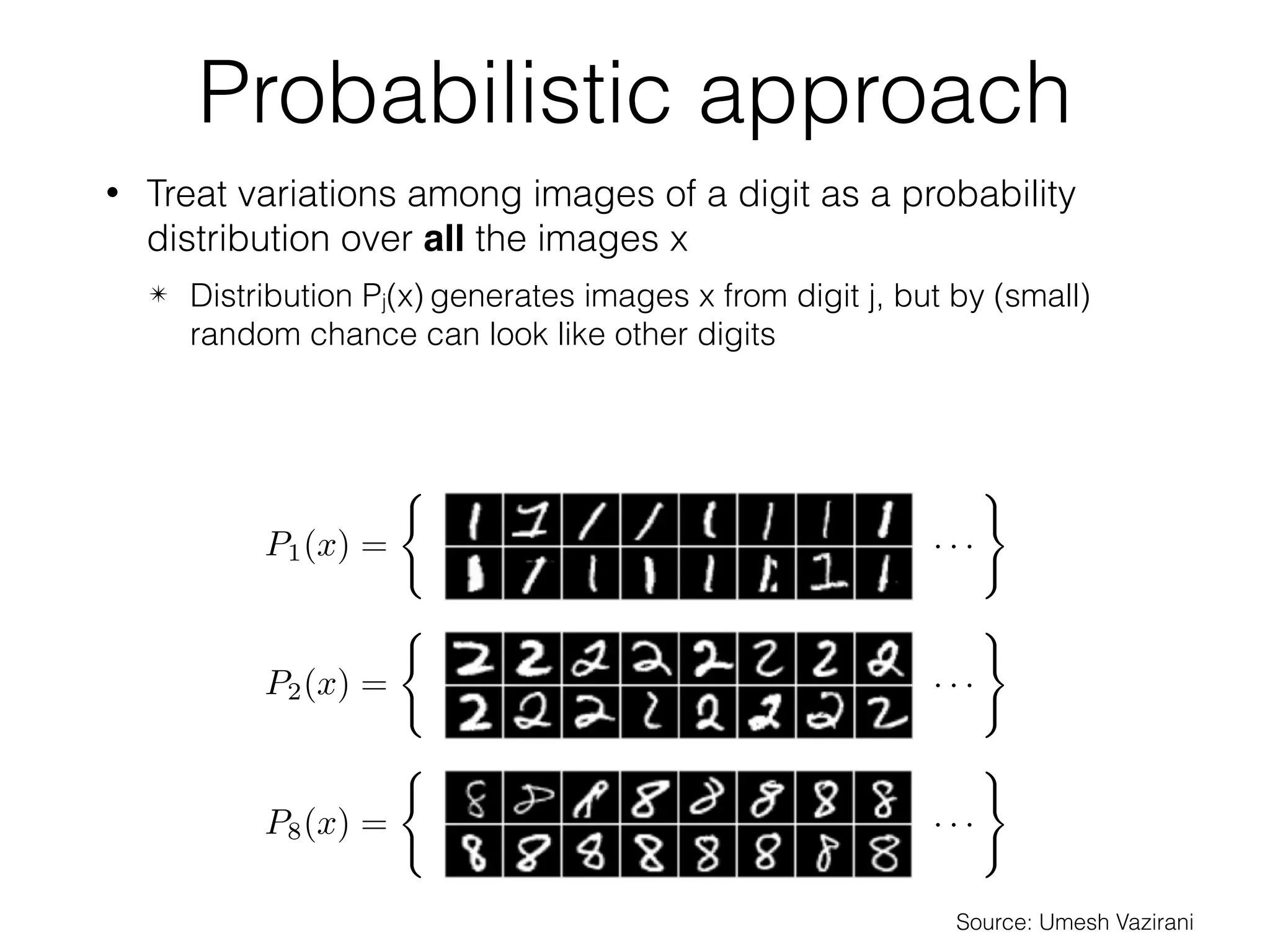
Probabilistic approach
• Treat variations among images of a digit as a probability
distribution over all the images x
✴ Distribution Pj(x) generates images x from digit j, but by (small)
random chance can look like other digits
✴ Imperfect model, represents our uncertainty/ambiguity, but Bayes’
rule to the rescue!
P1(x) =
(
P2(x) =
(
P8(x) =
(
· · ·
)
· · ·
)
· · ·
)
Source: Umesh Vazirani
/ 5638
Estimating the distributions
• Use training data to estimate the prior and the
class-conditional distributions
✴ MNIST dataset: 60K training data, 10K test data
• Estimating the is easy:
• From MNIST:
• But estimating the is difficult!
⇡j = Pr[y = j]
Pj(x) = P(x | y = j)
⇡j
Pj(x)
ˆ⇡j =
nj
n
=
# of examples of class j
total # of examples
j 0 1 2 3 4 5 6 7 8 9
ˆ⇡j (%) 9.87 11.24 9.93 10.22 9.74 9.03 9.86 10.44 9.75 9.92
Source: Umesh Vazirani
Naive Bayes
• Convert grayscale images to binary
• A general distribution over has parameters
threshold binary data
x 2 {0, 1}784
{0, 1}784
2784
1
• Assume that within each class, the individual pixel values
are independent:
• Each is a coin flip: easy to estimate!
• Now only have 784 parameters to learn
Pj(x) = Pj1(x1) · Pj2(x2) · · · Pj,784(x784)
Pji
Source: Umesh Vazirani
/ 5639
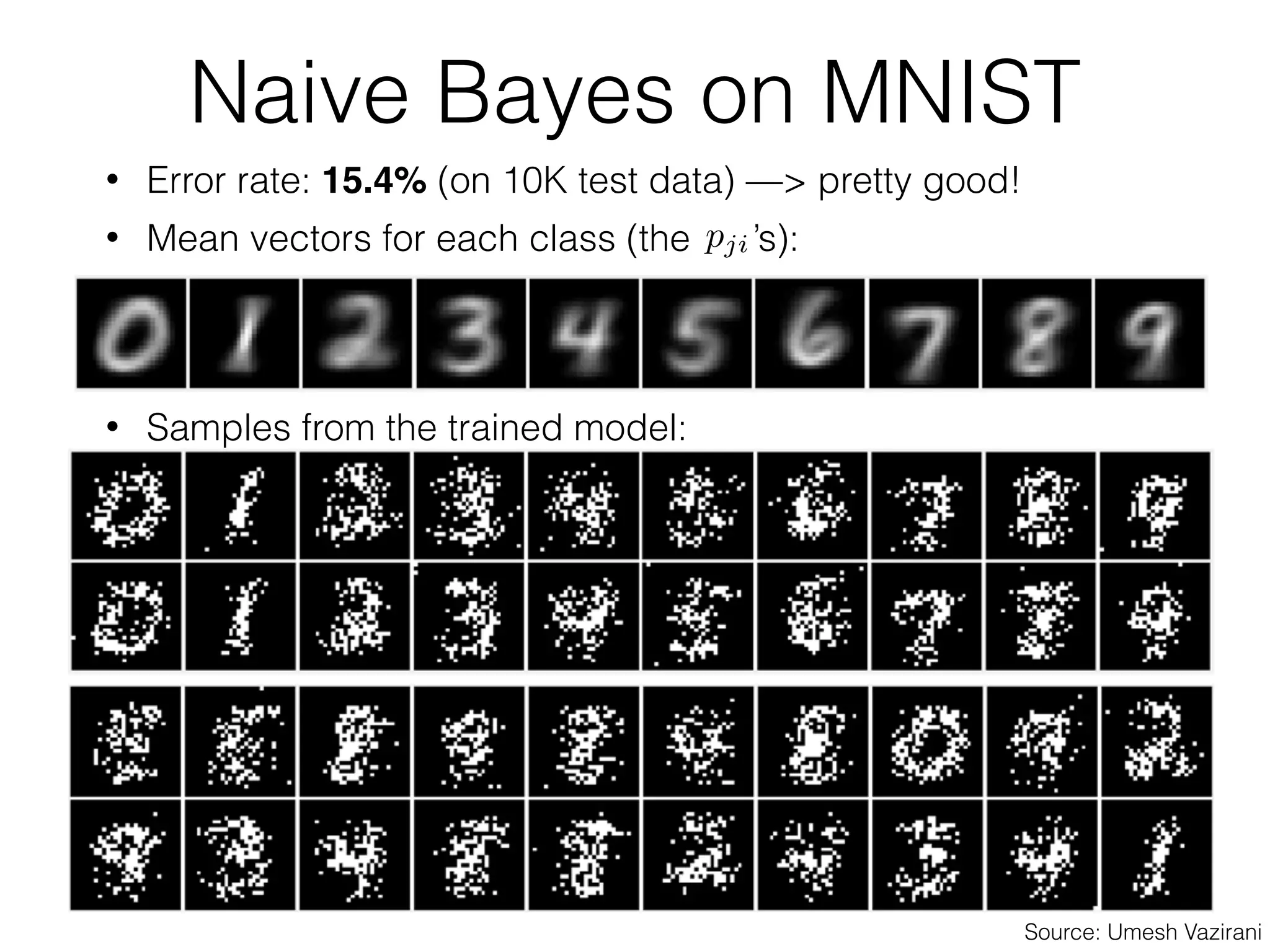
Naive Bayes on MNIST
• Error rate: 15.4% (on 10K test data) —> pretty good!
• Mean vectors for each class (the ’s):pji
• Samples from the trained model:
Source: Umesh Vazirani
/ 56
Plan
• Representation and learning
• Impact of representations on generation
• A naive bayes generator
• Generating novelty with neural networks
40
/ 5641
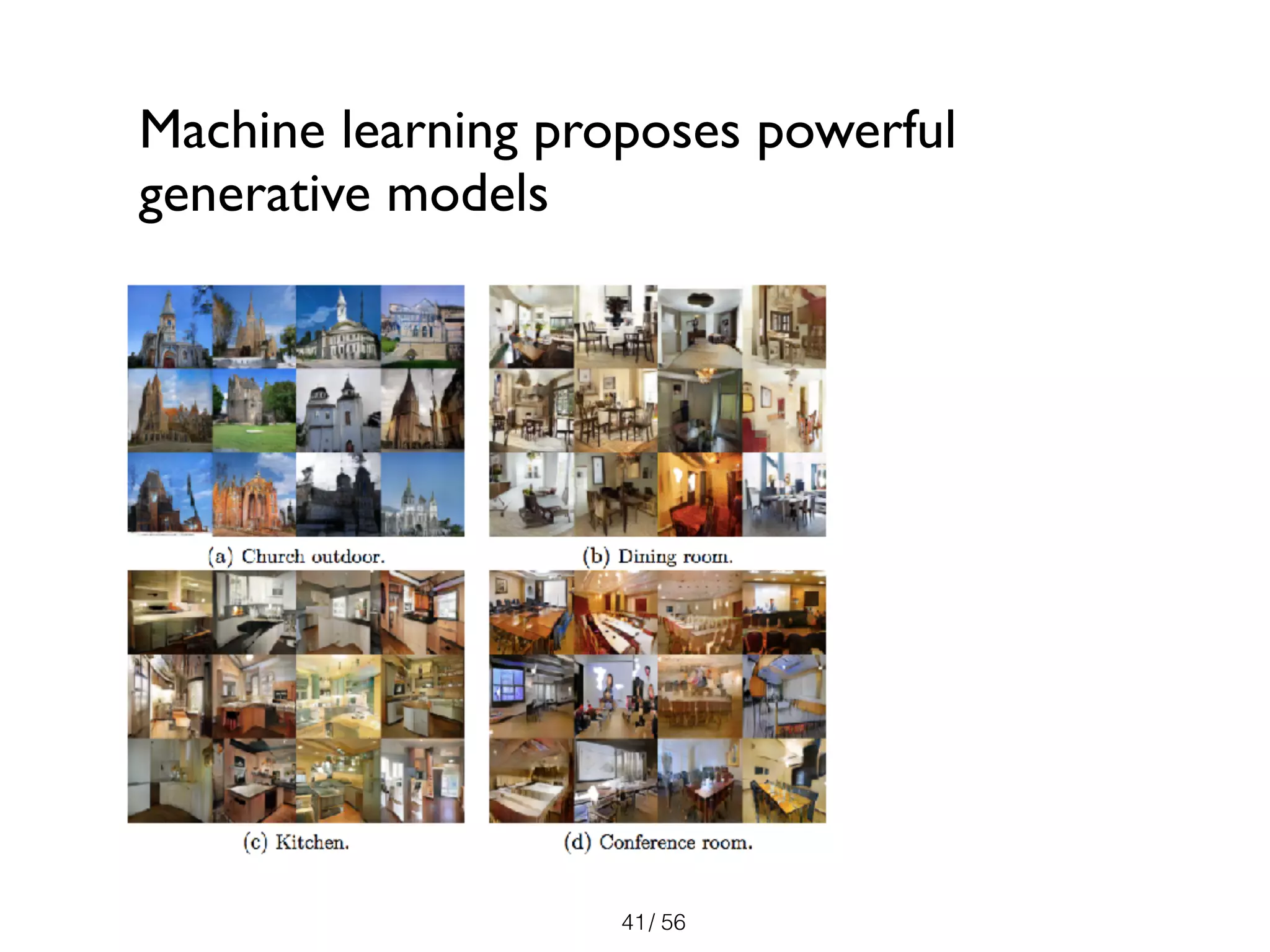
Machine learning proposes powerful
generative models
/ 5642
but these powerful models are used
to regenerate objects that we can
relate easily to known objects…
/ 56
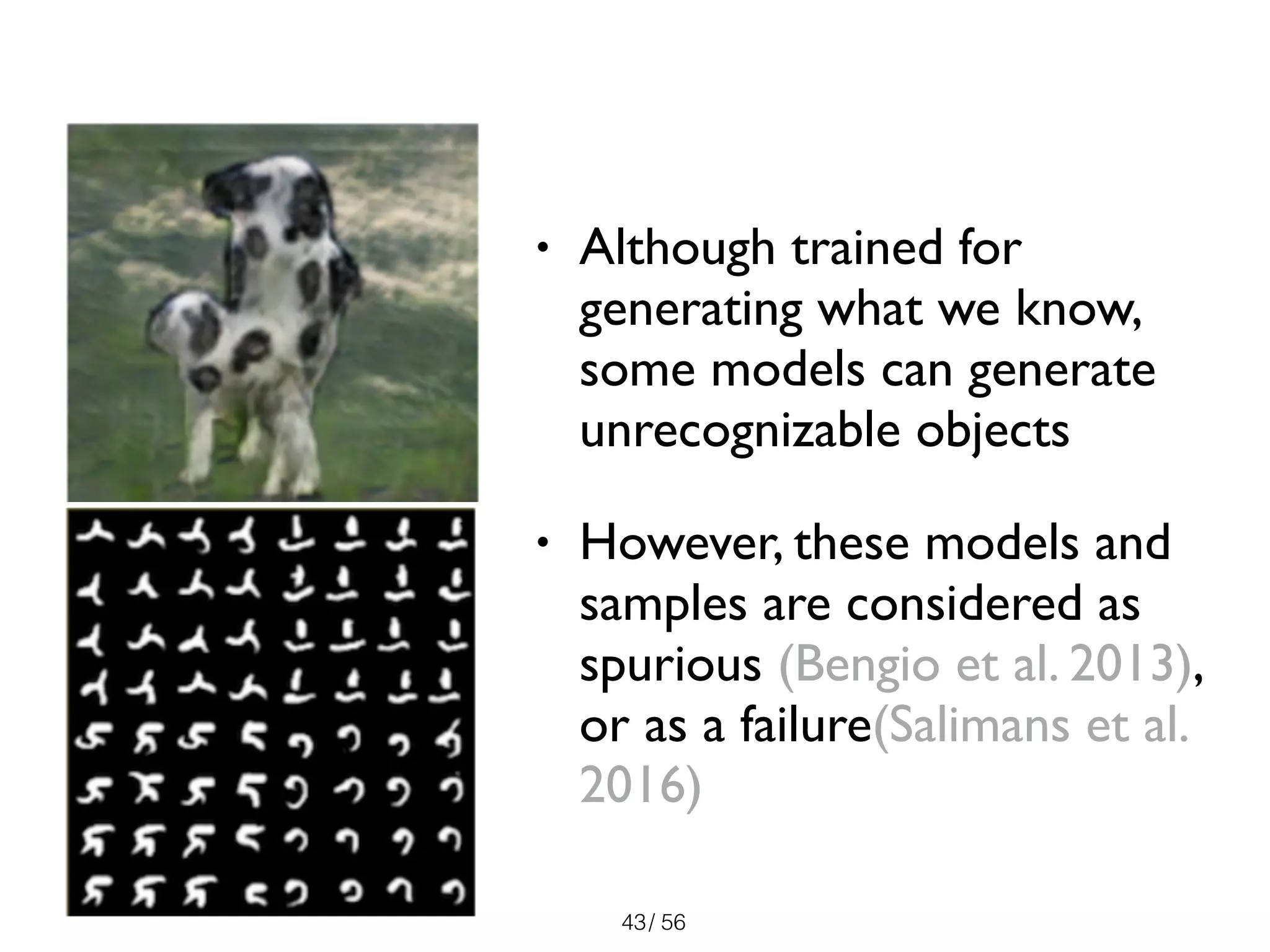
• Although trained for
generating what we know,
some models can generate
unrecognizable objects
• However, these models and
samples are considered as
spurious (Bengio et al. 2013),
or as a failure(Salimans et al.
2016)
43
/ 56
So, first task is to demonstrate that
there is a lot more generative potential
in DNNs than what was intended
44
/ 56
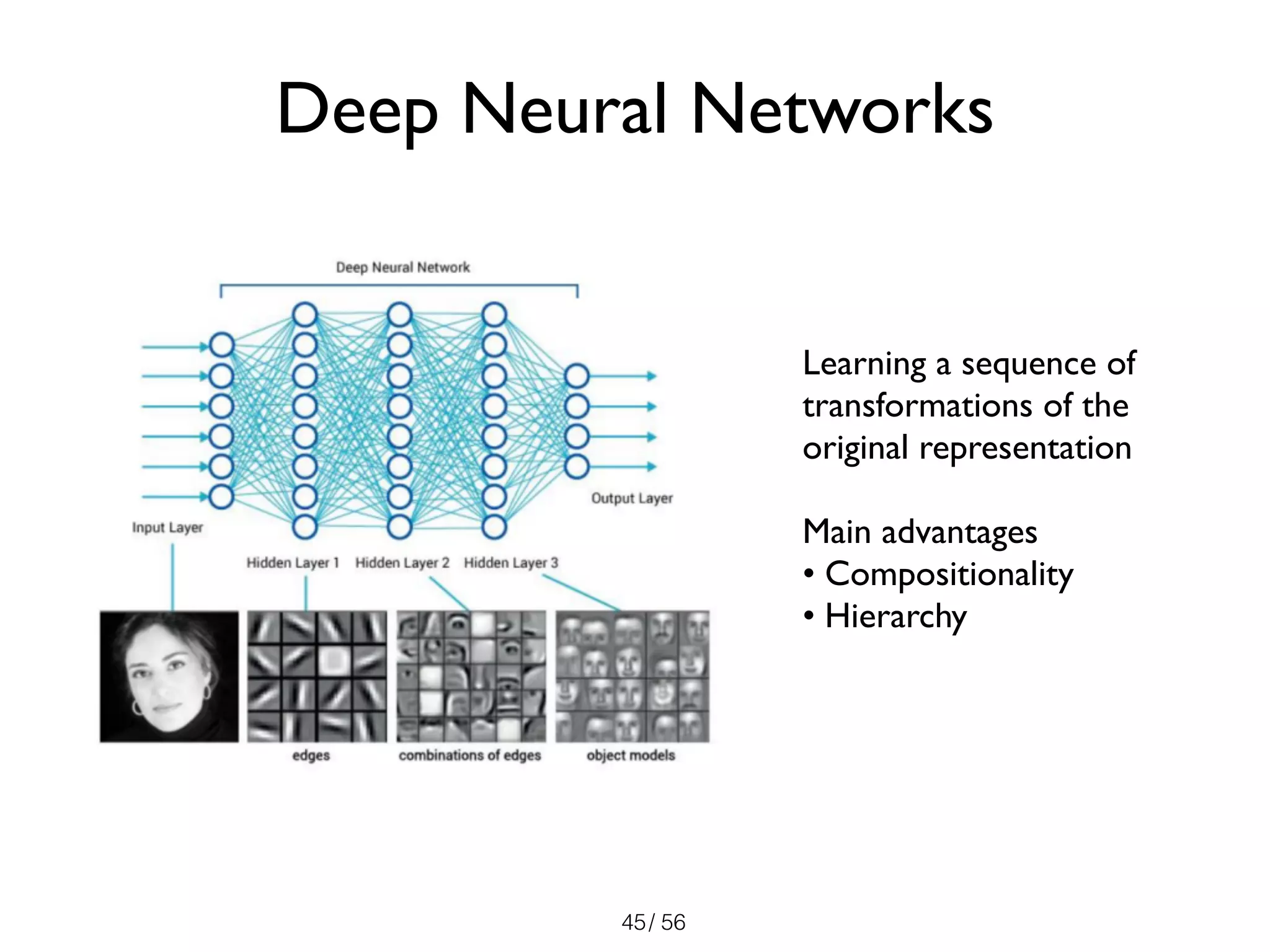
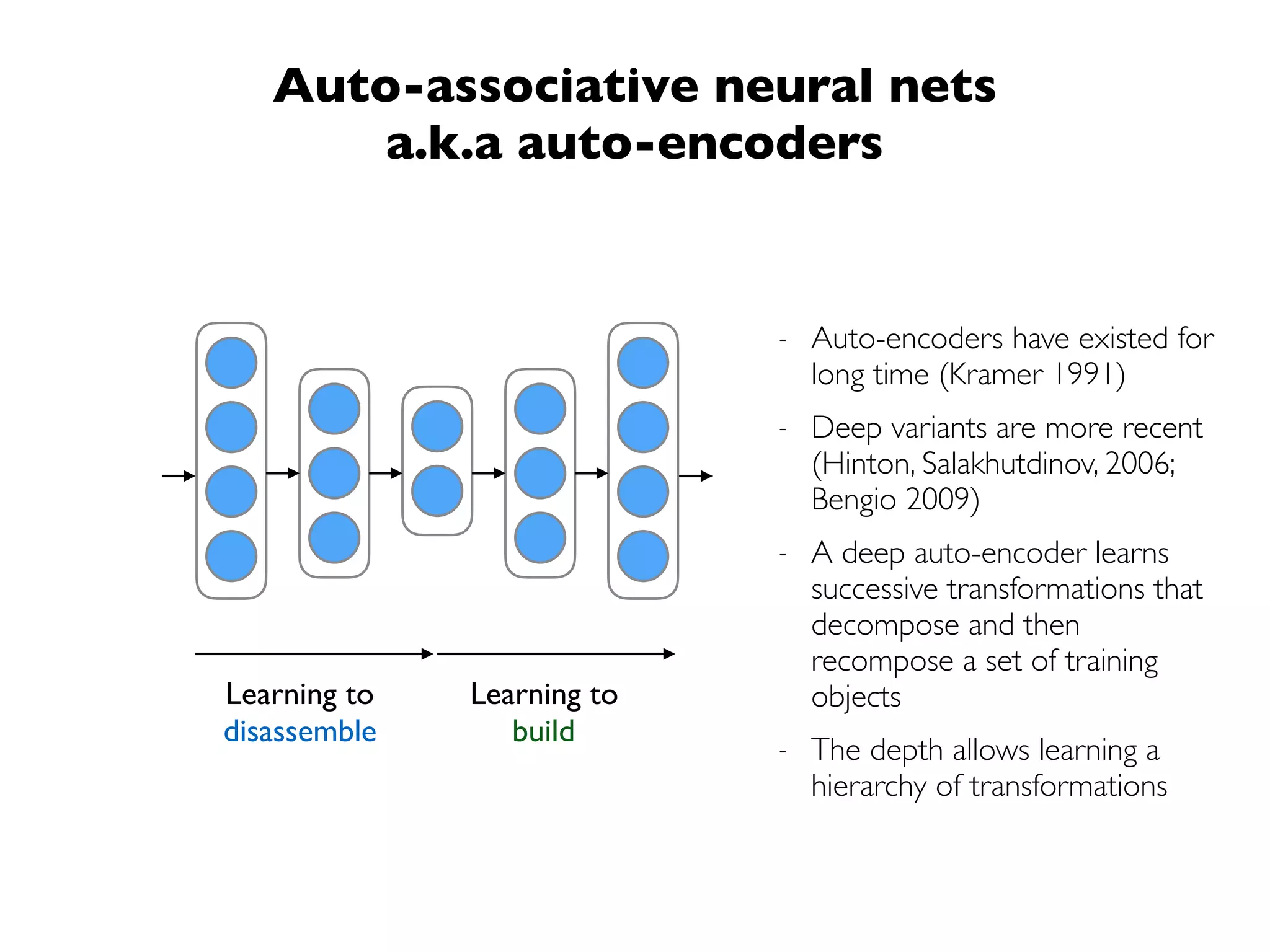
Deep Neural Networks
45
Learning a sequence of
transformations of the
original representation
Main advantages
• Compositionality
• Hierarchy
Auto-associative neural nets
a.k.a auto-encoders
Learning to
disassemble
Learning to
build
- Auto-encoders have existed for
long time (Kramer 1991)
- Deep variants are more recent
(Hinton, Salakhutdinov, 2006;
Bengio 2009)
- A deep auto-encoder learns
successive transformations that
decompose and then
recompose a set of training
objects
- The depth allows learning a
hierarchy of transformations
/ 56
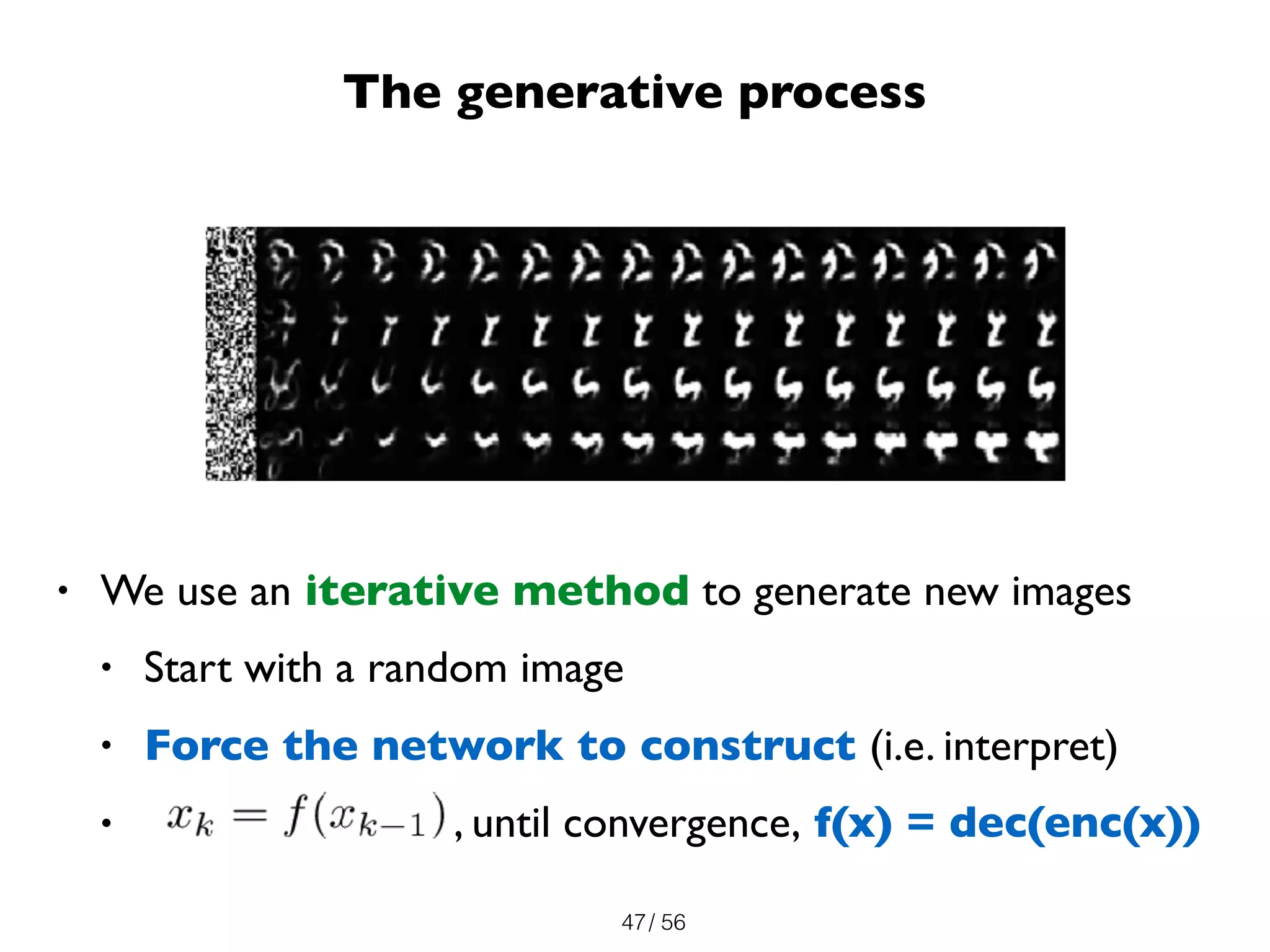
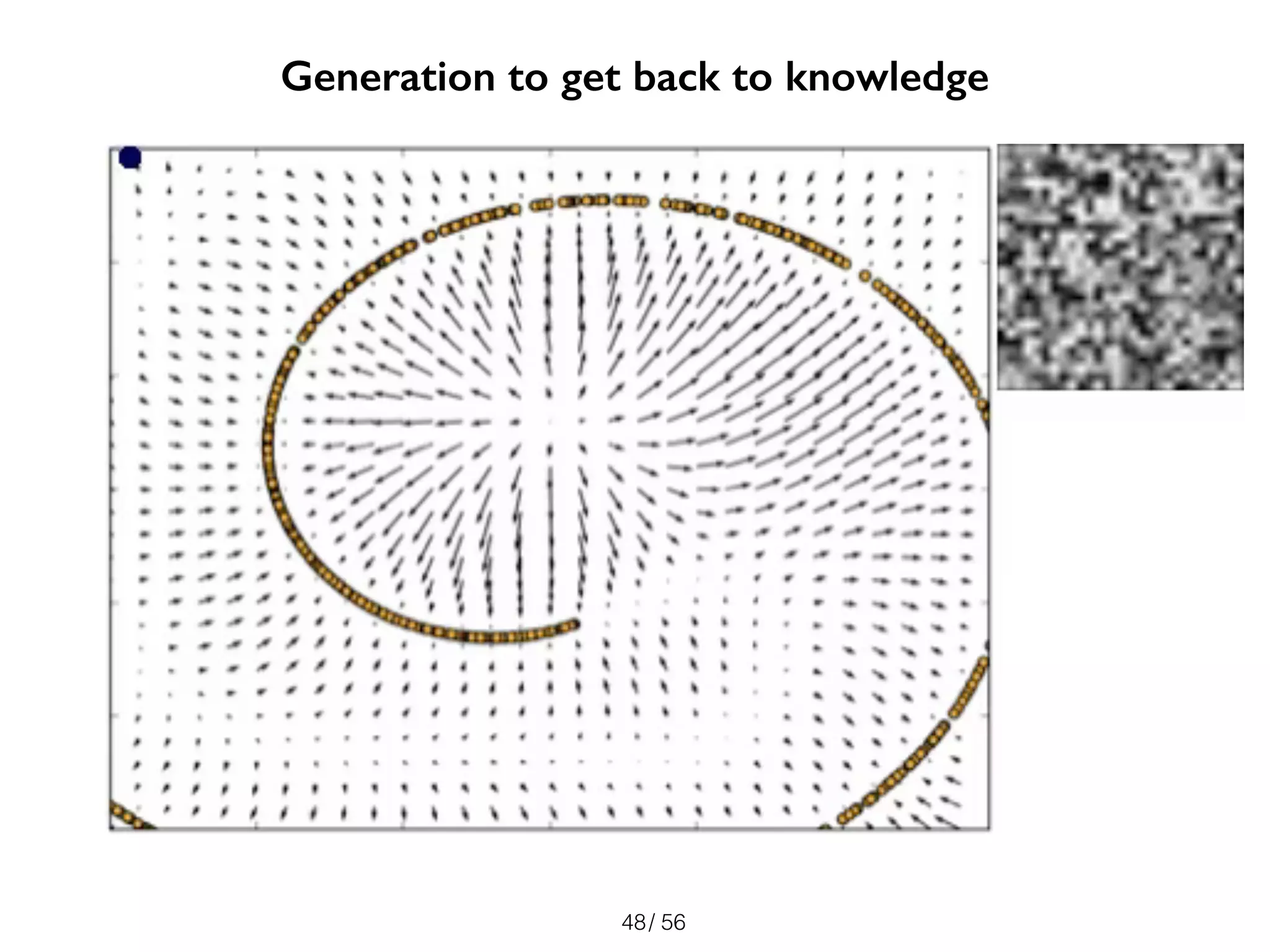
• We use an iterative method to generate new images
• Start with a random image
• Force the network to construct (i.e. interpret)
• , until convergence, f(x) = dec(enc(x))
47
The generative process
/ 56
Generation to get back to knowledge
48
/ 5649
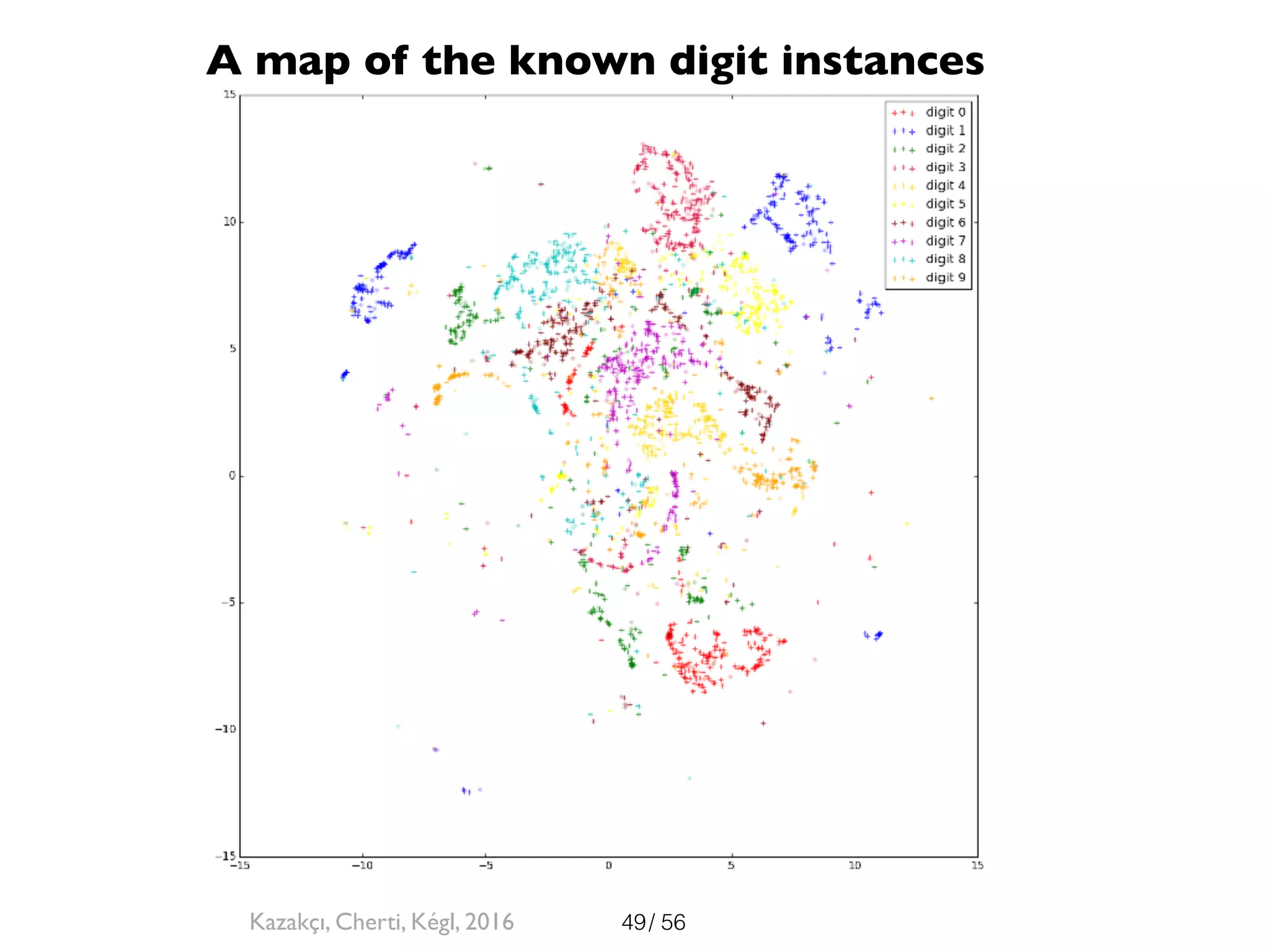
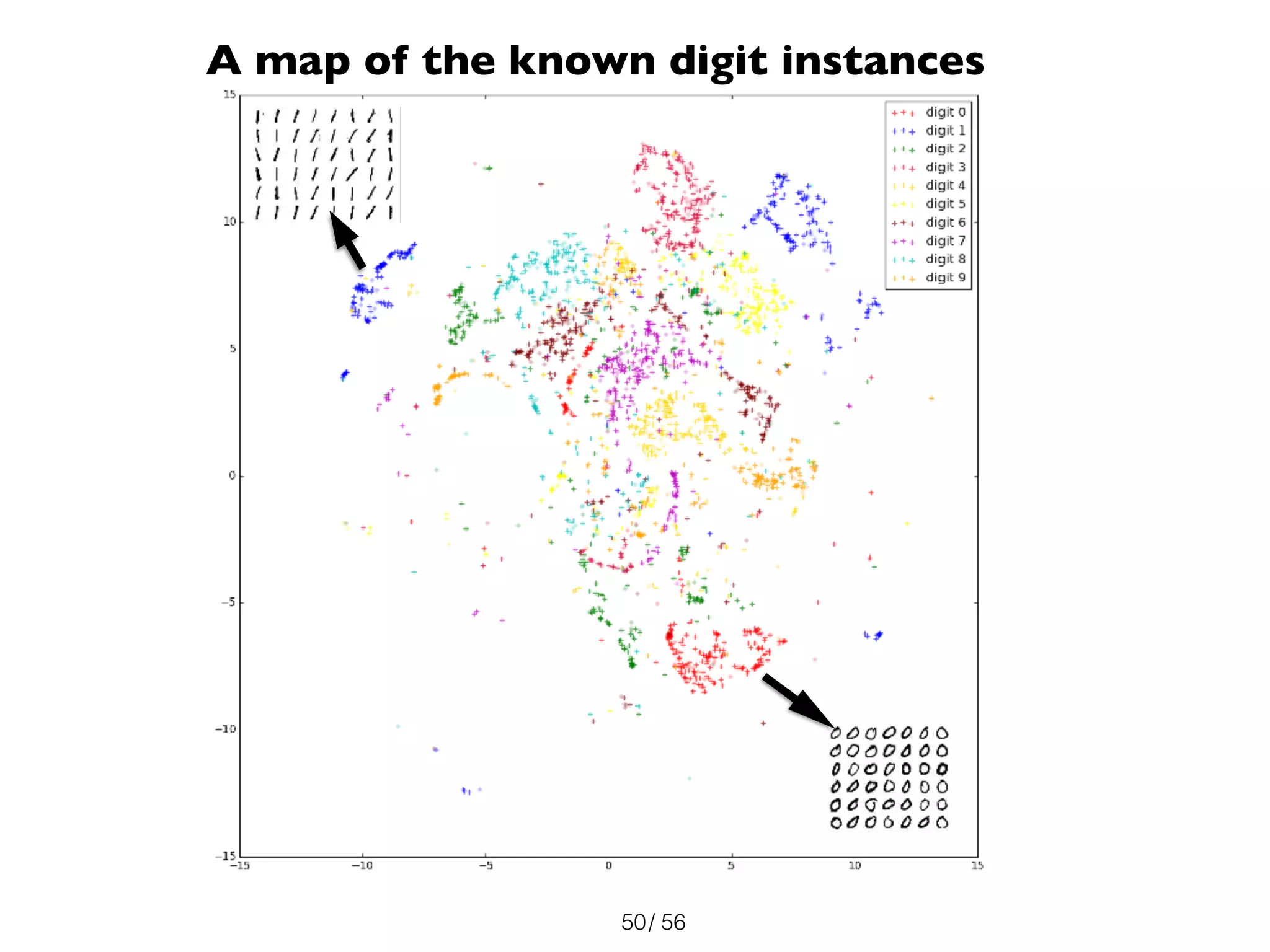
A map of the known digit instances
Kazakçı, Cherti, Kégl, 2016
/ 5650
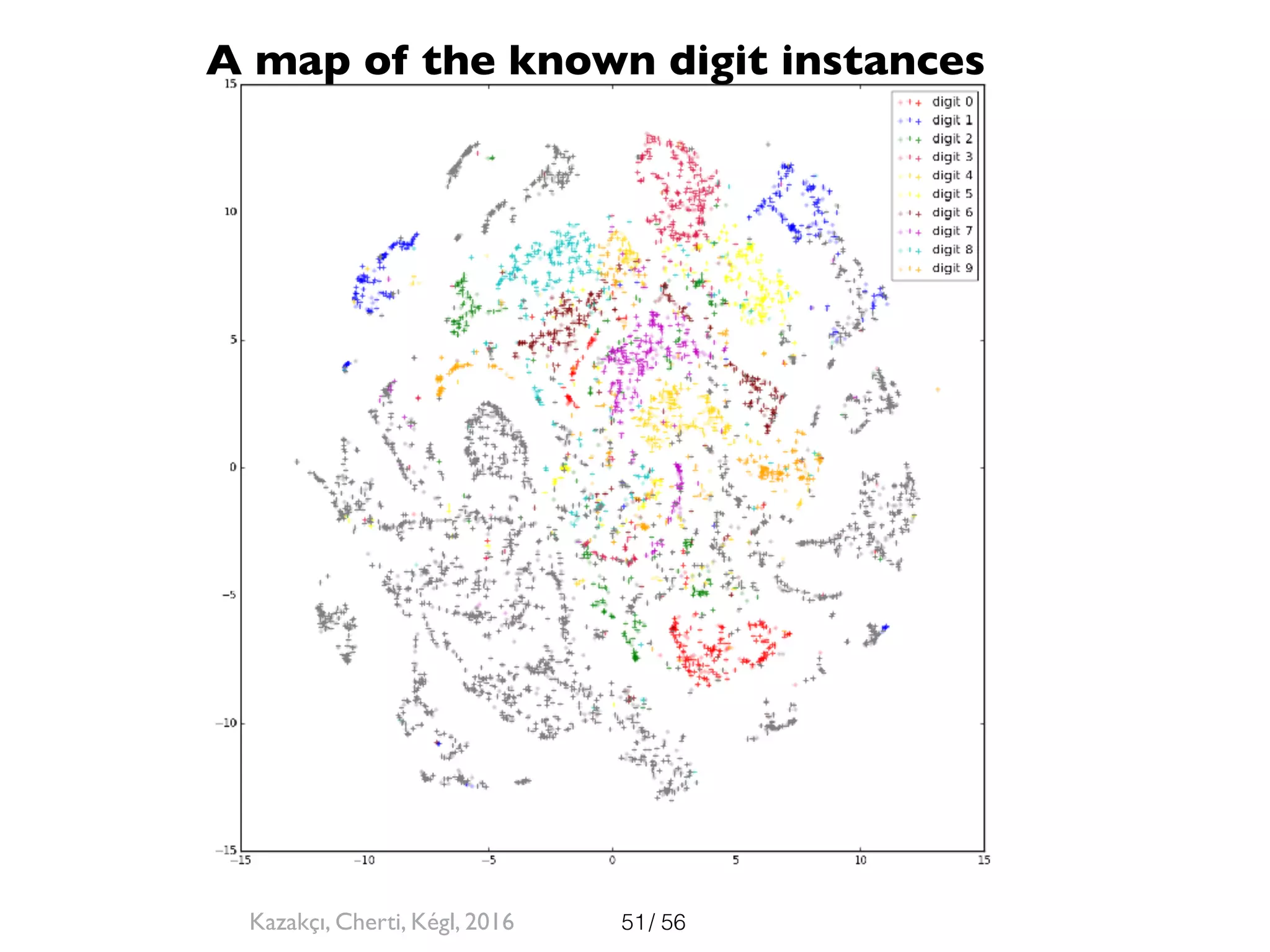
A map of the known digit instances
/ 5651
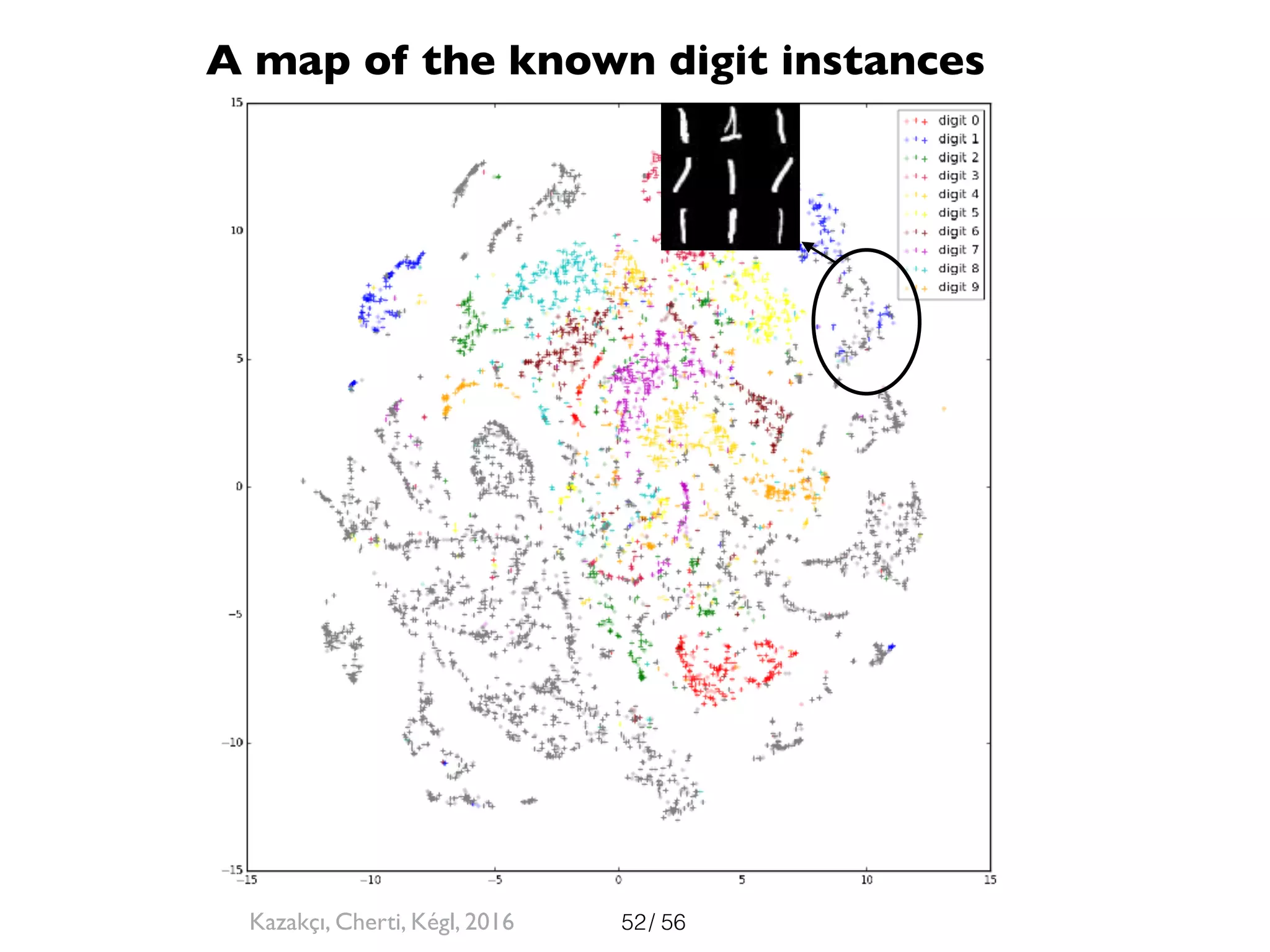
A map of the known digit instances
Kazakçı, Cherti, Kégl, 2016
/ 5652
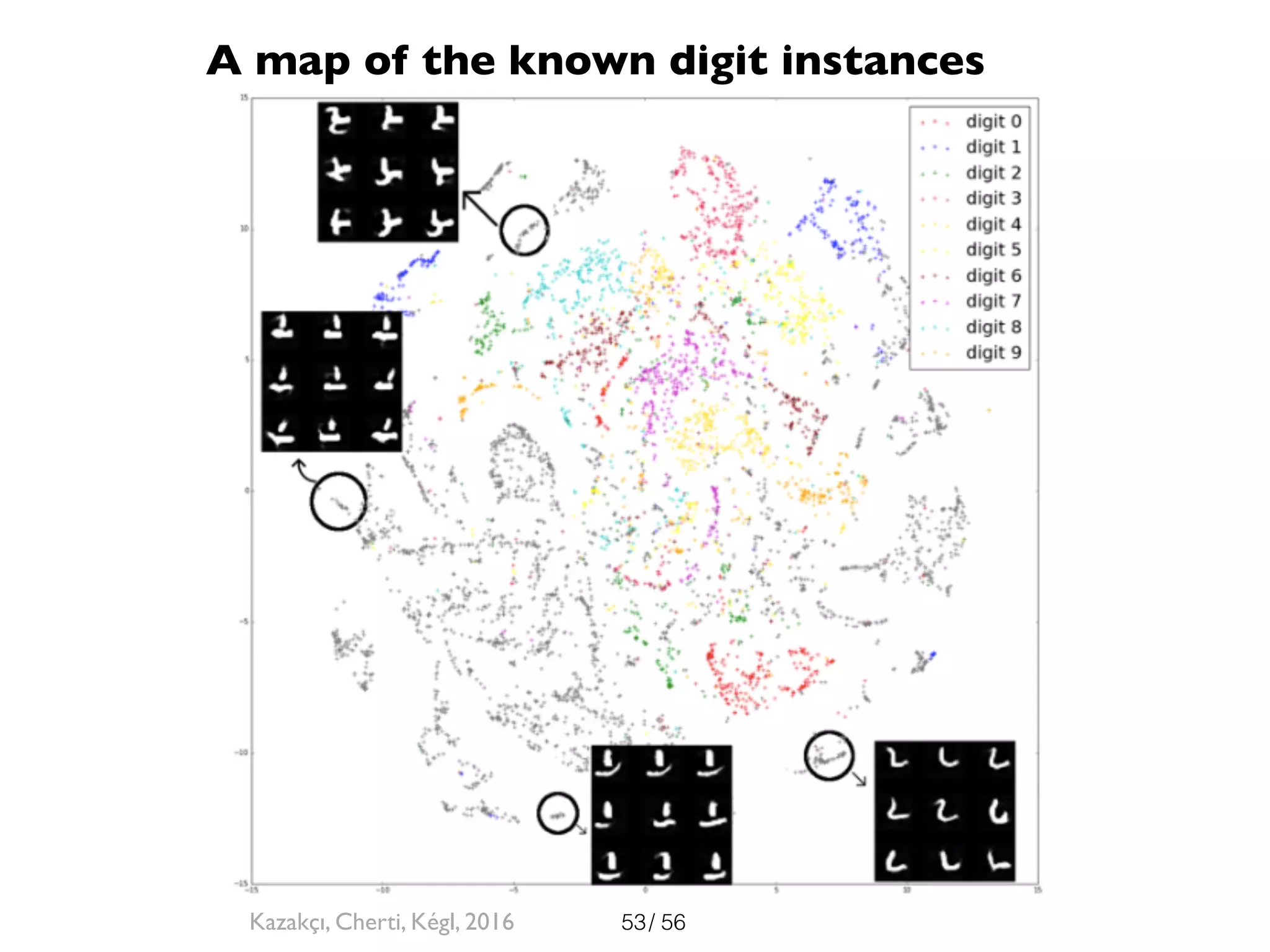
A map of the known digit instances
Kazakçı, Cherti, Kégl, 2016
/ 5653Kazakçı, Cherti, Kégl, 2016
A map of the known digit instances
/ 5654
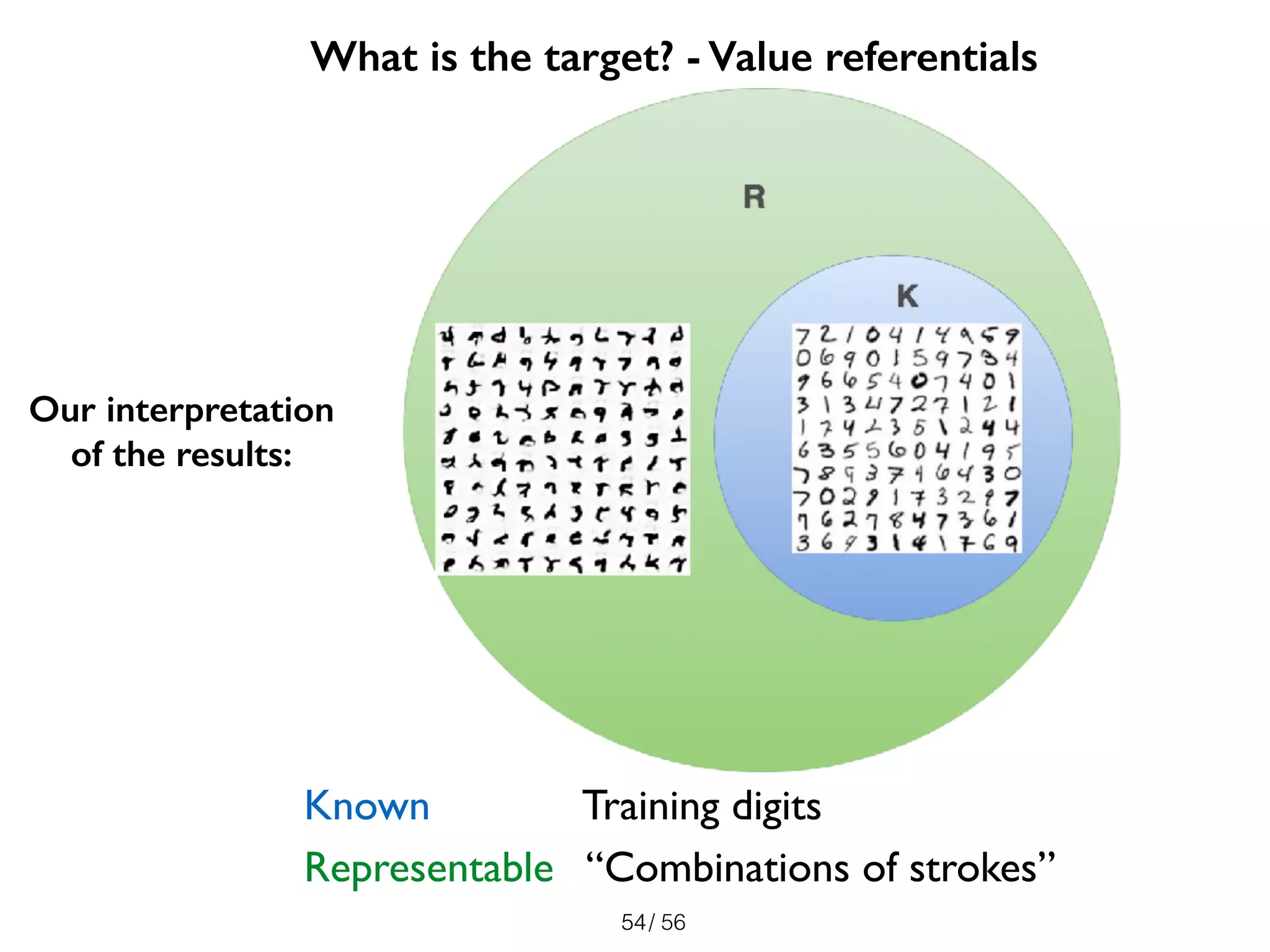
Known Training digits
Representable “Combinations of strokes”
54
What is the target? - Value referentials
Our interpretation
of the results:
/ 5655
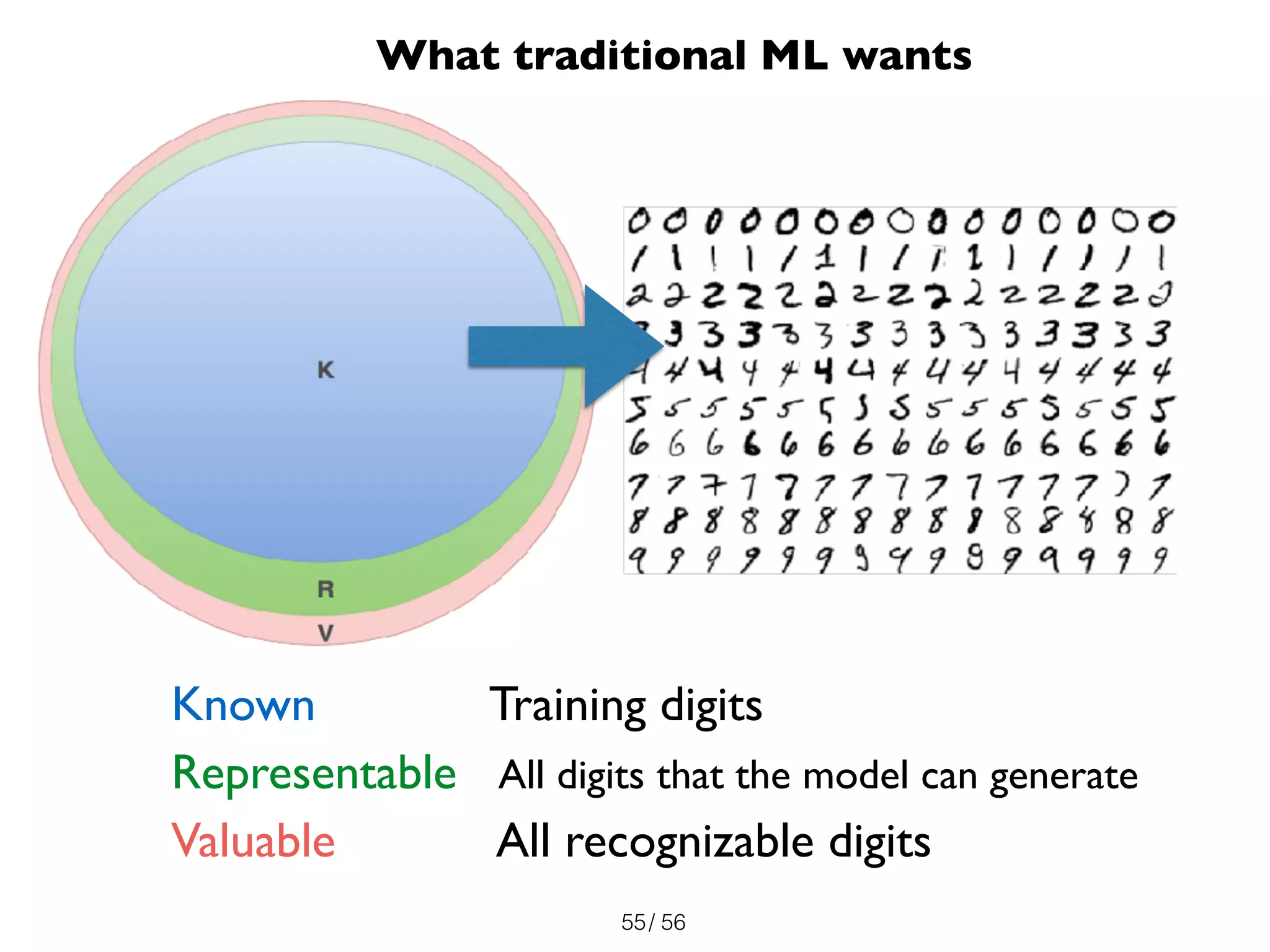
Known Training digits
Representable All digits that the model can generate
Valuable All recognizable digits
What traditional ML wants
/ 5656
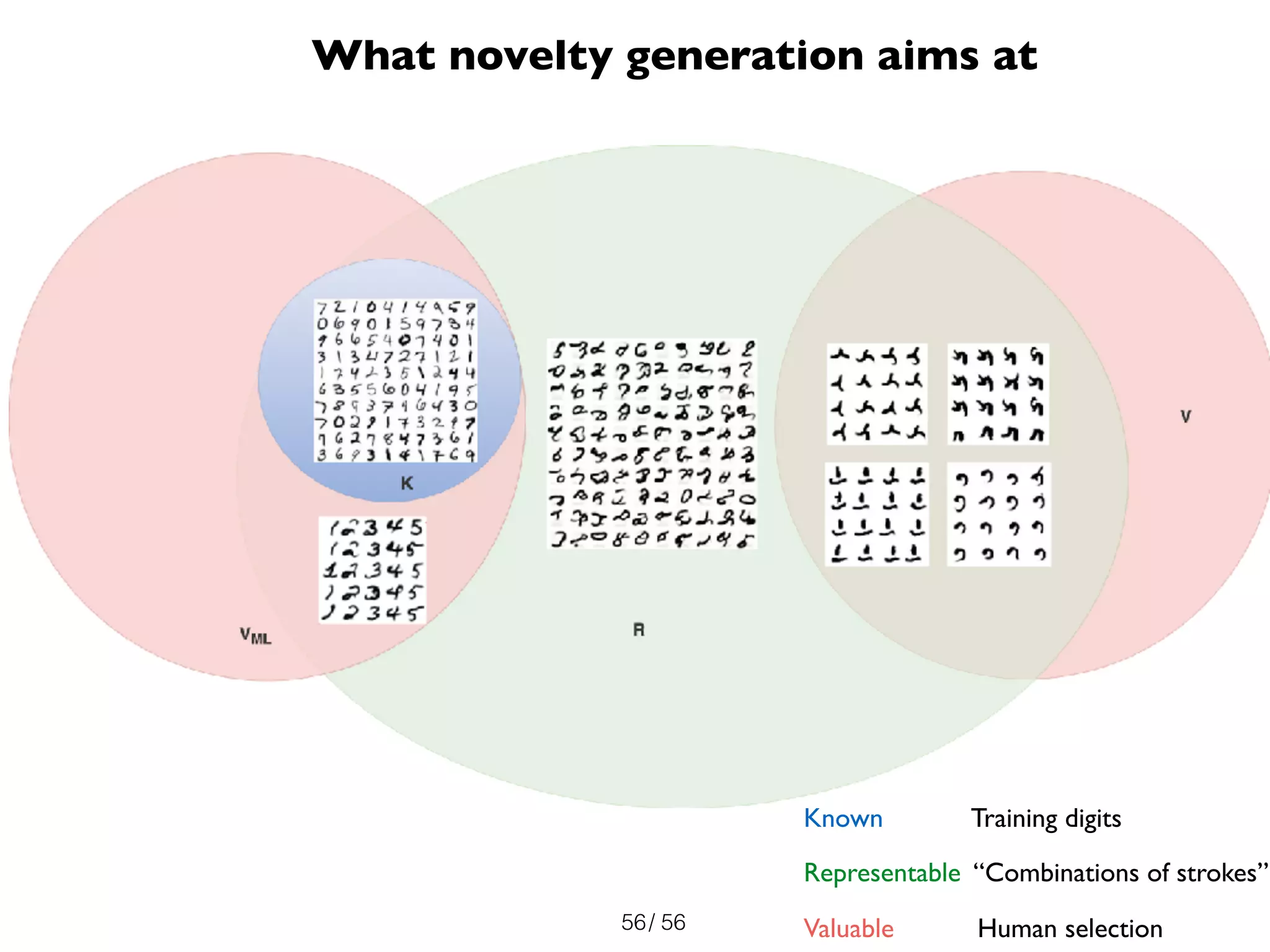
Known Training digits
Representable “Combinations of strokes”
Valuable Human selection
What novelty generation aims at
Discussion

Learning, Representations, Generative modelling

  • 1.
    / 56 Generativity andData Science 1 Akın Kazakçı (Mines Paristech) akin.kazakci@mines-paristech.fr
  • 2.
    2 Prediction A quest forartificial general intelligence
  • 3.
    3 Prediction Novelty generation Aquest for artificial general intelligence
  • 4.
    / 56 Plan • Representationand learning • Impact of representations on generation • A naive bayes generator • Generating novelty with neural networks 4
  • 5.
    / 56 How doyou represent this “object”? 5 Representing an object A
  • 6.
    / 56 What isa representation? 6 Representing an object A
  • 7.
    / 567 Representing anobject A Source: https://plato.stanford.edu/entries/ mental-representation/ Have fun! Very hard question.
  • 8.
    / 568 Representing anobject A Even the simplest of (computer) representations require some choice or arbitrariness. AObject (?) Pixel representation (8x9)
  • 9.
    / 569 To processany “object” (e.g. by computers) you need to “represent” it.
  • 10.
    / 5610 Representation arenot “neutral” and “independent” of the observer.
  • 11.
    / 56 What effecta representation have on learning and (or) generation?
  • 12.
    / 56 Let ustake a toy example; 16 letters Each represented with 9x5 binary pixels 12 Representation and Learning
  • 13.
    / 56 What isthe size of the representation space? 13 Representation and Learning
  • 14.
    / 56 There are245 object (representations) in that space. 14 Representation and Learning
  • 15.
    / 56 Each imagecan be represented as a vector of size 45. 15 Representation and Learning (0,0,0,0,0,0,0,0,0,0,0,1,1,1,1,1, 0,0 …………………..…… 0,0,0,0,0) (0,0,0,0,0,0,0,0,0,0,0,1,1,1,1,1, 0,1 …………………..…… 0,0,0,0,0) . . . . . . . . . . . . . .
  • 16.
    / 56 What canbe learned from this data? 16 Representation and Learning (0,0,0,0,0,0,0,0,0,0,0,1,1,1,1,1, 0,0 …………………..…… 0,0,0,0,0) (0,0,0,0,0,0,0,0,0,0,0,1,1,1,1,1, 0,1 …………………..…… 0,0,0,0,0) . . . . . . . . . . . . . .
  • 17.
    / 56 The firstand the simplest thing we can ‘consider’ learning is the data itself (e.g. identity function). 17 Representation and Learning (0,0,0,0,0,0,0,0,0,0,0,1,1,1,1,1, 0,0 …………………..…… 0,0,0,0,0) (0,0,0,0,0,0,0,0,0,0,0,1,1,1,1,1, 0,1 …………………..…… 0,0,0,0,0) . . . . . . . . . . . . . . The identity function can be conceived as a mapping from the image to its vectorised representation. What would be the inconvenient of such a function?
  • 18.
    / 5618 Representation andLearning A The new ‘A’ will be unrecognisable by Id(x)
  • 19.
    / 5619 Learning assumesa notion of ‘generalisation’
  • 20.
    / 5620 Representation andLearning What generalisations can we learn from these letters ? Here is an example:
  • 21.
    / 5621 Representation andLearning Learning means finding regularities or structures in representations. Where structure is the dependence of pixels (e.g. co-occurence)
  • 22.
    / 5622 Re-representing objects Wecan use the following structures to re-represent letters. For example,
  • 23.
    / 56 Objects canbe represented in multiple ways In design literature, it has been acknowledged that objects can be represented in multiple ways Images from Reich, A ciritcal review of general design theory, RED, 1995
  • 24.
  • 25.
    / 56 Strokes givesus a shorter representation (or code) for the letter domain. 25
  • 26.
    / 56 This newrepresentation is lossless compression (no information lost) 26
  • 27.
    / 56 Each representationis a model And the set of models of a given agent is its knowledge. 27
  • 28.
    / 56 Models canbe imperfect (e.g. lossy). 28
  • 29.
    / 56 One exampleof imperfect models are probabilistic models. 29
  • 30.
    / 56 Plan • Representationand learning • Impact of representations on (probabilistic) generation • A naive bayes generator • Generating novelty with neural networks 30
  • 31.
    / 56 We generatepixels randomly uniformly. Everything seems new. But it is hard to find any structure in this data. 31 The impact of representations on novelty generation
  • 32.
    / 5632 Pixel spaceStroke space Representations change what you can generate
  • 33.
    / 56 Size ofthe representation vs Size of Novelty Set 33 0 500 1000 1500 2000 2500 0 2 4 6 8 10 12 0 5E+12 1E+13 1,5E+13 2E+13 2,5E+13 3E+13 3,5E+13 4E+13 4 6 8 10 12 14 16 18 20 22 24 26 28 30 32 34 36 38 40 42 44 0 200000000 400000000 600000000 800000000 1E+09 1,2E+09 0 5 10 15 20 25 30 35 0 200000 400000 600000 800000 1000000 1200000 0 5 10 15 20 25
  • 34.
    / 56 Plan • Representationand learning • Impact of representations on (probabilistic) generation • A naive bayes generator • Generating novelty with neural networks 34
  • 35.
    / 5635 Assume wehave 60K handwritten digits. How to model them?
  • 36.
    / 56 Modeling digits 36 Themain idea is to treat digits as a probability distribution over the image space. Source: Umesh Vazirani
  • 37.
    / 5637 Probabilistic approach •Treat variations among images of a digit as a probability distribution over all the images x ✴ Distribution Pj(x) generates images x from digit j, but by (small) random chance can look like other digits ✴ Imperfect model, represents our uncertainty/ambiguity, but Bayes’ rule to the rescue! P1(x) = ( P2(x) = ( P8(x) = ( · · · ) · · · ) · · · ) Source: Umesh Vazirani
  • 38.
    / 5638 Estimating thedistributions • Use training data to estimate the prior and the class-conditional distributions ✴ MNIST dataset: 60K training data, 10K test data • Estimating the is easy: • From MNIST: • But estimating the is difficult! ⇡j = Pr[y = j] Pj(x) = P(x | y = j) ⇡j Pj(x) ˆ⇡j = nj n = # of examples of class j total # of examples j 0 1 2 3 4 5 6 7 8 9 ˆ⇡j (%) 9.87 11.24 9.93 10.22 9.74 9.03 9.86 10.44 9.75 9.92 Source: Umesh Vazirani Naive Bayes • Convert grayscale images to binary • A general distribution over has parameters threshold binary data x 2 {0, 1}784 {0, 1}784 2784 1 • Assume that within each class, the individual pixel values are independent: • Each is a coin flip: easy to estimate! • Now only have 784 parameters to learn Pj(x) = Pj1(x1) · Pj2(x2) · · · Pj,784(x784) Pji Source: Umesh Vazirani
  • 39.
    / 5639 Naive Bayeson MNIST • Error rate: 15.4% (on 10K test data) —> pretty good! • Mean vectors for each class (the ’s):pji • Samples from the trained model: Source: Umesh Vazirani
  • 40.
    / 56 Plan • Representationand learning • Impact of representations on generation • A naive bayes generator • Generating novelty with neural networks 40
  • 41.
    / 5641 Machine learningproposes powerful generative models
  • 42.
    / 5642 but thesepowerful models are used to regenerate objects that we can relate easily to known objects…
  • 43.
    / 56 • Althoughtrained for generating what we know, some models can generate unrecognizable objects • However, these models and samples are considered as spurious (Bengio et al. 2013), or as a failure(Salimans et al. 2016) 43
  • 44.
    / 56 So, firsttask is to demonstrate that there is a lot more generative potential in DNNs than what was intended 44
  • 45.
    / 56 Deep NeuralNetworks 45 Learning a sequence of transformations of the original representation Main advantages • Compositionality • Hierarchy
  • 46.
    Auto-associative neural nets a.k.aauto-encoders Learning to disassemble Learning to build - Auto-encoders have existed for long time (Kramer 1991) - Deep variants are more recent (Hinton, Salakhutdinov, 2006; Bengio 2009) - A deep auto-encoder learns successive transformations that decompose and then recompose a set of training objects - The depth allows learning a hierarchy of transformations
  • 47.
    / 56 • Weuse an iterative method to generate new images • Start with a random image • Force the network to construct (i.e. interpret) • , until convergence, f(x) = dec(enc(x)) 47 The generative process
  • 48.
    / 56 Generation toget back to knowledge 48
  • 49.
    / 5649 A mapof the known digit instances Kazakçı, Cherti, Kégl, 2016
  • 50.
    / 5650 A mapof the known digit instances
  • 51.
    / 5651 A mapof the known digit instances Kazakçı, Cherti, Kégl, 2016
  • 52.
    / 5652 A mapof the known digit instances Kazakçı, Cherti, Kégl, 2016
  • 53.
    / 5653Kazakçı, Cherti,Kégl, 2016 A map of the known digit instances
  • 54.
    / 5654 Known Trainingdigits Representable “Combinations of strokes” 54 What is the target? - Value referentials Our interpretation of the results:
  • 55.
    / 5655 Known Trainingdigits Representable All digits that the model can generate Valuable All recognizable digits What traditional ML wants
  • 56.
    / 5656 Known Trainingdigits Representable “Combinations of strokes” Valuable Human selection What novelty generation aims at
  • 57.