Machine Learning Applications in Particle
Physics
- Broadening the scope of exploration
Akın O. Kazakçı
akin.kazakci@mines-paristech.fr
Centre for Data Science
	
  January	
  the	
  12th,	
  2014	
  
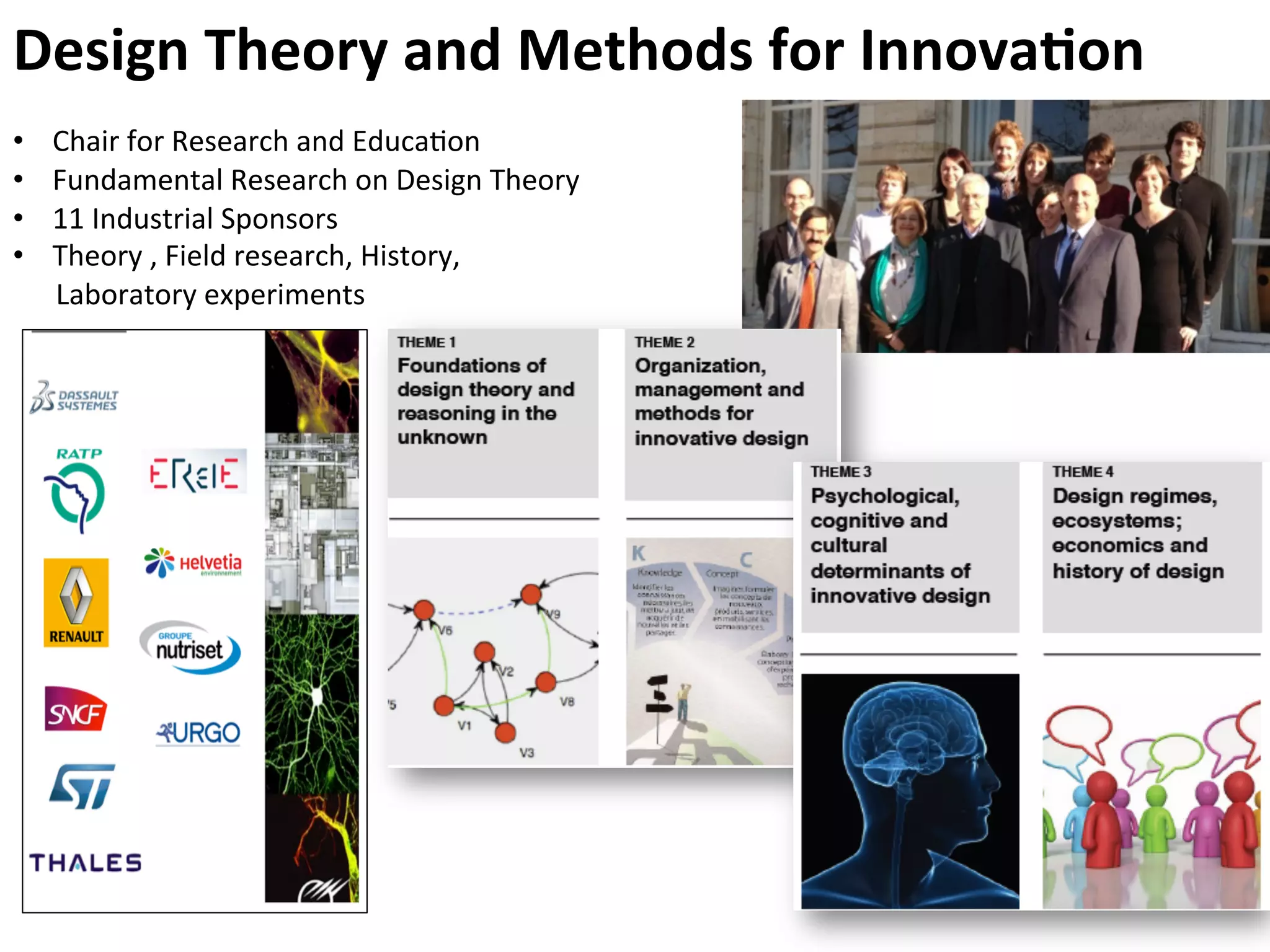
Design	
  Theory	
  and	
  Methods	
  for	
  Innova4on	
  
•  Chair	
  for	
  Research	
  and	
  Educa9on	
  
•  Fundamental	
  Research	
  on	
  Design	
  Theory	
  
•  11	
  Industrial	
  Sponsors	
  
•  Theory	
  ,	
  Field	
  research,	
  History,	


  Laboratory	
  experiments	
  
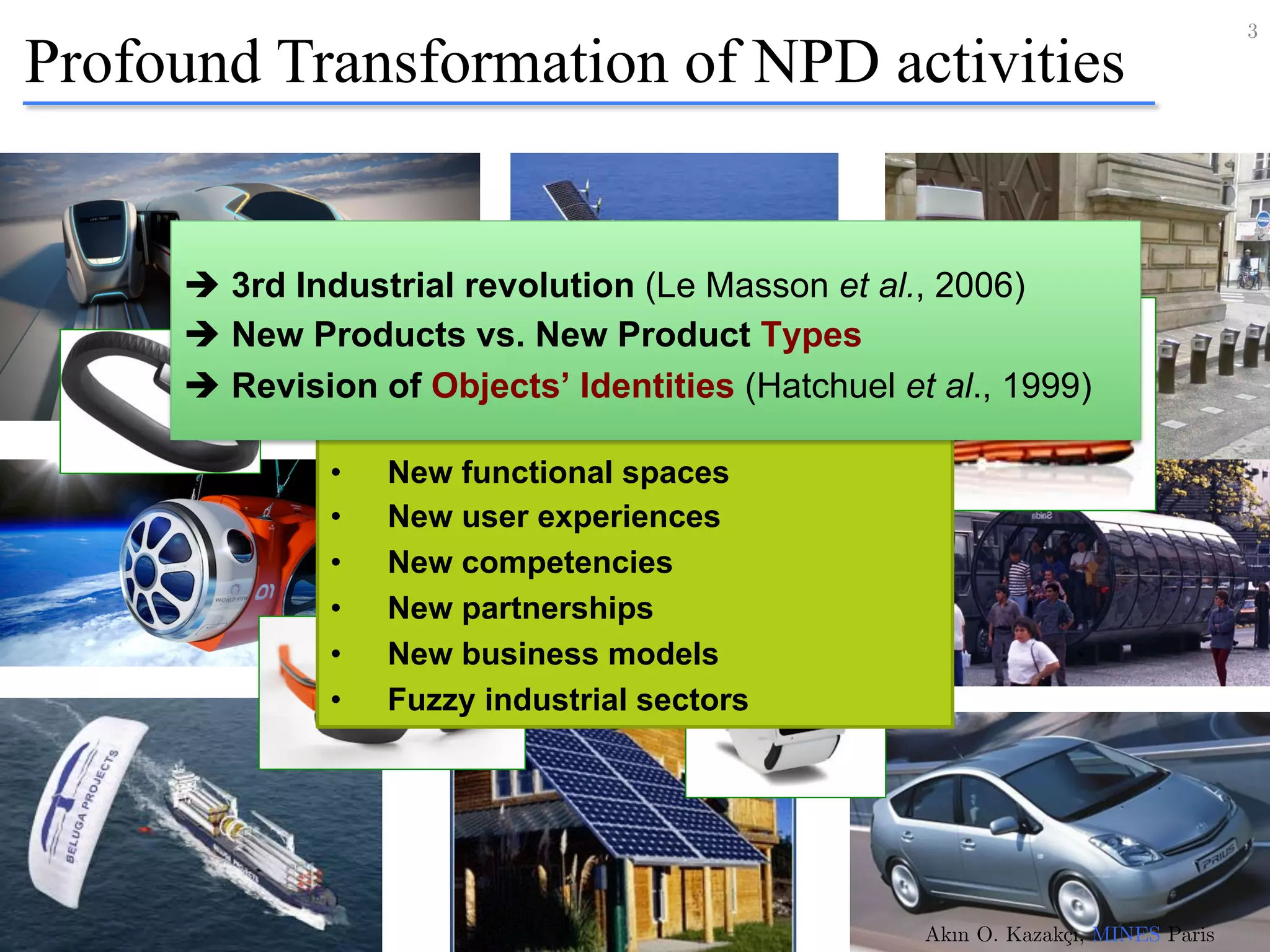
Profound Transformation of NPD activities
3!
Akın O. Kazakçı, MINES ParisTech!
•  New functional spaces
•  New user experiences
•  New competencies
•  New partnerships
•  New business models
•  Fuzzy industrial sectors
è 3rd Industrial revolution (Le Masson et al., 2006)
è New Products vs. New Product Types
è Revision of Objects’ Identities (Hatchuel et al., 1999)
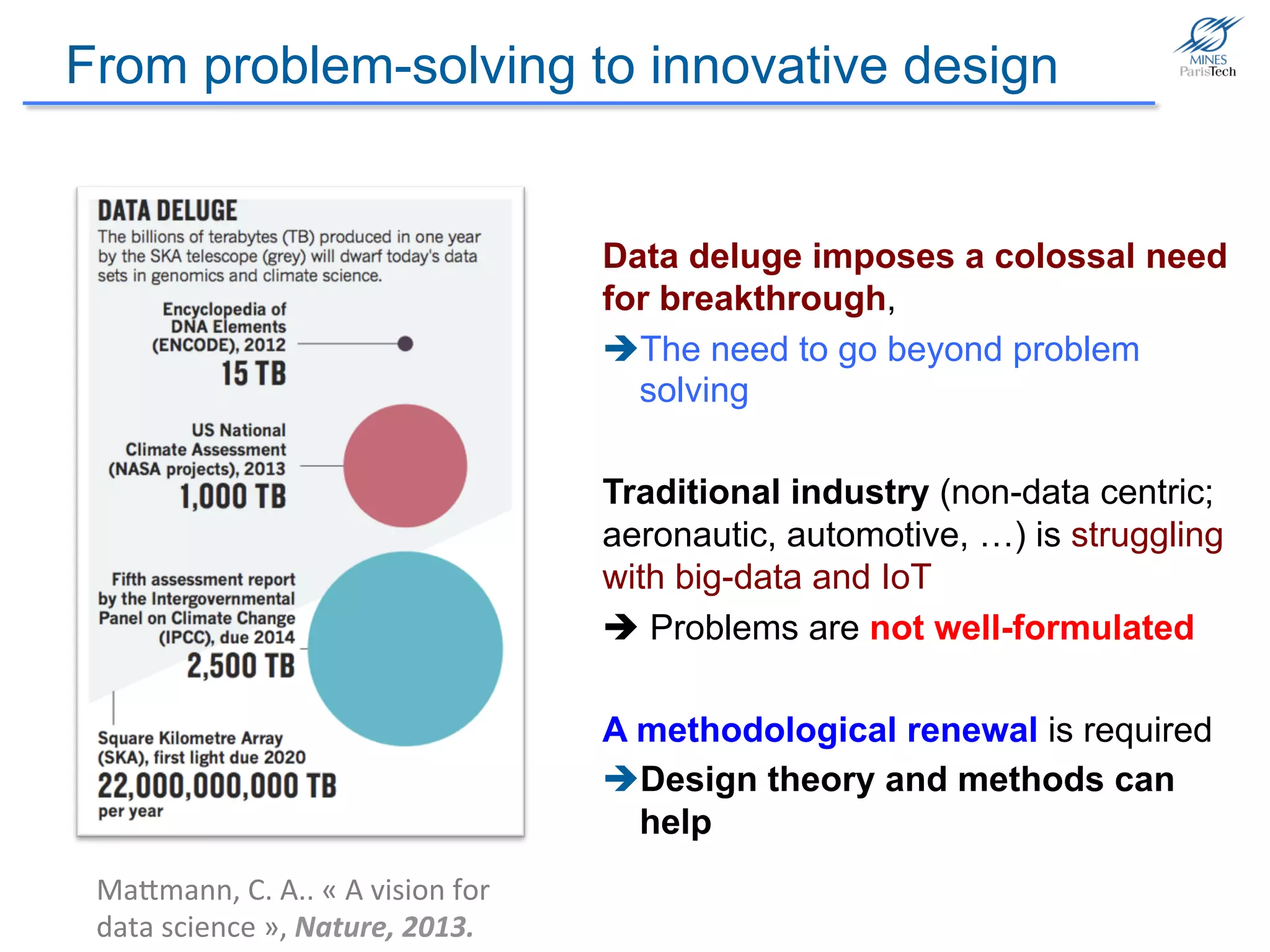
From problem-solving to innovative design
MaHmann,	
  C.	
  A..	
  «	
  A	
  vision	
  for	
  
data	
  science	
  »,	
  Nature,	
  2013.	
  
Data deluge imposes a colossal need
for breakthrough,
è The need to go beyond problem
solving
Traditional industry (non-data centric;
aeronautic, automotive, …) is struggling
with big-data and IoT
è Problems are not well-formulated
A methodological renewal is required
è Design theory and methods can
help
Plan
1. What does it mean to
define an object?!
2. Design theory: a few
basic notions!
3. Examples!
5!
Akın O. Kazakçı, MINES ParisTech!
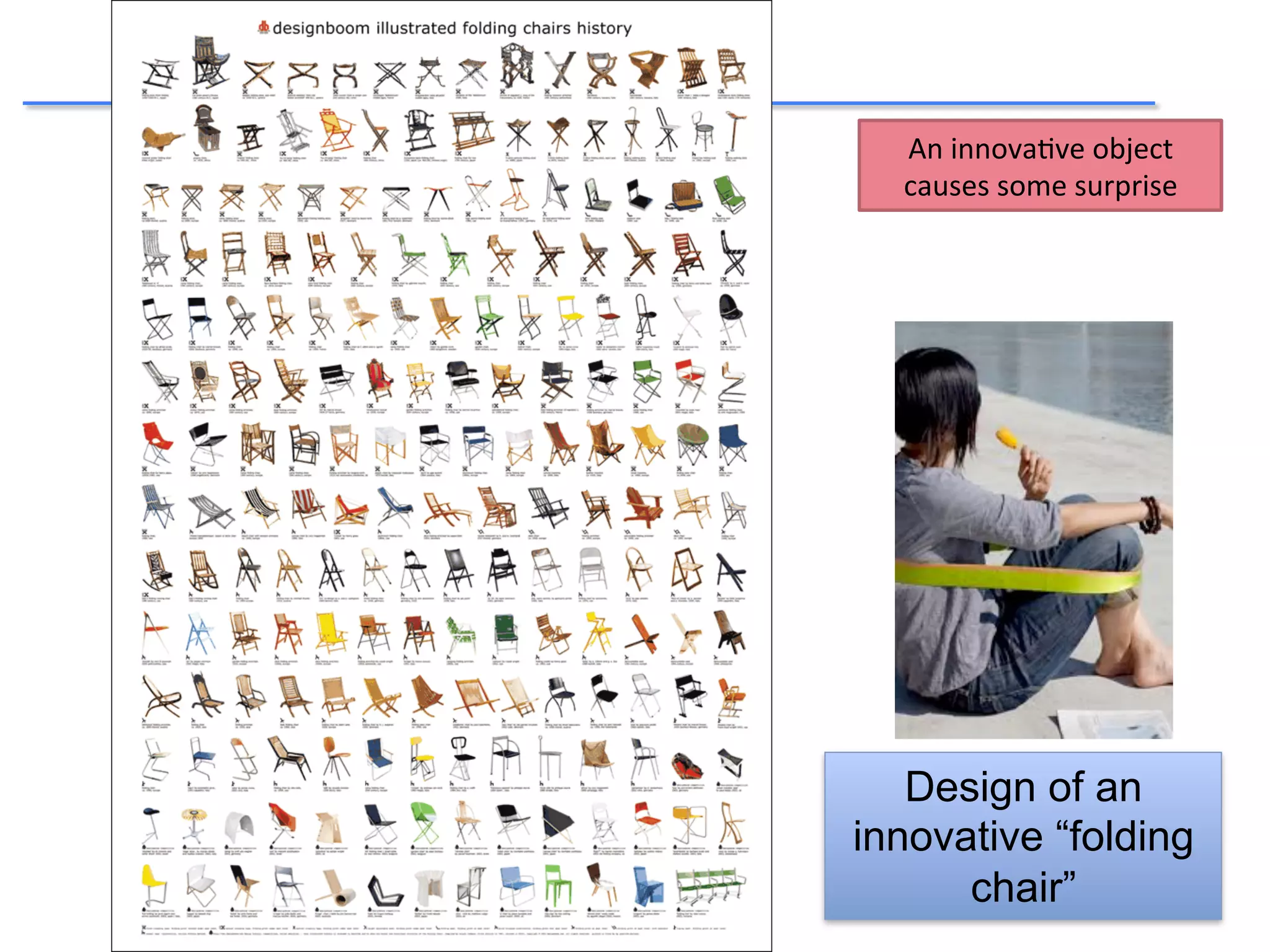
Design of an
innovative “folding
chair”
An	
  innova9ve	
  object	
  
causes	
  some	
  surprise	
  
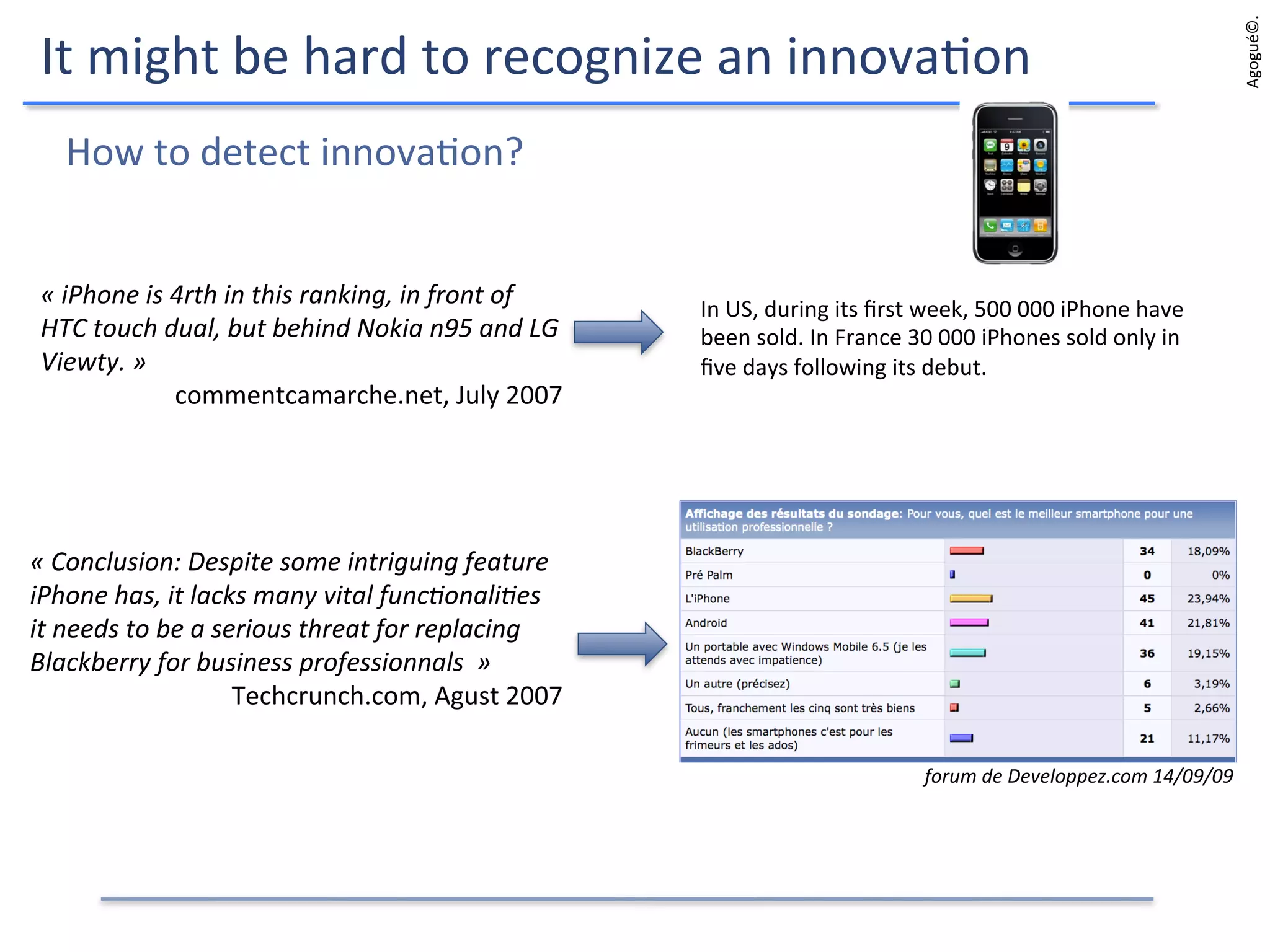
How	
  to	
  detect	
  innova9on?	
  
«	
  iPhone	
  is	
  4rth	
  in	
  this	
  ranking,	
  in	
  front	
  of	
  
HTC	
  touch	
  dual,	
  but	
  behind	
  Nokia	
  n95	
  and	
  LG	
  
Viewty.	
  »	
  
commentcamarche.net,	
  July	
  2007	
  
In	
  US,	
  during	
  its	
  first	
  week,	
  500	
  000	
  iPhone	
  have	
  
been	
  sold.	
  In	
  France	
  30	
  000	
  iPhones	
  sold	
  only	
  in	
  
five	
  days	
  following	
  its	
  debut.	
  
«	
  Conclusion:	
  Despite	
  some	
  intriguing	
  feature	
  
iPhone	
  has,	
  it	
  lacks	
  many	
  vital	
  funcIonaliIes	
  
it	
  needs	
  to	
  be	
  a	
  serious	
  threat	
  for	
  replacing	
  
Blackberry	
  for	
  business	
  professionnals	
  	
  »	
  
Techcrunch.com,	
  Agust	
  2007	
  
forum	
  de	
  Developpez.com	
  14/09/09	
  
It	
  might	
  be	
  hard	
  to	
  recognize	
  an	
  innova9on	
  
Agogué©.	
  	
  
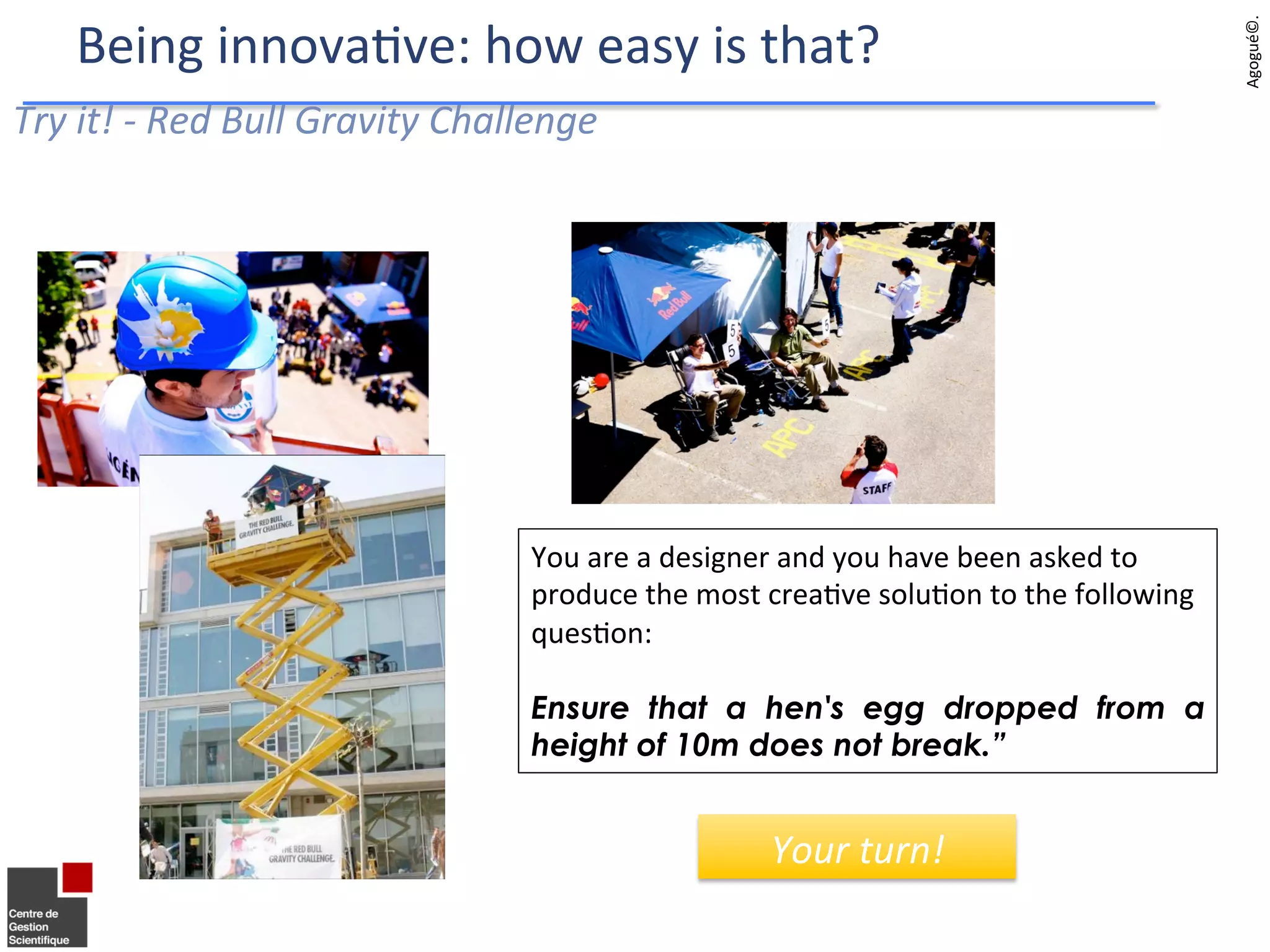
Try	
  it!	
  -­‐	
  Red	
  Bull	
  Gravity	
  Challenge	
  
You	
  are	
  a	
  designer	
  and	
  you	
  have	
  been	
  asked	
  to	
  
produce	
  the	
  most	
  crea9ve	
  solu9on	
  to	
  the	
  following	
  
ques9on:	


Ensure that a hen's egg dropped from a
height of 10m does not break.”
Agogué©.	
  	
  
Being	
  innova9ve:	
  how	
  easy	
  is	
  that?	
  
Your	
  turn!	
  
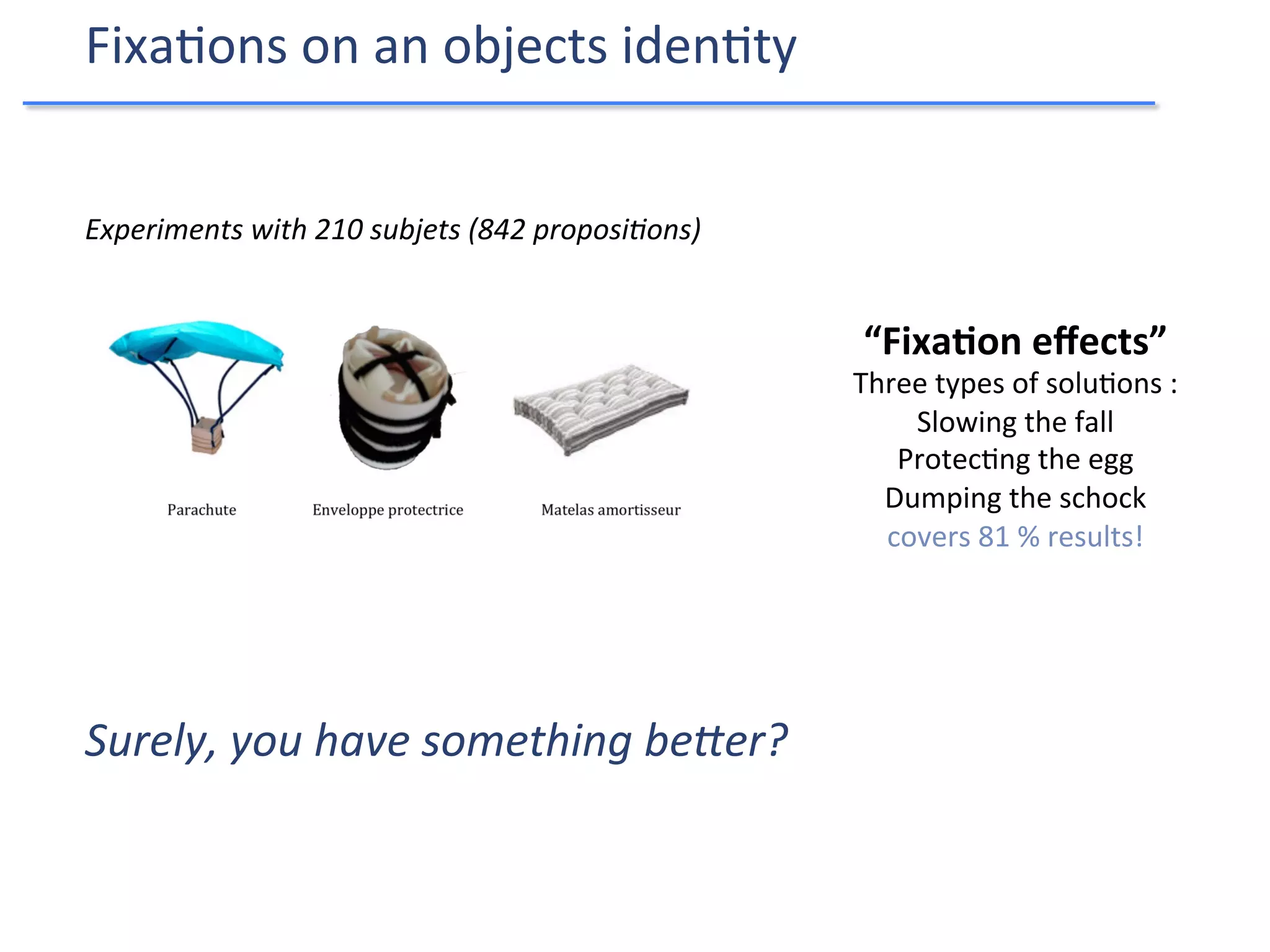
Experiments	
  with	
  210	
  subjets	
  (842	
  proposiIons)	
  
“Fixa4on	
  effects”	
  	
  
Three	
  types	
  of	
  solu9ons	
  :	
  
Slowing	
  the	
  fall	
  
Protec9ng	
  the	
  egg	
  
Dumping	
  the	
  schock	
  
covers	
  81	
  %	
  results!	
  
Fixa9ons	
  on	
  an	
  objects	
  iden9ty	
  
Surely,	
  you	
  have	
  something	
  be[er?	
  
10!
Akın O. Kazakçı, MINES ParisTech!
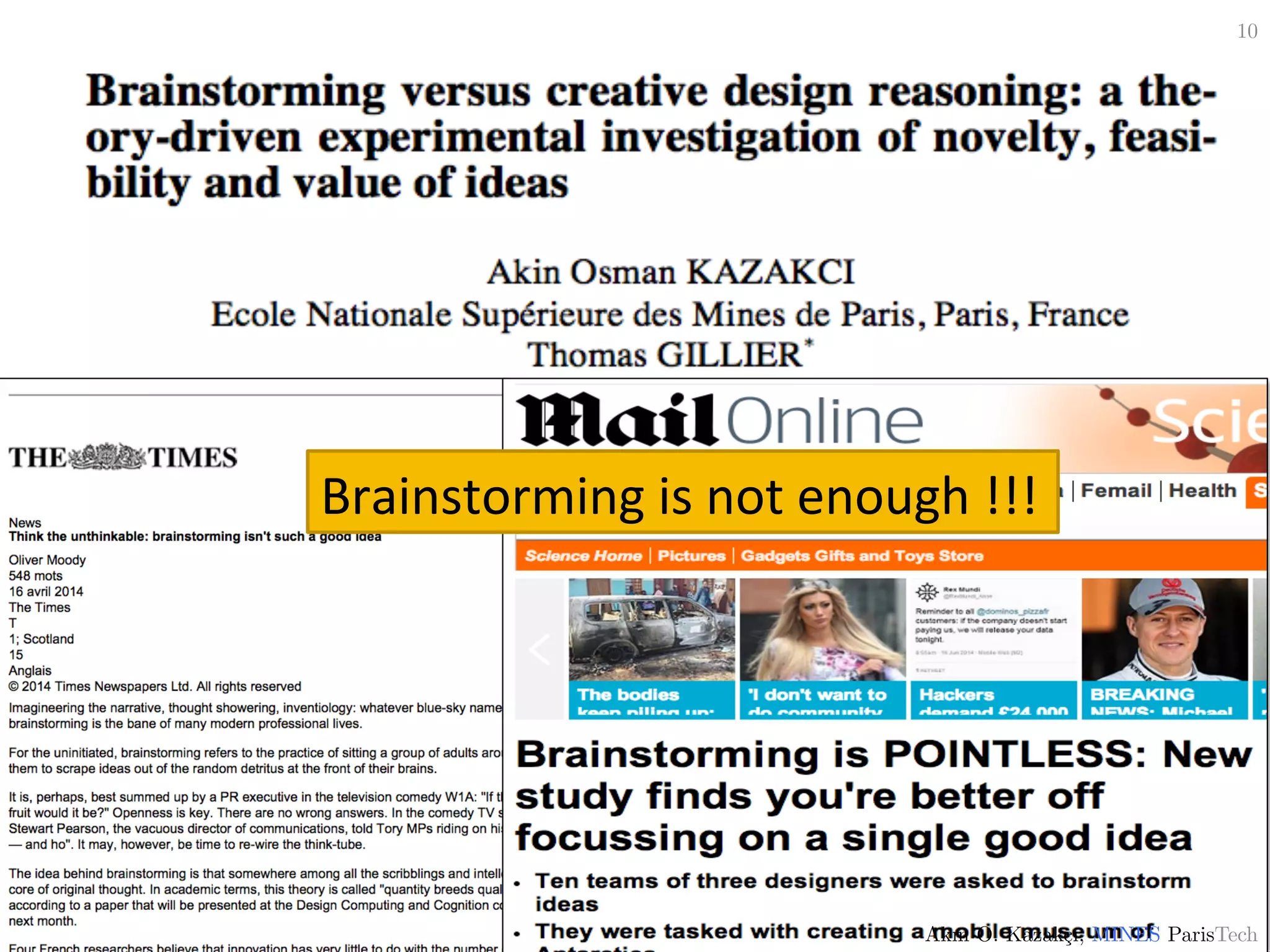
Brainstorming	
  is	
  not	
  enough	
  !!!	
  
Plan
1. What does it mean to
define an object?!
2. Design theory: a few
basic notions!
3. Examples!
11!
Akın O. Kazakçı, MINES ParisTech!
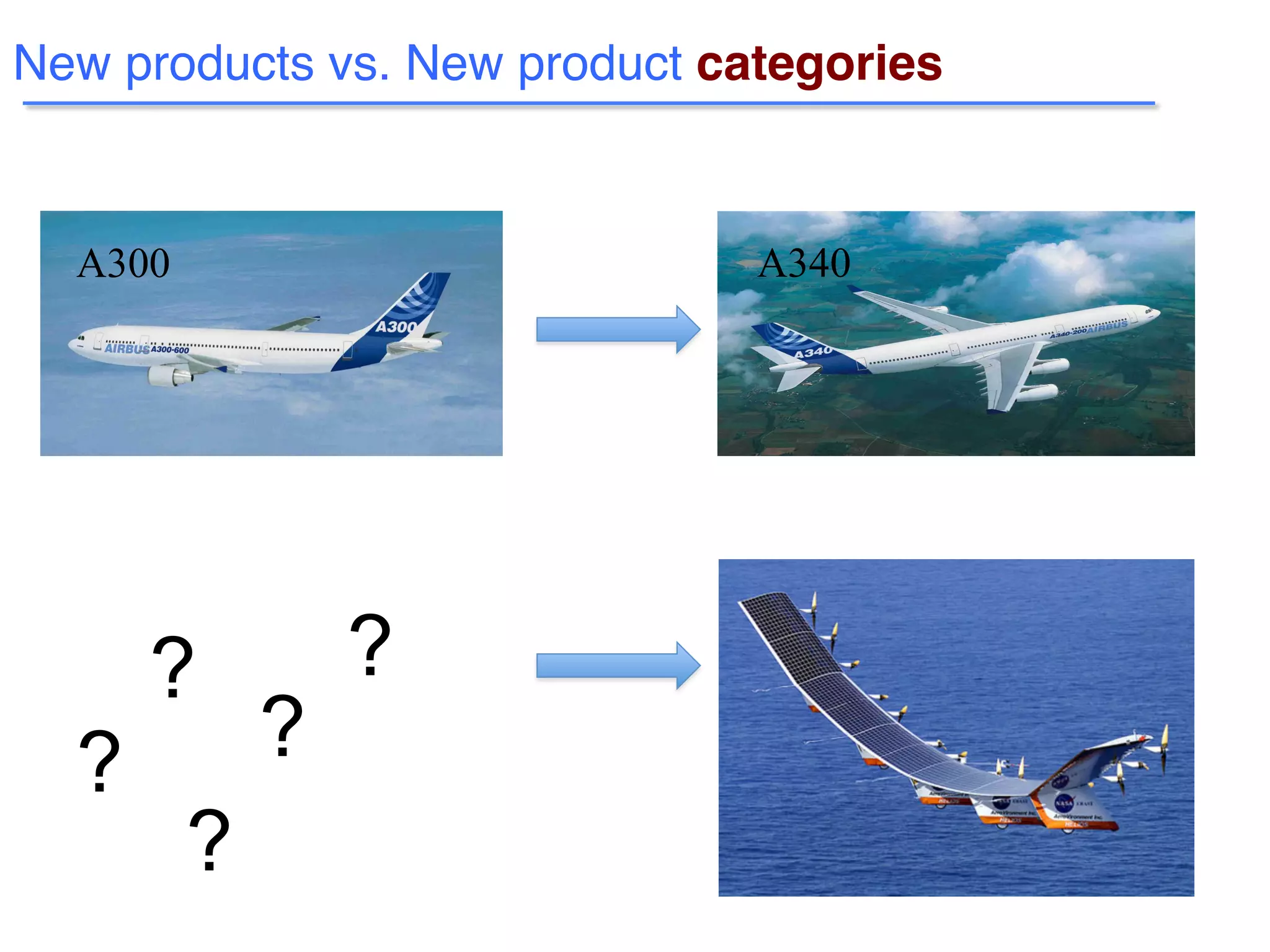
New products vs. New product categories 
?
? ?
?
?
A300 A340
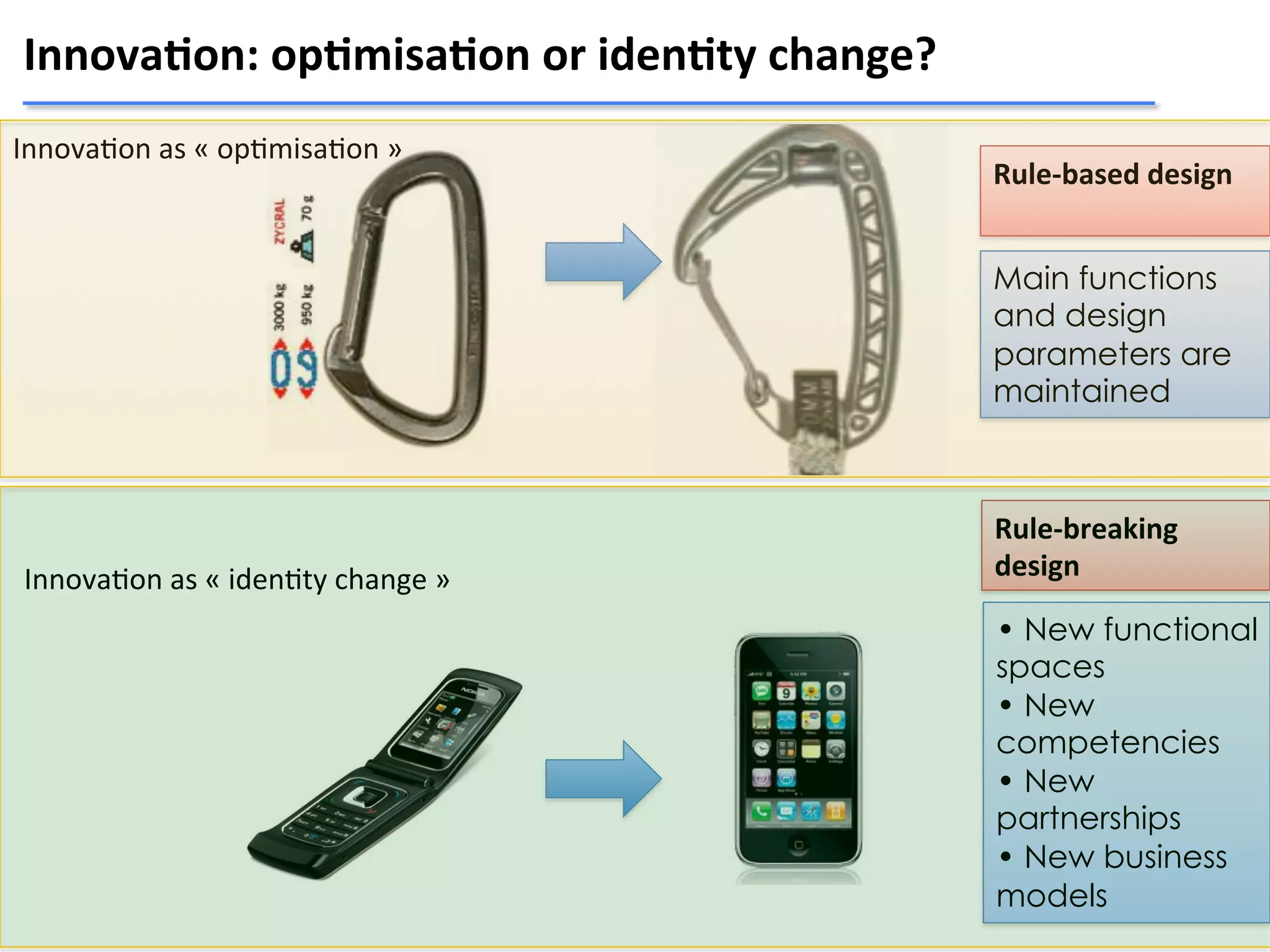
Main functions
and design
parameters are
maintained
Rule-­‐based	
  design	
  
Rule-­‐breaking	
  
design	
  
• New functional
spaces
• New
competencies
• New
partnerships
• New business
models
Innova4on:	
  op4misa4on	
  or	
  iden4ty	
  change?	
  
Innova9on	
  as	
  «	
  op9misa9on	
  »	
  
Innova9on	
  as	
  «	
  iden9ty	
  change	
  »	
  
14!
Akın O. Kazakçı, MINES ParisTech!
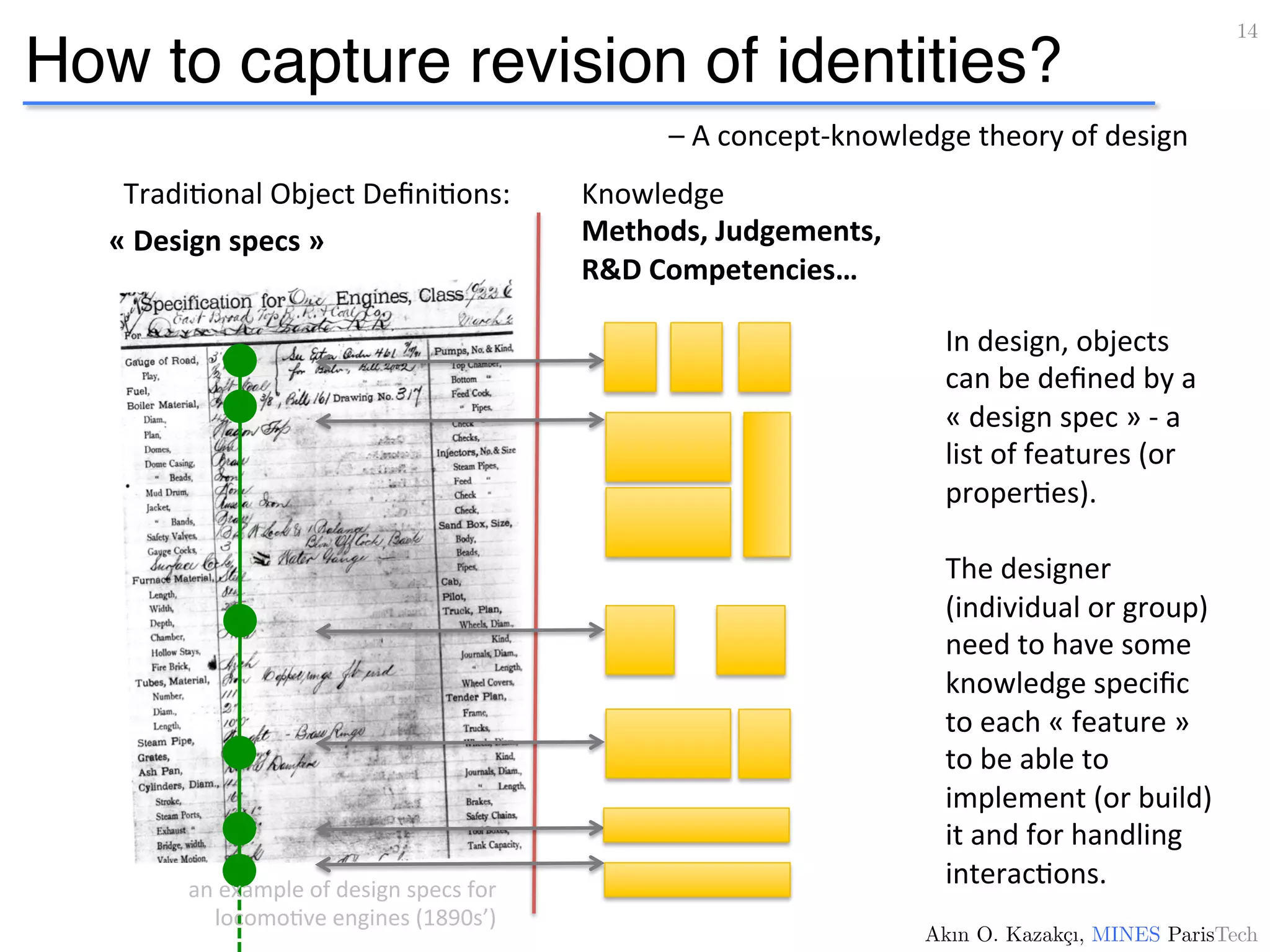
How to capture revision of identities?
–	
  A	
  concept-­‐knowledge	
  theory	
  of	
  design	
  
«	
  Design	
  specs	
  »	
  
Tradi9onal	
  Object	
  Defini9ons:	
   Knowledge	
  
Methods,	
  Judgements,	
  
R&D	
  Competencies…	
  
an	
  example	
  of	
  design	
  specs	
  for	
  
locomo9ve	
  engines	
  (1890s’)	
  
In	
  design,	
  objects	
  
can	
  be	
  defined	
  by	
  a	
  
«	
  design	
  spec	
  »	
  -­‐	
  a	
  
list	
  of	
  features	
  (or	
  
proper9es).	


The	
  designer	
  
(individual	
  or	
  group)	
  
need	
  to	
  have	
  some	
  
knowledge	
  specific	
  
to	
  each	
  «	
  feature	
  »	
  
to	
  be	
  able	
  to	
  
implement	
  (or	
  build)	
  
it	
  and	
  for	
  handling	
  
interac9ons.	
  
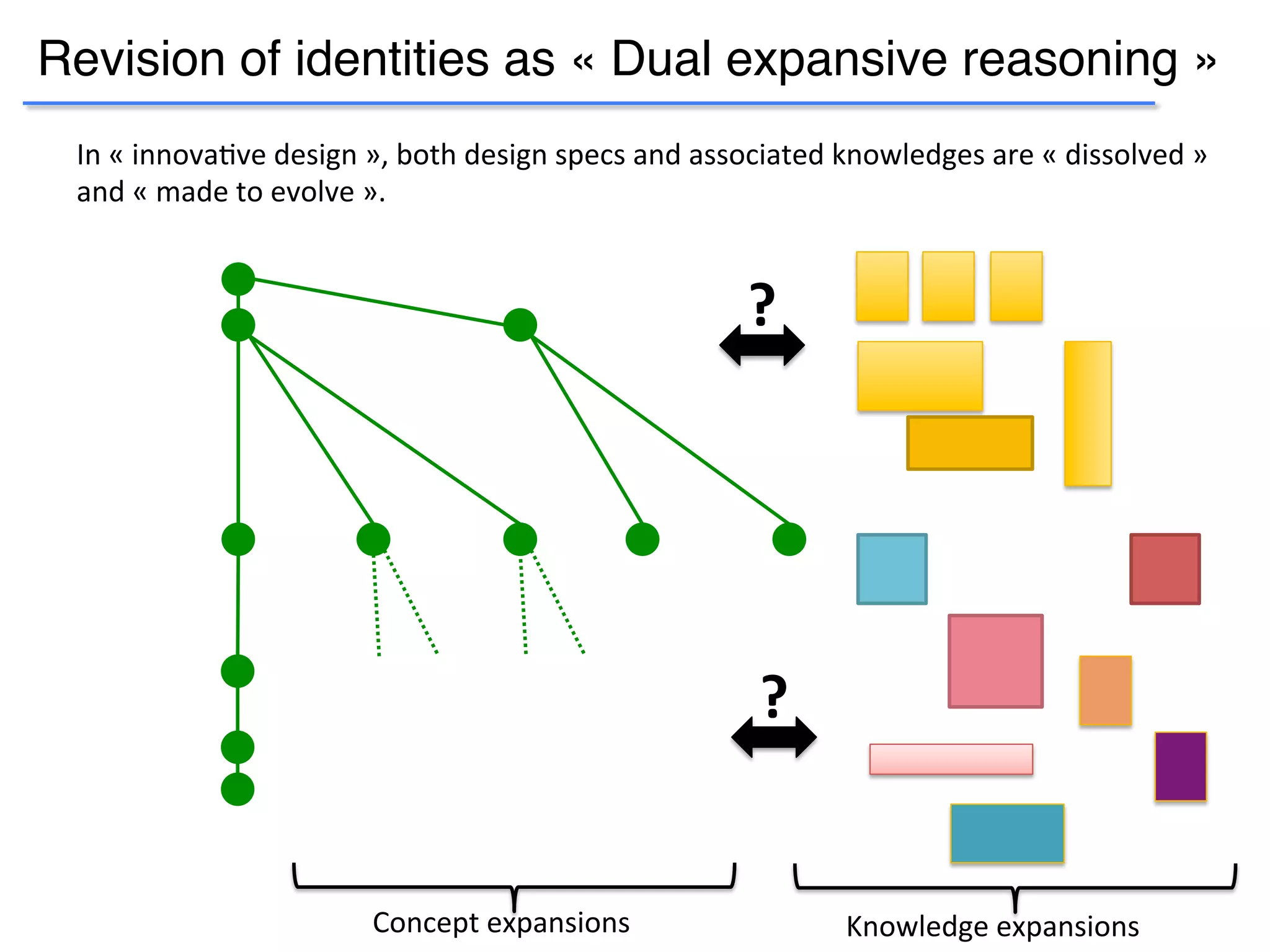
Revision of identities as « Dual expansive reasoning »
?	
  
?	
  
Concept	
  expansions	
   Knowledge	
  expansions	
  
In	
  «	
  innova9ve	
  design	
  »,	
  both	
  design	
  specs	
  and	
  associated	
  knowledges	
  are	
  «	
  dissolved	
  »	
  
and	
  «	
  made	
  to	
  evolve	
  ».	
  
Source:	
  Wikipedia	
  
Hatchuel	
  96;	
  Hatchuel	
  and	
  Weil	
  99,	
  02	
  
Kazakci	
  and	
  Tsoukias,	
  03;	
  Kazakci	
  07	
  
16!
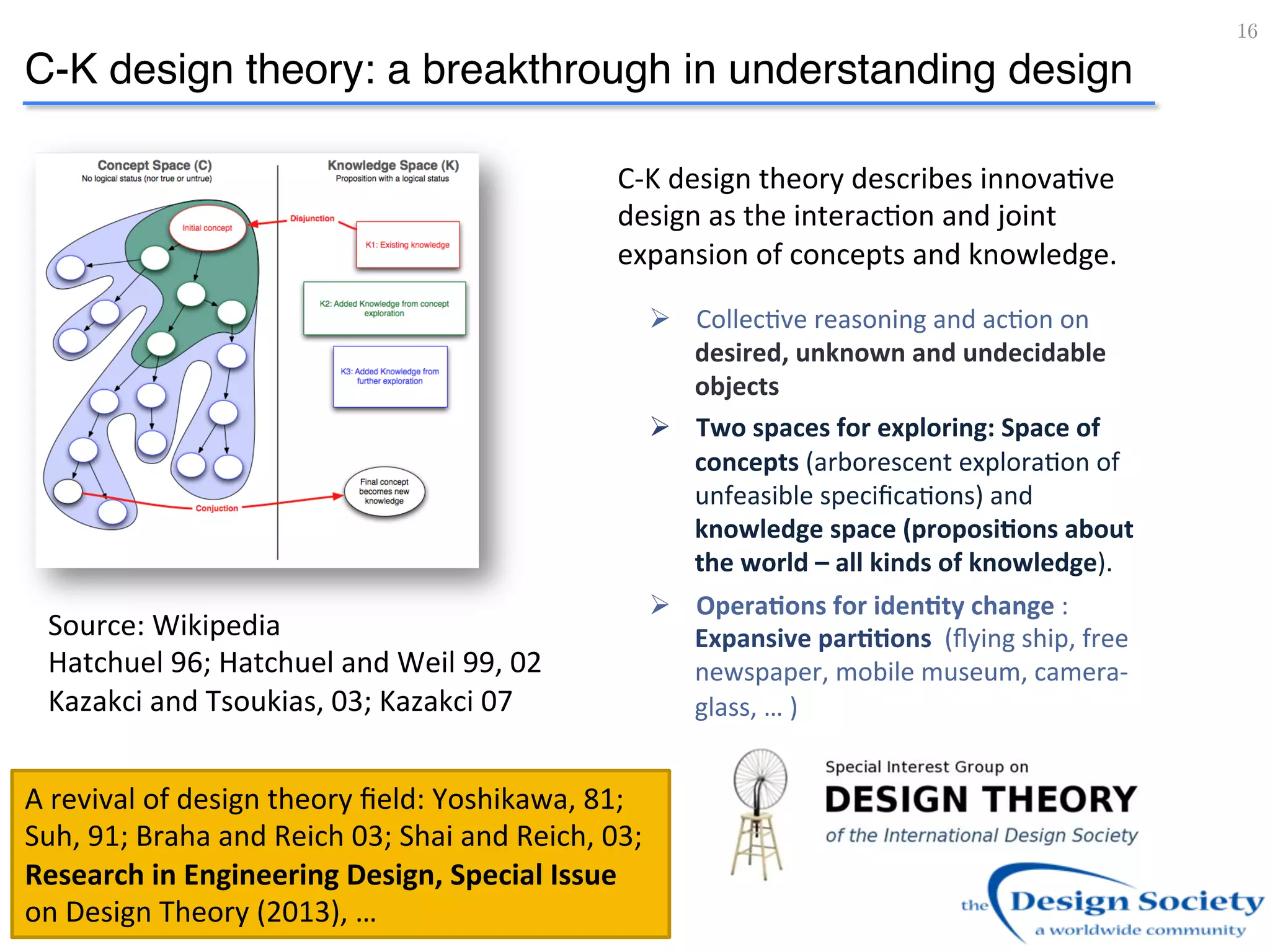
C-K design theory: a breakthrough in understanding design
C-­‐K	
  design	
  theory	
  describes	
  innova9ve	
  
design	
  as	
  the	
  interac9on	
  and	
  joint	
  
expansion	
  of	
  concepts	
  and	
  knowledge.	
  
Ø  Collec9ve	
  reasoning	
  and	
  ac9on	
  on	
  
desired,	
  unknown	
  and	
  undecidable	
  
objects	
  
Ø  Two	
  spaces	
  for	
  exploring:	
  Space	
  of	
  
concepts	
  (arborescent	
  explora9on	
  of	
  
unfeasible	
  specifica9ons)	
  and	
  
knowledge	
  space	
  (proposi4ons	
  about	
  
the	
  world	
  –	
  all	
  kinds	
  of	
  knowledge).	
  	
  
Ø  Opera4ons	
  for	
  iden4ty	
  change	
  :	
  
Expansive	
  par44ons	
  	
  (flying	
  ship,	
  free	
  
newspaper,	
  mobile	
  museum,	
  camera-­‐
glass,	
  …	
  )	
  
A	
  revival	
  of	
  design	
  theory	
  field:	
  Yoshikawa,	
  81;	
  
Suh,	
  91;	
  Braha	
  and	
  Reich	
  03;	
  Shai	
  and	
  Reich,	
  03;	
  
Research	
  in	
  Engineering	
  Design,	
  Special	
  Issue	
  
on	
  Design	
  Theory	
  (2013),	
  …	
  
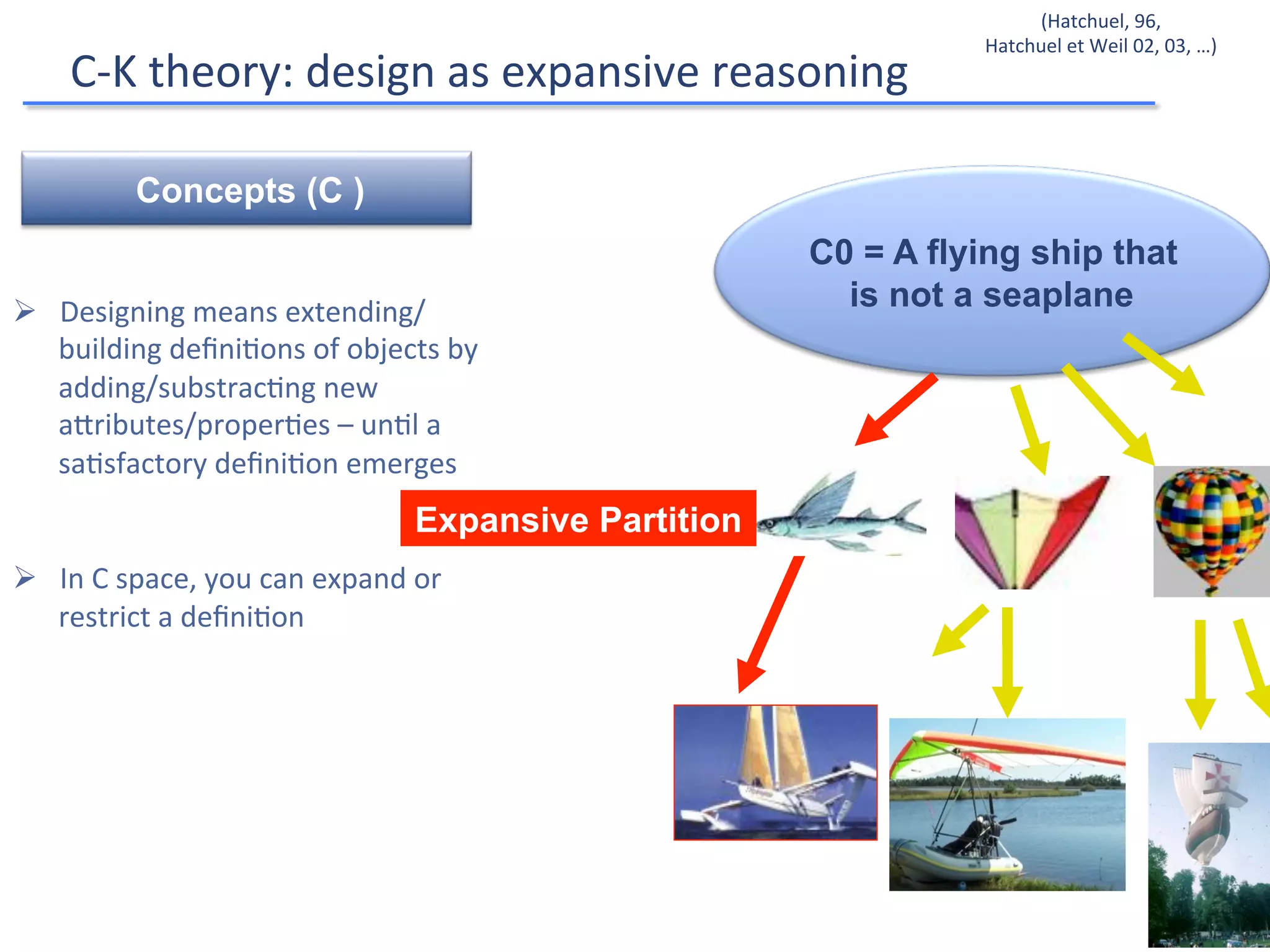
C-­‐K	
  theory:	
  design	
  as	
  expansive	
  reasoning	
  
(Hatchuel,	
  96,	
  	
  
Hatchuel	
  et	
  Weil	
  02,	
  03,	
  …)	
  
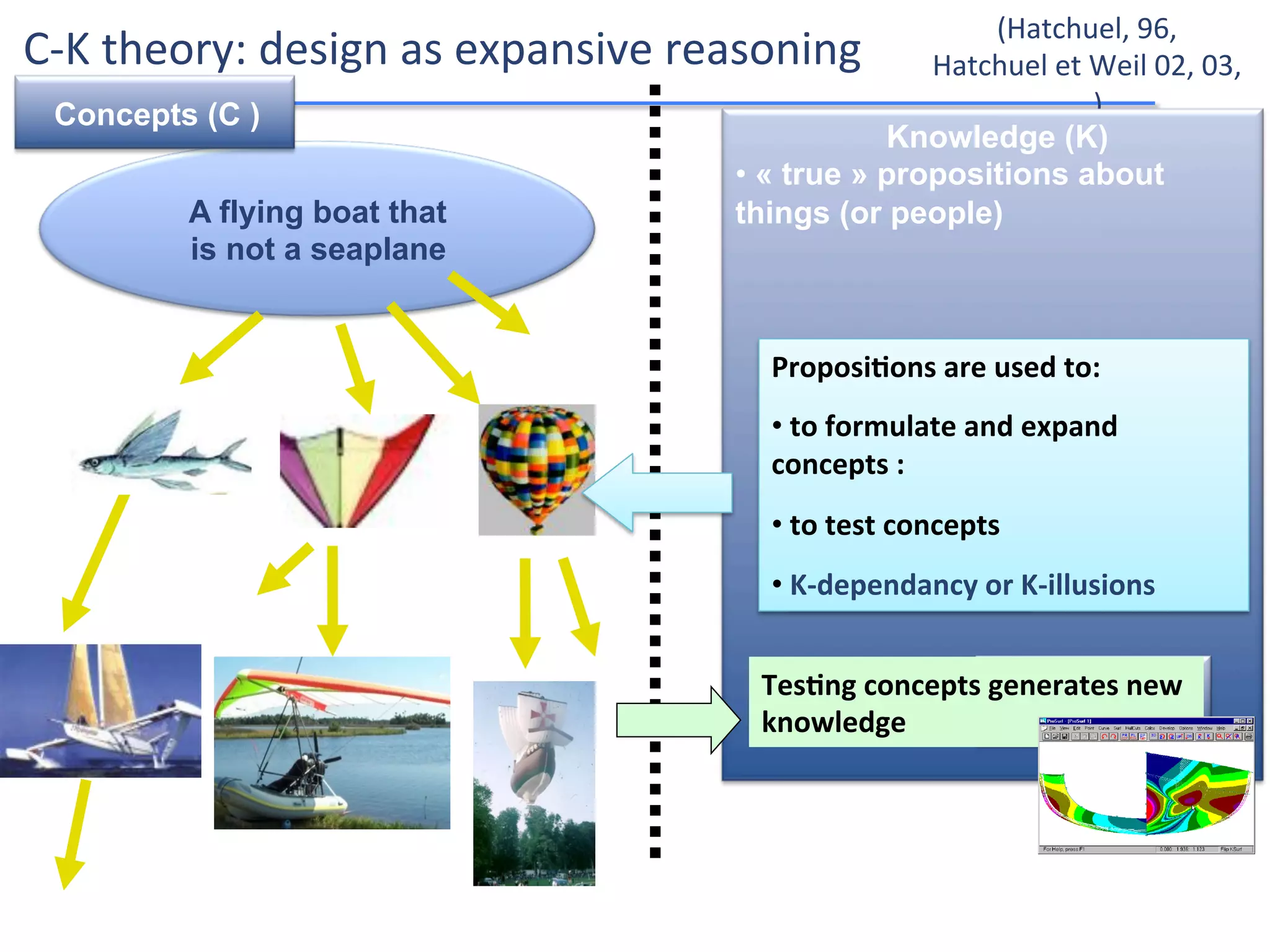
Concepts (C )
C0 = A flying ship that
is not a seaplane
Expansive Partition
Ø  Designing	
  means	
  extending/
building	
  defini9ons	
  of	
  objects	
  by	
  
adding/substrac9ng	
  new	
  
aHributes/proper9es	
  –	
  un9l	
  a	
  
sa9sfactory	
  defini9on	
  emerges	
  
Ø  In	
  C	
  space,	
  you	
  can	
  expand	
  or	
  
restrict	
  a	
  defini9on	
  
(Hatchuel,	
  96,	
  	
  
Hatchuel	
  et	
  Weil	
  02,	
  03,	
  
…)	
  
Knowledge (K)
• « true » propositions about
things (or people)
Planes, wings,
balloons
zoology
Aerodynamics
Outdoor
markets
Boats and
sailing
A flying boat that
is not a seaplane
Proposi4ons	
  are	
  used	
  to:	
  	
  
• 	
  to	
  formulate	
  and	
  expand	
  	
  
concepts	
  :	
  
• 	
  to	
  test	
  concepts	
  
• 	
  K-­‐dependancy	
  or	
  K-­‐illusions	
  
Tes4ng	
  concepts	
  generates	
  new	
  
knowledge	
  
Concepts (C )
C-­‐K	
  theory:	
  design	
  as	
  expansive	
  reasoning	
  
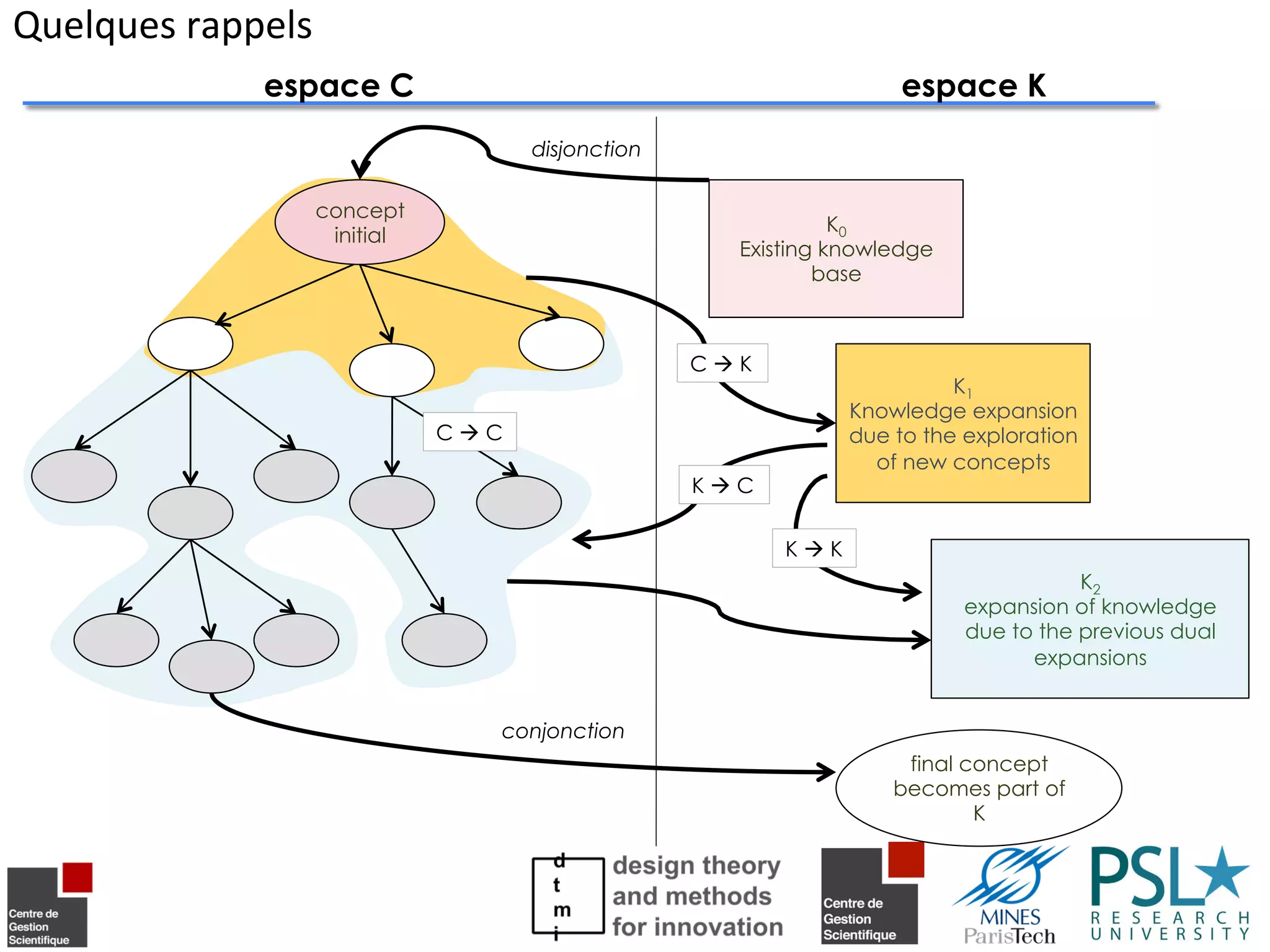
espace C espace K
K0
Existing knowledge
base
concept
initial
disjonction
K1
Knowledge expansion
due to the exploration
of new concepts
K2
expansion of knowledge
due to the previous dual
expansions
final concept
becomes part of
K
conjonction
K à K
C à K
K à C
C à C
Quelques	
  rappels	
  
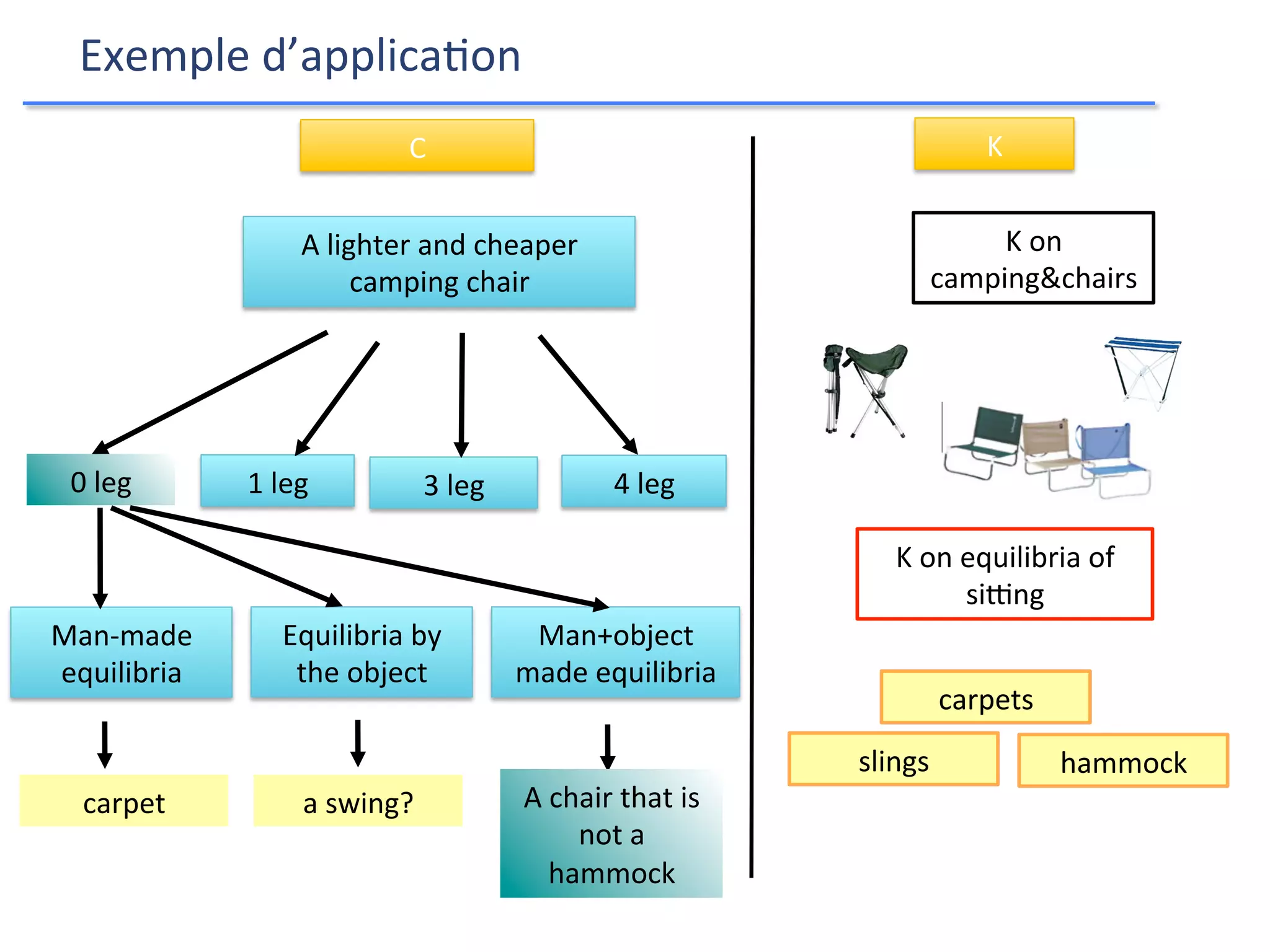
Exemple	
  d’applica9on	


A	
  lighter	
  and	
  cheaper	
  
camping	
  chair	
  
K	
  on	
  
camping&chairs	
  
C	
   K	
  
1	
  leg	
   3	
  leg	
   4	
  leg	
  0	
  leg	
  
K	
  on	
  equilibria	
  of	
  
sirng	
  
Equilibria	
  by	
  
the	
  object	
  
Man+object	
  
made	
  equilibria	
  
Man-­‐made	
  
equilibria	
  
carpet	
   a	
  swing?	
   hammock?	
  
carpets	
  
slings	
   hammock	
  
A	
  chair	
  that	
  is	
  
not	
  a	
  
hammock	
  
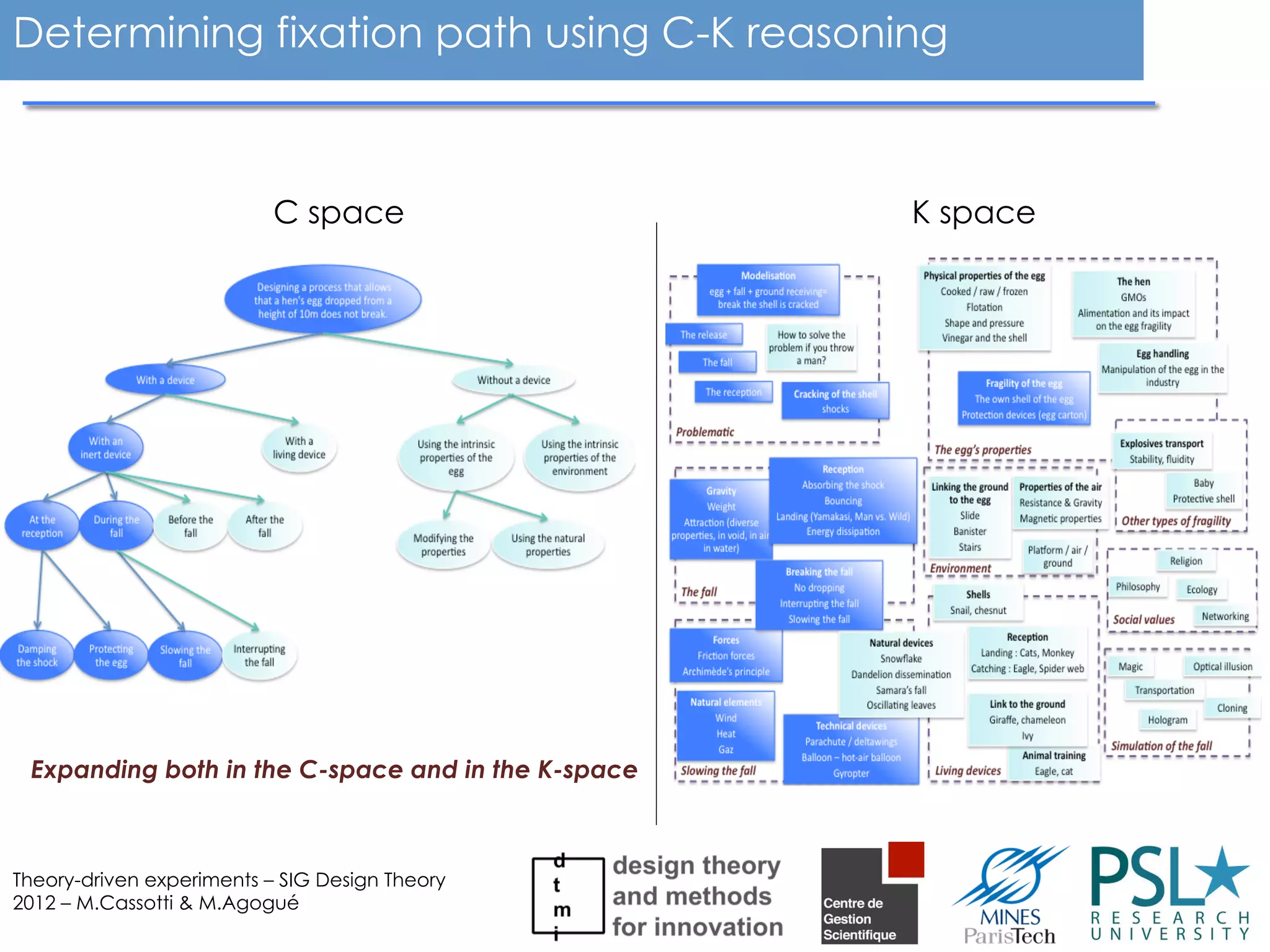
Determining expansive path using C-K reasoningDetermining fixation path using C-K reasoning
Theory-driven experiments – SIG Design Theory
2012 – M.Cassotti & M.Agogué
C space K space
Expanding both in the C-space and in the K-space
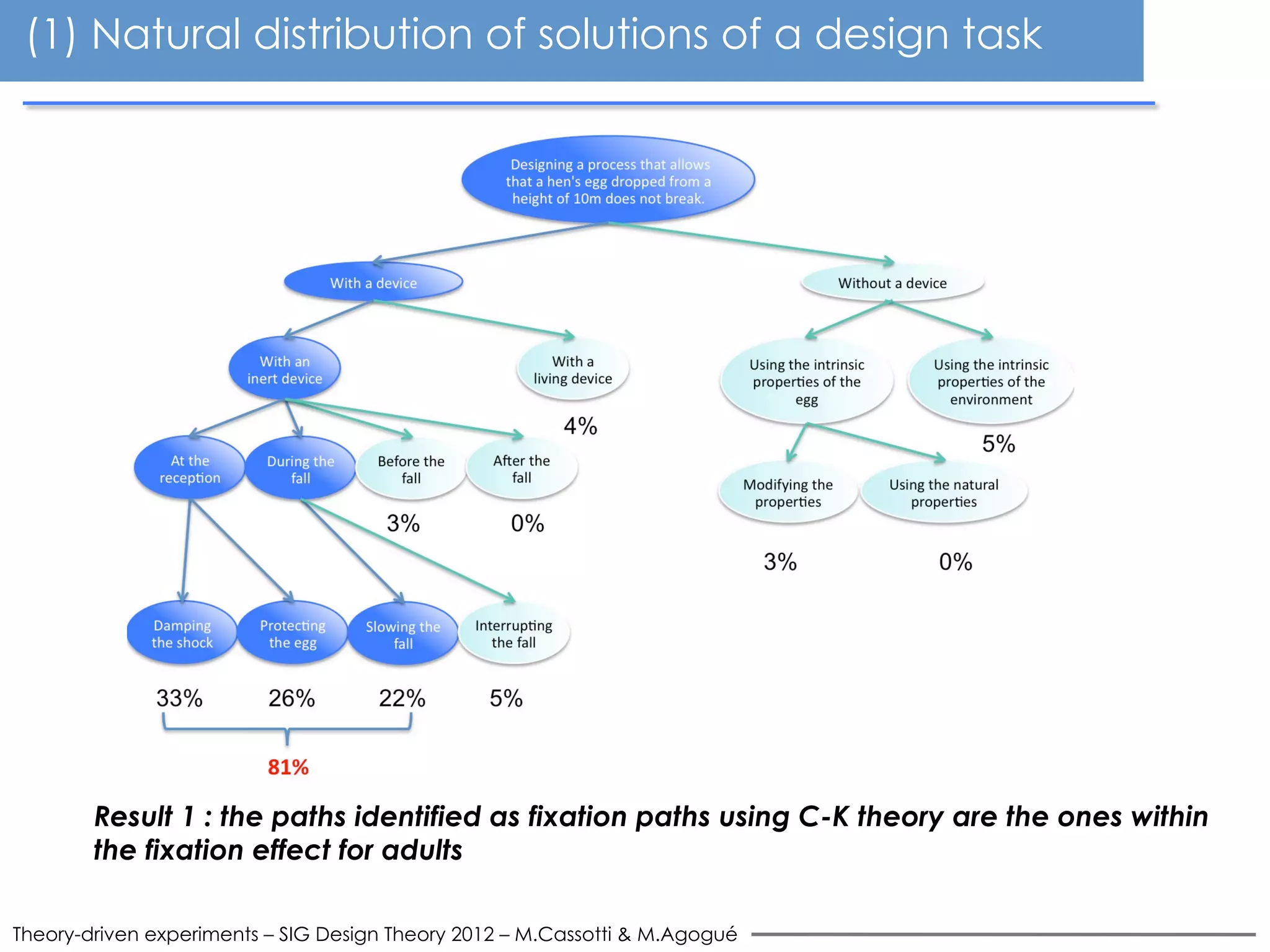
Result 1 : the paths identified as fixation paths using C-K theory are the ones within
the fixation effect for adults
Theory-driven experiments – SIG Design Theory 2012 – M.Cassotti & M.Agogué
(1) Natural distribution of solutions of a design task
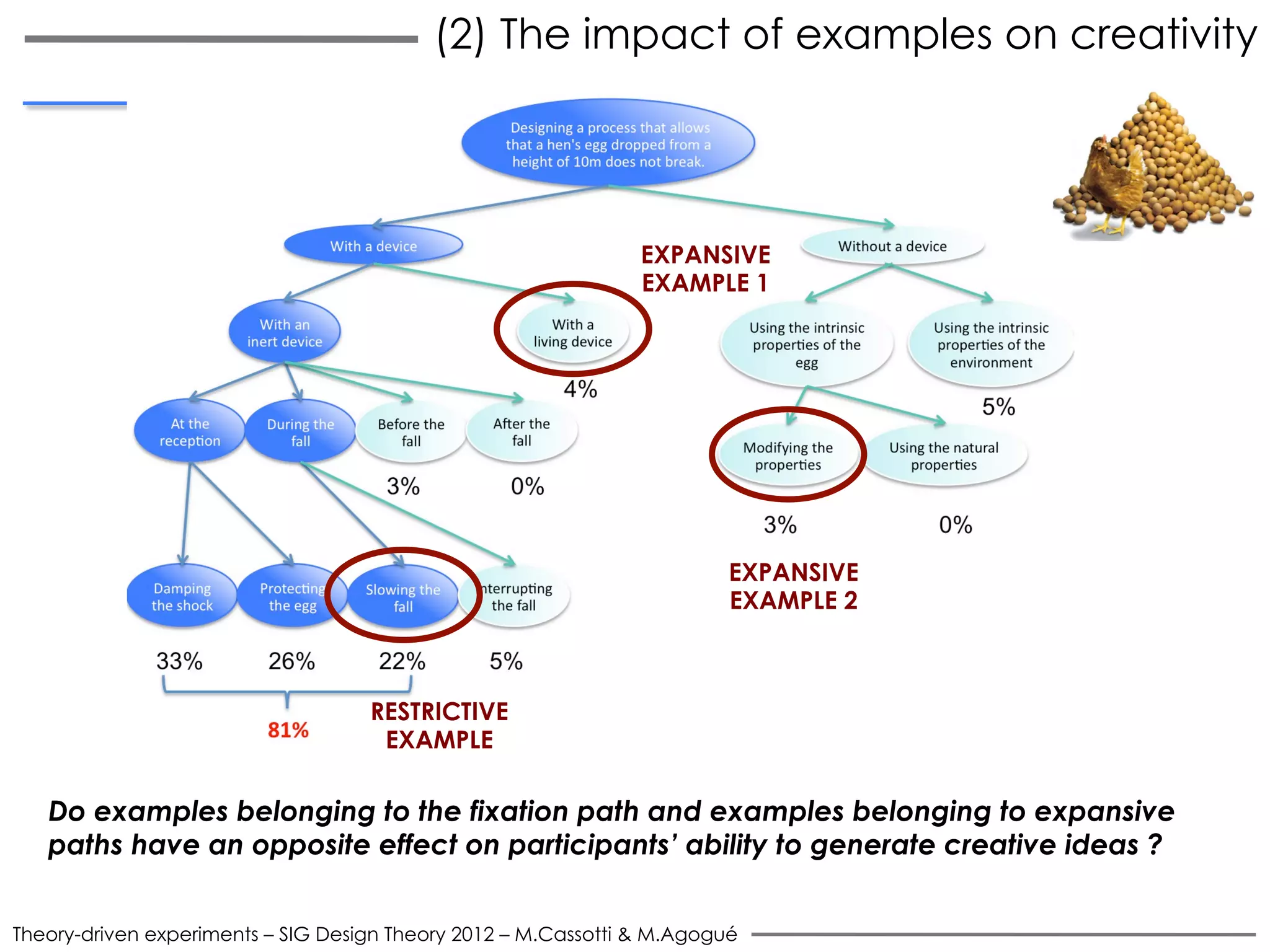
Do examples belonging to the fixation path and examples belonging to expansive
paths have an opposite effect on participants’ ability to generate creative ideas ?
Theory-driven experiments – SIG Design Theory 2012 – M.Cassotti & M.Agogué
EXPANSIVE
EXAMPLE 1
RESTRICTIVE
EXAMPLE
(2) The impact of examples on creativity
EXPANSIVE
EXAMPLE 2
Mg-CO2 Engine
pour Mars
exploration
International conference on low-cost planetary missions [Shafirovitch,
Salomon, Gökalp, 2003]: « Mars rover vs Mars
hopper »
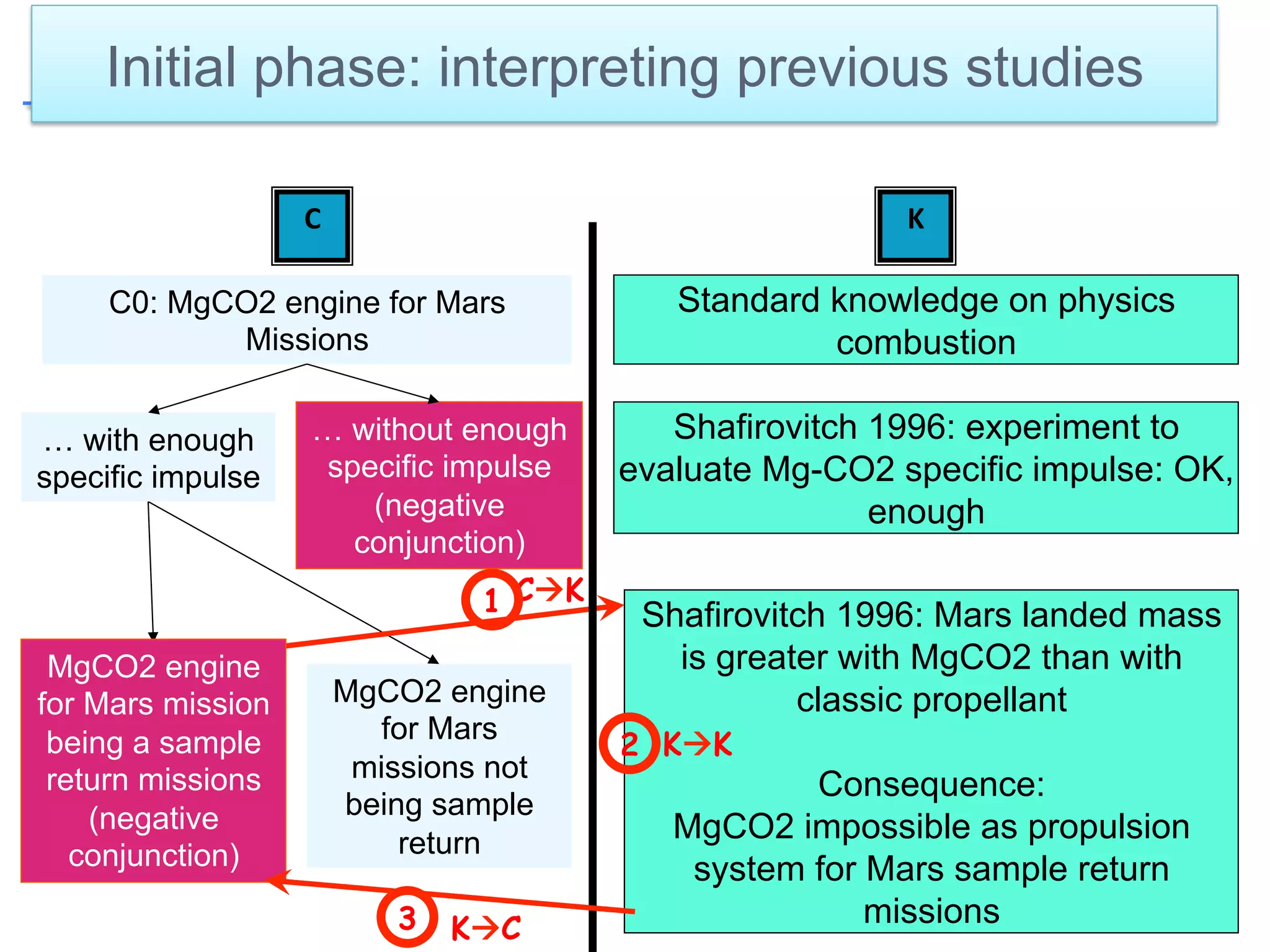
C	
   K	
  
C0: MgCO2 engine for Mars
Missions
MgCO2 engine
for Mars
missions not
being sample
return
Shafirovitch 1996: Mars landed mass
is greater with MgCO2 than with
classic propellant
Consequence:
MgCO2 impossible as propulsion
system for Mars sample return
missions
KàK2
Standard knowledge on physics
combustion
CàK1
Initial phase: interpreting previous studies
MgCO2 engine
for Mars mission
being a sample
return missions
KàC3
MgCO2 engine
for Mars mission
being a sample
return missions
(negative
conjunction)
Shafirovitch 1996: experiment to
evaluate Mg-CO2 specific impulse: OK,
enough
… with enough
specific impulse
… without enough
specific impulse
(negative
conjunction)
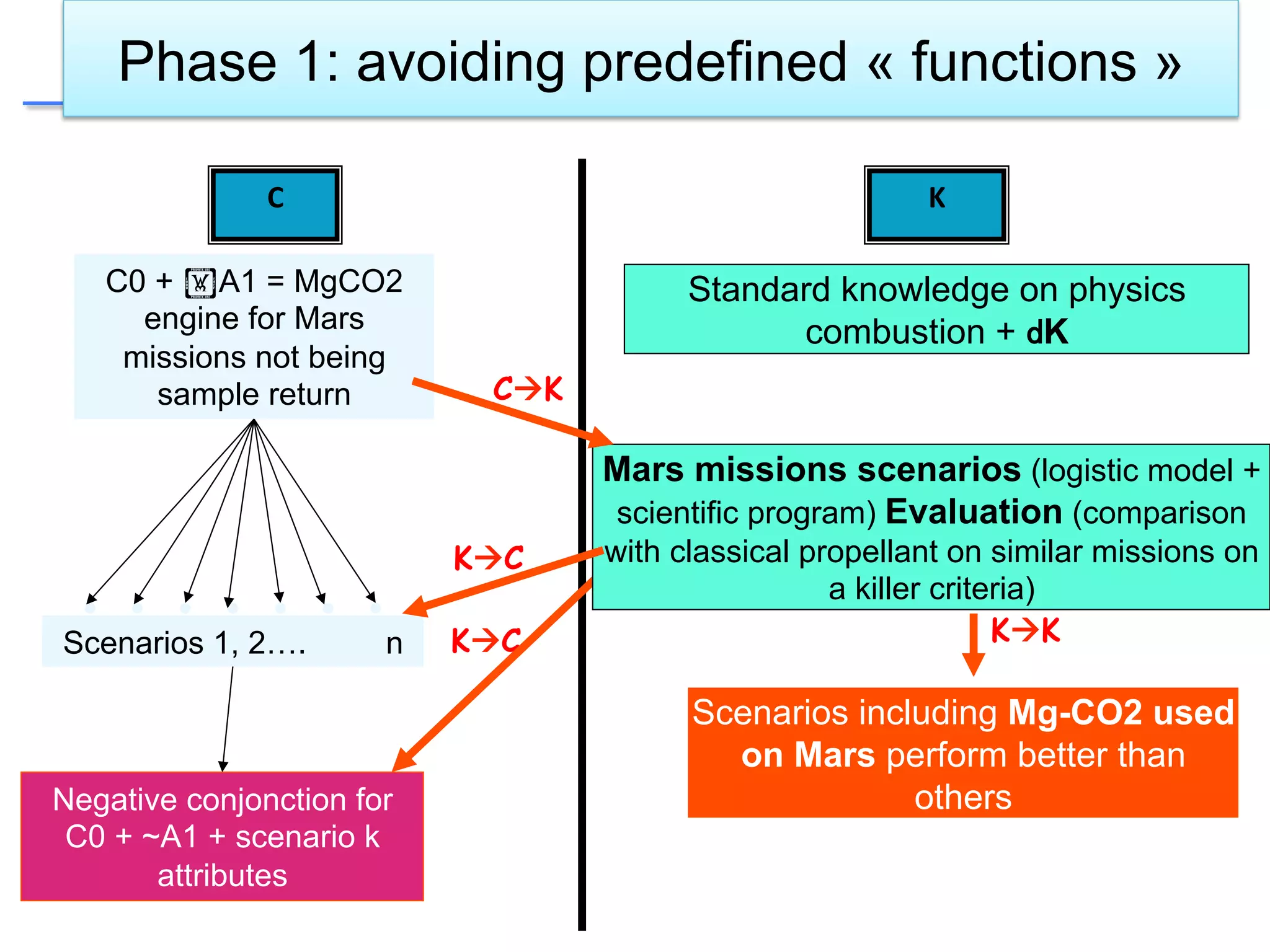
Phase 1: avoiding predefined « functions »
C	
   K	
  
C0 + !A1 = MgCO2
engine for Mars
missions not being
sample return
Standard knowledge on physics
combustion + dK
KàC
Negative conjonction for
C0 + ~A1 + scenario k
attributes
Scenarios including Mg-CO2 used
on Mars perform better than
others
KàK
Mars missions scenarios (logistic model +
scientific program) Evaluation (comparison
with classical propellant on similar missions on
a killer criteria)
CàK
Scenarios 1, 2…. n
KàC
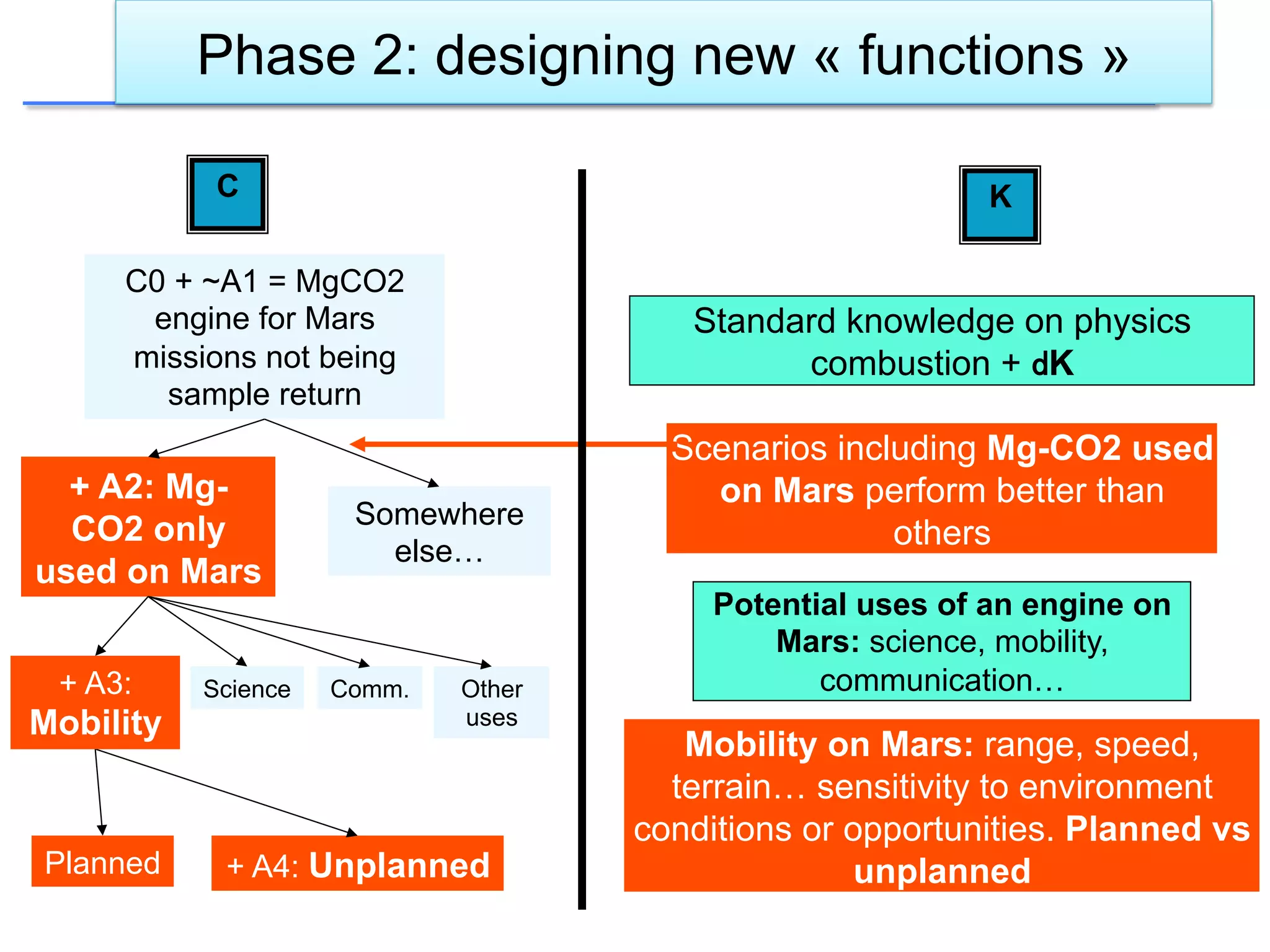
Phase 2: designing new « functions »
C K
Scenarios including Mg-CO2 used
on Mars perform better than
others
Planned + A4: Unplanned
Mobility on Mars: range, speed,
terrain… sensitivity to environment
conditions or opportunities. Planned vs
unplanned
C0 + ~A1 = MgCO2
engine for Mars
missions not being
sample return
Standard knowledge on physics
combustion + dK
Somewhere
else…
+ A2: Mg-
CO2 only
used on Mars
+ A3:
Mobility
Science
Potential uses of an engine on
Mars: science, mobility,
communication…Other
uses
Comm.
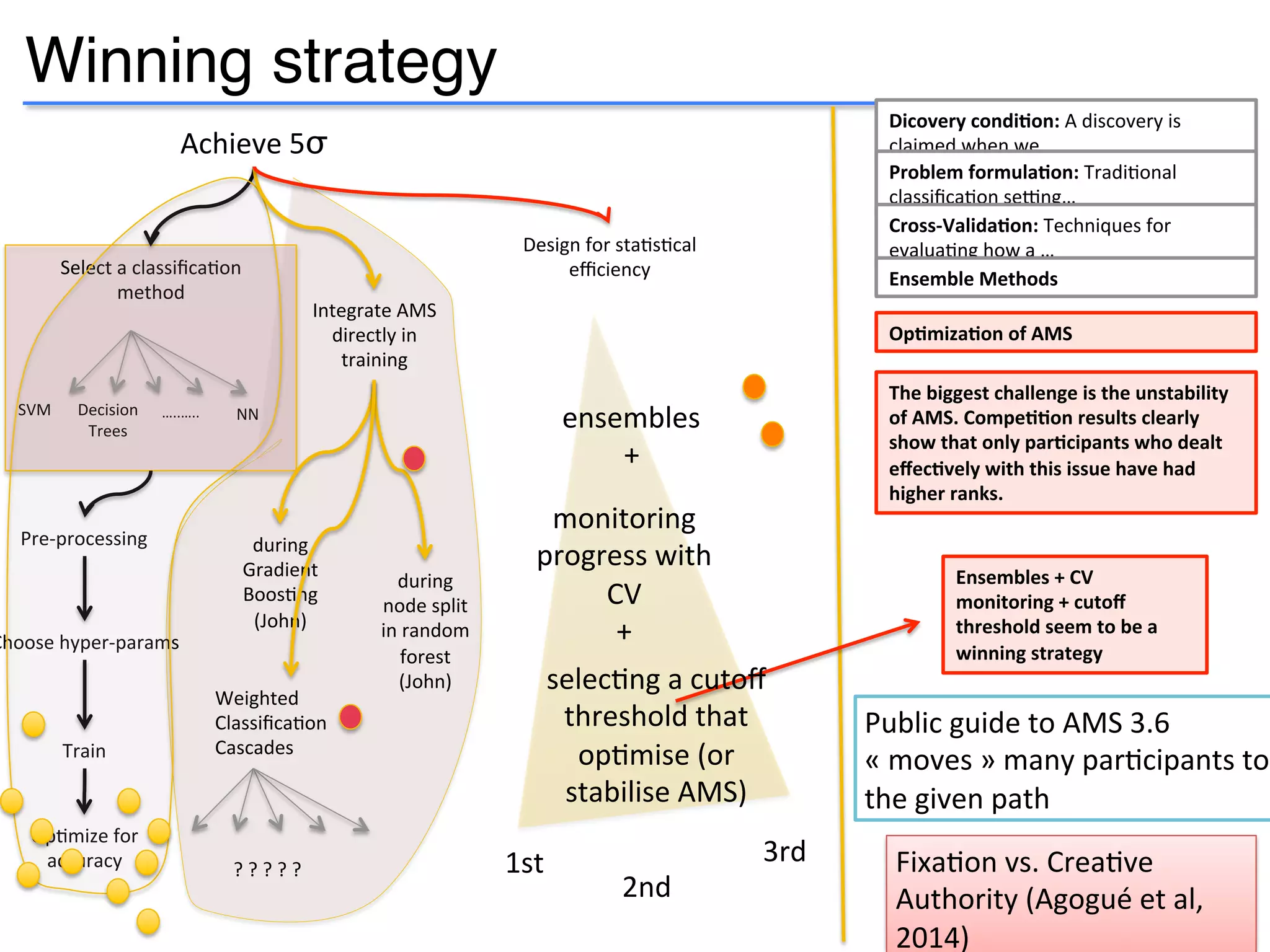
Winning strategy
Achieve	
  5σ!
Select	
  a	
  classifica9on	
  
method!
Pre-­‐processing!
Choose	
  hyper-­‐params!
Train!
Op9mize	
  for	
  
accuracy!
SVM	
   Decision	
  
Trees	
  
NN	
  …..…..	
  
Integrate	
  AMS	
  
directly	
  in	
  
training	
  
during	
  
Gradient	
  
Boos9ng	
  
(John)	
  
Dicovery	
  condi4on:	
  A	
  discovery	
  is	
  
claimed	
  when	
  we	
  …	
  
Problem	
  formula4on:	
  Tradi9onal	
  
classifica9on	
  serng…	
  
Cross-­‐Valida4on:	
  Techniques	
  for	
  
evalua9ng	
  how	
  a	
  …	
  
Ensemble	
  Methods	
  
during	
  
node	
  split	
  
in	
  random	
  
forest	
  	
  
(John)	
  
Weighted	
  
Classifica9on	
  
Cascades	
  
?	
  ?	
  ?	
  ?	
  ?	
  	
  
Op4miza4on	
  of	
  AMS	
  
Design	
  for	
  sta9s9cal	
  
efficiency	
  
The	
  biggest	
  challenge	
  is	
  the	
  unstability	
  
of	
  AMS.	
  Compe44on	
  results	
  clearly	
  
show	
  that	
  only	
  par4cipants	
  who	
  dealt	
  
effec4vely	
  with	
  this	
  issue	
  have	
  had	
  
higher	
  ranks.	
  
1st	
  
2nd	
  
3rd	
  
Ensembles	
  +	
  CV	
  
monitoring	
  +	
  cutoff	
  
threshold	
  seem	
  to	
  be	
  a	
  
winning	
  strategy	
  
monitoring	
  
progress	
  with	
  
CV	
  
+	
  
ensembles	
  
+	
  
selec9ng	
  a	
  cutoff	
  
threshold	
  that	
  
op9mise	
  (or	
  
stabilise	
  AMS)	
  
Public	
  guide	
  to	
  AMS	
  3.6	
  
«	
  moves	
  »	
  many	
  par9cipants	
  to	
  
the	
  given	
  path	
  
Fixa9on	
  vs.	
  Crea9ve	
  
Authority	
  (Agogué	
  et	
  al,	
  
2014)	
  
monitoring	
  
progress	
  with	
  
CrossValida9on	
  
+	
  
Achieve	
  5σ!
Select	
  a	
  classifica9on	
  
method!
Pre-­‐processing!
Choose	
  hyper-­‐params!
Train!
Op9mize	
  for	
  
accuracy!
SVM	
   Decision	
  
Trees	
  
NN	
  …..…..	
  
Integrate	
  AMS	
  
directly	
  in	
  
training	
  
during	
  
Gradient	
  
Boos9ng	
  
(John)	
  
during	
  
node	
  split	
  
in	
  random	
  
forest	
  	
  
(John)	
  
Weighted	
  
Classifica9on	
  
Cascades	
  
Two	
  par9cipants	
  observe	
  that	
  AMS	
  can	
  be	
  	
  refactorized	
  and	
  its	
  
terms	
  can	
  be	
  rewriHen	
  in	
  terms	
  of	
  their	
  convex	
  conjugate	
  form	
  
–	
  which	
  allow	
  to	
  Fenchel-­‐Young	
  inequality	
  from	
  convex	
  
op9miza9on	
  liHerature.	
  	
  
Ref:	
  hHp://arxiv.org/pdf/1409.2655v2.pdf,	
  Mackey	
  &	
  Brian	
  
Op9miza9on	
  of	
  AMS	
  becomes	
  possible	
  by	
  a	
  procedure	
  they	
  
name	
  Weigthed	
  ClassificaIon	
  Cascades.(Rank:	
  461th)	
  ?	
  ?	
  ?	
  ?	
  ?	
  	
  
Gradient	
  boos9ng	
  methods	
  fit	
  a	
  classifier	
  to	
  the	
  'per	
  data	
  point	
  
loss'	
  and	
  since	
  AMS	
  is	
  not	
  a	
  sum	
  of	
  per	
  data	
  point	
  (event)	
  
losses,	
  it's	
  not	
  obvious	
  how	
  to	
  do	
  use	
  AMS	
  as	
  a	
  loss	
  in	
  gradient	
  
boos9ng	
  (Andre	
  Holzner)	
  
AMS:	
  3.3	
  è	
  The	
  node	
  split	
  works	
  by	
  looking	
  for	
  the	
  split	
  that	
  
maximises	
  the	
  AMS	
  of	
  one	
  side	
  of	
  the	
  split	
  when	
  predic9ng	
  it	
  as	
  
pure	
  signal	
  (John)	
  
An	
  alterna9ve	
  may	
  be	
  to	
  «	
  use	
  AUC	
  in	
  gradient	
  boos9ng	
  9ll	
  you	
  
get	
  to	
  the	
  max	
  cv	
  result	
  and	
  then	
  tried	
  to	
  move	
  forward	
  with	
  an	
  
AMS	
  loss	
  func9on	
  from	
  that	
  point	
  »	


In	
  principle,	
  the	
  AMS	
  approximate	
  func4on	
  is	
  derivable	
  
(hHp://9nyurl.com/ov5pedq)	
  at	
  a	
  node	
  level	
  (s	
  and	
  b	
  being	
  the	
  
totals	
  of	
  other	
  nodes,	
  considered	
  constant,	
  and	
  x,	
  w	
  being	
  the	
  
probability	
  predic9on	
  and	
  weight	
  for	
  the	
  node	
  to	
  be	
  split)	
  and	
  
one	
  could	
  rewrite	
  the	
  part	
  of	
  code	
  where	
  the	
  objec9ve	
  func9on	
  
is	
  evaluated,	
  replacing	
  the	
  sums	
  with	
  a	
  different	
  
calcula9on	
  »	
  (Giulio	
  Casa)	
  
C	
  space	
   K	
  Space	
  
Design	
  for	
  
sta9s9cal	
  efficiency	
  
1st	
  
2nd	
  
3rd	
  
ensembles	
  
+	
  
selec9ng	
  a	
  cutoff	
  
threshold	
  that	
  
op9mise	
  (or	
  
stabilise	
  AMS)	
  
Design	
  strategy	
  analysis	
  for	
  HiggsML	
  challenge	
  teams	
  
Reduce	
  	
  
within-­‐class	
  
imbalance	
  
C	
   K	
  
Dealing	
  with	
  CIP	
  
By	
  adjus4ng	
  class	
  distribu4on	
  
Working	
  in	
  input	
  
space	
  
Re-­‐represen4ng	
  
inputs	
  
Local	
  	
  
distor4on	
  
Produce	
  an	
  
embedding	
  
Change	
  spa4al	
  
resolu4on	
  
For	
  some	
  X	
  
X	
  is	
  a	
  support	
  
vector	
  
With	
  raw	
  data	
  
Feature	
  engineering	
  
Exploratory	
  
(knowledge	
  or	
  
intui4on	
  based	
  
Automated	
  
Gene4c	
  Algoritms	
  
(Wasilowski,	
  Chen,	
  2009)	
  
Reduce	
  
between-­‐class	
  
imbalance	
  
Reduce	
  	
  
both	
  
Costs	
  are	
  
known	
  
Oversampling	
  
signals	
  
Undersampling	
  
the	
  background	
  
Iden4fying	
  class	
  
distribu4on	
  
Progressive	
  
sampling	
  
by	
  duplica4ng	
  
by	
  synthesizing	
  new	
  
points	
  
SMOTE,	
  (Chawla,	
  
Bowyer	
  et	
  al.	
  2002)	
  
MSMOTE	
  (Hu	
  
et	
  al,	
  2009	
  )	
  
Borderline	
  SMOTE	
  
(Han	
  et	
  al,	
  2005)	
  )	
  
Adap4ve	
  Synthe4c	
  
Sampling	
  
	
  (He	
  et	
  al,	
  2008	
  )	
  
SafeLevel	
  Sampling	
  
(Bunkhumpornpat	
  et	
  
al	
  2008	
  )	
  
resample	
  
each	
  mixture	
  
contains	
  all	
  signals	
  +	
  
some	
  background	
  
Such	
  that	
  all	
  
background	
  points	
  
are	
  used	
  at	
  least	
  in	
  
one	
  mixture	
  
Use	
  meta-­‐learning	
  
(Chan,	
  Stolfo,	
  2001)	
  
Use	
  SVM	
  ensemble	
  
(Yan,	
  Lin	
  et	
  al,	
  2003)	
  
Remove	
  
reduntant	
  (Kubat,	
  
Matwia,	
  1997	
  
Remove	
  border	
  
regions	
  with	
  
background	
  
examples	
  (Kubat,	
  
Matwia,	
  1997)	
  
Reduce	
  
overlap	
  
Preferen4al	
  
sampling	
  
Remove	
  background	
  whose	
  
average	
  distance	
  to	
  its	
  3	
  NN	
  
is	
  smallest	
  
(Mani,	
  Zhang,	
  2003)	
  
By	
  adap4ng	
  
algorithms	
  
Improve	
  predic4ve	
  
accuracy	
   Reduce	
  predic4ve	
  
variance	
  
Alterna4ve	
  
search	
  
techniques	
  
Non-­‐greedy	
  
methods	
  
Gene4c	
  Alg.	
  
Detect	
  rare	
  events	
  
TimeWeaver	
  
(	
  )	
  
Discover	
  small	
  
disjuncts	
  
(Carvahlo,	
  Freitas,	
  )	
  
Change	
  evalau4on	
  
metrics	
  
Simulated	
  
Annealing	
  
Depth-­‐bound	
  
exhaus4ve	
  
Brute	
  ()	
  
Laplace	
  
es4mate	
  
Evaluate	
  small	
  
disjuncts	
  
separately	
  
Quinlan,	
  ()	
  
Modify	
  
defini4on	
  of	
  
learning	
  
Bias	
  induc4on	
  
towards	
  
specificity	
  
Minimize	
  
error	
  
costs	
  
Change	
  
levels	
  of	
  
learning	
  
Cascade	
  of	
  
learners	
  
Learn	
  only	
  
rare	
  class	
  ()	
  
Two-­‐level	
  
learnig	
  ()	
  
Unknown	
  
Costs	
  
Modify	
  base	
  learner	
  
Max	
  
Specificity	
  
(Acker,	
  
Porter,	
  
1989)	
  
Specificity	
  
for	
  small	
  
disjuncts	
  
(Ting,	
  1989)	
  
Base	
  is	
  a	
  Tree	
  
Learner	
  
Split	
  arributes	
  
are	
  selected	
  to	
  
minimise	
  total	
  
expected	
  cost	
  
Base	
  is	
  a	
  
NN	
  
Cost-­‐weighted	
  
error	
  
propaga4on	
  
Relabeling	
  for	
  min	
  
expected	
  cost	
  
Test	
  data	
   Training	
  data	
  
Weigh4ng	
  
(Ting,	
  1998)	
  
CSC	
  (Wiren,	
  
Franck,	
  2005)	
  	
  
MetaCost	
  
(Domingos,	
  1999)	
  
Cos4ng	
  
(Zadrony	
  et	
  
al,	
  2003)	
  
Preprocess
ing	
  	
  
Cost-­‐based	
  
sampling	
  
Empirical	
  
Threshold	
  
Sesng	
  
Plot	
  total	
  
cost	
  for	
  
various	
  
thresholds	
  
Choose	
  
min	
  using	
  
plot	
  
With	
  Cross	
  
Valida4on	
  
by	
  choosing	
  less	
  steep	
  hills	
  
Thresholding	
  (Sheng,	
  Ling,	
  2006)	
  
Using	
  
ensembles	
  
Using	
  
cross	
  
valida4on	
  
Cost-­‐
Sensi4ve	
  
Boos4ng	
  
Imbalance
d	
  IVotes	
  ()	
  
AdaCost	
  (	
  )	
  
Using	
  
sampling	
  to	
  
alter	
  weight	
  
distribu4on	
  
Boos4ng	
  
CSB	
  ()	
  
RareBoost	
  (	
  )	
  
MSMOTE	
  
Boost	
  ()	
  
SMOTE	
  
Boost	
  ()	
  
Data	
  Boost-­‐
IM	
  ()	
  	
  
RUSBoost	
  
()	
  
Bagging	
  
Overbagging	
  
(	
  )	
  
Underbagging	
  ()	
  
Under-­‐
Over-­‐
Bagging	
  ()	
  
Dicovery
Problem
Cross-­‐Va
Ensemb
Gradient
loss'	
  and
losses,	
  it
boos9ng
AMS:	
  3.3
maximise
as	
  pure	
  s
An	
  altern
you	
  get	
  t
with	
  an	
  A
	
  
In	
  princip
(hHp://9
the	
  total
being	
  th
be	
  split)	
  
objec9ve
different
1	
  
2	
  
3	
  
4	
   5	
  
Data	
  science	
  as	
  a	
  new	
  fron9er	
  for	
  design	
  	
  
A.	
  Kazakci,	
  ICED’15	
  (submiHed)	
  
Warm-up exercice
•  « Design » a trip for 4
person for a week for less
than a thousand euros
31!
Akın O. Kazakçı, MINES ParisTech!
•  Not finished
32!
Akın O. Kazakçı, MINES ParisTech!
DKCP process: Linearising C-K dynamics
33!
Akın O. Kazakçı, MINES ParisTech!
Proven	
  methodology:	
  
-­‐	


  Developped	
  at	
  Mines	
  ParisTech	
  (TMCI)	
  with	
  RATP	
  and	
  Thalès	
  Avionics	
  
-­‐  40+	
  KCP	
  by	
  researchers	
  (2002-­‐2014)	
  
-­‐  2	
  PhD	
  Projects	
  (Arnoux,	
  2013;	
  Klasing	
  Chen,	
  in	
  process)	
  
-­‐  Now,	
  a	
  network	
  of	
  specialist	
  consultants	
  
Ini4alisa4on	
  
[K]	
  Knowledge	
  
sharing	
  
Workshops	
  
[P]	
  Project	
  
building	
  
[C]	
  IFM-­‐Design	
  
Workshops	
  
[RUN]	
  
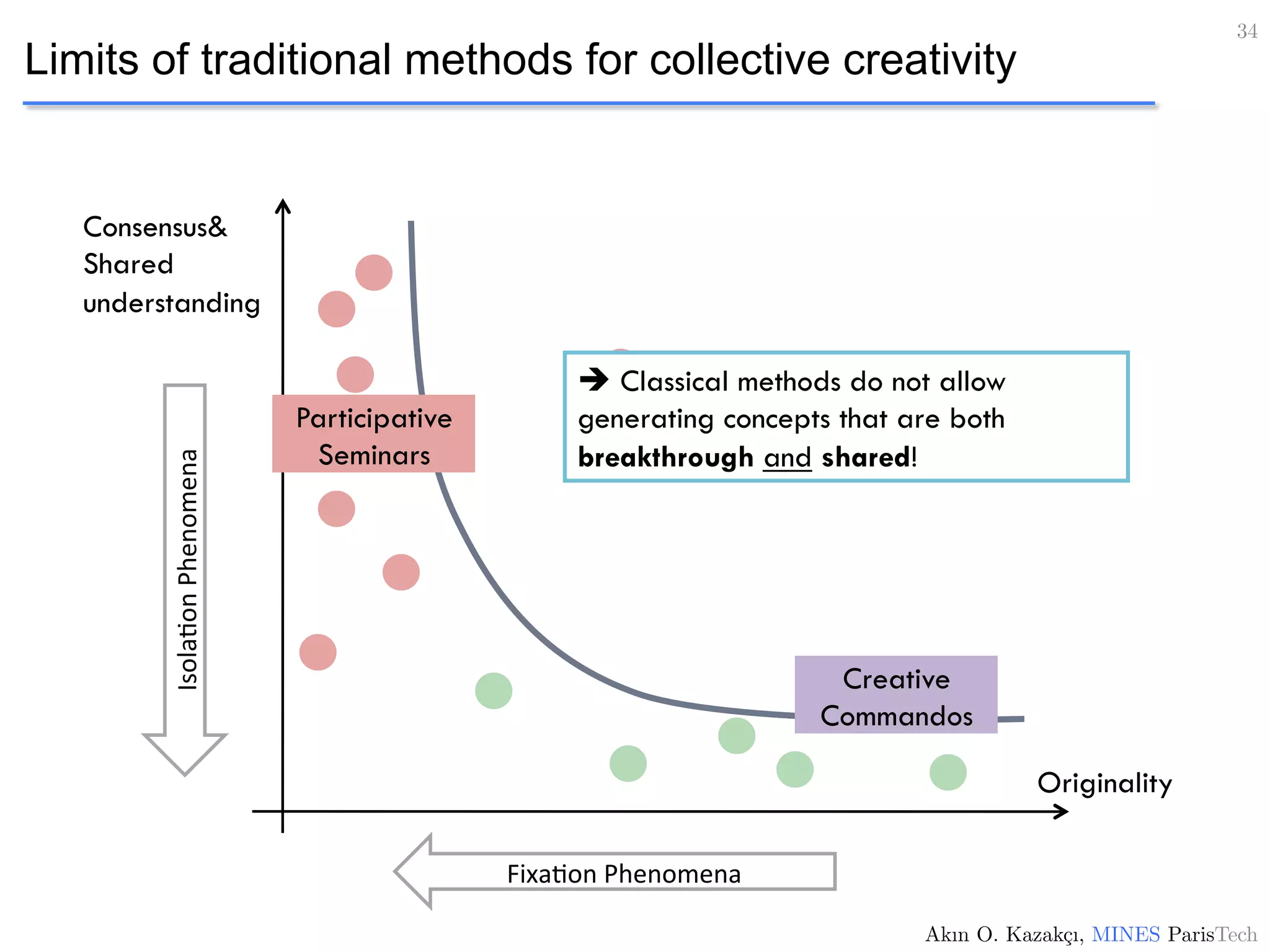
Limits of traditional methods for collective creativity
Consensus&
Shared
understanding
Originality
Participative
Seminars
Creative
Commandos
è Classical methods do not allow
generating concepts that are both
breakthrough and shared!
Fixa9on	
  Phenomena	
  
Isola9on	
  Phenomena	
  
34!
Akın O. Kazakçı, MINES ParisTech!
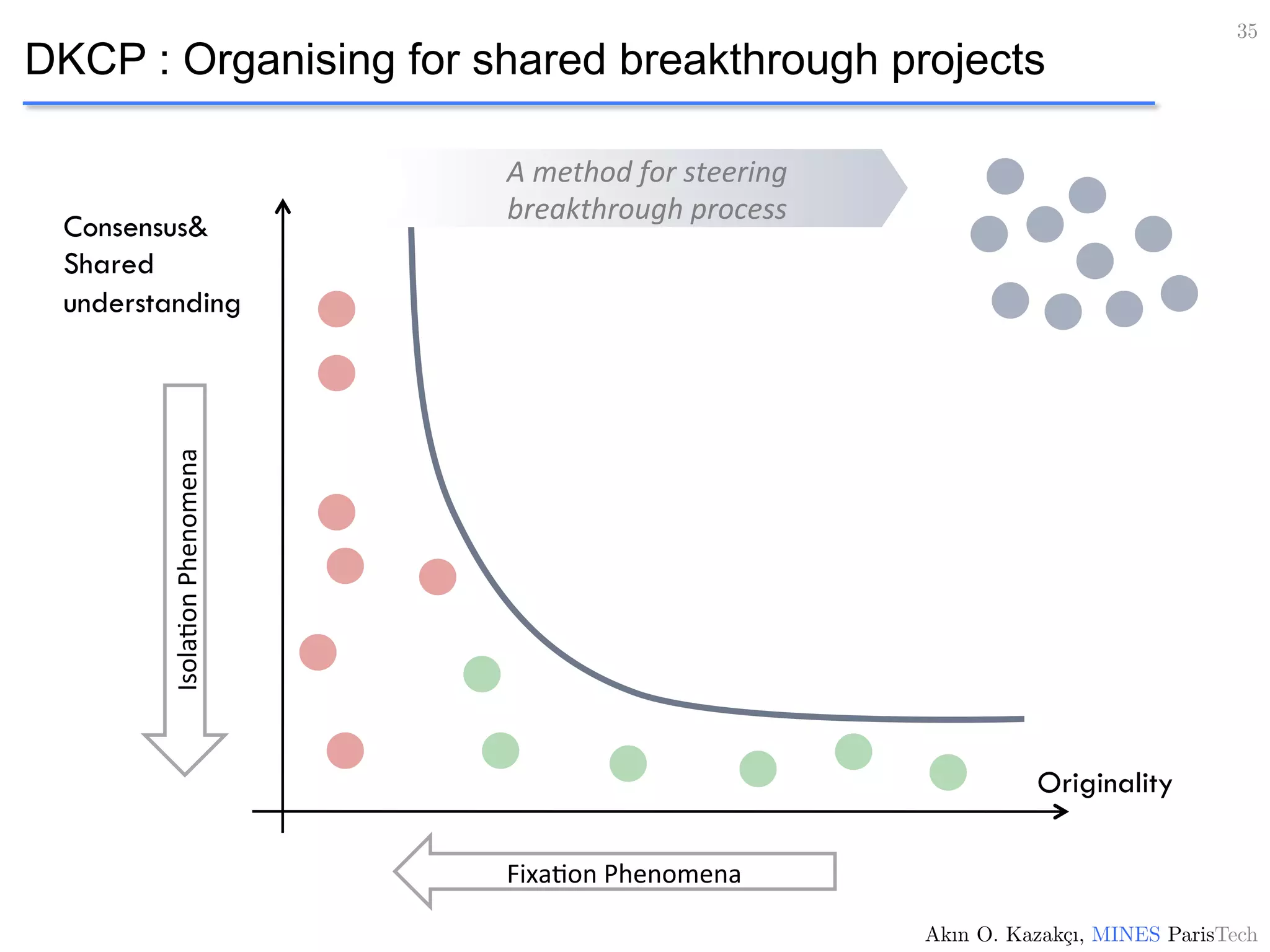
DKCP : Organising for shared breakthrough projects
Consensus&
Shared
understanding
Originality
Fixa9on	
  Phenomena	
  
Isola9on	
  Phenomena	
  
A	
  method	
  for	
  steering	
  
breakthrough	
  process	
  
35!
Akın O. Kazakçı, MINES ParisTech!
DKCP process: Linearising C-K dynamics
36!
Management	
  of	
  the	
  cogni4ve	
  and	
  social	
  
aspects	
  (KCP	
  facilitators)	
  
Innova4on	
  effort	
  (Par9cipants;	
  20-­‐50)	
  
D	
  
K	
   C	
  
P	
  Pré-­‐C	
  
Pré-­‐K	
  
Project	
  
organisa9on	
  
Defining	
  and	
  
pre-­‐explora9on	
  
of	
  K	
  pockets	
  
Sharing	
  and	
  
integra9ng	
  K	
  
Orienta9on	
  of	
  
phase	
  C	
  
Guided	
  
crea9vity	
  
Building	
  
ac9onnable	
  
strategies	
  
Akın O. Kazakçı, MINES ParisTech!
Ini4alisa4on	
  
[K]	
  Knowledge	
  
sharing	
  
Workshops	
  
[P]	
  Project	
  
building	
  
[C]	
  IFM-­‐Design	
  
Workshops	
  
[RUN]	
  
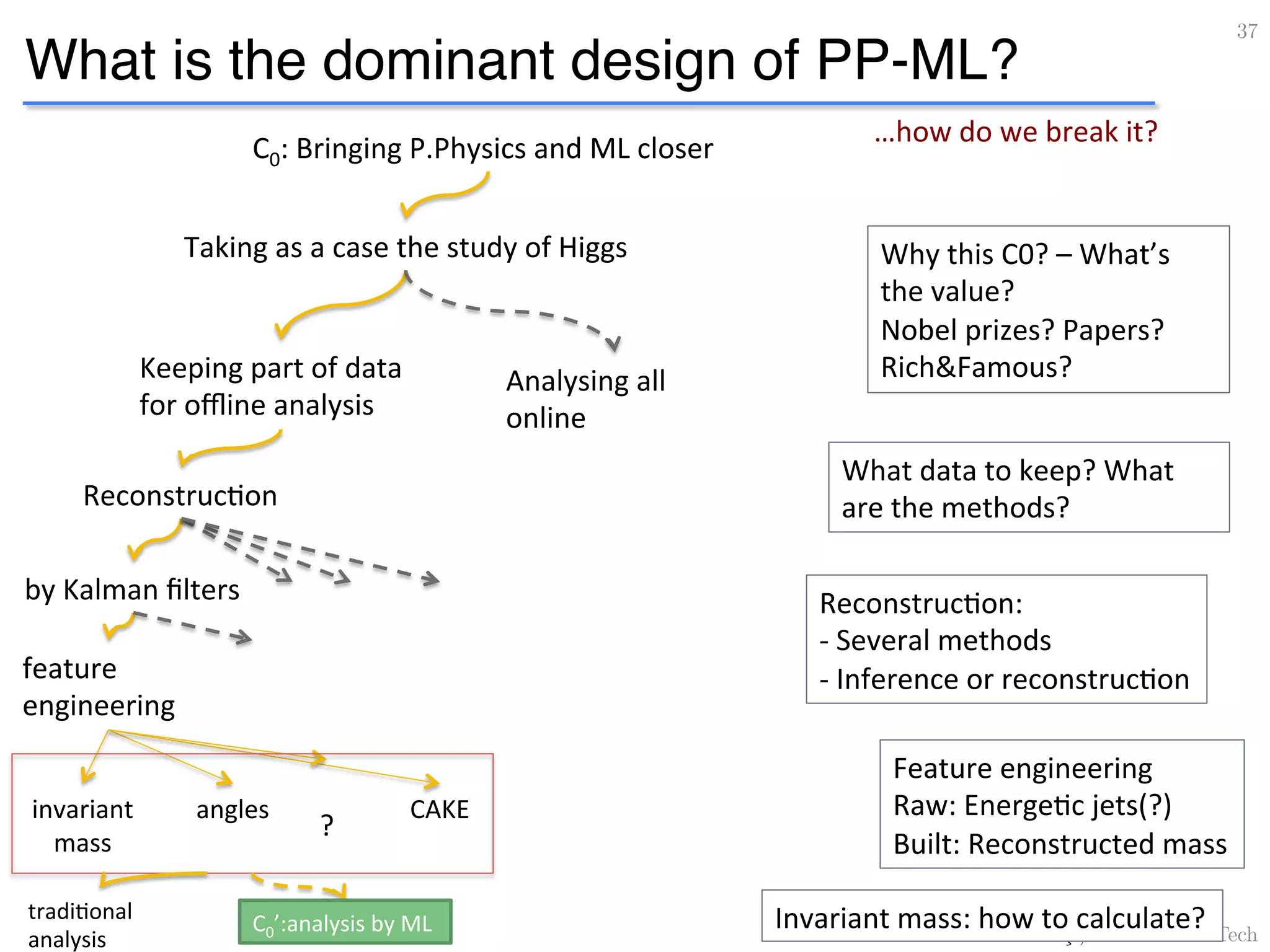
What is the dominant design of PP-ML?
37!
Akın O. Kazakçı, MINES ParisTech!
…how	
  do	
  we	
  break	
  it?	
  
C0:	
  Bringing	
  P.Physics	
  and	
  ML	
  closer	
  
Why	
  this	
  C0?	
  –	
  What’s	
  
the	
  value?	
  	
  
Nobel	
  prizes?	
  Papers?	
  
Rich&Famous?	
  
Taking	
  as	
  a	
  case	
  the	
  study	
  of	
  Higgs	
  
Keeping	
  part	
  of	
  data	
  
for	
  offline	
  analysis	
  
Analysing	
  all	
  
online	
  
Reconstruc9on	
  
by	
  Kalman	
  filters	
  
feature	
  
engineering	
  
invariant	
  	
  
mass	
  
angles	
   CAKE	
  
?	
  
C0’:analysis	
  by	
  ML	
  tradi9onal	
  
analysis	
  
What	
  data	
  to	
  keep?	
  What	
  
are	
  the	
  methods?	
  
Reconstruc9on:	
  
-­‐	
  Several	
  methods	
  
-­‐	
  Inference	
  or	
  reconstruc9on	
  
Feature	
  engineering	
  
Raw:	
  Energe9c	
  jets(?)	
  
Built:	
  Reconstructed	
  mass	
  
Invariant	
  mass:	
  how	
  to	
  calculate?	
  
Thank you!
Disclaimer: Copyrights of images belong to their respective owners.
38!
Akın O. Kazakçı, MINES ParisTech!
Akın O. Kazakçı
akin.kazakci@mines-paristech.fr
Feel	
  free	
  to	
  contact	
  me	
  for	
  more:	
  

Innovative Design Workshop - HiggsML and beyond (Machine Learning in Particle Physics)

  • 1.
    Machine Learning Applicationsin Particle Physics - Broadening the scope of exploration Akın O. Kazakçı akin.kazakci@mines-paristech.fr Centre for Data Science  January  the  12th,  2014  
  • 2.
    Design  Theory  and  Methods  for  Innova4on   •  Chair  for  Research  and  Educa9on   •  Fundamental  Research  on  Design  Theory   •  11  Industrial  Sponsors   •  Theory  ,  Field  research,  History,              Laboratory  experiments  
  • 3.
    Profound Transformation ofNPD activities 3! Akın O. Kazakçı, MINES ParisTech! •  New functional spaces •  New user experiences •  New competencies •  New partnerships •  New business models •  Fuzzy industrial sectors è 3rd Industrial revolution (Le Masson et al., 2006) è New Products vs. New Product Types è Revision of Objects’ Identities (Hatchuel et al., 1999)
  • 4.
    From problem-solving toinnovative design MaHmann,  C.  A..  «  A  vision  for   data  science  »,  Nature,  2013.   Data deluge imposes a colossal need for breakthrough, è The need to go beyond problem solving Traditional industry (non-data centric; aeronautic, automotive, …) is struggling with big-data and IoT è Problems are not well-formulated A methodological renewal is required è Design theory and methods can help
  • 5.
    Plan 1. What does itmean to define an object?! 2. Design theory: a few basic notions! 3. Examples! 5! Akın O. Kazakçı, MINES ParisTech!
  • 6.
    Design of an innovative“folding chair” An  innova9ve  object   causes  some  surprise  
  • 7.
    How  to  detect  innova9on?   «  iPhone  is  4rth  in  this  ranking,  in  front  of   HTC  touch  dual,  but  behind  Nokia  n95  and  LG   Viewty.  »   commentcamarche.net,  July  2007   In  US,  during  its  first  week,  500  000  iPhone  have   been  sold.  In  France  30  000  iPhones  sold  only  in   five  days  following  its  debut.   «  Conclusion:  Despite  some  intriguing  feature   iPhone  has,  it  lacks  many  vital  funcIonaliIes   it  needs  to  be  a  serious  threat  for  replacing   Blackberry  for  business  professionnals    »   Techcrunch.com,  Agust  2007   forum  de  Developpez.com  14/09/09   It  might  be  hard  to  recognize  an  innova9on   Agogué©.    
  • 8.
    Try  it!  -­‐  Red  Bull  Gravity  Challenge   You  are  a  designer  and  you  have  been  asked  to   produce  the  most  crea9ve  solu9on  to  the  following   ques9on:       Ensure that a hen's egg dropped from a height of 10m does not break.” Agogué©.     Being  innova9ve:  how  easy  is  that?   Your  turn!  
  • 9.
    Experiments  with  210  subjets  (842  proposiIons)   “Fixa4on  effects”     Three  types  of  solu9ons  :   Slowing  the  fall   Protec9ng  the  egg   Dumping  the  schock   covers  81  %  results!   Fixa9ons  on  an  objects  iden9ty   Surely,  you  have  something  be[er?  
  • 10.
    10! Akın O. Kazakçı,MINES ParisTech! Brainstorming  is  not  enough  !!!  
  • 11.
    Plan 1. What does itmean to define an object?! 2. Design theory: a few basic notions! 3. Examples! 11! Akın O. Kazakçı, MINES ParisTech!
  • 12.
    New products vs.New product categories  ? ? ? ? ? A300 A340
  • 13.
    Main functions and design parametersare maintained Rule-­‐based  design   Rule-­‐breaking   design   • New functional spaces • New competencies • New partnerships • New business models Innova4on:  op4misa4on  or  iden4ty  change?   Innova9on  as  «  op9misa9on  »   Innova9on  as  «  iden9ty  change  »  
  • 14.
    14! Akın O. Kazakçı,MINES ParisTech! How to capture revision of identities? –  A  concept-­‐knowledge  theory  of  design   «  Design  specs  »   Tradi9onal  Object  Defini9ons:   Knowledge   Methods,  Judgements,   R&D  Competencies…   an  example  of  design  specs  for   locomo9ve  engines  (1890s’)   In  design,  objects   can  be  defined  by  a   «  design  spec  »  -­‐  a   list  of  features  (or   proper9es).     The  designer   (individual  or  group)   need  to  have  some   knowledge  specific   to  each  «  feature  »   to  be  able  to   implement  (or  build)   it  and  for  handling   interac9ons.  
  • 15.
    Revision of identitiesas « Dual expansive reasoning » ?   ?   Concept  expansions   Knowledge  expansions   In  «  innova9ve  design  »,  both  design  specs  and  associated  knowledges  are  «  dissolved  »   and  «  made  to  evolve  ».  
  • 16.
    Source:  Wikipedia   Hatchuel  96;  Hatchuel  and  Weil  99,  02   Kazakci  and  Tsoukias,  03;  Kazakci  07   16! C-K design theory: a breakthrough in understanding design C-­‐K  design  theory  describes  innova9ve   design  as  the  interac9on  and  joint   expansion  of  concepts  and  knowledge.   Ø  Collec9ve  reasoning  and  ac9on  on   desired,  unknown  and  undecidable   objects   Ø  Two  spaces  for  exploring:  Space  of   concepts  (arborescent  explora9on  of   unfeasible  specifica9ons)  and   knowledge  space  (proposi4ons  about   the  world  –  all  kinds  of  knowledge).     Ø  Opera4ons  for  iden4ty  change  :   Expansive  par44ons    (flying  ship,  free   newspaper,  mobile  museum,  camera-­‐ glass,  …  )   A  revival  of  design  theory  field:  Yoshikawa,  81;   Suh,  91;  Braha  and  Reich  03;  Shai  and  Reich,  03;   Research  in  Engineering  Design,  Special  Issue   on  Design  Theory  (2013),  …  
  • 17.
    C-­‐K  theory:  design  as  expansive  reasoning   (Hatchuel,  96,     Hatchuel  et  Weil  02,  03,  …)   Concepts (C ) C0 = A flying ship that is not a seaplane Expansive Partition Ø  Designing  means  extending/ building  defini9ons  of  objects  by   adding/substrac9ng  new   aHributes/proper9es  –  un9l  a   sa9sfactory  defini9on  emerges   Ø  In  C  space,  you  can  expand  or   restrict  a  defini9on  
  • 18.
    (Hatchuel,  96,     Hatchuel  et  Weil  02,  03,   …)   Knowledge (K) • « true » propositions about things (or people) Planes, wings, balloons zoology Aerodynamics Outdoor markets Boats and sailing A flying boat that is not a seaplane Proposi4ons  are  used  to:     •   to  formulate  and  expand     concepts  :   •   to  test  concepts   •   K-­‐dependancy  or  K-­‐illusions   Tes4ng  concepts  generates  new   knowledge   Concepts (C ) C-­‐K  theory:  design  as  expansive  reasoning  
  • 19.
    espace C espaceK K0 Existing knowledge base concept initial disjonction K1 Knowledge expansion due to the exploration of new concepts K2 expansion of knowledge due to the previous dual expansions final concept becomes part of K conjonction K à K C à K K à C C à C Quelques  rappels  
  • 20.
    Exemple  d’applica9on     A  lighter  and  cheaper   camping  chair   K  on   camping&chairs   C   K   1  leg   3  leg   4  leg  0  leg   K  on  equilibria  of   sirng   Equilibria  by   the  object   Man+object   made  equilibria   Man-­‐made   equilibria   carpet   a  swing?   hammock?   carpets   slings   hammock   A  chair  that  is   not  a   hammock  
  • 21.
    Determining expansive pathusing C-K reasoningDetermining fixation path using C-K reasoning Theory-driven experiments – SIG Design Theory 2012 – M.Cassotti & M.Agogué C space K space Expanding both in the C-space and in the K-space
  • 22.
    Result 1 :the paths identified as fixation paths using C-K theory are the ones within the fixation effect for adults Theory-driven experiments – SIG Design Theory 2012 – M.Cassotti & M.Agogué (1) Natural distribution of solutions of a design task
  • 23.
    Do examples belongingto the fixation path and examples belonging to expansive paths have an opposite effect on participants’ ability to generate creative ideas ? Theory-driven experiments – SIG Design Theory 2012 – M.Cassotti & M.Agogué EXPANSIVE EXAMPLE 1 RESTRICTIVE EXAMPLE (2) The impact of examples on creativity EXPANSIVE EXAMPLE 2
  • 24.
    Mg-CO2 Engine pour Mars exploration Internationalconference on low-cost planetary missions [Shafirovitch, Salomon, Gökalp, 2003]: « Mars rover vs Mars hopper »
  • 25.
    C   K   C0: MgCO2 engine for Mars Missions MgCO2 engine for Mars missions not being sample return Shafirovitch 1996: Mars landed mass is greater with MgCO2 than with classic propellant Consequence: MgCO2 impossible as propulsion system for Mars sample return missions KàK2 Standard knowledge on physics combustion CàK1 Initial phase: interpreting previous studies MgCO2 engine for Mars mission being a sample return missions KàC3 MgCO2 engine for Mars mission being a sample return missions (negative conjunction) Shafirovitch 1996: experiment to evaluate Mg-CO2 specific impulse: OK, enough … with enough specific impulse … without enough specific impulse (negative conjunction)
  • 26.
    Phase 1: avoidingpredefined « functions » C   K   C0 + !A1 = MgCO2 engine for Mars missions not being sample return Standard knowledge on physics combustion + dK KàC Negative conjonction for C0 + ~A1 + scenario k attributes Scenarios including Mg-CO2 used on Mars perform better than others KàK Mars missions scenarios (logistic model + scientific program) Evaluation (comparison with classical propellant on similar missions on a killer criteria) CàK Scenarios 1, 2…. n KàC
  • 27.
    Phase 2: designingnew « functions » C K Scenarios including Mg-CO2 used on Mars perform better than others Planned + A4: Unplanned Mobility on Mars: range, speed, terrain… sensitivity to environment conditions or opportunities. Planned vs unplanned C0 + ~A1 = MgCO2 engine for Mars missions not being sample return Standard knowledge on physics combustion + dK Somewhere else… + A2: Mg- CO2 only used on Mars + A3: Mobility Science Potential uses of an engine on Mars: science, mobility, communication…Other uses Comm.
  • 28.
    Winning strategy Achieve  5σ! Select  a  classifica9on   method! Pre-­‐processing! Choose  hyper-­‐params! Train! Op9mize  for   accuracy! SVM   Decision   Trees   NN  …..…..   Integrate  AMS   directly  in   training   during   Gradient   Boos9ng   (John)   Dicovery  condi4on:  A  discovery  is   claimed  when  we  …   Problem  formula4on:  Tradi9onal   classifica9on  serng…   Cross-­‐Valida4on:  Techniques  for   evalua9ng  how  a  …   Ensemble  Methods   during   node  split   in  random   forest     (John)   Weighted   Classifica9on   Cascades   ?  ?  ?  ?  ?     Op4miza4on  of  AMS   Design  for  sta9s9cal   efficiency   The  biggest  challenge  is  the  unstability   of  AMS.  Compe44on  results  clearly   show  that  only  par4cipants  who  dealt   effec4vely  with  this  issue  have  had   higher  ranks.   1st   2nd   3rd   Ensembles  +  CV   monitoring  +  cutoff   threshold  seem  to  be  a   winning  strategy   monitoring   progress  with   CV   +   ensembles   +   selec9ng  a  cutoff   threshold  that   op9mise  (or   stabilise  AMS)   Public  guide  to  AMS  3.6   «  moves  »  many  par9cipants  to   the  given  path   Fixa9on  vs.  Crea9ve   Authority  (Agogué  et  al,   2014)  
  • 29.
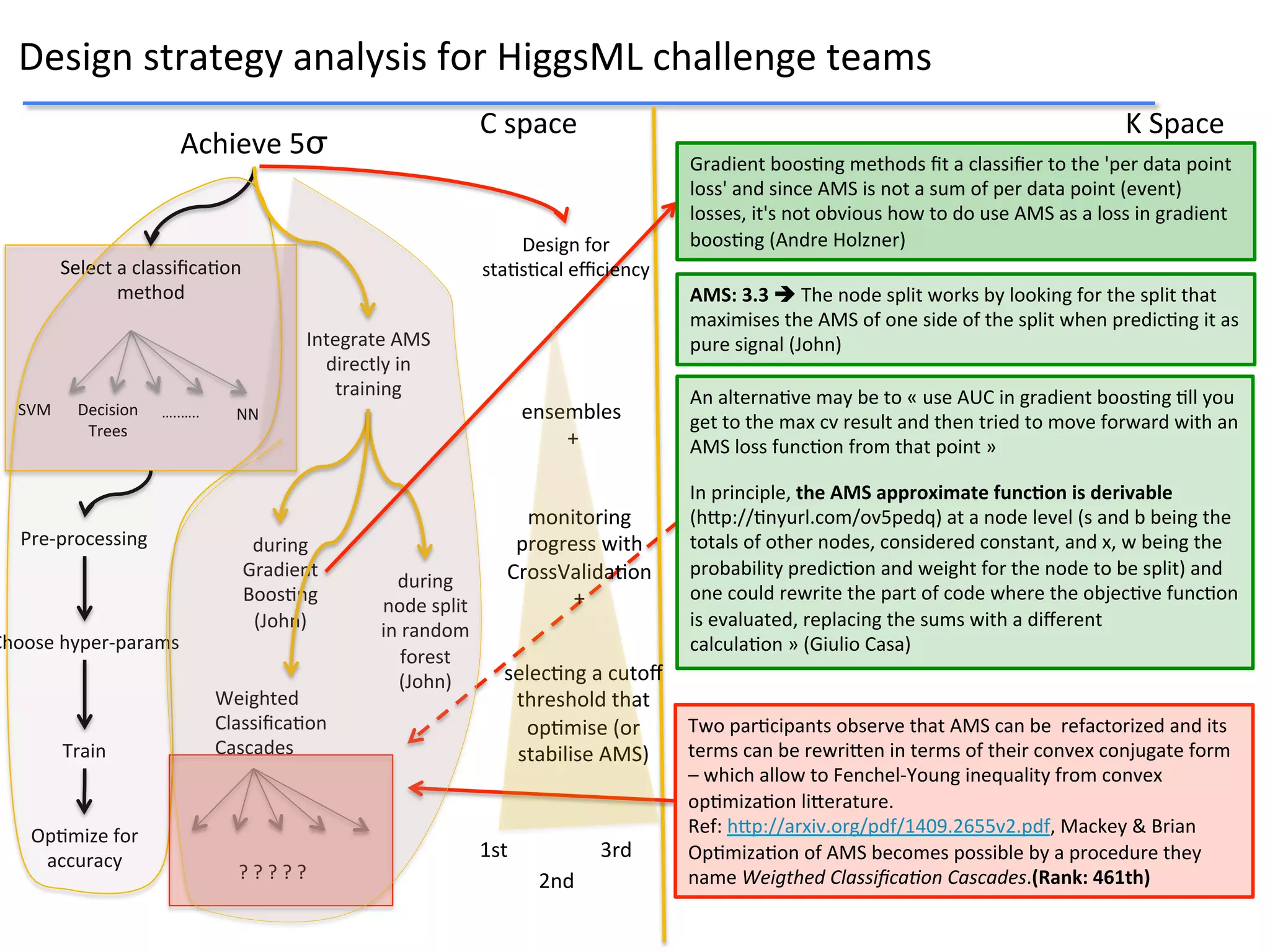
    monitoring   progress  with   CrossValida9on   +   Achieve  5σ! Select  a  classifica9on   method! Pre-­‐processing! Choose  hyper-­‐params! Train! Op9mize  for   accuracy! SVM   Decision   Trees   NN  …..…..   Integrate  AMS   directly  in   training   during   Gradient   Boos9ng   (John)   during   node  split   in  random   forest     (John)   Weighted   Classifica9on   Cascades   Two  par9cipants  observe  that  AMS  can  be    refactorized  and  its   terms  can  be  rewriHen  in  terms  of  their  convex  conjugate  form   –  which  allow  to  Fenchel-­‐Young  inequality  from  convex   op9miza9on  liHerature.     Ref:  hHp://arxiv.org/pdf/1409.2655v2.pdf,  Mackey  &  Brian   Op9miza9on  of  AMS  becomes  possible  by  a  procedure  they   name  Weigthed  ClassificaIon  Cascades.(Rank:  461th)  ?  ?  ?  ?  ?     Gradient  boos9ng  methods  fit  a  classifier  to  the  'per  data  point   loss'  and  since  AMS  is  not  a  sum  of  per  data  point  (event)   losses,  it's  not  obvious  how  to  do  use  AMS  as  a  loss  in  gradient   boos9ng  (Andre  Holzner)   AMS:  3.3  è  The  node  split  works  by  looking  for  the  split  that   maximises  the  AMS  of  one  side  of  the  split  when  predic9ng  it  as   pure  signal  (John)   An  alterna9ve  may  be  to  «  use  AUC  in  gradient  boos9ng  9ll  you   get  to  the  max  cv  result  and  then  tried  to  move  forward  with  an   AMS  loss  func9on  from  that  point  »     In  principle,  the  AMS  approximate  func4on  is  derivable   (hHp://9nyurl.com/ov5pedq)  at  a  node  level  (s  and  b  being  the   totals  of  other  nodes,  considered  constant,  and  x,  w  being  the   probability  predic9on  and  weight  for  the  node  to  be  split)  and   one  could  rewrite  the  part  of  code  where  the  objec9ve  func9on   is  evaluated,  replacing  the  sums  with  a  different   calcula9on  »  (Giulio  Casa)   C  space   K  Space   Design  for   sta9s9cal  efficiency   1st   2nd   3rd   ensembles   +   selec9ng  a  cutoff   threshold  that   op9mise  (or   stabilise  AMS)   Design  strategy  analysis  for  HiggsML  challenge  teams  
  • 30.
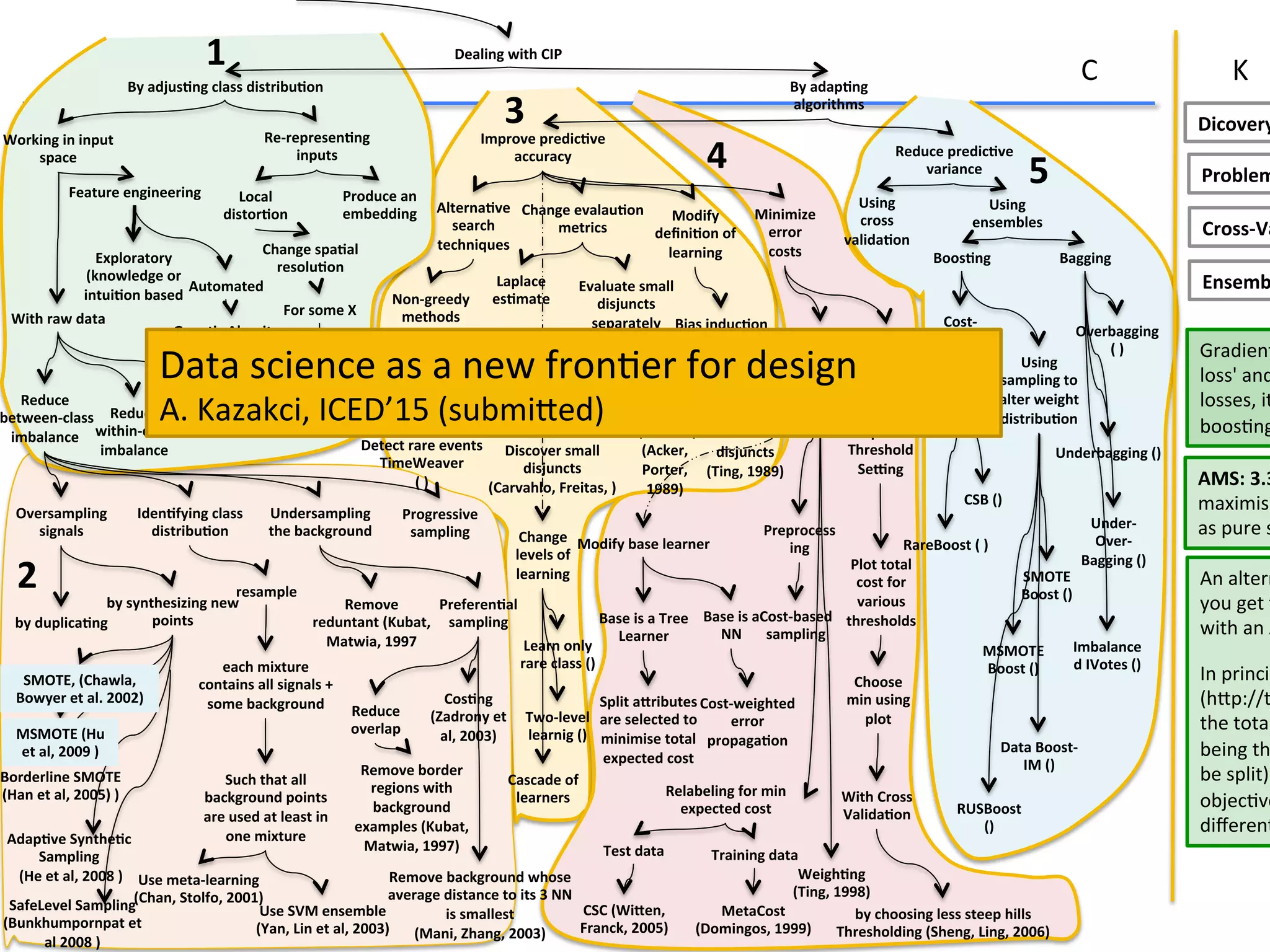
    Reduce     within-­‐class   imbalance   C   K   Dealing  with  CIP   By  adjus4ng  class  distribu4on   Working  in  input   space   Re-­‐represen4ng   inputs   Local     distor4on   Produce  an   embedding   Change  spa4al   resolu4on   For  some  X   X  is  a  support   vector   With  raw  data   Feature  engineering   Exploratory   (knowledge  or   intui4on  based   Automated   Gene4c  Algoritms   (Wasilowski,  Chen,  2009)   Reduce   between-­‐class   imbalance   Reduce     both   Costs  are   known   Oversampling   signals   Undersampling   the  background   Iden4fying  class   distribu4on   Progressive   sampling   by  duplica4ng   by  synthesizing  new   points   SMOTE,  (Chawla,   Bowyer  et  al.  2002)   MSMOTE  (Hu   et  al,  2009  )   Borderline  SMOTE   (Han  et  al,  2005)  )   Adap4ve  Synthe4c   Sampling    (He  et  al,  2008  )   SafeLevel  Sampling   (Bunkhumpornpat  et   al  2008  )   resample   each  mixture   contains  all  signals  +   some  background   Such  that  all   background  points   are  used  at  least  in   one  mixture   Use  meta-­‐learning   (Chan,  Stolfo,  2001)   Use  SVM  ensemble   (Yan,  Lin  et  al,  2003)   Remove   reduntant  (Kubat,   Matwia,  1997   Remove  border   regions  with   background   examples  (Kubat,   Matwia,  1997)   Reduce   overlap   Preferen4al   sampling   Remove  background  whose   average  distance  to  its  3  NN   is  smallest   (Mani,  Zhang,  2003)   By  adap4ng   algorithms   Improve  predic4ve   accuracy   Reduce  predic4ve   variance   Alterna4ve   search   techniques   Non-­‐greedy   methods   Gene4c  Alg.   Detect  rare  events   TimeWeaver   (  )   Discover  small   disjuncts   (Carvahlo,  Freitas,  )   Change  evalau4on   metrics   Simulated   Annealing   Depth-­‐bound   exhaus4ve   Brute  ()   Laplace   es4mate   Evaluate  small   disjuncts   separately   Quinlan,  ()   Modify   defini4on  of   learning   Bias  induc4on   towards   specificity   Minimize   error   costs   Change   levels  of   learning   Cascade  of   learners   Learn  only   rare  class  ()   Two-­‐level   learnig  ()   Unknown   Costs   Modify  base  learner   Max   Specificity   (Acker,   Porter,   1989)   Specificity   for  small   disjuncts   (Ting,  1989)   Base  is  a  Tree   Learner   Split  arributes   are  selected  to   minimise  total   expected  cost   Base  is  a   NN   Cost-­‐weighted   error   propaga4on   Relabeling  for  min   expected  cost   Test  data   Training  data   Weigh4ng   (Ting,  1998)   CSC  (Wiren,   Franck,  2005)     MetaCost   (Domingos,  1999)   Cos4ng   (Zadrony  et   al,  2003)   Preprocess ing     Cost-­‐based   sampling   Empirical   Threshold   Sesng   Plot  total   cost  for   various   thresholds   Choose   min  using   plot   With  Cross   Valida4on   by  choosing  less  steep  hills   Thresholding  (Sheng,  Ling,  2006)   Using   ensembles   Using   cross   valida4on   Cost-­‐ Sensi4ve   Boos4ng   Imbalance d  IVotes  ()   AdaCost  (  )   Using   sampling  to   alter  weight   distribu4on   Boos4ng   CSB  ()   RareBoost  (  )   MSMOTE   Boost  ()   SMOTE   Boost  ()   Data  Boost-­‐ IM  ()     RUSBoost   ()   Bagging   Overbagging   (  )   Underbagging  ()   Under-­‐ Over-­‐ Bagging  ()   Dicovery Problem Cross-­‐Va Ensemb Gradient loss'  and losses,  it boos9ng AMS:  3.3 maximise as  pure  s An  altern you  get  t with  an  A   In  princip (hHp://9 the  total being  th be  split)   objec9ve different 1   2   3   4   5   Data  science  as  a  new  fron9er  for  design     A.  Kazakci,  ICED’15  (submiHed)  
  • 31.
    Warm-up exercice •  « Design »a trip for 4 person for a week for less than a thousand euros 31! Akın O. Kazakçı, MINES ParisTech!
  • 32.
    •  Not finished 32! AkınO. Kazakçı, MINES ParisTech!
  • 33.
    DKCP process: LinearisingC-K dynamics 33! Akın O. Kazakçı, MINES ParisTech! Proven  methodology:   -­‐        Developped  at  Mines  ParisTech  (TMCI)  with  RATP  and  Thalès  Avionics   -­‐  40+  KCP  by  researchers  (2002-­‐2014)   -­‐  2  PhD  Projects  (Arnoux,  2013;  Klasing  Chen,  in  process)   -­‐  Now,  a  network  of  specialist  consultants   Ini4alisa4on   [K]  Knowledge   sharing   Workshops   [P]  Project   building   [C]  IFM-­‐Design   Workshops   [RUN]  
  • 34.
    Limits of traditionalmethods for collective creativity Consensus& Shared understanding Originality Participative Seminars Creative Commandos è Classical methods do not allow generating concepts that are both breakthrough and shared! Fixa9on  Phenomena   Isola9on  Phenomena   34! Akın O. Kazakçı, MINES ParisTech!
  • 35.
    DKCP : Organisingfor shared breakthrough projects Consensus& Shared understanding Originality Fixa9on  Phenomena   Isola9on  Phenomena   A  method  for  steering   breakthrough  process   35! Akın O. Kazakçı, MINES ParisTech!
  • 36.
    DKCP process: LinearisingC-K dynamics 36! Management  of  the  cogni4ve  and  social   aspects  (KCP  facilitators)   Innova4on  effort  (Par9cipants;  20-­‐50)   D   K   C   P  Pré-­‐C   Pré-­‐K   Project   organisa9on   Defining  and   pre-­‐explora9on   of  K  pockets   Sharing  and   integra9ng  K   Orienta9on  of   phase  C   Guided   crea9vity   Building   ac9onnable   strategies   Akın O. Kazakçı, MINES ParisTech! Ini4alisa4on   [K]  Knowledge   sharing   Workshops   [P]  Project   building   [C]  IFM-­‐Design   Workshops   [RUN]  
  • 37.
    What is thedominant design of PP-ML? 37! Akın O. Kazakçı, MINES ParisTech! …how  do  we  break  it?   C0:  Bringing  P.Physics  and  ML  closer   Why  this  C0?  –  What’s   the  value?     Nobel  prizes?  Papers?   Rich&Famous?   Taking  as  a  case  the  study  of  Higgs   Keeping  part  of  data   for  offline  analysis   Analysing  all   online   Reconstruc9on   by  Kalman  filters   feature   engineering   invariant     mass   angles   CAKE   ?   C0’:analysis  by  ML  tradi9onal   analysis   What  data  to  keep?  What   are  the  methods?   Reconstruc9on:   -­‐  Several  methods   -­‐  Inference  or  reconstruc9on   Feature  engineering   Raw:  Energe9c  jets(?)   Built:  Reconstructed  mass   Invariant  mass:  how  to  calculate?  
  • 38.
    Thank you! Disclaimer: Copyrightsof images belong to their respective owners. 38! Akın O. Kazakçı, MINES ParisTech! Akın O. Kazakçı akin.kazakci@mines-paristech.fr Feel  free  to  contact  me  for  more: