LEARNING BY DOING
by
M. Rupas Kumar
IIIT, RK Valley
RGUKT, Andhra Pradesh, India
Presented in
51st Orientation Programme, UGC - HRDC
JNTUH, Date: 15.09.2018
Outline
 Introduction
 Importance of Learning by Doing in Education
 Methodology
 Adoption of Learning by Doing in India
o Elementary Education
o Higher Education
 Summary
2
Introduction
 Learning by Doing - Learning through experiences
attained by doing a series of activities.
 Learning by Doing refers to a theory of education
expounded by American Philosopher, John Dewey
(1915)
 The same concept of learning is termed as
“Experienced based learning” by Wolfe & Byrne
(1975)
 Several other philosophers call it as “Activity based
learning”.
3
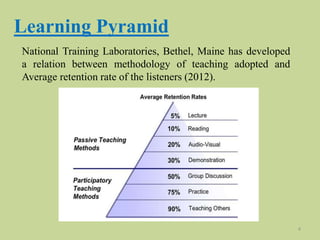
Learning Pyramid
4
National Training Laboratories, Bethel, Maine has developed
a relation between methodology of teaching adopted and
Average retention rate of the listeners (2012).
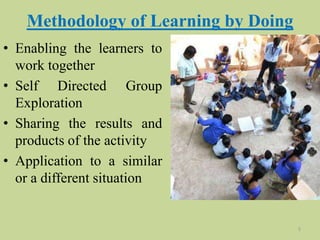
Methodology of Learning by Doing
• Enabling the learners to
work together
• Self Directed Group
Exploration
• Sharing the results and
products of the activity
• Application to a similar
or a different situation
5
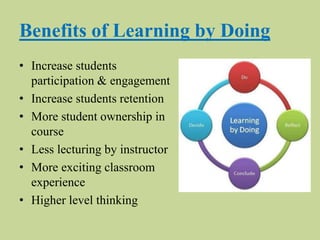
Benefits of Learning by Doing
• Increase students
participation & engagement
• Increase students retention
• More student ownership in
course
• Less lecturing by instructor
• More exciting classroom
experience
• Higher level thinking
Limitations of Learning by Doing
• Requires preparation by leader/teacher
• Requires patience and guidance by teacher;
decentralized approach can seem less orderly which
may be less comfortable to an authoritarian-style
teacher
• There is often no single, “right” answer
• Consumes more amount of Time
7
Learning by Doing in India
• Elementary Education
• Started by David Horsburgh in 1950’s by establishing a
school called “Neel Bagh” in Kolar District in
Karnataka. Then Rishi Valley school acquired this
school and practicing the methodology adopted till date.
• Similar kind of concept is adopted by Sri. Vijaya
Kumar, Collector of Vellore in Tamil Nadu for the
Child Labour in 1994. Later, in 2003 UNICEF extended
it to Corporation Schools in Chennai
• Govt. of Haryana also adopted the concept under
scheme called “Mukya Mantri Siksha Deeksha Yojna”
in 2014. 8
Contd.
• Madhya Pradesh also adopted the concept under
“Sarva Siksha Abhiyan.” There is a Non-profit
organization called Humana People to People India’s
(HPPI) which trained teachers to promote the concept
of Learning by Doing.
• Chhattisgarh also started following the methodology
under a programme “Parivartan Shiksha Abhiyan”
with the support of UNICEF in 2011.
• The Concept is currently being practiced in several
states like Karnataka, Maharastra, North East States
etc. 9
Role of Learning by Doing in Higher Education
MSIT Programme
• This is a program of higher education started in 2001
in JNTU-H, IIIT-H, and NIT-W.
• This is an ICT based programme developed on the
concept of “learning by doing” where the students are
provided with individual workstations.
• The students are instructed to work on mini projects to
cover the courses in the program.
• This program became a huge success and now
extended to JNTU-K, JNTU-A, & SVU with the
Collaboration of CMU, USA
10
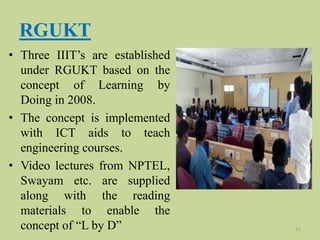
RGUKT
• Three IIIT’s are established
under RGUKT based on the
concept of Learning by
Doing in 2008.
• The concept is implemented
with ICT aids to teach
engineering courses.
• Video lectures from NPTEL,
Swayam etc. are supplied
along with the reading
materials to enable the
concept of “L by D” 11
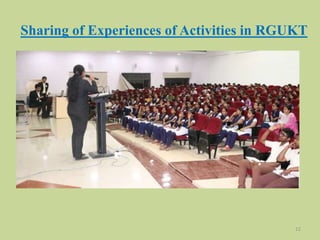
Sharing of Experiences of Activities in RGUKT
12
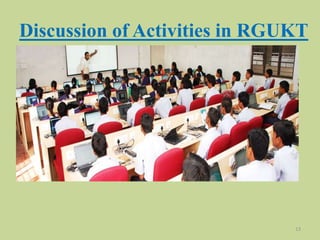
Discussion of Activities in RGUKT
13
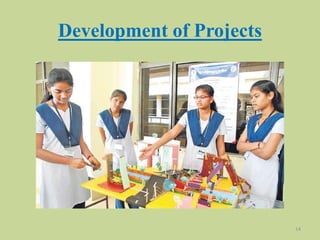
Development of Projects
14
Summary
• “Learning by Doing” is a concept which aims at
Student Centric Learning which creates interest,
enhances the thinking ability, and enables creativity.
• The concept of Learning by doing is currently being
implemented on a large scale in India in Elementary
Education & Primary Education.
• There is a necessity to promote this program in Higher
education levels on a large scale.
15
Thank You
16

learning by doing.ppt

  • 1.
    LEARNING BY DOING by M.Rupas Kumar IIIT, RK Valley RGUKT, Andhra Pradesh, India Presented in 51st Orientation Programme, UGC - HRDC JNTUH, Date: 15.09.2018
  • 2.
    Outline  Introduction  Importanceof Learning by Doing in Education  Methodology  Adoption of Learning by Doing in India o Elementary Education o Higher Education  Summary 2
  • 3.
    Introduction  Learning byDoing - Learning through experiences attained by doing a series of activities.  Learning by Doing refers to a theory of education expounded by American Philosopher, John Dewey (1915)  The same concept of learning is termed as “Experienced based learning” by Wolfe & Byrne (1975)  Several other philosophers call it as “Activity based learning”. 3
  • 4.
    Learning Pyramid 4 National TrainingLaboratories, Bethel, Maine has developed a relation between methodology of teaching adopted and Average retention rate of the listeners (2012).
  • 5.
    Methodology of Learningby Doing • Enabling the learners to work together • Self Directed Group Exploration • Sharing the results and products of the activity • Application to a similar or a different situation 5
  • 6.
    Benefits of Learningby Doing • Increase students participation & engagement • Increase students retention • More student ownership in course • Less lecturing by instructor • More exciting classroom experience • Higher level thinking
  • 7.
    Limitations of Learningby Doing • Requires preparation by leader/teacher • Requires patience and guidance by teacher; decentralized approach can seem less orderly which may be less comfortable to an authoritarian-style teacher • There is often no single, “right” answer • Consumes more amount of Time 7
  • 8.
    Learning by Doingin India • Elementary Education • Started by David Horsburgh in 1950’s by establishing a school called “Neel Bagh” in Kolar District in Karnataka. Then Rishi Valley school acquired this school and practicing the methodology adopted till date. • Similar kind of concept is adopted by Sri. Vijaya Kumar, Collector of Vellore in Tamil Nadu for the Child Labour in 1994. Later, in 2003 UNICEF extended it to Corporation Schools in Chennai • Govt. of Haryana also adopted the concept under scheme called “Mukya Mantri Siksha Deeksha Yojna” in 2014. 8
  • 9.
    Contd. • Madhya Pradeshalso adopted the concept under “Sarva Siksha Abhiyan.” There is a Non-profit organization called Humana People to People India’s (HPPI) which trained teachers to promote the concept of Learning by Doing. • Chhattisgarh also started following the methodology under a programme “Parivartan Shiksha Abhiyan” with the support of UNICEF in 2011. • The Concept is currently being practiced in several states like Karnataka, Maharastra, North East States etc. 9
  • 10.
    Role of Learningby Doing in Higher Education MSIT Programme • This is a program of higher education started in 2001 in JNTU-H, IIIT-H, and NIT-W. • This is an ICT based programme developed on the concept of “learning by doing” where the students are provided with individual workstations. • The students are instructed to work on mini projects to cover the courses in the program. • This program became a huge success and now extended to JNTU-K, JNTU-A, & SVU with the Collaboration of CMU, USA 10
  • 11.
    RGUKT • Three IIIT’sare established under RGUKT based on the concept of Learning by Doing in 2008. • The concept is implemented with ICT aids to teach engineering courses. • Video lectures from NPTEL, Swayam etc. are supplied along with the reading materials to enable the concept of “L by D” 11
  • 12.
    Sharing of Experiencesof Activities in RGUKT 12
  • 13.
  • 14.
  • 15.
    Summary • “Learning byDoing” is a concept which aims at Student Centric Learning which creates interest, enhances the thinking ability, and enables creativity. • The concept of Learning by doing is currently being implemented on a large scale in India in Elementary Education & Primary Education. • There is a necessity to promote this program in Higher education levels on a large scale. 15
  • 16.