Learning by
Doing: Guiding
students
through Activities
Presented by: NEERAJ SOUN
TGT ENGLISH
VIVEKANANDVIDYA MANDIR INTER COLLEGE PITHORAHARH
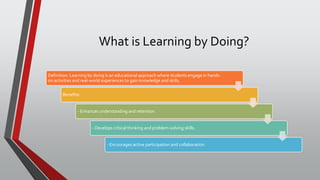
What is Learning by Doing?
Definition: Learning by doing is an educational approach where students engage in hands-
on activities and real-world experiences to gain knowledge and skills.
Benefits:
- Enhances understanding and retention.
- Develops critical thinking and problem-solving skills.
- Encourages active participation and collaboration.
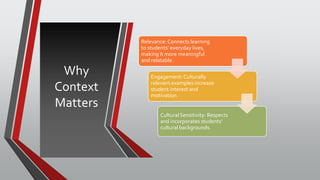
Why
Context
Matters
Relevance:Connects learning
to students' everyday lives,
making it more meaningful
and relatable.
Engagement:Culturally
relevant examples increase
student interest and
motivation.
Cultural Sensitivity: Respects
and incorporates students'
cultural backgrounds.
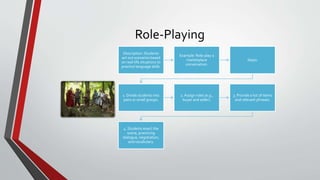
Role-Playing
Description: Students
act out scenarios based
on real-life situations to
practice language skills.
Example: Role-play a
marketplace
conversation.
Steps:
1. Divide students into
pairs or small groups.
2. Assign roles (e.g.,
buyer and seller).
3. Provide a list of items
and relevant phrases.
4. Students enact the
scene, practicing
dialogue, negotiation,
and vocabulary.
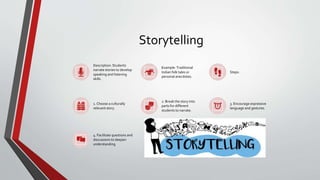
Storytelling
Description: Students
narrate stories to develop
speaking and listening
skills.
Example: Traditional
Indian folk tales or
personal anecdotes.
Steps:
1. Choose a culturally
relevant story.
2. Break the story into
parts for different
students to narrate.
3. Encourage expressive
language and gestures.
4. Facilitate questions and
discussions to deepen
understanding.
Group Discussions
• Description: Students engage in discussions on various topics to
enhance critical thinking and communication skills.
• Example: Debate on a current event or social issue relevant to
India.
• Steps:
• 1. Select a pertinent topic.
• 2. Form small discussion groups.
• 3. Provide guiding questions to structure the discussion.
• 4. Groups discuss and present their viewpoints, followed by a class
discussion.
Project-Based Learning
• Description: Students work on long-term projects, integrating
multiple skills and knowledge areas.
• Example: Creating a local community guidebook.
• Steps:
• 1. Choose a project theme (e.g., local history, environmental
issues).
• 2. Divide the class into groups and assign specific tasks
(research, writing, presentation).
• 3. Guide students through the project phases: planning,
execution, and presentation.
• 4. Encourage peer review and reflection on the project process.
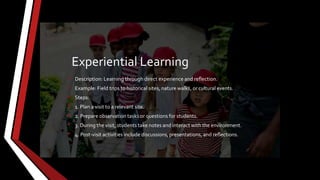
Experiential Learning
• Description: Learning through direct experience and reflection.
• Example: Field trips to historical sites, nature walks, or cultural events.
• Steps:
• 1. Plan a visit to a relevant site.
• 2. Prepare observation tasks or questions for students.
• 3. During the visit, students take notes and interact with the environment.
• 4. Post-visit activities include discussions, presentations, and reflections.
IntegratingTechnology
• Description: Utilizing digital tools to enhance learning.
• Example: Using language learning apps, online collaboration
tools, or multimedia projects.
• Steps:
• 1. Introduce educational apps and tools (e.g., Duolingo, Google
Classroom).
• 2. Assign tasks or projects that require the use of these tools.
• 3. Monitor progress and provide feedback.
• 4. Encourage collaborative online projects and digital
storytelling.
Case Study:
Successful
Implementa
tion
• Description: A real-life example of
effective 'learning by doing'
• Example: A school that improved
language skills through
community-based projects.
• Details:
• 1. Outline the school's approach to
integrating hands-on activities.
• 2. Highlight key activities and their
outcomes.
• 3. Discuss challenges faced and
solutions implemented.
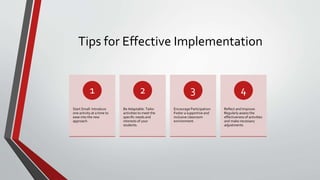
Tips for Effective Implementation
Start Small: Introduce
one activity at a time to
ease into the new
approach.
1
Be Adaptable: Tailor
activities to meet the
specific needs and
interests of your
students.
2
Encourage Participation:
Foster a supportive and
inclusive classroom
environment.
3
Reflect and Improve:
Regularly assess the
effectiveness of activities
and make necessary
adjustments.
4
Questions
and
Answers
• Interactive Session: Open the floor
for questions.
• Engagement: Encourage
participants to share their
experiences and challenges.
• Support: Provide additional
examples and resources as needed.
Conclusion
start incorporating
'learning by doing'
activities in your
classrooms.
Thanks for your time
and attention.

Learning_by_Doing_Training_Presentation for pupil teachers(1).pptx

  • 1.
    Learning by Doing: Guiding students throughActivities Presented by: NEERAJ SOUN TGT ENGLISH VIVEKANANDVIDYA MANDIR INTER COLLEGE PITHORAHARH
  • 2.
    What is Learningby Doing? Definition: Learning by doing is an educational approach where students engage in hands- on activities and real-world experiences to gain knowledge and skills. Benefits: - Enhances understanding and retention. - Develops critical thinking and problem-solving skills. - Encourages active participation and collaboration.
  • 3.
    Why Context Matters Relevance:Connects learning to students'everyday lives, making it more meaningful and relatable. Engagement:Culturally relevant examples increase student interest and motivation. Cultural Sensitivity: Respects and incorporates students' cultural backgrounds.
  • 4.
    Role-Playing Description: Students act outscenarios based on real-life situations to practice language skills. Example: Role-play a marketplace conversation. Steps: 1. Divide students into pairs or small groups. 2. Assign roles (e.g., buyer and seller). 3. Provide a list of items and relevant phrases. 4. Students enact the scene, practicing dialogue, negotiation, and vocabulary.
  • 5.
    Storytelling Description: Students narrate storiesto develop speaking and listening skills. Example: Traditional Indian folk tales or personal anecdotes. Steps: 1. Choose a culturally relevant story. 2. Break the story into parts for different students to narrate. 3. Encourage expressive language and gestures. 4. Facilitate questions and discussions to deepen understanding.
  • 6.
    Group Discussions • Description:Students engage in discussions on various topics to enhance critical thinking and communication skills. • Example: Debate on a current event or social issue relevant to India. • Steps: • 1. Select a pertinent topic. • 2. Form small discussion groups. • 3. Provide guiding questions to structure the discussion. • 4. Groups discuss and present their viewpoints, followed by a class discussion.
  • 7.
    Project-Based Learning • Description:Students work on long-term projects, integrating multiple skills and knowledge areas. • Example: Creating a local community guidebook. • Steps: • 1. Choose a project theme (e.g., local history, environmental issues). • 2. Divide the class into groups and assign specific tasks (research, writing, presentation). • 3. Guide students through the project phases: planning, execution, and presentation. • 4. Encourage peer review and reflection on the project process.
  • 8.
    Experiential Learning • Description:Learning through direct experience and reflection. • Example: Field trips to historical sites, nature walks, or cultural events. • Steps: • 1. Plan a visit to a relevant site. • 2. Prepare observation tasks or questions for students. • 3. During the visit, students take notes and interact with the environment. • 4. Post-visit activities include discussions, presentations, and reflections.
  • 9.
    IntegratingTechnology • Description: Utilizingdigital tools to enhance learning. • Example: Using language learning apps, online collaboration tools, or multimedia projects. • Steps: • 1. Introduce educational apps and tools (e.g., Duolingo, Google Classroom). • 2. Assign tasks or projects that require the use of these tools. • 3. Monitor progress and provide feedback. • 4. Encourage collaborative online projects and digital storytelling.
  • 10.
    Case Study: Successful Implementa tion • Description:A real-life example of effective 'learning by doing' • Example: A school that improved language skills through community-based projects. • Details: • 1. Outline the school's approach to integrating hands-on activities. • 2. Highlight key activities and their outcomes. • 3. Discuss challenges faced and solutions implemented.
  • 11.
    Tips for EffectiveImplementation Start Small: Introduce one activity at a time to ease into the new approach. 1 Be Adaptable: Tailor activities to meet the specific needs and interests of your students. 2 Encourage Participation: Foster a supportive and inclusive classroom environment. 3 Reflect and Improve: Regularly assess the effectiveness of activities and make necessary adjustments. 4
  • 12.
    Questions and Answers • Interactive Session:Open the floor for questions. • Engagement: Encourage participants to share their experiences and challenges. • Support: Provide additional examples and resources as needed.
  • 13.
    Conclusion start incorporating 'learning bydoing' activities in your classrooms. Thanks for your time and attention.