LEARNING BY
DOING: GUIDING
STUDENTS
THROUGH
ACTIVITIES
Presented by: Neeraj Soun
TGT English
Vivekanand Vidya Mandir Inter College Pithoragarh
WHAT IS
LEARNING BY
DOING?
Definition: Learning by doing is an
educational approach where
students engage in hands-on
activities and real-world experiences
to gain knowledge and skills.
Benefits:
- Enhances understanding and
retention.
- Develops critical thinking and
problem-solving skills.
- Encourages active participation
and collaboration.
WHY CONTEXT
MATTERS
Relevance: Connects learning to
students' everyday lives, making it
more meaningful and relatable.
Engagement: Culturally relevant
examples increase student interest
and motivation.
Cultural Sensitivity: Respects and
incorporates students' cultural
backgrounds.
ROLE-PLAYING
Description: Students act out scenarios based on real-life
situations to practice language skills.
Example: Role-play a marketplace conversation.
Steps:
1. Divide students into pairs or small groups.
2. Assign roles (e.g., buyer and seller).
3. Provide a list of items and relevant phrases.
4. Students enact the scene, practicing dialogue, negotiation,
and vocabulary.
STORYTEL
LING
Description: Students narrate
stories to develop speaking
and listening skills.
Example: Traditional Indian
folk tales or personal
anecdotes.
Steps:
1. Choose a culturally relevant
story.
2. Break the story into parts
for different students to
narrate.
3. Encourage expressive
language and gestures.
4. Facilitate questions and
GROUP DISCUSSIONS
Description: Students engage in discussions on various
topics to enhance critical thinking and communication
skills.
Example: Debate on a current event or social issue relevant
to India.
Steps:
1. Select a pertinent topic.
2. Form small discussion groups.
3. Provide guiding questions to structure the discussion.
4. Groups discuss and present their viewpoints, followed by
a class discussion.
PROJECT-BASED LEARNING
Description: Students work on long-term projects, integrating
multiple skills and knowledge areas.
Example: Creating a local community guidebook.
Steps:
1. Choose a project theme (e.g., local history, environmental
issues).
2. Divide the class into groups and assign specific tasks
(research, writing, presentation).
3. Guide students through the project phases: planning,
execution, and presentation.
4. Encourage peer review and reflection on the project
process.
EXPERIENTIAL LEARNING
Description: Learning through direct experience and
reflection.
Example: Field trips to historical sites, nature walks, or
cultural events.
Steps:
1. Plan a visit to a relevant site.
2. Prepare observation tasks or questions for students.
3. During the visit, students take notes and interact with
the environment.
INTEGRATING TECHNOLOGY
Description: Utilizing digital tools to enhance learning.
Example: Using language learning apps, online collaboration
tools, or multimedia projects.
Steps:
1. Introduce educational apps and tools (e.g., Duolingo, Google
Classroom).
2. Assign tasks or projects that require the use of these tools.
3. Monitor progress and provide feedback.
4. Encourage collaborative online projects and digital
storytelling.
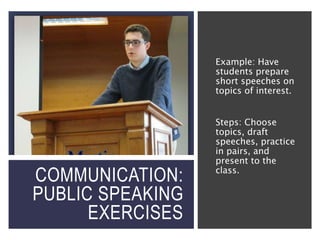
COMMUNICATION:
PUBLIC SPEAKING
EXERCISES
Example: Have
students prepare
short speeches on
topics of interest.
Steps: Choose
topics, draft
speeches, practice
in pairs, and
present to the
class.
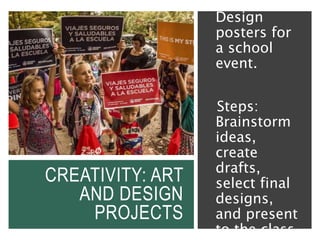
CREATIVITY: ART
AND DESIGN
PROJECTS
Example:
Design
posters for
a school
event.
Steps:
Brainstorm
ideas,
create
drafts,
select final
designs,
and present
to the class.
ACTIVIT
IES FOR
JUNIOR
CLASSE
S
Activity 1: Show and Tell
Description: Students bring an item from home and
talk about it.
Steps: Choose a theme, allow each student to present
their item, and ask questions to engage the class.
Activity 2: Alphabet Hunt
Description: Students search for objects starting with
each letter of the alphabet.
Steps: Provide a list of letters, let students find
objects, and share their findings with the class.
Activity 3: Simple Science Experiments
Example: Making a volcano with baking soda and
vinegar.
Steps: Gather materials, follow experiment steps, and
discuss the results.
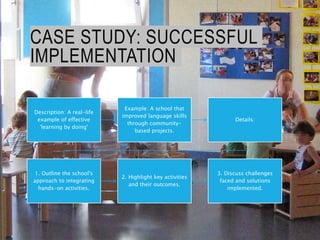
CASE STUDY: SUCCESSFUL
IMPLEMENTATION
Description: A real-life
example of effective
'learning by doing'
Example: A school that
improved language skills
through community-
based projects.
Details:
1. Outline the school's
approach to integrating
hands-on activities.
2. Highlight key activities
and their outcomes.
3. Discuss challenges
faced and solutions
implemented.
TIPS FOR EFFECTIVE
IMPLEMENTATION
1. Start Small: Introduce one activity at a time to ease into the
new approach.
2. Be Adaptable: Tailor activities to meet the specific needs and
interests of your students.
3. Encourage Participation: Foster a supportive and inclusive
classroom environment.
4. Reflect and Improve: Regularly assess the effectiveness of
activities and make necessary adjustments.
QUESTION
S AND
ANSWERS
Interactive Session: Open the floor for
questions.
Engagement: Encourage participants
to share their experiences and
challenges.
Support: Provide additional examples
and resources as needed.
CONCLUSION
Start incorporating
'learning by doing'
activities in your
classrooms.
Thanks for your
time and attention.

Learning_by_Doing_Presentation based on nep.pptx

  • 1.
    LEARNING BY DOING: GUIDING STUDENTS THROUGH ACTIVITIES Presentedby: Neeraj Soun TGT English Vivekanand Vidya Mandir Inter College Pithoragarh
  • 2.
    WHAT IS LEARNING BY DOING? Definition:Learning by doing is an educational approach where students engage in hands-on activities and real-world experiences to gain knowledge and skills. Benefits: - Enhances understanding and retention. - Develops critical thinking and problem-solving skills. - Encourages active participation and collaboration.
  • 3.
    WHY CONTEXT MATTERS Relevance: Connectslearning to students' everyday lives, making it more meaningful and relatable. Engagement: Culturally relevant examples increase student interest and motivation. Cultural Sensitivity: Respects and incorporates students' cultural backgrounds.
  • 4.
    ROLE-PLAYING Description: Students actout scenarios based on real-life situations to practice language skills. Example: Role-play a marketplace conversation. Steps: 1. Divide students into pairs or small groups. 2. Assign roles (e.g., buyer and seller). 3. Provide a list of items and relevant phrases. 4. Students enact the scene, practicing dialogue, negotiation, and vocabulary.
  • 5.
    STORYTEL LING Description: Students narrate storiesto develop speaking and listening skills. Example: Traditional Indian folk tales or personal anecdotes. Steps: 1. Choose a culturally relevant story. 2. Break the story into parts for different students to narrate. 3. Encourage expressive language and gestures. 4. Facilitate questions and
  • 6.
    GROUP DISCUSSIONS Description: Studentsengage in discussions on various topics to enhance critical thinking and communication skills. Example: Debate on a current event or social issue relevant to India. Steps: 1. Select a pertinent topic. 2. Form small discussion groups. 3. Provide guiding questions to structure the discussion. 4. Groups discuss and present their viewpoints, followed by a class discussion.
  • 7.
    PROJECT-BASED LEARNING Description: Studentswork on long-term projects, integrating multiple skills and knowledge areas. Example: Creating a local community guidebook. Steps: 1. Choose a project theme (e.g., local history, environmental issues). 2. Divide the class into groups and assign specific tasks (research, writing, presentation). 3. Guide students through the project phases: planning, execution, and presentation. 4. Encourage peer review and reflection on the project process.
  • 8.
    EXPERIENTIAL LEARNING Description: Learningthrough direct experience and reflection. Example: Field trips to historical sites, nature walks, or cultural events. Steps: 1. Plan a visit to a relevant site. 2. Prepare observation tasks or questions for students. 3. During the visit, students take notes and interact with the environment.
  • 9.
    INTEGRATING TECHNOLOGY Description: Utilizingdigital tools to enhance learning. Example: Using language learning apps, online collaboration tools, or multimedia projects. Steps: 1. Introduce educational apps and tools (e.g., Duolingo, Google Classroom). 2. Assign tasks or projects that require the use of these tools. 3. Monitor progress and provide feedback. 4. Encourage collaborative online projects and digital storytelling.
  • 10.
    COMMUNICATION: PUBLIC SPEAKING EXERCISES Example: Have studentsprepare short speeches on topics of interest. Steps: Choose topics, draft speeches, practice in pairs, and present to the class.
  • 11.
    CREATIVITY: ART AND DESIGN PROJECTS Example: Design postersfor a school event. Steps: Brainstorm ideas, create drafts, select final designs, and present to the class.
  • 12.
    ACTIVIT IES FOR JUNIOR CLASSE S Activity 1:Show and Tell Description: Students bring an item from home and talk about it. Steps: Choose a theme, allow each student to present their item, and ask questions to engage the class. Activity 2: Alphabet Hunt Description: Students search for objects starting with each letter of the alphabet. Steps: Provide a list of letters, let students find objects, and share their findings with the class. Activity 3: Simple Science Experiments Example: Making a volcano with baking soda and vinegar. Steps: Gather materials, follow experiment steps, and discuss the results.
  • 13.
    CASE STUDY: SUCCESSFUL IMPLEMENTATION Description:A real-life example of effective 'learning by doing' Example: A school that improved language skills through community- based projects. Details: 1. Outline the school's approach to integrating hands-on activities. 2. Highlight key activities and their outcomes. 3. Discuss challenges faced and solutions implemented.
  • 14.
    TIPS FOR EFFECTIVE IMPLEMENTATION 1.Start Small: Introduce one activity at a time to ease into the new approach. 2. Be Adaptable: Tailor activities to meet the specific needs and interests of your students. 3. Encourage Participation: Foster a supportive and inclusive classroom environment. 4. Reflect and Improve: Regularly assess the effectiveness of activities and make necessary adjustments.
  • 15.
    QUESTION S AND ANSWERS Interactive Session:Open the floor for questions. Engagement: Encourage participants to share their experiences and challenges. Support: Provide additional examples and resources as needed.
  • 16.
    CONCLUSION Start incorporating 'learning bydoing' activities in your classrooms. Thanks for your time and attention.