LEARNING BARRIERS
LEARNING DIFFICULTIES
PRESENTED BY GG KHOZA
INTRODUCTION
• What comes to your mind when you think of LEARNING BARRIERS?
• What is a barrier? What is learning?
• These are questions we can ask ourselves while dealing with this topic.
• Therefore a barrier is anything that prohibits another thing. It serves a block
or hindrance between two or more things. While learning on the other hand is,
the acquisition of knowledge and skills through study and at times through
personal experiences.
• After coming up with definitions of a barrier and of learning one can try to
come up with a definition of a learning barrier(s).
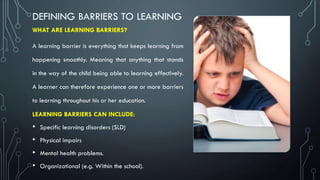
DEFINING BARRIERS TO LEARNING
WHAT ARE LEARNING BARRIERS?
A learning barrier is everything that keeps learning from
happening smoothly. Meaning that anything that stands
in the way of the child being able to learning effectively.
A learner can therefore experience one or more barriers
to learning throughout his or her education.
LEARNING BARRIERS CAN INCLUDE:
• Specific learning disorders (SLD)
• Physical impairs
• Mental health problems.
• Organizational (e.g. Within the school).
A BROADER LOOK AT THE TYPES OF LEARNING BARRIERS
PHYSICAL IMPAIRMENTS
Physical impairments are
classified into two different
categories; Neuro motor
impairments and Muscular&
Skeletal conditions. Under the
first category we have Polio,
seizure disorder and spinal cord
disorders. Then in the second
category; limb arthritis, and
limb deficiencies.
ORGANIZATIONAL
Organizational barriers can be
within the school and also
classroom. In a way that the
arrangements of the furniture
cannot be accommodative to
learners, especially those with
learning needs. E.g. a learner in
a wheel chair would not be able
to move around in a crowded
classroom, affecting the learner’s
learning negatively.
MENTAL HEALTH PROBLEMS
Mental health of children is very
much necessary for well education
of the children. If a child is active
he may be able to participate in
sports and extra circular activities
within the school. This means that if
the child has good mental health
they will do well in school. But of
otherwise the learner might be
passive in classrooms, finding it
difficult to concentrate and even
keep with the content being
taught.
SPECIFIC LEARNING DISORDERS (SLD).
In the previous SLD was excluded because it will our focus area.
• What are specific learning disorders (SLD) ?
Specific because it concerns specific skills and not the intelligence of a person
Involves school learning skills such as reading, writing and calculations.
The disorder/ disturbance is not an illness but an alteration.
• SLD’s are specified into the following categories:
Dyslexia (Problems with reading, usually associated with sight problems and
other physical impairments within the learner)
Dysgraphia and dysothography (Problems with writing, usually associated
with learners struggling with fine motor skills)
Dyscaculia (Problems with calculations, mathematics).
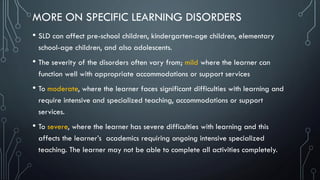
MORE ON SPECIFIC LEARNING DISORDERS
• SLD can affect pre-school children, kindergarten-age children, elementary
school-age children, and also adolescents.
• The severity of the disorders often vary from; mild where the learner can
function well with appropriate accommodations or support services
• To moderate, where the learner faces significant difficulties with learning and
require intensive and specialized teaching, accommodations or support
services.
• To severe, where the learner has severe difficulties with learning and this
affects the learner’s academics requiring ongoing intensive specialized
teaching. The learner may not be able to complete all activities completely.
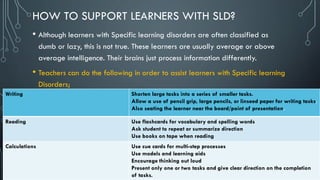
HOW TO SUPPORT LEARNERS WITH SLD?
• Although learners with Specific learning disorders are often classified as
dumb or lazy, this is not true. These learners are usually average or above
average intelligence. Their brains just process information differently.
• Teachers can do the following in order to assist learners with Specific learning
Disorders;
Writing Shorten large tasks into a series of smaller tasks.
Allow a use of pencil grip, large pencils, or linseed paper for writing tasks.
Also seating the learner near the board/point of presentation.
Reading Use flashcards for vocabulary and spelling words
Ask student to repeat or summarize direction
Use books on tape when reading
Calculations Use cue cards for multi-step processes
Use models and learning aids
Encourage thinking out loud
Present only one or two tasks and give clear direction on the completion
of tasks.
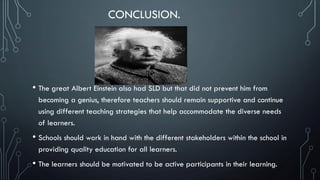
CONCLUSION.
• The great Albert Einstein also had SLD but that did not prevent him from
becoming a genius, therefore teachers should remain supportive and continue
using different teaching strategies that help accommodate the diverse needs
of learners.
• Schools should work in hand with the different stakeholders within the school in
providing quality education for all learners.
• The learners should be motivated to be active participants in their learning.
THANK YOU!
REFERENCES.
Cyrus, J. (2003). Physical Impairments, ED443 Assistive/ Adaptive Technology. Available from:
https://www.slideshare.net/gilster1969/physical-impairments-97-2003-presentation?qid=fa21500d-6fdd-477a-
bf7e-a8f98f12f437&v=&b=&from_search=1
Gardner, C. (2019). Integrated learner support. Available from:
https://www.slideshare.net/CILIPARLGAcademicand/arlg-2019-gardner-integrated-learner-
support?qid=47ac0e56-230c-4ab4-b8c5-62e1edf62a63&v=&b=&from_search=3
Ghanghoriya, P. (2017). Specific learning disorders. Available from:
https://www.slideshare.net/vineetaghanghoriya/specific-learning-disorders-71771742?qid=3d4f3334-5a58-4403-
9947-cd6b542daae4&v=&b=&from_search=3
Makarono. (2018). Specific learning disorders. Available from: https://www.slideshare.net/makarono/italy-
specific-learning-disorders-in-english?qid=e5e95bf8-17e5-49c8-8e72-55c3f0d6c30f&v=&b=&from_search=1
Mayzel, O. (2013). Learning barriers, a program to change teacher’s attitude towards inclusion. Available from:
https://www.slideshare.net/Olga_Maizel/learning-barriers?qid=bdee2255-890b-4976-96d8-
ce09e337f934&v=&b=&from_search=1

Learning barriers &Specific learning disorders.

  • 1.
  • 2.
    INTRODUCTION • What comesto your mind when you think of LEARNING BARRIERS? • What is a barrier? What is learning? • These are questions we can ask ourselves while dealing with this topic. • Therefore a barrier is anything that prohibits another thing. It serves a block or hindrance between two or more things. While learning on the other hand is, the acquisition of knowledge and skills through study and at times through personal experiences. • After coming up with definitions of a barrier and of learning one can try to come up with a definition of a learning barrier(s).
  • 3.
    DEFINING BARRIERS TOLEARNING WHAT ARE LEARNING BARRIERS? A learning barrier is everything that keeps learning from happening smoothly. Meaning that anything that stands in the way of the child being able to learning effectively. A learner can therefore experience one or more barriers to learning throughout his or her education. LEARNING BARRIERS CAN INCLUDE: • Specific learning disorders (SLD) • Physical impairs • Mental health problems. • Organizational (e.g. Within the school).
  • 4.
    A BROADER LOOKAT THE TYPES OF LEARNING BARRIERS PHYSICAL IMPAIRMENTS Physical impairments are classified into two different categories; Neuro motor impairments and Muscular& Skeletal conditions. Under the first category we have Polio, seizure disorder and spinal cord disorders. Then in the second category; limb arthritis, and limb deficiencies. ORGANIZATIONAL Organizational barriers can be within the school and also classroom. In a way that the arrangements of the furniture cannot be accommodative to learners, especially those with learning needs. E.g. a learner in a wheel chair would not be able to move around in a crowded classroom, affecting the learner’s learning negatively. MENTAL HEALTH PROBLEMS Mental health of children is very much necessary for well education of the children. If a child is active he may be able to participate in sports and extra circular activities within the school. This means that if the child has good mental health they will do well in school. But of otherwise the learner might be passive in classrooms, finding it difficult to concentrate and even keep with the content being taught.
  • 5.
    SPECIFIC LEARNING DISORDERS(SLD). In the previous SLD was excluded because it will our focus area. • What are specific learning disorders (SLD) ? Specific because it concerns specific skills and not the intelligence of a person Involves school learning skills such as reading, writing and calculations. The disorder/ disturbance is not an illness but an alteration. • SLD’s are specified into the following categories: Dyslexia (Problems with reading, usually associated with sight problems and other physical impairments within the learner) Dysgraphia and dysothography (Problems with writing, usually associated with learners struggling with fine motor skills) Dyscaculia (Problems with calculations, mathematics).
  • 6.
    MORE ON SPECIFICLEARNING DISORDERS • SLD can affect pre-school children, kindergarten-age children, elementary school-age children, and also adolescents. • The severity of the disorders often vary from; mild where the learner can function well with appropriate accommodations or support services • To moderate, where the learner faces significant difficulties with learning and require intensive and specialized teaching, accommodations or support services. • To severe, where the learner has severe difficulties with learning and this affects the learner’s academics requiring ongoing intensive specialized teaching. The learner may not be able to complete all activities completely.
  • 7.
    HOW TO SUPPORTLEARNERS WITH SLD? • Although learners with Specific learning disorders are often classified as dumb or lazy, this is not true. These learners are usually average or above average intelligence. Their brains just process information differently. • Teachers can do the following in order to assist learners with Specific learning Disorders; Writing Shorten large tasks into a series of smaller tasks. Allow a use of pencil grip, large pencils, or linseed paper for writing tasks. Also seating the learner near the board/point of presentation. Reading Use flashcards for vocabulary and spelling words Ask student to repeat or summarize direction Use books on tape when reading Calculations Use cue cards for multi-step processes Use models and learning aids Encourage thinking out loud Present only one or two tasks and give clear direction on the completion of tasks.
  • 8.
    CONCLUSION. • The greatAlbert Einstein also had SLD but that did not prevent him from becoming a genius, therefore teachers should remain supportive and continue using different teaching strategies that help accommodate the diverse needs of learners. • Schools should work in hand with the different stakeholders within the school in providing quality education for all learners. • The learners should be motivated to be active participants in their learning.
  • 9.
  • 10.
    REFERENCES. Cyrus, J. (2003).Physical Impairments, ED443 Assistive/ Adaptive Technology. Available from: https://www.slideshare.net/gilster1969/physical-impairments-97-2003-presentation?qid=fa21500d-6fdd-477a- bf7e-a8f98f12f437&v=&b=&from_search=1 Gardner, C. (2019). Integrated learner support. Available from: https://www.slideshare.net/CILIPARLGAcademicand/arlg-2019-gardner-integrated-learner- support?qid=47ac0e56-230c-4ab4-b8c5-62e1edf62a63&v=&b=&from_search=3 Ghanghoriya, P. (2017). Specific learning disorders. Available from: https://www.slideshare.net/vineetaghanghoriya/specific-learning-disorders-71771742?qid=3d4f3334-5a58-4403- 9947-cd6b542daae4&v=&b=&from_search=3 Makarono. (2018). Specific learning disorders. Available from: https://www.slideshare.net/makarono/italy- specific-learning-disorders-in-english?qid=e5e95bf8-17e5-49c8-8e72-55c3f0d6c30f&v=&b=&from_search=1 Mayzel, O. (2013). Learning barriers, a program to change teacher’s attitude towards inclusion. Available from: https://www.slideshare.net/Olga_Maizel/learning-barriers?qid=bdee2255-890b-4976-96d8- ce09e337f934&v=&b=&from_search=1