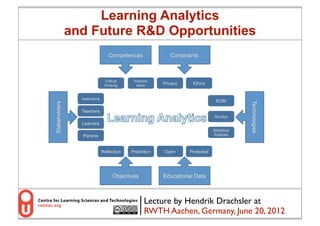
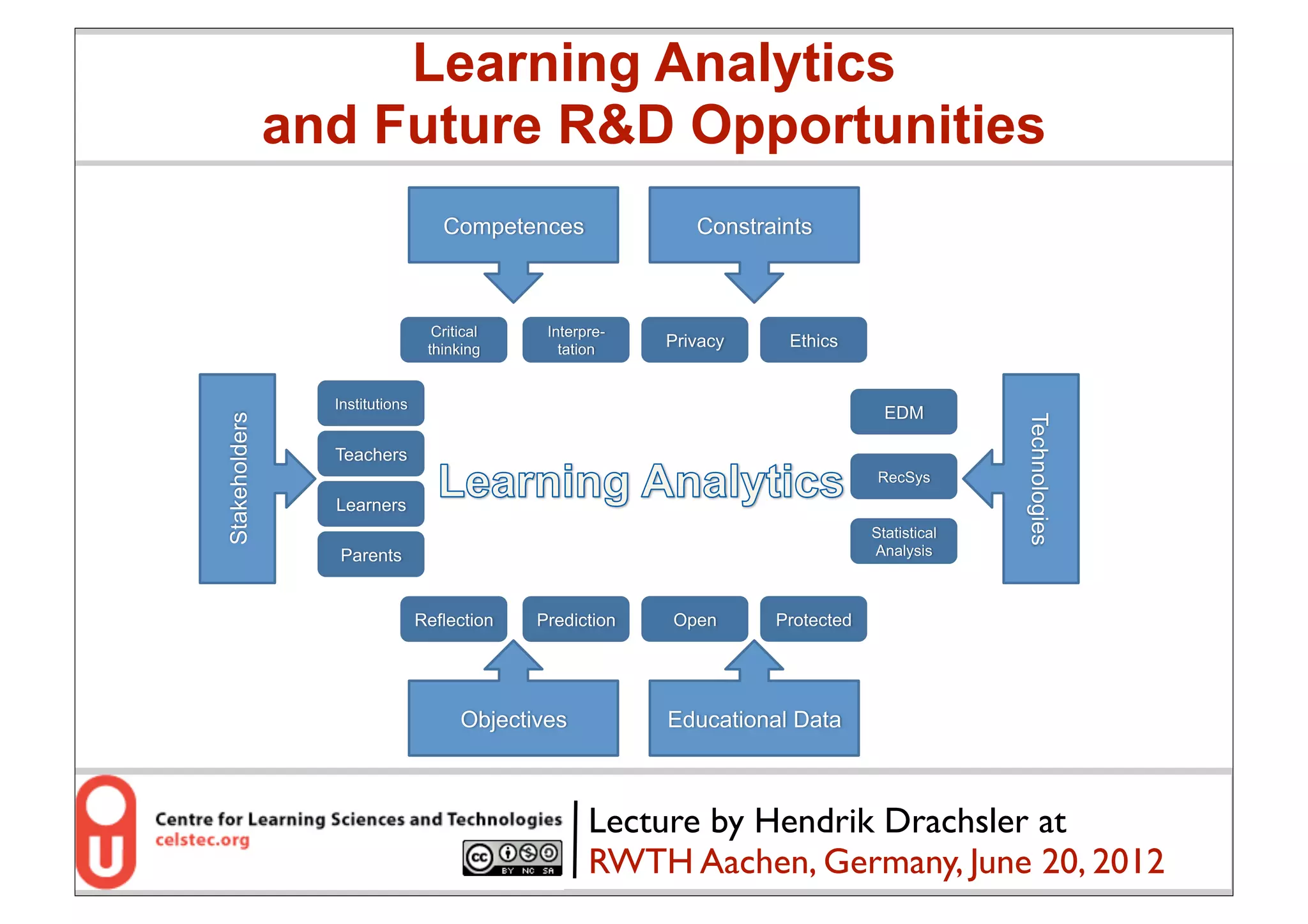
Learning Analytics
and Future R&D Opportunities


           Lecture by Hendrik Drachsler at
           RWTH Aachen, Germany, June 20, 2012
               1
Goals of the lecture

   LA Framework
                  Survey
                           Findings

                            Conclusions


              2
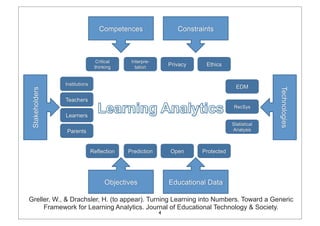
A view on Learning Analytics
The Learning
Analytics
Framework


               3
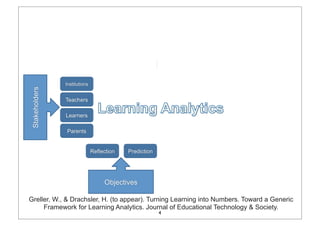
Greller, W., & Drachsler, H. (to appear). Turning Learning into Numbers. Toward a Generic
     Framework for Learning Analytics. Journal of Educational Technology & Society.
                                           4
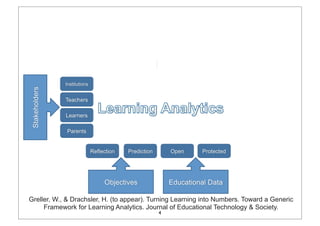
Greller, W., & Drachsler, H. (to appear). Turning Learning into Numbers. Toward a Generic
     Framework for Learning Analytics. Journal of Educational Technology & Society.
                                           4
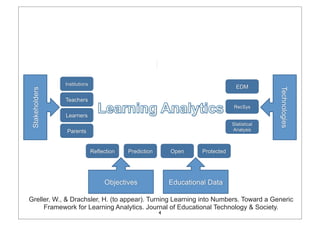
Greller, W., & Drachsler, H. (to appear). Turning Learning into Numbers. Toward a Generic
     Framework for Learning Analytics. Journal of Educational Technology & Society.
                                           4
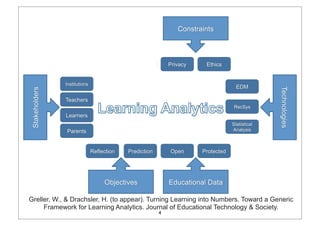
Greller, W., & Drachsler, H. (to appear). Turning Learning into Numbers. Toward a Generic
     Framework for Learning Analytics. Journal of Educational Technology & Society.
                                           4
Greller, W., & Drachsler, H. (to appear). Turning Learning into Numbers. Toward a Generic
     Framework for Learning Analytics. Journal of Educational Technology & Society.
                                           4
Greller, W., & Drachsler, H. (to appear). Turning Learning into Numbers. Toward a Generic
     Framework for Learning Analytics. Journal of Educational Technology & Society.
                                           4
Greller, W., & Drachsler, H. (to appear). Turning Learning into Numbers. Toward a Generic
     Framework for Learning Analytics. Journal of Educational Technology & Society.
                                           4
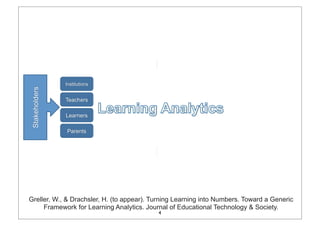
Stakeholders vs. LA Framework
Opinions from
the stakeholders
toward the
dimensions of the
LA framework


                    5
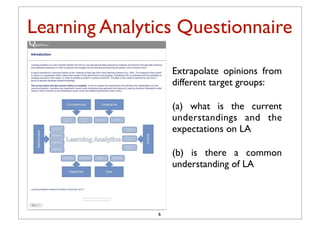
Learning Analytics Questionnaire

                   Extrapolate opinions from
                   different target groups:

                   (a) what is the current
                   understandings and the
                   expectations on LA

                   (b) is there a common
                   understanding of LA


               6
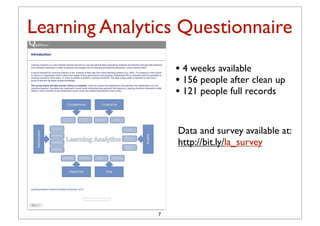
Learning Analytics Questionnaire
                   • 4 weeks available
                   • 156 people after clean up
                   • 121 people full records


                   Data and survey available at:
                   http://bit.ly/la_survey


               7
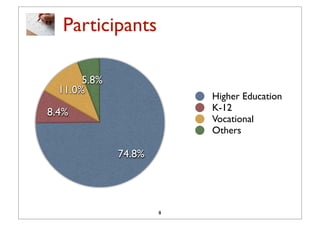
Participants

       5.8%
  11.0%
                          Higher Education
8.4%                      K-12
                          Vocational
                          Others

              74.8%


                      8
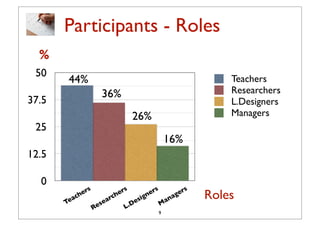
Participants - Roles
  %
 50
        44%                                                 Teachers
                    36%                                     Researchers
37.5                                                        L.Designers
                                26%                         Managers
 25
                                              16%
12.5

  0
              s           s             s           s
            er          er            er          er
       Te
         ac
           h
                    ar
                      ch        sig
                                    n
                                             na
                                                g       Roles
                 es
                   e
                          L .D
                              e           Ma
                R
                                          9
Participants - Reach
Responses from 31 countries [UK (38), US (30), NL (22)]


                          10
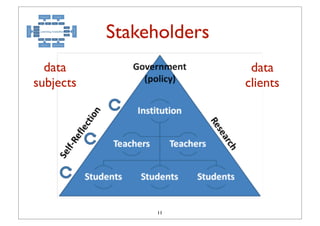
Stakeholders
  data                     data
subjects                  clients


                11
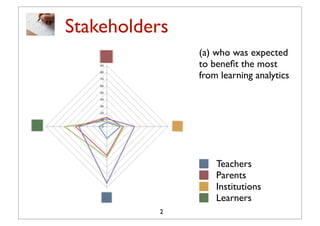
Stakeholders
               (a) who was expected
               to benefit the most
               from learning analytics


                   Teachers
                   Parents
                   Institutions
                   Learners
          12
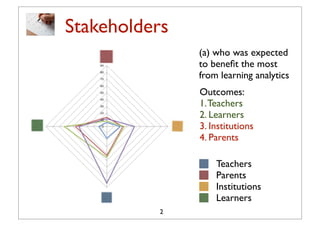
Stakeholders
               (a) who was expected
               to benefit the most
               from learning analytics
               Outcomes:
               1. Teachers
               2. Learners
               3. Institutions
               4. Parents

                   Teachers
                   Parents
                   Institutions
                   Learners
          12
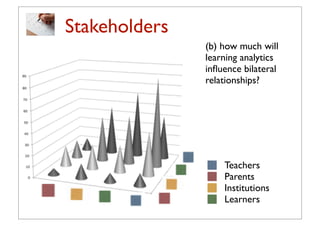
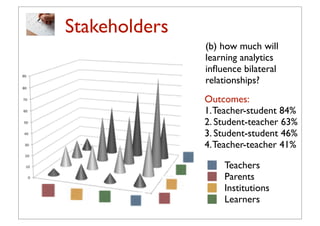
Stakeholders
               (b) how much will
               learning analytics
               influence bilateral
               relationships?


                   Teachers
                   Parents
                   Institutions
          13       Learners
Stakeholders
               (b) how much will
               learning analytics
               influence bilateral
               relationships?
               Outcomes:
               1. Teacher-student 84%
               2. Student-teacher 63%
               3. Student-student 46%
               4. Teacher-teacher 41%

                   Teachers
                   Parents
                   Institutions
          13       Learners
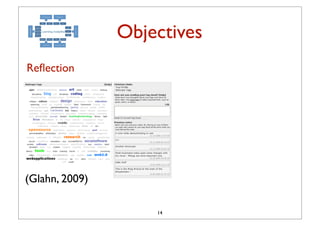
Objectives
Reflection


(Glahn, 2009)

                    14
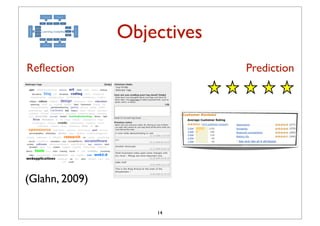
Objectives
Reflection                    Prediction


(Glahn, 2009)

                    14
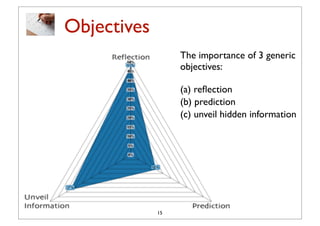
Objectives
                  The importance of 3 generic
                  objectives:

                  (a) reflection
                  (b) prediction
                  (c) unveil hidden information


             15
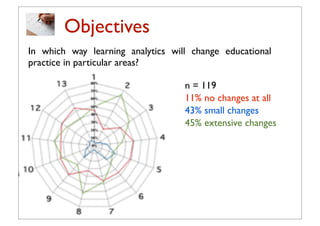
Objectives
In which way learning analytics will change educational
practice in particular areas?

                                   n = 119
                                   11% no changes at all
                                   43% small changes
                                   45% extensive changes


                             16
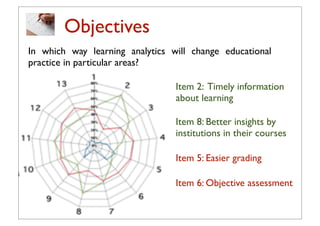
Objectives
In which way learning analytics will change educational
practice in particular areas?

                                  Item=2: Timely information
                                     n 119
                                     11% no changes at all
                                  about learning
                                     43% small changes
                                  Item 8: extensive changes
                                     45% Better insights by
                                  institutions in their courses

                                  Item 5: Easier grading

                                  Item 6: Objective assessment

                             16
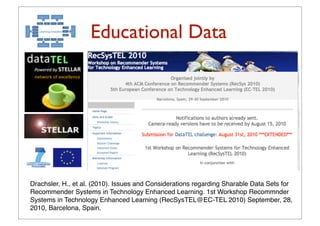
Educational Data


Drachsler, H., et al. (2010). Issues and Considerations regarding Sharable Data Sets for
Recommender Systems in Technology Enhanced Learning. 1st Workshop Recommnder
Systems in Technology Enhanced Learning (RecSysTEL@EC-TEL 2010) September, 28,
2010, Barcelona, Spain.
                                          17
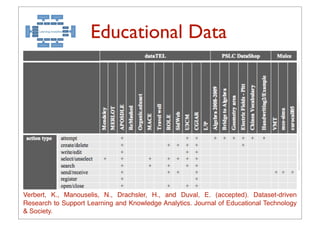
Educational Data


  Drachsler, H., et al. (2010). Issues and Considerations regarding Sharable Data Sets for
Verbert, K., Manouselis, in Technology Enhanced Learning.E. (accepted).Recommnder
  Recommender Systems N., Drachsler, H., and Duval, 1st Workshop Dataset-driven
  Systems in Technology Enhanced Learning (RecSysTEL@EC-TEL 2010) September, 28,
Research to Support Learning and Knowledge Analytics. Journal of Educational Technology
  2010, Barcelona, Spain.
& Society.                                  17
Educational Data
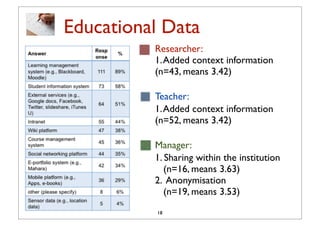
          Researcher:
          1. Added context information
          (n=43, means 3.42)

          Teacher:
          1. Added context information
          (n=52, means 3.42)

          Manager:
          1. Sharing within the institution
             (n=16, means 3.63)
          2. Anonymisation
             (n=19, means 3.53)
          18
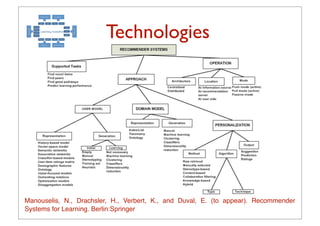
Technologies


Manouselis, N., Drachsler, H., Verbert, K., and Duval, E. (to appear). Recommender
Systems for Learning. Berlin:Springer
                                        19
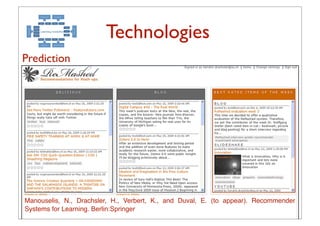
Technologies
Prediction


Manouselis, N., Drachsler, H., Verbert, K., and Duval, E. (to appear). Recommender
Systems for Learning. Berlin:Springer
                                        19
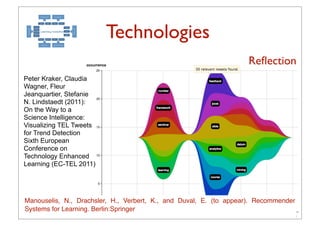
Technologies
                                                                   Reflection
Peter Kraker, Claudia
Wagner, Fleur
Jeanquartier, Stefanie
N. Lindstaedt (2011):
On the Way to a
Science Intelligence:
Visualizing TEL Tweets
for Trend Detection
Sixth European
Conference on
Technology Enhanced
Learning (EC-TEL 2011)


Manouselis, N., Drachsler, H., Verbert, K., and Duval, E. (to appear). Recommender
Systems for Learning. Berlin:Springer
                                        19
Technologies
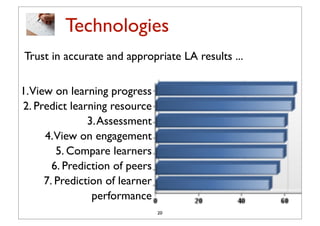
Trust in accurate and appropriate LA results ...

1.View on learning progress
2. Predict learning resource
               3. Assessment
     4.View on engagement
        5. Compare learners
       6. Prediction of peers
     7. Prediction of learner
                performance
                                20
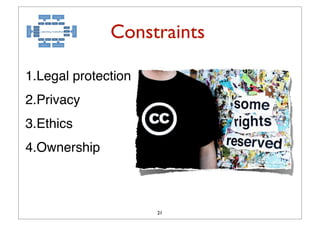
Constraints

1.Legal protection
2.Privacy
3.Ethics
4.Ownership


                     21
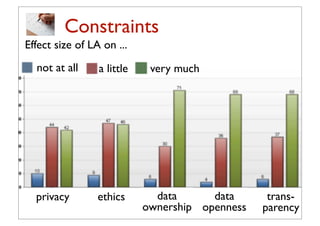
Constraints
Effect size of LA on ...
  not at all     a little    very much


  privacy        ethics       data      data      trans-
                            ownership openness   parency
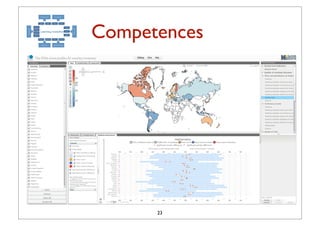
Competences


      23
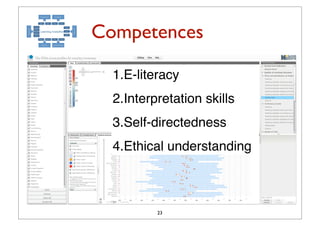
Competences

  1.E-literacy
  2.Interpretation skills
  3.Self-directedness
  4.Ethical understanding


          23
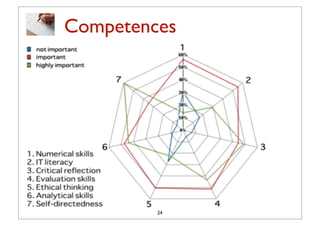
Competences


         24
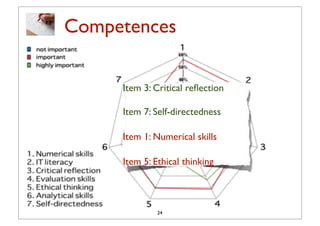
Competences

     Item 3: Critical reflection

     Item 7: Self-directedness

     Item 1: Numerical skills

     Item 5: Ethical thinking


              24
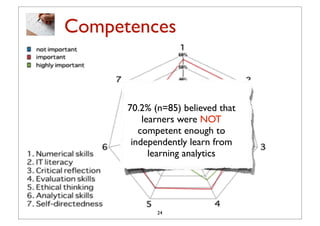
Competences

     Item 3: Critical reflection

     Item 7: Self-directednessthat
       70.2% (n=85) believed
           learners were NOT
          competent enough to
     Item 1: Numerical skills
        independently learn from
             learning analytics
     Item 5: Ethical thinking


             24
Limitations


picture by Stephan Downes   http://www.flickr.com/photos/stephen_downes/3808714505
                                   25
Limitations
1. Dominance of responses
from the HE sector

2. Absence of students

3. Low awareness of LA;
 Only surveyed innovators and early adopters

4. Mainly opinions from western cultures
                         26
Survey summary
Main findings
of the survey
according to
the LA
framework


                27
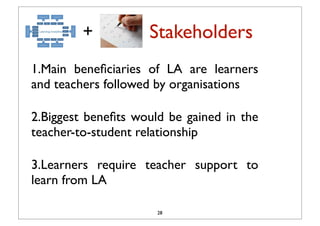
+          Stakeholders
1.Main beneficiaries of LA are learners
and teachers followed by organisations

2.Biggest benefits would be gained in the
teacher-to-student relationship

3.Learners require teacher support to
learn from LA

                      28
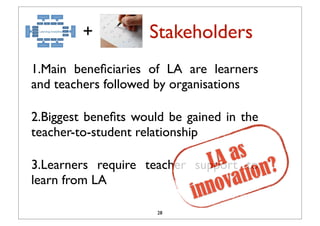
+          Stakeholders
1.Main beneficiaries of LA are learners
and teachers followed by organisations

2.Biggest benefits would be gained in the
teacher-to-student relationship

                                LA asto
3.Learners require teacher   support
                                     tio n?
learn from LA
                             inn ova
                      28
+           Objectives
1. Reflection support is main objective from
the stakeholders view ...
2. ...by revealing hidden information about
learners


                       29
+           Objectives
1. Reflection support is main objective from
the stakeholders view ...
2. ...by revealing hidden information about
learners

   Reflection support only for
  teacher student relationship?
                       29
+               Educational Data
1. Context information from learners and the learning
process

2. Anonymisation is the second most important data
attribute

3. Willingness to share if data is anonymised


                             30
+               Educational Data
1. Context information from learners and the learning
process

2. Anonymisation is the second most important data
attribute

3. Willingness to share if data is anonymised


   Can we achieve a collection of
        reference datasets?
                             30
+            Technologies

1. Trust in LA algorithms is not well developed

2. High confidence on gaining a comprehensive
view of the learning progress


                        31
+            Technologies

1. Trust in LA algorithms is not well developed

2. High confidence on gaining a comprehensive
view of the learning progress


  How accurate can we measure
      a learning progress?
                        31
+               Constraints
1. Data ownership is the most important topic

2. LA lead to breaches of privacy but privacy and ethical aspects
are of lesser importance

3. Many organisations have ethical boards and guidelines in place


                               32
+               Constraints
1. Data ownership is the most important topic

2. LA lead to breaches of privacy but privacy and ethical aspects
are of lesser importance

3. Many organisations have ethical boards and guidelines in place


   Do we need new policies for
   data ownership and privacy?
                               32
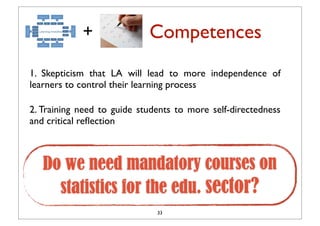
+               Competences
1. Skepticism that LA will lead to more independence of
learners to control their learning process

2. Training need to guide students to more self-directedness
and critical reflection


                              33
+               Competences
1. Skepticism that LA will lead to more independence of
learners to control their learning process

2. Training need to guide students to more self-directedness
and critical reflection


   Do we need mandatory courses on
     statistics for the edu. sector?
                              33
Future R&D


                         Future
                          R&D


picture by Tom Raftery   http://www.flickr.com/photos/traftery/4773457853
                                    34
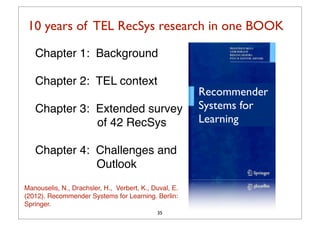
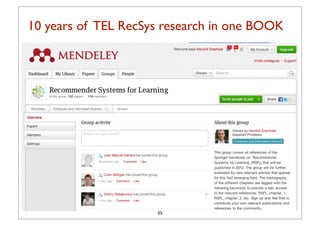
10 years of TEL RecSys research in one BOOK

   Chapter 1: Background

   Chapter 2: TEL context
                                                        Recommender
   Chapter 3: Extended survey                           Systems for
              of 42 RecSys                              Learning

   Chapter 4: Challenges and
              Outlook
Manouselis, N., Drachsler, H., Verbert, K., Duval, E.
(2012). Recommender Systems for Learning. Berlin:
Springer.
                                             35
10 years of TEL RecSys research in one BOOK

   Chapter 1: Background

   Chapter 2: TEL context
                                                        Recommender
   Chapter 3: Extended survey                           Systems for
              of 42 RecSys                              Learning

   Chapter 4: Challenges and
              Outlook
Manouselis, N., Drachsler, H., Verbert, K., Duval, E.
(2012). Recommender Systems for Learning. Berlin:
Springer.
                                             35
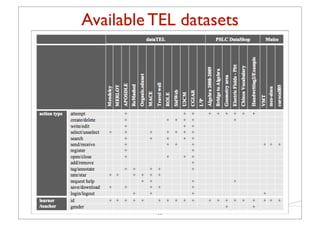
Available TEL datasets


          36
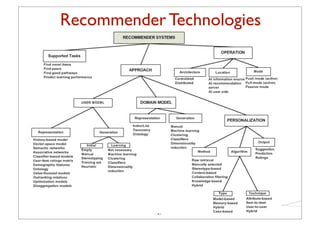
Recommender Technologies


           37
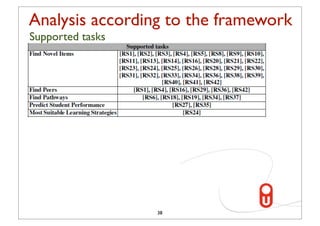
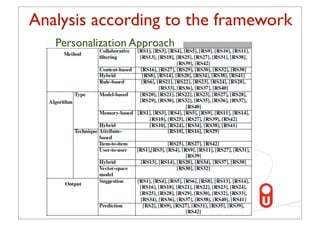
Analysis according to the framework
Supported tasks


                  38
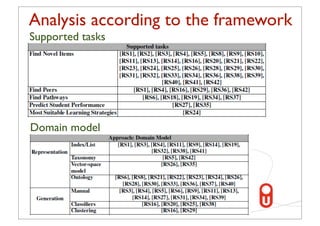
Analysis according to the framework
Supported tasks


Domain model


                  38
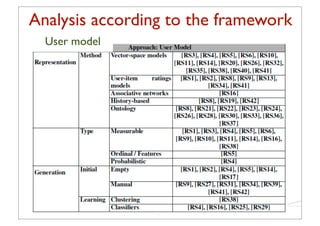
Analysis according to the framework
  User model


                 39
Analysis according to the framework
   Personalization Approach


                       40
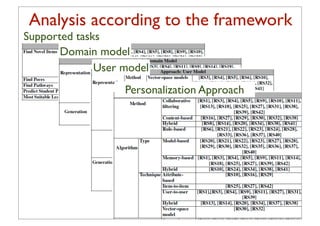
Analysis according to the framework
Supported tasks
       Domain model
              User model
                   Personalization Approach


                           41
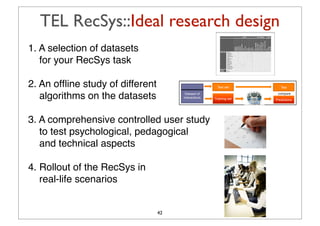
TEL RecSys::Ideal research design
1. A selection of datasets
   for your RecSys task

2. An offline study of different
   algorithms on the datasets

3. A comprehensive controlled user study
   to test psychological, pedagogical
   and technical aspects

4. Rollout of the RecSys in
   real-life scenarios


                                  42
TEL RecSys::Open issues

1. Evaluation
2. Datasets
3. Context
4. Visualization
5. Virtualization
6. Privacy


                    43
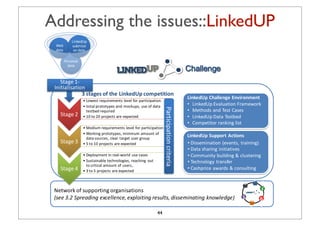
Addressing the issues::LinkedUP
            LinkedUp
 Web        submissi
 data        on data(

        Personal(
          data


    Stage(1J
 Initialisation
 Initialisation
              36stages6of6the6LinkedUp competition6
                                                                                             LinkedUp Challenge6Environment
                    • Lowest(requirements(level(for(participation
                    • Inital(prototypes(and(mockups,(use(of(data(                            • LinkedUp Evaluation(Framework


                                                                    Participation criteria
                      testbed(required                                                       • Methods and Test(Cases
   Stage(2          • 10(to(20(projects(are(expected                                         • LinkedUp Data(Testbed
                                                                                             • Competitor ranking list
                    • Medium(requirements(level(for(participation
                    • Working(prototypes,(minimum(amount of
                      data(sources,(clear(target(user(group
                                                                                             LinkedUp Support Actions
   Stage(3          • 5(to(10(projects(are(expected(                                         • Dissemination((events,( training)(
                                                                                             • Data(sharing(initiatives
                    • Deployment(in(realJworld( use(cases                                    • Community(building(&(clustering
                    • Sustainable(technologies,(reaching out                                 • Technology(transfer
                      to critical(amount(of(users,
   Stage(4          • 3(to(5(projects(are(expected(
                                                                                             • Cashprice( awards(&(consulting

                                                                                                                         E
                                                                                                                                 P S
                                                                                                                         T       P F
 Network(of(supporting(organisations(                                                                                    (


                                                                                                                                  I
 (see 3.2'Spreading'excellence,'exploiting'results,'disseminating'knowledge)''                                          S           E
                                                                                                                             C    B
                                                                                                                             C    O
                                                               44
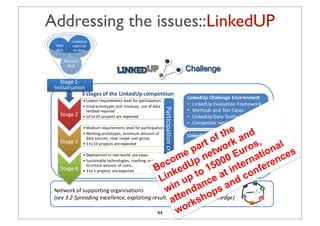
Addressing the issues::LinkedUP
            LinkedUp
 Web        submissi
 data        on data(

        Personal(
          data


    Stage(1J
 Initialisation
 Initialisation
              36stages6of6the6LinkedUp competition6
                                                                                             LinkedUp Challenge6Environment
                    • Lowest(requirements(level(for(participation
                    • Inital(prototypes(and(mockups,(use(of(data(                            • LinkedUp Evaluation(Framework


                                                                    Participation criteria
                      testbed(required                                                       • Methods and Test(Cases
   Stage(2          • 10(to(20(projects(are(expected                                         • LinkedUp Data(Testbed
                                                                                             • Competitor ranking list

                                                                        the and
                    • Medium(requirements(level(for(participation
                    • Working(prototypes,(minimum(amount of
                                                                      f                      LinkedUp Support Actions
                                                                   t o ork os, al
                      data(sources,(clear(target(user(group
    Stage(3
                                                                 r                           • Dissemination((events,( training)(
                                                               pa etw
                    • 5(to(10(projects(are(expected(
                                                                                 r       n   • Data(sharing(initiatives
                                                              e n           Eu atio ces
                                                          om Up
             • Deployment(in(realJworld( use(cases                                           • Community(building(&(clustering
                                                                         0
             • Sustainable(technologies,(reaching out
                                                         c d
                                                      Be ke           00 tern feren          • Technology(transfer
               to critical(amount(of(users,
    Stage(4 • 3(to(5(projects(are(expected(                        15 t in          n        • Cashprice( awards(&(consulting
                                                         n p to e a
                                                       Li u                     c oP
                                                                 n  c and E P S
 Network(of(supporting(organisations(                    win nda ps             T      F
                                                           tte sho
                                                                                     I
                                                                                                                         (


 (see 3.2'Spreading'excellence,'exploiting'results,'disseminating'knowledge)'' S C B   E
                                                          a rk
                                                      44   w o                     C O
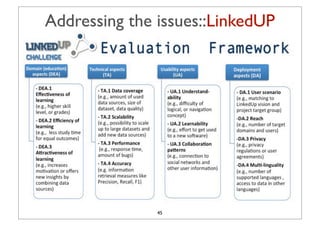
Addressing the issues::LinkedUP


               45
!
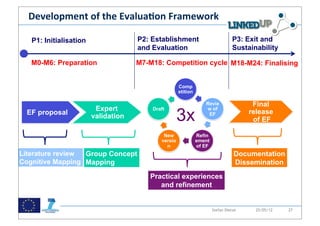
  Development*of*the*Evalua0on*Framework*
  *
   P1: Initialisation                P2: Establishment                           P3: Exit and
                                     and Evaluation                              Sustainability

   M0-M6: Preparation                M7-M18: Competition cycle M18-M24: Finalising


                                                     Comp
                                                     etition

                                                                  Revie                 Final
                         Expert
                                                     3x
                                         Draft                    w of
 EF proposal                                                       EF                  release
                        validation                                                      of EF

                                             New               Refin
                                            versio             ement
                                              n                of EF
Literature review Group Concept                                                   Documentation
Cognitive Mapping Mapping                                                         Dissemination
                                        Practical experiences
                                           and refinement


                                                                       Stefan Dietze     25/05/12   27
                                          46
!

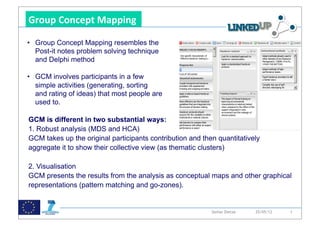
Group&Concept&Mapping&&

•  Group Concept Mapping resembles the
   Post-it notes problem solving technique
   and Delphi method

•  GCM involves participants in a few
   simple activities (generating, sorting
   and rating of ideas) that most people are
   used to.

GCM is different in two substantial ways:
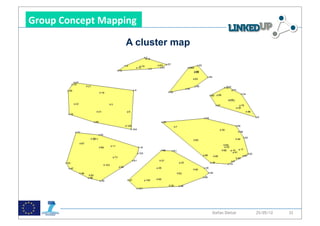
1. Robust analysis (MDS and HCA)
GCM takes up the original participants contribution and then quantitatively
aggregate it to show their collective view (as thematic clusters)

2. Visualisation
GCM presents the results from the analysis as conceptual maps and other graphical
representations (pattern matching and go-zones).


                                          47               Stefan Dietze   25/05/12   1
!

Group&Concept&Mapping&&

                 Example: EU FP7
                    Handover

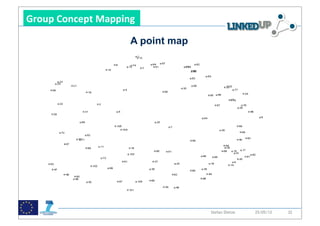
        •  105 criteria about accurate handover training
           interventions
        •  Sorting on similarity in meaning
        •  Rating on importance and feasibility


                               48            Stefan Dietze   25/05/12   31
!

Group&Concept&Mapping&&

                     A point map


                          49       Stefan Dietze   25/05/12   32
!

Group&Concept&Mapping&&

                   A cluster map


                          50       Stefan Dietze   25/05/12   33
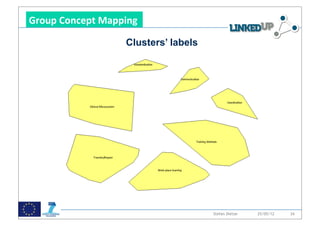
!

Group&Concept&Mapping&&

                   Clusters’ labels


                                                                      A


                          51          Stefan Dietze   25/05/12   34
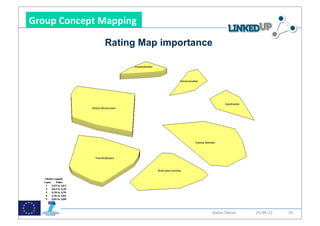
!

Group&Concept&Mapping&&

               Rating Map importance


                          52       Stefan Dietze   25/05/12   35
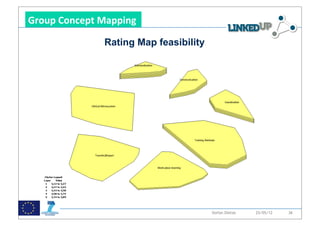
!

Group&Concept&Mapping&&

               Rating Map feasibility


                          53            Stefan Dietze   25/05/12   36
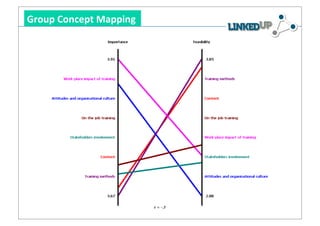
!

Group&Concept&Mapping&&


                          54   Stefan Dietze   25/05/12   37
!

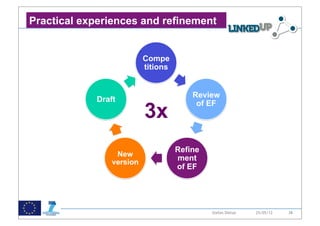
Practical experiences and refinement


                          Compe
                          titions


                                        Review
            Draft

                          3x
                                         of EF


                                    Refine
                 New
                version
                                    ment
                                    of EF


                             55              Stefan Dietze   25/05/12   38
Many Thanks::Questions?
 This presentation is available at:
    slideshare.com/Drachsler

  Email: hendrik.drachsler@ou.nl
  Email: wolfgang.greller@ou.nl

       Supporting projects:


                              !


                 56

Learning Analytics and Future R&D at CELSTEC

  • 1.
    Learning Analytics and FutureR&D Opportunities Lecture by Hendrik Drachsler at RWTH Aachen, Germany, June 20, 2012 1
  • 2.
    Goals of thelecture LA Framework Survey Findings Conclusions 2
  • 3.
    A view onLearning Analytics The Learning Analytics Framework 3
  • 4.
    Greller, W., &Drachsler, H. (to appear). Turning Learning into Numbers. Toward a Generic Framework for Learning Analytics. Journal of Educational Technology & Society. 4
  • 5.
    Greller, W., &Drachsler, H. (to appear). Turning Learning into Numbers. Toward a Generic Framework for Learning Analytics. Journal of Educational Technology & Society. 4
  • 6.
    Greller, W., &Drachsler, H. (to appear). Turning Learning into Numbers. Toward a Generic Framework for Learning Analytics. Journal of Educational Technology & Society. 4
  • 7.
    Greller, W., &Drachsler, H. (to appear). Turning Learning into Numbers. Toward a Generic Framework for Learning Analytics. Journal of Educational Technology & Society. 4
  • 8.
    Greller, W., &Drachsler, H. (to appear). Turning Learning into Numbers. Toward a Generic Framework for Learning Analytics. Journal of Educational Technology & Society. 4
  • 9.
    Greller, W., &Drachsler, H. (to appear). Turning Learning into Numbers. Toward a Generic Framework for Learning Analytics. Journal of Educational Technology & Society. 4
  • 10.
    Greller, W., &Drachsler, H. (to appear). Turning Learning into Numbers. Toward a Generic Framework for Learning Analytics. Journal of Educational Technology & Society. 4
  • 11.
    Stakeholders vs. LAFramework Opinions from the stakeholders toward the dimensions of the LA framework 5
  • 12.
    Learning Analytics Questionnaire Extrapolate opinions from different target groups: (a) what is the current understandings and the expectations on LA (b) is there a common understanding of LA 6
  • 13.
    Learning Analytics Questionnaire • 4 weeks available • 156 people after clean up • 121 people full records Data and survey available at: http://bit.ly/la_survey 7
  • 14.
    Participants 5.8% 11.0% Higher Education 8.4% K-12 Vocational Others 74.8% 8
  • 15.
    Participants - Roles % 50 44% Teachers 36% Researchers 37.5 L.Designers 26% Managers 25 16% 12.5 0 s s s s er er er er Te ac h ar ch sig n na g Roles es e L .D e Ma R 9
  • 16.
    Participants - Reach Responsesfrom 31 countries [UK (38), US (30), NL (22)] 10
  • 17.
    Stakeholders data data subjects clients 11
  • 18.
    Stakeholders (a) who was expected to benefit the most from learning analytics Teachers Parents Institutions Learners 12
  • 19.
    Stakeholders (a) who was expected to benefit the most from learning analytics Outcomes: 1. Teachers 2. Learners 3. Institutions 4. Parents Teachers Parents Institutions Learners 12
  • 20.
    Stakeholders (b) how much will learning analytics influence bilateral relationships? Teachers Parents Institutions 13 Learners
  • 21.
    Stakeholders (b) how much will learning analytics influence bilateral relationships? Outcomes: 1. Teacher-student 84% 2. Student-teacher 63% 3. Student-student 46% 4. Teacher-teacher 41% Teachers Parents Institutions 13 Learners
  • 22.
  • 23.
    Objectives Reflection Prediction (Glahn, 2009) 14
  • 24.
    Objectives The importance of 3 generic objectives: (a) reflection (b) prediction (c) unveil hidden information 15
  • 25.
    Objectives In which waylearning analytics will change educational practice in particular areas? n = 119 11% no changes at all 43% small changes 45% extensive changes 16
  • 26.
    Objectives In which waylearning analytics will change educational practice in particular areas? Item=2: Timely information n 119 11% no changes at all about learning 43% small changes Item 8: extensive changes 45% Better insights by institutions in their courses Item 5: Easier grading Item 6: Objective assessment 16
  • 27.
    Educational Data Drachsler, H.,et al. (2010). Issues and Considerations regarding Sharable Data Sets for Recommender Systems in Technology Enhanced Learning. 1st Workshop Recommnder Systems in Technology Enhanced Learning (RecSysTEL@EC-TEL 2010) September, 28, 2010, Barcelona, Spain. 17
  • 28.
    Educational Data Drachsler, H., et al. (2010). Issues and Considerations regarding Sharable Data Sets for Verbert, K., Manouselis, in Technology Enhanced Learning.E. (accepted).Recommnder Recommender Systems N., Drachsler, H., and Duval, 1st Workshop Dataset-driven Systems in Technology Enhanced Learning (RecSysTEL@EC-TEL 2010) September, 28, Research to Support Learning and Knowledge Analytics. Journal of Educational Technology 2010, Barcelona, Spain. & Society. 17
  • 29.
    Educational Data Researcher: 1. Added context information (n=43, means 3.42) Teacher: 1. Added context information (n=52, means 3.42) Manager: 1. Sharing within the institution (n=16, means 3.63) 2. Anonymisation (n=19, means 3.53) 18
  • 30.
    Technologies Manouselis, N., Drachsler,H., Verbert, K., and Duval, E. (to appear). Recommender Systems for Learning. Berlin:Springer 19
  • 31.
    Technologies Prediction Manouselis, N., Drachsler,H., Verbert, K., and Duval, E. (to appear). Recommender Systems for Learning. Berlin:Springer 19
  • 32.
    Technologies Reflection Peter Kraker, Claudia Wagner, Fleur Jeanquartier, Stefanie N. Lindstaedt (2011): On the Way to a Science Intelligence: Visualizing TEL Tweets for Trend Detection Sixth European Conference on Technology Enhanced Learning (EC-TEL 2011) Manouselis, N., Drachsler, H., Verbert, K., and Duval, E. (to appear). Recommender Systems for Learning. Berlin:Springer 19
  • 33.
    Technologies Trust in accurateand appropriate LA results ... 1.View on learning progress 2. Predict learning resource 3. Assessment 4.View on engagement 5. Compare learners 6. Prediction of peers 7. Prediction of learner performance 20
  • 34.
  • 35.
    Constraints Effect size ofLA on ... not at all a little very much privacy ethics data data trans- ownership openness parency
  • 36.
  • 37.
    Competences 1.E-literacy 2.Interpretation skills 3.Self-directedness 4.Ethical understanding 23
  • 38.
  • 39.
    Competences Item 3: Critical reflection Item 7: Self-directedness Item 1: Numerical skills Item 5: Ethical thinking 24
  • 40.
    Competences Item 3: Critical reflection Item 7: Self-directednessthat 70.2% (n=85) believed learners were NOT competent enough to Item 1: Numerical skills independently learn from learning analytics Item 5: Ethical thinking 24
  • 41.
    Limitations picture by StephanDownes http://www.flickr.com/photos/stephen_downes/3808714505 25
  • 42.
    Limitations 1. Dominance ofresponses from the HE sector 2. Absence of students 3. Low awareness of LA; Only surveyed innovators and early adopters 4. Mainly opinions from western cultures 26
  • 43.
    Survey summary Main findings ofthe survey according to the LA framework 27
  • 44.
    + Stakeholders 1.Main beneficiaries of LA are learners and teachers followed by organisations 2.Biggest benefits would be gained in the teacher-to-student relationship 3.Learners require teacher support to learn from LA 28
  • 45.
    + Stakeholders 1.Main beneficiaries of LA are learners and teachers followed by organisations 2.Biggest benefits would be gained in the teacher-to-student relationship LA asto 3.Learners require teacher support tio n? learn from LA inn ova 28
  • 46.
    + Objectives 1. Reflection support is main objective from the stakeholders view ... 2. ...by revealing hidden information about learners 29
  • 47.
    + Objectives 1. Reflection support is main objective from the stakeholders view ... 2. ...by revealing hidden information about learners Reflection support only for teacher student relationship? 29
  • 48.
    + Educational Data 1. Context information from learners and the learning process 2. Anonymisation is the second most important data attribute 3. Willingness to share if data is anonymised 30
  • 49.
    + Educational Data 1. Context information from learners and the learning process 2. Anonymisation is the second most important data attribute 3. Willingness to share if data is anonymised Can we achieve a collection of reference datasets? 30
  • 50.
    + Technologies 1. Trust in LA algorithms is not well developed 2. High confidence on gaining a comprehensive view of the learning progress 31
  • 51.
    + Technologies 1. Trust in LA algorithms is not well developed 2. High confidence on gaining a comprehensive view of the learning progress How accurate can we measure a learning progress? 31
  • 52.
    + Constraints 1. Data ownership is the most important topic 2. LA lead to breaches of privacy but privacy and ethical aspects are of lesser importance 3. Many organisations have ethical boards and guidelines in place 32
  • 53.
    + Constraints 1. Data ownership is the most important topic 2. LA lead to breaches of privacy but privacy and ethical aspects are of lesser importance 3. Many organisations have ethical boards and guidelines in place Do we need new policies for data ownership and privacy? 32
  • 54.
    + Competences 1. Skepticism that LA will lead to more independence of learners to control their learning process 2. Training need to guide students to more self-directedness and critical reflection 33
  • 55.
    + Competences 1. Skepticism that LA will lead to more independence of learners to control their learning process 2. Training need to guide students to more self-directedness and critical reflection Do we need mandatory courses on statistics for the edu. sector? 33
  • 56.
    Future R&D Future R&D picture by Tom Raftery http://www.flickr.com/photos/traftery/4773457853 34
  • 57.
    10 years ofTEL RecSys research in one BOOK Chapter 1: Background Chapter 2: TEL context Recommender Chapter 3: Extended survey Systems for of 42 RecSys Learning Chapter 4: Challenges and Outlook Manouselis, N., Drachsler, H., Verbert, K., Duval, E. (2012). Recommender Systems for Learning. Berlin: Springer. 35
  • 58.
    10 years ofTEL RecSys research in one BOOK Chapter 1: Background Chapter 2: TEL context Recommender Chapter 3: Extended survey Systems for of 42 RecSys Learning Chapter 4: Challenges and Outlook Manouselis, N., Drachsler, H., Verbert, K., Duval, E. (2012). Recommender Systems for Learning. Berlin: Springer. 35
  • 59.
  • 60.
  • 61.
    Analysis according tothe framework Supported tasks 38
  • 62.
    Analysis according tothe framework Supported tasks Domain model 38
  • 63.
    Analysis according tothe framework User model 39
  • 64.
    Analysis according tothe framework Personalization Approach 40
  • 65.
    Analysis according tothe framework Supported tasks Domain model User model Personalization Approach 41
  • 66.
    TEL RecSys::Ideal researchdesign 1. A selection of datasets for your RecSys task 2. An offline study of different algorithms on the datasets 3. A comprehensive controlled user study to test psychological, pedagogical and technical aspects 4. Rollout of the RecSys in real-life scenarios 42
  • 67.
    TEL RecSys::Open issues 1.Evaluation 2. Datasets 3. Context 4. Visualization 5. Virtualization 6. Privacy 43
  • 68.
    Addressing the issues::LinkedUP LinkedUp Web submissi data on data( Personal( data Stage(1J Initialisation Initialisation 36stages6of6the6LinkedUp competition6 LinkedUp Challenge6Environment • Lowest(requirements(level(for(participation • Inital(prototypes(and(mockups,(use(of(data( • LinkedUp Evaluation(Framework Participation criteria testbed(required • Methods and Test(Cases Stage(2 • 10(to(20(projects(are(expected • LinkedUp Data(Testbed • Competitor ranking list • Medium(requirements(level(for(participation • Working(prototypes,(minimum(amount of data(sources,(clear(target(user(group LinkedUp Support Actions Stage(3 • 5(to(10(projects(are(expected( • Dissemination((events,( training)( • Data(sharing(initiatives • Deployment(in(realJworld( use(cases • Community(building(&(clustering • Sustainable(technologies,(reaching out • Technology(transfer to critical(amount(of(users, Stage(4 • 3(to(5(projects(are(expected( • Cashprice( awards(&(consulting E P S T P F Network(of(supporting(organisations( ( I (see 3.2'Spreading'excellence,'exploiting'results,'disseminating'knowledge)'' S E C B C O 44
  • 69.
    Addressing the issues::LinkedUP LinkedUp Web submissi data on data( Personal( data Stage(1J Initialisation Initialisation 36stages6of6the6LinkedUp competition6 LinkedUp Challenge6Environment • Lowest(requirements(level(for(participation • Inital(prototypes(and(mockups,(use(of(data( • LinkedUp Evaluation(Framework Participation criteria testbed(required • Methods and Test(Cases Stage(2 • 10(to(20(projects(are(expected • LinkedUp Data(Testbed • Competitor ranking list the and • Medium(requirements(level(for(participation • Working(prototypes,(minimum(amount of f LinkedUp Support Actions t o ork os, al data(sources,(clear(target(user(group Stage(3 r • Dissemination((events,( training)( pa etw • 5(to(10(projects(are(expected( r n • Data(sharing(initiatives e n Eu atio ces om Up • Deployment(in(realJworld( use(cases • Community(building(&(clustering 0 • Sustainable(technologies,(reaching out c d Be ke 00 tern feren • Technology(transfer to critical(amount(of(users, Stage(4 • 3(to(5(projects(are(expected( 15 t in n • Cashprice( awards(&(consulting n p to e a Li u c oP n c and E P S Network(of(supporting(organisations( win nda ps T F tte sho I ( (see 3.2'Spreading'excellence,'exploiting'results,'disseminating'knowledge)'' S C B E a rk 44 w o C O
  • 70.
  • 71.
    ! Development*of*the*Evalua0on*Framework* * P1: Initialisation P2: Establishment P3: Exit and and Evaluation Sustainability M0-M6: Preparation M7-M18: Competition cycle M18-M24: Finalising Comp etition Revie Final Expert 3x Draft w of EF proposal EF release validation of EF New Refin versio ement n of EF Literature review Group Concept Documentation Cognitive Mapping Mapping Dissemination Practical experiences and refinement Stefan Dietze 25/05/12 27 46
  • 72.
    ! Group&Concept&Mapping&& •  Group ConceptMapping resembles the Post-it notes problem solving technique and Delphi method •  GCM involves participants in a few simple activities (generating, sorting and rating of ideas) that most people are used to. GCM is different in two substantial ways: 1. Robust analysis (MDS and HCA) GCM takes up the original participants contribution and then quantitatively aggregate it to show their collective view (as thematic clusters) 2. Visualisation GCM presents the results from the analysis as conceptual maps and other graphical representations (pattern matching and go-zones). 47 Stefan Dietze 25/05/12 1
  • 73.
    ! Group&Concept&Mapping&& Example: EU FP7 Handover •  105 criteria about accurate handover training interventions •  Sorting on similarity in meaning •  Rating on importance and feasibility 48 Stefan Dietze 25/05/12 31
  • 74.
    ! Group&Concept&Mapping&& A point map 49 Stefan Dietze 25/05/12 32
  • 75.
    ! Group&Concept&Mapping&& A cluster map 50 Stefan Dietze 25/05/12 33
  • 76.
    ! Group&Concept&Mapping&& Clusters’ labels A 51 Stefan Dietze 25/05/12 34
  • 77.
    ! Group&Concept&Mapping&& Rating Map importance 52 Stefan Dietze 25/05/12 35
  • 78.
    ! Group&Concept&Mapping&& Rating Map feasibility 53 Stefan Dietze 25/05/12 36
  • 79.
    ! Group&Concept&Mapping&& 54 Stefan Dietze 25/05/12 37
  • 80.
    ! Practical experiences andrefinement Compe titions Review Draft 3x of EF Refine New version ment of EF 55 Stefan Dietze 25/05/12 38
  • 81.
    Many Thanks::Questions? Thispresentation is available at: slideshare.com/Drachsler Email: hendrik.drachsler@ou.nl Email: wolfgang.greller@ou.nl Supporting projects: ! 56