#LeanInTogether | LeanIn.Org/Men
#LeanInTogether
TIPS FOR MEN: HOW TO BE A 50/50 PARTNER
Get the complete tips at leanin.org/tips/50-50
BraunS /	Getty	Images
#LeanInTogether | LeanIn.Org/Men
Women still do a majority of housework and
child care, and in many cases husbands’
careers get prioritized.
Approach your relationship as a true partner. Couples who
share responsibilities have stronger marriages—and their
children benefit from seeing their parents model equality.
TIPS FOR MEN:
HOW TO BE A 50/50 PARTNER
#LeanInTogether | LeanIn.Org/Men
1SITUATION
Communication is critical in relationships.1
Marriages are stronger
when both partners talk through disagreements calmly and listen
to each other’s perspectives, and this is particularly important
when you’re managing a home or raising children together.2
Discuss your goals for your home and career with your partner.
Listen carefully to what she wants and be vocal about your own
needs. Talk through unresolved issues and review your to-do lists
and calendars together.
1 COMMUNICATE OPENLY
SOLUTION
#LeanInTogether | LeanIn.Org/Men#LeanInTogether | LeanIn.Org/Men
Couples are more likely to
relocate for the husband’s
career.3
#LeanInTogether | LeanIn.Org/Men
2 MAKE DECISIONS AS A TEAM
SITUATION
Many women make professional sacrifices to support their
partner’s career, and men still assume their partner will do the lion’s
share of child care.4
In addition, couples often prioritize the
husband’s career when they make household decisions.5
Over time,
these trends can lead to missed opportunities for you as a couple.
SOLUTION
Make decisions as a team. It’s not about finding the perfect
compromise with each decision; it’s about achieving a healthy
balance over time.
#LeanInTogether | LeanIn.Org/Men#LeanInTogether | LeanIn.Org/Men
When men share
household responsibilities,
their marriages are
stronger.
#LeanInTogether | LeanIn.Org/Men
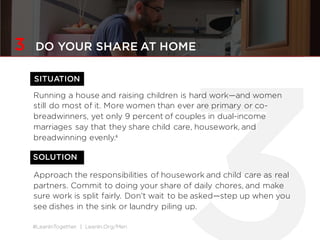
3 DO YOUR SHARE AT HOME
Running a house and raising children is hard work—and women
still do most of it. More women than ever are primary or co-
breadwinners, yet only 9 percent of couples in dual-income
marriages say that they share child care, housework, and
breadwinning evenly.6
Approach the responsibilities of housework and child care as real
partners. Commit to doing your share of daily chores, and make
sure work is split fairly. Don’t wait to be asked—step up when you
see dishes in the sink or laundry piling up.
SOLUTION
SITUATION
#LeanInTogether | LeanIn.Org/Men#LeanInTogether | LeanIn.Org/Men
Women are four times less
likely than men to
negotiate.7
#LeanInTogether | LeanIn.Org/Men
4 ENCOURAGE YOUR PARTNER TO LEAN IN
SITUATION
Women negotiate less frequently and ask for a third less money when
they do.8
As a result, women often miss out on opportunities and
income. There is a good chance these dynamics impede your wife’s
career advancement and your income as a couple.
Encourage your partner to apply for stretch opportunities and
commit to do your fair share at home. When it’s time to negotiate her
compensation, encourage her to go for it and role play the
conversation.
SOLUTION
#LeanInTogether | LeanIn.Org/Men
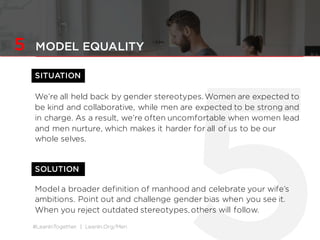
5 MODEL EQUALITY
SITUATION
We’re all held back by gender stereotypes. Women are expected to
be kind and collaborative, while men are expected to be strong and
in charge. As a result, we’re often uncomfortable when women lead
and men nurture, which makes it harder for all of us to be our
whole selves.
Model a broader definition of manhood and celebrate your wife’s
ambitions. Point out and challenge gender bias when you see it.
When you reject outdated stereotypes, others will follow.
SOLUTION
#LeanInTogether | LeanIn.Org/Men
When men lean in for equality, they win—and so does everyone else.
Men have an important role to play in reaching equality, and
everyone benefits when they do. Children with involved fathers are
happier, healthier, and more successful. Couples who share
responsibilities have stronger marriages. Diverse teams and
companies produce better results.
Leaning in is not just the right thing to do—it’s the smart thing to do.
Learn more at leanin.org/men
PROUD TO
#LEANINTOGETHER
#LeanInTogether | LeanIn.Org/Men
ENDNOTES
1 For a review of research see, ThomasA. Ledermann et al., “Stress, Communication,and Marital Qualityin Couples,”
FamilyRelations59 (2010): 195-206.
2 Kira S. Birdittet al., “Marital ConflictBehaviorsand ImplicationsforDivorceover16 Years,” Journal of Marriageand
the Family72.5 (2010): 1188–1204,PMC, Web, http://www.ncbi.nlm.nih.gov/pmc/articles/PMC3777640/.
3 LynneP. Cook, “‘Doing’ Genderin Context: Household Bargaining and theRisk of Divorcein Germanyand the
United States,” American Journal of Sociology 112, no. 2(2006): 442–72; DanielT. Carlson etal., “TheGendered
Division of Housework and Couples’ Sexual Relationships: A Re-examination,”Sociology Faculty Publications, Paper
2, 2014; ConstanceT. Gager and Scott T. Yabiku, “Who HastheTime? TheRelationship Between Household Labor
Time and Sexual Frequency,” Journal of Family Issues31, no. 2(2010): 135–63;Neil Chethik, VoiceMale: What
HusbandsReally Think AboutTheirMarriages, TheirWives, Sex, Housework, and Commitment (NewYork: Simon &
Schuster, 2006); and K. V. Rao and Alfred DeMaris, “Coital FrequencyAmong Married and Cohabitating Couplesin
the United States,” Journal of Biosocial Science27, no. 2(1995): 135–50.
4 KimberlyA. Shauman and MaryC. Noonan, "FamilyMigration and LaborOutcomes: Sex Differencesin Occupational
Context," Social Forces Vol. 85, No. 4 (June2007), 1735-176; RobinJ. Elyet al., “Rethink WhatYou KnowAbout
High-Achieving Women,”TheHarvard BusinessReview, December 2014, https://hbr.org/2014/12/rethink-what-you-
know-about-high-achieving-women.
#LeanInTogether | LeanIn.Org/Men
5. LeanIn.Org and McKinsey& Company, Women in theWorkplace 2015 (September2015),
http://womenintheworkplace.com/ui/pdfs/Women_in_the_Workplace_2015.pdf?v=5; Elyetal., “Rethink What
You KnowAboutHigh-Achieving Women”; Pamela Stone, Opting Out? WhyWomen ReallyQuitCareers and Head
Home.
6. Sarah JaneGlynn, TheNewBreadwinners: 2010 Update, Centerfor American Progress (April 2012), 2; and Scott S.
Hall and ShelleyM. MacDermid, "A Typologyof Dual EarnerMarriagesBased on Work and FamilyArrangements,"
Journal of Familyand Economic Issues 30, no. 3 (2009): 220.
7. Research cited by Katty Kay and Claire Shipman, “TheConfidenceGap,” Atlantic, May2014,
http://www.theatlantic.com/features/archive/2014/04/the-confidence-gap/359815/. Seealso Lydia Frank, “How
the GenderPay Gap Widensas Women Get Promoted,” Harvard BusinessReview, November 5, 2015,
https://hbr.org/2015/11/how-the-gender-pay-gap-widens-as-women-get-promoted.
8. Kay and Shipman, “TheConfidenceGap,”; and Frank, “HowtheGenderPayGap Widensas Women Get
Promoted.”
ENDNOTES

#LeanInTogether: How to Be a 50/50 Partner

  • 1.
    #LeanInTogether | LeanIn.Org/Men #LeanInTogether TIPSFOR MEN: HOW TO BE A 50/50 PARTNER Get the complete tips at leanin.org/tips/50-50 BraunS / Getty Images
  • 2.
    #LeanInTogether | LeanIn.Org/Men Womenstill do a majority of housework and child care, and in many cases husbands’ careers get prioritized. Approach your relationship as a true partner. Couples who share responsibilities have stronger marriages—and their children benefit from seeing their parents model equality. TIPS FOR MEN: HOW TO BE A 50/50 PARTNER
  • 3.
    #LeanInTogether | LeanIn.Org/Men 1SITUATION Communicationis critical in relationships.1 Marriages are stronger when both partners talk through disagreements calmly and listen to each other’s perspectives, and this is particularly important when you’re managing a home or raising children together.2 Discuss your goals for your home and career with your partner. Listen carefully to what she wants and be vocal about your own needs. Talk through unresolved issues and review your to-do lists and calendars together. 1 COMMUNICATE OPENLY SOLUTION
  • 4.
    #LeanInTogether | LeanIn.Org/Men#LeanInTogether| LeanIn.Org/Men Couples are more likely to relocate for the husband’s career.3
  • 5.
    #LeanInTogether | LeanIn.Org/Men 2MAKE DECISIONS AS A TEAM SITUATION Many women make professional sacrifices to support their partner’s career, and men still assume their partner will do the lion’s share of child care.4 In addition, couples often prioritize the husband’s career when they make household decisions.5 Over time, these trends can lead to missed opportunities for you as a couple. SOLUTION Make decisions as a team. It’s not about finding the perfect compromise with each decision; it’s about achieving a healthy balance over time.
  • 6.
    #LeanInTogether | LeanIn.Org/Men#LeanInTogether| LeanIn.Org/Men When men share household responsibilities, their marriages are stronger.
  • 7.
    #LeanInTogether | LeanIn.Org/Men 3DO YOUR SHARE AT HOME Running a house and raising children is hard work—and women still do most of it. More women than ever are primary or co- breadwinners, yet only 9 percent of couples in dual-income marriages say that they share child care, housework, and breadwinning evenly.6 Approach the responsibilities of housework and child care as real partners. Commit to doing your share of daily chores, and make sure work is split fairly. Don’t wait to be asked—step up when you see dishes in the sink or laundry piling up. SOLUTION SITUATION
  • 8.
    #LeanInTogether | LeanIn.Org/Men#LeanInTogether| LeanIn.Org/Men Women are four times less likely than men to negotiate.7
  • 9.
    #LeanInTogether | LeanIn.Org/Men 4ENCOURAGE YOUR PARTNER TO LEAN IN SITUATION Women negotiate less frequently and ask for a third less money when they do.8 As a result, women often miss out on opportunities and income. There is a good chance these dynamics impede your wife’s career advancement and your income as a couple. Encourage your partner to apply for stretch opportunities and commit to do your fair share at home. When it’s time to negotiate her compensation, encourage her to go for it and role play the conversation. SOLUTION
  • 10.
    #LeanInTogether | LeanIn.Org/Men 5MODEL EQUALITY SITUATION We’re all held back by gender stereotypes. Women are expected to be kind and collaborative, while men are expected to be strong and in charge. As a result, we’re often uncomfortable when women lead and men nurture, which makes it harder for all of us to be our whole selves. Model a broader definition of manhood and celebrate your wife’s ambitions. Point out and challenge gender bias when you see it. When you reject outdated stereotypes, others will follow. SOLUTION
  • 11.
    #LeanInTogether | LeanIn.Org/Men Whenmen lean in for equality, they win—and so does everyone else. Men have an important role to play in reaching equality, and everyone benefits when they do. Children with involved fathers are happier, healthier, and more successful. Couples who share responsibilities have stronger marriages. Diverse teams and companies produce better results. Leaning in is not just the right thing to do—it’s the smart thing to do. Learn more at leanin.org/men PROUD TO #LEANINTOGETHER
  • 12.
    #LeanInTogether | LeanIn.Org/Men ENDNOTES 1For a review of research see, ThomasA. Ledermann et al., “Stress, Communication,and Marital Qualityin Couples,” FamilyRelations59 (2010): 195-206. 2 Kira S. Birdittet al., “Marital ConflictBehaviorsand ImplicationsforDivorceover16 Years,” Journal of Marriageand the Family72.5 (2010): 1188–1204,PMC, Web, http://www.ncbi.nlm.nih.gov/pmc/articles/PMC3777640/. 3 LynneP. Cook, “‘Doing’ Genderin Context: Household Bargaining and theRisk of Divorcein Germanyand the United States,” American Journal of Sociology 112, no. 2(2006): 442–72; DanielT. Carlson etal., “TheGendered Division of Housework and Couples’ Sexual Relationships: A Re-examination,”Sociology Faculty Publications, Paper 2, 2014; ConstanceT. Gager and Scott T. Yabiku, “Who HastheTime? TheRelationship Between Household Labor Time and Sexual Frequency,” Journal of Family Issues31, no. 2(2010): 135–63;Neil Chethik, VoiceMale: What HusbandsReally Think AboutTheirMarriages, TheirWives, Sex, Housework, and Commitment (NewYork: Simon & Schuster, 2006); and K. V. Rao and Alfred DeMaris, “Coital FrequencyAmong Married and Cohabitating Couplesin the United States,” Journal of Biosocial Science27, no. 2(1995): 135–50. 4 KimberlyA. Shauman and MaryC. Noonan, "FamilyMigration and LaborOutcomes: Sex Differencesin Occupational Context," Social Forces Vol. 85, No. 4 (June2007), 1735-176; RobinJ. Elyet al., “Rethink WhatYou KnowAbout High-Achieving Women,”TheHarvard BusinessReview, December 2014, https://hbr.org/2014/12/rethink-what-you- know-about-high-achieving-women.
  • 13.
    #LeanInTogether | LeanIn.Org/Men 5.LeanIn.Org and McKinsey& Company, Women in theWorkplace 2015 (September2015), http://womenintheworkplace.com/ui/pdfs/Women_in_the_Workplace_2015.pdf?v=5; Elyetal., “Rethink What You KnowAboutHigh-Achieving Women”; Pamela Stone, Opting Out? WhyWomen ReallyQuitCareers and Head Home. 6. Sarah JaneGlynn, TheNewBreadwinners: 2010 Update, Centerfor American Progress (April 2012), 2; and Scott S. Hall and ShelleyM. MacDermid, "A Typologyof Dual EarnerMarriagesBased on Work and FamilyArrangements," Journal of Familyand Economic Issues 30, no. 3 (2009): 220. 7. Research cited by Katty Kay and Claire Shipman, “TheConfidenceGap,” Atlantic, May2014, http://www.theatlantic.com/features/archive/2014/04/the-confidence-gap/359815/. Seealso Lydia Frank, “How the GenderPay Gap Widensas Women Get Promoted,” Harvard BusinessReview, November 5, 2015, https://hbr.org/2015/11/how-the-gender-pay-gap-widens-as-women-get-promoted. 8. Kay and Shipman, “TheConfidenceGap,”; and Frank, “HowtheGenderPayGap Widensas Women Get Promoted.” ENDNOTES