6 σ  & Kaizen
KAIZEN
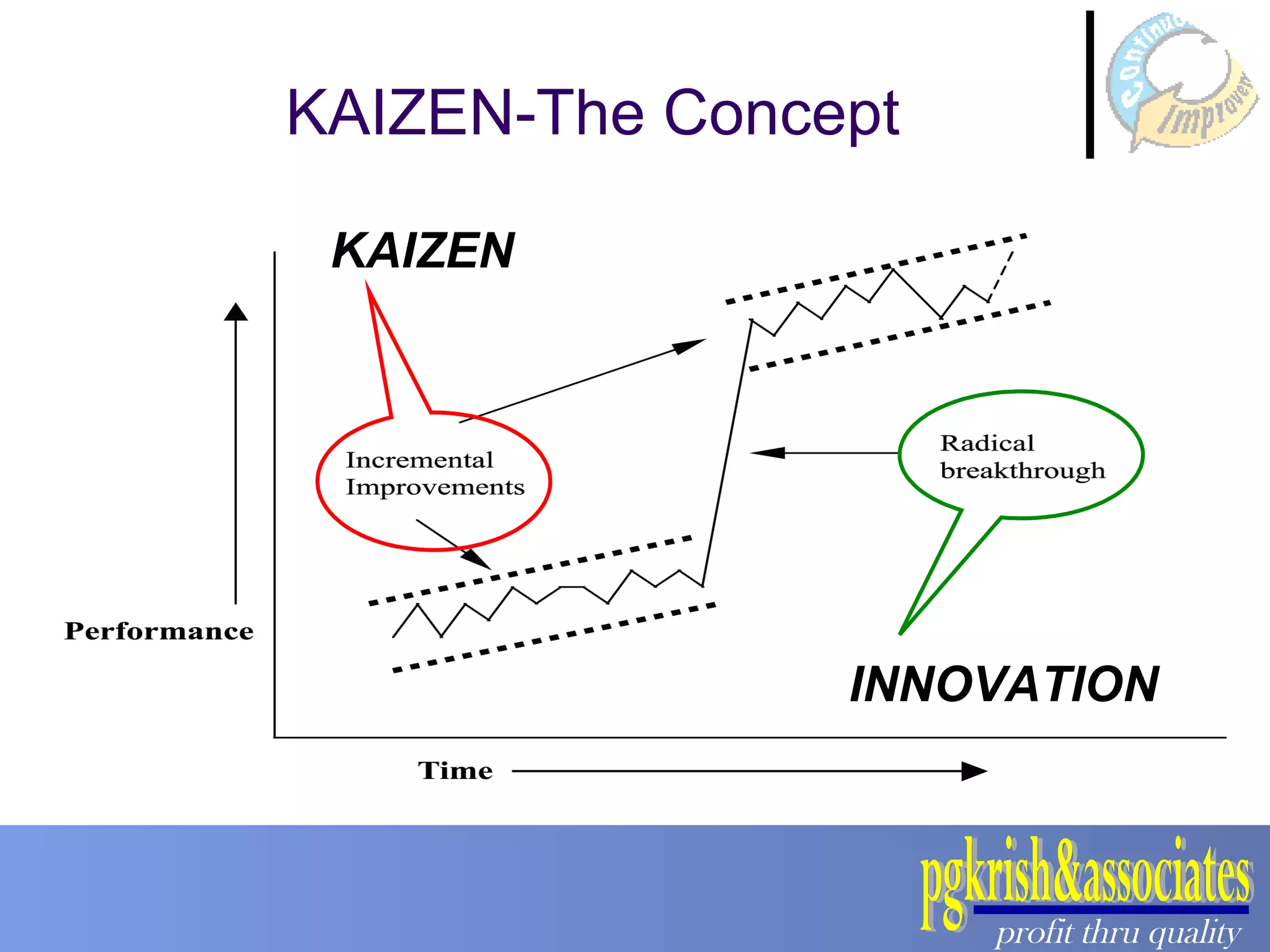
KAIZEN-The Concept Kaizen….means improvement Ongoing improvement Involves everyone Both Managers & Workers Kaizen Philosophy Our way of life need to be constantly improved Working life, social life, home life Kaizen embodies Productivity Improvement Total Quality Culture QC Circles Zero Defects … ..etc.
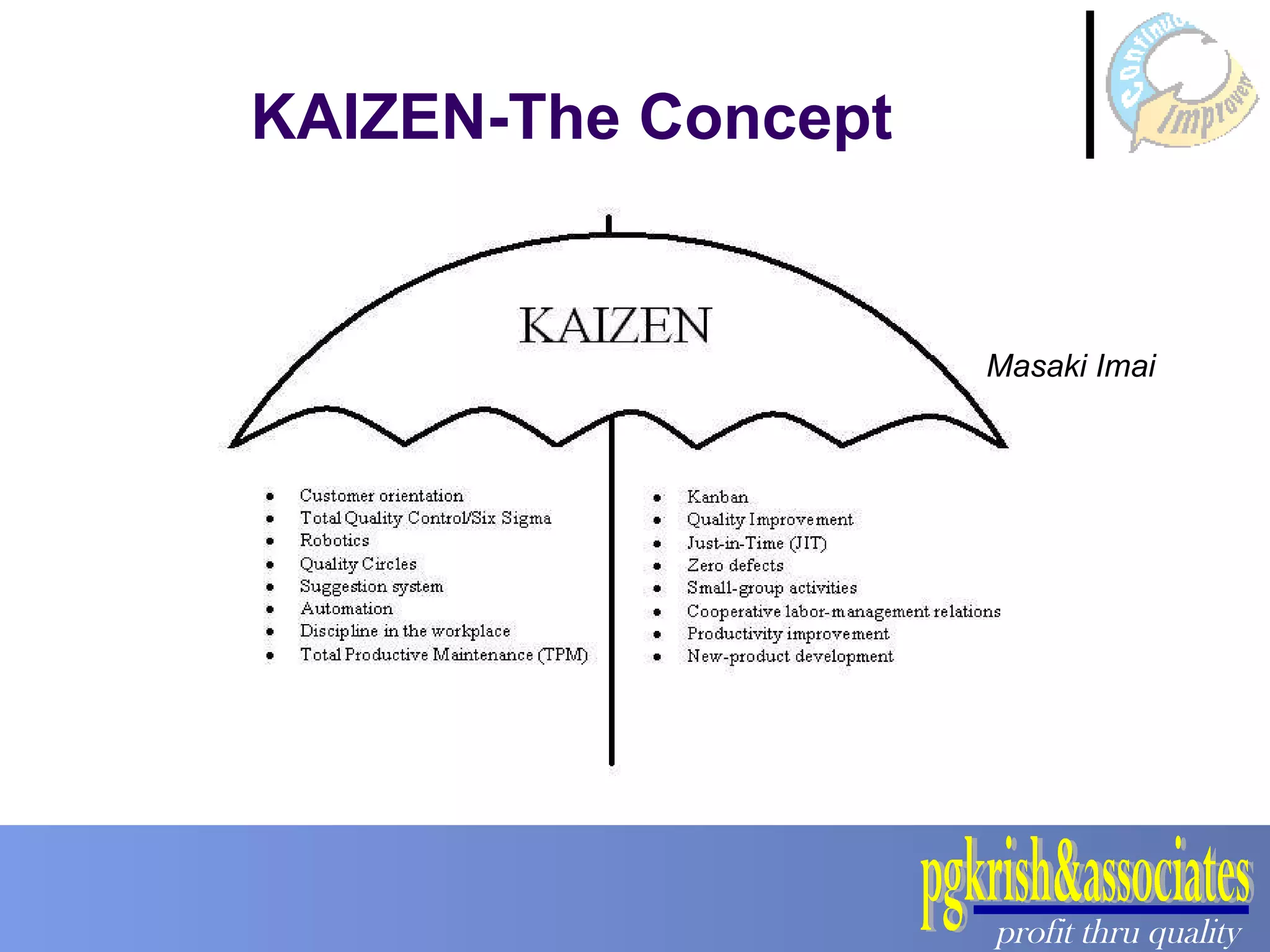
KAIZEN-The Concept Masaki Imai
KAIZEN-The Concept
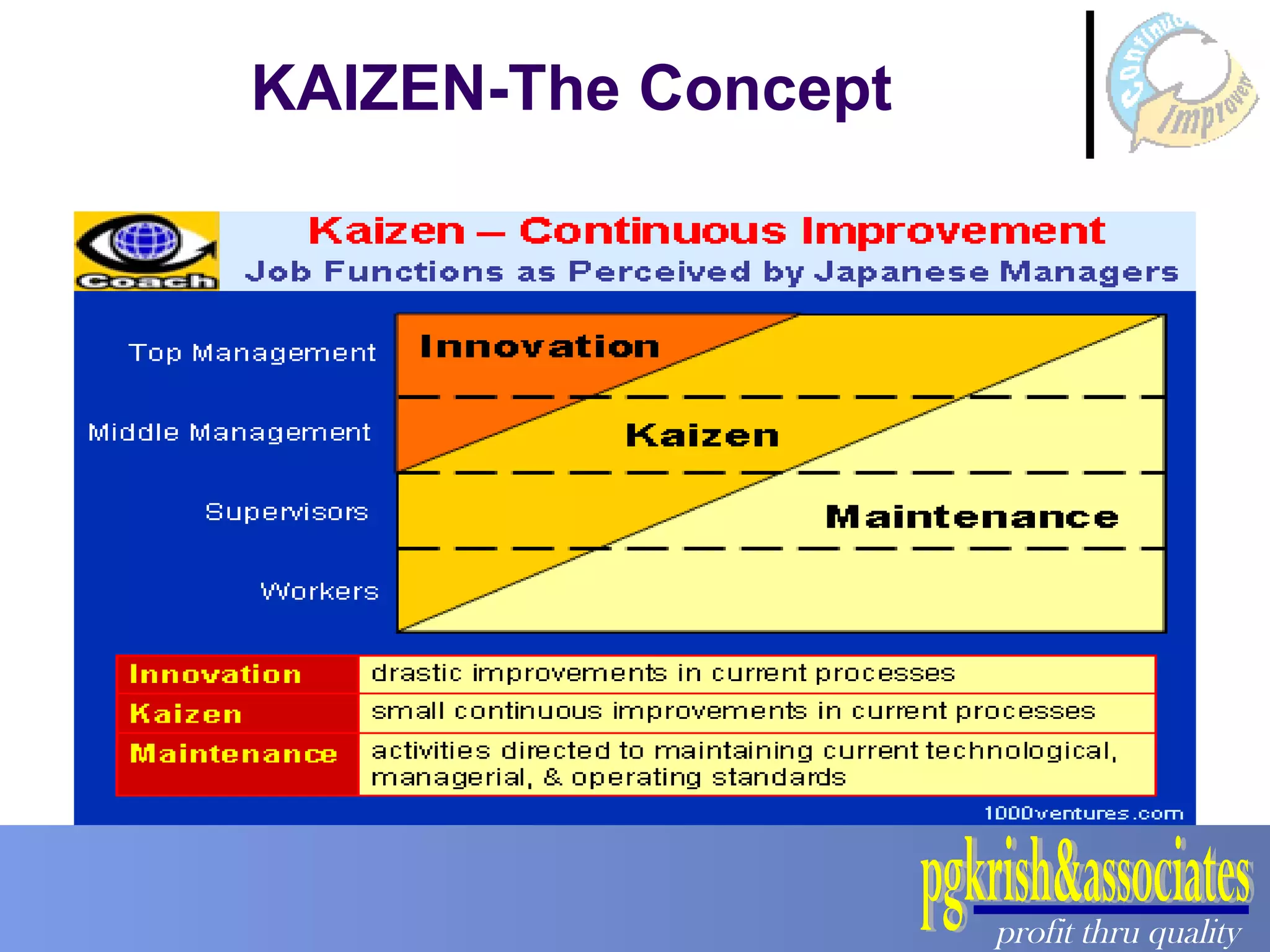
KAIZEN INNOVATION KAIZEN-The Concept
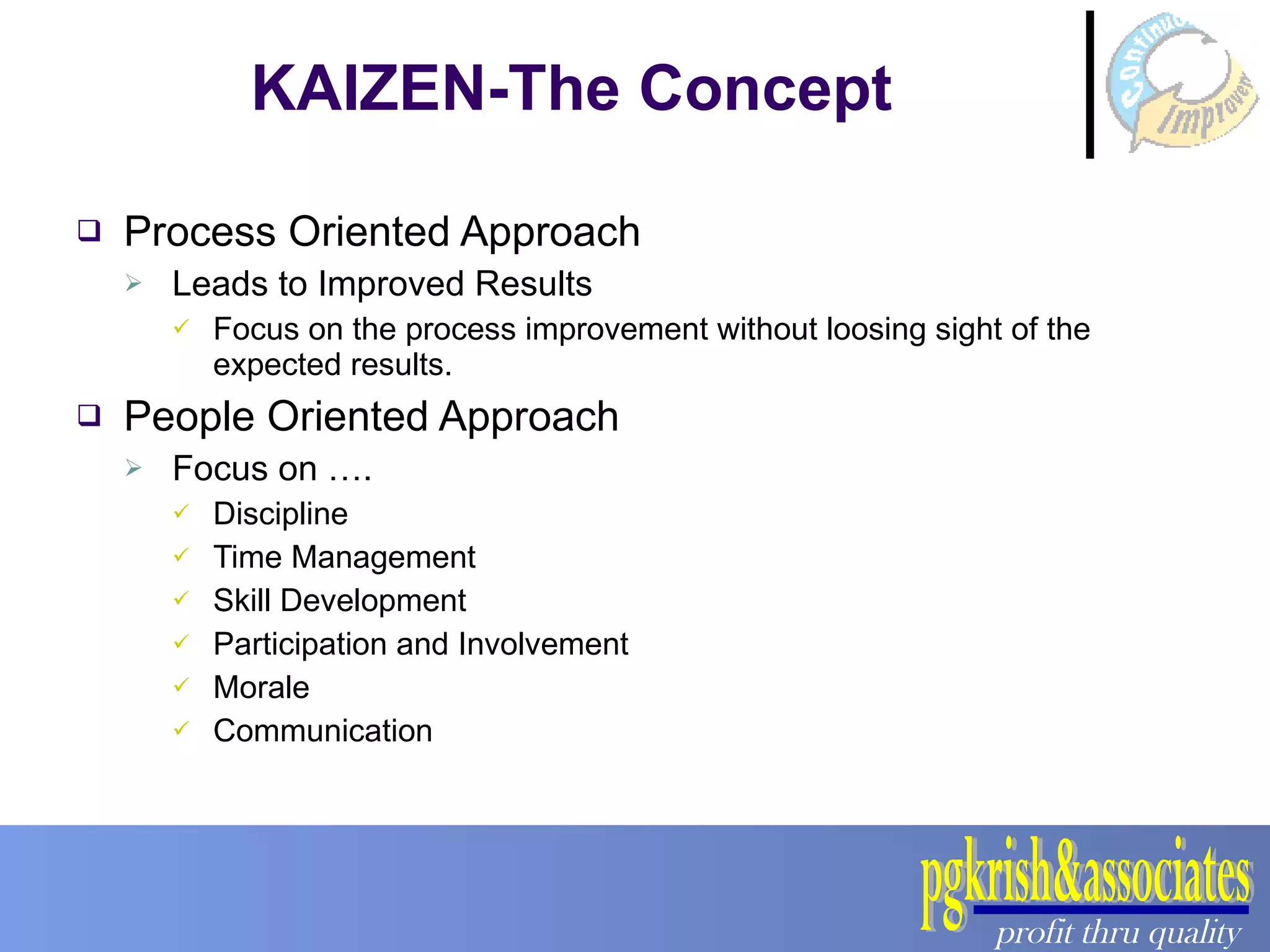
Process Oriented Approach Leads to Improved Results Focus on the process improvement without loosing sight of the expected results. People Oriented Approach Focus on …. Discipline Time Management Skill Development Participation and Involvement Morale Communication KAIZEN-The Concept
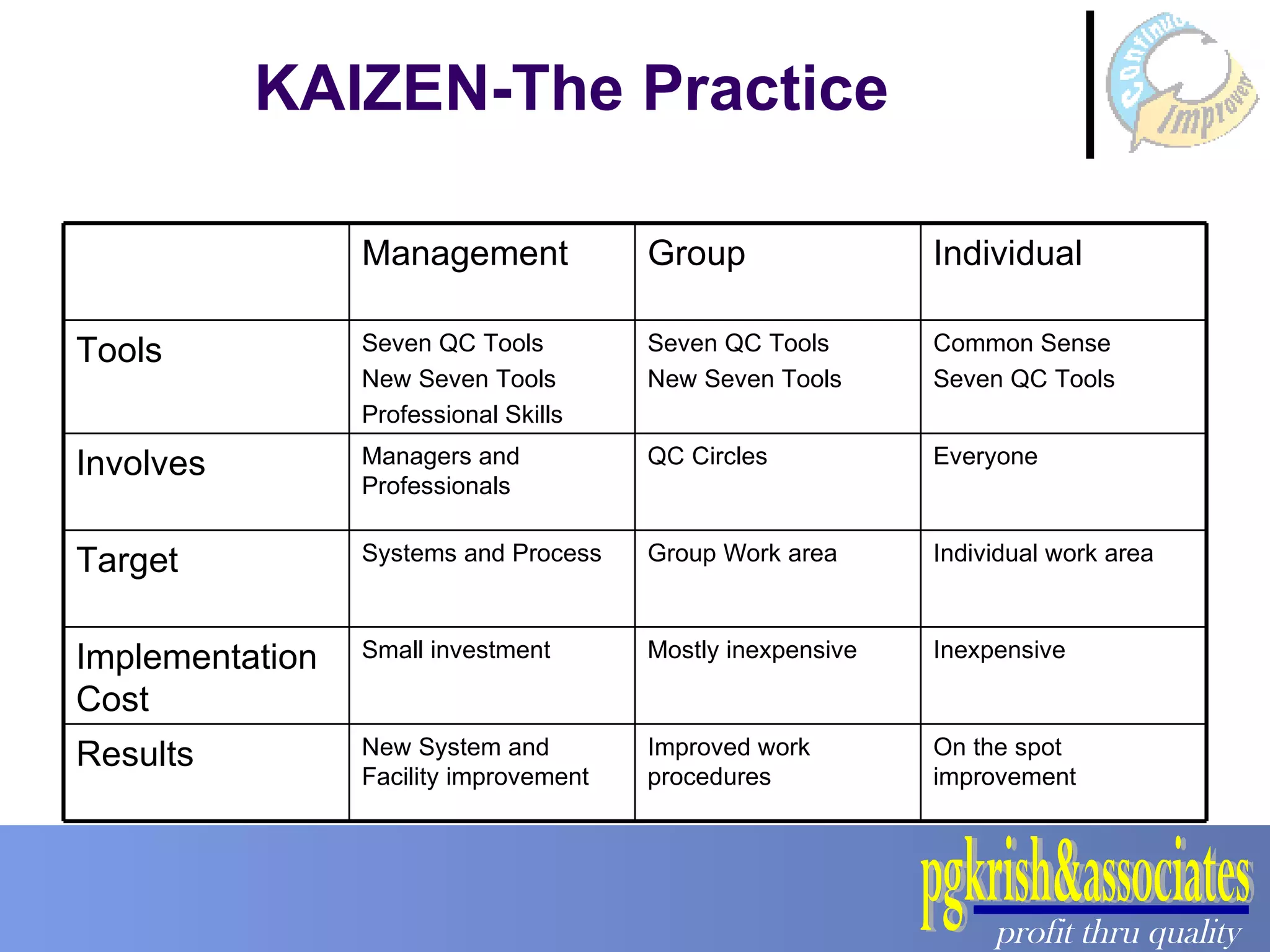
KAIZEN-The Practice On the spot improvement Improved work procedures New System and Facility improvement Results Inexpensive Mostly inexpensive Small investment Implementation Cost Individual work area Group Work area Systems and Process Target Everyone QC Circles Managers and Professionals Involves Common Sense Seven QC Tools Seven QC Tools New Seven Tools Seven QC Tools New Seven Tools Professional Skills Tools Individual Group Management
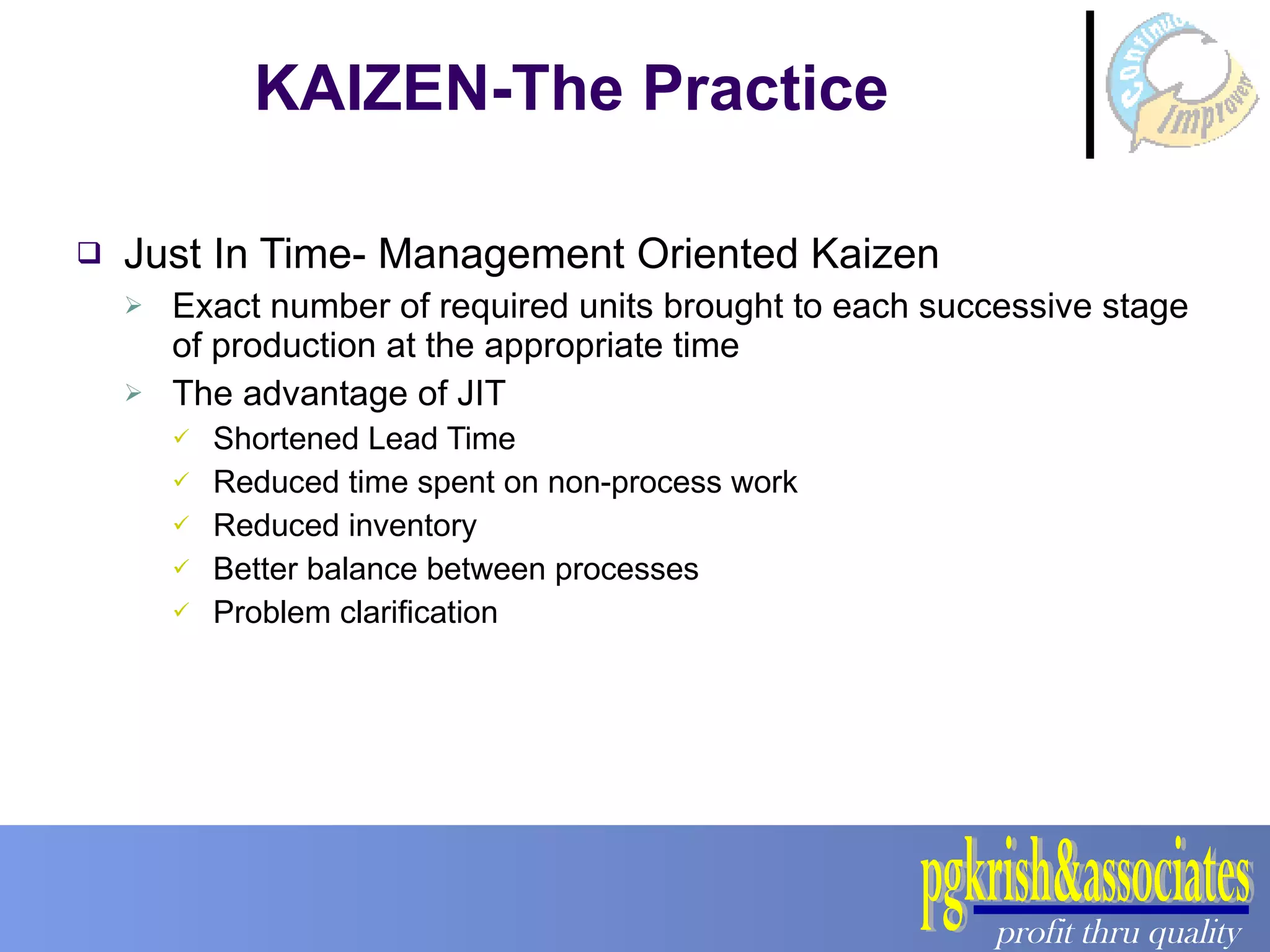
Just In Time- Management Oriented Kaizen Exact number of required units brought to each successive stage of production at the appropriate time The advantage of JIT Shortened Lead Time Reduced time spent on non-process work Reduced inventory Better balance between processes Problem clarification KAIZEN-The Practice
Group Oriented Kaizen- SMALL GROUP ACTIVTIES Informal, voluntary small groups, organized within the company Carry out specific improvement activities Many forms:- QC circles, Suggestion Groups, Workers group……… QC Circles…the most famous Emphasis on problem solving in the work area Advantages of QCC Sense of teamwork Improved communication Improved morale Acquire new skills Labor-Management relationship improved KAIZEN-The Practice
Individual Oriented Kaizen- SUGGESTION SYSTEM Individual provides suggestion on how to improve his work area. Helps the individual to be Kaizen conscious. Also helps in…. Workers to speak out. Opportunity for management to help workers. An valuable  opportunity for two way communication Suggestions normally covers:- Savings in energy, material and other resources Improvement in working environment Improvements in machines, processes, jigs and tools Improvements in customer services KAIZEN-The Practice
KAIZEN- Implementation Seven Conditions for Successful Implementation of Kaizen Strategy Top management   commitment Top management commitment Top management commitment Setting up an organization  dedicated to promote Kaizen Appointing the best available personnel to manage the Kaizen process Conducting training and education Establishing a step-by-step process for Kaizen introduction.
KAIZEN &  INNOVATION
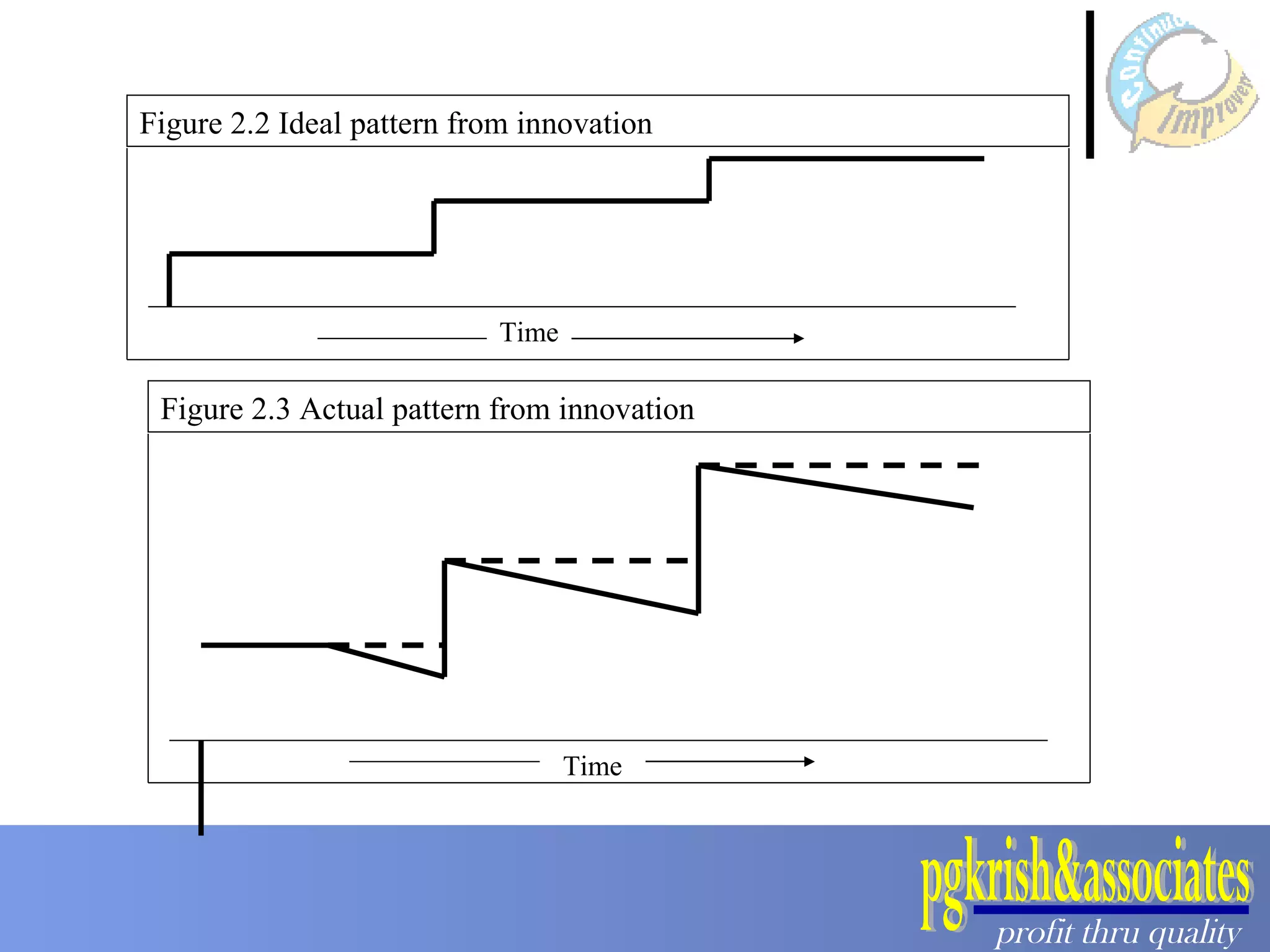
Time Figure 2.2 Ideal pattern from innovation Figure 2.3 Actual pattern from innovation Time
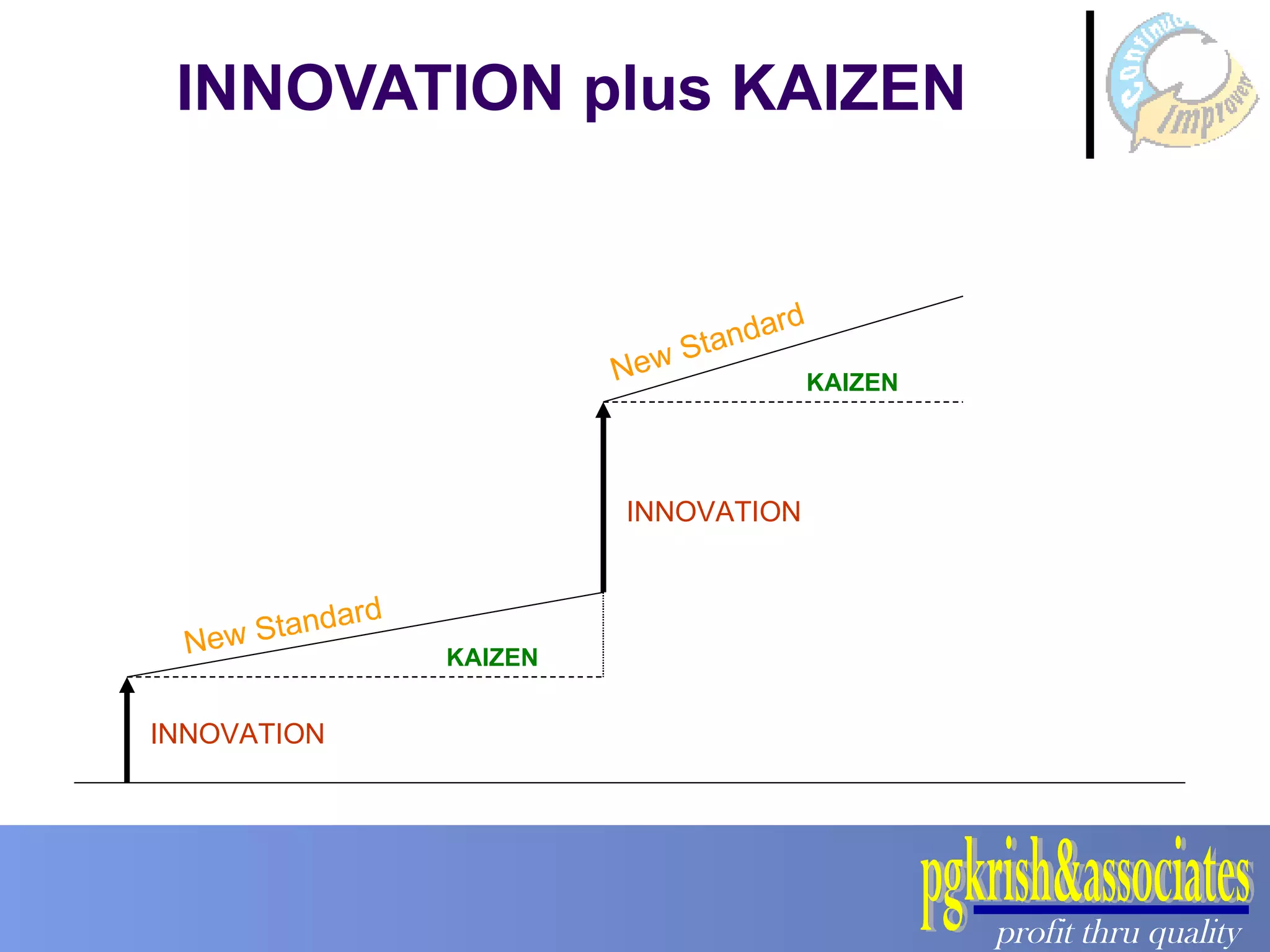
INNOVATION plus KAIZEN KAIZEN KAIZEN INNOVATION INNOVATION New Standard New Standard
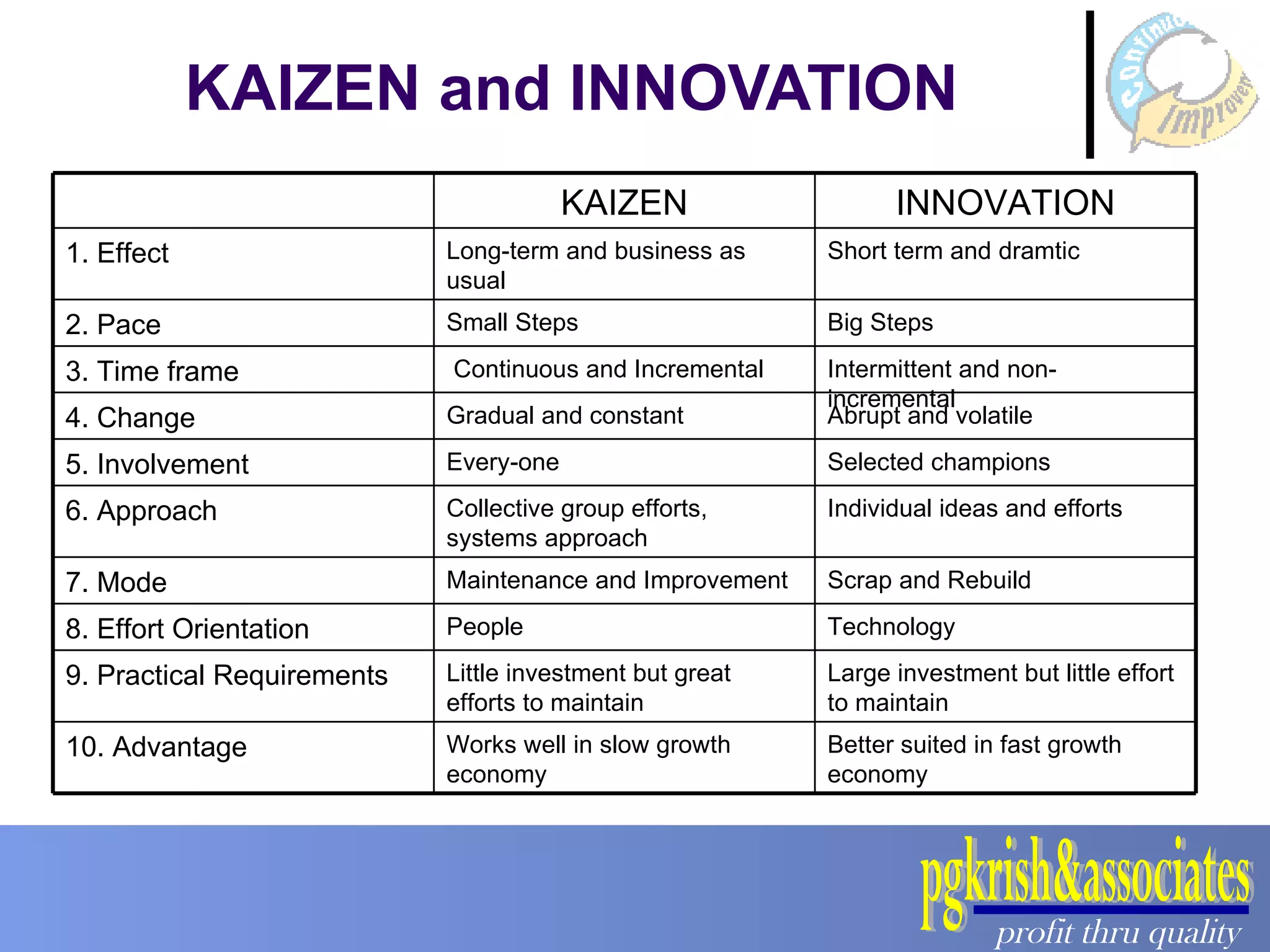
KAIZEN and INNOVATION Better suited in fast growth economy Works well in slow growth economy 10. Advantage Large investment but little effort to maintain Little investment but great efforts to maintain 9. Practical Requirements Technology People 8. Effort Orientation Scrap and Rebuild Maintenance and Improvement 7. Mode Individual ideas and efforts Collective group efforts, systems approach 6. Approach Selected champions Every-one 5. Involvement Abrupt and volatile Gradual and constant 4. Change Intermittent and non-incremental Continuous and Incremental 3. Time frame Big Steps Small Steps 2. Pace Short term and dramtic Long-term and business as usual 1. Effect INNOVATION KAIZEN
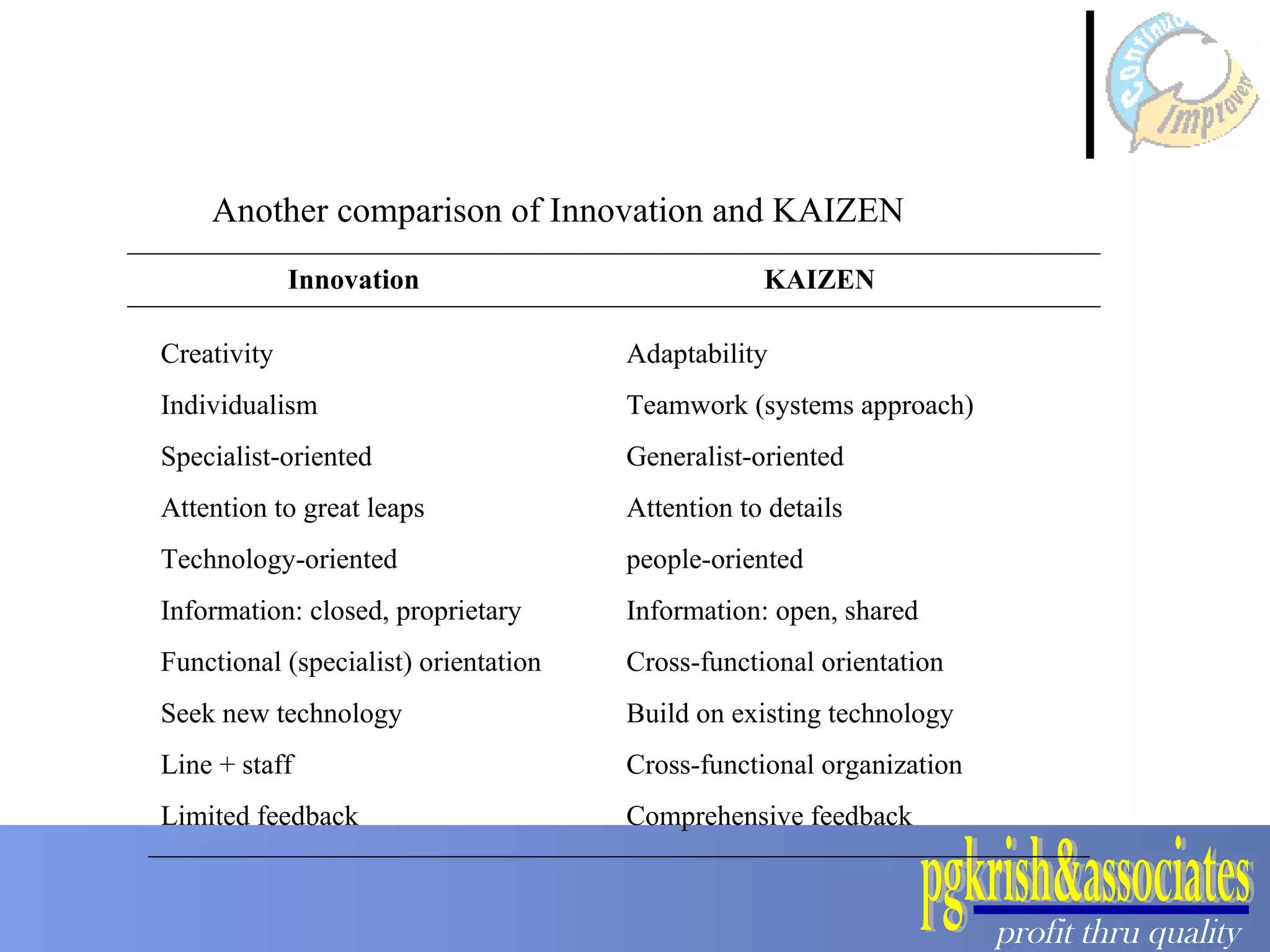
Another comparison of Innovation and KAIZEN Innovation KAIZEN Creativity Individualism Specialist-oriented Attention to great leaps Technology-oriented Information: closed, proprietary Functional (specialist) orientation Seek new technology Line + staff Limited feedback Adaptability Teamwork (systems approach) Generalist-oriented Attention to details people-oriented Information: open, shared Cross-functional orientation Build on existing technology Cross-functional organization Comprehensive feedback
6 Sigma
Six Sigma Was Developed at Motorola in the 1980’s As a Method to Improve Process Quality.  It Was First Used to Improve Manufacturing Process Capability and Then Migrated to Business Processes Capability Companies That Have Deployed Six Sigma: Bank of America, Motorola, GE, IBM, Kodak and Many More The Basic Premise Is, All Processes Have Variation. Variation Is the Enemy. About Six Sigma
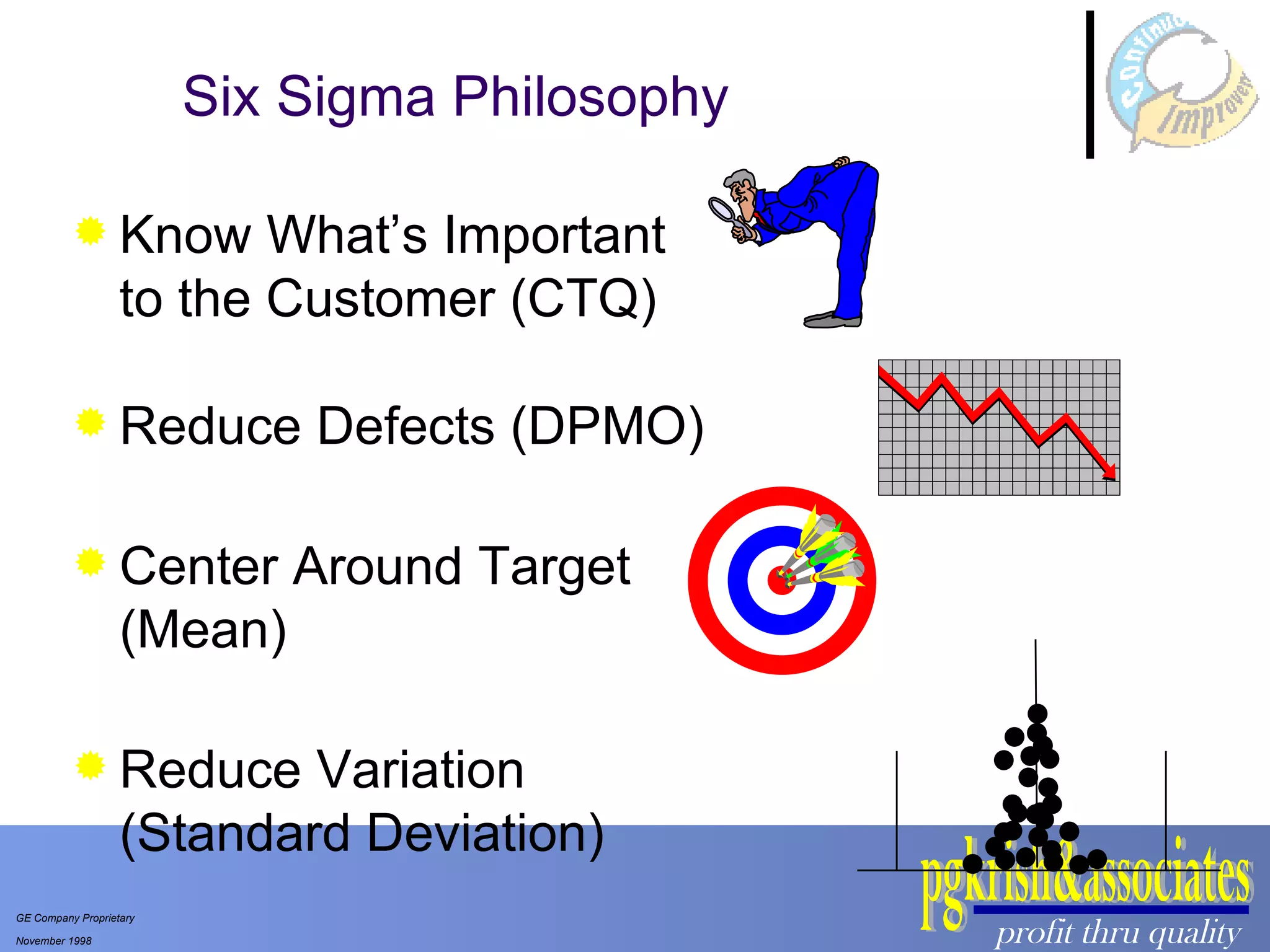
Six Sigma Philosophy Know What’s Important to the Customer (CTQ) Reduce Defects (DPMO) Center Around Target  (Mean) Reduce Variation (Standard Deviation) ? GE Company Proprietary November 1998
Business Definition A break through strategy to significantly improve customer satisfaction and shareholder value by reducing variability in every aspect of business . Technical Definition A statistical term signifying  3.4  defects per million opportunities. SIX SIGMA-Definitions
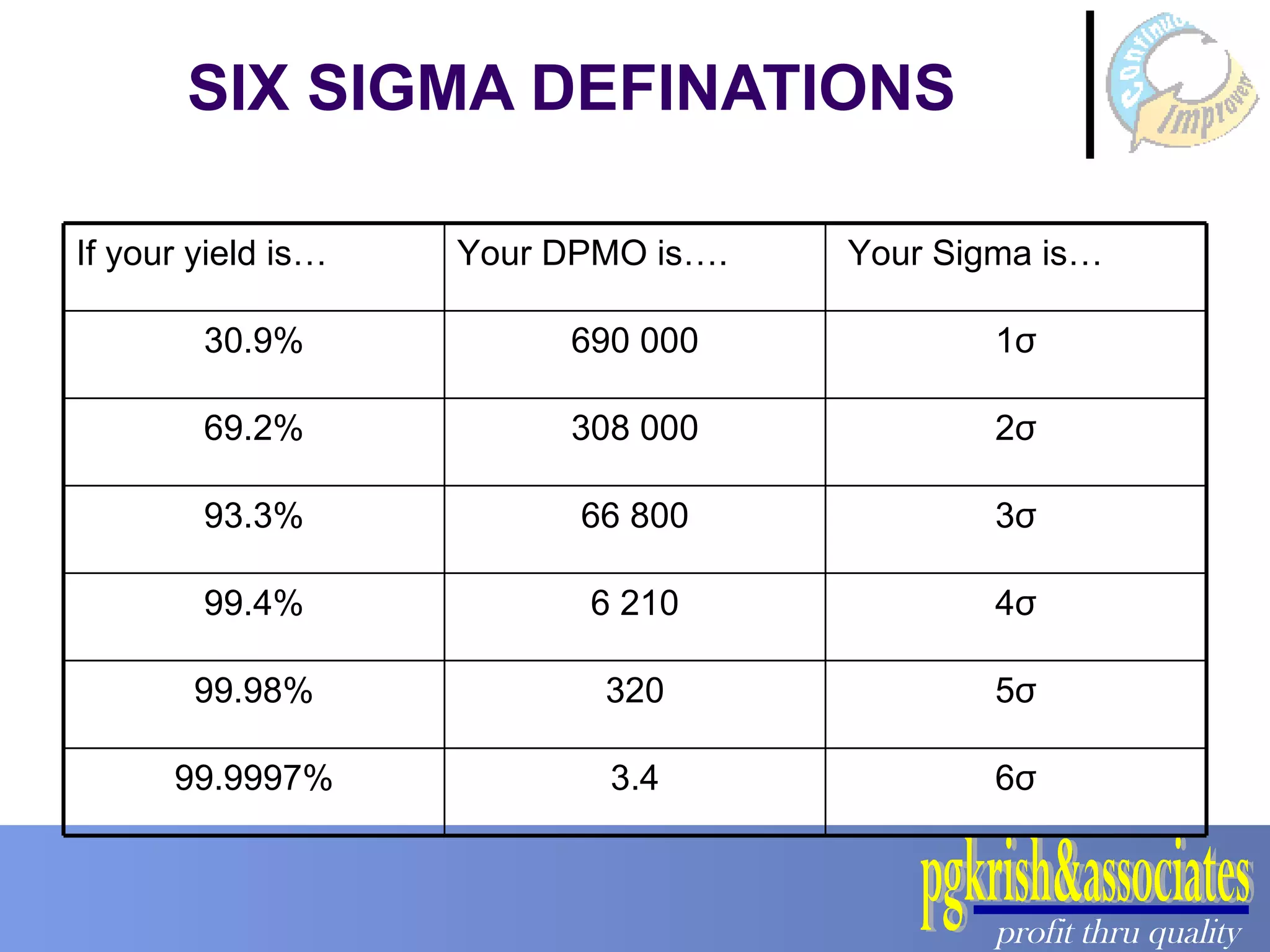
SIX SIGMA DEFINATIONS 6 σ 3.4 99.9997% 5 σ 320 99.98% 4 σ 6 210 99.4% 3 σ 66 800 93.3% 2 σ 308 000 69.2% 1 σ 690 000 30.9% Your Sigma is… Your DPMO is…. If your yield is…
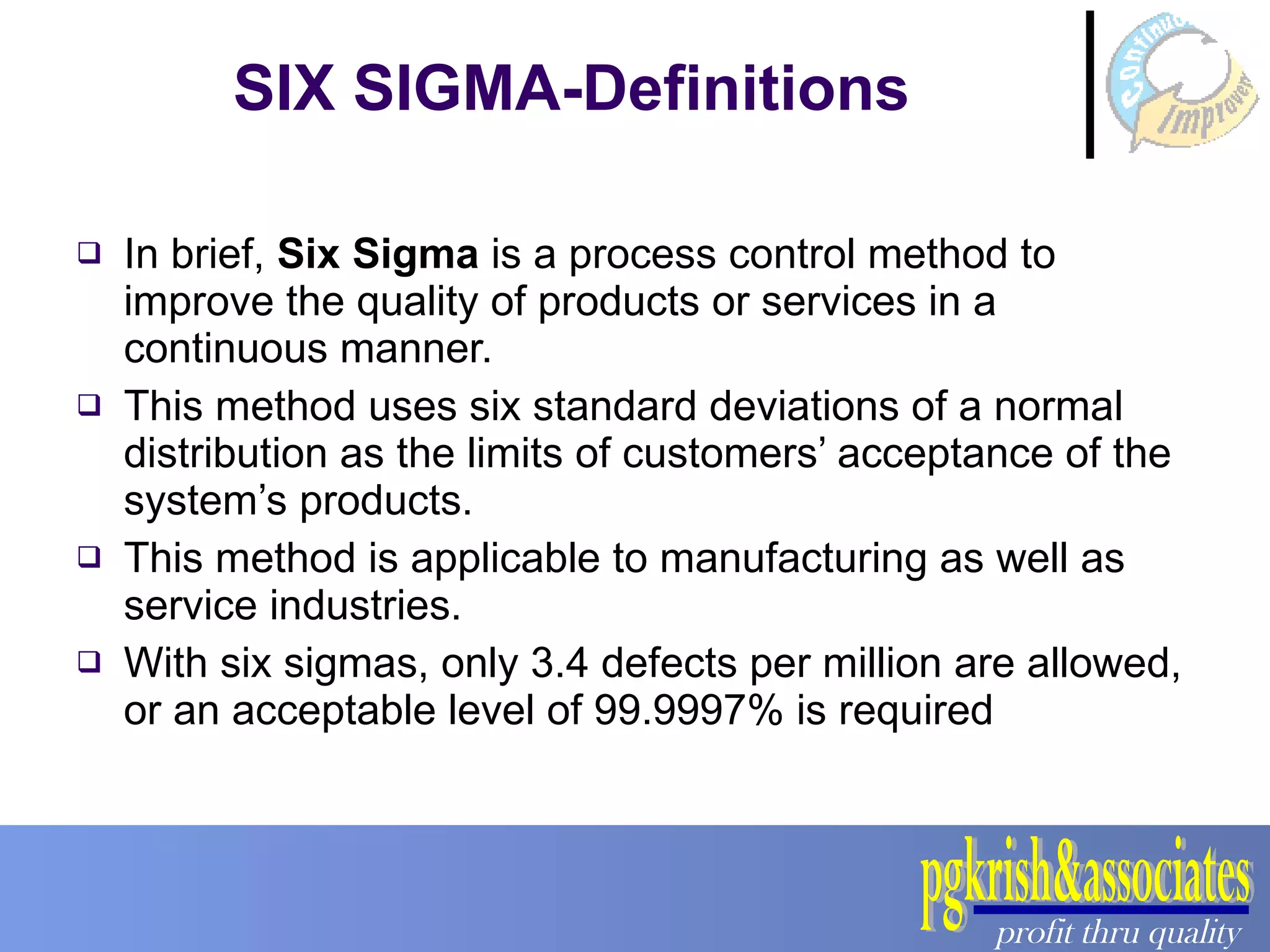
SIX SIGMA-Definitions In brief,  Six Sigma  is a process control method to improve the quality of products or services in a continuous manner.  This method uses six standard deviations of a normal distribution as the limits of customers’ acceptance of the system’s products. This method is applicable to manufacturing as well as service industries. With six sigmas, only 3.4 defects per million are allowed, or an acceptable level of 99.9997% is required
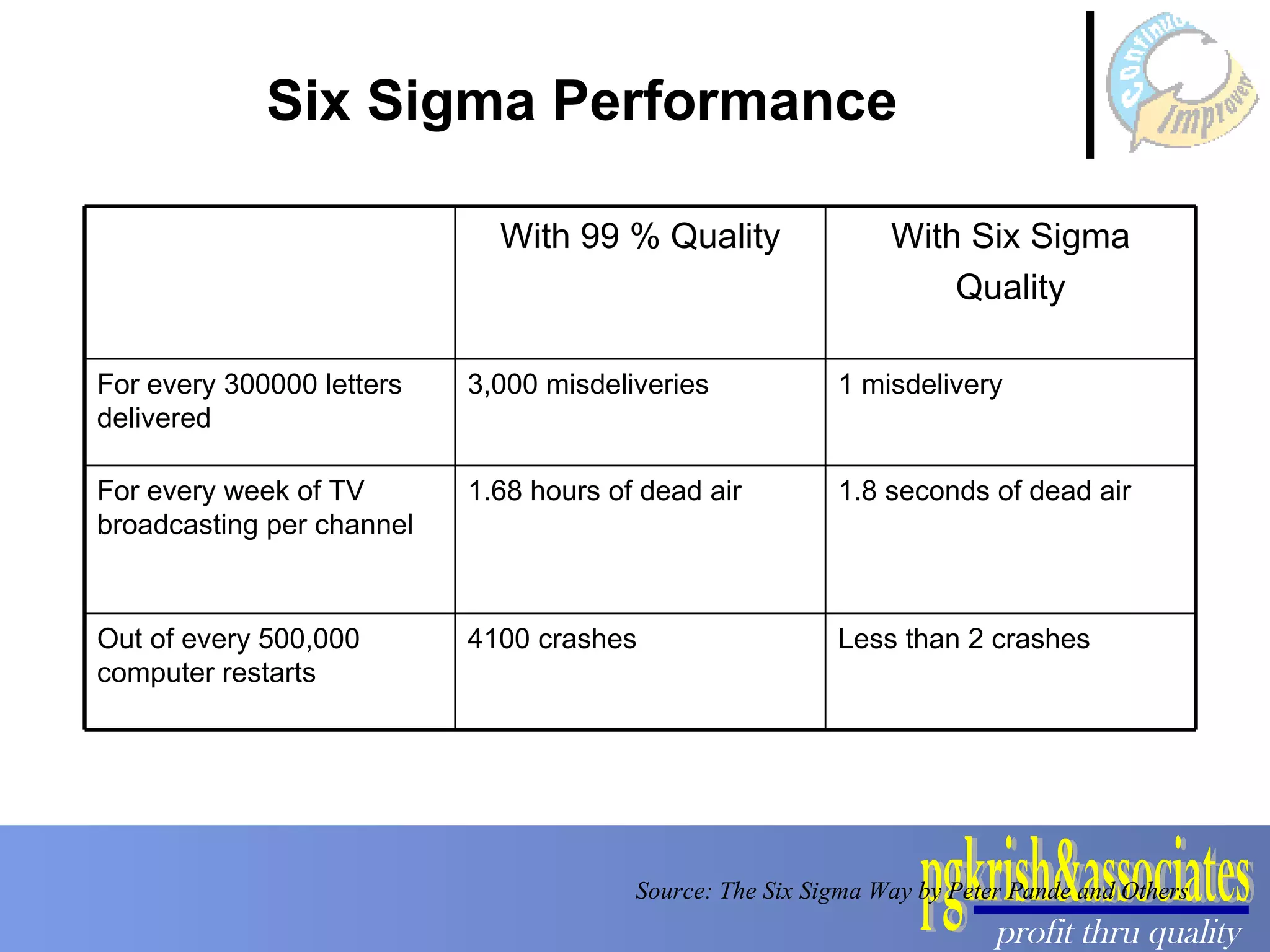
Six Sigma Performance Source: The Six Sigma Way by Peter Pande and Others Less than 2 crashes 4100 crashes Out of every 500,000 computer restarts 1.8 seconds of dead air 1.68 hours of dead air  For every week of TV broadcasting per channel 1 misdelivery 3,000 misdeliveries For every 300000 letters delivered With Six Sigma Quality With 99 % Quality
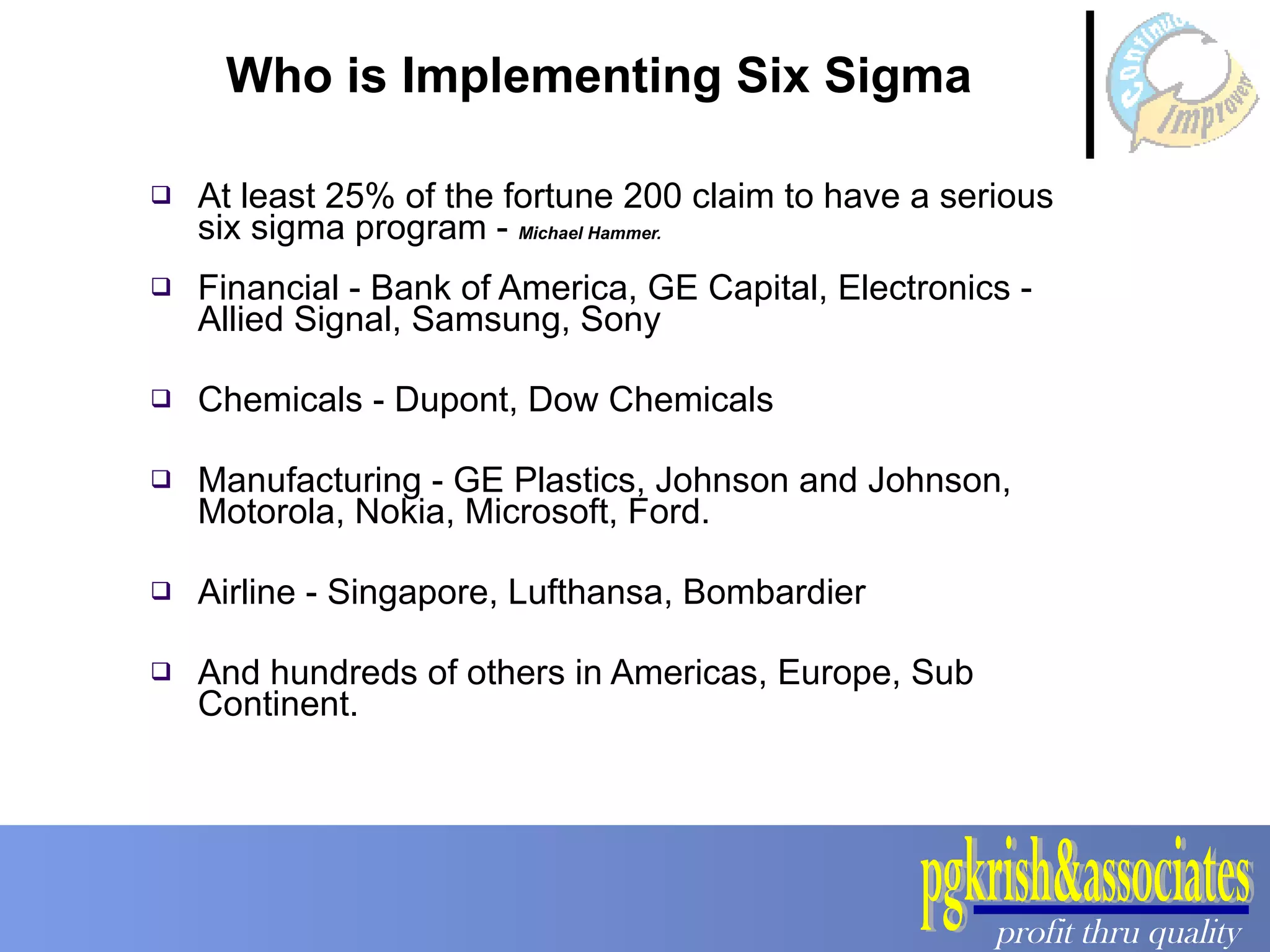
Who is Implementing Six Sigma At least 25% of the fortune 200 claim to have a serious six sigma program -  Michael Hammer.  Financial - Bank of America, GE Capital, Electronics - Allied Signal, Samsung, Sony Chemicals - Dupont, Dow Chemicals Manufacturing - GE Plastics, Johnson and Johnson, Motorola, Nokia, Microsoft, Ford. Airline - Singapore, Lufthansa, Bombardier And hundreds of others in Americas, Europe, Sub Continent.
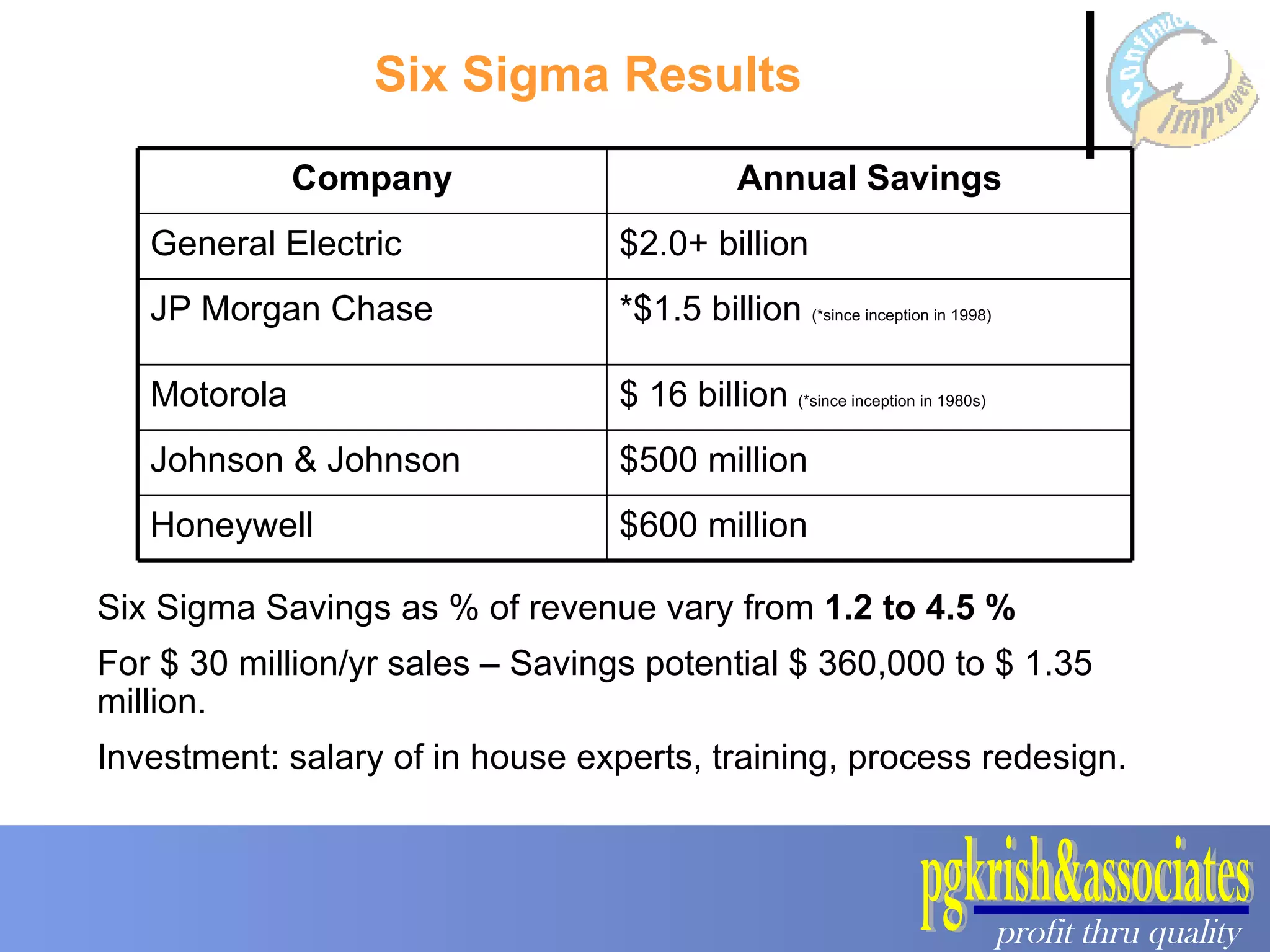
Six Sigma Results Six Sigma Savings as % of revenue vary from  1.2 to 4.5 % For $ 30 million/yr sales – Savings potential $ 360,000 to $ 1.35 million. Investment: salary of in house experts, training, process redesign. Annual Savings Company *$1.5 billion  (*since inception in 1998) JP Morgan Chase $600 million Honeywell  $500 million Johnson & Johnson $ 16 billion  (*since inception in 1980s) Motorola $2.0+ billion General Electric
Key Concepts of Six Sigma At its core, Six Sigma revolves around a few key concepts. Critical to Quality:  Attributes most important to the customer Defect:  Failing to deliver what the customer wants Process Capability:  What your process can deliver Variation:  What the customer sees and feels Stable Operations:  Ensuring consistent, predictable processes to improve what the customer sees and feels Design for Six Sigma:  Designing to meet customer needs and process capability
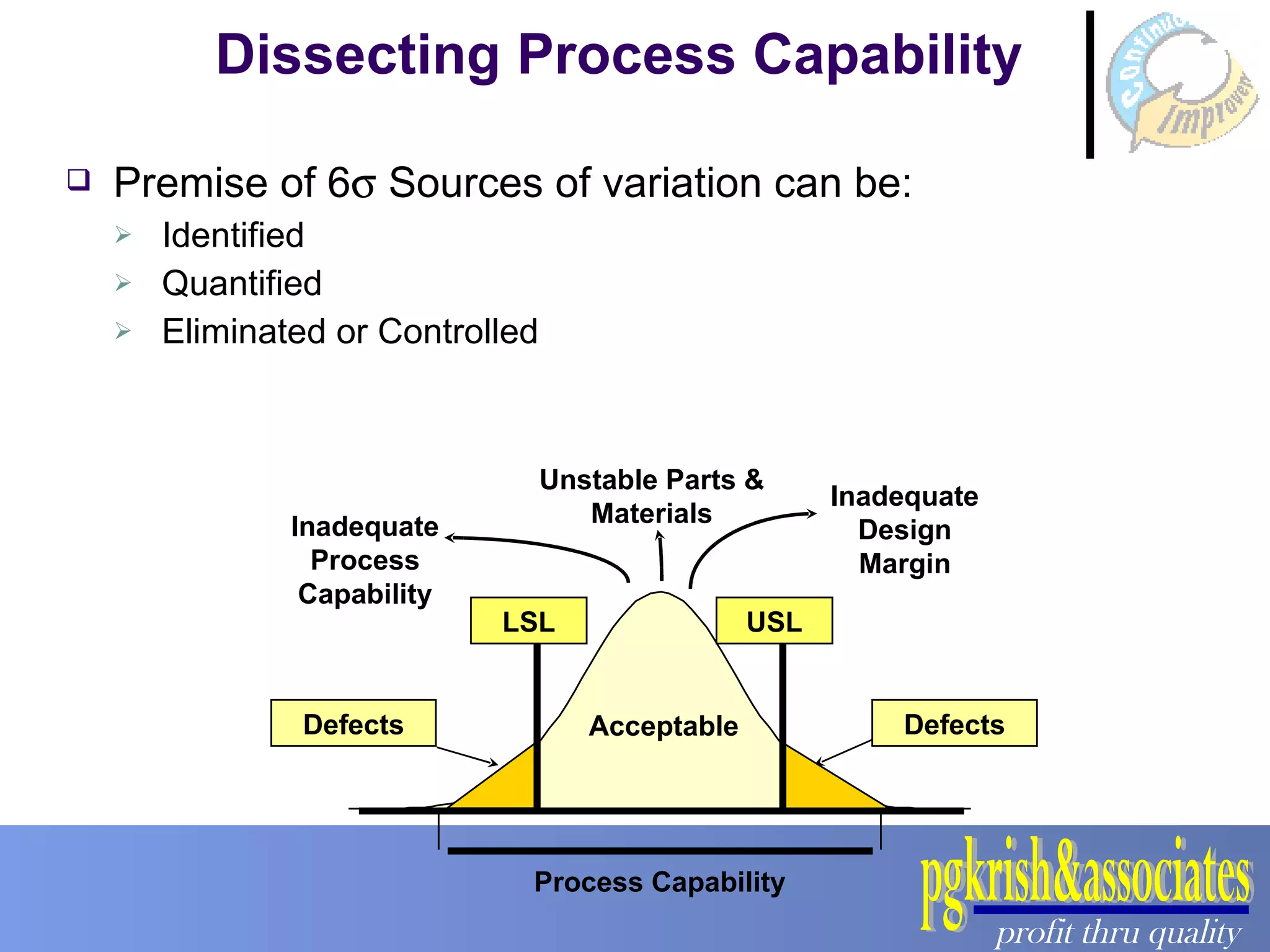
Dissecting Process Capability Premise of 6   Sources of variation can be: Identified Quantified Eliminated or Controlled Defects Process Capability Inadequate Design Margin Inadequate Process Capability Unstable Parts & Materials Defects Acceptable LSL USL
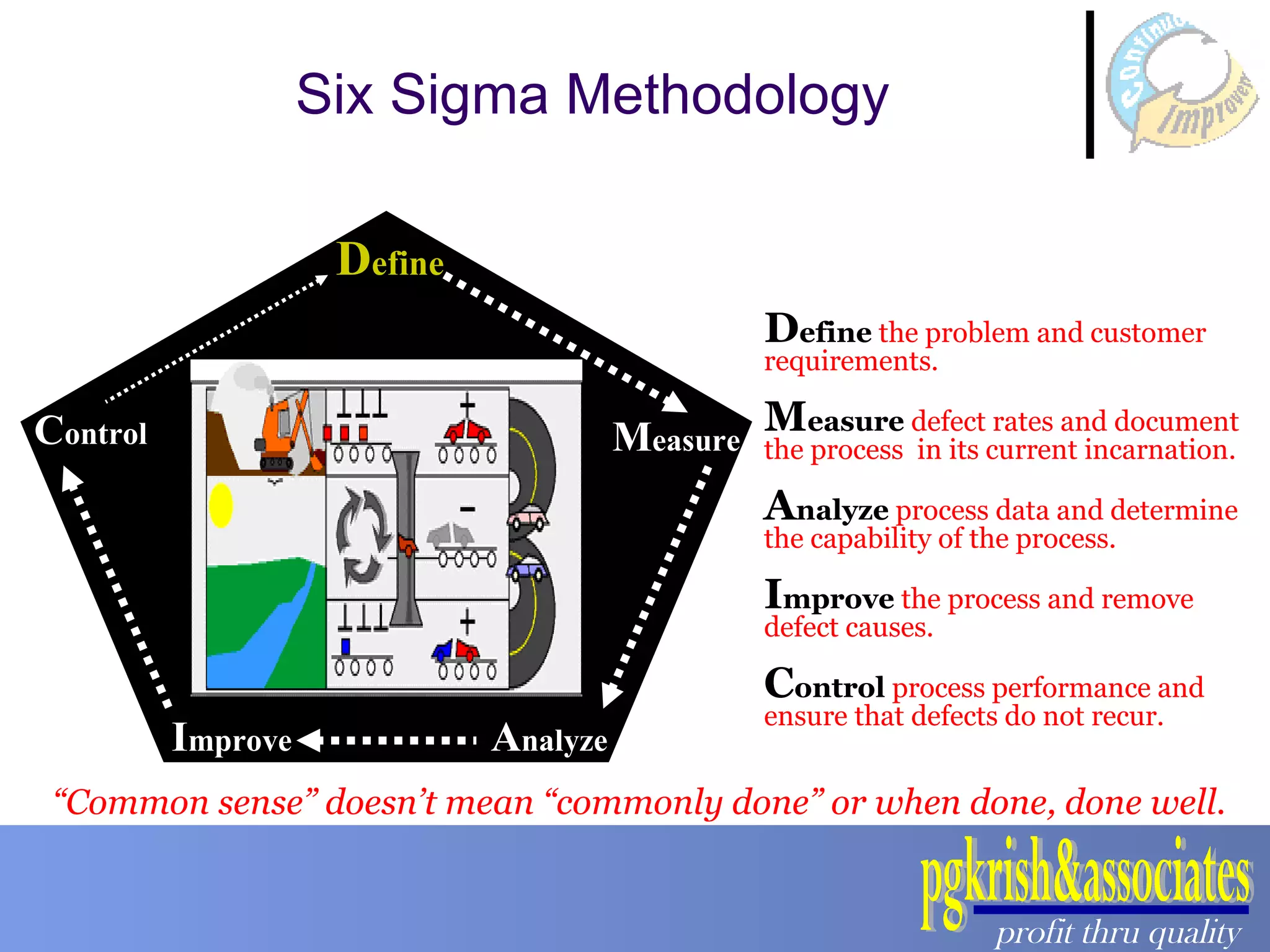
D efine C ontrol I mprove A nalyze M easure D efine   the problem and customer requirements. M easure  defect rates and document the process  in its current incarnation. A nalyze  process data and determine the capability of the process. I mprove  the process and remove defect causes. C ontrol  process performance and ensure that defects do not recur. “ Common sense” doesn’t mean “commonly done” or when done, done well. Six Sigma Methodology
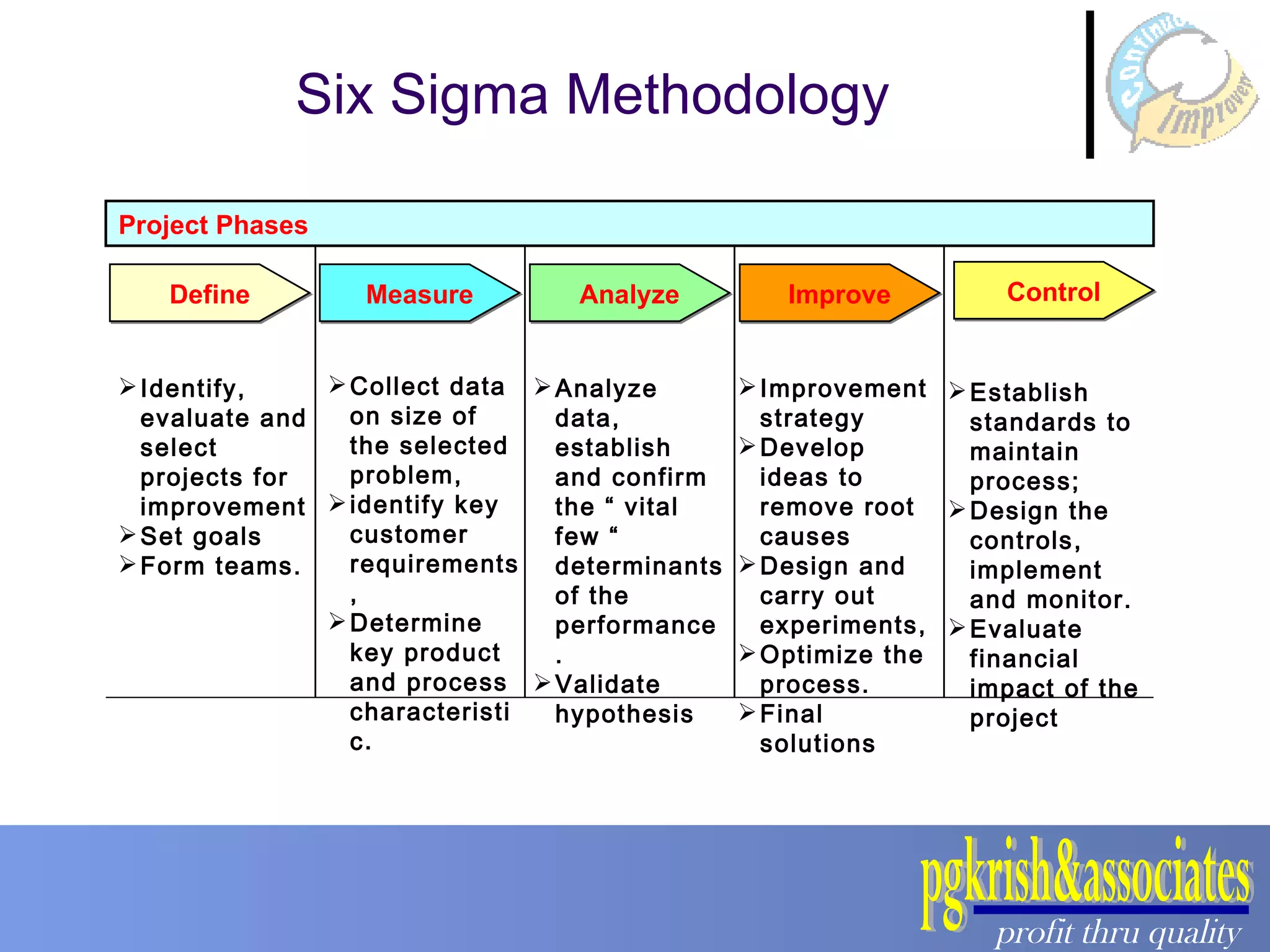
Six Sigma Methodology Control Define Measure Analyze Improve Establish standards to maintain process; Design the controls,  implement and monitor.  Evaluate financial impact of the project Identify, evaluate and select projects for improvement Set goals Form teams.  Collect data on size of the selected problem, identify key customer requirements, Determine key product and process characteristic .  Analyze data, establish and confirm the “ vital few “ determinants of the performance. Validate hypothesis Improvement strategy Develop ideas to remove root causes Design and carry out experiments, Optimize the process.  Final solutions Project Phases
Six Sigma – Case Study   Service Organisation Background  M/s Alpha Inc. manages out bound cargo from a distribution centre to different stores. Deliveries made on trucks - owned and hired.  Customers dissatisfied at delivery schedules.  Leadership decision to deploy Six Sigma; Team of 1 Black Belt and 3 Green Belts  formed  Sponsor of the project – Distribution Manager
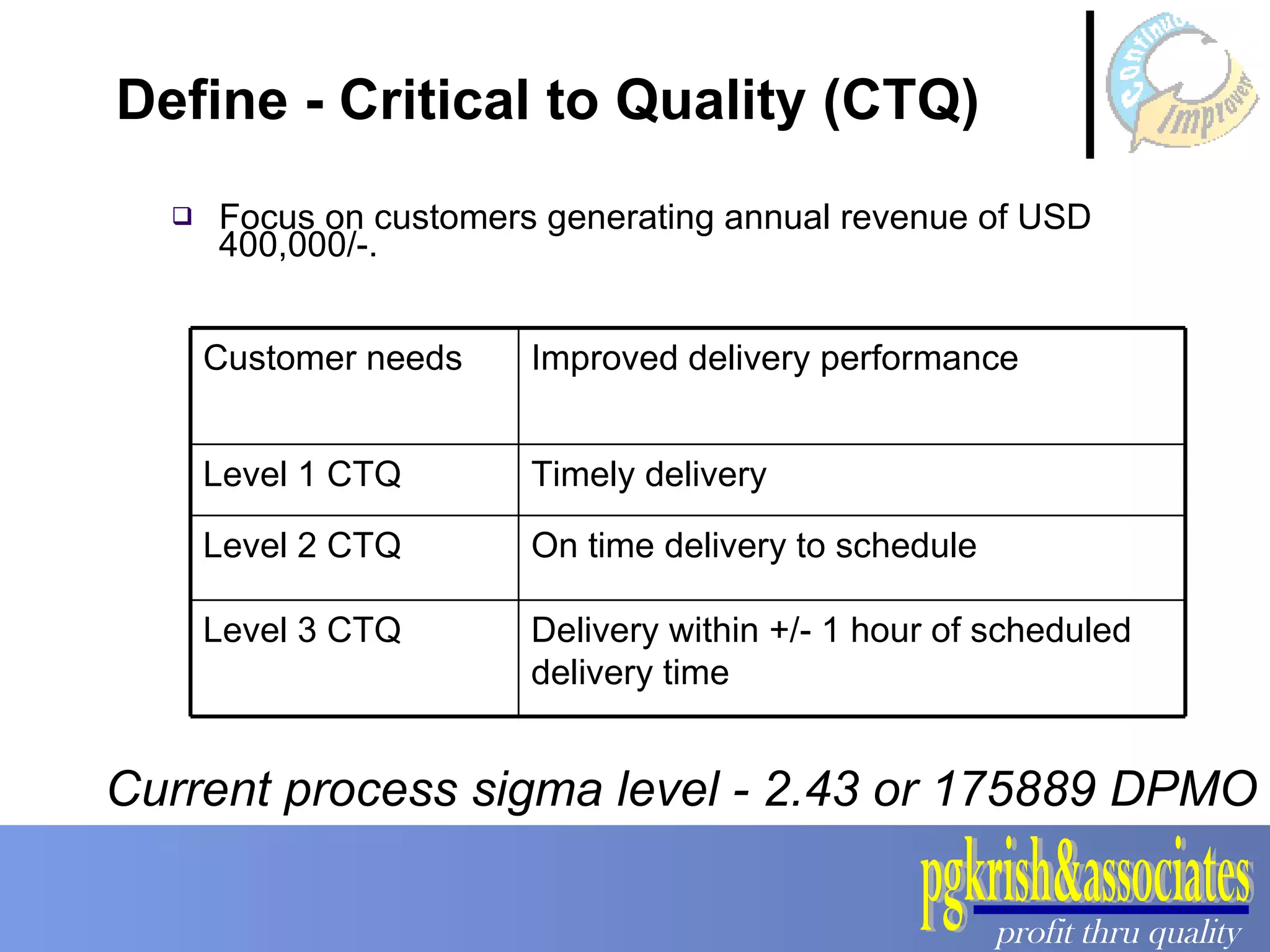
Define - Critical to Quality (CTQ)  Focus on customers generating annual revenue of USD 400,000/-.  Current process sigma level - 2.43 or 175889 DPMO Delivery within +/- 1 hour of scheduled delivery time Level 3 CTQ  On time delivery to schedule Level 2 CTQ  Timely delivery Level 1 CTQ  Improved delivery performance Customer needs
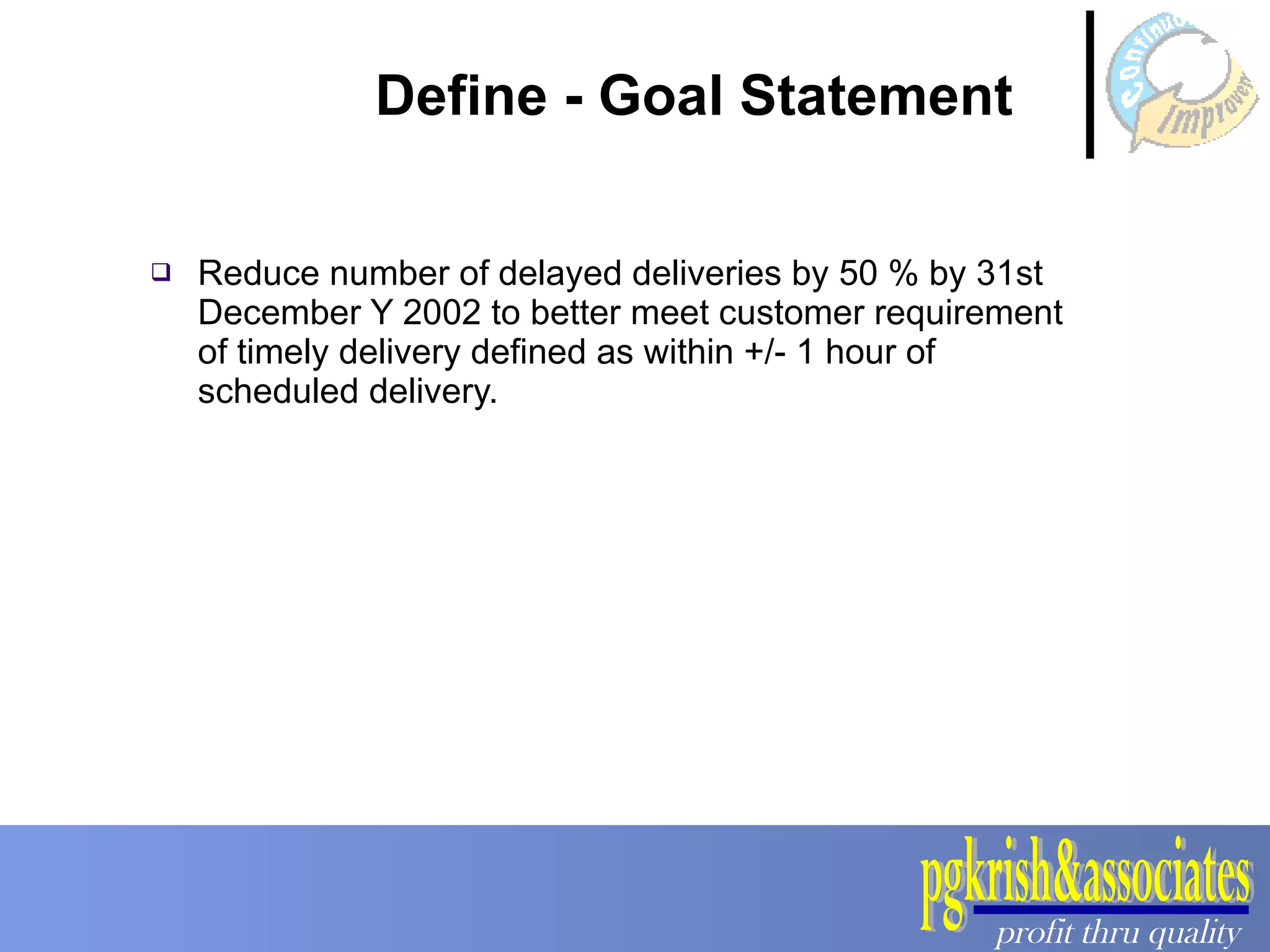
Define - Goal Statement Reduce number of delayed deliveries by 50 % by 31st December Y 2002 to better meet customer requirement of timely delivery defined as within +/- 1 hour of scheduled delivery.
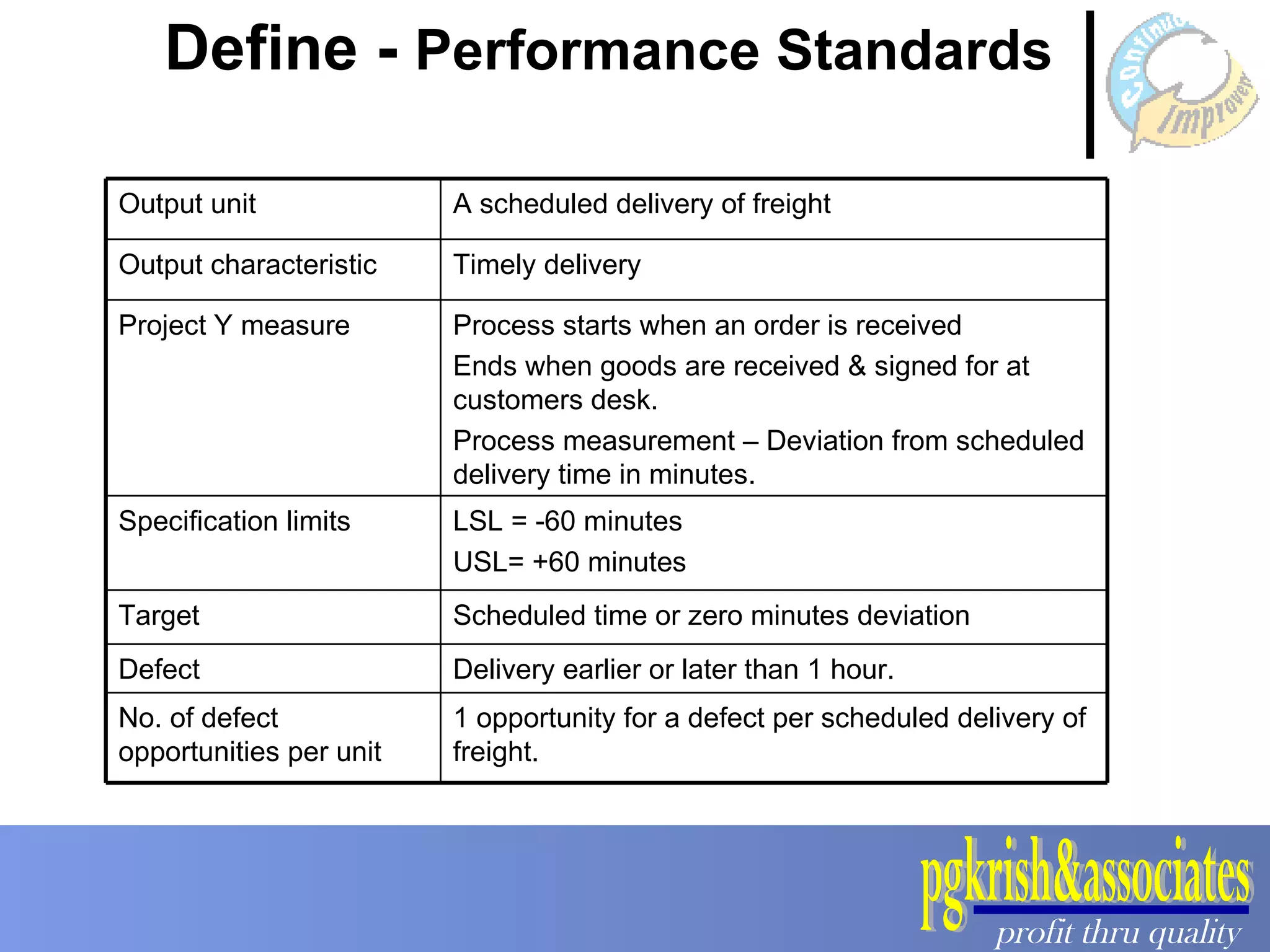
Define -  Performance Standards 1 opportunity for a defect per scheduled delivery of freight. No. of defect opportunities per unit Delivery earlier or later than 1 hour. Defect Scheduled time or zero minutes deviation Target LSL = -60 minutes USL= +60 minutes Specification limits Process starts when an order is received  Ends when goods are received & signed for at customers desk. Process measurement – Deviation from scheduled delivery time in minutes. Project Y measure Timely delivery Output characteristic A scheduled delivery of freight Output unit
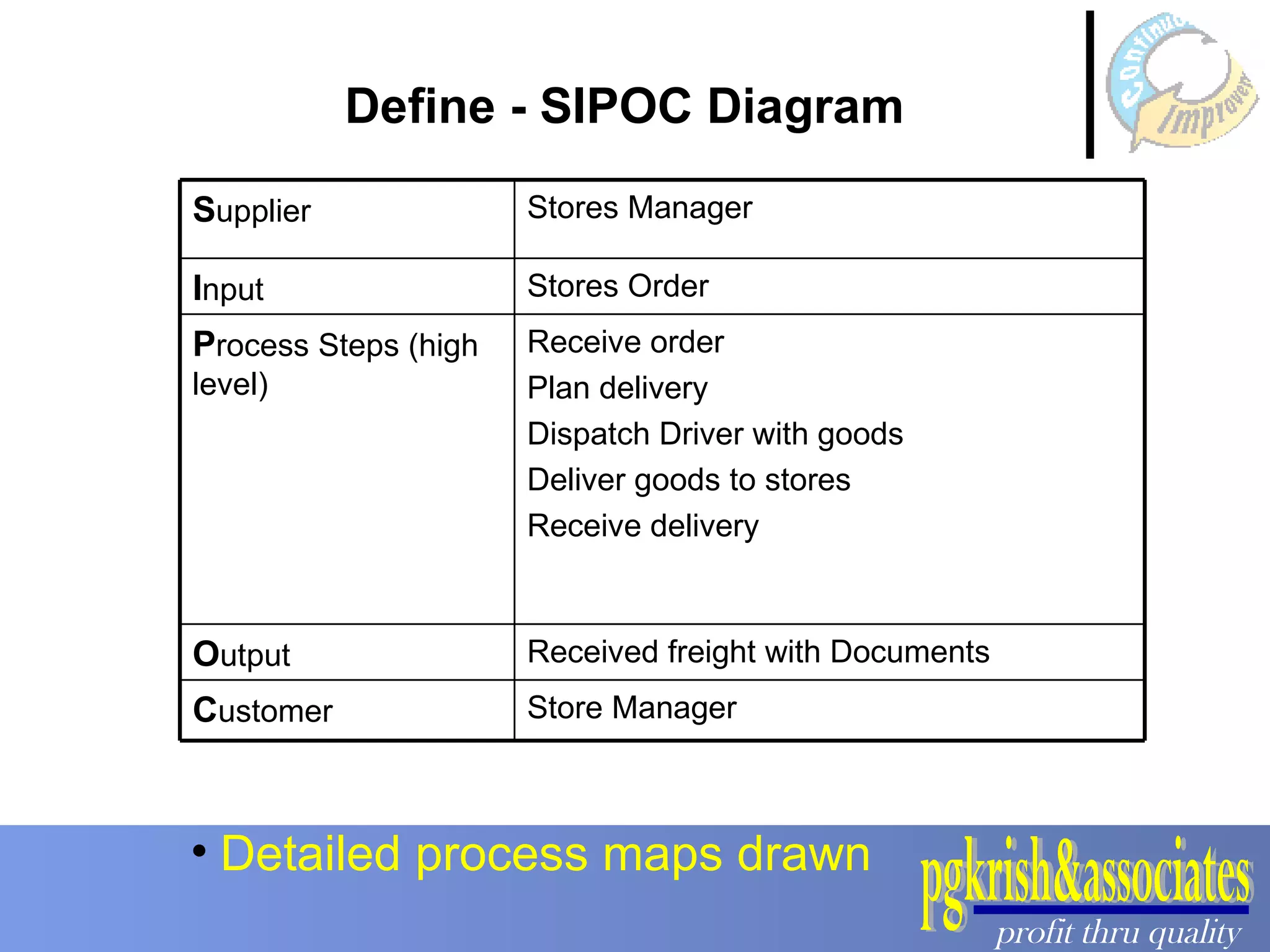
Define - SIPOC Diagram Detailed process maps drawn Store Manager C ustomer Received freight with Documents O utput Receive order Plan delivery Dispatch Driver with goods Deliver goods to stores Receive delivery P rocess Steps (high level) Stores Order I nput Stores Manager S upplier
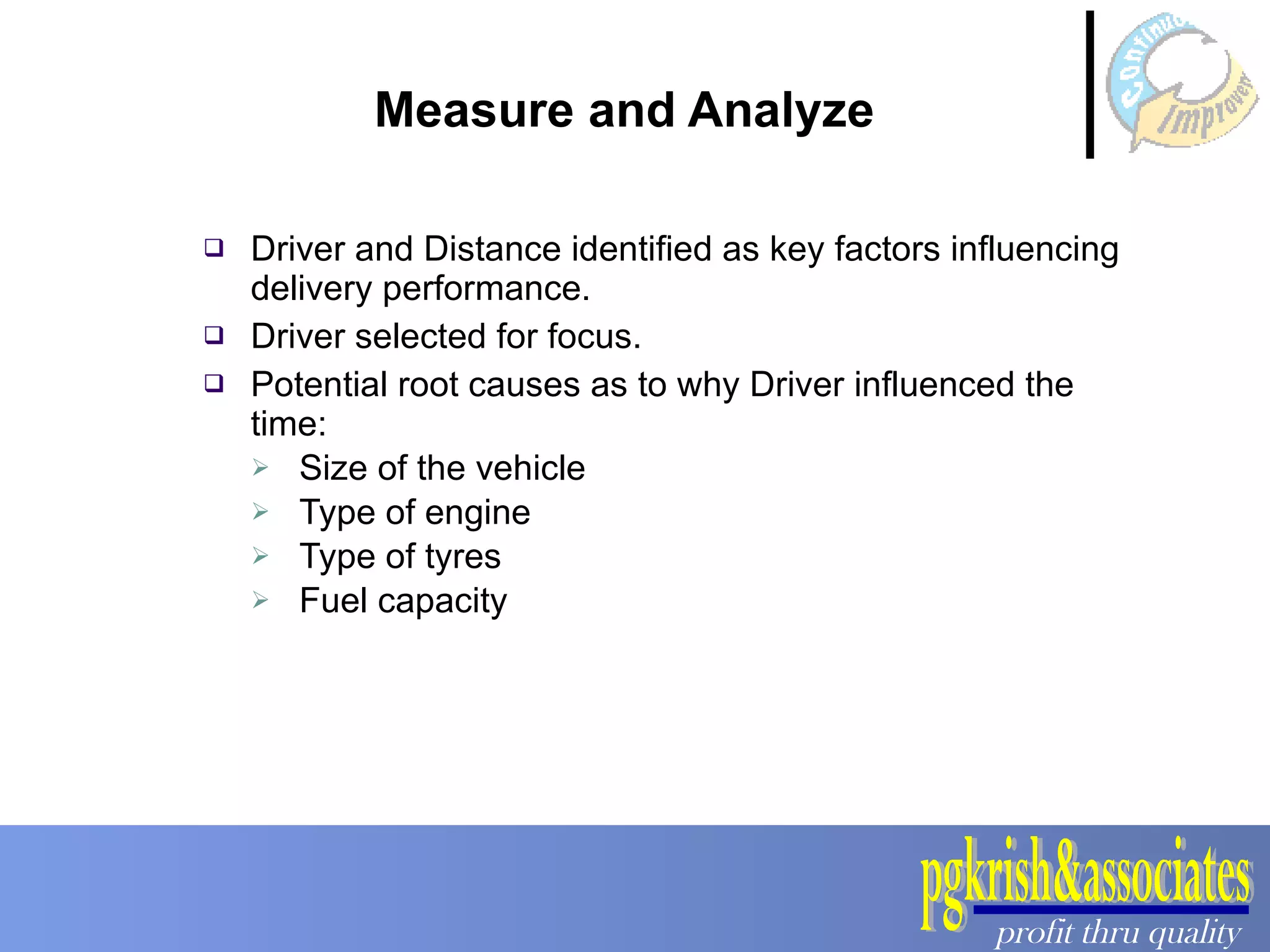
Measure and Analyze Driver and Distance identified as key factors influencing delivery performance.  Driver selected for focus.  Potential root causes as to why Driver influenced the time: Size of the vehicle Type of engine Type of tyres Fuel capacity
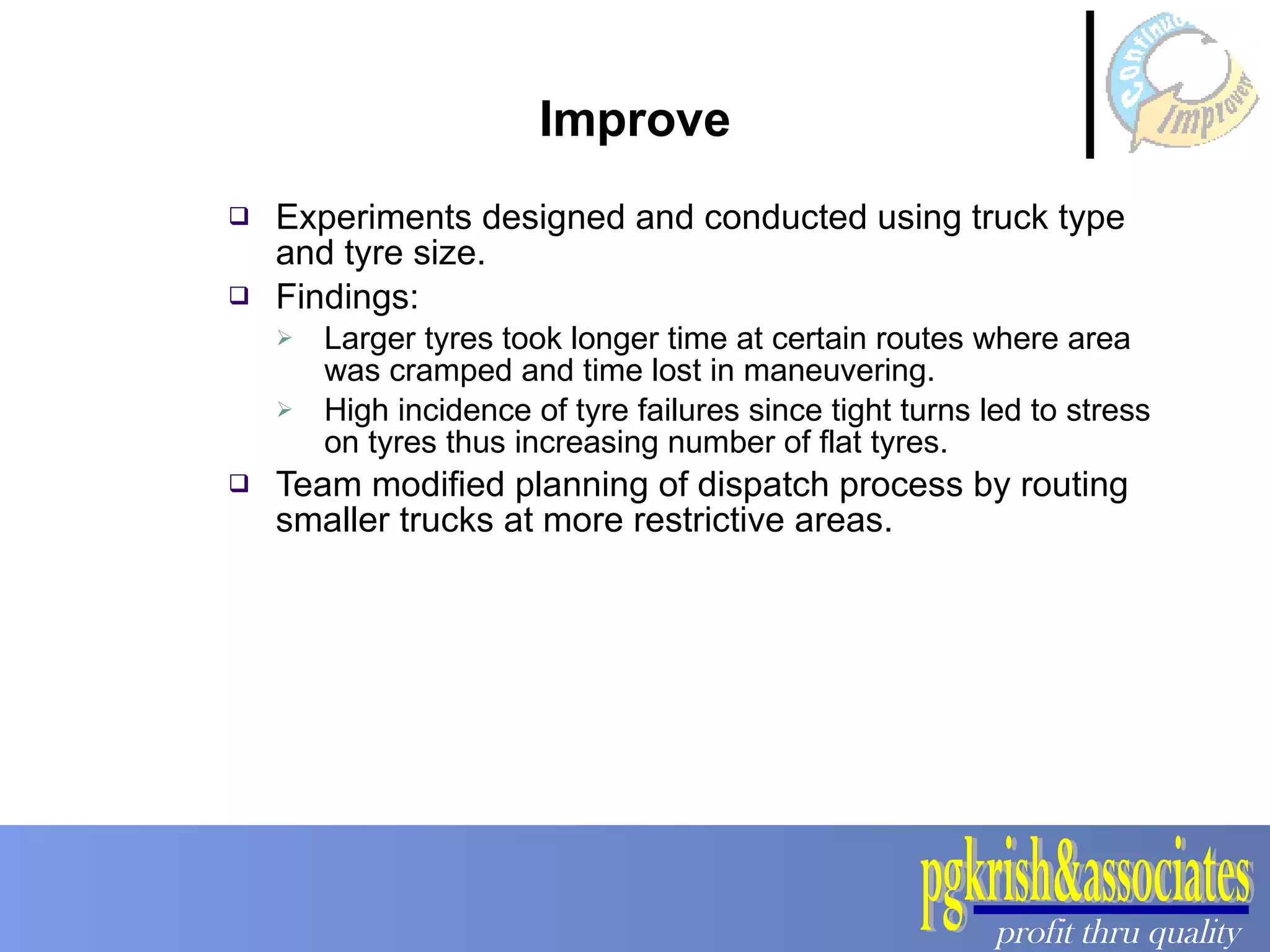
Experiments designed and conducted using truck type and tyre size.  Findings: Larger tyres took longer time at certain routes where area was cramped and time lost in maneuvering.  High incidence of tyre failures since tight turns led to stress on tyres thus increasing number of flat tyres.  Team modified planning of dispatch process by routing smaller trucks at more restrictive areas. Improve
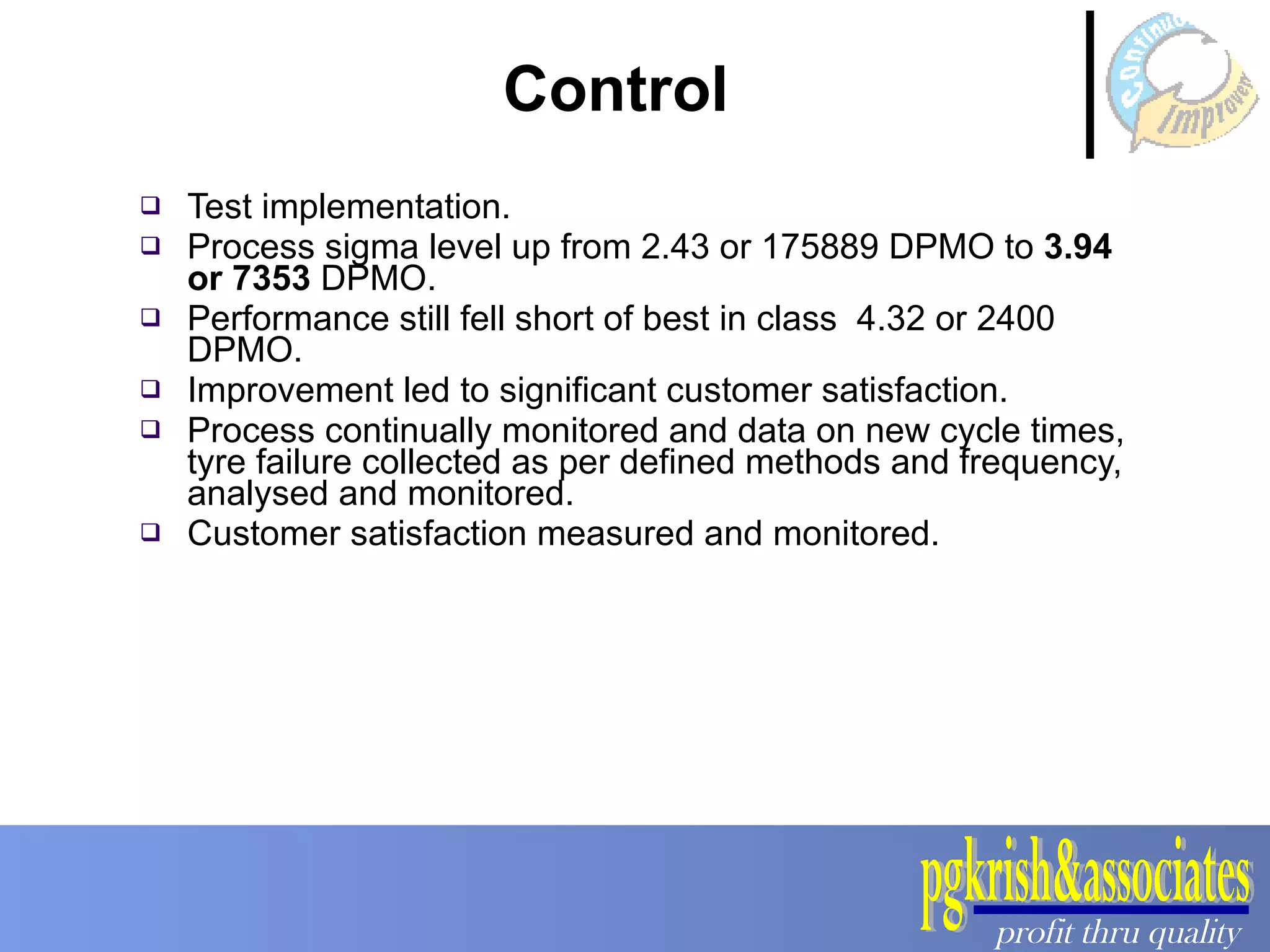
Test implementation. Process sigma level up from 2.43 or 175889 DPMO to  3.94 or 7353  DPMO.  Performance still fell short of best in class  4.32 or 2400 DPMO.  Improvement led to significant customer satisfaction.  Process continually monitored and data on new cycle times, tyre failure collected as per defined methods and frequency, analysed and monitored. Customer satisfaction measured and monitored. Control
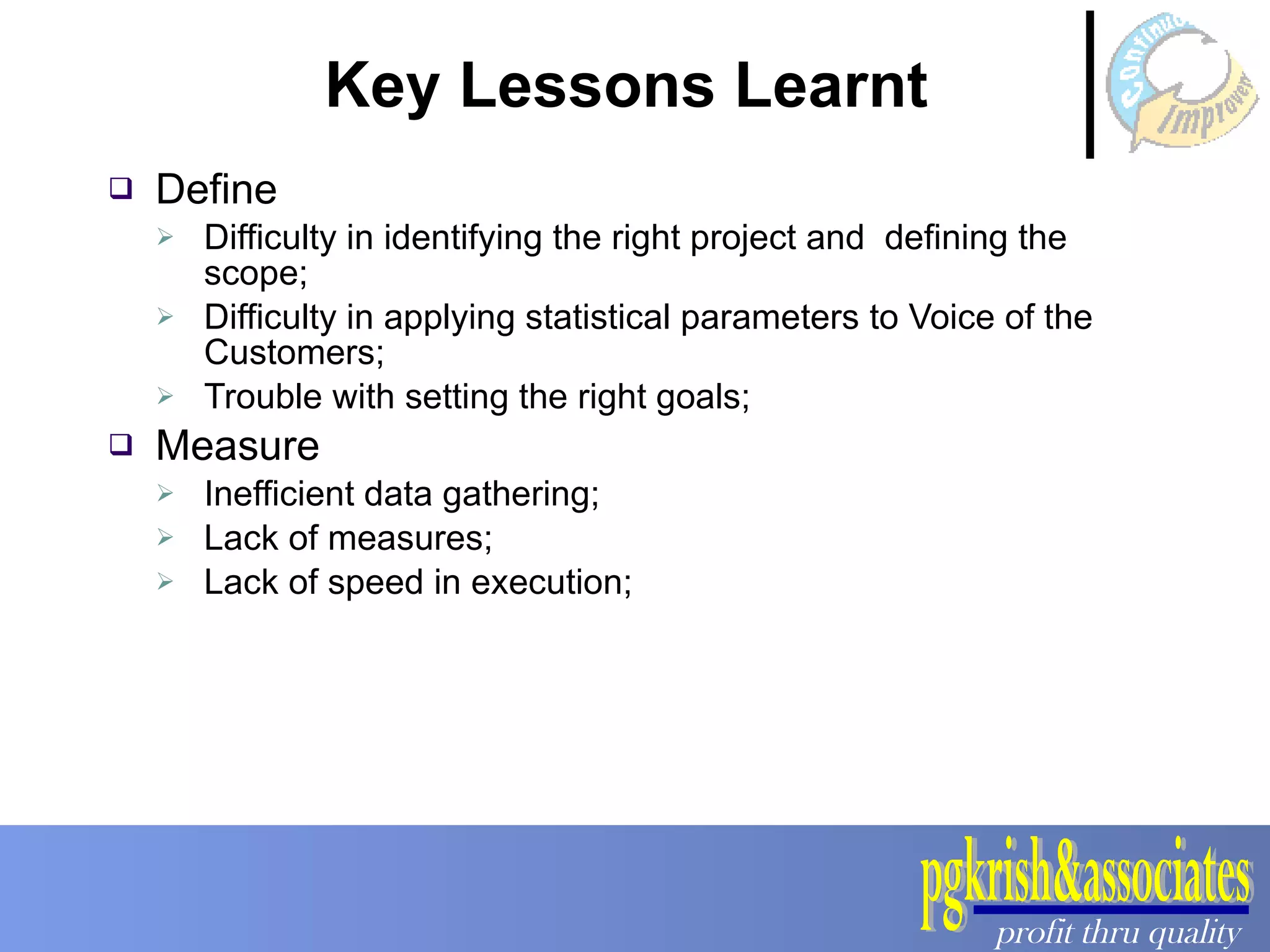
Key Lessons Learnt  Define Difficulty in identifying the right project and  defining the scope; Difficulty in applying statistical parameters to Voice of the Customers; Trouble with setting the right goals; Measure Inefficient data gathering; Lack of measures; Lack of speed in execution;
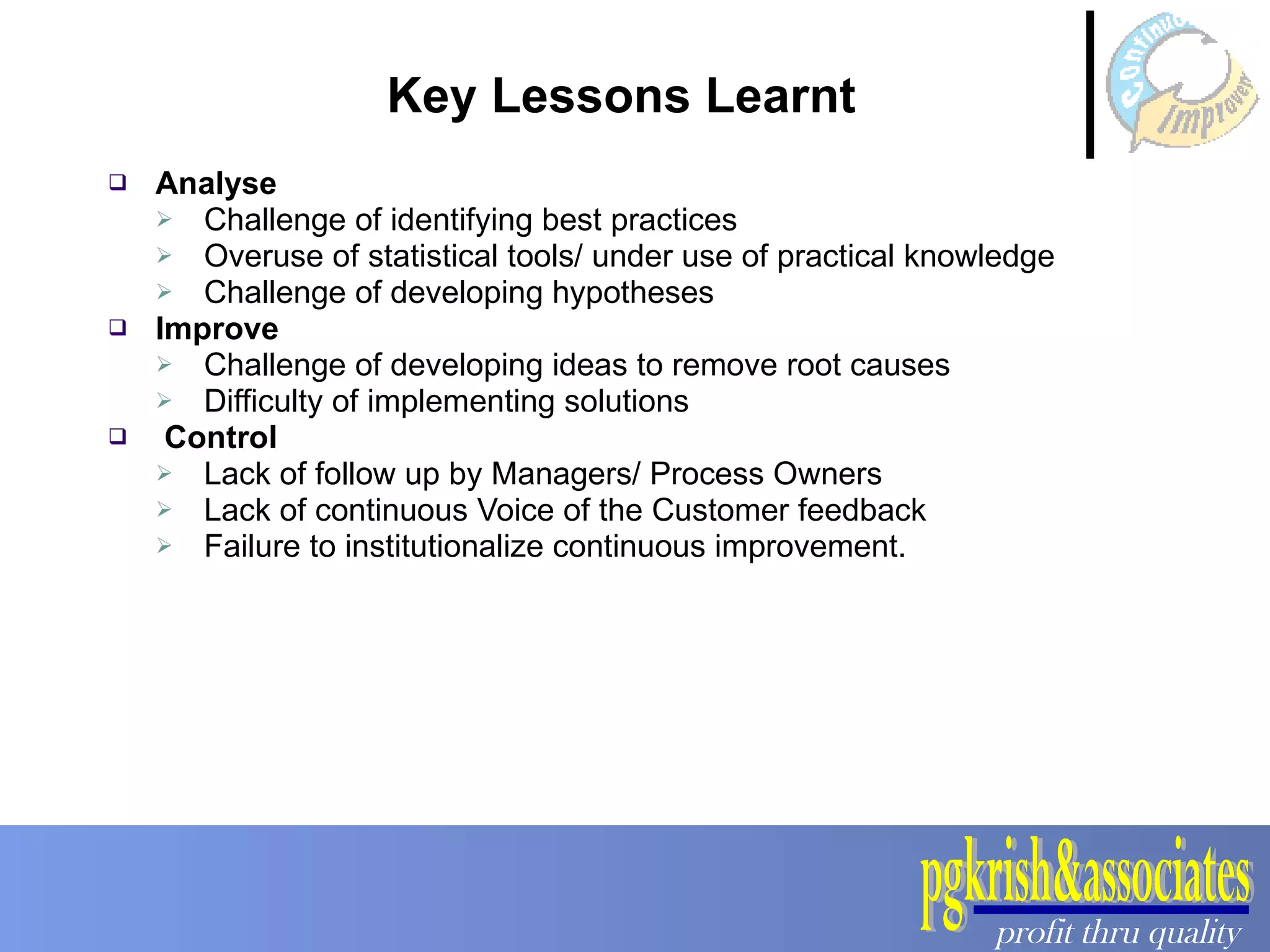
Key Lessons Learnt  Analyse Challenge of identifying best practices Overuse of statistical tools/ under use of practical knowledge Challenge of developing hypotheses Improve Challenge of developing ideas to remove root causes Difficulty of implementing solutions Control Lack of follow up by Managers/ Process Owners Lack of continuous Voice of the Customer feedback Failure to institutionalize continuous improvement.
Key Lessons Learnt “  Define “ ranked most important step but gets the lowest resource allocation Project scoping and its definition is critical to its success/ failure; “ Measure” is considered most difficult step and also gets the highest resources Source: Greenwich Associates Study Y 2002
Versatile Breakthrough improvements Financial results focus Process focus Structured & disciplined problem solving methodology using scientific tools and techniques Customer centered Involvement of leadership is mandatory. Training is mandatory;  Action learning (25% class room, 75 % application) Creating a dedicated organisation for problem solving (85/50 Rule). What Makes Six Sigma Different?
Benefits of Six Sigma Generates sustained success Sets performance goal for everyone Enhances value for customers; Accelerates rate of improvement; Promotes learning across boundaries; Executes strategic change
6 Sigma vs Kaizen
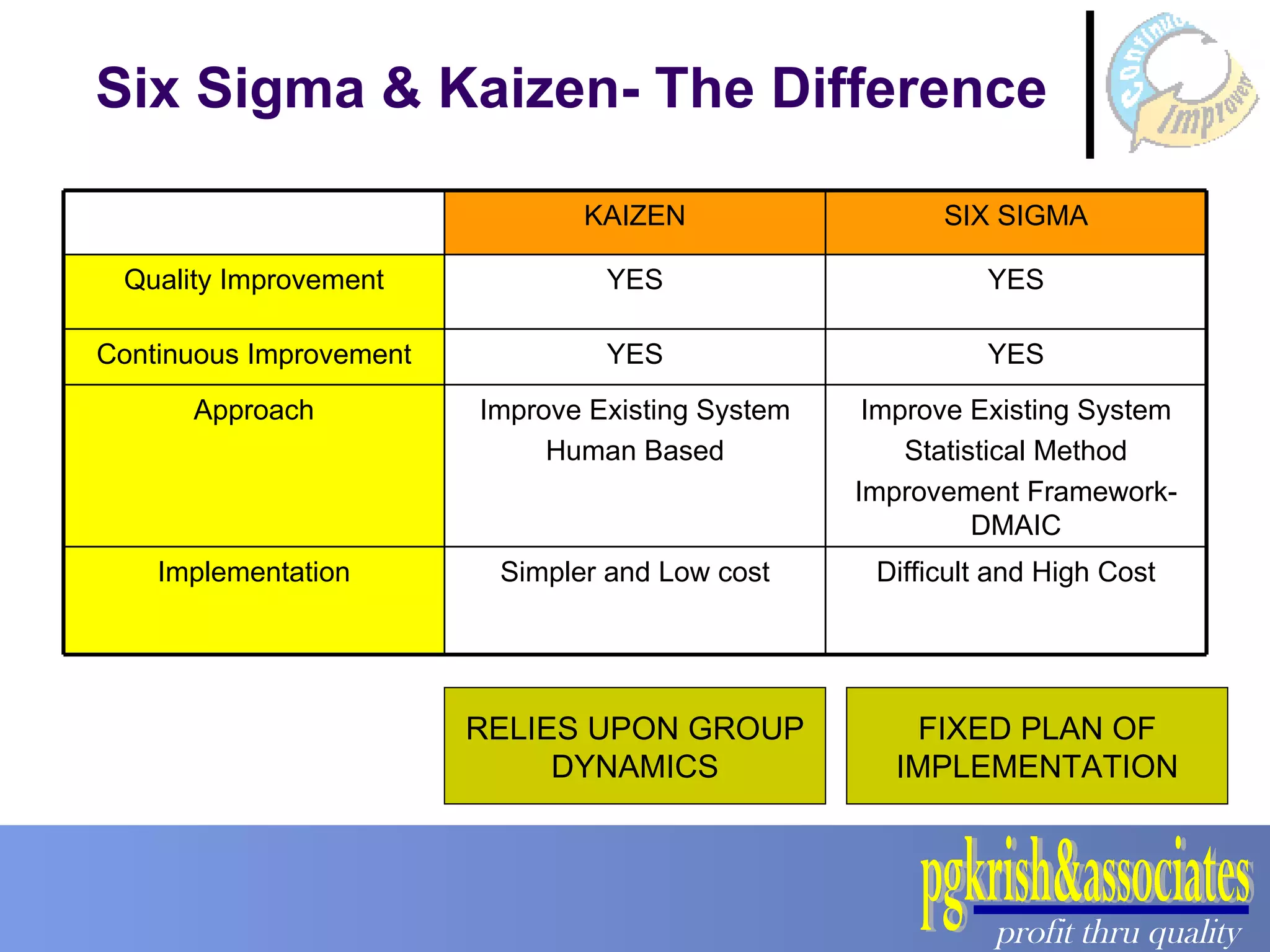
Six Sigma & Kaizen- The Difference RELIES UPON GROUP DYNAMICS FIXED PLAN OF IMPLEMENTATION Difficult and High Cost Simpler and Low cost Implementation Improve Existing System Statistical Method Improvement Framework-DMAIC Improve Existing System Human Based Approach YES YES Continuous Improvement YES YES Quality Improvement SIX SIGMA KAIZEN
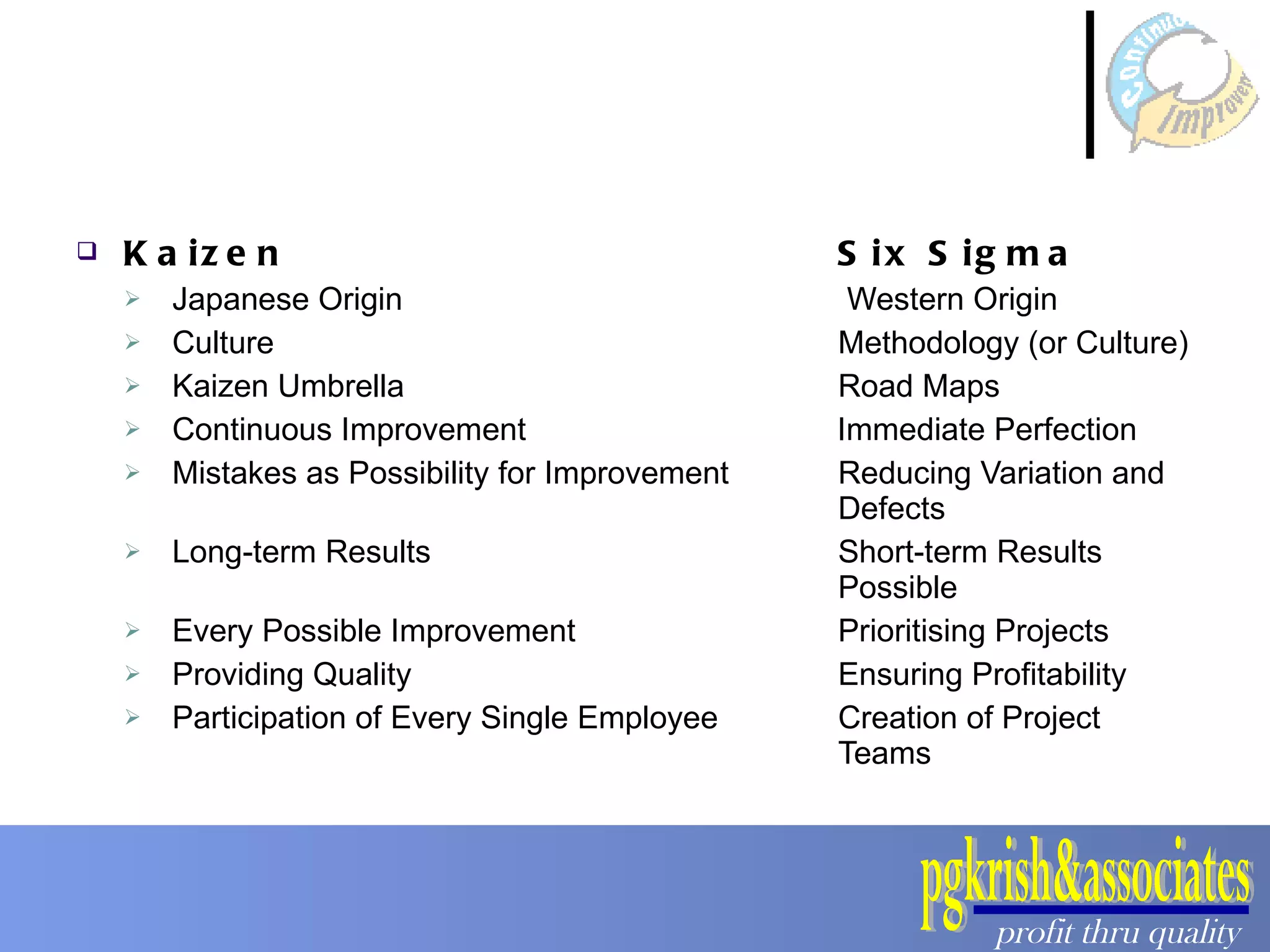
Kaizen  Six Sigma Japanese Origin  Western Origin Culture  Methodology (or Culture) Kaizen Umbrella  Road Maps Continuous Improvement  Immediate Perfection Mistakes as Possibility for Improvement  Reducing Variation and  Defects Long-term Results  Short-term Results  Possible Every Possible Improvement Prioritising Projects Providing Quality  Ensuring Profitability Participation of Every Single Employee  Creation of Project  Teams
Thank You

Six Sigma Vs Kaizen

  • 1.
    6 σ & Kaizen
  • 2.
  • 3.
    KAIZEN-The Concept Kaizen….meansimprovement Ongoing improvement Involves everyone Both Managers & Workers Kaizen Philosophy Our way of life need to be constantly improved Working life, social life, home life Kaizen embodies Productivity Improvement Total Quality Culture QC Circles Zero Defects … ..etc.
  • 4.
  • 5.
  • 6.
  • 7.
    Process Oriented ApproachLeads to Improved Results Focus on the process improvement without loosing sight of the expected results. People Oriented Approach Focus on …. Discipline Time Management Skill Development Participation and Involvement Morale Communication KAIZEN-The Concept
  • 8.
    KAIZEN-The Practice Onthe spot improvement Improved work procedures New System and Facility improvement Results Inexpensive Mostly inexpensive Small investment Implementation Cost Individual work area Group Work area Systems and Process Target Everyone QC Circles Managers and Professionals Involves Common Sense Seven QC Tools Seven QC Tools New Seven Tools Seven QC Tools New Seven Tools Professional Skills Tools Individual Group Management
  • 9.
    Just In Time-Management Oriented Kaizen Exact number of required units brought to each successive stage of production at the appropriate time The advantage of JIT Shortened Lead Time Reduced time spent on non-process work Reduced inventory Better balance between processes Problem clarification KAIZEN-The Practice
  • 10.
    Group Oriented Kaizen-SMALL GROUP ACTIVTIES Informal, voluntary small groups, organized within the company Carry out specific improvement activities Many forms:- QC circles, Suggestion Groups, Workers group……… QC Circles…the most famous Emphasis on problem solving in the work area Advantages of QCC Sense of teamwork Improved communication Improved morale Acquire new skills Labor-Management relationship improved KAIZEN-The Practice
  • 11.
    Individual Oriented Kaizen-SUGGESTION SYSTEM Individual provides suggestion on how to improve his work area. Helps the individual to be Kaizen conscious. Also helps in…. Workers to speak out. Opportunity for management to help workers. An valuable opportunity for two way communication Suggestions normally covers:- Savings in energy, material and other resources Improvement in working environment Improvements in machines, processes, jigs and tools Improvements in customer services KAIZEN-The Practice
  • 12.
    KAIZEN- Implementation SevenConditions for Successful Implementation of Kaizen Strategy Top management   commitment Top management commitment Top management commitment Setting up an organization  dedicated to promote Kaizen Appointing the best available personnel to manage the Kaizen process Conducting training and education Establishing a step-by-step process for Kaizen introduction.
  • 13.
    KAIZEN & INNOVATION
  • 14.
    Time Figure 2.2Ideal pattern from innovation Figure 2.3 Actual pattern from innovation Time
  • 15.
    INNOVATION plus KAIZENKAIZEN KAIZEN INNOVATION INNOVATION New Standard New Standard
  • 16.
    KAIZEN and INNOVATIONBetter suited in fast growth economy Works well in slow growth economy 10. Advantage Large investment but little effort to maintain Little investment but great efforts to maintain 9. Practical Requirements Technology People 8. Effort Orientation Scrap and Rebuild Maintenance and Improvement 7. Mode Individual ideas and efforts Collective group efforts, systems approach 6. Approach Selected champions Every-one 5. Involvement Abrupt and volatile Gradual and constant 4. Change Intermittent and non-incremental Continuous and Incremental 3. Time frame Big Steps Small Steps 2. Pace Short term and dramtic Long-term and business as usual 1. Effect INNOVATION KAIZEN
  • 17.
    Another comparison ofInnovation and KAIZEN Innovation KAIZEN Creativity Individualism Specialist-oriented Attention to great leaps Technology-oriented Information: closed, proprietary Functional (specialist) orientation Seek new technology Line + staff Limited feedback Adaptability Teamwork (systems approach) Generalist-oriented Attention to details people-oriented Information: open, shared Cross-functional orientation Build on existing technology Cross-functional organization Comprehensive feedback
  • 18.
  • 19.
    Six Sigma WasDeveloped at Motorola in the 1980’s As a Method to Improve Process Quality. It Was First Used to Improve Manufacturing Process Capability and Then Migrated to Business Processes Capability Companies That Have Deployed Six Sigma: Bank of America, Motorola, GE, IBM, Kodak and Many More The Basic Premise Is, All Processes Have Variation. Variation Is the Enemy. About Six Sigma
  • 20.
    Six Sigma PhilosophyKnow What’s Important to the Customer (CTQ) Reduce Defects (DPMO) Center Around Target (Mean) Reduce Variation (Standard Deviation) ? GE Company Proprietary November 1998
  • 21.
    Business Definition Abreak through strategy to significantly improve customer satisfaction and shareholder value by reducing variability in every aspect of business . Technical Definition A statistical term signifying 3.4 defects per million opportunities. SIX SIGMA-Definitions
  • 22.
    SIX SIGMA DEFINATIONS6 σ 3.4 99.9997% 5 σ 320 99.98% 4 σ 6 210 99.4% 3 σ 66 800 93.3% 2 σ 308 000 69.2% 1 σ 690 000 30.9% Your Sigma is… Your DPMO is…. If your yield is…
  • 23.
    SIX SIGMA-Definitions Inbrief, Six Sigma is a process control method to improve the quality of products or services in a continuous manner. This method uses six standard deviations of a normal distribution as the limits of customers’ acceptance of the system’s products. This method is applicable to manufacturing as well as service industries. With six sigmas, only 3.4 defects per million are allowed, or an acceptable level of 99.9997% is required
  • 24.
    Six Sigma PerformanceSource: The Six Sigma Way by Peter Pande and Others Less than 2 crashes 4100 crashes Out of every 500,000 computer restarts 1.8 seconds of dead air 1.68 hours of dead air For every week of TV broadcasting per channel 1 misdelivery 3,000 misdeliveries For every 300000 letters delivered With Six Sigma Quality With 99 % Quality
  • 25.
    Who is ImplementingSix Sigma At least 25% of the fortune 200 claim to have a serious six sigma program - Michael Hammer. Financial - Bank of America, GE Capital, Electronics - Allied Signal, Samsung, Sony Chemicals - Dupont, Dow Chemicals Manufacturing - GE Plastics, Johnson and Johnson, Motorola, Nokia, Microsoft, Ford. Airline - Singapore, Lufthansa, Bombardier And hundreds of others in Americas, Europe, Sub Continent.
  • 26.
    Six Sigma ResultsSix Sigma Savings as % of revenue vary from 1.2 to 4.5 % For $ 30 million/yr sales – Savings potential $ 360,000 to $ 1.35 million. Investment: salary of in house experts, training, process redesign. Annual Savings Company *$1.5 billion (*since inception in 1998) JP Morgan Chase $600 million Honeywell $500 million Johnson & Johnson $ 16 billion (*since inception in 1980s) Motorola $2.0+ billion General Electric
  • 27.
    Key Concepts ofSix Sigma At its core, Six Sigma revolves around a few key concepts. Critical to Quality: Attributes most important to the customer Defect: Failing to deliver what the customer wants Process Capability: What your process can deliver Variation: What the customer sees and feels Stable Operations: Ensuring consistent, predictable processes to improve what the customer sees and feels Design for Six Sigma: Designing to meet customer needs and process capability
  • 28.
    Dissecting Process CapabilityPremise of 6  Sources of variation can be: Identified Quantified Eliminated or Controlled Defects Process Capability Inadequate Design Margin Inadequate Process Capability Unstable Parts & Materials Defects Acceptable LSL USL
  • 29.
    D efine Control I mprove A nalyze M easure D efine the problem and customer requirements. M easure defect rates and document the process in its current incarnation. A nalyze process data and determine the capability of the process. I mprove the process and remove defect causes. C ontrol process performance and ensure that defects do not recur. “ Common sense” doesn’t mean “commonly done” or when done, done well. Six Sigma Methodology
  • 30.
    Six Sigma MethodologyControl Define Measure Analyze Improve Establish standards to maintain process; Design the controls, implement and monitor. Evaluate financial impact of the project Identify, evaluate and select projects for improvement Set goals Form teams. Collect data on size of the selected problem, identify key customer requirements, Determine key product and process characteristic . Analyze data, establish and confirm the “ vital few “ determinants of the performance. Validate hypothesis Improvement strategy Develop ideas to remove root causes Design and carry out experiments, Optimize the process. Final solutions Project Phases
  • 31.
    Six Sigma –Case Study Service Organisation Background M/s Alpha Inc. manages out bound cargo from a distribution centre to different stores. Deliveries made on trucks - owned and hired. Customers dissatisfied at delivery schedules. Leadership decision to deploy Six Sigma; Team of 1 Black Belt and 3 Green Belts formed Sponsor of the project – Distribution Manager
  • 32.
    Define - Criticalto Quality (CTQ) Focus on customers generating annual revenue of USD 400,000/-. Current process sigma level - 2.43 or 175889 DPMO Delivery within +/- 1 hour of scheduled delivery time Level 3 CTQ On time delivery to schedule Level 2 CTQ Timely delivery Level 1 CTQ Improved delivery performance Customer needs
  • 33.
    Define - GoalStatement Reduce number of delayed deliveries by 50 % by 31st December Y 2002 to better meet customer requirement of timely delivery defined as within +/- 1 hour of scheduled delivery.
  • 34.
    Define - Performance Standards 1 opportunity for a defect per scheduled delivery of freight. No. of defect opportunities per unit Delivery earlier or later than 1 hour. Defect Scheduled time or zero minutes deviation Target LSL = -60 minutes USL= +60 minutes Specification limits Process starts when an order is received Ends when goods are received & signed for at customers desk. Process measurement – Deviation from scheduled delivery time in minutes. Project Y measure Timely delivery Output characteristic A scheduled delivery of freight Output unit
  • 35.
    Define - SIPOCDiagram Detailed process maps drawn Store Manager C ustomer Received freight with Documents O utput Receive order Plan delivery Dispatch Driver with goods Deliver goods to stores Receive delivery P rocess Steps (high level) Stores Order I nput Stores Manager S upplier
  • 36.
    Measure and AnalyzeDriver and Distance identified as key factors influencing delivery performance. Driver selected for focus. Potential root causes as to why Driver influenced the time: Size of the vehicle Type of engine Type of tyres Fuel capacity
  • 37.
    Experiments designed andconducted using truck type and tyre size. Findings: Larger tyres took longer time at certain routes where area was cramped and time lost in maneuvering. High incidence of tyre failures since tight turns led to stress on tyres thus increasing number of flat tyres. Team modified planning of dispatch process by routing smaller trucks at more restrictive areas. Improve
  • 38.
    Test implementation. Processsigma level up from 2.43 or 175889 DPMO to 3.94 or 7353 DPMO. Performance still fell short of best in class 4.32 or 2400 DPMO. Improvement led to significant customer satisfaction. Process continually monitored and data on new cycle times, tyre failure collected as per defined methods and frequency, analysed and monitored. Customer satisfaction measured and monitored. Control
  • 39.
    Key Lessons Learnt Define Difficulty in identifying the right project and defining the scope; Difficulty in applying statistical parameters to Voice of the Customers; Trouble with setting the right goals; Measure Inefficient data gathering; Lack of measures; Lack of speed in execution;
  • 40.
    Key Lessons Learnt Analyse Challenge of identifying best practices Overuse of statistical tools/ under use of practical knowledge Challenge of developing hypotheses Improve Challenge of developing ideas to remove root causes Difficulty of implementing solutions Control Lack of follow up by Managers/ Process Owners Lack of continuous Voice of the Customer feedback Failure to institutionalize continuous improvement.
  • 41.
    Key Lessons Learnt“ Define “ ranked most important step but gets the lowest resource allocation Project scoping and its definition is critical to its success/ failure; “ Measure” is considered most difficult step and also gets the highest resources Source: Greenwich Associates Study Y 2002
  • 42.
    Versatile Breakthrough improvementsFinancial results focus Process focus Structured & disciplined problem solving methodology using scientific tools and techniques Customer centered Involvement of leadership is mandatory. Training is mandatory; Action learning (25% class room, 75 % application) Creating a dedicated organisation for problem solving (85/50 Rule). What Makes Six Sigma Different?
  • 43.
    Benefits of SixSigma Generates sustained success Sets performance goal for everyone Enhances value for customers; Accelerates rate of improvement; Promotes learning across boundaries; Executes strategic change
  • 44.
    6 Sigma vsKaizen
  • 45.
    Six Sigma &Kaizen- The Difference RELIES UPON GROUP DYNAMICS FIXED PLAN OF IMPLEMENTATION Difficult and High Cost Simpler and Low cost Implementation Improve Existing System Statistical Method Improvement Framework-DMAIC Improve Existing System Human Based Approach YES YES Continuous Improvement YES YES Quality Improvement SIX SIGMA KAIZEN
  • 46.
    Kaizen SixSigma Japanese Origin Western Origin Culture Methodology (or Culture) Kaizen Umbrella Road Maps Continuous Improvement Immediate Perfection Mistakes as Possibility for Improvement Reducing Variation and Defects Long-term Results Short-term Results Possible Every Possible Improvement Prioritising Projects Providing Quality Ensuring Profitability Participation of Every Single Employee Creation of Project Teams
  • 47.