8 WASTES IN
LEAN SIX SIGMA
Vinay MC
8 Wastes – What is it?
A method of categorising activities or Types of Work that
do not add value during the production process. These
activities are known as Waste.
Types of Work
ValueAdding
Non-Value
Adding, but
unavoidable
Waste
Any process that changes the nature, shape or
characteristics of the product, in line with customer
requirements
Non-Value Adding, but unavoidable with current
technology or methods.
Any work carried out that does not increase product value.
All other meaningless, non-essential activities that do not
add value to the product you can eliminateimmediately
Vinay MC
Why Use 8 Wastes?
Safety: Reduces risks through minimising inventory, human movement, transport and
product processing
Quality: Seeks to eliminate defects and associated scrap or rework
Delivery: Improves flow through the business and optimises inventory levels
Cost: Profitability improved through elimination of wasteful activities, cash released by
reducing lead times and stopping over productions
People: Seeks to eliminate the underutilisation of human potential
Discuss the benefits of using 8 Wastes
Discuss the reasons for applying 8 Wastes in your organisation
Vinay MC
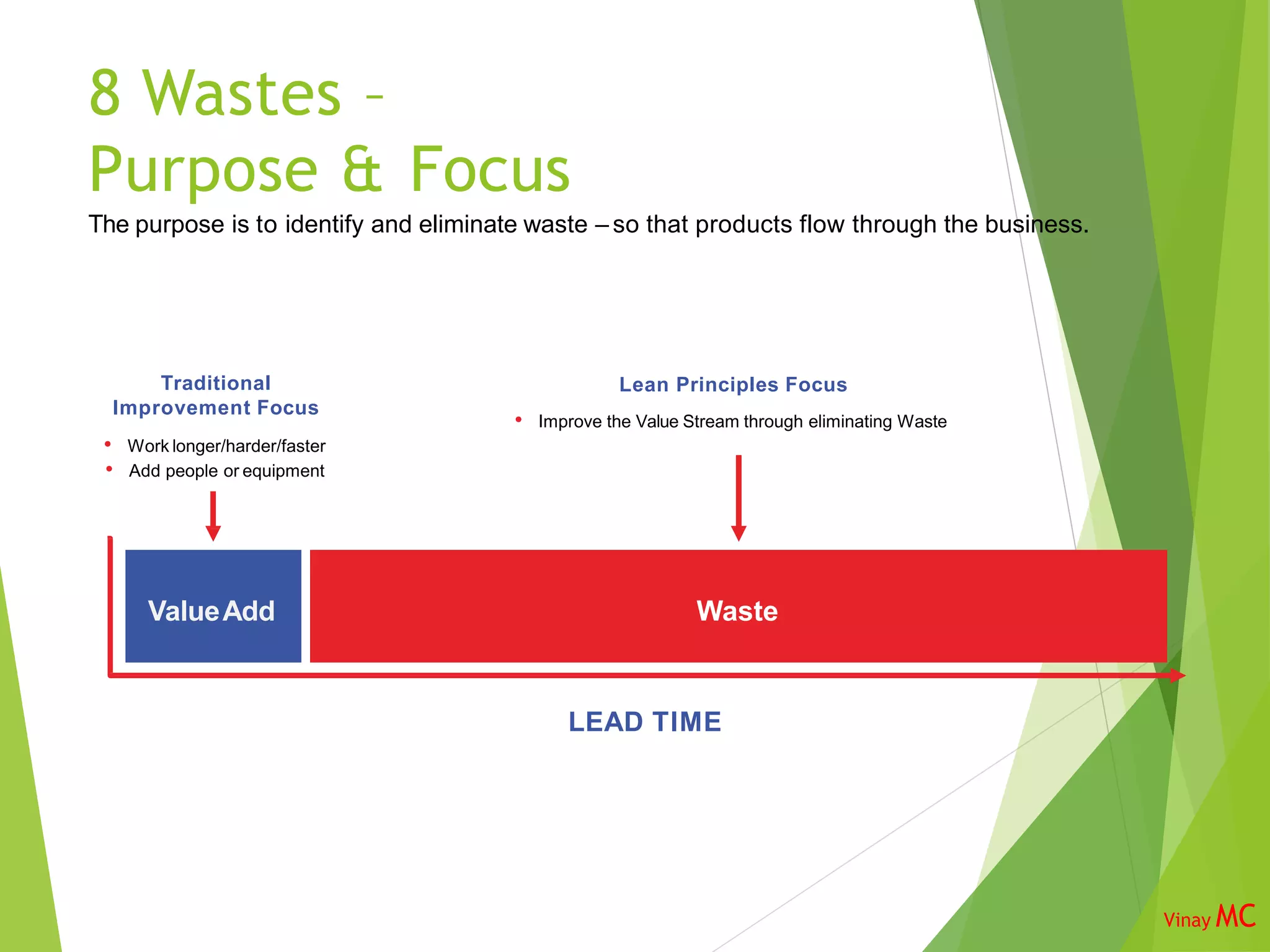
8 Wastes –
Purpose & Focus
The purpose is to identify and eliminate waste – so that products flow through the business.
ValueAdd Waste
LEAD TIME
Traditional
Improvement Focus
• Work longer/harder/faster
• Add people or equipment
Lean Principles Focus
• Improve the Value Stream through eliminating Waste
Vinay MC
8 Wastes - Categories
There are 8 key Categories of waste:
• Transportation
• Inventory
• Motion
• People (Creativity / Intellect)
• Waiting
• Over Production
• Over Processing
• Defects / Rework
Typically, less than 5% of activity is value-adding.
Over Production
95%
< 5%
Over Processing Defects / Rework
Vinay MC
8 Wastes - Transportation
Transportation of work-in-progress
or finished goods:
• Internal travel between work
stations
• Travel between business units
• Travel between sites.
Vinay MC
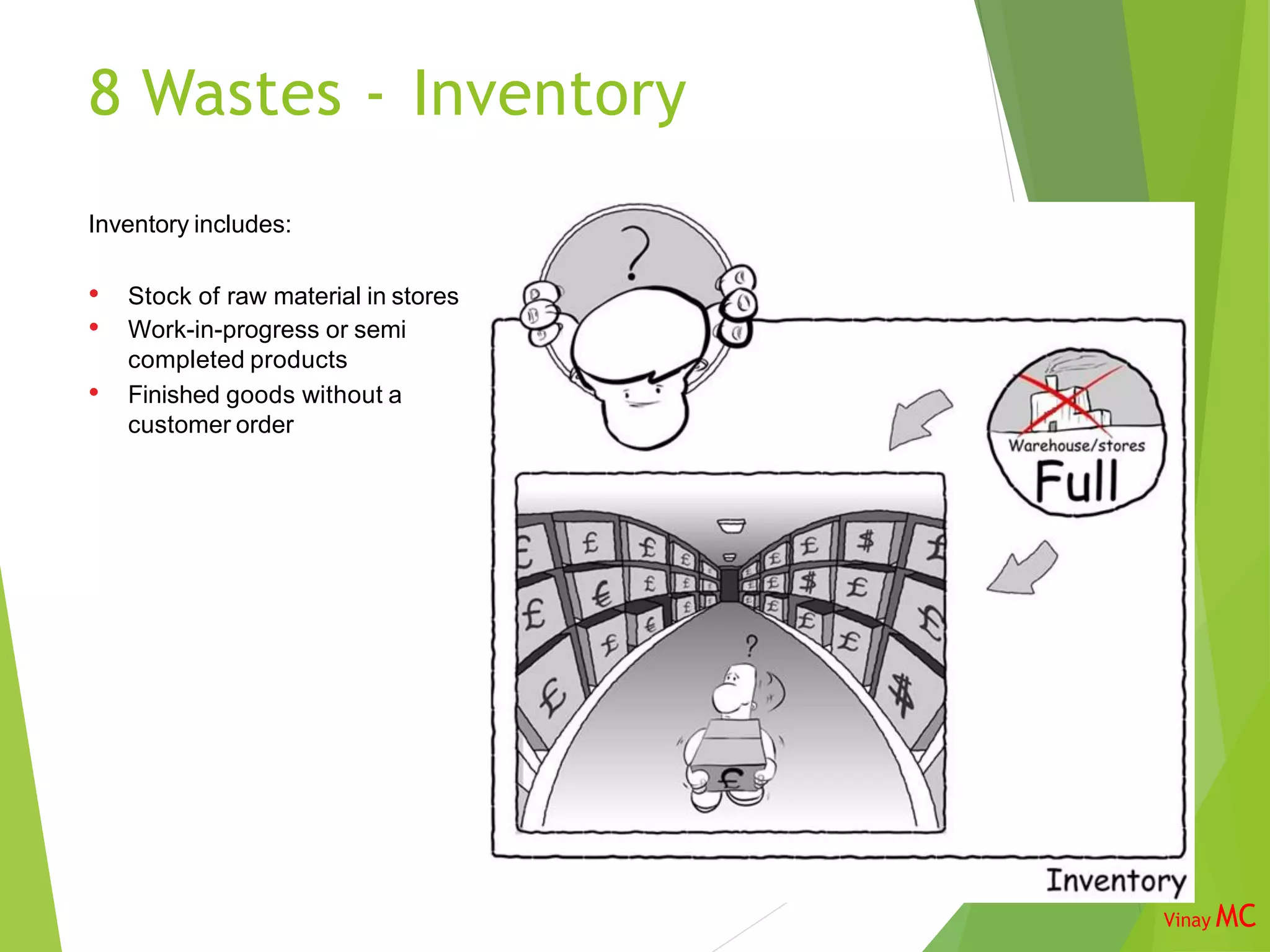
8 Wastes - Inventory
Inventory includes:
• Stock of raw material in stores
• Work-in-progress or semi
completed products
• Finished goods without a
customer order
Vinay MC
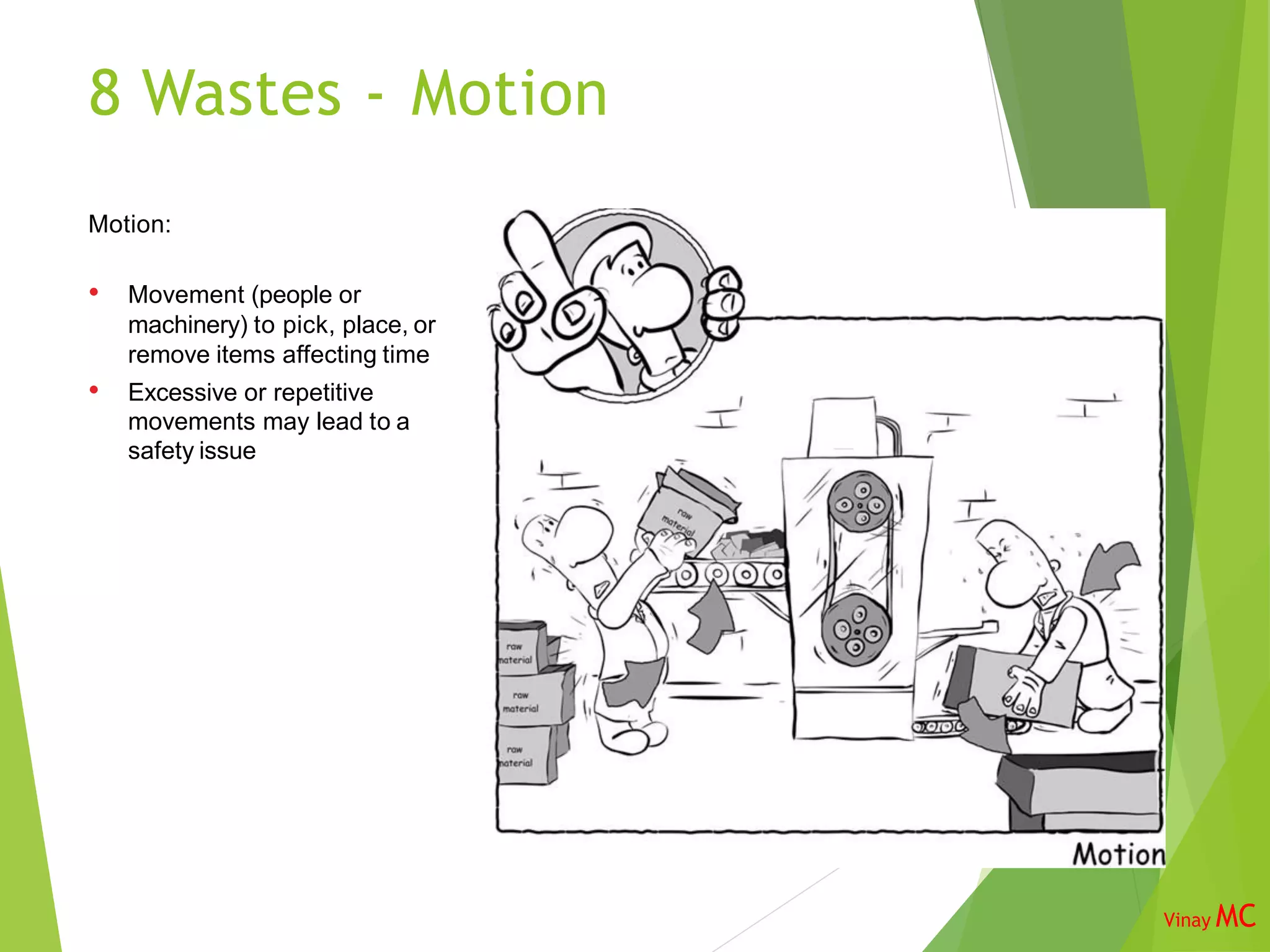
8 Wastes - Motion
Motion:
• Movement (people or
machinery) to pick, place, or
remove items affecting time
• Excessive or repetitive
movements may lead to a
safety issue
Vinay MC
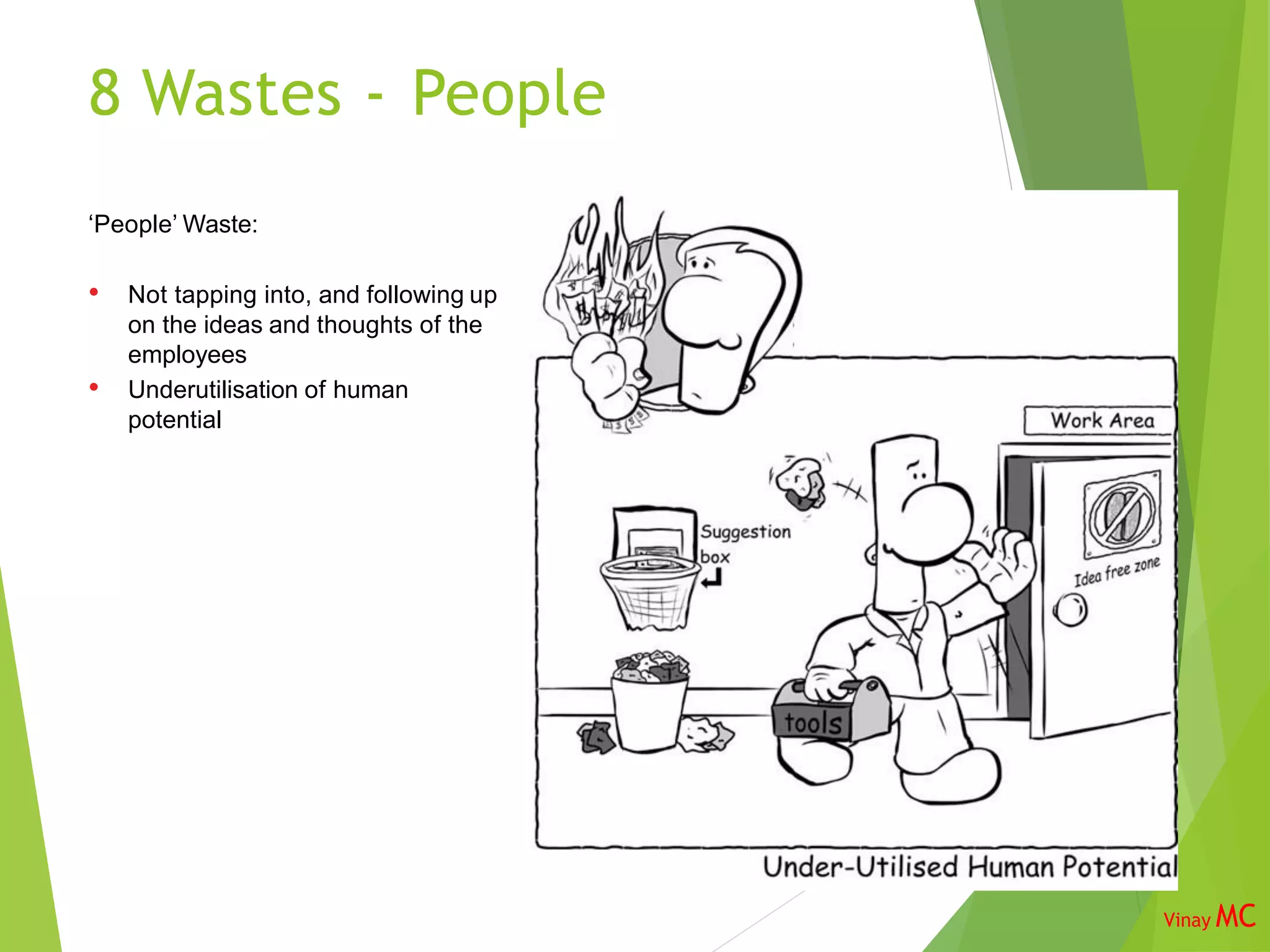
8 Wastes - People
‘People’ Waste:
• Not tapping into, and following up
on the ideas and thoughts of the
employees
• Underutilisation of human
potential
Vinay MC
8 Wastes - Waiting
A process may have stopped and
be waiting for:
• Equipment or tools
• Material deliveries
• Support to resolve issues
• People to complete the task
Also, people waiting for a machine
to complete its cycle.
Vinay MC
8 Wastes – Over
Production
Over producing:
• Making anything more than the
customer requires
Over production is a multiplier of
the other 7 wastes
Vinay MC
8 Wastes – Over
Processing
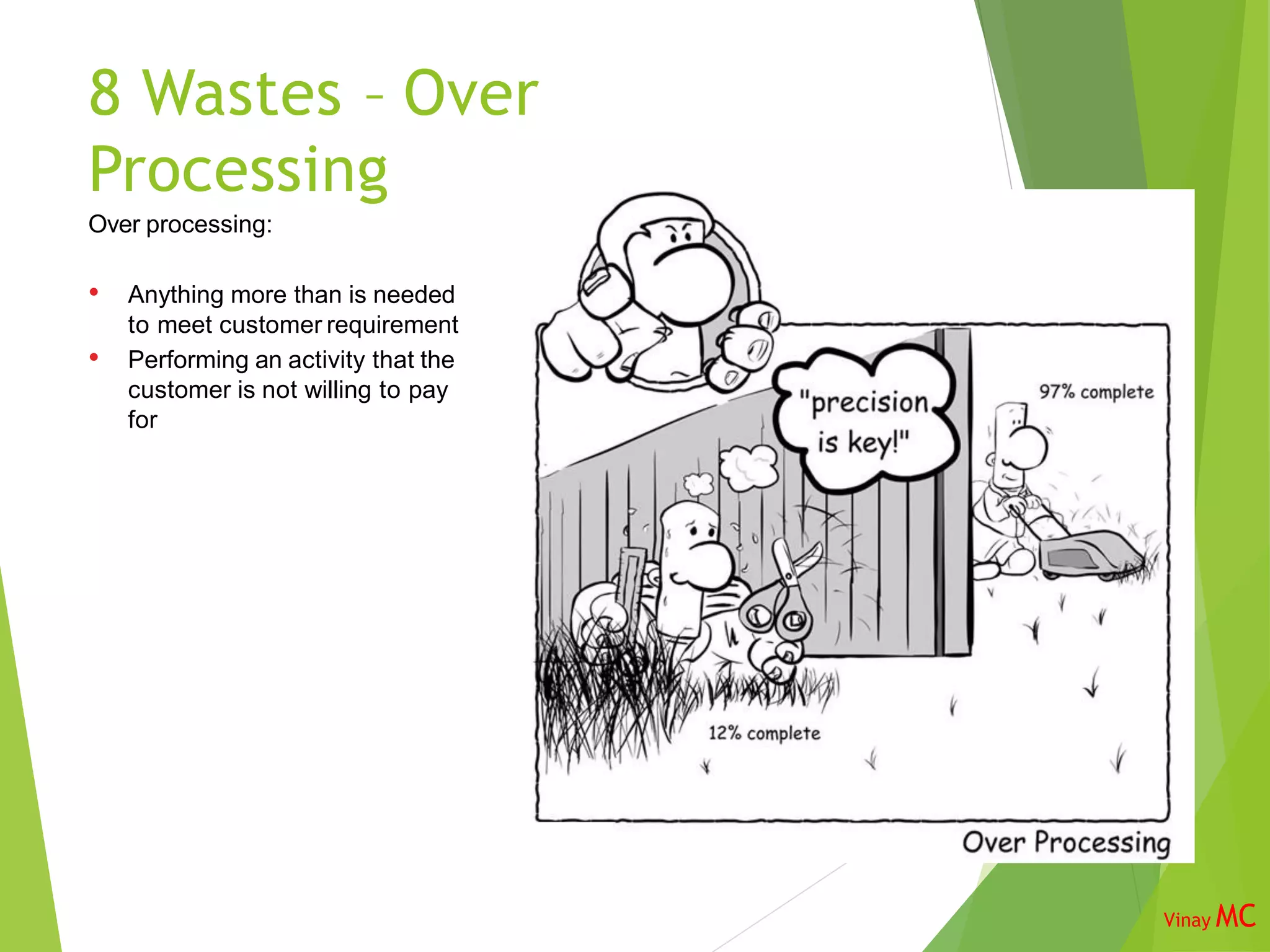
Over processing:
• Anything more than is needed
to meet customer requirement
• Performing an activity that the
customer is not willing to pay
for
Vinay MC
8 Wastes – Defects
(Scrap / Rework)
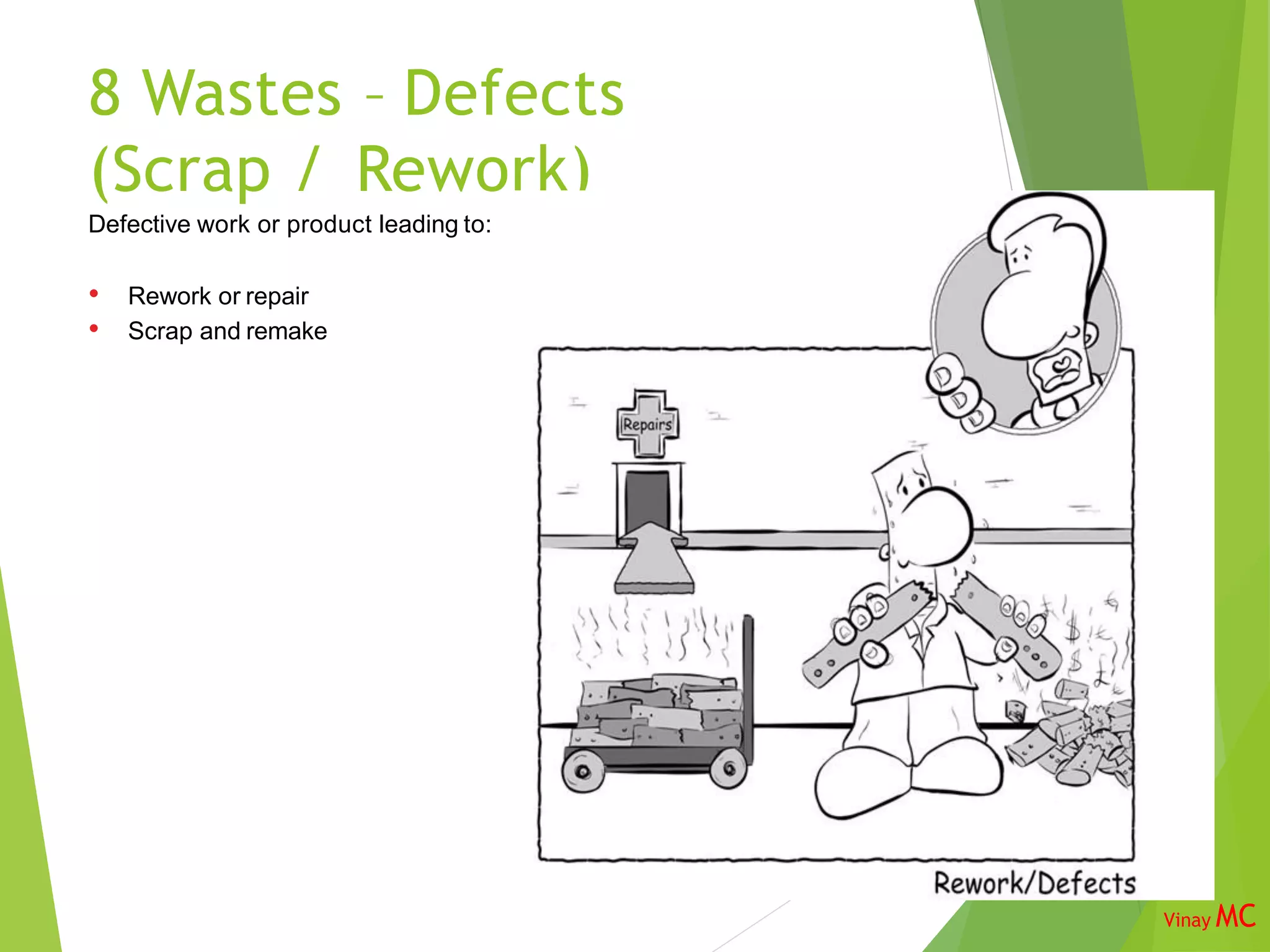
Defective work or product leading to:
• Rework or repair
• Scrap and remake
Vinay MC
Who?
The team members involved include:
• Operations team members to be aware of and highlight wastes
• Operations leaders to identify and effectively manage the reduction
of wastes in their areas
• Manufacturing or production engineers to support identification of
wastes and facilitate improvements
• Quality to identify and lead problem solving of issues causing
defects, also to interpret the minimum standard required by the
customer
• Production planning to manage inventory and avoid
overproduction
• HR to minimise people waste through effective PDR processes and
deployment of skills matrices and training plans
Vinay MC
Summary
There are 3 types of work:
• Activities that add value
• Activities that are non-value adding, but necessary
• Waste
There are 8 categories of waste (TIM P WOOD)
• Transportation
• Inventory
• Motion
• People (Creativity / Intellect)
• Waiting
• Over Production
• Over Processing
• Defects / Rework
Eliminating waste improves safety, quality, delivery and
profitability whilst maximising the potential of personnel
Vinay MC

Six sigma.pdf

  • 1.
    8 WASTES IN LEANSIX SIGMA Vinay MC
  • 2.
    8 Wastes –What is it? A method of categorising activities or Types of Work that do not add value during the production process. These activities are known as Waste. Types of Work ValueAdding Non-Value Adding, but unavoidable Waste Any process that changes the nature, shape or characteristics of the product, in line with customer requirements Non-Value Adding, but unavoidable with current technology or methods. Any work carried out that does not increase product value. All other meaningless, non-essential activities that do not add value to the product you can eliminateimmediately Vinay MC
  • 3.
    Why Use 8Wastes? Safety: Reduces risks through minimising inventory, human movement, transport and product processing Quality: Seeks to eliminate defects and associated scrap or rework Delivery: Improves flow through the business and optimises inventory levels Cost: Profitability improved through elimination of wasteful activities, cash released by reducing lead times and stopping over productions People: Seeks to eliminate the underutilisation of human potential Discuss the benefits of using 8 Wastes Discuss the reasons for applying 8 Wastes in your organisation Vinay MC
  • 4.
    8 Wastes – Purpose& Focus The purpose is to identify and eliminate waste – so that products flow through the business. ValueAdd Waste LEAD TIME Traditional Improvement Focus • Work longer/harder/faster • Add people or equipment Lean Principles Focus • Improve the Value Stream through eliminating Waste Vinay MC
  • 5.
    8 Wastes -Categories There are 8 key Categories of waste: • Transportation • Inventory • Motion • People (Creativity / Intellect) • Waiting • Over Production • Over Processing • Defects / Rework Typically, less than 5% of activity is value-adding. Over Production 95% < 5% Over Processing Defects / Rework Vinay MC
  • 6.
    8 Wastes -Transportation Transportation of work-in-progress or finished goods: • Internal travel between work stations • Travel between business units • Travel between sites. Vinay MC
  • 7.
    8 Wastes -Inventory Inventory includes: • Stock of raw material in stores • Work-in-progress or semi completed products • Finished goods without a customer order Vinay MC
  • 8.
    8 Wastes -Motion Motion: • Movement (people or machinery) to pick, place, or remove items affecting time • Excessive or repetitive movements may lead to a safety issue Vinay MC
  • 9.
    8 Wastes -People ‘People’ Waste: • Not tapping into, and following up on the ideas and thoughts of the employees • Underutilisation of human potential Vinay MC
  • 10.
    8 Wastes -Waiting A process may have stopped and be waiting for: • Equipment or tools • Material deliveries • Support to resolve issues • People to complete the task Also, people waiting for a machine to complete its cycle. Vinay MC
  • 11.
    8 Wastes –Over Production Over producing: • Making anything more than the customer requires Over production is a multiplier of the other 7 wastes Vinay MC
  • 12.
    8 Wastes –Over Processing Over processing: • Anything more than is needed to meet customer requirement • Performing an activity that the customer is not willing to pay for Vinay MC
  • 13.
    8 Wastes –Defects (Scrap / Rework) Defective work or product leading to: • Rework or repair • Scrap and remake Vinay MC
  • 14.
    Who? The team membersinvolved include: • Operations team members to be aware of and highlight wastes • Operations leaders to identify and effectively manage the reduction of wastes in their areas • Manufacturing or production engineers to support identification of wastes and facilitate improvements • Quality to identify and lead problem solving of issues causing defects, also to interpret the minimum standard required by the customer • Production planning to manage inventory and avoid overproduction • HR to minimise people waste through effective PDR processes and deployment of skills matrices and training plans Vinay MC
  • 15.
    Summary There are 3types of work: • Activities that add value • Activities that are non-value adding, but necessary • Waste There are 8 categories of waste (TIM P WOOD) • Transportation • Inventory • Motion • People (Creativity / Intellect) • Waiting • Over Production • Over Processing • Defects / Rework Eliminating waste improves safety, quality, delivery and profitability whilst maximising the potential of personnel Vinay MC