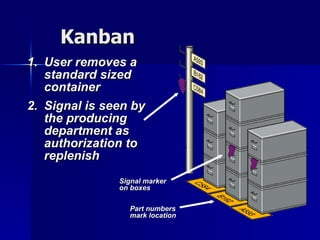
Kanban User removes a standard sized container Signal is seen by the producing department as authorization to replenish Part numbers mark location Signal marker on boxes
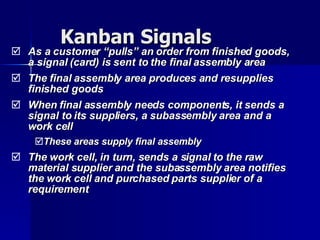
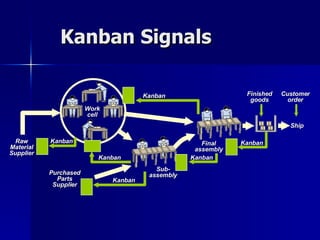
Kanban Signals As a customer “pulls” an order from finished goods, a signal (card) is sent to the final assembly area The final assembly area produces and resupplies finished goods When final assembly needs components, it sends a signal to its suppliers, a subassembly area and a work cell These areas supply final assembly The work cell, in turn, sends a signal to the raw material supplier and the subassembly area notifies the work cell and purchased parts supplier of a requirement
Kanban Signals Purchased Parts Supplier Work cell Raw Material Supplier Kanban Sub-assembly Ship Kanban Kanban Kanban Kanban Finished goods Customer order Final assembly Kanban
Advantages of the Kanban A simple and understandable process Provides quick and precise information Low costs associated with the transfer of information Provides quick response to changes Limit of over-capacity in processes Avoids overproduction Is minimizing waste Control can be maintained Delegates responsibility to line workers


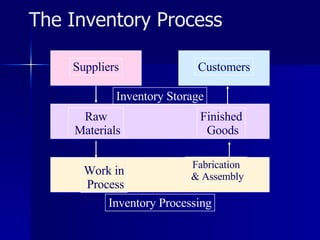
The Inventory Process Suppliers Customers Finished Goods Raw Materials Work in Process Fabrication & Assembly Inventory Storage Inventory Processing
 
 
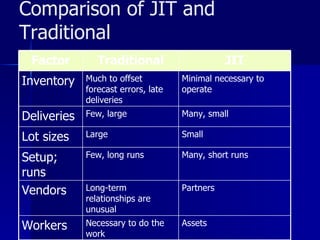
Comparison of JIT and Traditional Assets Necessary to do the work Workers Partners Long-term relationships are unusual Vendors Many, short runs Few, long runs Setup; runs Small Large Lot sizes Many, small Few, large Deliveries Minimal necessary to operate Much to offset forecast errors, late deliveries Inventory JIT Traditional Factor


Just in time

  • 1.
  • 2.
  • 3.
  • 4.
  • 5.
  • 6.
  • 7.
  • 8.
  • 9.
  • 10.
  • 11.
  • 12.
  • 13.
    Kanban User removesa standard sized container Signal is seen by the producing department as authorization to replenish Part numbers mark location Signal marker on boxes
  • 14.
    Kanban Signals Asa customer “pulls” an order from finished goods, a signal (card) is sent to the final assembly area The final assembly area produces and resupplies finished goods When final assembly needs components, it sends a signal to its suppliers, a subassembly area and a work cell These areas supply final assembly The work cell, in turn, sends a signal to the raw material supplier and the subassembly area notifies the work cell and purchased parts supplier of a requirement
  • 15.
    Kanban Signals PurchasedParts Supplier Work cell Raw Material Supplier Kanban Sub-assembly Ship Kanban Kanban Kanban Kanban Finished goods Customer order Final assembly Kanban
  • 16.
    Advantages of theKanban A simple and understandable process Provides quick and precise information Low costs associated with the transfer of information Provides quick response to changes Limit of over-capacity in processes Avoids overproduction Is minimizing waste Control can be maintained Delegates responsibility to line workers
  • 17.
  • 18.
  • 19.
  • 20.
  • 21.
  • 22.
    The Inventory ProcessSuppliers Customers Finished Goods Raw Materials Work in Process Fabrication & Assembly Inventory Storage Inventory Processing
  • 23.
  • 24.
  • 25.
    Comparison of JITand Traditional Assets Necessary to do the work Workers Partners Long-term relationships are unusual Vendors Many, short runs Few, long runs Setup; runs Small Large Lot sizes Many, small Few, large Deliveries Minimal necessary to operate Much to offset forecast errors, late deliveries Inventory JIT Traditional Factor
  • 26.
  • 27.
  • 28.
  • 29.
  • 30.
  • 31.
  • 32.
  • 33.
  • 34.
  • 35.