SHORT-TERM DATA LOGGING TO IDENTIFY LOW-COST/NO-COST OPPORTUNITIES
FOR IMPROVING ENERGY EFFICIENCY
Tom White, P.E., CEM; Chief Engineer, Green Building Initiative
Ken Anderson, P.E.; Principal, The Energy Gleaners
Paul Williamson, EMC; Principal, Planwest Partners
Kevin Stover, P.E.; Commercial Programs Consultant, Green Building Initiative
ABSTRACT
The objective of energy auditing is to uncover opportunities for
improving energy efficiency at a facility and to collect
information useful for estimating potential savings from selected
energy efficiency measures (EEMs). This paper describes an
approach for using data loggers and hand-held instruments to
record key operating parameters of energy using equipment.
The emphasis is on: (1) inventorying energy systems;
(2) identifying key operating variables to be measured (what
short-term data to collect); (3) specifying data collection points
(for where and how to instrument or monitor a system);
(4) analyzing the data and apportioning annual energy by end
uses; and (5) estimating the energy savings that can be attributed
to low-cost/no-cost EEMs, which subsequently can be
implemented as a result of the auditing, data collection, and
analysis. An example of calculating energy savings for a
compressed air system, using this five-step approach, is reviewed.
OVERVIEW: ENERGY AUDITING TO IDENTIFY
ENERGY EFFICIENCY OPPORTUNITIES
The Green Building Initiative (GBI) in Portland, Oregon is the
licensed developer of the Green Globes ™ rating system in the
United States. The Green Globes environmental criteria used for
certifying sustainable commercial buildings are based on best-
practices in seven key areas: integrated project management and
design, site development, energy efficiency, water use, materials
selection, indoor environmental quality, and reduced emissions.
Although a building’s architecture and engineered systems are the
basis for a sustainable design, the performance of a building is
highly dependent on how the building is operated. This principle
of managing operations to achieve high performance is especially
true for energy systems.
Quoting a common business aphorism, “You can’t improve what
you don’t measure,” gets right to the point of this paper. Without
knowing how energy systems are actually performing, it’s not
possible to determine the relative impact any remedial action
might have for improving a system’s energy efficiency. This
paper takes a practical, first-hand look at how to collect key
operating information and evaluate the performance of common
energy systems in buildings.
With measured results in hand, energy analysts can determine
reasonable estimates of energy savings that can be attributed to
applied energy efficiency measures (EEMs). Once the challenge
of data collection and analysis has been addressed, the
implementation of recommended no-cost/low-cost measures to
realize energy savings can be passed on to the building owners or
managers to take corrective action.
Energy-efficient systems, left by themselves, cannot be expected
to generate energy savings. These systems have to be managed –
by adjusting set points, reversing operation overrides, re-
commissioning equipment and sequences of operation,
implementing preventive maintenance to avert performance drift
or degradation, and committing to a host of other follow-through
operations and management (O&M) activities that help ensure
energy-efficient performance. Research from a number of studies
[1] suggests that active O&M and occupant behavior practices
can alter energy use significantly, resulting in savings in the range
of 5% to 15%. What’s even better, such improvement strategies
can most often be implemented for little or no cost.
A general approach for realizing energy savings can be
summarized as a sequence of seven steps, outlined by asking the
following key questions:
1. Where is energy being used in my facility? [taking an
inventory]
2. What data do I collect to characterize how my systems are
operating? [depends on the system]
3. How do I measure these data? [using short-term
logging/data collection methods and tools]
4. How do I analyze the collected data to estimate annual
energy end use? [system-specificexamples are explained]
5. What kind of energy efficiency measures (EEMs) can be
applied to thesesystems?
6. How do I calculate energy savings from the proposed
EEMs?
7. What are thefinancial criteria for selecting no-cost/low-
cost EEMs for improving energy efficiency?
Of course, answers to these questions depend on the energy
systems in use at a given site. The overriding question comes
down to this: What kind of short-term data can I collect, on which
systems, and how would I analyze this data to estimate energy
savings that are possible from low-cost/no-cost EEMs?
Levels of energy auditing – different emphasis, different
outcomes
Energy auditing is the practice of assessing how energy is used at
a site, for the purpose of identifying opportunities for eliminating
waste and improving energy-efficient operation. ASHRAE
describes three levels of energy audits [2], which are successive
levels of energy use investigation summarized as follows:
Level I – A walk-thru of the building and its systems, gathering
information that can be collected mainly by observation and spot
measurements, such as ambient space temperatures, lighting
levels, or inches of duct or pipe insulation. No detailed
measurement or analyses are involved. Recommended EEMs are
based on what is apparent and can be readily adjusted or fixed,
such as: lighting levels too high, windows or doors not closing or
left open, dampers rusted shut, valves stuck, inadequate pipe and
duct insulation, space temperatures too high/too low, or systems
operating when not needed.
Level II – A higher-level effort to collect data for characterizing
system operations and for identifying potential EEMs and
corresponding savings. For example: temperature, pressure, and
flow data for assessing whether air or water systems are operating
within design; voltage, amp, and power factor to characterize
motor performance; exhaust gas analysis to determine boiler
operating efficiency; lighting schedules and switching controls to
evaluate whether lighting meets or exceeds occupant needs.
A key objective of a Level II audit might be to complete an
estimate and apportioning of the building’s annual kWh and
therm usage split out by end uses – heating, cooling, lighting, hot
water, fans and pumps, ventilation, and plug loads. Level II
results are often the basis for determining what systems might
warrant a Level III audit.
Level III – Often referred to as an “investment grade audit,” this
level of audit implies full characterization of major energy
systems such as boilers or chillers, over a range of operating
conditions. The purpose is to learn, with some accuracy and
confidence, what the energy use differences would be if you were
to spend a lot of money to swap out the current system or its
major components with expensive new or refurbished equipment.
For example, an investment grade audit (Level III) might be
carried out to derive a part load performance curve for an existing
chiller, and corresponding kW/ton efficiency at each operating
point. Using life-cycle costing and engineering analysis, the
performance results and operating costs of this chiller would be
compared to a replacement chiller, figuring out the kW/ton
differences and the expected energy savings over the life of the
system. From these results, you’d get a rate of return (ROI) for an
investment.
One emphasis of a Level III audit might be to collect enough
building operations and control data to inform a building energy
model to the extent that the “tuned” model accurately represents
that actual building performance. Once the building model has
been calibrated with Level III data, the model can be run with any
“what if” scenario, allowing analysts to look are realistic energy
use profiles of individual systems.
DATA COLLECTION – LOGGING, METERING,
MONITORING
The terms data collection, logging, metering, and monitoring are
often bandied about interchangeably.
Metering and monitoring are often used synonymously, with the
difference being that metering uses instruments to measure data
elements whereas monitoring implies a broader effort to collect,
but also especially, measure key performance information.
Metering implies measurement of a quantity such as gallons,
kWh, Btus or CFM and the data is a snapshot at a given moment.
Monitoring is a generic term for tracking any energy use on any
scale, perhaps to compare results against an objective. For
example, energy use monitoring could mean to gather and review
kWh and therms from monthly utility bills and evaluate whether
the totals are within range of an expected value.
Logging is a term that spans both quantitative measurements of
operational data, but also accounts for key parameters such as
how frequently a compressor engages or lights turn on and off.
Logging also implies collection of data over time rather than a
one-time measurement.
Data collection covers the gamut of all kinds of information
gathered by multiple means – values from monthly utility meters
for gas, water, electricity; number of times a compressor motor
starts and stops in a given interval, the pressures at different
points in a piping system; a histogram of the range of responses
from building occupants on a thermal comfort survey. The
variation in the types and frequency, and the degree of resolution
and different methods of data collection, vary widely. The key
question would be: What systems do you want to evaluate and
what are the operating parameters that define the system’s
performance?
For example, say you want to determine the energy use of a
pump. In this case, you would measure the pressure difference
across the pump (head), its RPM, the voltage and current to the
motor (multiple legs if the motor is more than one phase), and the
power factor. With this data, you can plot the operating
conditions of the pump using the manufacturer’s pump curves
and determine pump efficiency, gpm, and kW. With additional
information about pump ON-OFF cycling times you can create
and operational profile and then calculate cumulative energy use.
If the pump cycles are intermittent or the pump operates at
different RPMs, the calculation of aggregate energy use can be a
little more complicated. But, typical use patterns, logged over
short periods of time, give you a basis for aggregating total
energy.
If adding a VFD to a pump motor is an energy-efficiency option,
you can use affinity laws or more exacting power calculations to
determine energy savings at different RPMs or gpm flows, head
pressures, and kW levels.
Another example of short term system measurements might be in
evaluating the heating and cooling heating capacities (in Btu/hr)
of an air handler, at different air delivery rates, and at various
cooling and heating coil temperatures and flows. Your purpose
might be to characterize the system sufficiently to optimize
cooling coil gpm for a given delta-T at varying rates of supply air
CFM delivered. Your objective might be to measure fan and
pump energy with an eye toward modifying controls or adding
VFDs to make fan and pump operations more efficient.
As with most any energy systems, performing a First Law energy
balance would be the approach. A system diagram of the air
handler, with its mass and energy inputs and outputs, suggests
what operating variables to measure at what points of the system.
To evaluate air handler performance, you would need to collect
data on at least the following parameters: temperature, humidity,
and CFM of the return (RA) and outside air (OA) streams
(inputs), and thesame parameters for thesupply (SA) and exhaust
(EA) air streams (outputs);flow rates and temperatures in and out
of the cooling and heating coils; the air temperatures before and
after passing over the heating and cooling coils. And, of course,
the electrical energy to fans and pumps would have to be
accounted for through measurement.
Sources andtypes of data to be gatheredfor energy auditing
There are many kinds of useful information that can be collected
in an audit, both qualitative and quantitative, which you can use
to inform your assessment of how energy systems are performing
and how to improve those systems.
Audits can cover a broad range of data and information, from
surveys or interviews of occupants, to detailed, automated
electronic reporting of key operating characteristics, systemby
system.
There are two general classes of information or data to be
gathered – quantitative and qualitative – and two ways to go
about gathering key information, by observation and by
measurement.
Quantitativedata have numeric values: 40°F, 125 psi, 12 minute
cycles, 341 kWh – and lends themselves to calculations and
analysis. Qualitative information is more about characterizing a
status or condition: “Windows were left open over-night; the
boiler is 25 years old and badly in need of repair.” Qualitative
information can inform what kinds of quantitative data might
need to be collected to resolve open questions about system
performance – suggesting what systems an audit needs to focus
on.
Although measurements are clearly quantitative, observations can
be both quantitativeand qualitative, depending on what is
observed: “insulation levels were applied inconsistently along the
piping,” or “only 3ft of the 21ft pipelength was insulated.”
Here is a list of key information sources and thekinds of results
that can be gleaned from thedetails:
 Surveys and interviews, O&M records – Useful for
identifying occupancy concerns, O&M issues, repairs and
change histories.
 Building drawings and equipment schedules –
Typically indicate how the building is zoned, conditioned,
lighted, and the capacities and specifications and controls
for major energy systems such as HVAC and lighting,
envelope construction – although the older the building,
the less likely the details are accurate.
 Monthly utility bills – At least a year’s worth of monthly
gas and electricity or other fuel bills reveal patterns of
energy use. Seasonal variations and peak demands can be
gleaned from the bills, and the kWh and therm profiles are
essential for calibrating building energy models. For
example, if gas is only used for hot water and space
heating, and there is no heating during the summer
months, the gas usage profile during the summer
represents only hot water heating, which might be taken
as a relative constant load.
 Utility interval data – With the advent of electricity
smart meter technology, facilities have begun using 15-
minute interval data, rather than relying only on a single
monthly value, to detect anomalies and variations in
operating schedules. Interval metering is a powerful tool
for evaluating energy use impacts from such factors
differences in occupancy profiles (weekday/weekend,
occupied/unoccupied), utility-triggered demand response
(turning off air-conditioners for short, rolling periods),
after hours events, and human overrides of control settings
such as lighting sweeps.
 Building Automation System (BAS)/Energy Manage-
ment System (EMS) – Thesecentralized controls systems
have dozens of inputs and outputs – including zone
temperature set-points, ventilation rate scheduling,
lighting controls. Polling the building BAS/EMS offers an
opportunity to track variables and trend energy use
correlated with other factors, such as outdoor weather,
occupancy patterns, and control sequences of operation.
 End-use profile monitoring – Emphasis on short-term
metering and logging to develop operation profiles of
energy systems, measuring such values as lighting levels,
temperatures, pressures, flows, power, run time, humidity,
CO2, and other key variables that influence energy system
controls and performance.
FIELD AUDITING TOOLS AND DATA LOGGERS
Once the data collection points are identified, the next step in
planning for an audit is to select appropriate instrumentation to
measure the operating parameters, or variables, of the energy
systems. There is virtually no limit to the variety and capabilities
of different instrumentation and measuring devices.
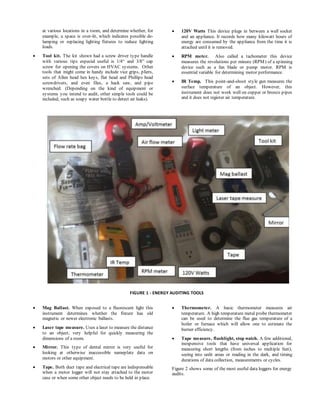
Some examples of hand-held tools are shown in Figure 1, and
many of these devices are relatively inexpensive. Here, you see
some energy auditing tools used to make spot checks of lighting
levels, power draw of electrical equipment, temperature, air flow,
rotational speed, and other operating parameters.
 Flow rate bag. A simple calibrated bag that is used to
check the water flow rate from faucets and shower heads
when there is no labeled aerator.
 Amp/Voltmeter. A clamp-on device for checking power
or current draw through one leg of an electrical device. A
one-time check of current and voltage of each leg can be
used to get an estimate of total energy use when only one
leg is data logged.
 Air flow meter. A wheel-type anemometer with around
fan that spins as air flows through it. The display reads
the air velocity. You can use this instrument, for example,
to check various locations across a vent or duct, then
average the velocity and multiply by the cross-sectional
area to get an estimate of the CFM air flow.
 Light meter. This device has an electric eye on the spiral
cord placed horizontally on its face to measure the foot
candle of illumination. You can spot check lighting levels
at various locations in a room, and determine whether, for
example, a space is over-lit, which indicates possible de-
lamping or replacing lighting fixtures to reduce lighting
loads.
 Tool kit. The kit shown had a screw driver type handle
with various tips especial useful is 1/4“ and 3/8” cap
screw for opening the covers on HVAC systems. Other
tools that might come in handy include vice grips, pliers,
sets of Allen head hex keys, flat head and Phillips head
screwdrivers, and even files, a hack saw, and pipe
wrenched. (Depending on the kind of equipment or
systems you intend to audit, other simple tools could be
included, such as soapy water bottle to detect air leaks).
 Mag Ballast. When exposed to a fluorescent light this
instrument determines whether the fixture has old
magnetic or newer electronic ballasts.
 Laser tape measure. Uses a laser to measure the distance
to an object; very helpful for quickly measuring the
dimensions of a room.
 Mirror. This type of dental mirror is very useful for
looking at otherwise inaccessible nameplate data on
motors or other equipment.
 Tape. Both duct tape and electrical tape are indispensable
when a motor logger will not stay attached to the motor
case or when some other object needs to be held in place.
 120V Watts This device plugs in between a wall socket
and an appliance. It records how many kilowatt hours of
energy are consumed by the appliance from the time it is
attached until it is removed.
 RPM meter. Also called a tachometer this device
measures the revolutions per minute (RPM) of a spinning
device such as a fan blade or pump motor. RPM is
essential variable for determining motor performance.
 IR Temp. This point-and-shoot style gun measures the
surface temperature of an object. However, this
instrument does not work well on copper or bronze pipes
and it does not register air temperature.
 Thermometer. A basic thermometer measures air
temperature. A high temperature metal probe thermometer
can be used to determine the flue gas temperature of a
boiler or furnace which will allow one to estimate the
burner efficiency.
 Tape measure, flashlight, stop watch. A few additional,
inexpensive tools that have universal application for
measuring short lengths (from inches to multiple feet),
seeing into unlit areas or reading in the dark, and timing
durations of data collection, measurements or cycles.
Figure 2 shows some of the most useful data loggers for energy
audits.
FIGURE 1 - ENERGY AUDITING TOOLS
 Temp/RH/light logger. This instrument has an internal
temperature sensor and relative humidity sensor and a
built-in light meter so it measures and logs these values
over time. It also has one external input that can accept an
external sensor such as a temperature or a current sensor.
 4-External channel logger. This instrument has no
internal sensors but has four external inputs to accept
temperature, CO2, current, voltage and other sensors.
 5-wrap coil. This home-made coil of wire can be inserted
in-line on one leg of a motor or other electrical power
line. The five wraps when run through a current
transformer will amplify the reading so a 5 Amp current
would read as 25 Amps, making it possible to use an
oversized current transformer (CT) to measure current
flow to a smaller device or motor.
 Clamp-on CTs. Also called a split core Current
Transformer, this instrument measures in Amps the
current flowing through a wire inside its loop. One CT is
rated for 20 to 200 Amps. The smaller CT of 100 Amps
can measure a maximum current: if applied to a wire
carrying more than 100 Amps, this unit will register up to
its 100 Amp read-out and stop. For this reason, a low
range CT is only accurate down to 10 Amps. If the subject
current wire runs less than 10 Amps the 5-wrap coil can
be used to register current as low as 2 Amps.
 External Temperature Sensor. This device is a
thermistor-type temperature sensor with a 25 foot cable.
It is only good for temperatures in the range of 32°F to
212°F.
 Motor ON/OFF Logger. This device detects the
magnetic field of a motor when it is running and uses this
information to record when the motor comes ON and
when it goes OFF.
EXAMPLE OF HOW END-USE METERING
INFORMS ENERGY AUDIT RESULTS
During 2013 – 2014, Ken Anderson and Paul Williams, two of
the authors of this paper, performed a series of energy audits for
several Portland-area buildings under theauspices of the Existing
Buildings Program of the Oregon Energy Trust [4]. An example
from their field work and energy analysis results is presented
here. Thepurposeof the systemcharacterizations was to
establish a baseline of energy use, and to identify energy
efficiency measures that could be applied to reduce utility bills
for the building owner.
FIGURE 2 - Data Monitoring Tools Used in Energy Audits
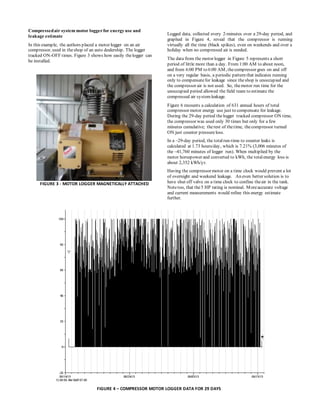
FIGURE 4 – COMPRESSOR MOTOR LOGGER DATA FOR 29 DAYS
Compressedair system motor loggerfor energy use and
leakage estimate
In this example, the authors placed a motor logger on an air
compressor, used in theshop of an auto dealership. The logger
tracked ON-OFF times. Figure 3 shows how easily thelogger can
be installed.
Logged data, collected every 2-minutes over a 29-day period, and
graphed in Figure 4, reveal that the compressor is running
virtually all the time (black spikes), even on weekends and over a
holiday when no compressed air is needed.
The data from the motor logger in Figure 5 represents a short
period of little more than a day. From 1:00 AM to about noon,
and from 6:00 PM to 6:00 AM, thecompressor goes on and off
on a very regular basis, a periodic pattern that indicates running
only to compensatefor leakage since theshop is unoccupied and
the compressor air is not used. So, themotor run time for the
unoccupied period allowed the field team to estimate the
compressed air systemleakage.
Figure 6 recounts a calculation of 631 annual hours of total
compressor motor energy use just to compensate for leakage.
During the 29-day period thelogger tracked compressor ON time,
the compressor was used only 30 times but only for a few
minutes cumulative; the rest of thetime, thecompressor turned
ON just counter pressureloss.
In a ~29-day period, the totalrun-time to counter leaks is
calculated at 1.73 hours/day, which is 7.21% (3,006 minutes of
the ~41,760 minutes of logger run). When multiplied by the
motor horsepower and converted to kWh, the totalenergy loss is
about 2,352 kWh/yr.
Having the compressor motor on a time clock would prevent a lot
of overnight and weekend leakage. An even better solution is to
have shut off valve on a time clock to confine theair in the tank.
Notetoo, that the5 HP rating is nominal. Moreaccurate voltage
and current measurements would refine this energy estimate
further.
FIGURE 3 - MOTOR LOGGER MAGNETICALLY ATTACHED
TO COMPRESSOR MOTOR
2 minute intervals fromlogger
41,760 loggerduration,minutes = ~29 days * 24 hr/day* 60 min/hr
3,006 total minutesrunningtocompensate forleaks fromlogger
7.2% runtime of compressorON forleakcompensation = (3006 / 42102)
696 hourscompressorON time,leakcompensation = 41760 min/ (60 min/hr)
29 days,durationof logging fromlogger
1.73 hours/day compressorON tocompensate forleak
= [(696 hr duration/29days) *
7.2%]
631 annual compressorON forleakcompensation,hours = 365 days * 1.73 hr/day
5 HP compressorrating fromcompressornameplate
0.746 kW/HP conversionfactor
2,352 kWh due to leaks, peryear = 631 hr * 5 hp * 0.746 kW/HP
FIGURE 6 – TOTAL COMPRESSOR MOTOR ENERGY USE CALCULATION
FIGURE 5 - DETAILED MOTOR RUN TIME
SUMMARY AND RECOMMENDATIONS
When entering a site to conduct an energy audit, a few important
guidelines are worth keeping mind.
 Safety first and always! Many kinds of measurements –
especially those involving electricity or high temperatures
– present serious hazards. No one should attempt auditing
and data collection without proper training and without
wearing appropriate protective clothing.
 What to meter and measure. With limited time and
resources, it’s important to focus auditing efforts on
systems that are likely to result in the largest savings.
 Accuracy. With instruments, both the measurement range
and accuracy are key factors in collecting useful data.
Instruments must be properly calibrated and the range of
data read-out be selected according to the expected values
to be measured.
 Spot checking. You can use spot checks to calibrate
metering sensors for example, measure a known value and
compare it an instrument reading.
 Sensor response time. An instrument must have a short
enough response time lag that it can measure a variable
value that is changing rapidly.
 Enough data? For any measured parameter, it is
important think through how long to meter and what time
interval to use if sufficient data and resolution is to be
gained.
 General rule. The longer you measure, the more useful or
sufficient the results. But, too much data is a waste.
 Adjusting for seasonal variation. Weather and other
external variables can significantly affect the performance
of energy systems. It’s important to take into account
seasonal variations when characterizing the performance
of such systems.
 Interval duration. Intervals need to be short enough to
capture changes in state that might occur between
measurements.
 Data logging multiple variables. When setting up data
logging periods, it’s important to match intervals so that
the data profiles from multiple parameters can be
combined on one graph.
REFERENCES
[1] No-Cost/Low-Cost EEMs – A Guide to Energy Audits
http://www.pnnl.gov/main/publications/external/technical_re
ports/pnnl-20956.pdf
http://www.ecova.com/media/173057/no-cost_low-
cost_conservation_strategies.pdf
[2] ASHRAE levels of audit
http://www.microgrid-solar.com/2010/11/the-difference-
between-ashrae-level-1-2-3-energy-audits/
[3] CBECS Commercial Buildings Energy Consumption Survey
http://www.eia.gov/consumption/commercial/
[4] Energy Trust of Oregon, Existing Buildings Program
http://energytrust.org/commercial/equipment-upgrades-
remodels/
[5] PNNLre-tuning website
http://buildingretuning.pnnl.gov/index.stm
[6] IPMVP protocols website http://www.evo-world.org/
[7] UC Berkeley M+Vwebsite http://mnv.lbl.gov/home
AUTHOR BIOS
Tom White is the chief engineer at the Green Building Initiative
(GBI), based in Portland, Oregon. Tom’s primary responsibilities
include investigating and resolving technical issues, ensuring that
Green Globes and Guiding Principles rating systems and criteria
are well-founded in both concept and application, and offering
guidance and direction to customers on initiatives that affect their
green building projects. Tom is a registered professional
engineer, with CEM and LEED AP credentials, and holds both
bachelors and master's degrees in mechanical engineering.
tom@thegbi.org
Kevin Stover is a registered professional engineer and the
commercial programs consultant with the Green Building
Initiative. Kevin’s technical guidance supports the development
and application of the Green Globes rating systems for certifying
the design, construction and operation of commercial green
buildings. Kevin is responsible for tracking registered projects,
collaborating with staff members and customers, alike;
addressing technical issues; and reaching out to prospective users,
organizations and public organizations. kevin@thegbi.org
Ken Anderson is registered mechanical engineer, principal of the
Energy Gleaners, a Portland-area company providing high end
engineering and energy services to building owners in Oregon as
well as other parts of the country. Ken has more than 30 years of
experience in field work evaluation and analysis of energy
systems. kenja777@comcast.net
Paul Williamson, principal of Planwest Partners, has spent most
of his career in the management and delivery of energy efficiency
programs, products, and services. As the Energy Smart Design
program manager for Clark Public Utilities in Washington, Paul
delivered energy efficiency design and commissioning services to
several hundred utility customers who also received incentives
for their building improvements. He worked closely with building
design teams and their contractors as well as vendors of energy-
efficient products.
At Ecos Consulting, Paul was a program coordinator for the
regional ENERGY STAR Lighting and ENERGY STAR Homes
NW programs, establishing successful networks with trade allies,
supporting training programs and maintaining utility
relationships. His direct industry experience includes managing
Energy Star light fixture manufacturing and distribution for both
national and regional companies. While working for Seattle and
Globe Lighting, he secured the highest honors available in this
industry from the National ENERGY STAR Lighting Program
including the Lighting Retailer of the Year Award in 2008. In the
last several years, Paul has designed a suite of portable high
efficiency task/ambient light fixtures, built prototypes and
demonstrated them for leaders in the efficient lighting industry.
Paul holds a B.S. degree from the University of Oregon School of
Architecture and Allied Arts and an Energy Management
Certificate through the Northwest Water and Energy Education
Institute. pwilliamson5158@gmail.com

WEEC_White-Anderson_01OCT2014-FINAL

  • 1.
    SHORT-TERM DATA LOGGINGTO IDENTIFY LOW-COST/NO-COST OPPORTUNITIES FOR IMPROVING ENERGY EFFICIENCY Tom White, P.E., CEM; Chief Engineer, Green Building Initiative Ken Anderson, P.E.; Principal, The Energy Gleaners Paul Williamson, EMC; Principal, Planwest Partners Kevin Stover, P.E.; Commercial Programs Consultant, Green Building Initiative ABSTRACT The objective of energy auditing is to uncover opportunities for improving energy efficiency at a facility and to collect information useful for estimating potential savings from selected energy efficiency measures (EEMs). This paper describes an approach for using data loggers and hand-held instruments to record key operating parameters of energy using equipment. The emphasis is on: (1) inventorying energy systems; (2) identifying key operating variables to be measured (what short-term data to collect); (3) specifying data collection points (for where and how to instrument or monitor a system); (4) analyzing the data and apportioning annual energy by end uses; and (5) estimating the energy savings that can be attributed to low-cost/no-cost EEMs, which subsequently can be implemented as a result of the auditing, data collection, and analysis. An example of calculating energy savings for a compressed air system, using this five-step approach, is reviewed. OVERVIEW: ENERGY AUDITING TO IDENTIFY ENERGY EFFICIENCY OPPORTUNITIES The Green Building Initiative (GBI) in Portland, Oregon is the licensed developer of the Green Globes ™ rating system in the United States. The Green Globes environmental criteria used for certifying sustainable commercial buildings are based on best- practices in seven key areas: integrated project management and design, site development, energy efficiency, water use, materials selection, indoor environmental quality, and reduced emissions. Although a building’s architecture and engineered systems are the basis for a sustainable design, the performance of a building is highly dependent on how the building is operated. This principle of managing operations to achieve high performance is especially true for energy systems. Quoting a common business aphorism, “You can’t improve what you don’t measure,” gets right to the point of this paper. Without knowing how energy systems are actually performing, it’s not possible to determine the relative impact any remedial action might have for improving a system’s energy efficiency. This paper takes a practical, first-hand look at how to collect key operating information and evaluate the performance of common energy systems in buildings. With measured results in hand, energy analysts can determine reasonable estimates of energy savings that can be attributed to applied energy efficiency measures (EEMs). Once the challenge of data collection and analysis has been addressed, the implementation of recommended no-cost/low-cost measures to realize energy savings can be passed on to the building owners or managers to take corrective action. Energy-efficient systems, left by themselves, cannot be expected to generate energy savings. These systems have to be managed – by adjusting set points, reversing operation overrides, re- commissioning equipment and sequences of operation, implementing preventive maintenance to avert performance drift or degradation, and committing to a host of other follow-through operations and management (O&M) activities that help ensure energy-efficient performance. Research from a number of studies [1] suggests that active O&M and occupant behavior practices can alter energy use significantly, resulting in savings in the range of 5% to 15%. What’s even better, such improvement strategies can most often be implemented for little or no cost. A general approach for realizing energy savings can be summarized as a sequence of seven steps, outlined by asking the following key questions: 1. Where is energy being used in my facility? [taking an inventory] 2. What data do I collect to characterize how my systems are operating? [depends on the system] 3. How do I measure these data? [using short-term logging/data collection methods and tools] 4. How do I analyze the collected data to estimate annual energy end use? [system-specificexamples are explained] 5. What kind of energy efficiency measures (EEMs) can be applied to thesesystems? 6. How do I calculate energy savings from the proposed EEMs?
  • 2.
    7. What arethefinancial criteria for selecting no-cost/low- cost EEMs for improving energy efficiency? Of course, answers to these questions depend on the energy systems in use at a given site. The overriding question comes down to this: What kind of short-term data can I collect, on which systems, and how would I analyze this data to estimate energy savings that are possible from low-cost/no-cost EEMs? Levels of energy auditing – different emphasis, different outcomes Energy auditing is the practice of assessing how energy is used at a site, for the purpose of identifying opportunities for eliminating waste and improving energy-efficient operation. ASHRAE describes three levels of energy audits [2], which are successive levels of energy use investigation summarized as follows: Level I – A walk-thru of the building and its systems, gathering information that can be collected mainly by observation and spot measurements, such as ambient space temperatures, lighting levels, or inches of duct or pipe insulation. No detailed measurement or analyses are involved. Recommended EEMs are based on what is apparent and can be readily adjusted or fixed, such as: lighting levels too high, windows or doors not closing or left open, dampers rusted shut, valves stuck, inadequate pipe and duct insulation, space temperatures too high/too low, or systems operating when not needed. Level II – A higher-level effort to collect data for characterizing system operations and for identifying potential EEMs and corresponding savings. For example: temperature, pressure, and flow data for assessing whether air or water systems are operating within design; voltage, amp, and power factor to characterize motor performance; exhaust gas analysis to determine boiler operating efficiency; lighting schedules and switching controls to evaluate whether lighting meets or exceeds occupant needs. A key objective of a Level II audit might be to complete an estimate and apportioning of the building’s annual kWh and therm usage split out by end uses – heating, cooling, lighting, hot water, fans and pumps, ventilation, and plug loads. Level II results are often the basis for determining what systems might warrant a Level III audit. Level III – Often referred to as an “investment grade audit,” this level of audit implies full characterization of major energy systems such as boilers or chillers, over a range of operating conditions. The purpose is to learn, with some accuracy and confidence, what the energy use differences would be if you were to spend a lot of money to swap out the current system or its major components with expensive new or refurbished equipment. For example, an investment grade audit (Level III) might be carried out to derive a part load performance curve for an existing chiller, and corresponding kW/ton efficiency at each operating point. Using life-cycle costing and engineering analysis, the performance results and operating costs of this chiller would be compared to a replacement chiller, figuring out the kW/ton differences and the expected energy savings over the life of the system. From these results, you’d get a rate of return (ROI) for an investment. One emphasis of a Level III audit might be to collect enough building operations and control data to inform a building energy model to the extent that the “tuned” model accurately represents that actual building performance. Once the building model has been calibrated with Level III data, the model can be run with any “what if” scenario, allowing analysts to look are realistic energy use profiles of individual systems. DATA COLLECTION – LOGGING, METERING, MONITORING The terms data collection, logging, metering, and monitoring are often bandied about interchangeably. Metering and monitoring are often used synonymously, with the difference being that metering uses instruments to measure data elements whereas monitoring implies a broader effort to collect, but also especially, measure key performance information. Metering implies measurement of a quantity such as gallons, kWh, Btus or CFM and the data is a snapshot at a given moment. Monitoring is a generic term for tracking any energy use on any scale, perhaps to compare results against an objective. For example, energy use monitoring could mean to gather and review kWh and therms from monthly utility bills and evaluate whether the totals are within range of an expected value. Logging is a term that spans both quantitative measurements of operational data, but also accounts for key parameters such as how frequently a compressor engages or lights turn on and off. Logging also implies collection of data over time rather than a one-time measurement. Data collection covers the gamut of all kinds of information gathered by multiple means – values from monthly utility meters for gas, water, electricity; number of times a compressor motor starts and stops in a given interval, the pressures at different points in a piping system; a histogram of the range of responses from building occupants on a thermal comfort survey. The variation in the types and frequency, and the degree of resolution and different methods of data collection, vary widely. The key question would be: What systems do you want to evaluate and what are the operating parameters that define the system’s performance? For example, say you want to determine the energy use of a pump. In this case, you would measure the pressure difference across the pump (head), its RPM, the voltage and current to the motor (multiple legs if the motor is more than one phase), and the power factor. With this data, you can plot the operating conditions of the pump using the manufacturer’s pump curves and determine pump efficiency, gpm, and kW. With additional information about pump ON-OFF cycling times you can create and operational profile and then calculate cumulative energy use. If the pump cycles are intermittent or the pump operates at different RPMs, the calculation of aggregate energy use can be a little more complicated. But, typical use patterns, logged over short periods of time, give you a basis for aggregating total energy. If adding a VFD to a pump motor is an energy-efficiency option, you can use affinity laws or more exacting power calculations to determine energy savings at different RPMs or gpm flows, head pressures, and kW levels. Another example of short term system measurements might be in evaluating the heating and cooling heating capacities (in Btu/hr) of an air handler, at different air delivery rates, and at various cooling and heating coil temperatures and flows. Your purpose might be to characterize the system sufficiently to optimize cooling coil gpm for a given delta-T at varying rates of supply air CFM delivered. Your objective might be to measure fan and
  • 3.
    pump energy withan eye toward modifying controls or adding VFDs to make fan and pump operations more efficient. As with most any energy systems, performing a First Law energy balance would be the approach. A system diagram of the air handler, with its mass and energy inputs and outputs, suggests what operating variables to measure at what points of the system. To evaluate air handler performance, you would need to collect data on at least the following parameters: temperature, humidity, and CFM of the return (RA) and outside air (OA) streams (inputs), and thesame parameters for thesupply (SA) and exhaust (EA) air streams (outputs);flow rates and temperatures in and out of the cooling and heating coils; the air temperatures before and after passing over the heating and cooling coils. And, of course, the electrical energy to fans and pumps would have to be accounted for through measurement. Sources andtypes of data to be gatheredfor energy auditing There are many kinds of useful information that can be collected in an audit, both qualitative and quantitative, which you can use to inform your assessment of how energy systems are performing and how to improve those systems. Audits can cover a broad range of data and information, from surveys or interviews of occupants, to detailed, automated electronic reporting of key operating characteristics, systemby system. There are two general classes of information or data to be gathered – quantitative and qualitative – and two ways to go about gathering key information, by observation and by measurement. Quantitativedata have numeric values: 40°F, 125 psi, 12 minute cycles, 341 kWh – and lends themselves to calculations and analysis. Qualitative information is more about characterizing a status or condition: “Windows were left open over-night; the boiler is 25 years old and badly in need of repair.” Qualitative information can inform what kinds of quantitative data might need to be collected to resolve open questions about system performance – suggesting what systems an audit needs to focus on. Although measurements are clearly quantitative, observations can be both quantitativeand qualitative, depending on what is observed: “insulation levels were applied inconsistently along the piping,” or “only 3ft of the 21ft pipelength was insulated.” Here is a list of key information sources and thekinds of results that can be gleaned from thedetails:  Surveys and interviews, O&M records – Useful for identifying occupancy concerns, O&M issues, repairs and change histories.  Building drawings and equipment schedules – Typically indicate how the building is zoned, conditioned, lighted, and the capacities and specifications and controls for major energy systems such as HVAC and lighting, envelope construction – although the older the building, the less likely the details are accurate.  Monthly utility bills – At least a year’s worth of monthly gas and electricity or other fuel bills reveal patterns of energy use. Seasonal variations and peak demands can be gleaned from the bills, and the kWh and therm profiles are essential for calibrating building energy models. For example, if gas is only used for hot water and space heating, and there is no heating during the summer months, the gas usage profile during the summer represents only hot water heating, which might be taken as a relative constant load.  Utility interval data – With the advent of electricity smart meter technology, facilities have begun using 15- minute interval data, rather than relying only on a single monthly value, to detect anomalies and variations in operating schedules. Interval metering is a powerful tool for evaluating energy use impacts from such factors differences in occupancy profiles (weekday/weekend, occupied/unoccupied), utility-triggered demand response (turning off air-conditioners for short, rolling periods), after hours events, and human overrides of control settings such as lighting sweeps.  Building Automation System (BAS)/Energy Manage- ment System (EMS) – Thesecentralized controls systems have dozens of inputs and outputs – including zone temperature set-points, ventilation rate scheduling, lighting controls. Polling the building BAS/EMS offers an opportunity to track variables and trend energy use correlated with other factors, such as outdoor weather, occupancy patterns, and control sequences of operation.  End-use profile monitoring – Emphasis on short-term metering and logging to develop operation profiles of energy systems, measuring such values as lighting levels, temperatures, pressures, flows, power, run time, humidity, CO2, and other key variables that influence energy system controls and performance. FIELD AUDITING TOOLS AND DATA LOGGERS Once the data collection points are identified, the next step in planning for an audit is to select appropriate instrumentation to measure the operating parameters, or variables, of the energy systems. There is virtually no limit to the variety and capabilities of different instrumentation and measuring devices. Some examples of hand-held tools are shown in Figure 1, and many of these devices are relatively inexpensive. Here, you see some energy auditing tools used to make spot checks of lighting levels, power draw of electrical equipment, temperature, air flow, rotational speed, and other operating parameters.  Flow rate bag. A simple calibrated bag that is used to check the water flow rate from faucets and shower heads when there is no labeled aerator.  Amp/Voltmeter. A clamp-on device for checking power or current draw through one leg of an electrical device. A one-time check of current and voltage of each leg can be used to get an estimate of total energy use when only one leg is data logged.  Air flow meter. A wheel-type anemometer with around fan that spins as air flows through it. The display reads the air velocity. You can use this instrument, for example, to check various locations across a vent or duct, then average the velocity and multiply by the cross-sectional area to get an estimate of the CFM air flow.  Light meter. This device has an electric eye on the spiral cord placed horizontally on its face to measure the foot candle of illumination. You can spot check lighting levels
  • 4.
    at various locationsin a room, and determine whether, for example, a space is over-lit, which indicates possible de- lamping or replacing lighting fixtures to reduce lighting loads.  Tool kit. The kit shown had a screw driver type handle with various tips especial useful is 1/4“ and 3/8” cap screw for opening the covers on HVAC systems. Other tools that might come in handy include vice grips, pliers, sets of Allen head hex keys, flat head and Phillips head screwdrivers, and even files, a hack saw, and pipe wrenched. (Depending on the kind of equipment or systems you intend to audit, other simple tools could be included, such as soapy water bottle to detect air leaks).  Mag Ballast. When exposed to a fluorescent light this instrument determines whether the fixture has old magnetic or newer electronic ballasts.  Laser tape measure. Uses a laser to measure the distance to an object; very helpful for quickly measuring the dimensions of a room.  Mirror. This type of dental mirror is very useful for looking at otherwise inaccessible nameplate data on motors or other equipment.  Tape. Both duct tape and electrical tape are indispensable when a motor logger will not stay attached to the motor case or when some other object needs to be held in place.  120V Watts This device plugs in between a wall socket and an appliance. It records how many kilowatt hours of energy are consumed by the appliance from the time it is attached until it is removed.  RPM meter. Also called a tachometer this device measures the revolutions per minute (RPM) of a spinning device such as a fan blade or pump motor. RPM is essential variable for determining motor performance.  IR Temp. This point-and-shoot style gun measures the surface temperature of an object. However, this instrument does not work well on copper or bronze pipes and it does not register air temperature.  Thermometer. A basic thermometer measures air temperature. A high temperature metal probe thermometer can be used to determine the flue gas temperature of a boiler or furnace which will allow one to estimate the burner efficiency.  Tape measure, flashlight, stop watch. A few additional, inexpensive tools that have universal application for measuring short lengths (from inches to multiple feet), seeing into unlit areas or reading in the dark, and timing durations of data collection, measurements or cycles. Figure 2 shows some of the most useful data loggers for energy audits. FIGURE 1 - ENERGY AUDITING TOOLS
  • 5.
     Temp/RH/light logger.This instrument has an internal temperature sensor and relative humidity sensor and a built-in light meter so it measures and logs these values over time. It also has one external input that can accept an external sensor such as a temperature or a current sensor.  4-External channel logger. This instrument has no internal sensors but has four external inputs to accept temperature, CO2, current, voltage and other sensors.  5-wrap coil. This home-made coil of wire can be inserted in-line on one leg of a motor or other electrical power line. The five wraps when run through a current transformer will amplify the reading so a 5 Amp current would read as 25 Amps, making it possible to use an oversized current transformer (CT) to measure current flow to a smaller device or motor.  Clamp-on CTs. Also called a split core Current Transformer, this instrument measures in Amps the current flowing through a wire inside its loop. One CT is rated for 20 to 200 Amps. The smaller CT of 100 Amps can measure a maximum current: if applied to a wire carrying more than 100 Amps, this unit will register up to its 100 Amp read-out and stop. For this reason, a low range CT is only accurate down to 10 Amps. If the subject current wire runs less than 10 Amps the 5-wrap coil can be used to register current as low as 2 Amps.  External Temperature Sensor. This device is a thermistor-type temperature sensor with a 25 foot cable. It is only good for temperatures in the range of 32°F to 212°F.  Motor ON/OFF Logger. This device detects the magnetic field of a motor when it is running and uses this information to record when the motor comes ON and when it goes OFF. EXAMPLE OF HOW END-USE METERING INFORMS ENERGY AUDIT RESULTS During 2013 – 2014, Ken Anderson and Paul Williams, two of the authors of this paper, performed a series of energy audits for several Portland-area buildings under theauspices of the Existing Buildings Program of the Oregon Energy Trust [4]. An example from their field work and energy analysis results is presented here. Thepurposeof the systemcharacterizations was to establish a baseline of energy use, and to identify energy efficiency measures that could be applied to reduce utility bills for the building owner. FIGURE 2 - Data Monitoring Tools Used in Energy Audits
  • 6.
    FIGURE 4 –COMPRESSOR MOTOR LOGGER DATA FOR 29 DAYS Compressedair system motor loggerfor energy use and leakage estimate In this example, the authors placed a motor logger on an air compressor, used in theshop of an auto dealership. The logger tracked ON-OFF times. Figure 3 shows how easily thelogger can be installed. Logged data, collected every 2-minutes over a 29-day period, and graphed in Figure 4, reveal that the compressor is running virtually all the time (black spikes), even on weekends and over a holiday when no compressed air is needed. The data from the motor logger in Figure 5 represents a short period of little more than a day. From 1:00 AM to about noon, and from 6:00 PM to 6:00 AM, thecompressor goes on and off on a very regular basis, a periodic pattern that indicates running only to compensatefor leakage since theshop is unoccupied and the compressor air is not used. So, themotor run time for the unoccupied period allowed the field team to estimate the compressed air systemleakage. Figure 6 recounts a calculation of 631 annual hours of total compressor motor energy use just to compensate for leakage. During the 29-day period thelogger tracked compressor ON time, the compressor was used only 30 times but only for a few minutes cumulative; the rest of thetime, thecompressor turned ON just counter pressureloss. In a ~29-day period, the totalrun-time to counter leaks is calculated at 1.73 hours/day, which is 7.21% (3,006 minutes of the ~41,760 minutes of logger run). When multiplied by the motor horsepower and converted to kWh, the totalenergy loss is about 2,352 kWh/yr. Having the compressor motor on a time clock would prevent a lot of overnight and weekend leakage. An even better solution is to have shut off valve on a time clock to confine theair in the tank. Notetoo, that the5 HP rating is nominal. Moreaccurate voltage and current measurements would refine this energy estimate further. FIGURE 3 - MOTOR LOGGER MAGNETICALLY ATTACHED TO COMPRESSOR MOTOR
  • 7.
    2 minute intervalsfromlogger 41,760 loggerduration,minutes = ~29 days * 24 hr/day* 60 min/hr 3,006 total minutesrunningtocompensate forleaks fromlogger 7.2% runtime of compressorON forleakcompensation = (3006 / 42102) 696 hourscompressorON time,leakcompensation = 41760 min/ (60 min/hr) 29 days,durationof logging fromlogger 1.73 hours/day compressorON tocompensate forleak = [(696 hr duration/29days) * 7.2%] 631 annual compressorON forleakcompensation,hours = 365 days * 1.73 hr/day 5 HP compressorrating fromcompressornameplate 0.746 kW/HP conversionfactor 2,352 kWh due to leaks, peryear = 631 hr * 5 hp * 0.746 kW/HP FIGURE 6 – TOTAL COMPRESSOR MOTOR ENERGY USE CALCULATION FIGURE 5 - DETAILED MOTOR RUN TIME
  • 8.
    SUMMARY AND RECOMMENDATIONS Whenentering a site to conduct an energy audit, a few important guidelines are worth keeping mind.  Safety first and always! Many kinds of measurements – especially those involving electricity or high temperatures – present serious hazards. No one should attempt auditing and data collection without proper training and without wearing appropriate protective clothing.  What to meter and measure. With limited time and resources, it’s important to focus auditing efforts on systems that are likely to result in the largest savings.  Accuracy. With instruments, both the measurement range and accuracy are key factors in collecting useful data. Instruments must be properly calibrated and the range of data read-out be selected according to the expected values to be measured.  Spot checking. You can use spot checks to calibrate metering sensors for example, measure a known value and compare it an instrument reading.  Sensor response time. An instrument must have a short enough response time lag that it can measure a variable value that is changing rapidly.  Enough data? For any measured parameter, it is important think through how long to meter and what time interval to use if sufficient data and resolution is to be gained.  General rule. The longer you measure, the more useful or sufficient the results. But, too much data is a waste.  Adjusting for seasonal variation. Weather and other external variables can significantly affect the performance of energy systems. It’s important to take into account seasonal variations when characterizing the performance of such systems.  Interval duration. Intervals need to be short enough to capture changes in state that might occur between measurements.  Data logging multiple variables. When setting up data logging periods, it’s important to match intervals so that the data profiles from multiple parameters can be combined on one graph. REFERENCES [1] No-Cost/Low-Cost EEMs – A Guide to Energy Audits http://www.pnnl.gov/main/publications/external/technical_re ports/pnnl-20956.pdf http://www.ecova.com/media/173057/no-cost_low- cost_conservation_strategies.pdf [2] ASHRAE levels of audit http://www.microgrid-solar.com/2010/11/the-difference- between-ashrae-level-1-2-3-energy-audits/ [3] CBECS Commercial Buildings Energy Consumption Survey http://www.eia.gov/consumption/commercial/ [4] Energy Trust of Oregon, Existing Buildings Program http://energytrust.org/commercial/equipment-upgrades- remodels/ [5] PNNLre-tuning website http://buildingretuning.pnnl.gov/index.stm [6] IPMVP protocols website http://www.evo-world.org/ [7] UC Berkeley M+Vwebsite http://mnv.lbl.gov/home AUTHOR BIOS Tom White is the chief engineer at the Green Building Initiative (GBI), based in Portland, Oregon. Tom’s primary responsibilities include investigating and resolving technical issues, ensuring that Green Globes and Guiding Principles rating systems and criteria are well-founded in both concept and application, and offering guidance and direction to customers on initiatives that affect their green building projects. Tom is a registered professional engineer, with CEM and LEED AP credentials, and holds both bachelors and master's degrees in mechanical engineering. tom@thegbi.org Kevin Stover is a registered professional engineer and the commercial programs consultant with the Green Building Initiative. Kevin’s technical guidance supports the development and application of the Green Globes rating systems for certifying the design, construction and operation of commercial green buildings. Kevin is responsible for tracking registered projects, collaborating with staff members and customers, alike; addressing technical issues; and reaching out to prospective users, organizations and public organizations. kevin@thegbi.org Ken Anderson is registered mechanical engineer, principal of the Energy Gleaners, a Portland-area company providing high end engineering and energy services to building owners in Oregon as well as other parts of the country. Ken has more than 30 years of experience in field work evaluation and analysis of energy systems. kenja777@comcast.net Paul Williamson, principal of Planwest Partners, has spent most of his career in the management and delivery of energy efficiency programs, products, and services. As the Energy Smart Design program manager for Clark Public Utilities in Washington, Paul delivered energy efficiency design and commissioning services to several hundred utility customers who also received incentives for their building improvements. He worked closely with building design teams and their contractors as well as vendors of energy- efficient products. At Ecos Consulting, Paul was a program coordinator for the regional ENERGY STAR Lighting and ENERGY STAR Homes NW programs, establishing successful networks with trade allies, supporting training programs and maintaining utility relationships. His direct industry experience includes managing Energy Star light fixture manufacturing and distribution for both national and regional companies. While working for Seattle and Globe Lighting, he secured the highest honors available in this industry from the National ENERGY STAR Lighting Program including the Lighting Retailer of the Year Award in 2008. In the last several years, Paul has designed a suite of portable high efficiency task/ambient light fixtures, built prototypes and demonstrated them for leaders in the efficient lighting industry. Paul holds a B.S. degree from the University of Oregon School of Architecture and Allied Arts and an Energy Management Certificate through the Northwest Water and Energy Education Institute. pwilliamson5158@gmail.com