

LEAN CANVAS
INTRODUCTION
TO
LEAN CANVAS
Day 2
1-MAR-15
WHAT IS A LEAN CANVAS
• The lean canvas is the perfect format for brainstorming
possible business models, prioritizing where to start and
tracking ongoing learning .
• It is a business model hypothesis testing tool – also called
the lean canvas
• A lean canvas is divided into 9 segments
Steps in Creating a Lean Canvas
 Step 1 - Brainstorm possible customers
-Distinguish between customers and users
-split broad customers segments into smaller ones
-sketch a lean canvas for each customer
 Step 2 - Sketch multiple lean canvas
- This section will give you an outline of the process for sketching a lean canvas
- Sketch a canvas in one sitting
- Its ok to leave section blank
- Think in the present
- Use a customer – centric approach
Step 3- Prioritize Where to Start
 Once the lean canvas is sketched for each customers segment , lay them
aside and select business model to start with
 The objective is to find a big enough market you reach with customers who
need your product that will pay a price you can build a business around
Customer pain level
Ease of reach
Price
Market size
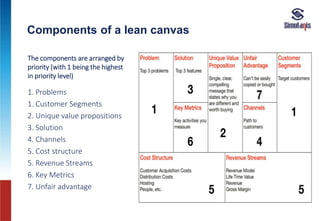
Components of a lean canvas
1. Problems
1. Customer Segments
2. Unique value propositions
3. Solution
4. Channels
5. Cost structure
5. Revenue Streams
6. Key Metrics
7. Unfair advantage
The components are arranged by
priority (with 1 being the highest
in priority level)
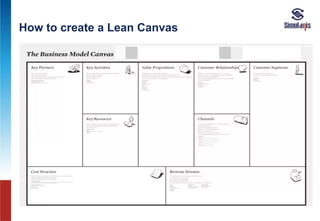
How to create a Lean Canvas
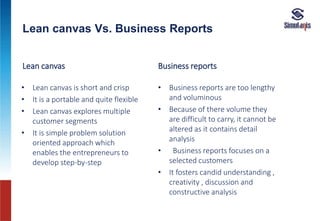
Lean canvas Vs. Business Reports
Lean canvas Business reports
• Lean canvas is short and crisp
• It is a portable and quite flexible
• Lean canvas explores multiple
customer segments
• It is simple problem solution
oriented approach which
enables the entrepreneurs to
develop step-by-step
• Business reports are too lengthy
and voluminous
• Because of there volume they
are difficult to carry, it cannot be
altered as it contains detail
analysis
• Business reports focuses on a
selected customers
• It fosters candid understanding ,
creativity , discussion and
constructive analysis
Introduction to Lean Canvas and how to create one!

Introduction to Lean Canvas and how to create one!

  • 2.
  • 3.
    WHAT IS ALEAN CANVAS • The lean canvas is the perfect format for brainstorming possible business models, prioritizing where to start and tracking ongoing learning . • It is a business model hypothesis testing tool – also called the lean canvas • A lean canvas is divided into 9 segments
  • 4.
    Steps in Creatinga Lean Canvas  Step 1 - Brainstorm possible customers -Distinguish between customers and users -split broad customers segments into smaller ones -sketch a lean canvas for each customer  Step 2 - Sketch multiple lean canvas - This section will give you an outline of the process for sketching a lean canvas - Sketch a canvas in one sitting - Its ok to leave section blank - Think in the present - Use a customer – centric approach
  • 5.
    Step 3- PrioritizeWhere to Start  Once the lean canvas is sketched for each customers segment , lay them aside and select business model to start with  The objective is to find a big enough market you reach with customers who need your product that will pay a price you can build a business around Customer pain level Ease of reach Price Market size
  • 6.
    Components of alean canvas 1. Problems 1. Customer Segments 2. Unique value propositions 3. Solution 4. Channels 5. Cost structure 5. Revenue Streams 6. Key Metrics 7. Unfair advantage The components are arranged by priority (with 1 being the highest in priority level)
  • 7.
    How to createa Lean Canvas
  • 8.
    Lean canvas Vs.Business Reports Lean canvas Business reports • Lean canvas is short and crisp • It is a portable and quite flexible • Lean canvas explores multiple customer segments • It is simple problem solution oriented approach which enables the entrepreneurs to develop step-by-step • Business reports are too lengthy and voluminous • Because of there volume they are difficult to carry, it cannot be altered as it contains detail analysis • Business reports focuses on a selected customers • It fosters candid understanding , creativity , discussion and constructive analysis