Business Architecture A Practical Guide 1st Edition Jonathan Whelan
Business Architecture A Practical Guide 1st Edition Jonathan Whelan
Business Architecture A Practical Guide 1st Edition Jonathan Whelan
Business Architecture A Practical Guide 1st Edition Jonathan Whelan
Business Architecture A Practical Guide 1st Edition Jonathan Whelan
1.
Business Architecture APractical Guide 1st
Edition Jonathan Whelan download
https://ebookbell.com/product/business-architecture-a-practical-
guide-1st-edition-jonathan-whelan-43682352
Explore and download more ebooks at ebookbell.com
2.
Here are somerecommended products that we believe you will be
interested in. You can click the link to download.
The Practice Of Enterprise Architecture A Modern Approach To Business
And It Alignment Svyatoslav Kotusev
https://ebookbell.com/product/the-practice-of-enterprise-architecture-
a-modern-approach-to-business-and-it-alignment-svyatoslav-
kotusev-46487232
The Practice Of Enterprise Architecture A Modern Approach To Business
And It Alignment 2nd Edition Svyatoslav Kotusev
https://ebookbell.com/product/the-practice-of-enterprise-architecture-
a-modern-approach-to-business-and-it-alignment-2nd-edition-svyatoslav-
kotusev-46495050
Professional Practice 101 Business Strategies And Case Studies In
Architecture Third Andy Pressman
https://ebookbell.com/product/professional-practice-101-business-
strategies-and-case-studies-in-architecture-third-andy-
pressman-32739272
A Guide To The Business Architecture Body Of Knowledge V90 9th Edition
Business Architecture Guild
https://ebookbell.com/product/a-guide-to-the-business-architecture-
body-of-knowledge-v90-9th-edition-business-architecture-guild-35117700
3.
Business Rules ManagementAnd Service Oriented Architecture A Pattern
Language Ian Graham
https://ebookbell.com/product/business-rules-management-and-service-
oriented-architecture-a-pattern-language-ian-graham-1475462
The Art Of Enterprise Information Architecture A Systemsbased Approach
For Unlocking Business Insight Paperback Mario Godinez Eberhard
Hechler Klaus Koenig Steve Lockwood Martin Oberhofer Michael Schroeck
https://ebookbell.com/product/the-art-of-enterprise-information-
architecture-a-systemsbased-approach-for-unlocking-business-insight-
paperback-mario-godinez-eberhard-hechler-klaus-koenig-steve-lockwood-
martin-oberhofer-michael-schroeck-7348536
Systems Thinking Managing Chaos And Complexity A Platform For
Designing Business Architecture 2nd Edition Jamshid Gharajedaghi
President And Ceo Of Interact Former Director Of The Busch Center The
Research Arm Of The Systems Sciences Department And Adjunct Professor
Of Systems Sciences At The Wharton School University Of Pennyslvania
https://ebookbell.com/product/systems-thinking-managing-chaos-and-
complexity-a-platform-for-designing-business-architecture-2nd-edition-
jamshid-gharajedaghi-president-and-ceo-of-interact-former-director-of-
the-busch-center-the-research-arm-of-the-systems-sciences-department-
and-adjunct-professor-of-systems-sciences-at-the-wharton-school-
university-of-pennyslvania-1392154
Systems Thinking Third Edition Managing Chaos And Complexity A
Platform For Designing Business Architecture 3rd Edition Jamshid
Gharajedaghi
https://ebookbell.com/product/systems-thinking-third-edition-managing-
chaos-and-complexity-a-platform-for-designing-business-
architecture-3rd-edition-jamshid-gharajedaghi-2269664
Serviceoriented Architecture Soa A Planning And Implementation Guide
For Business And Technology 1st Edition Eric A Marks
https://ebookbell.com/product/serviceoriented-architecture-soa-a-
planning-and-implementation-guide-for-business-and-technology-1st-
edition-eric-a-marks-2138692
Contents
List of Figuresix
List of Tables xi
About the Authors xiii
Forewordxv
Prefacexix
Acknowledgementsxxv
Abbreviationsxxvii
Chapter 1 Introduction 1
The Macro Picture 1
About Business Architecture 2
Inside Business Architecture 4
Terminology6
Part I The Rationale for Business Architecture
Chapter 2 Recognizing Today’s Business Dynamics 11
Continuous Change 11
Increasing Competition and Globalization 12
The Influence of Technology 13
The Whole and the Parts 14
Chapter 3 Positioning for Change 19
Business Architecture and the Organization 19
The Value Proposition 21
A Complementary Approach 24
Chapter 4 Managing Complexity 29
The Impact of Size 29
Variants and Diversity 32
11.
Business Architecture
vi
Matrix Management33
Negotiating the Boundaries 35
Organizations are More Complex than Machines 37
How Business Architecture Can Help 39
Chapter 5 Delivering Value 41
The Importance of a Demonstrable Value Proposition 41
Focusing on the Benefits 42
Risk and Reward 43
Part II Integrating Business Architecture into
the Organization
Chapter 6 Architecture Stakeholders 47
Stakeholder Groups 47
Upstream Stakeholders 48
Partners 51
Downstream Stakeholders 54
Stakeholder RASCI Matrix 56
Chapter 7 Life Cycles 61
Life Cycle Groups 61
Business Strategy and Planning 63
Change Delivery 67
Emergent Change Management 71
Business Operations 72
Asset Provisioning and Management 75
Asset Support 78
Life Cycles and Business Architecture Services 80
Part III Describing Business Architecture
Chapter 8 Architecture Levels 87
The Different Levels of Architecture 87
Level 1: Macro Level 88
Level 2: Strategic Level 88
Level 3: Segment/programme Level 89
Level 4: Project Level 90
Variations in the Four-level Business Architecture Model 91
Summing Up 95
12.
Contents vii
Chapter 9Business Architecture Outputs 97
Business Architecture by Other Names 97
How Architecture is Represented Over Time 101
Business Architecture Descriptions 102
Part IV Architecture Building Blocks
Chapter 10 The Elements of a Business Architecture 107
The Business Architecture Classification System 107
Capability 109
The Environment, Direction, Action and Performance 112
The Business Proposition 118
Operating the Business 122
The Technology Employed 134
Risks to the Business 138
Conclusion141
Chapter 11 Building Views of the Organization 143
The Need for Architecture Views 143
Architecture in One Dimension 144
Architecture in Two Dimensions 144
Architecture in Three Dimensions and Beyond 145
Beyond Matrices 146
Taxonomies146
Ontologies 148
Blueprints149
Part V Practising Business Architecture
Chapter 12 Overcoming the Barriers to Business Architecture 153
The Stigma of Business Architecture 153
Worst Case Scenario 154
Barriers 154
Engagement Principles 161
Chapter 13 The Business Architect 173
The Business Architect Role 173
Business Architecture’s Position in the Organization 176
The Competencies of a Business Architect 177
Certification 180
13.
Business Architecture
viii
Chapter 14 EstablishingBusiness Architecture as a Practice 183
Positioning the Practice in the Organization 183
Achieving the Right Balance 184
Maturing the Practice 186
Part VI Architecture Resources
Chapter 15 Architecture Frameworks 191
Defining Architecture Frameworks 191
The Benefits and Limitations of Frameworks 192
Types of Framework 196
The Business Model Canvas 199
TOGAF®
204
The Zachman Framework for Enterprise Architecture™ 209
Using Frameworks 215
Chapter 16 Reference Models and Architecture Patterns 219
What are Reference Models? 219
The Value of Reference Models 221
Architecture Patterns 223
Chapter 17 Architecture Tools, Meta Models and Standards 225
The Role of Architecture Tools 225
Using Tools for Business Architecture Outputs 226
Architecture Tool Features 228
Selecting a Tool 230
Benefits and Limitations of Architecture Tools 231
Architecture Meta Models 232
Architecture Standards 236
Chapter 18 The Future of Business Architecture 237
Appendix 1: Business Architecture Supporting Activities 241
Appendix 2: Viewpoint Template 247
Appendix 3: Business Architecture Business Model Canvas 249
Appendix 4: TOGAF®
Applicability to Business Architecture 251
Glossary253
Index265
14.
List of Figures
Figure0.1 How this book is organized xxiii
Figure 1.1 Business architecture Value Creation Model (VCM) 4
Figure 3.1 The ‘ready position’ in tennis 21
Figure 3.2 Business architecture value proposition 23
Figure 4.1 Size–complexity curve 30
Figure 4.2 Variant identification matrix 33
Figure 6.1 Key stakeholder groups 47
Figure 7.1 Life cycle groups 62
Figure 7.2 Business capability versus change portfolio matrix 66
Figure 8.1 Business architecture levels 87
Figure 8.2 Example architecture level variant 92
Figure 9.1 Architecture roadmap 101
Figure 10.1 The business architecture classification system 109
Figure 10.2 Environment, Direction, Action and Performance 113
Figure 10.3 Corporate goal versus change portfolio matrix 117
Figure 10.4 The business proposition 119
Figure 10.5 Operating the business 122
Figure 10.6 The technology employed 135
Figure 10.7 Risks to the business 139
Figure 11.1 Example ontology 148
Figure 12.1 Business architecture barriers 155
Figure 12.2 Engagement principles 162
Figure 13.1 Business architecture core activities 175
Figure 15.1 The Business Model Canvas 200
Figure 15.2 Business Model Canvas key constituents 201
Figure 15.3 Structure of TOGAF®
205
Figure 15.4 TOGAF®
Architecture Development Cycle 207
Figure 15.5 The Zachman Framework for Enterprise Architecture™ 210
Figure 15.6 Summary of The Zachman Framework for Enterprise
Architecture™210
15.
Business Architecture
x
Figure 15.7Demonstrating composite elements using the
Zachman Framework 212
Figure 17.1 Architecture tool feature sets 229
Figure 17.2 Relationships between entities in the full TOGAF®
meta model 233
Figure A.1 Business Model Canvas for a business architecture practice 249
16.
List of Tables
Table0.1 Role-based paths through the text xxiv
Table 6.1 Stakeholder RASCI matrix 57
Table 7.1 Life cycle groups 64
Table 7.2 Change Delivery life cycles 68
Table 7.3 Emergent Change Management life cycles 71
Table 7.4 Business Operations life cycles 73
Table 7.5 Asset Provisioning and Management life cycles 77
Table 7.6 Asset Support life cycles 79
Table 7.7 Business architecture core services by life cycle 81
Table 10.1 Matrix viewpoints of EDAP 117
Table 10.2 Matrix viewpoints of Business Proposition 121
Table 13.1 Skills and competencies of a business architect 178
Table 15.1 Frameworks 197
Table 15.2 Zachman Framework misconceptions 214
Table 16.1 Reference models 220
Table A.1 Business architecture supporting activities by life cycle 242
Table A.2 TOGAF®
applicability to business architecture 251
About the Authors
JonathanWhelan
Jonathan is an established business
architect who has over 25 years’
experience in a variety of change-
related roles within leading
organizations. A broad spectrum
of businesses have benefited from
his observations, and a number of
his insights have led to significant
programmes of work within
corporate organizations. Jonathan
has given specific consideration
to the significance of technology
to businesses and in particular the
opportunities and issues that face
business users of technology. In recent years his focus has been exclusively on
business architecture, and in particular the formulation of business architecture
for global institutions from a strategic level through to implementation at a
programme and project level.
As well as having considerable practical experience, Jonathan is a Chartered
Engineer and a Fellow of the British Computer Society. He is also TOGAF®
9-
certified and Zachman-certified.
In his spare time, Jonathan writes on business technology issues and
opportunities. He is the author of numerous books, including email@work
(2000) and e-Business Matters (2000), and he has also contributed to numerous
professional, trade and national press publications. His books have received
wide acclaim from government and professional organizations and senior
business executives.
19.
Business Architecture
xiv
Graham Meaden
Grahamstarted his career 25 years ago
in software development and systems
architecture. Most notably, he was the
architect for the contactless smartcard
system Oyster Card®
that is used to
manage access and fare collection in
London’s public transport system.
Since then, Graham has been a
practising enterprise architect, as a
consultant and member of staff, in
the banking, insurance, government,
transportation and energy industry
sectors. In recent years he has focused
on business architecture and setting up
architecture practices. Most recently, as part of heading up the global Strategic
Architecture and Business Architecture teams for HSBC Group, he defined
the standards for the bank’s global Business Process Management centre of
excellence. Along the way he has made extensive use of enterprise architecture
frameworks and he has contributed, along with others, in the development of
TOGAF®
9.
After brief spells in Asia and North America, Graham is now based in the
UK. He continues to provide business architecture consultancy, mentoring and
coaching and is also a certified Managing Successful Programmes practitioner.
20.
Foreword
I love thisbook. I have read it two times, and I am looking forward to reading
it again!
Yes, I know Graham Meaden and Jonathan Whelan, and you could surmise
that I am simply biased. However, my bias has nothing to do with why I loved
the book. It is a great book. It is a book whose time has come. The world needs
this book at this important time.
A lot of material has been written about business architecture (by some
definition), going back to The Principles of Scientific Management (1911) by
Frederick Taylor. A lot of people talk about business architecture – at least
going back to 1989, in my own experience, a US National Institute of Science
and Technology research project, the origins of the FEA Framework and an
early publication of my Framework (The Zachman Framework). A lot of people
define business architecture differently (I know a lot of people who have a lot
of different opinions and definitions for business architecture). Not too many
people do business architecture, at least not in a comprehensive and definitive
fashion (in my estimation).
Clearly, the time has come for Business Architecture: A Practical Guide (see
my observations below).
One reason why I like this book is that it tells it like it is.
A lot of people forget (or don’t like to think about the fact) that an enterprise
is the most complex creation of which humanity has yet conceived. And the
enterprise doesn’t have to get very big to be very complex – a subject that
Graham and Jonathan address specifically. (I like to use the word ‘enterprise’
as an encompassing idea that contextualizes its business architecture.)
21.
Business Architecture
xvi
The characteristicsof the Information Age that are universally recognized
are extreme complexity and extreme change. The analytical approach to
accommodate complexity is classification. You have to get all of the like things
into one category in order to understand their characteristics and then examine
the relationships between the categories to express complexity. Graham
and Jonathan structure the book conveniently into categories to convey the
complexity of business architecture in a comprehensible fashion.
The complexity lies in the relationships between the simple, understandable
categories, and the change, the dynamics, lies in the variability of the
relationships.Howbettertoexpressthecomplexityandchangethaninmatrices,
the relationships between two categories? I like the book’s matrices. They can
be very definitive and can very simply depict extreme complexity.
Another reason I like the book is their extensive use of metaphors and
examples.TheonlywayIcanunderstandconceptsthathavelittleornoprecedent
is to relate them to something I know – a metaphor. I like the physical world of
tangible objects that I live in or fly over or ride in. These are understandable as a
conceptual basis for understanding something unknown. Where the metaphor
doesn’t hold, a good example from real business life is very helpful. The book’s
metaphors and examples are really helpful in communicating these rather
arcane business architecture concepts.
I like their acknowledgement that there are short-term issues, and there are
long-term issues. A lot of material has been developed to address the business’s
short-term issues. This is the way to produce immediate, measurable results –
benefits that those of us in the Western world especially appreciate.
In the 24 July 2006 Fortune Magazine article ‘The New Rules’, the author,
Betsy Morris, observes that Jack Welch, the retired CEO of General Electric,
is held up as the epitome of the modern CEO: ‘Jack’s Rules are now the
business equivalent of the holy writ, bedrock wisdom that has been open to
interpretation, perhaps, but not dispute.’
The article continues with the theme that ‘Jack’s rules’ are ‘the old rules’.
It also quotes Harvard Business School’s Rakesh Khurana in observing that
‘Managing to create shareholder value became managed earnings became
managing quarter by quarter to please the street.’ ‘That meant a disinvestment
in the future,’ says Khurana. ‘It was a reversal of everything that made
capitalism the envy of the rest of the world: the willingness of a CEO to forgo
22.
Foreword xvii
dividends andmake an investment that wouldn’t be realized until one or two
CEO’s down the road. Now we are at a hinge point in American capitalism.’
Yes, we are! How do we intend to accommodate orders of magnitude
increases in complexity and orders of magnitude increases in the rate of
change? If you read newspapers or watch TV, you are acutely aware of current
evidence that enterprises of today, in both public and private sectors, are not
accommodating extreme complexity and extreme change. We are not talking
about some day in the ‘sweet by and by’.
Enter business architecture!
My observation is: you cannot simply focus on short-term issues to the
exclusion of the long term! You are optimizing the parts and sub-optimizing
the whole. And at the point in time when you need to have your business
architecture in order to address the increasing plethora of non-deterministic
challenges and escalating complexity – it is too late!
I have spent most of my professional life trying to understand and classify
the total set of things that exist that are relevant and that can be formalized,
made explicit, that would constitute the total knowledgebase of the enterprise –
everythingthatcouldbeknowntocreate,change,manage,operateanenterprise,
to enable an enterprise to be viable in an extremely complex and dynamic
environment – the Information Age. That is, my Framework is an ‘ontology’ –
it is not a methodology. I like Graham and Jonathan’s characterization of my
Framework in the book.
I spent my life trying to understand the templates, the meta model, the
ontology for describing an enterprise, because until you have an ontology,
nothing is repeatable and nothing is predictable. I know very little about the
actual contents, the population of the templates. That is another big reason why
I love this book. Graham and Jonathan have given me a great appreciation for
what the actual contents, descriptive representations, of the enterprise would
contain. This is the reason why I am going to read this book a third and a fourth –
and maybe many more times!
Now here, in my opinion, is the most practical message of the book, found
early on:
23.
Business Architecture
xviii
The deliveryof an architecture doesn’t bring any direct benefit in its
own right. Business architecture is not a solution, it is a tool. In the
right hands it becomes an asset of strategic value to the organization.
If business architecture becomes a solution, it is only good for one point in time.
Ifitisatool,itisthemostvaluableassettheenterpriseowns–theknowledgebase
of the enterprise that accommodates extreme complexity and forms the basis
for change. That is what is needed to survive in the Information Age. If you
have no idea how something works at the level of definition required to make
actual changes to it, what are you going to change and how are you going
to change it? ‘In the right hands [business architecture] becomes an asset of
strategic value to the organization.’
I hope every business architect reads this book. In fact, I hope that every
CEO who so enjoys Jack Welch’s books will read this book! To repeat the quote
from Rakesh Khurana, whatever happened to ‘the willingness of a CEO to
forgo dividends and make an investment that wouldn’t be realized until one or
two CEOs down the road’?
This is not to say there are no benefits to be realized from business
architecture in the short term – there are plenty of benefits. But somebody
better start thinking about business architecture as a tool for the future, or there
is not likely to be a future!
Business Architecture: A Practical Guide – the time has come.
Thank you, Graham and Jonathan.
John A. Zachman
Glendale, California
24.
Preface
Introducing Business Architecture
Organizationstoday exist in an environment of unprecedented change, and
they do so against a backdrop of a global, competitive marketplace, the fast-
paced enablement of technology, amplified regulation and ever-increasing
organizational complexity. It is these dynamics that are leading organizations
to recognize and embrace business architecture.
The intent of business architecture is not new: it is to enable organizations
to achieve their business plans; to realize their vision. But what role does
business architecture play? What unique value proposition does business
architecture bring to the table? For business architects to get a seat at the table
there need to be clear and consistent answers to these questions – there needs
to be a compelling value proposition.
However, business architecture can be a difficult ‘sell’ – it is often perceived
to be abstract and lacking in tangible delivery. To succeed, business architecture
must be pragmatic, and to be sustainable, it must focus on driving out value
while recognizing that the value may not be immediate.
Business architecture:
• provides a way to describe and visualize the components of an
organization;
• enables organizations to be viewed holistically, providing
traceability from intent (investment of financial and human capital)
to outcome (operational cost reduction, faster time to market,
reduced cost-to-market and cost-in-market, customer satisfaction,
shareholder satisfaction and so on);
25.
Business Architecture
xx
• providesa mechanism to balance risk with opportunity;
• is a collection of assets, methods, processes, directives and resources
that combine to realize a purpose, a goal, a vision;
• is complementary to other disciplines (such as P3M, business
strategy and enterprise architecture).
Business architecture is not ‘the solution’. If it is well-defined and shrewdly
executed, it is a valuable asset, but if it is poorly defined and carelessly executed,
it is a liability.
We do not believe there is any competing alternate term for business
architecture.Theonlytermthatmayconflictorconfuseisenterprisearchitecture
(EA). What is the relationship between enterprise architecture and business
architecture? Does business architecture sit within enterprise architecture,
or vice versa? With this book we hope to advance the importance and scope
of business architecture beyond what it is described as within current EA
frameworks and standards.
About this Book
This book promotes the use and evolution of practices that are tried and tested;
they may not be perfect – few things are. It recognizes and promotes the use of
materials and methods that already exist; many organizations and many people
(and not just business architects) have invested a significant amount of time
in establishing a pool of knowledge and experience. Diversity of background,
context and challenge is driving out many niche techniques and methods that
will ultimately contribute to this evolving practice.
This book does not propose a revolutionary way of structuring, developing
or practising business architecture. Nor does it recommend a new definition
for business architecture or a new notation to be adopted; there are plenty of
definitions and notations out there already. This book is intended to be what it
says: a practical guide that focuses on the most important aspects of business
architecture – those that are crucial to delivering value.
Business architecture should not be practised in isolation, nor should it
be thought of as a one-off process; it needs to be woven into the fabric of the
organization. And so we illustrate the opportunities for weaving the business
26.
Preface xxi
architecture practiceinto this fabric through the various stakeholders and life
cycles that exist, either formally or informally, within an organization.
Alongside acknowledging best practice, this book explores a new,
inspirational level of business architecture while recognizing that the best way
to realize the vision is one step at a time.
This book:
• sets out the need for business architecture and the value that can be
derived from it;
• identifies the relationship between business architecture, its
stakeholders and the disciplines related to it (for example, business
strategy and planning);
• describes the levels within organizations at which business
architecture can be applied and the types of products that it delivers;
• discusses the core elements (or building blocks) of business
architecture – the foundations on which to build a business
architecture;
• highlights the practical aspects of establishing a credible business
architecture practice, including the critical success factors and the
competencies required of a business architect;
• identifies the resources (materials, tools and methods) that exist to
inform, enrich and enable a business architecture capability.
Organizations are becoming too complex to evolve without a plan of the agents
of which they are comprised. Without business architecture, organizations may
be left in the dark as to the real operational risks they face, and the flexibility
and agility that they should exhibit. The risks are there; they may be hidden or
not easily visible, but they are there. It is how those risks are managed that can
determine survival, and beyond that, excellence.
Who Should Read this Book
This book will appeal to you if you are someone who:
27.
Business Architecture
xxii
• ispivotal to the success of investment and change in organizations;
• recognizes the need to link investment decisions to business strategy;
• is involved in innovation such as the development of new products,
services or business propositions;
• interacts with business architects and wants a greater appreciation
of business architecture;
• is a practising business architect wishing to evolve their own
architectures and practices;
• is part of an architecture practice that is struggling to gain traction
and/or is looking to make improvements;
• ishavingtojustifytheestablishmentofabusinessarchitecturepractice;
• has heard about business architecture and wants to understand
more about it;
• is embarking on a career as a business architect;
• is in education and is considering business architecture (or a related
disciplines) as a career;
• is enrolled on a graduate or post-graduate course of Business
Administrationandwishestounderstandhowbusinessarchitecture
relates.
Business architecture is an industry-independent discipline, so it will appeal to
a broad spectrum of people.
How this Book is Organized
We have divided the book into six parts, as shown in Figure 0.1. These parts are
based on the layers of the business architecture Value Creation Model (VCM)
that we introduce in Chapter 1. As well as forming the backbone of the book,
the model provides an overall structure for describing the numerous layers of
business architecture.
28.
Preface xxiii
Each partis further divided in chapters. However, we recognize that not
everyone will want to read this book from cover to cover, so we have structured
each chapter so that it can be read as a stand-alone text.
The parts follow the introductory chapter (Chapter 1) and precede our
vision for the future of business architecture in Chapter 18.
We recognize that what you want out of this book may well depend on
your role, therefore in Table 0.1 we suggest some specific paths through the text
depending on what it is.
We hope you get as much from reading this book as we did from writing it.
PART VI: Architecture Resources
PART V: The Architecture Practice
and
and
Figure 0.1 How this book is organized
29.
Table 0.1 Role-basedpaths through the text
Parts and Chapters
Role
Part I Part II Part III Part IV Part V Part VI
1 2 3 4 5 6 7 8 9 10 11 12 13 14 15 16 17 18
C-Suite: CEO, CFO, CIO etc. × × × × × × × ×
Change agent: portfolio,
programme, project manager etc.
× × × × × × × × ×
Architect: business, enterprise,
capability etc.
× × × × × × × × × × × × × × × × × ×
Considering a career as a business
architect
× × × × × ×
General reader × × × × × × × ×
30.
Acknowledgements
Much of thecontent of this book is based on our own experiences, but we
have not been alone on our journey. We have learnt from working with many
talented architects whose passion has been inspirational – you know who you
are! – as well as the business executives, programme and project managers, and
others who have given us the opportunity to practise and develop our trade.
Reviewing drafts of the book requires time and dedication, and we received
these in abundance from our reviewers. Mark Carr, Serena Li and Peter Tapp
gave detailed and supportive feedback of early drafts. We are also grateful
to Sally Bean and Jeff Scott for their reviews of drafts and for sharing their
insights in driving forward the adoption and future development of business
architecture. We also acknowledge John Zachman, not only for his enthusiastic
support of our efforts, but also for his contribution to the field of architecture
over many years.
There are a number of companies and organizations which provided
input and allowed us to use their material, including the BBC, Forrester, The
Open Group, Wiley Inc. and Zachman International, Inc., and of course all the
websites that we raided for information. In addition, we are grateful to Celestial
Consulting and Selvyn Wright. We also recognize that technology has had
a part to play (not least because we live almost 6,000 miles apart), especially
Skype and Dropbox, both of which are underpinned by great business models.
We are indebted to Jonathan Norman, our publisher, for confirming that the
market was missing a book such as ours. Also thanks to Jonathan’s colleagues
at Gower for their enthusiasm while carrying out the numerous activities
that transformed our final draft into the finished article – these include Fiona
Martin, Chris Muddiman, Emily Ruskell, Huw Jones, Sue White, Melisa Young
and many others.
31.
Business Architecture
xxvi
Writing abook invariably results in sacrifices, and it is usually those who are
closest to the authors who make the greatest sacrifices and provide the greatest
encouragement. This book is no exception, and so our greatest thanks go to
Alessandra, a ‘high five’ to Arthur (who so often provided Skype interludes),
and to Lindsay (not least of all for the proofreading), Lizzie (who ‘encouraged’
the venture in the first place) and Poppy (who, alas, received fewer walks than
she would have liked).
32.
Abbreviations
ACORD Association forCooperative Operations Research and Development
ADM Architecture Development Method
APQC American Productivity and Quality Center
BAD Business Architecture Description
BSC Balanced Scorecard
BMM Business Motivation Model
BOM Bill Of Materials
BPM Business Process Management
BPMM Business Process Maturity Model
BPMN Business Process Model and Notation
BRM Business Reference Model
CBA Certified Business Architect
CBM Component Business Model
CEO Chief Executive Officer
CFO Chief Financial Officer
33.
Business Architecture
xxviii
CIO ChiefInformation Officer
CMMI Capability Maturity Model Integration
COBIT Control Objectives for Information and related Technology
COO Chief Operating Officer
CRM Customer Relationship Management
CSF Critical Success Factor
CTO Chief Technology Officer
DODAF Department Of Defense Architecture Framework
DRM Data Reference Model
EA Enterprise Architecture
EDAP Environment, Direction, Action and Performance
EM BRM Exploration and Mining Business Reference Model
EPC Event-driven Process Chain
ERP Enterprise Resource Planning
eTOM enhanced Telecom Operations Map
FEA Federal Enterprise Architecture
GERAM Generalized Enterprise Reference Architecture and Methodology
IDEF Integration Definition
IEEE Institute of Electrical and Electronics Engineers
IT Information Technology
34.
Abbreviations xxix
ITIL®
Information TechnologyInfrastructure Library
KPI Key Performance Indicator
LEED Leadership in Energy and Environmental Design
MODAF Ministry Of Defence Architecture Framework
MSP®
Managing Successful Programmes
NAFTA North American Free Trade Agreement
NASCIO National Association of State Chief Information Officers
NGOSS New Generation Operations Systems and Software
OGC Office of Government Commerce
PCF Process Classification Framework
PEST Political, Economic, Social, and Technological
PMBOK®
Project Management Body of Knowledge
PMI Project Management Institute
PRM Performance Reference Model
P3M Portfolio, Programme and Project Management
RACI Responsible, Accountable, Consulted, Informed
RASCI Responsible, Accountable, Supporting, Consulted, Informed
RBM Replicable Business Model
RFC Request For Change
RFID Radio Frequency Identifier
35.
Business Architecture
xxx
ROI ReturnOn Investment
RUP®
Rational Unified Process
SABSA Sherwood Applied Business Security Architecture
SCOR®
Supply Chain Operations Reference
SFIA Skills Framework for the Information Age
SIPOC Supplier, Input, Process, Output, Customer
SLA Service Level Agreement
SMART Specific, Measurable, Achievable, Realistic, Time‑bound
SPEM Software and systems Process Engineering Metamodel
specification
SRM Service component Reference Model
STEER Socio-cultural, Technological, Economic, Ecological, Regulatory
SWOT Strengths, Weaknesses, Opportunities, Threats
TBM Target Business Model
TCO Total Cost of Ownership
TOGAF®
The Open Group Architecture Framework
TOM Target Operating Model
UML Unified Modelling Language
VCM Value Creation Model
VRM Value Reference Model
36.
1
Introduction
The Macro Picture
Theextraordinary events in the financial markets early in the twenty-first
century had a substantial impact on the global economy – almost everyone
was impacted in some way, either directly or indirectly. Private and public
organizations tightened their belts, reignited their focus on delivering value
from their investments and demanded more bang from their buck. But, as the
saying goes, ‘Money isn’t everything,’ and characteristics such as a compelling
customer experience, innovation and agility have become prominent
differentiators.
At the same time, organizations have become increasingly complex
ecosystems. Rigid organization structures are being replaced with a network
of inter-related, loosely coupled capabilities fused by a common vision –
or at least you would hope so! Product and service offerings are now more
sophisticated, and the ‘customer expectation’ bar is rising every day. Industries
and marketplaces face increasing regulation, introducing constraints on the
one hand, and opportunities on the other.
Internationalcompanies,once‘holdingcompanies’foralooseconfederation
of businesses operating in geographical silos, are now striving to become truly
internationalized businesses. New technologies that enable the creation of a
systems and informational platform capable of supporting global operations
are now breaking down traditional silos and creating integrated businesses. The
benefits of rationalization, economies of scale, global customer propositions,
franchising and labour arbitrage are driving businesses to become webs of
interconnected and integrated service providers in a way that they have never
been before.
37.
Business Architecture
2
But thatjust brings us as far as today. What about the big issues that we
face in the future? The growing global economy and globalization increases
competition, and that in turn fuels greater innovation. The frequency and
potency of technological innovation is likely to increase. Other dimensions
also play their part: scarce resources (minerals, water and food) in the face of
a growing human population. Ecological concerns are driving organizations
to consider total product life cycle beyond sale into product recall and recycle.
Demographics is forcing a greater focus on long-term financial planning and
commitments. Trading zones and supranationalism are stimulating the free
movement of labour and immigration, and social networking is enabling new
kinds of democracy.
About Business Architecture
Against this backdrop of change, business architecture is maturing into a
discipline in its own right, rising from the pool of inter-related practices that
include business strategy, enterprise architecture, business portfolio planning
and change management – to name but a few.
But what is business architecture? Ask ten architects and invariably you
will get at least ten answers! It is different things to different people, although
there is generally common ground about what it aims to achieve. There is no
single agreed definition of business architecture, or any other architecture for
that matter. We do not intend to offer yet another definition, although we do
position ourselves to address this complex topic.
In this book, we view business architecture as a collection of assets, methods,
processes and resources that all contribute towards enabling the goals of the
organization. Of course, to existing practitioners there is more to it than that,
and we address those details, including the purpose of business architecture,
its value proposition and what the key assets of a business architecture look
like.
Several definitions of business architecture exist:
• The Institute of Electrical and Electronics Engineers (IEEE)1
defines
architecture as:
1 IEEE Standard 1471-2000: IEEE Recommended Practice for Architectural Description of Software-
Intensive Systems.
38.
Introduction 3
The fundamentalorganization of a system embodied in its components,
their relationships to each other, and to the environment, and the
principles guiding its design and evolution.
Although this is a definition for the architecture of software systems, the core
concept is applicable to business architecture. You can replace ‘system’ with
‘business’; the components are the resources (people, technologies, facilities
and so on) that collaborate to deliver products and services.
• The Open Group Architecture Framework (TOGAF)2
defines
business architecture as:
a description of the structure and interaction between the business
strategy, organization, functions, business processes, and information
needs.
• The Business Architecture Special Interest Group3
defines business
architecture as:
a blueprint of the enterprise that provides a common understanding of
the organization and is used to align strategic objectives and tactical
demands.
• Wikipedia4
defines business architecture as:
a part of an enterprise architecture related to corporate business, and
the documents and diagrams that describe that architectural structure
of business.
Each definition is valid, but no single definition is all-encompassing. In this
book we aim to push the boundaries by exploring deeper into the discipline of
business architecture, for example by addressing the non-deterministic, ‘living’
ecosystem that represents today’s organizations. We also focus considerably on
the rationale for using it, and we deliberately take a business-centric perspective
in order to shift the thinking away from the IT-centric views that have shaped
the discipline to date.
2 TOGAF: http://www.opengroup.org/togaf/, accessed 10 March 2012.
3 http://bawg.omg.org/, accessed 10 March 2012.
4 http://en.wikipedia.org/wiki/Business_Architecture, accessed 10 March 2012.
39.
Business Architecture
4
Business architectureis not just for the global operatives; yes, the larger
the organization, the more formal the manifestation of its architecture should
be. But the ambitions and ideals of a business architecture should benefit all
organizations, be they large or small, for-profit or not-for-profit, emerging or
established. We must not lose sight of the fact that architecture is a means to an
end, and for business architecture the end is the realization of the business vision.
But in reality, we also need to consider the journey as well as the destination.
Inside Business Architecture
Business architecture is a complex topic comprising numerous layers.
Developing a business architecture for an organization means taking a
360-degree perspective incorporating each of those layers. We do the same for
the business architecture practice, and like an onion, we peel away the different
layers of the topic. Figure 1.1 shows our Value Creation Model that defines
those layers.
The Architecture Practice
Architecture Resources
Figure 1.1 Business architecture Value Creation Model (VCM)
40.
Introduction 5
Using theVCM, we look at the environment within which the organization
and practice operates, and we identify the influences that pose as threats
and opportunities. We outline the rationale for getting started, and the value
proposition that a business architecture practice can deliver to stakeholders.
Taking this value proposition, we then present the different ways in which
the practice can be integrated into the fabric of the organization, identifying
ten major stakeholder groups and six major process life cycle groups through
which business architects can engage.
Recognizing that one size does not fit all, we discuss the different
manifestations of business architecture. We present a Four‑level Business
Architecture Model, starting with the top, macro‑level architecture and working
down through to the bottom, project‑level architecture. We also discuss the
various deviations from this model that we have experienced during our
practice in larger organizations. We also discuss the various architecture
outputs produced, including, for example, operating models and business
architecture descriptions (BADs).
We then identify the business architecture ‘building blocks’ used to
construct the architecture outputs: the elements, views and underlying models
that describe an architecture.
Achieving a sustainable value proposition means investing in establishing
a robust business architecture practice, so we identify the challenges it faces,
its critical success factors, the role of a business architect, and the evolution of
the practice.
Finally, we discuss some of the prominent architecture resources: the
architecture frameworks, reference models and tools available to business
architects to increase their productivity and deliver value more quickly to
stakeholders.
The organization must support progressive change with minimal impact
to business operations. It must also facilitate business-led reconfiguration
to enable the timely exploitation of new business opportunities. To achieve
this we believe organizations must be created from an explicit business
architecture. Current state architecture expresses a representation of the current
organization, whether architected or not. Future state architecture represents
the envisioned organization in abstract form that is then created in reality via
41.
Business Architecture
6
change initiatives(programmes and projects). The VCM provides a framework
to optimise the practice of business architecture and to optimize the transition
from the current organization to the desired future organization.
Terminology
Later in the book we talk about engagement principles for the business architect.
More than one of those principles highlights the need to establish a common
language with which to connect with architecture stakeholders and describe
the business architecture consistently. In this spirit, before jumping into the
rest of the book we will describe a few concepts and terms to ensure that the
meaning and spirit of the text is conveyed in line with that principle.
This book discusses business architecture, but we recognize that the subject
matter is as applicable to governmental and non-commercial organizations as
much as commercial businesses, hence we have used the terms interchangeably.
Throughout the book we have used the term architecture element to
represent any discrete thing that could be used to describe a business within
the architecture; we also use the terms element and component synonymously.
We use the terms agent, building block and relationship to be more specific than
‘element’: the term agent is used to represent parts of the architecture that
may be described as active, initiative, non-deterministic, self-minded, chaotic,
natural, social or organic (usually reserved for people, organization units and
organizational entities); building blocks may be described as passive, reactive,
deterministic, synthetic, technological; we capture important relationships
between building blocks and agents: for example, causality, dependency,
location, applicability, ownership, command/control, composition, inheritance,
or any other meaningful and useful association. Recognizing that building
blocks come in different forms and that constructing more sophisticated
building blocks is certainly a product of advancing technology, we may qualify
building blocks as ‘primitive’ or ‘composite’: primitive building blocks represent
base or atomic parts, and composite building blocks represent assemblies of other
architectural elements. We generally assume agents to be composite in nature,
but we often have no control over that composition.
There is a lot of discussion among business architects of the concept
of capability and capability models. We use the dictionary sense of the term
‘capability’: an ability that an organization, person or system possesses to do
42.
Introduction 7
something orachieve certain outcomes. To describe a capability might mean
having to create a composite building block, typically describing why it is
required, what activity is, or can be, accomplished (perhaps in terms of services),
what resources are needed (skills, knowledge, information, technology), what
methods (processes and procedures) are used, what controls are required to
manage and govern the capability, and what metrics are used to measure
performance.
For the sake of brevity, we have used the term customer offering to mean
either product(s) and/or service(s).
We use the term organization unit to represent a real, internal unit within an
organizational entity of any size, for example: teams, departments, divisions,
subsidiaries and branches. We don’t preclude an organization unit being a legal
entity within a group of companies. An organization unit is a kind of agent (see
previous definition).
We use the term deliverable and artefact synonymously to represent things
that are produced as outputs from the business architecture: for example,
business architecture descriptions, reports, analyses and information for
publication.
We use the term asset to represent any kind of non‑consumable or financial
resource to which the organization is reliant for its success.
We use view and viewpoint as described in ISO 42010: a view presents a
specific set of architectural information to a standard dictated by the template
of the viewpoint. The viewpoint describes the stakeholder (user), the concern
addressed by the view (the content) and other aspects such as format and style.
Despite the simplicity, these terms are occasionally considered to be confusing.
To clarify: a viewpoint is like a lens or filter that you would use to view the
architecture; each different architecture or part of the architecture you observe
through the lens will give a different view.
We define some other terms in the Glossary.
Success is more a function of consistent common sense
than it is of genius.
An Wang
2
Recognizing Today’s
Business Dynamics
ContinuousChange
Waves of change are hitting organizations with increasing frequency and
ferocity. Technological and competitive pressure is forcing organizations
to achieve greater efficiencies while meeting ever-declining price points. As
customers expect more for less, organizations have to deliver better service and
greater value for money year on year.
To survive, organizations must provide customers with great customer
offerings and at the same time maintain their ability to change or reinvent
themselves, and do so with agility. Increased competition fuelled by an
expanding and maturing global marketplace and the penetration of technology
into the home has led to rising customer expectations. To do better than just
survive, organizations must offer something unique; in the industrial age a key
differentiator was price, but in the information (or, arguably, knowledge) age
there are many dimensions, including, but certainly not limited to, customer
experience, personalized customer service, responsiveness, agility and
innovation. These are the dynamics that today’s organizations face.
But change has always been present, and it has always been a necessity
for organizations to master change if they want to excel. Many organizations
respond by reorganizing themselves, and others by reinventing themselves.
Take, for example, 3M, a company that started out as a niche mining concern
and evolved into a multi-billion-dollar solution provider to customers in over
200 countries with over 55,000 product solutions,1
and Nokia, which started off
1 History of 3M Company: http://solutions.3m.com/wps/portal/3M/en_WW/History/3M/
Company/At-a-Glance/, accessed 10 March 2012.
47.
Business Architecture
12
as amanufacturer of paper, then went into rubber and electricity generation,
then telecommunications.2
The most successful companies adapt to embrace and exploit change;
others (but not all) survive.
Increasing Competition and Globalization
The response to constant change is not a simple case of modernizing or
refreshing an existing product or service line. The Internet as a distribution
channel has removed geographical borders and allowed even the smallest
companies to compete with the largest. The Internet has shrunk the world
and provided access to a global community to ramp up competition. Web 2.03
is with us, and Web 3.04
takes advantage of semantics to create ‘intelligent
products and services’.
Addressing these dynamics is leading organizations to restructure and
reorganize themselves in a more integrated fashion, not just to the existing
business model, but to a reinvented one. At the same time organizations are
extending out to third parties and offshore locations, creating an ecosystem
of collaborating entities. The pressure to squeeze out inefficiencies of more
conventional, siloed organizations is irrepressible. Whether the silos exist
as individual legal entities under the umbrella of a holding company or as
disparate local and international divisions within a single entity, organizations
are focusing on developing capabilities that drive strategic differentiation.
Furthermore, they are exporting capabilities from the core to the external
reaches of the ecosystem where they are commoditized and/or most efficiently
served.
Organizations are eliminating, rationalizing, standardizing and reusing
common labour, products, services, processes and technology. And they have
to do so against a backdrop of increasing regulation – one of the costs of doing
business – and corporate and social responsibility.
2 The Story of Nokia: http://www.nokia.com/global/about-nokia/company/about-us/story/the-
nokia-story/, accessed 10 March 2012.
3 Web 2.0: http://en.wikipedia.org/wiki/Web_2.0, accessed 10 March 2012.
4 Web 3.0: http://en.wikipedia.org/wiki/Web_3.0#Web_3.0, accessed 10 March 2012.
48.
Recognizing Today’s BusinessDynamics 13
In some cases, changing the existing organization is too difficult. We saw
this with the Internet boom at the start of the twenty-first century. Bricks-and-
mortar organizations were just too slow. To compete with new market entrants,
start-ups were incubated and grown alongside their bricks-and-mortar parents,
and either subsequently integrated or left to operate alone under a differentiated
branding. This model is still likely to be necessary going forward. However, the
option for organizations to disassemble and reassemble is, in most cases, not
feasible because no one really understands how their organization works and
which of its activities are decisive in making profit and loss. Rarely can any
individual understand all the complexities of today’s conglomerates.
The Influence of Technology
Change may be constant, but the pace is not: technology is a major accelerant.
So dramatic is technology’s influence that it has the power to redefine the
business landscape, to shape the structures and behaviour of organizations,
to ultimately determine the success of organizations. With such an influence,
organizations cannot ignore technology; they must embrace it.As organizations
develop technology, exploit technology, sell technology, they must ensure that
they refresh and rejuvenate their business models to ensure they are not wrong-
footed or even marginalized by competitors. Their business architecture must
change in tandem.
New technological advances are creating opportunities for start-up
organizations to challenge the fundamental business models of industry sector
leaders, sometimes leaving them stranded and struggling to survive and
compete. Examples include:
• Amazon versus book stores
• iTunes versus music stores
• Google versus traditional advertising
• iPads versus laptops versus desktops
• smartphones versus mobile phones
• Netflix versus Blockbuster
49.
Business Architecture
14
If thoseexamples don’t convince, today there are organizations that can attract
more revenue from the advertising on their website than they can from the
products and services they channel through the website.
We can be sure that there is more to come; the twenty-first century has
been declared the ‘century of intellectual property’. If everyone owns a 3D
printer in twenty years’ time, then distribution of ‘print designs’ will become
the new media content. In the future, will iTunes be selling designs for printing
a coffee table, a TV, a violin? Prototype printers are already printing prototype
human organs. Advances in body scanning will enable replacement organs to
be grown to custom-fit the customer.
The Whole and the Parts
A modern-day motorcar has over ten thousand parts on average, and a Boeing
747 has six million.5
Each of these has some form of architecture in place. A
motorcar has a transmission system, fuel supply system, electrical system,
exhaust system, steering system, engine, suspension system, braking system,
cooling system, chassis, and so on; an aircraft has a fuselage, cockpit, wings,
tail fins, engines, fuel systems, cargo storage, passenger compartments, flight
systems, and so on.
Construction of motorcars and aircraft is complex, but their design and
manufacturing has been constantly refined over the last hundred years or
so. In other words, their architecture is well understood. This architecture
is relatively static in nature: once these machines have been designed and
manufactured, they are largely expected to operate to the same functional and
quality specifications throughout their working life.
The complexity of these manufactured items compared with a living
ecosystem is relatively simple: they are tangible, broadly predictable and
measurable, and hence manageable. Of course, we do not underestimate the
design and engineering feats required to create something like the Boeing 747 –
it is without doubt one of the most recognizable icons of the twentieth century.
But developing an architecture for something that is constantly changing in
purpose, operation and nature, that contains as many dynamic agents as it
does static agents, represents another level of challenge, and one that every
large organization faces each day.
5 http://www.boeing.com/commercial/747family/pf/pf_facts.html, accessed 10 March 2012.
50.
Recognizing Today’s BusinessDynamics 15
Complexity and richness of capability6
is increasing. Organizations are
using layering, componentization, encapsulation, standardized interfaces and
standards to hide and manage complexity. One of the reasons that Apple7
products are popular is that their underlying technical complexity is hidden
from the user by simple, intuitive interfaces. In other words, organizations
introduce ‘layers’ to shield customers from the complexity of their operations
and, also so that they can be more flexible or agile. Some organizations achieve
this with varying degrees of success, as we have all discovered through using
Internet sites and customer call centres.
Managing complexity in this way drives up the number of parts in a
‘solution’. Organizing the parts structurally and determining how they behave
and interact requires an architecture to ensure that the collective set of parts
operates optimally. Also, smarter or multi-purpose, multi-feature parts are
more complex than uni-purpose parts. For ‘parts’ read ‘components’; for
‘components’ read ‘resources’; for ‘resources’ read ‘people’. The multi-faceted
nature of these parts means that to suit circumstance, they:
• can be configured in different ways;
• can be fit together in different ways;
• can operate in different ways.
With a solution like an aircraft, with thousands of different kinds of parts,
without an architecture composed of superstructures, structures, assemblies,
sub-assemblies and parts, conception would be difficult and construction and
maintenance would be harder. Furthermore, the aircraft has to be designed to
cope with the challenges it will face in the skies.
It is not sufficient to optimize each of the parts individually: having each
part optimized for its own aims doesn’t necessarily mean an optimized whole.
A car with a super-powerful engine able to achieve 300 km/h is not much use
unless the brakes are up-rated accordingly.
6 We define capability as being all the building blocks and agents necessary to provide one or
more services, including the business processes, human resources, technology and facilities
(buildings, power and so on).
7 Apple, Inc.: http://www.apple.com.
51.
Business Architecture
16
Staying withthe car analogy briefly, when asked the question ‘What
controls the speed of a car?’, the answer from the majority of respondents is the
gas (or accelerator) pedal. However, other answers are equally valid depending
on your perspective: for example, the brakes, the weather conditions, the
environment in which the car is being driven (for example, in the vicinity
of a school, an urban area), the condition of the car itself and the condition
(ability, experience, mental state and so on) of the driver. Like driving a car,
organizations need to consider all aspects of the environment in which they
operate.
So we see the trends and the actions. But what are the consequences of
such change, and what does the new world look like? We are already seeing
traditional organizations evolving into organizations constructed from an
operating platform of common processes, technologies, information and
services that can be orchestrated to deliver differentiated (and in many cases
mass-customized) customer propositions through multiple channels. Such
organizations are no longer composed of rigid functional structures with well-
defined boundaries and interaction channels. Today’s global organizations
are complex ecosystems that cannot be represented by simple hierarchical
charts; they reveal fractal-like complexity when you examine their detail.
Business architecture provides the holistic perspective to understand this
complexity.
We talk about whole, parts and structures of an organization in this book,
and although we make comparisons to complex machines, organizations
are not mechanistic, but largely social. Organizations are full of people, so
organizations must be designed to maximize the human potential as well
as the technology.
In many ways society provides useful parallels to understand the
problem facing business owners, managers and architects. Deciding to
swing towards or away from employing stronger architecture and more
command and control methods across an organization with less freedom for
the individual parts is akin to political swings in society: swings between
greater or less private sector and public sector contribution to society;
swings between powers of the state and powers of the individual. The real
challenge for organizations is to get this balance right.
52.
Recognizing Today’s BusinessDynamics 17
The world is moving so fast these days that the man who
says it can’t be done is generally interrupted by someone
doing it.
Elbert Hubbard
3
Positioning for Change
BusinessArchitecture and the Organization
In an unpredictable world, a competitive business needs as many options
as possible to ensure that when change comes it can adjust and respond
accordingly. To achieve this it must have a business architecture to create and
manage an operating platform that is easily configurable and extendible. Such
an architecture must ensure that:
• the internal parts of the organization integrate and operate together
efficiently and effectively;
• the parts operate in a robust and resilient manner;
• the parts can be upgraded, extended or replaced;
• the impact of change is unambiguous;
• the associated risks can be understood and managed.
Business architecture aims to define what the ecosystem in which the
organization lives should look like and how the elements of which it comprised
should be best arranged. This is in contrast to, and complementary to, other
change related disciplines such as P3M (Portfolio, Programme and Project
Management) which we discuss in detail in Chapter 7.
Business architecture serves to facilitate change and the identification
of change work packages (programmes or projects) necessary to take the
organization from where it is today to where it wants to be in the future,
following a defined roadmap. Crucially, this change is not based upon a
‘scrap and rework’ mentality, but a ‘learn–adjust–deploy’ evolutionary cycle.
I have abandonedhope ... yet love remains. I no longer believe that any
happiness is possible for me in the future, but you I love more every day;
better than the first day, better than yesterday, better than this morning,
better than a moment ago; and still I am not happy.
A PAGE OF JULIETTE DROUET’S NOTE-BOOK IN 1834.
The note-book belongs to M. Louis Barthou.
You remember what I used to say to you when Marie Tudor was in
rehearsal? “Those wretches have robbed me of my self-confidence; I dare
not, cannot rehearse any more; I feel paralysed.”
To-day, it is not a theatrical part that is in question—it is my life. Now
that calumny has crushed me, now that my mode of life has been
condemned without my having a chance of self-defence, now that my
health and reason have been expended in this struggle without profit or
57.
glory, now thatI have been held up before the public as a woman without a
future, I dare not, cannot live longer ... this is absolutely true ... I dare not
live. This fear has brought me to the verge of suicide ... a peculiar suicide. I
do not propose to kill myself like other people. I mean to sever myself from
you, and, to me, such a severance signifies death. Death certainly. I have
already made one experiment of the kind, therefore I am sure.
I am confirmed in this project by the reflection that you will thereby be
restored to liberty; that you will be free to direct your life and your genius
in the way best suited to your happiness; that I shall no longer be an
obstacle in your path, but an object of pity and indulgence—pity for what I
shall suffer, indulgence and forgiveness for such of my faults as have made
you suffer.
If the excess of my love and grief should bring me back to your side, do
not notice me ... shut your eyes, stop your ears, remain in your own house ...
thus you may learn to forget, while I ... I ... shall die. I shall not suffer long.
I shall soon be at rest.
It is raining hard at this moment, and I am in a raging fever. No matter, I
shall go out. I do not know whether you propose coming to fetch me. If you
do not, I cannot tell what time I shall return home. I don’t care, I am mad! I
am in torture such as I have never yet endured! yet I love you even more
than I suffer. My love dominates my whole being. I love you!
Juliette.
5.30 (1834).
You wish me to write to you in your absence. I am always unwilling to
accede to this desire, for when we are separated, my thoughts are so sad and
painful that I should prefer to hide them from you if possible.
You see, my Victor, this sedentary, solitary life is killing me. I wear my
soul out with longing. My days are spent in a room twelve feet square.
What I desire is not the world, not empty pleasures, but liberty—liberty to
act, liberty to employ my time and strength in household duties. What I
want is a respite from suffering, for I endure a thousand deaths every
moment. I ask for life—life like yours, like other people’s. If you cannot
understand this, and if I seem foolish or unjust in your eyes, leave me, do
not worry about me any more. I hardly know what I am writing; my eyes
are inflamed, my heart heavy. I want air, I am suffocating! Oh, Heaven,
58.
have pity uponme! What have I done to deserve such wretchedness? I love
you, I adore you, my Victor; have pity upon me. Kill me with one blow, but
do not let me suffer as many eternities as there are minutes in every one of
your absences.
What am I saying? I am delirious, feverish. Oh God, have mercy on me!
Juliette.
November 4th, 8.30 p.m. (1834).
Yes, you are my support, the stable earth beneath my feet, my hope, my
joy, my happiness, my all! I do not know how these halting words of mine
can be expected to convey my thoughts to your mind, but this indeed is
truly and sincerely meant: that you are to me the noblest, most sincere, most
generous of men. I believe this, and have absolute confidence in your power
to frustrate the evil fate which holds me in its grip.
My dearly beloved, you were quite charming just now, and you are
perfectly right when you say that there is an element of vanity in your
nobility of conduct; for nothing could be more becoming than the elegant
and dignified manner in which you raised me just now from my knees. You
were really great. You were a king!
My darling little Toto, chéri! I am going to bed now, because I am not
certain that you will come early enough to take me out; and, after all, you
are not the sort of man to be scandalised by finding a woman in bed,
especially ...
Juliette.
1834.
My dearly Beloved,
I am always wishing I were a great actress, because, if my soul and
intellect were equal to yours, another link would be forged between us; but I
wish it still more at such a time as this, for I should then be able to relieve
you of the annoyance of being at the mercy of an old woman, whose conceit
has made her aggressive.[63]
I need not finish this letter, for here you are!
1835.
59.
It is longafter 11 o’clock. I am no longer expecting you for a walk, but I
still hope to see you this evening. I write you these few lines as an apology
for the disappointment I feel each time you fail me. I am miserable, but not
angry; I shed tears, but do not reproach you; I am often much to be pitied,
but I never cease loving you to distraction. If only you would believe this, I
think I could bear my invidious position with more resignation. I am afraid
you misapprehend my love, and this anxiety often makes the days seem
long and sad.
But I must not forget that you are working and worn out, and that you
have neither strength nor leisure to listen, that is to say, to read of my
worries.
11.30 p.m.
Here you are! I am finishing this letter more untidily even than usual.
Luckily one’s character, and, more important still, one’s heart, are not
exclusively interpreted by one’s handwriting.
Juliette.
Saturday, 3.15 p.m. (1835).
My poor, dear, beloved Toto,
When I see you so preoccupied with important business I am ashamed to
add to your fatigues by the reiteration of my devotion, which you already
know by heart. Did I not fear that you would misunderstand my silence, I
should put an end to these letters, which, after all, are only a cold skeleton,
a dull narrative of the generous, tender, passionate feelings which fill my
heart. I should stop them, I say, until after the production of your play,
reserving to myself the privilege of taking my revenge afterwards by
multiplying my words and caresses. This is what I should do if you felt only
a quarter as much solicitude for your dear little person as I do.
It is nearly three o’clock. I hope by this time everything has gone off
well at rehearsal. It is high time, my admired, beloved, adored poet, you left
that wretched den they call the Théâtre Français. You will leave it with full
credit to yourself, notwithstanding the ill-will of that jealous old wretch,
and the stupidity, hatred, and malice of the cabal against you.
You will see, my splendid lion, whether those hideous crows will dare
croak in face of your roaring. As for me, if anything could make me prouder
60.
and happier, itwould be that I alone understand you.
Juliette.
Saturday, 1.30 p.m., April 11th (1835).
Why were you so smart just now? It makes me dreadfully anxious,
especially in conjunction with your early morning walks to the Arsenal.
Toto ... Toto ... you do not know what I am capable of; take care! I do not
love you for nothing. If you deceived me the least bit in the world I should
kill you. But no, seriously, I am jealous when I see you so fascinating. I do
not feel as reassured as you would wish me to be. In fact, I insist upon
attending these rehearsals. I do not choose to confide my dear lover to the
discretion of nobody knows who. I wish to keep my lover to myself, in the
face of the nation and of all French actresses.
That is my politic and literary resolve: I shall put it into execution, from
to-morrow.
By the way, this is my birthday. You did not even know it—or, rather, I
dare say you do not care whether I was ever born or not. Is it true that you
do not mind one little bit? That is all the importance you attach to my love!
And yet one thing is very certain: that I was created and put into the world
solely to love you, and God knows with what ardour I fulfil my mission.
I love you—ah, yes, indeed, I love you—I love my Victor!
Juliette.
Saturday, 8 p.m. (1835).
I am more than ever resolved to separate our lives one from the other.
What you say about Mlle. Mars’s increasing age and the impossibility of
obtaining a double success through her, literary as well as financial, and
about the necessity of securing the services of Madame Dorval or some
equally handsome and celebrated actress, makes me determined to sever our
connection as speedily as possible, no matter where I may have to go, or
under what pecuniary conditions. Your words to-night prove that you have
had private intelligence about Mlle. Mars, Madame Dorval, and the theatre
generally, that you have concealed from me, although it must completely
revolutionise the plans made by you for the first play you were to give at
this theatre. The secrecy you have maintained on the subject, contrary to all
your promises to conceal nothing from me, grieves me more than the
61.
treachery of MonsieurHarel and Mlle. George, more even than the wicked
animosity of your enemies and the perfidy of your intimate friends against
myself. This silence is proof positive that I am a hindrance to your interests;
you dread my ambition and my jealousy; you had already seen the propriety
of giving a part to Madame Dorval, but you did not dare tell me so, for fear
of encountering resistance and tears from me at this new distribution. You
have only partially averted these. I will not attempt to thwart you, on the
contrary; as for my tears, they are not worth wiping away, nor even
restraining.[64] From this very night we cease our communion of dramatic
interests. I go back to the position I ought never to have left: that of a hack
actress, who is given any part, and badly paid at that. You resume your
liberty without any impediment.
Let us hope this new resolution will conduce to our greater happiness.
Juliette.
Tuesday, April 28th, 1835.
Four hours before the production of “Angélo.”
This is just to remind you of my love, and that it will only be purified
and augmented by the ill-luck and perfidy to which you are more exposed
than others, my noble poet, my king—king, indeed, of us all, though lover
only of me: is that not so? I have nothing to fear from you, have I, my
darling? You will take care of yourself and resist the advances of that
shameless woman. Promise me this. I would not allude to it to-day, only I
feel so uneasy at the thought of your spending the whole evening in her
society, that I would give my life to prevent it. If you understood the
greatness and quality of my love, you would appreciate my alarm.
Think of poor me, sitting at the back of a box to-night, enduring all the
anguish of jealousy and love.
Juliette.
Madame Pierceau came at one o’clock, leaving Monsieur Verdier in a
cab below. He was desperate at the loss of his stall, which, he hears, was
taken from him by your orders. As I did not know what to say about it, I
advised Madame Pierceau to send him to you. Monsieur Pasquier, as I
anticipated, has not taken Madame Récamier’s box. I wonder what you
have done with it. Did it reach you in time?
62.
Midnight, Tuesday, April28th, 1835.
An hour after the triumph of “Angélo.”
My cup is full. Bravo! bravo!! bravo!!! bravo!!!! bravo!!!!! For the first
time I have been able to applaud you as much as I wished, for you were not
there to prevent it.
Thank you, my beloved! Thank you for myself, whose happiness you
increase with every second of my life, and thank you also for the crowd that
was there, admiring, listening, and appreciating you.
AUTOGRAPH LETTER FROM JULIETTE DROUET TO HER DAUGHTER CLAIRE.
63.
AUTOGRAPH LETTER FROMJULIETTE DROUET TO HER DAUGHTER CLAIRE
(continued).
I saw and heard everything, and will tell you all about it; although if the
applause, enthusiasm, and delirium could be measured by sheer weight, my
load would indeed be heavy. I will give you full details of the performance,
to-morrow, for I dare not hope to see you to-night; it would be too much
happiness for one day, and you do not want me to go mad with joy!
Till to-morrow, then. If you knew how conscientiously I clapped
Madame Dorval, you would hesitate to say or do anything to add to the
soreness I already feel at the thought that another than I has been selected to
interpret your noble sentiments. There, now I am giving way to sadness
again, because you are with that woman!
Good-night, my beloved. Sleep well, my poet, if the sound of the great
chorus of praise does not prevent it. To your laurels I add my tender
caresses and thousands of kisses.
Juliette.
Friday, 8 p.m. (1835).
If I were a clever woman, my gorgeous bird, I could describe to you how
you unite in yourself the beauties of form, plumage, and song! I would tell
you that you are the greatest marvel of all ages, and I should only be
speaking the simple truth. But to put all this into suitable words, my superb
one, I should require a voice far more harmonious than that which is
64.
bestowed upon myspecies—for I am the humble owl that you mocked at
only lately. Therefore, it cannot be. I will not tell you to what degree you
are dazzling and resplendent. I leave that to the birds of sweet song who, as
you know, are none the less beautiful and appreciative.
I am content to delegate to them the duty of watching, listening and
admiring, while to myself I reserve the right of loving; this may be less
attractive to the ear, but it is sweeter far to the heart. I love you, I love you,
my Victor; I cannot reiterate it too often; I can never express it as much as I
feel it.
I recognise you in all the beauty that surrounds me—in form, in colour,
in perfume, in harmonious sound: all of these mean you to me. You are
superior to them all. You are not only the solar spectrum with the seven
luminous colours, but the sun himself, that illumines, warms, and revivifies
the whole world! That is what you are, and I am the lowly woman who
adores you.
Juliette.
If you are coming to fetch me, as you led me to expect, I shall see you
very soon now. I have never longed more ardently for you. Lanvin has just
come. I will tell you about it when I see you.
Thursday, 7.30 p.m. (1835).
To my dear absent One.
I hardly saw you this morning. I have not seen you this evening, and
God knows what time it will be before you come to take me to Angélo—for
I do not admit the possibility of a single performance taking place without
my presence: besides, I am not sorry to know exactly how much time you
spend with these actresses of the sixteenth century, and those of the
nineteenth, who are no less dangerous. There, I am nearly as cross as I am
sad. I had vowed I would not write at length to-day, just to teach you not to
throw my letters aside without reading them. Myself, my letters, forgotten!
You certainly manage to be the most worshipped and the least attentive of
lovers. Oh, you do not care!
Never mind, I am sad. I am longing for you to-night, as the poor prisoner
hungers for his pittance at the hour he is accustomed to receive it.
But you are indifferent—you can calmly let my soul die of inanition—do
you not love me, then? Tell me!
65.
Well, I loveyou. I love you my Victor. I forgive you, because I hope it is
not your fault, and also, because I cannot prevent myself from loving you.
Juliette.
Tuesday, 8 p.m., 1835.
You hurt me a little bit just now, my Toto. While I was sacrificing the
happiness of being with you one moment longer, to your need of repose,
you were worrying about trifles, and not giving me a thought or a farewell.
In moments like these I am forced to realise that you do not care for me as I
care for you, and I feel wretched in consequence.
Another thing I have observed is that you never allude to my letters. You
neither notice the complaints I make nor the love I shower upon you with
every word. You have turned my happiness and content into sadness. My
Toto, you do not love me as I love you. You have exhausted your faculty of
loving. I tell myself that the enthusiastic and passionate devotion you once
cherished for me has degenerated into mere partiality—then I mourn and
mope, like a woman betrayed.
If you knew how I love you, my Toto, you would understand the anguish
of my eagerness, you would pity me, and, instead of leaving my letters
unanswered, you would fly to me the moment you have read them, to
reassure and comfort me if my fears are unfounded.
Never mind, I give you a thousand kisses. How many will you waste?
Juliette.
Tuesday, 12.30 p.m. (1835).
My dear little Toto,
You have written me a very charming letter. I cannot send you one as
fascinating; all I can do is to give you my whole heart and thoughts and life.
You are quite right when you say that I shall soon give myself to you
again, regardless of the sorrows that may follow. It is true, for I could
sooner dispense with life than with your love.
But let me tell you again the joy, surprise, and happiness, your letter
caused me. You are better than I, and you are right when you think me an
old idiot. I am in the seventh heaven this morning. You have never given me
so much happiness, my dear little Toto. I am so grateful! I cannot love you
66.
more in return,for that were impossible; but I can appreciate in a higher
degree your worth and the depth of your affection for me.
You are my dear little man, my lover, my god, my adored tyrant! I love
you, adore you, think of you, desire you, call upon you!
Juliette.
Which do you like best, quality or quantity?
Monday, 8.20 p.m. (1835).
I adore your jealousy when it gives me the pleasure of seeing you at an
unaccustomed hour; but when it simply consists in suspecting me without
advantage to ourselves, oh, how I detest it!
You were rather cross to-day, but you atoned so amply by coming as you
did, that I would willingly see you a little bit unjust to me every day, if it
entailed the pleasure of having you one minute longer in the evening.
If you only knew how true it is that I love you, you could never be
jealous, or admit the possibility of my being unfaithful to you; and again, if
you knew how much I love you, you would come every moment of the day
and of the night, to surprise me in that occupation, and you would ever be
welcomed with transports of joy.
Yes, yes, I love you! I do not say so to force you to believe it, but
because I crave to repeat it with every breath, with every word, in every
tone. I adore you much more than you can ever wish. I love you above all
things.
Juliette.
You attach too little importance to my letters as a rule. You forget that
fine unguents are contained in small boxes, great love in trivial words.
Friday, 2 p.m. (1835).
You want a huge long letter ... and yet another huge long letter ... you are
not very modest in your requirements. What would you say if I asked as
much?—you, who write to every one in the world except me. I have a great
mind to treat you according to your deserts, and write only as much as you
write, love you only as much as you love me. You would be nicely punished
if I did this. But do not fear; I should never play you such a scurvy trick. I
am too much in need of an outlet for the superabundance of my heart, to
67.
venture to closethe issue. I am too anxious to tell you every day how much
I adore you, to condemn myself to silence. I long too much to get near you,
in thought at all events, to afford to cut off the way of communication. Now
that you know why I write so often, I will begin my letter.
My dear little Toto, although it is not long since I left you, I desire you
with all the impatience and all the inclination that comes of a long
separation. I should like to know where you are and what you are doing. I
should like to be wherever you are, and, above all, I should like to be in
your heart and thoughts, as you are in mine. I should like to be you and you
me, in respect of love. The rest becomes you and you only. You are
admired; I need to be loved. Are you capable, I ask you, of loving me as
much as I love you, or half as much? even that would be immeasurable. If
you only knew the extent of my love, you would treasure me, only for that.
I love you, love you, love you, love you, love you!
This short little word, issuing from my heart, has impetus enough to
mount right up to the heavens. I love you!
Juliette.
I have received a letter from my daughter. This, combined with the
horrible weather, makes me quite happy.
Friday, 9 p.m. (1835).
You gave me a delicious afternoon. How delightfully you talked! I am
not alluding to your wit; a fly does not seek to raise an ingot of gold!
Neither do I speak of the happiness of leaning upon your arm, listening to
your voice, gazing into your eyes, breathing your breath, measuring my
steps by yours, feeling my heart beat in unison with yours.
There can be no happiness greater than that I enjoyed this afternoon with
you, clasped in your arms, your voice mingling with mine, your eyes in
mine, your heart upon my heart, our very souls welded together. For me,
there is no man on this earth but you. The others I perceive only through
your love. I enjoy nothing without you. You are the prism through which
the sunshine, the green landscape, and life itself, appear to me. That is why
I am idle, dejected, and indifferent, when you are not by my side. I do not
know how to employ either my body or my soul, away from you. I only
come to life again in your presence. I need your kisses upon my lips, your
love in my soul.
68.
Juliette.
Saturday, 11 a.m.(1835).
Good morning, my Victor!
Let me first kiss you. Of all the promises I made you yesterday, when we
separated, only one has been broken. I promised to love you as I loved you
at that moment—that is to say, more than all the world; but I do not know
how it happened, I have come to love you much more! and I feel it will be
so as long as I shall live. I beg you, my dear little Toto, to make up your
mind to this, as I have already done.
Do you know, my blessed Toto, you are a second little Tom Thumb, far
more marvellous than your prototype; for, not merely with pebbles or
crumbs of bread do you mark the roads along which you travel, but actually
with jewels and precious stones. I shall always recognise the spot where
you dropped an enormous ruby as big as a flint, yesterday, with as much
indifference as if it had been a piece of grit from Fontainebleau.
What do you suppose must happen to an insignificant creature like
myself in the presence of so much wealth, in the midst of the enchantments
of your mind? Will she lose her reason? That is already done. As to her
heart, you stole it from her very easily, and therefore nothing remains to the
poor wight but what is already yours.
Her love, her admiration, her life, belong to you! My glances, words,
caresses, kisses, all, are yours!
Juliette.
(1835.)
It seems to be always my turn to write to you now. In the old days your
letters called forth my letters, your love mine—and it was meet that it
should be so, for, as you have often said, the man should be the pursuer of
the woman. It is always awkward when a change of rôles occurs, and I am
acutely conscious of it. I feel that a caress from you gives me far more
happiness and security than thousands of those elicited by me.
It is already half-past eleven and you have not arrived. Perhaps you are
not coming, and the prohibition you laid upon me yesterday against seeking
you at the printing works redoubles my anxiety and jealousy. I fear lest
69.
some untoward thingmay have befallen you, or, worse still, some agreeable
invitation reached you. My heart is crushed as in a vice; I think there is no
greater suffering in this world than that of loving yet fearing. We arrange
our lives very badly. Since you are not a free agent, and may be prevented
from seeing me by thousands of circumstances we cannot foresee, you
should at least allow me the opportunity of knowing what you are doing and
where you are. It would satisfy me and keep me content. Instead of this, I
have to wait for you, a prey to fears that tear at my heartstrings. Alas, I am
to be pitied for loving you so intensely. It is a superabundance that will
surely kill the body which bears it.
If you love me only moderately, I pray God to deprive me of one of two
things: either my life, or my love.
Juliette.
Nearly midnight. What a night I have before me! God pity me!
At Metz,
September 17th, Thursday, 8.15 a.m., 1835.
Good-morning, my Toto, good morning. It is magnificently fine, and we
are going to be enormously happy. We are about to resume our bird-life, our
life of love and freedom in the woods. I am enchanted. If only you were
here, I should kiss you with all my might and main, as a reminder.
What sort of a night did you have? Did you love me? Have you been
writing to me under the old chestnut-tree? I am sure you have not. You
scamp, I am afraid I go on loving you in proportion to the decrease of your
affection.
I was not able to read last night. I went to bed at a quarter past ten, and
had horrid dreams. I trust they will not come true, but I confess I should be
glad to get news of my poor little girl, whom we neglect far too much. If
two more days go by without a letter, I shall write to Saumur, for I am really
worried about her.
My dear little Toto, I am going to dress now, so as to get to you earlier. I
love you, I love you with all my strength and all my soul. I kiss you! I adore
you! Till this afternoon.
Your Juliette.
70.
At Metz,
September 24th,Thursday, 8.45 a.m.
Good-morning, my darling Victor. I love you and am happy, for we are
going to be more absolutely together than was possible yesterday, or the day
before, when an inconvenient third disturbed our privacy. Also the weather
is glorious, and I am madly in love with you; so everything around me
glows radiant and beautiful.
I stayed in bed until 8.30, although I woke up at seven o’clock; but I just
rolled lazily about, thinking of you, and reading yesterday’s newspapers. I
reached home exactly at seven o’clock last night, undressed, tidied my
things, dined, wrote to you, did my accounts, and read Claude Gueux till
half-past ten. Then I put my hair into curl-papers, and got into bed at eleven
o’clock. I went to you in spirit, and dreamt that I was kissing Baby Toto,
and making big Toto jealous. This is the complete history of my morning up
to date; now I shall dress, breakfast, and go for a walk in the meadows with
the maid. Farewell, dearest, until this afternoon’s happiness. Always yours
in love and longing.
I love you with all my heart, I embrace you in spirit, I adore you with my
whole soul, I admire you with every faculty of my mind. Think of me, come
to me, come to me as soon as possible. My arms, my cheek, my whole
being, await you.
J.
At Metz,
Thursday, 8.45 p.m.
My dear, good Toto,
I should have got back without adventure, had I not met an enormous
and horrific toad in the road, which sent me flying home, shrieking as if the
devil was at my heels. I was here by ten minutes past seven, began my
dinner at five minutes past eight, and am now sitting writing to you, to
thank you for all the bliss you lavish upon me. This day, drenched with rain
though it was, has been one of the most beautiful and happiest of my whole
life. If there had been rainbows in the sky, they would be reflected in our
hearts, linking our souls together in thought and emotion.
I thank you for drawing my attention to so many lovely things I should
never notice without your assistance and the touch of your dear white hand
71.
upon my brow;but there is one beauty greater and nobler than all the
combined ones of heaven and earth, for the recognition of which I require
no help—and that is yourself, my best beloved, your personality that I
adore, your intellect that enchants and dazzles me. Would that I possessed
the pen of a poet, to describe all I think and feel! But, alas, I am only a poor
woman in love, and such a condition is not conducive to brilliancy of
expression!
Good-night, my adored one; good-night, my darling. Sleep well. I send
you a thousand kisses.
J.
Metz,
Monday, 11.5 a.m., September 24th, 1835.
Great indeed was our misfortune yesterday! I agree with you in that, my
Victor, because I love you. For over a year I have suffered much; oftener
than not, without complaint. I always trusted that my love and fidelity
would engender in you feelings of esteem and confidence, but now that
hope is for ever at an end; for, far from diminishing, your suspicion and
contempt have grown to terrible dimensions. You love me, I know, and I
worship you with all the strength of my being. You are the only man I have
ever loved, the only one to whom I have ever given this assurance. Yet I
now implore you on my knees to let me go. I cannot urge this too strongly.
You see, my dear, I am so wretched, so humiliated, and I suffer so acutely,
that I shall have to leave you, even against your will; so it would be kinder
of you to give your consent, that I may at least have the sad satisfaction, if I
must forsake you, of knowing that I have not disobeyed you.
Farewell, my joy; farewell, my life; farewell, my soul! I leave you, for
the very sake of our love—I offer this sacrifice on behalf of us both. Later,
you will understand. But before bidding you a last good-bye, I swear to you
that, during the last year, I have not committed one single action I need
blush for, nor harboured one guilty thought. I tell you this from the bottom
of my heart. You may believe it.
I shall go to my child, for I am anxious about her since she has been at
Saumur. Perhaps I may bring her back with me. I think I was very wrong to
send her away. I mean to repair my fault if there is yet time. The pretext of
her health will be sufficient before the world. My heart shall be dumb upon
72.
all that concernsyou. I will keep everything to myself. I must get work. If
you can do anything to help me find some, it will be good of you. I mention
this for the first and last time, for, if you were to forget me, you know very
well that I should be the last to venture to recall myself to you.
Good-bye again, my friend; good-bye, for ever! I have been copying
your little book, hoping you would be generous enough to leave it with me.
Good-bye! good-bye! Do not suffer, do not weep, do not think, do not
accuse yourself! I love and forgive you.
Juliette.
Metz,
Saturday, 7.30 p.m. (October 1835).
You were in a great hurry to leave me to-night, my best-beloved. If
consideration for me was your motive, it was high-handed and blundering
of you, for I never enjoyed myself more than this evening, and, until the
moment you left me so abruptly, I had never so savoured the happiness of
being with you in the highways and byways.
I therefore returned home sadly and thoughtfully. I have begun my letter
to-night with diminished joy and confidence in the future, for your hurry to
leave me weighs upon me, and I cannot explain it satisfactorily to myself.
I came in at a quarter past six, suffering greatly from indigestion. The
maid told me some one had called for the dog—two gentlemen, who
seemed much attached to it. Poor brute, it was a wrong instinct that led it to
follow us. I have no doubt it is expiating its offence in hunger and cold at
this very moment. I am somehow unduly interested in the fate of the poor
thing. I feel something beyond ordinary pity for it; it makes me think of the
fate and future in store for a poor girl we both know. She also follows step
by step a master who will have no scruple in casting her adrift when his
duty to society proves as pressing and sacred as that which called him away
to-night.
I am depressed, my dear friend, and unwell. The oppression on my chest
is increasing. I hope your sore throat will diminish in proportion to what I
am enduring. Providence is too just to allow such cumulation of suffering.
Good-night—sleep well and think of me if you can. As for loving me, that
is another question; one’s emotions cannot grow to order. I love you.
J.
73.
Sunday, 8 p.m.,1835.
My dear darling, I cannot describe to you the rapture with which I
listened to the two sublime poems you recited to me, one on the first
Revolution and the other on the two Napoleons.
But where can your equal be found on earth!... My dear little Toto, do
not laugh at me. I feel so many things I cannot express, much less write. I
love and revere you, and when I reflect upon what you are, I marvel! Since
you left me, I have read again Napoleon the Second. I shall never tire of it.
It is going to bed with me now.
You told me to wait for you till 9.30; after that hour I shall go to bed. If
you should happen to come later, I will open the door to you myself, as you
have forgotten the key. I want to do so, that I may not lose one second of
the happiness of having you with me. Sleep well—good-night—do not
suffer—do not work—sleep!
Juliette.
Wednesday, 8.30 p.m., 1835.
I am half afraid of taking too literally your request for a daily letter. Tell
me seriously how I am to interpret it, so that I may not make myself
ridiculous, by overwhelming you with letters you do not want. Tell me the
truth once for all, so that I may know where I am, and may give myself up
without restraint to the pleasure of telling you, and writing to you, that I
love you with all my heart, and that you alone constitute my sole joy, my
sole happiness, and my sole future. If you can experience only one quarter
of the bliss in reading, that I shall feel in inditing my scribble, you shall
receive some of my prose every day, but in limited quantities, calculated not
to wear out your patience.
And, in order to demonstrate my powers of self-restraint, I will limit
myself to six trillions of kisses for your beautiful mouth. Besides, here you
come! I love you.
Juliette.
Wednesday, 8 p.m., December 2nd, 1835.
My Beloved,
74.
When one isill and feverish, everything tastes bitter to the lips and
palate. I am in that position. I am abominably miserable, and all the sweet
words you lavish upon me seem tainted. But I have enough sense left to
realise that it is my condition that prevents me from relishing the full meed
of happiness you are able to give me in one moment. Forgive me for
suffering, and for not having the strength or generosity to conceal it from
you; it is only because I suffer too much, and love you too much, which is
the same thing.
I promise to be very cheerful to-night, and to disguise my feelings. I
have read everything concerning you in the papers, and I cannot help
suspecting that a passage about you and your work has been purposely cut
out. If this is so, you had much better tell me, for I am quite equal to
bearing the truth, and even to hearing lies; so I beg you to tell me what was
in that newspaper, and thus spare me the trouble of procuring another copy.
You must indeed be happy and proud on behalf of the person to whom you
are supposed to have dedicated your sublime poem.
75.
VICTOR HUGO.
The articleby Monsieur F. Dugué seems singularly well-informed about
your restoration to the domestic hearth. I am apparently not the only one
who notices that for the last year you have been changing your habits and
feelings, though I am probably the only one who will die of grief in
consequence—but what matter, so long as the domestic hearth remains
cheerful and the family, happy.
I hope you will do your best to come and see me to-morrow, during the
intervals of the performance unless the salutations you have to make, and
the compliments and admiration you must acknowledge should detain you
against your will; in which case I hope I may be brave enough not to worry
about such a trifle, and reasonable enough not to let the magnitude of my
love depend upon so slight a pleasure.
You see, my dear angel, I bow to the arguments you impress on me. I am
no longer sad, neither do I suffer. I love you; that is the truest word of all.
Juliette.
Tuesday, 8.45 p.m., December 15th, 1835.
76.
Of course, mydarling, you did right to come back, whatever your reason
might be; but the pleasure of your visit was quite spoilt by your inquiry as
to how I spend my time, when it is self-evident that my conduct is
irreproachable.
It may surprise you that I should have borne the inquisition you
habitually subject me to, with less equanimity to-day than usual. I own, my
poor angel, that I do not know why it should be so. Perhaps I am like the
cripple, who feels pain in the leg which has been cut off, long after he has
lost it. I often suffer over my past life, though the present is so widely
different. I suffer, not from variations of temperature, but from the
variations of your love, which seems to grow daily colder and more
gloomy. If I am mistaken, forgive and pity me; but if, as I fear, I make no
error, tell me so frankly, and I shall be grateful for your sincerity. You see,
my poor friend, I cannot believe that your jealousy is other than an insulting
mistrust of us both. I have watched you carefully for the last six months,
and I can see quite well that, although your love is gradually waning, your
supervision becomes ever more active and more fidgety. If I were
absolutely sure of what I suspect, I should not say this to you—I should go
away at once, and you would never hear of me again; but if by chance I
were wrong, and you still care for me, such a course would entail frightful
sorrow upon us both. Therefore I remain, preferring to incur your hatred
and contempt, rather than run the risk of grieving you.
There, my poor angel, is the attitude of mind and heart in which you
found me this evening; it will explain why I received your question so
badly, although I was grateful for your presence. You see, my head and
heart are weary. If you are not careful, some calamity, resulting from this
condition, will overtake and crush you, at a moment when neither you nor I
will be able to prevent it. I give you this warning in all sincerity, but with
the intimate conviction that it will not affect you. As long as you feel I
belong to you wholly and entirely, you are as indifferent to my sufferings as
to my happiness.
J.
Wednesday, 8.30, February 3rd, 1836.
If I have grieved you, my beloved, I beg you to forgive me, for I know
your position is awkward and demands much consideration, especially from
77.
me. Besides, whyshould I complain of my mode of life more to-day, than
yesterday? I accept my position without regret; therefore there is no reason
for questioning an arrangement which only you can alter.
I cannot help noticing that your love is not what it was. I may say I am
sure of it, if I may judge by the impatient words you occasionally utter, half
against your will, and by other signs it would take too long to commit to
paper. I certainly possess a devoted Victor, but no longer the lover Victor of
former days. If it is as I fear, it becomes your duty to leave me at once; for I
have never wished to live with you otherwise than as an adored mistress—
certainly not as a woman dependent upon a man whose passion is spent. I
want no pension. I demand my place in your heart, apart from any feeling
of duty or gratitude. That is what I desire, as earnestly as I long to be a
faithful woman, submissive to your every whim, whether just or unjust.
If I have hurt your feelings, my dearly beloved, I plead for pardon from
the bottom of my heart. If you have to acknowledge a decrease in your love,
be brave enough to do so frankly, and do not leave to me the frightful task
of guessing it; but if you care for me as much as ever, say it again and
again, for I doubt it, alas, and, in love, doubt is more painful a thousand
times than the most heartbreaking certainty. Farewell, I worship you.
J.
Wednesday, 8.15 p.m., February 17th, 1836.
You must think me either very cruel or very blind, my beloved. I think,
perhaps, it would be best for you to accept the latter hypothesis. I love you,
which means that I am jealous; but, as my jealousy is in proportion to my
love, my doubts and frenzy are more vivid, more bitter, than those of
ordinary women, who are only capable of an ordinary affection. Very well
—I am cruel! So be it! I detest every woman upon whom your glances rest.
I feel capable of hating all women, young or old, plain or handsome, if I
suspect that they have dared raise their eyes to your splendid and noble
features. I am jealous of the very pavement upon which you tread, and the
air you breathe. The stars and sun alone are beyond my jealousy, because
their radiance can be eclipsed by one single flash from your eyes.
I love you as the lioness loves her mate. I love you as a passionate
woman, ready to yield up her life at your slightest gesture. I love you with
the soul and intelligence God has lent His creatures to enable them to
78.
appreciate exceptional menlike yourself. That is why, my glorious Victor,
at one and the same moment, I can rage, weep, crawl, or stand erect; I bow
my head and venerate you!
There are days when one can fix one’s gaze upon the sun itself without
being blinded: thus it is with me now. I see you, I am dazzled, entranced,
and I grasp your beauty in all its splendour.
Juliette.
Thursday, 8 p.m., August 15th, 1836.
Since you leave me here all by myself, my beloved, I shall think only of
you, and in proof of this, I will scribble all over this virgin sheet of white
paper. It is barbarous of you to let me grow fatter than I already am, by
leaving me to dawdle at my fireside, instead of taking me out to walk and
get thin.
I am in love with you, but you do not care a bit. I am very sad not to
have you with me, doubly so, when I think that it is on account of a play in
which I am to have no part, after all the time I have waited and endured.
When I reflect seriously upon this, my despair makes me long to fly to the
uttermost ends of the world. It is so necessary that I should think of my
future. I have wasted so much time waiting, that it almost spells ruin to me
that you should produce a piece in which I may not play. You see, my
dearest, I am not as generous as you thought. I am afraid I can no longer
disguise from you the injury it does me to be three years out of the
theatrical world, while you are bringing out plays. Forgive me, but I have a
horror of poverty, and would do anything in reason to evade it. I love you.
Juliette.
Friday, 8.30 p.m., March 11th, 1836.
Dear little Soul,
You are quite happy, I hope, now that you possess the keys of Paradise. I
had a few more difficulties to encounter after you went away, but they were
of no consequence. Now that our little palace is nearly finished, my soul, I
hope we shall celebrate the event in the usual way; but I must first rest a
little, and nurse myself up, for I am really quite worn out with the dirt and
litter. I am afraid to look at you or touch you in your beauty and purity and
charm, while I am so ugly and untidy and exhausted that I hardly know
79.
myself as yourJuju. But it will not last. My foulness will fall from me, and
reveal me dressed, as in the fairy-tale, in garments of blue, bordered with
golden stars, and a prince will marry me after tasting of my cooking.
Splendid! But meanwhile you must graciously permit me to go on loving
you, stains and all! Shut your eyes to the common lamp that guards the
flame. If you will wait, you shall see that when we reach the heaven above
us, I shall be as resplendent as yourself. Meanwhile, I drop a kiss upon your
shoes, even if it entails your having them blacked again.
J.
Wednesday, 7.45 p.m., March 23rd, 1836.
No doubt, dear angel, I ought to disguise in your presence the sadness
that overwhelms me when I have to wait too long for you; but the late hour
at which you generally come, makes it difficult for me to forget the weary
suspense I have already been through, and am to endure again shortly. I
love you, my dear—indeed, I love you too much. We often say this lightly,
but I assure you that this time I state it in full gravity and knowledge, for I
feel it to the very marrow of my bones. I love you. I am jealous. I hate
being poor and devoid of talent, for I fear that these deficiencies will cost
me your love. Still, I am conscious of something within me, greater than
either wealth or intellect; but is it powerful enough to rivet you to me for
ever? I ask myself this question night and day, and you are not at hand to
soothe my unrest; hence the sadness that wounds you, the jealousy that
amazes you, the mental torment you are incapable of understanding.
But I love you all the same, and am happy in the midst of my pain. I
smile through my tears, for I love you.
Juliette.
Saturday, 8 a.m., March 26th, 1836.
Good-morning, my little darling Toto.
I am up at cock-crow, though very tired; but I want to be ready to
witness your new triumph—for, beloved Toto of mine, you are the great
Toto, the greatest man on earth.
How I love you, my Victor! I am jealous. Even your success makes me
uneasy with the dread that, amongst so much adulation, you may overlook
the humble homage of your poor Juju. I fear that these universal
80.
acclamations may drownmy lowly cry of—I love you! This apprehension
becomes an obsession on such a day as this, when everything is at your feet,
caresses, adoration, frenzy. Ah, why are you not insignificant and unknown
like myself! I should then have no need to fear that the torch of my love
will be eclipsed by that immense illumination.
Try, beloved, to keep a little place in your heart for the love and
admiration of your poor mistress, who has loved you from the day she first
set eyes upon you, and who will worship you as long as the breath remains
in her body.
Juliette.
Saturday, 6.15 p.m., March 26th, 1836.
Let me tell you once again that I love you, my Victor. Presently,
thousands of voices will be raised in a chorus of praise. I alone say: I love
you. You are my joy, the light of my eyes, the treasure of my life, you are
YOU. This evening, my adored one, whatever you say or do, I must be
jealous and wretched. Be merciful to me; do not let me suffer too cruelly. If
you think of me when you are absent, I shall be conscious of it—if you love
me, I shall feel it upon my heart like beneficent balm upon a raw wound.
Farewell, dear soul; it is impossible to wish an increase of beauty to the
man, or more glory to the genius; so, if you are happy, so am I. Farewell,
then, dearest; I cannot refrain from sending a word of love to the lover,
before going to applaud the poet. The heart must have its due share.
Good-bye till later. For ever, for life and until death, love, nothing but
love!
J.
Sunday, 7.45 p.m., March 27th, 1836.
I hardly dare speak to you to-night of love. I feel humiliated by my
devotion, for all those women seem to be rivals, preferred before me. I
suffer, but I do not hold you responsible. I feel worse even than usual this
evening. I did not venture to ask what you had written to Madame Dorval,
for I was afraid to discover some fresh reason for bitterness and jealousy; so
I remained silent.
My dear treasure, you are very lucky not to be jealous: you have no
competition to fear with any other celebrity, for there is none besides
81.
yourself, and youknow that I love you with my whole heart, whereas all I
can be sure of is, that I love you far too much to hope to be loved in
proportion. In addition, I feel I shall never be capable of raising the heavy
stone under which my intellect slumbers.
Forgive me, I am sad. I am worse than sad—I am ashamed, because I am
jealous. I am an idiot, and consequently, I am in love!
Juliette.
Thursday, 8.30 p.m., April 14th, 1836.
I love you, my dear Victor, and you make me very unhappy when you
seem to doubt it. It is still harder for me when you put your want of
confidence into words, for I can only attribute it to the sacrifices you
constantly make for me, and which probably cause you to think that an
ignoble motive constrains me to remain under your protection. In addition
to thus wounding me in the most sensitive part of my love, you exasperate
me to a point I cannot describe, because it is true that I have not the
wherewithal to live independently of you and your influence. Therefore, my
poor angel, when you show your suspicions of my sincerity, I read into
them more than jealousy and ill-will: I imagine a reproach against my
dependent position. I feel an overwhelming need to prove to you, by any
means, that you are mistaken in the woman and her love. Remember your
burnt letters! You know what a doubt on your part led me to do on one
occasion. Well, angel, I tell you honestly that when you question, not only
my fidelity, but also my love, I long to fly to the other side of the world,
there to exist as best I can, and never pronounce your name again for the
rest of my life. This will be the last proof of love I can give you, and at least
you will not be able to accuse me, then, of self-interest and self-love. You
hurt me terribly to-night; you often do, and generally when I am most
tender and demonstrative towards you.
Yet I love you.
J.
Tuesday, 8 p.m., April 19th, 1836.
Beloved, I am perfectly certain you will not come to fetch me to see
Lucrèce, and I am already resigned. There is only one thing I shall never
submit to, and that is, the loss of your love. I know you are devoted, that
82.
you lavish friendshipupon me; but I feel that you have no more love to give
me, and I cannot bear it. During the four months I have been alone, ill for
the most part, I never knew whether the time would come when you would
be impelled to say to me: Take courage, for I love you. I would have given
life to find those words in your handwriting at my bedside in the morning,
or on my pillow at night. I waited in vain, they never came; my sorrow
grew, and now I am certain that you have ceased to care for me.
I know what you will say, Victor—you will tell me that you are hard at
work, that you do everything for me, and do not let me want for anything.
To that I reply that I have been just as busy or busier than you, yet have
always found time to show you the outward signs of my inward love. I may
also tell you that, without your love, I do want for everything, and that my
life is utterly wretched without it. Lastly, I declare to you that if you
continue to be so reasonably kind and attentive, I will release you from
your self-imposed burden, at some moment when you least expect it, and
for evermore. I must have true love or nothing.
Juliette.
Monday, 7.45 p.m., May 2nd, 1836.
My dear little Beloved,
I am sorry to find that you are not as convinced as I am, of the propriety
of giving me your portrait.
I confess I feel the greatest disappointment when I realise, from your
daily evasion of my request, that I shall probably never become the
possessor of the picture which is so like you, nor even, perhaps, of a copy
of the original. I am sad and dejected. I think you do not care enough for
me, a poor disinherited creature, to do me the favour you have already
bestowed upon another, who already has her full meed of the gifts of life. I
am therefore greatly disappointed. I had counted upon having the portrait,
and had anticipated much happiness from its possession. The contemplation
of it would have so greatly contributed to my courage and resignation, that
it is very grievous to have to renounce it thus suddenly, without any
compensation.
If I wanted to speak of other things now, I could not; my heart is heavy,
my eyes overflow with tears. I can only find bitter words for the expression
of my wounded love.
83.
I love youmore to-day than I have ever done before, yet I am not happy.
Juliette.
Friday, 7.45 a.m., May 20th, 1836.
Good morning, my dear little Toto.
You failed me again last night, so I shall never count upon you again. I
loved you with all my strength, and thought of you even in my sleep. This
morning I love you with my whole soul, and heartily long for you, but I
know you will not come, so I am cross and sad.
How fine the weather is, my Toto, and how happy we could be in the
fresh air, on the high road, in a nice little carriage, with a month of
happiness in prospect: it would be Paradise, but ... but ... I dare not set my
heart upon it, for I should go crazy with grief if the treat were withheld. At
all events, I am ready to start; my foot is well again, and we can set off to-
night, or to-morrow morning, at whatever time suits you. I am quite ready,
let us, therefore, seize our chance of the fine weather.
My adored one, I am dying to make this expedition.... Do try to get free
at the earliest moment possible. I shall be so happy. I still love you, ever so
much. I need you terribly. My heart is more than ready for the happiness
you will give me during the whole time we shall be together.
Juliette.
Thursday, 12.45 p.m., July 21st, 1836.
Once more I am reduced to writing all that is in my heart, my adored
one. It is but a slender satisfaction after the bliss we have been enjoying.
Nevertheless, we must take life as we find it, and it would be ungracious of
me to complain. A month like the one we have just spent would compensate
for a whole life-time of misfortune and worry. Poor angel, since you left me
I feel lost and alone in the world. You cannot imagine the utter void,
surrounded as you are at this moment by the affection of charming children
and devoted friends, while I am alone with my love—that is to say alone in
space—for my love has no limits. I seek what consolation I can, by
speaking to you, and writing to you. Your handkerchief, breathing of you,
lies by my side, with your adored name embroidered in the corner. I caress
and talk to it, and we understand each other perfectly. For every kiss I press
upon it, it exhales your sweet aroma; it is as if I scented your very soul.
84.
Then I weep,as one does in a beautiful dream from which one fears to
awake. Heavens, how I love you! You are my life, my joy! I adore you!
Juliette.
Friday, 2.15 p.m., September 2nd, 1836.
My poor, beloved angel. The nearer the moment approaches, the more I
dread the inevitable parting which must follow the few days of happiness
you have just given me. I long for delay, but I know very well that, however
Providence may interpose in my favour, the day must come when you will
have to go to St. Prix. Lucky for me if it is not to-day. But, putting aside all
considerations of love and Juju, it would really not be prudent for you to go
to the country in this cold, foggy weather; even this morning, in the warmth
and repose of home, you felt a warning twinge of rheumatism, which
prescribes prudence on your part. I fear your natural desire to kiss Toto on
his donkey, and watch the other little rogues at their holiday occupations,
may draw you, in spite of rain, wind, and the good counsel of your old Juju,
to St. Prix. At any rate, if you do this foolish thing, try to avoid chills, to
think of me, and to come back to my care and caresses as quickly as
possible.
Juliette.
Saturday, 6 p.m., 29th, 1836.
You torment me unjustly, as usual, my darling beloved. Yet you ought to
begin to know me, and not suspect my every action, down to the drinking of
a cup of coffee. The awkwardness of my position, the absolute solitude in
which I am compelled to live, and the many insults I have to tolerate daily
from you, exasperate me so, that I feel I would rather go out of your life,
than continue to exist like a woman condemned and accursed.
It is your fault that I am so unhappy. Nobody else will ever love you so
well, or be so entirely devoted to you. But one is not bound to put up with
impossibilities, and I cannot live longer under a yoke which you make more
crushing every day. What am I to do, beloved? Run away from you? I have
scarcely enough money for my quiet Paris routine. Remain here? If you
have not the courage to abstain from visiting me, I certainly shall never
have enough to prevent you from coming.
85.
Welcome to ourwebsite – the perfect destination for book lovers and
knowledge seekers. We believe that every book holds a new world,
offering opportunities for learning, discovery, and personal growth.
That’s why we are dedicated to bringing you a diverse collection of
books, ranging from classic literature and specialized publications to
self-development guides and children's books.
More than just a book-buying platform, we strive to be a bridge
connecting you with timeless cultural and intellectual values. With an
elegant, user-friendly interface and a smart search system, you can
quickly find the books that best suit your interests. Additionally,
our special promotions and home delivery services help you save time
and fully enjoy the joy of reading.
Join us on a journey of knowledge exploration, passion nurturing, and
personal growth every day!
ebookbell.com





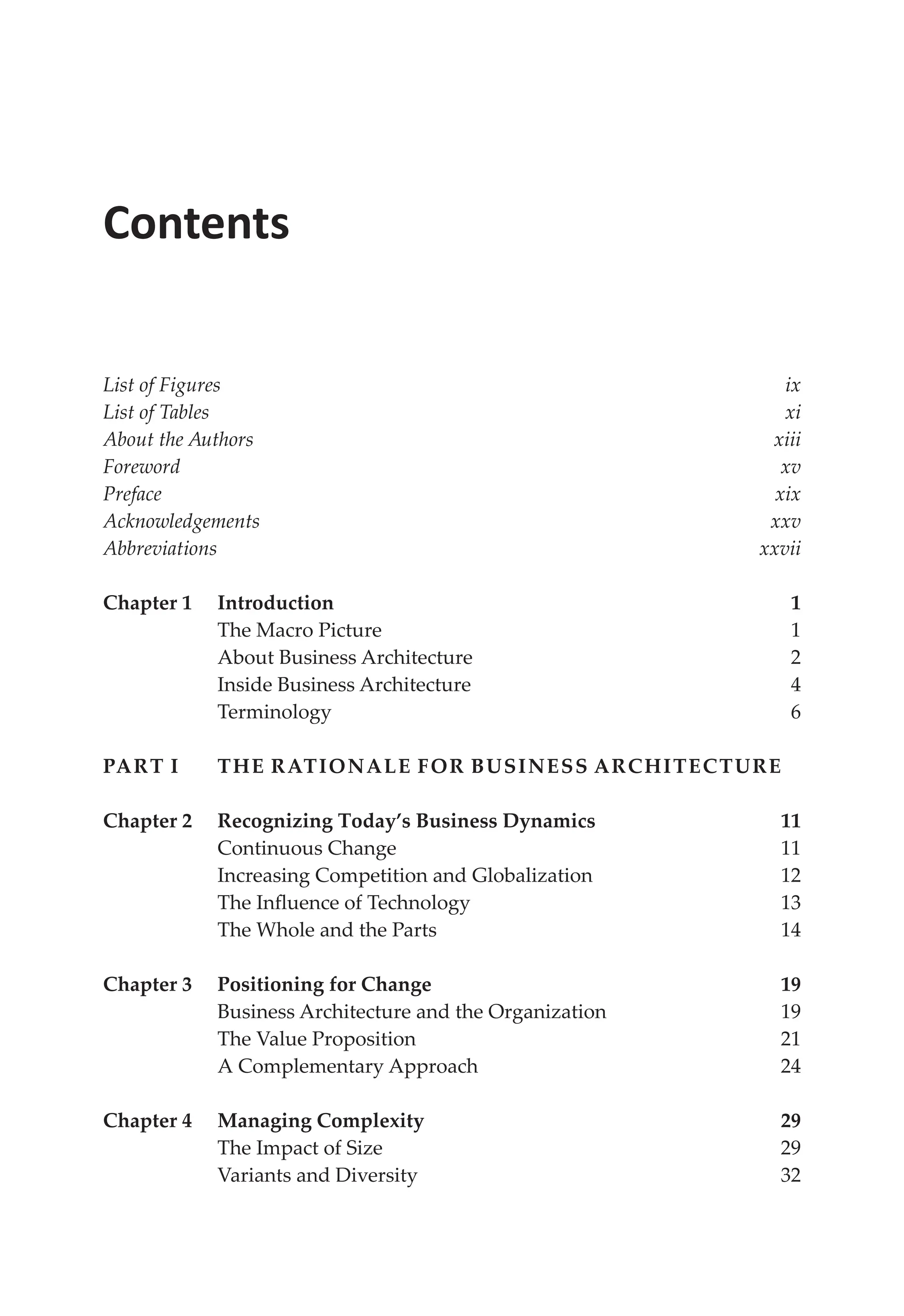
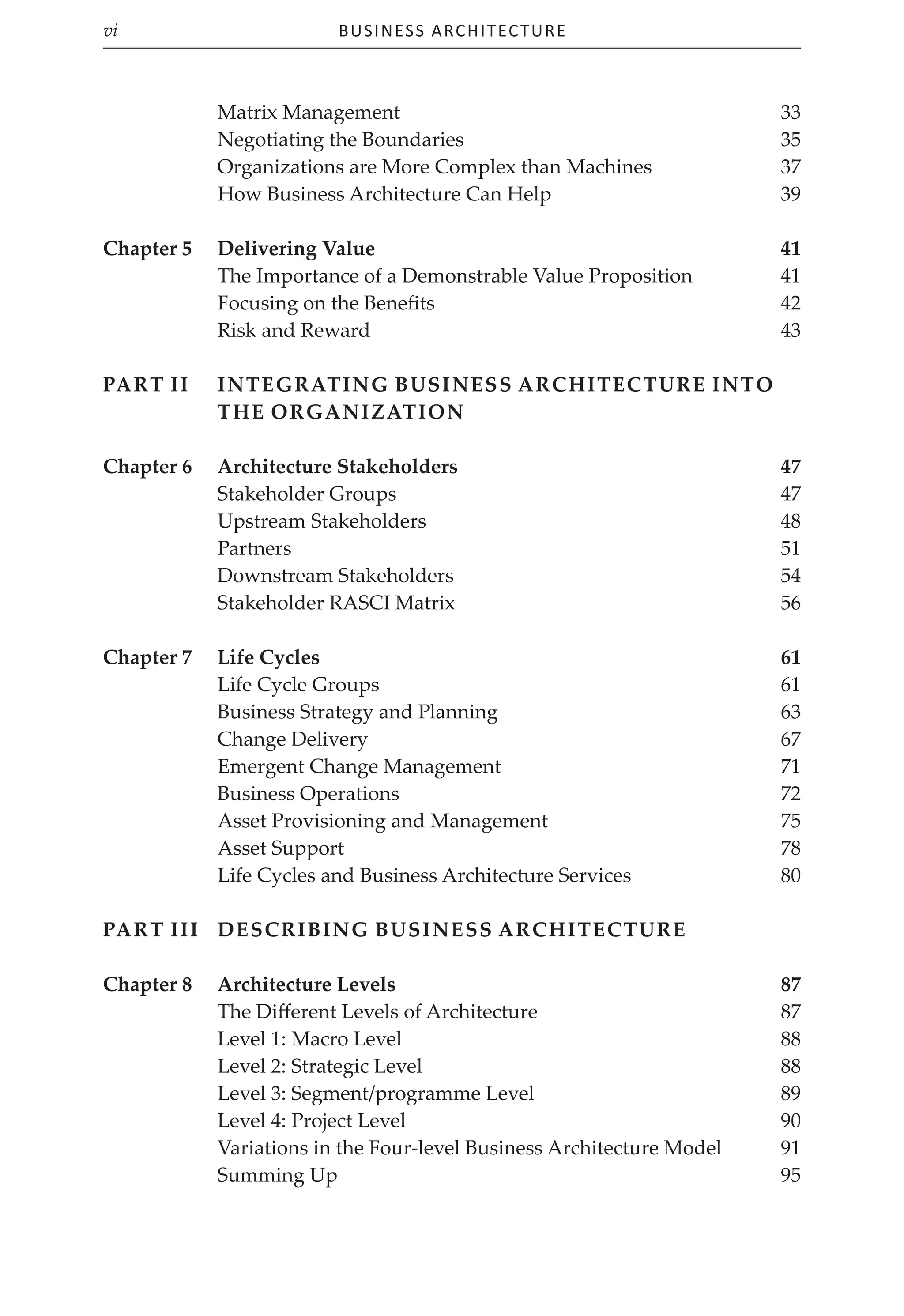
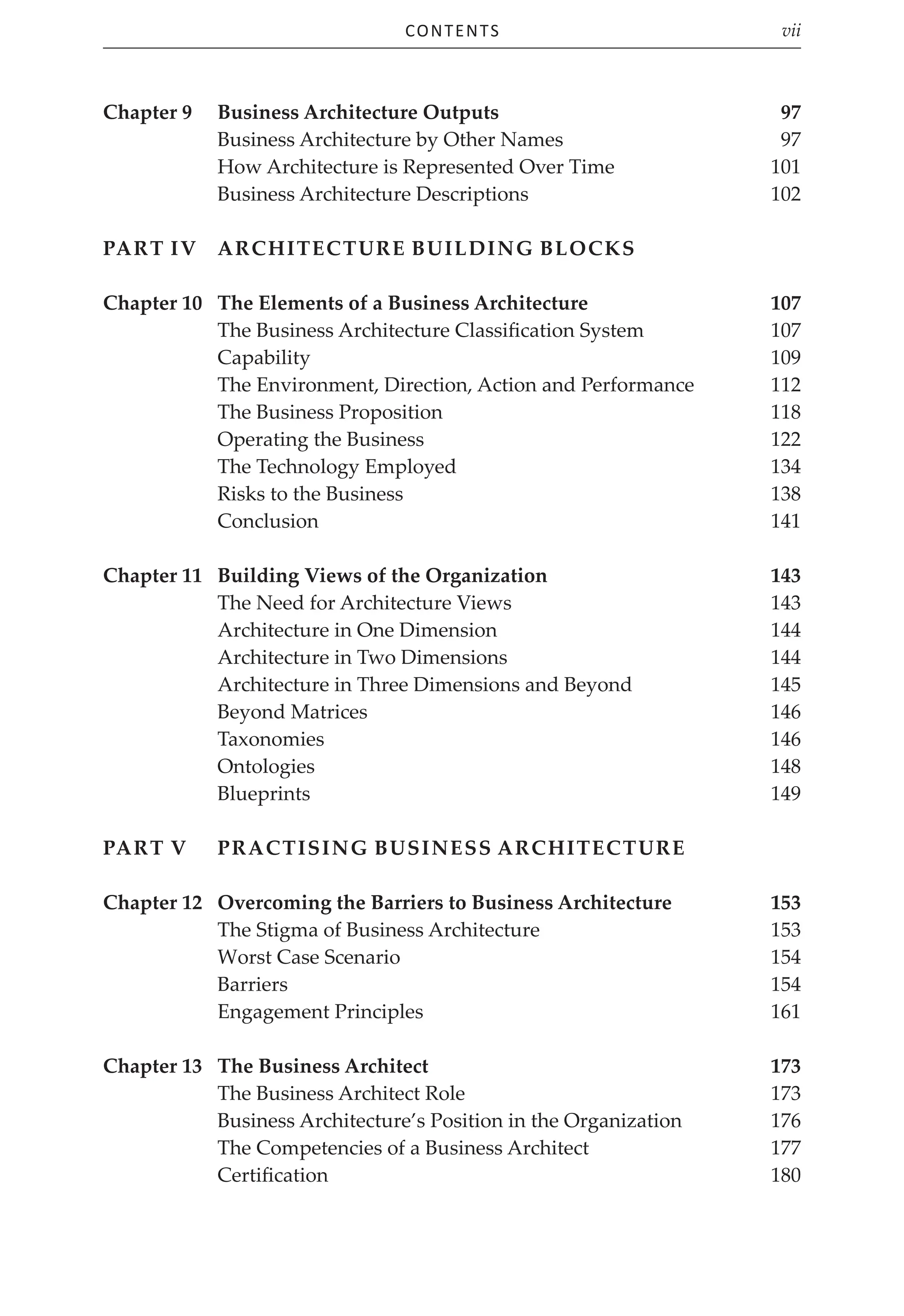
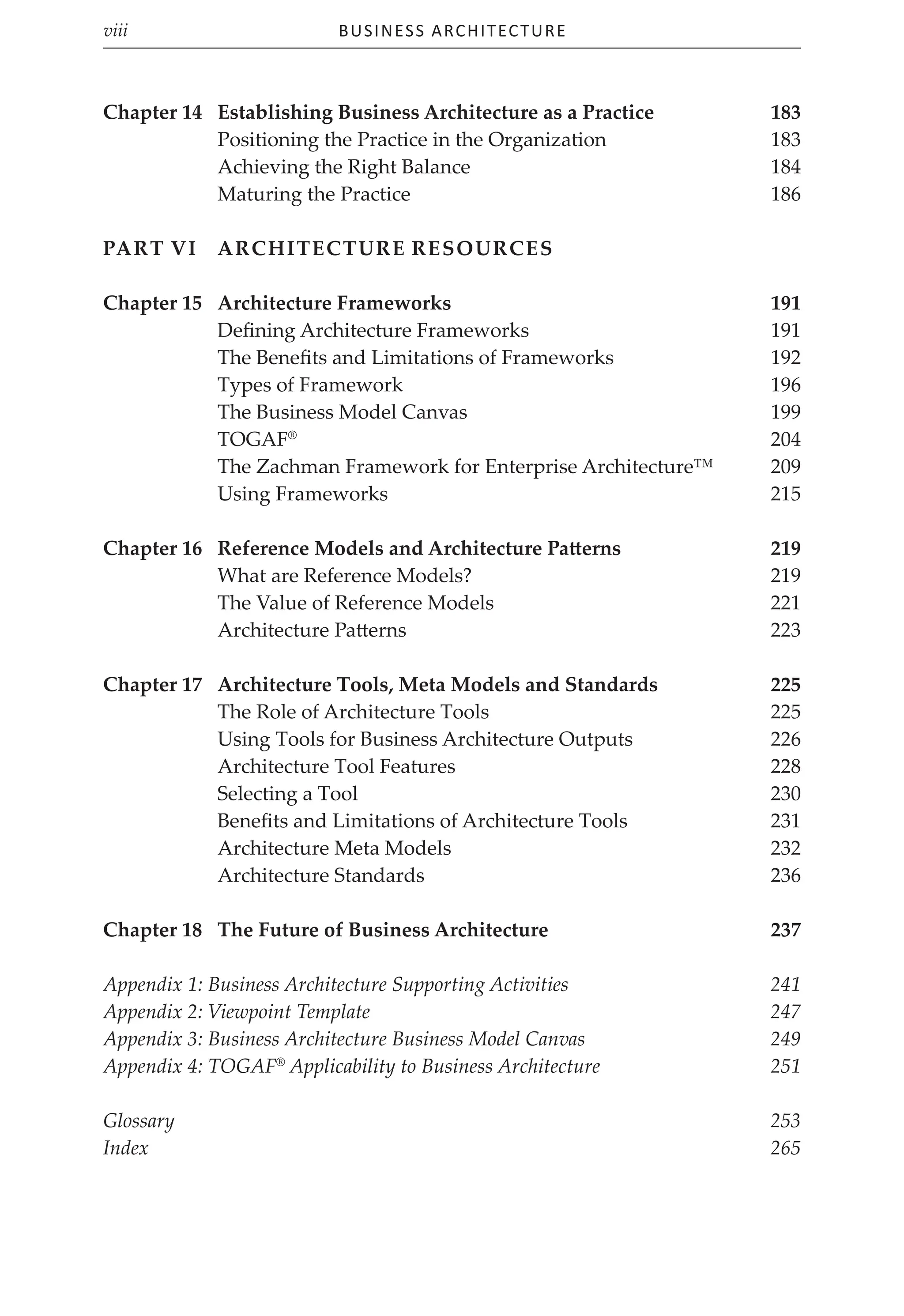
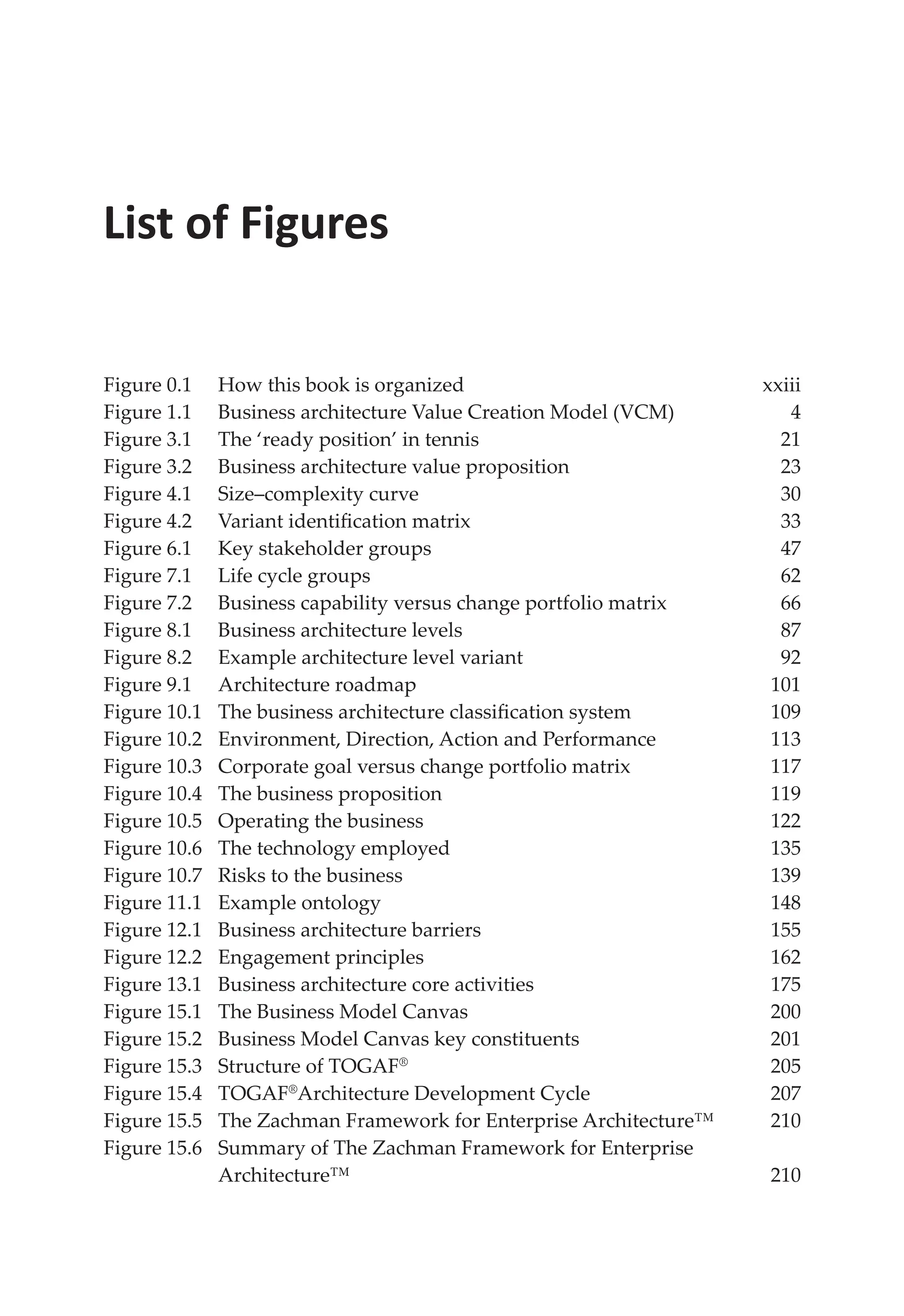
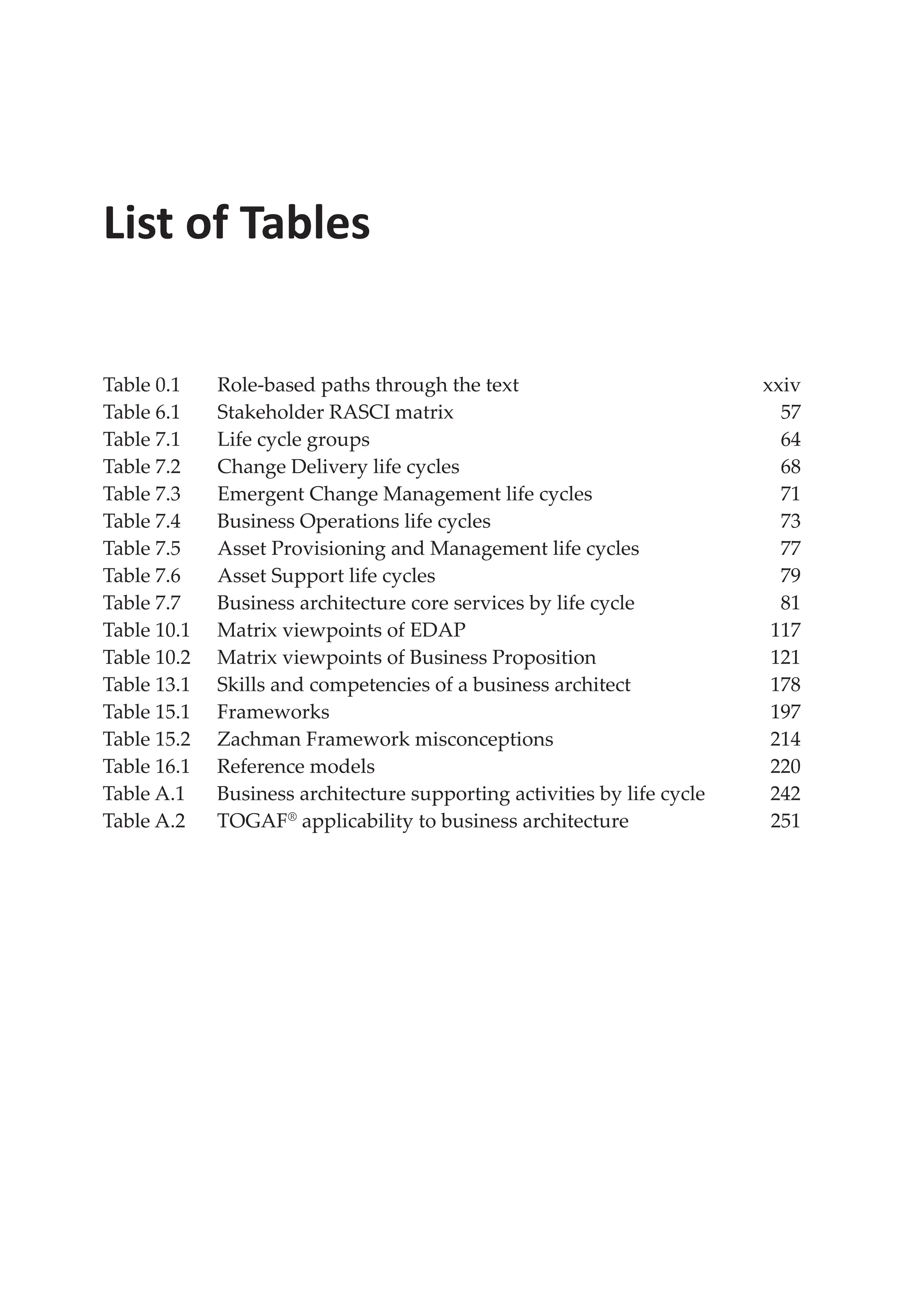

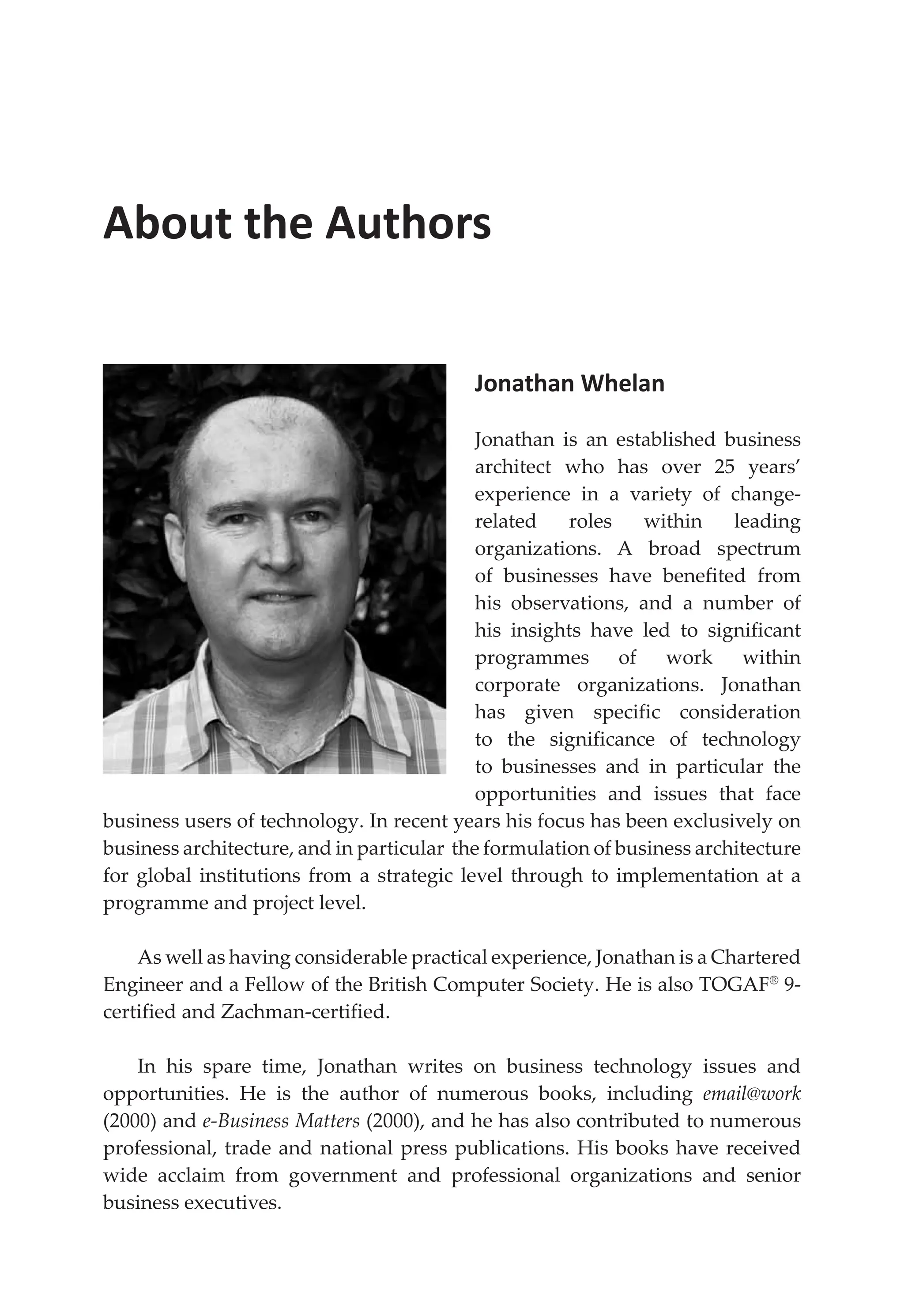
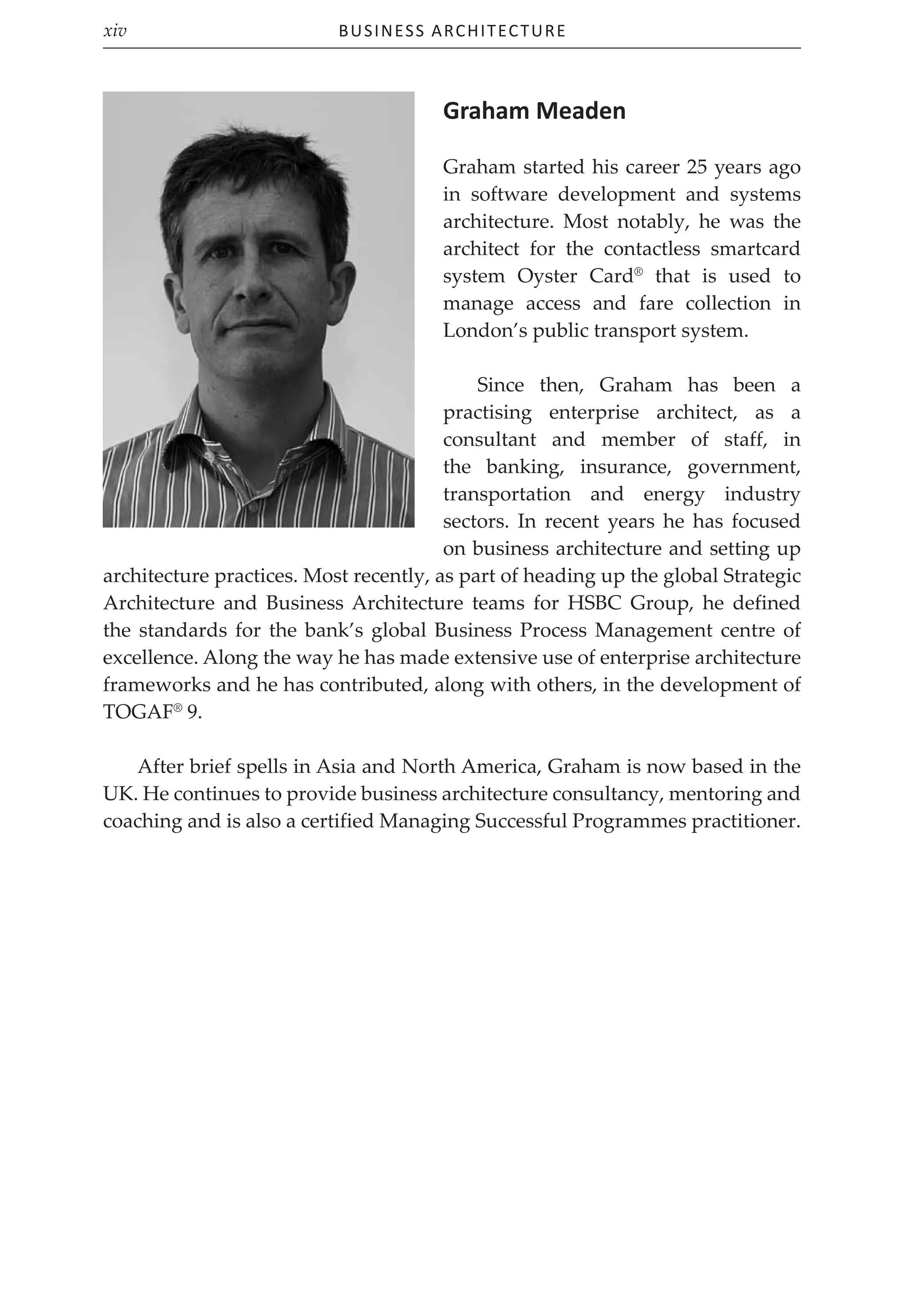
![Business Architecture
xviii
The delivery of an architecture doesn’t bring any direct benefit in its
own right. Business architecture is not a solution, it is a tool. In the
right hands it becomes an asset of strategic value to the organization.
If business architecture becomes a solution, it is only good for one point in time.
Ifitisatool,itisthemostvaluableassettheenterpriseowns–theknowledgebase
of the enterprise that accommodates extreme complexity and forms the basis
for change. That is what is needed to survive in the Information Age. If you
have no idea how something works at the level of definition required to make
actual changes to it, what are you going to change and how are you going
to change it? ‘In the right hands [business architecture] becomes an asset of
strategic value to the organization.’
I hope every business architect reads this book. In fact, I hope that every
CEO who so enjoys Jack Welch’s books will read this book! To repeat the quote
from Rakesh Khurana, whatever happened to ‘the willingness of a CEO to
forgo dividends and make an investment that wouldn’t be realized until one or
two CEOs down the road’?
This is not to say there are no benefits to be realized from business
architecture in the short term – there are plenty of benefits. But somebody
better start thinking about business architecture as a tool for the future, or there
is not likely to be a future!
Business Architecture: A Practical Guide – the time has come.
Thank you, Graham and Jonathan.
John A. Zachman
Glendale, California](https://image.slidesharecdn.com/21841176-250526193830-11f43699/75/Business-Architecture-A-Practical-Guide-1st-Edition-Jonathan-Whelan-23-2048.jpg)
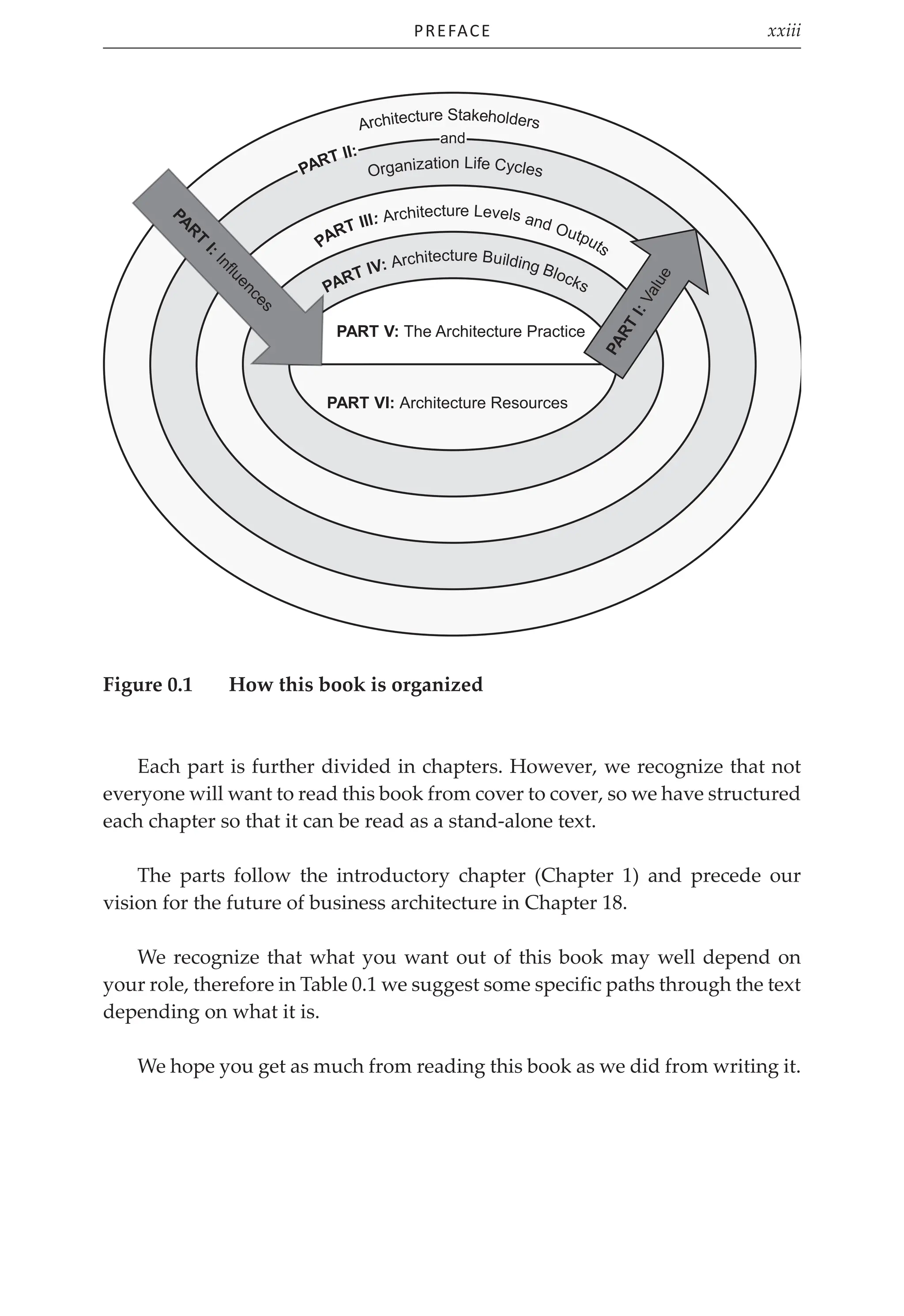
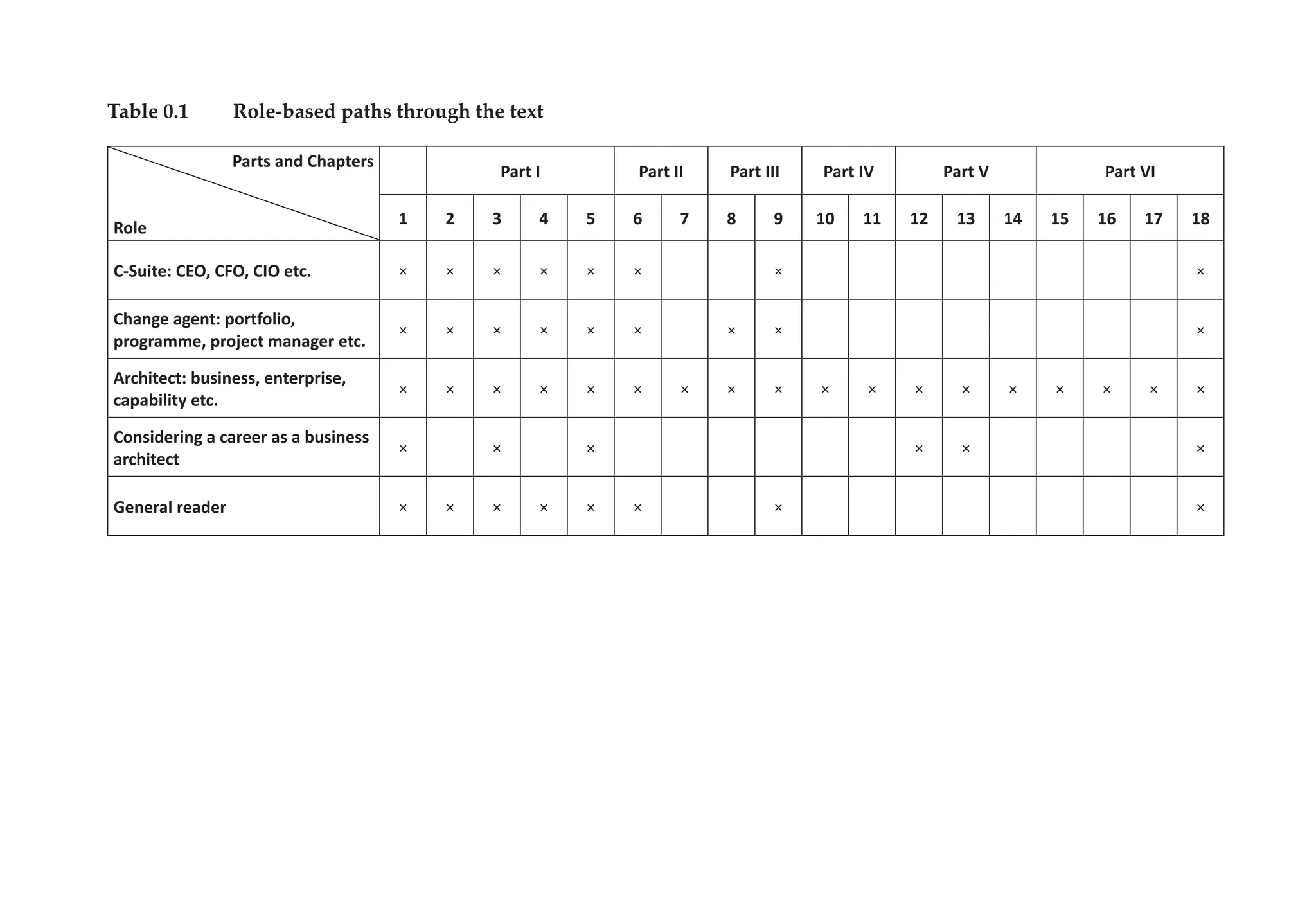
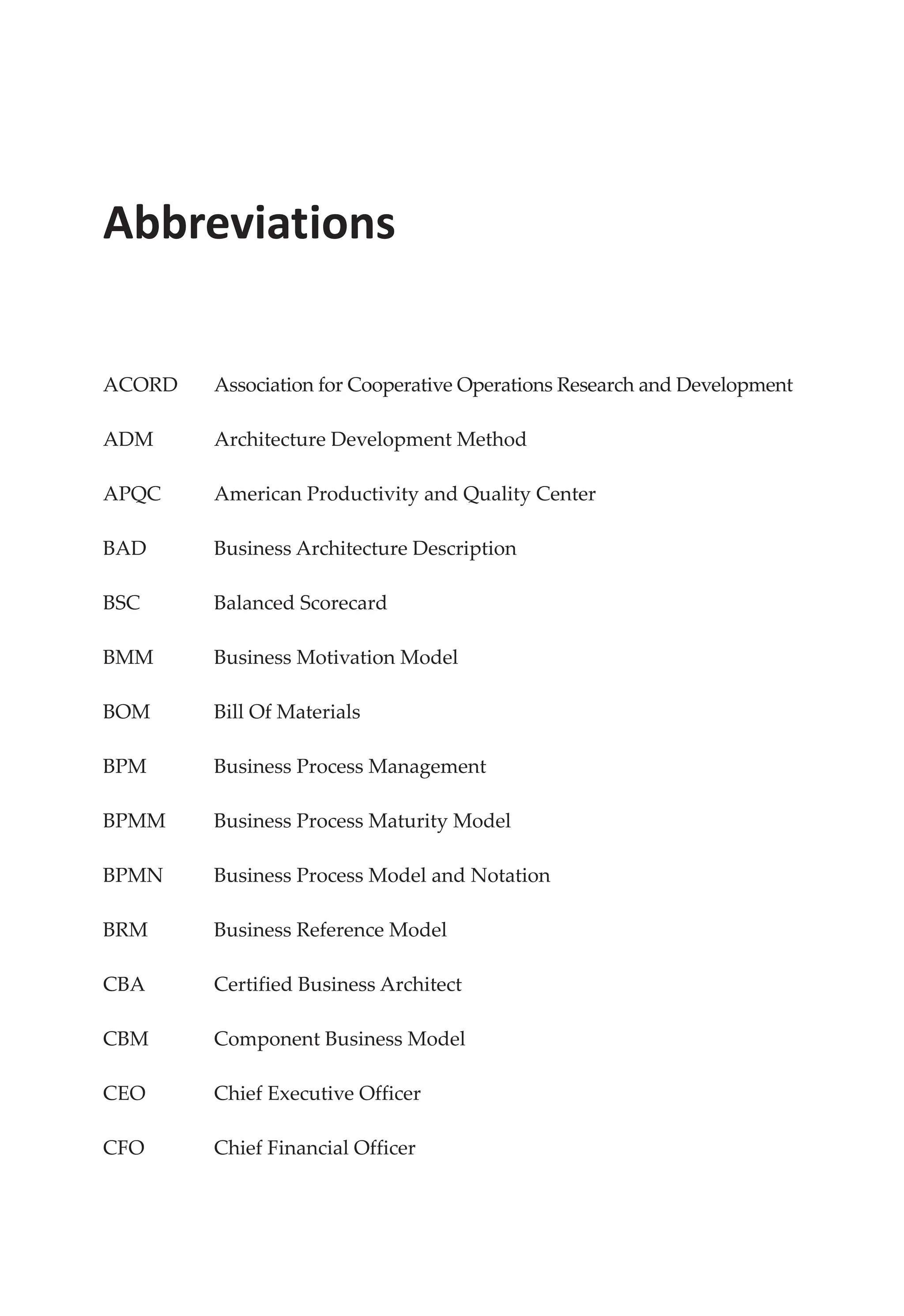
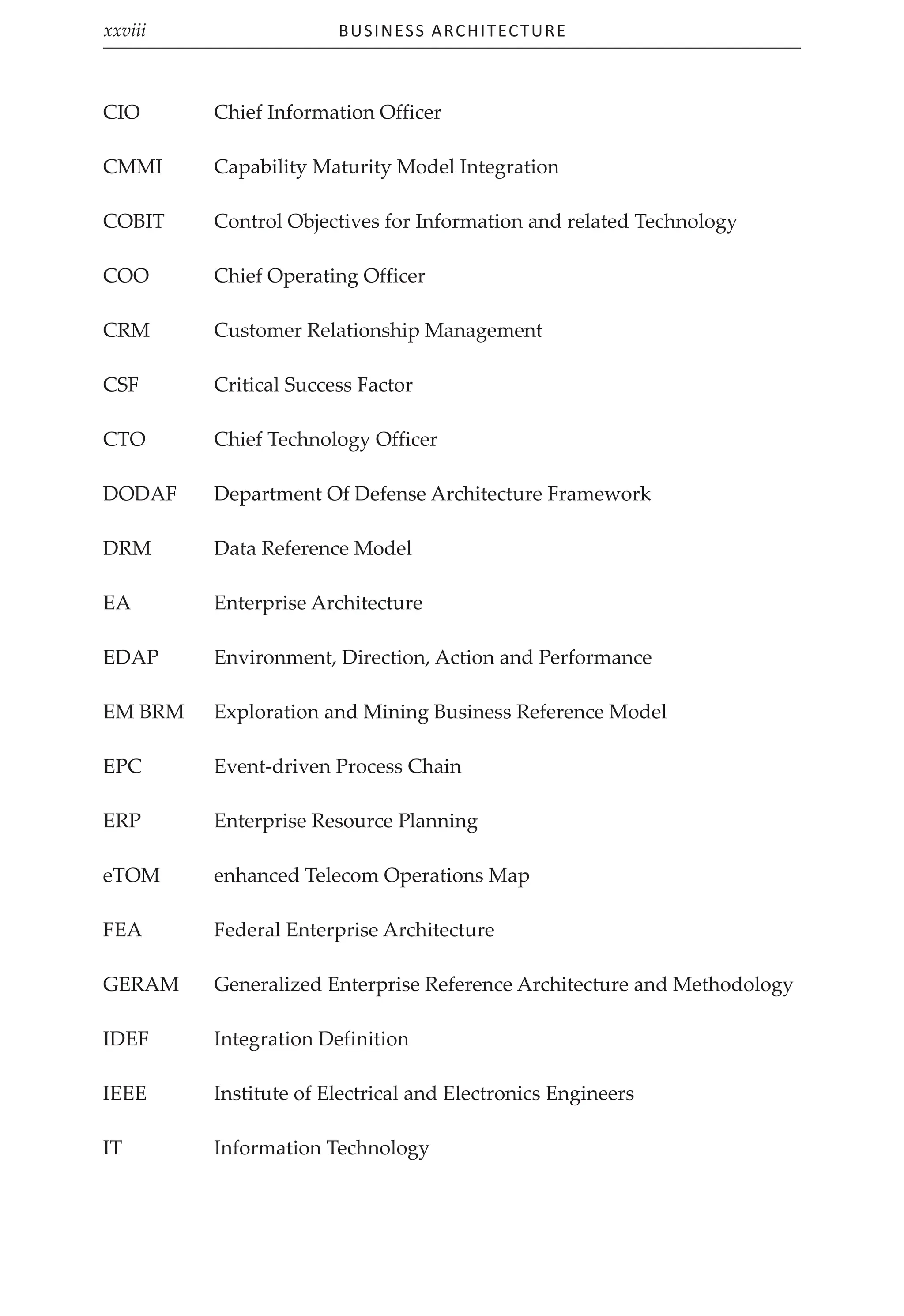
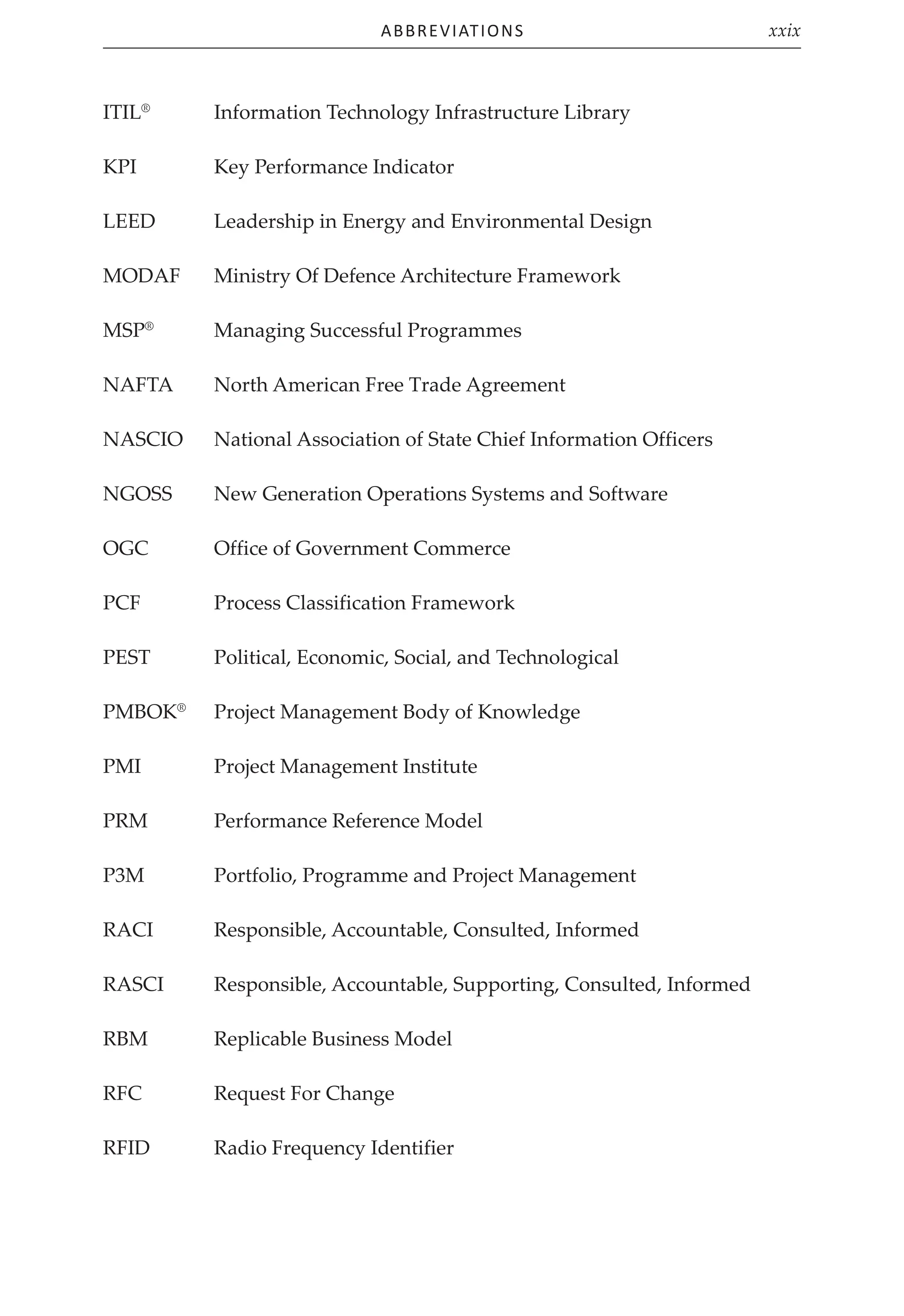
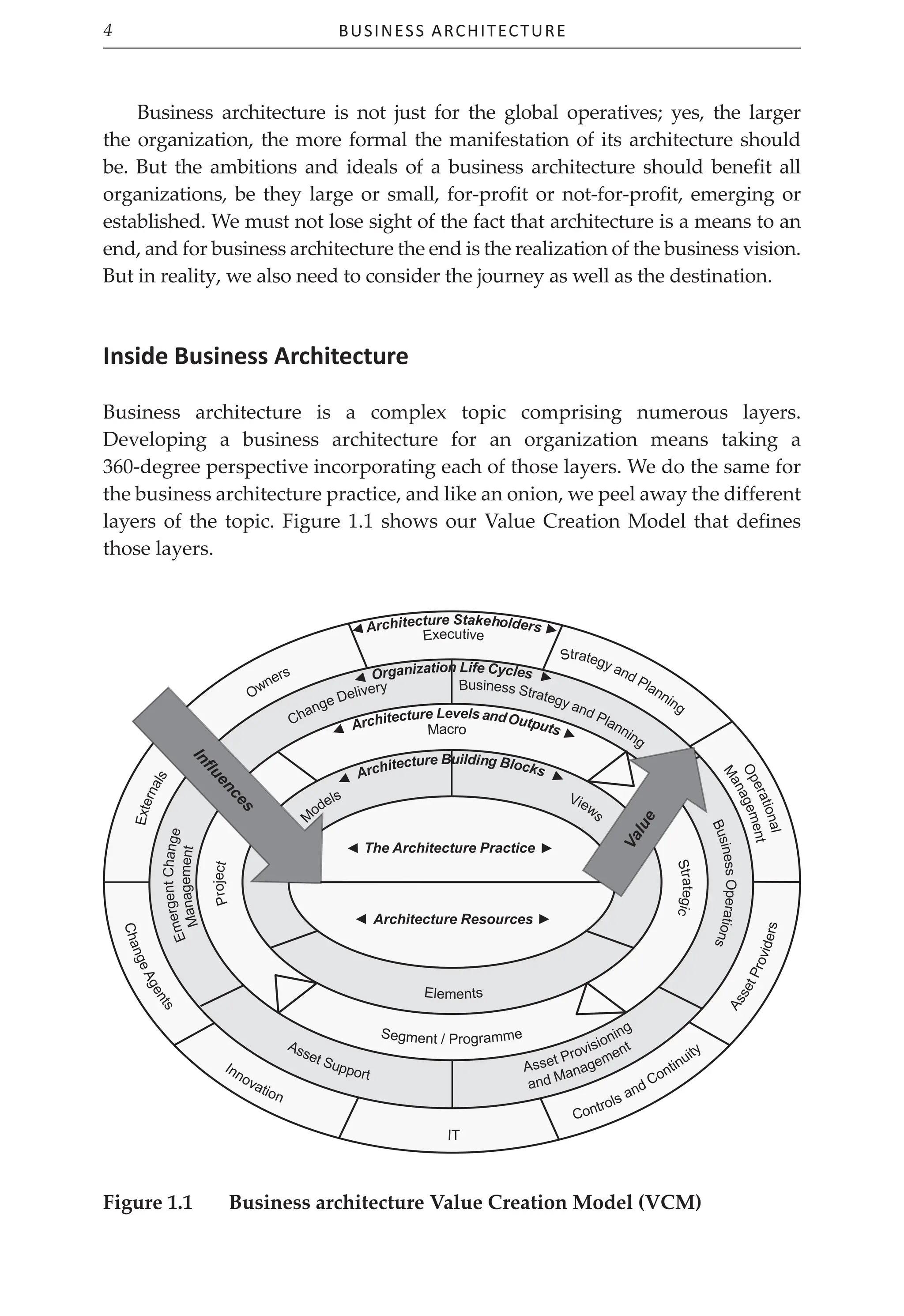

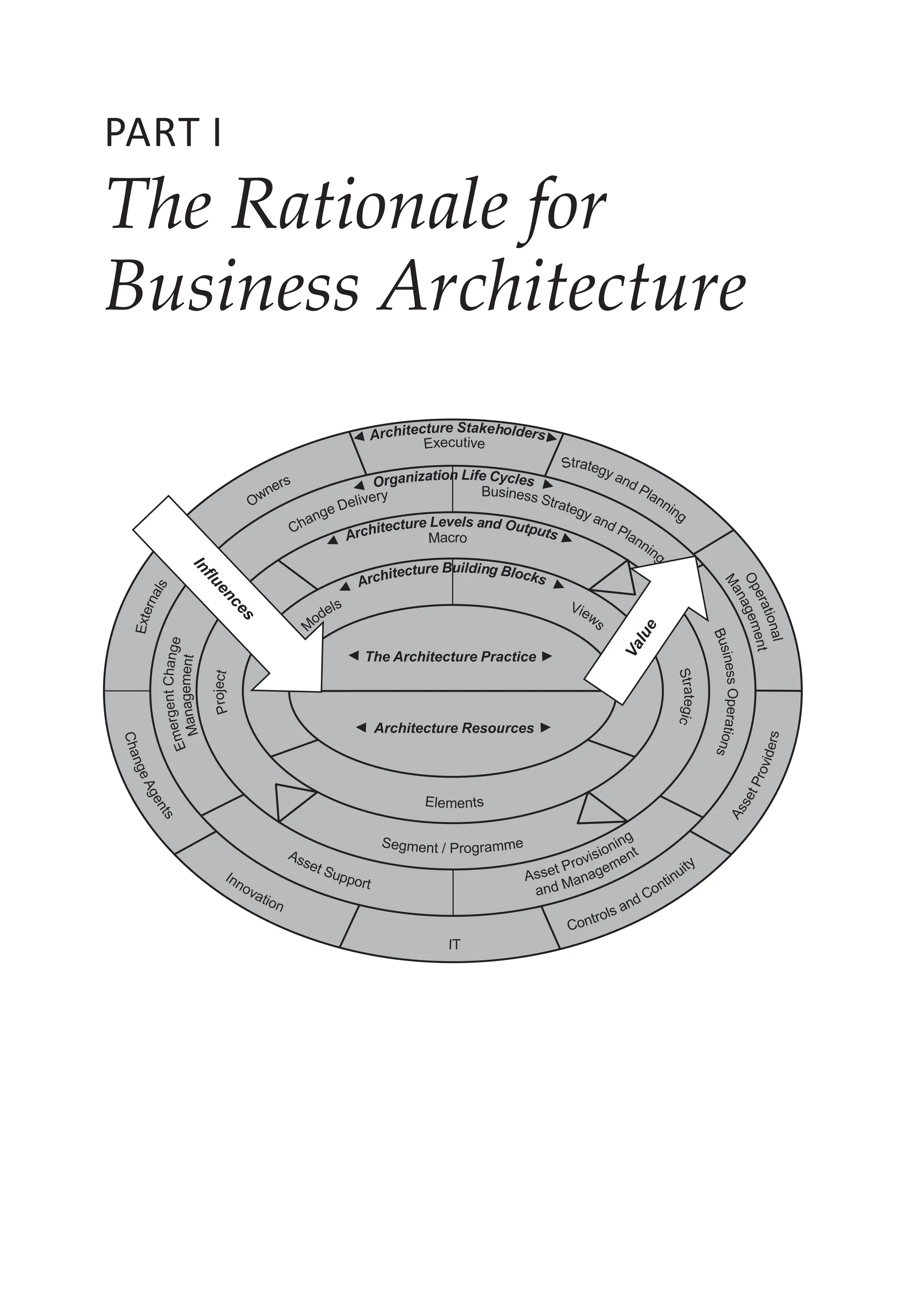



![have pity upon me! What have I done to deserve such wretchedness? I love
you, I adore you, my Victor; have pity upon me. Kill me with one blow, but
do not let me suffer as many eternities as there are minutes in every one of
your absences.
What am I saying? I am delirious, feverish. Oh God, have mercy on me!
Juliette.
November 4th, 8.30 p.m. (1834).
Yes, you are my support, the stable earth beneath my feet, my hope, my
joy, my happiness, my all! I do not know how these halting words of mine
can be expected to convey my thoughts to your mind, but this indeed is
truly and sincerely meant: that you are to me the noblest, most sincere, most
generous of men. I believe this, and have absolute confidence in your power
to frustrate the evil fate which holds me in its grip.
My dearly beloved, you were quite charming just now, and you are
perfectly right when you say that there is an element of vanity in your
nobility of conduct; for nothing could be more becoming than the elegant
and dignified manner in which you raised me just now from my knees. You
were really great. You were a king!
My darling little Toto, chéri! I am going to bed now, because I am not
certain that you will come early enough to take me out; and, after all, you
are not the sort of man to be scandalised by finding a woman in bed,
especially ...
Juliette.
1834.
My dearly Beloved,
I am always wishing I were a great actress, because, if my soul and
intellect were equal to yours, another link would be forged between us; but I
wish it still more at such a time as this, for I should then be able to relieve
you of the annoyance of being at the mercy of an old woman, whose conceit
has made her aggressive.[63]
I need not finish this letter, for here you are!
1835.](https://image.slidesharecdn.com/21841176-250526193830-11f43699/75/Business-Architecture-A-Practical-Guide-1st-Edition-Jonathan-Whelan-58-2048.jpg)
![treachery of Monsieur Harel and Mlle. George, more even than the wicked
animosity of your enemies and the perfidy of your intimate friends against
myself. This silence is proof positive that I am a hindrance to your interests;
you dread my ambition and my jealousy; you had already seen the propriety
of giving a part to Madame Dorval, but you did not dare tell me so, for fear
of encountering resistance and tears from me at this new distribution. You
have only partially averted these. I will not attempt to thwart you, on the
contrary; as for my tears, they are not worth wiping away, nor even
restraining.[64] From this very night we cease our communion of dramatic
interests. I go back to the position I ought never to have left: that of a hack
actress, who is given any part, and badly paid at that. You resume your
liberty without any impediment.
Let us hope this new resolution will conduce to our greater happiness.
Juliette.
Tuesday, April 28th, 1835.
Four hours before the production of “Angélo.”
This is just to remind you of my love, and that it will only be purified
and augmented by the ill-luck and perfidy to which you are more exposed
than others, my noble poet, my king—king, indeed, of us all, though lover
only of me: is that not so? I have nothing to fear from you, have I, my
darling? You will take care of yourself and resist the advances of that
shameless woman. Promise me this. I would not allude to it to-day, only I
feel so uneasy at the thought of your spending the whole evening in her
society, that I would give my life to prevent it. If you understood the
greatness and quality of my love, you would appreciate my alarm.
Think of poor me, sitting at the back of a box to-night, enduring all the
anguish of jealousy and love.
Juliette.
Madame Pierceau came at one o’clock, leaving Monsieur Verdier in a
cab below. He was desperate at the loss of his stall, which, he hears, was
taken from him by your orders. As I did not know what to say about it, I
advised Madame Pierceau to send him to you. Monsieur Pasquier, as I
anticipated, has not taken Madame Récamier’s box. I wonder what you
have done with it. Did it reach you in time?](https://image.slidesharecdn.com/21841176-250526193830-11f43699/75/Business-Architecture-A-Practical-Guide-1st-Edition-Jonathan-Whelan-61-2048.jpg)