






{	
From  Good  To  Great	
Be  Positive  and  Develop  your  EQ
                       BE  POSITIVE  
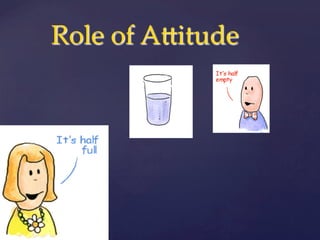
Role  of  ABitude
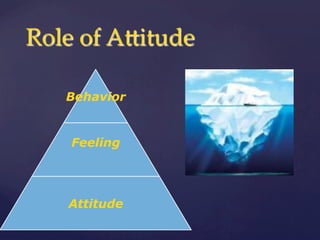
Role  of  ABitude	
Behavior
Feeling
Attitude
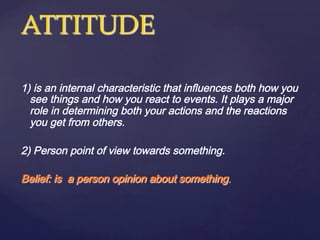
ATTITUDE    
	
1) is an internal characteristic that influences both how you
see things and how you react to events. It plays a major
role in determining both your actions and the reactions
you get from others.
2) Person point of view towards something.
Belief: is a person opinion about something.
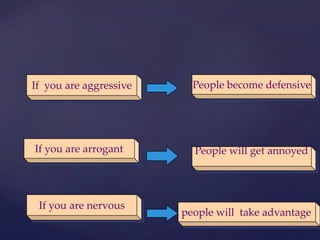
SO  AS  YOU  GIVE  AS  YOU  GET  
If    you  are  aggressive	
If  you  are  arrogant	
If  you  are  nervous	
People  become  defensive	
People  will  get  annoyed	
people  will    take  advantage.
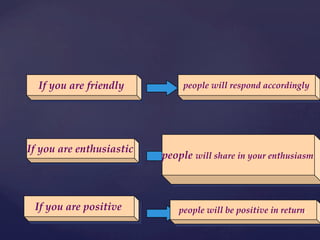
If  you  are  friendly	
If  you  are  enthusiastic	
If  you  are  positive	
people  will  respond  accordingly	
people  will  share  in  your  enthusiasm	
people  will  be  positive  in  return.
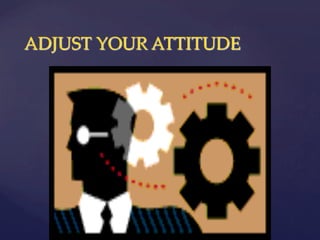
ADJUST  YOUR  ATTITUDE    
If    You  Are  Positive  You  
Become  Emotionally  Intelligent  
In  Return
12
Do  you  know?	
People  with  higher  levels  of	
Emotional  intelligence......	
• Make  beBer  and  faster	
decisions.
13
• Are  generally  more  effective	
  in  their  roles.	
• And  are  less  likely  to	
  be  derailed  in  their	
  careers.
14
The  analysis  revealed,	
People  with  strong  EQ  were  more  
likely  to	
succeed  than  those  who  were  
strongest  in  IQ.
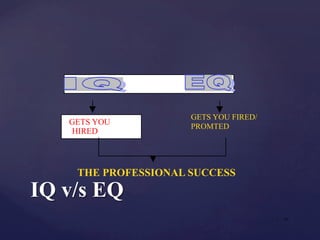
IQ v/s EQ
| 15
GETS YOU
HIRED
THE PROFESSIONAL SUCCESS
Th
e
im
ag
e
The image cannot be displayed. Your
computer may not have enough
memory to open the image, or the
image may have been corrupted.
Restart your computer, and then open
the file again. If the red x still appears,
The image
cannot be
displayed.
Your
computer
may not
The image cannot
be displayed. Your
computer may not
have enough
memory to open
the image, or the
image may have
GETS YOU FIRED/
PROMTED
IQ v/s EQ
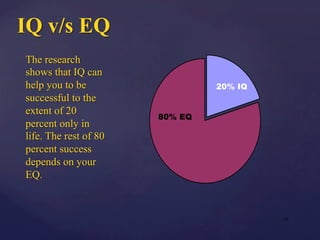
The research
shows that IQ can
help you to be
successful to the
extent of 20
percent only in
life. The rest of 80
percent success
depends on your
EQ.
| 16
80% EQ
20% IQ
“Anyone can be angry—that is easy. But to be
angry with the right person, to the right
degree, at the right time, for the right
purpose, and in the right way — that is not
easy.”
| 17
What  Does  EQ  mean  ?
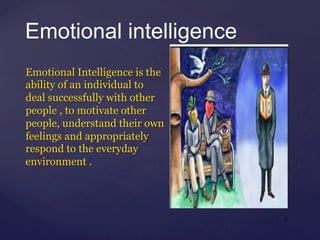
Emotional intelligence
Emotional Intelligence is the
ability of an individual to
deal successfully with other
people , to motivate other
people, understand their own
feelings and appropriately
respond to the everyday
environment .
| 19
20
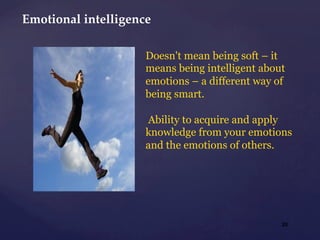
Doesn't mean being soft – it
means being intelligent about
emotions – a different way of
being smart.
Ability to acquire and apply
knowledge from your emotions
and the emotions of others.	
Emotional  intelligence
Characteristics of a High EQ Person
Ñ  A time to wait and a time to watch,
Ñ  A time to be aggressive and a time to be passive,
Ñ  A time to be together and a time to be alone,
Ñ  A time to fight and a time to love,
Ñ  A time to work and a time to play,
Ñ  A time to cry and a time to laugh,
Ñ  A time to speak and a time to be silent,
Ñ  A time to be patient and a time to decide.
| 21
Characteristics of a low EQ Person
“If only I had a different job … …”
“If only I had finished graduation … …”
“If only I had been handsome/beautiful …”
“If only my spouse had stopped drinking …”
“If only I had been born rich and famous…”
“If only I had good contacts…”
“If only I had better friends …”
“If only I had married someone else …” | 22
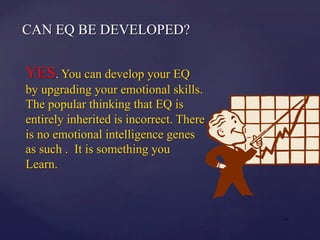
CAN EQ BE DEVELOPED?
YES. You can develop your EQ
by upgrading your emotional skills.
The popular thinking that EQ is
entirely inherited is incorrect. There
is no emotional intelligence genes
as such . It is something you
Learn.
| 23
   11  Steps  To  Develop  Your  EQ
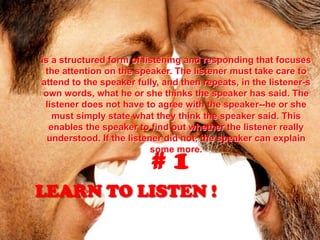
LEARN TO LISTEN !
is a structured form of listening and responding that focuses
the attention on the speaker. The listener must take care to
attend to the speaker fully, and then repeats, in the listener-s
own words, what he or she thinks the speaker has said. The
listener does not have to agree with the speaker--he or she
must simply state what they think the speaker said. This
enables the speaker to find out whether the listener really
understood. If the listener did not, the speaker can explain
some more.
# 1
Membaca situasi
Dengan memperhatikan lingkungan
sekitar, kita akan mampu
mengetahui situasi sebenarnya dan
mengetahui apa yang sebenarnya
terjadi sehingga mampu mengambil
keputusan dengan emosi yang
terkendali.
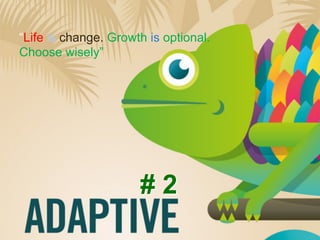
“Life is change. Growth is optional.
Choose wisely”
# 2
NEVER GIVE UP !
"Our greatest glory is not in never failing,
but in rising up every time we fail".
- Ralph Waldo Emerson -
# 3
komunikasi
Ñ Komunikasi à jalan keluar
untuk menyelesaikan masalah
Dengan membiasakan
mengkomunikasikan masalah
dengan baik, dapat
meningkatkan kecerdasan
emosi dan menghindarikan dari
kesalah pahaman yang tidak
penting
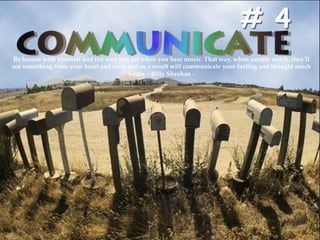
Be  honest  with  yourself  and  the  way  you  act  when  you  hear  music.  That  way,  when  people  watch,  they'ʹll  
see  something  from  your  heart  and  soul,  and  as  a  result  will  communicate  your  feeling  and  thought  much  
be?er.  -­‐‑  Billy  Sheehan  -­‐‑  	
# 4
Emphaty to Others
Ability with many different definitions. They cover a broad
spectrum, ranging from caring for other people and having a
desire to help them, to experiencing emotions that match
another person's emotions, to knowing what the other person
is thinking or feeling, to blurring the line between self and
other.
Hodges, S.D., & Klein, K.J. (2001)
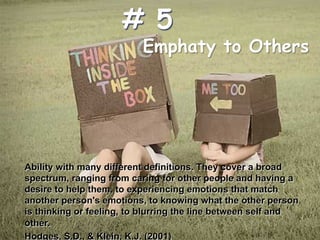
# 5
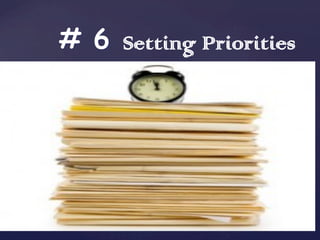
# 6 Setting Priorities
Berpikiran positif
# 7
“Give the world the best that you have, and the best will come back
to you.”
- Madeline Bridges
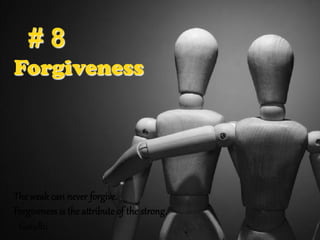
Forgiveness
# 8
The  weak  can  never  forgive.    
Forgiveness  is  the  a45ibute  of  the  st5ong.    
-­‐  Gandhi  
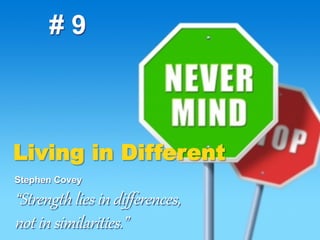
Living in Different
# 9
Stephen Covey
“St$eng(h  lies  in  differences,  
not  in  similarities.”  
Keep Smile
# 10
If  at  times  you  feel  you  want  to  cry,    
And  life  seems  such  a  trial;    
Above  the  clouds  there'ʹs  a  bright  blue  sky,    
So  make  your  tears  a  smile.	
As  you  travel  on  life'ʹs  way,    
With  its  many  ups  and  downs;    
Remember  its  quite  true  to  say,    
One  smile  is  worth  a  dozen  frowns.	
Among  the  world'ʹs  expensive  things,    
A  smile  is  very  cheap;    
And  when  you  give  a  smile  away,    
You  get  one  back  to  keep.  	
Happiness  comes  at  times  to  all,    
But  sadness  comes  unbidden;    
And  sometimes  a  few  tears  must  fall,    
Among  the  laughter  hidden.  	
So  when  friends  have  sadness  on  their  face,    
And  troubles  round  them  piled;    
The  world  will  seem  a  be?er  place,    
And  all  because  you  smiled!    
  
~  Author  Unknown  ~  
11#
From good to great
From good to great

From good to great

  • 1.
    { From  Good  To Great Be  Positive  and  Develop  your  EQ
  • 2.
                          BE  POSITIVE  
  • 3.
  • 4.
  • 5.
    ATTITUDE     1)is an internal characteristic that influences both how you see things and how you react to events. It plays a major role in determining both your actions and the reactions you get from others. 2) Person point of view towards something. Belief: is a person opinion about something.
  • 6.
    SO  AS  YOU GIVE  AS  YOU  GET  
  • 7.
    If    you are  aggressive If  you  are  arrogant If  you  are  nervous People  become  defensive People  will  get  annoyed people  will    take  advantage.
  • 8.
    If  you  are friendly If  you  are  enthusiastic If  you  are  positive people  will  respond  accordingly people  will  share  in  your  enthusiasm people  will  be  positive  in  return.
  • 9.
  • 11.
    If    You Are  Positive  You   Become  Emotionally  Intelligent   In  Return
  • 12.
    12 Do  you  know? People with  higher  levels  of Emotional  intelligence...... • Make  beBer  and  faster decisions.
  • 13.
    13 • Are  generally  more effective  in  their  roles. • And  are  less  likely  to  be  derailed  in  their  careers.
  • 14.
    14 The  analysis  revealed, People with  strong  EQ  were  more   likely  to succeed  than  those  who  were   strongest  in  IQ.
  • 15.
    IQ v/s EQ |15 GETS YOU HIRED THE PROFESSIONAL SUCCESS Th e im ag e The image cannot be displayed. Your computer may not have enough memory to open the image, or the image may have been corrupted. Restart your computer, and then open the file again. If the red x still appears, The image cannot be displayed. Your computer may not The image cannot be displayed. Your computer may not have enough memory to open the image, or the image may have GETS YOU FIRED/ PROMTED
  • 16.
    IQ v/s EQ Theresearch shows that IQ can help you to be successful to the extent of 20 percent only in life. The rest of 80 percent success depends on your EQ. | 16 80% EQ 20% IQ
  • 17.
    “Anyone can beangry—that is easy. But to be angry with the right person, to the right degree, at the right time, for the right purpose, and in the right way — that is not easy.” | 17
  • 18.
    What  Does  EQ mean  ?
  • 19.
    Emotional intelligence Emotional Intelligenceis the ability of an individual to deal successfully with other people , to motivate other people, understand their own feelings and appropriately respond to the everyday environment . | 19
  • 20.
    20 Doesn't mean beingsoft – it means being intelligent about emotions – a different way of being smart. Ability to acquire and apply knowledge from your emotions and the emotions of others. Emotional  intelligence
  • 21.
    Characteristics of aHigh EQ Person Ñ  A time to wait and a time to watch, Ñ  A time to be aggressive and a time to be passive, Ñ  A time to be together and a time to be alone, Ñ  A time to fight and a time to love, Ñ  A time to work and a time to play, Ñ  A time to cry and a time to laugh, Ñ  A time to speak and a time to be silent, Ñ  A time to be patient and a time to decide. | 21
  • 22.
    Characteristics of alow EQ Person “If only I had a different job … …” “If only I had finished graduation … …” “If only I had been handsome/beautiful …” “If only my spouse had stopped drinking …” “If only I had been born rich and famous…” “If only I had good contacts…” “If only I had better friends …” “If only I had married someone else …” | 22
  • 23.
    CAN EQ BEDEVELOPED? YES. You can develop your EQ by upgrading your emotional skills. The popular thinking that EQ is entirely inherited is incorrect. There is no emotional intelligence genes as such . It is something you Learn. | 23
  • 24.
       11  Steps To  Develop  Your  EQ
  • 25.
    LEARN TO LISTEN! is a structured form of listening and responding that focuses the attention on the speaker. The listener must take care to attend to the speaker fully, and then repeats, in the listener-s own words, what he or she thinks the speaker has said. The listener does not have to agree with the speaker--he or she must simply state what they think the speaker said. This enables the speaker to find out whether the listener really understood. If the listener did not, the speaker can explain some more. # 1
  • 26.
    Membaca situasi Dengan memperhatikanlingkungan sekitar, kita akan mampu mengetahui situasi sebenarnya dan mengetahui apa yang sebenarnya terjadi sehingga mampu mengambil keputusan dengan emosi yang terkendali. “Life is change. Growth is optional. Choose wisely” # 2
  • 27.
    NEVER GIVE UP! "Our greatest glory is not in never failing, but in rising up every time we fail". - Ralph Waldo Emerson - # 3
  • 28.
    komunikasi Ñ Komunikasi à jalankeluar untuk menyelesaikan masalah Dengan membiasakan mengkomunikasikan masalah dengan baik, dapat meningkatkan kecerdasan emosi dan menghindarikan dari kesalah pahaman yang tidak penting Be  honest  with  yourself  and  the  way  you  act  when  you  hear  music.  That  way,  when  people  watch,  they'ʹll   see  something  from  your  heart  and  soul,  and  as  a  result  will  communicate  your  feeling  and  thought  much   be?er.  -­‐‑  Billy  Sheehan  -­‐‑   # 4
  • 29.
    Emphaty to Others Abilitywith many different definitions. They cover a broad spectrum, ranging from caring for other people and having a desire to help them, to experiencing emotions that match another person's emotions, to knowing what the other person is thinking or feeling, to blurring the line between self and other. Hodges, S.D., & Klein, K.J. (2001) # 5
  • 30.
    # 6 SettingPriorities
  • 31.
    Berpikiran positif # 7 “Givethe world the best that you have, and the best will come back to you.” - Madeline Bridges
  • 32.
    Forgiveness # 8 The  weak can  never  forgive.     Forgiveness  is  the  a45ibute  of  the  st5ong.     -­‐  Gandhi  
  • 33.
    Living in Different #9 Stephen Covey “St$eng(h  lies  in  differences,   not  in  similarities.”  
  • 34.
    Keep Smile # 10 If at  times  you  feel  you  want  to  cry,     And  life  seems  such  a  trial;     Above  the  clouds  there'ʹs  a  bright  blue  sky,     So  make  your  tears  a  smile. As  you  travel  on  life'ʹs  way,     With  its  many  ups  and  downs;     Remember  its  quite  true  to  say,     One  smile  is  worth  a  dozen  frowns. Among  the  world'ʹs  expensive  things,     A  smile  is  very  cheap;     And  when  you  give  a  smile  away,     You  get  one  back  to  keep.   Happiness  comes  at  times  to  all,     But  sadness  comes  unbidden;     And  sometimes  a  few  tears  must  fall,     Among  the  laughter  hidden.   So  when  friends  have  sadness  on  their  face,     And  troubles  round  them  piled;     The  world  will  seem  a  be?er  place,     And  all  because  you  smiled!       ~  Author  Unknown  ~  
  • 35.