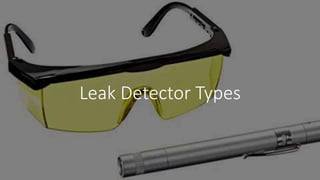
Leak Detector Types
Types of Leak
Detectors
Many different leak detectors are available
to find the refrigerant leaks:
Electronic leak detectors
Fluorescent dye
Ultrasonic Testers
Halide Gas Torch
Electronic leak
detectors
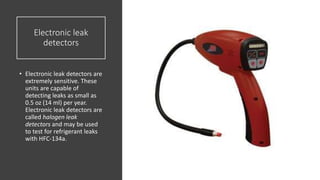
• Electronic leak detectors are
extremely sensitive. These
units are capable of
detecting leaks as small as
0.5 oz (14 ml) per year.
Electronic leak detectors are
called halogen leak
detectors and may be used
to test for refrigerant leaks
with HFC-134a.
Fluorescent dye
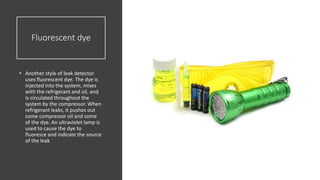
• Another style of leak detector
uses fluorescent dye. The dye is
injected into the system, mixes
with the refrigerant and oil, and
is circulated throughout the
system by the compressor. When
refrigerant leaks, it pushes out
some compressor oil and some
of the dye. An ultraviolet lamp is
used to cause the dye to
fluoresce and indicate the source
of the leak
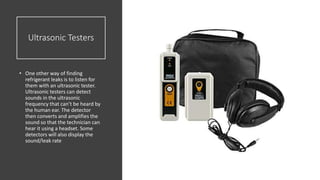
Ultrasonic Testers
• One other way of finding
refrigerant leaks is to listen for
them with an ultrasonic tester.
Ultrasonic testers can detect
sounds in the ultrasonic
frequency that can’t be heard by
the human ear. The detector
then converts and amplifies the
sound so that the technician can
hear it using a headset. Some
detectors will also display the
sound/leak rate
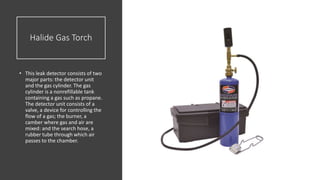
Halide Gas Torch
• This leak detector consists of two
major parts: the detector unit
and the gas cylinder. The gas
cylinder is a nonrefillable tank
containing a gas such as propane.
The detector unit consists of a
valve, a device for controlling the
flow of a gas; the burner, a
camber where gas and air are
mixed: and the search hose, a
rubber tube through which air
passes to the chamber.

Leak detector types

  • 1.
  • 2.
    Types of Leak Detectors Manydifferent leak detectors are available to find the refrigerant leaks: Electronic leak detectors Fluorescent dye Ultrasonic Testers Halide Gas Torch
  • 3.
    Electronic leak detectors • Electronicleak detectors are extremely sensitive. These units are capable of detecting leaks as small as 0.5 oz (14 ml) per year. Electronic leak detectors are called halogen leak detectors and may be used to test for refrigerant leaks with HFC-134a.
  • 4.
    Fluorescent dye • Anotherstyle of leak detector uses fluorescent dye. The dye is injected into the system, mixes with the refrigerant and oil, and is circulated throughout the system by the compressor. When refrigerant leaks, it pushes out some compressor oil and some of the dye. An ultraviolet lamp is used to cause the dye to fluoresce and indicate the source of the leak
  • 5.
    Ultrasonic Testers • Oneother way of finding refrigerant leaks is to listen for them with an ultrasonic tester. Ultrasonic testers can detect sounds in the ultrasonic frequency that can’t be heard by the human ear. The detector then converts and amplifies the sound so that the technician can hear it using a headset. Some detectors will also display the sound/leak rate
  • 6.
    Halide Gas Torch •This leak detector consists of two major parts: the detector unit and the gas cylinder. The gas cylinder is a nonrefillable tank containing a gas such as propane. The detector unit consists of a valve, a device for controlling the flow of a gas; the burner, a camber where gas and air are mixed: and the search hose, a rubber tube through which air passes to the chamber.