Cooling
System
Pressure Test
TESTING THE
COOLING SYSTEM
Pressure testing the cooling system.
A typical hand-operated pressure
tester applies pressure equal to the radiator
cap pressure.
The pressure should hold; if it drops, this
indicates a leak somewhere in the cooling
system. An adapter is used to attach the
pump to the cap to determine if the radiator
can hold pressure, and release it when
pressure rises above
its maximum rated pressure setting.
TESTING THE COOLING SYSTEM
CAUTION: Do not pump up the pressure beyond that
specified by the vehicle manufacturer. Most systems should
not be pressurized beyond
14 psi (100 kPa). If a greater pressure is used, it may cause
the water pump, radiator, heater core, or hoses to fail.
TESTING THE
COOLING SYSTEM
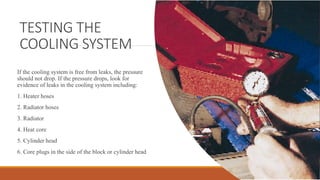
If the cooling system is free from leaks, the pressure
should not drop. If the pressure drops, look for
evidence of leaks in the cooling system including:
1. Heater hoses
2. Radiator hoses
3. Radiator
4. Heat core
5. Cylinder head
6. Core plugs in the side of the block or cylinder head
REFERENCE
Duffy. E. J., (2004) Modern Automotive Technology (6 e.d.). Goodheart-Willcox Co.
Halderman. D. J., (2012) Automotive Technology: Principles, Diagnosis and Service (4th e.d.).
Pearson Education, Inc.,

Cooling system radiator pressure test

  • 1.
  • 2.
    TESTING THE COOLING SYSTEM Pressuretesting the cooling system. A typical hand-operated pressure tester applies pressure equal to the radiator cap pressure. The pressure should hold; if it drops, this indicates a leak somewhere in the cooling system. An adapter is used to attach the pump to the cap to determine if the radiator can hold pressure, and release it when pressure rises above its maximum rated pressure setting.
  • 3.
    TESTING THE COOLINGSYSTEM CAUTION: Do not pump up the pressure beyond that specified by the vehicle manufacturer. Most systems should not be pressurized beyond 14 psi (100 kPa). If a greater pressure is used, it may cause the water pump, radiator, heater core, or hoses to fail.
  • 4.
    TESTING THE COOLING SYSTEM Ifthe cooling system is free from leaks, the pressure should not drop. If the pressure drops, look for evidence of leaks in the cooling system including: 1. Heater hoses 2. Radiator hoses 3. Radiator 4. Heat core 5. Cylinder head 6. Core plugs in the side of the block or cylinder head
  • 5.
    REFERENCE Duffy. E. J.,(2004) Modern Automotive Technology (6 e.d.). Goodheart-Willcox Co. Halderman. D. J., (2012) Automotive Technology: Principles, Diagnosis and Service (4th e.d.). Pearson Education, Inc.,